online | memorias.ioc.fiocruz.br
RFLP analysis of a PCR-amplified fragment of the 16S rRNA gene
as a tool to identify
Enterococcus
strains
EMD Scheidegger1, SAP Fracalanzza1,2, LM Teixeira3, P Cardarelli-Leite1,2/+
1Programa de Pós Graduação em Vigilância Sanitária 2Departamento de Microbiologia, Instituto Nacional de Controle de Qualidade em Saúde-Fiocruz, Av. Brasil 4365, 21045-900 Rio de Janeiro, RJ, Brasil 3Instituto de Microbiologia Professor Paulo de Góes,
Universidade Federal do Rio de Janeiro, Rio de Janeiro, RJ, Brasil
Restriction fragment length polymorphism (RFLP) analysis of a PCR-amplified fragment of the 16S rRNA gene was performed on reference strains belonging to 21 different enterococcal species and on 75 Enterococcus isolates re-covered from poultry meat, pasteurised milk and fresh cheese. PCR amplification generated a 275 bp fragment, which was digested with three restriction endonucleases (DdeI, HaeIII, HinfI). The strains were divided into five groups (groups A-E) on the basis of their restriction patterns. Five biochemical tests (arabinose, arginine, manitol,
methyl-β-D-glucopyranoside and raffinose) were then performed in addition to RFLP analysis to narrow the identification
of enterococcal strains to the species level. PCR-RFLP, in conjunction with the selected biochemical tests, allowed the precise identification of the 21 species of Enterococcus included in the present study. This proposed method is relatively simple and rapid and can be useful as an adjunct tool for accurate identification of Enterococcus.
Key words:16S rRNA genePCR-RFLP - Enterococcus identification - food isolates - PCR-based identification - phenotypical characterisation
Financial support: FIOTEC, FAPERJ, CNPq, MCT/PRONEX + Corresponding author: [email protected] Received 1 July 2009
Accepted 2 September 2009
The protection of the food supply requires analysis of the microbiologic quality and safety of commodities that are available for public consumption. While such concerns most frequently address pathogenic micro-or-ganisms that present immediate risks to human health, there is a growing interest in the commensal micro-biota associated with food (Giraffa et al. 1997, Giraffa 2002, Hayes et al. 2003, Mannu et al. 2003). Commensal bacte-ria contaminate food, water and the environment and they may also be involved in the spreading of antimicrobial resistance to pathogenic or to other commensal micro-organisms, which may then infect or colonise humans and animals (van den Bogaard & Stobbering 2000).
In this context, members of genus Enterococcus
deserve major attention. They are ubiquitous bacteria, widely distributed in a variety of habitats. They make up a large proportion of the saprophyte bacteria associated with the gastrointestinal tracts of humans and animals and they are usually found in large numbers in soil, wa-ter and food of both vegetable and especially of animal origin, particularly in beef, poultry and swine carcasses (Franz et al. 1999, Giraffa 2002, Domig et al. 2003).
Enterococci are important nosocomial pathogens with a remarkable capacity for resistance to antimicro-bial agents. Their ubiquitous nature and resistance to ad-verse environmental conditions account for their ability to colonise different habitats and underlie their potential
to easily spread through the food chain (Giraffa et al. 1997, Giraffa 2002, Fracalanzza et al. 2007).
Classical identification methods for enterococci based on phenotypic traits are often time consuming. Further-more, subjective interpretative criteria, lack of standardi- sation and the occurrence of strains with atypical biochemi- cal characteristics have increased the interest in molecular approaches for identification (Marshall et al. 1999).
Bacterial 16S rRNA is a common target for taxonomic purposes, largely due to the mosaic composition of phy-logenetically conserved and variable regions within the gene (De Rijk et al. 1992, Gurtler & Stanisich 1996). Many investigators have targeted the 16S or 23S rRNA gene in order to identify species belonging to a variety of genera, including Campylobacter (Cardarelli-Leite et al. 1996, Iri- arte & Owen 1996, Marshall et al. 1999, Jeng et al. 2001),
Salmonella (Shah & Romick 1997) and Enterococcus
(Palepou et al. 1998, Teng et al. 2001, Bersos et al. 2004). PCR-restriction fragment length polymorphism
(PCR-RFLP) of the groESL sequences of Streptococcus species
has also been developed and used for taxonomies (Chen et al. 2008). However, these methods are sometimes narrow in their application or require lengthy and highly complex PCR-RFLP schemes as part of the identification protocol.
To overcome the difficulties mentioned above, we report that a relatively simple PCR-RFLP-based identifi-cation method combined with specific biochemical tests can be used to discriminate between many species of
Enterococcus isolated from food sources. This approach was shown to be more discriminatory and reliable than identification based on phenotypic tests only.
MATERIALS AND METHODS
Bacterial strains - A total of 96 Enterococcus
following strains of 21 enterococcal species were used
to standardise the PCR-RFLP technique:
Enterococ-cus asini ATCC 700915, Enterococcus avium ATCC
14025, Enterococcus canis LMG 11738, Enterococcus
casseliflavus ATCC 25788, Enterococcus columbae
ATCC 51263, Enterococcus dispar ATCC 51266,
En-terococcus durans ATCC 19432, Enterococcus
faeca-lis ATCC 19433, Enterococcus faecium ATCC 19434,
Enterococcus gallinarum ATCC 49573, Enterococcus gilvus ATCC BAA-350, Enterococcus
haemoperoxi-dus ATCC BAA-382, Enterococcus hirae ATCC 8043,
Enterococcus malodoratus ATCC 43197, Enterococcus moraviensis ATCC BAA-383, Enterococcus mundtii
ATCC 43186, Enterococcus pallens ATCC BAA-351,
Enterococcus raffinosus ATCC 49427, Enterococcus ratti ATCC 700914, Enterococcus saccharolyticus
ATCC 43076 and Enterococcus sulfureus ATCC 49903.
The 75 food isolates were obtained in ongoing studies in our laboratories. They were selected for inclusion in the present study based on their phenotypes. The iso-lates were recovered from poultry meat (48 isoiso-lates), pasteurised milk (6 isolates) and fresh minas cheese (21 isolates) obtained in retail stores in Rio de Janeiro (RJ), Brazil from October 2002-October 2008. Bacte-ria were isolated from food samples according to the methodology proposed by Andrews and June (1998), with a few modifications. Briefly, poultry or cheese samples (25 g) were placed in sterile plastic bags con-taining 225 mL of buffered peptone (Oxoid Limited, Hampshire, UK) water and homogenised at 230 rpm for 2 min in a laboratory blender (Stomacher, Seward Limited, London, UK). Pasteurised milk samples (25 mL) were homogenised in 225 mL of buffered peptone water in a sterile flask. Aliquots (1 mL) of the homo-genates were plated on Enterococcosel agar (Becton Dickinson Microbiology Systems, Sparks, MD, USA) plates. Up to five typical colonies suggestive of En-terococcus were randomly selected from each primary isolation culture on Enterococcosel agar for further identification. The isolates were identified on the ba-sis of cellular morphology following Gram stain and the results of the following biochemical tests: catalase production, pyrrolidonyl arylamidase activity, growth in 6.5% NaCl broth, hydrolysis of esculin in the pres-ence of bile, pigment production, haemolytic activity, arginine hydrolysis, tolerance to tellurite, utilisation of pyruvate, motility and acid production from L-arabi-nose, mannitol, methyl-β-D-glucopyranoside (MGP), D-raffinose, sorbitol, sorbose and sucrose (Facklam & Collins 1989, Teixeira et al. 2007).
Bacterial DNA extraction - Bacteria were grown on brain heart infusion agar for 24 h at 37ºC. Bacterial cells from half the plate were harvested with a sterile loop and suspended in 0.3 mL of lysis buffer from the Puregene
Gentra System Genomic isolation kit (Minneapolis,
MN, USA). The DNA was extracted as recommended by the manufacturer. DNA concentrations were estimated
by the Gene Quant Pro spectrophotometer (Amersham
Biosciences, Piscataway, NJ) and up to 100 ng was used for PCR amplification.
Detection of genus-specific genes -In addition to the classical phenotypic characterisation, all isolates were confirmed at the genus level (16S rRNA gene) by a PCR-based assay, as described by Deasy et al. (2000) with slight modifications. E. faecalis SS1273 and E. faecium SS1274 were used as positive control strains for the PCR reaction. The PCR reaction mixture was as recommended by Perkin-Elmer (Norwalk, CT, USA) with the MgCl2 concentration optimised to 2.5 mM. The DNA in the reaction mixture (2 µL) was denatured at 95ºC for 4 min. The amplification cycles consisted of denaturation at 95ºC for 30 s, annealing at 55ºC for 60 s and elongation at 72ºC for 60 s. After 30 ampli-fication cycles, a final elongation step was performed at 72ºC for 7 min; the samples were maintained at 4ºC until they were tested. Reactions also contained 240
nM each primer, 0.2 mM (each) dNTPs and 1.25U Taq
DNA polymerase (Perkin-Elmer).
Detection of species-specific genes - The molecu-lar identification of E. faecalis (ddlE.faecalis gene) and E. faecium (ddlE.faecium gene) was performed by species-specific PCR assays as described by Dutka-Malen et al. (1995) with slight modifications. E. faecalis SS1273 and
E. faecium SS1274 were used as positive control strains for the PCR reaction. The PCR reaction mixture was as recommended by Perkin-Elmer with the concentra-tion of magnesium optimised for each primer set (7 mM for ddlE.faecalis and 3.5 mM for ddlE.faecium). The DNA in the reaction mixture (2 µL) was denatured at 94ºC for 3 min. The amplification cycles consisted of denatur-ation at 94ºC for 60 s, annealing at 52ºC (for ddlE.faecalis
or 54ºC (for ddlE.faecium) for 60 s and elongation at 72ºC for 60 s. After 30 amplification cycles, a final elonga-tion step was performed at 72ºC for 7 min; the samples were maintained at 4ºC until they were tested. Reac-tions also contained 240 nM each primer for ddlE.faecalis
and for ddlE.faecium, 0.2 mM (each) dNTPs and 1.25U Taq
DNA polymerase (Perkin-Elmer).
PCR amplification for PCR-RFLP - The 16S rRNA gene was amplified by PCR with the following primers (in conserved regions of the 16S rRNA gene): forward primer PLO6 (Greisen et al. 1994), 5’-GGTTAAGTC-CCGCAACGAGCGC-3’; reverse primer CAMPC5 (Blom et al. 1995), 5’-GGCTGATCTACGATTACTA-GAT-3’. Primers were synthesised by Invitrogen (São Paulo, SP, Brazil). PCR amplification was carried out in 100 µL volumes containing 2 µL of bacterial DNA and 98 µL of amplification cocktail, which contained the fol-lowing components: 15 pmol each primer, 0,2 mM (each) dNTPs, 10 µL of GeneAmp PCR buffer (Perkin-Elmer)
and 2.5 U of Taq DNA polymerase (Perkin-Elmer). The
Restriction digest of the amplified DNA - Aliquots of 10 µL of each 275 bp amplified product were di-gested with restriction endonucleases as recommended
by the manufacturer. Three restriction enzymes, DdeI,
HaeIII and HinfI (Promega, Madison, WI, USA), were
used in separate reactions.
Electrophoresis - Amplified DNA was detected on 1% agarose gels [1% agarose (GIBCO-BRL, Gaithersburg, MD, USA) plus 1.5% NuSieve agarose (3:1) (NuSieve, FMC BioProducts, Rockland, ME, USA)] in 1X Tris-bo-rate-EDTA buffer at 90 V for 90 min, while the restriction fragments were separated on 4% NuSieve agarose (3:1) at 90 V for 210 min. The gels were stained with ethidium bromide and photographed. Photographs of the gels were analysed visually. Fragment sizes were assessed against a 50 bp DNA ladder (GIBCO-BRL, Grand Island, NY, USA) and a 25 bp DNA ladder (GIBCO-BRL).
Nucleotide sequence accession numbers - Reference sequences from GenBank were used to compare the sizes of the observed restriction fragments with the ones expected based on published sequences. The GenBank accession numbers for 16S rRNA gene sequences (in-cluding the sequences of the two universal amplification primers) are as follows: Y11621 for E. asini, AJ301825 for E. avium, AY156090 for E. canis, EF199997 for E. casseliflavus, AJ301828 for E. columbae, AJ301829 for E. dispar, EU333895 for E. durans, FJ378704 for E. faecalis, FJ378707 for E. faecium, EF025908 for E. gal-linarum, EF535229 for E. gilvus, AF286832 for E. hae-moperoxidus, FJ378895 for E. hirae, DQ223886 for E. malodoratus, AF286831 for E. moraviensis, Y18340 for
E. mundtii, DQ411812 for E. pallens, DQ223885 for E. raffinosus, DQ411816 for E. saccharolyticus, DQ411815 for E. sulfureus and AF539705 for E. ratti.
RESULTS
The PCR-RFLP patterns obtained for the 21 refer-ence strains with our three restriction endonucleases approach are summarised in Table I. The strains were divided into five groups (groups A-E) based on their restriction patterns (Fig. 1). Unlike other Enterococcus
species, E. faecalis and E. ratti presented unique restric-tion patterns (patterns A and E, respectively). Each ref-erence strain was submitted to PCR-RFLP analysis 2-4 times; all restriction patterns were reproducible.
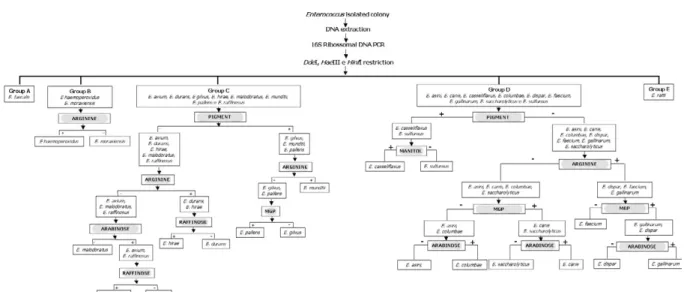
When the results obtained by PCR-RFLP were analysed in association with the results of phenotypic testing, the species included in pattern groups B, C and D could be distinguished by 1-5 phenotypic tests. Fig. 2 shows a scheme for the identification of
Enterococ-cus species based on PCR-RFLP of the 16S rRNA gene
using three restriction enzymes (DdeI, HaeIII, HinfI) and a few biochemical tests selected from the scheme proposed by Teixeira et al. 2007.
The 75 Enterococcus samples isolated from food were identified at the genus level by a PCR-based as-say as described. Typical and atypical isolates of E. faecalis, E. faecium, E. casseliflavus and E. gallina-
rum were also decisively identified by species-specific
PCR based assays.
The scheme was then applied to characterise 75 se-lected isolates recovered from foodstuffs. Of these iso-lates, 64 were identified at the species level based on the results of phenotypic testing (26 had typical results and 38 had atypical results in 1 or 2 tests) and 11 could not be assigned to an enterococcal species on the basis of biochemical testing only (Table II). All the food isolates were identified at the species level by using the scheme combining PCR-RFLP and 1-5 biochemical tests.
A comparative analysis of the 1500 bp 16S rRNA gene of enterococcal species included in the present study (including the sequences of the two universal am-plification primers) deposited in the GenBank verified the polymorphism of the 275 bp rDNA amplicons of the reference strains. Restriction maps were calculated from the amplicon regions of the GenBank sequences using NEBCutter 2.0 (Vincze et al. 2003). The predicted re-striction fragments from E. faecalis (representing
PCR-RFLP group A), E. haemoperoxidus (group B), E. avium
(group C), E. faecium (group D) and E. ratti (group E) had the same molecular weights observed experimentally (Table III, Fig. 1).
TABLE I
Groups of PCR-restriction fragment length polymorphism (PCR-RFLP) patterns obtained after enzyme restriction of the 16S rRNA gene from the type strains of 21 species of Enterococcus
Reference strain Group
Fragmentsa
n
HaeIII HinfI
DdeI
Enterococcus faecalis A 2 1 3a*
Enterococcus haemoperoxidus B 2 2 3a
Enterococcus moraviensis - - -
-Enterococcus avium C 3 1 3a
Enterococcus durans - - -
-Enterococcus gilvus - - -
-Enterococcus hirae - - -
-Enterococcus malodoratus - - -
-Enterococcus mundtii - - -
-Enterococcus pallens - - -
-Enterococcus raffinosus - - -
-Enterococcus asini D 3 1 2
Enterococcus canis - - -
-Enterococcus casseliflavus - - -
-Enterococcus columbae - - -
-Enterococcus sulfureus - - -
-Enterococcus dispar - - -
-Enterococcus faecium - - -
-Enterococcus gallinarum - - -
-Enterococcus saccharolyticus - - -
-Enterococcus rattii E 3 1 3b**
DISCUSSION
Enterococci are frequently found in foodstuffs, mainly raw products of animal origin (meat and milk) and their pres-ence is an indicator of faecal contamination in sources asso-ciated with low hygiene conditions (Mannu et al. 2003).
Data on antibiotic resistance of enterococci associ-ated with foodstuffs provide strong epidemiological evi-dence of a link between the use of antibiotics in human medicine and animal husbandry and the emergence, spreading and persistence of resistant strains in animal products (van den Bogaard & Stobbering 2000).
Multi-resistant enterococcal populations are com-monly isolated from humans, aquatic environments and sewage. These microbes can be introduced into the human intestinal micro-f lora by food consump-tion. The increasing occurrence of multi-resistant en-terococcal isolates and isolates with the propensity to acquire new resistance traits is a major concern for the therapy and control of enterococcal infections (Murray 1998, Teixeira et al. 2007).
In a previous study (Fracalanzza et al. 2007), we reported the occurrence of multiple species as well as antimicrobial resistance profiles among enterococcal isolates from commercial foodstuffs of animal origin (represented by poultry and pasteurised milk) in RJ. A
variety of species was identified in 167 isolates obtained from poultry and 127 isolates from pasteurised milk, including E. faecalis (62.6%), E. casseliflavus (17.3%),
E. durans (6.5%), E. gallinarum (3%), E. gilvus (2.4%),
E. faecium (2%), E. hirae (1.4%) and E. sulfureus (1%). Eleven (3.8%) of the isolates remained non-identified. Multi-resistance was observed in isolates identified as
E. faecalis, E. casseliflavus, E. faecium, E. gallinarum,
E. durans and E. gilvus. The major risk related to the resistance traits is that they are for the most part trans-ferable to the enterococci and more virulent pathogens as well some of these strains were used to evaluate the PCR-RFLP method in the present study.
In this study, five groups (A-E) with distinct restric-tion patterns were obtained after PCR-RFLP analysis of
275 bp 16S rDNA amplicons digested with DdeI, HaeIII
and HinfI. The reference Enterococcus strains could be easily differentiated on the basis of restriction patterns produced by these three restriction enzymes in associa-tion with the results of selected biochemical tests.
We validated our identification scheme by testing 75 isolates of Enterococcus recovered from foodstuffs. These isolates presented different levels of difficulty of precise identification by biochemical testing only. All 75 food iso-lates fit into 1-5 PCR-FRLP groups. After the PCR-RFLP
TABLE II
Sources and 16S rRNA PCR-restriction fragment length polymorphism (PCR-RFLP) patterns of 75 Enterococcus isolates recovered from food
Speciesa
Strains n (source)
PCR-RFLP group pattern
Identification by PCR-RFLP based scheme
Enterococcus faecalis 10 (7 poultry, 2 cheese, 1 milk) A E. faecalis E. faecalis (atypical)b 12 (10 cheese, 1 poultry, 1 milk) E. faecalis
Not identifiedc 1 (milk) E. faecalis
Enterococcus haemoperoxidus (atypical) 2 (poultry) B E. haemoperoxidus
Not identified 3 (poultry) E. haemoperoxidus
Enterococcus gilvus 1 (poultry) C E. gilvus
E. gilvus (atypical) 6 (poultry) E. gilvus
Enterococcus hirae 1 (poultry) E. hirae
E. hirae (atypical) 2 (poultry) E. hirae
Not identified 1 (poultry) E. hirae
Not identified 3 (poultry) E. malodoratus
Not identified 1 (milk) E. pallens
Enterococcus casseliflavus 9 (6 poultry, 2 cheese, 1 milk) D E. casseliflavus
E. casseliflavus (atypical) 4 (poultry) E. casseliflavus
Enterococcus durans (atypical) 1 (poultry) E. durans
Enterococcus faecium 3 (2 poultry, 1 cheese) E. faecium
E. faecium (atypical) 5 (cheese) E. faecium
Enterococcus gallinarum 2 (poultry) E. gallinarum
E. gallinarum (atypical) 3 (1 poultry, 1 milk, 1 cheese) E. gallinarum
Enterococcus sulfureus (atypical) 3 (poultry) E. sulfureus
Not identified 2 (poultry) E. sulfureus
technique was combined with selected biochemical tests, all isolates could be identified at the species level.
Thirty-seven of the food isolates exhibited atypi-cal phenotypic traits. Among them, eleven E. faecalis
and two E. haemoperoxidus strains presented atypical results in the MGP test. Five E. faecium, three E. galli-narum, three E. sulfureus, two E. hirae and one E. gilvus
strains presented atypical results in the potassium tellu-rite test. Three E. casseliflavus strains presented atypi-cal results in the arginine test; two E. gilvus and one
E. casseliflavus presented atypical results in the pyru-vate and sorbose tests, respectively. One E. faecalis and three E. gilvus presented atypical results in the raffinose test. Some of these strains presented atypical results for two physiological tests simultaneously, illustrating the phenotypic diversity of enterococci isolated from foods and the difficulty of identifying these micro-organisms through phenotypic tests alone.
TABLE III
Enterococcus 16S rRNA gene restriction fragment patterns obtained by using the NEBCutter 2.0 program
Pattern group
Restriction patterna according to the enzyme
DdeI HaeIII HinfI
A 208/67 275 165/85/25
B 208/67 175/100 165/85/25
C 184/67/24 275 165/85/25
D 184/67/24 275 250/25
E 184/67/24 275 190/60/25
pattern groups:A: Enterococcus faecalis ATCC 19433 (repre-senting the group A); B: Enterococcus haemoperoxidus ATCC BAA-382(group B); C: Enterococcus avium ATCC 14025 (group C); D: Enterococcus faecium ATCC 19434 (group D); E: Entero-coccus ratti ATCC 700914 (group E). a: size in base pairs.
Fig. 1: restriction patterns of a 16S rRNA gene 275-bp fragment am-plified by PCR and digested with DdeI, HaeIII and HinfI represent-ing the five different PCR-restriction fragment length polymorphism groups (A-E) that include 21 different species of Enterococcus. Lanes A: Enterococcus faecalis ATCC 19433 representing group A; B: En-terococcus haemoperoxidus ATCC BAA-382 representing group B; C: Enterococcus avium ATCC 14025 representing group C; D: En-terococcus faecium ATCC 19434 representing group D; E: Entero-coccus ratti ATCC 700914 representing group E; U: uncut fragment of 275-bp; 1: 25-bp DNA Ladder; 2: 50-bp DNA Ladder.
Fig. 2: scheme for rapid identification of the species of Enterococcus by PCR-based RFLP in conjunction with a few biochemical tests.
In conclusion, PCR-RFLP combined with a few se-lected biochemical tests was shown to be a relatively simple, rapid and reliable technique to identify species of
Enterococcus even when isolates presented atypical or uncommon phenotypic characteristics. The DNA-based assay developed in this study provides an alternative to current methods for the identification of enterococcal isolates in public health laboratories.
ACKNOWLEDGEMENTS
To the Support Section and to Dr. Célia Romão, Head of the Microbiology Department of INCQS, for their valorous technical assistance.
REFERENCES
Bersos Z, Maniati M, Kontos F, Petinaki E, Maniatis AN 2004. First report of a linezolid-resistant vancomycin-resistant Enterococcus faecium strain in Greece. J Antimicrob Chemother 53: 685-686.
Blom K, Patton CM, Nicholson MA, Swaminathan B 1995. Identi-fication of Campylobacter fetus by PCR-DNA probe method.
J Clin Microbiol 33: 1360-1362.
Cardarelli-Leite P, Blom K, Patton CM, Nicholson MA, Steigerwalt AG, Hunter SB, Brener DJ, Barrett TJ, Swaminathan B 1996. Rapid identification of Campylobacter species by restriction frag-ment length polymorphism analysis of a PCR-amplified fragfrag-ment of the gene coding for 16S rRNA. J Clin Microbiol 34: 62-67.
Chen H-J, Tsai J-C, Chang T-C, Hung W-C, Tseng S-P, Hsueh P-R, Teng L-J 2008. PCR-RFLP assay for species and subspecies dif-ferentiation of the Streptococcus bovis group based on groESL sequences. J Med Microbiol 57: 432-438.
De Rijk P, Neefs JM, Van de Peer Y, De Wachter R 1992. Compilation of small ribosomal subunit RNA sequences. Nucleic Acids Res 20: 2075-2089.
Deasy BM, Rea MC, Fitzgerald GF, Cogan TM, Beresford TP 2000. A rapid PCR based method to distinguish between Lactococcus and
Enterococcus. Syst Appl Microbiol23: 510-522.
Domig KJ, Mayer HK, Kneifel W 2003. Methods used for the isola-tion, enumeraisola-tion, characterisation and identification of Entero-coccus spp. 1. Media for isolation and enumeration. Int J Food Microbiol 88: 147-164.
Dutka-Malen S, Evers S, Courvalin P 1995. Detection of glycopeptide resistance genotypes and identification to the species level of clin-ically relevant Enterococci by PCR. J Clin Microbiol33: 24-27.
Facklam RR, Collins MD 1989. Identification of Enterococcus species isolated from human infections by a conventional test scheme.
J Clin Microbiol 27: 731-734.
Fracalanzza SAP, Scheidegger EMD, Santos PF, Cardarelli-Leite P, Teixeira LM 2007. Antimicrobial resistance profiles of entero-cocci isolated from poultry meat and pasteurized milk in Rio de Janeiro, Brazil. Mem Inst Oswaldo Cruz102: 853-859.
Franz CMAP, Holzapfel WH, Stiles ME 1999. Enterococci at the crossroads of safety? Int J Food Microbiol 47: 1-24.
Giraffa G 2002. Enterococci from foods. FEMS Microbiol Rev 26: 163-171.
Giraffa G, Carminati D, Neviani E 1997. Enterococci isolated from dairy products: a review of risks and potential technological use.
J Food Prot 60: 732-738.
Greisen K, Loeffelholz M, Purohit A, Leong D 1994. PCR primers and probes for the 16S rRNA gene of most species of pathogenic bacteria, including bacteria found in cerebrospinal fluid. J Clin Microbiol 32: 335-351.
Gurtler V, Stanisich VA 1996. New approaches to typing and identi-fication of bacteria using the 16S-23S rDNA spacer region. Mi-crobiology142: 3-16.
Hayes JR, Enghish LL, Carter PJ, Proescholt T, Lee KY, Wagner DD, White DG 2003. Prevalence and antimicrobial resistance of En-terococcus species isolated from retail meats. Appl Environ Mi-crobiol 69: 7153-7160.
Iriarte P, Owen RJ 1996. PCR-RFLP analysis of the large subunit (23S) ribosomal RNA genes of Campylobacter jejuni. Lett Appl Microbiol 23:163-166.
Jeng RS, Svircev AM, Myers AL, Beliaeva L, Hunter DM, Hubbes M 2001. The use of 16S and 16S-23S rDNA to easily detect and dif-ferentiate common Gram-negative orchard epiphytes. J Micro-biol Methods44: 69-77.
Mannu L, Paba A, Daga E, Comunian R, Zannetti S, Duprè I, Sacchi LA 2003. Comparison of the incidence of virulence determinants and antibiotic resistance between Enterococcus faecium of ani-mal and clinical origin. Int J Food Microbiol 88: 291-304.
Marshall SM, Melito PL, Woodward DL, Johnson WM, Rodgers FG, Mulvey MR 1999. Rapid identification of Campylobacter, Arco-bacter and Helicobacter isolates by PCR-restriction fragment length polymorphism analysis of the 16S rRNA gene. J Clin Mi-crobiol37: 4158-4160.
Murray BE 1998. Diversity among multidrug-resistant enterococci.
Emerg Infect Dis 4: 37-47.
Palepou MFI, Adebiyi AMA, Tremlett CH, Jensen LB, Woodford N 1998. Molecular analysis of diverse elements mediating VanA glycopeptide resistance in enterococci. J Antimicrob Chemother 42: 605-612.
Shah SA, Romick TL 1997. Subspecies differentiation of Salmonella by PCR-RFLP of the ribosomal operon using universal primers.
Lett Appl Microbiol25: 54-57.
Teixeira LM, Carvalho MGS, Facklam RR 2007. Enterococcus. InPR Murray, EJ Baron, JH Jorgensen, ML Landry, MA Pfaller (eds.),
Manual of clinical microbiology, 9th ed., American Society for Microbiology, Washington DC, p. 430-442.
Teng L-J, Hsueh P-R, Wang Y-H, Lin H-M, Luh K-T, Ho S-W 2001. Determination of Enterococcus faecalis groESL full-length se-quence and application for species identification. J Clin Micro-biol 39: 3326-3331.
van den Bogaard AE, Stobbering EE 2000. Epidemiology of resis-tance to antibiotic. Links between animals and humans. Int J An-timicrob Agents 14: 327-335.