SOCIUS Working Papers
Education, Development and Knowledge:
new forms of unequal change under
globalization. The case of SSA countries
Margarida Chagas Lopes
Nº 10/2011
SOCIUS - Centro de Investigação em Sociologia Económica e das Organizações ISEG - Instituto Superior de Economia e Gestão
Universidade Técnica de Lisboa R. Miguel Lupi 20 - 1249-078 Lisboa Portugal Tel: +351 213 951 787 Fax: +351 213 951 783
Email: [email protected]
2 Education, Development and Knowledge: new forms of unequal change under
globalization. The case of SSA countries1
Margarida Chagas Lopes, SOCIUS, ISEG-UTL
Abstract
One of the leading mismatches brought about by globalization has to do with the severe opposition between the national frameworks in which qualifications and skills are being developed and the wider international contexts in which they are increasingly utilized and reproduced. This gulf becomes almost impossible to overcome and imposes a growing inequality in the access to knowledge in the global economy as the prevalent forms of economic regulation are rendered obsolete. The limitations displayed by national systems of education and training interact with the growing insufficiencies in the performance of labor market and innovation hetero regulators. As a result, increasing flows of excluded workers have been paving the ways between the new global development centers and the emerging new peripheries.
Key Words: Education and economic development; quality of education; new North-South divide; Sub-saharan Africa.
3 Resumo
O fosso alargado entre os espaços nacionais de criação e desenvolvimento de competências e a economia global onde elas cada vez mais se expressam e reproduzem, constitui uma das principais fontes de desajustamento inerentes à globalização. Aquele fosso, virtualmente impossível de ultrapassar, projecta-se numa desigualdade sem precedentes nas condições de acesso ao conhecimento na economia global, tanto mais quanto os reguladores económicos tradicionais se encontram em falência. Com efeito, às insuficiências dos sistemas nacionais de educação e formação associa-se a crescente incapacidade dos reguladores externos dos mercados de trabalho e dos sistemas de inovação. A grande resultante é o fluxo sustentado de trabalhadores excluídos que as relações desiguais entre os novos centros desenvolvidos e as novas periferias vão contribuindo para engrossar.
4 1. Education and development … in spite of Economy
The study of the contribution of education to development has mostly been shaped by an excessive emphasis on economic features. We do not agree with that approach. In fact, economic processes are but social phenomenon, and as such, they nurture a network of wider relationships which must be taken into account in order to assess the object of research in all its complexity. Therefore, from the beginning special attention and concern must be given to context and framework. If we take education in the framework of the French Revolution, for instance, what strikes us most is its extraordinary contribution to fostering the adoption of French as mother tongue, by replacing the multitude of existing dialects, thereby becoming the reference axis in fostering national identity. But when we consider the role played by one unique or official language in such multi-linguistic and multi-ethnic societies as those in Sub Saharan Africa (SSA), we are inevitably led to the critical reappraisal of the conventional role performed by education as a vehicle of instilling values…
The study of the relationship between education and development also demands that a major part of the research effort should concern the analysis of the function of social regulator, which education is expected to perform, as well as the nature of the networking between the several stakeholders. According to Ambrósio (2001):
“(…) Cabe aqui também referenciar o largo campo de efectivação da responsabilidade social, de empresas, ordens e associações profissionais (…) dentro de uma estratégia não só de qualificação profissional, mas de valorização dos recursos humanos, de fomento da cidadania e da equidade na educação e formação” (Ambrósio 2001: 34).
5
it should meet accordingly, lead us to the appraisal of the role played by values, culture and behavior not only as outcomes of the education processes but also as some of its pre-conditions. Kenny (2010) refers to some recent research on scholastic results carried out in São Paulo (Brazil) which showed that the best scores were obtained by students living in communities with high immigration rates of people from countries with public and well settled education systems. Here we find again the influence exerted by context and inner values and attitudes, albeit from a foreign origin.
Over time education has given rise to several autonomous scientific domains, whose social and scientific legitimacy came before and independently from the influence exerted by Economics. Even Economics of Education, a scientific domain which epistemologically is grounded in the interaction between Economics and Education, has been developing a noticeable critical reappraisal of the economistic drive
which marks most of its schools of thought. This is especially the case with regard to the critical attitude towards the functionalist approach under which educational purposes must obey – sometimes almost exclusively – labor market requirements. As has become clear, successive crises, and noticeably the current one, have contributed to discarding the above perspective given the growing difficulties faced by even the most qualified to obtain a job and to retain it. Once transposed from Economics to Education, Say’s Law, which has conquered so many adepts, becomes more and more utopian, in parallel with the failure of laissez-faire in education and labor markets.
This growing inaptitude of education to provide for social regulation and the (re)equilibrium of labor markets has been reinforced with the global crisis and is reflected in many features, which we will discuss in the following sections.
6 2. Education and Economic Development: a brief reappraisal
The relationship between education and economic development constitutes one of the most prominent research topics in Economics as expressed in numerous theoretical and empirical studies which have been developed since World War II2.
Despite the diversity of approaches, the common core of knowledge starts from the individual relationship between the number of years of schooling, occupational experience and expected wage income (Mincer 1974). Frequently, the above relationship is transposed almost automatically to the macroeconomic level, without sufficient concern for the heterogeneity among individual behavior towards education, the imperfection of the capital markets in financing education, the great diversity in educational and training programs, and, most of all, the corresponding labor market opportunities, upon which wage incomes and rates of return of the investment in education strictly depend.
These kinds of analyses have led to some well-known, quite unrealistic and inconsistent outcomes. For example, the empirical study on the internal rates of return for basic education by Psacharopoulos (1994), which covered 78 countries, obtained values ranging from 42% in Botswana to 3,3% in the former Yugoslavia. This prevalent conundrum gave rise to another approach, according to which the effects exerted by education on income would diminish with an increase in overall education and in the initial average income level. In other words, this approach argues that similar efforts in educational development will not necessarily lead to identical outcomes; everything depends upon the context and the development stage. We shall discuss this kind of inequality later in the paper.
The above mentioned inconsistencies were also being expressed in a set of new research questions, such as that relative to the role effectively played by capital accumulation in the more developed economies: given its contribution to the overall factors productivity (OFP), and not only to average labor productivity, won’t it be that throughout OFP other complimentary effects will appear to reinforce the “net” effects displayed by education? (Johnes & Johnes 2004).
2
7
Moreover, the differentiation in labor productivity associated with the multitude of skills and qualifications deserved a new concern: how far would substitutability among production factors (between capital and labor; among several “qualities” of labor) prevail in the new heterogeneous context? Will we not risk a reinforcement of the conflict between skills development (and corresponding higher labor productivity) and employability, both outcomes being actually among the major development goals?
Furthermore, what will actually contribute to economic development the most: the insertion into the labor market of new more highly educated generations, the up-skilling of the adult population, or both? The latter issue becomes critical in societies whose education systems are immature and have to overcome several intricate bottlenecks, as in SSA countries. Nevertheless, even in such contexts policy measures and approaches are rarely homogeneous.
We therefore propose to discuss possible answers to the above questions. We will take some of the more critical aspects of the education systems in some SSA countries as case studies and try to illustrate them using the most adequate indicators provided by international databases such as UNESCO and ILO, among others.
2.1 From Education to Economic Development …or the other way round
The database on education from Barro & Lee (2010) provides information on a worldwide scale and has already given rise to new interesting research outcomes. Among them we refer to Teal (2010), who includes in his analysis the global situation between 1950 and 2010 for the 33 countries in the SSA.
8
Nevertheless, the relative evolution in per capita income was disappointing. As a matter of fact, per capita income almost stagnated in SSA countries between 1980 and 2000, in stark contrast to the evolution displayed by South and Southeast Asia, the Middle East and Latin America. Moreover, the situation in SSA countries relatively to per capita income has been largely surpassed by the new “Asiatic tigers”, India and China, despite the latter having departed from much more disadvantageous starting points. According to the same study (Teal 2010), the doubling in the average schooling years in SSA countries, during 1960-2010, corresponded to an average increase in per capita outcome of only some 12%.
This outcome raises diverse meaningful questions, among them the one which ponders the nature and the direction of the association between education and economic development. On one hand, it has been observed that the higher impacts exerted by education upon per capita income in other regions lead to a renewed focus on the role played by physical capital and OFP. On the other hand, consideration of the average starting income levels points again to the direction underlying the above association: is it education which enhances economic development or the reverse? In other words, will it not be necessary for a minimum level of economic development and per capita income to be attained before education is able to exert further, more substantial and sustainable development effects?
This question is left open. But the investigation on the present relationship between education and economic development brings to the foreground some other important topics, such as those which concern production and occupational structure or the average labor productivity and the quality of teaching and learning, which we will consider further on.
9 2.2.- African countries and heterogeneous behavior
On the basis of the UNESCO report Education for all Literacy for Life (2004,
2006), we can retrieve a sub sample of more homogeneous SSA countries from the point of view of two important education indicators:
- net enrollment rates (NER) in basic education (higher than 70% in 2004// 95% as stated by UN Millenium Development Goals);
- adult literacy rates (ALR), (higher than 60% in 2004):
Table 1: Net Enrollment Rates (NER) in Basic Education (2004) and Adult Literacy
Rates (ALR), (%), (2004)
Sao Tome & Principe
Cape Verde
Equat. Guinea
Rwanda Tanzania Zambia Malawi Madagascar
NER, Basic Educ.
98,0 92,0 85,0 73,0 91,0 80,0 95,0 89,0
ALR
---
84,0 93,0 70,0 71,0 71,0 73,0 71,0
Sources: UNESCO (2004, 2006)
Table 1 shows that the degree of accomplishment of the above two indicators differs across the 9 countries under analysis, with Tanzania, Zambia and Madagascar clearly revealing a meaningful neglect for adult education. It could well be that this lesser concern for adult education and training are among the main reasons for a smaller effect of education on economic development, the latter being expressed by an increase in per capita income. Actually, as Romer (1990) explains, a big concern with adult education and training, even if there were less attention to youngsters’ education, would imply …
10 continue to increase and thus continuing growth is possible (…)” (Romer, P. in Johnes & Johnes 2004: 242)
And yet…
“(…) the growth of productivity depends on the existing stock of ideas and the number of people devoting their time to the accumulation of new ideas (…)” (ibidem: 243)
The latter idea focuses directly on the contribution which advanced studies bring to economic development, a topic we will not address in this paper.
For some of the above countries we have also obtained data on the evolution of average labor productivity and the share of self-employment (ILO 2009):
Table 2: Average Labor Productivity (Y/L) and Self Employment (% SE)
Cape Verde Equat.
Guinea
Rwanda Tanzania Zambia Malawi Madagascar Lesotho
Y/L ---- ---- ---- 4,9 (08) 3,8 (08) 6,9 (08) 1,8 (08) ---
% SE 29,3 (00) --- 61,3 (96) 88,4 (01) 59,7 (03) 83,5 (87) 41,6 (03) 4,8 (99)
Source: OIT (2009). Values within (.) refer to the last two digits of the corresponding year.
Given the discrepancies between dates of reference for the percentage of self-employment (% SE), we will consider only the values relative to the 2000 decade. The enormous heterogeneity which characterizes SSA countries, here from the point of view of production structures, is acutely depicted.
For the three countries which we can now directly compare - Tanzania, Zambia e Madagascar, those with lower investment in adult education – we can observe higher values for average labor productivity3 in parallel with either higher values of self-employment or lower ones. This outcome could be more obviously explained through analysis of the production structure, which we shall develop further on.
When we compare Tables 1 and 2, we observe that among the above three countries, Tanzania, where labor productivity is at the top, is the one with the highest
3Average labor productivity is expressed here as the ratio Production/ Number of employees and not in
11
net enrollment rate in Basic education. But adult literacy, which exhibits equivalent scores for Zambia and Madagascar, is not found to be definitely associated with average labor productivity.
In some of the countries, higher net enrollment rates in Basic education seem to correspond to lower values of self-employment: such is the case of Sao Tome & Principe and Madagascar. By contrast, Tanzania and Malawi show clearly opposite results.
Likewise, in such a heterogeneous context we cannot identify any systematic relationship between literacy – especially adult – and average labor productivity, the latter being inseparable from the relative share of self-employment. So, for the sub sample of countries we have been considering so far, the relationship between schooling, employment status and labor productivity seems to be far from leading to a fair equivalence.
2.3. –Production structure, Education offer and Say’s law
As we have mentioned previously, the increase in per capita income has been much weaker in SSA countries than in China or India in the same period of time. As a matter of fact, comparison with those two emerging Asiatic countries deserves further attention.
Departing from lower levels of per capita income than in most SSA countries, it could be that in India and China the “education effect” would lead to more than proportionate increases in the above development indicator. Taken alone this does not seem to be a very strong hypothesis.
By contrast, the argument relative to a shift in production paradigm has been attracting much more concern. In fact, China has been developing paid employment alongside rural-urban emigration with a concomitant huge expansion in the export sector, based on the contribution of an increasingly skilled labor force4. In the case of India, the big drive has been the highly qualified information technology (IT) sector, alongside some other frontier-knowledge sectors such as life sciences, all of them being strongly internationalized and highly competitive.
12
Will not these same possibilities be open to other less developed countries, namely to SSA ones? Currently, in fact, there has been a great temptation in SSA to expect mobile phones to enable the countries to emulate the Indian “IT revolution”. Moreover, is it not to be expected that the steady increase in medium and high level schooling qualifications, and subsequent knowledge progress, will play the role of a strategic factor of development in the sense proposed by Say’s law in Economics?
One possible answer to the above questions has to do with, among other factors, the prevailing occupational structure in at least some of the SSA countries, like Ghana or Tanzania; the leading employment opportunities for the highly skilled, even for graduates, lie in the civil service, and the “second best” chance is … self-employment. This results from an increasing narrowness of public sector and the restriction of employment opportunities in larger private firms. This feature helps to explain the relatively high values for average labor productivity in parallel with high shares of self-employment, as we observed in some of these countries.
According to ILO (2009) data for 2000 decade, the relative share of self-employment among total self-employment reached 41.8% in Ethiopia (2006), 76.3% in Tanzania (2006), 59.7% in Zambia (2003), 49.9% in Zimbabwe (2002), 74.3% in Sierra Leone (2004), but smaller values in South Africa5. These results seem to endanger the articulation with an increasing, large scale and competitive export sector, which should be supported by a continuous product and process innovation.
The “strategic” commitment to systematically generate higher qualifications as a factor of development “per se” seems to face severe challenges as well. This “strategy” works as an attempt to apply Say’s law to economic development through high qualifications and has been discussed by Acemoglu (1999): with the increase in the development of higher qualifications, firms steadily tend to offer more demanding jobs that are able to absorb the highly skilled … provided that minimum levels of average labor productivity and innovation have already been met. Under such conditions, there will be room for a dualist economic structure, with a highly skilled, competitive and innovative sector, often held by foreign capital and offering very limited employment prospects; in parallel with a “secondary segment” beset by relative stagnation. The
13
outcomes of such a model in the light of sustainable development are not difficult to perceive.
We therefore need to take into consideration the latter interactions in the case of SSA.
2.4.- “Unequal Change”, take two: relations between schooling, employment and wages
Heterogeneity also marks SSA countries from the points of view of labor productivity and unemployment of the highly skilled. Actually, during 2000 decade, labor productivity ranged from increases of more than 100% in Mozambique, 80% in Angola, 57% in Nigeria and Uganda, and 30% in Ghana to significant decreases in Zimbabwe, Ivory Coast or Niger, among other countries. Once again, context and the diversity of factors besides education which condition economic and social development are displaying their effects.
Data on unemployment by education level is relatively scarce for SSA countries. As a general rule, we can observe that “human capital” hypotheses lead to positive employability prospects for higher education. Actually, unemployment among graduates is usually low (Chad, Ethiopia and Madagascar are exceptions) given the escape valves provided by the civil service and self-employment. But the employment premium associated with the transition from Basic to Secondary education is very often negative, as in Ethiopia, Zimbabwe and South Africa (OIT 2009).
Let us consider now the correspondence between education outcomes and labor market opportunities. An interesting study by Castagnetti, Chelli & Rosti (2005), points to the huge differences in wages associated with learning assessment scores when one compares paid work with self-employment. This outcome leads once again to the crucial role performed by occupational structure. But it also points to rewarding inequalities among equivalent educational outputs.
14
ten times more, irrespective of their real productivity. In South Korea, those having completed Upper Secondary earn approximately ten times the Indian wage for the equivalent education level. A Nigerian having completed Upper Secondary earns an average yearly income 27 times less than a Mexican with the same schooling… (OIT 2009).
Therefore, the strategy of Say’ Law in SSA countries seems to be hindered by the absence of a minimum critical core of highly skilled workers, the absence of a steady increase in average labor productivity and the distortion of occupational and wage structures against medium and high skills . At the same time, these obstacles also seem to prevent the latter countries from adopting development models identical to the ones in China and India.
As we believe, the above gaps and distortions will not fail to reflect the consequences exerted by learning and schooling quality or its impact upon knowledge robustness, either within or among countries. We will refer to this in the next section.
2.5.- Quality of teaching and learning
The economic functions which model the relationship between education and economic development usually take the average number of years at school as the variable representative of the influence exerted by schooling. Nevertheless, more recent approaches have pointed to the limitations of this methodology; it implicitly draws on “quantity” of teaching when it is becoming increasingly evident that “quality” of education and training is playing the critical role as a development enhancer, by fostering the real labor force’s skills and qualifications.
As Kenny (2010) argues, we must distinguish between education and learning. He repeats the question raised by Lant Pritchett, “Where has allthe education gone?” as the latter founds no meaningful association between education and economic development in spite of the whole amount of education financing (Pritchett 2001).
15
basis of PISA indicators on learning and knowledge outcomes, Hanushek & Woessmann (2010). When information on cognitive skills is added to the average years of schooling in economic development models, the latter authors find that not only do models become statistically much more robust but also that the influence exerted by schooling meaningfully diminishes.
In fact, a large number of empirical outcomes on the (non) correspondence between schooling and learning in the context of less developed countries could be highlighted, as in Kenny (2010). For instance:
- a recent study points to the fact that although the gross enrollment rate in Basic Education in Bangladesh remains at almost 100%, about one half of its 11- year-old youngsters cannot read or write;
or
- a research on Brazilian pupils’ average skills in Mathematics found it to be comparable to the 2% bottom performers’ of Danish pupils in the same grade, in 2006.
16
Source: Kenny (2010): 22
Like many other authors, Kenny insists on the need to take into account the dimension “quality” of schooling when trying to assess the real effects exerted by education upon economic development. Quality should also be directly intertwined with the contents and organization of the education system with regard to four features: first and foremost, the widespread inability to exercise social and public control towards education systems; second, the delivery mechanisms and conditions of access to books and other school supplies and materials; third, the government’s ability to control lobbies in education; and last but not least teacher training, the need to reduce teacher absenteeism (which reaches 27% in Uganda) and the need to review rewarding systems, including the possibility that the latter could be linked to scholastic outcomes.
17
enlarge compulsory education will be almost useless to improve school and learning quality if a complex set of factors remains outside public control and commitment. And this applies not only, nor especially, to less developed countries. Therefore, it may well be advisable for Millennium Development Goals (among other purposes) to be based upon learning goals and outcomes as assessed by PISA scores, for instance, instead of relying upon quantitative indicators such as those relative to enrollment and completion rates.
3.- Education, Knowledge, Globalization and … increasing inequality
It is now obvious that the real impart of education upon economic development depends on the quality of schooling and the robustness of the knowledge it contributes to foster. In fact, today knowledge has become the most relevant factor of production because it enhances productivity, global income and economic development on the whole.
Knowledge breeding, however, is to be nourished by a systematic policy of enhancing advanced human resources, as it is as well contingent upon the social embeddedness of the outcomes from science and technology, which are to be shared among diverse stakeholders: government, higher education systems, economic activity. As a matter of fact, these domains are usually kept under government control (directly or indirectly), particularly wherever the voice of civil society remains weak. The big issue, therefore, has to do with the fairness and equity in access to knowledge and to its fruits as expressed through income; will these opportunities and outcomes be evenly shared among society? In fact, globalization effects - made even more acute by the last crisis – have been widening the gap between the “haves’” and the “have nots’” access to knowledge, either within each country or internationally, as we will address now.
18
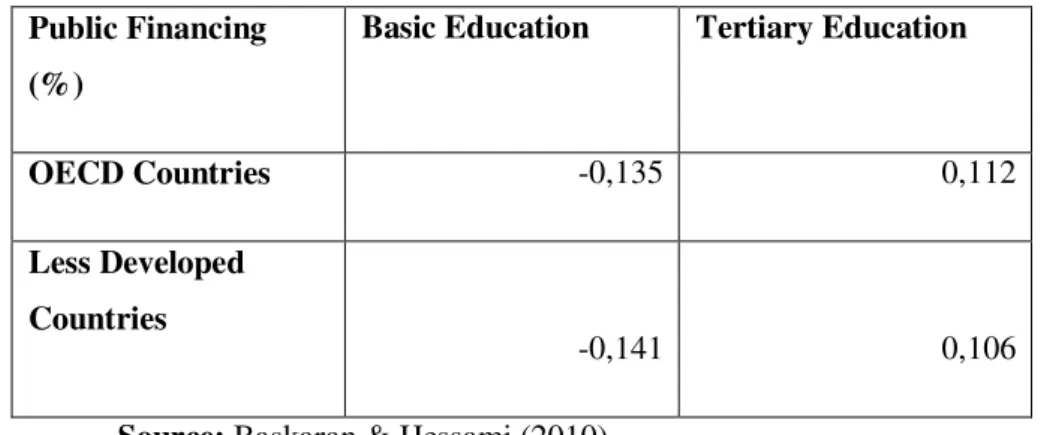
However, in the latter societies it is absolutely essential that a meaningful investment in very high-level and high-level skills should be made as a pre-condition for open and sustainable economic development. As a matter of fact, several studies have been pointing to a sound trend in this latter sense, as shown by Baskaran & Hessami in their study on 121 OECD countries between 1992 and 2006 (Baskaran & Hessami 2010).
Table 3: Public Financing by Education Level and Development Status (1992-2006)
Public Financing
(%)
Basic Education Tertiary Education
OECD Countries -0,135 0,112
Less Developed
Countries
-0,141 0,106
Source: Baskaran & Hessami (2010)
After all, the resounding decrease of public investment in Basic Education is an obstacle to overcoming the still large insufficiencies that characterize many of the less developed countries today.
Also, it becomes obvious that such disproportionate allocation of public funding to Higher Education contributes to widening the gap between the rich and poor in the above societies, given the lower chance of the latter to access tertiary studies. At the same time, there is a pretty large gap between graduates’ and the bottom skilleds’ reward, as we referred previously. This bias towards Higher Education and advanced studies is not exclusively driven by the apologetics towards Say’s Law. In fact, a great number of factors, most of which have been triggered by globalization, lie behind this kind of public action.
19
compensate for the lower income tax revenue arising from skills at the bottom, despite the narrowness of the former’s tax base.
Notwithstanding, in many of the less developed countries like the SSA ones, self-employment frequently becomes the (unique) employment chance for the highly and very highly skilled, as we have seen. There, equivalent skills are under rewarded compared to paid work, as a matter of fact. Yet, with globalization, labor - especially highly skilled labor - has become more and more mobile. Given the incapacity of the economic activities to absorb higher skills and due to the large wage gaps towards developed countries for equivalent skills, there has been a significant tendency for a brain drain.
So, how will governments try to prevent skilled emigration and retain the return of the investment made in developed skills? They will mainly intervene through two eventually complementary measures. On one hand, they will try to lessen the fiscal burden on the high skilled, which together with the bias in budgeting in favor of Higher Education contributes to reinforce internal inequity. Furthermore, reducing the fiscal burden contributes to diminishing the social rate of return from the investment in education through fiscal revenue provided that there is no rise in the fiscal burden of the low wages. On the other hand, governments will try to increase further the rewards for the highly skilled, and in doing so will reinforce the vicious cycles of social inequity.
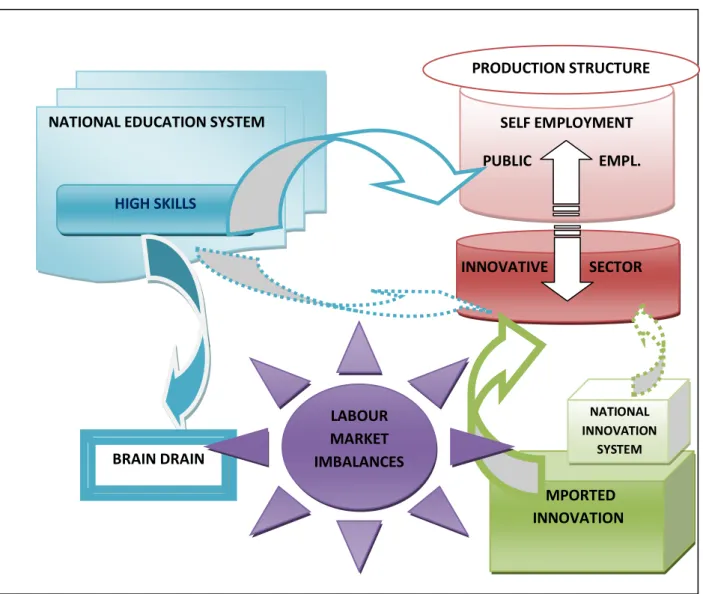
Inequality between more and less developed countries is apparent in several domains. With regard to labor markets, it gives rise to new forms of imbalances, the regulation of which lies outside the scope of education on its own whenever no adequate innovation policies are implemented.
20
education systems, and therefore they can hardly adapt to imported innovation models. The context of origin of the innovation processes should therefore be a major concern in the study of the processes of globalization (Beckman & Barry 2007).
A growing and auto-feeding gap is thereby being generated between those countries that are more developed and those that are less developed, along with systematic imbalances in the former labor markets, as we depict in the next figure:
Figure 2: Globalization and Labor Market Imbalances in Less Developed
Countries
Figura 2: Globalização e Desequilíbrios nos Mercados de Trabalho
NATIONAL EDUCATION SYSTEM SELF EMPLOYMENT
PUBLIC EMPL.
INNOVATIVE SECTOR
PRODUCTION STRUCTURE
HIGH SKILLS
BRAIN DRAIN
IMPORTED
INNOVATION
NATIONAL INNOVATION
SYSTEM
LABOUR
MARKET
21
Obviously, education on its own becomes even more unable to ensure labor market regulation given the complexity of the vicious circles driven by globalization.
In a previous work we explored the need for the regulation process to be supported by adequate demand side policies and above all by research and development ones. In such a case, the economic activity is able to progressively absorb the national effort of investment in higher skills (Chagas Lopes 2011). Transferred to the context of developing countries our previous reflection becomes even more pertinent, as it seems. Several reports - such as UNESCO Science Report 2010 - have insisted on this point and on the modest amount of Gross Domestic Product devoted to research and development in SSA countries:
Persistently low investment in STI
“(…) R&D attracts less public investment in sub-Saharan Africa than the military, health or education sectors. Only South Africa is approaching the
target of a 1% GERD/GDP ratio, the level recommended by UNESCO and, more
recently, by the African Union summit in January 2007. Even more worrisome is that
many countries either have no record of the share of GDP they devote to R&D or
simply allocate no funds at all to R&D. This is most saddening for a continent desirous
to develop STI.”(UNESCO 2010: 281).
Concluding Remarks
22
conception of education. As in many other domains within mainstream economics the
prevailing conceptions persisted and proved hard to eradicate, even now that the globalization process has become deeply rooted. Yet, this process encompasses in itself the very mechanisms which discredit the conventional approach. With globalization and increased labor (besides capital…) mobility, national shortcomings have become openly exposed to international (de)regulation while developing economies find themselves increasingly subdued to the whims of global competitiveness.
Knowledge, the most important development factor in today’s societies, bears the mark of national idiosyncrasies and resents the effects of the bottlenecks and shortcomings which characterize national systems of education and training. In short, in most developing countries there is a severe problem of quality in teaching and learning, that is to say in the ability to foster real knowledge development; a problem which cannot be offset by (simply) investing in education in quantitative terms.
In addition, developing countries like the SSA ones, which are compelled by competitiveness to adopt innovation models coming from abroad, face persistent and increasing imbalances in the articulation between education and training outputs and the structure of occupations; investing in high skills is not a sufficient condition – although an extremely necessary one – to promote economic and social development, for Say’s law is not working in the economics of education. Unless adequate research and development policies are implemented and contribute to strengthening the occupational structure, the economic activity will go on throwing away the public effort with skills and qualifications development.
Likewise, formally highly skilled workers in these countries will barely be offered a good match in the labor market: they tend to be discarded by multinationals and find no job opportunities other than in the public sector or in self-employment. These are the most frequent results of the labor market imbalances in these countries. These results take place in parallel with emigration, the other increasingly probable way out for the most skilled individuals, not only in less developed countries.
23
a m o n g u n e q u a l l y d e v e l o p e d c o u n t r i e s b e c a u s e they a l s o strongly depend upon access to labor market opportunities and enriching occupational performances.
R e f e r e n c e s :
Acemoglu, D. (1999). Changes in unemployment and wage inequality: an alternative theory and some evidence, American Economic Review, 89(5), 1259-1278.
Ambrósio, T. (2001). Educação e Desenvolvimento: Contributo para uma
mudança reflexiva na Educação, Monte da Caparica: UIED, FCT-Universidade Nova
de Lisboa.
Barro, R. J. & Lee, J-W. (2010). A new dataset of educational attainment in the world (1950-2010), NBER WP15902.
Baskaran, Th. & Hessami, Z. (2010). Globalization and the Composition of Public Education Expenditures: A Dynamic Panel Analysis, MPRA Paper nº25750. Retrieved April 7, 2011 from (http://mpra.ub.uni-muenchen.de/25750/).
Beckman, S. & Barry, M. (2007). Innovation as a Learning Process: embedding design thinking, California Management Review, vol. 50, nº1, Fall 2007,
25-56. Retrieved June 10, 2011 from ( http://www.hivolda.no/eng/studies/-courses-in-english/studiesmd201&PHPSESSID=4c5902a0bd52ed73ca2b7707e659a297).
Castagnetti, C., Chelli, F. & Rosti, L. (2005). Educational Performance as Signalling Device: Evidence from Italy, Economics Bulletin, Vol 9, nº 4, 1-7.
Chagas Lopes, M. (2011). Education, Vocational Training and R&D: Towards New Forms of Labor Market Regulation, SOCIUS Working Papers nº 8-2011.
Cortesão, L. & Stoer, S. (1995). Inter/multicultural Education on the European (Semi)periphery: Notes on an action-research Project in four Portuguese Schools,
European Journal of Intercultural Studies, vol. 6, n.º 1.
Crick, R. D. (2008). Key Competencies for Education in a European Context: narratives of accountability or care, European Education Research Journal, vol. 7, n.º3.
Retrieved September 26, 2009 from
24
Gandin, L.A. (2007). The Construction of the Citizen School Project as an Alternative to Neoliberal Educational Policies, Policy Futures in Education, vol. 5, n.º2.
Retrieved March 2009 from
(http://www.wwwords.co.uk/pfie/content/maincontents.asp).
Hanushek, E. A. & Woessmann, L. (2010). How Much Do Educational Outcomes Matter in OECD Countries? NBER Working Papers 16515.
ILO (2009). Key Indicators of the Labor Market, Geneve, International Labor
Organization.
Johnes, G. & Johnes, J. (2004). International Handbook on the Economics of Education, Cheltenham: Edward Elgar Publishing Ltd. Retrieved February 22, 2009
from
(http://megapustaka.info/m1/images/document/Education/edward%20elgar%20publish ing%20international%20handbook%20on%20the%20economics%20of%20education.p df).
Kenny, C. (2010). Learning about Schools in Development, Center for Global Development Working Paper 236. Retrieved May 5, 2011 from (www.cgdev.org).
Mincer, J. (1974). Schooling, Earnings and Experience, New York: Columbia
University Press.
Pritchett, L. (2001). Where has all the Education Gone? World Bank Economic
Review 15 (3): 367-391. Retrieved May 7, 2011 from
(http://wber.oxfordjournals.org/content/15/3/367).
Psacharopoulos, G. (1994). Returns to education: a global update, World
Development, 22, 1325–43.
Romer, P. M. (1994). The Origins of Endogenous Growth, Journal of Economic Perspectives, vol 8, nº 1, 3-22.
Sen, A. (1999). Development as Freedom, Oxford: Oxford University Press.
Solow, R. (1956). A contribution to the theory of economic growth, Quarterly
25
Teal, F. (2010). Higher Education and Economic Development in Africa: a Review of Channels and Interactions, University of Oxford, Centre for the Study of African Economies CSAE WPS/2010-25. Retrieved May 20, 2011 from (http://www.csae.ox.ac.uk/workingpapers/pdfs/2010-25text.pdf).
UNESCO (2004). Education for all, The Quality Imperative. Retrieved April
28, 2009 from (http://unesdoc.unesco.org/images/0013/001373/137333e.pdf).
UNESCO (2006). Education for all, Literacy for Life. Retrieved January 2,
2010, from (http://www.uis.unesco.org/Library/Documents/gmr06-en.pdf ).
UNESCO (2010). Science Report 2010, The Current Status of Science around
the World. Retrieved September 23, 2011 from
(http://unesdoc.unesco.org/images/0018/001899/189958e.pdf).
UNESCO (2011). Education for all, Literacy for Life. Retrieved April 24, 2011