DOI 10.20504/opus2016a2202
. . .
DUDEQUE, Norton. Prométhée, op. 21 by Leopoldo Miguez: Considerations on the
Symphonic Poem, Its Program and Sonata Form. Trad. Kathleen S. Martin. Opus, [s.l.], v. 22, n. 1, p. 35-58, June 2016.
Parts of this article were presented and published in the proceedings of the XXIV Congresso da Associação Nacional de Pesquisa em Música, São Paulo, 2014 and the Simpósio
Internacional de Musicologia of UFRJ, Rio de Janeiro, 2014. Submitted on 26/11/2015, approved on 12/01/2016.
Prométhée, op. 21 by Leopoldo Miguez: Considerations on the
Symphonic Poem, Its Program and Sonata Form
Norton Dudeque (UFPR)
Trad.: Kathleen S. Martin
Abstract: This article discusses Leopoldo Miguez’s symphonic poem Prometheus, op. 21 and
its programmatic and structural aspects. Firstly, it addresses the programme, where the central character is Prometheus, and its representation in the music. Secondly, structural aspects of the work are observed as an adapted sonata form. Finally, it briefly discusses the changes to the sonata form introduced by Franz Liszt, as well as aspects of the composer’s musical language that suggest an influence by Richard Wagner’s music.
The Olympian gods of Greek mythology rose to power in a cataclysmic battle against the Titans, divine progeny of the primordial Sky God and Earth Mother. One of their clan, Prometheus, remained defiant in defeat, boldly stealing heavenly fire as a gift for mortals, a boon denied them by Zeus, the triumphant Olympian ruler. As punishment, Zeus had Prometheus chained to a Cliff, where in perpetual solitude he suffered the daily torment of an eagle feasting on his liver. Lamenting his fate but never recanting, he was ultimately freed by Hercules and celebrated as mankind’s champion (BERTAGNOLLI, 2007: 1).
he quote above summarizes the general plot of the myth of Prometheus. Prior to the nineteenth century, this myth became a symbol of political rebellion and of the progress and potential of the human race (DOUGHERTY, 2006: 91-92). An illustration can be found in late eighteenth-century European literature , for example, Johann Wolfgang von Goethe (1749-1832) who wrote an ode to Prometheus in 1774 which was published in 1830. In the poem, the character and power of Zeus are subject to neglect and derision, but the power of human creativity is ennobled. The poem begins with Prometheus showing the gods he has Earth and human inventions represented by the hovel, the home and the hearth, that Zeus so envies. The poem also establishes the dichotomy between gods and humans:
Still you must leave My earth intact
And my small hovel, which you did not build, And this my hearth
whose glowing heat
You envy me1 (GOETHE, 1774).
The poem continues with Prometheus questioning his veneration to the god; however, Zeus does not deign to answer and demonstrates his complete lack of compassion for the human race:
1 “Musst mir meine Erde / Doch lassen stehn / Und meine Hütte, die du nicht gebaut, / Und meine
Herd, / Um dessen Glut / Du mich beneidest” (GOETHE, 1774). The translation of Prometheus by Goethe is from Dougherty (2006: 93-94).
I pay homage to you? For what? Have you ever relieved The burdened man’s anguish? Have you ever assuaged
The frightened man’s tears? 2 (GOETHE, 1774)
The poem ends with Prometheus emphasizing that he creates men in his likeness and that the human race can suffer and weep, but also rejoice and delight, feelings that express the duality inherent in humans, and finally, Prometheus, encourages humans to not respect Zeus, in an act of political rebellion, in which they should mirror himself 3:
Here I sit, forming men In my image,
A race to resemble me: To suffer, to weep, To enjoy, to be glad – And never to heed you,
Like me! 4 (GOETHE, 1774)
Throughout the nineteenth century the myth of Prometheus was, for the most part, politicized. Rather than seen as a myth of human creation, the focus shifted to its act of rebellion, a model of resistance to divine tyranny and a powerful symbol of suffering. The myth of Prometheus has offered a way of thinking about the complexities of a tumultuous era (DOUGHERTY, 2006: 96). Among many who wrote poems inspired by the myth are George G. Byron (Lord Byron, 1788-1824), who in his Ode to Prometheus (1816) emphasizes the qualities of endurance and strength as symbols of humankind. Previously, in 1814, in the Ode to Napoleon Bonaparte, Byron invokes the figure of Prometheus and weaves a critical comparison between Napoleon and Prometheus, attacking the failure of Napoleon to incorporate the spirit of Prometheus. Whereas in 1818, Mary Shelley anonymously published Frankenstein subtitled as the The Modern Prometheus. We can identify several Promethean qualities in Victor Frankenstein. He wants to be the benefactor of humankind, but at the same time, he created a monster with “Promethean” qualities, such as the discovery of fire and its condemnation to a life of suffering; hence, a romantic view where the intrinsic qualities of the myth combine into two characters. In Brazilian literature,
2 “Ich dich ehren? Wofür? / Hast du die Schmerzen gelindert / Je des Beladenen? / Hast du die Tränen
gestillet / Je des Geängsteten?” (GOETHE, 1774).
3 Cf. Dougherty (2006: 91-115).
4 “Hier sitz’ ich, forme Menschen / Nach meinem Bilde, / Ein Geschlecht, das mir gleich sei, / Zu leiden,
references to the myth of Prometheus appear in The Posthumous Memoirs of Bras Cubas (1880) by Machado de Assis, but it is in the short story Viver! (To Live!) (1886) from his collection Várias Histórias (Several Stories) (1896) where the principal reference is found. The story is a dialogue between Ahasverus, the last human being and representative of Judeo-Christian culture, and Prometheus, a representative of Greek antiquity and pagan culture.
Using the myth of Prometheus as a subject and program in nineteenth-century music is frequent. Works like the songs Prometheus by Franz Schubert (1819) and Hugo Wolf (1889) were composed by alternating episodes of recitative and lyrical passages. Among the best-known orchestral works is Beethoven’s ballet Die Geschöpfe des
Prometheus, op. 43 (1801). However, among symphonic poems, certainly, Franz Liszt’s no. 5, Prometheus, is the most relevant to the present discussion.
In 1857, Wagner, in his letter entitled Über Franz Liszts symphonische Dichtungen, begins to consider the symphonic poem, as developed by Liszt, a legitimate aesthetic development of the symphonic style implying “that the means of musical expression are substantiated by the object which they represent”. Thus, mythical figures such as Orpheus, Prometheus, Siegfried and Tristan, difficult to comprehend fully within a single text, may be considered objects, or subject matter for the program of the symphonic poem, and therefore for the musical drama (DAHLHAUS, 1989: 236-237). Furthermore, Wagner also comments on the term “symphonic poem”, its form and its relationship with orchestral overtures (WAGNER, 1907 [1857]: 243-244)5.
Franz Liszt’s Symphonic Poem No. 5 Prometheus (1850-55) is well-known for its adapted sonata form. According to Bertagnolli, Liszt, generally, opted to use sonata form in order to heighten the artistic and aesthetic level of the symphonic poem, regarded at the time as mere descriptive music. Moreover, he observes two other factors that may have motivated Liszt to adopt the sonata form. First, classical subjects like Prometheus, brought Liszt to opt for forms that offered great plasticity and symmetry. Examples of where the use of the sonata form are most evident are Liszt’s two symphonic poems based on classical myths, Prometheus and Orpheus (Symphonic Poem No. 4). Second, with the growing literature on Beethoven at the time, Liszt must have been influenced to recognize the opposition between “heroic” and “cantabile-elegiac” themes. These two arguments, in fact, are important and explain to some extent the sonata form in Liszt’s Prometheus (cf.
5Wagner's hypothesis that absolute music had culminated with the final choral movement of
Beethoven's ninth symphony, and the means of expression developed by Beethoven would only consummate their full potential in the Wagnerian musical drama, led him to pronounce the “symphony” as dead in 1851 in Oper und Drama (cf. DAHLHAUS, 1989: 236-237).
BERTAGNOLLI, 2007: 170-171). Dahlhaus, in turn, emphasizes three points on the poetics of Liszt’s “symphonic poem” genre. Dahlhaus explains that: (1) Liszt tried to adopt the classical ideal of the symphony without linking it to a traditional formal scheme; (2) he tried to “elevate” this picturesque programmatic music genre to “serious” music; and (3) he was convinced that it was possible to join the expressive gestures of his piano music to a thematic and motivic elaboration (DAHLHAUS, 1989: 238). In fact, by relativizing the dimensions of the typical formal categories of the sonata form e.g., primary and secondary themes, exposition, development and recapitulation, Liszt establishes a relationship between themes and motivic figures similar to those from the various sections of works, or even, as if they occur between different movements of a work, in a symphony, for example. Therefore, changes in tempo and atmosphere acquire a formal function status. Furthermore, the technique of motivic transformation functions not only as a means for uniting changes in atmosphere and tempo, but also as an attempt to generate a work’s precise and sophisticated structural coherence, even when the program is insufficient to guide the listener (cf. DAHLHAUS, 1989: 236-244). Another important point also highlighted by Dahlhaus, is the use of sequences. The technique of “real sequence” that allows the interruption or a real change of the initial tonality receives distinct treatment in Liszt’s and Wagner’s music than that in music of the classical period. Notably, in the music of Haydn and Beethoven, sequences were used as a technique for development, that is, part of the process of music development that should be preceded by an exposition section where themes are presented and formally consolidated, both tonally and syntactically. In the case of Liszt’s and Wagner's music, sequence is a technique used for exposition, a way of elaborating and presenting a musical idea that doesn’t require continuation. The initial sequence in the opening of Wagner’s Tristan und Isolde is exemplary in this respect (cf. DAHLHAUS, 1980: 45-46).
Miguez and the German aesthetic
Miguez’s adoption of Germanic aesthetics is noted soon after his first trip to Europe. In 1882, Miguez traveled to Paris where he had contact with César Franck and Vincent D'Indy, composers influenced by and linked to Liszt and Wagner. Soon after returning to Brazil in September 1883, Miguez attended the premiere of Wagner's Lohengrin in Rio de Janeiro (CORRÊA, 2005: 28-29).
Another important composer who took a different path in respect to adopting the German aesthetic was Alberto Nepomuceno. The link between Nepomuceno and Tobias Barreto, leader of the Recife School reminds us of the ideas and ideological options
that predominated in Brazil after 18706. For example, in 1881 Nepomuceno studied at the Recife School of Law and began to have direct contact with Barreto, with whom he took lessons on philosophy and German language (CORRÊA, 1996: 12; DUDEQUE, 2010; cf. PEREIRA, 2007: 75), and between 1882 and 1885, he became involved with the abolitionist and republican movements. The ideas of German and French aesthetics at the end of the nineteenth century focused on scientific objectiveness, positivism, literary realism, abolitionism and republicanism. Therefore, during the 1880s, two key composers of nineteenth-century Brazilian music had already begun to demonstrate their preferences for German aesthetics implicated in aesthetic/stylistic definitions in their compositions and work at the National Institute of Music. Partly by the influence that came from a vision of Germany as a progressive and modern country, in part to the influence of German music and the Wagnerian oeuvre.
By the 1890s, the two composers continued their pursuit of German aesthetics. A first illustration is Nepomuceno’s decision, right after moving to Rome, to leave for Berlin in August 1890 to matriculate at the Meister Schulle Academy of Berlin to study with Heinrich Herzogenberg, a composer linked to Brahms. In the case of Miguez, his composition
Prométhée, op. 21 of 1891—clearly illustrates his adoption of the German aesthetic—
awarded him a review of his work in Gazeta Musical of July 1892, where the author reports (and criticizes Miguez’s lack of support):
If Miguez lived in France or Germany his name would be known throughout the world, and his music performed in all great centers of art. But he is Brazilian; he has this great defect against him [...] when he finishes a symphonic poem, who knows what prize awaits him? He sent it to print at his own expense in Germany because the government will not even grant this (GAZETA MUSICAL, 1892: 181).
More broadly, from the 1870s and as late as the 1890s, changes for the reception of European music were adopted at the beginning of the Brazilian republic. For example, the “regeneration” of French music during the 1870s longed for a change from “light music”, appreciated by Parisian society, to a more “serious music” inspired on the lines of German instrumental music. At the beginning of the Brazilian republic, the “regeneration” of Brazilian music would change the standards of national musical aesthetics. For this purpose, an agenda was established with the objective of devaluing the Italian operatic music and to
6 Tobias Barreto de Menezes (1837-1889), jurist and leader of the Recife School. Between
1871-81 he wrote for liberal periodicals associated with ideas of French positivism and German monism.
appreciate German music, which was characterized by its refined musical language, modern aspects of harmony, German instrumental music and to raise Wagner's operas to standard repertoire. However, the public’s reception of this “new music” in Rio de Janeiro was less than complete, and goals to modernize the music of the day were only achieved in part. As Andrade describes in her monograph on the Gazeta Musical, on one hand there may have been no change in public taste, on the other hand, Wagnerian-supporting critics, like Alfred Bruneau7, defended not only “French nationalists” like Debussy and Dukas, but also the pursuit of modern music—Wagnerian, original and national—represented by Miguez and Nepomuceno (cf. ANDRADE, 2013: 145-181). Moreover, the introduction of German music in the music societies in Rio de Janeiro also contributed to establish a taste for instrumental and symphonic music and even the acceptance of music by Liszt and Wagner. Magaldi reports that in the late 1870s, the concert programs of the Fluminense Philarmonic Society begin to include works by Mendelssohn and Schumann. Certainly, however, the best examples of concerts and a change in repertoire are the concert activities of the Beethoven Club that pursued European performance standards, and where in the early 1880s emphasized “classical music” concerts, including works by Beethoven, Chopin, Haydn, Mendelssohn, Mozart, Schubert, Schumann and Wagner, et al. It is also important to note, however, that the Beethoven Club also premiered works by local composers like Nepomuceno, Miguez, and Nascimento (MAGALDI, 1995)8.
Another illustration is a report written by Miguez in 1897 that addresses his visit to European music conservatories. In the report, Miguez concludes that the Italian institutions were conservative and outdated, and their German counterparts, progressive and innovative, because they valued order and discipline (cf. PEREIRA, 2007: 75-76; VERMES, 2004). In the words of Miguez:
To say that in Germany art is a religion revered by all, is to say what everyone knows. Its Professoren are true ministers of the artistic cult and sincere apostles of evolution. There is everything to learn: organizations, programs, teaching methods, order, discipline, etc. (MIGUEZ, 1897: 30 apud VERMES, 2004).
7 (Louis Charles Bonaventure) Alfred Bruneau (1857-1934), French composer and critic, his
ideas, in general, reflect an admiration for Wagner who he considered a great liberator of nineteenth-century music.
8 For a report of the significant musical activity of nineteenth-century Rio de Janeiro cf. Magaldi
Finally, in 1898, Miguez conducted symphonic concerts organized by the Centro Artístico of Rio de Janeiro with works by Wagner and Liszt as advertised by the Gazeta da
Tarde on September 17. The program contained the first local performances of Wagner’s Siegfried-Idyll and of Liszt’s symphonic poem Les preludes.
Prometheus, op. 21, by Miguez
Miguez, a dedicated Republican, already composed the Hymn of the Proclamation of
the Republic in 1889, but principally he composed Ave Libertas!, op. 18 in 1890, a symphonic
poem in “homage to Marshal Manuel Deodoro da Fonseca who proclaimed the republic of Brazil and in commemoration of the first anniversary of the proclamation of the United States of Brazil.” In 1892, in tribute to Marechal Floriano Peixoto’s birthday, Miguez prepared a performance of his two symphonic poems, Prométhée, op. 21 and Ave Libertas!, op. 18, which are celebratory and representative of republican ideals9.
Prométhée, op. 21, composed in 1891, pays homage to the newly founded Brazilian
republic through its program. Through it, Miguez invokes the myth of Prometheus as the character (the object) of the work’s program.
Prometheus will be punished for having pained from the ignorance and misery of mankind. Faced with the severity of the penalty, the gods pity the Titan’s luck and implore Jupiter for mercy, inflexible, however, to their entreaties. Chained to a cliff, listening to the painful woes of the Oceanids and the beating wings of vultures flying overhead, Prometheus keeps his pride and ignores the pains that afflict him, suffocates the bitterness of the present and foretells his future glory. And when rejecting the counsels and threats of Jupiter's messenger, he is caught up in the maelstrom, surpasses the cataclysmic roar of the lament of the gods who deplore him (CORREA, 2012).
This promethean myth helped Miguez to express his political bias in favor of the newly created republic. The titan who created the human race and gave knowledge (represented by fire) to mankind, represents the republic and its heroes who are victorious over the decadent empire, represented by the gods of Olympus.
9 Cf. Gazeta da Tarde, April 29, 1892, the concert also included Preludio from the Suite in D by
Oswald and Souvenir–Melodia by Nepomuceno. Previously in 1888, Miguez had also composed
Parisina, op. 15, another symphonic poem, based on a homonymous poem by George G. Byron
Sonata form and the musical structure of Prométhée, op. 21
Hepokoski defends that musical form is dialogical, that is, it results from the comprehension that an implied musical form “is essentially a task of reconstructing a processual dialogue between any individual work (or section thereof) and the charged network of generic norms, guidelines, possibilities, expectations and limits provided by the implied genre at hand”. In other words, dialogical form is form in dialogue with compositional options historically conditioned (HEPOKOSKI, 2009: 71-72). Applying this concept to the sonata form, Hepokoski and Darcy outline that
sonata form is neither a set of “textbook” rules nor a fixed scheme. Rather, it is a constellation of normative and optional procedures that are flexible in their realization–a field of enabling and constraining guidelines applied in the production and interpretation of a familiar compositional shape. Existing at any given moment, synchronically, as a mappable constellation [...], the genre was subjected to ongoing diachronic transformation in history, changing via incremental nuances from decade to decade. (HEPOKOSKI; DARCY, 2006: 15).
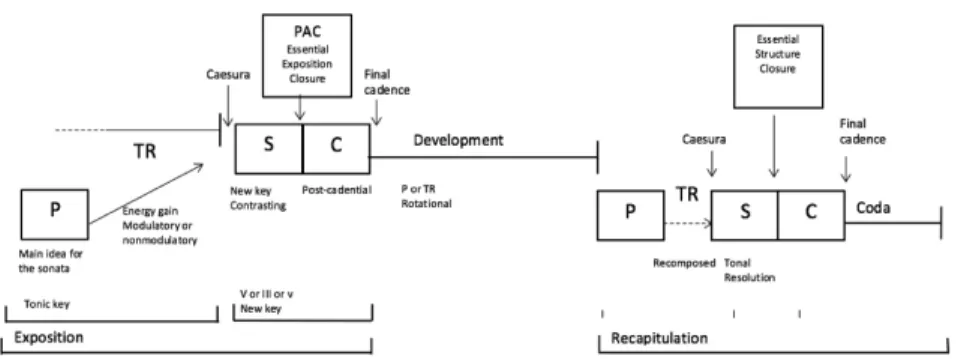
In its most typical form, the sonata is considered a binary structure composed of two parts: (1) the exposition and (2) the development and recapitulation. In fact, however, the binary structure can also be viewed as a formal space delineated into three major phases: exposition, development, and recapitulation, or a formal A || B A' type scheme. The exposition utilizes two strategies, one harmonic and the other thematic-textural, or as Hepokoski and Darcy argue, a rhetorical strategy. The harmonic strategy should define the tonal space of the tonic followed by a tonal transition to a secondary key. For works in a major key, the normative would be to modulate to the dominant (V), which functions as a means to create tonal tension. For works in a minor key, the transition would frequently modulate to a relative major (III), and less frequently to the minor fifth (v). The thematic-textural strategy provides an array of themes and textures on which the development and recapitulation sections are founded. The exposition begins by presenting the primary theme (P) in the tonic followed by a transition zone (TR) that presents a “gain in energy” and moves towards a caesura (MC) at about the middle of the exposition. The secondary theme (S) is in a new tonic, generally a dominant (V) if it is in a major key; or a relative major (III) or a minor fifth (v) if in a minor key. The secondary theme (S) moves towards the essential closure of the exposition characterized by a perfect authentic cadence (PAC). Follows an optional closing zone (C) that confirms the new tonic through perfect cadences, but can sometimes present elements connected to S. The development section elaborates
the thematic elements presented in the exposition. In general, the development section presents fragments of themes, harmonic sequences, and a general “modulatory” character, but transitions towards the dominant (V) (cf. CAPLIN, 1998: 139-159)10. The recapitulation resolves the tonal tension generated in the exposition by the dichotomy of keys of P and S. By restating the theme-textural elements (rhetorical) in the tonic, tonal conflict is resolved and the synthesis of the rhetorical presentation is accomplished. Although there are cases of reordering of the thematic material in some sonatas, the order of the exposition is respected. At the end of the recapitulation, one may find an (optional) coda. Considered by Schoenberg as an “extrinsic addition” (SCHOENBERG, 1967: 185), some codas can be classified, for example, according to Hepokoski and Darcy, as discursive and are known for being lengthy and may represent an extra closing of the main event, the sonata form11.
Figure 1, adapted from Hepokoski and Darcy (2006), schematically illustrates the principal formal elements of the typical sonata form discussed above. Figure 2, in its turn, illustrates the elements of the sonata form in Prométhée, op. 21. Comparing the standard form (Fig. 1) to Miguez’s symphonic poem there is an addition of an introduction (Lento), the deletion of the closing space (C, marked with dotted lines) of the essential closing of the exposition and the final cadence, which are replaced by a final cadence of the closing zone (C) (cf. Fig. 8). The primary and secondary themes are restated in the recapitulation section, however, the cadence does not occur at the end of C. Finally, the coda is organized in three different episodes.
Miguez’s symphonic poem is structured according to an adaptation of traditional sonata form. Thus, three aspects connect the work to the sonata form: (1) the resolution of a tonal dichotomy; (2) thematic duality, i.e. contrasting themes; and (3) a recapitulation section with the resolution of the tonal dichotomy. However, the process of defining the form of the work is not evident, being more indirect. Classical features of sonata form are not to be found, such as a repeated exposition and delimitations of themes through caesuras and cadences. In fact, the presentation of thematic ideas is often followed by sequential passages that obscure its particular formal function. Perhaps to compensate for
10 Schoenberg argues that the term “development” for this section is a misnomer. This term
suggests an idea of germination and growth, i.e., the development of new musical ideas. Consequently, he suggests Durchführung, thematic elaboration, as being more appropriate (cf. SCHOENBERG, 1967: 200, footnote 1).
11 Naturally, it is not our intention to profoundly discuss the subject of the sonata form. For
this work, an understanding of the basic structural elements of the form suffice. For a broader discussion of the sonata form cf. Hepokoski and Darcy (2006), chapter 2 (pp. 14-22) and chapter 13 (pp. 281-292); Hepokoski (2009); and Caplin (1998).
this lack of clear demarcation of formal functions, Miguez uses other types of strategies. For example, sections are delimited by tempo changes such as those between the introduction and exposition and between the primary and secondary themes, and also by cadential points (or cadential gestures). Miguez makes use of the same resources that Liszt uses to delimit the sonata form in Prometheus. Table 1 illustrates a comparison between the formal segmentation of Liszt’s Prometheus and Miguez’s Prométhée, op. 21 and suggests an intertextual rereading by Miguez of both the formal structure and the programmatic aspect of Liszt’s work12.
Fig. 1: Schematic presentation of generic layout of the sonata form, adapted from Hepokoski; Darcy
(2006: 17).
Fig. 2: Schematic presentation of the sonata form in Prométhée, op. 21 by Miguez.
12 Kaplan (1984) observes some of these characteristics of the sonata form in the orchestral
music by Franz Liszt. It is worth mentioning, however pertinent, that the focus of this text is not the discussion of the intertextual relationships between the works of Liszt and Miguez.
For m al s egm ent at ion of Pr om et he us by Fr anz Li sz t For m al s egm ent at ion of Pr om ét hé e, o p . 2 1 b y L eo p o ld o M ig u ez SEC T IO N /T EM PO IN T R O D U C T IO N (m m . 1 -47) 1. Al le gr o ene rg ico ed ag itat o as sai (m m . 1 -12) : Prom et heus mo tif 2. Ma es to so (m m . 1 3-26) : a nt ici pa tion of P 3. Andant e re cit at ivo ex pr es siv o m ol to (m m . 2 7-47) : r eci ta tive IN T R O D U C T IO N Len to (m m . 1 -73) 1. 1s t sect ion (m m . 1 -29) : pr es ent at ion of Prom et heus th em e 1; 2. 2nd sect ion (m m . 30 -40) : I m ita tio ns ; n ew th em e fo llo w ed b y its in ve rs io n 3. 3r d sect ion (m m . 41 -63) : I nt roduct ion of el em ent s of P; t ra ns iti on to the expos iti on of t he sona ta for m ( m m . 41 -63) EX PO SI T IO N Al le gr o m ol to apas sionat o (m m . 4 8-160) 1. P zone (m m . 4 8-83) : Pr om et heus t hem e, A m inor , s equent ia l pr es ent at ion, epi sode w ith doubl e peda l ( F/ E and B! /A ) a nd r ep re se nt at io n o f t he a tt ac k o f ea gl es ; epi sode w ith chr om at ic sca les in the ba ss ; Pr om et heus m ot if 2. T ra ns iti on (m m . 84 -128) : s equent ia l; pr es ent at ion of t he m ot if Pr om et heus ; re pre se ntati on Qu as i R ec ita tiv o 3. S zone (m m . 1 29 -159) : cont ra st ing t hem e; fl uct ua tes bet w een B! /D ! EX PO SI T IO N Al le gr o m ode rat o (m m . 6 4-211) 1. P zo ne (m m . 6 4-130) : Pr om et heus t hem e 2, ha rm oni c fluct ua tion bet w een A m in or /F " mi no r; s eq ue nt ia l e pi so de ; Pi ù ani m at o (m m . 1 31 -145) epi sode re pre se nti ng th e bi rds attack (vu ltu re s) 2. T ra ns iti on (m m . 146 -159) : m odul at ion to E ma jo r 3. Pi ù m oder at o (m m . 1 60 -211) : S zo ne (E ma jo r); th em e of th e O ce an id s, k ey: E ma jo r/C " mi no r; cadence for concl us ion (m m . 202 -211) DE VE L O P M E N T Al le gr o m ode rat o (m m . 1 61 -236) 1. Fu ga to (m m . 1 61 -185) 2. Poc o a poc o ac ce le ra nd o il te m po (1 86 -236) : f ra gm ent ati on of t he Fu ga to th em e; se qu en tial p re se ntati on ; re state m en t of t he Pr om et heus t hem e; r es ta te m en t of t he P sequent ia l DE VE L O P M E N T mm. 2 12 -291 1. Im ita tio ns ( m m . 2 12 -251) 2. P (m m . 252 -263) 3. Pi ù mo de ra to ( quas i Andant e) (m m . 2 64 -291) : No n ta nt o le nt o, Un po cc he tin o pi ù rav viv at o, P REC A PI T U LA T IO N (m m . 2 37 -) 1. A bbr evi at ed Int roduct ion (m m . 237 -268) : Tem po pr im o, P ro m eth eu s m otif a nd P w ith sequent ia l pres ent at ion; Andant e (re ci tati ve ) 2. Al le gr o m ol to appas sionat o (m m . 2 69 -299. 1) : Pr om et heus t hem e, A m inor , se qu en tial p re se ntati on , e pi so de w ith d ou bl e pe dal (F /E an d B! /A ) an d re pre se ntati on o f th e eagl e attack s; e pi so de w ith ch ro m ati c scal es in th e bass; Prom et heus m ot if 3. T ra ns içã o (m m . 299. 2-303) : a bbr evi at ed tr ans iti on, Pr om et heus m ot if 4. St ret to . P iù a nim ato (m m . 3 04 -322) : S zone , flu ctu ate s b etw ee n B /F " REC A PI T U LA T IO N Al le gr o m ode rat o com e pr im o (m m . 2 92 -418) 1. P (m m . 292 -349) : ha rm oni c fluct ua tion bet w een B m inor /F " mi no r 2. T ra ns iti on (m m . 350 -371) : ha rm oni c m odul at ion of A m inor t o A ma jo r 3. S (m m . 374 -418. 1) : ha rm oni c fluct ua tion bet w een A ma jo r/F " mi no r CO DA (m m . 3 22 -442) “ Second devel opm ent ” 1. Epi sode I ( m m . 322 -351) : V peda l 2. Epi sode II (m m . 352 -362) : Fu ga to mo tif 3. Epi sode III ( 363 -417) : el abor at ion of S; Pr om et heus m ot if 4. Epi sode IV ( m m . 418 -442) : f ina l f anf ar es a nd Pr om et heus r edem pt ion CO DA (m m . 4 18 -482) “ Second devel opm ent ” 1. Epi sode I ( m m . 418. 2-450) : i m ita tions 2. Epi sode II (m m . 451 -470) : el abor at ion of P 3. Epi sode III ( m m . 4741 -482) : re state m en t of th e Int roduct ion – Len to com e pr im a, in th e k ey o f A ma jo r, P ro m éth ée r ed em ptio n Ta b. 1: C om pa ris on of the for m al seg m ent at ion bet w een Li sz t’s Pr om et heus an d M igu ez’ s Pr om ét hée , o p. 2 1.
In Table 1, we initially observe the correlation of formal segmentation between the two works. In the introduction, the work of Liszt is divided into three sections defined by tempo changes. In Miguez’s work there are no tempo changes, but there is a structured subdivision with the presentation of new material. The first section presents the first theme of Prometheus, the second section is structured with a new theme followed by its inversion and imitation, and the third section introduces elements that make up P of the sonata form. In the exposition of the sonata form, the relationship between the two works is given by their common composing methods. Structurally, the work by Liszt presents P followed by a sequence and an episode representing the eagle attack. S is contrasting and harmonically fluctuates between B@ minor and D@ major. While in the work by Miguez, the composer uses in the presentation of P a harmonic fluctuation that revolves around A minor and F# minor, followed by a sequential episode and the Più animato episode representing the birds attacking Prometheus. S is characterized by a tempo change (Più moderato) and the fluctuations between E major and C# minor. The development section in the work by Liszt is mainly characterized by its long Fugato and by the elaboration of fragments of this Fugato theme. While in the work by Miguez, this section is characterized by successive segments of imitation in the strings and by two sections elaborating P. In the recapitulation section, both works correspond to the exposition of a sonata form including the proper resolution of tonal dichotomy. However, the final coda of both works presents final climactic episodes, a final fanfare in the work by Liszt and a restatement of the introduction in Miguez’s piece. Both represent the redemption of Prometheus as the hero of mankind. Thus, one can perceive a structural relationship between both works.
Observations of Whittall and Bailey on the characteristics of Wagner's musical language are also relevant to the analysis that follows. Whittall remarks on the inclusive role of tonality in the music of the second half of the nineteenth century as being inclusive, that is, in a specific tonic, in both major and minor modes, there is a principle in which a tonic and its major or minor parallel (A minor and C major, for example), can be combined into a single harmonic complex (WHITTALL, 1995: 281). In turn, Bailey summarizes tonal pairing as "the pairing together of two tonalities a minor 3rd apart in such a way as to form a “double-tonic complex”, and exemplifies it with an analysis of the first act of Tristan und
Isolde. Finally, Bailey concludes that “either triad can serve as the local representative of the
tonic complex. Within that complex itself, however, one of the two elements is at any moment in the primary position while the other remains subordinate to it” (BAILEY, 1985, 121-122). These two characteristics are present in the Miguez’s work and corroborates his Wagnerian influence, and hence the adoption of characteristics of German romantic
music13. In the analysis of the work by Miguez, will be illustrated aspects related to specific formal functions of the sonata form and the adaptation realized by Miguez, examples of harmonic complex, as well as examples of thematic development among the main themes of the piece.
To follow, a few aspects of the work will be illustrated. Firstly, examples of the floating tonal center between two poles referring to the primary and secondary themes. Secondly, sequential passages that are part of the thematic exposition zone and frequently used in the work. These characteristics corroborate, in part, observations of Wagnerian influence in Miguez’s work since they are characteristic procedures found in Wagner's music.
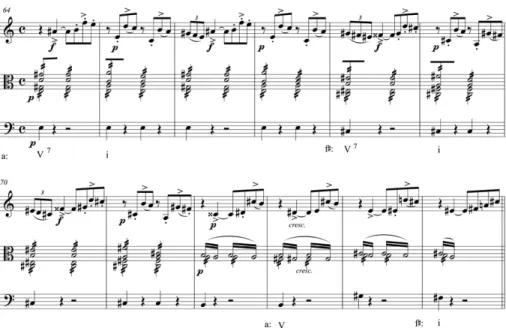
Fig. 3: Primary theme (m. 64-75).
13 Miguez’s use of the idea of the harmonic complex in the presentation of the primary theme
of Prométhée leads us to believe that the composer was attentive to harmonic methods that became characteristic of German music of the latter half of the nineteenth century.
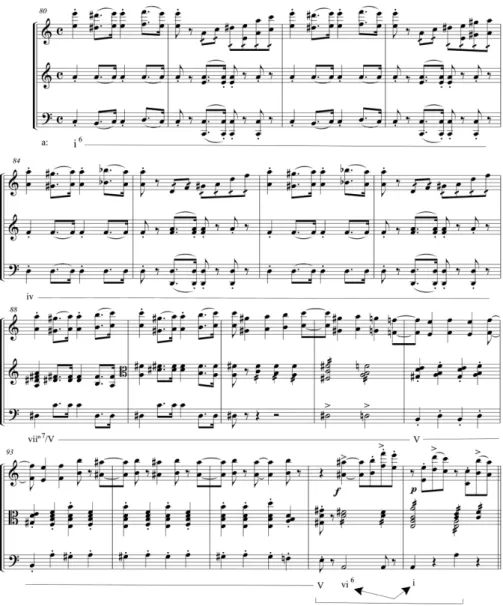
Figure 3 shows the main theme of the sonata form which is characterized by its diffused tonality, having no assertive clear tonal center. The constant harmonic fluctuation between A minor and F# minor demonstrates how the composer uses locally the method of harmonic complex. Following the exposition of the theme is an extensive sequential passage (mm. 76-95; cf. Fig. 4) that destabilizes the very notion of a primary theme as a traditionally treated structure, i.e., with well-defined tonality and form.
Figure 4 shows the first sequential passage that follows the presentation of the primary theme of the exposition. The sequence prolongs the harmonies i6–iv–viiº7/V–V–vi6– i. The passage between mm. 88-95 moves more directly to the dominant of A minor. Thus, the sequence characterizes a cadential progression of resolution that reaches the stable tonic in mm. 96-97, which is emblematic for concisely representing the harmonic complex, A minor/F# minor, and for the first time presenting the tonic, A minor, in root position in the exposition of the sonata form. Although the harmonic progressions are essentially diatonic, the chromaticism on the music surface is limited to ornamental notes, appoggiaturas and chromatic passing notes.
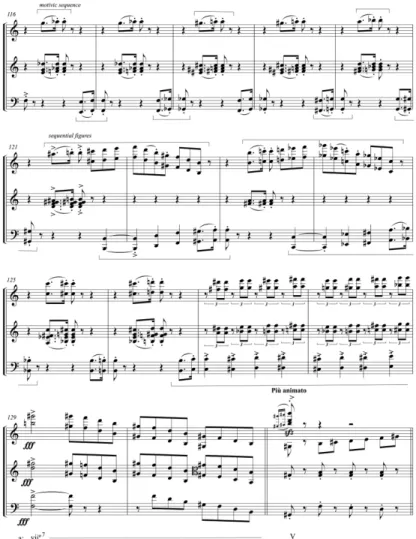
Figure 5 shows another passage which is characterized by motivic sequences. Although the elements that make up a phrase are fragmented, the passage is well driven to the dominant of A minor, however, it does not resolve to the tonic. The passage as a whole is characterized by motivic sequences, mm. 116-120, and by sequential figures, mm. 121-128, since they quickly change any reference to the tonic, they produce a temporary suspension of tonality. The passage, in regards to formal function, is close to the transition in the exposition of the sonata form, but is still part of the zone of P. The Più animato episode that follows is, within the work’s program, the attack of the birds (vultures) on Prometheus, and is followed by a transition to S in E major.
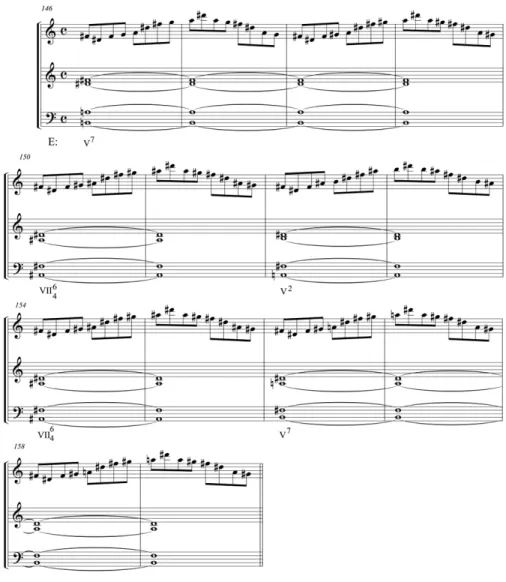
The transition to S is accomplished through a modulation to E major. Figure 6 shows the progression that projects a prolongation of V7 of the new key. This section shows a marked change of texture (strings and flutes), and of rhythmic movement: the strings sustain long chords while the solo flute performs eighth-note arpeggios. These modifications produce a formal functional closing required of the large zone of P and tonally, prepare the presentation of S through the modulating TR to E major, though characterized by a reduction in energy, instead of a gain, caused by the change in texture and tempo of S.
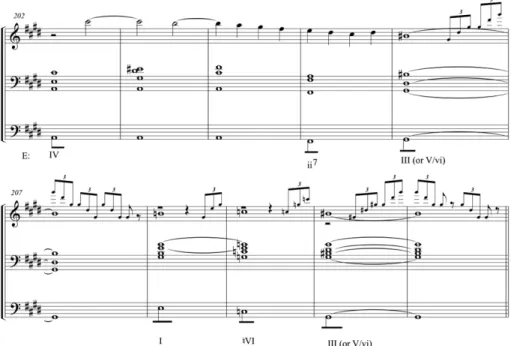
Figure 7 shows S of the sonata form: we see characteristics similar to those already mentioned. The theme is also tonally unstable and fluctuates between E major and C# minor forming a harmonic complex related by thirds. The contrasting theme represents the woeful song of the Oceanids and the flight of birds over Prometheus, represented by the figures in eighth notes. Figure 8 shows the end of the secondary theme (S) that ends with a cadential gesture based on the progression of A major - F# minor – G# major - E major - C major - G# major, a progression that sums up the importance of mediant relationships (to the distance of a third) used in the exposition of the sonata form. However, if this progression is classified in E major, it would read IV–ii7–III (or V/vi)–I–VI natural–III (or V/vi), a progression that presents no defining tonal cadence of tonal directionality or even the resolution of a secondary dominant (V/vi). Therefore, the passage is characterized more by its cadential gesture than by its tonal aspect. This cadential gesture replaces both the function of the closing zone (C) as well as the essential closing of the exposition. Therefore, the formal delimitation of the exposition of the sonata form is complete.
Fig. 8: Cadential gesture (mm. 202-211).
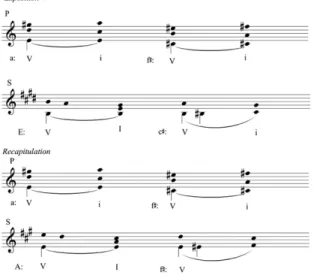
The resolution of the tonal dichotomy presented in the exposition is resolved during the re-exposition of P and S in the recapitulation section. According to Table 2, the harmonic complex A minor/F# minor of P is maintained as A minor/F# minor in the recapitulation, but the harmonic complex E major/C# minor of S is resolved as A major/F# minor in the recapitulation. Hence, the composer’s broad plan of the tonal complex is summarized in Table 2.
EXPOSITION RECAPITULATION
Primary theme A minor /F# minor è A minor/F# minor Secondary theme E major/C# minor è A major /F# minor
Figure 9 graphically illustrates a representation of the tonal complex in the exposition of the sonata form and its resolution in the recapitulation.
Fig. 9: Graphic summary of the tonal structure in Prométhée, op. 21.
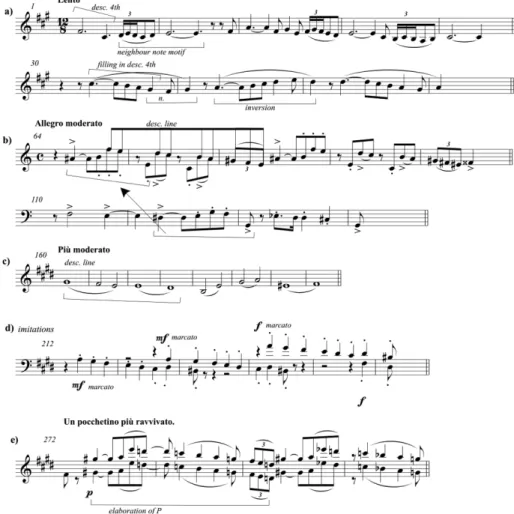
Finally, Figure 10 illustrates the main themes of the work and demonstrates aspects of the thematic work developed by the composer. Figure 10a illustrates the themes of the introduction: the first theme representing Prometheus (mm. 1-5), and a subsequent theme that is derived by filling in the interval of the descending fourth and by the use of a neighbor note motif and followed by the inversion of its initial phrase (mm. 30-33). Figure 10b shows the primary theme and its characteristic descending line, indicated by the prolonged beam (mm. 64-66). In m. 110, there is a small section of thematic embellishment, but is not developed by the composer. Figure 10c shows the secondary theme, which is the theme of woe of the Oceanids. In this theme, we observe its derivation from the descending line of P and also a development from the theme in mm. 30-31. In Figure 10d, the beginning of the development section, shows a fragment of a descending scale related to the descending line of P. Finally, Figure 10e shows an elaboration of P at the end of the development section.
Fig. 10: Thematic derivation of the main themes.
Concluding remarks
The symphonic poem by Miguez contains recurring characteristics of nineteenth-century German music that corroborate observations in respect to the composer’s aesthetic preferences. The choice of the genre “symphonic poem” for works that represent his republican political ideology, and the choice of the programmatic plot and its musical treatment reveal a mature composer and a keen observer of the music of his time. In the
sphere of influence endured by Miguez, we perceive a more direct relationship with
Prometheus by Franz Liszt through the similar formal structure of both works and the use of
a program and its musical realization. On the other hand, the Wagnerian influence experienced by Miguez seems to be more within general aspects of musical language, such as the use of the harmonic complex of thirds and the choice of sequential passages within the function of formal presentation. However, Miguez does not use thematic transformation as one of the methods to guarantee unity of the work. In fact, the work’s unity is characterized by the adaptation of the sonata form, which guarantees the structural and rhetorical coherency of the literary program.
References
ANDRADE, Clarissa Lapolla Bomfim. A gazeta musical positivismo e missão civilizadora nos
primeiros anos da República no Brasil. São Paulo: Editora UNESP, 2013.
BAILEY, Robert. An Analytical Study of the Sketches and Drafts. In: BAILEY, Robert (Ed.).
Wagner - Prelude and Transfiguration from Tristan and Isolde. New York: W.W. Norton, 1985.
p. 113-146.
BERTAGNOLLI, Paul. Prometheus in Music - Representations of the Myth in the Romantic Era. Aldershot: Ashgate, 2007.
CAPLIN, William E. Classical Form, a Theory of Formal Functions for the Instrumental Music of
Haydn, Mozart, and Beethoven. Oxford: Oxford University Press, 1998.
CORRÊA, Marcelo. Programa Orquestra Filarmônica de Minas Gerais - Prometeu, Poema Sinfônico. n. 3, op. 21. Não paginado. Belo Horizonte: Instituto Cultural Filarmônica, 2012. CORRÊA, Sérgio Nepomuceno Alvim. Leopoldo Miguez, catálogo de obras. Rio de Janeiro: Academia Brasileira de Música, 2005.
______. Alberto Nepomuceno: catálogo geral. Rio de Janeiro: Funarte/INM, 1985. DAHLHAUS, Carl. Nineteenth-Century Music. Trans: J. Bradford Robinson. Berkeley: University of California Press, 1989.
______. Between Romanticism and Modernism. Trans: Mary Whittall. Berkeley: University of California Press, 1980.
DOUGHERTY, Carol. Prometheus. Abingdon: Routledge-Taylor and Francis Group, 2006. DUDEQUE, Norton. Realismo musical, nacionalismo e a Série Brasileira de Nepomuceno.
Música em Perspectiva, Curitiba, v. 3, n. 1, p. 136-163, 2010.
GAZETA DA TARDE. Rio de Janeiro: Luiz Ferreira de Moura Brito, 1892. GAZETA MUSICAL. Rio de Janeiro: Alfredo Fertin de Vasconcellos, 1891-1893.
GOETHE, J. W. Poemas. Antologia. Trad. Português Paulo Quintela. Coimbra: Centelha, 1979.
KAPLAN, Richard. Sonata Form in the Orchestral Works of Liszt: The Revolutionary Reconsidered. 19th-Century Music. Berkeley, v. 8, n. 2, p. 142–152, Oct. 1984.
HEPOKOSKI, James; DARCY, Warren. Elements of Sonata Theory – Norms, Types, and Deformations in the Late-Eighteenth-Century Sonata. Oxford: Oxford University Press, 2006.
HEPOKOSKI, James. Sonata Theory and Dialogic Form. In: BERGÉ, Pieter (Ed.). Musical
Form, Forms, Formenlehre. Leuven: Leuven University Press, 2009. p. 71-89.
MAGALDI, Cristina. Music in Imperial Rio de Janeiro - European Culture in a Tropical Milieu. Lanham, Md.: Scarecrow Press, 2004.
______. Music for the Elite: Musical Societies in Imperial Rio de Janeiro. Latin American
Music Review, v. 16, n. 1, p. 1-41, 1995.
PEREIRA, Avelino Romero. Música, sociedade e política - Alberto Nepomuceno e a República Musical. Rio de Janeiro: Editora UFRJ, 2007.
SCHOENBERG, Arnold. Fundamentals of Musical Composition. Ed. Gerald Strang and Leonard Stein. London: Faber and Faber, 1967.
VERMES, Mónica. Por uma renovação do ambiente musical brasileiro: o relatório de Leopoldo Miguez sobre os conservatórios europeus. Revista Eletrônica de Musicologia, v. 8, 2004.
VOLPE, Maria Alice. Algumas considerações sobre o conceito de romantismo musical no Brasil. Brasiliana - Revista da Academia Brasileira de Música, v. 5, p. 36-46, 2000.
WAGNER, Richard. Richard Wagner’s Prose Works. Trad. Inglês: William Ashton Ellis. 2 ed. London: Kegan Paul, Trench, Trübner & Co., LTD., 1907 [1857].
WHITTALL, Arnold. A linguagem musical. In: MILLINGTON, Barry (Ed.). Wagner, um
compêndio. Rio de Janeiro: Jorge Zahar Editor, 1995, p. 277-293.
. . .
Norton Dudeque has a Master’s in Music Performance - University of Western Ontario
(1991), a Master’s in Musicology -- University of São Paulo (1997) and a Doctorate in Music - University of Reading (2002), and post-doctorate at King’s College, KCL, London, Great Britain. He is currently Associate Lecturer at the Federal University of Paraná. He works in the area of theory and music analysis, mainly on the following topics: theory and music analysis, Brazilian music of the Romantic period, and the music of Heitor Villa-Lobos. [email protected]