The evaluation of the “Triple Jump” Method applied to
students of Medical school
A avaliação do método “Salto Triplo” aplicado a estudantes do curso de Medicina Isaac Farias Cansanção1, Diogo Vilar da Fonseca1,
Bruno Mello de Matos1, William Novaes de Gois2, Thayze Teixeira Melo Nunes Martins2,
Anekécia Lauro da Silva1, Joilda Silva Nery1, Matheus Rodrigues Lopes1,
Natália Gomes de Morais1
Universidade Federal do Vale do São Francisco, UNIVASF, Paulo Afonso-BA, Brazil
Abstract
The present article aims to report an experience of tutors in performing a triple jump by evaluating the methodology of Problem-Based Learning (PBL) in a group of 37 students of the second period of a medical school of the Universidade Federal do Vale do São Francisco - UNIVASF, campus Paulo Afonso, Bahia, Brazil.The “triple jump” occurred in a daylight period, and was divided into three tutorial groups of nine students, a group of ten students and eight tutors. The problem situation was prepared by the tutors involved and all students were previously informed about the methodology applied. The assessment was divided into three stages (1-presentation of the problem; 2- individualized study; 3- Oral Presentation). In the end of the triple jump, it was applied an evaluative questionnaire and the 27 students had consented previously to fill them out. The students who participated in this application were able to quickly identify the learning objectives (94.6%). However, a small part of the participants (about 5%) suggested modifications on the time used to complete all the steps of the “Triple Jump”.The reported experience consolidate this evaluative tool has formative character and effective way in the measuring the teaching-learning process of students in health care in PBL methodby improving their educational background.
Keywords: Higher education. Problem-based learning. Evaluation.
Resumo
O presente artigo tem como objetivo relatar a experiência vivenciada por tutores na realização de um salto triplo avaliando a metodologia de Aprendizagem Baseada em Problemas (ABP) em um grupo de 37 estudantes do segundo período do curso de medicina da Universidade Federal do Vale do São Francisco-UNIVASF, campus de Paulo Afonso, Bahia, Brasil. O “salto triplo” ocorreu em um período diurno, e foi dividida em três grupos de tutoria de nove alunos, um grupo com dez alunos e oito docentes. A situação-problema foi elaborada pelos tutores envolvidos e todos os estudantes foram previamente informados sobre a metodologia aplicada. A avaliação foi dividida em três etapas (1-apresentação do caso clínico; 2-Estudo individualizado; 3-Apresentação oral). No final do salto triplo, ainda foi aplicado um questionário avaliativo e 27 alunos consentiram em preenchê-lo. Os estudantes que participaram desta aplicação
1 Ph.D. Professor of the medical course of the Universidade Federal do Vale do São Francisco - UNIVASF. E-mail: [email protected]
674 Joilda Silva Nery, Matheus Rodrigues Lopes, Natália Gomes de Morais
conseguiram identificar com rapidez os objetivos de aprendizagem (94,6%). No entanto, uma pequena parte dos estudantes participantes (cerca de 5%) sugeriram modificações quanto ao tempo estipulado para cumprimento das etapas do método. A experiência relatada reforça que esta ferramenta avaliativa tem caráter formativo eficaz na mensuração do processo de ensino-aprendizagem dos estudantes na área da saúde que estudam com ABP, aperfeiçoando sua formação educacional.
Palavras-chave: Ensino superior. Aprendizagem baseada em problemas. Avaliação.
Introduction
Higher education schools in Brazil have historically been based on the use of traditional methodologies, with strong Cartesian and Jesuitic influence, in pursuit of a technical, expert, and fragmented, education (CAPRA, 2006; SHIGUNOV NETO; MACIEL, 2008).
Facing increasing access to new technologies, a lack of interest on the part of students for studies has been evidenced, which may be associated to the inefficiency of the teaching-learning environment in various schools of higher education (SANTOS; SOARES, 2011). In addition, in the area of health, major dilemmas to be won in the formation of future professionals are the disease-patient relationship, and possibilities for associating and troubleshooting various health issues (MITRE et al., 2008).
In recognition of this, current education should envisage students as able to auto-didact knowledge and employ their autonomy in the education process (MITRE et al., 2008). Within this theme, the use of active methodologies is a good tool in the search for critical sense in the face of the learned, such that the student acquires skills and attitudes, correlating this new knowledge to the real world (PINTO et al., 2012).
Among the active methodologies, problem based learning (PBL) is one of the tools that work with problem-situations delivering improvements in teaching and learning. The students, observing reality through reflective exercises, divide their prior knowledge in a group, support their scientific information, and, finally, apply the theoretical reality to the practice in two pre-programmed moments (opening and closing tutorial sessions) (XAVIER et al., 2014).
PBL is a methodology that can be verified by applicable tools to ascertain the method’s quality (SORDI, 2000). Among these, “triple jump” is one of the possible instruments used to measure the quality of the tutorial sessions, and the student’s level of knowledge acquisition, through a tutorial simulation divided into three distinct stages.
The “triple jump” evaluative exercise was proposed in accordance with Echavarria (2010), supported in Painvin et al. (PAINVIN et al., 1979), as well as Powles et al. (POWLES et al., 1981), being composed of three steps. The first is to discuss the learning objectives necessary to solve a particular problem. The second step is to study the necessary content for learning the goals raised, and to discuss the information found. The third step is to evaluate knowledge gained through autodidactic learning and the skills gained through the resolved problem. (ECHAVARRIA, 2010).
Although in Brazil several medical schools use this tool for evaluation of the teaching-learning process, there is still a lack of scientific reports demonstrating the use of this exercise, and whether some variation of this method was successful
GONTIJO et al., 2015).
In this context, this article aims to evaluate the experience report conducted by medical professors of Universidade Federal do Vale do São Francisco -UNIVASF, in the realization of a “triple jump”, evaluating PBL for second period students of the Medicine Course on the Paulo Afonso campus, Bahia.
Methodological procedures
The experience of “triple jump” in the Paulo Afonso campus medicine course was performed in mentoring activities in the second period, in the first half of 2016, with a course load of 180 hours.
The class (37 students) was divided into three nine student mentoring groups, and a group with ten students, as advocated by PBL for a small student number in each tutorial room. The eight teachers were characterized as tutor and co-tutor and forwarded to each mentee group.
The “triple jump” evaluation occurred on a tutorial day, with the objective of analyzing each student for knowledge acquired using the method of learning in the mentoring activity. The students were informed in advance that the assessment was a tool for the evaluation of the active learning methodology, receiving detailed information on the procedures before its implementation.
It is worth pointing out that the problem was previously elaborated by the teachers, involving new themes of knowledge, yet using subjects that were easy to learn, and reducing the number of learning objectives. After an oral presentation held by the tutor reiterating the process and the steps of the evaluative exercise, the situation problem was presented to the students. The assessment was divided into three stages: first the student would analyze the problem individually, articulating the steps of the mentoring activities (KOMATSU; LIMA, 2003). In this step, each student had one hour to state the scenario of the opening tutorial.
In the second step, students had one hour to learn the objectives as stated in the previous step (time of self-directed study-TEAD). Finally, in the last step, each student individually re-discussed the problem coming from the new knowledge acquired through an oral discourse (estimated time of five to ten minutes), demonstrating their ability to synthesize the information and addressing the steps of closing a tutorial session.
All three stages were assessed by a tutor and co-tutor, and a routine for evaluation of the different stages of the “triple jump” was drafted. In the first step, we analyzed the ability to identify issues, drafting a synthesis of the brainstorming, and the establishment of the learning objectives. In the third step, we evaluated the use of consistent bibliographic references, the capacity of ideas synthesis, and the power of student discussion, key processes for satisfactorily acquiring knowledge in courses with active methodologies of learning.
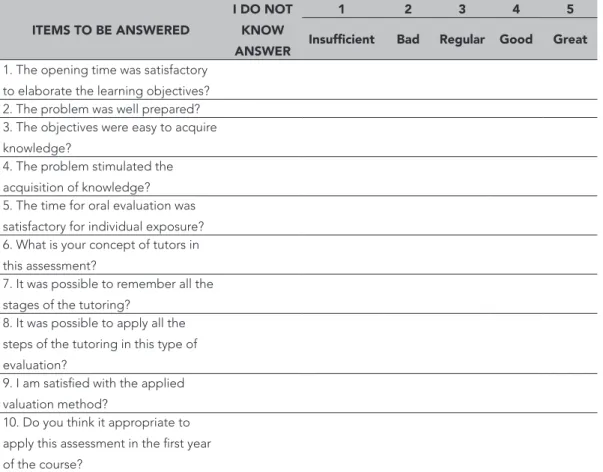
At the end of the “triple jump”, a questionnaire was applied in order to evaluate by students the implementation of the methodology, the stimulus in the teaching-learning process, and the use of all recommended steps in a mentoring programs (Table 1).
676 Joilda Silva Nery, Matheus Rodrigues Lopes, Natália Gomes de Morais
Results and discussion
In the evaluation performed by tutors, 94.6% of the students were considered having satisfactory learning (considering concepts 4 and 5) of the stages evaluated, and only 5.4% were considered as having poor learning in the “triple jump”exercise.
With regard to the questionnaire applied to students, 27 (72.9%) evaluated the application of this tool, shown in Figure 1. Among items responded, 81.5% assessed as “great” for preparation of learning objectives, while 18.5% considered “good”. 63% stated the problem as well prepared (good) and 37% entered top mark for the problem used. Also, 92.6% of students judged that the applied problem stimulated the acquisition of knowledge, being concepts 4 and 5 at the same time. A striking factor was that 100% of the students mentioned the fact of rememberance of all steps of the tutorial session in this assessment (considering both concepts 4 and 5 simultaneously). In addition the level of satisfaction with the assessment applied, was asked, and 48.2% stated that the concepts were good or very good. It is worth mentioning that the other concept 3 (regular) was voted at 51.8%. Finally, in the evaluation of the tutor as regarded by the students, 18.5% of responses rated them as good, and 81.5% great.
Although there have been some updates to the Curriculum Guidelines of medical courses in Brazil (BRASIL, 2001; BRASIL, 2014), the majority of medical schools are still appropriating and adapting to active methodologies in their own curricula, as an example, the PBL methodology.
Table 1: Questionnaire used by professors to carry out the evaluation of students’ performance in the “triple jump”
ITEMS TO BE ANSWERED
I DO NOT KNOW ANSWER
1 2 3 4 5
Insufficient Bad Regular Good Great
1. The opening time was satisfactory to elaborate the learning objectives? 2. The problem was well prepared? 3. The objectives were easy to acquire knowledge?
4. The problem stimulated the acquisition of knowledge? 5. The time for oral evaluation was satisfactory for individual exposure? 6. What is your concept of tutors in this assessment?
7. It was possible to remember all the stages of the tutoring?
8. It was possible to apply all the steps of the tutoring in this type of evaluation?
9. I am satisfied with the applied valuation method?
10. Do you think it appropriate to apply this assessment in the first year of the course?
And to evaluate the PBL, the tool called “triple jump” is intended to evaluate the efficiency of the tutorial methodology in the learning process, planning corrections to the learning route for students in a formative character (PAINVIN et al., 1979; BLAKE et al., 1996 TRONCON, 2007).
In this line of thought, Rangachari (2002) suggested that “triple jump” is an exercise which stimulates the process of scientific teaching and designs a better approach to the practice of learning exercises within graduate studies. In addition, participants demonstrate that such assessment assists the process for both teacher and student, improving the educational reality which guides the orientation and the practical training of students.
Other versions of “triple jump” have already been applied in foreign universities, changes having occurred, originating in the methodology used by McMaster University, since the 1970s (PAINVIN et al., 1979; RANGACHARI, 2002). Examples of such variations are tests developed in the medical schools of the University of Hawaii (SMITH, 1993) and Vanderbilt University (BHUTIANI et al., 2016), where clinical questionnaires and goals are being inserted into the last step of the method.
Thus, the “triple jump” evaluative exercise was useful in the evaluation of the main points used in tutorials for teaching, and in the identification of variables between the groups that might hinder the acquisition of knowledge during the current period. This process was important for evaluating the presence of deviations in the learning process, and for pedagogical construction of route corrections for teaching/learning in the class or for certain specific students.
It is important to highlight that students involved in this exercise were able to identify the learning objectives with the themes addressed in the problem situation. However, part of the group evaluated (approximately 5%) showed the need for a longer TEAD time to gain further knowledge and gain greater confidence for oral assessment.
Final considerations
The reported experiment reinforces that this tool is active and effective in the teaching-learning process of the medical students who study with active methodologies in PBL. However, we found some methodological limitations concerning the still
678 Joilda Silva Nery, Matheus Rodrigues Lopes, Natália Gomes de Morais
restricted amount of diversified literature made available by the campus libraries, as well as in the choice of scientific sources, mainly, those available on the internet.
The method is formative in character, since the tutors can critically analyze their group of students and correct possible irregularities in interpretation and depth of knowledge acquired, preparing their group for a more comprehensive and continuous process of education.
References
BHUTIANI, M. et al. Triple-jump assessment model for use of evidence-based medicine. MedEdPORTAL
Publications., v. 12, n. ID: 10373, 2016.
BLAKE, J. M. et al. Introducing progress testing in McMaster University’s problem-based medical curriculum: psychometric properties and effect on learning. Acad Med, v. 71, n. 9, p. 1002-7, Sep 1996.
BRASIL. Ministério da Educação. Conselho Nacional de Educação. Câmara de Educação Superior. Resolução
nº 3, de 20 de junho de 2014. . Brasília (DF): Ministério da Educação; 2014. Institui Diretrizes Curriculares
Nacionais do Curso de Graduação em Medicina e dá outras providências. Disponível em: <http://portal.mec.gov. br/ index.php?option=com_docman&view=download&alias=15874-rces003-14&category_slug =junho-2014-pdf&Itemid=30192 >. Acesso em: 11 de agosto de 2016.
BRASIL. Ministério da Educação. Secretaria de Educação Superior. Diretrizes Curriculares para os Cursos de Graduação. Resolução CNE/ CES Nº 3, de 7 de novembro de 2001. Disponível em: < http://www.mec.gov. br/sesu/diretriz.htm >. Acesso em: 11 de agosto de 2016.
CAPRA, F. O ponto da mutação: a ciência, a sociedade e a cultura emergente. Cultrix: São Paulo, 2006. ECHAVARRIA, M. V. Problem-based learning application in engineering. Revista EIA, p. 85-95, 2010.
GONTIJO, E. D.; ALVIM, C. G.; LIMA, M. E. C. D. C. Manual de avaliação da aprendizagem no curso de graduação em Medicina. Rev. Docência Ens. Sup., v. 5, n. 1, p. 121, 2015.
GRISI, S. J. F. E. A avaliação e o processo de formação do médico. Pediatria, São Paulo, v. 26, n. 4, p. 217-218, 2004. KOMATSU, R. S.; LIMA, V. V. Manual Famema 2003. Marília: Faculdade de Medicina de Marília, 2003. MITRE, S. M. et al. Metodologias ativas de ensino-aprendizagem na formação profissional em saúde: debates atuais.
Ciênc Saúde Coletiva, v. 13, n. Suppl 2, p. S2133-44, 2008.
PAINVIN, C. et al. The “triple jump” exercise - a structured measure of problem solving and self directed learning.
Annu Conf Res Med Educ, v. 18, p. 73-7,1979.
PINTO, A. S. S. et al. Inovação didática - Projeto de reflexão e aplicação de metodologias ativas de aprendizagem no ensino superior: uma experiência com “peer instruction”. Janus: Lorena, v. ano 6, n. 15, p. 75-87, 2012.
POWLES, A. C. et al. The “triple-jump” exercise - further studies of an evaluative technique. Annu Conf Res Med
Educ, v. 20, p. 74-9, 1981.
RANGACHARI, P. K. The TRIPSE: A process-oriented evaluation for problem-based learning courses in basic sciences. Biochemistry and Molecular Biology Education, v. 30, n. 1, p. 57-60, 2002.
SANTOS, C. P.; SOARES, S. R. Aprendizagem e relação professor-aluno na universidade: duas faces da mesma moeda. São Paulo: Est. Aval. Educ., v. 22, n. 49, p. 353-370, maio/ago 2011.
SHIGUNOV NETO, A.; MACIEL, L. S. B. O ensino jesuítico no período colonial brasileiro: algumas discussões.
Educar em Revista, p. 169-189, 2008.
SMITH, R. M. The triple-jump examination as an assessment tool in the problem-based medical curriculum at the University of Hawaii. Acad Med, v. 68, n. 5, p. 366-72, May 1993.
SORDI, M. R. L. Problematizando o papel da avaliação da aprendizagem nas metodologias inovadoras na área da saúde. Revista de Educação PUC-Campinas, v. 9, p. 52-61, 2000.
TRONCON, L. Utilização de pacientes simulados no ensino e na avaliação de habilidades clínicas. Medicina
Ribeirão Preto, v. 40, n. 2, p. 180-191, 2007.
WATANABE, L. M. Manual de avaliação: curso de Medicina. Brasília: Fundação de Ensino e Pesquisa em Ciências da Saúde, 2002. 86p.
XAVIER, L. N. et al. Analisando as metodologias ativas na formação dos profissionais de saúde: uma revisão integrativa. SANARE, v. 13, n. 1, p. 76-83, 2014.