Repositório ISCTE-IUL
Deposited in Repositório ISCTE-IUL:
2019-05-09
Deposited version:
Publisher Version
Peer-review status of attached file:
Peer-reviewed
Citation for published item:
Mendes, P. (2018). Atelier da Rua: a participated street design strategy. Journal of Architecture and
Planning. 18 (1)
Further information on publisher's website:
http://www.architecture.url.tw/index.html
Publisher's copyright statement:
This is the peer reviewed version of the following article: Mendes, P. (2018). Atelier da Rua: a
participated street design strategy. Journal of Architecture and Planning. 18 (1). This article may be
used for non-commercial purposes in accordance with the Publisher's Terms and Conditions for
self-archiving.
Use policy
Creative Commons CC BY 4.0
The full-text may be used and/or reproduced, and given to third parties in any format or medium, without prior permission or charge, for personal research or study, educational, or not-for-profit purposes provided that:
• a full bibliographic reference is made to the original source • a link is made to the metadata record in the Repository • the full-text is not changed in any way
The full-text must not be sold in any format or medium without the formal permission of the copyright holders.
Serviços de Informação e Documentação, Instituto Universitário de Lisboa (ISCTE-IUL) Av. das Forças Armadas, Edifício II, 1649-026 Lisboa Portugal
Phone: +(351) 217 903 024 | e-mail: [email protected] https://repositorio.iscte-iul.pt
VOL.18 NO.1,pp. 01-20
街道工作室:一個共同參與的街道設計過程
Pedro Mendes1摘要
街道是城鎮結構中的關鍵要素。儘管這項結構性、生活化的城鎮要素有著至關重要性,當代 葡萄牙街道的現狀特點卻是在許多街道的建設、使用及維護上缺乏投資。此外,人們注意到當地 政府在解決與街道相關的市民日常生活問題以及觸及分散性的公民結構上的困境。這些都是在小 型的、本土規模的建築項目中會遇到的問題。共同參與的項目方法通過對現有困境的理解觸及這 些問題,並提倡新的方法以解決這些難題。本文在(Atelier da Rua)街道工作室研究範圍內完成, 聚焦于滿足當代在街道公共空間管理干預方面的需求。方法論假設應用了街道工作室戰略以提升 社區生活品質。本文旨在探索街道工作室方法論(Pita, 2014 b)與「合作夥伴」關係價值(Arnstein, 1969)的結合。 關鍵詞:本土、街道工作室、公共空間、街道、合作夥伴1
ISCTE-University Institute of Lisbon, DINÂMIA’CET-IUL
2
Atelier da Rua: a Participated Street Design Strategy
Pedro Mendes
ISCTE-University Institute of Lisbon, DINÂMIA’CET-IUL.
Abstract
Streets are key elements on the city urban structure. Despite the importance of this structural and living urban element, the contemporary Portuguese situation is characterized by the lack of investment in the realization, use and maintenance of many streets. Moreover it is noted local authorities’ difficulties to communicate with citizen everyday life problems within the street, and to approach diffuse civic structures. These are some of the problems encountered in small and local scale architectural projects. Participated project processes tackle these issues through the understanding of the existing problems and promoting new processes to face them. This paper is done in the research scope of Atelier da Rua (Street Atelier) focused to meet contemporary needs of intervention in the street public space. The methodological hypothesis applies Atelier da Rua strategy to improve community living. This paper aims to explore the combination of Atelier da Rua (Pita, 2014 b) methodology and the values of a “partnership” relation (Arnstein, 1969).
1. Introduction
According to the National Association of City Transportation Officials (Baily, 2013), street comprise 80% of the public space in the cities. Its importance in the physical structure and everyday life of the city is crucial in physical, environmental quality and sustainability of public space. The street is a privileged civic and societal civic space. Street urban space is particularly important in the city structure as a cultural, economic and environmental resource. The living experience and transformation of the street is the result of a complex interaction of the various actors involved. Local administrations and decision makers, street users, inhabitants and stakeholders are some of the participants involved on the complex process of street public space intervention. The development of an intervention deals with the combination of diverse elements: existing plan, buildings and constructions, green structures, infrastructures, etc.
The recent financial crisis has underlined the failures of a system of intervention in the public space as dependent on political power and public investment (Bourdin, 2011). In recent years Portugal witnessed a general reduction in resources available for public works. Following a government commissioned demand, University do Minho conducted a study about municipal investment reduction. The level of municipal investment dropped 74% from 2001 to 2014. During this period the largest investment fall occurred before the Portuguese adjustment program of the troika. Between 2010 and 2014 the lowering of investment situated on 39%, but in absolute terms the reduction was sharper in previous years, starting at the beginning of the decade (Esteves, 2015).
The reduction on the available budget has direct repercussions in promoting public works and maintenance of street public space. This fact leads to situations of stagnation and degradation of environmental quality of public space. On the other hand we are witnessing a growing civic consciousness about the limitations of local government capacity to respond to the needs and problems that arise in day-to-day citizen life. This awareness is associated with the economic crisis and the dissociation between citizens and the political power. The difficulties of communication and interaction between citizens and political power are accentuated by the ineffectiveness of planning instruments set. At the basis of this problem there is a representation deficit. Citizens do not identify with their decision-makers and decision-makers are unable to establish effective means of sharing their decisions. Considering the municipality of Cascais where participative processes have been successfully implemented it turns out that the number of voting citizens for local elections has consecutively decreased from 2009 on. In the other direction the figures for abstention show an increase tendency (Pordata, 2015).
4
Looking for solutions to fill the gap of citizen involvement in decisions about the planning of public spaces, local authorities launched initiatives such as the Orçamento Participado (Participatory Budget). Referring to the case of the Municipality of Cascais, the focus is placed on the idea of strengthening the participation of citizens in the definition of budget priorities. The total budget available for the program is Eur 1, 5 million/year to be applied in projects that do not exceed 300 000 euros (Cascais, 2015a).
This instrument, spread among various municipalities in Portugal, aims to create a proximity scale and stimulate civic participation of citizen. It represents an attempt to overcome the problems of communication and involvement of citizen in local governance decisions. The process comprises a collection of proposals presented by citizens to a municipal working committee. The multidisciplinary committee legitimates and selects the proposals to be submitted to popular vote. The voting process is held by mobile phone application, a large range access technology. Citizens are consulted on the solution to be implemented, but the development of the project rests under the domain of political power. We are facing what Arnstein (1969) classifies as tokenism. Citizens are heard and informed but do not have the power to ensure that their prospect will be fully answered. The level of participation is on the 3rd and 4th level, which corresponds to Informing and Consultation respectively. These levels of participation do not introduce significant changes on the status quo. The participatory process is focused on the consultation of the existing problems and informing of the selected proposals to be implemented. Still, development of architectural design decisions still under the control of the local authority. However the popular involvement on the Participatory Budge of Cascaist is significant. In 2014 the number of voters for the project proposal selection reached 41 005 votes (Pincha, 2015). Looking at the 2013 municipal election (Cascais, 2015b) there were 65 546 voters of a total of 172 537 registered voters. Considering that the political coalition elected (PPD-PSD / CDS- PP) had 26 455 votes, there is a larger number of voters (plus 14 550) on the Participatory Budget process.
The trigger of this research arises with the creation and participation of Atelier da Rua on Ideias de Origem Portuguesa (Ideas of Portuguese Origin) an initiative of Fundação Calouste Gulbenkian. This competition looked for relevant projects on social entrepreneurism created by the recent Portuguese emigration. Atelier da Rua (Pita, 2014a) was one of the finalists with a working team composed by a three generation group of Portuguese architects, offering multidisciplinary academic experience along with professional skills2.
2 The founding group of Atelier da Rua crosses their academic and professional courses at ISCTE - University Institute of Lisbon.
Two of the elements are teachers and researchers, the other two were formed in the institution. The professional experience of the group is developed in Lisbon, Paris and Rotterdam, covering different areas and scales in the field of architectural design.
The research followed addressing the issue of improving the process of street design, gathering better, happier and engaged public spaces for and with the citizen (Jacobs, 1962). Atelier da Rua arises with the prospective goal to find specific and concrete answers to the following questions:
What alternatives can be offered to current dominant participation models of intervention on street public space?
The participation of citizens and their representatives on the development of an urban or building design solution gathers a unanimous agreement of all the agents involved (Arnstein, 1969). Although, this foundation stone of a representative democracy frequently derives to other paths and practices that lead to inefficient results concerning the adjustment of the proposal to the users and their expectations. This gap on the fitness between the purpose of a street project and the expected success of the results (Alexander, 1964) is in many situations, in the Portuguese context, related to difficulties on establishing a cooperation process between the various intervenient involved along the process (Bourdin, 2011). In these situations it remains a difficulty to establish a common and comprehensive dialogue between the various stakeholders along the project process and on the use of public space. A dialogue that can gather the different agents - local administrations, technicians and decision makers, street users, inhabitants and stakeholders - in an effective sharing of the decision process and responsibility.
The methodology proposed by Atelier da Rua aims to establish a cooperation platform that is able to involve and put in dialogue citizen, stakeholders, design experts, local and regional political entities. Through this process it is expected an improvement in planning and design results concerning the street public space. It also promotes the empowerment of local communities on the work execution and their involvement in a “partnership” (Arnstein, 1969) relationship. To reach the rung 6 of the “Ladder of Citizen Participation” may seem a reduced ambition assumption. Although for the Portuguese context we identified this step of empowerment of the citizens towards the effective sharing of power decision as a crucial one. Atelier da Rua participates on the partnership process as mediator and supplier of technical skills (Wates, 2014). This enables the real possibility to redistribute the power between citizens and authorities (Arnstein, 1969).
In this paper is discussed the participated design methodological approach of Atelier da Rua, created in order to develop improvements to conventional design approaches. This article is organized into three major parts. Firstly it is explored a conventional architectural design methodology. The approach is grounded on Giancarlo de Carlo text -“An Architecture of the Participation” – that classifies it is as an authoritarian methodology. In the second part Atelier da Rua design methodology is exposed. This part is subdivided along the three phases that compose the methodology: Phase 1 Participated sketch, Phase 2 Participated project and Phase 3 Participated working site. On the third part is presented an implementation process located in Lisbon, Rua do Salvador.
6
2. Authoritarian methology
Before addressing the proposed methodology by Atelier da Rua, it is relevant to go through the methodological processes commonly used for a public promoted architectural project. This methodology it is classified, according to Giancarlo de Carlo, as authoritarian (Carlo, 2010) Design process is defined through different phases of development and implementation of an architectural project. The architectural project is understood, in this article, through a wide scope of view. Urban and built elements, the city structure and its buildings are inseparable universes and part of the whole which is the city (Rossi, 1977).
“An Architecture of the Participation” is the title of an article that, Giancarlo de Carlo wrote in the Perspecta: Yale Journal, in 1980. The article approaches different phases and procedures of project methodology. In a simple and clear perspective the project methodology is addressed on the distinction between an authoritarian planning and a participative approach. According to Carlo (2010), the project methodology is defined in three main phases. The first phase is focused on the problem definition. The second corresponds to the development of the project, and the third relates to the evaluation of results.
The authoritarian methodology is characterized by a rigid sequence of the different phases. The articulation between the different stages is reduced and at the end of the second phase (design) the project is mostly completed. This type of approach is commonly used in the development of architectural projects. It is characterized by being carried out in separate phases in which the results of each phase little interfere with each other. On the other hand the design process is highly centralized in the design phase of the project. The designer, the political power and their technicians assume the central role and monopolize the decision process. This way aesthetic and use issues are taken for granted and imposed to a wider group of citizens. In a certain way the users and the use associated to the project end up having a reduced influence on the final result (Carlo, 2010). It is a level 3 (Informing) of tokenism (Arnstein, 1969). Citizens are just informed of the result. The decision-making is kept in the sphere of the political power and the designers. It is an authoritarian approach, centered on the design process of the project, focusing on policy-makers (Carlo, 2010) and designers.
It is now necessary to detail each stage of the authoritarian methodology. The problem definition phase starts with the project commission and the context (Alexander, 1977) data collection. At this stage the proceedings fall into an intuitive and non-systematic approach of gathering information. The selection of data and the definition of problems are strongly centered on the designer and policy maker options. The defined goals are taken for granted and the possibility of an expanded discussion with the users is excluded. The issue subject to be discussed is centered on the
costs of the operation, technique and aesthetics aspects. The prospect of future users is rarely considered or subjugated to the interests of political power or the designer's idea.
The stage of project design development runs since the presentation of the first intervention proposals to the conclusion of the project construction. Throughout this period the project is regarded as an absolute entity that responds to the principles set out by the designer (technician) and the public developer. The scope for changes is scarce. In case of inadequacy, minor changes are introduced or in extreme cases the solution can be rejected and replaced by another proposal. If the promoter accepts the project, the work will be executed and delivered to their users. Sometimes future users are different from those that initiated the project process. However the project keeps unchanged. The users have a small share of influence in the drafting of the project and in the final solution to be built. The knowledge potential of all the involved actors in the process is not fully explored.
The third phase focuses on the evaluation, most often a neglected moment. The final work tends to be considered and evaluated exclusively from the aesthetic point of view. The subjective dimension overrides the rational and objective approach. The objective issues accessed focus mainly on financial aspects related to the cost of the work. The overvaluation of the aesthetic and financial components leads to a deterministic perspective. The process as an integrated whole is neglected. The end result is not the result of a broad outlook process, but rather an isolated case that responds to the will of political power and the designer intentions. This corresponds to Giancarlo di Carlo (2010) definition of authoritarian planning.
3. The Atelier da Rua proposed methodology
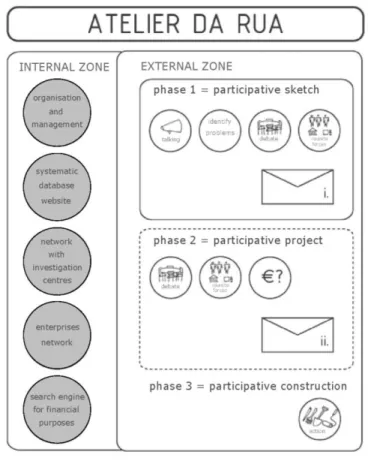
Reacting to a liberal urbanism which has characterized the last three decades with a lack of place for a scientific approach, multiplication of actors and power holders, generating too complex, unclear and incomprehensible operations and languages (Bourdin, 2010), Atelier da Rua aims to establish an operative methodology to be implemented. This methodology responds to the current Portuguese context where economic resources are scarce. It aims to answer to local needs (whyte, 2001) and contribute to citizen empowerment on street participated projects (Fig.1). The process is to be triggered by local and dynamic citizens, associations, municipalities, companies, entrepreneurs, and other institutions. Through a collective architectural design project it is possible to implicate design experts, policy-makers, private and public interests on the support of meaningful social and participative process. Through this process of collaboration it is possible to achieve improvements in the street living quality (Whyte, 2001) and reach meaningful social changes (Manzini, 2015).
8
In contrast with the exposed authoritarian methodology of project, Atelier da Rua proposes the overlap between a conventional architectural design methodology and a participatory process (Bourdin, 2011; Slocum, 2003). The intersection of these two components intends to establish an operative methodology of intervention in the street public space. It seeks to establish the foundations of a simple and direct instrument to communicate and implement better and more intensive living of street (Jacobs, 1962). Issues such as programming, architectural design and implementation (Quaroni, 1977) apply and overlap to a bottom-up approach (Mendes, 2014). The proposed methodology develops a blend between a conventional architectural design methodology and a participatory process. The proposed strategy follows conventional architectural design phases – analysis, architectural design proposal and implementation on building site. The development of the strategy embraces the use of free-hand sketches, plans, sections, detail, models and axonometric drawings. The working methodology establishes a systematic perspective for each project. Each project is a flexible entity and case-sensitive to a particular context, time and scale.
The founding principles of Atelier da Rua can be traced at the intersection of team academic and professional experience. It is also possible to identify a desire to overcome the communication barrier between architects (project) and the users (living). Quite often project issues can be very clear to the architect but their demonstration rather opaque to the users and intervenient on the process. Donald Schon approaches the architect position referring: “He compresses and perhaps masks the process by which designers learn from iterations of moves which lead them to reappreciate, reinvent, and redraw.” (Schon, 1983, p 104). Based on the team Portuguese project development experience it is found that better communication and wider participation on architectural design proposals have more possibilities to find solutions with improved fit between context and form (Alexander, 1964).
Positioning the methodology of Atelier da Rua two major references arise: “Charrette” (Slocum, 2003 p 27) and “The community Planning Handbook” (Wates, 2014). These two methodologies are not taken in absolute terms. Adaptations and adjustments reflect inputs from a wider methodological universe and the authors architectural design experience. With its own specificities a conventional architecture project involves participation. The level of participation changes according to the client and the number of involved actors.
Concerning the structure of Atelier da Rua, some relation can be found with “Community Design Center” (Wates, 2014, p 38). Nevertheless Atelier da Rua is meant to be an informal structure to provide technical support. Due to the short period interventions and the face to face approach of Atelier da Rua, “Charrette” presents favorable features. The “Pre-Charrette” (Slocum, 2003 p 27) discussion process can be quite useful on the initial moment (problem definition) of Atelier da Rua Phase 1. “Briefing Workshop” (Wates, 2014, p 34) can also be a strong catalyzer to the initial moments. Concerning design conception of Phase 1 and 2 the “Charrette Workshop” is a valid tool. The final evaluation of “Post-Charrette” content has some affinity with the Monitoring
moment (phase 3) of Atelier da Rua. Although on the presented methodology Monitoring is not a separate phase, but rather an ongoing process running during and at the end of construction work.
The use of “Models” (Wates, 2014, p 82), pictures and images (Hofmann, 2015) can give a powerful support to the project development and participation. Short period actions may be implemented to support the group activities and solve unexpected problems. Some of these actions may involve “Mapping” (Wates, 2014, p 76), “Action planning event” (Wates, 2014, p 24), “Scenarios Workshop” (Slocum, 2003, p 129), etc.
Figure 1. Atelier da Rua, structure and methodology key phases.
10
In each project phase, Atelier da Rua defends a participated process, valuing each actor and their skills towards a horizontal dynamic of empowerment and confidence between actors. At the same time it is developed an accessible and synthetic architectural design process able to expose problems and solutions to different actors.
The engagement, responsibility and valuing of different actors involved in each project phase is crucial. Users, associations, technicians, politicians, entrepreneurs, institutions, outside professionals, but above all citizens with different skills and sensibilities are key actors of a co-built-work (Alexander, 1977; Bourdin, 2010). To achieve operative contributors it is necessary to valorize actors involved on the creation of a horizontal dialogue platform of know-how and sharing.
The methodology implementation of Atelier da Rua establishes the foundation stone for architectural design production linked to a bottom-up and top-down, global and local process. This way, it is possible to generate efficient, citizen centered public spaces (street).In the same direction public awareness and confidence on decisions enable a stronger civic design (Trabajo colaborativo, 2016). In the same spirit, the sense of belonging to a specific place and community is implemented (Wates, 2014). The apprehension of the specific context (local community identity, program and resources) along with the effective strengthening of citizen participation on design decisions will set the conditions to reach “partnership”. We are facing the rung of the ladder where “power is in fact redistributed through negotiation between citizens and power holders” (Arnstein, 1969).
4. Phase 1 - Participative sketch
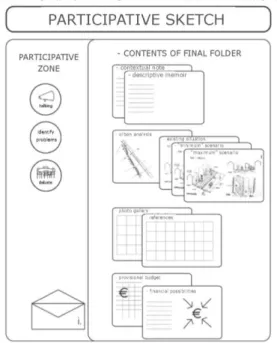
This phase marks the starting point of street design project: an inclusive process of reflection that corresponds to the definition of the design project principles (Fig.2). Within this phase, initial context observations, needs, and suggestions are exposed in order to set the design basis (Hofmann, 2015). In this project phase, the various actors (technicians, residents, local business, local elected officials, associative organizations, religious and educational representatives) work around the problems to solve - problem definition. This involves facing management of interests, conflicts and participating on the development of specific project scenarios (Wates, 2014) through a shared decision-making process.
Debate on the problem definition is developed in organized subgroups (residents, local business, elected official, associative organizations, religious and educational representatives) that discuss different topics of the main issue. Subgroups report results to the whole group and feedback is given to all the participants. The process is repeated until consensus about the two scenarios (“minimum” and maximum”) is reached. Technicians develop architectural design scenarios and financial proposals. The results are presented and discussed with the whole group. The final result is summarized in topics and free hand sketches. Adjustments may be introduced if the proposal does not meet the objectives. Existing place visit, models and free hand sketches may be used to reinforce the understanding of the problem and scenarios.
With this phase it is possible to achieve an approach that reinforces a strong link between involved actors. It implies the establishment of notions of trust and respect of different knowledge areas and points of view, entwined in a constructive dialogue between different skills. It is also the moment to implement construction of a win-win perspective and engagement.
The outputs of this phase materialize on a synthesis folder that defines the current status of this phase. In result of a systematic approach the folder presents: - 1 written note to contextualize the operation and proposed program; - 1 written note about the guide lines of the two proposed design scenarios; - 1 graphic urban analysis allowing the understanding of site integration in a larger urban system and consequent impacts; - 1 base drawing of the current situation (plan, section, axonometric); - 1 drawing of a soft scenario (minimum intervention) - plan, section, axonometric; - 1 drawing of a hard scenario (maximum intervention) - plan, section, axonometric; - 1 gallery of photos to register process memory; - 1 gallery of references reporting similar situation and parallel solutions in other world contexts; - 1 budget forecast for each proposed scenario; - 1 list about project funding options and models adequate to the context.
Figure 2. Atelier da Rua. Phase 1, participative sketch.
12
5. Phase 2 - Participative project
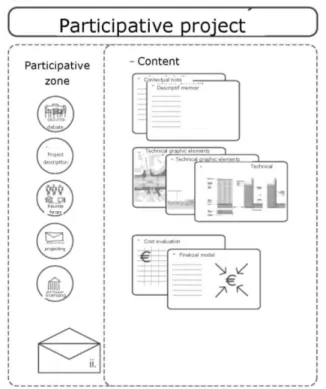
This phase develops the analysis, discussion and collective decision about the two proposals established in the previous phase 1. The goal is to develop a stable definition of the architectural design principles: program, funding, planning and working site phase (Fig.3). In this project phase technicians, local and city elected officials assume a central role in the project development. Technical meetings between technicians, local resident representatives and local/city elected officials will be promoted. The project design will be developed on the spirit of an open atelier. The operation of the atelier will run in full respect of technical autonomy of each area of knowledge.
In order to define project priorities and essential decisions, key debate moments will be promoted with the entire group of actors (technicians, residents, local business, local and city elected officials, associative organizations, religious and educational representatives). Debates focus on specific topics with limited time per issue. In order to achieve a participative process, decisions are taken on a partnership relation. Equity principles between designers, stakeholders, local power representatives and citizen are fundamental concepts to follow. The development of the project is not seen as a closed process but rather an open sequence of hypothesis subject to evaluation and debate. Adaptability and flexibility are important issues to be incorporate on project definition.
The selected project solution is detailed allowing testing its technical feasibility. Drawings and written elements are produced, in order to enable physical implementation of the project. Technical and legal issues are intensely addressed and developed. During this phase it is promoted and reinforced: a continuous approach and strong contact between actors; the establishment of notions of trust and respect about different knowledge and points of view; the experience of a participated process; a positive dialogue between different skills; the construction of a win-win perspective and engagement; the co-construction of the architectural design project; and the development of the sense of belonging and responsibility around a common choices and a collective architectural design project.
Figure 3. Atelier da Rua. Phase 2, participative project.
Source: Pita, M et al (2014b) [adapted and translated]
The outputs of this phase generate a folder constituted by a set of simplified reference boards: - 1 written note to contextualize the operation, previous choices, collective proposed program and architectural design project; - 1 written note about the guide lines concerning the proposed design project; - 1 graphic architectural analysis allowing site integration and project comprehension in a larger urban system and consequent impacts; - technical drawings of the design project (plans, sections, axonometric); - 1 gallery of photos to register process memory; - 1 gallery of references reporting similar situations and parallel solutions in other world contexts; - 1 budget forecast for the proposed design project; - 1 note about the funding model adopted.
14
6. Phase 3 - Participated working site
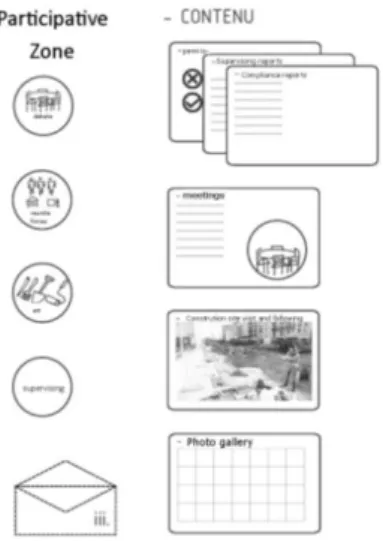
Phase 3 consists on the physical implementation of architectural design project on the site (Fig.4). Atelier da Rua methodology focuses on projects that resort to construction companies. Due to the technical and legal specificities of this phase, builders, technicians, local and city elected officials assume a central role. Technical meetings between builders, technicians and local resident representatives will be promoted. Although steps towards project materialization encourages the involvement of all actors involved (technicians, residents, local business, local and city elected officials, associative organizations, religious and educational representatives). This can be reached either by following or actively participating, if skills are available, on the construction of architectural design. The traditional process of surveyed working site is partially replaced by an active participation on the working site. Different actors can take an active role, being able to participate through a direct or indirect input. Site Visit (Aravena, 2016) can be promoted to allow the visualization of architectural design construction evolution. Due to technical specificities of this phase, technical specialists guide the development and control of construction work.
Within this phase key debate moments will be promoted with the entire group. In order to promote a horizontal understanding and participation, process will go through possible project adjustments. Various situations and issues are attended: final working drawings validation; need of initial project adjustments due to new evolutions not previewed or lack of information on previous phases; prototypes and materials validation.
The project construction corresponds to the achievement of a collective design project on site (Hofmann, 2015). A registry folder of the process is constituted in order to monitor the whole project. A set of elements integrates this folder: - 1 written note to contextualize the operation, previous choices, collective proposed program, architectural design project and working site decisions; - 1 written note about the guide lines concerning the proposed design project and final result; - 1 graphic urban analysis allowing the understanding of site integration and its new form in a larger urban system and consequent impacts; - technical drawings of built design project (plan, section, axonometric); - 1 gallery of photos to register process memory; - 1 gallery of references reporting similar situations and parallel solutions in other world contexts; - final budget of the participated architectural design project; - 1 critical note about the funding model adopted, facing its positive and negative consequences.
Figure 4. Atelier da Rua. Phase 3, participative working site.
Source: Pita, M et al (2014b) [adapted and translated]
In parallel with the working site development, an architectural design project folder is produced. Technicians, residents, local business, local and city elected officials are the actors involved in its execution. This allows the possibility to register the development of this phase process and final results. This way it is possible to monitor the process during and after conclusion of construction (Slocum, 2003). The monitor process involves all actors with particular emphasis on the street inhabitants and users. Through monitor process it is possible to carry out an assessment of positive and negative aspects. This enables the possibility to analyze, systematize and consequently introduce improvements on the used methodology. At first it will be analyzed the fit and misfit relation between form and context (Alexander, 1964). The success of build solution is registered if the absence of misfit relations (between context and form) is reached. Secondly the same procedure is applied to specific contents of participative process and used funding model. The relation between predicted and final cost is also registered. With the outcome of monitor process from different interventions it is possible to present, explore and compare, in a systematic way, the outputs of each process. The outline of a map of different projects and themes allows the possibility to establish comparisons in a local and global context.
16
7. Implementation of Atelier da Rua: the case study of Rua do Salvador
Over past year Atelier da Rua has been presented in Portugal and abroad (France, Italy, Luxembourg, Germany and Sweden). On the one hand several public entities have been addressed: Local authorities, Associations and citizens groups. On the other hand the project was presented in academic context at conferences and International symposium in Venice (Mendes, 2014) and Stockholm. This set of actions intended to identify places to implement a pilot project and validate the relevance of the proposal. The feedback has been positive, which has allowed proceeding with the development of contacts and search for a practical application at a specific site. However until now it was not possible to implement in full extend the proposed methodology. The decision-making and response process of the approached entities has proven slow and winding.
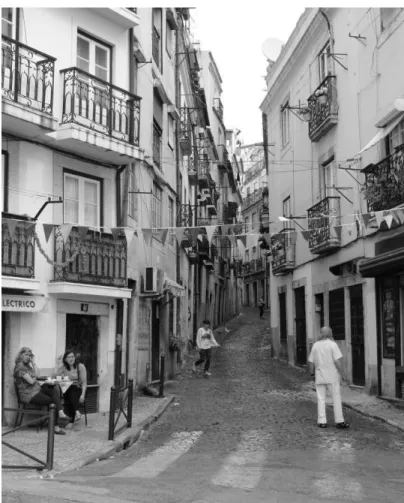
The case presented refers to Rua do Salvador (Fig 5), located at the historic center of Lisbon, in
São Vicente Parish. The street is characterized by the specificities of its own physical and
environmental settings. It is a narrow street lined with black basalt stone and no sidewalks. The existence of one of the first traffic signposts gives it a unique status in touristic itineraries of Lisbon. This stone signpost attracts a significant number of pedestrian visitors and small vehicles such as Tuc - tuc. The street is flanked with a set of partially degraded residential and commercial buildings, mostly occupied by a population of aged residents. This dominant group coexists with new economic activities linked to the increase of tourism in the city of Lisbon. Rental apartments or rooms for tourists coexist with traditional grocery store and coffee shop. It is also possible to find a pottery workshop, an engravings atelier and a small objects antiques shop called Coisas do Alberto. The owner of this shop approached Atelier da Rua looking for support to promote improvements in the street conditions, such as pavement leveling and prevent car traffic. Another request points to the creation of a monthly open sky fair with the participation of all street residents. This same claim had already been presented to the parish council. In consequence of political changes in the parish council leadership the population claims produced no response to the request.
A working meeting was promoted. The merchant needs and desires were presented. It was found that there was no local organization of residents that would allow the process development. There was an agreement to create a group of residents and inhabitants of the street. This group would represent the local community on future project developments. To reach this goal it would be necessary to hold a meeting with residents and street traders. The first meeting would also involve team members of Atelier da Rua, allowing the presentation of the procedures to be followed. During preparation period to the community meeting Lisbon City Hall starts remodeling works in south section of the street.
Figure 5. Case study: street in a consolidated historic urban context.
Source: Rua do Salvador, Lisbon. Cruz, T (2014)
At this time process development is facing difficulties in forming a local group of residents and inhabitants that represents the community. The generated discredit by unfulfilled promises from the Parish and the City Hall of Lisbon thickens the difficulty to create a group of street representatives. Moreover the feeling among residents is that remodeling works are likely to be promoted on the street without residents and traders involvement.
Rua do Salvador process is not closed or stopped. Nevertheless the reported initial difficulty to
constitute a representing group of local population and stakeholders is blocking the development of street project. Without an organized power-base in the community the process evolution is at risk. Until now the process is characterized for being slow and with plenty of unexpected difficulties.
18
8. Conclusion
Complexity and effectiveness of design project for public street spaces requires the integration of a high level of disciplinary insights, stakeholders, political representatives and citizen perspectives, combined and developed through time constraints and location conditions (context). Therefore, more effective decision support methodologies able to improve citizen participation on the construction of a better fit between the context and the designed form are needed. In order to develop an effective methodology that responds to the recent economic Portuguese condition of scarcity and the need of successful project results it is proposed the methodology of Atelier da Rua improved with the principles of partnership - rung 6 of “A ladder of citizen participation” (Arnstein, 1969).
In our view the combination of a conventional project design methodology with a participated one, incremented with the empowerment of citizen leads into a partnership relation. This way it is possible to reach a higher level of fulfillment of the involved intervenient. From a higher involvement of the intervenient and a careful selection of the relevant variables, architectural project design solutions have more chances to effectively respond to context requirements.
The prospects for Atelier da Rua will be focused on two mains aspects. First, search for a suitable place and their representatives to implement the proposed methodology. Private – organized group of citizens - or public – Associations, County, or City Hall – initiatives are welcome and suitable to be developed. Second, Atelier da Rua will continue to develop contacts and partnerships that will add value and different perspectives to the project. Investigation, professional, business companies and associative organizations are seen as potentials partners to join and enrich the whole project.
References
Alexander, C., 1964, Notes on the synthesis of form, Cambridge: Massachusetts and London, England. Harvard University Press.
Alexander, C., 1977, A Pattern Language: towns, buildings, construction, New York: Oxford University Press. Aravena, A. and Lacobelli A., 2016, Elemental. Instrumental housing and participatory design manual. Ostfilder,
Germany: Hatje Cantz.
Arnstein, S., 1969, “A Ladder of Citizen Participation”, Journal of the American Planning Association, 35(4): 216 - 224
Baily, L. (ed), 2013, NACTO, National Association of City Transportation Officials - Urban street design guide,: http://nacto.org/usdg/streets/, (February 29, 2015).
Carlo, G., 2010, Uma arquitectura da participação. In Rodrigues, José (co. ed.) – Teoria e crítica de
Arquitectura – Século XX, Casal de Cambra: Ordem dos Arquitectos, Caleidoscópio.
Cascais, C.M., 2015a, Orçamento Participativo, http://www.cm-cascais.pt/area/orcamento-participativo-0, (June 14, 2015).
Cascais, C.M., 2015b, Eleições autárquicas 2013, Câmara Municipal, http://www.cm-cascais.pt/sites/default/files/anexos/gerais/aut2013cm.pdf, (June 21, 2015).
Esteves, M., 2015, Investimento das câmaras caiu 74% desde 2001, http://www.jornaldenegocios.pt/economia/autarquias/detalhe/investimento_das_camaras_caiu_74_desde_2 001.html, (June 14, 2015).
Hofmann, S., 2015, Architecture is participation, Die Baupiloten methods and projects, Berlin: Jovis. Jacobs, J., 1962, The Death and Life of Great American Cities, London: Jonathan Cape.
Manzini, E., 2015, “Design, when everybody designs”, An introduction to design for social innovation, Cambridge MA: London, MIT Press.
Mendes, P., Alves, P. and Pita, M., 2014, “Designing with the People, on the Street, Towards the City”, In Smitheran, J., Moloney, J. and Twose, S., Architectural Design Research Symposium. Wellington: s.n. pp. 108-110.
Pincha, J., 2015, Lex Paulson: “Nova Iorque tem muito a aprender com Cascais”, http://observador.pt/2015/07/11/nova-iorque-tem-muito-a-aprender-com-cascais, (July 21, 2015).
Pita, M., Marques, P. and Mendes, P., 2014a, “se essa rua fosse minha…” - ATELIER DA RUA, http://2014.ideiasdeorigemportuguesa.org/ideias/63, (June 21, 2014).
Pita, M., Marques, P., Mendes, P. and Botelho, P., 2014b, Atelier da Rua, http://issuu.com/atelier.da.rua/docs/20141111_atelier_da_rua_book_fr/1, (July 23, 2015).
Pordata, Fundação Francisco Manuel dos Santos , 2015, Eleitores, votantes e abstenção, http://www.pordata.pt/Municipios/Ambiente+de+Consulta/Gr%C3%A1fico, (July 27, 2015).
Quaroni, L., 1987, Proyectar un edificio: ocho lecciones de arquitectura, Madrid: Xarait Ediciones. Rossi, A., 1982, The architecture of city, Cambridge: Massachusetts, MIT Press.
Schon, D., 1983, The reflective practitioner. How professional think in action, United States of America: Basic Books.
Slocum, N., 2003, Participatory Methods Toolkit, a practitioner’s manual, http://www.kbs-frb.be/uploadedfiles/kbs-frb/files/en/pub_1540_toolkit_9_pame.pdf, (May 10, 2015). Wates, N., 2014, The community Planning Handbook, London and New York: Routledge.
Whyte, N., 2001, The social life of small urban spaces. New York, NY: Projects for Public Space.
Trabajo c., 2016, Diseño Cívico. Diseño, territorio, inteligencia colectiva, https://disenocivico.org/primera-version-del-ebook-diseno-civico/, (September 25, 2017).