UNIVERSIDADE DA BEIRA INTERIOR
Ciências Sociais e Humanas
Affection, self-esteem, and resilient coping
as predictors of health in old age
Inês Isabel Xavier Soares
Dissertação para obtenção do Grau de Mestre em
Psicologia Clínica e da Saúde
(2º ciclo de estudos)
Orientador: Professora Doutora Rosa Marina Lopes Brás Martins Afonso
Orientador: Professor Doutor Henrique Pereira
Agradecimentos
Aos meus pais. Sobretudo a eles, que tanto me ensinaram sobre a vida, o amor e a superação. Agradeço sobretudo por me mostrarem quão simples a vida se torna quando se vive com amor, hoje sei que nada afeta o seu poder, e mesmo estando distante, ao longo destes 5 anos, senti todos os dias essa magia que só vocês são capazes de brotar. Gostava que soubessem o quão grata me sinto por me terem transmitido valores que se tornaram guias ao meu caminho, e seja ele qual for, acreditem sempre que tudo o que fizer é por vocês.
Ao Luís. Pelo apoio incondicional, pela presença, pelo companheirismo, pela amizade e pelo amor, por me acalmar quando nem eu mesma me suportava, por completar comigo este percurso e por me mostrar que tudo se consegue quando se luta incessantemente pelos nossos sonhos. Tenho um enorme orgulho em ti, obrigada por todos estes anos.
À Carolina. Por ser a minha irmã, de coração. Por me mostrar que a amizade transcende todas as barreiras e por compreender a minha distância. Pela genuinidade e simplicidade em tudo o que faz e por acreditar em mim.
À Joana. Por ter aparecido na minha vida ao longo desta caminhada e por se ter tornado indispensável mesmo a quilómetros de distância.
Aos meus avós, fontes de inspiração e motivadores do meu percurso.
Ao meu irmão, que me obrigou a colocá-lo nos agradecimentos, mostrando o quão diferente e insubstituível pode ser uma relação entre irmãos.
À Catarina e ao Tiago. A ela, pela maravilhosa ajuda que me deu. A eles pela excelente companhia nos estudos de fim-de-semana.
À Dr.ª Isabel Malaca. Por ser mais, ultrapassando a função de supervisora de estágio e tornando-se num apoio incontestável para o término deste ciclo. Pela disponibilidade, pela atenção, pela confiança que depositou em mim e pela força que me deu sempre. Um muito obrigada!
Ao Professor Doutor Henrique Pereira, pela orientação magnífica, pelo valioso apoio concedido e por toda a disponibilidade, força e permanente encorajamento.
À Professora Doutora Rosa Marina Afonso, pela partilha dos seus conhecimentos na área do envelhecimento, que embora nunca lho tenha referido, estimularam o meu interesse e motivaram a presente dissertação.
E sobretudo, à Inês. Por ter sido a minha referência, mostrando-me que o que somos, depende somente daquilo que escolhemos e fazemos na nossa vida. Por me demonstrar que os laços do coração conseguem ser maiores que os de sangue, porque apenas importa o amor. Por ter sido quem despoletou toda a minha curiosidade nesta fase tão bonita da vida e por me fazer apaixonar pela psicologia do envelhecimento. A ti, avó.
Resumo
A presente dissertação, intitulada Affection, self-esteem, and resilient coping as
predictors of health in old age surge no âmbito do mestrado em Psicologia Clínica e da Saúde,
após a verificação da carência de estudos que englobem as variáveis referidas. Para tal, são estipulados os seguintes objetivos: (1) Avaliar, numa amostra de idosos, os níveis de afeto, autoestima, coping resiliente e saúde; (2) Avaliar diferenças na comparação entre géneros; (3) Determinar o impacto em função das variáveis psicossociais e sociodemográficas, na saúde geral dos idosos; e (4) Determinar o grau de associação entre as variáveis.
É parte integrante desta dissertação, um artigo, escrito em língua inglesa, submetido a publicação na revista Clinical Gerontologist, que representa uma contribuição metodológica para a melhor compreensão das variáveis psicossociais associadas a um envelhecimento mais positivo. A dissertação, por forma a aprofundar teoricamente as variáveis em estudo, apresenta ainda um anexo teórico organizado de maneira a possibilitar ao leitor a consolidação de eventuais aspetos que, dada a sua natureza, não foram desenvolvidos no artigo teórico.
Os resultados obtidos permitem concluir que elevados níveis de afeto positivo, autoestima e coping resiliente estão fortemente associados a melhores níveis de saúde geral, e particularmente, a melhores níveis de bem-estar emocional. Por conseguinte, o afeto negativo surge relacionado com piores níveis de saúde, o que demonstra a importância das emoções positivas na saúde dos idosos.
Palavras-chave
Abstract
The present dissertation, titled Affection, self-esteem, and resilient coping as
predictors of health in old age arises in the context of the Masters in Clinical Psychology and
Health, after noticing the lack of studies covering such variables. Hence, the following objectives were estabilished: (1) Evaluate, on a group of elderly, the levels of affection, self-esteem, resilient coping and health; (2) Evaluate, comparing differences between genders; (3) Determine the impact in terms of psychosocial and sociodemographic variables, in the overall health of the elderly; and (4) determine the degree of association between the variables.
It is an integral part of this dissertation, an article, written in English, submitted to publication in the journal Clinical Gerontologist , which represents a methodological contribution to a greater understanding of the psychosocial variables linked to a more positive aging . In order to theoretically deepen the variables being studied, this dissertation, even presents an organized theoretical attachment in order to enable the reader to consolidate any aspects which, due to their nature, were not developed in the theoretical article.
The achieved results show that high levels of positive affection, self-esteem and resilient coping are strongly connected to a better general health levels, and particularly, to higher levels of emotional well-being. Though, the negative affection is related to worse health status, which demonstrates the importance of positive emotions on the health of the elderly.
Keywords
Índice
Capítulo1 - Introdução
Capítulo 2 - Affection, self-esteem, and resilient coping as predictors of health in old age 1 3 2.1 Abstract 2.2 Keywords 2.3 Introduction 2.4 Method 2.5 Results 2.6 Discussion 2.7 References 4 4 5 7 10 12 16 Capítulo 3 - Discussão geral
Anexo 1: Anexo teórico
Anexo 2: Comprovativo de submissão à revista Clinical Gerontologist
25 29 51
Capítulo 1
Introdução
O interesse científico pela temática do envelhecimento tem aumentado a par das acentuadas mudanças demográficas evidenciadas nas últimas décadas e da maior preocupação com a saúde mental dos idosos, no entanto, não existem na literatura, contributos portugueses que nos ajudem a entender, com maior profundidade, a importância das variáveis psicossociais no envelhecimento saudável. Neste sentido, constitui-se a presente dissertação, organizada, tal como previsto no regulamento do grau de mestre em Psicologia Clínica e da Saúde, em formato de artigo científico.
Assim sendo, apresenta-se no capítulo 2, o artigo intitulado Affection, self-esteem,
and resilient coping as predictors of health in old age, que foi submetido à revista Clinical Gerontologist, sendo por isso escrito em língua inglesa. Deste artigo fazem parte uma breve
introdução sobre a temática em estudo, a exposição dos resultados obtidos e a discussão dos mesmos, representando a investigação levada a cabo, cujos objetivos foram: (1) Avaliar, numa amostra de idosos, os níveis de afeto, autoestima, coping resiliente e saúde; (2) Avaliar diferenças na comparação entre géneros; (3) Determinar o impacto em função das variáveis psicossociais e sociodemográficas, na saúde geral dos idosos; e (4) Determinar o grau de associação entre as variáveis.
No capítulo 3 revisitam-se os contributos empíricos da presente investigação, através da discussão geral, que integra uma síntese reflexiva acerca dos resultados, e exalta a importância desta para o término do 2º ciclo em Psicologia Clínica e da Saúde.
Tal como previsto no referido regulamento, esta dissertação culmina com a anexação de um documento teórico onde são abordadas, de forma mais abrangente e aprofundada, as variáveis psicossociais afeto, autoestima, coping resiliente e saúde na velhice.
Capítulo 2
Affection, self-esteem, and resilient coping as
predictors of health in old age
This chapter is based on the paper:
Soares, I., Pereira, H., Afonso, R. M., Esgalhado, G., Monteiro, S. & Loureiro, M. (Submitted). Affection, self-esteem, and resilient coping as predictors of health in old age. Clinical
Abstract
There is a lack of studies covering variables such as affection, self-esteem, resilient coping, and health in the elderly. This study aims to bridge this gap, with the objective of studying the association between these variables. Our sample consists of 241 elderly Portuguese participants, aged 65 to 97 years old. Five surveys were used to obtain the results, namely: a socio-demographic questionnaire; PANAS-VRP; RSS; BRCS; and SF-36. The results showed that high levels of positive affect, self-esteem, and resilient coping are strongly associated with better general health levels, and particularly higher levels of emotional well-being. Therefore, negative affect is correlated with worse health status, showing the importance of positive emotions on the health of the elderly. These results highlight the need for further studies covering psychosocial variables and health in the elderly.
Keywords: Aging; Health; Affection; Self-Esteem; Resilient Coping.
Resumen
Hay una falta de estudios que incluyan variables tales como el afecto, la autoestima, el afrontamiento resiliente y la salud en la vejez. Este estudio pretende llenar ese vacío, con el objetivo de estudiar la asociación entre estas variables.
La muestra consta de 241 personas mayores portuguesas desde los 65 a los 97 años de edad. Fueran utilizadas cinco encuestas para obtener los resultados, a saber: un cuestionario socio-demográfico; PANAS-VRP; RSS; BRCS; y SF-36.
Los resultados enseñan que elevados niveles de afecto positivo, autoestima y afrontamiento resiliente están fuertemente asociados a mejores indicadores de salud en general y específicamente a niveles de bienestar superiores. Por lo tanto, los afectos negativos se correlacionan con un peor estado de salud, enseñando la importancia de las emociones positivas en la salud de los ancianos. Estos resultados destacan la necesidad de estudios adicionales que cubran las variables psicosociales y la salud en la vejez.
Introduction
The increase in the elderly population has attracted a growing scientific interest, not only in understanding the aging process (Macedo, Oliveira, Günther, Alves & Nobrega, 2008), but also concerning the relevance of the study of demographic change and its consequences (DGS, 2014). Population aging has also spurred research related to anticipating scenarios and finding ways to respond to new challenges, such as the provision of health care and the monitoring of the aging process.
It is of great interest to better understand the relationship between affect and health (Nolla, Queral & Miró, 2014). This relationship is described as one of the factors that ensures satisfactory psycho-emotional and physical development throughout the life cycle, and is considered to be the main component of overcoming life challenges (Diniz & Koller, 2010). Affect results from the interaction of the individual with the environment in which he/she operates, and can be defined as positive or negative, acting, respectively, as a protective element or risk to general health (Sansinenea, Montes, Aguirrezabal & Garaigordobil, 2010; Krisjthe, Walter, Newson, Hofman, Hunink & Tiemeier, 2011; Arciniega, 2014; Galinha, Pereira & Esteves, 2014).
Positive Affect (PA) is defined by Pressman and Cohen (2005) as a mental state characterized by feelings of pleasure, happiness, joy, excitement, enthusiasm, inspiration, and determination, reflecting one’s pleasant involvement with his/her environment (Watson, Clark & Tellegen, 1988; Libran & Piera, 2008; Galinha et al., 2014). The presence of positive emotions is essential for healthy development (Diniz & Koller, 2010), since it is assumed that the experience of pleasant and positive emotions triggers a general sense of personal and social well-being that will lead to improved levels of health (Libran & Piera, 2008).
The opposite is true when it comes to Negative Affect (NA), which is characterized by a wide range of negative emotions such as fear, sadness, anxiety, hostility, grief, loneliness, numbness, anger, and guilt (Watson et al., 1988; Libran & Piera, 2008; Krijthe et al., 2011; Galinha et al., 2014). NA is therefore a risk factor for health, as it shows a strong predisposition to negative emotions towards experiences that influence cognitive processes, the self, and life satisfaction, which can lead to depressive states in individuals (Campos, Iraurgui, Páez & Velasco, 2004; Alcalá, Camacho & Giner, 2007; Libran & Piera, 2008; Galinha
et al., 2014).
Self-esteem is one of the most important psychological aspects in the self-worth of the elderly, having a great influence on their well-being and adaptation to the world around them (Ruibyté, 2007; Arriagada & Salas, 2009). There are several aspects that can affect self-esteem in the elderly, including the loss characteristics of this age group, such as the death of family members or friends, the imposition of widowhood, a decline in health, the absence
of valued social roles, a lack of family support, or deviation from the ideal body image (Gatto, 1996; Baldessim, 1996). According to Vitoreli, Pessini, and Silva (2005), these factors mean that many older people may reject aging itself, developing a low self-esteem and devaluing the stage of life they are in, exposing them to inappropriate situations and health risks.
Thus, as an important indicator of health and well-being, self-esteem is usually defined as an attitude or a positive or negative feeling that someone holds of them self based upon the evaluation of their own characteristics, including feelings of self-satisfaction (Sebastian, Manos, Bueno & Mateos, 2007). This assessment can be based on low self-esteem (feelings of incompetence, inadequacy, and the inability to meet challenges), medium self-esteem (oscillation of the individual between feelings of approval and the rejection of self), or high self-esteem (a self-judgment of value, confidence, and competence) (Sbicigo, Bandeira & Dell'Aglio, 2010). It is extremely important that the elderly possess high levels of self-esteem and a positive image of themselves, because this leads to better physical and emotional health, and reduces vulnerability to negative emotions, since the elderly will feel more secure, independent, respected, valued, and happy (Vitoreli et al., 2005; Montaño, 2008).
The literature also stresses the importance of resilience in aging from the perspective of a health promotion construct and in relation to emotional well-being (Sinclair & Wallston, 2004; Tugade, Fredrickson & Barrett, 2004; Pan & Chan, 2007; Smith & Zautra, 2008; Zautra, Hall & Murray, 2008). The literature emphasizes resilience as a coping mechanism that, according to some authors (Sinclair & Wallston, 2004; Ribeiro & Morais, 2010), is associated with positive adaptations in the face of adversity, generating better general functioning among the elderly.
Although aging has triggered a great number of studies on other related aspects, there is a lack of studies covering variables such as affection, self-esteem, resilient coping, and health in this age group. To fill this gap, we developed this research, which aims to accomplish the following goals. First, we propose to assess levels of affection, self-esteem, resilient coping, and health in a sample of elderly people. Second, we aim to evaluate the differences in these variables between genders. Third, we attempt to determine the impact of psychosocial and socio-demographic variables on the general health of the elderly. Finally, we seek to determine the degree of association between all variables.
Method
Participants
The sample consists of a total two hundred and forty-one (241) elderly Portuguese people. All participants are older than 65, ranging from 65 to 97 years of age (Mean=75, SD=7.87). We used a non-probabilistic sampling method with previously defined criteria of inclusion, such as age and the absence of cognitive deterioration in participants. 52.3% of participants are women and 47.7% men. The majority of the elderly have lower levels of education (38.4%) and 14.6% have attained higher levels of education. In regards to marital status, the sample is divided into two large groups, married (49.2%) and widowed (31.1%). A much smaller percentage of participants are unmarried (5.5%), in a civil union (2.9%), or in an emotionally committed relationship (1.3%). Regarding the type of residence in which participants live, 76.8% live in a house/apartment and 20.1% live in an institution.
Instruments
In this investigation the following assessment tools were administered: a socio-demographic questionnaire; the Short Version of the Portuguese Scale of Positive and Negative Affect (PANAS-VRP; Galinha et al., 2014); the Rosenberg Self-Esteem Scale (RSS); the Brief Resilient Coping Scale (BRCS); and the 36-Item Short Form Health Survey (SF-36).
The socio-demographic questionnaire surveyed items such as age, gender, type of residence, education level, and marital status.
The PA and NA were assessed using the PANAS-VRP. The short version of the Portuguese PANAS consists of a total of 10 items and is divided into two groups of 5 items. It defines PA using the items enthusiastic, inspired, determined, interested, and active, and identifies NA with the items scared, frightened, tormented, nervous, and guilty (Galinha et
al., 2014). Watson et al. (1988) developed the PANAS to measure the PA and NA, as defined
overall dimensions that describe the emotional experience of individuals. Thus, a high PA reflects pleasure and subjective well-being, while a high NA reflects displeasure and subjective distress, including emotions such as fear and nervousness (McDowell, 2006; Galinha
et al., 2014). Internal consistency for this instrument was α=.868 for PA and α=.785 for NA,
which signify very good and good reliability scores, respectively (Maroco & Garcia-Marques, 2006).
The evaluation of self-esteem was based on the Portuguese translation and adaptation of the Rosenberg Self-Esteem Scale (1965), which was developed by Pechorro, Maroco,
Poiares and Viera (2011). The RSS is an overall evaluation of self-esteem, defined by Rosenberg (1989) as the positive or negative orientation that an individual possesses of him/herself. It includes self-concept as one of the components, which is conceptualized as all of the thoughts and feelings of an individual in reference to him/herself as an object.
It consists of a total of 10 items, which are divided into positive items (1,3,4,7, and 10) and negative items (2,5,6,8, and 9). The results are related to feelings of acceptance and compliance with him/herself and score self-esteem as low, medium, or high. High self-esteem indicates that individuals consider themselves to be persons of worth and that they are respectful of themselves. In contrast, low self-esteem reflects a devaluation of self, dissatisfaction, and a lack of respect in regards to oneself (Santos & Maia, 2003). This scale is an international reference in the evaluation of self-esteem and is probably the most widely used in psychological research (Santos & Maia, 2003; Santos, 2008; Pechorro et al., 2011). The consistency of the scale is α=.822 which indicates a very good reliability score (Maroco & Garcia-Marques, 2006).
The level of resilient coping was assessed by the Brief Resilient Coping Scale (BRCS) (Brook and Mitchell, 2010). This instrument consists of 4 items and evaluates the ability of individuals to cope with stress in an adaptive way (Gurgel, Plentz, Joly & Reppold, 2013). The BRCS scale ranges from 4 to 20. According to the authors, a score below 13 represents low levels of resilient coping and a score that exceeds 17 signifies high resilient coping (Sinclair & Wallston, 2004). The consistency score for this instrument was α=.777, which is a good reliability score (Maroco & Garcia-Marques 2006).
For a general assessment of physical and mental health, the SF-36 was used. This instrument, as its name implies, has a total of 36 items, which are divided into eight dimensions: physical functioning (α=.939); social limitations due to physical health problems (α=.956); social limitations due to emotional problems (α=.924); energy/fatigue (α=.818); emotional well-being (α=.900); social functioning (α=.697); pain (α=.645); and general health (α=.808) (Rand Corporation; Ware & Sherbourne, 1992). The internal consistency of the SF-36 subscales ranges from excellent to reasonable reliability scores, depending on the number of items involved in each subscale (Maroco & Garcia-Marques, 2006). The SF-36 was constructed as a general indicator of health status and can be used in clinical settings, research, and the evaluation of the general population (Ware & Sherbourne, 1992; McDowell, 2006).
The Global Deterioration Scale (GDS) of Reisberg, Ferris, De Leon & Grook (1982) was also utilized. It is widely used, particularly in clinical studies, to observe the degree of cognitive impairment in participants. The GDS measures the intensity of clinical deterioration in 7 stages, and higher values signify a higher degree of deterioration. The GDS is used by our study to ensure that participants do not suffer from any cognitive impairment.
Procedures
Data collection took place between October 2014 and February 2015 through direct and personal contact, as well as the recruitment of answers over the Internet using mailing lists. Both data collection systems took into account the preservation of all ethical principles, which include informed consent, data privacy, and anonymity, in accordance with the ethical standards of the American Psychological Association. The Scientific Committee of the Department of Psychology and Education of the University of Beira Interior (Portugal) also approved this study. We administered the GDS to each participant to ensure that none of the respondents had any cognitive impairment that could compromise the reliability of the results. Finally, the responses were entered into a database, using IBM® SPSS (version 21). We used Student's t-Test to compare the means of psychosocial variables in two different groups, such as age, gender, and type of residence, and ANOVA to compare groups according to education level and marital status. We used linear regression to test the predictions of the independent variables (affection, self-esteem, and resilient coping) in relation to the dependent variable (health).
Results
In order to make the presentation of results clearer, the data are organized in respect to each objective formulated.
1. Assess the levels of Affection, Self-Esteem, Resilient Coping, and Health
In the PA scale the average total score in this sample is 16.14 (SD=4.27), while the average NA score is 8.88 (SD=3.61). These results point to a low NA in the sample and a PA near the average, but still within the range of positive values. Regarding self-esteem the average total score was 31.3 (SD=4:55). Given that this scale varies between 10 and 40, this indicates a high level of reported self-esteem in the sample. As for the resilient coping variable, the scale had a mean total score of 13.58 (SD=3.73), indicating median scores within the range of positive values. Finally, in regards the dimensions of physical and mental health the sample yielded the following mean scores: 22.88 (SD=6.21) for “physical functioning”; 14.67 (SD=4.79) for “social limitations due to physical health”; 12.3 (SD=3.22) for “social limitations due to emotional problems”; 10.55 (SD=3.55) for “energy/fatigue”; 11.8 (SD=4.68) for “emotional well-being”; 3.63 (SD=1.76) for “social functioning”; 4.89 (SD=2.24) for the “pain” scale; and 16.86 (SD=4:51) for “general health”. These results show that participants exhibit both physical and social functionality, with few social limitations due to physical or emotional problems, as well as low levels of fatigue and pain. It is also salient to note that there are high levels of emotional well-being and positive levels of general health.
2. Evaluate the differences between genders
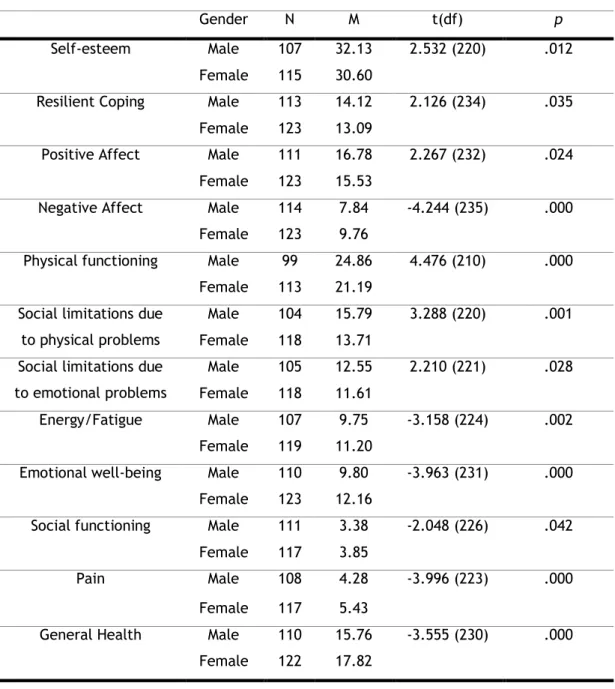
To evaluate the differences between men and women in levels of affection, self-esteem, resilient coping, and health, we verified statistically significant differences (p<.05) using Student’s t-test. As demonstrated by Table 1, men show higher levels of self-esteem, resilient coping, and PA, demonstrating a greater level of overall health when compared to women, who have higher levels of pain and fatigue.
3. The impact on overall health as a result of NA, self-esteem, resilient
coping, and socio-demographic variables
Table 2 shows the results of the psycho-social impact of demographic variables on the overall health of the participants. We found that the results are statistically significant in all dimensions. The results show that having higher levels of PA, low NA, high self-esteem, and
high resilient coping are predictors of higher levels of overall health, The results indicate that groups with higher levels of general health are younger elderly people, men, elderly people who live in their own house, those with more education, participants who are in a relationship (married or civil union), or who are divorced.
4. Determine the degree of association between the variables
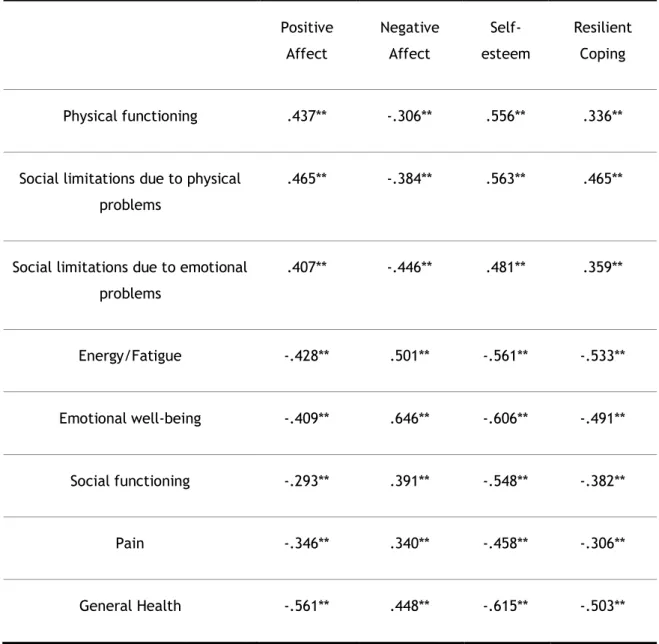
As can be seen in Table 3, in this study we aim to explore whether psychosocial variables (PA, NA, self-esteem, and resilient coping) are associated with dimensions of health (physical functioning, social limitations due to physical problems, social limitations due to emotional problems, energy/fatigue, emotional well-being, social functioning, body pain, and general health). Our results confirm that psychosocial variables are strongly correlated with the dimensions of general health.
Based on Hemphill (2003) proposal on correlation coefficients, it is important to emphasize that, except for the correlation between the PA and the scale of social functionality (-.293), all other variables are strongly correlated, presenting scores above of .30. Thus, the elderly in this study who have higher levels of PA, show more self-esteem and resilient coping, less fatigue and more energy, fewer limitations due to emotional, social, and physical problems, lower levels of pain, increased physical and social functioning, and high levels of emotional well-being. Concerning NA, a correlation between higher levels of NA and lower levels of overall health is seen.
Discussion
The purpose of this study is to understand whether psychosocial variables, such as affection, self-esteem, and resilient coping are associated with health in old age. In addition, we want to understand how socio-demographic variables such as gender, age, type of residence, education, and marital status, relate to these variables.
We found lower levels of NA in the sample and average levels of PA. These results are considered positive, since, according to Zanon, Bastianello, Pacico, and Hutz (2013), PA plays an important role in the perception of happiness by forming a protective factor of psychopathology, which is strongly associated with better overall health indices (Pressman & Cohen, 2005; Nolla et al., 2014), self-esteem (Hewitt, 2009), and overcoming adversity (De La Fuente, 2009).
In their studies, several authors (Matud, 2004; Chaim, Izzo & Sera, 2009) mention that old age is associated with a rejection of the self, marked by constant self-deprecation and decreased self-esteem, contradicting the results obtained in this study, which indicate high levels of self-esteem among the sample. Again, self-esteem is clearly related to mental and physical health (Lopez, García & Dresch, 2006), and leads to increased security, independence, happiness, and improved self-concept (Vitoreli et al., 2005).
Respondents exhibit average levels of resilient coping, as expected for the study population, since, according to Baltes, Lindenberg & Staudinger (2006), old age is a stage characterized by resilience. The ability to face and overcome difficulties adaptively results in higher levels of satisfaction with life, health, self-esteem, PA, and social involvement (Ong, Bergeman & Boker, 2009; Reich, Zautra & Hall, 2010; Saavedra & Varas, 2013; Smith & Hollinger-Smith, 2015).
As stated by Ferrucci, Giallauria, and Guralnik (2008), the results in terms of health, defined by the WHO (2002) as the physical, mental, and social well-being of individuals, would classify the sample as functional, both physically and socially, with few social limitations due to physical or emotional problems. The sample also demonstrates low levels of fatigue and pain, in addition to possessing high levels of emotional well-being, which is strongly associated with healthy and active aging, and contributes to the prevention of mental illness (Sprange et al., 2013). Thus, the sample shows generally positive levels of health.
It is important to highlight the strong correlations among all variables in the study. This indicates that PA, self-esteem, and resilient coping are strongly associated with better general health levels, and particularly higher levels of emotional well-being. Therefore, NA
appears to be associated with worse health status, showing the importance of positive emotions on the health of the elderly.
The results described in the literature (Pressman & Cohen, 2005; López et al., 2006; Ong et al., 2009; Reich et al., 2010; Saavedra & Varas, 2013; Nolla et al., 2014; Smith & Hollinger-Smith, 2015) corroborate the information obtained in the present study, in which there was a strong, positive and statistically significant association between affect, self-esteem, resilient coping, and health in old age.
With regard to socio-demographic variables, the differences between gender and psychosocial variables show that, men typically have higher levels of general health, PA, self-esteem and resilient coping in comparison with the results obtained from women, which suggest greater levels of NA. The influence of social, cultural, and historical factors could be possible justifications for the results obtained. In Portugal, men have traditionally been seen as responsible for economically supporting their families. The traditional role of women was focused on family care and home chores, specifically fulfilling the functions of mother and homemaker, but, at the same time, "making it more acceptable for women to seek medical help" (Jones, 1994, p.254). On the other hand, according to old social traditions, heavy work was suited for men who experienced riskier situations and expressed less concern for their health status (Cabral, Silva & Mendes, 2002; Cupertino, Rosa & Ribeiro, 2007). The experience of a more carefree lifestyle, as opposed to the multiplicity of tasks performed by women, could be a possible justification for the fact that men possess more positive affect, tranquility, and energy (Simon & Nath, 2004), than women, who are characterized as showing more negative affect (Nolen-Hoeksema & Jackson, 2001; Martínez, Delgado & Navarro, 2011), as a result of anxiety and sadness.
In this study, men also present higher levels of self-esteem than women. Vitoreli et
al. (2005) also obtained similar results. These data confirm the existing socio-demographic
profile of the Portuguese population, in which women report worse health status than men (Cabral & Silva, 2009; Eurostat, 2011). One possible explanation could be the higher proportion of older women in comparison to men (Perista & Perista, 2012a). This feminization of aging (Monge, 2006; INE, 2012; Saavedra & Varas, 2013) shows that the longevity of women is strongly associated with higher levels of morbidity (Cabral et al., 2002; Eurostat, 2011). Thus, it can be said that gender is a strong indicator of how people age (WHO, 2002; Jacob & Fernandes, 2011).
In analyzing age and general health, younger elderly participants in this study have better general health levels, which confirms the deterioration of health associated with aging (Cabral et al., 2002; Cabral & Silva, 2009). However, aging does not necessarily mean decline or loss of faculties and/or functions (Schmidt & Wosiack, 2007; Arciniega, 2014). Hence, chronological age is not the sole criterion for the study of the aging process, although it is undoubtedly related (Paúl, 2005).
With regard to the other variables of the study, an increase in age is negatively associated with PA, self-esteem, and resilient coping, which corroborates the data in the literature about PA and self-esteem (Gatto, 1996; Baldessim, 1996; Matud, 2004; Chaim et
al., 2009), but contradicts the results of Baltes et al. (2006).
Regarding the type of residence in which participants live, the majority (76.8%) of the sample live in a house/apartment. This group shows notably higher levels of PA, self-esteem, resilient coping, and overall health, contrasting with the high levels of NA in the elderly who live in institutions. These results can be explained by the continued existence of social support networks and family support for the elderly living in their homes (Santos, Santos, Santos & Duarte, 2013), which allows them to maintain personal control and autonomy for longer. This contrasts with elderly participants who are institutionalized and are often subject to greater social isolation. This leads to the development of sharp declines in levels of function, cognition, and immunity, which are key components not only in health, but also in regards to life expectancy (Arranz, Giménez-Llort, Castro, Baeza & De La Fuente, 2009). Thus, the physical environment in which the elderly live can act as a regulator of emotions and influence quality of life (Macedo et al., 2008).
Many studies also highlight education as a variable linked to better levels of PA, self-esteem, resilient coping, and health. The results corroborate the literature (Fontaine, 2000; Cabral et al., 2002; Cabral & Silva, 2009; Cortés, Méndez & Ramirez, 2013), which points to a natural influence of education on health and how the elderly experience adverse situations, therefore demonstrating a link with an increased life expectancy.
The existence of an affective/emotional relationship, such as a marriage or a civil union, is shown to be associated with better health, PA, self-esteem, and resilient coping (Laurentino, Barboza, Chaves, Besutti, Bervian & Portella, 2006), in contrast to the results seen in elderly widows and widowers. However, elderly participants who are divorced also present these results. On one hand, being in a committed relationship can be a major source of emotional support, while on the other hand, divorced participants also show higher levels of health, possibly as a result of the relief that comes from breaking an unhealthy emotional cycle. In contrast, widowhood seems to be associated with loss of emotional and social support, which conditions the health of the participants. Thus, it can be said that marital status is not a good predictor of health given the potential variability of triggered emotions and possible implications.
This study is not without its limitations. One caveat is the heterogeneity and multidimensionality among the elderly, which is higher than that of other age groups (Paúl, 2005). It is important to avoid stereotypes about the non-variability of behavior in the elderly (Hummert, 1990), and note that, as in any other stage of the life cycle, each person is different and the results obtained cannot be generalized. In addition, the convenience sampling further prevents the generalization of our results. This can be considered one
limitation in studies on aging, in addition to the possibility that the responses of elderly participants are conditioned by factors of social desirability. On one hand, the extensive length of the questionnaire that underpins this study could have negatively influenced the answers given by respondents, possibly due to exhaustion. On the other hand, the amount of time and the interest shown by the researchers towards the elderly may have triggered feelings of value and social utility, which may, in turn, trigger feelings of well-being.
The results of this study reinforce the importance of working to promote PA, self-esteem, and resilient coping, demonstrating their benefits in increasing health and emotional well-being in old age. Consequently, this reduces the need for healthcare and social services, promotes more active aging, and guides the involvement and participation of the elderly in their community in a more independent, confident, and happy manner (Perista & Perista, 2012b;. Sprange et al., 2013; Smith & Hollinger-Smith, 2015).
While the previous research has not encompassed the variables involved in this study, our research facilitates increased understanding of the degree of association among the variables studied, which is a contribution to the scientific knowledge and a possible guide for future interventions for health and mental health professionals working with the elderly. Thus, although it is not possible to contrast the results with other studies, they can still be considered an asset to the study of psychology and aging.
References
Alcalá, V., Camacho, M. & Giner, J. (2007). Afectos y depresión en la tercera edad.
Psicothema, 19(1), 49-56.
Arciniega, J.D. (2014). Resiliencia y envejecimiento. European Journal of Investigation in
Health, Psychology and Education, 4(2), 67-77.
Arranz, L., Giménez-Llort, L., Castro, N., Baeza, I. & DeLaFuente, M. (2009). El aislamiento social durante la vejez empeora el deterioro cognitivo, conductual e inmunitario.
Revista Española de Geriatría y Gerontología, 44(3), 137-142.
Arriagada, J.B. & Salas, M.C. (2009). Bienestar psicológico de los adultos mayores, su relación con la autoestima y la autoeficacia: Contribuición de enfermería. Ciencia y
enfermeria, 15(1), 25-31.
Baldessim, A. (1996). O idoso: viver e morrer com dignidade. In M.P. Netto (Org.),
Gerontologia (491-498). São Paulo: Atheneu.
Baltes, P.B., Lindenberger, U. & Staudinger, U.M. (2006). Life span theory in developmental psychology. In W. Damon & R.M. Lerner (Eds.), Handbook of child psychology: Vol1,
Theoretical models of human development (6ed., 569–664). New York: Wiley.
Cabral, M.V. & Silva, P.A. (2009).O estado da saúde em Portugal: acesso, avaliação e atitudes
da população portuguesa em relação ao sistema de saúde: evolução entre 2001 e 2008 e comparações regionais. Lisboa: Imprensa de Ciências Sociais.
Cabral, M.V. (coord.), Silva, P.A. & Mendes, H. (2002). Saúde e doença em Portugal: inquérito
aos comportamentos e atitudes da população portuguesa perante o sistema nacional de saúde. Lisboa: Imprensa de Ciências Sociais.
Campos, M., Iraurgui, J., Páez, D. & Velasco, C. (2004). Afrontamiento y regulación emocional de hechos estresantes: Un meta-análisis de 13 estudios. Boletín de
Psicología, 82, 25-44.
Chaim, J., Izzo, H. & Sera, C.T. (2009). Cuidar em saúde: Satisfação com imagem corporal e autoestima de idosos. O mundo da saúde, 33(2), 175-181.
Cortés, J.M., Méndez, M.G. & Ramírez, A.T. (2013). Factores que intervienen en el potencial resiliente. Revista de Psicología Social y Personalidad, 30(2), 17-29.
Cupertino, A.P., Rosa, F.H. & Ribeiro, P.C. (2007). Definição de envelhecimento saudável na perspectiva de indivíduos idosos. Psicologia: Reflexão e Crítica, 20(1), 81-86.
De La Fuente, M. (2009). Teorías del envejecimiento. In G.V. Moreiras & E.A. Aperte (coord.),
Retos de la nutrición en el siglo XXI ante el envejecimiento poblacional (29-48).
Madrid: IM&C.
DGS (2014). Portugal idade maior em números, 2014: A saúde da população portuguesa com
65 ou mais anos de idade. Lisboa: DGS.
Diniz, E. & Koller, S.H. (2010). O afeto como um processo de desenvolvimento ecológico.
Educar, 36, 65-76.
EUROSTAT (2011). Active ageing and solidarity between generations: a statistical portrait of
the European Union 2012. Luxemburgo: Comissão Europeia.
Ferrucci, L., Giallauria, F. & Guralnik, J.M. (2008). Epidemiology of aging. Radiologic Clinics
of North America, 46(4), 643-652.
Fontaine, R. (2000). Psicologia do envelhecimento. Lisboa: Climepsi Editores.
Galinha, I.C., Pereira, C.R. & Esteves, F. (2014). Versão traduzida da escala portuguesa de afeto positivo e negativo PANAS-VRP: Análise fatorial confirmatória e invariância temporal. Revista Psicologia, 28(1), 53-65.
Gatto, I.B. (1996). Aspectos psicológicos do envelhecimento (109-113). In M.P. Netto (Org.),
Gerontologia. São Paulo: Atheneu.
Gurgel, L.G., Plentz, R.D.M., Joly, M.C.R. & Reppold, C.T. (2013). Avaliação da resiliência em adultos e idosos: revisão de instrumentos. Estudos de Psicologia, 30(4), 487-496. Hemphill, J.F. (2003). Interpreting the magnitudes of correlation coefficients. American
Psychologist, 58(1), 78-80.
Hewitt, J.P. (2009). Self-Esteem. In S. J. Lopez (Ed.), Encyclopedia of positive psychology
vol.2 (880-886). Malden: Wiley-Blackwell Publishers.
Hummert, M.L. (1990). Multiple stereotypes of elderly and young adults: A comparison of structure and evaluations. Psychology and Aging, 5(2), 182-193.
INE (2012). Destaque de 3 de Fevereiro de 2012. Lisboa: Instituto Nacional de Estatística, I.P. Jacob, L. & Fernandes, H. (coords.)(2011). Ideias para um envelhecimento activo. Lisboa:
Rutis.
Krijthe, B.P., Walter, S., Newson, R.S., Hofman, A., Hunink, M.G. & Tiemeier, H. (2011). Is positive affect associated with survival? A population-based study of elderly persons.
American Journal of Epidemiology, 173(11), 1298-1307.
Laurentino, N.R., Barboza, D., Chaves, G., Besutti, J., Bervian, S.A. & Portella, M.R. (2006). Namoro na terceira idade e o processo de ser saudável na velhice: Recorte ilustrativo de um grupo de mulheres. Revista Brasileira de Ciências do Envelhecimento Humano, 51-63.
Librán, E.C. & Piera, P.J.F. (2008). Variables cognitivas y afectivas como predictoras de satisfacción en la vida. Psicothema, 20(3), 408-412.
López, M.P.S., García, M.E.A. & Dresch, V. (2006). Ansiedad, autoestima y satisfacción autopercibida como predictores de la salud: diferencias entre hombres y mujeres.
Psicothema, 18(3), 584-590.
Macedo, D., Oliveira, C.V., Günther, I.A., Alves, S.M. & Nóbrega, T.S. (2008). O lugar do afeto, o afeto pelo lugar: O que dizem os idosos?. Psicologia: Teoria e Pesquisa, 24(4), 441-449.
Maroco, J. & Garcia-Marques, T. (2006). Qual a Fiabilidade do Alfa de Cronbach? Questões Antigas e Soluções Modernas? Laboratório de Psicologia, 4(1), 65-90.
Martínez, B.B., Delgado, J.B. & Navarro, A.B. (2011). Perspectivas sobre envejecimiento y calidad de vida. In F.Q. Olguín, Atención psicológica de las personas mayores:
Investigación y experiencias en psicologia del envejecimiento (53-72). México:
Editorial Pax México.
Matud, M.P. (2004). Autoestima en la mujer: Un análisis de su relevancia en la salud. Avances
en Psicología Latinoamericana, 22, 129-140.
McDowell, I. (2006). Measuring health: A guide to rating scales and questionnaires (3ed.). New York: Oxford University Press.
Monge, M.B. (2006). Género, vejez y salud. Acta Bioethica, 12(2), 193-197.
Montaño, I.L. (2008). Imagen corporal y envejecimiento. Avances en Psiquiatría Biológica, 9, 57-73.
Nolen-Hoeksema, S. & Jackson, B. (2001). Mediators of the gender difference in rumination.
Psychology of Women Quarterly, 25, 37-47.
Nolla, M.C., Queral, R. & Miró, J. (2014). Las escalas panas de afecto positivo y negativo: nuevos datos de su uso en personas mayores. Revista de psicopatología y psicologia
Ong, A.D., Bergeman, C.S. & Boker, S.M. (2009). Resilience comes of age: Defining features in later adulthood. Journal of Personality, 77, 1777-1804.
Pan, J.Y. & Chan, C. (2007). Resilience: A new research area in positive psychology.
Psychologia, 50(3), 164-176.
Paúl, C. (2005). A construção de um modelo de envelhecimento humano. In C. Paúl & A.M. Fonseca, Envelhecer em Portugal: Psicologia, saúde e prestação de cuidados (21-41). Lisboa: Climepsi Editores.
Pechorro, P., Maroco, J., Poiares, C. & Vieira, R.X. (2011). Validação da escala de auto-estima de Rosenberg com adolescentes portugueses em contexto forense e escolar.
Arquivos de Medicina, 25(5), 174-179.
Perista, H. (coord.) & Perista, P. (2012a). Género e envelhecimento: Planear o futuro começa
agora! Estudo de diagnóstico. Lisboa: Comissão para a cidadania e a igualdade de
género.
Perista, H. (coord.) & Perista, P. (2012b). Género e envelhecimento: Planear o futuro começa
agora! Recomendações. Lisboa: Comissão para a cidadania e a igualdade de género.
Pressman, S.D. & Cohen, S. (2005). Does positive affect influence health? Psychological
Bulletin, 131(6), 925-971.
Reich, J.W., Zautra, A.J., & Hall, J.S. (2010). Handbook of adult resilience. New York: Guilford Press.
Reisberg, B., Ferris, S.H., De Leon, M.J. & Grook, T. (1982). The global deterioration scale for assessment of primary degenerative dementia. The american journal of psychiatry, 139(9), 1136-1139.
Ribeiro, J.L.P. & Morais, R. (2010). Adaptação portuguesa da escala breve de coping resiliente. Psicologia, Saúde & Doenças, 11(1), 5-13.
Rosenberg, M. (1989). Society and the adolescent self-image. Middletown: Wesleyan University Press.
Ruibyté, L. (2007). Relationship between individul attributional style, self-esteem, locus of control and academic achievement of vytautas magnus university students. Sportas, 4(67), 71-78.
Saavedra, E. & Varas, C. (2013). Características resilientes y de calidad de vida en adultos mayores: la importancia de tener redes. In J.H. Ávila-Toscano, Individuo, comunidad
y salud mental: avances en estudios sociales y aplicados a la salud (105-123).
Sansinenea, E., Montes, L.G., Aguirrezabal, A. & Garaigordobil, M. (2010). Preditores del afecto positivo: El papel de la autonomía percebida y el estilo de afrontamiento.
Ansiedade y Estrés, 16(1), 71-82.
Santos, P.J. & Maia, J. (2003). Análise factorial confirmatória e validação preliminar de uma versão portuguesa da escala de auto-estima de Rosenberg. Psicologia: Teoria,
Investigação e prática, 2, 253-268.
Santos, P.J. (2008). Validação da Rosenberg Self-esteem scale numa amostra de estudantes do ensino superior. In A.P. Noronha, C. Machado, L. Almeida, M. Gonçalves, S. Martins & V. Ramalho(orgs.), Avaliação psicológica: Formas e contextos(Vol.XIII). Braga: Psiquilíbrios Edições.
Santos, R.M., Santos, P.M., Santos, V.L. & Duarte, J.C. (2013). A qualidade de vida do idoso: O caso da Cova da Beira. Revista Enfermagem Referência, 3(11), 37-48.
Sbicigo, J.B., Bandeira, D.R. & Dell'Aglio, D.D. (2010). Escala de Autoestima de Rosenberg (EAR): validade fatorial e consistência interna. Psico-USF, 15(3), 395-403.
Schmidt, V.R.H. & Wosiack, R.M.R. (2007). Resgatando a auto-estima do idoso mediante a expressão gráfico-plástica e modelagem de máscaras. Revista Brasileira de Ciências
do Envelhecimento Humano, 4(2), 31-39.
Sebastián, J., Manos, D., Bueno, M.J. & Mateos, N. (2007). Imagen corporal y autoestima en mujeres con cáncer de mama participantes en un programa de intervención psicosocial. Clínica y Salud, 18(2), 137-161.
Simon, R.W. & Nath, L.E. (2004). Gender and emotion in the United States: do men and women differ in self-reports of feelings and expressive behavior? The American
Journal of Sociology, 109(5), 1137-1177.
Sinclair, V.G. & Wallston, K.A. (2004). The development and psychometric evaluation of the brief resilient coping scale. Assessment, 11(1), 94-101.
Smith, J.L. & Hollinger-Smith, L. (2015). Savoring, resilience, and psychological well-being in older adults. Aging & Mental Health, 19(3), 192-200.
Smith, B.W., & Zautra, A.J. (2008). Vulnerability and resilience in women with arthritis: Test of a two-factor model. Journal of Consulting and Clinical Psychology, 76, 799-810.
Sprange, K., Mountain, G.A., Brazier, J., Cook, S.P., Craig, C., Hind, D., Walters, S.J., Windle, G., Woods, R., Keetharuth, A.D., Chater, T. & Horner, K. (2013). Lifestyle matters for maintenance of health and wellbeing in people aged 65 years and over: study protocol for a randomised controlled trial. Trials Journal, 14(302).
The Rand Corporation (s.d.). Scoring Instructions for MOS 36-Item Short Form Survey Instrument (SF-36). The Rand Corporation. Retrieved from http://www.rand.org/health/surveys_tools/mos/mos_core_36item_scoring.html Tugade, M.M., Fredrickson, B.L. & Barrett, L.F. (2004). Psychological resilience and positive
emotional granularity: Examining the benefits of positive emotions on coping and health. Journal of Personality, 72(6), 1161-1190.
Vitoreli, E., Pessini, S. & Silva, M.J. (2005). A auto-estima de idosos e as doenças crônico-degenerativas. Revista Brasileira de Ciências do Envelhecimento Humano, 102-114. Ware, J.E. & Sherbourne, C.D. (1992). The MOS 36-item short-form health survey (SF-36):
Conceptual framework and item selection. Medical Care, 30(6), 473-483.
Watson, D., Clark, L.A. & Tellegen, A. (1988). Development and validation of brief measures of positive and negativeaffect: the panas scales. Journal of Personality and Social
Psychology, 54(6), 1063-1070.
WHO (2002). Active aging: a policy framework. A contribution of the WHO to the second
united nations world assembly on ageing. Retrieved from http://whqlibdoc.who.int/hq/2002/who_nmh_nph_02.8.pdf
Zanon, C., Bastianello, M.R., Pacico, J.C. & Hutz, C.S. (2013). Desenvolvimento e validação de uma escala de afetos positivos e negativos. Psico-USF, 18(2), 193-202.
Zautra, A.J., Hall, A.J. & Murray, K.E. (2008). Resilience: A new integrative approach to health and mental health research. Health Psychology Review, 2, 41-64.
Table 1 - Results for differences between genders.
Gender N M t(df) p
Self-esteem Male 107 32.13 2.532 (220) .012 Female 115 30.60
Resilient Coping Male 113 14.12 2.126 (234) .035 Female 123 13.09
Positive Affect Male 111 16.78 2.267 (232) .024 Female 123 15.53
Negative Affect Male 114 7.84 -4.244 (235) .000 Female 123 9.76
Physical functioning Male 99 24.86 4.476 (210) .000 Female 113 21.19
Social limitations due to physical problems
Male 104 15.79 3.288 (220) .001 Female 118 13.71
Social limitations due to emotional problems
Male 105 12.55 2.210 (221) .028 Female 118 11.61
Energy/Fatigue Male 107 9.75 -3.158 (224) .002 Female 119 11.20
Emotional well-being Male 110 9.80 -3.963 (231) .000 Female 123 12.16
Social functioning Male 111 3.38 -2.048 (226) .042 Female 117 3.85
Pain Male 108 4.28 -3.996 (223) .000 Female 117 5.43
General Health Male 110 15.76 -3.555 (230) .000 Female 122 17.82
Table 2 - Results for the impact on overall health according to PA, NA, self-esteem, resilient coping, and socio-demographic variables
Positive Affect 236 / 98% 16.14 (4.27) -.561 < .001 Negative Affect 239 / 99% 8.88 (3.61) .448 < .001 Self-esteem 224 / 93% 31.3 (4.55) -.615 < .001 Resilient Coping 238 / 99% 13.58 (3.73) -.503 < .001 Age Younger 119 / 49% 15.62 (4.18) t(231) = -4.466 < .001 Older 114 / 47% 18.16 (4.48) Gender Male 110 / 46% 15.76 (4.33) t(230) = -3.555 < .001 Female 122 / 50.6% 17.82 (4.45) Type of residence House/Apartment 166 / 69% 16.13 (4.37) t(208) = -4.472 <.001 Institution 44 / 18% 19.5 (4.75) Education Up to 4 years 82 / 34% 18.52 (3.89) F (6; 205) = 10.692 < .001 Up to 6 years 15 / 6% 18.33 (4.15) Up to 9 years 29 / 12% 16.9 (3.27) Up to 12 years 20 / 8% 17.05 (4.71) Undergraduate 30 / 13% 14.17 (3.45) Post-graduate 22 / 9% 13.09 (3.49) Ph.D. 14 / 6% 13.36 (4.39) Marital status Single 13 / 5% 17.69 (4.19) F (5; 224) = 9.579 <.001 Married 114 / 47% 15.96 (4.04) Civil Union 6 / 2.48% 12.00 (1.79) Widow 71 / 29% 19.38 (4.64) Emotional committment 3 / 1% 17.00 (2.00) Divorced/Separated 23 / 10% 14.48 (3.56)
Table 3 - Correlations between the dimensions of health and psychosocial variables Positive Affect Negative Affect Self-esteem Resilient Coping Physical functioning .437** -.306** .556** .336** Social limitations due to physical
problems
.465** -.384** .563** .465**
Social limitations due to emotional problems .407** -.446** .481** .359** Energy/Fatigue -.428** .501** -.561** -.533** Emotional well-being -.409** .646** -.606** -.491** Social functioning -.293** .391** -.548** -.382** Pain -.346** .340** -.458** -.306** General Health -.561** .448** -.615** -.503**
Capítulo 3
Discussão geral
Os resultados encontrados nesta investigação confirmam que a saúde na velhice resulta da conjugação de diversos fatores, entre os quais se destacam o afeto positivo, a autoestima e o coping resiliente. Fazendo um paralelo com a revisão teórica, evidencia-se ainda a importância do estilo de vida enquanto fator relevante para o envelhecimento saudável. A adoção de um estilo de vida ativo, pautado pela prática de atividade física, despoleta na velhice, uma melhor perceção do estado de saúde, bem como a diminuição dos níveis de stress, o que reduz os fatores de risco associados às doenças e promove uma maior longevidade. Importam também as relações sociais e afetivas estabelecidas com outras pessoas, que fomentam níveis superiores de bem estar emocional e promovem a saúde, desenvolvendo a capacidade comunicativa, o sentimento de pertença, a autoestima e os afetos positivos.
Numa analogia entre os resultados obtidos e a literatura consultada, recomenda-se a promoção de um estilo de vida saudável (pautado pela prática de atividade física e integração social e afetiva do idoso) como potenciador da autoestima, dos afetos positivos e de comportamentos resilientes na velhice, diminuindo as emoções negativas associadas a um maior stress, afetos negativos ou estilos de coping desadequados.
A presente dissertação tem um carácter inovador, uma vez que não são conhecidas investigações que relacionem o afeto, a autoestima, o coping resiliente e a saúde na velhice. No entanto, deve ressaltar-se como limitação o cariz subjetivo das variáveis, destacando a variável saúde que referindo-se à perceção de cada idoso sobre a mesma, pode ser afetada pela desejabilidade social aquando das respostas aos instrumentos. De futuro seria interessante incluir indicadores objetivos da saúde dos idosos (e.g. exame médico), dotando o estudo de medidas mais completas sobre a saúde. Esse acréscimo permitirá comparar qual o impacto das variáveis psicossociais na saúde. Esclarecendo, por exemplo, se a influência do afeto, da autoestima e do coping resiliente é diferente consoante se fale em saúde subjetiva ou em saúde objetiva.
Deve ressalvar-se a heterogeneidade e multidimensionalidade do envelhecimento, destacando que, tal como em qualquer outra fase do ciclo vital, cada pessoa é distinta não podendo ser generalizados os resultados obtidos. Acresce a este, o facto de a recolha da amostra ter sido por conveniência, impedindo a representatividade dos resultados. Também o tamanho do questionário que alicerça este estudo, pode considerar-se como uma limitação ao mesmo, uma vez que o facto de ser um pouco extenso pode influenciar negativamente as
respostas dadas pelos inquiridos, devido a um possível cansaço destes, no entanto este ponto é visto também como positivo, uma vez que a disponibilidade de tempo e o interesse demonstrado por alguém desconhecido a um idoso, faz com que este se sinta valorizado e útil socialmente, o que poderá despoletar sensações de bem-estar.
Por outro lado, a dissertação de mestrado apresentada, constitui um elemento indispensável para o culminar do 2º ciclo de formação, sendo um requisito necessário para a atribuição do grau de mestre em Psicologia Clínica e da Saúde. A elaboração do estudo que a engloba, implicou a aquisição de competências facilitadoras da prática profissional, destacadas no Diploma do Psicólogo Europeu, tais como:
(1) Estratégia profissional: Desenvolver trabalho prático orientado e apoiado na literatura científica e no respeito pelos princípios éticos e deontológicos;
(2) Investigação e desenvolvimento: Investigar e desenvolver estudos que demonstrem potencial para responder às necessidades existentes, gerando investigações com interesse cientifico;
(3) Autorreflexão: Promover uma reflexão crítica sobre a prática do próprio profissional, que englobe as expetativas iniciais, dificuldades e os fatores pessoais que contribuíram para o seu sucesso/insucesso.
Desta forma, realçando a segunda competência, a aquisição de competências metodológicas, tornou-se fundamental neste processo, permitindo a constituição de um projeto de investigação e a recolha e análise estatística dos dados, culminando na elaboração de um documento científico (artigo), considerado como um acréscimo ao conhecimento científico em psicologia, através da exploração do grau de associação existente entre o afeto, a autoestima, o coping resiliente e a saúde na velhice. com Esta investigação constitui ainda um documento de suporte no norteamento de futuras intervenções junto de técnicos que trabalham com idosos.
Relativamente à terceira competência apontada, devo destacar o enorme interesse pela temática do envelhecimento suscitada pela convivência com idosos e preocupação com a saúde mental destes e das gerações vindouras. No contacto com idosos é percetível a acentuada importância que têm os afetos e a necessidade, cada vez mais avultada que estes fazem na sua vida e saúde. As mudanças demográficas evidenciadas nas últimas décadas, são, a par do ritmo frenético que abrange o mercado de trabalho e financeiro, as maiores culpadas por este desfecho, que dada a falta de tempo livre dos filhos-adultos, e muitas vezes também pela falta de saúde destes, superlota instituições, como centros de dia e lares, de pais-idosos.
Torna-se por isso importante perceber de que forma a saúde destes últimos é afetada enquanto são esquecidos em instituições ou nas próprias casas. Na presente investigação, embora os resultados sejam amplamente positivos quanto à amostra geral, os idosos institucionalizados quando comparados com outros idosos, demonstram menores níveis de afeto positivo, autoestima, coping resiliente, e claro está, menor saúde, o que pode dever-se aos maiores sentimentos de solidão, menor perceção de utilidade, redução das redes de apoio e suporte familiar, e maior inatividade física.
Estes são os motivos que levaram à elaboração deste estudo, que mais do que uma investigação científica pretende ser um alerta aos familiares e profissionais que trabalham com idosos, ressaltando a extrema importância da escuta ativa, do apoio, da atenção, da presença e da partilha de afetos com os idosos, enquanto promotores de afetos positivos, autoestima e coping resiliente, que consequentemente despoletam nestes melhores níveis de saúde e bem-estar emocional.
Assim, e atendendo ao rápido envelhecimento populacional é importante manter ou implantar projetos que visem a promoção da saúde e bem-estar psicológico dos idosos. Para isso torna-se necessário que todos os técnicos que trabalham com idosos, deem um maior enfoque, não apenas teórico, mas sobretudo prático, sobre o que é ser velho e todos os fatores que envolvem o processo de envelhecimento. Somente desta forma, e através da vivência e conhecimento das suas individualidades, é possível entender melhor a última fase da vida e, consequentemente, melhorar a atuação através da definição de programas e/ou objetivos de prevenção/intervenção mais concretos e adequados.
Finalizando, a presente dissertação contribui para o aumento de estudos nesta área, oferecendo informações relevantes aos técnicos que trabalham com a população idosa, particularmente na área da Psicologia Clínica e da Saúde. Todavia, a investigação sobre a temática abordada não termina aqui, sendo importante que no futuro seja aprofundada com recurso a novas abordagens, ponderando a realização de estudos mais qualitativos ou seguindo uma linha quantitativa que inclua a participação de idosos através de amostras probabilísticas, de forma a encontrar uma maior representatividade dos resultados alcançados.
Anexo 1
Anexo teórico
As últimas décadas têm sido pautadas pelo vertiginoso envelhecimento populacional. Embora este panorama seja visível em todo o mundo, Portugal é claramente um dos países europeus mais envelhecidos, representando os idosos, em 2011, 19% da sua população total, o equivalente a mais de 2 milhões de pessoas com idade igual ou superior a 65 anos (Censos, 2011). No mesmo ano, o índice de envelhecimento correspondia a 127.8%, duplicando as marcas do ano de 1991 (68.1%), mostrando as acentuadas mudanças a nível demográfico no país que em 1991 tinha mais jovens que idosos e que apresenta, 20 anos depois, uma população fortemente envelhecida (PORDATA, 2015). Estes dados demonstram a rapidez com que estes números se alastram e apontam para uma previsão inevitável: este será um país com cada vez mais idosos, e em que estes serão cada vez mais velhos. A atual esperança média de vida à nascença aponta para os 79 anos (Censos, 2011), contudo estima-se que esta população alcance cada vez níveis mais longevos de envelhecimento (Perista & Perista, 2012; Santos, Santos, Santos & Duarte, 2013; INE, 2014; PORDATA, 2015). Seguindo esta tendência, Portugal tornar-se-á num dos países da União Europeia com maior percentagem de idosos e menor percentagem de população ativa, uma vez que associada à maior longevidade, existe uma diminuição acentuada das taxas de natalidade (DGS, 2014).
O aumento deste segmento populacional tem despertado um crescente interesse científico, não só na compreensão do processo de envelhecimento (Macedo, Oliveira Günther, Alves & Nóbrega, 2008), como na relevância do estudo da evolução demográfica e suas consequências (DGS, 2014), antecipando cenários e encontrando caminhos que respondam a novos desafios como a prestação de cuidados de saúde e o acompanhamento do processo de envelhecimento. A saúde é, sem dúvida, a área mais afetada pela repentina alteração demográfica, sendo que em alguns países da Organização para a Cooperação e Desenvolvimento Económico (OCDE) cerca de 50% dos gastos com a saúde são atribuídos aos idosos, e o seu custo per capita é 3 a 5 vezes superior ao de grupos etários (Jacobzone & Oxley, 2002). Portugal é um desses países, sendo que, com o aumento da esperança de vida, que possibilitou que um crescente número de pessoas chegassem à chamada quarta idade (mais de 75 ou 80 anos), aumentou também, de forma exponencial, a população vulnerável a doenças crónicas e degenerativas associadas à velhice (Cabral & Silva, 2009). No entanto, envelhecer não significa, necessariamente, declínio ou perda das faculdades e funções (Schmidt & Wosiack, 2007; Arriagada & Salas, 2009; Arciniega, 2014) não sendo o número de anos vividos determinante da qualidade de vida, experiência psicológica e social, e da saúde desses anos.