arXiv:1301.1583v1 [hep-ex] 8 Jan 2013
EUROPEAN ORGANISATION FOR NUCLEAR RESEARCH (CERN)
CERN-PH-EP-2012-344
Submitted to: Phys. Lett. B
Search for single
b
∗
-quark production with the ATLAS detector
at
√
s
=
7
TeV
The ATLAS Collaboration
Abstract
The results of a search for an excited bottom-quark
b
∗in
pp
collisions at
√
s
=
7 TeV
, using
4
.
7
fb
−1of data collected by the ATLAS detector at the LHC are presented. In the model studied, a single
b
∗-quark is produced through a chromomagnetic interaction and subsequently decays to a
W
boson and
a top quark. The search is performed in the dilepton and lepton+jets final states, which are combined
to set limits on
b
∗-quark couplings for a range of
b
∗-quark masses. For a benchmark with unit size
chromomagnetic and Standard Model-like electroweak
b
∗couplings,
b
∗quarks with masses less than
Search for single
b
∗-quark production with the ATLAS detector at
√
s
=
7 TeV
The ATLAS Collaboration
Abstract
The results of a search for an excited bottom-quarkb∗ in pp collisions at √s = 7 TeV, using 4.7 fb−1 of data collected by the ATLAS detector at the LHC are presented. In the model studied, a singleb∗-quark is produced through a chromomagnetic interaction and subsequently decays to aW boson and a top quark. The search is performed in
the dilepton and lepton+jets final states, which are combined to set limits onb∗-quark couplings for a range ofb∗ -quark masses. For a benchmark with unit size chromomagnetic and Standard Model-like electroweakb∗couplings,
b∗quarks with masses less than 870 GeV are excluded at the 95% credibility level.
Keywords: ATLAS,b∗, single top-quark, excited quark
1. Introduction
The single top-quark signature is sensitive to many models of new physics [1]. Single top-quark produc-tion in the Standard Model (SM) has been measured at the LHC in thet-channel [2, 3] and in association with
aW boson (Wt-channel) [4, 5]. Searches for resonant
production of a new particle which decays with a single top-quark have been carried out in thes-channel
produc-tion of a top quark together with abquark [6, 7]. This
Letter presents the first search for a resonance decay-ing to a sdecay-ingle top-quark and aW boson [8]. Here we
consider the production of an excited quarkb∗ which
decays to a single top-quark and aW boson. This is
the first search for excited-quarks coupling to the third generation of fermions.
Previous searches for excited quarks have focused on their strong interactions [9, 10], as well as their electro-magnetic interactions [11, 12] with SM quarks. These searches exploit the coupling between the excited quark and up or down quarks in the proton. Here the produc-tion of excited-quarks coupling primarily to the third generation of SM quarks is investigated. This cou-pling occurs for example in Randall–Sundrum models that address the strong interaction sector [13, 14] or in models with a heavy gluon partner, such as composite Higgs models [15–17]. Theb∗quark is produced singly
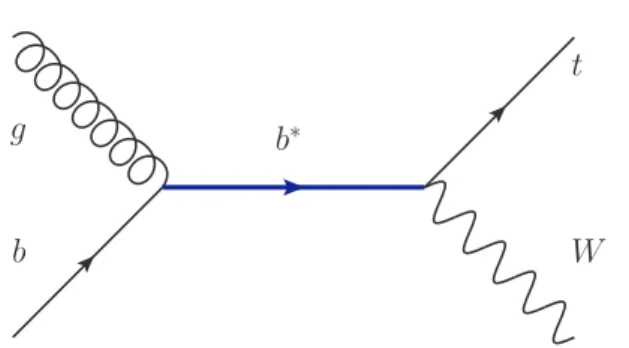
through its coupling to abquark and a gluon, as shown
in Fig. 1.
The Lagrangian describing this interaction is given by
b
∗g
b
t
W
Figure 1: Leading-order Feynman diagram for single-b∗-quark pro-duction and decay toWt.
[18, 19]
L= gs
2ΛGµνbσ
µν κb
LPL+κbRPR
!
b∗+h.c. , (1) where gs is the strong coupling, Gµν the gauge field
tensor of the gluon and Λ = mb∗ the scale of the new physics. PLandPR are the left- and right-handed
pro-jection operators andκbLandκbR are the respective cou-pling strengths. This analysis is thus complementary to excited-quark searches focusing on the coupling to the first generation [9, 20, 21]. Singleb∗-quark production can also reveal the chiral nature of the excited bottom-quark [8].
In addition to the chromomagnetic coupling, the
quarks can have left-handed or right-handed couplings to theWboson or can be vector-like with equal strength
for both couplings. The Lagrangian describing the elec-troweak decay of theb∗quark, shown in Fig. 1, is
L= √g2
2W
+
µtγ
µ
gLPL+gRPR
b∗+h.c. , (2) whereg2is the SU(2)Lweak coupling andgLandgRare
the coupling strengths for left-handed and right-handed couplings, respectively.
While the search is general and considers any res-onance decaying into the Wt signature, three specific b∗-quark coupling scenarios are considered in order to
extractb∗-quark coupling and mass limits: left-handed (κbL, gL non-zero and κbR = gR = 0), right-handed
(κbL = gL = 0 and κbR, gR non-zero) and vector-like
(κb L = κ
b R = κ
b
L/R andgL = gR = gL/R non-zero)
pro-duction and decay. Limits are derived as a function of theb∗-quark mass as well as the couplingsκb
L,R and gL,R. These limits take into account both the change of
the production cross-section and the b∗ → Wt decay branching ratio, which depend on the couplings and the
b∗-quark mass. The branching ratio to Wtvaries be-tween 20% atmb∗ = 300 GeV and 40% at higher val-ues, with decays tobg,bZandbHalso allowed.
Con-tributions from non-Wtdecay modes that may increase
the b∗-quark acceptance of this analysis are not
con-sidered, resulting in conservative limits. Signal event yields presented in the following tables are calculated withκb
L=gL=1 andκbR =gR=0.
For a left-handedb∗at √s=7 TeV withκb
L=gL=1
andκb
R =gR =0, the leading-order cross section times
branching ratio toWtis 0.80 pb formb∗=900 GeV [8]. The uncertainties due to the choice of factorisation and renormalisation scales are evaluated by varying the scales between mb∗/2 and 2 ×mb∗, and those due to the choice of PDF by comparing results obtained us-ing the CT10 [27], MRST [28] and NNPDF [29] sets. These uncertainties are added in quadrature to yield cross-section uncertainties ranging from 12% atmb∗ = 300 GeV to 25% atmb∗ =1200 GeV.
This channel proceeds via twoW bosons fromb∗
-quark and top--quark decays. At least oneW boson is
required to decay to a lepton (electron or muon). The analysis is performed separately in the dilepton and lep-ton+jets final states. The lepton+jets channel has the
advantage that the invariant mass of theb∗ quark can be reconstructed, whereas the dilepton channel benefits from smaller backgrounds. A discriminant that sepa-rates theb∗-quark signal from the backgrounds is de-fined in each final state. Limits onb∗-quark production are obtained from a combined Bayesian analysis of both
discriminant distributions.
2. The ATLAS detector
The ATLAS detector [30] is a general purpose de-tector with a precise tracking system, calorimeters and an outer muon spectrometer. The inner tracking sys-tem consists of a silicon pixel detector, a silicon mi-crostrip tracker, and a straw-tube transition radiation tracker. This system is immersed in a 2 T axial magnetic field produced by a solenoid and provides charged parti-cle tracking and identification in the pseudorapidity1 re-gion|η|<2.5. The central calorimeter system consists of a liquid-argon electromagnetic sampling calorime-ter with high granularity and an iron/scintillator tile
calorimeter providing hadronic energy measurements in the central pseudorapidity range (|η|<1.7). The endcap and forward regions are instrumented with liquid-argon calorimeters for both electromagnetic and hadronic en-ergy measurements up to|η|=4.9. The muon spectrom-eter is operated in a toroidal magnetic field provided by air-core superconducting magnets and includes tracking chambers for precise muon momentum measurements up to|η|=2.7 and trigger chambers covering the range
|η|<2.4.
3. Data and simulated samples
This analysis uses data collected with the ATLAS de-tector in 2011, corresponding to an integrated luminos-ity of 4.7±0.2 fb−1[31, 32] of 7 TeV proton–proton (pp) collisions delivered by the LHC. The data are selected using single-electron or single-muon triggers whose ef-ficiencies reach their plateau at 25 GeV and 20 GeV, re-spectively [33, 34]. The data must also pass stringent quality requirements [35]. Events are selected if they contain at least one primary vertex candidate with at least five associated tracks.
The signal is modelled using MadGraph5 [36] and the CTEQ6L1 parton distribution functions (PDFs) [37]. Events with single top-quarks in the t
-channel are generated with the AcerMC [38] genera-tor, using the MRST LO** PDF set [39]. MadGraph5
1ATLAS uses a right-handed coordinate system with its origin at the nominal interaction point (IP) in the centre of the detector and thez-axis along the beam pipe. Thex-axis points from the IP to the centre of the LHC ring, and they-axis points upwards. Cylindrical coordinates (r, φ) are used in the transverse plane,φis the azimuthal
angle around the beam pipe. The pseudorapidityηis defined in terms
and AcerMC are interfaced to Pythia [40] for par-ton showering and modelling of the underlying event. Other processes producing single quarks and top-quark pairs (tt¯) are modelled with the
next-to-leading-order(NLO) generator MC@NLO [41] using the CT10 PDF set [27], interfaced to Herwig [42] for parton showering and Jimmy [43] for the underlying event. Alpgen [44] is used to model vector boson (W and
Z) production in association with jets as well as
dibo-son processes (WW,WZandZZ) using the CTEQ6L1
PDF set. It is interfaced to Herwigfor parton shower modelling. In the lepton+jets analysis the diboson
pro-cesses are modelled with Herwigonly. Decays ofτ lep-tons are handled by Tauola[45]. A top-quark mass of 172.5 GeV [46] is assumed. Approximate next-to-next-to-leading-order(NNLO) cross-section calculations are used to normalise thett¯[47] (Hathor) and single top-quark samples [48–50], while the vector boson and di-boson samples are normalised using calculations with MCFM [51] at NNLO and NLO, respectively.
A variable number of additionalppinteractions
(pile-up) are overlaid on simulated events, which are then weighted to reproduce the distribution of the number of collisions per bunch crossing observed in data. All samples are passed through a GEANT4-based simula-tion [52] of the ATLAS detector [53] and are then re-constructed using the same procedure as for collision data.
4. Physics object selection
Electron candidates are reconstructed from clusters of energy deposits in the calorimeter [54]. The transverse energyETof electron candidates is required to be larger than 25 GeV and their pseudorapidity is required to be
|η|<2.47. Electrons in the barrel–endcap transition re-gion of the calorimeter, corresponding to 1.37 <|η| < 1.52, are not considered. Selected electrons must pass a set of “tight” quality criteria [54] and the electons must be matched to a track reconstructed in the inner tracking system. Electrons must also be isolated from close-by tracks in a cone of∆R = p(∆η)2+(∆φ)2 < 0.3 and from calorimeter energy deposits not belonging to the electron candidate in a cone of∆R < 0.2. The isola-tion requirements on the sum of transverse momenta of tracks in the cone and on the sum of energy deposits in the calorimeter in the cone are chosen as a function of
pTandηsuch that an efficiency of 90% for electrons in the simulation is achieved.
Muon candidates are reconstructed from matching tracks in the muon spectrometer and inner tracking sys-tem. Muons are required to have transverse momentum
pT >25 GeV and|η|<2.5 and fulfil tight quality crite-ria [55]. Muons must be isolated from close-by tracks in a cone of∆R <0.3 and from energy deposits in the calorimeter in a cone of ∆R <0.2. The sum of trans-verse momenta of tracks in the cone must not exceed 2.5 GeV and the sum of energy deposits in the calorime-ter in the cone must be below 4 GeV.
In order to reject events in which a muon emitting a hard photon is also reconstructed as an electron, events are vetoed if a selected electron–muon pair shares the same track.
Jets are reconstructed from clusters of energy de-posits in the calorimeter [56] using the anti-kt
algo-rithm [57] with a radius parameter R = 0.4. These jets are calibrated to the hadronic energy scale through
pT- and η-dependent scale factors, which are derived from simulation. An additional uncertainty due to residual differences between simulation and data is
ap-plied in the analysis [58]. Jets are required to have
pT > 30 (25) GeV and|η| < 2.5 in the dilepton (lep-ton+jets) channel. The ratio of the scalar sum of the
pT of tracks associated with the jet and the primary vertex to the scalar sum of the pT of all tracks asso-ciated with the jet must be at least 0.75 to reject jets from pile-up interactions. Muons overlapping with jets within∆R < 0.4 are removed and the jet is kept. The closest jet overlapping with electrons within∆R <0.2 is removed and the electron is kept. If electrons sub-sequently still overlap with any remaining jet within
∆R < 0.4, they are removed. Information about jets containingbquarks [59] is also used in the lepton+jets
channel. A neural network combines lifetime-related in-formation reconstructed from the tracks associated with each jet. At the chosen working point, theb-tagging
al-gorithm has an efficiency of 70% (20%/0.7%) for jets
containingbquarks (cquarks/light quarks or gluons) in
a simulatedtt¯sample.
The missing transverse momentum ETmiss is
calcu-lated using topological clusters of energy deposits in the calorimeter and corrected for the presence of muons [60].
5. Event selection in the dilepton channel
The event selection and background modelling in the dilepton channel is the same as in the ATLAS mea-surement of the single top-quark production in theWt
b-tagging requirement is made since the dominant
back-ground fromtt¯production also containsbquarks. The EmissT is required to be greater than 50 GeV. In theee
andµµchannels, the invariant mass of the lepton pair,
mℓℓ, is required to be outside the Z boson mass
win-dow: mℓℓ < 81 GeV or mℓℓ > 101 GeV. In all three
channels, theZ→ττbackground is reduced by a dedi-cated veto, which requires the sum of the azimuthal an-gle differences between each lepton and theEmissT vector
to be greater than 2.5 rad. After all cuts, the acceptance for signal events withmb∗ = 800 GeV in which both
Wbosons decay leptonically (to eithereorµ) is 26%. The main background, accounting for 63% of the to-tal, comes fromtt¯events in which one of the two jets
originating fromb quarks is not detected. The second
largest background is from SMWt production, which
has the same final state as theb∗-quark signal, and ac-counts for 13% of the total background. Diboson events produced in association with jets account for 12% of the total background. With the exception of single- and di-boson samples, these backgrounds are taken from NLO simulation and are normalised to their NNLO theoret-ical predictions. Drell–Yan (DY) events contribute a small background of 7.3% to the sum ofeeandµµ chan-nel events. The events are taken from the simulation and normalised to data using a two-dimensional side-band region with low EmissT and/ormℓℓ outside of the
Z boson mass window [4]. The contribution fromττ final states, where bothτleptons decay leptonically, is estimated from simulated samples, with the normalisa-tion checked in an orthogonal data sample obtained by reversing theZ →τ+τ−veto cut described above.Z → τ+τ−events account for 0.7% of the total background. The small background from jets that are misidentified as primary leptons and from non-prompt leptons (fake dileptons) is modelled and normalised using data [61]. It accounts for 4% of the background.
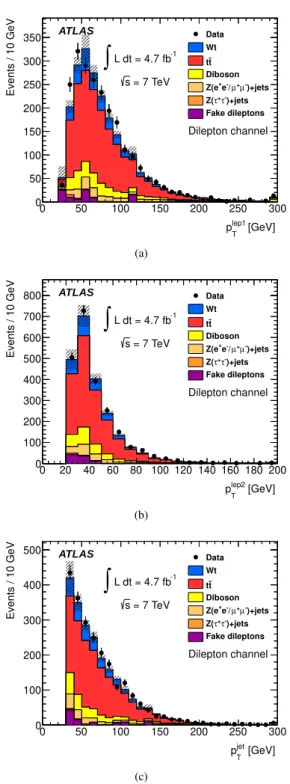
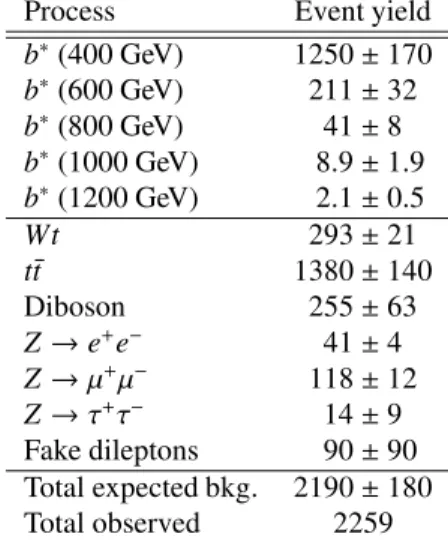
The predicted event yields for the backgrounds and signal at a few mass points are compared to data in Ta-ble 1. ThepTdistributions of the two leptons and the jet are shown in Fig. 2.
A discriminating variable that separates the signal from the backgrounds isHT, the scalar sum of the trans-verse momenta of the leptons, jet and ETmiss. The HT distribution is shown in Fig. 3.
6. Event selection in the lepton+jets channel
The analysis in the lepton+jets channel follows the
same background modelling strategy as the cross-section measurement for single top-quark production in
[GeV]
lep1 T
p
0 50 100 150 200 250 300
Events / 10 GeV
0 50 100 150 200 250 300 350 Data Wt t t Diboson )+jets -µ + µ / -e + Z(e )+jets -τ + τ Z( Fake dileptons -1
L dt = 4.7 fb
∫
ATLAS= 7 TeV s Dilepton channel (a) [GeV] lep2 T p
0 20 40 60 80 100 120 140 160 180 200
Events / 10 GeV
0 100 200 300 400 500 600 700 800 Data Wt t t Diboson )+jets -µ + µ / -e + Z(e )+jets -τ + τ Z( Fake dileptons -1
L dt = 4.7 fb
∫
ATLAS= 7 TeV s Dilepton channel (b) [GeV] jet T p 0 50 100 150 200 250 300
Events / 10 GeV
0 100 200 300 400 500 Data Wt t t Diboson )+jets -µ + µ / -e + Z(e )+jets -τ + τ Z( Fake dileptons -1
L dt = 4.7 fb
∫
ATLAS= 7 TeV s
Dilepton channel
(c)
Table 1: Observed and predicted event yields in the dilepton channel with normalisation uncertainties. The signal yields are calculated with
κbL=gL=1 andκbR=gR=0.
Process Event yield
b∗(400 GeV) 1250±170
b∗(600 GeV) 211±32
b∗(800 GeV) 41±8
b∗(1000 GeV) 8.9±1.9
b∗(1200 GeV) 2.1±0.5
Wt 293±21 tt¯ 1380±140
Diboson 255±63
Z→e+e− 41±4
Z→µ+µ− 118±12
Z→τ+τ− 14±9 Fake dileptons 90±90
Total expected bkg. 2190±180 Total observed 2259
[GeV]
T
H 0 500 1000 1500
Events / GeV
-3
10
-2
10
-1
10 1 10
Data b* (800 GeV) Wt
t t Diboson
)+jets
-µ + µ
/
-e
+
Z(e )+jets
-τ + τ
Z(
Fake dileptons
-1
L dt = 4.7 fb
∫
ATLAS= 7 TeV s
Dilepton channel
Figure 3:HTdistribution for data and background expectation for the dilepton channel. The hatched band shows the uncertainty due to the background normalisation. The signal for ab∗-quark mass of 800 GeV is also shown.
the t-channel [2]. Events are required to have either ex-actly one muon andEmissT >25 GeV or exactly one elec-tron andEmissT > 30 GeV, as well as exactly three jets with pT > 25 GeV. Exactly one of the jets is required to beb-tagged to reduce backgrounds. The lepton must
also match the corresponding trigger object. Additional requirements are made to reject multijet events, which tend to have lowEmissT and a low transverse mass2of the
lepton–ETmisssystem, mWT. In the muon channel events
are required to have mWT +EmissT > 60 GeV, while in the electron channel a requirement of mWT > 30 GeV is made. The acceptance for signal events withmb∗ = 800 GeV in which one of theWbosons decays
leptoni-cally (eorµ) and the other hadronically is 9%.
In this channel, one of the largest backgrounds is
W+jets production for which the normalisation and
flavour composition (the heavy-flavour fraction, HF, includes b quarks and c quarks) are derived from
data [62]. The overall normalisation is determined from the charge asymmetry betweenW+andW−production in three-jet events without the b-tag requirement. The
flavour composition is determined in two-jet events by comparing the predictedW+jets yields to data with and
without a b-tag requirement. The resulting
normali-sation and flavour scale factors are then applied to b
-taggedW+3-jets events. About 37% of the total
back-ground comes fromW+jets events, including 28% from
events with heavy flavour.
Backgrounds from tt¯yield 41% of the total
back-ground and single top-quark production in thet-,s- and Wt-channel 9%. The multijet background is obtained
using a data-based approach by comparing the num-bers of events passing loose and tight lepton identifi-cation criteria [63]. It accounts for 9% of the total back-ground. Smaller backgrounds fromZ+jets and diboson
processes are normalised to their theoretical predictions and contribute 4%.
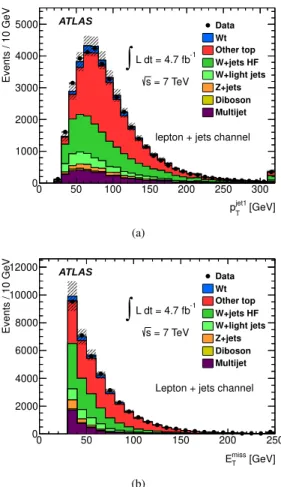
The predicted event yields are compared to data in Table 2. The distributions of thepTof the highest-pTjet andEmissT are shown in Fig. 4.
In the lepton+jets channel it is possible to reconstruct
the candidateb∗-quark mass from the decay products.
The only missing information is the neutrino longitudi-nal momentum, which is set to zero. The resulting re-constructed mass provides good discrimination between background and signal, as shown in Fig. 5.
2The transverse mass, mW
T, is calculated from the lepton transverse momentum plepT and the difference of the azimuthal angle, ∆φ, between the ETmiss and plepT vector as mW
T =
q
[GeV]
jet1 T
p 0 50 100 150 200 250 300
Events / 10 GeV
0 1000 2000 3000 4000 5000 ATLAS
= 7 TeV s
-1
L dt = 4.7 fb
∫
lepton + jets channel
Data Wt Other top W+jets HF W+light jets Z+jets Diboson Multijet (a) [GeV] miss T E
0 50 100 150 200 250
Events / 10 GeV
0 2000 4000 6000 8000 10000 12000 ATLAS
= 7 TeV s
-1
L dt = 4.7 fb
∫
Lepton + jets channel
Data Wt Other top W+jets HF W+light jets Z+jets Diboson Multijet (b)
Figure 4: Kinematic distributions comparing data to predictions in the lepton+jets channel for (a) thepjet1T of the highest-pTjet and (b)EmissT . “Other top” includestt¯,s- andt-channel single top-quark production. The hatched band shows the uncertainty due to the background nor-malisation. The last bin includes overflows.
reconstructed mass [GeV] 0 400 800 1200 1600 2000
Events / GeV
-1 10 1 10 2 10 ATLAS -1
L dt = 4.7 fb
∫
Lepton + jets channel
= 7 TeV s
Data b’ (800 GeV) Wt Other top W+jets HF W+light jets Z+jets Diboson Multijet
Figure 5: Reconstructed mass distribution for data and background expectation for the lepton+jets channel. “Other top” includestt¯,s -andt-channel single top-quark production. The hatched band shows the uncertainty due to the background normalisation. The signal for a mass of 800 GeV is also shown. The last bin includes overflows.
Table 2: Observed and expected event yields in the lepton+jets chan-nel with normalisation uncertainties. The signal yields are calculated withκb
L=gL=1 andκbR=gR=0.
Process Event yield
b∗(400 GeV) 12100±1600 b∗(600 GeV) 1950±300 b∗(800 GeV) 370±70 b∗(1000 GeV) 79±17 b∗(1200 GeV) 20±5
Wt 1660±120
single tops,t-channel 1960±140
tt¯ 15700±1600
W+light jets 3200±400
W+jets HF 10900±1400
Diboson 327±16
Z+jets 1300±800
Multijet 3500±1700
Total expected bkg. 38500±2900
Total observed 38175
7. Systematic uncertainties
Systematic uncertainties affecting the signal
accep-tance and the background normalisation are consid-ered, together with uncertainties affecting the shape of
the discriminant distributions. The main experimental source of systematic uncertainty comes from the lim-ited knowledge of the jet energy scale [58], which car-ries an uncertainty of 2–7% parameterised as a function of jet pT andη. The presence of a b quark in the jet adds an additional uncertainty of 2–5% to the jet en-ergy scale uncertainty, depending on the jet pT. Other jet-related uncertainty sources are the jet energy reso-lution, jet reconstruction efficiency and b-tagging
ef-ficiency [59]. Lepton-related uncertainties come from trigger and identification efficiencies as well as the
lep-ton energy scale and resolution. Event-related uncer-tainties are due to the modelling of multiple proton-proton interactions and the underlying event as well as
ETmiss[60]. The uncertainty on the integrated luminosity
is 3.9% [31, 32].
Simulation uncertainties include modelling of the hard process, parton shower and hadronisation, and initial- and final-state radiation. These have been as-sessed for thett¯background events by comparing
dif-ferent generators (Powheg and MC@NLO), different shower models (Pythiaand Herwig), and fortt¯and sig-nal events different settings for the amount of additional
radiation [64]. Other sources of theoretical uncertainty include the normalisation fortt¯(+7%
sin-gle top-quark (±7%) [48–50] and diboson (±5% with
an additional 24% per extra jet) production [61], as well as the choice of PDF. The latter was assessed using the CT10 [27], MRST [28] and NNPDF [29] sets.
Additional uncertainties affect the data-driven
ground estimation. The uncertainty on the DY back-ground normalisation in the dilepton channel is 10% foreeandµµ final states and 60% forττ final states. The uncertainty on the fake-dileptons normalisation in the dilepton channel is 100%. The uncertainty on the
W+jets normalisation in the lepton+jets channel is 13%.
TheW+jets flavour composition has two additional
un-certainties: the HF contribution has a relative uncer-tainty of 6%, and theWbb/WHFratio has an uncertainty
of 17%. The multijet background normalisation in the lepton+jets channel has an uncertainty of 50%.
8. Statistical analysis
Both theHT distribution in the dilepton channel and the reconstructed mass distribution in the lepton+jets
channel show good agreement between the data and the background model. These two discriminants are used to set limits on theb∗-quark signal using a Bayesian anal-ysis technique [68]. The likelihood function is defined as
L(data|σb∗)= Y
k
µnk
k e−
µk
nk!
Y
i
Gi, (3)
wherekis the index of the discriminant template bin,
running over both analysis channels;µk=sk+bkis the
sum of predicted signal and background yields;nkis the
observed yield andGiis a Gaussian prior for theith
sys-tematic uncertainty. A flat prior is assumed for the sig-nal cross-section. Upper limits on theb∗-quark produc-tion cross-secproduc-tion times branching ratio toWtare set at
the 95% credibility level (CL) for a series ofb∗masses at 100 GeV intervals.
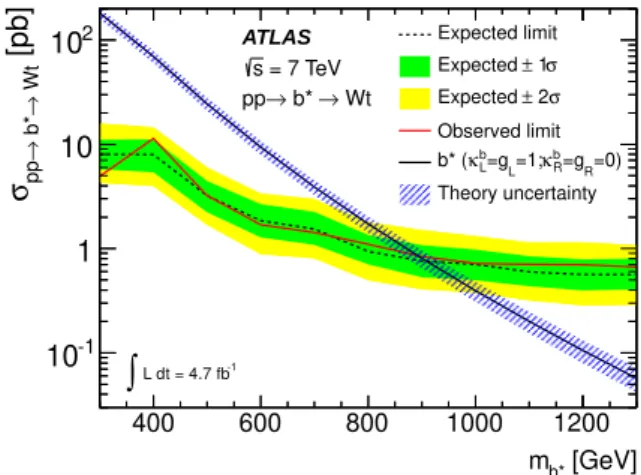
The observed and expected cross-section limits as a function of theb∗-quark mass for the left-handed
cou-pling scenario (κbL = gL = 1 and κRb = gR = 0) are
shown in Fig. 6, where the expected limit and its un-certainty are derived from ensembles of background-only pseudo-datasets. The intersection of the theoret-ical section and the observed (expected) cross-section limit defines the observed (expected)b∗-quark mass limit. The observed lower limit on theb∗-quark mass for this left-handed coupling scenario is 870 GeV with an expectation of 910 GeV. When considering only the dilepton channel, the observed (expected) limit on theb∗-quark mass is 800 GeV (820 GeV); for the lep-ton+jets channel, the limits are 800 GeV (830 GeV).
[GeV]
b*
m
400 600 800 1000 1200
[pb] Wt → b* → pp σ -1 10 1 10 2
10 Expected limit
σ 1 ± Expected σ 2 ± Expected Observed limit =0) R =g R b κ =1; L =g L b κ b* ( Theory uncertainty ATLAS Wt → b* → pp = 7 TeV s
-1 L dt = 4.7 fb
∫
Figure 6: Expected and observed limits at the 95% CL as a function of theb∗-quark mass. Also shown is the theory prediction forb∗-quark production with couplingsκbL=gL=1 andκbR=gR =0, including
PDF and scale uncertainties.
Limits are also computed for models with right-handed and vector-like couplings of theb∗quark. Set-ting κb
L = gL = 0 and κ b
R = gR = 1, the observed
lower mass limit is 920 GeV with an expected limit of 950 GeV. SettingκbL=κbR =gL=gR=1, the observed
lower mass limit is 1030 GeV with an expected limit of 1030 GeV.
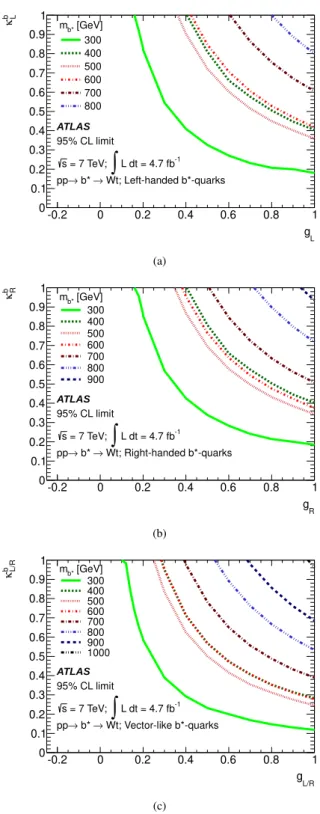
At each mass point, the corresponding cross section is parameterised as a function of the couplingsκbL,R and
gL,R in order to extract coupling limits in each of the
threeb∗-quark coupling scenarios. The resulting limit
contours are shown in Fig. 7. The coupling limits in-crease as the theoretical cross-section dein-creases with
b∗ mass, except for the region between 400 GeV and 500 GeV where the backgrounds decrease rapidly with increasing mass (see Figs. 3 and 5).
9. Summary
A search for a singly produced excited b∗-quark in
4.7 fb−1 of data collected with the ATLAS detector in
ppcollisions at √s=7 TeV has been presented. This is
the first search for excited-quarks coupling to the third generation. It considers the dilepton and lepton+jets
L
g -0.2 0 0.2 0.4 0.6 0.8 1
L b κ 0 0.1 0.2 0.3 0.4 0.5 0.6 0.7 0.8 0.9 1 ATLAS
95% CL limit
-1
L dt = 4.7 fb
∫
= 7 TeV; s
Wt; Left-handed b*-quarks
→ b* → pp [GeV] b* m 300 400 500 600 700 800 (a) R g -0.2 0 0.2 0.4 0.6 0.8 1
R bκ 0 0.1 0.2 0.3 0.4 0.5 0.6 0.7 0.8 0.9 1 ATLAS
95% CL limit
-1
L dt = 4.7 fb
∫
= 7 TeV; s
Wt; Right-handed b*-quarks
→ b* → pp [GeV] b* m 300 400 500 600 700 800 900 (b) L/R g -0.2 0 0.2 0.4 0.6 0.8 1
L/R b κ 0 0.1 0.2 0.3 0.4 0.5 0.6 0.7 0.8 0.9 1 ATLAS
95% CL limit
-1
L dt = 4.7 fb
∫
= 7 TeV; s
Wt; Vector-like b*-quarks
→ b* → pp [GeV] b* m 300 400 500 600 700 800 900 1000 (c)
Figure 7: Limit contours at the 95% CL as a function of the coupling parameters for several differentb∗-quark masses, for (a) left-handed
b∗quarks, (b) right-handedb∗quarks and (c) vector-likeb∗quarks.
10. Acknowledgements
We thank CERN for the very successful operation of the LHC, as well as the support stafffrom our
institu-tions without whom ATLAS could not be operated effi
-ciently.
We acknowledge the support of ANPCyT, Argentina; YerPhI, Armenia; ARC, Australia; BMWF and FWF, Austria; ANAS, Azerbaijan; SSTC, Belarus; CNPq and FAPESP, Brazil; NSERC, NRC and CFI, Canada; CERN; CONICYT, Chile; CAS, MOST and NSFC, China; COLCIENCIAS, Colombia; MSMT CR, MPO CR and VSC CR, Czech Republic; DNRF, DNSRC and Lundbeck Foundation, Denmark; EPLANET, ERC and NSRF, European Union; IN2P3-CNRS, CEA-DSM/IRFU, France; GNSF, Georgia; BMBF, DFG,
HGF, MPG and AvH Foundation, Germany; GSRT and NSRF, Greece; ISF, MINERVA, GIF, DIP and Benoziyo Center, Israel; INFN, Italy; MEXT and JSPS, Japan; CNRST, Morocco; FOM and NWO, Netherlands; BRF and RCN, Norway; MNiSW, Poland; GRICES and FCT, Portugal; MERYS (MECTS), Romania; MES of Russia and ROSATOM, Russian Federation; JINR; MSTD, Serbia; MSSR, Slovakia; ARRS and MVZT, Slovenia; DST/NRF, South Africa; MICINN, Spain;
SRC and Wallenberg Foundation, Sweden; SER, SNSF and Cantons of Bern and Geneva, Switzerland; NSC, Taiwan; TAEK, Turkey; STFC, the Royal Society and Leverhulme Trust, United Kingdom; DOE and NSF, United States of America.
The crucial computing support from all WLCG part-ners is acknowledged gratefully, in particular from CERN and the ATLAS Tier-1 facilities at TRIUMF (Canada), NDGF (Denmark, Norway, Sweden), CC-IN2P3 (France), KIT/GridKA (Germany), INFN-CNAF
(Italy), NL-T1 (Netherlands), PIC (Spain), ASGC (Tai-wan), RAL (UK) and BNL (USA) and in the Tier-2 fa-cilities worldwide.
References
[1] T. M. P. Tait and C. P. Yuan,Single top quark production as a window to physics beyond the standard model, Phys. Rev. D63
(2000) 014018,arXiv:hep-ph/0007298.
[2] ATLAS Collaboration,Measurement of the t-channel single top-quark production cross section in pp collisions at
√
s=7 TeVwith the ATLAS detector, Physics Letters B717
(2012) 330–350,arXiv:1205.3130 [hep-ex].
[3] CMS Collaboration,Measurement of the single-top-quark t-channel cross section in pp collisions at√s=7 TeV,
arXiv:1209.4533 [hep-ex]. Submitted to JHEP. [4] ATLAS Collaboration,Evidence for the associated production
[5] CMS Collaboration,Evidence for associated production of a single top quark and W boson in pp collisions at7 TeV,
arXiv:1209.3489 [hep-ex]. Submitted to Phys. Rev. Lett.
[6] ATLAS Collaboration,Search for tb resonances in proton-proton collisions at√s=7 TeVwith the ATLAS detector, Phys. Rev. Lett.109(2012) 081801, arXiv:1205.1016 [hep-ex].
[7] CMS Collaboration,Search for a W’ boson decaying to a bottom quark and a top quark in pp collisions at √s=7 TeV,
arXiv:1208.0956 [hep-ex]. Submitted to Phys. Lett. B.
[8] J. Nutter, R. Schwienhorst, D. Walker and J.-H. Yu,Single Top Production as a Probe of B-prime Quarks,arXiv:1207.5179 [hep-ph].
[9] ATLAS Collaboration,Search for New Physics in the Dijet Mass Distribution using 1 fb−1of pp Collision Data at
√s=7 TeVcollected by the ATLAS Detector, Phys. Lett. B708
(2012) 37–54,arXiv:1108.6311 [hep-ex].
[10] CMS Collaboration,Search for Resonances in the Dijet Mass Spectrum from7 TeVpp Collisions at CMS, Phys. Lett. B704
(2011) 123–142,arXiv:1107.4771 [hep-ex].
[11] H1 Collaboration, F. Aaron et al.,Search for Excited Quarks in ep Collisions at HERA, Phys. Lett. B678(2009) 335–343, arXiv:0904.3392 [hep-ex].
[12] ATLAS Collaboration,Search for production of resonant states in the photon-jet mass distribution using pp collisions at
√s=7TeV collected by the ATLAS detector, Phys. Rev. Lett.
108(2012) 211802,arXiv:1112.3580 [hep-ex]. [13] C. Cheung, A. L. Fitzpatrick and L. Randall,Sequestering CP
Violation and GIM-Violation with Warped Extra Dimensions, JHEP0801(2008) 069,arXiv:0711.4421 [hep-th].
[14] A. L. Fitzpatrick, G. Perez, and L. Randall,Flavor anarchy in a Randall-Sundrum model with 5D minimal flavor violation and a low Kaluza-Klein scale, Phys. Rev. Lett.100(2008) 171604, arXiv:0710.1869 [hep-ph].
[15] C. Bini, R. Contino and N. Vignaroli,Heavy-light decay topologies as a new strategy to discover a heavy gluon, JHEP
1201(2012) 157,arXiv:1110.6058 [hep-ph]. [16] N. Vignaroli,Discovering the composite Higgs through the
decay of a heavy fermion, JHEP1207(2012) 158, arXiv:1204.0468 [hep-ph].
[17] N. Vignaroli,∆F=1 constraints on composite Higgs models with LR parity, Phys. Rev. D86(2012) 115011,
arXiv:1204.0478 [hep-ph].
[18] A. de Rujula, L. Maiani and R. Petronzio,Search for excited quarks, Phys. Lett. B140(1984) 253–258.
[19] U. Baur, I. Hinchliffe and D. Zeppenfeld,Excited Quark Production at Hadron Colliders, Int. J. Mod. Phys. A2(1987) 1285.
[20] ATLAS Collaboration,Search for pair production of a new quark that decays to a Z boson and a bottom quark with the ATLAS detector, Phys. Rev. Lett.109(2012) 071801,
arXiv:1204.1265 [hep-ex].
[21] ATLAS Collaboration,Search for heavy vector-like quarks coupling to light quarks in proton-proton collisions at
√
s=7 TeVwith the ATLAS detector, Phys. Lett. B712(2012)
22–39,arXiv:1112.5755 [hep-ex].
[22] C. T. Hill and E. H. Simmons,Strong dynamics and electroweak symmetry breaking, Phys. Rept.381(2003)
235–402,arXiv:hep-ph/0203079 [hep-ph].
[23] S. P. Martin,Extra vector-like matter and the lightest Higgs scalar boson mass in low-energy supersymmetry, Phys. Rev. D
81(2010) 035004,arXiv:0910.2732 [hep-ph]. [24] K. Kumar, W. Shepherd, T. M.P. Tait and R. Vega-Morales,
Beautiful Mirrors at the LHC, JHEP1008(2010) 052, arXiv:1004.4895 [hep-ph].
[25] B. Holdom, W. Hou, T. Hurth, M. Mangano, S. Sultansoy, et al.,Four Statements about the Fourth Generation, PMC Phys. A3(2009) 4,arXiv:0904.4698 [hep-ph].
[26] A. K. Alok, A. Dighe and D. London,Constraints on the Four-Generation Quark Mixing Matrix from a Fit to Flavor-Physics Data, Phys. Rev. D83(2011) 073008, arXiv:1011.2634 [hep-ph].
[27] H.-L. Lai, M. Guzzi, J. Huston, Z. Li and P. M. Nadolsky,New parton distributions for collider physics, Phys. Rev. D82
(2010) 074024,arXiv:1007.2241 [hep-ph].
[28] A. Martin, W. Stirling, R. Thorne and G. Watt,Uncertainties onαsin global PDF analyses and implications for predicted hadronic cross-sections, Eur. Phys. J. C64(2009) 653–680, arXiv:0905.3531 [hep-ph].
[29] R. D. Ball, L. Del Debbio, S. Forte, A. Guffanti, J. I. Latorre, et al.,A first unbiased global NLO determination of parton distributions and their uncertainties, Nucl. Phys. B838(2010)
136–206,arXiv:1002.4407 [hep-ph].
[30] ATLAS Collaboration,The ATLAS Experiment at the CERN Large Hadron Collider, J. Inst.3(2008) S08003.
[31] ATLAS Collaboration,Luminosity Determination in pp Collisions at√s=7 TeVusing the ATLAS Detector at the LHC, Eur. Phys. J. C71(2011) 1630,arXiv:1101.2185 [hep-ex].
[32] ATLAS Collaboration,Luminosity determination in pp collisions at7 TeVusing the ATLAS detector at the LHC in 2011, ATLAS–CONF–2011–116.
https://cdsweb.cern.ch/record/1376384.
[33] ATLAS Collaboration,Performance of the ATLAS Trigger System in 2010, Eur. Phys. J. C72(2012) 1849, arXiv:1110.1530 [hep-ex].
[34] ATLAS Collaboration,The evolution and performance of the ATLAS calorimeter-based triggers in 2011 and 2012, ATL–DAQ–PROC–2012–051.
https://cdsweb.cern.ch/record/1485638.
[35] ATLAS Collaboration,Data-Quality Requirements and Event Cleaning for Jets and Missing Transverse Energy
Reconstruction with the ATLAS Detector in Proton-Proton Collisions at a Center-of-Mass Energy of√s=7 TeV, ATLAS–CONF–2010–038.
https://cdsweb.cern.ch/record/1277678.
[36] J. Alwall, M. Herquet, F. Maltoni, O. Mattelaer and T. Stelzer, MadGraph 5 : Going Beyond, JHEP1106(2011) 128, arXiv:1106.0522 [hep-ph].
[37] P. M. Nadolsky, H.-L. Lai, Q.-H. Cao, J. Huston and J. Pumplin,Implications of CTEQ global analysis for collider observables, Phys. Rev. D78(2008) 013004,
arXiv:0802.0007 [hep-ph].
[38] B. P. Kersevan and E. Richter-Was,The Monte Carlo event generator AcerMC version 2.0 with interfaces to PYTHIA 6.2 and HERWIG 6.5,arXiv:hep-ph/0405247 [hep-ph]. AcerMC version 3.8 is used.
[39] A. Sherstnev and R. Thorne,Parton Distributions for LO Generators, Eur. Phys. J. C55(2008) 553–575, arXiv:0711.2473 [hep-ph].
[40] T. Sjostrand, S. Mrenna, and P. Z. Skands,PYTHIA 6.4 Physics and Manual, JHEP0605(2006) 026,
arXiv:hep-ph/0603175 [hep-ph]. PYTHIA version 6.425
is used.
[41] S. Frixione, E. Laenen, P. Motylinski, B. R. Webber and C. D. White,Single-top hadroproduction in association with a W boson, JHEP0807(2008) 029,arXiv:0805.3067 [hep-ph].
supersymmetric processes), JHEP0101(2001) 010,
arXiv:hep-ph/0011363. HERWIG version 6.520 is used. [43] J. M. Butterworth, J. R. Forshaw and M. H. Seymour,
Multiparton interactions in photoproduction at HERA, Z. Phys. C72(1996) 637–646,arXiv:hep-ph/9601371 [hep-ph]. JIMMY version 4.31 is used.
[44] M. L. Mangano, M. Moretti, F. Piccinini, R. Pittau and A. D. Polosa,ALPGEN, a generator for hard multiparton processes in hadronic collisions, JHEP0307(2003) 001,
arXiv:hep-ph/0206293 [hep-ph].
[45] N. Davidson, G. Nanava, T. Przedzinski, E. Richter-Was and Z. Was.,Universal Interface of TAUOLA Technical and Physics Documentation, Comput. Phys. Commun.183(2012) 821–843, arXiv:1002.0543 [hep-ph].
[46] Particle Data Group, K. Nakamura et al.,Review of Particle Physics, J. of Phys. G37(2010) 075021.
[47] M. Aliev, H. Lacker, U. Langenfeld, S. Moch, P. Uwer, et al., HATHOR: HAdronic Top and Heavy quarks crOss section calculatoR, Comput. Phys. Commun.182(2011) 1034–1046, arXiv:1007.1327 [hep-ph]. HATHOR version 1.2 is used.
[48] N. Kidonakis,Next-to-next-to-leading-order collinear and soft gluon corrections for t-channel single top quark production, Phys. Rev. D83(2011) 091503,arXiv:1103.2792 [hep-ph].
[49] N. Kidonakis,NNLL resummation for s-channel single top quark production, Phys. Rev. D81(2010) 054028,
arXiv:1001.5034 [hep-ph].
[50] N. Kidonakis,Two-loop soft anomalous dimensions for single top quark associated production with a W−or H−, Phys. Rev. D82(2010) 054018,arXiv:1005.4451 [hep-ph].
[51] J. M. Campbell and R. Ellis,MCFM for the Tevatron and the LHC, Nucl. Phys. Proc. Suppl.205-206(2010) 10–15, arXiv:1007.3492 [hep-ph].
[52] GEANT4 Collaboration, S. Agostinelli et al.,GEANT4: A simulation toolkit, Nucl. Instrum. Meth. A506(2003) 250.
[53] ATLAS Collaboration,The ATLAS Simulation Infrastructure, Eur. Phys. J. C70(2010) 823–874,arXiv:1005.4568 [physics.ins-det].
[54] ATLAS Collaboration,Electron performance measurements with the ATLAS detector using the 2010 LHC proton-proton collision data, Eur. Phys. J. C72(2012) 1909,
arXiv:1110.3174 [hep-ex].
[55] ATLAS Collaboration,Measurement of the W→lνand Z→l+l−production cross sections in proton-proton collisions
at7 TeVwith the ATLAS detector, JHEP1012(2010) 060, arXiv:1010.2130 [hep-ex].
[56] W. Lampl et al.,Calorimeter clustering algorithm: description and performance, (2008) ATL–LARG–PUB–2008–002.
https://cdsweb.cern.ch/record/1099735.
[57] M. Cacciari, G. P. Salam and G. Soyez,The anti-kt jet clustering algorithm, JHEP0804(2008) 063,
arXiv:0802.1189 [hep-ph].
[58] ATLAS Collaboration,Update on the jet energy scale systematic uncertainty for jets produced in proton-proton collisions at√s=7 TeVmeasured with the ATLAS detector, ATLAS–CONF–2011–007.
https://cdsweb.cern.ch/record/1330713.
[59] ATLAS Collaboration,Measuring the b-tag efficiency in a ttbar sample with4.7fb−1of data from the ATLAS detector, ATLAS–CONF–2012–097.
https://cdsweb.cern.ch/record/1460443/. [60] ATLAS Collaboration,Performance of Missing Transverse
Momentum Reconstruction in Proton-Proton Collisions at 7 TeVwith ATLAS, Eur.Phys.J. C72(2012) 1844, arXiv:1108.5602 [hep-ex].
[61] ATLAS Collaboration,Measurement of the top quark-pair production cross section with ATLAS in pp collisions at
√
s=7 TeV, Eur. Phys. J. C71(2011) 1577, arXiv:1012.1792 [hep-ex].
[62] ATLAS Collaboration,Measurement of the top quark pair production cross-section with ATLAS in the single lepton channel, Phys. Lett. B711(2012) 244–263,
arXiv:1201.1889 [hep-ex].
[63] ATLAS Collaboration,Measurements of top quark pair relative differential cross-sections with ATLAS in pp collisions at
√
(s)=7 TeV ,arXiv:1207.5644 [hep-ex]. Submitted to Eur. Phys. J. C.
[64] ATLAS Collaboration,Measurement of tt production with a¯ veto on additional central jet activity in pp collisions at
√s=7 TeVusing the ATLAS detector, Eur. Phys. J. C72
(2012) 2043,arXiv:1203.5015 [hep-ex].
[65] S. Moch and P. Uwer,Heavy-quark pair production at two loops in QCD, Nucl. Phys. Proc. Suppl.183(2008) 75–80, arXiv:0807.2794 [hep-ph].
[66] U. Langenfeld, S. Moch and P. Uwer,New results for t anti-t production at hadron colliders,arXiv:0907.2527 [hep-ph].
[67] M. Beneke et al.,Threshold expansion of the gg(qq¯)→QQ¯+X cross section at O(α4s), Phys. Lett. B690(2010) 483–490, arXiv:0911.5166 [hep-ph].
[68] A. Caldwell, D. Kollar and K. Kroninger,BAT - The Bayesian Analysis Toolkit, Comput. Phys. Commun.180(2009)
The ATLAS Collaboration
G. Aad48, T. Abajyan21, B. Abbott111, J. Abdallah12, S. Abdel Khalek115, A.A. Abdelalim49, O. Abdinov11, R. Aben105, B. Abi112, M. Abolins88, O.S. AbouZeid158, H. Abramowicz153, H. Abreu136, M.I. Ochoa77,
B.S. Acharya164a,164b,a, L. Adamczyk38, D.L. Adams25, T.N. Addy56, J. Adelman176, S. Adomeit98, P. Adragna75,
T. Adye129, S. Aefsky23, J.A. Aguilar-Saavedra124b,b, M. Agustoni17, S.P. Ahlen22, F. Ahles48, A. Ahmad148,
M. Ahsan41, G. Aielli133a,133b, T.P.A. Åkesson79, G. Akimoto155, A.V. Akimov94, M.A. Alam76, J. Albert169,
S. Albrand55, M. Aleksa30, I.N. Aleksandrov64, F. Alessandria89a, C. Alexa26a, G. Alexander153, G. Alexandre49, T. Alexopoulos10, M. Alhroob164a,164c, M. Aliev16, G. Alimonti89a, J. Alison120, B.M.M. Allbrooke18, L.J. Allison71,
P.P. Allport73, S.E. Allwood-Spiers53, J. Almond82, A. Aloisio102a,102b, R. Alon172, A. Alonso36, F. Alonso70,
A. Altheimer35, B. Alvarez Gonzalez88, M.G. Alviggi102a,102b, K. Amako65, C. Amelung23, V.V. Ammosov128,∗, S.P. Amor Dos Santos124a, A. Amorim124a,c, S. Amoroso48, N. Amram153, C. Anastopoulos30, L.S. Ancu17, N. Andari115, T. Andeen35, C.F. Anders58b, G. Anders58a, K.J. Anderson31, A. Andreazza89a,89b, V. Andrei58a, M-L. Andrieux55, X.S. Anduaga70, S. Angelidakis9, P. Anger44, A. Angerami35, F. Anghinolfi30, A. Anisenkov107, N. Anjos124a, A. Annovi47, A. Antonaki9, M. Antonelli47, A. Antonov96, J. Antos144b, F. Anulli132a, M. Aoki101, S. Aoun83, L. Aperio Bella5, R. Apolle118,d, G. Arabidze88, I. Aracena143, Y. Arai65, A.T.H. Arce45, S. Arfaoui148, J-F. Arguin93, S. Argyropoulos42, E. Arik19a,∗, M. Arik19a, A.J. Armbruster87, O. Arnaez81, V. Arnal80,
A. Artamonov95, G. Artoni132a,132b, D. Arutinov21, S. Asai155, S. Ask28, B. Åsman146a,146b, D. Asner29, L. Asquith6, K. Assamagan25,e, A. Astbury169, M. Atkinson165, B. Aubert5, B. Auerbach6, E. Auge115, K. Augsten126,
M. Aurousseau145a, G. Avolio30, D. Axen168, G. Azuelos93,f, Y. Azuma155, M.A. Baak30, G. Baccaglioni89a,
C. Bacci134a,134b, A.M. Bach15, H. Bachacou136, K. Bachas154, M. Backes49, M. Backhaus21, J. Backus Mayes143,
E. Badescu26a, P. Bagnaia132a,132b, Y. Bai33a, D.C. Bailey158, T. Bain35, J.T. Baines129, O.K. Baker176, S. Baker77,
P. Balek127, F. Balli136, E. Banas39, P. Banerjee93, Sw. Banerjee173, D. Banfi30, A. Bangert150, V. Bansal169, H.S. Bansil18, L. Barak172, S.P. Baranov94, T. Barber48, E.L. Barberio86, D. Barberis50a,50b, M. Barbero83,
D.Y. Bardin64, T. Barillari99, M. Barisonzi175, T. Barklow143, N. Barlow28, B.M. Barnett129, R.M. Barnett15, A. Baroncelli134a, G. Barone49, A.J. Barr118, F. Barreiro80, J. Barreiro Guimar˜aes da Costa57, R. Bartoldus143, A.E. Barton71, V. Bartsch149, A. Basye165, R.L. Bates53, L. Batkova144a, J.R. Batley28, A. Battaglia17, M. Battistin30, F. Bauer136, H.S. Bawa143,g, S. Beale98, T. Beau78, P.H. Beauchemin161, R. Beccherle50a, P. Bechtle21, H.P. Beck17, K. Becker175, S. Becker98, M. Beckingham138, K.H. Becks175, A.J. Beddall19c, A. Beddall19c, S. Bedikian176, V.A. Bednyakov64, C.P. Bee83, L.J. Beemster105, M. Begel25, S. Behar Harpaz152, P.K. Behera62, M. Beimforde99, C. Belanger-Champagne85, P.J. Bell49, W.H. Bell49, G. Bella153, L. Bellagamba20a, M. Bellomo30, A. Belloni57, O. Beloborodova107,h, K. Belotskiy96, O. Beltramello30, O. Benary153, D. Benchekroun135a, K. Bendtz146a,146b, N. Benekos165, Y. Benhammou153, E. Benhar Noccioli49, J.A. Benitez Garcia159b, D.P. Benjamin45, M. Benoit115, J.R. Bensinger23, K. Benslama130, S. Bentvelsen105, D. Berge30, E. Bergeaas Kuutmann42, N. Berger5,
F. Berghaus169, E. Berglund105, J. Beringer15, P. Bernat77, R. Bernhard48, C. Bernius25, T. Berry76, C. Bertella83, A. Bertin20a,20b, F. Bertolucci122a,122b, M.I. Besana89a,89b, G.J. Besjes104, N. Besson136, S. Bethke99, W. Bhimji46,
R.M. Bianchi30, L. Bianchini23, M. Bianco72a,72b, O. Biebel98, S.P. Bieniek77, K. Bierwagen54, J. Biesiada15,
M. Biglietti134a, H. Bilokon47, M. Bindi20a,20b, S. Binet115, A. Bingul19c, C. Bini132a,132b, C. Biscarat178, B. Bittner99,
L. Bugge117, O. Bulekov96, A.C. Bundock73, M. Bunse43, T. Buran117, H. Burckhart30, S. Burdin73, T. Burgess14, S. Burke129, E. Busato34, P. Bussey53, C.P. Buszello166, B. Butler143, J.M. Butler22, C.M. Buttar53,
J.M. Butterworth77, W. Buttinger28, M. Byszewski30, S. Cabrera Urb´an167, D. Caforio20a,20b, O. Cakir4a,
P. Calafiura15, G. Calderini78, P. Calfayan98, R. Calkins106, L.P. Caloba24a, R. Caloi132a,132b, D. Calvet34, S. Calvet34,
R. Camacho Toro34, P. Camarri133a,133b, D. Cameron117, L.M. Caminada15, R. Caminal Armadans12, S. Campana30,
M. Campanelli77, V. Canale102a,102b, F. Canelli31, A. Canepa159a, J. Cantero80, R. Cantrill76,
M.D.M. Capeans Garrido30, I. Caprini26a, M. Caprini26a, D. Capriotti99, M. Capua37a,37b, R. Caputo81,
R. Cardarelli133a, T. Carli30, G. Carlino102a, L. Carminati89a,89b, S. Caron104, E. Carquin32b,
G.D. Carrillo-Montoya145b, A.A. Carter75, J.R. Carter28, J. Carvalho124a,i, D. Casadei108, M.P. Casado12, M. Cascella122a,122b, C. Caso50a,50b,∗, A.M. Castaneda Hernandez173,j, E. Castaneda-Miranda173,
V. Castillo Gimenez167, N.F. Castro124a, G. Cataldi72a, P. Catastini57, A. Catinaccio30, J.R. Catmore30, A. Cattai30, G. Cattani133a,133b, S. Caughron88, V. Cavaliere165, P. Cavalleri78, D. Cavalli89a, M. Cavalli-Sforza12,
V. Cavasinni122a,122b, F. Ceradini134a,134b, A.S. Cerqueira24b, A. Cerri15, L. Cerrito75, F. Cerutti15, S.A. Cetin19b, A. Chafaq135a, D. Chakraborty106, I. Chalupkova127, K. Chan3, P. Chang165, B. Chapleau85, J.D. Chapman28, J.W. Chapman87, D.G. Charlton18, V. Chavda82, C.A. Chavez Barajas30, S. Cheatham85, S. Chekanov6,
S.V. Chekulaev159a, G.A. Chelkov64, M.A. Chelstowska104, C. Chen63, H. Chen25, S. Chen33c, X. Chen173, Y. Chen35, Y. Cheng31, A. Cheplakov64, R. Cherkaoui El Moursli135e, V. Chernyatin25, E. Cheu7, S.L. Cheung158,
L. Chevalier136, G. Chiefari102a,102b, L. Chikovani51a,∗, J.T. Childers30, A. Chilingarov71, G. Chiodini72a,
A.S. Chisholm18, R.T. Chislett77, A. Chitan26a, M.V. Chizhov64, G. Choudalakis31, S. Chouridou9, I.A. Christidi77, A. Christov48, D. Chromek-Burckhart30, M.L. Chu151, J. Chudoba125, G. Ciapetti132a,132b, A.K. Ciftci4a, R. Ciftci4a,
D. Cinca34, V. Cindro74, A. Ciocio15, M. Cirilli87, P. Cirkovic13b, Z.H. Citron172, M. Citterio89a, M. Ciubancan26a, A. Clark49, P.J. Clark46, R.N. Clarke15, W. Cleland123, J.C. Clemens83, B. Clement55, C. Clement146a,146b,
Y. Coadou83, M. Cobal164a,164c, A. Coccaro138, J. Cochran63, L. Coffey23, J.G. Cogan143, J. Coggeshall165, J. Colas5,
S. Cole106, A.P. Colijn105, N.J. Collins18, C. Collins-Tooth53, J. Collot55, T. Colombo119a,119b, G. Colon84,
G. Compostella99, P. Conde Mui˜no124a, E. Coniavitis166, M.C. Conidi12, S.M. Consonni89a,89b, V. Consorti48, S. Constantinescu26a, C. Conta119a,119b, G. Conti57, F. Conventi102a,k, M. Cooke15, B.D. Cooper77,
A.M. Cooper-Sarkar118, K. Copic15, T. Cornelissen175, M. Corradi20a, F. Corriveau85,l, A. Cortes-Gonzalez165, G. Cortiana99, G. Costa89a, M.J. Costa167, D. Costanzo139, D. Cˆot´e30, G. Cottin32a, L. Courneyea169, G. Cowan76, B.E. Cox82, K. Cranmer108, F. Crescioli78, M. Cristinziani21, G. Crosetti37a,37b, S. Cr´ep´e-Renaudin55,
C.-M. Cuciuc26a, C. Cuenca Almenar176, T. Cuhadar Donszelmann139, J. Cummings176, M. Curatolo47, C.J. Curtis18, C. Cuthbert150, P. Cwetanski60, H. Czirr141, P. Czodrowski44, Z. Czyczula176, S. D’Auria53, M. D’Onofrio73, A. D’Orazio132a,132b, M.J. Da Cunha Sargedas De Sousa124a, C. Da Via82, W. Dabrowski38, A. Dafinca118, T. Dai87, F. Dallaire93, C. Dallapiccola84, M. Dam36, D.S. Damiani137, H.O. Danielsson30, V. Dao104, G. Darbo50a,
G.L. Darlea26b, J.A. Dassoulas42, W. Davey21, T. Davidek127, N. Davidson86, R. Davidson71, E. Davies118,d,
M. Davies93, O. Davignon78, A.R. Davison77, Y. Davygora58a, E. Dawe142, I. Dawson139,
R.K. Daya-Ishmukhametova23, K. De8, R. de Asmundis102a, S. De Castro20a,20b, S. De Cecco78, J. de Graat98,
N. De Groot104, P. de Jong105, C. De La Taille115, H. De la Torre80, F. De Lorenzi63, L. De Nooij105, D. De Pedis132a, A. De Salvo132a, U. De Sanctis164a,164c, A. De Santo149, J.B. De Vivie De Regie115, G. De Zorzi132a,132b,
W.J. Dearnaley71, R. Debbe25, C. Debenedetti46, B. Dechenaux55, D.V. Dedovich64, J. Degenhardt120, J. Del Peso80, T. Del Prete122a,122b, T. Delemontex55, M. Deliyergiyev74, A. Dell’Acqua30, L. Dell’Asta22, M. Della Pietra102a,k,
D. della Volpe102a,102b, M. Delmastro5, P.A. Delsart55, C. Deluca105, S. Demers176, M. Demichev64, B. Demirkoz12,m,
S.P. Denisov128, D. Derendarz39, J.E. Derkaoui135d, F. Derue78, P. Dervan73, K. Desch21, E. Devetak148, P.O. Deviveiros105, A. Dewhurst129, B. DeWilde148, S. Dhaliwal158, R. Dhullipudi25,n, A. Di Ciaccio133a,133b, L. Di Ciaccio5, C. Di Donato102a,102b, A. Di Girolamo30, B. Di Girolamo30, S. Di Luise134a,134b, A. Di Mattia152, B. Di Micco30, R. Di Nardo47, A. Di Simone133a,133b, R. Di Sipio20a,20b, M.A. Diaz32a, E.B. Diehl87, J. Dietrich42, T.A. Dietzsch58a, S. Diglio86, K. Dindar Yagci40, J. Dingfelder21, F. Dinut26a, C. Dionisi132a,132b, P. Dita26a, S. Dita26a, F. Dittus30, F. Djama83, T. Djobava51b, M.A.B. do Vale24c, A. Do Valle Wemans124a,o, T.K.O. Doan5, M. Dobbs85, D. Dobos30, E. Dobson30,p, J. Dodd35, C. Doglioni49, T. Doherty53, Y. Doi65,∗, J. Dolejsi127, Z. Dolezal127, B.A. Dolgoshein96,∗, T. Dohmae155, M. Donadelli24d, J. Donini34, J. Dopke30, A. Doria102a, A. Dos Anjos173, A. Dotti122a,122b, M.T. Dova70, A.D. Doxiadis105, A.T. Doyle53, N. Dressnandt120, M. Dris10, J. Dubbert99, S. Dube15,