DOI 10.1140/epjc/s10052-012-2157-0
Letter
Search for a fermiophobic Higgs boson
in the diphoton decay channel with the ATLAS detector
The ATLAS Collaboration⋆
CERN, 1211 Geneva 23, Switzerland
Received: 3 May 2012 / Revised: 1 August 2012
© CERN for the benefit of the ATLAS collaboration 2012. This article is published with open access at Springerlink.com
Abstract A search for a fermiophobic Higgs boson us-ing diphoton events produced in proton-proton collisions at a centre-of-mass energy of √s=7 TeV is performed using data corresponding to an integrated luminosity of 4.9 fb−1 collected by the ATLAS experiment at the Large
Hadron Collider. A specific benchmark model is consid-ered where all the fermion couplings to the Higgs boson are set to zero and the bosonic couplings are kept at the Stan-dard Model values (fermiophobic Higgs model). The largest excess with respect to the background-only hypothesis is found at 125.5 GeV, with a local significance of 2.9 stan-dard deviations, which reduces to 1.6 stanstan-dard deviations when taking into account the look-elsewhere effect. The data exclude the fermiophobic Higgs model in the ranges 110.0– 118.0 GeV and 119.5–121.0 GeV at 95 % confidence level.
Several extensions of the Standard Model (SM) have been proposed in which the Higgs field couplings to some or all fermion generations are substantially suppressed, for exam-ple two Higgs doublet models or Higgs triexam-plet models [1–4]. A fermiophobic benchmark model, in which the Higgs field couplings to all fermions are set to zero while the couplings to bosons are kept at their SM values, has been introduced to allow a generic investigation of these scenarios [5].
In such a model, the production of the Higgs boson in hadron colliders and its decay properties are significantly altered compared to the SM. Fermiophobic Higgs bosons can only be produced via vector boson fusion (VBF) or as-sociated production with vector bosons (VH, V=W, Z). Because Higgs boson decays to fermions are absent at tree level, the branching fractions for decays to gauge bosons are enhanced. In addition, the partial width of the decay to two photons is enhanced by the suppression of the destructive interference between theW-boson and top-quark loops. The
⋆e-mail:[email protected]
resulting cross section times branching ratio for fermiopho-bic Higgs boson production with decay to two photons is larger than that of the SM for Higgs boson masses (mH) be-low 125 GeV. Table1 lists, for several values of mH, the fermiophobic Higgs boson cross section multiplied by the decay branching ratio into two photons. The ratio of this quantity with respect to that of the SM Higgs boson and the enhancement of the diphoton branching ratio are also shown. In addition to the enhanced diphoton decay rates, the recoiling jets or vector bosons in the VBF or VH produc-tion modes, respectively, imply a high transverse momentum for the Higgs boson that can be exploited as a discriminat-ing variable in the analysis. However, for increasdiscriminat-ingmH the diphoton decay rate falls rapidly, making the search less sen-sitive at higher masses in this decay channel.
Searches for a fermiophobic Higgs boson have been performed at the LEP and Tevatron colliders. The combi-nation of results from the LEP experiments [5] excludes a fermiophobic Higgs boson at 95 % confidence level (CL) for masses below 109 GeV. When including both the W W and γ γ decay modes, the Tevatron experiments exclude a fermiophobic Higgs boson with masses up to 119 GeV [6,7].
This letter describes a search for a fermiophobic Higgs boson using diphoton events produced in proton-proton col-lisions at a centre-of-mass energy of√s=7 TeV using data corresponding to an integrated luminosity of 4.9 fb−1 col-lected by the ATLAS experiment. This analysis follows ex-actly that of the related search for a SM Higgs boson with the same dataset [8], but the fermiophobic Higgs hypothesis is used to construct the signal model. The sensitivity to the fermiophobic signal is larger than that for the SM Higgs due to the larger diphoton transverse momentum.
Table 1 Higgs boson production cross section multiplied by the branching ratio into two photons for the fermiophobic benchmark model (σf), the ratio of this value to the SM value (σf/σSM) and the two photon branching ratio enhancement compared to the SM (Bf/BSM) for various fermiophobic Higgs boson masses. The expected number of signal events after candidate selection are also shown for 4.9 fb−1 of data as well as the overall signal selection efficiencies
mH[GeV] 110 115 120 125 130 135 140 145 150
σf[fb] 163 90 53 32 21 13 8.9 5.9 3.9 σf/σSM 3.7 2.1 1.2 0.8 0.6 0.4 0.3 0.3 0.2
Bf/BSM 30.2 17.0 10.3 6.7 4.7 3.5 2.8 2.3 2.0
Signal events 255 149 91 58 38 25 17 12 7.9 Efficiency [%] 32 34 35 37 38 38 39 40 42
and longitudinal directions. It is composed of a barrel part covering the pseudorapidity range|η|<1.475 and two end-cap sections covering 1.375<|η|<3.2. The barrel (|η|< 0.8) and extended barrel (0.8<|η|<1.7) hadron calorime-ter sections consist of steel and scintillating tiles, while the end-cap sections (1.5<|η|<3.2) are composed of copper and liquid argon. The inner detector includes silicon-based pixel and micro-strip detectors in the range|η|<2.5, and a transition radiation tracker with electron identification capa-bility extending out to |η|<2.0. It is surrounded by a su-perconducting solenoid that provides a 2 T axial magnetic field.
Data used in this analysis were recorded using a dipho-ton trigger with a 20 GeV transverse energy (ET)
thresh-old on each photon. This trigger is seeded by a first-level trigger, which requires two clusters in the electromagnetic calorimeter with ET>14 GeV orET>12 GeV, depend-ing on the data-takdepend-ing period. This trigger has a signal ef-ficiency close to 99 % following the final event selection. After application of data-quality requirements the analysed data sample corresponds to a total integrated luminosity of 4.9±0.2 fb−1[10,11].
The events are required to have at least one reconstructed vertex with a minimum of three associated tracks, where the transverse momentum of each track is required to be larger than 0.4 GeV. At least two photons within the fidu-cial region |η|<2.37 (excluding the transition region be-tween the barrel and the end-cap, 1.37<|η|<1.52) satis-fying tight identification criteria based on electromagnetic shower shapes [12] are required. The transverse momenta for the leading and sub-leading photons are required to be larger than 40 GeV and 25 GeV, respectively. The photon reconstruction and identification efficiency ranges typically from 65 % to 95 % for ET in the range between 25 GeV
and 80 GeV. The transverse energy deposited around each photon within a cone ofΔR=(Δη)2+(Δφ)2=0.4,
ex-cluding the deposits of the photon itself, is required to be less than 5 GeV. Corrections for the small estimated energy
leakage outside the excluded region, the underlying event and effects of additional minimum bias interactions occur-ring in the same or neighbouoccur-ring bunch crossings (in-time and out-of-time pileup) are applied to this quantity on an event-by-event basis.
The invariant mass of each diphoton candidate (mγ γ) is evaluated using the photon energies, the impact points mea-sured in the calorimeter and the production vertex. The pho-ton energy calibration is performed independently for con-verted and unconcon-verted photons. Concon-verted photons are de-fined to be those with a well-reconstructed conversion ver-tex in the inner detector. A detailed simulation of the detec-tor geometry and response is used for the calibration. Ad-ditional corrections due to mis-modelling of the material in front of the calorimeter and of calorimeter non-uniformities are applied. These amount to about±1 % depending on the pseudorapidity of the photon and are obtained from studies ofZ→e+e−decays in data [13]. The diphoton production vertex along the beam axis is determined by combining the trajectories of each photon, measured using the longitudinal segmentation of the calorimeter, with a constraint from the average beam spot position. The position of the conversion vertex is also used where the photons convert in the track-ing region instrumented with silicon detectors. Conversion candidates with tracks reconstructed in inactive regions of the innermost pixel layer are rejected to reduce the contam-ination from misidentified electrons. The resolution of the diphoton mass reconstructed using this method is dominated by the photon energy resolution.
A total of 22,489 events were selected with a diphoton invariant mass between 100 GeV and 160 GeV. Although not used directly in the final result, the diphoton sample composition was studied using a two-dimensional side-band technique based on photon identification quality and iso-lation [8]. The fraction of true diphoton events was esti-mated to be(71±5)%. The rest of the background is due to events with one or more misidentified jets, except for a small (∼0.7 %) contribution from Drell-Yan events where both electrons pass the photon selection.
To enhance the sensitivity of the analysis, the data sample is split into nine categories, each with different expected sig-nal mass resolutions, sigsig-nal yields and sigsig-nal-to-background ratios (S/B). This categorisation depends on the impact point of the photons on the calorimeter, the presence of photon conversions and the value of the component of the diphoton transverse momentum orthogonal to the diphoton thrust-like axis in the transverse plane1(pTt) [14,15].
Events in which both photons are unconverted are sepa-rated into theunconverted central(both photons in the
cen-1p
Tt= |pγ γT ×t|, wheret=
pγ1 T−p
γ2 T |pγT1−p
γ2 T|
denotes the transverse thrust,
pγ1 T and p
γ2
T are the transverse momenta of the two photons, and
pγ γT =pγ1 T +p
γ2
tral region of the barrel calorimeter,|η|<0.75) and uncon-verted rest (all other events) categories. Events for which at least one photon is converted are separated into the con-verted central(both photons within |η|<0.75),converted transition (at least one photon close to the barrel/end-cap transition region, 1.3<|η|<1.75) andconverted rest(the remaining events) categories.
With the exception of theconverted transitioncategory, all the events are further subdivided into low pTt (pTt < 40 GeV) andhighpTt (all other events) categories. Monte
Carlo (MC) simulation studies show that a fermiophobic Higgs boson signal has larger pTt on average than
back-ground events. This quantity is strongly correlated with the diphoton transverse momentum but offers several advan-tages. Higher values of pTt do not include kinematic
con-figurations for which the two photons are back-to-back in the azimuthal plane with substantially different transverse momenta. This reduces biases on the identification and iso-lation (transverse energy deposited around the photon) of the sub-leading photon in the highpTtcategories and retains
a monotonically falling diphoton invariant mass distribution for the background events at the chosen cut values. The latter quality is advantageous for the background modelling and associated uncertainties discussed below.
A fullGeant4-based [16] MC simulation [17] of Higgs boson events decaying into two photons is used to model the expected signal. The signal yields are normalised to next-to-next-to-leading-order production cross sections [18– 23] and the branching ratios for the fermiophobic Higgs boson are calculated using HDECAY [24]. Higgs boson VBF production is simulated usingPOWHEG[25] interfaced withPYTHIA[26] for showering and hadronisation, while PYTHIAis chosen for the VH processes. Pileup effects are simulated by overlaying each MC event with a variable num-ber of simulated inelasticppcollisions, taking into account the LHC bunch-train structure [27].
A set of corrections is applied to the simulated events in order to match the data-taking conditions. The simu-lated events are re-weighted to reproduce the distribution of the average number of interactions per bunch crossing re-constructed in the data, which has a mean value of about nine for the data sample used in this analysis. The ener-gies of the simulated photons are smeared to account for differences observed in studies of the calorimeter resolution with Z→e+e− decays. Calorimeter shower shapes used in the photon identification are slightly shifted to improve the agreement with the distributions observed with inclusive photons from data.
The number of fermiophobic Higgs bosons expected af-ter candidate selection and the overall signal selection effi-ciency for various values ofmH are shown in Table1. The signal selection efficiency increases from 32 % to 42 % as the Higgs boson mass increases from 110 GeV to 150 GeV.
The signal is modelled as the sum of a core component, described by aCrystal Ball(CB) function [28], and a wider Gaussian component incorporating outlying events. The lat-ter component typically accounts for less than 5 % of the sig-nal. Table2lists the expected full-width-at-half-maximum (FWHM) and Gaussian width of the core component (σCB)
for each of the nine event categories. The expected number of signal events formH =120 GeV, the number of back-ground events in the diphoton mass range of 100 GeV to 160 GeV, and the signal-to-background ratio in a mass win-dow containing 90 % of the signal are also shown. The main sensitivity to the fermiophobic production modes comes from the highpTt categories due to their enhanced signal yields and signal-to-background ratios. Figure1shows the signal diphoton mass distribution summed over the highpTt
categories for a Higgs boson mass of 120 GeV.
The observed diphoton invariant mass distribution in each category is modelled by an exponential function. A fit to the data is performed for which the slope and nor-malisation are unconstrained. Studies with large samples of simulated diphoton events show that this simple function gives a good description of the expected shape. The small systematic uncertainties associated with this assumption are discussed below. Figures2(a) and2(b) show the diphoton mass distributions of the selected data events summed over the low and highpTtcategories, respectively. Theconverted
transitioncategory is included in the lowpTtcategories.
Systematic uncertainties affecting the signal significance arise from uncertainties on the predicted signal yields, the expected partition of the signal among the categories and the modelling of the signal and background shapes. The domi-nant experimental uncertainty on the signal yield is due to the imperfect knowledge of the photon reconstruction and
Table 2 Expected signal mass resolution (σCB and FWHM in GeV, see text) and total number of signal events (NS) formH=120 GeV for each of the nine analysis categories and for the inclusive case. Also shown for each category are the number of observed events (ND) in the diphoton mass range from 100 GeV to 160 GeV, and the expected signal-to-background ratio (S/B) in a mass window containing 90 % of the signal
Category σCB FWHM NS ND S/B
Unconverted central, lowpTt 1.4 3.3 6.2 1763 0.03 Unconverted central, highpTt 1.3 3.2 8.6 235 0.37 Unconverted rest, lowpTt 1.7 3.9 12.1 6234 0.02 Unconverted rest, highpTt 1.6 3.8 16.0 1006 0.13 Converted central, lowpTt 1.6 3.8 4.0 1318 0.02 Converted central, highpTt 1.5 3.5 5.8 184 0.26 Converted rest, lowpTt 2.0 4.6 11.8 7311 0.01 Converted rest, highpTt 1.9 4.4 16.1 1072 0.09 Converted transition 2.3 5.8 10.8 3366 0.01
Fig. 1 Diphoton invariant mass spectrum from simulated signal sam-ples (dots) withmH=120 GeV summed over the highpTtcategories, superimposed with the signal model (line)
identification efficiencies, which is estimated to be±11 %. This uncertainty is studied with electrons fromWandZ bo-son decays in data, and photons from radiative decays ofZ bosons to electron and muon pairs. In addition, the effect of pileup on photon identification gives a further contribu-tion to the signal yield uncertainty of ±4 %. Uncertainties related to the trigger efficiency (±1 %), isolation cut effi-ciency (±5 %) and luminosity (±3.9 %) are also included here.
Uncertainties on the signal cross section include a com-bination of the uncertainties on the parton distribution func-tions [29,30] andαs, and uncertainties on the QCD scale. Combining the VBF and VH production modes this uncer-tainty is within±4 % over the considered mass range. To this uncertainty, that due to the H→ γ γ branching ratio (±5 %) is added linearly, based on the SM calculation [23]. This yields uncertainties of±9 % on the theoretical signal yield, leading to an overall uncertainty of ±16 % on the total signal expectation. In addition, the uncertainty on the Higgs bosonpTmodelling is estimated by comparing signal
samples from alternative MC generators—HERWIG[31] for VBF andResBos[32] for VH. The result is a±1 % signal migration between the low and high pTt categories with a
negligible effect on the signal selection efficiency.
The dominant uncertainties on the signal mass resolution are due to the uncertainty on the calorimeter energy reso-lution (±12 %) and photon calibration (±6 %), which are both extrapolated from the uncertainty on the electron cal-ibration determined using Z and J /ψ data [13]. The lat-ter comes from the imperfect knowledge of the malat-terial in front of the active part of the calorimeter and is estimated using simulations with different amounts of material. This quantity also affects the fraction of expected events in the categories with converted photons; the maximal migration betweenconvertedandunconvertedcategories is estimated to be±4.5 %. Other effects on the signal mass resolution are
Fig. 2 Diphoton invariant mass spectra for the (a) low and (b) high pTtcategories, overlaid with the sum of the background-only fits from the individual categories. Thebottom plotsshow the residual of the data with respect to the fitted background. The signal expectation for a fermiophobic Higgs boson with a mass of 120 GeV superimposed on the background fit is also shown
due to pileup fluctuations contributing to the cluster energy measurement (±3 %) and to the uncertainty on the photon angular resolution (±1 %) which is studied in Z→e+e− decays using the track-based direction measurement. The to-tal relative uncertainty on the diphoton invariant mass reso-lution is thus±14 %.
of the fit of the background model to theResBosdiphoton mass distribution are integrated over a sliding mass window of 4 GeV, the approximate FWHM of the expected signal. The largest deviations were found at small invariant masses and these uncertainties are then applied over the whole mass range. The resulting uncertainties range from±0.1 to±7.9 events in the individual analysis categories, where the mag-nitude of these uncertainties is roughly proportional to the number of background events in each category. These ab-solute uncertainties do not scale with the signal strength in the final likelihood fit. For a fermiophobic Higgs boson with mH =120 GeV the background modelling uncertainty in the highpTtcategories is equivalent to up to 5 % of the
sig-nal yield with nomisig-nal sigsig-nal strength. The estimation of the uncertainties is cross-checked by fitting the data with differ-ent functional forms and comparing the result to the expo-nential fit.
The possible presence of a signal is investigated using a combined likelihood function constructed from the signal and background models for the diphoton invariant mass dis-tribution in each of the nine categories. Unbinned maximum likelihood fits of the signal strength are performed, treat-ing the systematic uncertainties as nuisance parameters— fourteen in total. These nuisance parameters are added to the signal likelihood function using a Gaussian term for the background modelling uncertainty, and log-normal terms for all other uncertainties.
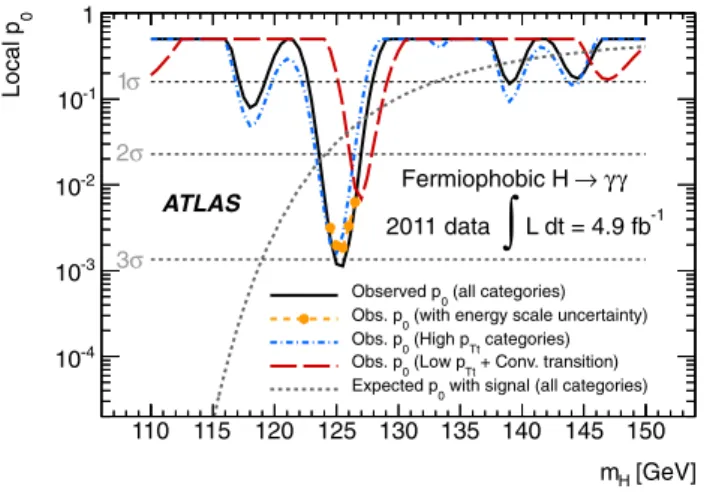
The compatibility of the data with the background-only hypothesis, relative to the hypothesis of background plus the fermiophobic model signal, is quantified by the local signif-icancep0. Figure3shows the result formH ranging from 110 GeV to 150 GeV, where p0 is computed in 0.5 GeV
Fig. 3 Local observedp0as a function of the Higgs boson massmH (solid line) and the median expectation for a fermiophobic signal with the givenmH (dotted line). The five points near 125 GeV show the observedp0when the uncertainty on the photon energy scale is con-sidered. The individual contributions of the lowpTtand highpTt cate-gories to the observedp0are also shown
steps using asymptotic formulae [34]. The contributions to p0 values from the high pTt and low pTt categories are
shown separately. The highpTtcontribution has a minimum
p0at 125 GeV, while the lowpTt contribution has a mini-mum at 127 GeV. The larger signal-to-background ratio as well as the larger expected signal yield in the highpTt
cate-gory compared to the lowpTtcategory results in the highpTt contribution dominating in the final result. The combinedp0
has a minimum at 125.5 GeV corresponding to 3.0 standard deviations. The figure also shows thep0value expected for
a fermiophobic Higgs boson signal, as a function of Higgs boson mass.
To obtain the final result, the impact of the uncertainties on the photon energy scale is considered for Higgs boson masses in the region of the minimump0, as shown in Fig.3.
The corresponding effect on the measuredp0value is
esti-mated using pseudo-experiments, since asymptotic formu-lae were found not to yield accurate estimates of the proba-bility in this case. The position of the minimump0is almost
unchanged and the significance is lowered to 2.9 standard deviations. Taking the look-elsewhere effect [35] into ac-count in the range 110–150 GeV, the significance reduces to about 1.6 standard deviations, withp0≈0.051. This may
be compared to the result of a search for the SM Higgs boson performed with the same dataset and candidate selection [8], yielding a minimump0at a mass of 126.5 GeV with a global
significance of 1.5 standard deviations. No statistically sig-nificant preference for either the SM or fermiophobic Higgs boson is observed.
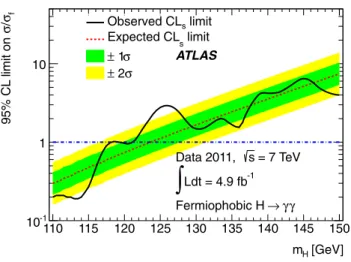
Given the lack of evidence for a signal, mass-dependent exclusion limits on the fermiophobic benchmark model are calculated at the 95 % confidence level (CL) with a profile likelihood ratio test statistic in theCLs modified frequen-tist approach [34,36,37] and are shown in Fig.4. Fermio-phobic Higgs boson masses from 110.0 GeV to 118.0 GeV and from 119.5 GeV to 121.0 GeV are excluded, while the expected exclusion mass range is 110.0–123.5 GeV. These results give more stringent lower mass limits than the pre-vious results from LEP (108.2 GeV) [5] and the Tevatron (112.9 GeV from D0, 114 GeV from CDF) [6,38] in the diphoton decay channel.
Acknowledgements We thank CERN for the very successful oper-ation of the LHC, as well as the support staff from our institutions without whom ATLAS could not be operated efficiently.
Fig. 4 Observed (solid line) and expected (dotted line) 95 % CL exclu-sion limits for a fermiophobic Higgs boson normalised to the fermio-phobic cross section times branching ratio expectation (σf) as a func-tion of the Higgs boson mass hypothesis (mH)
and FCT, Portugal; MERYS (MECTS), Romania; MES of Russia and ROSATOM, Russian Federation; JINR; MSTD, Serbia; MSSR, Slo-vakia; ARRS and MVZT, Slovenia; DST/NRF, South Africa; MICINN, Spain; SRC and Wallenberg Foundation, Sweden; SER, SNSF and Cantons of Bern and Geneva, Switzerland; NSC, Taiwan; TAEK, Turkey; STFC, the Royal Society and Leverhulme Trust, United King-dom; DOE and NSF, United States of America.
The crucial computing support from all WLCG partners is ac-knowledged gratefully, in particular from CERN and the ATLAS Tier-1 facilities at TRIUMF (Canada), NDGF (Denmark, Norway, Sweden), CC-IN2P3 (France), KIT/GridKA (Germany), INFN-CNAF (Italy), NL-T1 (Netherlands), PIC (Spain), ASGC (Taiwan), RAL (UK) and BNL (USA) and in the Tier-2 facilities worldwide.
Open Access This article is distributed under the terms of the Cre-ative Commons Attribution License which permits any use, distribu-tion, and reproduction in any medium, provided the original author(s) and the source are credited.
References
1. P. Bamert, Z. Kunszt, Phys. Lett. B306, 335 (1993)
2. A. Barroso, L. Brucher, R. Santos, Phys. Rev. D60, 035005 (1999)
3. J. Gunion, R. Vega, J. Wudka, Phys. Rev. D42, 1673 (1990) 4. A. Akeroyd, M.A. Diaz, M.A. Rivera, D. Romero, Phys. Rev. D
83, 095003 (2011)
5. LEP Higgs Working Group, ALEPH Collaboration, DEL-PHI Collaboration, L3 Collaboration, OPAL Collaboration, hep-ex/0107035(2001)
6. V. Abazov et al., Phys. Rev. Lett.107, 151801 (2011)
7. Tevatron New Higgs Working Group, CDF Collaboration, D0 Col-laboration,arXiv:1109.0576[hep-ex] (2011)
8. ATLAS Collaboration, Phys. Rev. Lett.108, 111803 (2012) 9. ATLAS Collaboration, J. Instrum.3, S08003 (2008) 10. ATLAS Collaboration, Eur. Phys. J. C71, 1630 (2011)
11. ATLAS-CONF-2011-116 (2011). http://cdsweb.cern.ch/record/ 1376384
12. ATLAS Collaboration, Phys. Rev. D83, 052005 (2011) 13. ATLAS Collaboration, Eur. Phys. J. C72, 1909 (2012) 14. K. Ackerstaff et al., Eur. Phys. J. C4, 47 (1998)
15. M. Vesterinen, T. Wyatt, Nucl. Instrum. Methods A 602, 432 (2009)
16. S. Agostinelli et al. (GEANT4 Collaboration), Nucl. Instrum. Methods A506, 250 (2003)
17. ATLAS Collaboration, Eur. Phys. J. C70, 823 (2010)
18. M. Ciccolini, A. Denner, S. Dittmaier, Phys. Rev. Lett.99, 161803 (2007)
19. M. Ciccolini, A. Denner, S. Dittmaier, Phys. Rev. D77, 013002 (2008)
20. P. Bolzoni, F. Maltoni, S.O. Moch, M. Zaro, Phys. Rev. Lett.105, 011801 (2010)
21. M. Ciccolini, S. Dittmaier, M. Kramer, Phys. Rev. D68, 073003 (2003)
22. O. Brein, A. Djouadi, R. Harlander, Phys. Lett. B579, 149 (2004) 23. S. Dittmaier, C. Mariotti, G. Passarino, R. Tanaka (LHC Higgs Cross Section Working Group) (eds.), CERN-2011-002 (CERN, Geneva, 2011)
24. A. Djouadi, J. Kalinowski, M. Spira, Comput. Phys. Commun.
108, 56 (1998)
25. P. Nason, C. Oleari, J. High Energy Phys.1002, 037 (2010) 26. T. Sjostrand, S. Mrenna, P.Z. Skands, J. High Energy Phys.0605,
026 (2006)
27. ATLAS Collaboration, ATL-PHYS-PUB-2011-009 (2011).http:// cdsweb.cern.ch/record/1363300
28. J.E. Gaiser PhD. Thesis, SLAC-R-255, 1982
29. M. Botje, J. Butterworth, A. Cooper-Sarkar, A. de Roeck, J. Feltesse et al.,arXiv:1101.0538[hep-ph] (2011)
30. S. Alekhin, S. Alioli, R.D. Ball, V. Bertone, J. Blumlein et al., arXiv:1101.0536[hep-ph] (2011)
31. G. Corcella et al.,hep-ph/0210213(2002) 32. C. Balazs, C. Yuan, Phys. Rev. D56, 5558 (1997)
33. C. Balazs, E.L. Berger, P.M. Nadolsky, C.P. Yuan, Phys. Rev. D
76, 013009 (2007)
34. G. Cowan, K. Cranmer, E. Gross, O. Vitells, Eur. Phys. J. C71, 1554 (2011)
35. E. Gross, O. Vitells, Eur. Phys. J. C70, 525 (2010) 36. A.L. Read, J. Phys. G28, 2693 (2002)
37. ATLAS and CMS Collaborations, LHC Higgs Combination Group, ATL-PHYS-PUB-2011-011 (2011). http://cdsweb.cern. ch/record/1375842
38. T. Aaltonen et al., Phys. Rev. Lett.103, 061803 (2009)
The ATLAS Collaboration
1University at Albany, Albany NY, United States of America
2Department of Physics, University of Alberta, Edmonton AB, Canada
3(a)Department of Physics, Ankara University, Ankara;(b)Department of Physics, Dumlupinar University, Kutahya; (c)Department of Physics, Gazi University, Ankara;(d)Division of Physics, TOBB University of Economics and
Technology, Ankara;(e)Turkish Atomic Energy Authority, Ankara, Turkey
4LAPP, CNRS/IN2P3 and Université de Savoie, Annecy-le-Vieux, France
5High Energy Physics Division, Argonne National Laboratory, Argonne IL, United States of America 6Department of Physics, University of Arizona, Tucson AZ, United States of America
7Department of Physics, The University of Texas at Arlington, Arlington TX, United States of America 8Physics Department, University of Athens, Athens, Greece
9Physics Department, National Technical University of Athens, Zografou, Greece 10Institute of Physics, Azerbaijan Academy of Sciences, Baku, Azerbaijan
11Institut de Física d’Altes Energies and Departament de Física de la Universitat Autònoma de Barcelona and ICREA,
Barcelona, Spain
12(a)Institute of Physics, University of Belgrade, Belgrade;(b)Vinca Institute of Nuclear Sciences, University of Belgrade,
Belgrade, Serbia
13Department for Physics and Technology, University of Bergen, Bergen, Norway
14Physics Division, Lawrence Berkeley National Laboratory and University of California, Berkeley CA, United States of
America
15Department of Physics, Humboldt University, Berlin, Germany
16Albert Einstein Center for Fundamental Physics and Laboratory for High Energy Physics, University of Bern, Bern,
Switzerland
17School of Physics and Astronomy, University of Birmingham, Birmingham, United Kingdom
18(a)Department of Physics, Bogazici University, Istanbul;(b)Division of Physics, Dogus University, Istanbul;
(c)Department of Physics Engineering, Gaziantep University, Gaziantep;(d)Department of Physics, Istanbul Technical
University, Istanbul, Turkey
19(a)INFN Sezione di Bologna;(b)Dipartimento di Fisica, Università di Bologna, Bologna, Italy 20Physikalisches Institut, University of Bonn, Bonn, Germany
21Department of Physics, Boston University, Boston MA, United States of America 22Department of Physics, Brandeis University, Waltham MA, United States of America
23(a)Universidade Federal do Rio De Janeiro COPPE/EE/IF, Rio de Janeiro;(b)Federal University of Juiz de Fora (UFJF),
Juiz de Fora;(c)Federal University of Sao Joao del Rei (UFSJ), Sao Joao del Rei;(d)Instituto de Fisica, Universidade de
Sao Paulo, Sao Paulo, Brazil
24Physics Department, Brookhaven National Laboratory, Upton NY, United States of America
25(a)National Institute of Physics and Nuclear Engineering, Bucharest;(b)University Politehnica Bucharest, Bucharest; (c)West University in Timisoara, Timisoara, Romania
26Departamento de Física, Universidad de Buenos Aires, Buenos Aires, Argentina 27Cavendish Laboratory, University of Cambridge, Cambridge, United Kingdom 28Department of Physics, Carleton University, Ottawa ON, Canada
29CERN, Geneva, Switzerland
30Enrico Fermi Institute, University of Chicago, Chicago IL, United States of America
31(a)Departamento de Física, Pontificia Universidad Católica de Chile, Santiago;(b)Departamento de Física, Universidad
Técnica Federico Santa María, Valparaíso, Chile
32(a)Institute of High Energy Physics, Chinese Academy of Sciences, Beijing;(b)Department of Modern Physics,
University of Science and Technology of China, Anhui;(c)Department of Physics, Nanjing University, Jiangsu;(d)School
of Physics, Shandong University, Shandong, China
33Laboratoire de Physique Corpusculaire, Clermont Université and Université Blaise Pascal and CNRS/IN2P3, Aubiere
Cedex, France
34Nevis Laboratory, Columbia University, Irvington NY, United States of America 35Niels Bohr Institute, University of Copenhagen, Kobenhavn, Denmark
36(a)INFN Gruppo Collegato di Cosenza, Cosenza;(b)Dipartimento di Fisica, Università della Calabria, Arcavata di Rende,
Italy
38The Henryk Niewodniczanski Institute of Nuclear Physics, Polish Academy of Sciences, Krakow, Poland 39Physics Department, Southern Methodist University, Dallas TX, United States of America
40Physics Department, University of Texas at Dallas, Richardson TX, United States of America 41DESY, Hamburg and Zeuthen, Germany
42Institut für Experimentelle Physik IV, Technische Universität Dortmund, Dortmund, Germany 43Institut für Kern- und Teilchenphysik, Technical University Dresden, Dresden, Germany 44Department of Physics, Duke University, Durham NC, United States of America
45SUPA - School of Physics and Astronomy, University of Edinburgh, Edinburgh, United Kingdom 46Fachhochschule Wiener Neustadt, Johannes Gutenbergstrasse 3, 2700 Wiener Neustadt, Austria 47INFN Laboratori Nazionali di Frascati, Frascati, Italy
48Fakultät für Mathematik und Physik, Albert-Ludwigs-Universität, Freiburg i.Br., Germany 49Section de Physique, Université de Genève, Geneva, Switzerland
50(a)INFN Sezione di Genova;(b)Dipartimento di Fisica, Università di Genova, Genova, Italy
51(a)E. Andronikashvili Institute of Physics, Tbilisi State University, Tbilisi;(b)High Energy Physics Institute, Tbilisi State
University, Tbilisi, Georgia
52II Physikalisches Institut, Justus-Liebig-Universität Giessen, Giessen, Germany
53SUPA - School of Physics and Astronomy, University of Glasgow, Glasgow, United Kingdom 54II Physikalisches Institut, Georg-August-Universität, Göttingen, Germany
55Laboratoire de Physique Subatomique et de Cosmologie, Université Joseph Fourier and CNRS/IN2P3 and Institut
National Polytechnique de Grenoble, Grenoble, France
56Department of Physics, Hampton University, Hampton VA, United States of America
57Laboratory for Particle Physics and Cosmology, Harvard University, Cambridge MA, United States of America 58(a)Kirchhoff-Institut für Physik, Ruprecht-Karls-Universität Heidelberg, Heidelberg;(b)Physikalisches Institut,
Ruprecht-Karls-Universität Heidelberg, Heidelberg;(c)ZITI Institut für technische Informatik, Ruprecht-Karls-Universität Heidelberg, Mannheim, Germany
59Faculty of Applied Information Science, Hiroshima Institute of Technology, Hiroshima, Japan 60Department of Physics, Indiana University, Bloomington IN, United States of America 61Institut für Astro- und Teilchenphysik, Leopold-Franzens-Universität, Innsbruck, Austria 62University of Iowa, Iowa City IA, United States of America
63Department of Physics and Astronomy, Iowa State University, Ames IA, United States of America 64Joint Institute for Nuclear Research, JINR Dubna, Dubna, Russia
65KEK, High Energy Accelerator Research Organization, Tsukuba, Japan 66Graduate School of Science, Kobe University, Kobe, Japan
67Faculty of Science, Kyoto University, Kyoto, Japan 68Kyoto University of Education, Kyoto, Japan
69Department of Physics, Kyushu University, Fukuoka, Japan
70Instituto de Física La Plata, Universidad Nacional de La Plata and CONICET, La Plata, Argentina 71Physics Department, Lancaster University, Lancaster, United Kingdom
72(a)INFN Sezione di Lecce;(b)Dipartimento di Matematica e Fisica, Università del Salento, Lecce, Italy 73Oliver Lodge Laboratory, University of Liverpool, Liverpool, United Kingdom
74Department of Physics, Jožef Stefan Institute and University of Ljubljana, Ljubljana, Slovenia 75School of Physics and Astronomy, Queen Mary University of London, London, United Kingdom 76Department of Physics, Royal Holloway University of London, Surrey, United Kingdom
77Department of Physics and Astronomy, University College London, London, United Kingdom
78Laboratoire de Physique Nucléaire et de Hautes Energies, UPMC and Université Paris-Diderot and CNRS/IN2P3, Paris,
France
79Fysiska institutionen, Lunds universitet, Lund, Sweden
80Departamento de Fisica Teorica C-15, Universidad Autonoma de Madrid, Madrid, Spain 81Institut für Physik, Universität Mainz, Mainz, Germany
82School of Physics and Astronomy, University of Manchester, Manchester, United Kingdom 83CPPM, Aix-Marseille Université and CNRS/IN2P3, Marseille, France
86School of Physics, University of Melbourne, Victoria, Australia
87Department of Physics, The University of Michigan, Ann Arbor MI, United States of America
88Department of Physics and Astronomy, Michigan State University, East Lansing MI, United States of America 89(a)INFN Sezione di Milano;(b)Dipartimento di Fisica, Università di Milano, Milano, Italy
90B.I. Stepanov Institute of Physics, National Academy of Sciences of Belarus, Minsk, Republic of Belarus 91National Scientific and Educational Centre for Particle and High Energy Physics, Minsk, Republic of Belarus 92Department of Physics, Massachusetts Institute of Technology, Cambridge MA, United States of America 93Group of Particle Physics, University of Montreal, Montreal QC, Canada
94P.N. Lebedev Institute of Physics, Academy of Sciences, Moscow, Russia 95Institute for Theoretical and Experimental Physics (ITEP), Moscow, Russia 96Moscow Engineering and Physics Institute (MEPhI), Moscow, Russia
97Skobeltsyn Institute of Nuclear Physics, Lomonosov Moscow State University, Moscow, Russia 98Fakultät für Physik, Ludwig-Maximilians-Universität München, München, Germany
99Max-Planck-Institut für Physik (Werner-Heisenberg-Institut), München, Germany 100Nagasaki Institute of Applied Science, Nagasaki, Japan
101Graduate School of Science, Nagoya University, Nagoya, Japan
102(a)INFN Sezione di Napoli;(b)Dipartimento di Scienze Fisiche, Università di Napoli, Napoli, Italy
103Department of Physics and Astronomy, University of New Mexico, Albuquerque NM, United States of America 104Institute for Mathematics, Astrophysics and Particle Physics, Radboud University Nijmegen/Nikhef, Nijmegen,
Netherlands
105Nikhef National Institute for Subatomic Physics and University of Amsterdam, Amsterdam, Netherlands 106Department of Physics, Northern Illinois University, DeKalb IL, United States of America
107Budker Institute of Nuclear Physics, SB RAS, Novosibirsk, Russia
108Department of Physics, New York University, New York NY, United States of America 109Ohio State University, Columbus OH, United States of America
110Faculty of Science, Okayama University, Okayama, Japan
111Homer L. Dodge Department of Physics and Astronomy, University of Oklahoma, Norman OK, United States of
America
112Department of Physics, Oklahoma State University, Stillwater OK, United States of America 113Palacký University, RCPTM, Olomouc, Czech Republic
114Center for High Energy Physics, University of Oregon, Eugene OR, United States of America 115LAL, Université Paris-Sud and CNRS/IN2P3, Orsay, France
116Graduate School of Science, Osaka University, Osaka, Japan 117Department of Physics, University of Oslo, Oslo, Norway
118Department of Physics, Oxford University, Oxford, United Kingdom
119(a)INFN Sezione di Pavia;(b)Dipartimento di Fisica, Università di Pavia, Pavia, Italy
120Department of Physics, University of Pennsylvania, Philadelphia PA, United States of America 121Petersburg Nuclear Physics Institute, Gatchina, Russia
122(a)INFN Sezione di Pisa;(b)Dipartimento di Fisica E. Fermi, Università di Pisa, Pisa, Italy
123Department of Physics and Astronomy, University of Pittsburgh, Pittsburgh PA, United States of America
124(a)Laboratorio de Instrumentacao e Fisica Experimental de Particulas - LIP, Lisboa, Portugal;(b)Departamento de Fisica
Teorica y del Cosmos and CAFPE, Universidad de Granada, Granada, Spain
125Institute of Physics, Academy of Sciences of the Czech Republic, Praha, Czech Republic 126Faculty of Mathematics and Physics, Charles University in Prague, Praha, Czech Republic 127Czech Technical University in Prague, Praha, Czech Republic
128State Research Center Institute for High Energy Physics, Protvino, Russia
129Particle Physics Department, Rutherford Appleton Laboratory, Didcot, United Kingdom 130Physics Department, University of Regina, Regina SK, Canada
131Ritsumeikan University, Kusatsu, Shiga, Japan
132(a)INFN Sezione di Roma I;(b)Dipartimento di Fisica, Università La Sapienza, Roma, Italy
133(a)INFN Sezione di Roma Tor Vergata;(b)Dipartimento di Fisica, Università di Roma Tor Vergata, Roma, Italy 134(a)INFN Sezione di Roma Tre;(b)Dipartimento di Fisica, Università Roma Tre, Roma, Italy
135(a)Faculté des Sciences Ain Chock, Réseau Universitaire de Physique des Hautes Energies - Université Hassan II,
Semlalia, Université Cadi Ayyad, LPHEA Marrakech;(d)Faculté des Sciences, Université Mohamed Premier and LPTPM, Oujda;(e)Faculté des sciences, Université Mohammed V-Agdal, Rabat, Morocco
136DSM/IRFU (Institut de Recherches sur les Lois Fondamentales de l’Univers), CEA Saclay (Commissariat a l’Energie
Atomique), Gif-sur-Yvette, France
137Santa Cruz Institute for Particle Physics, University of California Santa Cruz, Santa Cruz CA, United States of America 138Department of Physics, University of Washington, Seattle WA, United States of America
139Department of Physics and Astronomy, University of Sheffield, Sheffield, United Kingdom 140Department of Physics, Shinshu University, Nagano, Japan
141Fachbereich Physik, Universität Siegen, Siegen, Germany
142Department of Physics, Simon Fraser University, Burnaby BC, Canada
143SLAC National Accelerator Laboratory, Stanford CA, United States of America
144(a)Faculty of Mathematics, Physics & Informatics, Comenius University, Bratislava;(b)Department of Subnuclear
Physics, Institute of Experimental Physics of the Slovak Academy of Sciences, Kosice, Slovak Republic
145(a)Department of Physics, University of Johannesburg, Johannesburg;(b)School of Physics, University of the
Witwatersrand, Johannesburg, South Africa
146(a)Department of Physics, Stockholm University;(b)The Oskar Klein Centre, Stockholm, Sweden 147Physics Department, Royal Institute of Technology, Stockholm, Sweden
148Departments of Physics & Astronomy and Chemistry, Stony Brook University, Stony Brook NY, United States of
America
149Department of Physics and Astronomy, University of Sussex, Brighton, United Kingdom 150School of Physics, University of Sydney, Sydney, Australia
151Institute of Physics, Academia Sinica, Taipei, Taiwan
152Department of Physics, Technion: Israel Institute of Technology, Haifa, Israel
153Raymond and Beverly Sackler School of Physics and Astronomy, Tel Aviv University, Tel Aviv, Israel 154Department of Physics, Aristotle University of Thessaloniki, Thessaloniki, Greece
155International Center for Elementary Particle Physics and Department of Physics, The University of Tokyo, Tokyo, Japan 156Graduate School of Science and Technology, Tokyo Metropolitan University, Tokyo, Japan
157Department of Physics, Tokyo Institute of Technology, Tokyo, Japan 158Department of Physics, University of Toronto, Toronto ON, Canada
159(a)TRIUMF, Vancouver BC;(b)Department of Physics and Astronomy, York University, Toronto ON, Canada 160Institute of Pure and Applied Sciences, University of Tsukuba, 1-1-1 Tennodai, Tsukuba, Ibaraki 305-8571, Japan 161Science and Technology Center, Tufts University, Medford MA, United States of America
162Centro de Investigaciones, Universidad Antonio Narino, Bogota, Colombia
163Department of Physics and Astronomy, University of California Irvine, Irvine CA, United States of America
164(a)INFN Gruppo Collegato di Udine, Udine;(b)ICTP, Trieste;(c)Dipartimento di Chimica, Fisica e Ambiente, Università
di Udine, Udine, Italy
165Department of Physics, University of Illinois, Urbana IL, United States of America 166Department of Physics and Astronomy, University of Uppsala, Uppsala, Sweden
167Instituto de Física Corpuscular (IFIC) and Departamento de Física Atómica, Molecular y Nuclear and Departamento de
Ingeniería Electrónica and Instituto de Microelectrónica de Barcelona (IMB-CNM), University of Valencia and CSIC, Valencia, Spain
168Department of Physics, University of British Columbia, Vancouver BC, Canada 169Department of Physics and Astronomy, University of Victoria, Victoria BC, Canada 170Department of Physics, University of Warwick, Coventry, United Kingdom
171Waseda University, Tokyo, Japan
172Department of Particle Physics, The Weizmann Institute of Science, Rehovot, Israel 173Department of Physics, University of Wisconsin, Madison WI, United States of America 174Fakultät für Physik und Astronomie, Julius-Maximilians-Universität, Würzburg, Germany 175Fachbereich C Physik, Bergische Universität Wuppertal, Wuppertal, Germany
176Department of Physics, Yale University, New Haven CT, United States of America 177Yerevan Physics Institute, Yerevan, Armenia
bAlso at Faculdade de Ciencias and CFNUL, Universidade de Lisboa, Lisboa, Portugal
cAlso at Particle Physics Department, Rutherford Appleton Laboratory, Didcot, United Kingdom dAlso at TRIUMF, Vancouver BC, Canada
eAlso at Department of Physics, California State University, Fresno CA, United States of America fAlso at Novosibirsk State University, Novosibirsk, Russia
gAlso at Fermilab, Batavia IL, United States of America
hAlso at Department of Physics, University of Coimbra, Coimbra, Portugal iAlso at Department of Physics, UASLP, San Luis Potosi, Mexico
jAlso at Università di Napoli Parthenope, Napoli, Italy kAlso at Institute of Particle Physics (IPP), Canada
lAlso at Department of Physics, Middle East Technical University, Ankara, Turkey mAlso at Louisiana Tech University, Ruston LA, United States of America
nAlso at Dep Fisica and CEFITEC of Faculdade de Ciencias e Tecnologia, Universidade Nova de Lisboa, Caparica,
Portugal
oAlso at Department of Physics and Astronomy, University College London, London, United Kingdom pAlso at Group of Particle Physics, University of Montreal, Montreal QC, Canada
qAlso at Department of Physics, University of Cape Town, Cape Town, South Africa rAlso at Institute of Physics, Azerbaijan Academy of Sciences, Baku, Azerbaijan sAlso at Institut für Experimentalphysik, Universität Hamburg, Hamburg, Germany tAlso at Manhattan College, New York NY, United States of America
uAlso at School of Physics, Shandong University, Shandong, China
vAlso at CPPM, Aix-Marseille Université and CNRS/IN2P3, Marseille, France wAlso at School of Physics and Engineering, Sun Yat-sen University, Guanzhou, China
xAlso at Academia Sinica Grid Computing, Institute of Physics, Academia Sinica, Taipei, Taiwan yAlso at Dipartimento di Fisica, Università La Sapienza, Roma, Italy
zAlso at DSM/IRFU (Institut de Recherches sur les Lois Fondamentales de l’Univers), CEA Saclay (Commissariat a
l’Energie Atomique), Gif-sur-Yvette, France
aaAlso at Section de Physique, Université de Genève, Geneva, Switzerland abAlso at Departamento de Fisica, Universidade de Minho, Braga, Portugal
acAlso at Department of Physics and Astronomy, University of South Carolina, Columbia SC, United States of America adAlso at Institute for Particle and Nuclear Physics, Wigner Research Centre for Physics, Budapest, Hungary
aeAlso at California Institute of Technology, Pasadena CA, United States of America afAlso at Institute of Physics, Jagiellonian University, Krakow, Poland
agAlso at LAL, Université Paris-Sud and CNRS/IN2P3, Orsay, France
ahAlso at Department of Physics and Astronomy, University of Sheffield, Sheffield, United Kingdom aiAlso at Department of Physics, Oxford University, Oxford, United Kingdom
ajAlso at Institute of Physics, Academia Sinica, Taipei, Taiwan