Editor
Carla Nunes, FCT, Universidade do Algarve, Faro, Portugal
Editorial Board
Brion Duffy, Agroscope FAW Wadenswil Bacteriology, Switzerland Carla Nunes, FCT, Universidade do Algarve, Portugal
Christian Larrigaudiere, IRTA-Institut de Recerca i Tecnologia Agroalimentàries, Spain Josef Streif, Inst. Sonderkulturen & Produktsphysiologie, Hohenheim, Germany Maribela Pestana, FCT, Universidade do Algarve, Portugal
Maria Graça Barreiro, Instituto Nacional de Investigação Agrária, Portugal Maria Dulce Antunes, FCT, Universidade do Algarve, Portugal
Miguel Salazar, CICAE, Instituto Universitário Dom Afonso III, Portugal Mustafa Erkan, Akdeniz University, Turkey
Paolo Bertolini, Universita de Bologna, Italy Pol Tijskens, Wageningen University, Netherlands Shimshon Ben-Yehoshua, A.R.O. Volcani Centre, Israel Susan Lurie, A.R.O. Volcani Centre, Israel
The papers contained in this book report some of the peer reviewed Proceedings of the International Conference “Environmentally friendly and safe technologies for quality of fruit and vegetables”, but also other papers related with the subject were included. The manuscripts were reviewed by the Editor and Editorial Board, and only those papers judged suitable for publication were accepted. The Editor wish to thank to all the reviewers and authors for their contribution.
Proceedings of the International Conference “Environmentally friendly and safe
technologies for quality of fruit and vegetables”, held in Universidade do Algarve, Faro,
Portugal, on January 14-16, 2009. This Conference was a join activity with COST Action 924.Convener
Carla Nunes, Universidade do Algarve, Portugal
Scientific Committee
Carla Nunes, Universidade do Algarve, Portugal Amílcar Duarte, Universidade do Algarve, Portugal
Angelos Kanellis, Aristotle University of Thessaloniki, Greece Bart Nicolaï, Katholieke Universiteit Leuven, Belgium
Brion Duffy, Agroscope FAW Wadenswil Bacteriology, Switzerland
Christian Larrigaudiere, IRTA-Institut de Recerca i Tecnologia Agroalimentàries, Spain Domingos de Almeida, Universidade do Porto, Portugal
Josef Streif, Inst. Sonderkulturen & Produktsphysiologie Hohenheim, Germany Krzysztof Rutkowski, Research Inst. of Pomology and Floriculture, Poland Maria Dulce Antunes, Universidade do Algarve, Portugal
Maria da Graça Barreiro, Instituto Nacional de Investigações Agrárias, Portugal Mustafa Erkan, Akdeniz University, Turkey
Paolo Bertolini, Universita de Bologna, Italy Pol Tijskens, Wageningen University, Netherland Shimshon Ben-Yehoshua, A.R.O. Volcani Centre, Israel
Organizing Committee
Carla Nunes, Universidade do Algarve, Portugal Amílcar Duarte, Universidade do Algarve, Portugal Bart Nicolaï, Katholieke Universiteit Leuven, Belgium Maria Dulce Antunes, Universidade do Algarve, Portugal Maria Emília Costa, Universidade do Algarve, Portugal Maribela Pestana, Universidade do Algarve, Portugal
Miguel Salazar, Instituto Universitário Dom Afonso III, Portugal
Sponsors
COST, European Cooperation in the field of Scientific and Technical Research
Fundação para a Ciência e a Tecnologia
International Association of Students in Agriculture and Related Sciences, Faro
Serviço Técnico Pós-colheita do IRTA em Portugal Algarve.resorts.net
Câmara Municipal de Faro Câmara Municipal de Albufeira
Câmara Municipal de Aljezur Câmara Municipal de Lagos
Câmara Municipal de S. Brás de Alportel Crédito Agrícola, Caixa do Algarve A Farrobinha 80 g C.N. Kopke & Cª PrimeDrinks, S.A. Uniprofrutal Frutas Mourinho
Se c ti o n 1 . n on -d eS tr u c ti v e m et h o d S f o r m ea Su ri n g q u a li ty o f f ru it S a n d v eg et a bl eS
03. ON THE APPLICATION OF SPATIALLy RESOLVED
REFLECTANCE AND DIFFuSE LIgHT BACkSCATTERINg
gONIOmETRy TO THE PREDICTION OF FIRmNESS IN
APPLE ‘BRAVO DE ESmOLFE’
Rui Guerra1*, Sandro Almeida1, Ana Cavaco1, Dulce Antunes2
1Centro de Electrónica, Optoelectrónica e Telecomunicações (CEOT), Universidade do Algarve, Campus de Gambelas,
8005-139 Faro, Portugal
2IBB-CBV, Universidade do Algarve, FCT, Ed 8, Campus de Gambelas, 8005-139 Faro, Portugal
*E-mail: [email protected]
abstract
In this study we have made exploratory tests on a set of 40 apples (Malus domestica Borkh.) ‘Bravo de Esmolfe’, using spatially resolved reflectance (SRR) and diffuse light backscattering goniometry (DLBG). The objective was to test the potential of DLBG for firmness prediction, as compared with SRR, whose potential has been already proved in the literature. SRR is performed with a red diode laser and a CMOS camera. DLBG uses the same laser shining on the apple and a photomultiplier tube collecting the light reemitted from a small area, at angles ranging from 90 deg (tangent to the surface) to 180 deg (normal to the surface). From the measurements several parameters have been calculated (e.g. decay exponent for SRR profiles, anisotropy factor for the DLBG angular distributions) and Partial Least squares (PLS) models for the prediction of firmness were build. The model based on DLBG variables (only) and on SRR variables (only) gave similar results. From here we conclude that, within the obvious statistical limitations of the test, DLBG seems to match the potential of SRR for firmness prediction. The possibility of combining both measures in one model is also discussed.
Introduction
Several optical non-destructive optical techniques (NDOT) for fruit quality assessment are based on the fundamental phenomenon of light propagation, absorption and scattering in random media. Traditional approaches like Near Infra Red Spectroscopy (NIRS) rely on the physics of this process but the analysis is rather heuristic, taking the spectra “as they are” and relating them directly with the fruit physiological attributes of interest. Nevertheless, it is always important to consider the basic aspects of the theory, trying to understand if a more deep knowledge of the optical processes may lead to improved methods in NDOT for fruit quality assessment. The above argument serves the purpose of remembering that in general the
propagation of light in a complex media is described by the specific intensity I(r, ) [units: Wm-2sr-1Hz-1],
where r stands for the position of a given point in space and is a specific direction for energy flow. In other words, the intensity of light in a given point depends on the spatial location of that point and on the direction considered for energy flow. The specific intensity depends further on the wavelength considered. Thus, the most general approach in NDOT would have to discriminate spectral, spatial and angular variations of the light signal.
The investigation of the angular dependency has not attracted attention in NDOT, since all the current methods integrate the angular components or, at least, choose one. The reasons for the lack of data on angular measurements are multiple: i) angular measurements (goniometry) are slow and time-consuming; ii) there are no commercial systems available; and iii) if the conditions for the validity of the so-called “diffusion approximation” (DA) are valid, the angular distribution of light inside the tissue is expected to be nearly isotropic and that emerging from the tissue expected to be Lambertian [dependence of intensity
on cos( being the angle between the normal to the surface and the direction of observation]. Hence,
En v ir o n m En ta ll y F ri En d ly a n d S a FE tE ch n o lo g iES F o r Q u a li ty o F F ru it S a n d vE g Eta bl ES
issues by using a light scattering goniometer set up in our laboratory and used already in previous studies (Pinto et al. 2007). The answer to the third objection is also twofold: i) there is no evidence that DA is always valid; ii) even when DA is valid the assumption of Lambertian radiance emerging from the tissue may be false (see Li et al. 2000 and also our results below).
The objective of this work was then to investigate the potential of angularly resolved light measurements as a possible NDOT for fruit firmness assessment. The technique we will be employing was named Diffuse Light Backscattering Goniometry (DLBG). In this technique a laser beam is incident upon the fruit and the light re-emerging from a nearby small surface is measured as a function of the angle between the normal to the surface and the direction of observation. In parallel to DLBG we have performed measurements of Spatially Resolved Reflectance (SRR), whose applicability for fruit firmness prediction been proven in the literature (Lu 2004). SRR results will be used for comparison with DLBG results. The preliminary results presented here are only indicative, since the reduced number of samples (40 apples) is far from the minimum statistically acceptable when working with biological material. However, the comparison with SRR on the same conditions compensates in part for the sample small size.
material & methods
fruit
Forty ‘Bravo de Esmolfe’ apples (Malus domestica Borkh.) were bought in a local supermarket and kept under shelf-life conditions (70% RH, 23±2 ºC) in dark. In each measurement session, ten apples were followed optically and at the end used to perform destructive measurements of firmness. The four measurement sessions spanned a period of 20 days.
Spatially resolved reflectance
A diode laser (Hitachi HL6314MG, Hitachi, Tokyo, Japan, housed in a Thorlabs TCLD M9-TEC mount and coupled to a Thorlabs laser diode controller LDC 205 and to a TED 200 temperature controller, Thorlabs, Newton, USA) emitting at 635 nm was coupled to an optical fiber of 1 mm diameter whose other end was held in contact with the apple skin (this insures that all re-emitted photons travel through the interior of the fruit). The light halo on the apple surface was imaged through an 8 bit CMOS camera (BCi4 CMOS Camera, C-Cam Technologies, Belgium) and appropriate lens. A neutral density filter wheel (Edmund Optics M54-080) was placed in front of the camera and for each halo three photos were taken with different attenuation factors (exposure and gain always kept at the same level). The lowest attenuation provided detail on the most exterior areas of the halo (and the image was saturated on the center of the halo), while the highest attenuation provided detail on the center of the halo (loosing definition in the exterior areas). The intermediate attenuation served to provide a bridge between the extreme attenuation photos. Dark photos (laser off) were subtracted in order to eliminate the ambient and shot noise. The photos were further analyzed through the Matlab software (MATLAB 7.7 (R2008b)®, The MathWorks, Inc., Natick, USA, 2008).
diffuse light Backscattering goniometry
The same diode laser, with horizontal polarization, was sent through an opaque tube of 8 mm diameter whose other end was held in contact with the apple skin (this insures that all re-emitted photons travel through the interior of the fruit). The light halo on the apple surface was blocked through the application of
opaque adhesive tape, except in a small square area of 1 cm2 adjacent to the tube. The angular dependence
of the light re-emitted by this area was measured by a light scattering goniometer. This was constituted by a motorized rotational stage (Newport URS100PP rotation stage and Newport ESP 300 motion controller, Newport Corp., Irvine, USA) attached to a rotating arm holding a polarizer and a collecting lens. The arm rotates between 0 º (normal to the halo) and 90 º (tangent to the halo) in steps of 5 º, collecting the light re-emitted at different angles. The lens (74-UV, Ocean Optics, Dunedin, USA) focuses the light on
Se c ti o n 1 . n on -d eS tr u c ti v e m et h o d S f o r m ea Su ri n g q u a li ty o f f ru it S a n d v eg et a bl eS
an optical fiber coupled to a photomultiplier tube (PMT) (H5784-20, Hamamatsu, Shizuoka, Japan). The polarizer was used in two positions: vertical and horizontal polarization. The signal from the PMT was low-pass filtered (SR650 dual channel filter, Stanford Research Systems, Sunnyvale, CA, USA) and acquired by a digital oscilloscope (Picoscope 3206, Pico Technology, Cambridgeshire, UK). Dark measurements (laser off) were subtracted in order to eliminate the ambient and instrumental noise. All the system is automated and controlled through a PC via the Labview software (Labview 7, Austin, USA, 2004).
fruit attributes
Firmness was measured destructively immediately after the optical assay in two opposite sites along the fruit equatorial line by puncture, after skin removal, with a fruit pressure tester (FT 327, Italy).
results
Spatially resolved reflectance
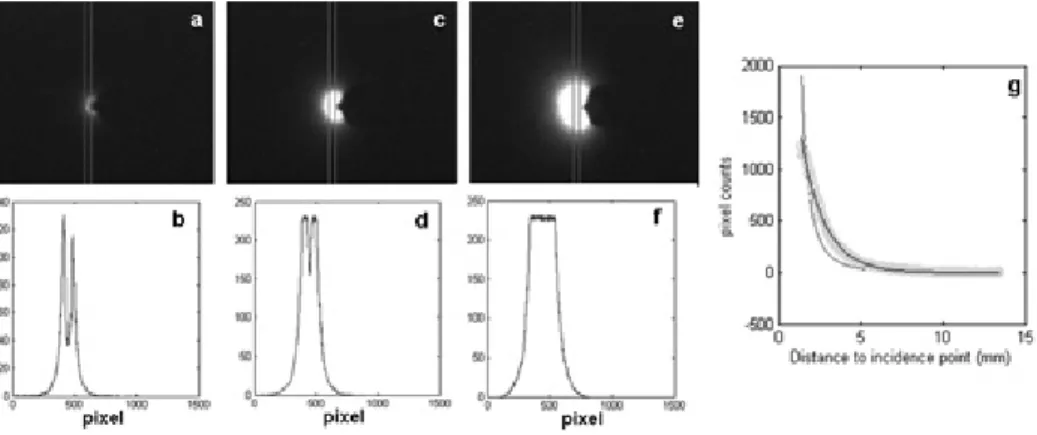
The results of SRR are depicted in Fig 1. The three profiles obtained with the three attenuations were normalized through a Matlab script. Basically, it was applied to two pictures at a time and looks for a pixel range where the counts of both pictures are in the range [p; 255-q], where p and q are “safety” constants that prevent distortions in linearity due to proximity to the noise floor (p) or to the saturation level (q). The ratio count (Photo 1)/count (Photo 2) was approximately constant under the above condition and that constant was used to normalize the counts of Photo 1 to those of Photo 2. The process was then repeated for Photo 3. A typical final result is depicted on Fig 1g (conversion pixel/distance also made). Noteworthy, the profiles did not obey the classical result from the diffusion approximation (DA) (Contini et al. 1997). In Fig 1g the DA best fit was the line that fails most of the experimental data. The experimental points (dense dots, defining a broad line) were much better fitted by a simple exponential decay (line passing through the points).
fig 1. Results of SRR. a) image of the light halo (and of the optical fiber tip) in one of the pears with the highest attenuation; b) intensity profile corresponding to the box represented in a); c) same as a) with intermediate attenuation; d) same as b) with intermediate attenuation; e) same as a) with lowest attenuation; f) same as b) with lowest attenuation; g) full profile for the left wing, obtained after merging the three preceding profiles (detail of the merging procedure in the text).
diffuse light Backscattering goniometry
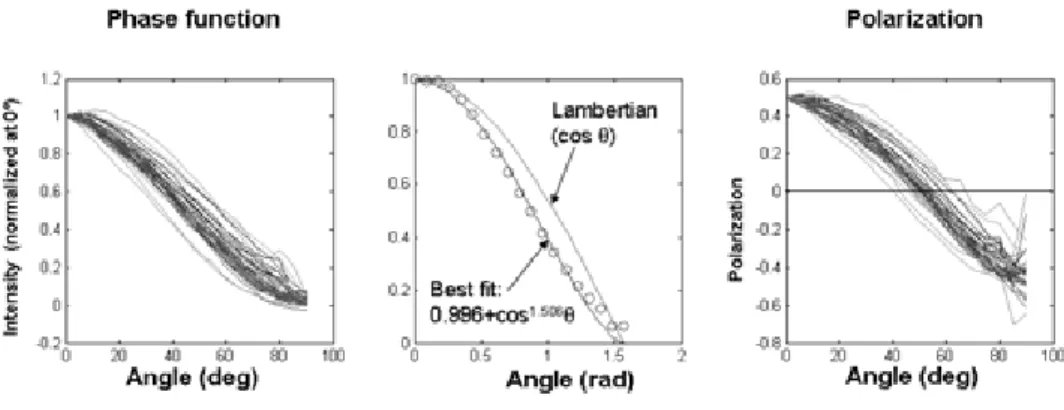
The results of DLBG are depicted in Fig 2. The phase functions presented are simply proportional to the PMT output at the different angles of measure. The phase functions were not found to follow the uninteresting
En v ir o n m En ta ll y F ri En d ly a n d S a FE tE ch n o lo g iES F o r Q u a li ty o F F ru it S a n d vE g Eta bl ES
Lambertian cos rule. A heuristic fit of the type a+cosb was tried in order to explore the variability of the
phase functions. Finally, the polarization of the re-emitted light was calculated by P=(IH-IV)/(IH+IV), where IH
and IV are the intensities of the horizontal and vertical polarization signals respectively.
fig 2. Results of DLBG. Left: phase functions (=angular distribution of the re-emitted light) for all 40 apples (vertical polarization measurements shown). Center: experimental points for one apple (dots). It can be seen that a Lambertian phase function does not fit the results. A heuristic fit of the type a+cosb was adopted. Right: polarization curves for the 40 apples (see explanation in the text).
discussion
Spatially resolved reflectance
From each apple we could obtain three profiles. Referring to Fig. 1a and to the center of the halo, located by the fiber tip, we may define the up, down and left profiles. To each of these profiles we have made a fit of the type A*exp(-Bx). We have also segmented the profiles, looking for sections more sensitive to firmness variations; and we have used normalized and non-normalized profiles. The parameters A and B for all these profiles were used as model parameters. We have also integrated the profile along the radial distance, creating a total reflectance variable, also used as a model parameter. Finally, we have used the error on fit itself also as a model parameter. On the whole, 52 variables were created from the initial photos. We have also added the variable shelf-life days. Some of the variables are highly redundant. However, at this preliminary stage we did not perform any type of refinement. We have simply ran a PLS model with the firmness values as the Y block (40×1 matrix) and the model parameters described above as the X block (40×52 matrix). The PLS calculations were performed with the PLS Toolbox 5 (Eigenvector Research, Wenatchee, USA, 2008) for Matlab. Results of the model are shown in Fig 3.
diffuse light Backscattering goniometry
The model variables for DLBG are: the 19 IH values (19 angles), the 19 IV values, the 19 polarization values,
the anisotropy factors for the H and V polarizations, gH and gV (g I( )cos( )d I( )d , where I( )
represents the scattered intensity and d the infinitesimal solid angle), the coefficients a and b of the fit a+cosb V and H polarizations and the coefficients c and d for a second fit of the form I( )=cI
0( )-dI1( )
V and H pols. , where I0( ) and I1( ) are the Bessel functions of the first kind of orders 0 and 1 respectively.
Se c ti o n 1 . n on -d eS tr u c ti v e m et h o d S f o r m ea Su ri n g q u a li ty o f f ru it S a n d v eg et a bl eS
fig 3. Results of the PLS models. Calibration samples are marked as circles and validation samples as triangles. Left: predicted vs. measured values of firmness through the application of a PLS model based on the variables measured in DLBG. Right: the same, but for the “PLS on PLS” model (details about this model in the text).
results of PlS model
From the 40 apples, 27 were used for calibration and 13 for prediction. The results for the PLS model based on the SRR measurements and for the PLS model based on the DLBG measurements were very similar and we depict in Fig 3 (left) only the results of the DLBG results. The fact that both models behaved similarly means that the potential of DLBG for firmness prediction should be comparable to that of SRR. And the key point is that the potential of SRR has already been demonstrated (Li et al. 2000). This conclusion, however, is severely limited by the small number of samples in this experiment. Further investigation is needed. However, DBLG seems to pass on a first coarse scrutiny.
refinement of the model: “PlS on PlS”
Merging all the variables and building a PLS model with all the 52+67 variables (“full model”) did not improve the results. The Principal Component Analysis (PCA) of the full model (not shown) showed that the variations in the SRR variables and DLBG variables are mainly independent, since the principal component 1 is more related with goniometric variables and principal component 2 with the SRR variables. However, we did succeed in improving the prediction performance building a “PLS on PLS” model. In this model we have used the predictions of the SRR, DLBG and SRR+DLBG models as input variables. We have also included, as before, the variable “days in laboratory”. Thus, the X matrix is simply a 27×4 matrix. The results for this model are presented in Fig 3 (right), for comparison with the DLBG model. Almost all of the parameters describing model performance improved in PLS on PLS (values for the models DLBG vs. PLS on PLS: RMSEC:
9.2 vs. 8.4 (N); RMSECV: 10.9 vs. 11.8 (N); RMSEP: 12.3 vs. 10.1 (N); R2: 0.35 vs. 0.53; slope of tendency line
for external predictions: 0.44 vs. 0.59 (N/N)).
Conclusions
Diffuse Light Backscattering Goniometry (DLBG) is a technique where the fruit is illuminated by a light beam and the angular dependence of the light re-emitted (and thus backscattered) to the exterior is measured by an optical detector rotating on a goniometer arm. As a first approach to the problem one could think that the angular pattern of the backscattered light should obey roughly a Lambertian law (cos ), with no interest for any type of fruit internal quality prediction. However, our measurements have shown that this is not the case: the angular pattern of the backscattered light diverges clearly from the Lambertian. Also, there is a considerable variation from fruit to fruit. The question is then to know if these variations
En v ir o n m En ta ll y F ri En d ly a n d S a FE tE ch n o lo g iES F o r Q u a li ty o F F ru it S a n d vE g Eta bl ES
may be correlated with fruit firmness. We have then performed a preliminary scrutiny of the potentialities of DLBG. We have used only forty ‘Bravo de Esmolfe’ apples, which is a small number to draw significant conclusions. However, we have used an auxiliary measurement to improve the significance level of our test: we have made parallel measurements of Spatially Resolved Reflectance (SRR), which has been proven in the literature to have good correlation with firmness (Lu 2004). Partial Least Squares (PLS) models for firmness prediction based on DLBG variables (only) and on SRR variables (only) gave similar results. From here we conclude that, within the obvious statistical limitations of the test, DLBG seems to match the potential of SRR for firmness prediction in this apple variety.
Finally we have tried to improve the prediction level by merging all the DLBG and SRR variables. This produced no effect. However, a second round “PLS on PLS” model having for variables the predictions of the individual models showed a clear improvement, indicating a possible way to optimize prediction models based on more than one measurement technique.
references
Contini D, Martelli F, Zaccanti G. 1997. Photon migration through a turbid slab described by a model based on diffusion approximation. I Theory Appl Optics 36:4587-99
Li H, Lin L, Xie S, Lu Z. 2000. Radiance distributions in biological tissue and the diffusion approximation. Proc SPIE 4224:160-4
Lu R. 2004. Multispectral imaging for predicting firmness and soluble solids content of apple fruit. Postharvest Biol Technol 31:147-57
Pinto PN, Fernandes P, Guerra R. 2007. Simultaneous determination of the mean and standard deviation of quasi-monodisperse size distributions of microspheres by static light scattering Meas. Sci Technol 18:1209-23