ISSN 1518-3483 Licenciado sob uma Licença Creative Commons
[T]
The external evaluation of schools
and the ongoing teacher education:
the case of the state of São Paulo
[I]
A avaliação externa das escolas e a formação continuada
de professores: o caso paulista
La evaluación externa de las escuelas y la formación
continuada de profesores: el caso paulista
Andréia da Cunha Malheiros Santana[a], José Carlos Rothen[b]*[a] Universidade Estadual de Londrina (UEL), Londrina, Paraná, PR, Brasil [b] Universidade Federal de São Carlos (UFSCar), São Carlos, São Paulo, SP, Brasil
[R]
Abstract
This article aims to discuss the impact of the Evaluation System of School Efficiency of the State of São Paulo [Sistema de Avaliação do Rendimento Escolar do Estado de São Paulo
* ACMS: doutora, professora adjunta, e-mail: [email protected] JCR: doutor, professor adjunto, e-mail: [email protected]
– SARESP] and of the Development Rate of Education in the State of Estado de São Paulo [Índice de Desenvolvimento da Educação no Estado de São Paulo – IDESP] in the ongoing teacher education. This article is the result of a post-doctorate research that investigated how the results of the external evaluation are dealt with in two schools with opposite performances in the IDESP: increasing and decreasing results. In the case study, the methodological procedures were documental analysis, observation of pedagogical meetings in the schools, a questionnaire for teachers and principals and interviews with teaching supervisors. The conclusion is that the model of ongoing teaching education developed from the results of the tests aims at the training of teachers. This kind of education is elaborated by the Department of Education, which reduces the ongoing teacher education to the preparation of teachers in order to train students on how to do the tests applied by the State; the school neither has autonomy to work on the results of external evaluations, nor the habit of questioning their reasons and causes. The results in the evaluations are analyzed and seen as goals to be reached, without any discussions about external and internal evaluations.
[P]
Keywords: Teacher education. Evaluation of education. SARESP. Resumo
Este artigo tem como objetivo discutir o impacto do Sistema de Avaliação do Rendimento Escolar do Estado de São Paulo (SARESP) e do Índice de Desenvolvimento da Educação no Estado de São Paulo (IDESP) na formação continuada de professores. Este artigo é fruto de uma pesquisa de pós-doutorado que investigou como os resultados da avaliação externa são trabalhados em duas escolas com desempenhos antagônicos no IDESP: uma com resultado crescente, e outra, decrescente. No estudo de caso, foram adotados como procedimentos metodológicos a análise documental, a observação das reuniões pedagógicas das escolas, um questionário destinado aos professores e diretores e entrevistas com os supervisores de ensino. Concluiu-se que o modelo de formação continuada realizado a partir dos resultados das provas visa ao treinamento dos professores. Esse tipo de formação é elaborado pela Secretaria de Educação, que reduz a formação continuada à preparação dos professores para treinarem os alunos a realizar as provas aplicadas pelo estado; a escola não tem auto-nomia para trabalhar os resultados das avaliações externas, nem o hábito de indagar suas
razões e causas. Os resultados nas avaliações são analisados e vistos como metas a serem atingidas sem que seja promovido o diálogo entre as avaliações externas e internas. Palavras-chave: Formação de professores. Avaliação da educação. SARESP.
Resumen
Esta investigación tiene el objetivo de discutir el impacto del Sistema de Evaluación del Rendimiento Escolar del Estado de São Paulo (SARESP) y del Índice de Desarrollo de la Educación en el Estado de São Paulo (IDESP) en la formación continuada de profesores. Este trabajo es fruto de una investigación de post doctorado que buscó saber cómo se trabajan con los resultados de la evaluación externa en dos escuelas con desempeños antagónicos en el IDESP, es decir, una con resultado creciente y otra decreciente. En el estudio de caso, se adoptó como procedimiento metodológico el análisis documental, la observación de las reuniones pedagógicas de las escuelas, un cuestionario destinado a profesores y directores y entrevistas con los supervisores de enseñanza. Se concluyó que el modelo de formación continuada realizado a partir de los resultados de las pruebas visa el entrenamiento de los profesores. Este tipo de formación es elaborado por la Secretaría de Educación, que reduce la formación continuada a la preparación de los profesores para que preparen los alumnos para realizar las pruebas aplicadas por el Estado. La escuela no tiene autonomía para trabajar los resultados de las evaluaciones externas, tampoco el hábito de indagar su razón de ser y causas. Se analizan los resultados en las evaluaciones, los cuales son interpretados como objetivos a alcanzar, aunque no haya la preocupación con el diálogo entre evaluaciones externas e internas.
[K]
Palabras Clave: Formación de profesores. Evaluación de la educación. SARESP.
Introduction
Following a worldwide trend, from 1990, in Brazil, school in-stitutions’ evaluation has consolidated itself as a center of public poli-cies for education. The evaluation on a large scale has shown itself as an
educational politic, aiming to rule and control the education through the policies guidelines, instruments, steps and actions what are prescripts from the results obtained from tests (DIAS SOBRINHO, 2002; FREITAS D., 2007; FREITAS L., 2007). The way these tests have been being utilized make the negative aspects overlap the possible gains, the tests have be-come “sirs” and not instruments for the education improvement. “The tests can become the ferocious master of the educational process and not the compliant servant they should be” (MADAUS, 1988, p. 85).
In consonance with this reality, in 1996, the State Secretariat of São Paulo has created the Evaluation System for Scholar Performance of São Paulo [Sistema de Avaliação do Rendimento Escolar de São Paulo – SARESP] with the aim of produce periodic information and comparable about the Paulista public network schools, from the obtained results new actions could be developed for improvement the public education. The SARESP consists in a single test annually applied to the students, following the methodology Theory of Response to Item (ANDRADE; TAVARES; VALE, 2000), whereby is possible to compare the results of every edition from the test to see if there was any improvement on the obtained results, what would indicate a better learning from the students (SÃO PAULO, 2012).
In May, 2008, the State Government of São Paulo released School Quality Program (PQE) with the main objective to promote the increased quality and equity of education in the State. In the same way of the fed-eral Education Development Plan (PDE) was created an index to monitor the Paulista education, the Index of Education Development in the State of São Paulo [Índice do Desenvolvimento da Educação no Estado de São Paulo – IDESP], relates the approval rate with the SARESP “score”, acting like Index of Basic Education Development [Índice de Desenvolvimento da Educação Básica – IDEB], this way the SARESP score started to be used to rank schools in São Paulo and measure their achievement.
This classification is performed from the school’s grades on IDESP, each school has a goal, therefore the teaching units are classified, by the Education Secretariat, between those who reach the goals and those who do not.
In the proposal, with the IDESP, the Education Secretariat in-tends to dialog with the school, presenting a diagnosis about its perfor-mance and showing the points that needs to be improved, that’s why the goals are set year to year. In practice, is imposed on school a goal to be reached. Reaching this goal is related to a financial bonus for the school’s professionals who reach it, according to the technical note emitted by the Education Secretariat “this year incorporates the fulfilled part of the goal and the quality additional, who rule the payment of the subsidy result-ing.” (SÃO PAULO, 2013a, p. 1).
By linking the obtained index by the school to pay a bonus merit, the SARESP’s evaluation becomes an instrument of strong regulation, be-cause it links to a punishment (for those who do not receive the money) and an award to the recipient, according to the definition used by Bonamino and Sousa (2012). The search for a better grade in this index became the goal of the schools are evaluated and classified according to their notes.
Searching for a better classification, the Education Secretariat guides the Education Boards to promote the continuing education of teachers. In this linking context of the evaluation’s results with awards, the IDESP is used as support for the continuing education of teachers. One of the privileged spaces in the network of São Paulo for this forma-tion is the weekly meeting occurs in schools with the title of Collective Pedagogical Work Class [Aula de Trabalho Pedagógico Coletivo – ATPC].
This politic of lecturer formation linked to the IDESP’s results is the object of this article and is an excerpt from a post-doctoral research which investigated how the external evaluation’s results are worked in two schools with opposing performances in IDESP, one with growing re-sult and the other with decreasing rere-sult.
Methodology
The methodology utilize in this article was the case study, whose basic feature focus on a situation for what it reveals about certain
thematic, in a full and dense way (ANDRÉ, 2008). It was adopted as meth-odological procedures the document analysis, observation of pedagogical meetings of schools, one questionnaire for teachers and principals and interviews with educational supervisors.
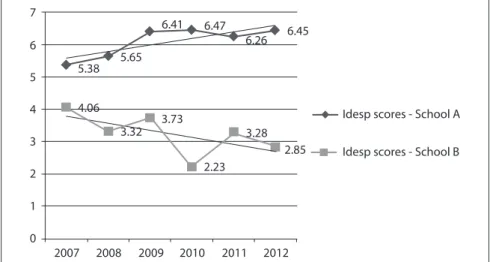
For the research, we chose two schools, whose performance in IDESP was opposite (Figure 1).
Both schools have integrated this research are state and they are located in the countryside of São Paulo state and both offer the first cycle of primary education, working during the day, both morning and evening, the school A is the one with a better IDESP and the school B is the one with the worst IDESP. To investigate why the same politic has very different impacts in the same school system was one of our goals. From this objective, we investigated how the continuing education hap-pens at the two schools.
7 6 5 4 4.06 3.32 3.73 2.23 3 2 1 0 2007 2008 2009 2010 2011 2012 3.28 2.85 5.38 5.65 6.41 6.47 6.26 6.45
Idesp scores - School A Idesp scores - School B
Figure 1 - Development of IDESP (São Paulo State Education Development Index)
at the participating schools
Analysis and discussion of results
The school A is located on an old and traditional neighborhood, a lot of students do not live in the neighborhood (around 30%, according to the Management Plan), but they insist studying there because they have received good references from school, or having relatives (mothers, fathers, grandparents and uncles) who studied there also. According to the Management Plan, only 8% of the school’s students are needy and receive some kind of social assistance.
At the school B, the situation is different, according to the Management Plan, 70% of families survive with less than three monthly minimum wages and receive some kind of assistance from the Federal Government, such as Family Allowance [Bolsa Família]. The parents do not have a good relation with the school, only a few to attend and do not feel integrated into it, they are constantly transferring their children from one school unit to another, because most of them have informal jobs and have no permanent home nowhere.
In addition the different context, lecturer staff in both schools have different features, which already would determine a different con-tinuing education in the two schools units. In the school A, 61% of teach-ers are effective, 66% are working for the school more than 5 years, which indicates there is a low job rotation on lecturers staff and a bigger knowl-edge of the school’s reality. On the other hand, at the school B, 36% are effective, 50% have started working at school one year ago and only 5% are working there more than five years. These data suggest the teachers of the school are working for a long time in the teaching unit and have a greater relationship with the school, as they are effective, other impor-tant data arising from this information is to be effective, we can infer the teachers were approved in a public contract and which dominate the content they teach.
In school B the situation is different, most of the teachers are not effective (64%) and they are in school less than five years (97%), to
impose the same model of continuing education in both schools is to ig-nore their training needs, their difficulties and the context in which the school is located.
Both schools presents around 80% of teachers who have more than 26 weekly hours in classroom. At school A, whose performance in IDESP is better, 83% of teachers working exclusively on it. In school B, whose performance is lesser, 75% teach only there, although it is a small difference, it exists.
Regarding professional experience there is also a difference in school A, 95% of teachers has over 15 years of experience and in school B 46% are less than 15 years of experience. This data allows us to infer in school B many teachers are new, while in A, only 5% are, this data is linked to the fact the school A is located on a privileged socioeconomi-cally region and attract many teachers in late career, while school B, as it is located on the outskirts, attracts not official teachers with less experience in teaching.
The initial training of teachers in both schools was carried out in the pedagogy course, and in school A, 45% did theirs graduation in a prestigious public university, in school B, this number drops to 11%. In school A, 28% of teachers have a post-graduation course, among them there is a master's degree and a doctorate and at school B, 25% of teach-ers have a post-graduation course, among them there is a teacher with a masters’ degree.
This difference in initial training also causes differences in the continuing education happens in school. Both schools follow the same educational policies and they are subject to the same external evaluations and the same continuing education format, but at school A, the position of teachers is more defiant.
The continuing education initiatives happen in times of ATPC, Planning and Redesign and involving all teachers, as the data of the Table 1.
In school A, 100% of teachers participating both of ATPCs as the planning meetings, in school B, this index is somewhat lower, but still it can be said teachers heard in two schools have a good participation both as
ATPCs in planning. The ATPCs and planning, re-planning and self-evalua-tion occurred similarly in both schools and had the same structure.
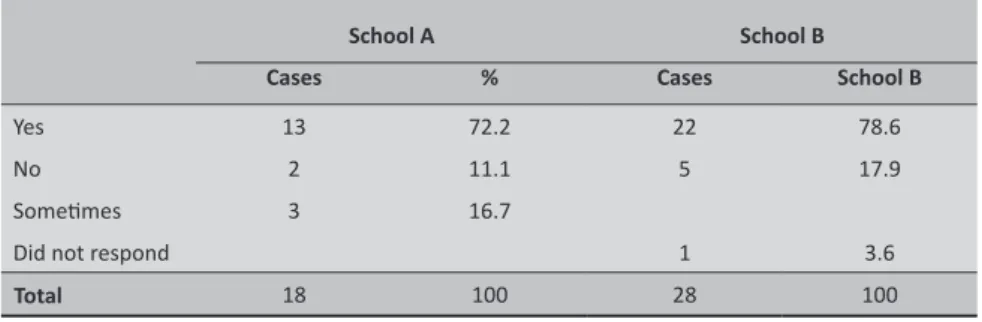
Most teachers said the continuing education happens (Table 2). For Helena Freitas (2003), this continuing education focused on training is adopted for being fast and inexpensive, but does not solve the prob-lems of teacher training.
The presented model in both schools aims at training teachers so they know the questions which are applied in the external evaluations and become able to work with them and train students.
Table 1 - Participation in ATPCs
Do you participate in ATPCs at this educational establishment?
School A School B
Cases % Cases %
Yes 18 100 26 92.9
Did not respond 2 7.1
Total 18 100
Source: The survey was conducted via a questionnaire completed by teachers of the school – 2013
Table 2 - Continuing education
Do you think that your school is working towards its teachers’ further development?
School A School B
Cases % Cases School B
Yes 13 72.2 22 78.6
No 2 11.1 5 17.9
Sometimes 3 16.7
Did not respond 1 3.6
Total 18 100 28 100
We understand working with external evaluations is a good theme to be developed during the continuing education initiatives, both in ATPCs or in times of planning and replanning. Such assessments are present on the teacher's daily life and interfering in their professional practice. This review can serve as a motto for reflection on different ques-tions such as teacher’s theoretical knowledge, different methodologies for working with students, the role of public policies in schools, apart from the specific discussion of what is a school of quality. However, the way this training should be made needs to change, it needs to realize the teacher as subject and seek remedy the difficulties they present, as many made it clear they do not dominate the proposed content.
The realization of continuing education follows the same line at the two schools, but thanks the differences of lecturer’s staff and context, discussions have different repercussions.
In both schools, there is an ATPC intended for EMAI, it is extra, as is paid to effective teachers or category F1, temporary teachers are not
entitled to do it. At school A, all teachers have taken the course, but in school B, the majority has no right to do so, but find doubts taught math-ematics content (39% of teachers said they did not master the content should work with students), the Department of Education believes they cannot attend because they do not have a continuous link with the state, which prevents to invest in this business.
In periphery schools, where most of the teachers do not belong to the category “effective”, the measure has a very negative effect, as well as create an uneven work environment, allows a teacher teach a content he does not know, as if this were correct.
At school A, the participation in EMAI was not a problem as all had already done, yet the coordinator socialized content intended for 1 The teachers classified as category F are those who were with bond on June 1st 2007, the date of termination of Social Security Institute of the State of São Paulo [Instituto de Previdência do Estado de São Paulo – IPESP] established in the State Complementary Law 1.010/2007. This law created a new social security authority, reducing the servers’ rights.
EMAI with all teachers as a way to review, since they already had printed all the material . At school B, teachers who could not do EMAI formally refused to participate in these discussions because not considered fair some teachers had received a payment to take the course and most of the teachers did it “for free”, moreover, the material only came for subscrib-ers, the others should photocopy the handouts on their own, because the school could not afford this reproduction. As a conclusion of this situa-tion, many teachers did not take the course, which became more a factor of disintegration among teachers.
In “routine” ATPC held at school A, teachers would gather in groups according to the number who ministered and exchanged experi-ences and the materials they have worked so all the classrooms could keep up with together in a similar way, as parents charged this from them, a time comparing what was given in a classroom with what was given in an-other. At this time, there was also the current year teacher dialogue with the previous year on the learning situation of some students in order to know what had been done for the child to learn.
In the school A collective ATPCs, planning and replanning al-ways had a preset agenda, it is noted the coordinator knew the materi-als worked, as highlighted a few parts for reading. Another very interest-ing point was after readinterest-ing, teachers were grouped in pairs, to analyze and discuss the activities produced by the students confronted with the reading taken on the day. There was always a practical part of the ATPC, although teachers manifested even while reading, making comments on the relevance (or not) of certain activity. At the end of the activity, they were standing justifying whether a theory was or was not relevant to school students.
The participation of teachers was always massive, they ques-tioned the lack of practical knowledge of the creators of public policy, yet questioned the constructivist method and defended the academic free-dom of teachers to be effective and to know the reality of school, they cited examples of students who could not learn from the new literacy techniques.
In school B, the teachers’ crowd was always higher than in A and was more common many arrived late because the school was far from the urban city center and had few bus lines available. Another important factor was the dispersion level of teachers, commonly made many other activities simultaneously (some of them had a snack, others used to cor-rect the homework and others used to fulfill their class journal). Another difference was the fact teachers do not enjoy the reading, when the coor-dinator asked a volunteer, someone hardly volunteered and the reading was constantly done by the same teacher every time.
A differentiating factor between the two schools was in school B, the coordinator proposed the reading of the texts in full, making it im-possible to carry out some practical activity and discussion of the text, as time did not allow. The “continuing education” held this time was restrict-ed to reading some texts. The theme of the read texts were similar in both schools and without the participation of teachers in the selection process.
Another inconvenience happened because of the scheduled meeting, in school B, were held two ATPCs following and because there is no specific space for the meeting at the end of the first period, it was necessary the teachers to change their room, the 50 minutes ATPC, was in practice 30 minutes because it lost the first 10 minutes for the ac-commodation and arrival of the staff, the final 10 to the change rooms and re-accommodation of the staff. Often, it was not possible to discuss all had been scheduled, nor end reading. In school A, happened just an ATPC per day.
Another highlight and differentiate point between school A and B, was a greater tendency to blame teachers for external evaluation (SARESP / IDESP) results in school B. During the planning done at the be-ginning of the school year and even in ATPC meetings, discussions about the importance of working the curriculum were constant and followed by the statement the teacher's another year had not done his part, so the school had had a poor performance. Here are some words show this place-ment, we highlight this situation was not attended at school A:
Many people do not give content in the year prescribed and overloads the col-league of the following year, there can be no “there’s no time” (Teacher 1). Teach for teach is not right! (Teacher 2).
It is not worth just write on the board and the student does not learn. You need to look at the school child’s reality (Teacher 4).
We are discussing the EMAI… Why follow the planning if we know the cli-entele is different? Why not think on March 15th and make a plan out of EMAI? The EMAI is not utopian... It cannot be the basis. We must match the EMAI (Teacher 7).
These speeches show the process of blame and accountability of school by SARESP results generate disunity among the lecturer staff, which is seeking to who should be the guilty and do not look for solu-tions, even when it appears a speech proposing something, like the last, it comes up against the lack of school autonomy, both the replanning as the so-called “D”2 day for school self-evaluation came with the default
tariff by the State Secretariat of Education and could not change it, if only because the position expressed by the coordinator, which reflects the orientation of the Educational Board, reinforced the importance of working all EMAI.
The curriculum evaluated in external evaluation is also imposed as continuing education happens in schools. Theoretically it is possible to do adjustments to the curriculum, but in practice they do not happen be-cause the curriculum is not discussed, it is usually taught and the questions are appeased, especially in school B, it teachers spend most of the time looking who to blame for poor performance of students and do not discuss the reasons of external evaluations, nor the curriculum’s imposition. 2 The day "D" is for the school self-evaluation by the management staff, lecturer staff, staff, students
and community. For more information, see: <http://www.educacao.sp.gov.br/noticias/escolas-da-rede-estadual-promovem-dia-de-autoavaliacao>. Access: July 29th, 2013.
Another problem encountered in school B is the high turnover of teachers (and administration) both ATPCs, as at other times, many teachers had no way to dialogue with the previous year teacher to know which topic the classroom had stopped and what students’ difficulties, the biggest problem of this is the school is always with teachers who do not know the student, because of this, many teachers were having dif-ficulty performing the survey evaluation3 because they were not sure of
the domain by the skills of students and the poor performance of some students was due to momentary nervousness or lack of basic skills.
The differences between ATPCs held more by the different con-texts than the theme in both schools they were intended for training (sometimes conformation), because there were few spaces for critical re-flection, either as a small time, to be an extensive agenda, or not be the intention of the State Department of Education provide a critical reflec-tion of the state policies.
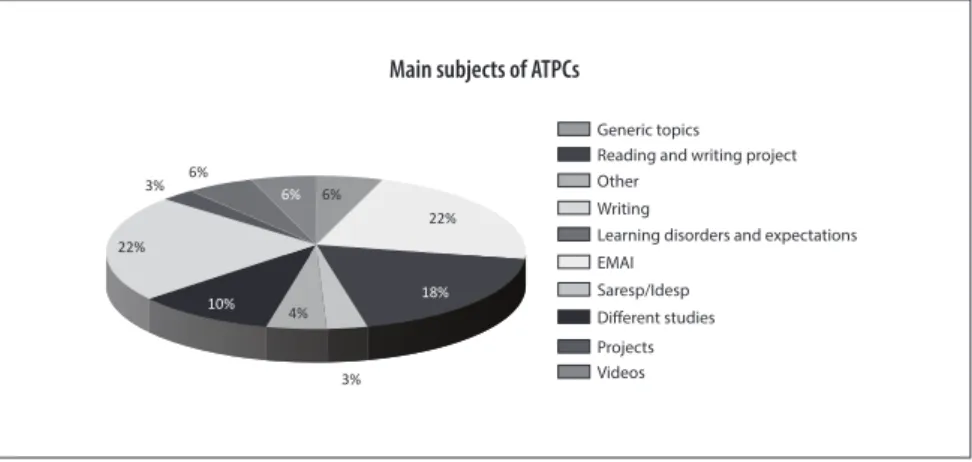
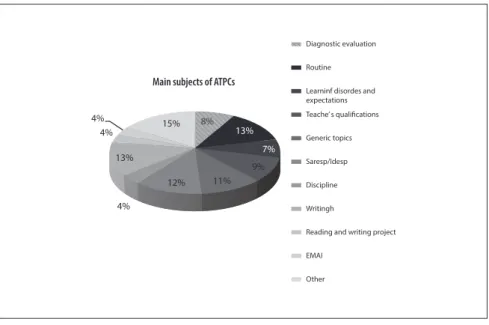
The themes of ATPCs are imposed and they are similar in both schools (Figures 2 and 3).
Both schools perform similar work in both ATPCs as in plan-ning, both emphasize the results obtained in SARESP/IDESP and work with content applications in this competition for the teacher to the lat-er work in the classroom, this can be evidenced through the similarities the themes.
The differences between the continuing education developed in schools happen because of the context in which schools are embedded and the attitude of teachers, since the continuing education model is ex-ternally defined and based on reading texts and training questions asked at SARESP/IDESP.
Although it is important the school stay connected to its Education Board and the rules governing an education system, a demo-cratic school should have the freedom to choose the subjects of ATPCs, 3 Survey Evaluation: it is an assessment carried out in the first month of classes to identify where literacy
In Fonseca (2001), this situation happens because the teacher training was infl uenced by the logic of international organizations. Teachers are ignored as subjects by the World Bank discourse, they are not seen as knowledge producers, so they do not have autonomy to choose their formations. Th is is a training line aimed at reducing costs. From this conception, seeks to increase investment in tangible goods such as books, technology resources and other learning materials to the detriment of human factors, such as initial teacher education.
Within this mercantilist and competitive vision, the teacher is part of school inputs, so their performance is evaluated by quantita-tive criteria, so the ranking has become common and rewards unequally teachers, this is accepted by society, one proof is that teachers themselves according to the needs of their teachers and this is not what occurs. All programming is already predefi ned and there is just a little, or no space, for the teacher to exercise their autonomy and propose new projects and new approaches. 6% 3% 22% 10% 4% 3% 18% 22% 6% 6% Generic topics Reading and writing project
Learning disorders and expectations Other Writing EMAI Saresp/Idesp Different studies Projects Videos Main subjects of ATPCs
Figure 2 - Main themes of ATPCs (School A)
4% 4% 4% 13% 13% 12% 11% 15% 8% 9% 7% Diagnostic evaluation Routine Learninf disordes and expectations Teache’ s qualifications Generic topics Saresp/Idesp Discipline Writingh
Reading and writing project EMAI
Other Main subjects of ATPCs
Figure 3 - Main themes of ATPCs (School B)
Source: The survey was conducted via a questionnaire completed by teachers of the school – 2013 yearn for a better school classification so that get a prize. This logic is not the object of reflection in continuing education but a desire of everyone being in the top positions, without realizing it is not possible for every-one to be in first place and there will always be an outcast, a school will be in last.
Barreto et al. (2001) states lack training (we assume both ini-tial and continuing) for the teacher to understand the assessment as a step in the learning process, so the authors claim the concern with the evaluation (internal and external) should not be restricted simply to the student, but should include the education of teachers and their working conditions.
Corroborating Fonseca (2001) and Oliveira and Fonseca (2001), Helena Freitas (2003) argues there is a decrease and lack of commitment to education funding by the State, which subordinated the third world countries (such as Brazil) the logic of the World Bank and the market, providing both initial training and continuing focused on labor and im-proving rates.
The continuing education held as a training exists in both schools. The Educational Board training managers, training teachers, who must train students, without a questioning of this logic. Do not pay a bo-nus merit for teachers whose students did not get a better grade in IDESP contributes to improving the quality of education? Probably not, give less to school and teachers who are already in delay will not increase the qual-ity of education. Exclusionary logic of the schools classification and this continuing education model is little questioned because for there to be this questioning these teachers need to have had an initial and continu-ing education quality.
Both the educational coordination as the school administration B point out continuing education is important, but it does not replace the initial training. In addition, a good initial training allows a different per-ception of their own continuing education, just remember many at school A (28%) stated there is no continuing education in school, they are not heard and feel “talking to themselves”. The speech of the Director and the B school teaching supervisor illustrates the lack a good initial training is:
The biggest problem is teacher training, not the continuing education, but the initial training, there are teachers who do not like reading aloud
(Interview 2).
The PCOPs attended the ATPCs, they gave training which was good but it was not enough, our school is in the worst place of DE, we will be hard-pressed (Speech of the Director during an ATPC, School B).
There is a much greater teacher training problem than people think, there are those who make a serious course and confronts it with their experience. The point of training is of each one, there are people who did these relaxed colleges in weekend... Each one must improve (Speech of the Director
dur-ing an ATPC, School B).
The school whose has more problems is the most affected with this training model as they have teachers who badly need for continu-ous training of quality. According to our observation, it is clear there is a continuing training, however this training follows a training model, in order to obtain higher scores on the external evaluations, as the State Department of Education to train teachers, so the discussions are super-ficial, even when working with the different possibilities of writing, what we seek is to train teachers to recognize them and rank them, focusing on what is required in external evaluations. This training model is not appro-priate to examine the basis of the implementation of evaluation systems, nor to question what kind of curriculum we are adopting as official, sim-ply obey, for this a poor university education is quite convenient.
Conclusion
In conclusion, the continuing education model performed in state schools in São Paulo is focused on the results of external evaluations (SARESP) and the need for IDESP to be improved, it is a training of teach-ers, this type of training is prepared by the Department of Education, which reduces the continuing education to prepare teachers to train stu-dents to carry out the tests applied by the state.
This training model creates a perverse situation, reinforcing in-dividualism, inequality between schools and the competitiveness, mak-ing the teachers start to blame each other for the poor performance of
students in external evaluations, since they are also assessed by it. The training, especially the continued one, becomes influenced by labor regu-lation process, training some skills so that performance in external evalu-ations improve and so the rates become higher.
On investigation, it was observed that the results in the evalu-ations are analyzed and seen as targets to be achieved without it being promoted dialogue between external and internal reviews and that the school has autonomy to work the results of external evaluations as they wish, not in the habit of asking their reasons and causes.
Opposed to this practice the proposition that the improvement of the students’ results is the continuing training for teachers’ improve-ment, which should be seen as subjects of their actions, so it is important to think on the external evaluation as a source of dialogue with the work of teachers, searching for new teaching methods and reviewing the cur-riculum choices.
We believe that continuing education should work with the re-sults of external evaluations, as this assessment may serve as a motto for to reflect on different issues such as teacher’s theoretical knowledge, different methodologies for working with students, the role of public policy in schools, apart from the specific discussion of what is a quality school today. However, the way this training should be made to change, it needs to realize the teacher as subject and seek remedy the difficulties they present, it cannot be reduced to only one training.
Acknowledgments
We would like to acknowledge Research Support Foundation in São Paulo [Fundação de Amparo à Pesquisa no Estado de São Paulo – FAPESP] for financing and the schools who have opened their doors for this research.
References
ANDRADE, D. F., TAVARES, H. R., VALE, R. C. Teoria de resposta ao item: concei-tos e aplicações. São Paulo: Associação Brasileira de Estatística, 2000.
ANDRÉ, M. E. D. A. Estudo de caso em pesquisa e avaliação educacional. 3. ed. Brasília: Líber Livro, 2008.
BARRETO, E. et al. Avaliação na educação básica nos anos 90 segundo os periódi-cos acadêmiperiódi-cos. Cadernos de Pesquisa, n. 114, p. 49-88, 2001.
BONAMINO, A.; SOUSA, S. Z. Três gerações de avaliação da educação básica no Brasil: interfaces com o currículo da/na escola. Educação e Pesquisa, v. 38, n. 2, p. 373-388, 2012. Available at: <http://www.revistas.usp.br/ep/article/ view/47883/51613>. Access on: Oct. 15th, 2013.
DIAS SOBRINHO, J. Campo e caminhos da avaliação: a avaliação da educação superior no Brasil. In: FREITAS, L. C. (Org.). Avaliação: construindo o campo e a crítica. Florianópolis: Insular, 2002.
FONSECA, M. A gestão da educação básica na ótica da cooperação internacional: um salto para o futuro ou para o passado? In: VEIGA, I. P. A.; FONSECA, M. As
dimensões do projeto político pedagógico. Campinas: Papirus, 2001.
FREITAS, D. N. T. A avaliação da educação básica no Brasil: dimensão normativa, pedagógica e educativa. Campinas: Autores Associados, 2007.
FREITAS, H. C. L. Certificação docente e a formação do educador: regulação e desprofissionalização. Educação e Sociedade, v. 24, n. 85, p. 1095-1124, 2003. Available at: <http://www.scielo.br/pdf/es/v24n85/a02v2485.pdf>. Access on: Oct. 15th, 2013.
FREITAS, L. C. Eliminação adiada: o ocaso das classes populares no interior da escola e a ocultação da (má) qualidade do ensino. Educação e Sociedade, v. 28, n. 100, p. 965-987, 2007. Available at: <http://www.scielo.br/pdf/es/v28n100/ a1628100.pdf>. vailable at: Mar 21th, 2012.
MADAUS, G. F. The influence of testing on the curriculum. In: TANNER, L. N.
Critical issues in curriculum: eighty-seventh yearbook of the National Society for the Study of Education. Chicago, Illinois: NSSE, 1988.
OLIVEIRA, D. A.; FONSECA, M. O Banco Mundial e as políticas de formação docente: a centralidade da educação básica. In: HIDALGO, A. M. et al. (Org.).
Educação e estado: as mudanças nos sistemas de ensino do Brasil e Paraná na
dé-cada de 90. Londrina: Ed. UEL, 2001.
SÃO PAULO (Estado). Lei Complementar n. 1.010, de 1 de junho de 2007. Dispõe so-bre a criação da SÃO PAULO PREVIDÊNCIA - SPPREV, entidade gestora do Regime Próprio de Previdência dos Servidores Públicos – RPPS e do Regime Próprio de Previdência dos Militares do Estado de São Paulo – RPPM, e dá providências cor-relatas. São Paulo, SP, 2007. Available at: <http://www.al.sp.gov.br/repositorio/ legislacao/lei.complementar/2007/lei.complementar-1010-01.06.2007.html>. Access on: Sept. 9th, 2013.
SÃO PAULO (Estado). Matrizes de referência para a avaliação: Documento Básico – Saresp. São Paulo: SEE, 2012. Available at: <http://saresp.fde.sp.gov.br/2012/ Arquivos/Saresp2012_MatrizRefAvaliacao_DocBasico_Completo.pdf>. Access on: Sept. 9th, 2013.
SÃO PAULO (Estado). Programa de Qualidade da Escola: nota técnica. São Paulo: SEE, 2013a. Available at: <http://idesp.edunet.sp.gov.br/Arquivos/Nota_tecni-ca_2012.pdf>. Access on: Oct. 1st, 2013.
SÃO PAULO (Estado). Boletim da Escola: 2013. São Paulo, 2013b. Available at: <http://idesp.edunet.sp.gov.br/>. Access on: June 1st, 2013.
Received: 07/01/2014
Recebido: 01/07/2014
Approved: 07/26/2014