junho de 2016
Ana Luísa Marques Oliveira
A systematic literature review on the themes
and measures used to study academic
possible selves
Universidade do Minho
Escola de Psicologia
A sys tematic literature re vie w on t he themes and measures used to s
tudy academic possible sel
ves
Ana Luísa Mar
ques Oliv
eir
a
UMinho|20
Dissertação de Mestrado
Mestrado Integrado em Psicologia
Trabalho realizado sob a orientação do
Professor Doutor Pedro José Sales Luís Fonseca Rosário
e coorientação da
Professora Doutora Paula Cristina Soares Magalhães
Silva Correia
junho de 2016
Ana Luísa Marques Oliveira
A systematic literature review on the themes
and measures used to study academic
possible selves
Universidade do Minho
Escola de Psicologia
DECLARAÇÃO
Nome: Ana Luísa Marques Oliveira
Endereço de correio eletrónico: [email protected]
Número de cartão de cidadão: 14302308 0 ZY9
Título da dissertação: A systematic literature review on the themes and measures used to study academic possible selves
Orientador: Professor Doutor Pedro José Sales Luís Fonseca Rosário
Coorientador: Professora Doutora Paula Cristina Soares Magalhães Silva Correia
Ano de conclusão: 2016
Designação do Mestrado: Mestrado Integrado em Psicologia
É AUTORIZADA A REPRODUÇÃO INTEGRAL DESTA DISSERTAÇÃO APENAS PARA EFEITOS DE INVESTIGAÇÃO, MEDIANTE DECLARAÇÃO ESCRITA DO INTERESSADO, QUE A TAL SE COMPROMETE;
Universidade do Minho, 13/06/2016
ii Index Agradecimentos…...……….. iii Resumo……….. iv Abstract……….. v Introduction……….. 6 Method……….. 8 Eletronic searches……….. 8
Inclusion and exclusion criteria………. 9
Data extraction………... 10 Results………... 11 Discussion………. 15 Limitations………. 17 Conclusion………. 17 References………. 18
Index for tables Table 1. Keywords used in the search……… 9
Table 2. Data extracted for systematic review about APSs……….. 12
Index for figures Figure 1. PRISMA flowchart with the number of articles recorded in each of the phases of the process throughout this systematic review………... 11
iii
Agradecimentos
Aos meus orientadores: Professor Doutor Pedro Rosário e Professora Doutora Paula Magalhães pela disponibilidade, apoio, paciência, confiança, conhecimentos, por acreditarem que eu era capaz e por me desafiarem constantemente a ser e fazer melhor.
À equipa do GUIA por todos os momentos partilhados. Convosco aprendi que juntos vamos mais longe! Um agradecimento especial à Sílvia e à Jennifer por todo o apoio e disponibilidade. Sem vocês este trabalho não seria o mesmo.
Às minhas colegas e amigas: Catarina Ribeiro, Isabel Vieira, Marta Borges, Sofia Tavares e Vera Soares. Obrigada por estes cinco maravilhosos anos! Passamos por muito juntas, desde bons a maus momentos, e espero passarmos ainda mais momentos juntas, de preferência bons momentos! Obrigada pela vossa ajuda, carinho, gargalhadas e brincadeiras!
À minha melhor amiga: Catarina Castro. Já lá vão sete anos desde que nos conhecemos e a nossa amizade não diminuiu, pelo contrário! Quero agradecer por estares comigo nos momentos de dor, raiva, angústia, mas também nos momentos de euforia, alegria e diversão!
Aos meus pais José e Amélia, à minha irmã Inês e avó Luísa: vocês são o meu porto seguro. Desafiam-me a seguir os meus sonhos e a ir mais longe, mas sempre com vocês por perto para aquilo que precisar. Obrigada por tudo!
Ao meu avô José, avô Francisco, avó Rosa e tia Deolinda: obrigada pelos momentos partilhados convosco. Mostraram-me que nunca estamos sozinhos, que uma queda não significa o fim e que a humildade, a fé e perseverança são essenciais para a nossa vida, quer esta seja longa ou curta.
Aos restantes familiares, amigos, colegas e professores que me ajudaram ao longo deste percurso.
“Aqueles que passam por nós, não vão sós, não nos deixam sós. Deixam um pouco de si, levam um pouco de nós” (Antoine de Saint-Exupéry)
iv
Revisão sistemática de literatura sobre os temas e medidas utilizados no estudo dos possible selves académicos
Resumo
Os possible selves referem-se a imagens que os indivíduos têm deles próprios no futuro. Eles derivam das representações do “eu” no passado e incluem representações do “eu” no futuro. Ao mesmo tempo representam os desejos, medos e fantasias que o indivíduo tem. Os possible selves podem ser desenvolvidos em qualquer contexto de vida ou domínio. A presente revisão sistemática tem como principal objetivo mostrar quais os temas e medidas utilizados para estudar os possible selves no domínio académico, ou seja, os possible selves académicos. A pesquisa dos artigos foi realizada em três bases de dados (WebScience, PsycArticles e Scopus). Foram apenas selecionados os estudos que referissem e avaliassem os possible selves académicos. A pesquisa e escrita dos resultados seguiu as recomendações da Cochrane e do PRISMA (Preferred Reporting Items for Systematic Reviews and Meta-Analyses). Os resultados mostram que os principais temas estudados juntamente com os possible selves académicos são: identidade, autorregulação, académico e o sexo. A maioria dos estudos incluídos na revisão sistemática utilizaram como método para avaliar os possible selves académicos um formato de respostas do tipo escala de Likert.
Palavras-chave: possible selves, académico, infância tardia, adolescência, revisão sistemática.
v
A systematic literature review on the themes and measures used to study academic possible selves
Abstract
Possible selves refer to images that individuals create about themselves in the future. They derive from representations of the self in the past and include representations of the self in future. At same time, they represent individually and specific hopes, fears and fantasies. Possible selves can be developed within any context of an individual´s life or domains. This systematic review aims to provide a compilation of the evidence on the themes and measures used to study possible selves in academic domain. Three databases were used (WebScience, PsycArticles, and Scopus) and only studies referring to, and evaluating, possible selves in academic domain were selected. The reporting and research of the results conforms to the Cochrane’s recommendation and PRISMA (Preferred Reporting Items for Systematic Reviews and Meta-Analyses) guidelines. Results showed that the main themes studied in relation to academic possible selves were: identity, self-regulation, academic, and gender. Additionally, the majority of the studies included in the present review used a Likert-like scale to evaluate the presence or absence of academic possible selves.
Running head: A SYSTEMATIC REVIEW OF ACADEMIC POSSIBLE SELVES
6 A systematic literature review on the themes and measures used to study academic possible
selves
The interest about Possible Selves (PSs) emerged in 1980s when Markus and Nurius (1986) studied this unexplored domain of self-knowledge. The construct of PSs refers to images that individuals create about themselves in the future. The relevance of PSs is two-fold; firstly, PSs work as incentives for future behavior and, secondly, they provide an interpretative and evaluative context for the current view of the self. In general, these images that people have about themselves offer an orientation or direction about the future, about what individuals want to be and what they want to achieve (Markus & Nurius, 1986;
Oyserman & Markus, 1990). These features help to justify the fact that PSs have been studied in many areas, such as in clinical, health, social, sport, and educational psychology (Dunkel & Kerpelman, 2006).
PSs are an important part of the self-concept of the individual - the self-concept component which is future oriented (Oyserman, Terry, & Bybee, 2002). PSs may work as roadmaps to guide and regulate behavior, and they can be developed within any context of an individual’s life or domains (Oyserman, Bybee, Terry, & Hart-Johnson, 2004). In fact, an individual’s own culture, generation, psychosocial environment, and socioeconomic status are among factors that may influence PSs (Vick & Packard, 2008), and help to explain its
flexibility and adaptability (Cross & Markus, 1991). Importantly, although PSs are influenced by others (e.g., family, friends, teachers, colleagues), they are mainly defined and evaluated by the individual, being a phenomenon of a private nature (Cross & Markus, 1991).
People may create hoped for (goals we desire to attain), expected (what we expect to achieve), and feared (what we want to actively avoid) PSs. For example, a hoped for PS could be “I want to be rich”, an expected PS could be “I expect to complete the math course with a positive grade” (both hoped for and expected possible selves represent self-set goals people aim to attain), and a feared PS could be “I worry to fail in math”. Importantly, some authors have suggested that a significant part of our behavior is an effort to attain or avoid many of our possible selves (Cross & Markus, 1991; Markus & Nurius, 1986).
As images of the future, PSs may be positive (e.g., to be financially autonomous) or negative (e.g., worry of being unemployed) (Oyserman, Bybee, & Terry, 2006). When an individual has a positive PS and a negative PS for the same domain, the PS is termed
balanced (Cadely, Pittman, Kerpelman, & Adler-Baeder, 2011; Oyserman & Markus, 1990). A balanced PS, is likely to be related with a strong motivation and effort to achieve the goal
A SYSTEMATIC REVIEW OF ACADEMIC POSSIBLE SELVES
7 and, simultaneously, avoid failure (Oyserman & Markus, 1990). To follow this path, self-regulatory efforts and strategies are needed (e.g., spend more time doing homework) and may be valuable tools (Oyserman et al., 2006). When the strategies used by youth are detailed and oriented to attain their goals, PSs are called plausible PSs. For example, Oyserman and colleagues (2004) found that students holding plausible PSs focused on the academic domain were more likely to improve their grades throughout the school year than those students who simply had PSs focused on the academic domain.
The voluminous literature on PSs present many misinterpretations regarding the nature of the construct, which may be due to the diversity of terms and (in)definitions that have been used to describe the concept (Erikson, 2007). As a result, PSs has become a fuzzy concept (Erikson, 2007). For this reason, with recent investigation and with the purpose of clarity, this systematic literature review will follow the definition by Markus and Nurius (1986) and Oyserman and Markus (1990).
Due to its developmental and continuously evolving nature, PSs are present throughout an individual’s lifetime. Moreover, the number of PSs tends to decrease as the individual ages (Cross & Markus, 1991). In adolescence and youth, the number of PSs is higher than that in later developmental stages, possibly due to the fact that there is still much of life ahead. Besides, school and academic futures are frequently mentioned by youth and adolescents when asked about their PSs (Oyserman et al., 2004). In fact, this is the domain within PSs that is most often mentioned in late childhood and adolescence and is termed as academic possible selves (APSs). Adolescence is a human stage of development characterized by changes in which individuals have to make decisions about their own academic and school futures that have significant impacts in their lives (Oyserman & Fryberg, 2006). Therefore, not surprisingly, APSs have been predominantly studied in adolescents and young adults who attend school, or higher education, by virtue of APSs pertaining to goals and expectations about the school or students’ educational aspirations (Kirk, Lewis, Nilsen, & Colvin, 2013; Markus & Nurius, 1986; Oyserman, Brickman, & Rhodes, 2007; Oyserman et al., 2004).
Prior research on APSs show that students with stronger academic aspirations are likely to work more, engage more in class activities, and outperform (Cadely et al., 2011; Oyserman et al., 2006, 2004). Still, sometimes students have high expectations about their academic performance (e.g., having good grades, be on the top 10% of the class) but fail to achieve those expectations. This inability to reach one’s goals can be due to several reasons, such as a lack of strategies to achieve the self-set purposes or the strategies being used are not fitted to the purpose or the individual (Oyserman et al., 2006; Oyserman & Fryberg, 2006).
A SYSTEMATIC REVIEW OF ACADEMIC POSSIBLE SELVES
8 The study of APSs has become important due to its central role on people
self-regulation and well-being, as well as on school achievement (Oyserman et al., 2004;
Oyserman & Fryberg, 2006). Although there is a large body of literature on PSs, there is not, to the best of our knowledge, a previous systematic review about this particular topic. Thus, the main goal of the present study is to learn the themes related, and measures used, to study the PSs in the academic domain (APSs) in school-aged youngsters within the last 10 years. Extending the understanding on the APSs is of relevance as it may help to improve school-based strategies and policies to promote school success and, simultaneously, offer a basis for a positive transition from adolescence to adulthood. The results arising from this systematic review may serve as a basis for further research on APSs and may contribute to the future development of this field.
Method
The present systematic review conforms to the Cochrane’s recommendations (Higgins & Green, 2011), as well as the guidelines proposed by PRISMA statement (Preferred
Reporting Items for Systematic Reviews and Meta-Analyses) (Moher, Liberati, Tetzlaff, Altman, & Group , 2009). Thus, initially, an investigation question about PSs was raised, and a systematic literature research was then conducted. Then, the title, abstract, and all the sections (i.e., introduction, methods, results, discussion, and limitations) of all the articles included in this review were reviewed.
The aim is to deepen and systematize the knowledge that was built in the last 10 years regarding the PSs in academic domain with the hope of guiding future research and
educational practice. Hence, the main goals of this systematic review were twofold: deepen the understanding on the themes studied in relation to APSs and how APSs were assessed.
Electronic searches
The initial literature search was conducted in three databases: Web of Science, Scopus, and PsycArticles. It was conducted between the 9th July and the 27thJuly, 2015. Only studies written in English, Portuguese, or Spanish, and published in the period between 2005 and 2015, were included in the search. The complete reading of the selected articles was performed independently by two researchers. Afterwards, researchers met to discuss which articles would be included in the present systematic literature review, and to work on the information displayed in the tables included in this manuscript.
A SYSTEMATIC REVIEW OF ACADEMIC POSSIBLE SELVES
9 The key terms used in the search were: (1) “possible selves” and “academic”
and “school”, (2) “possible selves” and “academic” and “homework”, and (3) “possible selves” and “academic” and “achievement” (see Table 1).
Table 1
Keywords used in the search
Main Keyword Secondary Keyword Tertiary Keyword “possible selves” “academic” “school”
“homework” “achievement”
The term school was selected as a key term because, as mentioned, APSs are
associated with school and academic trajectories of success or failure (Oyserman et al., 2006; Oyserman & Fryberg, 2006). Besides, youngsters are likely to attribute great importance to school as it is an essential context where they spend much of their time and establish many of their relationships (Butler-Barnes, Estrada-Martinez, Colin, & Jones, 2015). Achievement and homework were also selected because of their relevance to school literature (Cooper,
Robinson, & Patall, 2006; Leondari, Syngollitou, & Kiosseoglou, 1998). Moreover,
homework is an important instructional tool to promote learning and autonomy (Cooper et al., 2006; Hagger, Sultan, Hardcastle, & Chatzisarantis, 2015; Núñez et al., 2015; Rosário et al., 2009; Valle et al., 2015) and, for that reason, a strategy that youngsters may select to
increment the plausibility of their APSs. According to the literature, completing a moderate amount of homework helps students develop study habits, which facilitates learning and, in turn, improves academic achievement (Cooper et al., 2006; Núñez et al., 2015, Rosário et al., 2009). Moreover, Núñez et al. (2015) found a close and positive relationship between
completing homework and academic achievement.
Inclusion and Exclusion Criteria
For this study, screening of the articles was based on the following inclusion criteria: a) articles written in Portuguese, Spanish, or English; b) participants had to be students (from elementary until high school); c) participants had to be between 11-18 years of age (when information about the age was absent from the manuscript, the criteria for including the paper was the previous criterion); d) participants without any cognitive impairment or disorder; e) articles that refer APSs or PSs related to school (e.g., school-focused possible selves,
A SYSTEMATIC REVIEW OF ACADEMIC POSSIBLE SELVES
10 educational expectations or aspirations); f) specific mention on how PSs were assessed, for example, with a questionnaire (please note that although the main focus of the present review are the APSs, these are extracted from the PSs’ assessment. That is, first data regarding PSs is collected, and only through the coding of answers can the subcategories of PSs be identified, including the APSs). We excluded theoretical articles, dissertations, reviews, letters to the editor, books, book chapters, and studies with samples of individuals with 18 years of age attending college.
Data extraction
Figure 1 shows PRISMA flowchart with the number of articles recorded in each of the phases of the process: identification, screening, eligibility, and inclusion. In the identification, or initial, phase, 1179 articles were obtained (543 on Web of Science, 344 on Scopus, and 292 on PsycArticles). Of these 1179 articles, 458 were duplicated and 648 were excluded because they were not relevant to the research question, making a total of 73 potentially relevant articles. After reading the abstracts of the 73 papers, 43 were excluded because they were: a) book (n = 1); b) meta-analyses (n = 1); c) master thesis (n = 2); d) clinical study (n = 1); e) study’s sample was composed of college students or young adults (n = 2); f) study’s sample was composed by individuals presenting a risk of suicide, violent behavior, or substance abuse (n = 1); and g) did not refer PSs or APSs (n = 35).
This selection resulted in 30 articles for full assessment and, of these, 22 were excluded because: a) did not measure PSs or APSs (n = 4); b) study’s sample also included college students or students with more 18 years of age (n = 7); c) were a book chapter (n = 2); d) was a conference paper (n = 1); e) were theoretical papers (n = 3); f) PSs were measured but APSs were not referred (n = 3); and g) students expectations other than educational was the focus of the paper, not examples of APSs (n = 2). After this selection, a total of 8 articles were included in the present systematic literature review.
A SYSTEMATIC REVIEW OF ACADEMIC POSSIBLE SELVES
11 Figure 1. PRISMA flowchart with the number of articles recorded in each of the phases of the process throughout this systematic review.
Results
Literature presents a considerable amount of different terms to describe APSs: school-related PSs (e.g., Oyserman et al., 2006), school-focused PSs (e.g., Oyserman et al., 2011), educational PSs (e.g., Perry & Vance, 2010), and educational expectations (e.g., Kirk, Lewis, Brown, Nilsen, & Colvin, 2012). Other authors use the term educational expectations and aspirations (e.g., Kirk, Lewis, Scott, Wren, Nilsen, & Covin, 2012), not as an alternative term per se for APSs, but as an example of APSs. In the results section, and to be consistent with the original authors, the terms used in each study were maintained.
“PS, Academic, School” (n = 554) S cr ee ning Inc luded E li gibi li ty Ide nti fica ti on
Potentially relevant articles (n = 73)
Elimination based on abstract
(n = 43) Articles for complect lecture
(n = 30)
Elimination based on full text
(n = 22)
Included articles in results table (n = 8) “PS, Academic, Homework” (n = 132) “PS, Academic, Achievement” (n = 493) Non-relevant articles (n = 648) Duplicates (n = 458)
A SYSTEMATIC REVIEW OF ACADEMIC POSSIBLE SELVES
12
Themes related with APSs
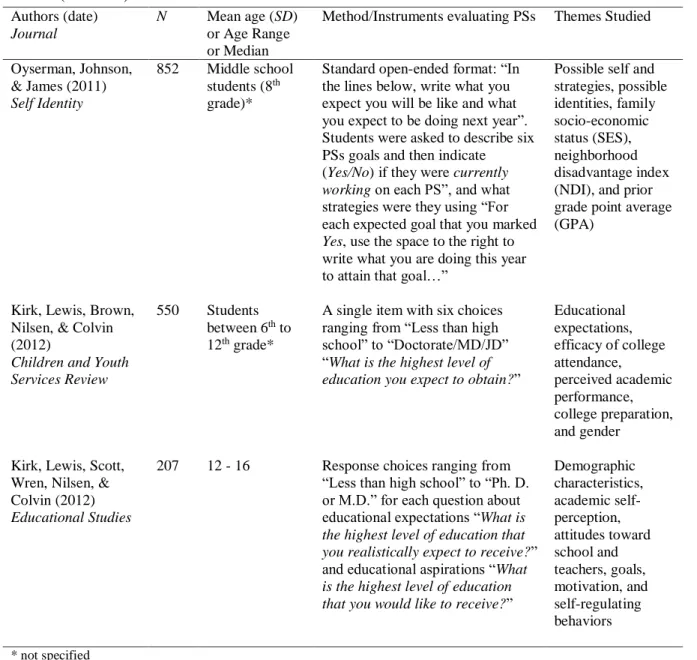
In the present systematic review, four themes studied in relation to APSs emerged. The themes were: (1) identity (Cadely et al., 2011; Oyserman et al., 2006), (2) self-regulation (Kirk, Lewis, Scott, et al., 2012; Oyserman et al., 2006; Vick & Packard, 2008), (3) academic (Kirk, Lewis, Brown, et al., 2012; Kirk, Lewis, Scott, et al., 2012; Oyserman et al., 2006), and (4) gender (Kirk, Lewis, Brown, et al., 2012; Perry & Vance, 2010) (see Table 2).
Table 2
Data extracted for systematic review about APSs
Authors (date)
Journal
N Mean age (SD) or Age Range or Median
Method/Instruments evaluating PSs Themes Studied
Oyserman, Bybee, & Terry (2006) Journal of Personality and Social Psychology 264 Middle school students (8th and 9th grade)*
Standard open-ended format where scholars generated expected PSs, noted strategies to attain each PS, and repeated this process for feared PSs Possible selves, Social Identity, self-regulatory behavior, academic outcomes, and depression Vick & Packard
(2008)
Hispanic Journal of Behavioral Sciences
66 13 – 18 15.5 (1.19)
A single item to be rated on a scale from 1 “strongly disagree” to 7 “strongly agree” “For some people,
becoming a college student is an important part of their future plans. How important is becoming a college student to your future plan?”
Self-regulation, self-efficacy, instrumentality, possible selves, and structured programming Mainwaring & Hallam (2010) Emotional and Behavioral Difficulties 25 Secondary students*
A semi-structured interview - each student was asked how he/she saw themselves in the future
Possible selves
Perry & Vance (2010) The Career Development Quarterly 216 13-17 15.01 (.74)
In educational domain: Ratings of the level of education students hoped for, expected, and feared, ranging from 1 “drop out of high school” to 6 “finish college and take further training”.
In career domain: scholars identified at least three jobs that they hoped, expected, and feared attaining
Peer beliefs, possible selves, and gender
Cadely, Pittman, Kerpelmen, & Adler-Baeder (2011)
An International Journal of Theory and Research
1137 15.64 (.95) Six statements using a 5-point Likert-type scale
Identity styles, academic possible selves, and grades
A SYSTEMATIC REVIEW OF ACADEMIC POSSIBLE SELVES
13
Identity. In relation to APSs, the focus on the theme identity has been diverse. Some
of the selected papers focused on the construct of social identity (Oyserman et al., 2006) while others addressed the identity styles (Cadely et al., 2011). According to Oyserman et al. (2006), students may have difficulties in creating school-focused PSs when these PSs are incongruent with their social identities, like racial-ethnic identities (e.g., African American, Latino, or Asian). With a focus on the identity styles, Cadely et al. (2011) mentioned three types: informational, normative identity, and diffuse-avoidant style. Informational identity style refers to active engagement in identity exploration, looking for different alternatives for oneself. The normative identity style is related to learning others’ expectations for oneself, and the diffuse-avoidant style is related to low efforts for exploration or even avoidance of exploration. The first two identity styles were found to be positively related with academic
Table 2 (continued) Authors (date) Journal N Mean age (SD) or Age Range or Median
Method/Instruments evaluating PSs Themes Studied
Oyserman, Johnson, & James (2011) Self Identity 852 Middle school students (8th grade)*
Standard open-ended format: “In the lines below, write what you expect you will be like and what you expect to be doing next year”. Students were asked to describe six PSs goals and then indicate (Yes/No) if they were currently
working on each PS”, and what
strategies were they using “For each expected goal that you marked
Yes, use the space to the right to
write what you are doing this year to attain that goal…”
Possible self and strategies, possible identities, family socio-economic status (SES), neighborhood disadvantage index (NDI), and prior grade point average (GPA)
Kirk, Lewis, Brown, Nilsen, & Colvin (2012)
Children and Youth Services Review
550 Students between 6th to
12th grade*
A single item with six choices ranging from “Less than high school” to “Doctorate/MD/JD” “What is the highest level of
education you expect to obtain?”
Educational expectations, efficacy of college attendance, perceived academic performance, college preparation, and gender
Kirk, Lewis, Scott, Wren, Nilsen, & Colvin (2012)
Educational Studies
207 12 - 16 Response choices ranging from “Less than high school” to “Ph. D. or M.D.” for each question about educational expectations “What is
the highest level of education that you realistically expect to receive?”
and educational aspirations “What
is the highest level of education that you would like to receive?”
Demographic characteristics, academic self-perception, attitudes toward school and teachers, goals, motivation, and self-regulating behaviors * not specified
A SYSTEMATIC REVIEW OF ACADEMIC POSSIBLE SELVES
14 achievement, while the latter did not (Hejazi, Shahraray, Farsinejad, & Asgary, 2009). Still, unlike the other two identity-styles that were related to APSs in their expected directions (positively for informational identity style and negatively for diffuse-avoidant style), normative style was not related to, nor promoted, APSs.
Self-regulation. Self-regulation is a process through which individuals activate and
maintain emotions, cognitions, and behaviors to achieve their own goals (Núñez, Rosário, Vallejo, & González-Pienda, 2013; Rosário et al., 2015). As mentioned above, students with balanced and plausible APSs are likely to show more self-regulated behaviors as, for instance, spending more time doing homework or avoiding missing classes (Oyserman et al., 2006). Kirk, Lewis, Scott, et al. (2012) mention the need for students to set future goals and self-regulate behaviors to attain their goals. This is consistent with Vick and Packard’s (2008) findings, stating that the more regulated students’ behaviors are and the more self-regulation strategies they display for attaining their APSs, the higher their school achievement.
Academic. Academic foci on the selected papers are diverse: academic outcomes
(Oyserman et al., 2006), academic performance (Kirk, Lewis, Brown, et al., 2012), and academic self-perception (Kirk, Lewis, Scott, et al., 2012). Oyserman et al. (2006), for example, found that students with more plausible APSs (i.e. that employ strategies related with the APSs to achieve their goals), showed higher grades than students who created APSs but did not employ strategies to achieve them. Another aspect of the academic theme that has been studied is academic self-perception. Regarding this topic, Kirk, Lewis, Scott, et al. (2012) found that students reporting lower opinions about themselves in the academic domain were those who revealed more incongruence between their aspirations and expectations about school. Finally, concerning academic performance, Kirk, Lewis, Brown, et al. (2012)
observed that students with higher educational expectations, analyzed as a measure of APSs, reported higher academic performance.
Gender. Concerning educational expectations, Kirk, and colleagues (2012) found that
girls show higher educational expectations (for example, complete a high educational degree) than boys. Despite some authors have found a relationship between gender and APSs, other authors have found no gender differences regarding educational PSs (Perry & Vance, 2010; Kirk, Lewis, Brown, et al. 2012).
A SYSTEMATIC REVIEW OF ACADEMIC POSSIBLE SELVES
15
Research methods employed to study APSs
Three research methods employed to study the APSs were found in this investigation. Two studies evaluated APSs using an open-ended format (Oyserman et al., 2006; Oyserman, Johnson, & James, 2011), in which students had to generate four possible selves in response to each of two sentences: “Next year, I expect to be...’’; ‘‘Next year I want to avoid being…’’. Five articles evaluated APSs using response choices with five points or Likert-like scale (Cadely et al., 2011; Kirk, Lewis, Brown, et al., 2012; Kirk, Lewis, Scott, et al., 2012; Perry & Vance, 2010; Vick & Packard, 2008). For example, in the study of Vick & Packard (2008) one question was “For some people, becoming a college student is an important part of their future plans. How important is becoming a college student to your future plan?”, in which students had to rate the statement on a scale from 1-7, with 1 = strongly disagree and 7 = strongly agree. Finally, one study used a semi-structured interview (Mainwaring & Hallam, 2010) with questions designed to explore how the students saw themselves in the future.
Discussion
The main aim of the present systematic review was to learn the themes related to, and measures used to study, the APSs in late childhood and adolescence. An important
observation from the analysis of the selected papers regards terminology. A considerable amount of different terms, sometimes subtle, used to describe APSs were found. Similar to the concept PSs, the concept APSs has also been called by different names by different authors. For example, Kirk, Lewis, Scott, et al. (2012) used the term educational expectations and aspirations as examples of APSs, but, according to Kirk and colleagues (2012), and Markus and Nurius (1986), this term is actually addressing APSs. Moreover, Oyserman et al. (2006) used the terms school-focused PSs and APSs indistinctly in the same article.
This diversity of terms for the same concept allows conceptual confusion and hampers unambiguous interpretation and comparison of findings, making the work of researchers in the field more difficult. Data highlight that researchers do not use a single definition of APSs or use different terms interchangeably. For the research on APSs to grow in consistency, there is a need to clarify the definitions of the concept currently used.
One of the main goals of the present systematic review was to systematize the themes studied in this topic and how they relate to the phenomenon of APSs. The results show that the themes most studied with APSs were identity, self-regulation, academic, and gender.
Although most studies examining PSs study variables related to school, to our knowledge in the time range analyzed in the current study, no study has been published
A SYSTEMATIC REVIEW OF ACADEMIC POSSIBLE SELVES
16 relating PSs or APSs and homework. As mentioned before, homework was selected as one of the three key terms because it is an important school-related activity and one of the most important instructional tools available to promote learning, autonomy, and school
competences (Núñez et al., 2015; Rosário et al., 2009, 2015). One interesting direction for future research would be to study how PSs, more concretely APSs, are related to homework engagement behaviors. For example, researchers might consider to deepen the understanding on how students, with different APSs, recognize the importance of homework as a tool to achieve their academic goals.
Another main goal of the present investigation was to systematize information
regarding the research methods used to assess APSs. Findings indicate that, among the studies included, the method most frequently used to study and measure APSs, in five out of eight papers, was response choices or Likert-like scales. However, Oyserman and Fryberg (2006), claimed that a Likert-like scale method does not allow PSs to be evaluated as precisely as an open format. In fact, in 2006, Oyserman and Fryberg presented a synthesis of the general formats for measure PSs published up to that date. Contrary to the present findings, those authors reported that the majority of the studies used an open format to measure PSs, which were then coded for a particular domain. The goal was to observe how participants rated the likelihood of attaining each PS and how much each PS was feared or hoped. Still, some studies mentioned by Oyserman and Fryberg (2006) used different formats to study the PSs: a close-ended format, which required participants to classify themselves in several domains of PSs on a scale that resulted in a positive or negative score; and a close-format focusing on a specific domain to observe the number of emerging positive and negative PSs (e.g. in the academic domain how many positive and negative PSs are referred by each participant) (Oyserman & Fryberg, 2006).
Results shows that, besides the different ways to measure APSs, several studies
followed different reference-points that may influence the results. For example, some items of the questionnaires include the term “The future” without any time specification, whereas others include the chronological term “Next year”, and, still, others include a developmental term “As an adult” (Oyserman & Fryberg, 2006; Oyserman & Markus, 1990). Using different measures and different reference-points is likely to influence participants’ responses, and, consequently, findings. Oyserman and Markus (1990) observed that when the term “adult” was used, data were more similar across participants, whereas when the reference-point refers to the “Next year”, the responses were more heterogeneous (Oyserman & Fryberg, 2006).
A SYSTEMATIC REVIEW OF ACADEMIC POSSIBLE SELVES
17 Globally, findings indicate that the different measures and reference-points used pose
important challenges for the research on APSs that should be addressed in a timely manner.
Limitations
The selection of studies for the present review followed PRISMA statement and Cochrane’s guidelines to avoid possible publications biases and to assure the quality of the studies selected. However, authors cannot guarantee that all data were covered, as many materials (e.g., books or unpublished material) were not included in the present review. Besides, authors acknowledge the existence of a publication bias, with the consequence of non-significant results being under-reported in the literature. Additionally, authors want to acknowledge that all of the studies included in this review were conducted in a unique
country with a particular school and college organizational system and, therefore, the findings may not generalize to youth in countries with school and academic organizations different than that. Finally, data from the included studies were synthesized to address the goals of the present review, but were not statistically pooled, which limits the strength of the conclusions that can be drawn. The conclusions must, therefore, be tentative.
Conclusion
By way of conclusion, PSs have been extensively studied in itself and in different domains, especially in the academic area. However, despite its importance, to our knowledge, literature lack a review on the themes related to the construct of APSs. Hence, the present work may help shed some light over which themes, variables, and methods to collect data, that can be studied in future research on APSs. Although future research in this topic is needed, as evidenced by the small number of papers included in this study, the present systematic review provides an important understanding about students’ academic possible selves. This knowledge can be useful to help children create expected possible selves related to school and help them develop useful strategies to facilitate academic success. As Oyserman and colleagues (2011) have already highlighted, seeing the destination is not sufficient; it is also important to see the path.
A SYSTEMATIC REVIEW OF ACADEMIC POSSIBLE SELVES
18 References1
Butler-Barnes, S., Estrada-Martinez, L., Colin, R., & Jones, B. (2015). School and peer
influences on the academic outcomes of African American adolescents. Journal of
Adolescence, 44, 168–181. doi: 10.1016/j.adolescence.2015.07.007
*Cadely, H., Pittman, J., Kerpelman, J., & Adler-Baeder, F. (2011). The role of identity styles
and academic possible selves on academic outcomes for high school students. Identity,
11(4), 267–288. doi: 10.1080/15283488.2011.613580
Cooper, H., Robinson, J., & Patall, E. (2006). Does homework improve academic
achievement? A synthesis of research, 1987-2003. Review of Educational Research,
76(1), 1–62. doi: 10.3102/00346543076001001
Cross, S., & Markus, H. (1991). Possible Selves across the Life Span. Human Development,
34, 230–255. doi: 10.1159/000277058
Dunkel, C., & Kerpelman, J. (Eds.). (2006). Possible selves: Theory, research and
applications. Possible Selves: Theory, Research and Applications. New York, NY: Nova Science Publishers, Inc.
Erikson, M. (2007). The meaning of the future: Toward a more specific definition of possible
selves. Review of General Psychology, 11(4), 348 –358. doi:
10.1037/1089-2680.11.4.348
Hagger, M., Sultan, S., Hardcastle, S., & Chatzisarantis, N. (2015). Perceived autonomy
support and autonomous motivation toward mathematics activities in educational and
out-of-school contexts is related to mathematics homework behavior and attainment.
Contemporary Educational Psychology, 41, 111–123. doi: 10.1016/j.cedpsych.2014.12.002
Hejazi, E., Shahraray, M., Farsinejad, M., & Asgary, A. (2009). Identity styles and academic
A SYSTEMATIC REVIEW OF ACADEMIC POSSIBLE SELVES
19 achievement: Mediating role of academic self-efficacy. Social Psychological
Education, 12, 123–135. doi: 10.1007/s11218-008-9067-x
Higgins, J., & Green, S. (2011). Cochrane Handbook for Systematic Reviews of
Interventions. Retrieved June 30, 2015, from http://handbook.cochrane.org/
*Kirk, C., Lewis, R., Brown, K., Nilsen, C., & Colvin, D. (2012). The gender gap in
educational expectations among youth in the foster care system. Children and Youth
Services Review, 34(9), 1683–1688. doi: 10.1016/j.childyouth.2012.04.026
*Kirk, C., Lewis, R., Scott, A., Wren, D., Nilsen, C., & Colvin, D. (2012). Exploring the
educational aspirations–expectations gap in eighth grade students: implications for
educational interventions and school reform. Educational Studies, 38(5), 507–519.
doi: 10.1080/03055698.2011.643114
Kirk, C., Lewis, R., Nilsen, C., & Colvin, D. (2013). Foster care and college: The educational
aspirations and expectations of youth in the foster care system. Youth & Society, 45(3),
307–323. doi: 10.1177/0044118X11417734
Leondari, A., Syngollitou, E., & Kiosseoglou, G. (1998). Academic achievement, motivation
and future selves. Educational Studies, 24(2), 153–163.
doi: 10.1080/0305569980240202
*Mainwaring, D., & Hallam, S. (2010). “Possible Selves” of young people in a mainstream
secondary school and a pupil referral unit: A comparison. Emotional & Behavioural
Difficulties, 15(2), 153–169.
doi: 10.1080/13632752.2010.480889
Markus, H., & Nurius, P. (1986). Possible selves. American Psychologist, 41(9), 954–969.
doi: 10.1037/0003-066X.41.9.954
A SYSTEMATIC REVIEW OF ACADEMIC POSSIBLE SELVES
20 Reporting/items for Systematic Reviews and Meta-Analyses: The PRISMA Statement.
Retrieved June 30, 2015, from http://www.prisma-statement.org/
Núñez, J., Suárez, N., Rosário, P., Vallejo, G., Valle, A., & Epstein, J. (2015). Relationships
between parental involvement in homework, student homework behaviors, and
academic achievement: Differences among elementary, junior high, and high school
students. Metacognition and Learning, 10, 375-406.doi: 10.1007/s11409-015-9135-5
Núñez, J., Rosário, P., Vallejo, G., & González-Pienda, J. (2013). A longitudinal assessment
of the effectiveness of a school-based mentoring program in middle school.
Contemporary Educational Psychology, 38, 11–21. doi.org/10.1016/j.cedpsych.2012.10.002
Oyserman, D., & Markus, H. (1990). Possible selves and delinquency. Journal of Personality
and Social Psychology, 59(1), 112–125. doi: 10.1037/0022-3514.59.1.112 Oyserman, D., Terry, K., & Bybee, D. (2002). A possible selves intervention to enhance
school involvement. Journal of Adolescence, 25(3), 313–326.
doi: 10.1006/jado.2002.0474
Oyserman, D., Bybee, D., Terry, K., & Hart-Johnson, T. (2004). Possible selves as roadmaps.
Journal of Research in Personality, 38(2), 130–149. doi: 10.1016/S0092-6566(03)00057-6
*Oyserman, D., Bybee, D., & Terry, K. (2006). Possible selves and academic outcomes: How
and when possible selves impel action. Journal of Personality and Social Psychology,
91(1), 188–204. doi: 10.1037/0022-3514.91.1.188
Oyserman, D., & Fryberg, S. (2006). The possible selves of diverse adolescents: Content and
function across gender, race and national origin. In C. Dunkel & J. Kerpelman (Eds.),
Possible selves: Theory, research and applications (pp. 17–39). New York: Nova Science Publishers, Inc.
A SYSTEMATIC REVIEW OF ACADEMIC POSSIBLE SELVES
21 Oyserman, D., Brickman, D., & Rhodes, M. (2007). School success, possible selves, and
parent school involvement. National Council on Family Relation, 56(5), 479–489.
doi: 10.1111/j.1741-3729.2007.00475.x
*Oyserman, D., Johnson, E., & James, L. (2011). Seeing the destination but not the path:
Effects of socioeconomic disadvantage on school-focused possible self content and
linked behavioral strategies. Self Identity, 10(4), 474–492. doi:
10.1080/15298868.2010.487651
*Perry, J., & Vance, K. (2010). Possible Selves Among Urban Youths of Color: An
Exploration of Peer Beliefs and Gender Differences. The Career Development
Quarterly, 58(3), 257–269. doi: 10.1002/j.2161-0045.2010.tb00191.x
Rosário, P., Mourão, R., Baldaque, M., Nunes, T., Nuñez, J., Gonzalez-Pienda, J., Cerezo, R.,
& Valle, A. (2009). Tareas para casa, autorregulación del aprendizaje y rendimiento en
matemáticas. Revista de Psicodidáctica, 14(2), 179–192.
doi: 10.1387/RevPsicodidact.721
Rosário, P., Núñez, J. C., Vallejo, G., Cunha, J., Nunes, T, Mourão, R., & Pinto, R.
(2015). Does homework design matter? The role of homework’s purpose in student
mathematics achievement. Contemporary Educational Psychology, 43, 10-24. doi:
10.1016/j.cedpsych.2015.08.001.
Valle, A., Pan, I., Núñez, J., Rosário, P., Rodríguez, S., & Regueiro, B. (2015). Deberes
escolares y rendimiento académico en Educación Primaria. Anales de Psicología,
31(2), 562 – 569. doi: 10.6018/analesps.31.2.171131
*Vick, R., & Packard, B. (2008). Academic success strategy use among community-active
urban hispanic adolescents. Hispanic Journal of Behavioral Sciences, 30(4), 463–