http://dx.doi.org/10.1590/0104-070720180002110016
Time-Trend AnAlysis of suicide And of HeAlTH informATion
sysTems in relATion To suicide ATTempTs
1Nilva Maria Ribeiro2, Sybelle de Souza Castro3, Lúcia Marina Scatena4, Vanderlei José Haas5
1 Article extracted from the dissertation ‘Analysis of the Health Information Systems SIM and SINAN in relation to suicide in
the city of Uberaba/MG’, presented to the Post Graduation Program in Healthcare at the Universidade Federal Triângulo Mineiro
(UFTM), in 2016.
2 M.Sc. in Healthcare. Nurse Hospital Municipal de Rio Parnaíba. Rio Paranaíba, Minas Gerais, Brazil. E-mail: [email protected] 3 P.hD. in Public Health Nursing. Professor, Health Sciences Institute. Department of Collective Health, UFMT. Uberaba, Minas
Gerais, Brazil. E-mail: [email protected]
4 P.hD. in Physics Applied to Medicine and Biology. Professor, Health Sciences Institute. Department of Social Medicine, UFMT. Uberaba, Minas Gerais, Brazil. E-mail: [email protected]
5 P.hD. in Hydraulic Engineering and Sanitation. Professor, Health Sciences Institute. Department of Collective Health, UFMT. Uberaba, Minas Gerais, Brazil. E-mail: [email protected]
ABsTrAcT
objective: to analyze the epidemiological profile of cases of suicide and suicide attempts on the databases of the Mortality Information System and Information System for Notifiable Diseases and the time trend of suicide mortality.
method: quantitative and time-series study, the databases of the Mortality Information System for deaths by suicide and the Information
System of Notifiable Diseases were used to analyze cases of suicide attempts and deaths by suicide reported by exogenous auto intoxication
and self-destructing violence, in the city of Uberaba/Minas Gerais/Brazil.
results: 169 suicide attempts and 11 deaths by suicide were analyzed. The Mortality Information System is more sensitive to the capture of deaths by suicide than the Information System of Notifiable Diseases. In the suicide attempts of females the use of medicines and poisoning stand out, between the ages of 15 and 29. In the Mortality Information System, suicide occurred mainly between the ages of 30 and 59, especially for men, and the main means of aggression were hanging followed by self-intoxication. The time series presented a growing
trend of 0.065 per year and negative acceleration of 0.007.
conclusion: the suicide attempt is prevalent in adolescents and young adults; women attempt to suicide more than men, and through less aggressive methods. Mortality is highest between the ages of 30 and 49, 45.4% by hanging. The time series analysis indicated an increasing
trend and higher incidence for males.
descripTores: Suicide. Suicide attempt. Health information systems. Time-series studies. Epidemiology.
Análise dA TendênciA TemporAl do suicídio e de sisTemAs de
informAÇÕes em sAÚde em relAÇÃo às TenTATivAs de suicídio
resumo
objetivo: analisar o perfil epidemiológico dos casos de tentativas de suicídios e suicídios nos bancos de dados do Sistema de Informação de Mortalidade e Sistema de Informação de Agravos de Notificação e a tendência temporal da mortalidade por suicídio.
método: estudo quantitativo e de série temporal, utilizou-se as bases de dados do Sistema de Informação de Mortalidade para os óbitos por suicídio e o Sistema de Informação de Agravos de Notificação para análise dos casos de tentativas de suicídios e óbitos por suicídio notificados por autointoxicação exógena e violência por autoextermínio em Uberaba/Minas Gerais/Brasil.
resultados: 169 tentativas de suicídio e 11 óbitos por suicídios foram analisados. O Sistema de Informação de Mortalidade é mais sensível à captação de óbitos por suicídio que o Sistema de Informação de Agravos de Notificação. Nas tentativas de suicídio do sexo feminino destacaram-se o uso de medicamentos e envenenamento, entre 15 e 29 anos. No Sistema de Informação de Mortalidade, o suicídio ocorreu principalmente entre 30 e 59 anos, destaque para homens e os principais meios de agressão foram enforcamento seguido de autointoxicação. A série temporal apresentou tendência crescente de 0,065 ao ano e aceleração negativa de 0,007.
conclusão: a tentativa de suicídio é predominante em adolescentes e adultos jovens, mulheres tentam mais suicídio do que os homens
através de métodos menos agressivos. A mortalidade é maior entre 30 e 49 anos, 45,4% por enforcamento. A análise de série temporal indicou tendência crescente e incidência maior para o sexo masculino.
Análisis de lA TendenciA TemporAl del suicidio y de sisTemAs
de informAciones en sAlud en relAciÓn A lAs TenTATivAs de
suicidio
resumen
objetivo: analizar el perfil epidemiológico de los casos de tentativas de suicidios y suicidios en las bases de datos del Sistema de Información de Mortalidad, el Sistema de Información de Agravios de Notificación y la tendencia temporal de la mortalidad por suicidio.
método: estudio cuantitativo y de serie temporal en el que se usaron las bases de datos del Sistema de Información de Mortalidad para los óbitos por suicidio y el Sistema de Información de Agravios de Notificación para el análisis de los casos de tentativas de suicidios y óbitos por suicidio notificados por autointoxicación exógena y violencia por autoexterminio, en la ciudad de Uberaba/Minas Gerais/Brasil. resultados: 169 tentativas de suicidio y 11 óbitos por suicidios han sido analizados. El Sistema de Información de Mortalidad es más propenso a la captación de óbitos por suicidio que el Sistema de Información de Agravios de Notificación. En las tentativas de suicidio del sexo femenino se destacaron el uso de medicamentos y el envenenamiento entre los 15 y 29 años. En el Sistema de Información de Mortalidad, el suicidio ocurrió, principalmente, entre los 30 y 59 años de edad, destacándose los hombres y los principales medios de agresión fueron ahorcamiento seguido de autointoxicación. La serie temporal presentó una tendencia creciente de 0,065 al año y una aceleración negativa del 0,007.
conclusión: la tentativa de suicidio sucede, predominante, entre adolescentes y jóvenes adultos. Las mujeres intentan suicidarse más que los hombres y a través de métodos menos agresivos. La mortalidad es mayor entre los 30 y 49 años, siendo que el 45,4% se suicida por ahorcamiento. El análisis de serie temporal indicó una tendencia creciente y una mayor incidencia para el sexo masculino.
descripTores: Suicidio. Tentativa de suicidio. Sistemas de información en salud. Estudios de series temporales. Epidemiología.
inTroducTion
Suicide is a conscious act of self-annihilation,
experienced by one in a vulnerable situation, who
perceives it as the best solution to leave an unbear-able psychological pain.1 The result is to voluntarily
finish their own lives.2 It is seen as violence and
ag-gressiveness, being categorized as “external cause” in the 10th International Classification of Diseases
(ICD).
The classification of urgency can be divided in: a) low, suicidal ideation occurs, but without specific planning and with low intentionality, the patient can still find alternatives to deal with their
suffering; b) medium, feasible suicidal plans occur, but the patient projects the action in the future, in case the crisis situation does not change favorably; c) high, clear planning and intention to execute the suicide in the next hours or days occurs.3 In
another study, the Suicide Risk Index (SRI) was
used, a psychometric instrument to assess the risk
through scores, being <5: reduced risk; ≥5 and <10: intermediate risk; ≥10: high risk.4
Another classification for the suicide risk
is proposed with a scale from 0 to 6, being 0: no
perturbation or discomfort; 1: mild emotional per-turbation; 2: vague ideas of death; 3: vague ideas of
suicide; 4: ideas of suicide, without mental disorder; 5: ideas of suicide, along with mental disorder or
serious social stressor; 6: ideas of suicide, along
with mental disorder or serious social stressor or
unrest and previous attempt.5 Notoriously there is
no common sense for the suicide risk classification
due to various types of approach.
With the construction of the psychiatric
re-form proposal, the mental health field goes through
important changes as of the 1980s, characterized by the creation of the Centers of Psychosocial
At-tention (CAPS - Centros de Atenção Psicossocial), which emerged as the basis for the opening of new
possibilities for public mental health. It is an open and community health service that serves as a ref-erence for the treatment of people in psychological
distress, with psychoses, severe neuroses and other pictures, whose severity and/or persistence justify
their stay in intensive, community, personalized and life-promoting care. It is characterized as an
‘intermediate structure’ between the hospital and the community, which offers people an institutional space which makes it possible to understand them
and enable them for the civilian life.6
Brazil is the eighth country in number of
suicides in the world. In 2012, 11,821 deaths were
registered, being 9,198 men (six deaths/100,000
in-habitants). Between 2000 and 2012, there has been an increase of 10.4% in these deaths, being this increase
of 17.8% among women and 8.2% among men.7
In a study conducted on the Brazilian population
between 1980 and 2000, there was a 32.8% increase in the male suicide rate, with growth in all the age
groups. Among females, the rates are higher in
sui-cide planning and attempts, whereas among males
successful suicide is higher.2
National data on suicide are provided by the
Department of Informatics of the Unified Health Sys -tem (DATASUS) through information sys-tems, among them the Mortality Information System (SIM) and the
Thus, investigating these two health information sys
-tems in order to verify which one best captures the suicide event can contribute with information to the
development and reformulation of health strategies aimed at reducing this public aggravation.
The studies with SIM and SINAN databases are important to have an overview of the quality of
these systems as regards the methodological clar-ity of documentation and the consistency of the data received in Health Information Systems (SIS
- Sistemas de Informação em Saúde), in addition
to being able to verify whether there is underre
-porting of suicide events in some of these SIS. It is important to remember that the greatest purpose of these systems is to generate timely information for decision-making in public health.
The monitoring of this data is important, this
study aims to analyze the epidemiological profile
of suicide attempt cases and suicide and their time trend, in order to contribute to a better understand-ing of this increase for the reduction of cases in the city of Uberaba.
meTHod
It is a quantitative, times-series, territorially-based study. For the year of 2014 the
epidemio-logical profile was described through the design of an ecologic study. And between 1996 and 2014 a time trend analysis of mortality by suicide was
conducted.
The survey was developed using two second
-ary databases relating to notifications involving sui -cides and attempted sui-cides in the city of Uberaba/ Minas Gerais/Brazil, using the database of SINAN
for the year of 2014, where self-destruction attempts and deaths by suicide were notified in the records
of ‘Exogenous intoxication’ and ‘Domestic Sexual
Violence and/or Other Violence’ and, in the SIM database through the ‘Death Certificate’ between
1996 and 2014. As for the SIM database the period
between 1996 and 2014 was used to analyze the time
series of mortality by suicide and the year of 2014 for comparison purposes on the deaths on SIM and
SINAN. Both were given by the Municipal Secretar
-iat of Health of Uberaba/MG (SMS), after approval
by the Committee of Ethics in Research with Hu
-man Beings at the Federal University of Triângulo Mineiro (UFTM - Universidade Federal do Triân-guloMineiro), via Brazil Platform under the opinion No. 1,060,226 and CAAE 44011515.5.0000.5154. The
research was conducted in accordance with the ethi -cal standards required.
It was requested to the SMS the SIM database, according to the root cause encoded between X60 and X84, which refers to the intentional self-harm
according to the 10th ICD. The selection criteria for
Exogenous Poisoning record was the field number
55 on the circumstances of the exhibition, the records
selected were only the ones in which the number 10 (referring to suicide attempts) was marked. On Violence records, the selection criterion was the markup for the field number 50, which is related to the self-inflicted lesion.
Data exploratory analyses (descriptive) were
performed, from the assessment of simple and ab-solute frequencies and percentages for categorical
variables. The analyzed variables were those with less than 20% incompleteness, considered inter -mediate by the criteria proposed by the Economic
Commission for Latin America and the Caribbean
(ECLAC).9
The description of the epidemiological
pro-file of the cases of suicide attempts and deaths by suicide was made though descriptive statistics and the coefficients of incidence and mortality (100,000 inhabitants/year), the lethality (%) and the ration
of sex by incidence of attempted suicide and
mor-tality were calculated. It was verified the deaths by
database and the presence of the same individuals
in SIM and SINAN through linkage between banks.
For the analysis of time trend, the mortality by
suicide (per 100,000 inhabitants) between 1996 and 2014 was calculated. The series was patterned after the smoothing process with polynomial regression. The modeling process began with the simple linear
regression model, then second degree, third degree
and exponential models were tested. The chosen model was one with significant trend, p<0.05, and, of a lower order, whereas there is similarity between two models from the statistical point of view. The transformation of the variable year (X) in the vari
-able centralized year (X - the midpoint of the period) was used to reduce the autocorrelation among the
terms of the equation of the polynomial regression models. As model precision measurement the
coef-ficient of determination was used (R2).
It was also verified the time trend of mortal -ity by suicide (1.000.000 inhab./month) according
to sex, between 2006 and 2014. The following steps were used: 1) descriptive analysis, including the
position measurement and the variability of total
mortality, as well as by sex, of deaths by suicide in
period, as well as its development to the variable
sex; 3) decomposition of the series, in the pursuit of its trend elements and seasonality, if existing,
using diagnosis obtained with the graphical view
of the autocorrelation and partial autocorrelation
functions. This search also identified the presence
of autoregressive processes and moving averages in potential models of (ARIMA) (Autogressive In-tegrided Moving Average) adjustment.
RESULTS
Regarding the epidemiological profile of the reports, 89 cases of suicide attempts were made by exogenous intoxication, of which five people died. The age group with the highest number of attempts was 20-29, with 25 cases (28.1%), followed by 15-19 with 17 cases (19.0%), consisting mostly of women, 68 cases (76.4%).
It was found a higher incidence of suicide at
-tempts in the female population aged 15 to 19, with
49.6 cases (100,000 inhab./year). The total incidence for the means of aggression through medication
intake was 10.3 self-destruction attempts (100,000
inhab./year) in females and 2.0 self-destruction attempts (100,000 inhab./year) in males. Females attempted suicide 5.1 times more than men through the intake of medications.
The place of exposure for exogenous
intoxica-tion was usually the residence, corresponding to 65 cases (73.0%) through the use of medicine, followed by rodenticides with 17 cases (19.2%). The predomi
-nant exposure route was digestive, 86 cases (96.6%), and usually the only one, with 76 cases (85.4%).
On Violence Records, 80 cases of attempted self-destruction were registered in 2014, with women prevailing over men, 61 cases (76.2%) and 19 cases (23.8%) respectively. The most frequent age group was 20-29 (26.2%), followed by 15-19 (23.8%).
The victim’s own residence was the predomi
-nant location for self-destruction violence, 68 cases
(85.0%). Most of them had no declared marital com
-mitment, 46 cases (57.6%); and the remainder were single, 40 cases (50.0%); widows, five cases (6.3%) and the married ones totaled 19 cases (23.8%).
Intoxication was the predominant nature of
harm in cases of violence by self-destruction, 26
cases (32.4%). The most commonly used means of aggression were through poisoning, 21 cases (26.2%); followed by the use of medicine, 19 cases (23.8%).
There were 11 deaths due to suicide in death certificates in 2014, mainly in the age groups
30-39 (three deaths) and 40-49 (three deaths), six of them in males. Regarding the means that resulted
in death, five cases were by hanging and two by
autointoxication. As for the place of occurrence of
the deaths, five cases were in the hospital (45.4%), three cases (27.3%) at home and three cases (27.3%)
on public roads.
In 2014, the suicide mortality coefficient com
-ing from the SIM was slightly higher for males than
for females, being respectively 4.1 and 3.2 deaths (100,000 inhab./year). In relation to the age group,
for males, the population between 70 and 79 years
old stood out, with 19.6 deaths (100,000 inhab./
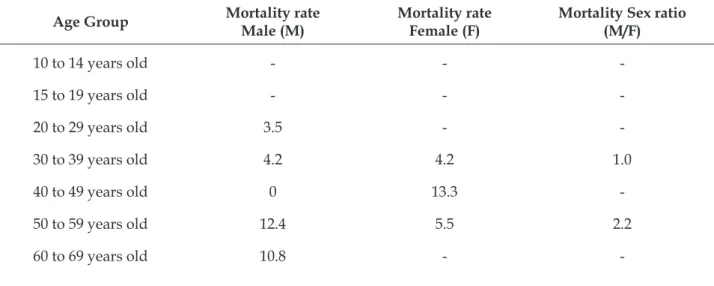
year); and for females aged 40 to 49 years old, 13.3 deaths (100,000 inhab./year), according to table 1.
Table 1 - Distribution of mortality coefficients through suicide (100,000 inhab./year) by sex, age group and sex ratio. Uberaba, MG, Brazil, 2014. (n=11)
Age Group mortality rateMale (M) mortality rateFemale (F) Mortality Sex ratio (M/F)
10 to 14 years old - -
-15 to 19 years old - -
-20 to 29 years old 3.5 -
-30 to 39 years old 4.2 4.2 1.0
40 to 49 years old 0 13.3
-50 to 59 years old 12.4 5.5 2.2
-Age Group mortality rateMale (M) mortality rateFemale (F) Mortality Sex ratio (M/F)
70 to 79 years old 19.6 -
-80 years old or > - -
-Total 4.1 3.2 1.3
Source: SIM, 2015 - SMS of Uberaba / MG. Indicators calculated by the author.
The self-destruction attempt reported through violence records according to table 2, for males, re-vealed a mortality rate of 0.7 deaths (100,000 inhab./ year), incidence of 13.5 suicide attempts (100,000
inhab./year) and lethality of 5%.
In females, the mortality rate was 2.6 deaths
(100.000 inhab./year), the incidence of 38.7 suicide
attempts (100,000 inhab./year) and the mortality
rate of 6.7%. On violence records it is highlighted
that the incidence of suicide attempt in the age
group 15-19, in both sexes is greater when compared
to the other age groups, corresponding to 115.8 attempts for a female death and 40.1 for no male deaths, according to table 2.
Table 2 - Distribution of the suicide attempt incidence coefficients, suicide mortality (100,000 inhab./ year) and lethality, according to sex and age group, of self-inflicted violence notifications. Uberaba, MG, Brazil, 2014. (n=80)
Age group
mortality lethality incidence mortality lethality incidence
Sex
incidence
ratio (F/M)
Male (M) Female (F)
10 to 14 years old
15 to 19 years old
20 to 29 years old
30 to 39 years old
40 to 49 years old
50 to 59 years old
60 to 69 years old
70 to 79 years old
≥ 80 years old
-4.2
-11.1
-40.1
14.2
38.1
4.9
6.2
-8.3
-4.2
4.4
5.5
-7.1
-12.5
12.5
16.7
0
0
-27.9
115.8
62.4
33.3
35.5
32.9
34.8
-2.9
4.4
0.9
7.2
5.3
-Total 0.7 5.0 13.5 2.6 6.7 38.7 2.9
Source: SINAN, 2015 - SMS of Uberaba / MG. Indicators calculated by the author.
On table 3, it was observed that women between 15 and 59 years old made more suicide
attempts by exogenous intoxication than men. In
notifications by exogenous intoxication,for males,
the incidence rate was 14.2 cases of suicide attempts (100,000 inhab./year) and the lethality was 4.8%.
The incidence rate for suicide attempts in males
between 10 and 14 years old was 26.4 deaths (100,000
inhab./year).
In females the mortality rate was 2.6 deaths
(100,000 inhab./year), the suicide attempts
inci-dence was higher for the age group 15-19, females
Table 3 - Distribution of the suicide attempt incidence coefficients, suicide mortality (100,000 inhab./ year) and lethality, according to sex and age group, of self-inflicted violence notifications. Uberaba, MG, Brazil, 2014. (n=89)
Age group
mortality lethality incidence mortality lethality incidence
Sex
incidence
ratio (F/M)
Male (M) Female (F)
10 to 14 years old 15 to 19 years old 20 to 29 years old 30 to 39 years old 40 to 49 years old 50 to 59 years old 60 to 69 years old 70 to 79 years old
≥ 80 years old
0 0 0 4.2
0 0 0 0 0
0 0 0 20.0
0 0 0 0 0
26.4 8.0 17.7 21.1 19.5 12.4 0 19.6
0
0 8.3
0 4.2 4.4 0 8.7
0 0
0 6.3
0 10.0
9.1 0 100.0
0 0
37.2 132 73.4 41.6 48.8 32.9 8.7
0 0
1.4 16.5
4.1 1.9 2.5 2.6 0 0 0
Total 0.7 4.8 14.2 2.6 5.9 43.9 3.1
Source: SINAN, 2015 - SMS of Uberaba / MG. Indicators calculated by the author.
In SIM and SINAN death reports for 2014, it
was found that on SINAN records there were seven deaths and on SIM forms there were 11 deaths. Among these, only one case was repeated in three
databases. The ICDs informed on the Death Certifi
-cated were pneumonitis due to inhalation of food or vomit (J69.0), shock, unspecified (R57.9), ill-defined
and unknown cause of mortality (R99.0) and poison
-ing (intoxication) due to exposure to other chemicals
and noxious substances and to unspecified, inten
-tion not determined (19.9).
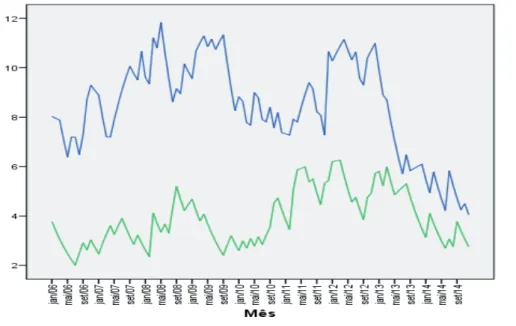
The time series indicates that there is an
er-ratic trend in suicide events between 2006 and 2014, according to figure 1.
Figure 1- Temporal evolution (monthly) of incidence adjusted by exponential smoothing (by 1 million inhabitants) of deaths through suicide, for males and females between 2006 and 2014. Uberaba, MG, Brazil
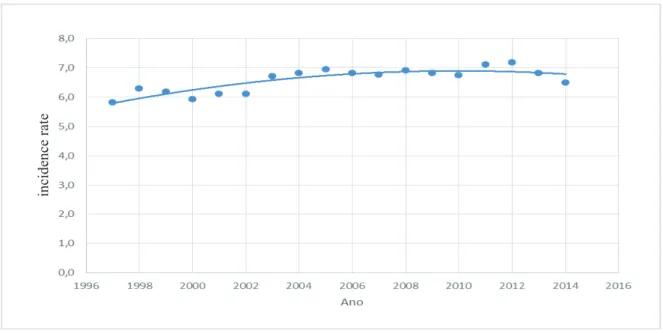
As for the time series in a wider range of time
(1996 to 2014) of deaths through suicide relating
to Death Certifi cates, it was observed, after the
ex-ponential smoothing Alpha 0.1, a mortality rate of
6.73 deaths (100,000 inhab./year) with increasing
tendency of 0.065 per year and negative acceleration
of 0.007 per year, as shown in Figure 2.
Still in fi gure 2, it was found that, in this
pe-riod, 356 deaths through suicide occurred, being 254
cases of males (71.35%).
Figure 2 – Time series (annual) of the mortality incidence rate (100,000 inhab./year) through suicide adjusted by the polynomial regression model between 1996 and 2014. Uberaba, MG, Brazil.
discussion
The population that attempts suicide is pre-dominantly composed of teenagers and young adults
in notifi cations by exogenous poisoning; furthermore, women attempt suicide more than men. Studies show that men commit suicide more than women and the
methods used are of a high degree of lethality, such
as hanging, fi rearm use and falling from high places.10
Women show a higher number of attempted suicides
through ingestion of medicines and other toxic
sub-stances, which was also verifi ed in this study.11
The choice of the preferred exposure place for
the suicide attempt is the victim’s residence, which
may be due to easy access to the means for this act, such as intoxication through medicines and
roden-ticides. This does not mean that it was the main
cause of deaths, but that it requires more attention
from health and family services. Studies show that
the place of residence is connected to the suicide attempt, mainly through the use of medications and rat poison.12-13 Besides favoring the use of substances,
the residence appears to be the most conducive place for the consummation of the death by hanging, a commonly used method by men.
People who are without a partner may
pres-ent greater risk for suicide attempts/suicide, ac-cording to a study carried out in 15 municipalities
of Minas Gerais, between 2003 and 2009. Suicide attempts were more frequent among single people
and younger people.10 Inanother study conducted
between 2004 and 2014 in Jundiaí, the sample showed that single people were more likely to
com-mit suicide.14
On violence records, it was also observed
more female suicide attempts than male. It also reveals that the age group that attempts suicide is predominantly young. Easy access to toxic
substances has an infl uence over suicide attempts and its restriction could work as prevention,
such as, for example, requiring greater accuracy for marketing. Results presented in this article
corroborate other studies, in which the main agents of self-destruction were the pesticides and
medicines.15A study conducted between 2013 and
2014 in a reference hospital for exogenous intoxi-cation cases indicated that most suicide attempts
in the State of Ceará were through drugs and toxic
agents such as the rat poison.16
On the Death Certificate forms it was found
that the deaths occurred in an older age than
what was observed in suicide attempts reported
in SINAN.
There was practically no difference in the amount of deaths by suicide between the sexes in this study, which differs from the historical re
-gions of Minas Gerais between 1997 and 2011, in which men corresponded to a total of 81.9% of all
suicides.17 In another study conducted in São João
da Boa Vista, São Paulo (Brazil) between 2006 and
2013, the predominance of male deaths in relation
to female deaths was observed, and it concluded
that most of the cases of suicide is linked to males
in more violent ways, such as hanging.18
A worrisome aspect was seen on exogenous
intoxication records, noting that the suicide attempt
begins in adolescents of both sexes, between 10 and
14 years old, increasing considerably in the female population of 15 to 19 years old, calling the attention to the fact that people attempt suicide earlier and
ear-lier, with greater tendency to women. In the violence records it was also noted a much higher incidence of attempts in females than in males, with special atten
-tion to the age group 15-19. In an integrative review,
it was observed that most of the discussed studies
identified greater prevalence of suicide attempts in women, teenagers and youth, people who live alone,
unemployed people and individuals with low school
-ing. This information is clinically useful, making it possible to identify risk groups in populations for
better follow up and evaluation.19
The reasons for the self-destruction attempts
were linked to the adolescent universe and its pe
-culiarities. The teenager, not feeling heard or
rec-ognized and for their own difficulty in expressing
themselves, searches, by their actions, the attention
that they are owed by their family and society. These
acts are driven by immediacy and impulsivity, thus
conveying a cry for help, showing that something does not go well.20
With regard to the means used for the aggres-sion, they may vary according to the community or country, due to easy access to certain offending agents. In the United States the most used resources by older
men are firearms and, in China, intoxication by pes
-ticides. Older women tend to use “softer” resources worldwide, such as the ingestion of toxic substances.21
The deaths by suicide occurred out of the
hospital are referred directly to the Medico-Legal Institute (MLI) or the Death Verification Service (Serviço de Verificação de Óbito - SVO), thus not being notified in SINAN, only in SIM.
With respect to death coverage in SIM and
SINAN it was verified that SIM collects deaths
by suicide better than SINAN, probably because the cases found in SINAN are related to suicide attempts that needed care in health units/hospi-tals, resulting in hospital death or discharge. Some cases may pass by the health units/hospitals and
not being notified to SINAN for reasons such as excess demand for service, causing the filling plug
of SINAN stay in the background; preparation for
the implementation of the notification or even lack of knowledge about the importance of completing the individual sheets of notification to surveillance
in health systems and health information. In
addi-tion, in certain situations it may be difficult for the doctor to identify whether there was intent to die, in which case the root cause is classified as unde -termined. It must be also considered the fact that deaths occurred at home are directly taken to the
SVO or the MLI, where only the Death Certificate is usually registered and SINAN is not notified.
Besides that, the family, either because it is a taboo subject or even because of issues related to
life insurance benefits, may request that the cause
of death is not informed as suicide. This might be
why, during the research, four cases leading to death were found notified in SINAN, but they are not registered in SIM within the basic causes of suicide, ICD between X60 and X84, even though there was the ingestion of medicines with suicidal purpose.
A limitation of this study is the use of a sec-ondary database from SIM and SINAN. Despite having national scope, not all health services and competent professionals adhere to the records, for issues such as lack of punishment and time for
filling and excess of forms, what may cause omis
-sion, ignorance or even undeclared forms, failing to complete medical records, completion of forms by administrative professionals, among others.22-24 The
omission or incompleteness may influence the final result, however they are the available official bases
and deserve attention to the quality of completion.
On the time series, it is clear that there is a
higher incidence of suicide deaths among men than
women, in comparison with the information provid
-ed in another study where it was verifi-ed that in the
historical series of suicide there is a predominance of male adults, a situation that can be observed in most countries that have data collection.17
In addition to the emotional issues that affect
the whole family of the suicidal patient, this ag
and deaths by suicide in Brazil between 1998 and
2007. 77,648 deaths and 102,031 hospitalizations
were identified, in addition to expenses exceeding
R$ 35 million for these causes. In this same study,
between 1998 and 2012, in a public teaching hospital
in the city of Uberaba/MG, there was an expen
-diture of R$574.922,60, mainly due to exogenous intoxication for suicide purposes. 25
For the formulation and implementation of prevention measures to reduce suicide rates, it is
important to identify individuals who are at risk (especially those with a history of previous suicide attempt) and vulnerable (individuals with suicidal
characteristics).26 The challenge is to avoid deaths,
through actions aimed at health promotion and
pre-vention, in addition to having a service network that
must be organized to meet the demand, identifying key determinants for suicide.27
The strategy formulation to reduce suicidal events requires incidence rates analysis and psy-chosocial characteristics of those involved in the
act; moreover, risk factors need to be identified and
monitored through appropriate prevention and treatment programs. There is a need for
sensitiza-tion and training of professionals to work in the identification and specialized monitoring through the whole care and humanization in the relationship with families. 28
This study is important for the development of strategies to treat and give support to vulnerable individuals, since many go through health units/ hospitals due to suicide attempts several times before they die, generating emotional distress on
family members and spending on care which could be avoided if there were a sensitized and organized care network.
Advances have been made on this subject, but there is much to develop, for example the
Munici-pal Secretariat of Health of Rio de Janeiro, which
published a Guide for Suicide Risk Assessment and Prevention, emphasizing the importance of the team of the Nucleus for Family Health Support
(NASF) to work together with the Psychosocial
Care Center (CAPS) for the reception and appro-priate care in groups and to assess the need for
individualized care of patients with imminent risk
of self-destruction.28
The nurse’s work in the Family Health Strat
-egy (ESF) and CAPS has a key factor for the
identi-fication and reception of patients at risk of suicide.
The nurse can have a therapeutic hearing, assessing the anguish and needs of the health service users
and manage the case with referrals to other profes
-sionals, in addition to appropriate home care with
the support of the Community Health Agents.
conclusion
The suicide attempt is prevalent in adoles-cents and young adults (15 to 29 years old),
espe-cially in women. It has been found that women
attempt suicide more than men through less ag-gressive methods. SINAN records emphasized suicide attempts due to poisoning and self-med-ication. It is assumed that there is an easy access to medicines, rodenticides, pesticides, among
others, which make the suicide attempt easier, especially in the victim’s own home. A strategy definition is necessary to restrict the purchase of
poisons and pesticides.
For suicide attempts, the methods are milder
between 15 and 29 years old, and suicide mortality is higher between 30 and 49 years old, in which 45.4% of the cases used hanging to end their lives
according to the SIM data. Regarding the coverage of deaths, it is noted that more deaths are recorded in SIM than in SINAN for the aggravated suicide.
The time series analysis indicated a higher incidence for male suicides. Although there is a negative acceleration, the number of suicide cases
is still increasing, which generates significant public
and social expenses.
A link between Mental Health and ESF/
NASF is needed to strengthen suicide prevention.
ESF, as a gateway to the health system, forms a permanent link with the community, identifying its problems, working with a multiprofessional
team, and may be more successful in monitoring
cases with potential for suicide/suicide attempt.
The nurse, for his skills and abilities inherent to the
profession, can greatly contribute to the identifica -tion and management of cases.
The improvement of mental health
promo-tion acpromo-tions through the network of psychosocial
care and basic care is important to prevent suicide attempts and deaths by suicide, the damage caused by suicidal behavior and the negative impact on the family and community. The CAPS teams are responsible for monitoring these people, because
they constantly deal with patients in crisis situa -tions. They have a lasting contact, facilitating the
necessary intervention to prevent suicide. However,
references
1. Sousa GS, Silva RM, Figueiredo AEB, Minayo MCS,
Vieira LJES. Circunstâncias que Envolvem o Suicídio de Pessoas Idosas. Interface – Comunic. Saúde, Educ.
2014 Abr-Jun; 18(49):1-13.
2. Schlosser A, Rosa GFC, More CLOO. Revisão:
comportamento suicida ao longo do ciclo vital. Temas Psicol. 2014 Jan-Fev; 22(133): 133-45.
3. Del-Bem CM, Junior AS, Montovani C, Faleiros MCM,
Oliveira GEC, Guapo VG. Emergências psiquiátricas: manejo de agitação psicomotora e avaliação de risco suicida. Medicina (Ribeirão Preto). 2017 Jan-Feb;
50(1): 98-112.
4. Alte da Veiga F, Andrade J, Garrido P, Neves S, Craveiro A, Santos JC, et al. IRIS: um novo índice de
avaliação do risco de suicídio. Psiquiatria Clínica.
2014; 35(2):65-72.
5. Bertolote JM, Santos CM, Botega NJ. Detecção do risco
de suicídio nos serviços de emergência psiquiátrica. Rev Bras Psiquiatr. 2010 Oct.; 32: 97-95.
6. Silveira LC, Silva MLS, Silva MRF, Almeida ANS,
Alencar MN. Pesquisa de avaliação em serviços de
saúde mental: uma proposta ético-estético-política. Rev Aval Políticas Públicas. 2015 Jan-Jun; 1(1):1-12.
7. Almeida LN, Silva J, Félix A, Rocha RAM. O suicídio
no Brasil: um desafio às Ciências Sociais. Rebela 2015
Sep-Dec; 5(3):510-91.
8. Santos SA, Legay LF, Aguiar FP, Lovisi GM, Abelha
L, Oliveira SP. Tentativas e suicídios por intoxicação exógena no Rio de Janeiro, Brasil: análise das informações através do linkage probabilístico. Cad Saúde Pública 2014 May; 30(5):1057-66.
9. Romero DE, Cunha CB. Avaliação da Qualidade das
Variáveis Epidemiológicas e Demográficas do Sistema de Informação de Nascidos Vivos, 2002. Cad Saúde Pública 2007 Mar; 23(3): 701-14.
10. Vidal CEL, Gontijo ECDM, Lima LA. Tentativas de
suicídio: fatores prognósticos e estimativa do excesso de mortalidade. Cad Saúde Pública. 2013 Jan; 29(1):
175-87.
11. Reisdorfer N, Araújo GM, Hildebrandt LM, Gewehr TR,
Nardino J, Leite MT. Suicídio na voz de profissionais de enfermagem e estratégias de intervenção diante
do comportamento suicida. Rev. Enfermagem UFSM. 2015 Apr-Jun; 5(2): 295-304.
12. Rosa NM, Campos APS, Guedes MRJ, Sales
CCF, Mathias TAF, Oliveira MLF. Intoxicações
associadas às tentativas de suicídio e suicídio em
crianças e adolescentes. Rev Enferm UFPE. 2015
Feb; 9(2):661-8.
13. Medeiros MNC, Medeiros MC, Silva MBA. Intoxicação
aguda por agrotóxicos anticolinesterásicos na cidade
do Recife, Pernambuco, 2007-2010. Epidemiol Serv
Saúde. 2014 Jul-Sep; 23(3):509-18.
14. Cunha FA, Baptista MN, Carvalho LF. Análise
documental sobre os suicídios ocorridos na região
de Jundiaí entre 2004 e 2014. Salud Sociedad. 2016 May-Aug; 7(2):212-22.
15. Vieira LP, Santana VTP, Suchara EA. Caracterização
de tentativas de suicídio por substâncias exógenas.
Cad Saúde Coletiva. 2015 Apr-Jun;23(2):118-23.
16. Oliveira EM, Félix TA, Mendonça CBL, Souza DR,
Ferreira GB, Freire MA, et al. Tentativa de suicídio
por intoxicação exógena: contexto de notificações compulsórias. Rev Eletrônica Gestão Saúde. 2015;
6(3):2497-11.
17. Simões BF, Cantão L, Botti NCL. Suicídio em cidades
históricas de um estado brasileiro. Rev Rene. 2015
Mar-Apr; 16(2):250-7.
18. Thesolim, BL, Bernardino A, Ferreira VL, Baptista C,
Franco LFR. Suicídios em município do interior de São Paulo: caracterização e prevalência de gêneros. Rev
Bras Multidisciplinar. 2016 Jul; 19(1):139-47.
19. Felix TA, Oliveira EN, Lopes MVO, Parente JRF, Dias
MSA, Moreira RMM. Fatores de risco para tentativa
de suicídio: produção de conhecimento no Brasil. Rev Contexto Saúde. 2016; 16(31):173-85.
20. Silva LLT, Madeira AMF. Tentativa de autoextermínio
entre adolescentes e jovens: uma análise compreensiva. Rev Enf do Centro Oeste Mineiro. 2014 Sep-Dec;
3(4):1281-9.
21. Minayo MCS, Pinto LW, Assis SG, Cavalcante SG,
Mangas RMN. Tendência de mortalidade por suicídio na população brasileira e idosa, 1980-2006. Rev Saúde Pública 2012;46(2): 300-9.
22. Melo GBT, Valongueiro S. Incompletude dos
registros de óbitos por causas externas no Sistema de Informações sobre Mortalidade em Pernambuco, Brasil, 2000-2002 e 2008-2010. Epidemiol Serv Saúde 2015 Oct-Dec; 24(4):651-60.
23. Ramalho MOA, Frias PG, Vanderlei LCM, Macêdo VC,
Lira PIC. Avaliação da incompletude da declaração de óbitos de menores de um ano em Pernambuco, Brasil, 1999-2011. Ciênc Saúde Coletiva. 2015; 20(9):2891-8.
24. Abath MB, Lima MLLT, Lima PS, Silva MCM, Lima
MLC. Avaliação da completitude, da consistência e da duplicidade de registros de violências do Sinan
em Recife, Pernambuco, 2009-2012. Epidemiol Serv
Saúde. 2014 Jan-Mar; 23(1):131-42.
25. Costa SP, Chavaglia SRR, Scarelli A, Silveira RE.
Internações e Gastos Relacionados ao Suicídio em um Hospital Público de Ensino. Reve Enferm Atenção à Saúde 2015 Aug-Dec; 4(2):15-27.
26. Costillas LP, Fontecilla HB, Benítez N, Comino
R, Antón JM, Ramos V, et al. Space-time suicide
clustering in the community of Antequera (Spain). Rev Psiquiatría y Salud Mental. 2015 Jan-Mar; 8(1):26-34.
27. Heck RM, Kantorski LP, Borges AM, Lopes CV, Santos
MC, Pinho LB. Ação dos profissionais de um centro de atenção psicossocial diante de usuários com tentativa
28. Ferreira NS, Pessoa VF, Barros RB, Figueiredo AEB. Minayo MCS. Fatores de risco relacionados
com suicídios em Palmas (TO), Brasil, 2006-2009, investigados por meio de autópsia psicossocial. Ciênc Saúde Coletiva. 2014; 19(1):115-26.
29. Secretaria Municipal de Saúde (RJ). Avaliação do risco
de suicídio e sua prevenção. Rio de Janeiro (BR); 2016.
Correspondence: Nilva Maria Ribeiro
Rua Ibiá, 255, Apto 302
38810-000 - Progresso, Rio Paranaíba, MG, Brasil E-mail: [email protected]
Received: August 28, 2016 Approved: August 10, 2017
This is an Open Access article distributed under the terms of