Arq. Bras. Med. Vet. Zootec., v.68, n.4, p.991-999, 2016
Effects of essential oils of Rosmarinus officinalis Linn. and Origanum vulgare Linn. from
different origins on Sporothrix brasiliensis and Sporothrix schenckii complex
Efeitos dos óleos essenciais de Rosmarinus officinalis Linn. e Origanum vulgare Linn. de diferentes origens em Sporothrix brasiliensis e complexo Sporothrix schenckii]
S.B. Waller1, I.M. Madrid2, M.B. Cleff1, R. Santin3, R.A. Freitag1,
M.C.A. Meireles1, J.R.B. Mello4
1Universidade Federal de Pelotas ˗ UFPel ˗ Pelotas, RS
2Prefeitura Municipal de Pelotas ˗ Centro de Controle de Zoonoses ˗ Pelotas, RS
3Instituto Federal Catarinense – IFC – Concórdia, SC
4Universidade Federal do Rio Grande do Sul ˗ UFRGS ˗ Porto Alegre, RS
ABSTRACT
Rosmarinus officinalis L. (rosemary) and Origanum vulgare L. (oregano) are known to have
antimicrobial properties, but studies on sporotrichosis are scarce. This study aimed to evaluate the
anti-Sporothrix spp. activity of essential oils from commercial products and oils extracted from aerial parts of
these plants and analyze their chemical constituents. S. schenckii complex and S. brasiliensis (n: 25)
isolated from humans, cats, dogs, and environmental soil were tested through M27-A3 guidelines of CLSI
with modification for phytotherapics. The essential oils of R. officinalis L. were similar for MIC50 and
MFC50≤2.25mg/mL for extracted oil; and 4.5mg/mL and 9mg/mL, respectively, for commercial oil. Both
products showed MIC90 of 18mg/mL and MFC90 of 36mg/mL. In O. vulgare L., the extracted oil had
better activity with MIC50 and MFC50≤2.25mg/mL, and MIC90 and MFC90 of 4.5mg/mL, whereas the
commercial oil showed MIC50 and MFC50 of 9mg/mL and MIC90 18mg/mL, respectively, and MFC90 of
36mg/mL. Through gas chromatography (CG/FID), thymol and α-terpinene were majority for extracted
oil of O. vulgare L., and carvacrol and γ-terpinene made up the majority of the commercial oil. Both
essential oils of R. officinalis L. showed 1,8-cineole and α-pinene as major. The fungal isolates were
susceptible to all tested essential oils, including in itraconazole-resistant S. brasiliensis isolates. The
extracted and commercial oils of the plants presented in vitro anti-Sporothrix spp. activity, and they are
promising for treatment of sporotrichosis, including in cases refractory to itraconazole. More studies
should be performed about toxicity and in vivo efficacy for its safe use.
Keywords: sporotrichosis, antifungal resistance, oregano, rosemary, Lamiaceae
RESUMO
Rosmarinus officinalis L. (alecrim) e Origanum vulgare L. (orégano) são conhecidos pelas propriedades
antimicrobianas, entretanto seus estudos na esporotricose são escassos. Este trabalho objetivou avaliar a atividade anti-Sporothrixspp. de óleos extraídos e comerciais dessas plantas e analisar seus constituintes químicos. Isolados do complexo S. schenckii e S. brasiliensis (n: 25) de humanos, gatos, cães e solo, foram testados pela diretriz M27-A3 do CLSI com modificações para fitoterápicos. Os óleos de R.
officinalis L. foram similares com CIM50 e CFM50≤2.25mg/mL para extraído; e 4.5mg/mL e 9mg/mL,
respectivamente, para comercial. Ambos os produtos demonstraram CIM90 de 18mg/mL e CFM90 de 36mg/mL. Em O. vulgare L., o óleo extraído apresentou melhor atividade com CIM50 e CFM50≤2.25mg/mL e CIM90 e CFM90 de 4.5mg/mL, ao passo que o óleo comercial mostrou CIM50 e CFM50 de 9mg/mL; e CIM90 de 18mg/mL e CFM90 de 36mg/mL. Por meio da cromatografia gasosa
(CG/FID), timol e α-terpineno foram majoritários para o óleo extraído de O. vulgare L., e carvacrol e γ -terpineno para o comercial. Ambos os óleos de R. officinalis L. apresentaram 1,8-cineol e α-pineno como
prevalentes. Os isolados foram sensíveis a todos os óleos essenciais testados, inclusive S. brasiliensis, resistentes ao itraconazol. Os óleos extraídos e comerciais de R. officinalis L. e O. vulgare L. apresentaram atividade anti-Sporothrix spp. in vitro e são promissores para o tratamento da esporotricose, inclusive em casos refratários ao itraconazol. Mais estudos devem ser realizados sobre toxicidade e eficácia in vivo para seu uso seguro.
Palavras-chave: esporotricose, resistência antifúngica, orégano, alecrim, Lamiaceae
INTRODUCTION
Sporotrichosis is a worldwide mycosis in humans and animals with importance in public health and has as etiological agents the species of
Sporothrix schenckii complex (Marimon et al.,
2007, 2008; Pereira et al., 2010). In Brazil,
Sporothrix brasiliensis has been isolated in cats,
and this species has been restricted to this
geographic region (Rodrigues et al., 2013;
Montenegro et al., 2014). The treatment of
choice in humans and animals is recommended with itraconazole due to its efficacy and therapeutic safety, but the emergence of resistant
strains has been reported (Marimon et al., 2008;
Pereira et al., 2010; Rodrigues et al., 2014a).
This problem has stimulated the search for new effective chemical compounds, such as in plants extracts, and their use in popular medicine to treat, cure, and prevent diseases is one of the
most ancient human practices (Veiga Jr. et al.,
2005; Jiang et al., 2011; Vale-Silva et al., 2012).
In the Lamiaceae family, rosemary (Rosmarinus
officinalis L.) and oregano (Origanum vulgare
L.) are aromatic plants that are widely used in the culinary arts and have therapeutic applications, and they produce essential oils containing phenolic compounds that are highly related to
antimicrobial properties (Bozin et al., 2007;
Luqman et al., 2007). Commercial oils and oils
extracted from aerial parts of these plants have been used to combat several fungal pathogens of
medical and veterinary interest (Luqman et al.,
2007; Cleff et al., 2010; Souza et al., 2010). For
therapeutic use, the acquisition of commercials oils is easier than the trouble of sending plant material for extraction in chemical laboratories. However, the quality of the commercial product should be controlled because adulteration can cause therapeutic inefficiency and even side effects, such as the mixture of volatile oils with different qualities to promote higher yield
(Simões et al., 2003; Veiga Jr. et al., 2005).
The few studies with commercial oils of R.
officinalis L. and O. vulgare L. have also proven
the good in vitro activity against fungal
pathogens (Moreira et al., 2012; Abrantes et al.,
2013; Cleff et al., 2013), but in Sporothrix spp.,
the studies concentrate on products extracted from plants collected in natura or acquired
commercially (Luqman et al., 2007; Cleff et al.,
2008, 2010). No scientific studies on the use of these commercial oils to treat sporotrichosis exist. This study aimed to evaluate and compare the in vitro antifungal activity of the essential
oils of commercial origin and extracted from
aerial parts of R. officinalis L. and O. vulgare L.
against isolates of Sporothrix brasiliensis and
Sporothrix schenckii complex, as well as to
analyze their chemical constituents.
MATERIALS AND METHODS
For the experiment aerial parts of O. vulgare L.
and R. officinalis L. were acquired with botanical
certifications and originated from Chile (process nº23110.001622/2012-55 of the Comissão de Ética em Experimentação Animal, Universidade
Federal de Pelotas), (Luar Sul® – Indústria e
Comércio de Produtos Alimentícios Ltda., Santa Cruz do Sul, RS, Brazil). The plant materials were submitted for extraction via distillation by steam dragging in Clevenger equipment for 4 hours, according to Farmacopéia Brasileira (1988). Subsequently, the oils were dried over
Na2SO4 (anhydrous sodium sulfate p.a),
concentrated in N2 (ultra pure, 99.99%, White
Martins) and stored in amber vials under refrigeration. In turn, the commercial oils (Ferquima® - Indústria e Comércio Ltda., Vargem Grande Paulista, SP, Brazil) were acquired with botanical certification and origin from Moldavia (Batch 212 for oregano) and Tunisia (Batch 141 for rosemary) and were extracted via distillation by steam dragging. The quality parameters were described in an accompanying technical report (appearance,
color, purity, odor, density – 20ºC, refraction
The extracted oils were chemically analyzed through high-resolution gas chromatography with a flame ionization detector (CG-FID) in a Shimadzu® 2010 model equipped with a DB-5
silica column (30m × 0.25mm × 0.25μm) at an
initial temperature of 40ºC, which was increased at the rate of 2ºC/min up 145ºC. From then on the rate was increased by 10ºC/min up to 280ºC and remained at this temperature for 10 min. The oil solutions were prepared at 5000mg/L in hexane and the chromatographic standards at
40mg/L and were injected into the
chromatographic column at a volume of 1µL, and the compounds were identified by comparison of the retention time. For commercial oils, the CG-FID was performed by HP 7820A (Agilent®) equipped with an HP-5 column (30m × 0.32mm × 0.25mm) at an initial temperature of 70ºC that was increased by 3ºC/min up to 240ºC. The injector temperature was 250ºC, and the FID detector was 260ºC. The speed of the drag hydrogen gas was 3ml/min, and the split was 1:30. The solutions of essential oils were diluted in 1% chloroform and injected
into the chromatograph volume of 1 μL. Data
were acquired through the EZChrom Elite Compact® program (Agilent®).
Twenty-five samples of Sporothrix schenckii
complex were derived from mycology collection
of the Centro de Pesquisa e Diagnóstico em
Micologia Veterinária (Universidade Federal de
Pelotas – UFPEL, Pelotas, RS, Brazil). The
isolates were derived from clinical cases of humans, dogs, and cats with sporotrichosis and an environmental soil isolate, as well as a standard strain (IOC 1226). All isolates were identified and stored in the mycelial phase in potato-dextrose agar (Acumedia, Lansing, Michigan, Unites States) and refrigerated at an average temperature of 4ºC. Fourteen of these were analyzed through polymerase chain
reaction of restriction fragment length
polymorphism (PCR-RFLP), according to
Rodrigues et al. (2014b), and all were identified
as Sporothrix brasiliensis.
The antifungal activity was determined through the broth microdilution technique in microplates with 96-wells and in duplicate, according to the
M27-A3 guidelines (Reference…, 2008a), which
were adapted for use with essential oils (Cleff et
al., 2008). Fungal subcultures in
brain-heart-infusion agar (BHI/Acumedia, Lansing,
Michigan, United States) at 35°C for 48h were performed to activate the yeast phase of
Sporothrix spp. The essential oils were tested in
concentrations of 2.25 to 72mg/mL. Itraconazole (Cepav Pharma Ltda., São Paulo, SP, Brazil) was utilized for positive control and tested in
concentrations of 0.03 to 16μg/mL, according to
CLSI guidelines. The microplates were incubated at 35ºC for 72h to obtain the minimal inhibitory concentration (MIC), and the microplates were put on a rotatory shaker (Certomat® BS-1, B. Sartorius, Göttingen, Germany) to mix the oils. To obtain the minimal fungicidal concentration
(MFC), 10μL of aliquots of the wells with no
fungal growth were transferred to Petri dishes containing Sabouraud dextrose agar (Acumedia, Lansing, Michigan, United States) and incubated at 35ºC for 72h to visualize fungal growth. The analysis of variance and comparison of geometric means of the data were performed according to the Tukey test using the statistical software BioEstat®, version 5.3, and a value of P<0.05 was considered significant.
RESULTS AND DISCUSSION
The MIC of itraconazole for tested isolates overall varied from equal to or less than 0.03 to greater than 16µg/mL, and the MFC varied from 0.25 to greater than 16µg/mL. However, one isolate from a cat was resistant to MIC, and five from cats and one from a dog were to MFC (Tab. 1). Although a cutoff point does not exist for establishing the values of resistance, the M38-A2
guidelines (Reference…, 2008b) suggest that
MIC values greater than or equal to 4 µg/mL for itraconazole should be considered, and this was
observed in the tested S. brasiliensis from cats
(MIC90 of 16µg/mL), which demonstrated a low
sensibility to this drug of choice. This
observation was also reported (Fernandes et al.,
2013; Rodrigues et al., 2014a). Interestingly, all
of the itraconazole-resistant isolates were susceptible to the essential oils of the Lamiaceae
plants between the concentrations of ≤2.25 and
36mg/mL, and this is accordance with studies of the activity of these oils in bacterial and fungal resistance to ciprofloxacin, amphotericin B and
clotrimazole (Luqman et al., 2007; Maida et al.,
2014).
In O. vulgare L., the extracted oil showed
activity against all samples of S. schenckii
≤2.25 and 4.5mg/mL, including in S. brasiliensis
from cats and dogs. But, the commercial oil showed activity against the overall isolates with
MIC/MFC50 of 9mg/mL, MIC90 of 18mg/mL,
and MFC90 of 36mg/mL, demonstrating less
activity compared to the extracted essential oil (P<0.05).
Table 1. Antifungal activity of the extracted and commercial essential oils (mg/mL) of Origanum vulgare
L. (O.V.) and Rosmarinus officinalis L. (R.O.) and itraconazole (μg/mL) against Sporothrix schenckii
complex
Origin of Sporothrix schenckii complex (No. of
samples)
O.V.
(Extracted) O.V. (Commercial)
R.O.
(Extracted) R.O. (Commercial) Itraconazole
MIC MFC MIC MFC MIC MFC MIC MFC MIC MFC
Human (3)† 50% R ≤2.25≤2.25 ≤2.25–4.5 4.5 18 18 18 18 ≤2.25–≤2.254.5 ≤2.25–≤2.254.5 ≤2.25–≤2.259 ≤2.25–≤2.2518 0.5 0.5 0.51 –2
90% ≤2.25 4.5 18 18 4.5 4.5 9 18 0.5 2
Dog (1)† R ≤2.25 ≤2.25 4.5 4.5 ≤2.25 4.5 4.5 9 1 2
Cat (5)† 50% R ≤2.25–≤2.254.5 ≤2.≤2.2525–9 ≤2.25–4.5 18 ≤2.25–9 36 ≤2.25–≤2.2518 ≤2.25–18 18 ≤2.25–4.5 9 4.54.5 –18 2–>16 2 4–>16 >16
90% ≤2.25 4.5 9 18 18 18 4.5 9 2 >16
Soil (1)† R ≤2.25 ≤2.25 18 18 ≤2.25 ≤2.25 9 18 0.5 0.5
IOC 1226 (1)* R ≤2.25 ≤2.25 ≤2.25 ≤2.25 ≤2.25 ≤2.25 18 36 1 8
Dogs (6)**
R ≤2.25 ≤2.25–4.5 ≤2.25–36 ≤2.25–36 ≤2.25 ≤2.25–4.5 ≤2.25–18 4.5–>72 0.5–8 1–>16
50% ≤2.25 ≤2.25 ≤2.25 4.5 ≤2.25 ≤2.25 4.5 9 1 2
90% ≤2.25 ≤2.25 9 18 ≤2.25 4.5 18 36 2 16
Cats (8)**
R ≤2.25–9 ≤2.25–9 ≤2.25–18 ≤2.25–36 ≤2.25–18 ≤2.25–72 ≤2.25–9 ≤2.25–9 ≤0.03–16 0.25–>16
50% ≤2.25 ≤2.25 9 9 ≤2.25 ≤2.25 ≤2.25 4.5 2 2
90% 4.5 4.5 18 18 18 36 4.5 4.5 16 >16
Overall (25) 50% R ≤2.25–≤2.259 ≤2.25–≤2.259 ≤2.25–9 36 ≤2.25–9 36 ≤2.25–≤2.2518 ≤2.25–≤2.2572 ≤2.25–4.5 18 ≤2.25–9 >72 ≤0.03–2 >16 0.254 –>16
90% 4.5 4.5 18 36 18 36 18 36 16 >16
50% and 90% refers to inhibition (MIC) and elimination (MFC) of the fungal growth in relation of origin of the
isolates ; R – Range; *S. schenckii; **S. brasiliensis; †Not identified.
Few studies have also demonstrated the
susceptibility of S. schenckii to the extracted oil
of O. vulgare L. at MIC of 250μL/mL (Cleff et
al., 2008) and between 250 to 500μL/mL (Cleff
et al., 2010), but the expression of these values
was distinct from the present study, making it difficult to compare the results. This difficulty occurs because of the lack of standardization in
antimicrobial in vitro tests with medicinal plants
(Khan et al., 2011). Even so, the studies are in
agreement with the present finding because of
the anti-Sporothrix spp. activity of the essential
oil of O. vulgare L. In other pathogenic fungi,
the extracted oil of O. vulgare L. inhibited
Malassezia pachydermatis, Aspergillus spp., Candida spp., Cryptococcus spp., Trichophyton
spp., Microsporum spp., and Epidermophyton
spp. in the MIC between 15 to 500μL/mL (Cleff
et al., 2010) and between 0.32 to 10μL/mL
(Vale-Silva et al., 2012). In commercial oils, M.
pachydermatis strains were inhibited by the
essential oil of O. vulgare L. between the MIC of
≤1.87 to 7mg/mL (Santin et al., 2014), with
similar results to this study. The antimicrobial activity of the commercial oils should be studied
because these products are easier to acquire for
popular use and showed in vitro anti-Sporothrix
spp. activity, which is promising for more scientific research.
In R. officinalis L., the commercial and extracted
essential oils showed similar anti-Sporothrix spp.
activity (P>0.05). The MIC50 of extracted oil
against overall tested isolates was ≤2.25mg/mL,
but the MIC90 and MFC90 of S. schenckii
complex isolated from humans were 4.5mg/mL and from cats were 18mg/mL. Although the
MIC90 and MFC90 of S. brasiliensis from dogs
were ≤2.25mg/mL and 4.5mg/mL, respectively, and those from cats were 18mg/mL and 36mg/mL, respectively, no statistical difference was observed in the activity of extracted oil for
these species (P>0.05). Luqman et al. (2007)
demonstrated the anti-Sporothrix spp. activity of
the extracted oil with the same methodology used in our study and described the MIC of
11mg/mL in an only S. schenckii strain tested,
and the plant did not show fungicidal activity.
The fungistatic activity found by Luqman et al.
showed the effect of MFC50 and MFC90 against
overall tested isolates at ≤2.25mg/mL and
36mg/mL for extracted oil, respectively, and 9mg/mL and 36mg/mL for commercial oils, demonstrating the good fungicidal activity of the
essential oil of R. officinalis L. Other pathogenic
fungi have been highly susceptible to rosemary
oil, as Candida albicans (Bozin et al., 2007;
Cleff et al., 2012), that was inhibited and
eliminated by the plant oil at 5.5mg/mL and
11mg/mL, respectively, as well as Crytococcus
neoformans (Luqman et al., 2011). The
dermatophytes Epidermophyton floccosum,
Trichophyton mentagrophytes, T. rubrum and Microsporum canis were susceptible in the MIC
of 15 to 30.2μL/mL(Bozin et al., 2007) and T.
rubrum and M. gypseum were inhibited at
1.38mg/mL and 2.75mg/mL, respectively
(Luqman et al., 2007).
In turn, the commercial oil of R. officinalis L.
had in vitro activity with MIC50 between ≤2.25
and 4.5mg/mL for all isolates from humans,
dogs, and cats. In MIC90, the concentration of 4.5
to 18mg/mL inhibited all S. brasiliensis and S.
schenckii complex, including environmental soil
and standard strain. The MFC50 and MFC90 of
overall isolates were 9mg/mL and 36mg/mL, respectively. With similar results, Santin (2013)
showed the in vitro activity of commercial oil of
R. officinalis L. against the pathogenic yeasts of M. pachydermatis, Candida spp. and Trichosporon asahii in the MIC/MFC between ≤1.87 and 30mg/mL, demonstrating the promising use of this plant oil in similar concentrations to our study. Although the studies were concentrated in essential oils extracted from collected plants, the need to study the antimicrobial activity of commercial oils is emphasized because they are readily available
for use. According to Veiga Jr. et al. (2005), the
popular use of medicinal plants is increasingly common because of their benefits to public health, as well as being marketed by industries.
In S. brasiliensis isolated from cats and dogs, all
of the isolates were susceptible to all of the tested oils, but a higher number of the isolates
were susceptible to the MIC ≤2.25mg/mL from
the extracted oils of R. officinalis L. and O.
vulgare L. (Fig. 1).
Figure 1. Number of Sporothrix brasiliensis isolated from cats and dogs with susceptibility to minimal
inhibitory concentration (MIC) of commercial oils and extracted oils from aerial parts of Origanum
vulgare L. (O.V.) and Rosmarinus officinalis L. (R.O.).
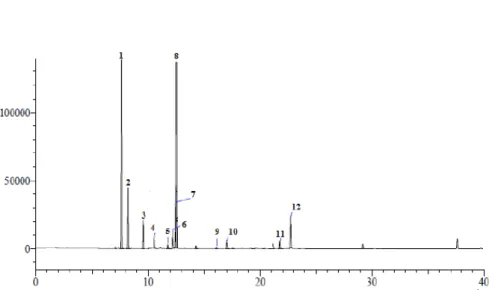
In the chromatographic analysis, both essential
oils of R. officinalis L. showed that 1.8-cineole
and α-pinene were the major compounds (Figure
2 and 3), which is in accordance with previous
studies (Jiang et al., 2011; Maida et al., 2014).
These compounds were also related to antimicrobial potential because they both showed
activity against C. albicans when tested in
isolation at MIC of 0.5% (Jiang et al., 2011).
Other compounds found in the oils were reported as major compounds, such as camphor,
verbenone, and myrcene (Prins et al., 2006; Cleff
et al., 2012), and could also be responsible for
Figure 2. Identified compounds in the extracted essential oil from aerial parts of Rosmarinus officinalis L.
through gas chromatograph with flame ionization detector (CG-FID): α-pinene (1), camphene (2), β
-pinene (3), myrcen (4), α-terpinene (5), p-cimene (6), limonene (7), 1,8-cineole (8), terpinolene (9),
linalool (10), terpinen-4-ol (11), α-terpineol (12).
Minutes
2 3 4 5 6 7 8 9 10 11 12 13 14 15 16 17
pA 0 100 200 300 400 500 600 700 800 900 1000 1100 1200 a -t h u je n o a -p in e n o c a n fe n o b -p in e n o m ir c e n o a -f e la n d re n o a -t e rp in e n o p -c im e n o lim o n e n o 1 ,8 -c in e o l g -t e rp in e n o lin a lo o l c a n fo ra te rp in e n -4 -o l a -t e rp in e o l a c e ta to d e b o rn ila b -c a ri o fi le n o h u m u le n o Back Signal OE Alecrim Name
Figure 3. Identified constituents in the commercial essential oil of Rosmarinus officinalis L. through the
gas chromatograph with flame ionization detector (CG-FID): α-thujene, α-pinene, camphene, β-pinene,
myrcen, α-phellandrene, α-terpinene, p-cimene, limonene, 1,8-cineole, γ-terpinene, linalool, camphor,
terpinen-4-ol, α-terpineol, bornyl acetate, α-copaene, β-caryophillene, humulene and others.
In O. vulgare L., the chemical composition was
different, as well as the anti-Sporothrix spp.
activity between the oils, in which the extracted oil from aerial parts had better efficacy than commercial oil (P<0.05). In extracted oil,
thymol, α-terpinene and 4-terpineol were the
major compounds, in decreasing order (Figure
4), as well as described by Cleff et al. (2008,
2010), but in commercial oil, the compounds
carvacrol, γ-terpinene and p-cimene were major
(Figure 5), according to Maida et al. (2014).
Although thymol and carvacrol were found in larger quantities, respectively, for extracted oil from Chile and for commercial oil from Moldavia, both substances are responsible for antifungal activity. Chavan and Tupe (2014)
reported that these substances provoke
Figure 4. Identified constituents of the extracted essential oil from aerial parts of Origanum vulgare L.
through gas chromatograph with flame ionization detector (CG-FID): α-pinene (1), camphene (2), β
-pinene (3), myrcene (4), α-terpinene (5), p-cimene (6), limonene (7), 1,8-cineole (8), terpinolene (9),
linalool (10), terpinen-4-ol (11), α-terpineol (12), thymol (13) and carvacrol (14).
Minutes
3 4 5 6 7 8 9 10 11 12 13 14 15 16 17
pA 10 20 30 40 50 60 70 80 90 100 110 a -p in e n o c a n fe n o b -p in e n o m ir c e n o a -f e la n d re n o a -t e rp in e n o p -c im e n o lim o n e n o 1 ,8 -c in e o l g -t e rp in e n o lin a lo o l c a n fo ra te rp in e n -4 -o l a -t e rp in e o l ti m o l c a rv a c ro l b -c a ri o fi le n o h u m u le n o Back Signal OE Oregano Name
Figure 5. Identified constituents in the commercial essential oil of Origanum vulgare L. by gas
chromatograph in high resolution with flame ionization detector (CG-FID): α-pinene, camphene, β
-pinene, myrcene, α-phellandrene, α-terpinene, p-cimene, limonene, 1,8-cineole, γ-terpinene, linalool,
camphor, terpinen-4-ol, α-terpineol, thymol, carvacrol, β-caryophyllene, humulene and others.
This difference in the chemical compositions of extracted and commercial products is influenced by several factors relating to plant and
cultivation (Simões et al., 2003; Prins et al.,
2006), such as the origin of the plant. The
commercial oils of O. vulgare L. and R.
officinalis L. came from Moldavia (Eastern
Europe) and Tunisia (North Africa), respectively, while the extracted oils came from aerial parts collected in Chile (South America). Even so, all
tested fungal isolateswere susceptible to the two
tested plants, regardless of their origin, including the commercial oils, which showed satisfactory activity against itraconazole-resistant isolates. Studies of commercial oils should be performed because the quality of these products could
influence their antimicrobial activity. According
to Simões et al. (2003) and Veiga Jr. et al.
(2005), the control of the commercial oils in the industry should be rigorous because adulterations may occur and compromise the chemical composition and, consequently, harm the therapeutic efficiency, such as the addition of compounds with low financial value and the mixture of volatile oils with different qualities for promoting greater yield.
CONCLUSION
In the essential oils of R. officinalis L. and O.
against itraconazole-resistant S. brasiliensis
isolates. The chemical composition between the oils extracted from aerial parts of the plants and
the oils acquired commercially was similar. In R.
officinalis L., 1,8-cineole was the major
compound for both oils, that presented similar
anti-Sporothrix spp. activity. In turn, the
majoritary composition in the oils of O. vulgare
L. was different, where thymol was largely found in extracted oil and showed better
anti-Sporothrix spp. activity in relation to the
carvacrol, that was largely found in the commercial oil. These findings encourage the promising use of these natural products in the treatment of humane and animal sporotrichosis and more studies need to be undertaken for their use in vivo to be safe.
ACKNOWLEDGMENTS
We are gratefull to Z.P. de Camargo (Universidade Federal de São Paulo, UNIFESP, São Paulo, SP, Brazil) for the biomolecular
analysis of Sporothrix spp. isolates; to V. Ferraz
(Universidade Federal de Minas Gerais, UFMG, Belo Horizonte, MG, Brazil) for chemical analysis of the commercial oils. We also thank CNPq, CAPES and FAPERGS for financial support.
REFERENCES
ABRANTES, M.R.; LIMA, E.O.; MEDEIROS,
M.A.P. et al. Atividade antifúngica de óleos
essenciais sobre leveduras Candida não albicans.
Rev. Bras. Farm., v.94, p.227-233, 2013.
BOZIN, B.; MIMICA-DUKIN, N.; SAMOJLIK, I.; JOVIN, E. Antimicrobial and antioxidant
properties of rosemary and sage (Rosmarinus
officinalis L. and Salvia officinalis L., lamiaceae)
essential oils. J. Agric. Food Chem., v.55,
p.7879-7885, 2007.
CHAVAN, P.S.; TUPE, S.G. Antifungal activity and mechanism of action of carvacrol and thymol against vineyard and wine spoilage
yeasts. Food Control., v.46, p.115-120, 2014.
CLEFF, M.B.; MADRID, I.M.; MEINERZ, A.R.
et al. Essential oils against Candida spp: in vitro
antifungal activity of Origanum vulgare. Afr. J.
Microbiol. Res., v.7, p.2245-2250, 2013.
CLEFF, M.B.; MEINERZ, A.R.; FARIA, R.O. et
al. Atividade inibitória do óleo essencial de
orégano em fungos de importância médica e
veterinária. Arq. Bras. Med. Vet. Zootec., v.62,
p.1291-1294, 2010.
CLEFF, M.B.; MEINERZ, A.R.M.; MADRID, I.
et al. Perfil de suscetibilidade de leveduras do
gênero Candida isoladas de animais ao óleo
essencial de Rosmarinus officinalis L. Rev. Bras.
Plant. Med., v.14, p.43-49, 2012.
CLEFF, M.B.; MEINERZ, A.R.M.; SCHUCH,
L.F.D. et al. Atividade in vitro do óleo essencial
de Origanum vulgare frente à Sporothrix schenckii. Arq. Bras. Med. Vet. Zootec., v.60,
p.513-516, 2008.
FARMACOPÉIA BRASILEIRA. 4.ed. São Paulo: Atheneu, 1988, parte I.
FERNANDES, G.F.; DOS SANTOS, P.O.;
RODRIGUES, A.M. et al. Characterization of
virulence profile, protein secretion and
immunogenicity of different Sporothrix schenckii
sensu stricto isolates compared with S. globosa
and S. brasiliensis species. Virulence, v.4,
p.241-249, 2013.
JIANG, Y.; WU, N.; FU, Y.J. et al. Chemical
composition and antimicrobial activity of the
essential oil of Rosemary. Environ. Toxicol.
KHAN, A.; BASHIR, S.; KHAN, S.R. et al.
Antiurolithic activity of Origanum vulgare is
mediated through multiple pathways. BMC
Complemen. Altern. Med., v.11, p.96p, 2011.
LUQMAN, S.; DWIVEDI, G.R.; DAROKAR,
M.P. et al. Potential of Rosemary oil to be used
in drug-resistant infections. Altern. Ther. Health
Med., v.13, p.54-59, 2007.
MAIDA, I.; NOSTRO, A.; PESAVENTO, G. et
al. Exploring the Anti-Burkholderia cepacia
complex activity of essential oils: a preliminary
analysis. Evid. Based Complement. Altern. Med.,
v.2014, n.ID 573518, p.1-10, 2014.
MARIMON, R.; CANO, J.; GENÉ, J. et al.
Sporothrix brasiliensis, S. globosa and S. mexicana, three new Sporothrix species of
clinical interest. J. Clin. Microbiol., v.45,
p.3198-3206, 2007.
MARIMON, R.; SERENA, C.; GENÉ, J. et al.
In vitro antifungal susceptibilities of five species
of Sporothrix. Antimicrob. Agents Chemother.,
v.52, p.732-734, 2008.
MONTENEGRO, H.; RODRIGUES, A.M.;
DIAS, M.A.G. et al. Feline sporotrichosis due to
Sporothrix brasiliensis: an emerging animal
infection in São Paulo, Brazil. BMC Vet. Res.,
v.10, p.269, 2014.
MOREIRA, M.S.C.; PAULINO, M.R.;
CAVALCANTI, Y.W. et al. Atividade
antifúngica de soluções antimicrobianas
disponíveis comercialmente e de produtos
naturais à base de Rosmarinus officinalis
(alecrim). Int. J. Dent., v.11, p.38-42, 2012.
PEREIRA, S.A.; PASSOS, S.R.L.; SILVA, J.N. Response to azolic antifungal agents for treating
feline sporotrichosis. Vet. Rec., v.166, p.290-294,
2010.
PRINS, C.L.; LEMOS, C.L.S.; FREITAS, S.P. Efeito do tempo de extração sobre a composição e o rendimento do óleo essencial de alecrim (Rosmarinus officinalis).Rev. Bras. Plant. Med.,
v.8, p.92-95, 2006.
REFERENCE method for broth dilution antifungal susceptibility testing of yeasts. M27-A3 guideline. Approved standard. 3.ed. Wayne, PA: CLSI, 2008a. 25p.
REFERENCE method for broth dilution antifungal susceptibility testing for filamentous fungi. M38-A2 guideline. Approve standard. 2.ed. Wayne, PA: CLSI 2008b. 35p.
RODRIGUES, A.M.; DE HOOG, G.S.; CAMARGO, Z.P. Genotyping species of the
Sporothrix schenckii Complex by PCR-RFLP of
calmodulin. Diagn. Microbiol. Infect. Dis., v.78,
p.383-387, 2014a.
RODRIGUES, A.M.; DE HOOG, G.S.; PIRES,
D.C. et al. Genetic diversity and antifungal
susceptibility profiles in causative agents of
sporotrichosis. BMC Infect. Dis., v.14, p.219,
2014b.
RODRIGUES, A.M.; DE HOOG, S.;
CAMARGO, Z.P. Emergence of pathogenicity in the Sporothrix schenckii complex. Med. Mycol.,
v.51, p.405-412, 2013.
SANTIN, R. Potencial antifúngico e toxicidade
de óleos essenciais da família Lamiaceae. 2013.
106f. Tese (Doutorado em Ciências Veterinárias)
– Faculdade de Veterinária, Universidade
Federal do Rio Grande do Sul, Porto Alegre, RS.
SANTIN, R.; GIORDANI, C.; MADRID, I.M. et
al. Antifungal activity of Origanum vulgare
essential oil against Malassezia pachydermatis.
Arq. Bras. Med. Vet. Zootec., v.66, p.367-373,
2014.
SIMÕES, C.M.O.; SCHENKEL, E.P.;
GOSMANN, G. et al. (Eds.). Farmacognosia: da
planta ao medicamento. 5.ed. Porto Alegre: Editora da UFRGS, 2003. 1102p.
SOUZA, N.A.B.; LIMA, E.O.; GUEDES, D.N.
et al. Efficacy of Origanum essential oils for
inhibition of pottentially pathogenic fungi. Braz.
J. Pharmacol. Sci.,v.46, p.499-508, 2010.
VALE-SILVA, L.; SILVA, M.J.; OLIVEIRA, D.
et al. Correlation of the chemical composition of
essential oils from Origanum vulgare subsp.
virens with their in vitro activity against
pathogenic yeasts and filamentous fungi. J. Med.
Microbiol., v.61, p.252-260, 2012.
VEIGA JR., V.F.; PINTO, A.C.; MACIEL,
M.A.M. Plantas medicinais: cura segura? Quim.