Vol.50, n. 5 : pp. 753-757 September 2007
ISSN 1516-8913 Printed in Brazil BRAZILIAN ARCHIVES OF
BIOLOGY AND TECHNOLOGY
A N I N T E R N A T I O N A L J O U R N A L
Resistance to Leaf Rust in Coffee Carrying S
H3 Gene and
others S
HGenes
Gustavo Hiroshi Sera*, Tumoru Sera, Dhalton Shiguer Ito, José Alves de Azevedo, João Siqueira da Mata, Deisy Saori Dói, Claudionor Ribeiro Filho and Fabio Seidi Kanayama Instituto Agronômico do Paraná; Área de Melhoramento e Genética Vegetal; Rod. Celso Garcia Cid, Km375; C.P.: 481; 86001-970; [email protected]; [email protected]; Londrina - PR - Brasil
ABSTRACT
The aim of this work was to evaluate the resistance to rust in coffee carrying SH3 gene and other SH genes. Twenty one CIFC’s coffee trees with several resistance genes SH were evaluated in field conditions. All the evaluated coffees carrying SH3 gene presented resistance to the rust. It was possible that rust races with the virulence gene v3 in the Paraná State didn’t exist. The SH3 gene in combination with genes SH5, SH6, SH7, SH8, SH9 and SH? would be very important to obtain cultivars with more durable resistance to the rust.
Key words: Hemileia vastatrix, cultivars, breeding, durable resistance, coffee crop, differential clones
* Author for correspondence
INTRODUCTION
The rust (Hemileia vastatrix Berk. et Br.) is the main coffee disease in the world. In Paraná State, Brazil, the annual average damage is around 50 %, varying from 10 to 90% depending on several factors such as the environment and yield of the year. This disease is more important for the coffee crop than frosts that occur once each 6, 9 or 12 years. The intense defoliation provoked by rust disease in the autumn and winter results in nutritionally deficient plant, predisposing for drought and frost.
The chemical control of the disease is efficient and economically viable, but it is dependent of funds, technology and enabled operators, beyond the climatic conditions, becoming uncertain its real efficiency. Although potentially efficient, the cost of control varies between US$ 200 and US$ 500 / ha / year, making it difficult for the farmers with low prices of the coffee.
The fungus causing this disease, H. vastatrix Berk. et Br., is of high mutability, breaking quickly the coffee resistance genes. Várzea et al. (2002) reported its 40 physiological races.
Recently, rust races have been identified with great virulence specter, like the race XXXIX, with seven virulence genes (v2, 4, 5, 6, 7, 8, 9), isolated from Indian samples (Várzea et al., 2002). Physiological races of the leaf rust already had defeated almost all SH resistance genes. Many coffee cultivars considered resistant in the past are now presenting susceptibility. For a perennial crop like the coffee, where a cultivar needs yield lifespan of at least 15 years, the durable resistance to leaf rust is very important to be a successfull cultivar. The resistance genes SH1, SH2 and SH4, alone or in combinations, have not provided durable resistance (Eskes, 1983). The SH3 gene and certain genes of C. canephora like of the “Híbrido de Timor” and “Icatu” can be more efficient to get durable resistance, especially when used in combinations (Bergamin-Filho, 1976; Eskes, 1983).
Eskes (1989) reported that the SH2 gene didn’t present rest resistance, therefore, when coffees with this gene were inoculated with races carrying v2 virulence gene, high susceptibility occurred. Genotypes with genes SH1 and SH4 present less disease at field than coffees without these genes if exposed to races with the v1 and v4 genes, respectively. However, this can be due to minor genes present in these genotypes. Varieties with gene SH3 have shown different levels of rest resistance, indicating the great importance of this gene. Eskes (1983) reported that the rest resistance could promote durable resistance to the rust. Bergamin-Filho (1976) and Eskes (1983) observed that coffee plants carrying SH3 gene were very promising to get durable resistance.
Thus, the aim of this work was to evaluate the resistance to rust in coffee plants carrying SH3 gene and others SH genes on field conditions in Londrina, Paraná, Brazil.
MATERIAL AND METHODS
The field assay was established in March 2002 at IAPAR’s Experimental Station (23º 22’ latitude south; 51º 10’ longitude west) in Londrina, Paraná State, Brazil, on the spacing 2.5 m x 1.5 m. The altitude of the place is 585 m, the annual average precipitation is 1610 mm, annual average
temperature of 20.8 °C and relative humidity of air is 71 %.
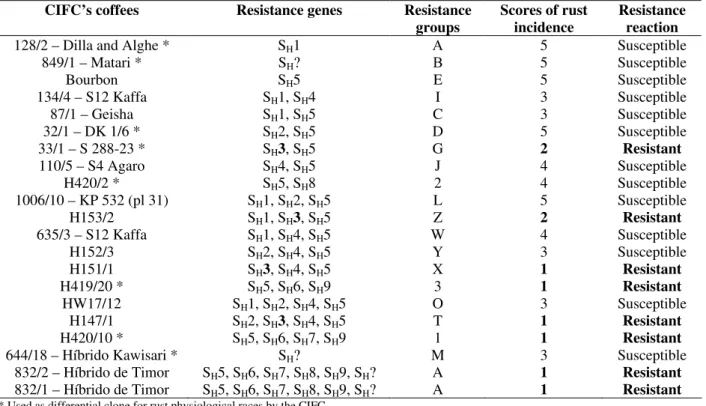
One plant of each of 21 CIFC’s coffee trees with several resistance genes SH were evaluated. Eight of these genotypes were differential coffees for rust physiological races. The characterization of the evaluated coffees with respective resistance genes and resistance groups are presented in Table 1.
The leaf rust incidence evaluation was done in July 2004 in a period of intense attack of H. vastatrix. The score scale used in this evaluation varied from 1 to 5, where: 1 = plants without lesions on the leaves; 2 = leaves with few chlorotic spots (1 to 5 spots) without spores, where the injured leaf percentage on the plant varies from 1 % to 9 %; 3 = leaves with few chlorotic spots (1 to 5 spots) with spores, where the injured leaf percentage on the plant varies from 1 % to 9 %; 4 = number of lesions with spores on leaves varying from 6 to 25 and injured leaf percentage between 10 % to 35%; and 5 = number of lesions with spores on leaves more than 25 and injured leaf percentage more than 35%. Plants with scores 1 and 2 of rust incidence were considered resistants and with scores 3, 4, and 5 as susceptibles ones.
RESULTS AND DISCUSSION
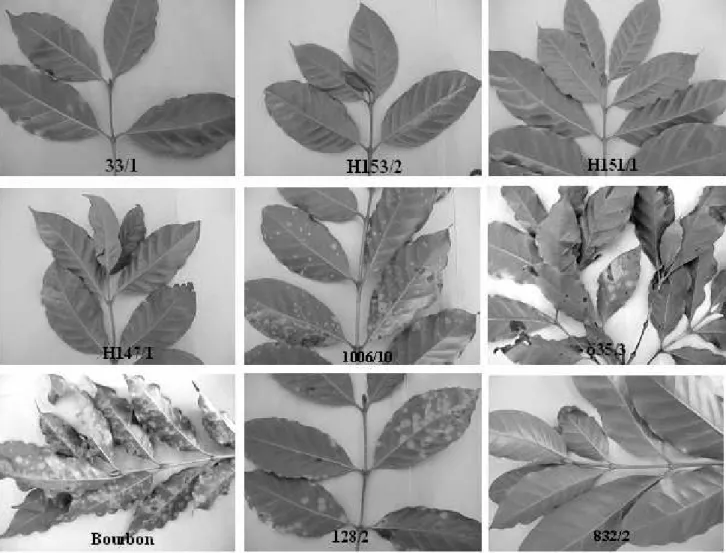
All coffee trees carrying SH3 gene presented resistance to the rust with the physiological races present at IAPAR (Table 1 and Fig. 1). On differentials 33/1 and H153/2, few injuries provoked for the rust were observed, however without spores. Bettencourt (1981) observed that all the differentials with SH3 presented resistance to majority of the 30 existing physiological races at that time, and moderately susceptible and susceptible for some races. Also out of the 40 physiological races characterized by Várzea et al. (2002), only 5 races presented the virulence gene v3.
aggressiveness. Probably, at Instituto Agronômico do Paraná, rust races with the v3 gene didn’t exist, therefore, even on the differential 33/1 carrying
only genes SH3 and SH5 sporulation was not observed. In Brazil the most common race is the race II carrying virulence gene v5.
Table 1 – Resistance to H. vastatrix in CIFC’s coffees with 2.5 years old evaluated in July 2004 at IAPAR
(Londrina – PR – Brazil). Evaluation of individual plants on the field conditions.
CIFC’s coffees Resistance genes Resistance groups
Scores of rust incidence
Resistance reaction
128/2 – Dilla and Alghe * SH1 Α 5 Susceptible
849/1 – Matari * SH? Β 5 Susceptible
Bourbon SH5 E 5 Susceptible
134/4 – S12 Kaffa SH1, SH4 I 3 Susceptible
87/1 – Geisha SH1, SH5 C 3 Susceptible
32/1 – DK 1/6 * SH2, SH5 D 5 Susceptible
33/1 – S 288-23 * SH3, SH5 G 2 Resistant
110/5 – S4 Agaro SH4, SH5 J 4 Susceptible
H420/2 * SH5, SH8 2 4 Susceptible
1006/10 – KP 532 (pl 31) SH1, SH2, SH5 L 5 Susceptible
H153/2 SH1, SH3, SH5 Z 2 Resistant
635/3 – S12 Kaffa SH1, SH4, SH5 W 4 Susceptible
H152/3 SH2, SH4, SH5 Y 3 Susceptible
H151/1 SH3, SH4, SH5 X 1 Resistant
H419/20 * SH5, SH6, SH9 3 1 Resistant
HW17/12 SH1, SH2, SH4, SH5 O 3 Susceptible
H147/1 SH2, SH3, SH4, SH5 T 1 Resistant
H420/10 * SH5, SH6, SH7, SH9 1 1 Resistant
644/18 – Híbrido Kawisari * SH? M 3 Susceptible
832/2 – Híbrido de Timor SH5, SH6, SH7, SH8, SH9, SH? A 1 Resistant
832/1 – Híbrido de Timor SH5, SH6, SH7, SH8, SH9, SH? A 1 Resistant
* Used as differential clone for rust physiological races by the CIFC. Supposed resistance reaction.
Differential H420/10 (SH5, 6, 7, 9) and H419/20 (SH5, 6, 9) showed resistance in the evaluation accomplished at IAPAR, while the H420/2 (SH5, 8) presented susceptibility (Table 1). However, these three differentials presented susceptibility to some existing races in the world. This could indicate the absence of physiological races such as XXIX (v5, 6, 7, 8, 9), XXXI (v2, 5, 6, 9), XXXVII (v2, 5, 6, 7, 9) and XXXIX (v2, 4, 5, 6, 7, 8, 9). The CIFC’s coffees number 832/1 and 832/2 showed resistance reaction, both with score 1.
The evaluations accomplished in this research indicated that at IAPAR rust races existed with the virulence genes v1, v2, v4, v5 and v8 alone or in combinations. Moreover, race(s) with the gene v? also existed that defeated the SH? gene(s) of the 849/1 Matari and of the 644/18 Híbrido Kawisari.
The study indicated that coffees carrying SH3 gene were important sources of resistance to rust for the Paraná. Ito et al. (2005) also observed
resistance in coffee selections of the “Catuaí SH2, SH3” with complete resistance in IAPAR’s field experiments.
Figure 1 - CIFC’s coffee trees with several resistance genes SH on field conditions at IAPAR
(Londrina, Paraná State, Brazil). July 2004
CONCLUSIONS
• All the evaluated coffees carrying gene SH3 presented resistance to the rust on the field.
• It was possible that rust races with virulence gene v3 in the Paraná State didn’t exist.
• Plants carrying SH3 gene (CIFC’s acessions H147/1 = SH2, SH3, SH4, SH5; H151/1 = SH3, SH4, SH5; and H153/2 = SH1, SH3, SH5) in combination with genes SH5, SH6, SH7, SH8, SH9 and SH? would be very important to obtain cultivars with more durable resistance to the rust.
ACKNOWLEDGEMENTS
The authors thank the Instituto Agronômico do Paraná (IAPAR) and the Consórcio Brasileiro de Pesquisa e Desenvolvimento do Café (CBPandD Café).
RESUMO
condição de alta incidência natural em campo. Todos os cafeeiros avaliados portadores do gene SH3 apresentaram resistência à ferrugem. É possível que não existam raças de ferrugem com o gene de virulência v3 no Paraná. Plantas portadoras do gene SH3 em combinação com os genes SH5, SH6, SH7, SH8, SH9 e SH? seria muito importante para obter cultivares com resistência mais durável à ferrugem.
REFERENCES
Bergamin-Filho, A. (1976), Possibilidades do emprego da resistência vertical no melhoramento do cafeeiro contra Hemileia vastatrix. Summa Phytopathol., 2, 103.
Bettencourt, A. J. (1981), Melhoramento genético do cafeeiro: transferência de factores de resistência à Hemileia vastatrix Berk. and Br. para as principais cultivares de Coffea arabica L. Lisboa: Junta de investigações científicas do ULTRAMAR/Centro de Investigação das Ferrugens do cafeeiro, Oeiras, 93 p. Bettencourt, A. J.; Noronha-Wagner, M. (1971),
Genetic factors conditioning resistance of Coffea arabica L. to Hemileia vastatrix Berk and Br..
Agronomia Lusitana, v.31, p.285-292.
Bettencourt, A. J.; Noronha-Wagner, M.; Lopes, M. (1980), Factor genético que condiciona a resistência do clone 1343/269 (Híbrido de Timor) à Hemileia vastatrix Berk. and Br. Brotéria Genética, v.I, n.LXXVI, p.53-58.
Bettencourt, A. J.; Rodrigues Jr., C. J. (1988), Principles and practice of coffee breeding for resistance to rust and other diseases. In: CLARCK, R.J.; Macrae, R. (Eds.). Coffee, v.4 Agronomy. Elseviers Applied Science, p.199-235.
Cardoso, R. M. L. (1986), Novas raças fisiológicas de Hemileia vastatrix Berk. et Br. no Brasil, métodos de identificação, e detecção de grupos fisiológicos em cafeeiros derivados do Híbrido de Timor. 111 f. Tese (Mestrado em Fitopatologia) – Universidade Federal de Viçosa, Viçosa, MG, Brasil.
Eskes, A. B. (1983), Incomplete resistance to coffee leaf rust (Hemileia vastatrix). 140 f. Doctoral thesis, Agricultural University of Wageningen, The Netherlands.
Eskes, A. B. (1989), Resistance. In: Kushalappa, A. C.; Eskes, A. B. (Eds.). Coffee rust: epidemiology, resistance and management. Boca Raton, Florida: CRC Press, Inc. cap. 6. p. 171 – 292.
Ito, D. S.; Sera, T.; Sera, G. H.; Azevedo, J. A. De; Mata, J. S. Da; Petek, M. R.; Doi, D. S.; Ribeiro Filho, C. (2005)Seleção para resistência à ferrugem e outras características agronômicas entre progênies de
Coffea arabica L. In: Simpósio de Pesquisa dos Cafés do Brasil, 4, 2005, Londrina – PR. Anais ... Cd-Room. Noronha-Wagner, M.; Bettencourt, A. J. (1967),
Genetic study of resistance of Coffea sp. to leaf rust. I. Identification and behaviour of four factors conditioning disease reaction in Coffea arabica to twelve physiologic races of Hemileia vastatrix.
Canadian Journal ofBotany, v.45, p.2021-2031. Rodrigues Jr., C. J.; Várzea, V. M. P.; Silva, M. C.;
Guerra-Guimarães, L.; Rocheta, M.; Marques, D.V. (2000), Recent advances on coffee leaf rust. In: International Scientific Symposium on Coffee. 4 de dezembro de 2000. Bangalore, India, Central Coffee Research Institute. Proceedings Coffee Board. p.179-193.
Várzea, V. M. P.; Rodrigues Jr., C. J.; Silva, M. C. M. L.; Gouveia, M.; Marques, D. V.; Guerra-Guimarães, L.; Ribeiro, A. (2002), Resistência do cafeeiro a
Hemileia vastatrix. In: ZAMBOLIM, L. (Ed.). O Estado da arte de tecnologias na produção de café. Viçosa: UFV. cap. 8. p. 297 – 320.