A Framework to Analyse the Approach Adopted in the Information Systems
Requirements Engineering Activity
Álvaro Rocha José Braga de Vasconcelos
[email protected] [email protected]
Faculty of Science and Technology Faculty of Science and Technology
Fernando Pessoa University Fernando Pessoa University
Porto - Portugal Porto - Portugal
Abstract
The RE is likely to be the more critical activity in the IS development. A misleading requirements definition results in an inadequate IS deployment for the target workplace.
The activity of requirements engineering (RE) is the initial stage for the information systems development process. The RE is often developed using an excessive technological-driven approach. This aspect is pointed as a factor for the failure of the RE and consequently to the corresponding information system.
An IS supports work activities. Work activities can be viewed as having different dimensions, namely: technical, social, and organizational. A successful IS should be well conceived technically and should support adequately the social and organizational aspects [4, 6, 13, 14, 18, 23, 34, 35, 37].
We present an evaluation framework for the requirements engineering activities within organizational settings that can help on analysing how this important activity is carried out in organizations. This framework, designed by RETIS, is composed by three parts. The first part focuses on the organizational domain, the second focuses on the users and information systems’ stakeholders, and the third focuses on the underlying methods and techniques.
Often requirements engineers assume a decision-making role asking the users what type of system should be designed. The users have a consultive and passive role. This work is often developed without social and organizational concerns. The IS implementation in a real setting interferes with the social and organizational structures. These effects should be considered in the requirement engineering activity [17, 24, 25, 31, 34, 36]. This requires that RE should be conducted by requirements engineers with expertise on social and organizational issues. It also requires that requirements engineers promote an active, participative, and responsible involvement of users [5, 16, 31, 33]. The idea is to encourage the representation of users’ tacit values, motivations and perspectives [13, 22].
The initial validation of this investigation was based in the application of the RETIS in five real organizational settings. Organizations that demonstrate higher maturity in their information systems’ function presented a less technological-driven RE approach.
Keywords: Requirements Engineering, Information Systems Development, Maturity of the Information
Systems Function. The main maturity models for the IS function [e.g.,
10, 15, 21, 26, 27, 28] suggest that less mature organizations tend to emphasize technical aspects. And suggest that more mature organizations pay a balanced attention to both technical and socio-organizational aspects.
1. Introduction
Taking into account that RE is usually conducted under a technological-driven tendency [5, 13, 16, 34, 37], this research work aims to tackle other approaches, such as the RE process following a social and organizational tendency. In this context, we raised the following question:
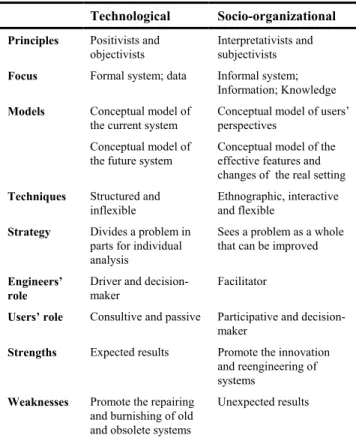
Table 1: Main features of the technical and socio-organizational approaches.
Technological Socio-organizational
Principles Positivists and objectivists
Interpretativists and subjectivists
Focus Formal system; data Informal system; Information; Knowledge
Models Conceptual model of the current system
Conceptual model of the future system
Conceptual model of users’ perspectives
Conceptual model of the effective features and changes of the real setting
Techniques Structured and inflexible
Ethnographic, interactive and flexible
Strategy Divides a problem in parts for individual analysis
Sees a problem as a whole that can be improved
Engineers’ role
Driver and decision-maker
Facilitator
Users’ role Consultive and passive Participative and decision-maker
Strengths Expected results Promote the innovation and reengineering of systems
Weaknesses Promote the repairing and burnishing of old and obsolete systems
Unexpected results (i) Is it possible to analyse the RE approach?
(ii) What type of RE approach is being followed in a particular organizational setting?
(iii) In what way the maturity of the IS function interferes with the RE tendency?
This paper presents the RETIS framework to assists the analysis of the RE tendency. We present three types of RE approaches. We present some considerations about the tendency of the RE activity, then the RETIS framework for analyse the RE approach. We conclude with some remarks concerning the application of the RETIS in five organizations.
2. Requirements Engineering Approaches
RE activity should give proper attention to all the domain problem aspects. Rocha [30] identified two perspectives: I) a technological perspective and II) a social and organizational perspective. Based on these perspectives, he is presented the following RE approaches:
Technological approach: when RE follows an objective perspective of the domain requirements and emphasizes the IS technical view. This approach is usually named as hard or using structured methods.
3. Tendency of the RE Activity
The RE should be an activity that addresses simultaneously solving activities of less structured and boundless domain problems, and computer engineering activities that could change the computer system, the IS, and the underlying organizational system [30].
Socio-organizational approach: when RE follows an inter-subjective vision of the requirements and social aspects that are related to the domain and to the underlying organization and emphasizes a socio-organizational perspective. This approach is usually
described as using soft or interpretative methods. An IS incorporates the technical and
socio-organizational components. Some authors [2, 5, 16, 19] claim that the socio-organizational component is often neglected throughout the RE activity. According to [13, 34, 37], a balance between the two approaches should be attempted. Figure 1 illustrates such balance as socio-technological approach.
Socio-technological approach: when RE combines the two previous approaches. This approach focuses initially on the socio-organizational aspects and then on the technological aspects in a complementary way.
According to suggestions of the main maturity models for the IS area [e.g., 10, 15, 21, 26, 27, 28], the last approach will be the most adequate and coadunate with RE activities of superior maturity. Then, effective RE practices will should be based on a socio-technological approach.
The x-axis represent many ways of conduct the RE activity, varying from a pure technologic approach to a pure socio-organizational approach. The darkest area means the technological emphasis and the lightest means the socio-organizational emphasis.
Table 1 resumes the main features of the technological and socio-organizational approaches focusing their principles, focus, models, techniques, strategies, role of the RE engineers and users, strengths and weaknesses.
Figure 1: Possible approaches/tendencies of the RE activity
• Software engineers that usually conduct the RE activity have some difficulties to deal with social and organizational components of the IS and related business domain.
• The RE is accomplished with the main aim of constructing computer systems, which are often viewed as a final product, neglecting the view that sees RE as a mean to enhance the IS and the way this supports the organizational processes.
• The importance of users is underestimated, they perform a passive role, and their important viewpoints are ignored.
• The applied methods and techniques stimulate a technological-driven approach.
As the RE is an activity that should simultaneously give attention to both technical and socio-organisational components, we find the need of defining a framework that is able to analyze the approach of the RE activity.
4. RETIS - A framework to analyse the
tendency of the RE activity
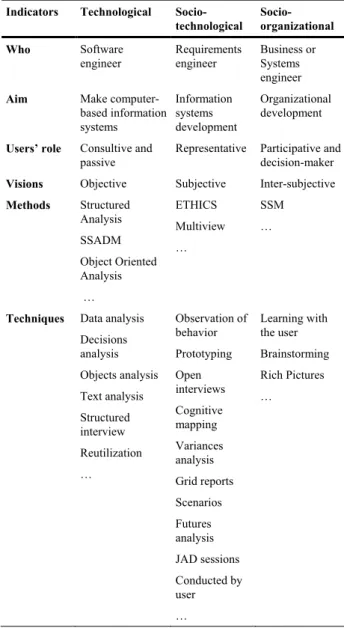
Next table is based on the aforementioned arguments used to justify the technological predominance in the RE activity and on the main characteristics from each of the three RE approaches. This table includes indicators used in the development of the RETIS framework to evaluate the tendency of RE activity within organizations.
The RETIS framework includes a questionnaire to collect information that is used to produce an evaluation of the RE approach. The questionnaire
uses a Likert scale and it is structured in three groups of questions (Appendix I).
Requirements Engineering
Technological
Socio- organizational
Socio-technological
Table 2: Indicators and arguments used to identify the RE approach.
Indicators Technological Socio-technological
Socio-organizational
Who Software engineer
Requirements engineer
Business or Systems engineer
Aim Make computer-based information systems
Information systems development
Organizational development
Users’ role Consultive and passive
Representative Participative and decision-maker
Visions Objective Subjective Inter-subjective
Methods Structured Analysis
SSADM
Object Oriented Analysis
…
ETHICS
Multiview
…
SSM
…
Techniques Data analysis
Decisions analysis
Objects analysis
Text analysis
Structured interview
Reutilization
…
Observation of behavior
Prototyping
Open interviews
Cognitive mapping
Variances analysis
Grid reports
Scenarios
Futures analysis
JAD sessions
Conducted by user
…
Learning with the user
Brainstorming
Rich Pictures
…
The first group includes a set of questions that allow the inference of the RE level: computing system, information system or organizational system.
The second group includes a set of questions that allow the identification of the user’s interference level and their level of participation as well as their concerns, perspectives and social interactions.
In each of the questions are presented some possible use cases, and each of these cases is associated to a specific type of RE tendency. The respondents need to mark one of five choices representing the practical level of occurrence: never, rarely, sometimes, frequently, or always. To finalize each question the respondent can introduce some open-ended comments. Each choice was classified using a percent grade (0%, 25%, 50%, 75%, and 100%) in order to quantify the influence of each use case in the RE approach.
b) What levels of requirements modeling are considered?
IS development and implementation in a real setting interferes both in the technological and in the socio-organizational infrastructures. This occurs either if the information system is developed internally, externally (outsourcing) or acquired (a software package) [17, 24, 25, 36]. Therefore, it is necessary to consider the impact of these factors before building or acquiring the computer system. In the questionnaire we consider three possibilities: (i) Organizational, (ii) Information system, (iii) Technological (computer system).
The use cases presented in each question were determined to assist the identification of the RE approach. The use cases were applied in different places in order to avoid the adulteration of the questionnaire responses.
II) The role and significance of the users The questionnaire should be answered by managers
of requirements engineering activities with presence of
the responsible for the approach analysis. The requirements engineer activity and his interaction with the different stakeholders promotes different users’ roles, attitudes and perspectives. This issue is fundamental to ensure the proper requirements definition. The aim of this set of questions is to evaluate the user’s roles and their perspectives and motivations. We consider the following questions:
A reflection is necessary in case of not following a socio-technological approach. We claim that this approach should be tackled as standard effort in normal situations.
4.1 Evaluation schema
a) What is the role performed by the users? For each group of questions and according the
choices marked in the use cases, we briefly explain the
way to detect the approach followed in the RE. The users’ involvement is a key issue in all the IS development process [9], specifically in the RE activity [29]. The participation level has a direct impact on their satisfaction [1]. In the questionnaire we consider the following user involvement types: (i) Passive or consultive, (ii) Representative, (iii) Participative or decision-maker.
I) Involvement level
RE should be conducted following the dynamics of the organization. The RE activity can change the computing system, the information system or the organizational system. In the first case we consider that RE follows a technological approach, in the second case we consider that RE follows a socio-technological approach, and in the third case we consider that RE follows a socio-organizational approach. The underlying questions are:
b) What requirements visions are considered?
Depending on the existing RE involvement, there are different users’ views that could determine the requirements definition. According to Iivari e Hirschheim [17], there are three visions that distinguish the definition of users’ requirements: (i) objective, (ii) subjective, (iii) inter-subjective. The first addresses a functional view of the domain. The second emphasizes the users’ personal features, and the requirements are defined following their preferences. The third emphasizes the user’s voluntarism and organizational relationships. In this context, the requirements definition emerges from the dynamics of the organization. In the questionnaire we consider these three visions.
a) Who performs the RE activity?
The RE activity usually deals with ill-defined and unbound domain problems (business engineering) as well as with the analysis of the related computer systems (software engineering) [Doyle 12]. Firstly, the concern is focused on the organizational aspects and then the focus is on the technological aspects.
III) Used Methods and Techniques Although the questionnaire included in the RETIS framework was applied only in five organizational settings, the multiple-case study described in Rocha [30] have validated the aforementioned framework. Within the organizations under investigation, we did not find difficulties concerning the application of this framework. It is demonstrated that these organizations have followed a technological-driven RE practice, and these was more evident in organizations that presented low levels of their IS maturity.
The RE activity involves a combination of principles, methods, and related techniques. The adopted methods and techniques promote different RE attitudes and results. These set of questions aims to identify different methods and techniques used during the RE activity. The underlying questions are:
a) What types of methods are used?
Future work need to be developed in order to enhance this framework. In the context of evaluating the RE tendency, new case studies should be considered. Therefore, we are going to apply this questionnaire in other organizations to refine or introduce (if applicable) new variables, indicators, and arguments used in the existing framework. The idea is to turn the RETIS framework more extensive and concise allowing us its application in the emergent knowledge-intensive organizations.
Although the objectives concerning the existing methods for the RE orientation and support seemed to be similar, there are specific features that allow some kind of categorization. According to the main objective of this research that is the identification of the RE approach within the organization, and the related evaluation framework, we have considered three types of methods in conjunction with the existing RE approaches: (i) Traditional/hard (e.g.: Structured Analysis [38]), (ii) Soft (e.g.: Soft System Methodology [8], (iii)
Socio-technological (e.g. Multiview [3]).
6. References
b) What types of techniques are used to acquire and
model the requirements? [1] Amoako-Gyampah, K. and White, K., “User involvement and user satisfaction: An exploratory contingency model”,
Information & Management, 25 (1993), pp. 1-10. There are several techniques to support the collection
and the definition of different requirements categories [7, 11]. The questionnaire includes a set of nineteen techniques. These techniques are based on the analysis performed by Rocha [30] that includes a categorization schema to classify the techniques according to the stimulated RE tendency. In the questionnaire we consider the following categories: (i) Technological (e.g.: text analysis, structured interviews) (ii) Socio-technological (e.g.: behaviour observation, cognitive mapping), (iii) Socio-organizational (e.g.: brainstorming, rich pictures).
[2] Andriole, S., Managing Systems Requirements: methods, tools and cases, McGraw-Hill, 1996.
[3] Avison, D. and Wood-Harper, A., Multiview: An Exploration in Information Systems Development, Blackwell Scientific Publication, 1990.
[4] Avison, D. and Fitzgerald, G., “Information systems, education and research”, Journal of Information Systems, 1, 1 (1991), pp. 5-17.
[5] Bate, R., "Do systems engineering? Who, me?", IEEE Software, Julho/Agosto (1998), pp. 65-66.
[6] Benbasat, I., Dexter, A. and Mantha, R., “Impact of organizational maturity on information system skill needs”,
MIS Quarterly, 4, 1 (1980),pp. 21-34.
5. Final Remarks
[7] Byrd, T., Cossick, K., and Zmud, R., “A synthesis ofresearch on requirements analysis and knowledge acquisitions techniques”, MIS Quarterly, 16 (1992), pp. 117-138.
This research focused in the RETIS framework definition for analyse the tendency of the RE activity. The main goal of this framework is to enhance the reflection of the RE participants and consequently to enhance the RE activity results, namely the validity and the expressiveness of the domain requirements to be acquired.
[8] Checkland, P., Systems Thinking, Systems Practice, Wiley, 1981.
[9] Clavadetscher, C. and Lawrence, B., “User involvement key to success/Designers must do the modeling”, IEEE Software, Março/Abril (1998), p. 30-33.
[10] CMMI, Capability Maturity Model Integration, Version 1.1, Continuous Representation, Software Engineering Institute, CMU/SEI-2002-TR-001/ESC-TR-2002-001, 2002. The need of such framework is related with the fact
that the RE activity is mainly developed using a technological-driven approach, which have resulted in some failures during the related IS development and implementation.
requirement definition”, Information Systems Journal, 8, 1 (1997), pp. 213-239.
[25] Mumford, E., “Defining system requirements to meet business needs: a case study example”, The Computer Journal, 28 (1985), 97-104.
[12] Doyle, K., Wood, J. and Wood-Harper, A., “Soft systems and engineering: on the use of conceptual model in information systems development”, Journal of Information Systems, 3 (1993), pp. 187-198.
[26] Mutsaers, E., Zee, H. and Giertz, H., “The Evolution of Information Technology”, BIK-Blad (Nolan Norton & Co., Utrecht), Vol. 2, nº 2 (1997), pp. 15-23.
[13] Flynn, D. and Jazi, D., "Constructing user requirements: a social process for a social context", Information Systems Journal, 8 (1998), pp. 53-83.
[27] Nolan, R., "Managing the crisis in data processing",
Harvard Business Review, 57, 2 (1979), pp. 115-126.
[28] Paulk, M., Curtis, B., Chrissis, M. and Weber, C.,
Capability Maturity Model for Software, Version 1.1, Software Engineering Institute, Carnegie Mellon University, CMU/SEI-93-TR-024, 1993.
[14] Galliers, R., “Towards a flexible information architecture: integration business strategies, information systems strategies and business process redesign”, Journal of Information Systems, 3, (1993), pp. 199-213.
[29] Purvis, R. and Sambamurthy, V., “An examination of designer and user perceptions of JAD and the traditional IS design methodology”, Information & Management, 32, 3 (1997), pp. 123-135.
[15] Galliers, R. and Sutherland, A., "Information systems management and strategy formulation: the ´stages of growth´ model revisited", Journal of Information Systems, 1, 2 (1991), pp. 89-94.
[30] Rocha, A., Influência da Maturidade da Função Sistema de Informação na Abordagem à Engenharia de Requisitos, Tese de Doutoramento, Universidade do Minho, 2000. (In Portuguese)
[16] Hanseth, O. and Monteiro, E., "Navigation future research: judging the relevance of information systems development research", Accounting, Management and Information Technologies, 6, 1-2 (1996), pp. 77-85.
[31] Stowell, F., “Towards client-led development of information systems”, Journal of Information Systems, 1 (1991), pp. 173-189.
[17] Hirschheim, R., Klein, H. and Lyytinen, K., "Exploring intellectual structures of information systems development: a social action theoretic analysis", Accounting, Management and
Information Technologies, 6, 1-2 (1996), pp. 1-64. [31] Sutcliffe, A. and Minocha, S., Linking business modelling
to socio-technical system design, CREWS Report 98-35, 1998. [18] Hooks, Ivy., Writing good requirements, artigo
apresentado ao Fourth INCOSE Symposium, 1999a. [33] Vasconcelos, J., An Ontology-Driven Organizational
Memory for Managing Group Competencies, PhD Thesis, University of York, Department of Computer Science, 2001.
[19] Hooks, Ivy., Management requirements, artigo de trabalho, 1999b.
[34] Vidgen, R., "Stakeholders, soft systems and technology: separation and mediation in the analysis of information systems requirements", Information Systems Journal, 7, 1 (1997), pp. 21-46.
[20] Iivari, J. and Hirschheim, R., “Analysing Information Systems Development: A Comparison and Analysis of Eight IS Development Approaches”, Information Systems, 21, 7 (1996), pp. 551-575.
[35] Vitalari, N., Knowledge as a basis for expertise in systems analysis: an empirical study, MIS Quarterly, 9, 3 (1985), pp. 221-241.
[21] Khandelwal, V. and Ferguson, J., Critical Success Factors (CSFs) and the Growth of IT in Selected Geographic Regions,
Proceedings of 32nd Hawaii International Conference on
Systems Sciences (HICSS-32), USA, 1999. [36] Walsham, G., "Exploring the intellectual structures of information systems development: a short critique",
Accounting, Management and Information Technologies, 6, 1-2 (1996), pp. 133-138.
[22] Leifer, R., Lee, S. and Durgee, J., “Deep Structures: Real information requirements determination”, Information & Management, 27 (1994), pp. 275-285.
[37] Wastell, D. and Newman, M., "Information system design, stress and organizational change in the ambulance services: a tale of two cities", Accounting, Management and Information Technologies, 6, 4 (1996), pp. 283-300.
[23] Mansell, G., “Action research in information systems development”, Journal of Information Systems, 1 (1991), pp. 29-40.
[24] Mathiassen, L., “Information systems development: reflections on a discipline”, Accounting, Management and Information Technologies, 6, 1-2 (1996), pp. 115-125.
APPENDIX I – Condensed Questionnaire of Measures the Requirements Engineering Tendency.
1. Intervention: Level/system where requirements engineering intervenes. 1.1 Who performs the requirements engineering activity?
Software Engineers. 1never1rarely1sometimes1frequently1always
Systems/Business Engineers 1never1rarely1sometimes1frequently1always Requirements Engineers. 1never1rarely1sometimes1frequently1always Comments:
1.2 What levels of requirements modeling are considered?
Organizational. 1never1rarely1sometimes1frequently1always
Information System. 1never1rarely1sometimes1frequently1always Technological/Software. 1never1rarely1sometimes1frequently1always
Comments:
2. Users. Theimportance given to the users, their degree of participation and their perspectives and social interactions.
2.1 What is the role performed by the users?
Passive/consultive. 1never1rarely1sometimes1frequently1always
Representative. 1never1rarely1sometimes1frequently1always
Participative/decision-maker. 1never1rarely1sometimes1frequently1always Comments:
2.2 What requirements visions are considered?
Objective. 1never1rarely1sometimes1frequently1always Subjective. 1never1rarely1sometimes1frequently1always
Inter-subjective. 1never1rarely1sometimes1frequently1always Comments:
3. Methods and techniques. Types of methods and techniques used in the requirements engineering activity.
3.1 What types of methods are used?
Traditional/Hard. 1never1rarely1sometimes1frequently1always
Soft. 1never1rarely1sometimes1frequently1always
Socio-technological. 1never1rarely1sometimes1frequently1always Comments:
3.1 What types of techniques are used to acquire and model the requirements? Data Analysis. 1never1rarely1sometimes1frequently1always Decision Analysis. 1never1rarely1sometimes1frequently1always Objects Analysis. 1never1rarely1sometimes1frequently1always
Text Analysis. 1never1rarely1sometimes1frequently1always
Structured Interviews. 1never1rarely1sometimes1frequently1always Reutilization. 1never1rarely1sometimes1frequently1always Observation of Behavior. 1never1rarely1sometimes1frequently1always Prototyping. 1never1rarely1sometimes1frequently1always Open Interviews. 1never1rarely1sometimes1frequently1always Cognitive Mapping 1never1rarely1sometimes1frequently1always Analysis of Variances. 1never1rarely1sometimes1frequently1always
Grid Reports. 1never1rarely1sometimes1frequently1always
Scenarios. 1never1rarely1sometimes1frequently1always Future Analyse. 1never1rarely1sometimes1frequently1always JAD Sessions. 1never1rarely1sometimes1frequently1always
Conducted by User. 1never1rarely1sometimes1frequently1always
Learning with the User. 1never1rarely1sometimes1frequently1always
Brainstorming. 1never1rarely1sometimes1frequently1always
Rich Pictures. 1never1rarely1sometimes1frequently1always