Silages of pearl millet submitted to nitrogen fertilization
Silagens de milheto submetidas à adubação nitrogenada
Ricardo Martins Araujo PinhoI* Edson Mauro SantosI Fleming Sena CamposII João Paulo de Farias RamosI Carlos Henrique Oliveira MacedoI
Higor Fábio Carvalho BezerraI Alexandre Fernandes PerazzoII
ISSN 0103-8478
ABSTRACT
This study aimed to evaluate the fermentation characteristics, losses and the chemical composition of two pearl millet genotypes silages submitted to nitrogen fertilization. The experimental design was a completely randomized blocks in a split plot scheme 2x5 (two nitrogen genotypes doses x fi ve doses of nitrogen), with four replicates. Nitrogen doses were 0, 20, 40, 60, 80kg ha-1 and the pearl millet genotypes were the variety ADR300
and the hybrid ADR7010. The hybrid ADR 7010 showed average lactic acid content higher than the variety ADR 300, at all doses of N, recording values ranging from 4.09 to 10.46dag kg-1. There
was an interaction between nitrogren doses and genotypes for the neutral detergent fi ber, which ranged from 51.81 to 63.63dag kg-1 of dry matter. Dry matter recovery decreased linearly with
increasing nitrogen doses only for hybrid ADR7010, the same did not happen for the ADR300. The nitrogen fertilization does not favor the fermentation characteristics and increases DM losses of the hybrid ADR7010.
Key words: chemical composition, fermentation characteristics, lactic acid, semi-arid.
RESUMO
Objetivou-se avaliar o perfi l fermentativo, as perdas e a composição bromatológica de silagens de dois genótipos de milheto, submetidos à adubação nitrogenada. O delineamento utilizado foi em blocos casualizados em um esquema de parcelas subdivididas 2x5 (dois genótipos x cinco doses de nitrogênio), com quatro repetições. As doses de nitrogênio foram 0, 20, 40, 60, 80kg ha-1 e os genótipos de milheto foram a variedade ADR300 e o
híbrido ADR7010. O híbrido ADR 7010 apresentou teores médios de ácido lático superiores aos da variedade ADR 300 em todos os níveis de N, registrando valores que variaram de 4,09 a 10,46 dag kg-1. Houve interação entre os níveis de adubo e os genótipos para
a fi bra em detergente neutro, que variaram de 51,81 a 63,63dag kg-1 de matéria seca. A recuperação de matéria seca diminuiu
linearmente com o aumento das doses de nitrogênio somente para o híbrido ADR7010, o mesmo não acontecendo para a ADR300. A adubação nitrogenada não favorece o perfi l fermentativo e incrementa as perdas de matéria seca do híbrido ADR7010.
Palavras-chave: composição bromatológica, perfi l fermentativo, ácido lático, semiárido.
INTRODUCTION
The pearl millet is grass specie has been widely used by farmers as an alternative to reach the animal requirements in the critical period of the year, due to the fact that it is the forage more resistant to drought and is adapted to low soil fertility, presents fast growth and high yields of phytomass by unit area (AMARAL et al., 2008). It is a culture that shows good development in regions with low rainfall profi le, so, it has been widely used for the production of grass silage during periods of late season and in regions that are characterized by having problems with dry periods or drought (GUIMARÃES JR. et al., 2010).
The nitrogen is considered one of the most important nutrients for the growth of several plant species because it can provide an increase in productivity of forage grass and in the amount of crude protein (CP) per hectare. But the responses to nitrogen depend on each forage species, being attributed to genetic constitution, soil and climatic conditions (DIAS et al., 2000).
IUniversidade Federal da Paraíba (UFPB), 58397-000, Areia, PB, Brasil. E-mail: [email protected]. *Autor para
correspondência.
The effi ciency of the silage conservation system should not be defi ned only by the nutritional value of silage, but also by the losses that occur from harvest to animals feeding (NEUMANN et al., 2007). The silage quality is directly related to the material which it is originated from and to the conditions under which it was ensiled (LOURES et al., 2003). In this way, changes occurring owing fertilization can provide changes in silage quality.
Therefore, this study aimed to evaluate the fermentation characteristics and the chemical composition, as well as to quantify the losses and dry matter recovery of two pearl millet genotypes silage submitted to nitrogen fertilization.
MATERIALS AND METHODS
The experiment was conducted at the Estação Experimental Pendência, of Empresa Estadual de Pesquisa Agropecuária da Paraíba S.A. (EMEPA), located in Agreste region of Paraiba, Microregion of Western Curimataú, municipality of Soledade. The precipitation volume during the experimental period (May to July 2010) was 96mm.
The soil analysis of the experimental area was conducted in the laboratory of Federal University of Paraiba, presenting the following chemical attributes (profi les 0 to 20cm): pH (H2O): 6,32; P: 1,63; K+: 159 (mg dm3-1); H++Al+3: 1,49; Al+3: 0,0; Ca+2: 5,85; Mg+2: 1,10 (cmolc dm3-1), base saturation (V): 83.87dag kg-1 and organic matter (OM): 8.60g kg-1.
At the stage of pearl millet cultivation, it was used split-plot design with them hole plots arranged in a randomized complete-block design, with the plots represented by the dosages of nitrogen (0, 20, 40, 60, 80kg ha-1), and the subplots represented by pearl millet genotypes (variety ADR300 and hybrid ADR7010), with four replications. The spacing used in the culture was 0.5m between rows. The sowing of millet was held on May 4, 2010. At 15 days after emergence (DAE) it was performed the thinning, to obtain 15 plants/linear meter.
The nitrogen fertilization with ammonium sulfate ((NH4)2SO4) was performed, manually, directly beside the rows of plants, being the dosages of 20 and 40kg ha-1 applied once, at 14 days after sowing (DAS), and the remaining dosages in installments, half of them applied at 14 days and half at 28DAS. At the time of sowing, it was performed the phosphate fertilization with 50 kg ha-1 of P
2O5, using simple superphosphate. In this experiment, which corresponds to the evaluation of the silages, all the material for each combination of the factors studied in the four blocks
was cut for ensilage, and replicates were established by experimental silos. Thus, the experimental design was completely randomized in a 2x5 factorial scheme, with two pearl millet genotypes (variety ADR300 and the hybrid ADR7010) and fi ve nitrogen dosages (0, 20, 40, 60 and 80kg ha-1) with four replicates.
The harvest of plants was done 64DAS, when the grains were in early-dough stage. In the plots of each treatment, the millet was cut to a height of 10cm from the ground and chopped into particles of approximately 2cm and ensiled in PVC silos with 15cm diameter and 30cm height, equipped with Bunsen valve, to exhaust gases. At the bottom of the silos, it was placed 1.50kg of sand to capture the effl uent. The compaction of the material allowed approximately 3kg of fresh forage per silo. The usable area of silo was 15cm diameter and 28cm height.
After 30 days, the silos were opened, and then it was collected two samples of each experimental unit, in order to perform the analysis at the Laboratory of Animal Nutrition of the Center of Agrarian Sciences at the Federal University of Paraiba (UFPB).
At opening time, it was eliminated the top and bottom portions of each one, equivalent to approximately 5cm each. The central portion was homogenized and a sample of approximately 200g for the determination of pH and ammonia nitrogen was used. The analysis of pH and ammonia-N were conducted according to the methodology described by BOLSEN et al. (1992). For analysis of organic acids, 10g of sample was diluted in 90mL of distilled water and fi ltered through Whatman fi lter (KUNG JR. & RANJIT, 2001).
Also at the opening moment, another sample of approximately 200g was collected from each silo. These samples were pre-oven-dried at 65°C for 72h and ground in a Willey knife mill with a 1mm sieve for determination of the chemical constituents.
The losses of dry matter (DM) in form of gas and effl uent, and the dry matter recovery (DMR) were estimated according to the equations described by ZANINE et al. (2010).
The results were submitted to analysis of variance, using the F test (α=0.05) to compare the means between genotypes, using the program SAEG, version 8.0 (UNIVERSIDADE FEDERAL DE VIÇOSA, 2000). When there was interaction, data were unfolded to evaluate effect of genotypes in each nitrogen doses and effect of doses in each genotype. For the effect of fertilizer, it was performed linear regression analysis. The criteria for selecting the models were the coeffi cients of determination, as well as the signifi cance of the regression parameters tested by Student’s t test (α=0.05).
RESULTS AND DISCUSSION
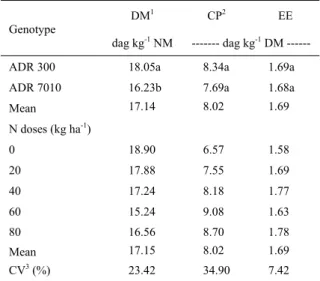
There was difference for the value of DM (P<0.05) between the genotypes. The variety ADR 300 presented higher value of DM than the hybrid ADR 7010 (Table 2). The values for DM decreased quadratically (P<0.05) with the increasing of nitrogen doses. Concerning the values of CP and EE, there were not found difference (P>0.05) among the genotypes studied.
There was an interaction (P<0.05) between doses of fertilizer and genotypes for the NDF (Table 3). The NDF content increased linearly with the increasing of nitrogen dosages to the variety ADR 300 and decreased linearly to the hybrid ADR 7010. The values found are lower than those noticed by AMARAL et al. (2008) and GUIMARÃES JR. et
al. (2008) wich studied cultivars of millet, and found values of NDF ranging from 60.15 to 68.63 and 70.50 and 71.2dag kg-1 DM, respectively. The low values of NDF observed in this study may be due to drought stress suffered by the culture, due to low rainfall observed during the experimental period. This stress undergone by plant caused to accelerate its cycle, staying with a smaller size, i.e., producing a smaller amount of fi bers, because there was not a further expansion of the stem, resulting in greater panicle’s participation in DM.
There was an interaction (P<0.05) between doses of fertilizer and genotypes for the content of NFC. NFC values decreased linearly with increased dosages of nitrogen to the variety, the opposite happening for hybrid in which the values increased linearly with the increasing of nitrogen. The hybrid ADR 7010, when not fertilized, had lower amount of non-fibrous carbohydrates when compared to others. This can be explained by NDF values reported in the same table. The amount of NDF is inversely proportional to the value of NFC and, as the NDF values in the hybrid ADR 7010 decreased with the increasing in the doses of nitrogen.
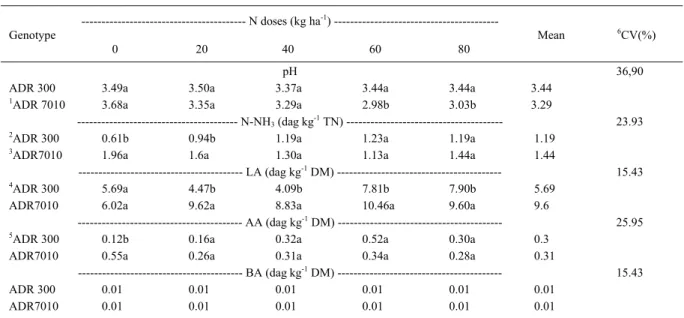
There was an interaction (P<0.05) between the nitrogen (N) doses and the genotypes for pH, noting that the values differ only statistically (P<0.05) in the dosages of 60 and 80kg ha-1 of N (Table 4). Due to drought stress occurred during the experimental period, the millet shortened its cycle, so, there was not enough time for the plants extend their stems and, because of this, plants presented a small height (average height of 115cm). When
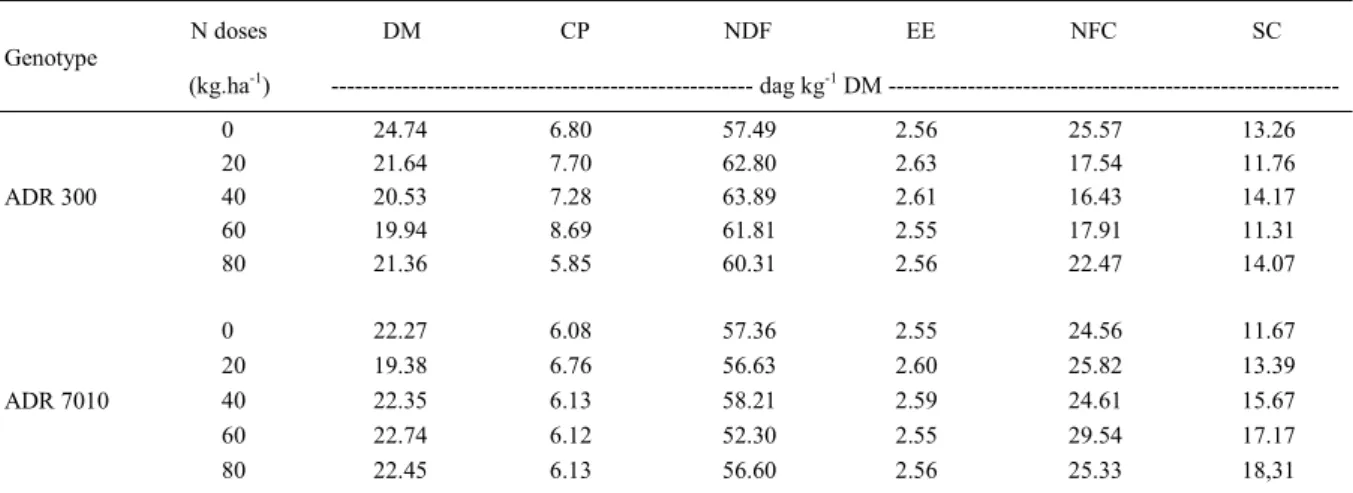
Table 1 - Average values of chemical composition of plant genotypes used for ensilage.
N doses DM CP NDF EE NFC SC
Genotype
(kg.ha-1) --- dag kg-1 DM
---0 24.74 6.80 57.49 2.56 25.57 13.26
20 21.64 7.70 62.80 2.63 17.54 11.76
40 20.53 7.28 63.89 2.61 16.43 14.17
60 19.94 8.69 61.81 2.55 17.91 11.31
ADR 300
80 21.36 5.85 60.31 2.56 22.47 14.07
0 22.27 6.08 57.36 2.55 24.56 11.67
20 19.38 6.76 56.63 2.60 25.82 13.39
40 22.35 6.13 58.21 2.59 24.61 15.67
60 22.74 6.12 52.30 2.55 29.54 17.17
ADR 7010
80 22.45 6.13 56.60 2.56 25.33 18,31
subjected to higher dosages of N, plant did not grow, hence it responded by concentrating its amount of soluble carbohydrates. It is likely that, in this case, the excess of sugar has caused a reduction in the pH range for growth of some species of yeast, below the ideal range recommended by McDONALD et al. (1991), between 3.8 and 4.2, which justifi es the increase in losses by gasses.
There was an interaction (P<0.05) between N doses and the genotypes for the content of lactic acid (LA) (Table 4). The hybrid ADR 7010 had average contents of LA superior to the ones of the variety ADR 300, at all doses of N, being not differed statistically (P<0.05), only in the absence of fertilization. The hybrid showed higher average content of LA (P<0.05), probably because it had a greater concentration of soluble carbohydrates, the main substrate used for fermentation of the bacteria which produce LA. According to McDONALD et al. (1991), content of 5.0 from 10.0dag kg-1 of LA shows silage with an adequate fermentation patterns associated.
As for the acetic acid (AA), it was observed an interaction (P<0.05) between the genotypes and doses of N (Table 4). Genotypes differed (P<0.05) only in treatment which did not receive nitrogen fertilizer. The values of AA are lower than those found by GUIMARÃES JR. et al. (2005), who reported mean values of AA of 1.04dag kg-1 DM for millet silages opened at 28 days after ensiling. Low concentrations of AA as seen in table 4, show that there was little incidence of fermentation by enterobacteria, which produce such acid.
Concerning the N-NH3, there was interaction (P<0.05) between genotypes and N dosages (Table 4). The means were different (P<0.05) only for the fi rst two N doses (20 and 40kg ha-1). The N-NH3 values are lower than those found by GUIMARÃES JR. et al. (2005), who found results ranging from 7.27 to 7.7dag kg-1 NT. The low production of N-NH3 can be explained by the rapid drop in pH, which leads to decrease in populations
Table 2 - Average values of dry matter (DM), crude protein (CP) and ether extract (EE) of two pearl millet genotypes silages under nitrogen (N) fertilization.
DM1 CP2 EE
Genotype
dag kg-1 NM --- dag kg-1 DM
---ADR 300 18.05a 8.34a 1.69a
ADR 7010 16.23b 7.69a 1.68a
Mean 17.14 8.02 1.69
N doses (kg ha-1)
0 18.90 6.57 1.58
20 17.88 7.55 1.69
40 17.24 8.18 1.77
60 15.24 9.08 1.63
80 16.56 8.70 1.78
Mean 17.15 8.02 1.69
CV3 (%) 23.42 34.90 7.42
Means followed by different letters in the column differ among themselves by F test (α = 0.05);
1Y = 19,1391 – 0,0825x + 0,0055x² r² = 0,84;
2 Y = 6,5153 + 0,0639x – 0,0004x2 r2 = 0,96; 3 CV – Coefficient of variation.
Table 3 - Average values of neutral detergent fiber (NDF) and non-fiber carbohydrates (NFC) in dagkg-1 DM of two pearl millet genotypes
silages under nitrogen (N) fertilization.
--- N doses (kg ha-1)
---Genotype
0 20 40 60 80
Mean CV5 (%)
--- NDF (dag kg-1 DM)
---ADR 3001 52.67b 56.10b 57.62a 59.98a 60.20a 57.31 10.12
ADR 70102 63.63a 60.91a 57.60a 53.82b 51.81b 57.55 10.12
--- NFC (dag kg-1 DM)
---ADR 3003 29.65a 24.61a 22.90a 19.50a 20.19a 22.90 10.12
ADR 70104 19.78b 21.26a 24.49a 25.65a 26.50a 24.49 10,12
Means followed by same letter in column do not differ by F test (α = 0.05).
1 Y = 53,5770 + 0,0932x r² = 0,90;
2
Y = 61,6815 – 0,1536x r² = 0,83;
3 Y = 28,1750 – 0,12x r2 = 0,87;
of proteolytic microorganisms (enterobacteria and bacteria from the Clostridium family).
There was no effect of any source of variation (P>0.05) for the values of butyric acid (BA) (Table 4). The lower values observed in this study (around 0.01dag kg-1 DM) can be explained by the rapid decrease in pH, probably due to the development of LA producing bacteria (LAB).
Table 5 shows that there was an interaction (P<0.05) between N doses and the genotypes for the dry matter recovery (DMR). The DMR decreased (P<0.05) linearly with the increasing in the dosages of nitrogen only for the hybrid ADR7010, the same is not true for the hybrid ADR300. It was observed that the variety ADR300 showed, on average, superiority in the DMR of approximately 14.8dag kg-1 compared to the hybrid ADR7010.
In the highest doses of fertilizer hybrid ADR7010 showed lower DMR 69.19 and 68.98 for N doses of 60 and 80kg ha-1, respectively. This increased loss can be explained by higher losses gases (Table 5) and was also observed when the genotype was subjected to the highest N doses. This lower DMR can be the result of undesirable fermentations, especially
yeast, since this hybrid showed high concentrations of soluble carbohydrates (Table 1), which possibly allowed a reduction in pH values close to 3.0 (PAIVA et al. 2011). In this pH range yeasts have greater development in detriment to other microbial groups, resulting in production of ethanol and consequently increasing the losses in the silage.
Concerning the losses by gas, it is possible to say that there was interaction (P<0.05) between nitrogen doses and the genotypes. It is observed that the hybrid ADR7010, when subjected to dosages of 60 and 80kg ha-1 of N, presented higher losses when compared to others. Losses by gas in the hybrid may have been infl uenced by high concentrations of soluble carbohydrates, which favored a signifi cant drop in pH, lower than the optimum value, stimulating secondary fermentation. Concerning the losses by effl uent, it was observed no effect of any source of variation (P>0.05). This can be explained due to the same doses of DM.
CONCLUSION
Spite of the increase in crude protein and decreased neutral detergent fi ber content, it is
Table 4 - Mean values of fermentation profile in silages of two pearl millet genotypes under nitrogen (N) fertilization
--- N doses (kg ha-1)
---Genotype
0 20 40 60 80
Mean 6CV(%)
pH 36,90
ADR 300 3.49a 3.50a 3.37a 3.44a 3.44a 3.44
1ADR 7010 3.68a 3.35a 3.29a 2.98b 3.03b 3.29
--- N-NH3 (dag kg-1 TN) --- 23.93 2
ADR 300 0.61b 0.94b 1.19a 1.23a 1.19a 1.19
3ADR7010 1.96a 1.6a 1.30a 1.13a 1.44a 1.44
--- LA (dag kg-1 DM) --- 15.43
4ADR 300 5.69a 4.47b 4.09b 7.81b 7.90b 5.69
ADR7010 6.02a 9.62a 8.83a 10.46a 9.60a 9.6
--- AA (dag kg-1 DM) --- 25.95
5ADR 300 0.12b 0.16a 0.32a 0.52a 0.30a 0.3
ADR7010 0.55a 0.26a 0.31a 0.34a 0.28a 0.31
--- BA (dag kg-1 DM) --- 15.43
ADR 300 0.01 0.01 0.01 0.01 0.01 0.01
ADR7010 0.01 0.01 0.01 0.01 0.01 0.01
Means followed by same letter in column do not differ by F test (α = 0.05); N-NH3 - ammonia nitrogen as a percentage of total nitrogen, LA
– lactic acid, AA – acetic acid, BA – butyric acid;
1 Y = 3,5895 - 0,0073x r² = 0,78;
2Y = 0,6052 + 0,0210x – 0,0001x² r2 = 0,98;
3
Y = 2,0040 – 0,0283x + 0,0002x² r² = 0,95;
4Y = 5,4026 – 0,0573x + 0,0012x² r2 = 0,75;
observed that the nitrogen fertilization does not favor fermentation and increases the losses of dry matter of hybrid ADR7010. The genotypes under study, when ensiled, result in well-fermented silage with chemical composition, which indicates an adequate nutritional value, providing a feeding alternative to the use as roughage supplementation in semiarid regions.
REFERENCE
AMARAL, P.N.C. et al. Qualidade e valor nutritivo da silagem de três cultivares de milheto. Ciência e Agrotecnologia, v.32, n.2, p.611-617, 2008. Available from: <http://www.scielo.br/pdf/ cagro/v32n2/41.pdf>. Accessed: Nov. 15, 2011.
BOLSEN, K.K. et al. Effect of silage additives on the microbial succession and fermentation process of alfalfa and corn silages.
Journal of Dairy Science, v.75, n.11, p.3066-3083, 1992.
DERIAZ, R.E. Routine analysis of carbohydrate and lignin in herbage. Journal of Science Food and Agriculture, v.12, p.150-160, 1961.
DIAS, P.F. et al. Produção e valor nutritivo de gramíneas forrageiras tropicais, avaliadas no período das águas, sob diferentes doses de nitrogênio. Ciência e Agrotecnologia, v.24, n.1, p.260-271, 2000. Available from: <http://www.trc.zootechnie.fr/node/5136>. Accessed: Jul. 25, 2012.
GUIMARÃES JR. et al. Matéria seca, proteína bruta, nitrogênio amoniacal e pH das silagens de três genótipos de milheto [Pennisetum glaucum (l). R. Br.] em diferentes períodos de fermentação. Revista Brasileira de Milho e Sorgo, v.4, n.2, p.251-258, 2005. Available from: <http:// rbms.cnpms.embrapa.br/index.php/ojs/article/view/145/145>. Accessed: Sept. 14, 2012.
GUIMARÃES JR. et al. Cinética de fermentação ruminal de silagens de milheto. Arquivo Brasileiro de Medicina Veterinária e Zootecnia,v.60, n.5, p.1174-1180, 2008. Available from: <http://www.scielo.br/pdf/abmvz/v60n5/20.pdf>. Accessed: May. 14, 2012.
GUIMARÃES JR. et al. Degradabilidade in situ de silagens de milheto em ovinos. Ciência Animal Brasileira, v.11, n.2, p.334-343, 2010. Available from: <http://www.revistas.ufg.br/index. php/vet/article/view/7053/6837>. Accessed: May. 12, 2012. doi 10.526/cab.v11i2.7053.
KUNG Jr.; RANJIT, N.K. The effect of Lactobacillus buchneri
and other additives on the fermentation and aerobic stability of barley silage. Journal of Dairy Science, v.84, p.1149-1155, 2001. Available from: <http://scielo.isciii.es/scielo.php?script=sci_nlink s&ref=636818&pid=S00040592201100020000900005&lng=es>. Accessed: Jan. 10, 2012.
LOURES, D.R.S. et al. Características do efl uente e composição químico-bromatológica da silagem de capim-elefante sob diferentes níveis de compactação. Revista Brasileira de Zootecnia. v.32, n.6, p.1851-1858, 2003. Available from: <http://www.scielo.br/ pdf/rbz/v32n6s2/20955.pdf>. Accessed: Sept. 12, 2011.
McDONALD, P. et al. The biochemistry of silage. 2.ed. Merlow: Chalcomb Publications, 1991. 340p.
MERTENS, D.R. Gravimetric determination of amylase teated neutral detergent fi ber in feeds with refl uxing in beaker or crucibles: collaborative study. Journal of AOAC International, v.85, p.1217-1240, 2002. Available from: <http://www.ingentaconnect. com/content/aoac/jaoac/2002/00000085/00000006/art00003>. Accessed: May. 23, 2012.
NEUMANN, M. et al. Efeito do tamanho de partícula e da altura de colheita das plantas de milho (Zea mays L.) sobre as perdas durante o processo fermentativo e o período de utilização das silagens. Revista Brasileira de Zootecnia, v.36, n.5,
p.1395-Table 5 - Average values of dry matter recovery (DMR), losses by gas (G), losses by effluent (E) of two pearl millet genotypes silages under nitrogen (N) fertilization.
--- N doses (kg ha-1)
---Genotype
0 20 40 60 80
Mean 3CV (%)
--- DMR (dag kg-1 DM) --- 12,72
ADR 300 87,76a 89,86a 86,24a 86,38a 88,16a 87,68
1
ADR 7010 81,41a 83,78a 81,29a 69,19b 68,98b 76,93
--- G (dag kg-1 DM) --- 36,90
ADR 300 13,25a 10,14a 13,75a 13,61b 11,84b 12,52
2ADR 7010 18,58a 16,20a 18,71a 35,80a 31,01a 24,06
--- E (kg Mg-1 NM) --- 27,35
ADR 300 3,45 2,92 4,51 3,15 3,40 3,49a
ADR 7010 3,12 3,24 4,71 3,42 3,91 3,68a
Means followed by same letter in column do not differ by F test (α = 0.05);
1Y = 88,8302 - 0,2723x r² = 0,74
2
Y = 11,17 + 0,2723x r² = 0,64
1405, 2007. Available from: <http://www.scielo.br/pdf/rbz/ v36n5/24.pdf>. Accessed: Jun. 18, 2012.
PAIVA, G.N. et al. Perdas na ensilagem de cinco cultivares de sorgo. In: SIMPÓSIO INTERNACIONAL SOBRE CAPRINOS E OVINOS DE CORTE, 2010, João Pessoa, PB. Anais... João Pessoa: SINCORTE. 2011. CD ROM.
SILVA, D.J.; QUEIROZ, A.C. Análises de alimentos (métodos químicos e biológicos). 3.ed. Viçosa: UFV, 2002. 235p.
SNIFFEN, C.J. et al. A net carbohydrate and protein system for evaluating cattle diets: carbohydrate and protein availability.
Journal of Animal Science, v.70, n.12, p.3562-3577, 1992.
UNIVERSIDADE FEDERAL DE VIÇOSA (UFV). Sistema de análises estatísticas e genéticas - SAEG. (versão 9.0). Viçosa, 2000. 138p. (Manual do usuário).