Monography
Integrated Master in Dental Medicine
“Biofilm study in waterlines and suction tubes of Dental Unit Chairs of a Dental Medicine Faculty Clinic –
Evaluation of effectiveness of a disinfection protocol”
Lino Rocha Vinhas
Supervisor: Prof. Doutor Pedro Mesquita Co-Supervisor: Profª. Doutora Benedita Sampaio Maia
_____________________________________________________________________
Oporto Dental Medicine Faculty Porto 2013
Monography
Integrated Master in Dental Medicine
“Biofilm study in waterlines and suction tubes of Dental Unit Chairs of a Dental Medicine Faculty Clinic –
Evaluation of effectiveness of a disinfection protocol”
Monography presented to Oporto Dental Medicine Faculty
under the course ”Research Monography” of the Integrated Master of Oporto Dental Medicine Faculty [email protected]
Lino Rocha Vinhas Supervised by Prof. Doutor Pedro Mesquita Co-supervised by Profª. Doutora Benedita Sampaio Maia
_____________________________________________________________________ Oporto Dental Medicine Faculty
ACKNOWLEDGMENTS
It is with great pleasure that I finish this adventure, leaving my thanks:
-‐
To my supervisor, Prof. Doutor Pedro Mesquita, a thank for the patience, the motivation and the immense good advice ever offered to me;-‐
To my co-supervisor, Profª. Doutora Benedita Sampaio Maia, sincere thanks for the support in every phase of the work. Without her support I would have not met the goals that I have set;-‐
To Ana Sofia Fernandes for all the support and understanding through all the stages.“It is always fun to do the impossible, because that is where there is less competition.”
INDEX
ABBREVIATIONS AND ACRONYMS ...5
UNITS ...5 ABSTRACT...6 OBJECTIVES...6 METHODS...6 RESULTS...6 CONCLUSIONS...6 KEYWORDS...7 INTRODUCTION ...8
MATERIAL AND METHODS... 10
SAMPLES COLLECTION...10 MICROBIAL ANALYSIS...11 STATISTICAL ANALYSIS...12 RESULTS ... 13 DISCUSSION... 16 CONCLUSIONS ... 21 REFERENCES ... 22
FIGURES AND TABLES INDEX... 24
ABBREVIATIONS AND ACRONYMS
ADA - American Dental Association
CDC – Center for Disease Control and Prevention DUC – Dental Unit Chair
DUWL – Dental Unit Water Line
FMDUP – Oporto Dental Medicine Faculty
UNITS
CFU/ml – Colony forming units / millilitre ºC – Degrees Celsius
ABSTRACT
Objectives
The goal of this research was to evaluate the quality of the water present in the Dental Unit Water Line (DUWL) and to asses the contamination of Dental Unit Chair (DUC) suction tubes. Also, it was our aim to evaluate the efficiency of two different disinfection protocols used in DUC suction tubes.
Methods
Microbial load and biodiversity were analyzed in DUWL of 20 DUCs as well as in DUC water source: 2 nearest taps. Microbial load and biodiversity was evaluated by pour plate method in rich and selective media: Blood agar, Brain Heart Infusion agar, MacConkey agar, Pseudomonas Cetrimide agar, Legionella GVPC agar, and Sabouraud dextrose agar. The disinfection protocols using Orotol® and Instrunet® were applied in DUC suction tubes. The efficiency of disinfection protocols was evaluated by collecting DUC suction tubes biofilm before and after disinfection protocols. The microbial load and biodiversity of the biofilm was evaluated using Brain Heart Infusion agar, Pseudomonas Cetrimide agar, and Legionella GVPC agar.
Results
In DUWL it was detected a significant microbial load (>1500 CFU/ml of total aerobic microorganisms) as well as a significant microbial biodiversity, including Gram-negative bacilli, Pseudomonas aeruginosa, Legionella spp. and Yeats. In comparison, the DUCs water source (tap) presented reduced microbial load (~25 CFU/ml) and low microbial biodiversity. In DUC suction tubes it was either detected a significant microbial load or biodiversity. Both disinfectants reduced significantly the microbial load of DUC suction tubes (p<0.05), but the removal rate was considerably low: <10% for total aerobic microorganisms and <30% for Pseudomonas aeruginosa or Legionella spp..
Conclusions
The quality of the water present in DUWL is beyond the standards of water quality needed for dental practice and there is relevant contamination on DUC suction tubes. This situation, specially the water quality present in DUWL, may endanger public
health, with a special focus on immunocompromised patients. Also, disinfectants protocols may need to be reviewed for higher efficiency. Infection control education in dental schools, continuing training in dental clinics, and mandatory regulations are needed to improve infection control practices in dental health care settings and particularly in dental waterlines.
KEYWORDS Dental Unit Chair Dental Unit Waterlines Suction System Infection Control Waterline disinfection
INTRODUCTION
The dental unit chair (DUC) is equipped with integrated systems, including the suction system and the water supply that assist and enable the performance of dental procedures. These systems consist of an elaborate structure of flexible plastic tubes, connected to each other, feeding the rotatory instruments and the ultrasound apparatus, forming the water aspiration unit [1].
The water passing through the DUC’s is responsible for the production of aerosols during clinical procedures. A part of it is collected through the suction system. Due to the contact with patient's blood and saliva, the suction system will contain microorganisms present in DUC’s waterlines and patient’s oral microbiota [2, 3].
The specific structure of DUC favors microbial contamination and the establishment of a biofilm in dental unit waterlines (DUWL). Moreover, waterlines and suction tubes remain constantly wet providing an excellent environment for the development of microorganisms [4]. In fact, phenomena such as the ability of bacteria to colonize surfaces and to form biofilms in water supply tubes, including DUWL, and the difficulties in biofilm removal or the prevention of its regrowth have been well documented [5-9].
Microorganisms present on contaminated DUWL may be transmitted to patient or dental clinician through aerosols and splatters generated by working unit handpieces [9]. Despite there is no evidence of a widespread public health problem from exposure to DUWLs’ microorganisms, the goal of infection control is to minimize the risk of exposure to potential pathogens and to create a safe working environment for the dental patients and practitioners [2].
The interest on these DUWL biofilms has been reawakened recently due to increasing number of immunocompromised dental patients and also due to an increase in awareness of occupational hazards at the dental offices [10]. Also, nowadays, the patient's expectations related to safety and hygiene standards in dentistry are high. In agreement with this, the American and European Dental Association defend maximum values for colony forming units per ml (cfu/ml) allowed in DUC’s water below the reference values for drinking water for consumption [2].
Notwithstanding, the disinfection of the waterlines or the suction tubes in DUC is extremely important since some studies indicate the presence of opportunistic
microorganisms in DUCs’ biofilm which may potentiate cross infection [8, 9]. In fact,
Legionella pneumophila and Pseudomonas aeruginosa are considered common
colonizers of water environments and often found in DUWL as a result of water stagnation [11]. The presence of high densities of Pseudomonas spp. and related organisms within the DUCs’ suction system, despite regular disinfection procedures, is worrying, specially if one takes into account that some studies have demonstrated that, under certain conditions, liquid from the low volume suction line can enter a patient’s oral cavity during clinical procedures [4, 12].
Commercial companies offer different disinfectant products marketing excellent efficiencies for disruption of biofilm and microorganisms elimination [13]. However, several studies show that the problem of microbial contamination of these tubes is hard to control [14-16], because the conditioning film will confer chemical properties that may completely mask the properties of the underlying substratum [17].
In this view, the main goals of this research were to assess microbial water quality of DUWLs and to evaluate the contamination levels of DUC’s suction tubes. Also, this study aimed to evaluate the efficiency of two different disinfection protocols used in DUCs’ suction tubes biofilm removal.
MATERIAL AND METHODS Samples collection
Water samples from DUWL were collected from the high-speed handpiece splice of 20 DUC at the Oporto Dental Medicine Faculty (FMDUP) clinic. As Urban Water Supply Network supplies all dental units, 2 control samples were also obtained from the nearest taps. A volume of 5 to 10 ml water samples was collected aseptically in sterile containers at 11a.m. of a working day after a 30 second-purge. Water samples were transferred to the microbiology laboratory in ice and immediately processed for microbial analysis.
DUC suction system biofilm was collected from the interior low volume suction tube of the same 20 DUC where water samples were collected. Low volume suction tube was chosen because it was the most used in oral surgery procedures among 5th
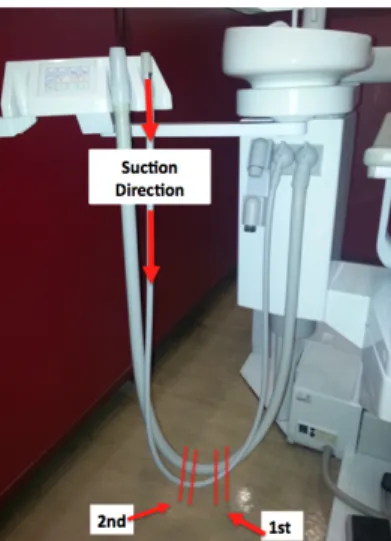
degree dental students. Before biofilm collection, the external surface of the tube was cleaned and disinfected according to the dental faculty protocol. Afterwards, the tubes were sectioned with a sterile scalpel at the bottom of the loop as shown in figure 1 - 1st
section, which is the place more likely for biofilm accumulation. In order to obtain a precise and accurate cut, similar in all analysed tubes, it was used a metal piece, shown in figure 2, to fasten the tube and give an exactly cut tube size unit. After, the tube was cut biofilm was collected from its interior with a sterile scalpel and placed in sterile eppendorf containing Brain Heart Infusion (BHI) with 10% of glycerol. All samples were frozen until microbial analysis.
Figure 1: Sectioned sections from low volume suction tube of DCUs.
Figure 2: Metal piece used to fasten the low volume suction tube of DCUs.
After biofilm collection, the 20 DUCs were divided into two groups of 10 for the performance of two different disinfection protocols, and were again joined with tape. One suction system group were subject to Instrunet® disinfection (the disinfection
protocol in use in FMDUP) and the other suction system group were subject to Orotol® disinfection. Both procedures were preformed according to manufacturers indications. After disinfection protocols were performed, another sample of suction system biofilm was collected from all 20 DUCs as previously described. The section sectioned is shown in figure 1 – 2nd section. These samples were also frozen until microbial analysis.
Microbial analysis
Immediately after collecting the water samples from 20 DUWL and 2 taps, the samples were serially diluted in 0.9% NaCl solution in decimal series until 10−2. The resulting samples were immediately plated in triplicate in rich and selective culture media. Also, a volume of 1ml of water samples was incorporated directly in the same culture media, in triplicate. The culture media used were the following: Blood agar (Biomerieux®, France) to evaluate the total number of anaerobic bacteria; Brain Heart Infusion agar (Liofilchem®, Italy) to determine the total number of aerobic bacteria; MacConkey agar (Cultimed, Panreac®, Spain) to determine the total coliforms and intestinal pathogens (Gram negative bacilli); Pseudomonas Cetrimide agar (Oxoid limited®, UK) to determine the total number of Pseudomonas aeruginosa; Legionella GVPC agar (Biomerieux®, France) to determine the total number of Legionella species; and Sabouraud dextrose agar (Cultimed, Panreac®, Spain) to determine the total number of fungi. All media were incubated aerobically for the maximum of five days at 37ºC except Blood agar that was incubated anaerobically for seven days. The numbers of colonies were counted and the results expressed in colony forming units per milliliter (CFU/ml) and converted to log10. The lower limit of detection was 1 CFU/ml.
DUC suction system biofilms collected before and after disinfection protocols were thawed in a 37ºC water bath. Biofilm was then disrupted by subsequent vortexing and ice bath sonication treatments for 3 seconds, in a total of four times. Afterwards, the suspensions were serially diluted in 0.9% NaCl solution in decimal series until 10−3.
The resulting samples were immediately plated in triplicate in the following culture mediums: Brain Heart Infusion agar, Pseudomonas Cetrimide agar, and Legionella GVPC agar. All media were incubated aerobically for the maximum of five days at 37ºC. The numbers of colonies were counted and the results expressed in colony forming
units per square millimeter (CFU/mm2) and converted to log
10. The lower limit of
detection was 0.2 CFU/ mm2.
Statistical analysis
Data analyses was performed using IBM® SPSS® version 21.0 (Statistical Package for Social Sciences). The categorical variables were described through relative frequencies (%) and analyzed by Chi-square independence test. Continuous variables were described using mean ± standard deviation (SD) and analyzed by student`s t-test. Value of p<0.05 was assumed to denote a significant difference.
RESULTS
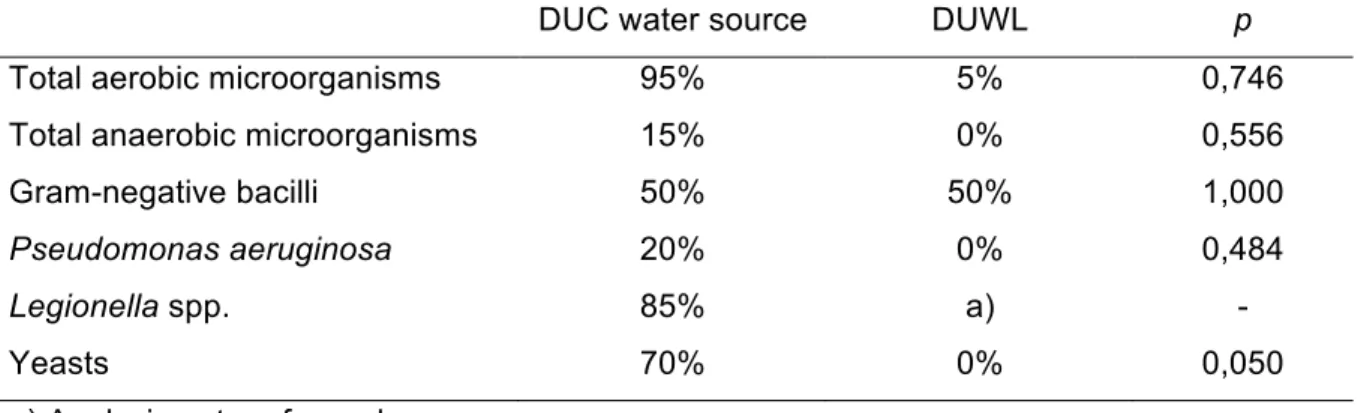
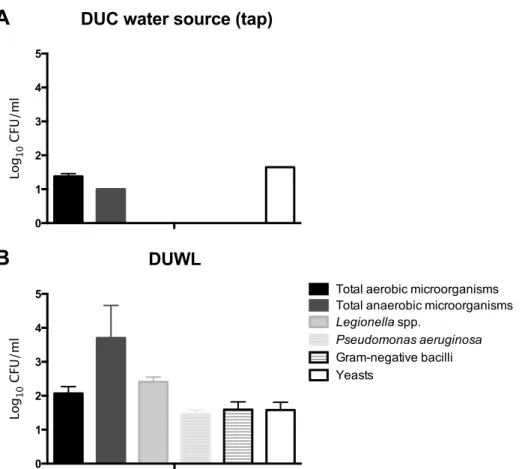
Microbial load and biodiversity were analysed in DUWL of 20 DUCs as well as in DUC water source from the 2 nearest taps. In comparison to DUC water source, the DUWL presented a significant microbial load (Fig. 3) as well as a significant microbial biodiversity, including Gram-negative bacilli, Pseudomonas aeruginosa, Legionella spp. and Yeats (Table I and Fig. 4).
Figure 3: Total aerobic microorganisms expressed in colony forming units per mililiter (CFU/ml), in dental unit chair (DUC) water source (nearest taps) and dental unit waterlines (DUWL).
Table I: Microbial prevalence in dental unit chair (DUC) water source (nearest taps) and dental unit waterlines (DUWL).
DUC water source DUWL p
Total aerobic microorganisms 95% 5% 0,746
Total anaerobic microorganisms 15% 0% 0,556
Gram-negative bacilli 50% 50% 1,000
Pseudomonas aeruginosa 20% 0% 0,484
Legionella spp. 85% a) -
Yeasts 70% 0% 0,050
a) Analysis not performed.
0 10 20 30 500 1000 1500 2000 2500 3000 To ta l&a er ob ic &m ic ro or ga ni sm s& ( CF U /m l) DUC&water&source&(tap) DUWL&
Figure 4: Microbial load expressed in Log10 colony forming units per mililiter (Log10
CFU/ml), in A) dental unit chair (DUC) water source (nearest taps) and B) dental unit waterlines (DUWL).
In DUC suction tubes it was detected a significant microbial load and biodiversity. Both disinfectants, Orotol ® and Instrunet ®, reduced significantly the microbial load of DUC suction tubes (Fig. 5). However, the microorganisms removal rates were considerably low as shown in table II.
DUC water source (tap)
0 1 2 3 4 5 Lo g10 C FU /m l
A
DUWL 0 1 2 3 4 5 Lo g10 C FU /m lTotal aerobic microorganisms
Legionella spp.
Pseudomonas aeruginosa
Gram-negative bacilli Yeasts
Total anaerobic microorganisms
B
Total aerobic microorganisms
3.0 3.5 4.0 4.5 Lo g10 C FU /c m 2 Before disinfection After disinfection Orotol® Instrunet® *
A
Figure 5: Efficiency of disinfectant protocols, Orotol ® and Instrunet ® on microbial load reduction of DUC suction tubes regarding A) total aerobic microorganisms, B)
Pseudomonas aeruginosa and C) Legionella spp.. * Statistically different from before
disinfection (p<0.05).
Table II: Percentage of microbial reduction after disinfection protocols. Orotol® Instrunet®
Total aerobic microorganisms 4.7% 9.6%
Legionella spp. 26.2% 18.2% Pseudomonas aeruginosa 23.1% 27.6% Pseudomonas aeruginosa 1.5 2.0 2.5 3.0 3.5 4.0 Lo g10 C FU /c m 2 Before disinfection After disinfection * * Orotol® Instrunet®
B
Legionella spp. 2.0 2.5 3.0 3.5 4.0 Lo g10 C FU /c m 2 Before disinfection After disinfection * * Orotol® Instrunet®C
DISCUSSION
Microorganisms universally attach to surfaces and produce extracellular polysaccharides, resulting in the formation of a biofilm. Biofilms pose an important problem for public health because of the increased resistance of biofilm-associated microorganisms to antimicrobial agents and its potential to cause infections in patients with indwelling medical devices. An appreciation of the role of biofilms in infection should enhance the clinical decision-making process [17].
The American Dental Association (ADA) addressed the standards of dental water quality and what should be considered safe for human consumption; the dental unit water should not exceed 200 CFU/ml [18]. Studies confirm that in newly installed dental unit waterlines, microbial counts can reach 200,000 CFU/ml within five days [8].
The quality of DUWL output water is directly influenced by the quality of the supply water. Water supplied to DCU’s is generally provided either in independent bottle reservoirs or directly from a municipal mains water supply [6]. According to ADA the best way to keep the DUWL safe from microorganisms is to implement a prevention protocol to avoid the deposition of biofilm.
Regarding our results, the quality of the water present in the DUWL is beyond the standards of water quality in dental practice. Given that, in the present study, it was observed low microbiological loads in tap water, after the water supply and before entering the DUWL, the high values of contamination in DUC output water suggests the contamination of DUWL by biofilm. This situation may endanger public health, with a focus on immunocompromised patients.
Having in mind the high contamination levels of DUWL, is questionable if the frequency and effectiveness of disinfection protocols generally used in dental facilities are appropriate to achieve the excellency in clinical practices. Unfortunately with the data we achieved, we may think that protocols implemented at clinics and educational institutions are not appropriate. Some additional measures have to be implemented in order to improve water quality and obtain results that achieve the standards of good dental practices.
According to ADA [19] we must start to identify the source of DUC water, which can be the municipal water supply or a self-contained water system. The water source of DUC analysed in the present study was municipal water. This source may provide limited access to the waterline but in such instances there are options for controlling water quality: 1) install a point-of-use filter between the dental instrument and the
waterline tubing, 2) retrofit the dental unit so that the water is supplied by a self-contained water system for easy delivery of chemical treatments, or 3) install a system that allows delivery of cleaning agents at the junction box [19]. The other option is the self-contained water system. In this case a reservoir (bottle) is attached to the DUWL isolating it from the municipal water supply. Water (tap, distilled, sterile etc.) must be added manually. Second step is to identify cleaning products that fit our needs and are compatible with our DUC. Some cleaning agents, like bleach, can corrode parts of the dental unit and degrade water tubes over time. Third step is to develop a schedule for waterline maintenance, based on manufacturer recommended treatment methods, and assign the duty to a particular person of the staff. Finally we should establish a periodic protocol for monitoring the quality of dental unit water because the only way to know that a DUWL cleaning regimen is effective is to test the water coming out of the unit [19]. Furthermore, this analysis has particular interest because several studies have demonstrated that DUWL provide a favourable environment for microbial proliferation and biofilm formation and that water is consequently often contaminated with high densities of different microorganisms.
Our results are somewhat in accordance with the results obtained by other authors. The percentage of Legionella present in DUWL obtained in our study was 85% which is similar to those obtained by Aprea et al., with 76,20% [11], and a little higher than that obtained by Zanetti et al. with 61% [20]. The percentage of Pseudomonas in DUWL obtained in our study was 20% which is similar to the 30% obtained in Monarca research [21] and much lower than that obtained by Aprea et al. with 67,7% [11] and the 52,2% observed in a study by Zanetti et al. [20].
Barbeau et al. [22] found high prevalence of Gram negative bacteria and yeasts in DUWL as our study in which we have values of 50%.
The case reported of a Pneumonia developed by an 82 year-old woman associated with DWUL contamination showed a direct relation between Pneumonia and high loads of Legionella present in DUWL of a Dental Office [23]. The values obtained by the authors in that study were significantly higher than ADA recommendations and than those obtained in our study.
Another author found positive relationship between the total bacterial count in the municipal water and the dental unit water counts of the clinics unlike our study, in which we have no correlation between contamination and the water source [24]. Other study performed in several European countries showed that water supplied in 51% of the DUWL exceeded the current ADA recommended bacterial contamination level of 200 CFU/ml [3].
Several diseases can be acquired from a dental unit waterline during routine dental treatment. Aerosolized water from high-speed turbine instruments was most likely the source of the infection [2]. Microorganism’s contamination in dental unit waterlines must be minimized to prevent exposure of patients and staff [2, 23, 24]. Most of the organisms isolated from DUWL are of low pathogenicity. However, data from a small number of studies described infection or colonization in susceptible hosts with Legionella spp., Pseudomonas spp. and environmental mycobacteria isolated from DUWL [2]. Legionella spp. is an important cause of sporadic and epidemic pneumonia in developed countries. Although there is no epidemiological evidence of a widespread public health problem, the risk of exposure to contaminated water in the dental office still exists. Microbial biofilms form inside the dental unit waterlines that deliver water to the dental equipment. The flushing out water delivered from the dental equipment always carries the risk of being inhaled, ingested or inoculated into open wounds [2].
In 1993, Center for Disease Control and Prevention (CDC) recommended that dental waterlines should be flushed several minutes at the beginning of the working day to reduce the microbial load [18]. However, studies have demonstrated that this practice does not affect directly biofilm in the waterlines, it only reduces the load of microorganisms that is higher after several hours without water flow [18]. Additionally CDC alerts that dental devices that are connected to the dental water system and that enter the patient’s mouth (e.g., handpieces, ultrasonic scalers, or air/water syringes) should be operated to discharge water and air for a minimum of 20–30 seconds between each patient. This procedure is intended to physically flush out patient material that may have entered the turbine, air, or waterlines [18].
Unless procedures specifically designed to prevent, eliminate, trap or kill biofilms are performed, there is little reason to believe that any dental unit can avoid being colonized by bacteria [25]. Over the last two decades, numerous approaches have been universally adopted, both chemical and nonchemical based, for reducing the microbial density in DUWL output water but none is both efficient at eliminating biofilm, compatible in the long-term with the material components of DUWL networks and dental instruments attached, as well as being safe for patients [26]. Filters may be installed in-line near the point-of-use (e.g. between the waterline and the dental instrument) to block the passage of microorganisms. Filters will have no effect on the development of biofilm in the waterlines, but will inhibit or reduce the transfer of microorganisms as the water is delivered to the patient. Filters must be periodically replaced, the frequency of which will depend on the amount of biofilm present in the waterlines. Filters may or may not remove endotoxin or other toxic metabolites [19]. Chemicals remove, inactivate, or prevent formation of biofilm. Chemical treatments are
either continuously infused into, or are intermittently added to, the dental unit water. If the waterline is contaminated with a biofilm, it may be necessary to remove it with another treatment before using these products [19]. Water purifiers treat the water entering the dental unit. These systems treat the source water by some method that kills/removes microorganisms (e.g. filtration, heat, UV light). For these systems to deliver clean water at the point of use (to the patient), a chemical treatment must be used to remove/inactivate biofilm in addition to intermittent chemical treatments to maintain waterlines. These systems will not result in delivery of purified water as the water passes through waterlines containing biofilm [19].
In many modern DUCs, the suction system consists of two suction hoses attached to a vacuum source supplied to the body of the DUC. The high-volume suction hose is used to remove debris and dental unit water, and to reduce spray and aerosols, whereas the low-volume suction hose, or saliva ejector, is used mainly to remove excess fluids from the patient’s mouth, especially if the clinician is working unassisted [4]. It has been postulated that evacuation systems used in dentistry could be a source of cross-infection between patients through backflow of bacteria dislodged from the saliva ejector tubings [12]. The potential for backflow was investigated by a study of pressure differentials in evacuation system tubing and by the presence of bacteria in backflow samples. In other experiments, flow reversal was detected several times during saliva ejector use though each of these events was brief (less than 0.1s). Aspiration of saliva, or occlusion of the mouthpiece opening by the oral mucosa, were the major factors leading to backflow episodes [12]. In the same study bacteria associated with backflow were found in almost 25% assays, with counts ranging from 1-300 cfu/ml The majority of the bacteria isolated from biofilm or backflow samples were staphylococci, micrococci and non-fermentative Gram-negative rods. Pathogens such as Pseudomonas aeruginosa was also isolated from backflow fluids [12]. These data suggest, although without direct proof of cross-infection, the possible existence of an infectious risk associated with oral evacuation systems, as potential pathogens may be shed from tubing biofilms following backflow. Even if the risk of cross-infection between patients is considered to be low, the necessity for regular disinfection of these systems must be stressed, since biofilms can serve as a reservoir or harbor potentially infectious pathogens [12].
In agreement with previous studies, in our study both disinfectants, Orotol® and Instrunet®, reduced the microbial loads of DUC suction tubes, but the microbial removal rate was considerably low: <10% for total aerobic microorganisms and <30% for Pseudomonas aeruginosa or Legionella spp. In DUC suction tubes was detected a significant microbial load for total aerobic microorganisms, Pseudomonas and
Legionella, even after disinfection. According to our results, regarding high load of
known pathogenic microorganisms, additional security measures should be implement, as filters between DUC and sewerage system or a reservoir that allowed further dilutions and to add chemicals to neutralize these microorganisms.
In this study we had some limitations such as the reduced number of samples collected in tap water, not having performed identification of Legionella and more important the microorganisms detection limits in microbial analysis for the DUWL should have been increased in order to enhance sensitivity for the microorganisms that we did not found in DUWL. A more appropriated method could be the filtration method using rich and selective culture media.
CONCLUSIONS
In conclusion, our study showed that the quality of the water present in DUWL is beyond the standards of water quality needed for dental practice and that there is relevant contamination on DUC suction tubes.
This situation may endanger public health, with a special focus on immunocompromised patients. Regular microbiological control of water quality should be performed. Also, disinfectants protocols may need to be reviewed for higher efficiency. Infection control education in dental schools, continuing training in dental clinics, and mandatory regulations are needed to improve infection control practices in dental health care settings and, particularly, in DUWL.
References
1. O'Donnell, M.J., A.C. Shore, and D.C. Coleman, A novel automated waterline cleaning
system that facilitates effective and consistent control of microbial biofilm contamination of dental chair unit waterlines: a one-year study. Journal of Dentistry,
2006. 34: p. 648-‐661.
2. Caroline, L. and W. A., Do contaminated dental unit waterlines pose a risk of
infection? Journal of Dentistry, 2007. 35: p. 712-‐720.
3. Walker, J.T.e.a., Microbiological evaluation of dental unit water systems in general
dental practice in Europe. European Journal of Oral Sciences, 2004. 112: p. 412-‐418.
4. O'Donnell, M.J., et al., Bacterial contamination of dental chair units in a modern
dental hospital caused by leakage from suction system hoses containing extensive biofilm. Journal of Hospital Infection, 2005. 59: p. 348-‐360.
5. Caroline, L. and N.W. Johnson, Microbial contamination of dental unit waterlines:
the scientific argument. International Dental Journal, 1998. 48: p. 359-‐368.
6. Coleman, D.C., et al., Biofilm problems in dental unit water systems and its practical
control. Journal of Applied Microbiology, 2009: p. 1424-‐1437.
7. Louis, G.e.a., A review of the science regarding dental unit waterlines. Journal American Dental Association, 2002. 133: p. 1199-‐1206.
8. Barbot, V., et al., Update on infectious risks associated with dental unit waterlines. FEMS Immunology and Medical Microbiology 2012. 65: p. 195-‐204.
9. Szymanska, J., O. Sitkowska, and J. Dutkiewicz, Microbial contamination of dental
unit waterlines. Annals of Agricultural and Environmental Medicine, 2008. 15: p.
173-‐179.
10. OZCAN, M., Y. KULAK, and E. KAZAZOGLU, The effect of disinfectant agents in
eliminating the contamination of dental unit water. Journal of Oral Rehabilitation,
2003. 30: p. 290-‐294.
11. Aprea, L.e.a., Can technical, functional and structural characteristics of dental units
predict Legionella pneumophila and Pseudomonas aeruginosa contamination?
Journal of Oral Science, 2010. 52: p. 641-‐646.
12. Barbeau, J., et al., Cross-contamination potential of saliva ejectors used in dentistry. Journal Hospital Infection, 1998. 4: p. 303-‐11.
13. O'Donnell, M.J., et al., A centralised, automated dental hospital water quality and
output at better than potable quality: a 2-year longitudinal study. Journal of
Dentistry, 2009. 37(10): p. 748-‐762.
14. Revdiwala, S., B. Rajdev, and S. Mulla, Characterization of Bacterial Etiologic Agents
of Biofilm Formation in Medical Devices in Critical Care Setup. Critical Care Research
and Practice, 2012.
15. Benoliel, M., A. Fernando, and P. Diegues, Prevenção e Controlo de Legionella nos
Sistemas de Água. Instituto Português da Qualidade em parceria com a EPAL,
Empresa Portuguesa das Águas Livres, S.A, 2012.
16. Szymanska, J., Microbiological risk factors in dentistry. Current status of knowledge. Annals of Agricultural and Environmental Medicine, 2005. 12: p. 157-‐163.
17. Donlan, R., Biofilm Formation: A Clinically Relevant Microbiological Process. Clinical Infectious Diseases, 2001. 33: p. 1387-‐1392.
18. Prevention, C.f.D.C.a., Guidelines for infection control in dental health-care settings--
2003, 2003. p. 1-‐52.
19. Association, A.D., Dental Unit Water Quality, 2011.
20. Zanetti, F.e.a., Water characteristics associated with the occurrence of Legionella
pneumophila in dental units. European Journal of Oral Sciences, 2000. 108: p. 22-‐
28.
21. Monarca, S., et al., Decontaminatione del sistema idrico del riunito mediante
disinfezi- one e filtrazione. Minerva Stomatology, 2002. 51: p. 451-‐459.
22. Barbeau J, e.a., Multiparametric analysis of waterline contamination in den- tal units. Applied Environmental Microbiology, 1996. 62: p. 3954-‐3959.
23. Ricci, M.e.a., Pneumonia associated with a dental unit waterline, 2012.
24. Bodrumlu, E., T. Alaçam, and A. Bayraktar, Legionella in the dental office. International Journal Dent Hygiene, 2007. 5: p. 116-‐121.
25. Mills, S., The Dental Unit Waterline Controversy: Defusing the myths, defining the
solutions. Journal American Dental Association, 2000. 131: p. 1427-‐1441.
26. Coleman, D.C., et al., The role of manufacturers in reducing biofilms in dental chair
waterlines. Journal of dentistry, 2007. 35: p. 701-‐711.
FIGURES AND TABLES INDEX Figures
Figure 1: Sectioned sections from low volume suction tube of DCUs.
Figure 2: Metal piece used to fasten the low volume suction tube of DCUs.
Figure 3: Total aerobic microorganisms expressed in colony forming units per mililiter (CFU/ml), in dental unit chair (DUC) water source (nearest taps) and dental unit waterlines (DUWL).
Figure 4: Microbial load expressed in Log10 colony forming units per mililiter (Log10
CFU/ml), in A) dental unit chair (DUC) water source (nearest taps) and B) dental unit waterlines (DUWL).
Figure 5: Efficiency of disinfectant protocols, Orotol ® and Instrunet ® on microbial load reduction of DUC suction tubes regarding A) total aerobic microorganisms, B)
Pseudomonas aeruginosa and C) Legionella spp.. * Statistically different from before
disinfection (p<0.05).
Tables
Table I: Microbial prevalence in dental unit chair (DUC) water source (nearest taps) and dental unit waterlines (DUWL).
PARECER
Informo que o trabalho de Monografia desenvolvido pelo estudante Lino Rocha Vinhas com o título “Biofilm study in waterlines and suction tubes of Dental Unit
Chairs of a Dental Medicine Faculty Clinic – Evaluation of effectiveness of a disinfection protocol” está de acordo com as regras estipuladas na FMDUP, foi por mim conferido e
encontra-se em condições de ser apresentado em provas públicas.
03/06/2013
O Orientador
! ! ! !
!
!
PARECER!
!
! !! Informo! que! o! trabalho! de! Monografia! desenvolvido! pelo! estudante! Lino! Rocha!
Vinhas! com! o! título! “Biofilm( study( in( waterlines( and( suction( tubes( of( Dental( Unit((
Chairs( of( a( Dental( Medicine( Faculty( Clinic( –( Evaluation( of( effectiveness( of( a( disinfection( protocol”!está!de!acordo!com!as!regras!estipuladas!na!FMDUP,!foi!por!mim!conferido!e! encontraBse!em!condições!de!ser!apresentado!em!provas!públicas.! ! ! 03/06/2013! ! ! O!CoBorientador! ! ! _____________________________________________________!