www.ccarevista.ufc.br ISSN 1806-6690
Morphological and productive aspects of lettuce in low altitude and
latitude
1Aspectos morfológicos e produtivos de cultivares de alface em baixa altitude e
latitude
Sara Santos Cardoso2, Marcelo de Almeida Guimarães3, Hozano de Souza Lemos Neto3*, Jean Paulo de Jesus
Tello4 and Júlio César DoVale3
ABSTRACT - Lettuce is considered a crop of mild climate and its production in regions of low altitude and latitude is impaired due to the high temperatures and the predominance of long days. Therefore, the aim of this study was to evaluate the behavior of lettuce cultivars in such conditions. An experiment was conducted at theHorta Didática of the Federal University of Ceará, Campus do Pici, in Fortaleza. Nine lettuce cultivars from three commercial groups were used and distributed in a randomized block design, with four replications. The following qualitative traits were evaluated: bolting, head formation, leaf texture, anthocyanin and phytosanitary status for pest and disease infestation. Regarding the quantitative traits, plant height, plant diameter, fresh marketable weight (FMW), and non-marketable (FNMW) total fresh weight (TFW), dry marketable weight (DMW) and non-marketable (DNMW), total dry weight, chlorophylla, chlorophyllb, chlorophylla/b ratio. Data were submitted to analysis of variance and, later, grouping test was performed. None of the cultivars presented head formation but all presented early bolting. The cultivars showed no difference for FMW, however, Babá de Verão produced almost 72% more than Repolhuda Brasil from the same group. Regarding FMW, the most productive cultivars were Babá de Verão, Crespa para Verão, Americana Delícia, Crespa Repolhuda and Kaiser. However, Babá do Verão and Crespa stood out for DMW.
Key words:Lactuca sativaL.. Bolting. Yield. Commercial groups.
RESUMO - A alface é considerada uma cultura de clima ameno e sua produção em regiões de baixa altitude e latitude é prejudicada principalmente devido às elevadas temperaturas e à predominância de dias longos. Assim, objetivou-se avaliar o comportamento de cultivares de alface numa condição que apresentasse essas características. Para isto, conduziu-se um ensaio na Horta Didática da Universidade Federal do Ceará,Campus do Pici, em Fortaleza. Utilizaram-se nove cultivares de alface
de três grupos comerciais, distribuídos no delineamento em blocos casualizados, com quatro repetições. Foram avaliadas as características qualitativas, idade de pendoamento, formação de cabeça, textura da folha, antocianina e, estado fitossanitários das plantas quanto a infestação por pragas e doenças. Em relação às características quantitativas avaliaram-se, altura das plantas, diâmetro das plantas, massa fresca comercializável (MFC) e não comercializável (MFNC), massa fresca total (MFT), massa seca comercializável (MSC) e não comercializável (MSNC), massa seca total (MST), clorofilaa, clorofilab e, relação
clorofilaab. Os dados foram submetidos a análises de variância e, posteriormente, realizado o teste de agrupamento. Nenhum
dos cultivares apresentou formação de cabeça, mas todos pendoaram precocemente. Os cultivares não apresentaram diferença para MFC, porém, Babá de Verão produziu quase 72% a mais que Repolhuda Brasil, de seu mesmo grupo. Quanto à MFT, os cultivares mais produtivos foram Babá de Verão, Crespa para Verão, Americana Delícia, Crespa Repolhuda e Kaiser. Contudo, para MSC apenas Babá de Verão e Crespa se sobressaíram. Esses últimos, juntamente com Crespa Repolhuda, foram os que apresentaram também os maiores valores de MST.
Palavras-chave:Lactuca sativaL.. Pendoamento. Produtividade. Grupos Comerciais. DOI: 10.5935/1806-6690.20180073
*Corresponding author
Received for publication on 18/09/2015; approved on 18/12/2017
1Trabalho de Conclusão de Curso da primeira autora apresentado ao Curso de Agronomia da Universidade Federal do Ceará/UFC
2Programa de Pós-Graduação em Agronomia, Universidade Federal da Paraíba/UFPB, CCA-Campus II, Areia-PB, Brasil, [email protected] 3Programa de Pós-Graduação em Agronomia/Fitotecnia, Universidade Federal do Ceará/UFC, Fortaleza-CE, Brasil, [email protected], hozanoneto@
hotmail.com, [email protected]
INTRODUCTION
Lettuce (Lactuca sativa L.) is the most popular leafy vegetable and, therefore, presents the greatest economic importance within this group. It also stands out from the social point of view since it is traditionally cultivated by small Brazilian producers. However, its relevance is not only national once it is present in the diet of a large part of
the world’s population (HEREDIA ZARATEet al., 2010;
SALA; COSTA, 2012).
It is considered a plant of subtropical climate because it produces quality leaves at temperatures between 12 and 22 °C. However, when submitted to temperatures above 22 °C, it is stimulated to emit plant bolting more quickly, culminating in the stoppage of its vegetative phase (RODRIGUESet al., 2008). When it happens, the product is unfit for consumption, due to the bitter taste from latex accumulation (VARGAS; DUARTE; ZECCHINI, 2014).
The length of the day also interferes with the cycle of this species. Days with more than 10 hours of light greatly influence their development. In general, this condition promotes early bolting (FILGUEIRA, 2008;
SANTOS et al., 2009). Therefore, temperature and day
length are crucial in the production of lettuce in regions of low altitude and latitude, such as the Brazilian Northeast. Then, marketers and traders routinely acquire lettuce from regions or municipalities that present more favorable climatic conditions for its cultivation.
Despite the difficulties mentioned above, professionals from phytotechnology and plant breeders have been working on the development of techniques and the improvement of this species to enable quality productions throughout the year. However, even with all the efforts made to increase the productive and visual efficiency of lettuce, little has been done in low altitude and latitude regions, which are typical of the North and Northeast regions of Brazil. These areas are dependent on the cultivation of lettuces developed for environments that present completely different climatic conditions, causing, in most cases, a marked reduction in yield and quality.
According to Disqual (2001), farmers should be attentive to the choice of the most appropriate cultivar, as well as the quality of the propagating material. An incorrect choice can result in damages to producers, even with the correct management. Thus, this study aimed to describe morphological and productive aspects of lettuce cultivars under low altitude and latitude climatic conditions.
MATERIAL AND METHODS
The experiment was conducted in a field belonging toHorta Didática, in the Plant Science Department of the
Federal University of Ceará, Campus Pici, in Fortaleza-Ceará (3º44´ S e 38º33´ W and altitude of 21 m). According to Köppen, the climate of the region is classified as type Aw ‘(tropical with dry season).
The experiment was conducted from March to April 2014. During the cycle, the temperature ranged from 23 to 30.6 °C, 70-80% relative humidity, insolation from 10.6 to 11.6 h.day-1 and precipitation from 50 to 272 mm.
Data were obtained at the meteorological station of the Department of Agricultural Engineering, 2 km away from the work location.
Nine lettuce cultivars were used: two of the group Lisa Repolhuda (Babá de Verão Manteiga and Repolhuda Brasil 303), three of the group Crespa Solta (Crespa Para Verão, Marianne and Elba) and four of Crespa Repolhuda (Americana, Americana Delícia, Crespa Repolhuda and Kaiser). These cultivars were distributed in the experimental field by a randomized blocks design, with four replications. The plot consisted of sixteen plants, but nine plants were considered as useful area, as recommended by Lúcioet al. (2011).
The production started from the sowing of each of the evaluated cultivars in polypropylene trays of 162 cells previously filled with a substrate formulated with an organic compost, coconut fiber and chicken litter (3:1:1v.v.). These trays were left until the emergence of plants in an environment with 71 ± 5% humidity and 23 ± 2 °C air temperature. After this period, they were transferred to a protected environment covered with screen mash 30%. The thinning was carried out at 14 days after sowing (DAS). Five kilos of organic compound per square meter was incorporated in each block (Table 1). This compound was produced by the deposition of organic material, such as leaves, twigs, vegetable residues interspersed with bovine manure.
One week after the incorporation, five simple samplings were performed in each block. For each one, a composite sample of soil was made, later sent for fertility analysis in the Soil Laboratory of the Soil Science Department of the Federal University of Ceará (Table 1).
The seedlings transplanting was performed at 23 DAS (when the seedlings presented from 4 to 6 definitive leaves), distributed in spacing of 0.20 m x 0.20 m. Weeding, pest and disease control were carried out whenever necessary, according to the crops need. Micro-sprinkler was used for irrigation twice a day (early morning and late afternoon). Regarding the fertilization, two coverage applications were performed at 33 and 43 DAS, with 3 kg of the organic compound per m2.
Table 1 - Chemical analysis of the soil and the organic compound used to produce seedlings and of the blocks used in the study, one week after the incorporation of the compound
O.C - Organic compound; B1, B2, B3, B4 - Blocks; N - Nitrogen; P - Phospor; K+- Potassium; Na+- Sodium; Ca2+- Calcium; Mg2+- Magnesium; Al3+
-Aluminum; pH - Potential of hydrogen; CEC - cation exchange capacity; EC - Electrical conductivity
Parameters O.C B1 B2 B3 B4
N (g kg-1) 4,40 2,20 3,00 2,90 2,20
P (mg dm-3) 983 1246 1061 783 656
K+ (mg dm-3) 1400 301 426 470 329
Na+ (mg dm-3) 22,00 64,00 95 168 85
Ca2+ (cmol
c dm-3) 11,20 10,50 8,40 8,20 6,20
Mg2+ (cmol
c dm-3) 10,80 8,00 6,20 3,30 5,00
Al3+ (cmol
c dm-3) 0,00 0,10 0,00 0,00 0,05
pH in H2O 7,40 7,10 7,00 7,10 7,40
CEC (cmolc dm-3) 23,42 18,87 15,12 12,14 11,61
EC (dS m-1) 1,00 0,93 0,69 0,78 1,03
was identified, indicated by the plant bolting. Regarding the qualitative evaluations, it was observed: age of bolting - defined by DAS by daily observation of the stem elongation; head formation (present or absent); leaf texture (crisp or smooth); anthocyanin (present or absent); phytosanitary status of plants for pest infestation; and, phytosanitary status of plants for disease infestation. The last two characteristics were evaluated based on a visual scale of grades proposed by Motaet al. (2003), with a variation from 1 to 5 (1- plants with highly lesioned leaves, 2- abundant presence of lesions in external leaves, 3-plants with moderately injured leaves, 4 3-plants with rarely injured leaves, and 5- plants without lesions in leaves).
For the quantitative evaluations, it was observed: plant height (PH) - determined from the measurement of the insertion point of the plant in the soil to the shoot apical bud; plants (PD) - determined from the distance between the edges of different and opposite leaves; chlorophylla and b (CLOR a and CLOR b) - before harvesting, the indirect measurement of non-destructive measurements was performed with Chlorophyllometer SPAD-502 (Minolta Camera Co. Ltd., Japan). The youngest leaf which was totally developed was used for this measurement. This evaluation was carried out at harvest. Then, chlorophyll a / b ratio was determined.
The plants were then harvested around 6 and 7 in the morning, and the shoot part was separated in marketable (leaves without lesions or apparent damage) and non-marketable (leaves with lesion or apparent damage) and then weighed on a digital scale with accuracy of 4 decimal places to determine fresh marketable weight (FMW), non-marketable (FNMW) and total (TFW). After the determination of the fresh weight, the plants were placed
in paper bags and then dried in a forced air circulation oven with temperature ranging from 65 to 70 °C for 48 hours to determine dry marketable weight (DMW), non-marketable (DNMW) and total (TDW). The results of all weights were expressed in g.
Data were submitted to analysis of variance through the hierarchical model:
yijk = m + ti+ gj+ t/gij+ bk+ eijk
wherey
ijk is the effect of observing thei-th cultivar of the
j-th commercial group in thek-th block;m is the overall mean of the experiment;t
i is the effect of thei-th cultivar;gj
is the effect of thej-th commercial group;t/g
ijis the effect
of thei-th cultivar within thej-th commercial group;bk is the effect of thek-th block and;eijk the effect of the error associated with the i-th cultivar of the j-th commercial
group in the k-th block. The treatments were ramdomly
distributed in the plots within each block.
Subsequently, the grouping test was performed using the Scott-Knott procedure at 0.05 probability. At first, a comparison was made involving all the cultivars, regardless the commercial group. Later, the test was applied between cultivars within each commercial group. All the statistical analyzes were performed with the computational application in Genetics and Statistics GENES (CRUZ, 2013).
RESULTS AND DISCUSSION
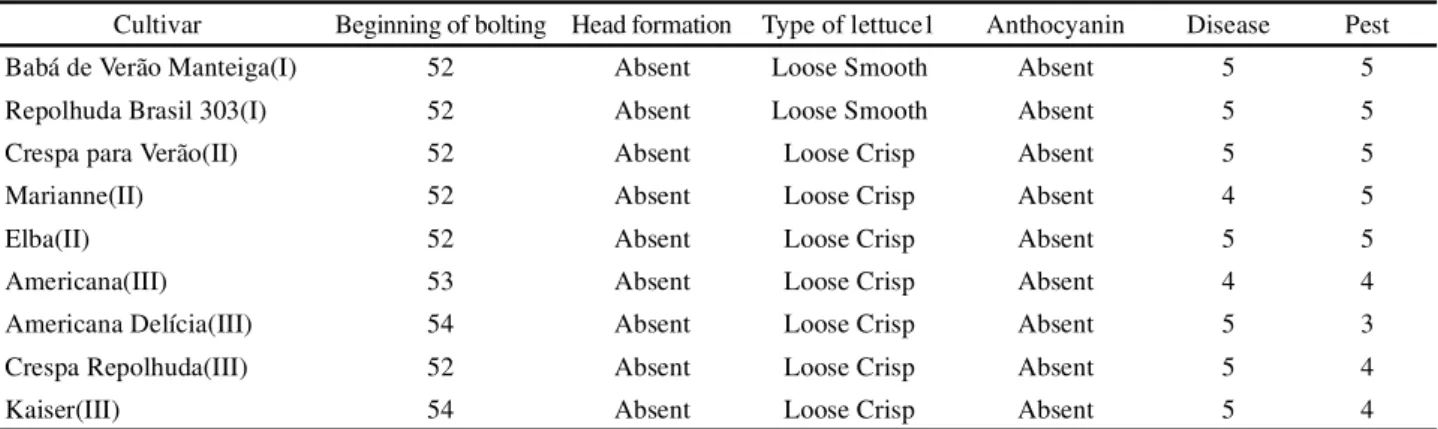
Repolhuda and Crespa Solta, respectively), which at 52 days after sowing (DAS) started the bolting process. The cultivars of Crespa Repolhuda (Americana Delícia and Kaiser) resisted two more days before bolting.
The combination of long days (10.6 to 11.6 h light) with high temperatures (averages of approximately 27 °C) influenced the early bolting of all cultivars in this study (FILGUEIRA, 2008; SANTOS et al., 2009). Diamante et al. (2013) working with cvs. Regina, Elizabeth, Elisa and Regiane, observed mean values of bolting of 82; 80; 79 and 81 DAS, respectively, in Cáceres-MT.
Head formation was not observed in any of the cultivars. This result shows relevant importance, because six out of the nine cultivars are commercialized as lettuces that form head (Babá de Verão Manteiga, Repolhuda Brasil 303, Americana, Americana Delícia, Crespa Repolhuda and Kaiser). A possible explanation for this morphological alteration may be related to temperature. For lettuce crops, air temperature is the main conditioning element of its development, interfering both in the emission of leaves and in the change of phenological stages (HERMESet al., 2001). According to Bezerra Netoet al. (2005), due to the Mediterranean origin of lettuce, part of its genetic load responds differently when submitted to different temperature conditions. Temperatures above
27 oC are considered high and promote an accelerated
development of the plant, with elevation in the distance between the leaves internodes, with early bolting without head formation. According to Fabri (2007), for head formation in lettuce, the internodes need to be short, and it only happens when the plants are cultivated at milder temperatures.
Table 2 - Visual morphological evaluation of nine lettuce cultivars of three commercial groups (Group I - Lisa Repolhuda; Group II - Crespa Solta; Group III - Crespa Repolhuda)
(I), (II) e (III) cultivars belonging to commercial groups I, II and III respectively;1Types of lettuce: Loose Crisp: presents more consistent, crisp and loose
leaves, without head formation. Depending on the cultivar, the leaves may have green or purple coloring. Purple is characteristic of anthocyanin accumulation. Loose Smooth: presents loose and smooth leaves with no head formation;2Evaluation of phytosanitary status of plants based on a visual
scale of grades, from 1 to 5 (1 plants with external leaves heavily attacked by leaf diseases / pests, 2) abundant presence of lesions on outer leaves, 3) moderate presence of lesions on outer leaves, 4 - scarce lesions on the outer leaves, and 5- plants with highly healthy leaves)
The type or group in which each cultivar was commercially framed was different for Babá de Verão Manteiga, Repolhuda Brasil 303, Americana, Americana Delícia, Crespa Repolhuda and Kaiser. Although commercially disclosed as group Repolhuda Lisa, in the present work, the two first cultivars presented typical characteristics of the group Solta Lisa. The last four, commonly cited as belonging to the group Repolhuda Crespa were morphologically classified as belonging
to the group Solta Crespa (KRISTKOVA et al., 2008).
The differences observed in the classification groups of lettuces are mainly related to the greater spacing observed between the leaves produced in the cultivars, which makes it impossible to form the head.
Regarding anthocyanin, none of the cultivars presented any apparent trace of this pigment. This was already expected, since all the cultivars presented only the green color in the description of the seeds commercial packages.
Regarding the phytosanitary status of plants for the disease factor, except for cvs. Marianne and Americana, which presented scarce lesions on older leaves, typical of the disease known as Cercospore Spot, the others did not show spots and were considered healthy. However, regarding the phytosanitary status for the pest factor, cvs. Babá de Verão, Repolhuda Brasil 303, Crespa para Verão, Marianne and Elba showed high sanity, as they did not present predation injuries. On the other hand, all those cvs. belonging to the commercial group Crespa Repolhuda suffered some type of predation, for example cv. Americana Delícia which presented the lowest grade (3). For Sala and Costa (2012), crisp lettuces tend to be more resistant to diseases and pest attacks than those Cultivar Beginning of bolting Head formation Type of lettuce1 Anthocyanin Disease Pest
Babá de Verão Manteiga(I) 52 Absent Loose Smooth Absent 5 5
Repolhuda Brasil 303(I) 52 Absent Loose Smooth Absent 5 5
Crespa para Verão(II) 52 Absent Loose Crisp Absent 5 5
Marianne(II) 52 Absent Loose Crisp Absent 4 5
Elba(II) 52 Absent Loose Crisp Absent 5 5
Americana(III) 53 Absent Loose Crisp Absent 4 4
Americana Delícia(III) 54 Absent Loose Crisp Absent 5 3
Crespa Repolhuda(III) 52 Absent Loose Crisp Absent 5 4
SV DF Mean Squares
FMW FNMW TFW DMW DNMW TDW
Cultivar (C) (8) 317.03ns 135.07* 396.27* 0.96** 0.98* 1.74*
Group (G) 2 61.44ns 232.54* 84.33ns 0.40ns 0.98ns 0.17ns
C/G 6 402.23ns 102.58ns 500.24** 1.15** 0.99* 2.27**
C/GI 1 2145.13** 2.00ns 2016.13** 5.75** 0.03ns 4.99**
C/GII 2 80.77ns 46.94ns 250.77ns 0.29ns 0.12ns 0.77ns
C/GIII 3 35.57ns 173.19* 161.26ns 0.19ns 1.88** 2.36*
Residue 24 202.68 44.07 137.29 0.22 0.40 0.61
Mean 62.23 15.21 77.44 3.27 1.06 4.33
CVe (%) 22.88 43.65 15.13 14.49 59.38 18.05
SV DF Mean squares
PH PD CLORa CLORb CLOR ab
Cultivar (C) (8) 10.54** 26.05** 42.87** 2.12** 0.73**
Group (G) 2 10.06** 26.26** 142.03** 6.69** 2.28**
C/G 6 10.69** 25.98** 9.82** 0.60** 0.21ns
C/GI 1 1.04ns 21.26* 0.06ns 0.05ns 0.27ns
C/GII 2 1.40ns 33.32** 0.29ns 0.01ns 0.02ns
C/GIII 3 20.12** 22.66** 19.44** 1.17** 0.32ns
Resíduo 24 0.94 3.44 1.83 0.02 0.13
Mean 6.06 30.06 17.15 2.79 6.26
CVe (%) 15.97 6.17 7.89 5.33 5.68
Table 3 - Summary of analysis of variance for plant height (PH, cm), plant diameter (PD, cm), chlorophyll a (CLOR a),
chlorophyllb (CLOR b) and chlorophylla andb ratio (CLOR ab) in nine lettuce cultivars in three commercial groups (Group
I - Lisa Repolhuda; Group II - Crespa Solta; Group III - Crespa Repolhuda)
ns not significant,** and* significant at 1 and at 5% probability, respectively, by the F test
ns not significant,** and* significant at 1 and 5% probability, respectively by the F test
Table 4 - Summary of analysis of variance for fresh marketable weight (FMW, in g) and non-marketable (FNMW in g), total fresh
weight (TFW in g), dry marketable weight (DMW in g) and non-marketable (DNMW in g), total dry weight (TDW, in g) in nine lettuce cultivars of three commercial groups (Group I - Lisa Repolhuda; Group II - Crespa Solta; Group III - Crespa Repolhuda)
classified as smooth. However, this was not observed in the present study.
The effect of cultivar was significant for almost all the evaluated traits, except the FMW (Tables 3 and 4). For group, no effect was observed for FMW, TFW, DMW, DNMW and TDW. For the cultivars within the groups, there were differences for all characteristics except for the chlorophyll a/b ratio and the FMW and FNMW. Regarding the effect of cultivars within group I (C/GI), differences were observed for the characteristics PD, FMW and TFW, DMW and TDW. On the other hand, for the cultivars within the GII presented differences only for PD, whereas for those
belonging to GIII there was difference in relation to PH, PD, chlorophyll a and chlorophyll b, FNMW, DNMW and TDW.
It was observed that GIII cultivars were the ones
with the lowest plant height, except Crespa Repolhuda
For PD, the cultivars Crespa para Verão and Elba from GII and the cultivar Americana from GIII presented mean diameter of the superior shoot part of 32 cm. Within the GI, the cultivar Babá de Verão Manteiga was superior, presenting average diameter of 30.35 cm. Plant diameter is an important characteristic from the standpoint of lettuce marketing, because plants with larger diameter tend to draw more attention from consumers at purchasing (REGHINet al., 2002).
Rodrigues et al. (2008), working with crisp
cultivars in the climatic conditions of Manaus-AM, similar in temperature and humidity to the city of Fortaleza (27 °C and 60%), observed plant diameter varying from 13.60 to 27.73 cm at 58 DAS, which are lower values than those obtained in this work at 53 DAS.
The difference in diameter observed between the two studies can be related to two factors: the first is the genetic difference among the cultivars, which can present totally different morphological and productive characteristics even under similar climatic conditions; the second one, which would explain the observed difference, would be related to the way of implantation and conduction of the crop (spacing, fertilization, duration of the major cycle, etc.), which can substantially interfere in the development of plants of any cultivar.
Cultivar Americana stood out for chlorophyll a
andb, cv. (22.82 and 4.18, on average) among the nine cultivars. For chlorophyll ab ratio, the cultivars of the commercial groups Lisa Repolhuda and Crespa Solta stood out in relation to the group Crespa Repolhuda, with means of 6.58 and 5.86, respectively.
(I), (II) e (III) cultivars of the comercial groups I, II and III, respectively; Means followed by the same capital letter in the column did not differ statistically
by the Scott-Knott test (p <0.05) and showed global differences among all cultivars; Means followed by the same lowercase letter in the column did not differ statistically by the Scott-Knott test (p <0.05) and showed global differences between cultivars of the same commercial group
Table 5 - Means of plant height (PH, cm), plant diameter (PD, cm), chlorophylla (CLOR a), chlorophyllb (CLOR b) and chlorophyll a and b ratio (CLOR ab) in nine lettuce cultivars of three commercial groups (Group I - Lisa Repolhuda; Group II - Crespa Solta; Group III - Crespa Repolhuda) cultivated under low altitude and latitude
The thylakoid membranes of all plants contain these two different forms of chlorophyll (a and b). The chlorophylla is found in all reaction centers and antennas,
in which chlorophyll b is also found (BUCHANAN;
GRUISSEM; JONES, 2000). Both are related to the accomplishment of the photosynthetic process in plants (TAIZ; ZEIGER, 2013). Chlorophyllais used to perform the photochemical phase of photosynthesis, since chlorophyllb acts more as an accessory pigment, aiding in the absorption of light and energy transfer to the reaction
centers (STREIT et al., 2005). Despite cv. Americana
presented the highest value of chlorophyll, it was not the one that presented the greatest mass production. This can happen, because under high temperatures and light, photoinhibitory damage can occur and cause reduction in pigments (TAIZ; ZEIGER, 2013).
By the values of the chlorophyll ab (CLORab)
relation, it was observed that the insolation of the environment in this work was quite high. This is because the ratio is usually 3: 1 and, in the present work, the cultivars presented values ranging from 5.49: 1 to 6.80: 1. However, they did not show differences among them. These values are within the ones observed by Boardman (1990), who concluded that the lower the value of this ratio, the lower the luminous intensity due to an increase of chlorophyllb in shaded environments.
Obviously, not only the content of chlorophyll a and bwill influence on the photosynthesis, but also the interaction of several factors with the genetic load of the plant. Thus, together, they can produce less or more productive plants.
Cultivars PH Traits
PD CLOR a CLOR b CLOR ab
Babá de Verão Manteiga (I) 7.28 aB 30.35 aB 16.88 aC 2.63 aD 6.44 aA
Repolhuda Brasil 303 (I) 6.56 aB 27.09 bB 16.71 aC 2.47 aD 6.80 aA
Crespa para Verão (II) 6.78 aB 34.41 aA 13.40 aD 2.07 aE 6.49 aA
Marianne (II) 7.05 aB 28.67 bB 13.90 aD 2.13 aE 6.53 aA
Elba (II) 5.92 aB 32.07 aA 13.47 aD 2.04 aE 6.64 aA
Americana (III) 4.63 bC 32.90 Aa 22.82 aA 4.18 aA 5.49 aB
Americana Delícia (III) 4.50 bC 27.35 bB 20.53 bB 3.44 bB 5.99 aB
Crespa Repolhuda (III) 8.48 aA 28.72 bB 17.67 cC 2.89 cC 6.15 aB
Regarding FMW, no difference was observed among the evaluated cultivars, which presented, on average, a production of 62.23 g plant-1 (Table 6). Among
the different commercial groups in the present study, there was difference only in GI, with emphasis for Babá de Verão that produced plants with fresh marketable weight of 78.38 g, almost 72% more mass than Repolhuda Brasil 303. Santiet al. (2010), also worked with Babá de Verão and obtained a fresh marketable weight value higher than that observed in this study (127.04 g). Probably, this difference occurred due to the higher doses of organic fertilization used by the authors and the climatic condition of the place, which presents an annual average temperature around 24 °C, which is considered ideal for the crop.
Probably, this difference occurred due to the higher doses of organic fertilization used by the authors and the climatic condition, which presents an annual average temperature around 24 °C, considered ideal for the crop.
GIII stood out negatively for FNMW. Three out of four cultivars of this group (Americana Delícia, Crespa Repolhuda and Kaiser) presented the highest fresh non-marketable weight (22.40 g on average). In a joint analysis of this characteristic with the phytosanitary status of the pest factor, it is possible to establish a partial relationship among the factors, since these three cultivars were also some of the ones that presented higher incidence of leaves predated by pests.
Regarding the TFW, five cultivars were considered the most productive (Babá de Verão, Crespa para Verão,
Table 6 - Means of fresh marketable weight (FMW, in g) and non-marketable (FNMW, in g), total fresh weight (TFW, in g), dry marketable weight (DMW, in g), non-marketable (DNMW, in g), and total dry weight (TDW in g) in nine lettuce cultivars of three commercial groups (Group I - Lisa Repolhuda; Group II - Crespa Solta; Group III - Crespa Repolhuda) cultivated under low altitude and latitude conditions
(I), (II) e (III) cultivars belonging to commercial groups I, II and III respectively; Means followed by the same capital letter in the column did not differ
statistically by the Scott-Knott test (p<0.05) and showed global differences among all cultivars; Means followed by the same lowercase letter in the column did not differ statistically by the Scott-Knott test (p<0.05) and showed global differences among cultivars of the same commercial group
Americana Delícia, Crespa Repolhuda and Kaiser) with a mean of 84.64 g, about 24% more than the other cultivars. For the commercial group Lisa Repolhuda, the cv. Babá de Verão was the most productive. However, for the other groups no difference was observed among the cultivars. Rodrigues et al. (2008) worked with different cultivars of crisp lettuce in the municipality of Iranduba-AM and observed mean values of total production (26.96 to 104.61 g plant-1) and marketable (25.54 to 96.7 g plant-1)
similar to those obtained in this work. This is probably due to the similarity of the climatic conditions between that environment and Fortaleza-CE, as well as to the cultivars belonging to the same commercial group.
Santoset al. (2009), evaluating different cultivars of crisp lettuce, such as Elba and Marianne in Cáceres-MT, observed means of total production ranging from 52.5 to 111.5 g plant-1 and marketable production of 29.0
to 104.3 g plant-1. In this aspect, cvs. Babá de Verão and
Crespa para Verão, developed to be produced at higher temperatures, stood out (ISLA SEMENTES, 2014; TOP SEED GARDEN, 2014). However, they can be perfectly used in locations with high daily thermal averages throughout the year. This position is supported by Henz and Suinaga (2009), who point out the so-called “cultivars for summer” as the best adapted for production in the North and Northeast regions (higher temperatures and days with more constant photoperiod and over 10 hours of light).
For DMW, cvs. Babá de Verão (group Lisa Repolhuda) and Crespa para Verão (group Crespa Solta)
Cultivar Traits
FMW FNMW TFW DMW DNMW TDW
Babá de Verão Manteiga (I) 78.38 aA 11.88 aB 90.25 aA 4.28 aA 0.86 aB 5.14 aA
Repolhuda Brasil 303 (I) 45.63 bA 12.88 aB 58.50 bB 2.59 bB 0.97 aB 3.56 bB
Crespa para Verão (II) 69.75 aA 15.63 aB 85.38 aA 3.68 aA 1.02 aB 4.73 aA
Marianne (II) 63.25 aA 10.50 aB 73.75 aB 3.16 aB 0.74 aB 3.90 aB
Elba (II) 61.13 aA 9.13 aB 70.25 aB 3.30 aB 0.70 aB 3.99 aB
Americana (III) 61.56 aA 9.69 bB 71.25 aB 3.31 aB 0.72 bB 4.03 bB
Americana Delícia (III) 58.88 aA 24.81 aA 83.69 aA 2.92 aB 1.11 bB 4.02 bB
Crespa Repolhuda (III) 64.13 aA 21.25 aA 85.38 aA 3.27 aB 2.31 aA 5.58 aA
were the most productive among all the evaluated cultivars. Babá de Verão also stood out within its commercial group. These cultivars presented, on average, 4.28 and 3.68 g plant-1, respectively. Santoset
al. (2009), worked with cvs. Itapuã, Elba and Veneranda, in Cáceres-MT, and observed higher values of dry weight than those obtained in this study (47.16 to 99.5
g plant-1). The difference observed between the two
studies may be related to the genetic difference between the cultivars, the way of implantation and conduction of the crop (spacing, fertilization, among others), as well as the season. All of them may interfere together or individually, but substantially in the development of the evaluated cultivars.
According to Tibbits and Bottemberg (1976), very low values of dry weight evidenced a higher speed of leaf expansion, probably due to high levels of air relative humidity. This may have happened in this work, because of the high temperatures, days with more than 10 h of light and mainly due to the micro sprinkler irrigation system. In spite of favoring the development of the visual appearance of the product, this accelerated growth hinders the accumulation of photoassimilates, which are used in the synthesis of structures that would be accounted as dry weight. This reduces their resistance to transportation and makes them more susceptible to damage during post-harvest handling. Regarding non-marketable dry weight, there was a negative highlight only for cv. Crespa Repolhuda (group Crespa Repolhuda), which produced on average 2.31 g plant-1.
Among the nive cultivars, three could be highlighted for TDW (Babá de Verão Manteiga, Crespa para Verão and Crespa Repolhuda), presenting on average 5.15 g plant-1. The cultivars Babá de Verão Manteiga and
Crespa Repolhuda also stood out, since they differed from the others of their respective commercial groups. It was expected that the cv. Americana would be able to capture more light, directing this greater energy for the accomplishment of photosynthesis and, consequently, for the accumulation of photoassimilates, since it presented the highest values of chlorophyll a and b in the tissues. However, observing the MDW produced by this cultivar, it was verified that the higher levels of chlorophyll a and b produced were not able to be converted into higher yield, at least under the edaphoclimatic conditions of this work. Thus, studies involving correlations between these traits should elucidate their importance for yield.
CONCLUSION
The cultivars Babá de Verão Manteiga and Crespa para Verão presented the best visual and productive
characteristics under the conditions of low altitude and latitude.
REFERENCES
BEZERRA NETO, F.et al. Produtividade de alface em função de condições de sombreamento e temperatura e luminosidade elevadas. Horticultura Brasileira, v. 23, n. 2, p. 189-192, 2005.
BOARDMAN, N. K. Comparative photosynthesis of sun and shade plants.Annual Review of Plant Physiology, v. 28, n. 1,
p. 355-377, 1990.
BUCHANAN, B.; GRUISSEM, W.; JONES, R. L.Biochemistry & molecular biology. 1. ed. Rockville: American Society of
Plant Physiologists, 2000. 1367 p.
CRUZ, C. D. Genes: a software package for analysis in experimental statistics and quantitative genetics. Acta Scientiarum. Agronomy, v. 35, n. 3, p. 271-276, 2013. DIAMANTE, S. M.et al. Produção e resistência ao pendoamento
de alfaces tipo lisa cultivadas sob diferentes ambientes.Revista Ciência Agronômica, v. 44, n. 1, p. 133-140, 2013.
DISQUAL. Manual de boas práticas. Disponível em: <http://www.esb.ucp.pt/twt/disqual/pdfs/disqual_alface.pdf>. Acesso em: 03 nov. 2011.
FABRI, E. G. et al. Desempenho de cultivares de alface em cultivo no verão. Horticultura Brasileira, v. 25, n. 1, p. 45, 2007.
FILGUEIRA, F. A. R. Novo manual de olericultura: agrotecnologia moderna na produção e comercialização de hortaliças. 3. ed. Viçosa, MG: UFV, 2008. 421 p.
HENZ, G. P.; SUINAGA, F.Tipos de alface cultivados no Brasil. Brasília: Embrapa Hortaliças, 2009. 7 p. (Comunicado
técnico, 75)
HEREDIA ZARATE, N. A.et al. Produção agroeconômica de
três variedades de alface: cultivo com e sem amontoa.Revista Ciência Agronômica, v. 41, n. 4, p. 646-653, 2010.
HERMES, C. C.et al. Emissão de folhas de alface em função de
soma térmica. Revista Brasileira de Agrometeorologia, v. 9,
n. 2, p. 269- 275, 2001.
ISLA SEMENTES. Alface baba de verão. Disponível
e m : < h t t p s : / / i s l a . c o m . b r / p r o d u t o / A l f a c e B a b a d e -Ver%C3%A3o/26>. Acesso em: 03 dez. 2014.
KRISTKOVA, E.et al. Description of morphological characters of lettuce (Lactuca sativa L.) genetic resources.Horticulture Science, v. 35, n. 3, p. 113-129, 2008.
LÚCIO, A. D. et al. Estimativa do tamanho de parcela para
experimentos com alface.Horticultura Brasileira, v. 29, n. 4, p. 510-515, 2011.
MOTA, J. H.et al. Avaliação de cultivares de alface americana
REGHIN, M. Y. et al. Sistemas de cultivo com diferentes espaçamentos entre plantas em alface mini. Horticultura Brasileira, v. 20, n. 2, p. 01-05, 2002.
RODRIGUES, I. N. et al. Desempenho de cultivares de alface na região de Manaus.Horticultura Brasileira, v. 26,
n. 4, p. 524-527, 2008.
SALA, F. C; COSTA, C. P. Retrospectiva e tendência da alfacicultura brasileira.Horticultura Brasileira, v. 30, n. 2,
p. 187-194, 2012.
SANTI, A.et al. Ação de material orgânico sobre a produção e
características comerciais de cultivares de alface.Horticultura Brasileira, v. 28, n. 1, p. 87-90, 2010.
SANTOS, C. L.et al. Desempenho de cultivares de alface tipo crespa sob altas temperaturas em Cáceres-MT.Agrarian, v. 2, n. 3, p.87-98, 2009.
STREIT, N. M.et al. As clorofilas.Ciência Rural, v. 35, n. 3, p. 748-755, 2005.
TAIZ, L.; ZEIGER, E. Fisiologia vegetal. 5. ed. Porto Alegre: Artmed, 2013. 954 p.
TIBBITS, T. W.; BOTTEMBERG, G. Growth of lettuce under controlled humidity levels.Journal of the American Society of Horticultural Science, v. 101, n. 1, p. 70-73, 1976.
TOP SEED GARDEN. Sementes de alface crespa para verão. Disponível em: <http://agristar.com.br/topseed-garden/ tradicional-hortalicas/alface-crespa-para-verao/552121//>. Acesso em: 03 dez. 2014.
VARGAS, P. F.; DUARTE, L. S.; ZECCHINI, A. C. Alternativas ao pendoamento.Revista Campos & Negócios, v. 1, n. 1, p. 81, 2014.