_____________________________________________________________________________________________________
*Corresponding author: E-mail: [email protected], [email protected];
Common octopus (Octopus vulgaris) Performance
When Including Fasting on Feeding Schemes:
Preliminary Data Regarding a Formulated Feed
Tania Rodríguez-González
1,2*, Jesús Cerezo Valverde
1, António V. Sykes
2and Benjamín García García
11
Instituto Murciano de Investigación y Desarrollo Agrario y Alimentario (IMIDA), Marine Aquaculture Station, Carretera del Puerto s/n, 20740, San Pedro del Pinatar, Murcia, Spain. 2Centro de Ciências do Mar (CCMAR), Universidade do Algarve, Campus de Gambelas, 8005-139, Faro, Portugal.
Authors’ contributions
This work was carried out in collaboration between all authors. Authors TRG, JCV, AVS and BGG designed the study, performed the statistical analysis, wrote the protocol and wrote the first draft of the manuscript. Author TRG managed the analyses of the study and the literature searches. All authors read and approved the final manuscript.
Article Information DOI: 10.9734/AIR/2018/39175 Editor(s): (1) Rauquírio André Albuquerque Marinho da Costa, Institute of Coastal Studies, Federal University of Pará, Brazil. Reviewers: (1)Jorge Castro Mejia, Universidad Autonoma Metropolitana, México. (2)Riccardo Caprioli, Istituto Zooprofilattico Sperimentale dell'Abruzzo e del Molise Giuseppe Caporale, Italy. Complete Peer review History:http://www.sciencedomain.org/review-history/23065
Received 2nd November 2017 Accepted 31st January 2018 Published 7th February 2018
ABSTRACT
The common octopus (Octopus vulgaris) has aroused great interest in recent years as a new species for aquaculture. The current research is focused on developing a formulated feed, although a proper diet management has also promoted rearing success of other commercial cultured species. It is documented that wild animals eat depending on prey availability and most experience fasting in nature. Hence, O. vulgaris subadults were subjected to two different feeding schemes, with a similar semi-moist diet, including either 2 (2FDb, control) or 3 (3FDb) non-consecutive days of fasting per week. Growth, feed efficiency (FE), digestibility and condition were assessed after 56 days of rearing. Both feeding schemes promoted similar growth and digestibility (P>0.05), 100% of survival and higher food-intake after fasting. Interestingly, feed efficiency (FE) was enhanced with the 3
fasting days scheme (58.6% vs. 48.3% for 2FDb scheme; P<0.05). Results might indicate that O. vulgaris has the ability to compensate fasting days through an increase in food intake on the subsequent day or a better use of its reserves. Moreover, a reduction on feeding days might promote a decrease in production costs at commercial scale.
Keywords: Octopus vulgaris; feeding protocol; fasting; growth; feed efficiency; formulated diet; performance.
1. INTRODUCTION
The common octopus (Octopus vulgaris) is considered a potential species for industrial aquaculture [1,2]. Currently, research is focused on developing a formulated feed, with an adequate nutritional composition and palatability [3–6]. Still, it must be considered that, in nature, cephalopods are subject to fasting [7] but still attain higher growth rates. This points to the possibility of establishing a feeding regime including fasting days when these species individuals are kept in captivity. In fact, this type of feeding scheme is already a common practice in other commercially reared species, such as salmonids [8]. A proper feed management has promoted a decrease in production expenses while maintaining culture success of fish species [8,9] through a compensatory growth strategy [10].
Octopus food intake increases after fasting days, when individuals are fed with either formulated [3,5] or natural diets [11]. Contrariwise, these species display an irregular ingestion pattern when fed daily. In this sense, some days they practically reject all food supplied which might indicate, as occurs in the wild, that this species doesn't need a daily feeding regime. Accordingly, Morillo-Velarde et al. [5] and García-Garrido et al. [12] proved the use of energetic reserves stored in the digestive gland during starvation, principally as triglycerides. In addition, amino acids and carbohydrates can also be used during fasting periods [13,14]. This has been reported not only in this species but also in other cephalopods, such as Sepia officinalis [15,16]. A suitable feeding regime for O. vulgaris could avoid an excess of lipids storage in the digestive gland when fed with formulated diets [17,18], which might have a negative effect on ingestion and in the condition of individuals in the long term. Moreover, a reduction in nourishing days in feeding schemes also denotes a cost reduction
and economic benefits for growing or
maintenance of commercial production of this species. In this sense, studies testing feeding schemes that include fasting might allow a
better comprehension on how it affects the growth performance. Hence, we tested if an increase in fasting days included in feeding
schemes affects octopus production
performance.
2. MATERIALS AND METHODS
In the present study, two feeding regimes were applied to octopus, reared with the same semi-moist diet (Table 1) but fasting either two (2FDb, fasting on Wednesdays and Saturdays, [19]), as control, or three (3FDb, fasting on Mondays, Wednesdays and Saturdays) non-consecutive days per week. Growth, feed efficiency, digestibility and condition of O. vulgaris were assessed after 56 days of rearing.
2.1 Acclimation and Experimental
Conditions
A total of 16 O. vulgaris juveniles were captured by trawling in the Mediterranean Sea (Murcia, SE, Spain), transported to the Instituto Murciano
de Investigación y Desarrollo Agrario y
Alimentario (IMIDA) facilities and kept in group in 1970L circular tanks for captive acclimation for two weeks. A week before the start of the
experiment, octopuses were re-allocated
individually in 216L circular tanks, of a recirculated seawater system described in [19], and were acclimated to isolation conditions for a week. Until the start of the experiment, individuals were fed to satiety on crab (Carcinus mediterraneus). The experiment was performed at 19.9±1.5°C, salinity of 36.8 ‰, dissolved oxygen concentration above 80% saturation and a photoperiod of 12L: 12D.
Two experimental groups of eight individual replicates were established depending on the feeding regime, being fed to satiety a semi-moist prepared diet, provided as cube/rectangular shaped pieces, previously tested by Rodríguez-González et al. [19] (see Table 1 for details
regarding raw materials and proximate
Table 1. Basal mixture (%) and proximate composition (% dry weight) of freeze-dried bogue (FDb) formulated diet [19]
FDb diet
Basal mixture (%) Water 40
Gelatin 1 22
Egg yolk 2 10
Bogue 3 (Boops boops) 10
Squid 3 (Todarodes sagittatus) 5
Crab 3,4 (Carcinus mediterraneus) 5
Fish oil 2
Glucose 5 3
Starch 6 3
Proximate composition (%) Moisture 43.48±0.13
Crude protein 66.14±0.01 Crude lipid 22.17±0.46 Ash 5.77±0.02 NFE 7 5.93±0.51 AIA 8 0.0938±0.0247 Gross energy (kJ/100 g) 2400.00±9.50 P/E 9 (g/MJ) 26.22±0.10
Data as mean±SD; 1Granulated Gelatin, Bloom 220, supplied by Productos Sur, S.A. (Pol. Ind. Oeste, San Ginés, Murcia, Spain); 2Egg yolk powder, supplied by Avícola San Isidro S.L. (Los Belones, Cartagena, Murcia, Spain); 3Freeze-dried ingredients; 4 Whole animal freeze-dried; 5Glucose anhydride, supplied by Guinama S.L.U.
(Alboraya, Valencia, Spain); 6Starch from potato soluble, supplied by Panreac Química S.L.U., (Castellar del Vallés, Barcelona, Spain); 7NFE, Nitrogen-free extract, calculated by difference; 8AIA, Acid Insoluble Ash;
9
P/E= protein/energy ratio Every individual was weighted at day 0 (mean
weight of 675±65 g), 28 and 56 days of rearing to avoid a handling stress. On the last day, individuals were euthanized by immersion in iced seawater. The experiment was performed under
Project INIA-Project RTA2012-00072-00-00,
which was approved before the entry into force of Directive 2010/63/EU as national legislation in Spain.
2.2 Preparation, Conservation and Water Stability of the Diets
The formulated diet based on freeze-dried ingredients (diet FDb) was prepared according to Rodríguez-González et al. [19], vacuum-packed and maintained frozen at -20°C until use.
The water stability was defined as feed
disintegration percentage (WSI) of dry
weight after soaking in seawater for 24 h. WSI
was calculated following WSI (%)=
((DWi – DWf)/DWi)x100, where DWi and DWf are the initial and final dry weights, respectively.
2.3 Sample Collection and
Determinations
During the experiment, the remaining food (moistened and less cohesive cube/rectangular shaped piece) of each replicate was collected (using a small net and removing the water excess) on the consecutive day of feeding and dried in an oven (105°C for 48 h) to calculate the individual daily feed intake. Similarly, faeces
(filamentous, soft and high water-content
structures that can appear rolled) were daily collected during the experiment (aspirated by a syphon, collected using a small net and removing the water excess) and preserved frozen (-80°C)
to estimate macronutrient digestibility. In
addition, formulated feed and faeces samples
were freeze-dried and pulverized before
macronutrient analyses.
After euthanasia, tissue samples were collected, grinded and frozen (-20°C) until biochemical determination analyses were performed (in triplicate) in eight individuals of each treatment. Four individuals were used for macronutrient composition of the digestive gland and muscle
tissue determinations, and another four for whole animal determinations.
The macronutrient composition (moisture, ash, crude protein and lipid content, and nitrogen-free
extract, calculated by difference) were
determined according to AOAC [20]
methodologies as described in Rodríguez-González et al. [19].
2.4 Calculated Parameters and Indices Growth, ingestion and feed efficiency indices were calculated as follows: (1) Weight gain (Wg; g) = Wf – Wi, where Wi = initial weight (g); Wf = final weight (g); (2) Absolute growth rate (AGR; g.day-1) = (Wf-Wi) / t, where t = time in days; (3) Specific growth rate (SGR; %BW.day-1) = (LnWf – LnWi) x 100 / t, where BW refers to body weight; (4) Absolute feeding rate (AFR; g.day-1) = IF / t, where IF is the Corrected ingestion (IF; wet weight in g) = (dry feed supplied in g – uneaten dry feed in g x F) + moisture feed supplied in g and F is a Correction factor for ingestion (F) = DWi / DWf, which considers disaggregation rate in water being DWi = initial dry weight (g) and DWf = final dry weight (g); (5) Absolute protein or lipid feeding rate: AyFR (g.day-1) = Iy / t, where y could be either protein or lipid, Iy = ingested protein or lipid (g); (6) Specific feeding rate (SFR; %BW.day-1) = (AFR x 100) / Wa, where Wa = Average weight in g = (Wi+Wf) / 2; (7) Feed efficiency (FE; %) = (Wf – Wi) x 100 / IF; (8) Feed conversion ratio: FCR = IF / (Wf – Wi); (9) Productive value for lipids or proteins (LPV and PPV, respectively; %) = 100 x retained (Lipids or Proteins) / Intake (Lipids or Proteins) and (10) Digestive gland index (DGI; %) = DGW x 100 / Wf, where DGW refers to digestive gland weight (g).
The variation of the daily food intake was analysed through the instantaneous feeding rate (IFR), according to [11]. Similarly, the variation of the weekly intake was analysed through the feeding rate per week (WFR), expressed as a percentage of the weekly ingested food, by each, with respect to its body weight estimation, from the obtained SGR for each one, at the 4th day of each week.
2.5 Statistical Analysis
The obtained results were expressed as mean ±
standard deviation (SD). Normality and
homogeneity of variances were tested using the
Shapiro-Wilk test and the Levene’s test [21],
respectively. An arcsine square root
transformation was applied on percentages and data when normality and/or homoscedasticity where not met. A t-test for independent samples [21] was used to compare: growth, ingestion and feed efficiency indices for each experimental group; the collected faeces macronutrient composition; digestibility; and the proximate
composition in octopus tissues fractions
(digestive gland, muscle and whole animal). A Mann-Whitney U test was used when a normal distribution and/or homogeneity of the variances were not achieved after arcsine square root transformation [21].
3. RESULTS AND DISCUSSION 3.1 Results
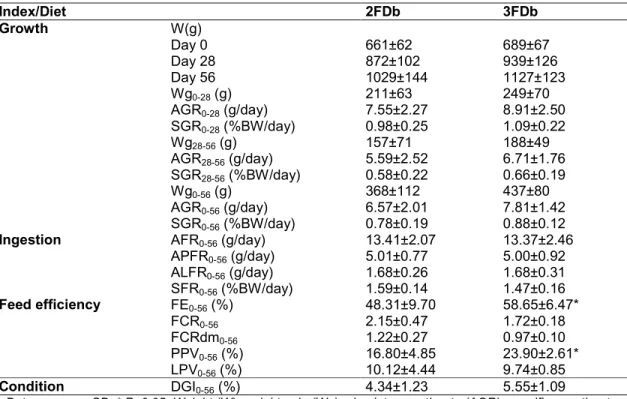
The semi-moist formulated diet (FDb, Table 1) was accepted by both groups and promoted growth, faeces production and 100% survival. Ingestion and growth were similar between experimental groups considering the lapses between samplings and the whole experimental period (P>0.05; Table 2). Nonetheless, the 3FDb group presented higher FE and PPV than 2FDb (P<0.05, Table 2) without differences on animal condition.
The macronutrient composition of faeces was similar between both feeding regimes (P>0.05; Table 3). Alike, the apparent digestibility coefficients (dry matter, protein, lipids and nitrogen-free extract) were similar (P>0.05; Table 3) and the whole animal, digestive
gland and muscle proximate composition
were also similar between groups (P>0.05, Table 4).
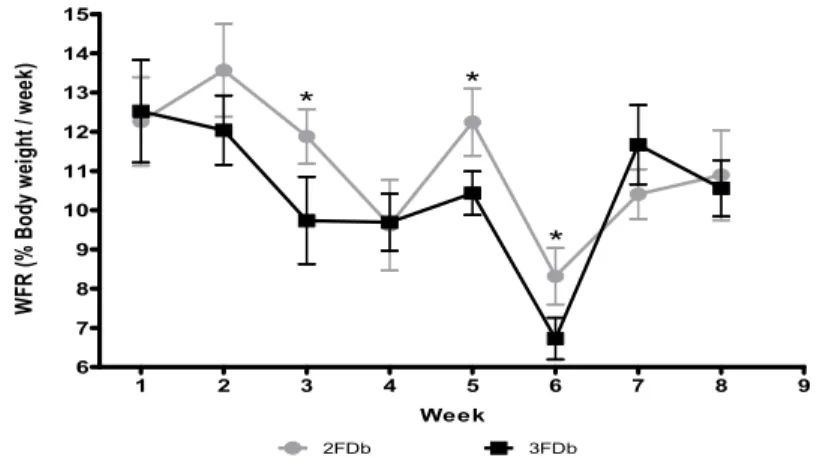
When Instantaneous Feeding Rate (IFR) values were compared on a daily basis (Fig. 1), significant differences were identified (P<0.05). Both groups displayed the highest IFR peaks after fasting. Additionally, the 2FDb group ingestion exceeded 4% IFR in some cases. The Feeding Rate per Week (WFR) displayed dissimilarities between different weeks (Fig. 2) but showed a similar ingestion trend, which was characterized by an intake reduction followed by an increase in the same weeks. In any case, ingestion and growth were similar for both fasting regimes through all the experimental period (P>0.05, Table 2).
Table 2. Growth, ingestion and feed efficiency for two (2FDb) or three (3FDb) days of fasting Index/Diet 2FDb 3FDb Growth W(g) Day 0 Day 28 Day 56 661±62 872±102 1029±144 689±67 939±126 1127±123 Wg0-28 (g) 211±63 249±70 AGR0-28 (g/day) 7.55±2.27 8.91±2.50 SGR0-28 (%BW/day) 0.98±0.25 1.09±0.22 Wg28-56 (g) 157±71 188±49 AGR28-56 (g/day) 5.59±2.52 6.71±1.76 SGR28-56 (%BW/day) 0.58±0.22 0.66±0.19 Wg0-56 (g) 368±112 437±80 AGR0-56 (g/day) 6.57±2.01 7.81±1.42 SGR0-56 (%BW/day) 0.78±0.19 0.88±0.12
Ingestion AFR0-56 (g/day) 13.41±2.07 13.37±2.46
APFR0-56 (g/day) 5.01±0.77 5.00±0.92 ALFR0-56 (g/day) 1.68±0.26 1.68±0.31 SFR0-56 (%BW/day) 1.59±0.14 1.47±0.16 Feed efficiency FE0-56 (%) 48.31±9.70 58.65±6.47* FCR0-56 2.15±0.47 1.72±0.18 FCRdm0-56 1.22±0.27 0.97±0.10 PPV0-56 (%) 16.80±4.85 23.90±2.61* LPV0-56 (%) 10.12±4.44 9.74±0.85 Condition DGI0-56 (%) 4.34±1.23 5.55±1.09
Data as mean±SD. * P<0.05. Weight (W), weight gain (Wg), absolute growth rate (AGR), specific growth rate (SGR), absolute feeding rate (AFR), absolute protein feeding rate (APFR), absolute lipid feeding rate (ALFR), specific feeding rate (SFR), feed efficiency (FE), feed conversion ratio (FCR), dry matter (dm), protein productive
value (PPV), lipid productive value (LPV) and digestive gland index (DGI)
Fig. 1. Instantaneous Feeding Rate (IFR) for two (2FDb) or three (3FDb) fasting days throughout the experiment
* P<0.05 1 3 5 7 9 11 13 15 17 19 21 23 25 27 29 31 33 35 37 39 41 43 45 47 49 51 53 55 0 1 2 3 4 5 2FDb 3FDb
*
*
*
*
Time (days) IF R (%Body we ight / da y)*
Table 3. Faeces proximate composition (% dry weight) and apparent digestibility coefficients (ADC) obtained with two (2FDb) or three (3FDb) days of fasting
Index/Diet 2FDb 3FDb
Proximate composition Crude protein 17.69±2.42 16.14±1.43
Crude lipid 24.46±1.03 26.28±5.22 Ash 29.70±1.50 28.34±1.98 NFE 28.15±3.33 29.25±5.03 AIA 0.7092±0.1811 0.8654±0.1894 ADC ADCDM 86.22±3.25 88.78±2.57 ADCPROT 96.30±1.02 97.23±0.86 ADCL 84.78±3.67 86.46±4.83 ADCNFE 35.21±13.68 46.06±3.29
No differences found in any comparison (P>0.05). NFE- Nitrogen-free extract, calculated by difference; AIA- Acid Insoluble Ash; ADCDM- apparent digestibility coefficients of the dry matter; ADCPROT- apparent digestibility coefficients of the protein; ADCL- apparent digestibility coefficients of the lipids; ADCNFE- apparent digestibility
coefficient of the nitrogen-free extract
Table 4. Macronutrient composition (% dry weight) of the different fractions of common octopus fed applying two different feeding schemes: two (2FDb) or three (3FDb) days of
fasting
2FDb 3FDb
Digestive gland Moisture 62.12±6.57 56.38±0.93
Crude protein 43.57±11.16 39.40±3.69 Crude lipid 44.28±13.77 53.14±6.91 Ash 3.77±1.41 3.12±0.89 NFE 8.39±2.83 4.34±4.76 Muscle Moisture 81.09±0.81 80.86±1.26 Crude protein 81.76±3.02 76.72±3.55 Crude lipid 2.44±0.18 2.72±1.80 Ash 11.56±0.73 11.43±1.36 NFE 4.24±3.14 9.13±4.52
Whole animal Moisture 79.66±1.27 79.04±1.04
Crude protein 73.55±3.02 74.24±3.17
Crude lipid 5.89±1.84 4.95±0.20
Ash 10.74±1.23 10.10±0.75
NFE 9.82±4.12 10.71±3.74
No differences found in any comparison (P>0.05). NFE = Nitrogen free extract
Fig. 2. Feeding Rate per Week (WFR) for both fasting protocols, 2FDb and 3FDb
*P<0.05 1 2 3 4 5 6 7 8 9 6 7 8 9 10 11 12 13 14 15 2FDb 3FDb * * * Week W FR (% B od y w ei gh t / w ee k)
3.2 Discussion
It seems that O. vulgaris subadults display a similar ingestion behaviour (see Fig. 1) as observed in fish species after fasting. In fact, Skalski et al. [22] reported that fish usually show higher food intake after fasting. Moreover, Ali et al. [10] recognized hyperphagia as a mechanism of growth compensation, which is characterized by a higher food intake after fasting by fish that are continuously fed ad libitum. The duration of hyperphagia depends on the frequency and duration of fasting, and food consumption might be equal or higher than in common conditions [10].
Ali et al. [10] did not observe growth depression when fish were starved for short periods with enough food being supplied between fasting episodes, but higher food intake rate was verified. Hence, it seems that growth depression was avoided with similar ingestion by octopus in the present experiment.
The obtained results with O. vulgaris were according to those reported by Teskeredžic et al. [23], who had already verified no differences in growth or body composition of rainbow trout fed daily or three times per week.
In the present study, no differences were found between 2 or 3 days of non-consecutive fasting, which indicates that octopus fed on this prepared diet were able to store enough reserves to be used to maintain the homeostasis during fasting. O. vulgaris is known for having the ability to regulate food intake when a previous meal was ingested in short-term [24]. Therefore, individuals experience fasting in nature and have the ability to adapt its metabolism to these specific conditions, as described in S. officinalis [15,16]. After fasting, both groups displayed higher food-intake as compensation. On the other hand, both groups displayed a similar trend of food intake when data were normalized as weekly food-intake. It is interesting that FE was better with 3 days of fasting, while no statistical differences were identified regarding FCR probably due to individual data variability.
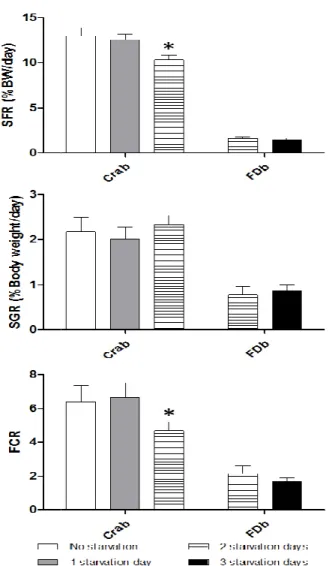
Interestingly, both treatments displayed a similar trend on feed intake, growth and conversion to those obtained by García García and Cerezo Valverde [11] in octopus fasted and fed on a crab-based diet (Fig. 3). These authors obtained similar Specific Feeding (SFR), Specific Growth
(SGR) and Food Conversion Rates (FCR) on animals fed with crab when comparing daily food supply with 1 fasting day per week. However, 2 fasting days per week caused a significant reduction in SFR and FCR, while SGR was
similar. Analogously, despite statistical
differences were not verified for any index, a similar trend was verified on mean values supplying the FDb formulated diet when increasing fasting from 2 to 3 days per week: SGR displayed a slight increase while FCR was slightly reduced (Fig. 3).
At the moment, octopus ongrowing development at industrial scale is limited by scarce specific production technology, i.e. the absence of massive production of paralarvae and juveniles in hatcheries, which implies the capture of wild juveniles, and the lack of a commercial feed that promotes high growth and survival. Specific economic studies performed on the production of octopus fed on natural diets, i.e. by-catch species with low commercial value, reared in sea cages related high-risk and low-profit to this activity. In these, juveniles capture and feeding were referred as the main production costs: 40% and 12% in the NE of Spain [25] or 17-23% and
38-40% in the Mediterranean coast [1],
respectively. Wild subadults and food price are dependent on availability and market demand fluctuations. When using formulated diets, the costs of feed must consider the cost of raw materials but also those related to the ingredients processing and diet preparation. Independently of feed, this study was conducted with isolated individuals fed a formulated diet and further research must be performed to quantify the real relevance on profitability of the obtained results at industrial scale. In this sense, it is important to consider mortality on octopus reared in group. In the latter, octopus mortality is frequently observed after high-stress conditions or results from cannibalism and is significantly dependent on the food supplied (either fish or crab), stocking density, temperature, weight and size dispersion [26].
Studies regarding feeding were performed supplying natural food and reported lower mortality rates when crustaceans were used compared to fish [26]. In this sense, a commercially formulated feed will need to be nutritionally balanced and possess organoleptic characteristics to promote ingestion and similar
growth performance to those obtained
with crustaceans while enhancing efficiency. Rodríguez et al. [27] established 10 kg m-3 as
Fig. 3. Specific feeding rate (SFR, % body weight/day), specific growth rate (SGR, % body weight/day), and food conversion rate (FCR) obtained from the present feeding regimes (2FDb
and 3FDb) and compared with those fed with crab [11]
* (P<0.05) Statistical di
the optimal initial stock density but García García et al. [26] initially established
6.6-reaching 46 kg m-3 without observing an impact in growth or survival. A temperature negative effect might be avoided maintaining temperature within the optimal temperature range for common octopus [27,28] of 15-21°C. Since octopus was individually stocked in tanks, the present study didn’t test cannibalism while this might be a relevant factor affecting mortality when animals are grown in groups. Since octopus
the wild are subjected to fasting/starvation, food supply was estimated applying wide individual margins (minimum 5%BW/day) to ensure an libitum feeding scheme. Following this reasoning, when octopus is to be reared in group, the food
3. Specific feeding rate (SFR, % body weight/day), specific growth rate (SGR, % body weight/day), and food conversion rate (FCR) obtained from the present feeding regimes (2FDb
and 3FDb) and compared with those fed with crab [11]
* (P<0.05) Statistical differences assessed independently for each diet the optimal initial stock density but García García
-35.2 Kg m-3 3 without observing an impact in growth or survival. A temperature negative effect might be avoided maintaining temperature the optimal temperature range for common 21°C. Since octopus was individually stocked in tanks, the present study didn’t test cannibalism while this might be a relevant factor affecting mortality when animals grown in groups. Since octopuses living in the wild are subjected to fasting/starvation, food supply was estimated applying wide individual margins (minimum 5%BW/day) to ensure an ad feeding scheme. Following this reasoning, eared in group, the food
supply should be estimated according to the total biomass (minimum 5%biomass/day). In contrast, Chapela et al. [29] observed that stressed or malnourished smaller dominated animals, due to the establishment of hierarchies in octopus groups, were more likely to die. García et al. also found an inverse relation between survival and size dispersion, highlighting the relevance of homogeneous sizes in grouped reared octopus.
4. CONCLUSION
Growth, survival, proximate composition of octopus and digestibility were not influenced by a feeding regime including either fasting for 2 or 3
3. Specific feeding rate (SFR, % body weight/day), specific growth rate (SGR, % body weight/day), and food conversion rate (FCR) obtained from the present feeding regimes (2FDb
supply should be estimated according to the total biomass (minimum 5%biomass/day). In contrast, observed that stressed or malnourished smaller dominated animals, due to the establishment of hierarchies in octopus roups, were more likely to die. García et al. [26] also found an inverse relation between survival
and size dispersion, highlighting the relevance of homogeneous sizes in grouped reared
Growth, survival, proximate composition of octopus and digestibility were not influenced by a feeding regime including either fasting for 2 or 3
non-consecutive days. O. vulgaris subadults seem to have the ability to compensate fasting through an increase in food intake on a subsequent day.
The application of feeding schemes that include fasting days is in accordance with the natural feeding pattern described for this species but is
also an interesting option for industrial
application, since it promotes a reduction on operational costs achieving similar growth and FE when supplying a formulated diet. In fact, our group current research is focused on octopus grouped rearing applying fasting protocols. Despite the interesting results obtained in the present preliminary study, octopus production at commercial scale is still hampered by the high costs related to food and the purchase of live juveniles. Still, the present results indicate that fasting may be a way to reduce one of the main production costs, the amount of feed. In this sense, further research is needed to achieve a sustainable feed that will allow a massive production of juveniles.
ETHICAL APPROVAL
All authors hereby declare that "Principles of laboratory animal care" (NIH publication No. 85-23, revised 1985) were followed, as well as specific national laws where applicable. All experiments have been examined and approved by the appropriate ethics committee.
ACKNOWLEDGEMENTS
This work was funded by “Instituto Nacional de Investigación y Tecnología Agraria y Alimentaria”
(INIA-Project RTA2012-00072-00-00). T.
Rodríguez González wishes to thank Number 37 INIA-CCAA (FPI-INIA) 2014 Grant. A.V. Sykes wishes to thank Fundação para a Ciência e
Tecnologia (FCT) his Post-Doc grant
(SFRH/BPD/36100/2007) and Investigator FCT contract (IF/00576/2014).
COMPETING INTERESTS
Authors have declared that no competing interests exist.
REFERENCES
1. García García J, García García B.
Econometric model of viability/profitability
of octopus (Octopus vulgaris) ongrowing in sea cages. Aquac. Int. 2011;19:1177. DOI: 10.1007/s10499-011-9432-1
2. Vaz-Pires P, Seixas P, Barbosa A.
Aquaculture potential of the common octopus (Octopus vulgaris Cuvier, 1797): A review. Aquaculture. 2004;238:221–238. DOI: 10.1016/j.aquaculture.2004.05.018
3. Cerezo Valverde J, Hernández MD,
Aguado-Giménez F, García García B. Growth, feed efficiency and condition of common octopus (Octopus vulgaris) fed on two formulated moist diets. Aquaculture. 2008;275:266–273.
DOI: 10.1016/j.aquaculture.2008.01.012
4. Cerezo Valverde J, Hernández MD,
Aguado-Giménez F, Morillo-Velarde PS,
García García B. Performance of
formulated diets with different level of lipids and glutamate supplementation in Octopus vulgaris. Aquac. Res. 2013;44:1952–1964. DOI: 10.1111/j.1365-2109.2012.03201.x
5. Morillo-Velarde PS, Cerezo Valverde J,
Hernández MD, Aguado-Giménez F,
García García B. Growth and digestibility of formulated diets based on dry and freeze-dried ingredients in the common octopus (Octopus vulgaris). Aquaculture. 2012;368:139–144.
DOI: 10.1016/j.aquaculture.2012.09.028
6. Morillo-Velarde PS, Valverde JC, García
García B. A simple format feed to test the acceptability of ingredients for common octopus (Octopus vulgaris Cuvier, 1797). Aquac. Res. 2015;46:994–1000.
DOI: 10.1111/are.12233
7. Boucher-Rodoni R, Boucaud-Camou E,
Mangold K. Feeding and digestion. In Cephalopod Life Cycles; Boyle, P. R., Ed.; Academic Press, London. 1987;85–108.
8. Lovell T. Nutrition and feeding of fish.
Media, S. S. & B., Ed.; 2nd ed.; 1998. ISBN 0412077019, 9780412077012.
9. Eroldoǧan OT, Kumlu M, Kiris GA, Sezer
B. Compensatory growth response of Sparus aurata following different starvation and refeeding protocols. Aquac. Nutr. 2006;12:203–210.
DOI: 10.1111/j.1365-2095.2006.00402.x
10. Ali M, Nicieza A, Wootton RJ.
Compensatory growth in fishes: A
response to growth depression. Fish Fish. 2003;4:147–190.
11. García BG, Valverde JC. Influencia del número de días de ayuno a la semana sobre el crecimiento, el índice de conversión y la supervivencia en el Pulpo de Roca (Octopus vulgaris Cuvier, 1797). Rev. Aquat. 2004;21:34–41.
12. García-Garrido S, Hachero-Cruzado I,
Garrido D, Rosas C, Domingues P. Lipid composition of the mantle and digestive gland of Octopus vulgaris juveniles (Cuvier, 1797) exposed to prolonged starvation. Aquac. Int. 2010;18:1223– 1241.
DOI: 10.1007/s10499-010-9335-6
13. García-Garrido S, Hachero-Cruzado I,
Rosas C, Domingues P. Protein and amino acid composition from the mantle of juvenile Octopus vulgaris exposed to
prolonged starvation. Aquac. Res.
2013;44:1741–1751.
DOI: 10.1111/j.1365-2109.2012.03180.x
14. Morillo-Velarde PS, Cerezo Valverde J,
Llinares RMS, García García B. Energetic
contribution of carbohydrates during
starvation in common octopus (Octopus vulgaris). J. Molluscan Stud. 2011;77: 318–320.
DOI: 10.1093/mollus/eyr018
15. Lamarre SG, MacCormack TJ, Sykes AV,
Hall JR, Speers-Roesch B, Callaghan NI, Driedzic WR. Metabolic rate and rates of protein turnover in food-deprived cuttlefish, Sepia officinalis (Linnaeus 1758). Am. J. Physiol. - Regul. Integr. Comp. Physiol. 2016;310:1160–R1168.
DOI: 10.1152/ajpregu.00459.2015
16. Speers-Roesch B, Callaghan NI,
MacCormack TJ, Lamarre SG, Sykes AV, Driedzic WR. Enzymatic capacities of metabolic fuel use in cuttlefish (Sepia officinalis) and responses to food deprivation: Insight into the metabolic
organization and starvation survival
strategy of cephalopods. J. Comp. Physiol.
B Biochem. Syst. Environ. Physiol.
2016;186:711–725.
DOI: 10.1007/s00360-016-0991-3
17. Estefanell J, Roo J, Guirao R, Afonso JM,
Fernández-Palacios H, Izquierdo M,
Socorro J. Efficient utilization of dietary lipids in Octopus vulgaris (Cuvier 1797) fed fresh and agglutinated moist diets based on aquaculture by-products and low price trash species. Aquac. Res. 2012;44(1):93-105.
DOI: 10.1111/j.1365-2109.2011.03014.x
18. Morillo-Velarde PS, Cerezo Valverde J,
García García B. Utilization of diets with different fish oil content in common octopus (Octopus vulgaris Cuvier, 1797) and resulting changes in its biochemical composition. Aquac. Res. 2015;46:2871– 2884.
DOI: 10.1111/are.12439
19. Rodríguez-González T, Cerezo Valverde
J, Sykes AV, García García B.
Performance of raw material thermal treatment on formulated feeds for common octopus (Octopus vulgaris) ongrowing. Aquaculture. 2015;442:37–43.
DOI: 10.1016/j.aquaculture.2015.01.035
20. AOAC. Official Methods of Analysis. In The
Association of Official Analytical Chemists International; 2003.
21. Zar JH. Biostatistical analysis. Hall, P.,
Ed.; 5th ed.; 2010. ISBN 0321656865, 9780321656865.
22. Skalski GT, Picha ME, Gilliam JF, Borski
RJ. Variable intake, compensatory growth, and increased growth efficiency in fish:
Models and mechanisms. Ecology.
2005;86:1452–1462. DOI: 10.1890/04-0896
23. Teskeredžic Z, Teskeredzic E, Tomec M,
Hacmanjek M, McLean E. The impact of restricted rationing upon growth, food
conversion efficiency and body
composition of rainbow trout. Water Sci. Technol. 1995;31(10):219-223.
DOI: 10.1016/0273-1223(95)00442-P
24. Nixon M. Cephalopod diets. In Cephalopod
Life Cycles; Boyle, P. R., Ed.; Academic Press, London. 1987;201–219.
25. García García J, González LMR, García
García B. Cost analysis of octopus ongrowing installation in Galicia. Spanish J. Agric. Res. 2004;2:531–537.
26. García García B, Cerezo Valverde J,
Aguado-Giménez F, García García J, Hernández MD. Growth and mortality of common octopus Octopus vulgaris reared
at different stocking densities in
Mediterranean offshore cages. Aquac. Res. 2009;40:1202–1212.
DOI: 10.1111/j.1365-2109.2009.02222.x
27. Rodríguez C, Carrasco JF, Arronte JC,
Rodríguez M. Common octopus (Octopus vulgaris Cuvier, 1797) juvenile ongrowing in floating cages. Aquaculture. 2006;254: 293–300.
28. Aguado-Giménez F, García García B. Growth and food intake models in Octopus vulgaris Cuvier (1797): Influence of body weight, temperature, sex and diet. Aquac. Res. 2002;40:1202–1212.
29. Chapela A, González ÁF, Dawe EG.
Growth of common octopus (Octopus vulgaris) in cages suspended from rafts. Sci. Mar. 2006;70:121–129.
DOI: 10.1525/auk.2009.08179
_________________________________________________________________________________
© 2018 Rodríguez-González et al.; This is an Open Access article distributed under the terms of the Creative Commons Attribution License (http://creativecommons.org/licenses/by/4.0), which permits unrestricted use, distribution, and reproduction in any medium, provided the original work is properly cited.
Peer-review history:
The peer review history for this paper can be accessed here: http://www.sciencedomain.org/review-history/23065
![Table 1. Basal mixture (%) and proximate composition (% dry weight) of freeze-dried bogue (FDb) formulated diet [19]](https://thumb-eu.123doks.com/thumbv2/123dok_br/18451798.897504/3.918.158.776.190.545/table-basal-mixture-proximate-composition-weight-freeze-formulated.webp)