Universidade do Minho
Universidade do Minho
Dissertação de Mestrado
Escola de Engenharia
Evaluation of key-agreement protocols based on
weak secrets
Author: Tiago Miguel Soares Fernandes Supervisor: Manuel Bernardo Barbosa
University of Minho
Acknowledgments
Firstly, I would like to thank my Supervisor, Prof. Manuel Bernardo Barbosa, for his counseling and support through this dissertation.
I wish to thank Tiago and Isabel, my dearest Father and Mother, for all the support through all these years.
I like to thank specially to Ana Palhares, when I needed strength she was always there for me. I would like to thank my good friends Jorge Miranda, Nuno Correia, Jo˜ao Sanches, Lu´ıs Mascarenhas, Rui Abreu, Mariana Fernandes, Cristina Oliveira, Carl`ene Barbosa, Pedro Fernandes, M´ario Lameiras, Rita Anjo, Tiago Dias, M´ario Ara´ujo, Ana Gon¸calves, Rui Fonseca, Rui Costa, Rui Gama, Joana Presa, Tiago Castro, N´adia Silva and Afonso Arriaga.
I acknowledge that my work was supported by the Funda¸c˜ao para a Ciˆencia e Tecnologia (FCT) under the project “WITS – Wireless Information Theoretic Security - Refa PTDC/EIA/71362/2006”
Resumo
Duas entidades desejam comunicar de forma segura atrav´es de um canal inseguro na presen¸ca de um advers´ario. Para isso acordam uma chave criptogr´afica forte a partir de uma fonte fraca de aleatoriedade, extra´ıda com base nas caracter´ısticas f´ısicas da rede onde comunicam. Nesta disserta¸c˜ao avaliamos as contrapartidas entre dois protocolos: um onde as garantias de seguran¸ca se baseiam em no¸c˜oes de teoria da informa¸c˜ao — o protocolo Authenticated Key Agreement (AKA) proposto em [7] — e que foi especialmente criado para este cen´ario; e outro que baseia a sua seguran¸ca em argumentos computacionais — o protocolo Password-Authenticated Key Exchange (PAKE) proposto em [11]. Para este efeito efectuamos uma an´alise detalhada da seguran¸ca concreta de ambos os protocolos, considerando que em ambos os casos se pretende acordar uma nova chave de 128 bits.
Abstract
Two agents want to securely communicate on a insecure channel in the pres-ence of an adversary. For that they agree in a strong cryptographic key based on a weak-source of randomness stemming from the physical network characteristics where these agents communicate. In this dissertation we evaluate the tradeoffs be-tween two protocols: an information theoretically-secure Authenticated Key Agree-ment (AKA) [7] that was specifically designed for this scenario; and a Password-Authenticated Key Exchange (PAKE) protocol [11] whose security guarantees are based on computational arguments. To this end, we carry out an analysis of the concrete security of both protocols, considering in both cases that the goal is to agree on a fresh 128-bit secret key.
Contents
1 Introduction 1
2 Preliminaries 4
2.1 Provable Security . . . 4
2.2 Digital Signature Schemes . . . 6
2.3 Public Key Encryption Schemes . . . 8
2.4 Decisional Diffie-Hellman Assumption . . . 9
2.5 Cryptographic Hash Functions . . . 10
3 Information-theoretically secure authenticated key agreement 12 3.1 Definitions and Security Model . . . 13
3.2 A concrete IT-AKA protocol . . . 15
3.3 Randomness Extractor . . . 16
3.4 Message Authentication Protocol . . . 16
3.4.1 Look-ahead extractors . . . 18
3.4.2 Look-ahead MAC . . . 19
3.5 Global concrete security analysis . . . 20
3.6 Practical Implementation . . . 25
4 Computationally secure password authenticated key exchange 27 4.1 Definitions and Security Model . . . 27
4.2 A concrete PAKE protocol . . . 32
4.3 Lamport’s one-time signature scheme . . . 35
4.4 Extended Cramer-Shoup cryptosystem . . . 37
4.5 Global concrete security analysis . . . 45
4.6 Practical implementation . . . 48
Chapter 1
Introduction
The topic for this dissertation was proposed in the context of the FCT-funded Wire-less Information Theoretic Security (WITS) project, where the interaction between physical-layer security mechanisms and higher-layer security protocols for wireless networks is explored. Physical-layer security mechanisms take advantage of the char-acteristics of communications channels in order to provide a security functionality, which typically consists of the following:
• Two agents, Alice and Bob aim to securely transfer information across a com-munications channel.
• A passive adversary Eve is able to eavesdrop on the communications, according to what is known as the wiretap channel model.
• Taking advantage of the knowledge of the communications channel connecting them, and the fact that the quality of this channel will be (perhaps occa-sionally) better than that available to Eve, Alice is able to transfer to Bob a random string of which Eve has only partial knowledge.
• This random string, which we call a weak secret following [7], is usually modeled as being sampled from a random variable W shared between Alice and Bob. Physical layer security results are typically formulated in the information-theoretical setting, and they describe the guarantees provided to Alice and Bob regarding Eve’s uncertainty (or equivocation) with respect to the shared random variable W .
Given the security bootstrap provided by these physical security results, a higher level protocol is then applied to actually securely transfer data from Alice to Bob. This higher level protocol is typically carried out in two steps:
• A cryptographic protocol is used to transfer data across the channel using k. Assuming a passive adversary, the solutions for both these problems have been ex-tensively studied. The typical solution is to use a privacy amplification protocol [13] to derive the secret key, and then a one-time-pad to convey the information across the channel. This solution provides an overall information-theoretical security level whereby no assumptions are made about the computational capabilities of the ad-versary. Nevertheless, it is clear that the one-time-pad can be replaced by alternative secure data transfer protocols, in order to improve performance or to protect against different types of adversaries. For example, one could simply use a computationally-secure authenticated encryption scheme to thwart active attacks by computationally bounded adversaries during the data transfer stage and securely reuse the shared secret key several times.
The natural question that arises is then: does a similar tradeoff between informa-tion-theoretic security and computational security make sense at other levels in the protocol stack? This question is partially addressed in this dissertation: we study the tradeoffs between information-theoretic and computational security solutions to deal with active attackers during the key derivation stage.
In cryptographic terminology, secure key derivation in the presence of active adversaries is the functionality provided by Authenticated Key Agreement (AKA) or Authenticated Key Exchange (AKE) protocols. In the WITS scenario, such AKA protocols must be able to derive a secure secret key from a weak secret. In the information-theoretical (IT) security setting, we analyze a concrete IT-AKA protocol [7] that was specifically designed for this scenario, and find that there are practical limitations to using such a protocol in the real-world. Indeed, even if efficient instantiations of all required components are available (or if one is willing to assume that some algorithm – e.g. a cryptographic hash function – provides the necessary functionality) one finds that the protocol puts a significant strain on the physical layer security mechanism: to derive a single 128-bit key at 128-bit security level, the protocol requires an input of a weak secret of almost 512 times that size. Furthermore, each weak secret can only be used to derive a single secret key.
In the computational security setting, the most natural counterpart to a weak se-cret is a password. Indeed, several Password-Authenticated Key Exchange (PAKE) solutions have been proposed which satisfy the intuitive security definition that an active attacker should only succeed in attacking the key exchange protocol if it successfully guesses the password. In particular, eavesdropping on a polynomial number of executions of the protocol (and even obtaining previously established
secret keys), the adversary should not learn (in the computational sense) anything about the shared weak secret. Furthermore, the most efficient attack of an active adversary should be to test all possible weak secret values. We analyze the practical applicability of a concrete PAKE protocol [11] to the WITS scenario. We identify a typical application scenario for the PAKE protocol, whereby higher-level protocols will be fed with a fresh 128-bit secret key derived from the most recent weak secret released by the physical layer security mechanism. In this scenario, the security of the key can be seen as all-or-nothing: it is either the case that the adversary has actively established a rogue secret key by mounting an on-line attack and guessing the weak secret; or it is the case that the secret key is computationally hidden from the adversary at a 128-bit security level. We carry out a detailed analysis of the concrete computational security of the selected PAKE protocol in order to accu-rately estimate the values of all parameters that must be instantiated in its building blocks to obtain the desired security level. We evaluate the performance of the se-lected PAKE protocol at the desired security level by presenting an implementation of the selected PAKE protocol for the identified parametrisation and showing some benchmarking results.
Document structure
We start with Chapter 2 where we present security definitions, notions, and cryp-tographic primitives including their syntax, attack models, and security goals that will be used in the following chapters. In Chapter 3, we present the definition and security model of an information-theoretically secure Authenticated Key Agreement protocol, followed by a particular instance of such a protocol by from Dodis and Wichs [7]. We perform concrete security analysis of this protocol for 128 bit security, and present benchmarking results from a prototype implementation. Analogously, in Chapter 4, we describe the concept and security model for a computationally secure Password-Authenticated Key agreement protocol, and discuss a concrete in-stantiation proposed by Katz, Ostrovsky and Yung [11]. We also perform a concrete security analysis of this protocol for 128 bit security, and present benchmarking re-sults from a prototype implementation. We conclude the paper with a discussion of our results in Chapter 5
Chapter 2
Preliminaries
2.1
Provable Security
Since the beginning of public-key cryptography, many suited algorithmic problems for cryptography have been proposed and many cryptographic schemes have been designed with more or less heuristics arguments of their security. If a cryptographic algorithm could cope cryptanalytic attacks for several years, it was often considered somehow as validation procedure. Several schemes take a long periods of time before being broken. Pointcheval [14] points out as an example the Chor-Rivest cryptosys-tem, that took more than 10 years to be totally broken. Before this attack was found, the scheme was believed to be strongly secure. This shows that the absence of attacks in some point in time must not be interpreted as security validation for some scheme. A different paradigm is given by the provable security concept. This is a line of research which tries to provide proofs in the framework of complexity theory. Commonly known as reductionist security proofs, these proofs provide re-ductions from a well-studied problem, such as RSA or the discrete logarithm, to an attack against some cryptographic protocol.
Computational Security
Many security goals in symmetric and asymmetric cryptography cannot be efficiently realized unless one relies on some computational assumption. There are two major families of computational assumptions in number theory-based public-key cryptog-raphy:
• the schemes based on integer factoring, and on the RSA problem. The most famous intractable problem is factorization of two integers: while it is easy to multiply two prime integers p and q to get the product n = p.q, it is not
simple to decompose n into its prime factors p and q.
• the schemes based on the discrete logarithm problem, and on the Diffie-Hellman problems, in any “suitable” group.
Given such objects and thus computational assumptions about the intractability of the inversion without possible trapdoors, we would like that security could be achieved without extra assumptions. This fact is only formally proven when it is shown that an attacker against the cryptographic protocol can be used as sub-part in an algorithm that can break the computational assumption. Such arguments are called reductions. Reductions establish partial order between computational assumptions, also between intractable problems. As the required assumption is weaker, the more secure the cryptographic scheme is [14].
A reduction, in complexity theory, is an algorithm which uses an attacker as a sub-part in a global algorithm. If this reduction is efficient (i.e. the reduction is a polynomial-time algorithm), then the attack of the cryptographic protocol is at least as hard as inverting the function: if one has a polynomial algorithm to solve the lat-ter problem, one can polynomially solve the former one. The associated asymptotic security definition typically requires that the success probability of any probabilistic, polynomial time algorithm be a negligible function of the security parameter. Some-times hidden in security reductions based on these so-called asymptotic notions of security are very large factors, which imply that a successful attack on the scheme may not translate into a break of the computational assumption, except possibly for huge values of the security parameter (i.e. key sizes). Concrete security refers to a security reduction that does not rely asymptotic notions of security, rather manipulating concrete values for the parameters that specify the security level of the scheme, and the power of the adversary (namely its execution time), and using them to express an adversary’s probability of success.
Information-Theoretic security
An information-theoretically secure cryptosystem derives its security from argu-ments that establish an adversary’s probability of success independently of its com-putational power. This means essentially that comcom-putational assumptions have no place in an information-theoretical security proof, since they are not valid once one considers unbounded adversaries. Put simply, in an information-theoretically secure scheme, it is proven that the adversary does not have enough information to succeed in its attack. So, even if the adversary is computationally unbounded, encryption schemes based on information-theory can be proven secure [10].
A special case of information-theoretic schemes are encryption schemes display-ing a property called perfect secrecy: the one-time pad is its most famous example. The main issue common to all schemes with perfect secrecy is that for any per-fectly secret encryption scheme we must have a key space that is at least as large as the message space and can be used only once. If the key space consists of fixed-length keys, and the message space consists of all messages of some fixed fixed-length, this implies that the key must be as long as the message. Such practical limitations of information-theoretically secure schemes are common, and justify the pragmatic approach of considering computationally bounded adversaries. By making this re-laxation and admitting a conceptually weaker security level, modern cryptography has been able to provide efficient solutions to very complex information security protection scenarios, that provide an adequate level of assurance for most practical applications.
2.2
Digital Signature Schemes
Digital Signatures schemes are a mechanism that protect the authenticity of a digital message or document. Digital signature schemes allow a signer who has established a public key pk to sign a message in such way that any other party who knows pk (and knows that the public key was established by the signer) can verify that the message originated from the signer and has not been modified in any way.
Syntax
A signature scheme is a tuple of three probabilistic polynomial-time algorithms (Gen, Sign, Vrfy) satisfying the following:
• The key-generating algorithm Gen takes as input a security parameter 1λ and
outputs a pair of keys (pk, sk), public and private key respectively.
• The signing algorithm Sign takes as input a private key sk and a message m ∈ {0, 1}∗. It outputs a signature σ, denoted as σ ← Sign(sk, m).
• The deterministic verification algorithm Vrfy takes as input a public key pk, a message m, and a signature σ. It outputs a bit b, with b = 1 meaning valid and b = 0 invalid signature. b := Vrfy(pk, m, σ).
Correctness
For every λ, every (pk, sk) outputted by Gen(1λ) and every m ∈ {0, 1}l(λ), it holds that Vrfy(pk, m, Sign(sk, m)) = 1.
If (Gen, Sign, Vrfy) is such that for every (pk, sk) output by Gen(1λ), algorithm
Sign is only defined for messages m ∈ {0, 1}l(λ) (and Vrfy outputs 0 for m 6∈
{0, 1}l(λ)), then (Gen, Sign, Vrfy) is a signature scheme for messages of length l(λ)
[4].
Security model
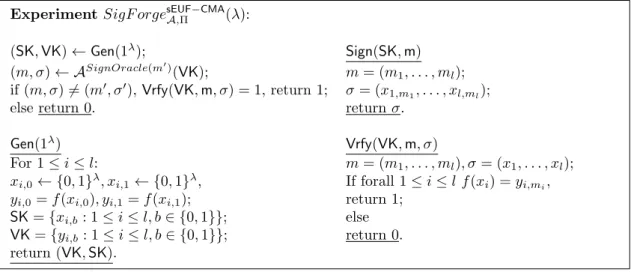
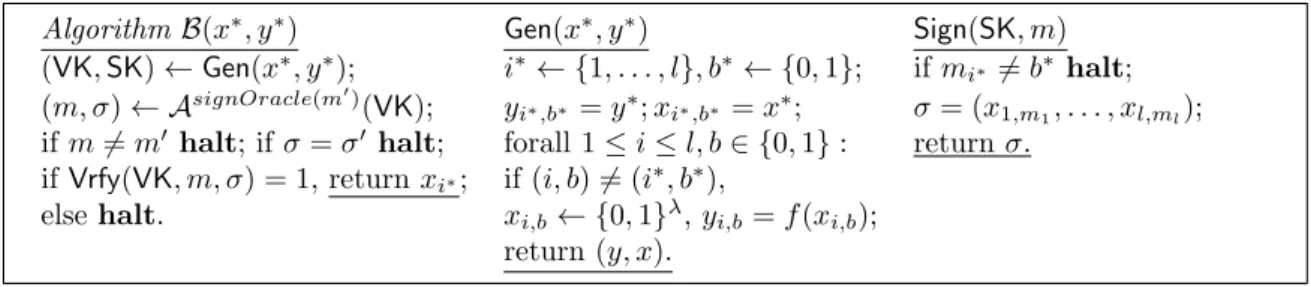
Considering a signature scheme Π = (Gen, Sign, Vrfy). We consider the notion pre-sented in [4] of strong existential unforgeability under an adaptive chosen-message attack. This can be described as an attack game as follows.
• The challenger runs Gen. It gives the adversary the resulting public key pk and keeps the private key sk to itself.
• The adversary issues signature queries m0
1, . . . , m 0 q, denoted as P = {m 0 1, . . . , m 0 q},
with q as the maximum number of queries allowed. The challenger responds by running Sign to generate signatures σ0i of m0i and sending σi0 to the adversary. The set of issued signatures is denoted as Q = {σ01, . . . , σq0}.
• Finally the adversary outputs a pair (m, σ). The adversary wins if σ is a valid signature of m according to Vrfy and σ 6∈ Q.
The advantage of an adversary A in attacking the signature scheme is defined as the probability that A wins the game described.
Definition 1. ([4]) A signature scheme Π = (Gen, Sign, Vrfy) is strongly existen-tially unforgeable under an adaptive chosen-message attack, if for all probabilistic polynomial-time adversaries A, the probability that A wins the game above (i.e. its advantage) is negligible in the security parameter.
In [4] a weaker version of unforgeability was also considered, properly called weak existential unforgeability. In this case, the adversary must only use a message m that was not previously queried to the Sign oracle.
We also use a weaker definition of digital signatures denoted one-time signatures. This type of signature is secure as long it is used to sign at most one message. In this particular case of signatures schemes, its security model only allows the adversary to submit one query (q = 1) to Sign oracle.
2.3
Public Key Encryption Schemes
Syntax
A public-key encryption scheme PKE consists of the following algorithms:
• A probabilistic, polynomial-time key generation algorithm PKE.KeyGen that on input 1λ for λ ∈ Z≥0, outputs a pair public key/secret key (PK, SK). The
structure of PK and SK depends on the particular scheme.
• A probabilistic, polynomial-time encryption scheme PKE.Encrypt that takes as input 1λ, a public key PK and a message m, outputs a ciphertext ψ. A ci-phertext is a bit string and its structure may depend on the particular scheme; • A deterministic, polynomial-time decryption algorithm PKE.Decrypt that takes as input 1λ, a secret key SK and a ciphertext ψ, outputs either a message m or the special symbol reject.
Correctness
A public-key encryption scheme is correct if for all (PK, SK) ∈ [PKE.KeyGen(1λ)],
all m and all ψ ∈ [PKE.Encrypt(PK, m)], we have PKE.Decrypt(SK, ψ) = m.
Security model
The following attack game is used to define security against adaptive chosen cipher-text attacks.
• The adversary queries a key generation oracle. The key generation oracle computes (PK, SK)←R− PKE.KeyGen(1λ) and responds with PK.
• The adversary makes a sequence of calls to a decryption oracle.
For each decryption oracle query, the adversary submits a bit string ψ, and the decryption oracle responds with PKE.Decrypt(1λ, SK, ψ).
• The adversary submits two messages m0, m1 ∈ PKE.MSpaceλ,PK to the
chal-lenger. On input m0, m1, the challenger then computes σ R
←− {0, 1}; ψ∗ ←−R
PK.Encrypt(1λ, PK, mσ); and responds with the target ciphertext ψ∗. In the
case of an unrestricted message space, it is required that |m0| = |m1|.
• The adversary continues to make calls to the decryption oracle, subject only to the restriction that a submitted bit string ψ is not identical to ψ∗.
• The adversary outputs ˆσ ∈ {0, 1}, and wins the game if ˆσ = σ.
The CCA advantage of A against PKE at λ, denoted by AdvCCAPKE,A(λ), to be
|P r[σ = ˆσ − 1/2]| in the above attack game.
Definition 2. ([5]) PKE is secure against adaptive chosen ciphertext attack if for any probabilistic, polynomial-time adversary A, the function AdvCCAPKE,A(λ) grows
negligibly in λ.
2.4
Decisional Diffie-Hellman Assumption
A computational group scheme G specifies a sequence Sλ of group distributions. For
every value of a security parameter λ ∈ Z≥0, Sλ is a probability distribution of group
descriptions. A group description Γ specifies a finite abelian group ˆG, along with a prime-order subgroup G, a generator g of G, and the order q of G. A multiplicative notation for the group operation in ˆG is used and the identity element of ˆG denoted by 1G. The notation Γ[ ˆG, G, g, q] indicates that Γ specifies ˆG, G, q and q as above
[5].
The Decisional Diffie-Hellman is an assumption formulated with respect to a suitable group G of a large prime order q generated by a given element g. The Decisional Diffie-Hellman assumptions says that is hard to distinguish triples of the form (gx, gy, gz) for random x, y, z ∈ Zq from triples of the form (gx, gy, gxy) for
random x, y ∈ Zq. Formally, let G be a computational group scheme, specifying a
sequence Sλ of group distributions. For all λ, and for all Γ[ ˆG, G, g, q] ∈ [Sλ], the
sets Dλ,Γ and Tλ,Γ are defined as follows.
Dλ,Γ := {(gx, gy, gxy) ∈ G3 : x, y ∈ Zq}; (2.1)
Tλ,Γ := G3. (2.2)
The set Dλ,Γ is the set of Diffie-Hellman triples. Also, for ρ ∈ G3, define
DHPλ,Γ(ρ) = 1 if ρ ∈ Dλ,Γ, and otherwise, define DHPλ,Γ(ρ) = 0. For all 0/1-valued,
probabilistic, polynomial-time algorithms A, and for all λ and all Γ[ ˆG, G, g, q] ∈ [Sλ],
the DDH advantage of A against G at λ given Γ is defined as follows.
Definition 3. ([5]) The decisional Diffie-Hellman assumption for G is that for every probabilistic, polynomial-time 0/1-valued adversary A, the function AdvDDHG,A(λ|Γ)
AdvDDHG,A(λ|Γ) := P r[τ = 1 : ρ ← Dλ,Γ; τ ← A(1 λ, Γ, ρ)] − P r[τ = 1 : ρ ← Tλ,Γ; τ ← A(1λ, Γ, ρ)] . (2.3)
2.5
Cryptographic Hash Functions
A hashing scheme HF specifies for each value of λ, a function HFλ : KeySpaceλ → Dλ → Cλ, which we denote as HFλhk(.), hk ∈ KeySpaceλ, where KeySpaceλ is a family
of key spaces indexed by λ where each key space is a probability space on bit strings, and typically Dλ ⊆ {0, 1}∗ and Cλ ⊆ {0, 1}λ. There must exist a deterministic,
polynomial-time algorithm that on input 1λ, D, hk ∈ [HF.KeySpaceλ] and ρ ∈ D, outputs HFλhk(ρ).
Target Collision Resistant hash functions
A family of keyed hash functions is used, such that given a randomly chosen preim-age and randomly chosen hash function key, it is computationally infeasible to a probabilistic, polynomial-time adversary to find a different preimage that hashes to the same value using the given hash key.
Definition 4. ([5]) For any probabilistic, polynomial-time algorithm A, if a function HFλhk is target collision resistant (TCR) function then AdvTCRHF,A(λ|D) is negligible
in λ. AdvTCRHF,A(λ|D) := Pr[ρ ∈ D ∧ ρ 6= ρ∗∧ HFλhk(ρ ∗ ) = HFλhk(ρ) : ρ∗ ←− D; hkR ←R− HF.Keyspaceλ; (2.4) ρ←− A(1R λ, ρ∗, hk)]. Universal one-way hash functions
We refer to a Universal One-Way Hash Function (UOWHF) as a slightly stronger se-curity notion compared to target collision resistance as presented above. In UOWHF security the first input to the hash function is chosen adversarially (contrarily to the random sampling presented on the TCR hash function), but independent of the key of the hash function. In this case, the adversary A should provide another preimage such that when applying a keyed hash function produce the same image.
This definition was formally analyzed in [2], albeit in a concrete security formula-tion. Let the adversary be defined as A = (A1, A2) which consists of two algorithms,
A1 and A2. First A1 is run, to produce the first preimage ρ and possibly some extra
state information st, that A1 wants to pass to A2. After A1 execution, a random
key hk is chosen and A2 is run. A2 receives as input hk, ρ, st, then it must find a
preimage ρ∗ different from ρ such that Hhk(ρ) = Hhk(ρ∗). The value ρ∗ can depend
on hk but ρ can not.
Definition 5. ([2]) For any probabilistic, polynomial-time algorithm A = {A1, A2},
if HFλhk is a universal one-way hash function then AdvUOWHF,A(λ, D) is negligible
in λ. For any λ and D, AdvUOWHF,A(λ, D) is defined as
AdvUOWHF,A(λ|D) := Pr[ρ ∈ D ∧ ρ 6= ρ∗∧ HFλhk(ρ ∗ ) = HFλhk(ρ) : (ρ∗, st) ←− A1(1λ), hk R ←− HF.Keyspaceλ; (2.5) ρ←− AR 2(hk, st)].
Chapter 3
Information-theoretically secure
authenticated key agreement
In this chapter we analyze an information-theoretically secure authentication key agreement protocol proposed by Dodis et al. in [7]. The authors considered a scenario where two parties Alice and Bob want to securely communicate over a public channel. The two share a weak-secret, about which an adversary Eve has some side information. This adversary Eve is computationally unbounded and has control over the communication channel. The shared weak-secret is modeled as a random variable W arbitrarily distributed over n-size length bitstrings, where Eve has some side-information about it, modeled as a random variable Z correlated to W . Weak-secret W might not be uniformly random, but the adversary must have at least k bits of uncertainty about it. This was formalized using the notion of conditional min-entropy.
We know that information-theoretic secure cryptosystems are often proposed as a theoretic feasibility result, or if practical, substantially less efficient compared to computational cryptosystems with the equivalent security levels. The presented protocol uses as privacy amplification technique a randomness extractor. Concrete constructions of these extractors have been shown to exist ([8]) but they are not practical except for very small parameter sizes. Nevertheless, to get a rough idea of the practicality of this protocol independently of this component, we will simply assume that it can be instantiated using a cryptographic hash function. We will perform a top-down analysis of the components in this protocol to estimate param-eter sizes for the protocol’s building block structures. With this knowledge we will be able to provide a valid construction of the IT-AKA protocol where the two parties agree on an 128 bit secret key, with 128 bit security.
Preliminaries
The notion of statistical distance between two random variables A, B is defined by SD(A, B) = 12P
v|P r[A = v] − P r[B = v]|. We use A ≈ε B, denoting that A and
B are ε-close, as shorthand for SD(A, B) ≤ ε.
Minimal assumptions about the secrecy of W are required [7]. The only require-ment is that W has at least k bits of entropy (conditioned on the side-information Z), where k is roughly proportional to the security parameter. This is captured by the notion of an (n, k)-source, which measures the predictability of W . This consists in the measurement of the min-entropy of a weak secret W when sampled according to some joint distribution (W |Z) where the adversary knows Z. In turn, min-entropy measures the predictability of a weak secret W by an adversary. Definition 6. ([7]) The min-entropy of a random variable W is defined by
H∞ def
= −log(maxwP r[W = w]) .
Conditioned predictability must be considered when W is sampled according to some joint distribution (W |Z) where the adversary sees Z.
Definition 7. ([7]) The average conditional min-entropy is defined by ˜
H∞(W |Z) def
= −log(Ez←ZmaxwP r[w = W |z = Z]).
Definition 8. ([7]) For some joint distribution (W |Z) is a (n, k)-source if W takes values over {0, 1}n and its min-entropy is at least k iff P r[X = x] ≤ 2−k for all x.
3.1
Definitions and Security Model
The goal of an authenticated key agreement protocol is the following. Alice and Bob share a secret W about which Eve has some side-information Z. They would like to run a protocol, in which they agree on a shared random key. Alice and Bob each have two candidate keys rA, rB that at the beginning are set to the special
value ⊥. Only after Alice reaches KeyDerived state, can Bob reach KeyConfirmed state. When these states are reached, the respective candidate key its set as some l-bit value (not ⊥) and it is not modified after that event. This key is to be used in some cryptographic task, so the parties would like to be assured that the key is and will remain private. At the same time this protocol allows that sharing the key and its preparation or the sending of the authenticated-ciphertext are not necessarily synchronous actions. The advantage to this asymmetric definition is that
Alice is able to use the key rA for some cryptographic task at the point she reaches
KeyDerived. Then, when Bob receives some message from Alice, he can reach KeyConfirmed alone. This definition generalizes the definitions for one-round key agreement protocols where Alice obtains a key on her own, goes into the KeyDerived state and sends a single message to Bob [7].
The notions of KeyDerived and KeyConfirmed are described informally as fol-lows. If Alice reaches KeyDerived state it means that she has a uniformly random candidate key rA, which is kept private no matter the behavior of the adversary
during the protocol. However, she is not sure if her key is shared with Bob, or if he is even involved in the protocol execution. If Bob reaches KeyConfirmed state and obtains a candidate key rB, this means that Alice must have been involved in
that particular execution of the protocol and she reached KeyDerived state. In this point, both have a shared key where rA = rB which is private from any adversary
[7]. Formally, this intuition is presented in the following definition.
Definition 9. ([7]) In a (n, k, l, ε, δ)-(information theoretic) authenticated key agree-ment protocol (IT-AKA), Alice and Bob have candidate keys rA, rB ∈ {0, 1}l∪ {⊥}
respectively. For any active adversarial strategy A employed by Eve, let R, R0 be random variables which denote the values of the candidate keys rA, rB at the
con-clusion of the protocol execution and let T be a random variable which denotes the transcript of the entire protocol as seen by Eve. The protocol must have the following three properties:
Key privacy: If (W |Z) is (n, k)-source then, for any adversarial strategy A em-ployed Eve, if Alice reaches the KeyDerived state during the protocol execution, the (Z, T, R) ≈ε (Z, T, Ul).
Key Authenticity: We say that the protocol has pre-application authenticity if for any (n, k)-source (W |Z) and any adversarial strategy A employed by Eve, the probability that Bob reaches the KeyConfirmed state and R 6= R0 is at most δ. We say that the protocol has post-application authenticity if the above holds even if the adversary is given R immediately after Alice reaches KeyDerived state [7].
Correctness: If Eve is passive, then Alice reaches the KeyDerived state, Bob reaches the KeyConfirmed state, and R = R0 (with probability 1).
The notion of pre/post-application authenticity was generalized from a previous work by Dodis, Katz, Reyzin and Smith [6], where it was noted that, if Alice wants
to use her key rA immediately after reaching KeyDerived, she needs the assurance
that her use of the key does not help the adversary Eve break authenticity.
3.2
A concrete IT-AKA protocol
As we want to create an actual implementation, we focus on a particular IT-AKA protocol presented in [7]. In this protocol, Alice reaches KeyDerived state by simply using a randomness extractor Extkey where a random seed XA and the weak secret
W are used to derive R. The main idea behind this construction consists in Alice using a message authentication protocol to transfer this random seed XA to Bob,
so that both parties can use a randomness extractor to obtain a shared key from the weak randomness source. The difficulty of the problem lies in using the same weak randomness source to feed the message authentication protocol that protects XA, and also to derive the final shared key: the adversary Eve can potentially learn
some information about W during the course of the authentication protocol, thus compromising the secrecy of the final key. In this construction, this problem is solved by employing an interactive message authentication protocol with look-ahead security. Overall the protocol displays the structure shown in Figure 3.1.
Figure 3.1: Structure of the IT-AKA protocol presented in [7]. The internal bold box depicts a message authentication protocol. The dotted box shows what values can the active adversary Eve access and modify.
An intuitive explanation of the security is described as follows. The message authentication protocol guarantees that XA0 = XA if Bob reaches KeyConfirmed,
implying that R = R0 and yielding authenticity, even if the adversary Eve has access to R. For privacy, the only information that an active adversary might obtain about the weak secret W is the tag σ = MACk0(XA). Due to the characteristics of the
MAC, σ is fully determined by k0 and XA, and therefore is independent of W when
conditioned on k0. This means that keys R, R0 are secure as long there is enough entropy left in W conditioned on k0 and Z [7]. This is ensured by the message authentication protocol. In the following, we will describe in detail the individual components used in the protocol.
3.3
Randomness Extractor
Randomness extractors are functions that convert weak random sources, which may have biases and correlations, into almost-perfect random sources. If only a weak random source W is used this task would be impossible, so the extractor is provided with a short seed X of truly random bits to help with the extraction [8].
Definition 10. ([8]) A function E : {0, 1}n× {0, 1}d → {0, 1}l is a (n, k, d, l,
ε)-extractor if for any W ∈ {0, 1}n with at least k bits of min-entropy, and a random source X ∈ {0, 1}d we can extract a R = Ext(W ; X), where R ∈ {0, 1}l is ε-close to
an uniformly random value.
3.4
Message Authentication Protocol
A special Message Authentication Protocol was proposed in [7] to authenticate the short seed used in the key agreement protocol. In this protocol, Alice and Bob share a weak secret W. Alice sends an authenticated message µAto Bob, in the presence of
Eve who has complete control over the network and can modify protocol messages arbitrarily. Bob should either receive µA or detect an active attack and quit by
outputting ⊥.
Definition 11. ([7]) An (n, k, m, δ)-message authentication protocol AUTH is a pro-tocol in which Alice starts with a source message µA∈ {0, 1}m and, at the conclusion
of the protocol, Bob outputs a received message µB ∈ {0, 1}m∪ {⊥}. The following
properties are required.
Correctness. If the adversary Eve is passive then, for any source message µA ∈
{0, 1}m, P r[µ
B = µA] = 1.
Security. If (W |Z) is an (n, k)-source then, for any source message µA ∈ {0, 1}m
If W was a perfectly random secret, we could use a standard message authen-ticated code (MAC) and only a single round where Alice would send her message µA along with a tag σ = MACW(µA). This strategy does not extend in general to
the case of weak secrets, for which theoretical lower bounds on communication com-plexity imply that one-round protocols are either impractical or impossible [7]. The proposed protocol therefore follows a challenge-response structure: it begins with Bob sending a random challenge X to Alice, who then uses secret W to compute a response that will authenticate her message. The random challenge X is used as seed for some extractor Ext. If the adversary does not modify the seed, then Alice will be able to derive a shared random key R = Ext(W ; X). Alice can then authenticate her message µA, by using R as a key for a message authentication code MAC and
sending the tag σ = MACR(µA) along with µAas her response to Bob. However, this
Alice:W,µA Eve:Z Bob:W
Sample X. R := Ext(W ; X) X0 ←−−−−−−−− X R0 := Ext(W ; X0) σ0 ← MACR0(µA) (µA, σ0) −−−−−−−−→ (µB, ˜σ) If ˜σ = MAC? R(µB)
Figure 3.2: Framework for Message Authentication Protocols. [7]
construction is not secure in general: Eve can modify the extractor seed X to some arbitrarily related X0, causing Alice to derive some incorrect, but possible related key R0 = Ext(W, X0). The proposed approach therefore relies on special components to instantiate the challenge-response protocol: a look-ahead extractor plugged in to an look-ahead MAC.
Theorem 1. ([7]) Plugging in a look-ahead extractor with a MAC with look-ahead security an efficient two-round (n, k, m, δ)-message authentication protocol is con-structed for any integers n ≥ k, m and any δ ≥ 0 as long as k > O(m(m + log(n) + log(1/δ))). Subsequently, the MAC key is bounded by τ = 4m(m + log(1/δ)).
By getting an upper-bound of τ we have the required guarantees about the entropy loss on W . The parameters reached for this protocol were considered vastly sub-optimal for all but very short messages [7], yet this is all that is required in the key agreement protocol.
3.4.1
Look-ahead extractors
A look-ahead extractor is a function that uses a random seed X to extract an arbitrary number of blocks of randomness R1, . . . , Rt from some secret W . If we
take some seed X0 that is arbitrarily related to X, and use it to extract blocks R01, . . . , R0i from W , then any suffix Ri+1, . . . , Rt of the sequence extracted with X
will look uniformly random, even when given the prefix R01, . . . , Ri0 in the related sequence. In this kind of extraction the adversarial entity Eve is not capable of modifying the seed in such way that the incorrectly extracted blocks could permit ”looking-ahead” into the original sequence of blocks [7].
Definition 12. ([7]) Let laExt : {0, 1}n×{0, 1}d → ({0, 1}l)t be a function such that
laExt(W ; X) outputs blocks R1, . . . , Rt with Ri ∈ {0, 1}l. laExt is a (n, k, d, l, t,
ε)-look-ahead extractor if, for any (n, k)-source (W |Z), any adversarial function A and any i ∈ {0, . . . , t − 1},
(Z, X, [R10, . . . , R0i], [Ri+1, . . . , Rt])) ≈ε (Z, X, [R01, . . . , R 0
i], Ul(t−i)) (3.1)
where [R1, . . . , Rt] = laExt(W ; X), X0 = A(X, Z), [R01, . . . , R0t] = laExt(W ; X0) and
Ul denotes a uniformly random distribution over l bit strings.
The concrete construction of a look-ahead extractor is as follows and uses an alternating extraction procedure [7]. This is an iterative process which uses two randomness extractors, Extq and Extw, and runs in t iterations. The look-ahead
extractor’s seed X is interpreted as X = (Q, S1), where Q is used as random seed
for randomness extractor Extq and S1 is used as random seed for Extw. In the first
iteration, the initial seed S1 is used by Extw, R1 := Extw(W ; S1) is computed and R1
is used by Extq; where Extq then computes S2 := Extq(Q; R1). In each subsequent
iteration i, Extq outputs Si which is used by Extw; this outputs Ri := Extw(W ; Si),
and then Extq goes on to computes Si+1:= Extq(Q; Ri). The two extractors together
produce the following sequence.
S1, R1 = Extw(W ; S1), S2 = Extq(Q; R1), . . . , St= Extq(Q, Rt−1), Rt= Extw(W, St) (3.2)
In the final iteration, this protocol outputs all blocks calculated by Extw, i.e. the
sequence R1, . . . , Rt is also the look-ahead extractor’s output. A relation between
the characteristics from the randomness extractors used and the resulting look-ahead extractor is described in the following theorem.
Theorem 2. ([7]) Given an (nw, kw− (2l)t, l, l, εw)-extractor Extw and a (nq, nq−
(2l)t, l, l, εq)-extractor Extq, the construction yields an (nw, kw, nq+l, l, t, t2(εw+εq
3.4.2
Look-ahead MAC
The look-ahead MAC is a special kind of message authentication code. Eve has the ability of modifying the look-ahead extractor seed during the initial flow, so then she can perform some limited related key attack. The look-ahead MAC is a message authentication code that is secure under the types of related key attacks allowed by the look-ahead extractor.
Definition 13. ([7]) A family of functions {MACr : {0, 1}m → {0, 1}s} indexed by
the keys r ∈ ({0, 1}l)t is a (m, s, l, t, ε, δ)-MAC with look-ahead security if, for any random variables R = [R1, . . . , Rt], R0 = [R10, . . . , R0t], V = (X, Z), which satisfy the
look-ahead property:
(V, [R01, . . . , Ri0], [Ri+1, . . . , Rt]) ≈ε (V, [R01, . . . , R 0
i], U(t−i)l) ∀i ∈ {0, . . . , t−1} (3.3)
and any µA∈ {0, 1}m and any adversarial function A, we have
P r " µB 6= µA, MACR(µB) = ˜σ σ0← MACR0(µA) (µB, ˜σ) ← A(V, σ0) # ≤ δ. (3.4) Construction
Any collection of pairwise top-heavy sets can be used to construct a MAC with look-ahead security.
Definition 14. ([7]) Given S1, S2 ⊆ {1, . . . , t}, we say that the ordered pair (S1, S2)
is top-heavy if there is some integer j that, |S1≥j| > |S2≥j|, where S≥j def= {s ∈ S|s ≥
j}. It is possible that (S1, S2) and (S2, S1) are both top-heavy. For a collection Ψ of
sets Si ⊆ {1, . . . , t} we say that Ψ is pairwise top-heavy if every ordered pair (Si, Sj)
of sets Si, Sj ∈ Ψ with i 6= j, is top-heavy.
Lemma 1. ([7]) Assume that a collection Ψ = {S1, . . . , S2m} of sets Si ⊆ {1, . . . , t}
is pairwise top-heavy. Then the family of functions M ACr(µ) def
= [ri|i ∈ Sµ],
in-dexed by r ∈ ({0, 1}l)t, is a (m, s, l, t, ε, δ)-MAC with look-ahead security where s = l maxSi∈Ψ(|Si|), δ ≤ (2
m−l + 2mε). Furthermore, if there is an efficient
map-ping of µ ∈ {0, 1}m to S
µ, then the construction is efficient.
To construct efficient MACs with look-ahead security, a large collection of sets which is pairwise top-heavy must be constructed. A collection Ψ is obtained by mapping a m bit message µ = (b1, . . . , bm) ∈ {0, 1}m to a subset S ⊆ {1, . . . , 4m}
using the function
f (b1, . . . , bm) def
i.e. each bit bi decides if to include the values {4i − 3, 4i} (if bi = 0) or the values
{4i − 2, 4i − 1} (if bi = 1).
Lemma 2. ([7]) The above construction gives us a pairwise top-heavy collection Ψ of 2m sets S ⊆ {1, . . . , t} where t = 4m. Furthermore, the function f is an efficient mapping of µ ∈ {0, 1}m to S
µ.
Corollary 1. ([7]) We get an (m, s, l, t, ε, δ)-MAC with look-ahead security for any m, l, ε with t = 4m, s = 4ml and δ ≤ (2m−l+ 2mε).
3.5
Global concrete security analysis
The building blocks presented in the previous sections, are combined into an informa-tion theoretically secure authenticated key agreement protocol under the condiinforma-tions formalized in the following theorem.
Theorem 3. ([7]) Let AUTH be an (n, k, m, δ)-message authentication protocol as above using components Extauth and MAC such that key size for MAC is τ bits long.
Let Extkey be an (n, k − τ, d = m, l, ε)-extractor. Then the construction in Figure 3.1
is an (n, k, l, ε, δ)-IT-AKA with pre-application authenticity. Assuming that AUTH is an (n, k − l, m, δ)-message authentication protocol, then we get post-application authenticity.
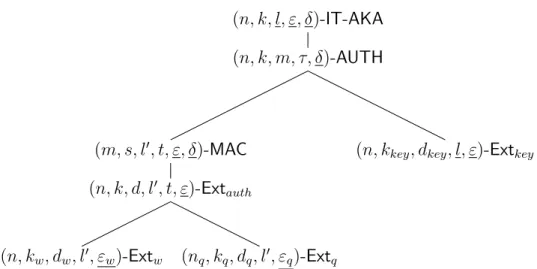
Based on this result, we have compiled the information about bit-length require-ments, statistical distances and probabilities of impersonation, in order to instantiate and implement the construction for some practically meaningful values. We have hierarchically organized the requirements in a top-down structure, where at the top we set the IT-AKA protocol and at the bottom the randomness extractors used as building blocks. This is depicted in Figure 3.3. At the top of this hierarchy we set some preliminary restrictions, particularly the size of the secret key agreed (denoted by R, R0 ∈ {0, 1}l where l = 128 bits), statistical distance from a uniform
distri-bution (denoted ε = 2−128), and probability of impersonation in the authentication protocol (denoted δ = 2−128).
Variables n, m and l0 bitlengths are free from restrictions, so we modeled them in order to present three case studies. We present an optimal, average, and a worst case situation. The optimal case depicts a good source of randomness where W has 93.2% of truly random bits. The worst case represents a bad source of randomness where W has only 14.2% of truly random bits. The average case depicts an average source of randomness where 56.3% are random bits.
(n, k, l, ε, δ)-IT-AKA (n, k, m, τ, δ)-AUTH
(m, s, l0, t, ε, δ)-MAC (n, k, d, l0, t, ε)-Extauth
(n, kw, dw, l0, εw)-Extw (nq, kq, dq, l0, εq)-Extq
(n, kkey, dkey, l, ε)-Extkey
Figure 3.3: IT-AKA’s building block hierarchy. The underlined variables are fixed a priori.
A special note for weak secret W ∈ {0, 1}n, where nothing more is required than n ≥ k throughout all the requirements presented. Variable k defines the bits of min-entropy. With only this requirement, our calculations tend to match the minimum length required for W that will be n = k. Of course, in a real-world application, fixing k will imply a possibly much larger value for n. The chosen lengths for n, m and l0 are presented in table 3.1.
n m l0 ratio k/n (%)
1 218 30 32 14.2 worst case
2 215 15 64 56.3 average
3 215 25 72 93.2 optimal
Table 3.1: The chosen values for the free variables for the four cases presented. We stress that the results presented in the following sections are just indicative, as they are based on the assumption that efficient randomness extractors can be con-structed for any parameter sizes. However, for the concrete construction suggested in [7], which is the extractor based in [8], obtaining an efficient implementation is not feasible for the large values of n that we are considering in this analysis, as this would imply dealing with irreducible polynomials of order n.
Randomness Extractor Extkey
This randomness extractor Extkey : {0, 1}n×{0, 1}dkey → {0, 1}lis responsible for the
extraction of R = R0 = Extkey(W ; XA), the secret key to be agreed by the parties.
Its output length is set a priori as l = 128. The random seed XA ∈ {0, 1}dkey
where dkey = m and where m is a free parameter corresponding to the size of the
the setting of other parameters. The bits of min-entropy kkey are the determined by
kkey = k − τ where k represents the entropy needed in AUTH message authentication
protocol, described in Theorem 3, and the results presented in tables 3.9 and 3.10. The notation pre and post for k present in table 3.2 describes the lengths required for the two types of authentication guarantees (pre and post-application authenticity) for AUTH.
n k (pre) k (post ) d l log(1/ε)
1 218= 262144 18349 18477 30 128 128
2 215 = 32768 9884 10012 15 128 128
3 215 = 32768 15227 15355 25 128 128
Table 3.2: Bitlengths for the construction of randomness extractor Extkey.
MAC with look-ahead security
The function MACk : {0, 1}m → {0, 1}s takes a message XA ∈ {0, 1}dkey=m, where
m is the same bitlength used in the seed to Extkey, and outputs a tag σ ∈ {0, 1}s
where s = 4ml0. The key k ∈ ({0, 1}l0)t is the output of a look-ahead extractor, where t = 4m, and l0 is a bitlength shared by the MAC, the look-ahead extractor Extauth, and the two randomness extractors Extq and Extw used as building blocks
of Extauth. As we said before, the probability of impersonation δ is set to 2−128, with
the requirement from the MAC definition δ ≤ (2m−l0 + 2mε) which is true for all
values m, l0, ε displayed in table 3.3.
m s l0 t log(1/ε) log(1/δ)
1 30 3840 32 120 128 128
2 15 3840 64 60 128 128
3 25 7200 72 100 128 128
Table 3.3: Bitlengths to construct a look-ahead MAC.
Look-ahead Extractor
The look-ahead extractor Extauth : {0, 1}n × {0, 1}d → ({0, 1}l
0
)t, outputs k =
Extauth(W ; XB) taking as arguments the weak secret W ∈ {0, 1}n and the
ran-dom seed (challenge) XB ∈ {0, 1}d. The min-entropy k for some value W has two
different requirements, one given by the look-ahead extractor construction (Theo-rem 2) as k = kw, where kw is the min-entropy of the weak secret used in extractor
minimum value for k as
k ≥ 2(t + 2)max(l0, O(log(n) + log(t) + log(1/ε))) . We therefore calculate k as follows.
k = max
kw
2(t + 2)max(l0, O(log(n) + log(t) + log(1/ε)))
(3.6)
The other Extauth’s argument is a random seed XB ∈ {0, 1}d, where by definition
d = nq+ l0, with d ≥ O(t(l0+ log(n) + log(t) + log(1/ε))). We use the same strategy
as before to reach the minimum length d that assured the previous condition. d = max
nq+ l0
O(t(l0+ log(n) + log(t) + log(1/ε)))
(3.7)
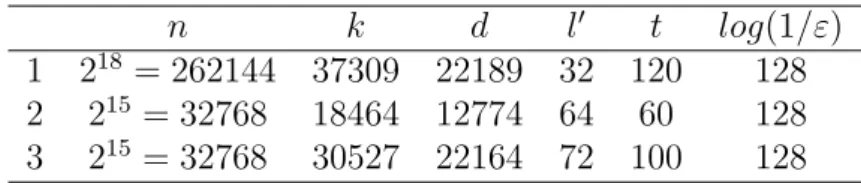
Length l0 is the same as the one used in the MAC construction. Variable t defines the number of iterations between the two extractors. This value comes from our analysis of the MAC construction, previously described in table 3.3. The results to a practical look-ahead extractor for our requirements are presented in table 3.4.
n k d l0 t log(1/ε)
1 218 = 262144 37309 22189 32 120 128
2 215= 32768 18464 12774 64 60 128
3 215= 32768 30527 22164 72 100 128
Table 3.4: Bitlengths to construct a look-ahead extractor Extauth.
We now look at the two randomness extractors Extw and Extqused as components
of the lookahead extractor, as described in Theorem 2. These two extractors have slightly different definitions. The size of the weak secret used by Extq is Q ∈ {0, 1}nq
where nq = d − l0. The size of weak secret W size is set as described before. The
requirements of min-entropy for each weak secret used in each randomness extractor are different. In the case of Extq it is given by kq = nq− (2l0)t, whereas in the case
of Extw it is given by kw = k − (2l0)t. Finally, the random seeds needed in both
extractors X ∈ {0, 1}dare d = l0, where l0is also the output size for these extractors, for the look-ahead extractor Extauth and for the MAC.
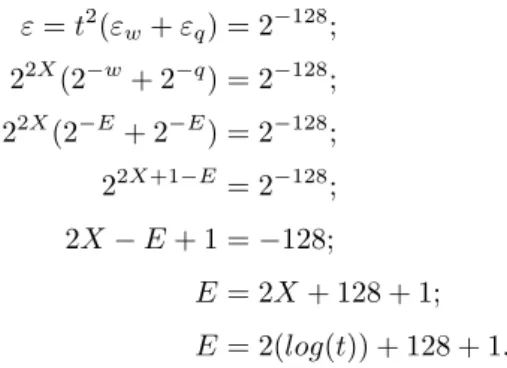
From above, we have the statistical distance of the lookahead extractor set at ε = 2−128. In Theorem 2 the definition of ε directly relates to the statistical distances from the two extractors Extq and Extw and the number of iterations t as ε = t2(εw+
εq). We calculate these two statistical distances from the deconstruction of Extauth’s
statistical distance ε. We define t = 2X and the statistical distances ε
q= εw = 2−E,
ε = t2(εw+ εq) = 2−128; 22X(2−w+ 2−q) = 2−128; 22X(2−E+ 2−E) = 2−128; 22X+1−E = 2−128; 2X − E + 1 = −128; E = 2X + 128 + 1; E = 2(log(t)) + 128 + 1.
Our conclusions are presented in tables 3.5 and 3.6.
n kw dw l0 εw = log(1/E)
1 218= 262144 29629 32 32 143
2 215 = 32768 10784 64 64 141
3 215 = 32768 16127 72 72 142
Table 3.5: Bitlengths to construct randomness extractor Extw.
nq kq dq l0 εq = log(1/E)
1 22157 14477 32 32 143
2 12710 5030 64 64 141
3 22092 7692 72 72 142
Table 3.6: Bitlengths to construct randomness extractor Extq.
Message authentication protocol
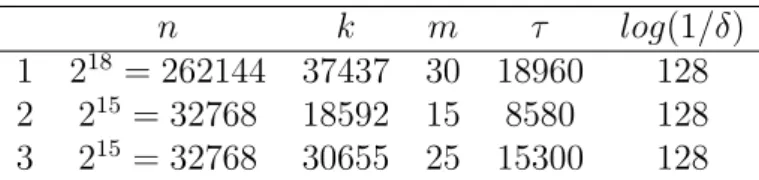
In Theorem 1 to construct an efficient (n, k, m, δ)-message authentication protocol it is required that n ≥ k, m, that the impersonation probability δ ≥ 0, and that k > O(m(m + log(n) + log(1/δ))). The size of the MAC key is upper bounded by τ = 4m(m + log(1/δ)) [7]. These bit lengths are described in tables 3.7 and 3.8.
n k m τ log(1/δ)
1 218 = 262144 37309 30 18960 128
2 215= 32768 18464 15 8580 128
3 215= 32768 30527 25 15300 128
Table 3.7: AUTH parameters for pre-application authenticity.
Key agreement protocol
Theorem 3 states that an (n, k, m, δ)-message authentication protocol which uses the components Extauth and MAC with look-ahead security coupled with an (n, k −
n k m τ log(1/δ)
1 218 = 262144 37437 30 18960 128
2 215= 32768 18592 15 8580 128
3 215= 32768 30655 25 15300 128
Table 3.8: AUTH parameters for post-application authenticity.
τ, dkey, l, ε)-Extkeyrandomness extractor is a (n, k, l, ε, δ)-IT-AKA with pre-application
authenticity. To achieve post-application authenticity we need to construct an (n, k − l, m, δ)-message authentication protocol instead. All values for both pre and post-application authenticity are described in the tables 3.9 and 3.10 respectively.
n k l log(1/ε) log(1/δ)
1 218= 262144 37309 128 128 128
2 215 = 32768 18464 128 128 128
3 215 = 32768 30527 128 128 128
Table 3.9: IT-AKA parameter sizes for pre-application authenticity.
n k l log(1/ε) log(1/δ)
1 218= 262144 37437 128 128 128
2 215 = 32768 18592 128 128 128
3 216 = 32768 30655 128 128 128
Table 3.10: IT-AKA parameter sizes for post-application authenticity.
3.6
Practical Implementation
We developed a C++ program that simulates the IT-AKA protocol and produces 218
bit random string as the weak secret. As pointed out before there is no actual randomness extractor construction, so to this purpose we have created an extractor based on the SHA-256 hash function. The extractor, as described produces a 256-bit output from the n-bit weak source.
From this randomness extractor and based on the construction proposed before, we have created a function that mimics the behavior of a look-ahead extractor. All other functions not directly related with the randomness extractor, were constructed according to the construction proposed.
Even with optimized code using the optimization flag gcc -O2 each execution is memory and CPU intense. Our performance tests were made on a machine with a two core 2.4 Ghz Intel Core 2 duo processor with 5GB of RAM. The average CPU
loads were near 100% and consumed approximately 2.7GBytes of memory. The execution times are presented in 3.11.
time 1m43.364s 1m44.900s 1m53.591s
Chapter 4
Computationally secure password
authenticated key exchange
Protocols for password-based authentication key exchange (PAKE) enable two par-ties who share a short, low-entropy password to agree on a cryptographically strong session key. Password-based protocols for authenticated key exchange are designed to work even if the passwords used are drawn from a small space in which an ad-versary might enumerate all the possible passwords off-line.
In this scenario there are two entities – a client C and a server S – where C holds a password pw and S holds a key related to this. These parties engage in a conversation at the end of which each holds a session key sk, which is private and only known by the two of them. A third entity is present which is an active adversary A whose capabilities include enumerating, off-line, the words in some dictionary which is rather likely to include pw. In a protocol considered good, the adversary’s chance to defeat the protocol’s goals will depend on how much A interacts with protocol participants, and will not significantly depend on its off-line computing time.
This protocol problem was originally suggested by Bellovin and Merritt [3], who also offered a protocol named Encrypted Key Exchange (EKE), and an informal security analysis.
4.1
Definitions and Security Model
Consider a fixed set of participants (denoted as Principals) each of which is either a client C ∈ Client or a server S ∈ Server (Client and Server are disjoint). Let User be a set with all the elements of Client and Server. Each client C ∈ Client has a password pwC. Each S ∈ Server holds a vector P WS = hpwCiC∈Client which
small space of possible passwords and is used by the client C to authenticate the connection.
In [1], passwords pwC, pwS are described as long-lived keys. The long-lived
keys are generated by a long-lived key generator P W . A possibility for P W is to determinate a password for a client A ∈ Client as pwA
R
←− P WA, for some finite set
P WA and pwB[A]B∈Server is set as pwA.
Initialization
An Initialization phase occurs where all the public parameters and passwords needed for the instances of the protocol are created. During an execution a Principal can run many instances, each one of them only once. An instance is denoted as Πi
U
where i ∈ N and U ∈ U ser. In this phase, for all i for every principal U the parameters sidi
U, pidiU, the session key skiU and the state preserving values state,
accui
U, termiU, usediU are initiated. Session id (sidiU) is used to uniquely name an
occurring session for some Principal U . Partner id (pidiU) names the Principal with which the instance believes it has just exchanged a key. sidiU and pidiU are write-only and public. Session key skiU is also write-only but secret, and for each client and server instances at most one value is accepted. The state preserving values state, accui
U, termiU, usediU are initialized. These values are used to maintain a global
state throughout the execution for an instance i. The passwords for each client C ∈ Client are generated independently, uniformly and randomly from a relatively small finite set, as described above [1].
Execution of the Protocol
Principals behave in response to input from their environment. In the formal model, these inputs are provided by the adversary [11]. Each principal is able to execute the protocol multiple times with different partners. This is modeled by allowing each principal an unlimited number of instances in which to execute the protocol. Any instance is used only once. We assume that the adversary has complete control over all communications, by that the adversary’s interaction with the principals is modeled via access to oracles whose inputs may range over U ∈ User and i ∈ N .
The adversary’s interaction with the principals is modeled via access to the following oracles:
• Send(U, i, M ) - This sends message M to instance Πi
U. The oracle runs this
instance as in a real execution, maintaining state as appropriate. The output of ΠiU is given to the adversary;
• Execute(C, i, S, j) - This oracle executes the protocol between instances of Πi U
and Πi
S, where C ∈ Client and S ∈ Server, and outputs a transcript of this
execution. This transcript includes everything an adversary would see when eavesdropping on a real-world execution of the protocol;
• Reveal(U, i) - This outputs the session key ski
U (stored as part of the global
state) of instance ΠiU;
• T est(U, i) - This query allowed only once, at any time during the adversary’s execution. A random bit b is generated; if b = 1 the adversary is given ski
U,
and if b = 0 the adversary is given a random session key;
• Corrupt(U, pw) - The adversary obtains pwU and the states of all instances of
U . This is a very damaging type of query. This query models the possibility of subverting a principal by witnessing a user type in his password, installing a trojan horse on his machine or hacking into a machine. A Corrupt query directed against a client U may also be used to replace the value of pwS[U ] used
by server S. This is the role of the second argument to Corrupt. This capability allows a dishonest client A to try to defeat protocol aims by installing a strange string as a server S’s password pwS[A] [1].
Freshness
There are two notions of freshness presented for this protocol, freshness with and without forward secrecy. These two notions of freshness presented have some events associated with them. RevealTo(U, i) event is true if there was at some point in time a Reveal(U, i) query. RevealToPartner(U, i) event is true if there was, at some point in time, a query Reveal(U0, i0) and Πi0
U0 is partner to ΠiU. SomebodyWasCorrupted
event is true if at some point in time, a Corrupt(U00, pw) query for some principle U00 and some pw. SomebodyWasCorruptedBeforeTheTestQuery event is true if there was a query Corrupt(U0, pw) and this query was made before T est(U, i). We say that Manipulated(U, i) event is true if there was at some point in time, a Send(U, i, M ) query, for some string M [1].
The basic notion of freshness with no requirement of forward secrecy, defines an instance as unfresh if RevealTo(U, i) query or RevealToPartnerOf(U, i) queries were made or SomebodyWasCorrupted is true. In any of the other cases an instance is considered fresh.
Freshness with forward secrecy defines an instance as unfresh if RevealTo(U, i) or
In any other cases it is considered fs-fresh. This definition of security gives credit to the adversary A if it specifies a fresh (fs-fresh) oracle and then correctly identifies if A is provided with the SK from that oracle or else a random SK. Two cases are presented, according to whether or not forward secrecy is expected. For the basic notion of security (fresh/unfresh) it is pessimistically assumed that a Corrupt query does reveal the session key, so any Corrupt query makes all oracles unfresh. For the version of the definition with forward secrecy a Corrupt query may reveal a SK only if the Corrupt query was made before the T est query. It is also required that the T est query was to an oracle that was the target of a Send query. This acts to build a requirement: that even after the Corrupt query, session keys exchanged by principals who behave honestly are still fs-fresh [1].
Accepting and Terminating
We differentiate between an instance accepting and terminating. When an instance terminates, it means that it has what it wants and won’t send out any further messages. An instance may wish to accept now, and terminate later, this happens typically when an instance believes it is holding a good session key, but, before using it, the instance wants confirmation that its communication partner really exists, and is holding the same session key. The instance can accomplish this by accepting now, but waiting for a confirmation message to terminate [1].
Advantage of the Adversary
Let Event Succ be the event when adversary A succeeds. Event Succ occurs if the adversary asks for a single T est-Query T est(U, i) where Πi
U has terminated, it is
fresh and A outputs a single bit b0 which b0 = b (where b is the bit selected by the Test query). The advantage of an adversary A attacking protocol P, is defined as AdvakeP,A = 2P r[Succ] − 1. Similarly, the ake-fs Advantage, AdvakeP,A(). An extra condition is required to the oracle ΠiU, to which the T est-Query is directed, must be fs-fresh [1]. If the adversary was unrestricted, success would be trivial (since the adversary could submit a Reveal query for the same instance submitted to the T est oracle). Some restrictions are imposed to prevent it. A polynomially bounded adversary will be able to break any protocol by attempting to impersonate a user and trying all passwords one-by-one. So, a given protocol is secure when this kind of attack is the best an adversary can do.
In [11], the resources available to an adversary A were measured and it was concluded that a protocol P is secure if, when passwords are chosen from a dic-tionary of size N , the adversary’s advantage in attacking the protocol is bounded
by O(qsend
N ) + ε(λ), where qsend is the number of calls the adversary makes to the
Send oracle, and ε(.) is some negligible function. The first term represents the fact that the adversary can do no better than guess a password during each call to the Send oracle. Even polymonially-many calls to the Execute oracle (which are passive observations of valid executions) and the Reveal oracle (compromise of short-term session keys) are of no help to an adversary. Only online impersonation attacks (which are harder to mount and easier to detect) give the adversary a non-negligible advantage.
Authentication
In an protocol execution P, an adversary A violates client-to-server authentication if some server oracle terminates but has no partner oracle. c2s advantage represents the probability of this event, and is denoted by Advc2s
P,A. An adversary violates
server-to-client authentication if some client oracle terminates but has no partner oracle. Let s2c advantage be the probability of this event, denoted by AdvP,As2c. Also, an adversary violates mutual authentication if some oracle terminates, but has no partner oracle. ma-advantage defines the probability of this event, and is denoted by Advma
P,A.
An AKE protocol is easily modified to provide authentication. These transfor-mations use a well-known approach of using the distributed session key to construct a simple authenticator for the other party [1].
Relation to information theoretic security model
The security models for information theoretically secure Authenticated Key Agree-ment (AKA) and computationally secure Password-Authenticated Key Exchange (PAKE) that we have studied have fundamental differences that are obvious. The former allows for an unbounded adversary, yet restricts the attack scenario to a single exchange. On the other hand, the latter allows for many interactions, even allowing the adversary to exploit cross-session attacks, yet only considers adversaries that can be modeled as probabilistic polynomial time algorithms.
Nevertheless, the models do have some properties in common. In particular, both definitions identify two types of events in a protocol execution, corresponding to two different types of states that can be reached by participants:
• Getting the values needed for preparing the key. This state is described as Accepting in PAKE and KeyDerived in AKA.
• Sending of the authenticated ciphertext. The is the final state and is described as terminating in PAKE and Keyconfirmed in AKA.
However, in the PAKE model, the idea of key confirmation is the following: when one of the participants gets the needed information from the other party and holds a good session key, it will still wait for some type of confirmation that their partner really exists, and is holding the same session key. The participant can accomplish this by Accepting now, but waiting for a confirmation message to terminate [1]. In AKA, Alice reaches KeyDerived after Bob has issued a challenge and Alice possesses a random candidate key. Alice, contrary to what happens in PAKE, has no information if her key is shared with Bob nor if he is even involved in the protocol [7]. When in PAKE, a participant Terminates, it means that it has what it wants and won’t send out any further messages [1]. In AKA, to Bob reaching the KeyConfirmed state and getting a candidate key means that Alice must have been involved in the protocol execution, must have reached the KeyDerived state, and the two parties have shared the same key [7].
4.2
A concrete PAKE protocol
Katz, Ostrovsky and Yung present their PAKE protocol presented in [11]. This protocol relies on the following building blocks: an extension of the Cramer-Shoup cryptosystem, secure under adaptive chosen-ciphertext attack; a one-time signature scheme secure against existential forgery; and finally, the proof also relies on the Decisional Diffie-Hellman assumption.
The extended Cramer-Shoup encryption is an extension to the original algorithm. We firstly studied the security analysis of Cramer-Shoup’s CS1A algorithm [5]. This
particular version was the basis for the extension presented. Extended Cramer-Shoup uses some extra arguments, which are used to tag a principal as either a client or a server. The protocol distinguishes between these two types of principals as they have two different roles. Two different encryption schemes are used, and labeled client and server encryption, respectively. We have analyzed where the original and the extension scheme diverged, and focused our study in the security games that were affected. The sole difference in the security proofs between the two schemes concerns the use of the hash function. Contrarily to the CS1A scheme, the
hash arguments in the extended version are not randomly sampled. Some of the extra arguments that form the hash function argument are given by the adversary. This means that the original security proof by Cramer and Shoup [5] does not apply, and the notion of a UOWHF must be used instead the use of a TCR hash function.
![Figure 3.1: Structure of the IT-AKA protocol presented in [7]. The internal bold box depicts a message authentication protocol](https://thumb-eu.123doks.com/thumbv2/123dok_br/17764945.836155/22.892.129.828.625.989/figure-structure-protocol-presented-internal-depicts-authentication-protocol.webp)

![Figure 4.1: protocol for password authentication key exchange [11].](https://thumb-eu.123doks.com/thumbv2/123dok_br/17764945.836155/41.892.122.780.104.596/figure-protocol-password-authentication-key-exchange.webp)