metaphorical containment in Brazilian Portuguese:
the case of em, dentro de, and fora de
Aparecida de Araújo Oliveira∗1
Abstract
I analyzed conventional metaphorical expressions in Brazilian Portuguese having lexicalized functional effects of spatial scenes as complements of the prepositions dentro de [inside], em [in, on, at], and fora de [out of]. The functional effects investigated were ‘protection’, ‘covering/hiding’, ‘control’, and ‘envelopment’, which constitute the family resemblance concept of Containment. I provided a cognitive account of these conventional expressions in terms of primary metaphors such as invisibleisinside and uncontrolled is outside, emerging through experiential correlation in
primary scenes. I described twelve meanings based on the container image
schema, four based on the verticality schema, and four based on the
non-imagetic notion of ‘non-existence’. Contradicting my initial expectations, the corpus-based analysis revealed little overlapping between em and sob [under], and fora de and sem [without]. However, the study confirmed the asymmetry between the prepositions meaning ‘in’ and those meaning ‘out’. Keywords: Metaphor. Experiential correlation. Containment functional relation. Prepositional meaning. Brazilian Portuguese.
* Universidade Federal de Viçosa.
1 Introduction
“The function of an object or relation is its role in the survival and well-being of infants and adults in the world.” (VANDELOISE, 2005, p.219)
Functional parts of objects’ configurations and their interaction in space have been assumed as the motivation for metaphorical uses of language (KÖVECSES, 2005), and more specifically, for the use of prepositions (LINDNER, 1981; TYLER; EVANS, 2003). In particular, some lexicalized functional consequences of these spatial configurations and interactions collocate with certain prepositions to convey metaphorical meaning. In this paper I analyze conventional metaphorical
expressions in Brazilian Portuguese, such as dentro do controle [under control],
em vista [in sight], and fora do alcance [out of reach], in (1), (2) and (3) below,
which encode distinct consequences of spatial scenes where an object is either in or out of a bounded region.
As for the prepositions that occur in these expressions, em [in, on, at], dentro
de [inside, within], and fora de [out of] are based on the container schema (JOHNSON, 1987, p. 22-23), sob [under] is based on the verticality schema, and
sem [without] conveys the non-imagetic notion of ‘non-existence’.12
(1) Os primogênitos também têm a função de manter os membros de seus
clãs dentro do controle. (Corpus Brasileiro)
[The firstborn sons also have the role of keeping the members of their clans
under control.]
(2)«Não tinha nenhum emprego em vista. » (CFolha) [I had no job in sight.]
(3)Várias tops estarão fora do alcance nestas férias de verão. (CFolha) [Several top models will be out of reach in these summer vacations.]
I provide a cognitive account of the way these expressions emerge from the functional category of containment (C/c – Container/content Relation, in VANDELOISE, 1991; 2005) through metaphor. I argue that these and other such expressions encode the ontological metaphors states are containers and activitiesarecontainers (LAKOFF; JOHNSON, 2003 (1980), p. 31-32), which are motivated by experiential correlation resulting from recurrent primary scenes (GRADY, 1997). Each of these primary scenes involves a perceptual experience of a C/c situation and a simultaneous cognitive response, such as ‘the container constrains the movements of its content’, or ‘the container hides its content.’ Because these functional effects are not exclusive to C/c events, I also analyze the metaphorical contexts in which em and dentro de overlap with sob [under], and
fora de overlaps with sem [without]. Finally, once dentro de (and em) and fora de
theoretically represent “opposite” poles on the in-out axis, I seek to demonstrate the asymmetry between containment and non-containment in the metaphorical usages investigated here.
1 For the sake of simplicity, I use the term “preposition” to refer to both simple and complex prepositions, such as em and dentro de, respectively.
2 The preposition em appears as n- when followed by an article or a pronoun starting with a vowel sound. For instance, na = em + a (fem. def. article); naquele = em + aquele (masc. distal demonstrative). This condition holds equally true for the preposition de, in dentro de and fora de, which becomes d- in similar contexts.
In what follows, I provide a brief definition of the class of prepositions according to Cognitive Grammar and a description of spatial meanings of em,
dentro de, and fora de. Next, I address the relevance of the functional effects of
the container schema for spatial cognition and spatial language across cultures. Finally, I present the theoretical grounds underlying the subsequent analysis of metaphorical uses of these prepositions.
1.1 Prepositions in grammar and conceptualization3
Prepositions are atemporal relational words that take part in constructions with nominals functioning as their “objects” or “complements”. While nominals elaborate ‘things’, which are conceptually autonomous, prepositions (as well as adjectives, adverbs, verbs, and conjunctions) elaborate ‘relationships’, which are conceptually dependent on the related entities (LANGACKER, 1987, p. 214-20, 299-301; 2008, p. 200-201). In the example animal fora da jaula [animal out of the cage], both animal [animal] and jaula [cage] are nouns, and thus refer to things that we can think of without invoking other objects. On the other hand, to conceive of the meaning of fora de, it is necessary to access the content of o animal and a
jaula. This is so because fora de contributes the sense of ‘localization outside a
bounded region’ to a lower-order schema wherein an animal’s cage is the spatial reference to ‘locate’ something that, in a more complex structure, turns out to be the animal itself.
This is true of any preposition, be it locative or not. At a higher level of conceptualization, a prepositional profile is comprised of a certain relation and two schematic entities, which are further elaborated in the use of language. As defined by Langacker (2008, p. 117, 122), these entities are the “trajector” and the “landmark”. The landmark works as the prepositional complement and is elaborated by a nominal in a prepositional phrase. That nominal elaborates a schematic entity (in this case, a ‘thing’) that receives “secondary focal prominence” (p. 117). The resulting prepositional phrases function either as adjectives –– e.g. O fogo
sem controle [uncontrolled fire] – or as adverbs – e.g. Plante os dentes dentro de um vaso [Plant the bulbs in a vase] –, depending on whether the modified entity is
a thing (o fogo) or a relationship (Plante os dentes). The modified entity is called 3 I wish to thank the anonymous reviewer for his/her pertinent and useful suggestion to enhance this text with a theoretical section on prepositions.
the “trajector”, and receives primary focus in the prepositional schema.
Following Langacker’s definitions, in the spatial scenes I analyze, the “trajector” is the entity seen as moving or located in relation to another that is the “landmark”. In a C/c relation expressed by a preposition, the landmark is the container, while the trajector is the content, and in the metaphorical uses discussed in this paper, the prepositional complements (landmarks) are nominals invoking conditions or situations in which each trajector is. Because these nominals stand for reified actions, the prepositions may differ regarding the encoding of the agent and patient roles in these constructions.
2 Spatial meanings of dentro de, em, and fora de
Dentro de, em, and fora de have their original meanings connected with
bounded landmarks and, in their current use, they form a continuum from ‘total inclusion’, through ‘partial inclusion’, to ‘non-inclusion’ in a bounded landmark.4 However, dentro de profiles the idea of ‘located inside’ more clearly than em does, as demonstrated in the examples below from Castilho (2012, p. 606). This difference in meaning renders dentro de the best choice in (4). Em expresses a general sense of ‘location’, further elaborated by the spatial properties of the landmarks, as in (5) and (6). Thus, in (6), em and dentro de help impose distinct construals on the same scene.
(4) O estatístico é o homem que senta numa barra de gelo e bota a cabeça dele
dentro do forno e diz que a temperatura média está ótima.
[A statistician is a man who sits on an ice block, sticks his head inside the oven, and says the average temperature is just great.]
(5) Morar bem é morar num apartamento de luxo, é morar no centro da cidade. [To live nicely is to live in a luxury apartment, to live in the city center.] (6) Eu moro numa grande cidade, moro dentro de Recife.
[I live in a large city; (I) live within the limits of Recife.]
A major distinction between dentro de and em in spatial uses is that the former typically conveys ‘total inclusion’ (see the functional property ‘the 4 Dentro = de + intro (CASTILHO, 2012, p. 589), and both em and dentro de come from Indo-European en, meaning ‘in’, through Old Latin (SLOCUM, 2016). Fora de derives its meaning from the Latin adverb fŏras = ‘outside, out’ (INSTITUTO ANTÔNIO HOUAISS, 2009), from Indo-European
dhuĕr = ‘door’, ‘gate’ (SLOCUM, 2016).
container envelops the content’ later in this paper), while the latter can express ‘non-containment location’, and both ‘total’ and ‘partial inclusion’. The different affordances of the trajectors in (7) and (8) explain the prepositional choices: encyclopedic knowledge tells us that pepper plants, which have a larger aerial portion that typically sticks out of the vase, differ from bulbs in that sense.
(7) Um pé de pimenta, que mantém em/*dentro de um vaso na sala... 5 (CFolha)
[A pepper plant, which he keeps in a vase in the living room…]
(8) Plante os dentes dentro de/em um vaso com as pontas para cima, a dois
centímetros de profundidade. (CFolha)
[Plant the bulbs in a vase with their tips up, two cm deep.]
Fora de means ‘exterior to a bounded landmark’ (CASTILHO, 2012, p. 607)
as in (9), which pragmatically represents many more locations than ‘interior’ does. Because a single preposition encodes this ‘general exteriority’ in contrast to at least two conveying ‘interiority’, it is hardly the case that fora de and em, or fora de and
dentro de, are symmetrical. Moreover, as Tyler and Evans (2003, p. 200) argue,
in terms of functional effects, being outside may not form a “unified experience” as being inside does. In fact, fora de encodes spatial meanings other than ‘non-containment’, with different functional consequences, such as ‘difficulty’ in (10), emerging from harsh driving conditions on unpaved terrain, which , by the way, does not produce a metaphor. Such spatial asymmetry is likely to determine metaphorical asymmetry as well.
(9) Hemorragia: a saída do sangue para fora do sistema vascular. (CFolha) [Hemorrhage: blood going out of the vascular system.]
(10) Os Land Rover confirmam sua superioridade fora de estrada. (CFolha) [Land Rovers confirm their superiority off road.]
(11) ...atirar fora do alvo. (Corpus Brasileiro) [… to shoot off target]
3 Relevance of the container image schema and its functional consequences
The high significance of the container image schema in cognition is due to the great ubiquity of C/c situations in our experience. As Mandler and Pagán Cánovas (2014, p. 515) note, after people and their eyes, infants first conceptualize 5 The first preposition in the pair or group is always the one originally found in the corpus.
containers, and actually pay more attention to movements in and out of containers than to containers proper. A functional effect of containing that is particularly relevant in early development is ‘hiding’. Occlusion and containment tend to co-occur in the myriad of situations where children experience the disappearance of objects and people they are watching. Furthermore, the way different peoples use ordinary artifacts has proven to affect infants’ pre-linguistic embodiment of spatial relations. For instance, the significance of container orientation is a result of containers’ affordance to ‘contain’ things, itself a culturally determined property (SINHA; JENSEN DE LÓPEZ, 2000, p. 29-36). As these authors state, a given people can frequently use a same object turned upwards to contain something, and downwards to contain something else. In other cultures, people may use two distinct objects to do the two jobs.
According to these authors, the emergence of language helps the entrenchment of such pre-linguistic conceptualizations. Just the same, the possibility of controlling the location of the content, especially with wide-open containers, influences adults’ use of the English preposition in (GARROD et al., 1999, p. 174). The fact that both infants’ and adults’ choices are not random is relevant here, since meaningful behavior is a property of primary scenes that give rise to metaphor (GRADY, 1997).
As a result of conventionalized construal (LANGACKER, 1987), the expression of spatial relations differs across languages in the sense that distinct aspects of a same “objective” scene are conveyed by diverse grammatical or lexical resources in each idiom. Thus, for instance, the Korean word kkita encodes the notion ‘tight-fit’, no matter if the trajector is ‘in’ or ‘on’ the landmark according to English categorization (McDONOUGH et al., 2003, p. 233). This concept is not conveyed by any closed-class word in either English or Portuguese. Equally, while English and Danish use two distinct words – in/under and i/under – when referring to C/c scenes with containers facing upwards/downwards respectively, Zapotec uses just one (SINHA; JENSEN DE LÓPEZ, 2000, p. 32): làa’iny (LILLEHAUGEN, 2003, p. 5), regardless of container orientation.6
Controlling the trajector’s position is essential to the semantics of French dans [in] (VANDELOISE, 2001, p. 235-238). The figures below refer to the prepositions
dans [in] and sous [under], according to whether or not the upside-down container
6 One meaning of English non-containment “under” is lexicalized differently in Zapotec, with the word ni’ih, as in Bèe’cw zùub [ni’ih me’es]. = ‘The dog is sitting under the table.’ (LILLEHAUGEN, 2003, p. 3)
constrains the content’s movements. The same holds for English: in Fig. 1, the insect is in the bowl, and the cheese is under the cheese cover in Fig. 2. Even when the landmark does not fully envelop the trajector, as in the case of a light bulb in a socket, French dans is adequate too, because the socket controls the position of the light bulb. So, La lampe est dans la douille sounds natural.
FIGuRE 1 – La mouche est dans la bol. SOuRCE: VANDELOISE (2001, p. 237)
FIGuRE 2 – Le camembert est sous la cloche à fromage. SOuRCE: VANDELOISE (2001, p. 237)
In Brazilian Portuguese, both the fly and the cheese are debaixo de (or sob)
a tigela/ a tampa da queijeira [under the bowl/the lid of the cheese cover], or
perhaps, na tigela/ queijeira [in the bowl/cheese cover]. The functional notion of ‘covering’ is profiled by debaixo de and sob, while em plainly conveys the idea of ‘locating’. Dentro de [in, inside] is a very ‘topological’ preposition and would be the best choice were the container an inverted bottle in Fig. 1, because the landmark alone would contain the trajector, regardless of orientation. As for the scene with the light bulb in the socket, dentro de would not be used – as in (12) – because no substantial part of the chip is included in the socket, and em just ‘locates’ the chip. Finally, in (13), dentro de is preferred, since it is a matter of keeping a considerable part of the shirt inside one’s shorts.
(12) O chip G3 é instalado em / *dentro de um soquete ZIF. (Corpus Brasileiro) [The G3 chip is installed in a ZIF socket.]
(13) Os jogadores devem estar com as camisas dentro do / *no short. (CFolha) [Players must have their shirts in their shorts.]
Meaning distinctions like these have a bearing on the lexicalization of functional effects of spatial scenes in conventionalized metaphorical expressions with semantically related prepositions.
4 Functional effects and metaphor
Metaphor derives from both “perceptual resemblance” (LAKOFF; JOHNSON, 2003 (1980)) and “experiential correlation” in “primary scenes” (GRADY, 1997). In Grady’s view, certain metaphors can only be explained in terms of the consequences of our goal-oriented interactions in the world. A classic example is difficultyisheaviness, a metaphor attested in many languages, derived from the effort needed to lift or carry heavy objects (for instance, ALARCÓN, 2012).
These interactions correspond to “basic events” (GRADY, 1997, p. 20), i.e., ordinary events we frequently experience, related to our goal-oriented interactions. Once functional effects of the container schema represent the target of this paper, let us think of things we do with containers, having a particular purpose in mind. Entering our homes, putting a coin in a piggy bank, and taking a present out of a box are distinct basic events elaborating the container image schema (GRADY; JOHNSON, 2002, p. 549-550). We often experience certain cognitive responses to these basic events. For instance, due to their physical properties and limits, houses, piggy banks, and boxes may provide a feeling of protection, safety, (in)visibility, and so forth. The combination of these perceptual experiences and feelings forms “primary scenes”.
We may not always be aware of these responses, but their recurrence creates a conceptual association, called “experiential correlation”, between a basic C/c event and its functional consequences, so that we recall the response even in the absence of the perceptual experience. This type of correlation forges metaphors wherein the source concept relates to a “bodily sensation” or a “perception of the world”, and the target domain is a cognitive response (GRADY, 1997, p. 26). As these are grounded in more basic, embodied experience, they are called “primary metaphors”.
In the C/c situations above, different “subscenes” are (I) our perceptual
experience of ourselves or something being either inside or outside a container and (II) cognitive responses to our perceptions, such as ‘control’ or ‘visibility’. The intense repetition of these associations gives rise to mappings between a certain spatial configuration and its functional consequences, as can be seen in metaphors such as controlledisinside and protectedisinside.7 Despite emerging from the same image schema, the metaphors are different because of the great variety of possible interactions in space and the greater specificity of primary scenes as compared to image schemas (LIMA, 2006, p. 115).
Regarding linguistic expression, what we see here is the encoding of the speaker’s involvement, a phenomenon within the process of grammaticalization that Traugott (1988, p. 407-408) names “pragmatic strengthening.” This author also signals the major role of metaphors as a motivation for grammaticalization. In this case, we should resort to the construct of “ontological metaphors” (LAKOFF; JOHNSON, 2003 (1980), p. 25-32) to explain how a functional effect, such as control in (14), and a physical landmark, such as a stadium in (15), complement one and the same preposition. Because these abstract things – activities or states – are construed as entities or substances that “can contain”, we can use them just as any nominal referring to a physical landmark.
(14) A multidão ficou fora de controle. [The crowd got out of control.]
(15) Parte dos torcedores ficou fora do estádio. [Some of the fans remained out of the stadium.]
5 Analysis
Vandeloise (2005, p. 224) defines the C/c relation in terms of a family resemblance concept, with six characteristics representing the requirements for prototypical containment. These requirements are: (a) the container protects the content; (b) the container hides the content; (c) the position of the content relative to the container does not change when the container is moving; (d) the container prevents the content from transgressing its limits in more than one direction; (e) before containment, the content moves towards the container rather than the reverse; (f) the container envelops the content. Conditions (c) and (d) are subsumed 7 I do not claim these are the only metaphors for ‘control’ or ‘protection’. verticality is also a source
domain for metaphors involving these two functional effects.
under positionalcontrol. A number of containment relationships do not meet all these conditions, and languages vary in the way they group these for encoding. Example (16) below only meets requirements (a), (b), and likely (f).
I will illustrate these conditions with examples of primary scenes that suggest specific functional consequences and metaphorical uses containing the lexicalized effect when available in the language. The examples come from the corpus CetenFolha (SANTOS; SARMENTO, 2003), the Corpus Brasileiro (BERBER SARDINHA et al. n/d), and from other sources otherwise informed.
5.1 The container protects the content:
The primary scene:
(16) Com o estudo do fóssil dentro da terra, poderemos entender como a pele
foi preservada. (Corpus Brasileiro)
[By studying the fossil in the soil, we will be able to understand how its skin was preserved.]
In this example, keeping the fossil “inside” the soil certainly protects it against decay. Indeed, the function of ‘protection’ can be salient in many containment scenes, but it is not productive with prepositions based on the container schema in Brazilian Portuguese. Instead, as described by Oliveira (2007, p. 243), ‘protection’ is mapped from the verticality schema, which can be found in a primary scene like (17), and is expressed by the preposition sob, as in (18). In that case, the primary metaphor is protectedisunderneath.
(17) Sob/debaixo das árvores do bosque, cerca de cinco mil pessoas
participaram da formatura.
[Under the trees in the woods, around five thousand people attended the graduation ceremony.]
(18) O parque é o mais antigo sob proteção do Estado. (CFolha) [The park is the oldest under State protection.]
In contrast, the meaning ‘unprotected’ is largely conveyed by sem proteção [without protection] as in (19), with 702 tokens in the two corpora, compared to 2 tokens of fora de proteção [out of protection]. Sem encodes a more abstract notion of ‘absence’ or ‘deprivation’ (NEVES, 2011, p. 729). These meanings cross-cut uncountable domains, so we cannot conceptualize them as a unified experience, such as ‘containment’ or ‘verticality’, much less estimate the number of possible functional effects associated with spatial uses of sem.
(19) O meio de campo avançou como um todo, em linha, e deixou os zagueiros
sem proteção. (CFolha)
[All the midfielders advanced in line and left the defenders unprotected.]
5.2 The container hides the content:
The primary scene I:
As Johnson (1987, p. 36-37) explains, “orientational schemata [such as in-out] presuppose a ‘viewpoint’.” In the examples below, a perspective from outside is pragmatically required due to the sizes of the landmarks, but especially necessary to construe the meaning of escondida(s) [hidden(-pl.)]. From this vantage point, one experiences two correlated situations: (I) the trajector is inside the landmark and (II) the landmark hides the trajector.
(20) As aves estavam escondidas em/ dentro de uma caixa de papelão. (Estado de Minas)
[The birds were hidden in/inside a cardboard box.]
(21) Graças ao animal, foi achada cocaína escondida em buracos nos
barracos. (CFolha)
[Thanks to the animal, cocaine was found hidden in holes in the shacks.] Metaphorical use:
It may be the case that such a perspective from outside is more recurrent in our experience than one from inside. For this reason, we may be more familiar with the hiding effect emerging in these circumstances, a correlation which engenders the primary metaphor invisibleisinside, which, in turn, gives rise to understanding (knowing) isseeing (LAKOFF; JOHNSON, 2003 (1980), p. 108) found in (22). As Sweetser (1990, p. 33) explains, this latter emerges from the fact that the sense of vision is a primary source of information. Thus, if something is inside and cannot be seen, its existence may go unsuspected.
(22) Os nomes dos suspeitos são mantidos em sigilo/*dentro de sigilo. (CFolha) [The names of the suspects are kept confidential.]
(23) Os nomes das empresas envolvidas estão sob sigilo. (CFolha) [The names of the companies involved are being kept confidential.]
Once again, em and sob [under] overlap in these contexts, as attested by the very similar example in (23), itself an instance of the primary metaphor invisible isunderneath. ‘Hiding’ the trajector is another functional effect of the verticality
image schema that appears associated with sob (OLIVEIRA, 2007, p. 240, 241). However, the two corpora produced 1552 tokens of em segredo plus 1484 tokens of em sigilo, compared to 77 tokens of sob segredo plus 591 tokens of sob sigilo. In addition to these figures, although sigilo and segredo are near synonyms, the highest frequency of sob segredo occurred in the technical expression sob segredo
de justiça [under judicial secrecy].
Given the general configuration of our bodies, it is more likely for a trajector to be hidden if it is “inside” rather than “under” a landmark. In this latter situation, the viewer must look at the scene from above. In the former, any vantage point outside an opaque landmark will produce this ‘hiding’ effect. That should explain the predominance of em in the expressions above in contrast with sob. However, the uses of em seem to be further explained by the ubiquity of this preposition with these things specifically in ontological metaphors (OLIVEIRA, 2011, p. 52-54). Thus, although sigilo in (22), but not solidão in (24), is an indirect consequence of the container schema, these nouns share a higher-order property: both are states metaphorically construed as substances.
(24) ... a rejeição é experimentada, muitas vezes, em/*dentro de solidão. (Estado de Minas)
[... rejection is often experienced in solitude.]
However, even though the idea of something being inside a bounded space “carries a sense of privacy” (LINDNER, 1981, p. 106), this notion does not represent a separate spatial sense of dentro de, and consequently, not a metaphorical one either. A separate sense occurs if a single condition of the family resemblance concept is enough to describe the use of a preposition (as posited by VANDELOISE, 1991, p. 193). As seen throughout this paper, compared to em,
dentro de profiles ‘being in a bounded space’ more clearly, which precludes its
occurrence with unbounded landmarks, such as a state in (22) to (27).
(25) Deverá o juiz determinar que o processo prossiga em/*dentro de segredo
de justiça. (CFolha)
[The judge must determine that the process proceed under judicial secrecy.] (26) O caso corre sob/ *dentro de segredo de Justiça. (CFolha)
[The case proceeds under judicial secrecy.]
(27) Hussein se reuniu em/*dentro de/*sob segredo com dirigentes israelenses. (CFolha)
[Hussein has secretly met with Israeli leaders.]
The expression fora de segredo/sigilo [“out of secrecy”], as an instance of the metaphor visibleisoutside, does not occur in Brazilian Portuguese.
The primary scene II:
The scene below is conceptualized from inside a container. Situations such as this are also very common in our experience, but frequently correlate with different functional effects from the one discussed above. For instance, in (28), a vantage point from inside allows the visitors to ‘see’ the two people there just as the walls of the house prevent them from seeing things outside.
(28) Ao entrar na casa, viram o menino com Maria, sua mãe. (A Bíblia) [Upon entering the house, they saw the child with Mary, his mother.] Metaphorical use:
Pragmatic strengthening of this correlation motivates the primary metaphors visible is inside and invisible is outside present in (29)-(31) below. In these metaphors, we attribute fictive boundaries to the area our sight (or another sense) can reach. The expression campo visual [visual field] supports this idea. Just the same, the metaphor eyesarelimbs (LAKOFF; JOHNSON, 2003 (1980), p. 50) can explain (30), (32), and (33) if we consider that there is a limit to how far we can see and how far our arms can reach. This part of the analysis will focus on metaphorical expressions with em and dentro de as elaborations of the metaphor visibleisinside, and fora de as elaborations of invisibleisoutside, and in both cases, the prepositional complements are nouns from the lexical fields of perception, especially visual and tactile perception.8
(29) (2) «Não tinha nenhum emprego em vista/*dentro de vista. » (CFolha) [I/he/she had no job in sight.]
(30) Várias tops estarão fora do alcance da vista nestas férias de verão. (CFolha) [Several top models will be out of sight in these summer vacations.]
(31) Para confessar todas suas peripécias em seus filmes e especialmente
aquelas que cometia fora da vista de um diretor, Brando recebeu US$ 4 milhões.
(CFolha)
[To confess all his adventures in his films and especially those committed out
of sight of a director, Brando received $ 4 million.]
(32) Constroem ninhos grandes e complexos nos ramos mais altos, fora do
alcance de predadores de pêlo, como os gatos-do-mato. (CFolha)
8 Portuguese does not have a word such as “earshot” in “listened until the parade was out of earshot.” (The American Heritage® Dictionary of the English Language, 2011)
[They build large, complex nests on the highest branches, out of the reach of fur predators, such as wild cats.]
(33) Quando uma atividade está fora do alcance da lei, o que predomina é a força. (CFolha)
[When an activity is out of the reach of law, force is what prevails.]
The view of an object may simply result in someone’s acknowledging its presence, or it can trigger another response to that visual information. For instance, it is often the case that a viewing event can provoke an action by the viewer. Because of this recurrent pattern of correlation, ‘cause’ can equate with ‘view’ in conceptual space. Language can make good use of this metaphor to express certain relations in discourse, for instance with the causal connectives tendo em vista and
em vista de, both meaning ‘because of’. These uses are instances of Traugott’s
(1988, p. 409) second semantic-pragmatic tendency in grammaticalization, in which a meaning in an external situation ends up as a meaning in a textual situation.
(34) Ele atribuiu a investigação a «interesses políticos, tendo em vista/*tendo
dentro de vista as eleições presidenciais». (CFolha)
[He attributed the investigation to “political interests, in view of the presidential elections”.]
(35) O Sistema Telebrás procura assegurar sua própria sobrevivência, em
vista/*dentro de vista das pressões para a quebra do monopólio estatal no setor.
(CFolha)
[The Telebras System seeks to ensure its own survival, given the pressures for breaking the state monopoly in the sector.]
5.3 The container controls the position of the content:
A container controls its content in at least two ways. It forces its content to remain inside or it controls the forces acting within its boundaries. The first case represents positional control and subsumes conditions (c) and (d) of the C/c relation. This functional meaning emerges from events such as the one described in (36).
The primary scene I:
(36) 29 mil m3 de resíduos tóxicos armazenados em/dentro de valas e em/ dentro de galões enterrados no/*dentro do solo. (Jornal do Brasil)
[29 thousand m3 of toxic waste stored in pits and in gallons buried in the ground.]
One response to this experience is the understanding that the pits and the gallons only theoretically prevent their dangerous content from escaping into the open air or into the soil. However, disregarding the poor storing conditions, keeping toxic waste in this fashion instead of liberating it into the environment is a goal-oriented action with a very clear expectation, given the danger represented by those substances. The correlation between the two events is very strong and gives rise to the metaphors controlledisinside and uncontrolledisoutside.
Metaphorical use:
However, the metaphor controlledisinside proved rather unproductive with
dentro de/do controle (11 tokens) as compared to sob (o) controle (7455 tokens).
uses such as (37), with a reading similar to (38), are extremely rare. This shows the prevalence of the ‘control’ effect from the verticality schema, in a primary scene like (39) below. Being under the landmark, the trajector “he” has all his movements constrained. The correlation of the two events gives us the primary metaphor controlledisunderneath.
(37) (1) Os Primogênitos também têm a função de manter os membros de seus
clãs dentro do controle. (Corpus Brasileiro)
[The firstborn sons also have the role of keeping the members of their clans
under control.]
(38) No dia-a-dia da economia, porém, a situação não parece sob controle. (CFolha)
[In day-to-day economy, however, the situation does not seem under control.] (39) Sob a caixa d’água prendia-se a vítima de tal maneira que esta não
conseguia mexer sequer a cabeça.
[Under the water tank, the victim was trapped in such a way that he could not even move his head.]
‘Out of control’ is very often expressed with fora de/do controle, as in (41) below (1325 tokens), which is coherent with the C/c metaphors approached here. If the content leaves the container, it is no longer controlled, and the spatial scene in (40) demonstrates that as the animal’s new condition.
(40) Creswell levou um susto ao defrontar-se com o animal fora da jaula, no
corredor. (Corpus Brasileiro)
[Creswell was startled when confronted with the animal out of the cage, in the hall.]
(41) A cidade está fora de controle. (CFolha) [The city is out of control.]
So far, I have focused on the (un)controlled participant, whose interactions have been expressed by fora de and by sob (marginally by dentro de). However, the use of em provokes a shift of attention to the controlling participant, as in (42), in a reading that would be impossible with dentro de. Perhaps because ‘controlling’ is pragmatically more relevant than ‘hiding’ or ‘protecting’, Portuguese has found a way to represent the controller (but neither the cover nor the protector) as the trajector of a preposition in these metaphorical expressions. As seen above in the explanation of (22) and (24), em very often encodes relations having states or activities as landmarks.
(42) A ideia é mostrar que a equipe está viva e no controle das coisas. (CFolha) [The idea is to show that the team is alive and in control of things.]
An even more schematic preposition is sem, if we consider the uncountable domains to which its ‘non-existence’ meaning can relate (See explanation of example (19) above). Here, this vaguer meaning of sem allows it to take both agents and patients as trajectors, as presented below in (43) and (44), respectively. (43) É uma página importante da história que nós estamos virando, de um
Brasil sem controle de nada. (CFolha)
[It is an important page of history that we are turning, a Brazil with no control of anything.]
(44) O fogo sem controle é crime. (CFolha) [Uncontrolled fire is a crime.]
In (44), no agent is present. This meaning partially contrasts with that in O fogo
está fora de controle [The fire is out of control], in which the agent’s efforts are not
sufficient to control the trajector.
5.4 The container envelops the content
The second condition involving control is that the container walls control and restrict the forces within, because the landmark is completely bounded, and the
trajector is fully included (JOHNSON, 1987, p. 22). As a result, conditions inside are more favorable to the trajector. In the metaphor emerging from this effect, the source concept is a different spatial feature of the landmark. Instead of the interior of containers, this metaphor highlights their borders: possibleiswithinlimits. This idea is supported by prepositional complements that evoke elements of topology, such as borders, limits, and margins, instead of the functional effect itself, as seen in (45).
The primary scene:
(45) O produtor pode ser muito competitivo dentro dos/ nos limites da fazenda,
mas sua competitividade é reduzida fora desses limites. (Corpus Brasileiro)
[The producer may be very competitive within the boundaries of his farm, but his competitiveness weakens outside these limits.]
In this example, the borders of the landmark are essential to guarantee favorable conditions in its interior. As mentioned throughout this paper, dentro de conveys the idea of ‘total inclusion’ more clearly than em (See examples (7) and (8)). In (45), the notion of ‘interior’ can be inferred from the context; thus, em is also adequate, and the other possible reading for no limite – ‘at the limit’ – would not work in this specific example. However, in metaphorical uses, the two prepositions encode the distinction between interior and border, as seen in (46) and (48).
Metaphorical use:
As Lindner (1981, p. 104) remarks, the sense of ‘constraint’ or ‘restriction’ that comes along with a boundary “makes it ideal for metaphorical extension to certain binding social or interpersonal agreements, responsibilities, promises, contracts, or obligations”, with these elements being bounded landmarks of prepositions. These metaphors are familiar, but they highlight the borders of the container: possible/ adequateiswithinlimits and impossible/inadequateisoutsidelimits. The greater salience of the boundaries makes dentro de and fora de the choice for encoding when the trajector is located inside (46) or outside (47) the limits of the landmark. By contrast, em is the most adequate when the trajector is located at the border of the landmark, in a metaphor maximumislimit, as in (48), itself an instance of the integration between space and quantity.
(46) O partido afirmou que eles estavam dentro do limite legal de contribuições. (CFolha)
[The party said that they were within the legal limit for contributions.] (47) Ficam fora do limite os gastos com o Sus, com ensino fundamental e
despesas dos ministérios militares no exterior. (CFolha)
[The spending with the Health System, primary education, and the military ministries abroad fall outside the limit.]
(48) No limite da eficiência, uma seção de 500 eleitores conseguiria encerrar
a votação em cerca de 11 horas. (CFolha)
[At the limit of efficiency, a polling station with 500 voters could end the voting in about 11 hours.]
An alternative scenario in which the trajector’s efficiency is not affected by the landmark’s control is that wherein the latter has no limits whatsoever. As stated before, sem conveys the notions of ‘absence’ and ‘deprivation’. Regardless of the difficulty to establish a unified functional meaning for this preposition, we find the metaphorical expression sem embargo in Portuguese, used to express the textual idea of ‘concession’, as in the example below, from Neves (2011, p. 730-731).
Embargo is a less common way to convey the functional effect of blocking a
project/work to proceed, especially in legal terms. The metaphorical path followed here seems to be the same proposed for tendo em vista and em vista de discussed above in (34) and (35), based on Traugott’s account of grammaticalization.
(49) Sem embargo de novas políticas que precisam e devem ser implementadas,
a indústria brasileira tem avançado nessa direção.
[Notwithstanding new policies that need and should be implemented, the Brazilian industry has made headway in this direction.]
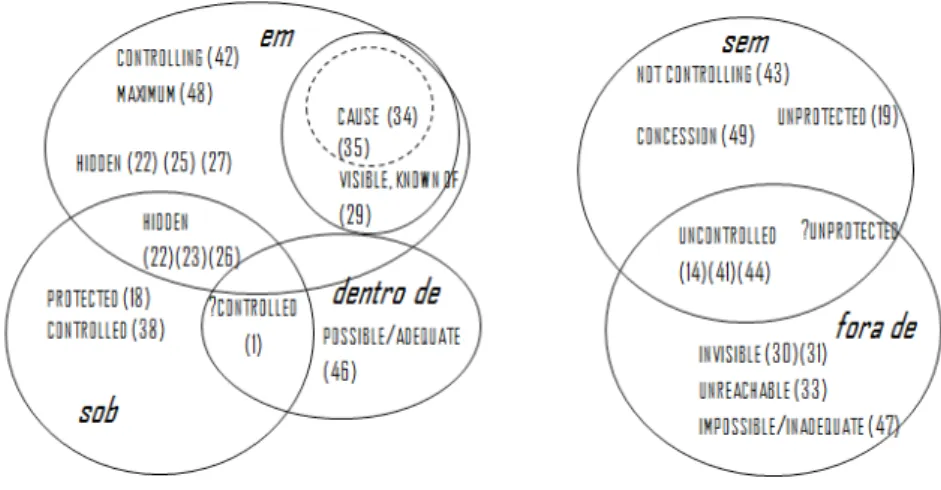
Closing the analysis, the prepositions can be grouped according to their meanings:
FIGuRE 3 – Distribution of functional meanings in conventional metaphorical expressions with em, dentro de, sob and sem, fora de, and corresponding examples
6 Conclusions
After analyzing these uses and use types, I come to the following conclusions: Differently from what I had expected, there was hardly any overlapping between the “in” prepositions and the “under” preposition in these metaphorical expressions, and, most remarkably, none between em and dentro de. The metaphor invisible is inside prevails over invisible is underneath for pragmatic reasons related to the configuration of our bodies in interaction with the environment. In contrast, because of the more “topological” meaning of dentro de with a focus on the container’s boundary, this preposition does not take unbounded states as metaphorical landmarks, and only occurs with the functional effect of ‘envelopment’ in the metaphor possible/adequate is within limits. In terms of these metaphorical expressions, the semantic space between a vaguer em and a very specific dentro de is fulfilled by sob, which encodes the metaphors for ‘controlled’ and ‘protected’.
By contrast, partial overlapping was attested between fora de and sem regarding the ‘control’ effect. Because fora de is the only true “out” preposition, it contrasts with both em and dentro de, as well as with sob. Other metaphorical meanings of
em and sob have their opposites in sem. This finding alone supports the hypothesis
of asymmetry between containment and non-containment in these expressions.
The fact that some of the C/c effects are not productive in these constructions in Brazilian Portuguese suggests that further studies are needed to explain the actual reach of such a metaphor as protectedis inside in this particular language as a whole, beyond prepositional meaning.
Considering higher-order notions, another finding in this study was the distinct encoding of the semantic roles agent and patient. In control metaphors, em requires agents (controllers) as trajectors and sob requires patients (controlled) in this position. The preposition sem, in contrast, takes both roles as trajectors. This distinction was not observed with the other functional effects, which demonstrates the need for further investigation. I suggest this exclusiveness is a result of the greater pragmatic relevance of ‘control’ in comparison with the other functional effects studied here.
Finally, among other things, the actual realization of these metaphors in these constructions partially depends on the range of spatial senses each preposition has, i.e., the range of basic event types each one can actually encode. This conclusion is supported, for instance, by the difference between the greater pervasiveness of the phenomenon with em in comparison with dentro de, but it also depends on cognitive and pragmatic aspects, as well as other linguistic and cultural properties not treated here. Furthermore, the analysis carried out in this paper demonstrates the complexity of prepositional semantics, even for those words orbiting the same image schema at apparently symmetrical distances.
Efeitos funcionais, semântica de preposições e
contenção metafórica no português do Brasil: o
caso de em, dentro de e fora de
Resumo
Este estudo analisou expressões metafóricas convencionalizadas no português do Brasil nas quais efeitos funcionais lexicalizados de cenas espaciais complementam as preposições dentro de, em, e fora de. Os efeitos funcionais investigados foram ‘proteção’, ‘cobertura/ocultação’, ‘controle’ e ‘inclusão’, que constituem o conceito de Contenção baseado em semelhanças de família. Essas expressões convencionalizadas tiveram uma explicação cognitiva em termos de metáforas primárias, tais como
invisívelédentro e semcontroleéfora, as quais emergem pela correlação
de experiências em cenas primárias. O estudo descreve doze significados baseados no esquema imagético de contentor, quatro baseados no
esquema de verticalidade e quatro baseados na noção não imagética de
‘inexistência’. Contradizendo a expectativa inicial, a análise baseada em
corpus revelou pouca sobreposição no uso das preposições: entre em e sob
e entre fora de e sem. Contudo, o estudo confirmou a assimetria entre as preposições com o sentido de ‘interioridade’ e aquelas com o sentido de ‘exterioridade’.
Palavras-chave: Metáfora. Correlação de experiências. Relação funcional de contenção. Significado preposicional. Português do Brasil.
References
American Heritage® Dictionary of the English Language, 5th. Boston: Houghton Mifflin Harcourt Publishing Company, 2011.
ALARCÓN, P. Polysemic Senses of Weight in Chilean Spanish. In: HART, C. (Org.). Selected papers from the 3rd UK Cognitive Linguistics Conference.
2010, Hertforshire: The uK Cognitive Linguistics Association, 2012. p. 277-288. BERBER SARDINHA, T.; MOREIRA FILHO, J. L.; ALAMBERT, E. Corpus
brasileiro. LAEL. PUC São Paulo. n/d. Available at: <http://www.linguateca.pt/
acesso/corpus.php?corpus=CBRAS>. Accessed on January 15, 2016.
CASTILHO, A. T. Nova gramática do português brasileiro. São Paulo: Contexto, 2012.
GARROD, S.; FERRIER, G.; CAMPBELL, S. In and on: investigating the functional geometry of spatial prepositions. Cognition, Amsterdam, v. 72, p. 167-189, September 1999.
GRADY, J. Foundations of meaning: primary metaphors and primary scenes.
1997. 299 p. Dissertation (Ph.D.). university of California at Berkeley, Berkeley. GRADY, J.; JOHNSON, C. Converging evidence for subscene and primary scene. In: DIRVEN, R. and PÖRINGS, R. (Orgs.). Metaphor and metonymy
in comparison and contrast. Berlin: Mouton de Gruyter, 2002. p. 533-554.
(Cognitive Linguistics Research).
INSTITUTO ANTÔNIO HOUAISS. Dicionário eletrônico Houaiss da língua
portuguesa. Rio de Janeiro: Objetiva, 2009.
JOHNSON, M. The body in the mind. Chicago, London: The University of Chicago Press, 1987.
KÖVECSES, Z. Metaphor in Culture: universality and variation. New York: Cambridge University Press, 2005.
LAKOFF, G.; JOHNSON, M. Metaphors we live by. 2nd. Chicago, London: The university of Chicago Press, 2003 (1980).
LANGACKER, R. W. Foundations of cognitive grammar: theoretical prerequisites. Stanford: Stanford university Press, 1987.
LANGACKER, R. W. Cognitive grammar: a basic introduction. Oxford: Oxford university Press, 2008.
LILLEHAuGEN, B. D. The Acquisition of Body Part Prepositions in Valley Zapotec. In: CONFERENCE ON INDIGENOuS LANGuAGES OF LATIN AMERICA, 1, 2003, Austin. CILLA 1 Proceedings. Austin: University of Texas at Austin. Department of Linguistics, 2003, p. 1-12. Available at: http://www.ailla. utexas.org/site/cilla1/Lillehaugen_Zapotec.pdf. Accessed on January 15, 2016. LIMA, P. L. C. About primary metaphors. D.E.L.T.A., São Paulo, v. 22, n. Especial, p. 109-122, January 2006.
LINDNER, S. A lexico-semantic analysis of English verb-particle constructions
with OUT and UP. 1981, 260 p., 1981, Dissertation (Ph.D.). university of
California at San Diego, San Diego.
MANDLER, J. M.; PAGÁN CÁNOVAS, C. On defining image schemas.
Language and Cognition, Cambridge, v. 6, n. 04, p. 510-532, December 2014.
MCDONOuGH, L.; CHOI, S.; MANDLER, J. M. understanding spatial relations: flexible infants, lexical adults. Cognitive Psychology, Cambridge, MA, v. 46, p. 229-259, May 2003.
NEVES, M. H. M. Gramática de usos do português. São Paulo: UNESP, 2011.
OLIVEIRA, A. de A. Esquemas espaciais e extensões metafóricas na semântica de preposições do português do Brasil: um estudo de caso. Revista da Associação
Brasileira de Linguística, Curitiba, v. 6, n. 1, p. 223-258, 2007.
OLIVEIRA, A. de A. Mapeamentos metafóricos a partir do esquema imagético de contentor: o caso de ‘em’. Revista da Associação Brasileira de Linguística, Curitiba, v. 10, n. 2, p. 43-65, jul./dez. 2011.
SANTOS, D.; SARMENTO, L. O projecto AC/DC: acesso a corpora/ disponibilização de corpora. In: MENDES, A.; FREITAS, T. ENCONTRO NACIONAL DA ASSOCIAÇÃO PORTuGuESA DE LINGuÍSTICA. XVIII, 2003, Porto. Actas. Porto: APL, 2003. p. 705-717.
SINHA, C.; JENSEN DE LÓPEZ, K. Language, culture and the embodiment of spatial cognition. Cognitive Linguistics, Berlin, Boston, v. 11, n. 1/2, p. 25, February 2000.
SLOCuM, J. Indo-European Lexicon: PIE Etymon and IE Reflexes. Austin, n/d. Available at: <http://www.utexas.edu/cola/centers/lrc/ielex/X/Lat.html >. Accessed on January 4, 2016.
SWEETSER, E. From etymology to pragmatics: metaphorical and cultural aspects of semantic structure. Cambridge (UK): Cambridge University Press, 1990.
TRAuGOTT, E. C. Pragmatic strengthening and grammaticalization. ANNuAL MEETING OF THE BERKELEY LINGuISTICS SOCIETY, 14, 1988, Berkeley.
Proceedings. Berkeley: Berkeley Linguistics Society, 1988. p. 406-416.
TYLER, A.; EVANS, V. The semantics of English prepositions. Cambridge (uK): Cambridge university Press, 2003.
VANDELOISE, C. Spatial Prepositions: a case study from French. Chicago, London: The University of Chicago Press, 1991.
VANDELOISE, C. Aristote et le lexique de l’espace: rencontres entre la physique grecque et la linguistique cognitive. Stanford: CSLI Publications, 2001.
VANDELOISE, C. Force and function in the acquisition of the preposition in. In: CARLSON, L.; van der ZEE, E. (Ed.). Functional features in language and
space. Oxford: Oxford university Press, 2005. chap. 15, p. 219-231.
Recebido em 11/04/2016. Aceito em 05/07/2016.