Analysis of
Plasmonics
Based Fiber
Optic Sensing
Structures
Hamed Moayyed
Thesis Submitted to Faculdade de Ciências da Universidade do Porto in partial fulfillment of the requirements for the degree of Ph. D. in Physics
Analysis of
Plasmonics Based
Fiber Optic Sensing
Structures
Hamed Moayyed
Physics
Departmento de Física e Astronomia
Supervisor
José Luís Campos de Oliveira Santos, Full Professor Faculdade de Ciências da Universidade do Porto
Co-supervisor
Diana Catarino das Neves Viegas, Research Fellow International Iberian Nanotechnology Laboratory
“Nothing in life is to be feared, it is only to be understood. Now is the time to understand more, so that we may fear less.”
- ix -
Acknowledgements
Firstly, I would like to express my sincere gratitude to my advisor Prof. José Luís Santos for the continuous support of my Ph.D study and related research, for his patience, motivation, and immense knowledge. His guidance helped me in all the time of research and writing of this thesis. His words can always inspire me and bring me to a higher level of thinking. What I learn from him is not just how to do the studies to meet the graduation requirements, but how to view this world from a new perspective.
I especially want to thank Prof. Faramarz Farahi for introducing me to my advisor, and providing me this special opportunity to pursue my academic goals.
My co-advisor, Dr. Diana Viegas, has been always willing to listen to me and give me advices. I am deeply grateful to her for her supports that helped me sort out the technical details of my work. A special thanks to other members of our research team Dr. Luis Coelho and Ivo Leite, for their many valuable discussions, constant caring and support.
To all my colleagues and friends from UOSE, namely, Luísa Mendonça, Dr. Pedro Jorge, Dr. Orlando Frazão, Dr. Susana Silva, Dr. Marta Ferreira, Dr. Ivo Nascimento, Dr. Joel Carvalho, Dr. Paulo Caldas, Rita Ribeiro, Dr. Carlos Gouveia and Hamid Hosseiny that somehow contributed for the great experience and my profound joy that it is working in this group.
To INESC TEC for providing the facilities without which my research work would not be possible. A word of recognition to Dr. Paulo Marques and Dr. Ireneu Dias for their support whenever it was needed.
Heartfelt thanks goes to my family for their unconditional support; to my parents, without whom I would not have gotten here, to my lovely wife Parisa for her endless patience, encouragement and constant support, and to my beloved daughter Hana, who her beautiful smile has been a source of strength and inspiration.
- xi -
Sumário
Plasmónica é hoje em dia uma palavra da moda no domínio da Ciência e na Tecnologia tantas vezes
é ela pronunciada e escrita. Frequentemente uma situação deste tipo não tem justificação objectiva, mas tal não é o caso. O volume de ciência e de tecnologia de qualidade que resulta da investigação e desenvolvimento em Plasmónica é enorme e cresce a ritmo acelerado. Na realidade esta realidade não é de todo surpreendente caso se compreenda o que efectivamente significa a plasmónica, a interacção coerente em ambiente controlado de um electrão e de um fotão, constituindo-se uma nova entidade designada de plasmon, sendo esta não mais um fotão ou um electrão, mas sim uma entidade hibrida que evidencia características de ambos. É esta mistura que possibilita, por exemplo, conseguir-se imagem óptica com resolução bem superior à determinada pelo convencional limite de difracção, isto porque neste caso o que domina é a propriedade do electrão de evidenciar um comportamento ondulatório determinado pelo seu comprimento de onda de DeBroglie, o qual é ordens de grandeza inferior ao comprimento de onda associado ao fotão. É certo que a área da Plasmónica não é nova, antes pelo contrário já que existe há mais de 100 anos, mas de facto foi só recentemente que o desenvolvimento da Nanociência e da Nanotecnologia possibilitou a construção de condições que permitem a geração de plasmões em ambiente controlado. Foi este progresso que originou o enorme desenvolvimento da Plasmónica nas componentes de estudos fundamentais e de desenvolvimentos tecnológicos, sendo reconhecido que se está apenas no início.
Na perspectiva histórica, uma das primeiras aplicações da Plasmónica foi na sensorização óptica, primeiro com suporte em plataformas construídas pela assemblagem de componentes ópticos discretos, mais tarde tirando partido da fibra óptica, um progresso que se poderá qualificar de elevado alcance e que originou o aparecimento de uma nova área no domínio da sensorização óptica, de modo sucinto identificada de sensores SPR em fibra óptica. O programa de investigação que deu origem a esta tese situa-se nesta área, mais precisamente na análise teórica e computacional de estruturas várias em fibra óptica que incorporam ressonância plasmónica orientada para se conseguir uma determinada funcionalidade de sensorização. Essas estruturas diferenciam-se pelo tipo de metal ou camada hibrida que se considera para suporte da ressonância plasmónica, ou então pela geometria adoptada para a fibra óptica. Os resultados que se obtêm a partir desse estudo e que se apresentam nesta tese têm valor pela compreensão que possibilitam dos princípios físicos envolvidos, assim como no que respeita à identificação das suas características de sensorização, mas também porque permitem orientar a fabricação dessas estruturas, muito em particular quando esta necessita de ser sintonizada no sentido de satisfazer especificações que decorrem da aplicação a que se destinam.
- xii -
Esta tese está organizada em sete capítulos. No Capítulo 1 começa-se por localizar historicamente a investigação do fenómeno da ressonância plasmónica no domínio óptico e de como pode ser utilizado para se conseguir funcionalidades de sensorização, primeiro em plataformas construídas pela assemblagem de componentes ópticos discretos, mais tarde pela utilização da fibra óptica. De seguida, avança-se para a contextualização desta abordagem de sensorização no âmbito da actual e dinâmica actividade de I&D em Plasmónica. No Capítulo 2 são apresentados os conceitos centrais que permitem a compreensão do fenómeno da ressonância plasmónica, assim como a identificação das condições que possibilitam a sua existência em guias de onda planos. É também analisada a propagação do campo electromagnético em estruturas multicamada. No Capítulo 3 apresenta-se a revisão das várias técnicas que têm sido utilizadas na interrogação de sensores baseados em plasmónica, sendo analisado o nível de desempenho passível de ser conseguido quando se considera as abordagens de interrogação que têm sido descritas na literatura, nomeadamente interrogação angular, no domínio espectral, em intensidade e em fase. O Capítulo 4 desenvolve o estudo de sensores SPR em fibra óptica em configurações que integram uma camada metálica única ou uma camada mista (metal + óxido) na perspectiva da interrogação em fase. Os metais considerados são a prata, o ouro, o cobre e o alumínio no contexto da utilização da fibra óptica com a geometria habitual, em taper e quando se considera a configuração em optrodo. No Capítulo 5 expõe-se um estudo sobre as características de sensores em fibra óptica baseados em plasmónica nos quais se considera uma camada interna de metal (prata) coberta por uma outra com propriedades dieléctricas (óxido). Pretende-se com esta abordagem deslocar o comprimento de onda de ressonância plasmónica para a região espectral utilizada pelos sistemas de comunicação por fibra óptica, significando com isto a possibilidade de incorporar nos elementos sensores componentes e dispositivos de elevado desempenho e relativamente baixo custo como consequência da sua utilização massiva nos sistemas de comunicação óptica. Diferentes óxidos serão considerados para a camada externa, como o dióxido de titânio, o dióxido de silício e o óxido de alumínio, pretendendo-se com este estudo aferir como melhorar a sensibilidade destas estruturas de sensorização a variações do índice de refracção do meio envolvente. O Capítulo 6 trata o problema da integração de redes em fibra óptica (redes de Bragg e redes de período longo) com estruturas convencionais de sensorização em fibra utilizando ressonância plasmónica, sendo o objectivo tornar estas estruturas compatíveis com o domínio da tecnologia da fibra monomodo onde se situam os sistemas de comunicação por fibra óptica, resultando daí as vantagens acima já identificadas. Em particular, procurar-se-á estudar uma configuração de sensorização de elevado potencial, nomeadamente a que resulta do acoplamento de redes de período longo às estruturas convencionais de sensorização SPR em fibra. Finalmente, no Capítulo 7 apresentam-se notas finais relativas ao trabalho desenvolvido e projectam-se caminhos para investigação futura.
- xiii -
Abstract
Plasmonics is nowadays a fancy word in the world of Science and Technology so many times it is
pronounced or so often it is written. It frequently happens such a situation represents a momentary fashion, but it will be fair to emphasize this is not the case. The amount of good science and technology that derives from R&D in Plasmonics is huge and is growing at an accelerated pace. As a matter of fact, such reality is not at all surprising if one understands what plasmonics means, a coherent interaction of an electron and a photon in a controlled environment generating a new entity, named plasmon, which is no more a photon or an electron, but a hybrid entity which shows flavours of both. It is this mix of flavours that enables, for example, optical imaging well below the standard diffraction limit because, in such case, dominates the electron flavour which has a wave behaviour determined by its DeBroglie wavelength with a value orders of magnitude smaller than the optical wavelength. It is true the field of Plasmonics is not new, is over 100 years old, but it was only recently that the Nanoscience and the Nanotechnology developed to a point that enabled to build up environments where plasmons could be generated in controlled conditions. It was such possibility that induced the burst of activity in Plasmonics, both at a fundamental level and at technological developments, being well present the perception this is just the beginning. Historically, one of the first applications of Plasmonics was optical sensing, first supported in bulk platforms and latter in optical fibers, a development that was truly a breakthrough, introducing a new branch in the field of optical fiber sensing shortly identified as SPR optical fiber sensors. The research programme that originated this thesis is anchored in this optical sensing approach, mostly focused on the theoretical and computational analysis of several fiber optic structures incorporating plasmonic resonance behaviour and oriented to the sensing functionality. Such structures differentiate on the type of metal or hybrid layer considered to support plasmonic resonance, or on the geometry of the optical fiber. Their research and the results obtained reported in this thesis are relevant by itself in what concerns the understanding of the basic working principles and identification of their sensing characteristics, but also to guide the implementation of these sensing devices particularly when they need to be tailored to fit the demands of a specific application.
The thesis is organized in seven chapters. Chapter 1 starts by locating historically the research on the phenomenon of plasmonic resonance in the optical domain and how it can be applied to achieve sensing functionalities, first in bulk optics platforms and later associated with the utilization of optical fibers. Then, it proceeds to contextualize this sensing approach within the actual and rather active field of R&D in Plasmonics. Chapter 2 delivers the basic concepts that permit the understanding of the phenomenon of plasmonic resonance and the conditions for its existence on dielectric-metal-dielectric slabs. The propagation of an electromagnetic field in a
- xiv -
multilayer structure will also be discussed. Chapter 3 presents a worked review of the different techniques to interrogate plasmonic based sensors, addressing in particular the performance level that can be achieved with each of the interrogation approaches analysed, namely angular interrogation, spectral interrogation, intensity interrogation and phase interrogation. Chapter 4 develops the study of SPR based optical fiber sensing configurations integrating a single metal or a bimetallic layer and, with the focus on phase interrogation, it is analysed the performance associated with the utilization of different metals, namely silver, gold, copper, and aluminium when the tapered and the tip (optrode) optical fibers geometric layouts are addressed. Chapter 5 presents a theoretical investigation of optical fiber plasmonic based sensors incorporating an internal metallic layer of silver covered with an oxide layer. The objective is to shift the resonance condition to longer wavelengths, therefore more suited to benefit from a broad range of optical fiber technologies developed along the years within the context of optical fiber communications systems. Different oxide materials like titanium dioxide, silicon dioxide and aluminium oxide are considered aiming to achieve enhanced sensitivity to refractive index variations of the external medium, particularly when addressing phase interrogation. Chapter 6 deals with the integration of fiber gratings with standard fiber optic SPR sensing technology to bring it to the singlemode domain, therefore turning it compatible with the vast field of fiber optic communication systems with its large portfolio of advanced and cost effective components and devices. In particular, emphasis is allocated on the theoretical analysis of long period grating (LPG) assisted optical fiber sensing structures supported by Plasmonics. Finally, Chapter 7 presents some final notes relative to the research performed and are outlined some paths for future work.
- xv -
Table of Contents
Acknowledgements ... ix Sumário ... xi Abstract ... xiii Table of Contents ... xvList of Figures ... xxiv
List of Tables ... xxiv
Historical Overview of Plasmonics ... 1
1.1 First Descriptions ... 2
1.2 SPR Optical Sensing ... 3
1.2.1 Environmental Applications ... 4
1.2.2 Space Applications ... 5
1.3 The Outcome of Optic Based SPR Sensing ... 5
1.4 The New World of Plasmonics ... 6
1.4.1 SPR Sensing and Microstructured Optical Fibers ... 7
1.4.2 Multiplexing of SPR Sensors ... 11
1.4.3 Sensor Functionalization ... 11
1.4.4 Nanostructured Plasmonic Sensors ... 12
1.5 Final Remarks ... 14
Theoretical Background of Plasmonics ... 15
2.1 Electromagnetic Theory of Surface Plasmons ... 16
2.2 Surface Plasmons on Metal-Dielectric Interface ... 20
2.3 Surface Plasmons on Dielectric-Metal-Dielectric ... 22
2.4 Excitation of Surface Plasmons ... 24
2.4.1 Kretschmann and Otto configurations ... 24
2.4.2 Grating Coupling ... 27
- xvi -
2.5 Theoretical Study of Optical Fiber based Surface Plasmon Resonance Sensors ... 29
2.5.1 Reflection Coefficient ... 29
2.5.2 Transmitted Power ... 31
2.5.3 Sensitivity and Quality parameter ... 32
2.6 Optical Sensing based in Optical Fibers Coupled to SPR Phenomenum ... 32
Interrogation of Plasmonics Sensing Structures ... 34
3.1 Introduction ... 35
3.2 Angular Interrogation ... 36
3.2.1 General Considerations and Historical Background... 36
3.2.2 Principle of the Technique ... 38
3.2.3 Performance of the Technique ... 39
3.3 Wavelength Interrogation ... 40
3.3.1 General Considerations and Historical Background... 40
3.3.2 Principle of the Technique ... 43
3.3.3 Performance of the Technique ... 44
3.4 Intensity Interrogation ... 45
3.4.1 General Considerations and Historical Background... 45
3.4.2 Principle of the Technique ... 47
3.4.3 Performance of the Technique ... 48
3.5 Phase Interrogation ... 48
3.5.1 General Considerations and Historical Background... 48
3.5.2 Principle of the Technique ... 51
3.5.3 Performance of the Technique ... 52
3.6 Conclusion ... 53
Optical Fiber SPR Sensing Structures with Single and Bimetal Layers ... 55
4.1 Introduction ... 56
4.2 General Considerations ... 56
4.3 Optical Fiber SPRSensor with a Single Metal Layer ... 57
- xvii -
4.5 Optical Fiber SPR Sensor with Bimetal Layers in a Tapered Transmissive Geometry ... 64
4.5.1 Modelling of the Tapered Sensing Structure ... 65
4.5.2 Optical Transmission of the Sensing Structure ... 67
4.5.3 Performance of the Sensing Structure with Phase Interrogation ... 68
4.6 Optical Fiber SPR Sensor with Bimetal Layers in a Tip (Optrode) ... 72
4.6.1 Modelling the Optrode Sensing Structure ... 73
4.6.2 Performance of the Sensing Structure with Phase Interrogation ... 77
4.7 Conclusion ... 78
Optical Fiber SPR Sensing Structures with Hybrid Layers ... 80
5.1 Introduction ... 81
5.2 General Considerations ... 82
5.3 Optical Fiber SPR Sensors with Metallic and Oxide Layers ... 84
5.4 Optical Fiber SPR Sensor with Metallic and Oxide Layers in a Tapered Transmissive Topology ... 90
5.5 Optical Fiber SPR Sensor with Metallic and Oxide Layers in a Tip (Optrode) Geometry………93
5.6 Conclusion ... 98
Grating Assisted Optical Fiber Sensing Structures Supported by Plasmonics ... 100
6.1 Introduction ...101
6.2 Fiber Gratings ...102
6.2.1 Fiber Bragg Gratings ...103
6.2.2 Long-Period Fiber Gratings ...104
6.3 FBG Assisted SPR Based Optical Fiber Sensors ...109
6.4 LPG Assisted SPR Based Optical Fiber Sensors ...113
6.5 Paths for Experimental Research ...117
6.5.1 A General Technique for Phase Interrogation of SPR Fiber Sensors ...118
6.5.2 High Performance Phase Interrogation of LPG Assisted SPR Fiber Sensors ...119
6.6 Conclusion ...120
- xviii -
Annex ... 127 References ... 1277
- xxiv -
List of Figures
1.1 First publication on the plasmonics [1]……….. 1
1.2 First publication on theoretical studies of plasmonics [2]……….. 2
1.3 Concept of the LMC: the evanescent field of the propagating light wave excites the fluorescent labels (green blocks) bound to the immobilized groups (red forks) on the chip surface [53]……….. 5
1.4 First publication on SPR fiber optic sensors [55]………. 5
1.5 Schematic of the three-hole microstructured optical fiber [64]……….. 9
2.1 Section of a planar waveguide with a step refractive index profile…………... 17
2.2 A metal–dielectric waveguide………... 21
2.3 Thin metal layer sandwiched between two dielectrics………. 23
2.4 Different SPR configurations (a) prism coupling (Kretschmann configuration). (b) Grating coupling. (c) Waveguide coupling………... 24
2.5 (a) Reflection of light at the metal surface (εm (ω)). The medium above the metal is a dielectric Material (εd) as a glass or silica; below the metal is the analyte that can be air, vacuum or an aqueous medium (εa). (b) Dispersion diagram of the attenuated total reflection method (SP0: Dispersion of surface plasmon at metal/air interface)………... 25
2.6 (a) Otto configuration. The analyte (dielectric or air) lies between the prism and the metal surface. (b) Kretschmann-Raether configuration. The metal film is in contact with the prism………... 26
2.7 (a) The grating coupler used to excite surface plasmons. (b) Wave vector diagram of the input coupler. k0 is the wave vector of the incident light (kSP is the wave vector of the surface plasmons and G = 2π/Λ, where Λ is the grating period……….. 27
2.8 Side view of an integrated waveguide device with SPR excitation………. 28
2.9 Equivalent planar model of an optical fiber based plasmonic structure……… 29
2.10 Electric and magnetic field vectors of p-wave at the inner surface of the multilayered system……….. 30
3.1 The configuration of SPR sensor based on angular modulation [107]……….... 37
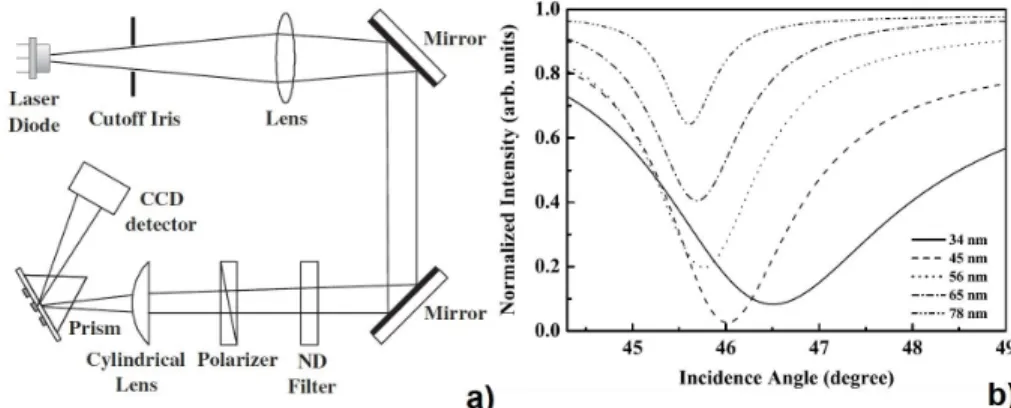
3.2 (a) Schematic diagram of the wedge-shaped beam type angular interrogation-based SPR sensor. (b) SPR spectra obtained from the various thicknesses of Au films on the glass substrates as a function of the incidence angle [112]……… 38
3.3 A typical SPR curve in angular interrogation. At certain angles and wavelengths, the energy associated with the incident radiation will couple with the SPW. The loss of this energy is observed as a dip in the reflectivity……….. 38
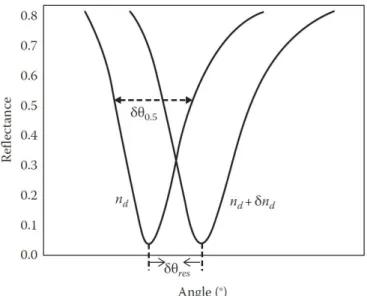
3.4 SPR curves for different refractive indices of the sensing medium in the cases of angular interrogation……….. 40
3.5 Dual-channel surface plasmon resonance sensor based on wavelength interrogation [114]……….. 41
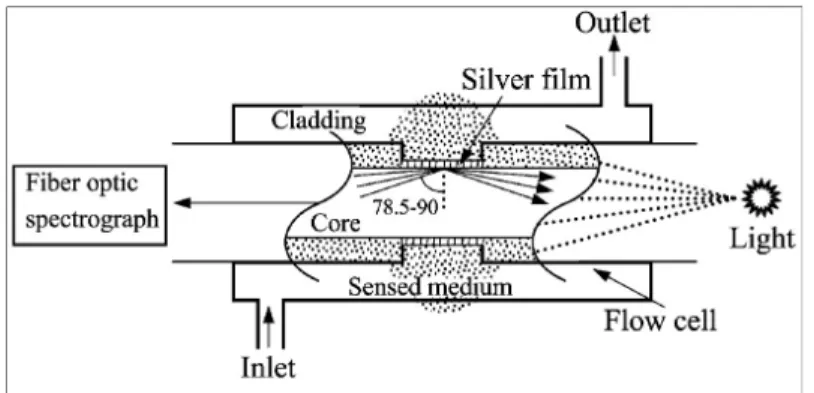
3.6 Illustration of the SPR fiber optic sensing element reported by Jorgenson et al. [118]……… 42
3.7 A typical SPR curve in wavelength interrogation. At certain wavelength and angle, the energy associated with the incident radiation will couple with the SPW which is observed as a dip in the reflectivity………... 43
- xxv -
3.8 SPR curves for different refractive indices of the sensing medium in the cases of wavelength interrogation……… 44 3.9 A typical SPR scanning instrument with intensity interrogation [125]……… 45 3.10 Configuration of a SPR sensing system with polarization contrast and intensity interrogation
[136]……….. 47 3.11 Intensity interrogation of SPR sensors (the three curves are corresponding to three different
refractive indices of surrounding the dielectric……….. 47 3.12 Scheme of SPR sensor based on interferometry. (1) light beam; (2, 4) polarisers; (3, 10)
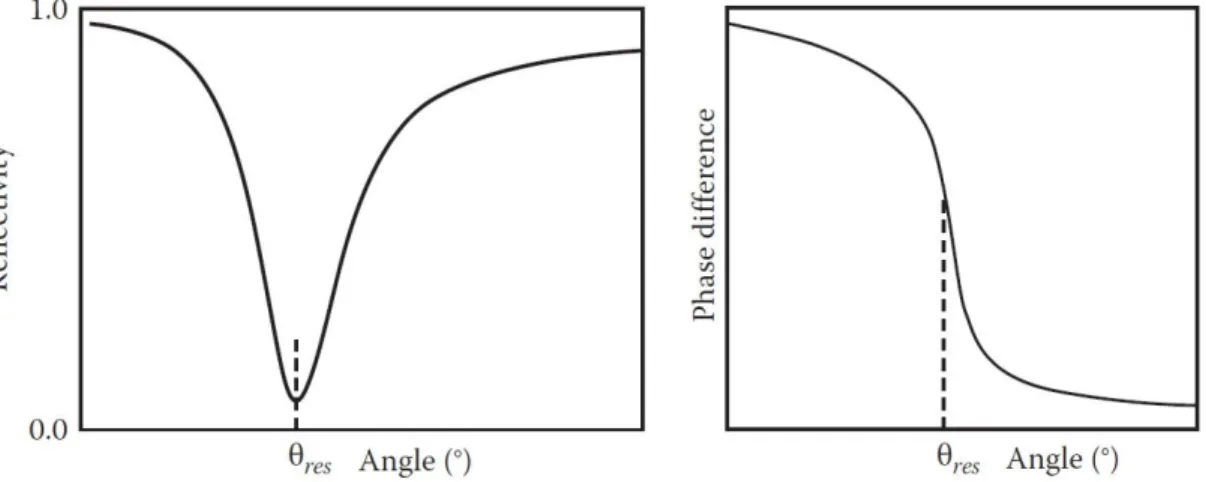
beam-splitting cubes; (5) phase-retarding glass plate; (6) mirror; (7) SPR prism; (8) gold film; (9) patterned coating; (11) analyser; (12) imaging lenses; (14) CCD camera [139]……….. 49 3.13 Scheme of SPR sensor based on a Mach-Zehnder interferometer [144]………... 50 3.14 Typical angular SPR curve (left) and the phase difference between the p- and s-components
of the reflected light (right)………. 52 4.1 Schematic diagram of an SPR sensor based on optical fibre………. 58 4.2 Spectrum of the normalized transmitted optical power for the (a) Au, (b) Ag, (c) Cu, (d) Al
metals sensing structure……….. 59 4.3 Variation of resonance wavelength of the SPR sensor with refractive index of the external
medium for each of the metals that overlay the optical fiber………. 59 4.4 Schematic diagram of an SPR sensor based on an optical fibre with bimetallic layer 61 4.5 Spectral resonance of the SPR optical fiber based sensing structure incorporating a
bimetallic layer derived from the , combination of metals with (a) Al and (b) Au as outer metal layer (the refractive index of the surrounding medium is ns=1.343)………. 62
4.6 Variation of (a) sensitivity, (b) Γλ with the ratio “inner layer thickness/total bimetallic
thickness” for different bimetallic combinations. These parameters were obtained from the response of the SPR resonance to a variation of the external medium refractive index from 1.343 to 1.353 (δns=0.010). ……… 63
4.7 Tapered optical fiber surface plasmon resonance sensor………... 65 4.8 Spectrum of the normalized transmitted optical power for a Ag-Au bimetallic sensing
structure (d1 = 45 nm – thickness of Ag layer and d2 = 25 nm – thickness of Au layer) and
different taper ratio when the surrounding medium having a refractive index of 1.333………… 68 4.9 Phase difference (between p and s polarizations) and phase sensitivity as function of the
refractive index of the surrounding medium, for a single metal layer sensing structure comprised of 50, 60 and 70 nm thick (a) gold layer and (b) silver layer. The interrogation wavelength is 632.8 nm………. 69 4.10 Phase difference (between p and s polarizations) and phase sensitivity as function of the
refractive index of the surrounding medium for different bimetallic sensing head combinations………... 70 4.11 (a) Phase difference (between p and s polarizations) as function of the refractive index of
the surrounding medium and (b) associated phase sensitivity, for Ag-Au bimetallic structures (d1 = 40 nm and d2 = 10 nm) having different taper ratios. The interrogation
wavelength considered is 632.8 nm, and the dashed vertical line at ns = 1.330 indicates the
- xxvi -
4.12 Spectrum of the normalized transmitted optical power for the Ag-Au bimetallic sensing structure (d1 = 40 nm and d2 = 10 nm) with taper ratio = 2.0 and surrounding medium having
a refractive index of 1.333. The dashed vertical line at 632.8 nm indicates the interrogation wavelength corresponding to maximum phase sensitivity………. 72 4.13 Schematic illustration of the SPR fiber optrode under analysis. The top and bottom of the
probe are polished to the same angle. The cladding of the optical fiber tip has been removed in the sensing region and replaced by a bimetallic film………... 73 4.14 Schematic of a length dL of the taper region around the coordinate z where the radius of the
taper is ρ(z)………... 75 4.15 Variation of (a) phase difference (between s and p polarizations) and (b) phase sensitivity
as function of the refractive index of the surrounding medium for different radii of the tip end. The sensing structure comprised of a 40 nm silver + 10 nm gold layer and tip length of 1 cm. The interrogation wavelength is 632.8 nm……… 77 4.16 Variation of (a) Phase difference (between s and p polarizations) and (b) phase sensitivity
as function of the refractive index of the surrounding medium for different tip length. The sensing structure comprised of a 40 nm silver + 10 nm gold layer and the tip end radius is 150 µm. The considered interrogation wavelength is 632.8 nm………... 78 5.1 Schematic illustration of the SPR sensing head under analysis. The cladding of the optical
fiber has been removed in the sensing region and replaced by a metallic film covered with an oxide overlayer………. 84 5.2 Resonance of a fiber optic SPR structure with a single silver layer for several thicknesses
(refractive index of the external medium: 1.33)………. 84 5.3 Spectral behaviour of the double layer fiber optic SPR structure for different thicknesses of
the oxide layer (TiO2, SiO2 and Al2O3 oxide materials are associated with (a), (b) and (c),
respectively; refractive index of the external medium: 1.33……… 85 5.4 Evolution of the spectral width of the SPR resonance (full width at the power level 6 dB
above the minimum) as function of the thickness of the oxide layer. The refractive index of the external medium is assumed to be 1.33………... 86 5.5 Normalized transmittance and phase difference (between p and s polarizations) as function
of the refractive index of the surrounding medium for an inner silver layer of 50 nm combined with a TiO2 layer of 15 nm (solid curves) and a Al2O3 layer of 30 nm (dashed
curves). The interrogation wavelength is 830 nm……… 87 5.6 Normalized transmittance and phase difference (between p and s polarizations) as function
of the refractive index of the surrounding medium for an inner silver layer of 50 nm combined with a TiO2 layer of 40 nm (solid curves) and a TiO2 layer of 55 nm (dashed
curves), associated to interrogation wavelengths of 1300 nm and 1550 nm, respectively…… 87 5.7 Phase sensitivity versus normalized transmittance for a fiber optic SPR structure with an
inner silver layer of 50 nm combined with a TiO2 layer of 40 nm (interrogation wavelength
of 1300 nm)………... 88 5.8 Thickness of the oxide layer required to operate with maximum sensitivity to changes of the
refractive index of water, determined by the intersection of the horizontal line (that defines in the y-axis the water refractive index at the wavelength of operation) with the curves associated with different materials for the oxide layer. The interrogation wavelength is 630 nm (a) and 830 nm (b)……… 89
- xxvii -
5.9 Same as Fig. 5.8 but now with interrogation wavelengths of (a) 1300 nm and (b) 550 nm…… 90 5.10 Schematic illustration of the SPR fiber taper geometry under analysis……… 91 5.11 Resonance of a fiber optic SPR structure with a single silver layer for several thicknesses
(refractive index of the external medium: 1.33)………... 92 5.12 Phase difference between the s and p light polarizations and associated phase sensitivity
versus the refractive index of the surrounding medium for a single silver layer with 80 nm thickness and when this layer is covered by 20 nm of an oxide layer of TiO2, Al2O3, and SiO2.
The interrogation wavelength is (a) 632.8 nm and (b) 1550 nm……….. 92 5.13 Spectral behavior of the double layer fiber optic SPR structure with a single silver layer and
20 nm of oxide layers (TiO2, Al2O3, and SiO2) when the refractive index of the external
medium is 1.33……… 93 5.14 Schematic illustration of the SPR fiber optrode under analysis. The top and bottom of the
probe are polished to the same angle. The cladding of the optical fiber tip has been removed in the sensing region and replaced by a metallic film covered with an oxide overlayer……….... 94 5.15 Spectra of the normalized returned optical power for a fiber optic SPR structure with a single
silver layer for several thicknesses (refractive index of the external medium: 1.33………. 94 5.16 Spectral behavior of the double layer fiber optic SPR structure for different thicknesses of
the oxide layer (TiO2, SiO2 and Al2O3 oxide materials are associated with (a), (b) and (c),
respectively; refractive index of the external medium: 1.33……… 95 5.17 Evolution of the spectral width of the SPR resonance (full width at the power level 6 dB
above the minimum) as function of the thickness of the oxide layer. The refractive index of the external medium is considered to be 1.33……….. 95 5.18 Normalized transmittance and phase difference (between p and s polarizations) as function
of the refractive index of the surrounding medium for an inner silver layer of 80 nm combined with a TiO2 layer of 15 nm (solid curves) and a Al2O3 layer of 30 nm (dashed
curves). These thicknesses were considered to allow operation wavelength around 830 nm... 97 5.19 Normalized transmittance and phase difference (between p and s polarizations) as function
of the refractive index of the surrounding medium for an inner silver layer of 80 nm combined with a TiO2 layer of 40 nm (solid curves) and a TiO2 layer of 55 nm (dashed
curves), associated with interrogation wavelengths of 1300 nm and 1550 nm, respectively…. 97 5.20 Phase sensitivity versus normalized transmittance for a fiber optic SPR structure with an
inner silver layer of 80 nm combined with a TiO2 layer of 40 nm (interrogation wavelength
of 1300 nm)………... 98 6.1 The diffraction of a light wave by a grating………. 102 6.2 The diffraction of a light wave by a grating.Ray-optics illustration of core-mode Bragg
reflection by a fiber Bragg grating and the β axis diagram demonstrating the grating coupling condition for m=-1 [199]……….. 103 6.3 FBG working principle………... 104 6.4 Spectra of a typical FBG (data obtained at INESC TEC)……… 104 6.5 Ray-optics illustration of cladding-mode coupling by a long-period grating and the β axis
diagram demonstrating the grating coupling condition for m=-1 [199]……… 105 6.6 Coupling of the fundamental guided mode to cladding modes in a long-period grating…………. 105 6.7 Transmission spectrum of a typical LPG (data obtained at INESC TEC)……… 106
- xxviii -
6.8 Theoretical determination of the relationship between grating periodicity and wavelength where guided-to-cladding mode coupling takes place……… 107 6.9 Fiber interferometer based on a LPG and SPR modulation……….. 109 6.10 Surface Plasmon resonance sensing structure with a fiber Bragg grating [234]………. 110 6.11 (a) Hollow core sensing structure with Bragg grating. (b) Cross section of the structure [61]... 111 6.12 Planar SPP sensor with (a) Bragg grating imprinted into the waveguide layer [236] and (b)
Bragg grating engraved on the top of the metal layer [237]………. 111 6.13 Planar SPP sensor with (a) LPG imprinted into the waveguide layer and (b) LPG engraved
on the top of the metal layer……… 112 6.14 LPG induced coupling of the core mode to a cladding mode associated with the oscillation
angle θ……….. 114 6.15 Spectrum of the normalized transmitted optical power for the Ag-TiO2 sensing structure for
different grating periodicity (a) Λ = 300 μm and (b) Λ= 500 μm (when surrounding medium having a refractive index of 1.333……… 116 6.16 (a) Phase difference (between p and s polarizations) and (b) phase sensitivity as function of
the refractive index of the surrounding medium for different grating periodicities Λ = 300 μm and Λ = 500 μm. The interrogation wavelength is 1550 nm………. 117 6.17 Optical fibre SPR interferometric sensing configuration with PHD signal processing………….. 119
- xxiv -
List of Tables
3.1 Performance of SPR interrogation techniques……….. 54 4.1 Comparison of the refractive index sensitivity of an optical fiber based SPR sensor incorporating a
single metal layer when different metals are addressed……….. 60 4.2 Comparison of the values for the Γλ and Quality Parameter (χ) for the SPR sensing heads
1
Historical Overview of Plasmonics
Summary: This Chapter starts to locate historically the research on the phenomenon of plasmonic
resonance in the optical domain and its support to achieve sensing functionalities, first in bulk optics platforms and later associated with the utilization of optical fibers. This sensing approach is contextualized within the actual and rather active field of R&D in Plasmonics which is continuously opening new horizons in science and in technology.
- 2 -
1.1 First Descriptions
Plasmonics has been studied since the beginning of the 20th century, although the great developments on SPR were achieved in the late 60s with bulk configurations. Surface plasmons are electromagnetic excitations that propagate in wave like form along the planar interface between a metal and a dielectric medium. The plasmon excitation produces a minimum in the spectral transmittance for certain wavelength and refractive index values.
Between 1902 and 1912 R.M. Wood at John Hopkins University (Baltimore, USA) [1] (figure 1.1) noticed that, when he shone polarized light on a metal backed diffraction grating, a pattern of unusual dark and light bands appeared in the reflected light. Although he speculated about how the light, gratings and metal interacted a clear answer to the phenomenon was not provided.
The first theoretical treatment of these anomalies is undergone by Lord Rayleigh in 1907 [2] (figure 1.2). His "dynamical theory of the grating" was based on an expansion of the scattered electromagnetic field in terms of outgoing waves only. With this assumption, he found that the scattered field was singular at wavelengths for which one of the spectral orders emerged from the grating at the grazing angle. He then observed that these wavelengths, which have come to be called the Rayleigh wavelengths , λR correspond to the Wood anomalies [3]. Furthermore, these
singularities appeared only when the electric field was polarized perpendicular to the rulings, and thus accounted for the S anomalies; for P polarization, his theory predicted a normal behavior near λR.
Wood's later papers [4, 5] however, suggest that P anomalies could sometimes be observed. Palmer [6, 7] very clearly demonstrated that P anomalies did exist in deeply ruled gratings. Thus,
anomalies of both the S and P type were obtainable, but P anomalies were found only on gratings with deep grooves [3].
Historical Overview of Plasmonics
- 3 -
In the fifties, more experimentation was done on electron energy losses in gasses and on thin foils [8, 9]. The suggestion by Pines and Bohm [10-12] that the energy losses where due to the excitation of conducting electrons creating plasma oscillation or plasmon was a great step forward. Further research [9] revealed that the energy loss resulted from excitation of a surface plasma oscillation in which part of the restoring electric field extended beyond the specimen boundary. Therefore, the surface plasma oscillation could be affected by the presence of any film or contaminant on the specimen surface. This effect was later described in terms of excitation of electromagnetic 'evanescent' waves at the surface of the metal, and in the 1970's evanescent waves where described as a means to study ultra-thin metal films and coatings [13].
In the late sixties, optical excitation of surface plasmons by the method of attenuated total reflection was demonstrated by Kretchman [14, 15] and Otto [16]. Since then, surface plasmons have been intensively studied and their major properties have been assessed [17, 18].
1.2 SPR Optical Sensing
During the last two decades we have witnessed remarkable research and development activity aimed at the realization of optical sensors for the measurement of chemical and biological quantities. First, optical chemical sensors were based on the measurement of changes in absorption spectrum and were developed for the measurement of CO and O concentration [19]. In the 1980s, surface plasmon resonance (SPR) and related techniques exploited evanescent waves applied to the interrogation of thin films as well as biological and chemical interactions [20-23]. In these sensors the target quantity is determined by measuring the refractive index, absorbance and fluorescence properties of analyte molecules or a chemo-optical transducing medium [24, 25]. The potential of surface plasmon resonance for characterization of thin films
- 4 -
and monitoring processes at metal interfaces [26] was recognized in the late seventies. In 1982 the use of SPR for gas detection and biosensing was demonstrated by Nylander and Liedberg [23, 27, 28]. Since then SPR sensing has been receiving continuously growing attention from the scientific community.
Within the last few years, the possibility of implementing the surface plasmon resonance sensing principle into optical waveguide structures has attracted much attention. SPR sensors based on optical waveguides offer various advantageous features for sensing. Indeed, they are small in size, exhibit ruggedness, there is the prospect of fabrication of multiple and/or multichannel sensors on a single optical chip and, in conjunction with optical fibers, they may, be used for remote sensing applications.
Development of new SPR-sensing configurations as well as applications of SPR-sensing devices for the measurement of physical, chemical and biological quantities have been widely described. A great deal of work has been done in the exploitation of SPR for optical biosensing, as can be assessed from the fact more than 75% of the research papers deal with applications of SPR to detect biomolecular interactions. In this area, SPR, as a surface-oriented method, has shown a great potential for affinity biosensors, allowing real-time analysis of biospecific interactions without the use of labeled molecules. The SPR sensor technology has been commercialized by several companies and has become a leading technology in the field of direct real-time observation of the biomolecular interactions.
In the following a few recent applications of SPR sensors will be described, in particular their employment in the detection of environmental pollutants and in space missions.
1.2.1 Environmental Applications
Surface Plasmon Resonance biosensors have been demonstrated for the detection of many aqueous pollutants , as arsenic [29], ricin [30, 31], endocrine disruptors [32, 33], pesticides [34-37], methane [38], heavy metals [39], bacteria and toxins [40-42], copper ions [43] and others. Some of them have been tested in real lake water, surface water or groundwater samples. Gaseous pollutants as NH3 [44], CO [45], NO2 [46], hydrogen [47, 48], SiO2 [49], ammonia and amine gases [50], petroleum hydrocarbon vapors [51] are examples of additional compounds whose detection has been addressed by SPR arrangements.
Optical sensors based on the SPR phenomenon has also been applied in the framework of other medical and environmental applications, as food quality, safety analysis, detection of cancer, allergy and heart attack markers, dioxins, phenols and aromatic hydrocarbons, as reported in [52].
Historical Overview of Plasmonics
- 5 -
SPR sensors are particularly suited for pollutant and explosive detection because they only optically act on the surrounding ambient, therefore avoiding electric interaction. Moreover these sensors are able to provide extremely high sensitivities.
1.2.2 Space Applications
SPR based sensors are also well suited for astrobiologial missions. An example of application of these sensors on this environment is the The Life Marker Chip (LMC), where SPR sensing is configured looking for the detection of organic or prebiotic molecules on the surface of planets or moons. The design aim of the LMC is to detect 20-25 biomarker molecules on 20-50 samples combining surface plasmon resonance and fluorescently labeled tracers. Specific Molecular
Identification of Life Experiment (SMILE) has been proposed as a possible LMC (figure 1.3).
Light with wavelength 635 nm is coupled into the LMC by fiber coupling. The light is then guided by a Si3N4 (stoichiometric silicon nitride) waveguide (refractive index n=2.01) standing between SiO2 (silicon oxide, n=1.47) top and bottom claddings. Locally, the top SiO2 cladding layer is selectively removed. As shown in figure 1.3 in these regions the evanescent field is available for probing the fluorescent spots and the top cladding consists of water [53].
1.3 The Outcome of Optic Based SPR Sensing
Due to all the favorable characteristics of optical fiber sensors, fiber sensing has been the focus of substantial research and development along the years and many solutions for field applications came out from this effort [54]. Following the degrees of freedom of the optical field, different classes of fiber sensors have been researched along the years, but it can be fairly stated that fiber optic sensors with spectral selectivity has been playing a major role in optical fiber sensor technology and all points out this trend will be strengthened in the future.
Figure 1.3 - Concept of the LMC: the evanescent field of the propagating light wave excites the fluorescent labels
- 6 -
Within this general trend, the deposition of metals on the optical fiber to induce the phenomena of surface plasmon resonance has also been explored, being nowadays a rather successful optical sensing approach. This orientation started by Jorgenson and Yee in 1995 who fabricated the first optical fiber SPR sensor (figure 1.4) [55]. They proved that the optical fiber can be used as a substrate for metallic deposition and surface plasmon resonance sensing. The fiber used was chemically etched in order to remove almost all the cladding. The metal film deposition was made on that region of the fiber.
Figure 1.4 - First publication on SPR fiber optic sensors [55].
In 1995 Tubb et al. [56] demonstrated SPR sensing with a tapered optical fiber (such configuration was later studied by Villatoro et al. [57] bringing it to a high performance standard). In 1996,
Homola et al. [58] used again the optical fiber as a substrate, but now considering a side polished
optical fiber in order to get into the evanescent field of the core mode. These initial studies proved the feasibility of the optical fiber as a SPR sensing platform and established the potential in the sensing domain of the combination optical fiber + SPR, which has undergone continuous growth in the following years to an extent that nowadays become a reference when high performance environment optical sensing is on demand.
1.4 The New World of Plasmonics
Plasmonics is a subject that undergone tremendous progresses in the last decade following an accelerated development path, indicating the high impact it will have in fundamental and applied optics. Surely, optical sensing will strongly benefit from this movement but also many other areas in view the possibilities of optical imaging systems with nanometre-scale resolution, the availability of hybrid photonic-plasmonic devices, the substantial enhancement of semiconductor luminescence which opens the road to high efficient plasmon-assisted lightning, the feasibility of
Historical Overview of Plasmonics
- 7 -
plasmon antennas with large light capture characteristics, the foreseen viability of plasmonic nanocircuits which combine a large bandwidth with a high level of integration, and others. Therefore, to have a correct perspective of the reasons behind such huge promise and to draw a balanced picture of possible future progress paths in plasmonics based optical sensing, it is worthwhile to add here some paragraphs addressing general points of the subject [59].
1.4.1 SPR Sensing and Microstructured Optical Fibers
As briefly outlined in Section 1.3, plasmonics based optical sensing undergone a development leap when the sensor platforms expanded from the prism coupling system layout to structures supported by guided optics, particularly optical fibers and planar devices with input/output fibers. This movement permitted to address functionalities not possible with the classic approach, such as sensor miniaturization and remote operation. Pointing specifically to optical fiber SPR sensors, in the last decade various compact configurations enabling effective coupling between the fiber modes and the surface plasmonic waves have been investigated, such as those based on metalized side-tapered single mode and multimode optical fibers, metalized tapered fibers, metallized fiber Bragg gratings and others .
The consideration of standard optical fibers or derived structures (such as tapers, side-etched fibers, etc.) for SPR sensors faced two main difficulties (common also to planar waveguides), which have been limiting the performance level conceptually attainable with these platforms. The most fundamental one is the problem of phase matching of a waveguide core mode and the surface plasmonic wave (SPW), which implies the need the mode and the wave to have the same value for the corresponding effective refractive indices at the operation wavelength, generating what is known as a SPW of hybrid nature. In the case of a single mode waveguide, the effective refractive index of its core mode is close to that of the core material, which is typically higher than 1.45. On the other hand, the effective refractive index of a plasmon is close to that of the surrounding analyte, with the most often found situations associated to the presence of air (refractive index ~1.0) and water (refractive index ~1.33). Therefore, it is necessary to move to shorter wavelengths for the plasmon refractive index becomes high enough as to match that of a waveguide core mode (for the case of gold metal film, this requires λ < 700 nm). Phase match condition can be achieved at longer wavelengths incorporating in the sensing head an additional dielectric thin film with specific characteristics [60], approach with some disadvantages, one of them being added complexity. This phase matching problem can be attenuated by coupling to a plasmon through the high order modes of a multimode waveguide. These modes can have substantially lower effective refractive indices than the waveguide core index. Following this strategy, light has to be launched into a waveguide as to excite high order modes, with some of
- 8 -
them in conditions to be phase matched with a plasmon. However, as only a fraction of higher order modes fulfil this phase matching condition, only a fraction of total launched optical power will be coupled to a plasmon, therefore reducing sensor sensitivity. Moreover, as power distribution in high order modes is sensitive to the launching conditions this adds noise to the system due to fluctuations in the coupling setup.
A much more effective approach recently proposed involves decoupling the SPW from the fiber guided mode using a grating, therefore converting the hybrid SPW into a pure one [61]. As pointed out, the difference between the effective refractive index of the guided mode and the effective refractive index of pure SPW is large and requires a proper strategy to excite such surface plasmonic wave (wavelength tuning, consideration of waveguide higher order modes or the insertion of an additional layer). However, such gap can be bridged with a Bragg grating, which allows the wave-vector matching condition to be met. It was pointed out the potential of this approach to improve the sensitivity of SPR sensors. Indeed, in hybrid SPW the effective refractive index is only slightly different from the effective refractive index of the guided mode supported by the structure without the metal layer. This is because most of the energy is associated with the guided mode and only slightly weighted by the plasmon effective index. This condition means the hybrid mode is weakly sensitive to any change in the effective index of the plasmon, should it be altered by the presence or absence of a surrounding layer. For the case of a pure SPW, since almost all its energy is concentrated at the metal-dielectric interface, this scheme can be extremely sensitive to small changes in the refractive index of the sensed medium.
The other difficulty mentioned above is more practical and has to be with the packaging of a microfluidics setup, waveguide and a metallic layer into a sensing structure. Considering single mode fiber based sensors, to metalize a surface close to the core first one has to strip the fiber jacket and then polish the fiber cladding almost to the core to enable evanescent coupling with a plasmon. This is a time-consuming process that compromises fiber integrity and turns the sensor susceptible to mechanical failures. In addition, the integration of a metalized fiber piece into a microfluidics setup presents extra difficulties, thus increasing the overall fabrication complexity and cost.
The first difficulty pointed out is related with the reduced degrees of freedom available for sensors supported in standard fibers, which means the tuning of their characteristics must be done acting essentially on the sensor constituent materials, which are essentially those of the optical fiber (or planar waveguide) with a variability strongly constrained by the need to assure, first of all, high quality optical propagation. Therefore, not considering the Bragg grating coupling approach described above, the open ground is from the geometry side, assuming it can be overcome the
Historical Overview of Plasmonics
- 9 -
technological problems associated with the fabrication of fibers with operation essentially defined by their geometry.
The breakthrough associated with the development of microstructured optical fibers (MOF) is, to a large extent, associated with the flexibility provided by the possibility to change readily the cross section profile of the fiber, alternating silica and void regions and, with that, tailoring in a wide range the characteristics of the modal propagation. This amplitude allows an easy compromise of the guiding properties with those related with high performance plasmonic based optical sensing. Indeed, in a MOF supported SPR sensor, plasmons on a surface of a thin metal film can be excited by a Gaussian-like leaky mode of an effectively single mode waveguide. It has been demonstrated the effective refractive index of such mode can be designed to be considerably smaller than that of the core material, actually it can have a value from zero to that of the refractive index of the core material [62]. This enables efficient phase matching with plasmons at any wavelength of choice, while retaining highly sensitive response to changes in the refractive index of an analyte layer. SPR sensing structures supported by MOF also considerably alleviate the second difficulty abovementioned. Microfluidics in these fibers is enabled by passing the analyte through the porous cladding, thus solving one of the packaging problems, as well as the fragility issue since no polishing is involved. Additionally, the internal propagation of the fluids increases the safety when dealing with the measurement of volatile or toxic samples. Deposition of metal layers inside the MOF can be performed either with high pressure CVD techniques or wet chemistry deposition techniques used in fabrication of metal covered hollow waveguides [63].
A recent development illustrates the potential of MOF for SPR sensing. A well-studied layout for a microstructured optical fiber is the three-hole fiber illustrated in figure 1.5(a) [64]. The silica fiber consists of three air holes, where cladding layers and gold layers are uniformly deposited in sequence. Since the size of the air holes can be tens of micrometers, fabrication of the
- 10 -
layered channel structures and the infiltration of sample into channels become easier. The cladding layers, with a refractive index slightly smaller than the fiber core, are introduced to tune the propagation loss of the sensor to a tolerable level. Polymers and down-doped silica are both candidates for the cladding layers. The gold layers, generally with a nano-scale thickness, can be coated via the technique of high-pressure microfluidic chemical deposition.
This structure was investigated to implement a dual-channel plasmonic sensor [65], with analyte A in one of the metalized holes (denoted as Channel 1) and analyte B in the other two holes (Channel 2&3). The study performed by the authors indicated the sensor in the standard configuration given in figure 1.5(a) fails to distinguish between the two analytes when there is a small refractive index difference between them (smaller than 0.01). So, it was proposed to introduce an asymmetry in the sensing structure by adding a high refractive index polymer layer on top of the gold surface of Channel 1, as illustrated in figure 1.5(b). In this case it turns possible to have two distinct SPR resonance dips, showing a spectral shift with refractive index variations with slopes of of 1535 nm/RIU (Channel 1) and 1550 nm/RIU (Channel 2&3). Assuming a resolution of 0.01 nm for the reading spectrometer, the corresponding refractive index minimum detectable variations are 6.51 × 10 and 6.45 × 10 , respectively.
The authors mention the capability of this structure in dual analyte sensing yields two applications. One is tracking two different analytes in one liquid sampling, where each analyte is captured by a functional material deposited in the corresponding channel. The other is sensing two different liquids samples simultaneously. Another interesting application of this device is to implement a sensor with referencing properties. For example, Channel 1 can be chosen as the sensing channel and channels 2 and 3 both work as reference channels, which are usually coated with receptors responding to the non-targeted molecules in the sample. Both the referencing signal and the sensing signal appear as absorption dips. The variation of the non-target molecules, which causes a shift of the referencing signal, also contributes to the shift of the sensing resonance. Hence, instead of monitoring a single resonance wavelength, the spectral separation of the two dips can be used to nullify the non-specific effects. In addition, the two resonances share almost the same instrumental noise and thermal instability, which also helps to eliminate external influences.
This example illustrates the possibilities in SPR sensing offered by platforms based in microstructured fibers. Moreover, to solve the two main difficulties identified for SPR sensors supported by standard optical fibers (and planar waveguides), it provides a level of flexibility for sensor design and tuning of performance level without parallel in other guided optics sensing approaches, further enhanced when the integration of grating structures is considered. It is therefore expectable to observe in the near future a growing level of R&D activity around the
Historical Overview of Plasmonics
- 11 -
combination of plasmonics and microstructured optical fibers towards advanced optical sensing functionalities.
1.4.2 Multiplexing of SPR Sensors
The reported R&D activity oriented to multiplexing of SPR sensors has been residual, although some efforts done on that direction in prism based sensors, as is the case of the work described by [66] where a dual-channel configuration was proposed. The truth is the prism coupling systems are not amenable to incorporate the multiplexing functionality, contrary to what happens when the optical fiber is considered. Indeed, the unique feature of the fiber being simultaneously sensing element and communication channel opens the intrinsic capability of this technology for sensor multiplexing, a characteristic that has been widely explored in the context of many areas addressed by fiber optic sensing, but not when considering SPR sensors, even when they are fiber based. This somehow surprising reality has reasons eventually rooted to that the background of the researchers that have been working out this type of sensors. Indeed, the illumination used is almost invariably at wavelengths in the 850 nm region, where the availability of high-performance fiber optic components is reduced, consequently not benefiting from the novel developments in optical fiber technology which are anchored to the telecommunications field, in particular from the high-tech optical fiber components available for the third telecommunications window (1550 nm), which are crucial for the development of effective fiber optic sensor networks. Some results were reported on fiber SPR sensors operating in this spectral region [67, 68], for all reasons a path to be reinforced in the future, opening the route for actively pursuing the topic of SPR sensor multiplexing.
1.4.3 Sensor Functionalization
A topic relevant for all optical sensing heads intrinsically sensitive to refractive index, but enhanced in the case of SPR based structures in view the performance level they exhibit which is compatible with ultra-low detection thresholds, derives from the circumstance in many situations the targeted measurand is not refractive index but another entity that can be detectable by variations it induces in the sensor surrounding index. As an example, the detection of Hydrogen with a SPR sensor can be achieved depositing a thin Palladium layer on the sensor structure, which has a refractive index that depends on the nearby Hydrogen concentration. In general, refractive index changes can be induced by a myriad of factors, which means the developing of a SPR sensor to detect a specific species implies the need to amplify those changes connected with its presence while minimizing the others associated to variations of any other parameter, a process known as
- 12 -
sensor functionalization. This is particularly acute in the domain of biochemical sensing because the intrinsic high sensitivity of SPR sensors is an appealing characteristic to detect very small concentrations of the targeted entity, admitting they induce refractive index changes larger enough compared with any other environmental related changes, which for the case have a noisy effect [69, 70].
In this domain substantial R&D effort has been done on how to detect specific molecules from groups of molecules. Here, one of the main problems is that recognition molecules may exhibit affinity to similar types of other unwanted molecules present in the environment. These unwanted (“noise”) molecules will react with the biosensors and will alter the refractive index, affecting important sensor parameters such as sensitivity, detection accuracy and reproducibility. A second problem is related with nonspecific interactions between sensor surface with “noise” molecules and with background refractive index variations, which can arise from many factors, such as temperature, humidity and compositional fluctuations. These two issues demand the conception and development of robust functionalization approaches for SPR based optical sensors (actually, in most circumstances for all sensing platforms with refractive index intrinsic sensitivity), desirably with tuning ability to the type of entities targeted for measurement. This is a demanding challenge, particularly when addressing the biochemical area, and will continue to be a focus of intense research and development activity.
1.4.4 Nanostructured Plasmonic Sensors
In the last few years, plasmonic nanostructures have been exploited in several ways for plasmonic sensors [71, 72]. Therefore, surface-enhanced spectroscopies (SES), such as surface-enhanced Raman scattering (SERS) [73, 74], surface enhanced resonance Raman scattering (SERRS) [75], surface-enhanced infrared absorption (SEIRA) [76] or metal enhanced fluorescence (MEF) [77], are considered as some of the most important optical sensing techniques. They are all based on a significant amplification of the spectroscopic signal by electromagnetic field enhancement induced by localized surface plasmon resonance (LSPR). In particular, SERS was the most widely used SES as an extremely sensitive analytical technique for chemical or bio-analytical applications. Although single molecule detection has already been predicted and observed in SERS [74, 78], in most of the cases giant enhancements of the Raman signal were only reached for coupled nanostructures such as at interstitial sites in nanoclusters or nanostructured surfaces with closely spaced features [79, 80]. However, SERS behaviors at so-called hot spots are complex and usually show poor repeatability and reproducibility, which limit their use in biosensor applications. Particularly, the LSPR excitations at such interstitials or on nanoparticle sharp edges are highly dependent on the excitation polarization [81]; as a consequence, the SERS signal will show in the
Historical Overview of Plasmonics
- 13 -
same way a strong dependence on the excitation polarization [82]. For example, using nano-ellipses as SERS-active substrates, intense Raman signals could only be obtained when the excitation polarization is parallel to the major axis of the nano-ellipses [83]. Such polarization dependence also brings limitations to the actual sensing applications because rigorous management of polarization in the measurements set-up will be required. This could be an important drawback especially when the light polarization control cannot be easily completed such as in optical fiber [84] or when the SERS substrate cannot be placed precisely in the right orientation. Further developments for technology transfer of such optically based sensors will depend on their robustness and simplicity for non-physicists users (biologist, medical doctors, others).
Most of the SPR biosensors commercially available at present use surface plasmon polaritons (SPPs), which are excited on continuous Au or Ag films in the attenuated total internal reflection (ATR) geometry [85]. Owing to the resonant photon-SPP coupling conditions, namely the specific combination of the wave vector and wavelength, SPPs provide an extremely small detection limit exceeding 10-5 refractive-index units (RIU), which can be further improved using phase-sensitive interferometry schemes [86]. However, the SPP-based approach still needs an improvement in sensitivity for the detection of small analytes and does not always satisfy modern requirements of biotechnology advancing towards new nanoscale designs and promising the manipulation on the nanoscale level of size-based selectivity and selective chemical and biochemical nano-architectures. Localized surface plasmons (LSPs) of metallic nanostructures seem much more suitable to match these new trends, as well as to bring new functionalities, such as spectral tenability [87] and strong enhancement of the local electric field [88]. However, LSP-based sensors are known to provide at least an order of magnitude lower sensing response to refractive index change compared with SPPs, with sensitivities not exceeding 100-300 nm per RIU in spectral interrogation schemes as well as 10 times smaller probe depth [89], making them applicable for only a very limited number of biological species. Understanding these problems in sensing applications of existing plasmonics structures also induced focus on newly emerging plasmonic metamaterials, composite structures consisting of subwavelength-size components. The objective is to design a sensor-oriented metamaterial that is capable of supporting similar or more sensitive guiding modes than SPPs. The metamaterial based approach may additionally offer the advantages of nano-architectures, i.e., enable large effective area and the possibility of guiding and imaging capabilities beyond the diffraction limit [90], as well as the feasibility of nanomanipulation and nanotrapping [91].
- 14 -
1.5 Final Remarks
The coherent interaction of the photon and the electron which generates an hybrid structure named Plasmon, with its own properties which shows flavours of the characteristics of the free electron and of the free photon, is a phenomenon known since the beginning of the twenty century, but can be fairly stated it was only recently that the conceptual relevance of such hybrid entity was grasped, from where a huge technological impact has been emerging. This statement becomes obvious when it is realized with plasmons optical sub-wavelength imaging turns possible, overcoming the constraints of the optical diffraction limit which has always been assumed to be an absolute one. The field of science that deals with this hybrid entity is identified as Plasmonics and is nowadays one of the most fascinating fields of Photonics and the focus of a worldwide R&D activity that takes place at a breathtaking pace.
Plasmonic has also strongly impacted the domain of optical sensing, starting from the modest demonstration of this possibility in the 1970’s. Up to the end of the century SPR based optical sensing progressed to a point it became the technique providing the best sensitivity in measurement of refractive index changes of the sensor surrounding and was demonstrated the advantages associated with the utilization of the optical fiber as a platform to host this sensing principle. But was the outcome of nanoscience and nanotechnology at the turn of the century that opened the door to rather large horizons for Plasmonic in general and plasmonics-based optical sensing in particular. This new reality brought to the forefront the nanoengineering of materials and, consequently, the new world of the metamaterials became accessible. The implications of this are rather difficult to foresee but no doubt the breakthroughs will be tremendous in science and technology, and surely optical sensing will not be an exception particularly when high performance interrogation approaches are considered to read out the status of the sensors as is the case of phase interrogation.
The research undergone in the context of this PhD programme was oriented to the analytical study of the performance of SPR based fiber optic sensing heads with different geometries and material compositions when coupled to optical phase interrogation. To do this first the theoretical background of Plasmonics was reviewed which is the focus of next chapter.
2
Theoretical Background of Plasmonics
Summary: This chapter presents the physical concepts that define the Surface Plasmon Polaritons
phenomenon and the conditions for their existence on dielectric-metal-dielectric slabs. The propagation of electromagnetic fields into a multilayer structure will also be discussed. This theory consequently allows understanding and model surface plasmon resonance based sensors.

![Figure 3.1 - The configuration of SPR sensor based on angular modulation [107].](https://thumb-eu.123doks.com/thumbv2/123dok_br/19177836.943986/61.918.269.662.175.446/figure-configuration-spr-sensor-based-angular-modulation.webp)
![Figure 3.13 - Scheme of SPR sensor based on a Mach-Zehnder interferometer [144].](https://thumb-eu.123doks.com/thumbv2/123dok_br/19177836.943986/74.918.205.712.421.671/figure-scheme-spr-sensor-based-mach-zehnder-interferometer.webp)