Accounting and the mitigation of the
resource curse: Exploring the efficacy of
the EU Law concerning Reports on
Payments to Governments in
country-specific contexts across the EU.
A REPORT AUTHORED BY THE STAR
COLLECTIVE
SOCIAL well-being through TRANSPARENCY and ACCOUNTABILITY RESEARCH* *The STAR Collective co-authors appears in Appendix 3 of this report
Accounting and the mitigation of the resource
curse: Exploring the efficacy of the EU Law
concerning Reports on Payments to Governments
in country-specific contexts across the EU
1
Accounting and the mitigation of the resource
curse: Exploring the efficacy of the EU Law
concerning Reports on Payments to
Governments in country-specific contexts
across the EU
A REPORT AUTHORED BY THE STAR COLLECTIVE
SOCIAL well-being through TRANSPARENCY and
ACCOUNTABILITY RESEARCH*
*The STAR Collective co-authors appears in Appendix 3
of this report
ISBN 978-1-902384-13-9
© THE STAR COLLECTIVE
All rights reserved
No part of this publication may be reproduced, stored in a retrieval system,
or transmitted in any form or by any means, electronic, mechanical,
photocopying or otherwise, without the prior written consent of the authors.
First published in 2020 by the Association for Accountancy & Business
Affairs, PO Box 5874, Basildon, Essex SS16 5FR, UK.
2
CONTENTS
Executive Summary
Foreword
The STAR Collective
Acknowledgements
Executive Summary
1
Introduction
1.1 Issue to be addressed
1.2 Rationale of the study
1.3 Aims, objectives and research questions
1.4 Importance of the study
1.5 Structure of this report
2
Contextual overview
2.1 Transparency and accountability
2.2 The legislation: transposition and implementation in EU
2.3 Contemporary developments in the international context
3
Research Methodology
3.1 Creating the STAR collective and the 7-questions survey
3.2 Collection and Analysis of RPGs at company level
3.3 In Depth Analysis of Selected Reports
3.4 Contextual analysis
4
Findings
4.1 Existence, access, completeness and reliability of RPGs in EU
jurisdictions
4.2 Company level compliance and disclosure
4.3 In Depth Analysis of Selected Reports – Emerging Good Practice
4.4 Findings drawn from the contextual analysis
5
Recommendations
Appendices
Appendix 1: Country selection and justification
Appendix 2: Creating the STAR Collective and 7-question survey
Appendix 3: The STAR Collective
3
Preface
The STAR Collective
The STAR Collective (Appendix 3) consists of academics employed in different institutions across Europe.
The core coordinators of the STAR Collective are Eleni Chatzivgeri (Heriot Watt University), Louise Crawford (Newcastle University), Martyn Gordon (Robert Gordon University) and Jim Haslam (University of Sheffield). In 2017, Chatzivgeri et al. published a report examining the implementation of mandatory reporting of payments to governments by the extractive sector in the UK1, which was extended by a report prepared by the STAR Collective to examine the
wider EU context2. This monograph extends the findings of the latter report.
Acknowledgements
The authors would like to acknowledge the financial support provided by Publish What You Pay (PWYP). We would also like to thank the following organisations for their non-financial support particularly in relation to sharing information about RPGs disclosures and usage and for introducing the UK researchers to selected interviewee contacts: PWYP UK; Transparency International EU; NRGI; Oxfam France; Global Witness; The ONE campaign. Finally, we wish to thank the Reference Group3 for their helpful and constructive comments during the research project.
1
https://openair.rgu.ac.uk/handle/10059/2523
2 https://www.pwyp.org/wp-content/uploads/2018/11/The-STAR-Collective-EU-Report.pdf
3 Reference Group: James Royston (PWYP); Elena Gaita (Transparency International); Dominic Eagleton (Global
Witness); Quentin Parrinello (Oxfam France/PWYP France), Alexander Malden (NRGI); Mark-Olivier Herman (PWYP), Miles Litvinoff (PWYP UK).
4 EXECUTIVE SUMMARY
“The “resource curse”, [is] a phenomenon by which countries rich in natural resources (such as oil, gas and minerals) – “resource-rich” countries – tend to have less economic growth, worse development outcomes, higher inequality and weaker institutions than countries with fewer natural resources…[P]romoting the transparent, accountable and sustainable management of oil, gas and minerals can contribute to prosperity for all” (PWYP, 2018).
The EU’s requirements for country-by-country reporting of payments to governments by oil, gas and mining (extractive) and forestry companies consist of the Accounting Directive’s Chapter 10 provisions and the equivalent provisions of the Transparency Directive (collectively ‘the Directives’ or ‘provisions’). The provisions require in-scope companies in the extractive and forestry sectors to publicly report details of payments they make to governments on an annual and per-country basis, including at project level. The reasoning behind the provisions was that by increasing transparency concerning substantial payments made to governments of resource-rich countries by significant corporations in the extractive and forestry sectors, these governments would become more accountable for the usage of the revenues they receive. The need for greater accountability arises from the concern to see improved socio-economic development of these countries. Hence, the provisions could help overcome the ‘resource curse’.
The provisions require that payments be broken down: into categories such as taxes, royalties, bonuses and licence and other fees as well as on a country-by-country basis and into payments made in respect of specific projects as well as entity-level payments such as corporate income tax. The Chapter 10 provisions apply to companies registered within EU Member States. The Transparency Directive provisions apply to in-scope companies from both within and outside of the EU, listed on EU-regulated stock exchanges. The following table outlines the minimum disclosures to be made under the Directives for country by country reporting:
Country payment
made Authority to whom payment is made Type of payment (tax, royalty, fee, bonus, dividend etc)
Amount and currency
Further disaggregation of payments is also required for project level reporting along with disclosure of the project to which each payment relates.
The study reported here follows on from an earlier investigation into the early transposition and implementation in the UK of the provisions of the Directives (Chatzivgeri et al., 2017).4
This report reflects an attempt to gather information from all EU Member States. This required collaboration across the EU. The UK researchers involved thus co-ordinated expansion into a larger research team, forming the collective authoring this report.
4
5
Particular attention was given to analysing Reports on Payments to Governments (RPGs) published after implementation of the law. Insights from the UK specific study (Chatzivgeri et al., 2017) – which, for instance, drew attention to how the EU provisions were transposed and what interpretations of the law were possible - informed the EU-wide analysis. There was also an interest in learning more about stakeholder views as to the nature, content and usefulness of the RPGs.
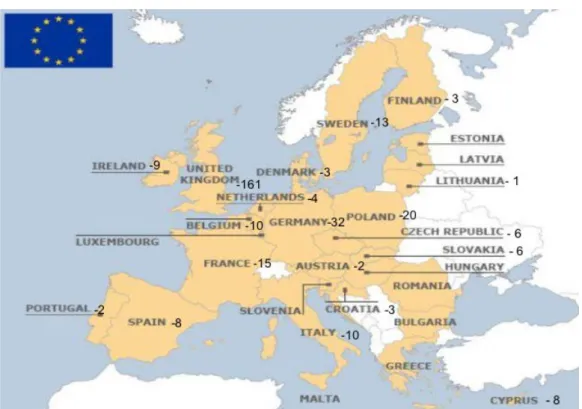
Figure 1: Number of reports found in each country
Map adapted from BBC News (2014)
This report reflects an attempt to respond to civil society’s request for an independent study in a way that is timely in relation to the EU review of the law. The 245 RPGs analysed here were published in 19 EU countries (Figure 1). 92 reports were found for the financial year beginning on or after 1/1/15 (these being mainly published in 2016) while 153 were published in the subsequent financial year (these mainly published in 2017). Some reports were found for the financial year beginning on or after 1/1/17, however, since many reports for this financial year were published subsequent to the finalisation of this report they were excluded from this analysis.
Executive summary of findings
We found substantively positive findings in terms of the usage of the reports and how the EU’s reporting requirements in practice were perceived by the corporate world.
Usage and usefulness Civil society is using the published RPGs and finding them useful. This includes local usage by NGOs in resource-rich countries, with global and local civil society
6
co-operating: for instance, Publish What You Pay has a Data Extractors programme to help train users to access and develop best-practice usage of available data including RPG in conjunction with other resources.5
Participation in formation of the legislation Analysis of comment letters submitted to public consultations carried out at the time of transposition of the Directive shows relatively little interest in Chapter 10 compared to other provisions of the Directive. The comment letters that were submitted do however demonstrate high level support for the aims of Chapter 10 with criticism and dissenting comments (mainly from preparers) focused on administrative areas such as penalties and deadlines rather than the purpose of Chapter 10. Support from the corporate world Interviews and observations indicate that among compliant companies the provisions of the Directives are not resisted but substantively accepted in the corporate world and costs are seen as not overly burdensome. Further, industry representatives have sympathy with the underlying aims. Consistent with this, there is evidence of some good reporting practice which is compliant with both the spirit and the letter of the law and in some cases goes beyond what is required.
At the same time, there is scope for improvement in terms of issues highlighted below.
Issues of accessibility and the monitoring of in-scope companies Serious issues emerged regarding the accessibility of the reports. Those reports that are filed in a national central repository or business register (as in 15 of 19 countries reviewed at the time of writing) are not always machine-readable and formats are very inconsistent between companies. In 4 of the 19 countries RPGs can only be found in media such as on the Web or embedded in companies’ annual reports and accounts – in the latter case making RPGs difficult to identify.
More basically, one cannot easily determine which companies are meant to comply with the law. There is no maintained list of in-scope companies. States’ obligations to monitor compliance with the law are mainly not met, and thus under-resourced non-governmental organisations (NGOs) are effectively given the responsibility to monitor compliance. It is difficult to ensure adequate compliance in this context.
Informativeness and consistency Accuracy of disclosure
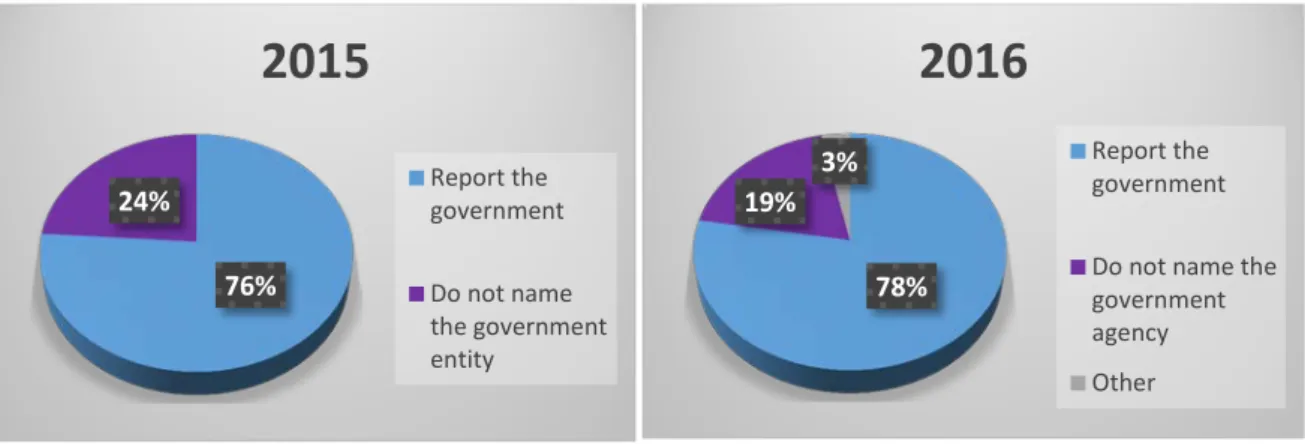
There was a lack of precision about which specific government authorities the payments are made to. For instance, 24% (2015) and 19% (2016) of companies do not report the name of the government entity to which payments are made.
Inconsistent interpretation of key definitions
There was an indication that different ways of interpreting payment categories might be operational in practice, which weakens analysis possibilities in respect of detailed breakdowns of different types of payments. Not many companies disclosed the volume and value of payments in kind.
5
7
Joint operations
There was evidence of a few companies using the lack of attention to joint operations in the law to in effect limit disclosure, although no evidence that companies were changing their inter-organisational arrangements to limit transparency. Evidence was found of a significant number of companies interpreting the expression ‘substantially interconnected’ – referring to project agreements – to arguably overly aggregate payments at the ‘project-by-project’ level. The project level disclosures of payments are a very important aspect of the transparency as they help to illuminate payments from particular operations in particular areas. This facilitates comparison between amounts paid in respect of these operations and the relative neglect of these particular areas in terms of social spending of the monies received by governments, as well as enabling better-informed cost-benefit analysis in terms of revenues versus frequently documented negative social and environmental impacts of extraction.
Auditing and reconciliations Few companies voluntarily gave enhanced validation to published reports by subjecting them to independent audit or reconciling them to other audited (or non-audited) figures. Some voluntary reconciliations and limited assurance audit practices were found.
We conclude overall that the law in practice is progress. Reporting has not been perfect in
the senses indicated. Nevertheless, various forces are at work, including positive usage of reports and companies’ willingness to adopt good reporting practices in relation to the provisions; mean that greater transparency has been achieved compared to the situation before the provisions were in place. More companies are now disclosing payments and the disclosures are more current and timely than under the voluntary Extractive Industries Transparency Initiative (EITI) that previously dominated payments to governments’ information provision in the extractive sector. The usage of the reports is already a strong indicator of their added value. At the same time, further improvement is still possible.
Executive summary of recommendations
• Better filing, preferably in a central repository at the EU level, to improve accessibility.
• The creation, updating and publication by the EC of a list of in-scope companies at EU level.
• Enhanced regulation, requiring at least limited assurance audits of the reports and/or their reconciliation to audited figures.
• More effective government monitoring of compliance with the provisions.
• Clarification in terms, consistent with the spirit of the law, of the meaning of ‘substantially interconnected’ with regard to project-level aggregation, the categories of payments and the specificity of payment recipients.
• A general requirement to disclose the basis of preparation of figures in the reports. • Enhancing format consistency and machine- as well as human-readability.
8
•
Alignment with and development of other laws and regulations would be additionally helpful: further prescribing of public country-by-country reporting and increased disclosures would enhance accountability/transparency in respect of tax, consistent with OECD recommendations.• Clarity of reporting requirements for payments made by joint operations. Ideally this would take the form of proportionate disclosure by participants in joint operations.
9
1. Introduction
Effective from 2016 (or earlier in the case of early transposition and adoption), Chapter 10 of the EU Accounting Directive requires large and public interest EU-domiciled extractive companies to report the payments they make to governments to access natural resources on a country-by-country and project-by-project basis. In order to ensure a level playing field the EU Transparency Directive (the “Transparency Directive”) extends the same requirements to non-EU domiciled companies which are listed on an EU regulated stock exchange. The aim of such disclosure s is to enable users – notably people of, and civil society advocacy groups in, resource rich countries, whose citizens often live in extreme poverty – to hold governments to account for the income received from oil, gas and mineral exploitation, and logging of primary forests.
The proposed research aims to explore the efficacy of Chapter 10 and the equivalent provisions of the Transparency Directive (herein referred to as “the Directives” or “provisions” of the Directives) to date.
There are thus three objectives: (i) to reflect on the Directives and how they have been interpreted and negotiated by Member States during transposition into national law; (ii) to review the disclosed Reports on Payments to Governments (RPGs) of companies in the extractives industry reporting in selected EU countries6; and (iii) to consider the views of stakeholders and constituencies about transparency reporting and the nature, content and usefulness of the RPGs.
The outcome of this research will inform contemporary debates on transparency and accountability in the extractives industry, and will be useful to stakeholders in their communications submitted in respect of the statutory review of the Directives to be undertaken by the European Commission (EC). The review was originally scheduled for completion by 21 July 2018. However, the deadline was extended, to mid-2019, to allow for an additional year of gathering views and experiences of implementation of the Directives and to account for the fact that few if any reports may had been published in certain countries where the Directives were implemented close to the transposition deadline, leaving little time available to enable effective review. Additional contextual issues to consider include the dynamics between the consultation process and 2019 EU elections and also the extent to which the EU/EC will be receptive post-Brexit to experiences from the UK’s early implementation of the Directives.
10
Chatzivgeri et al. (2017) completed a study focused upon the UK, which has been used by civil society in their communications relating to the UK government’s statutory consultation7 and most recently in their response to the European Commission’s review of Chapter 10 requirements. The research found controversial issues relating to UK interpretation of the legislation and consequent inconsistent and opaque UK company disclosures of RPGs relating to: joint venture arrangements, project aggregation and reliability. At the same time, the research highlighted positive aspects of the legislation and viewed it as progress, while also suggesting ways to enhance the efficacy of the law in terms of meeting its transparency and accountability objectives. This study builds upon and extends Chatzivgeri et al. (2017).
1.1 Issue to be addressed
Concerns have been raised about the phenomenon termed the resource curse, being:
…the correlation between the abundance of oil, gas and mineral resources and low economic growth and human development in many countries. It is a critical issue as, paradoxically, two-thirds of the world’s poorest people live in resource-rich developing countries (Oranje and Parham, 2009, p.26).
These concerns relate to the financial dealings of extractives companies and host country governments and the problematic/disappointing nature of the impacts in practice that large extractive operations have in resource-rich countries. The resource curse describes the situation whereby relatively resource-rich but cash-poor countries are unable to capitalise on their wealth of resources to substantively improve the socio-economic conditions of their populations. The issue also raises controversy about business as multi-national enterprises are able to generate seemingly large returns for their investors and highly paid senior executives from developing these resources.
Civil society action has influenced the development of statutory regulation in various jurisdictions around the world, requiring large and listed extractive companies (oil and gas, mining), as well as companies involved in the logging of primary forests, registered or listed in these jurisdictions, to disclose the payments they make to governments (PWYP, 2015; Tax Justice Network, 2006; European Commission, 2013; Sikka, 2013; Litvinoff, 2015; Transparency International, 2015). Such RPGs are a type of country-by-country reporting, contributing to a body of transparency reporting initiatives, such as the Extractive Industries Transparency Initiative (EITI), which has gained some traction globally.
1.2 Rationale of the study
There have been numerous calls for greater transparency in the extractives industry in order to understand the resource curse (Gallhofer and Haslam, 2007; PWYP, 2015). The calls for greater accountability and transparency focus substantively on two key areas. First, there is an interest
7
The UK consultation was completed on the 11th of May 2018
11
in making clearer the socio-economic impact of extractive activities carried out in the relatively resource-rich countries upon these countries themselves. Second, more specifically, there is an interest in disclosing how much money is received, arising from such activities, directly by every relatively resource rich country’s government – and in making visible by whom the payments (in forms such as corporate taxes, fees, license payments and royalties) are made. Thus, it is intended that a light is cast on the resource curse and aspects of the performance of relatively resource-rich countries as well as the financial sums paid directly by corporations to governments of these countries.
The proposed research is being carried out to assess the efficacy of the Directives, as implemented across the EU, in addressing the need for greater transparency in the extractive sector. The Directives have newly come into effect and most non-UK EU domiciled companies required to comply will have published their inaugural RPGs in 20178. With the European Commission undertaking a consultation into the operation of Chapter 10 requirements, it was felt that now is an opportune time for rigorous and independent research to be carried out into the development, implementation and perceptions of the Directives and the usefulness of transparency reporting. The proposed study will therefore address the question of whether this particular example of mandatory transparency reporting is successful in meeting the needs of users and providing additional insight into the resource curse at a time when the Directives are being subject to scrutiny and potential change.
1.3 Aims, objectives and research questions The research has three main objectives:
(i) to reflect on Chapter 10 requirements of the EU Accounting Directive and how they have been interpreted by Member Statesduring transposition into national law (ii) to review the disclosures linked to these requirements of selected extractive
companies reporting in EU jurisdictions, with particular attention to issues that were contentious at the time of developing the Directive and implementing the UK Directives
(iii) to consider the views of stakeholders and constituencies about transparency reporting and the nature, content and usefulness of the reporting payments to governments.
The objective of the research will be achieved by exploring the following questions:
• How have the requirements been interpreted and implemented in different European jurisdictions?
• To what extent have the requirements been complied with in different EU jurisdictions?
8 Chapter 10 requirements became effective for in-scope companies for financial years beginning on or after 1st
January 2016. The transposition of Chapter 10 requirements into UK legislation required early adoption and became effective for in-scope companies for financial years beginning on or after 1st January 2015.
12
• What are the views of stakeholders about transparency reporting and the nature,
content and usefulness of the payments to governments reported in different EU jurisdictions?9
• What evidence-based recommendations might feed into consultations on the law in the context of its review?
1.4 Importance of the study
The output from this research intends to inform contemporary debates on accountability and transparency practices in the extractives industry. This study has the potential to contribute to the development of transparency reporting in the EU and beyond. The empirical evidence gathered will underpin recommendations made by the Collective. These evidence-based policy recommendations will be useful for EU and other policy- and decision- makers, and also for civil society and other interested stakeholders in communications with government, regulators and standard setters. Specifically, we anticipate that EC officials, consultants who have been commissioned by the EC to review the efficacy of Chapter 10, and interested MEPs will consider this research and its recommendations when developing EU transparency legislation further with a view to facilitating accountability in the extractives industry.
1.5 Structure of this report
This report presents four further sections. Section 2 provides a brief contextual overview, while Section 3 presents the research methods of the study. Section 4 presents our findings relating to the aims of our study: reflection on the Directives; review of RPGs disclosures; while in Section 5 we present our conclusion and policy recommendations.
2. Contextual overview
The context in which this study takes place will inform the research approach. Certain developments in global politics also lend a degree of urgency to the work and make the production of quality research in this area pertinent and necessary to inform debate.
2.1 Transparency and accountability
As well as the issues directly relating to the extractives industry outlined in Section 1 above, this research adds to a growing body of literature concerned with the transparency and accountability of multi-national enterprises operating in a global context. Increasing calls for greater corporate responsibility from civil society campaigners, media commentators and the general public over issues such as financial secrecy, tax avoidance, the gender pay gap and modern slavery have resulted in governments imposing mandatory reporting requirements on
9 At the time of writing, 27 interviews have been undertaken with stakeholder groups representing
legislators/regulators/standard setters; industry representatives/preparers/advisors; civil society organisations and investors. The results from interview analysis will be reported more fully after all interviews have been completed, transcribed and analysed.
13
companies to heighten transparency and accountability. The introduction of mandatory legislation is on balance a welcome development in all of these areas and is the result of long and hard-fought advocacy campaigns. However, the introduction of legislation is not the end of the story and cannot be considered to solve the underlying issues which need to be addressed. Continued monitoring of the legislation and its operation is required to ensure that necessary improvements are made and that those companies whose practice falls short of societal expectations are held properly accountable to the societies in which they operate. It is therefore hoped that this research will inform wider debates on corporate transparency and accountability.
2.2 The legislation: transposition and implementation in the EU
Chapter 10 of the EU Accounting Directive was required to be transposed into the legislation of Member States by 20 July 2015 (with transposition of the equivalent provisions of the Transparency Directive due by 27 November 2015). In practice this means that most companies in mainland Europe made their first reports in respect of the financial year starting on or after 1st January 2016, therefore reports became available from 2017. The UK and France transposed the Directives one year early, meaning that RPGs of in-scope companies in these jurisdictions became available from 2016. It is interesting to note that some non-French and non-UK companies voluntarily published RPGs before the mandatory effective date (see Appendix 4).
The transposition required certain aspects of the Directives such as the nature of information to be disclosed to be transposed near verbatim, offering little room for Member States to adapt the legislation for jurisdiction-specific factors.
There are however several areas which allow Member States more flexibility in transposing the Directives into national legislation. These include the format of RPGs, the location where reports must be deposited and the institutional framework for the monitoring of compliance. These areas were highlighted as being of significant importance in the course of the UK study as they impact the usability of RPGs and the strength with which governments enforce the Directives within their jurisdiction, which may in turn affect perceptions as to the importance of the reports.
2.3 Contemporary developments in the international context
The UK vote to leave the EU (“Brexit”) and the election of the Trump administration in the USA have altered the political landscape in which the Directives now operate.
There has, as yet, been no stated intention from the UK government to alter the Directives as part of the Brexit process. Indeed, following a post-implementation review of the Directives carried out in the UK and completed in May 2018 the UK government has given the Directives a
14
“green” Regulatory Policy Committee (RPC) rating and recommended that the UK legislation remains intact in its current form. However, the UK’s decision to leave the EU raises the question of how much influence the UK will have on the EU consultation on the Directives. As the UK adopted the Directives early, experience from the UK is arguably more developed than elsewhere in Europe. Further, the extractives industry is significant in the UK and many UK-registered and UK-listed extractive companies operate overseas. Therefore, the experience of the UK government’s implementation and post-implementation review of the Directives, including the experience of users of UK-posted payment reports, potentially offers very valuable sources of information for the EC in carrying out their own consultation. It is hoped that these valuable lessons from the UK review of the Directives as enacted in UK legislation will help inform deliberations at the EU level in spite of the Brexit process.
The other development, which has changed the global political environment significantly since the Directives were brought into force, is the election of Donald Trump as President of the USA. Trump campaigned for election with promises to stimulate business, partly through cutting regulation. Following his inauguration as President, Trump gave Presidential approval for the repeal of a rule imposed by the Securities and Exchange Commission (SEC) implementing section 1504 of the Dodd Frank Act (s1504), which required US extractive companies to disclose payments to governments, the requirements being similar to the EU Chapter 10 requirements. At the time of writing, the law (Dodd-Frank, including s1504) remains intact, and the SEC remains time bound to produce a new rule implementing this section. So, the struggle to enhance transparency and accountability in the US context goes on. The potential voiding of the SEC rule for s1504, however, may be interpreted by some as giving US companies a competitive advantage over their counterparts in Europe, as a result of the reduced disclosure requirements. In this respect, Trump’s election potentially poses a threat to the EU Directives although industry/companies in the UK context, based on Chatzivgeri et al. (2017), are more supportive of the EU Directives. It is also the case that some companies, as well as civil society and other commentators, argue that greater transparency is in companies’ enlightened self-interest and helps (genuinely) to secure their social licence to operate and therefore offers a competitive advantage.
Positive developments in the international sphere include the recognition of the Canadian Extractive Sector Transparency Measures Act (ESTMA) by the EC as an equivalent to the Chapter 10 Directives.
3. Research Methods
The following methods were used to answer the research questions:
• Creation of the STAR Collective of academics to gather and analyse information about implementation of the Directives in different EU jurisdictions.
15
• Design and usage of a disclosure checklist to benchmark mandatory disclosures and
identify any voluntary disclosures of the sample of EU extractive companies identified by the STAR Collective. Further in-depth disclosure analysis of seven extractive companies was conducted, building on the findings of Chatzivgeri et al. (2017).
• Use of interpretations by legal counsel (interviewed for the UK study), industry and civil society of the Directives in the UK context, to build on the results of Chatzivgeri et al. (2017), in order to identify emerging good practice in reporting and problematic areas.
• Design of semi-structured interview questions for a number of different stakeholders groups.
3.1 Creating the STAR collective and the 7-questions survey
In order to gather the necessary data to allow for analysis of the transposition and implementation of the Directives into the legislature of selected EU countries, and to enable the analysis of RPGs published by companies in these countries, the STAR Collective was formed, representing collaboration from a wider collective of accounting academics from across Europe. Contact was made with these potential collaborators through existing networks in UK and other EU institutions. Potential collaborators were sent an introduction to the project by email and asked to respond to seven questions (see Appendix 2). The questions were designed to meet the research aims by collecting the necessary data to allow for data analysis mirroring the UK study carried out in 2017 (Chatzivgeri et al., 2017). In total, 27 (or more) potential STAR Collective representatives were sought from 27 EU jurisdictions (including the UK); contacts in Luxembourg did not materialise into collaboration while contacts from some jurisdictions agreed to collaborate but so far have not come back with the requisite data. This led to establishing links with collaborators representing 23 countries (see countries in Tables 1 and 2) with RPGs actually found in 19 EU countries (see countries in Appendix 4).
3.2 Collection and Analysis of RPGs at company level
In an effort to ensure consistency in data collection across the EU, the following steps were followed by the STAR Collective:
• The first step included the check of each country’s Stock Exchange for the identification of companies that might fall under the Directives. Due to the fact that the industry classification might be different from country to country, the Collective searched for companies belonging to all sectors that potentially relate to oil and gas, mining, minerals and logging of primary forests.
• Secondly, the Collective tried to identify whether a central repository for each country existed to get access to RPGs that were deposited there.
16
• Thirdly, and for any remaining companies identified, the companies’ websites were explored in an effort to locate information that relates to RPGs.
• Fourthly, since some answers to the 7-questions survey sent to the Collective members (see Appendix 2) indicated that in some EU countries, companies that fall under the Directives must submit their reports to the Business Register, the Collective tried to get access to these reports by contacting the Business Register or trying to gain access online.
• Finally, ‘Google’ search was used as final way of locating any reports that had not been included already for companies known to operate in the countries concerned.
In order to ensure consistency in the analysis of the reports, given that some of them were submitted in the local language and had to be analysed by the Collective members in that country, the approach below was followed:
• Collective members were sent a sample of UK reports, along with their content already analysed by the UK researchers;
• Collective members were instructed in the process that was followed by the UK researchers in analysing the reports and documenting the findings.
• The Collective were then asked to conduct content analysis on a sample of UK RPGs, and their results were compared to analysis already conducted by the UK researchers.
• Any inconsistencies in the analysis were explored and any clarification required was given to Collective members before they analysed local-language RPGs.
• All RPGs presented in English were analysed by the UK researchers.
In total, 245 RPG’s were analysed, out of which 92 relate to the financial year beginning on or after 1st January 2015 and 153 relate to the financial year beginning on or after 1st January 2016. These are also referred to throughout the report as 2015 reports or 2016 reports respectively.
3.3 In Depth Analysis of Selected Reports
In line with the methods employed in the UK study (Chatzivgeri et al., 2017), a selection of seven companies operating in both the oil and gas and mining sectors who fall within the scope of the Directives in the UK have been selected to be analysed in greater depth with the goal of identifying emerging good practice in reporting. The companies have been selected primarily because they have published information in excess of the minimum requirements of the Directives. In each case this takes the form of a PDF file published on the company website. Further detail about the companies selected is provided in later sections. The companies’ reports have been analysed for the financial year beginning on or after 1st January 2016 in conjunction with their annual report and accounts (AR&A) in order to identify additional disclosures that add to the usability and understandability of the RPGs. This analysis
17
builds on a similar study carried out on the same companies using information from their first RPGs (Chatzivgeri et al., 2017). These 7 companies are all UK in-scope extractive companies. 3.4 Contextual Analysis
Having analysed two years of RPGs across our European STAR Collective counties, the STAR Collective was brought together at an event in Poland in November 2018 to discuss country-specific experiences of accessing and analysing these reports. What became apparent during this meeting was the diverse institutional context across the different EU countries in the study, which, in some cases, appeared to influence:
• Development, interpretation and implementation of the legislation • Access/availability to RPG disclosures
• The types of payments to governments actually made
• Whether stakeholders were aware of the introduction of Chapter 10 and its transposition into jurisdictional legislation, specifically if stakeholders had commented on public consultations in this regard
To enable further understanding of the county-specific context in which in-scope companies report, our STAR Collective sought to provide answer the following questions about their particular country:
1. Is there a national industry body representing in-scope companies?
2. Are extractive activities mainly carried out by public or private enterprises and what are the main extractive activities taking place in this country?
3. Are there NGOs actively campaigning for transparency of in-scope company reporting in the country? Did they, and if so what issues did they raise, respond to relevant public consultations concerning the EU legislation?
4. What was the in-country process to transposing the EU Accounting Directive Chapter 10 into national legislation?
5. Are RPG being used, by who and for what?
6. Is there any further contextual information that is important to your country in respect of the development, interpretation and implementation of the legislation? From our STAR Collective, we received 19 country specific responses. These responses were analysed by the UK team and are presented and discussed in section 4.4 of this report.
4. Findings
4.1 Existence, access, completeness and reliability of RPGs in EU jurisdictions
18
As can be seen in Table 1, responses were received from academics in 23 Member States. Responses suggest that reports have been published and are accessible online - apart from in Greece, Latvia, Malta and Slovenia where no reports have been located. However, there are some differences across countries which may possibly raise concern for civil society users and may be worthy of further investigation. Of the 19 countries where we have managed to gather published RPGs, a few (Germany, Belgium, Croatia, Czech Republic, Slovenia) operate a central repository (see Table 1) with one further central repository under development in Poland at the time of writing. In the UK, Cyprus, Netherlands, Greece, Lithuania, Ireland, Malta, Finland, Latvia and Slovakia companies should submit their RPGs to Business or Company Registrars (which may of course be the equivalent of central repositories), while in the remaining countries access to RPGs is available through company websites where RPGs are published either in the form of standalone reports or available as part of companies’ annual filing, along with financial statements and sustainability reports. Where RPGs are required as part of a larger filing they are potentially available from a company registry at one central location – however, there may be nothing to distinguish which companies have filed RPGs in addition to their annual reports.
The lack of a central repository or the equivalent, raises issues about how civil society should access the information and also raises wider concerns about compliance monitoring. One of the key findings of the UK study was that despite companies having a legal obligation to file RPGs with the company registrar and/or listing authority there was no clear mechanism for monitoring compliance, nor a comprehensive list of in-scope companies produced by the regulator. It is notable that in the UK when a company fails to file mandatory documents, such as its accounts, annual return or tax return, by the statutory due date, an automatic penalty fine is applied. However, the same mechanism does not appear to be in place for the RPGs. The absence in some of the sample countries of even a requirement to file RPGs centrally is somewhat more concerning and could reasonably raise the question of whether companies will feel compelled to publish reports at all. It also raises concerns about the quality of reports that are submitted, if the government of their country does not appear to be monitoring compliance through a recognised institutional framework. For one European company, the compliance officer expressed how difficult it was to find RPG information, emphasising “you
need to know the names of the companies” to be able to find those that have prepared RPGs.
This frustration was confirmed by a European RPG preparer - reflecting on trying to find and access competitors’ RPGs, in an attempt to ensure interpretations of the Directives and implemented disclosures were consistent with those of their competitors - stating:
… you have to go on the website and you have to search for the menu in which you can find this kind of information and it’s not so easy to [retrieve] … [if] the company is not listed … they are not forced to publish on the website [and] this information [is] just in the chamber of commerce.
19
This preparer also explained how this company had needed to liaise with their specialist industry association to find out which of their competitor companies had reported:
We had some meetings with [the Industry Association], some conference calls, which [competitors] attended so we knew [which companies] were forced to make this report [RPG]. … Everybody reported their thoughts and experiences and tried to understand how to prepare the disclosure but then when we found the result, when we checked what they published, they were … all different”.
Compliance monitoring
This concern appears to be borne out by responses from collaborators. No respondents were able to confirm whether all companies in-scope in specific countries have reported or if it is even possible to monitor compliance on a country-wide basis e.g. through a government-maintained list of companies required to report (Table 2). Whilst most respondents were unable to confirm the existence of a list of companies required to report, responses from Italy and France suggest that no such list exists in these countries at all (or in the UK). Only the respondent from Denmark was able to provide evidence that filing of RPGs is monitored by relevant authorities. In Denmark an independent auditor has the responsibility to check the consistency of RPGs as part of companies’ annual financial reports and furthermore annual compliance monitoring means a selection of companies will be subject to an audit of financial reports by the Danish government, which would encompass the RPGs. Most respondents have thus been unable to ascertain whether compliance monitoring by a relevant government entity is taking place in their country however comments from one respondent in France suggest that there is no compliance monitoring and that the French authorities rely on NGOs to flag up instances of non-compliance, this is similar to the situation in the UK. Given the responses from collaborators and the findings of the study conducted in 2017 in the UK, which highlighted the lack of compliance monitoring at an institutional level as a potential weakness with the legislation, it is hoped that interviews can be arranged with representatives of government in various countries to discuss the issues of RPG accessibility and compliance monitoring.
20 Table 1: Existence and access to RPGs in EU countries
Countries * Access Location of access Format English Charge #**
Cyprus Yes Company websites; there is no central repository but submitted to the
Department of the Registrar of Companies and Official Receiver of the Republic of Cyprus
(http://www.mcit.gov.cy/mcit/drcor/drcor.nsf/index_en/index_en)
Pdf Yes Reports are stored on a
database for which an annual subscription charge for access applies. It is not known if a further charge is applied specifically for access to RPGs.
5
Denmark Yes Within or URL link within the MD&A of the annual report, by statutory
order. Must be available for 5 years
Pdf or XBRL Yes No Charge (NC) 3
France Yes Companies’ websites S-sheet; Pdf Some in French, some in
English
NC 8
Germany Yes Central repository: www.bundesanzeiger.de HTML Mainly listed companies;
smaller and private companies report in German
NC 32
Italy Yes Companies’ websites Pdf Yes NC 6
Netherlands Yes Companies’ websites; there is no central repository but submitted to
the trade register
Pdf Yes NC 3
Poland Yes Companies websites; repository (NCR) in development Pdf Some Polish, some English NC 10
Spain Yes Companies’ websites; no central repository Pdf Yes NC 5
Sweden Yes Swedish Companies Registration Office
(https://bolagsverket.se/)
Pdf Some Swedish, some
English
Yes, 2SEK per page 13
UK Yes Companies House
(https://www.gov.uk/government/organisations/companies-house), Morning Star (http://www.morningstar.co.uk/uk/default.aspx) Companies' websites
Csv, Pdf, HTML (XML from 2018)
Yes NC 93
Belgium Yes Central repository (repository contacted and reports were sent to the
Belgian collaborators)
Pdf No NC 8
21
(http://www.businessportal.gr/home/index_en) found (RNF) document requested
Lithuania Yes Company websites;
Nasdaq (http://www.nasdaqbaltic.com/market/?lang=en) for listed companies;
State Enterprise Centre of Registers (http://www.registrucentras.lt/en/) for other companies.
Mainly information was found as part of the annual report.
Pdf Yes No charge for accessing the
reports in company website and Nasdaq;
There is a charge fee for accessing annual reports in State Enterprise Centre of Registers (0,87 Euro/page)
1
Ireland Yes Reports are required to be filed with the Irish Company Register (CRO)
no later than 11 months after the financial year. The CRO provides a search by company function but any documents must be paid for in order to be accessed.
However, access was not available and therefore reports were obtained through the Irish Stock Exchange.
HTML Yes The CRO does not give out
information themselves; interested parties have to buy it from one of those vendors that have "bought" the bulk data from them
4
Malta*** No Registry of Companies RNF RNF RNF 0
Austria Yes Company's website, included within the annual report Pdf Yes NC 1
Croatia Yes Financial Agency (FINA) (https://www.fina.hr/Default.aspx?sec=1159) Pdf No NC 3
Czech Republic Yes All reports are available on https://justice.cz/ or on their own websites Pdf Most of them in Czech NC 6
Finland Yes Company websites. Within sustainability report or as part of financial
statements. All should be published through the Trade Register.
Pdf Some Finnish and some English
Yes, 6.20€ 3
Latvia*** No Register of Enterprises of the Republic of Latvia RNF RNF Yes, depending on the
document requested
0
Portugal Yes Company website, Stock Exchange regulator website **** Pdf English version
downloadable
NC 1
Slovakia Yes Register of Financial Statements - Central Repository (as part of annual
reports)
(http://www.registeruz.sk/cruz-public/domain/accountingentity/simplesearch)
Pdf No NC 3
Slovenia*** No Central Repository: JOLP
(https://www.ajpes.si/jolp/)
22
*The country profile is given in Appendix 1. Shading reflects the countries focused upon as a priority at the outset of the project. As the project developed, priority was given to those countries where the Collective could access RPGs together with related information concerning how the Directives had been implemented in each jurisdiction.
** This column shows the number of companies reporting in the country. See Appendix 4, which shows the financial years in which the companies report.
***Despite extensive research and efforts by the Collective, no reports were found in the following countries: Greece, Latvia, Malta, and Slovenia. No academic contacts have been established to date in Luxembourg (no positive responses in respect of collaboration). In addition, despite the fact that the UK researchers contacted academics in Bulgaria, Estonia, Hungary and Romania, no information has been received to date and therefore, these countries are not included in the report, bringing the final number of countries in which reports were found to 19 (and all reports for the 5 companies found in Cyprus were the same as those found in Spain or the UK and therefore are included as part of the analysis of Spain or the UK).
**** The annual accounts of all companies in Portugal are submitted to the Ministry of Finance and can be retrieved through the Business Registry (https://bde.portaldocidadao.pt/cve/ies/ElaborarPedido.aspx). The annual accounts of listed companies can be retrieved at the Stock Exchange regulator (http://web3.cmvm.pt/english/sdi/emitentes/info_priv.cfm). The report of the only RPG-compliant company was retrieved through the second method and through the company’s website.
23
Table 2: Completeness and reliability of RPGs
Countries Are the reports for all in scope
companies available?
Is there a list of in-scope companies provided by an authority?
Does the government or regulator ensure RPGs are received
Cyprus Unable to determine Not any that can be found Unable to ascertain if authority ensures they are received
Denmark Should be; disclosure is part of
Financial Statement Act
Not any that can be found Auditor will review MD&A for consistency with audited financial statements. Also, Danish regulator will select a number of annual reports for scrutiny
France Unable to determine No No; rely on NGOs, e.g. Oxfam France to monitor and alert the government
about cases of non-compliance
Germany Unable to determine* Not any that can be found Unable to ascertain if authority ensures they are received
Italy Unable to determine No Unable to ascertain if authority ensures they are received
Netherlands Unable to determine Not any that can be found No
Poland Unable to determine No No
Spain Unable to determine Not any that can be found Unable to ascertain if authority ensures they are received
Sweden Unable to determine Not any that can be found No
UK Unable to determine No No
Belgium Unable to determine Not any that can be found Unable to ascertain if authority ensures they are received
Greece Unable to determine Not any that can be found Unable to ascertain if authority ensures they are received
Lithuania Unable to determine No No
Ireland Unable to determine Not any that can be found Unable to ascertain if authority ensures they are received
Malta Unable to determine Not any that can be found Unable to ascertain if authority ensures they are received
Austria Unable to determine Not any that can be found Unable to ascertain if authority ensures they are received
Croatia Unable to determine No Unable to ascertain if authority ensures they are received
Czech Republic Unable to determine Not any that can be found No
Finland** Unable to determine Not any that can be found No
Latvia Unable to determine Not any that can be found Unable to ascertain if authority ensures they are received
Portugal No*** No Unable to ascertain if authority ensures they are received
Slovakia Yes**** No Yes, the Financial Administration Slovak Republic
Slovenia Unable to determine Not any that can be found Unable to ascertain if authority ensures they are received
24
** An issue arising: Translation of RPGs into Finnish (in the Act stated as “vuosiselvitys” ~ “annual account”) leaves text misleading and/or vague. In the search phase, it was hard for the Finnish collaborators to find any data or appropriate legislation in Finnish and try to explain the substance of it for stakeholders (who typically assumed the RPGs were only about corporate tax payments).
***Three companies did meet the criteria but two of them did not produce a report. With regard to one of those non-compliant companies, its parent company was reporting under ESTMA and the subsidiary did not publish any report; however, this company should have made public and/or submitted to the central repository the report that the parent company had submitted under ESTMA. It was not clear whether the other company is indeed non-compliant or whether a report was not produced because the company did not make such payments or these payments did not reach the threshold (the Portuguese collaborators contacted the company but they never received a response).
25
Format of RPGs
Respondents were asked to provide details of the format in which RPGs are made available in their country (Table 1). From responses received to date, the majority of companies appear to be publishing RPGs in non-machine-readable PDF format. Some companies have published RPGs in spreadsheet format however no countries (apart from the UK in case of home-registered companies - see below) have reported consistent reporting in spreadsheet format. This suggests that the decision as to which format to use when publishing RPGs is being made at a company level and (apart from in the UK) is not prescribed by national legislation. Civil society campaigners have expressed a preference for reports to be published in machine-readable formats to enable more efficient analysis (PWYP now advocates iXBRL, which is both machine- and human- readable and in line with EU policy). It is worth noting that the UK has made submission of RPGs in XML format, which converts to CSV format (spreadsheets), mandatory for UK registered companies, and similarly (although in this case converting to Excel spreadsheets) for reports on financial years starting from 1 August 2016 by companies reporting in the UK as a result of their market listing, which brings them within the ambit of the legislation via the EU Transparency Directive. This prescription of reporting format is arguably a useful interpretation of the Accounting Directive by the UK Government and although one preparer interviewed as part of the UK study related some difficulties in using the filing system required for electronic reports there was no broad objection from industry on this point.
4.2 Company level compliance and disclosure
The following analysis relates to reports that were found by the STAR Collective in 19 EU countries(see Table 1). The analysis relates to 92 companies for 2015 and 153 companies for 2016 (a full explanation of the reports found is provided in Appendix 4). 10
Figure 1: The government to which each payment is made
10 Several reports were found for 2017. However, many 2017 reports were unavailable for our analysis point and it
was decided that any 2017 reports should be excluded at this stage. Nevertheless, it is anticipated that these as well as any other 2017 reports subsequently published will be used in due course, as the Collective will continue to research this area.
76% 24%
2015
Report the government Do not name the government entity 78% 19% 3%2016
Report the government Do not name the government agency Other26
As can be seen from Figure 1 above, when all companies for which RPGs were found are examined, the majority of companies report the government entity to which each payment is made. The 24% and 17% include companies that do not specify the government entity to which the payment is made (e.g. disclosing UK Government rather than being more specific and including, for example, HMRC), while the 3% in the 2016 chart includes companies that do specify the government entity for some but not all payments.
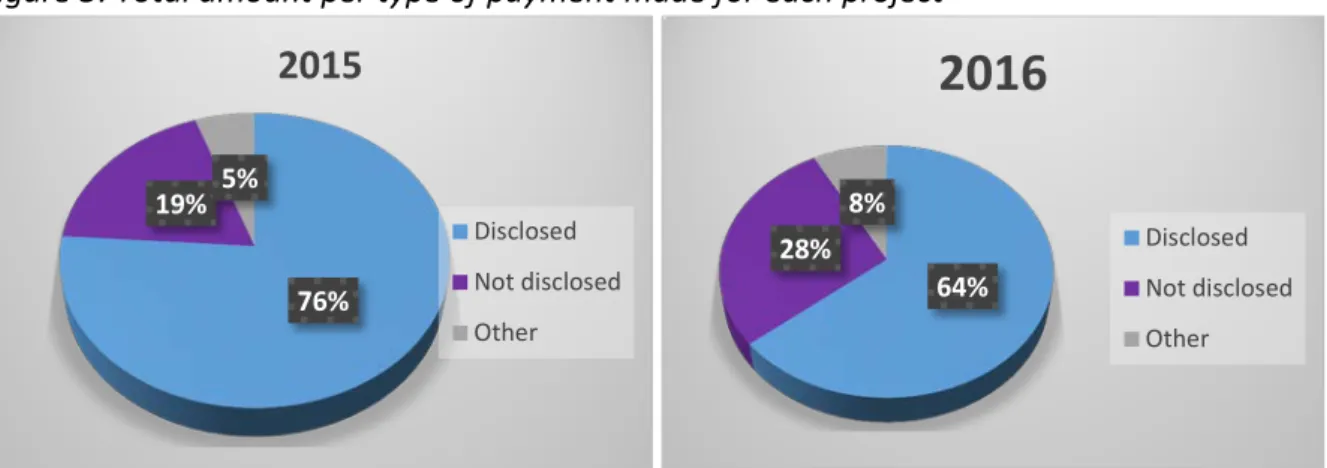
Figure 2: Total amount of payments made for each project
The ‘not disclosed’ category includes companies that do not provide project information, while the ‘other’ category includes companies that provide the breakdown of the payments made but not the total, a company that mentions that payments are below the threshold and two that mention that the payments are not allocated between projects.
Figure 3: Total amount per type of payment made for each project
When it comes to the total amount per type of payment made for each project, the ‘other’ category includes companies that either mention that payments have been made but are not above the threshold, or ‘payments are not allocated between company’s projects as the
entities do not attribute payments to a specific project/mine’, or they report project specific
information for all types except taxes. The ‘other’ category also includes a company that reports project specific payments for all types except where they are unable to allocate
76% 19% 5%
2015
Disclosed Not disclosed Other 64% 28% 8%2016
Disclosed Not disclosed Other 76% 19% 5%2015
Disclosed Not disclosed Other 64% 28% 8%2016
Disclosed Not disclosed Other27
payments to specific projects, such as taxes in Germany and France but also some fees in other countries.11
Due to the fact that most of the 2016 reports (79%; 121 out of the 153) relate to the UK, France, Germany, Sweden and Poland, the UK researchers have decided to provide graphs regarding the different payment types for these countries. Therefore, the analysis below shows the different payment types that were made by companies identified in these countries during 2016.
Figure 4 below shows the percentage of companies in each jurisdiction disclosing each different type of payment. Further work is required to understand whether such variability in payment types reflects the countries, projects or contracts of the jurisdiction-specific extractive companies, or whether such variability reflects also differences in how payment types have been interpreted in different jurisdictions.
Figure 4: Payment types
11 It should be noted that in an effort to identify whether the percentage change from 2015 to 2016 is attributed to the
different sample size in each period or to different approaches followed by each company, the UK researchers went through all the reports of all those companies that had a report for both years under investigation. There were not any changes from year to year for those companies (apart from some payment types - e.g. companies paying dividends one year and not the other).
0.00% 10.00% 20.00% 30.00% 40.00% 50.00% 60.00% 70.00% 80.00% 90.00% 100.00%
28
Some interesting observations from this analysis shows:
• Almost 67% of the French companies and over 80% of German companies disclose production entitlements payments, compared to 28% or fewer companies in Sweden, Poland and the UK. In the UK, 96% of companies report taxes levied, compared to 62% of German companies.
• 83% of French companies disclosed royalties; no such payments disclosed by German companies. 50% of French companies disclose dividend payments with fewer than 10% in the other countries. 80% of Polish companies disclosed bonus payments, compared to only 20% of UK companies.
• 83% of French companies made payments for infrastructure improvements, compared to 34% (UK), 23% (Sweden), 20% (Poland) and 5% (Germany). However, there is often limited information detailing the nature of such improvements.
• The majority of companies in France (67%), Sweden (62%), Poland (90%) and UK (79%) pay some form of fees to host governments. In Germany the figure is 14% per company disclosures.
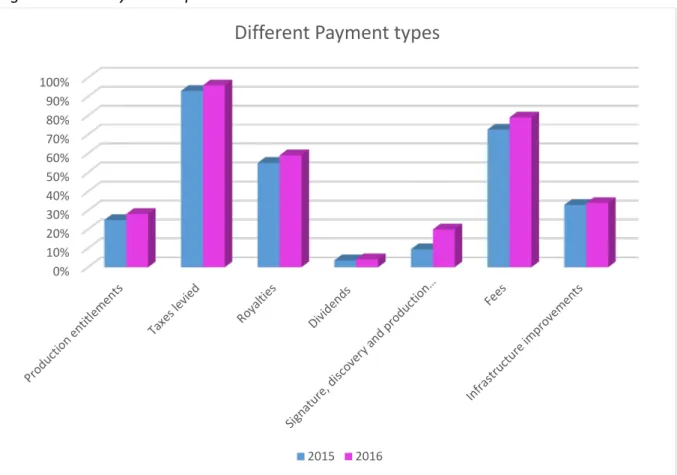
When the percentage of companies reporting different payment types are examined for the same sample of companies for the two countries that implemented the Directives early (UK and France), no year on year changes appear in France (results not shown) and no major changes are noted in the UK, although there are slight increases for all payment types from 2015 to 2016 reports (Figure 5).
Figure 5: Year to year comparison - UK
0% 10% 20% 30% 40% 50% 60% 70% 80% 90% 100%
Different Payment types
29
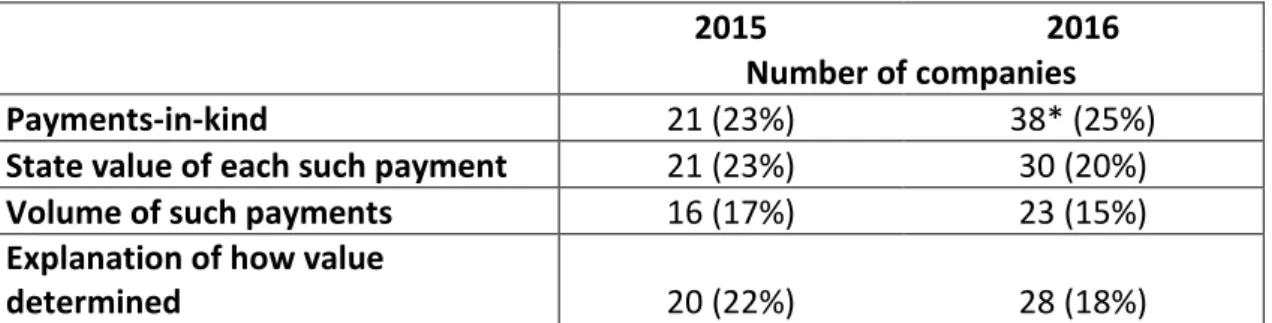
As can be seen from Table 3, when payments-in-kind are examined for all the reports that have been collected, approximately 23% of the companies (21 out of the 92) included in the analysis disclose payments-in-kind in 2015, with the majority also explaining how the value was determined. However, some of the companies fail to identify the volume of payments in kind made. In 2016, almost 25% of the companies analysed (38 out of 153) mention payments-in-kind. However, more than 20% of those companies fail to provide further explanation.
Table 3: Payments-in-kind
2015 2016
Number of companies
Payments-in-kind 21 (23%) 38* (25%)
State value of each such payment 21 (23%) 30 (20%)
Volume of such payments 16 (17%) 23 (15%)
Explanation of how value
determined 20 (22%) 28 (18%)
* The reports for 6 Polish companies mention that it includes payments whether in cash or in kind, without clearly identifying which of these were in kind. Also, two companies mention that they did make in kind payments but these payments did not reach the threshold
This finding is potentially of significance in jurisdictions where natural resource production takes place under production sharing agreements (PSCs) which allocate economic return to host countries in the form a share of commodities lifted. An absence of clear information as to how payments-in-kind are valued e.g. price per unit data (needed if volume unspecified for each separate payment-in-kind) leaves users potentially unable to determine whether governments received a return equal to a reasonable value in view of market conditions or if in-kind payments have been correctly valued.
4.3 In Depth Analysis of Selected Reports – Emerging Good Practice
The RPGs of seven companies who have filed in the UK were analysed in depth in conjunction with the companies’ annual report and accounts (AR&A), in order to identify areas of potential good practice emerging from early reporting periods. This analysis was conducted for the financial year beginning on or after 1st January 2016, building on a similar analysis carried out as part of the UK study which examined the same seven companies for the financial year beginning on or after 1st January 2015. The RPGs referred to in this section are reports published on companies’ websites in PDF format, containing additional narrative disclosures. The seven companies analysed are detailed in Table 4.
30
Table 4: In depth analysis sample
Company EU Directive mandating reporting
Industry Spreadsheet format RPGs also available
BP plc Accounting Directive Oil and Gas Yes BHP Billiton plc* Accounting Directive Mining Yes Evraz plc Transparency Directive Mining and Steel
Manufacturing
Yes Glencore plc Transparency Directive Mining and Oil and Gas Yes Rio Tinto plc* Accounting Directive Mining Yes Rosneft Transparency Directive Oil and Gas No Royal Dutch Shell plc Accounting Directive Oil and Gas Yes
* Both BHP Billiton and Rio Tinto have a track record of producing tax transparency reports on a voluntary basis before the implementation of mandatory rules.
The sample covers companies in both the oil and gas and the mining industries and companies who fall within the ambit of the Directives by virtue of their establishment (Accounting Directive) or their listing (Transparency Directive). As noted above, BHP Billiton and Rio Tinto have a track record of publishing this type of information, predating the implementation of mandatory European rules, both companies noting in their reports that they published their first country-by-country tax transparency reports in 2010. The inclusion of these two companies in the sample potentially therefore provides examples of mature disclosure which has had the chance to evolve over successive reporting periods.
The RPGs were assessed in terms of the information they provide supplementary to the minimum reporting requirements of the Directives which may better help users interpret the disclosures. The AR&A were then analysed to supplement and seek to corroborate information provided by the RPGs. The areas of focus in this analysis seek to shed light on how additional disclosures may improve reporting in areas which may be problematic due to lack of clarity or prescription in the Directives or opacity of reporting practice by companies. Areas of focus were derived from discussion with stakeholders and the findings of the UK study (Chatzivgeri et al., 2017) and are summarised below:
1. Explanation as to the basis of preparation, specifically focussing on key areas highlighted as potentially unclear from reading of the Directives, such as:
• Treatment of payments made to or on behalf of joint venture partners • Treatment of payments made to or in a company’s capacity as field operator
• Additional information on the principles applied in aggregating activities for the purpose of project-by-project reporting
31
2. Reconciliation between RPGs and the AR&A, including segmental disclosures in the AR&A, which may aid in contextualising RPG information
3. Assurance reports
4. Supplementary information evidencing good tax citizenship: • Tax authority risk ratings
• Details of open enquiries or tax litigation • Use of tax havens
• Transfer pricing policies and pricing agreements in place • Tax incentives received
Basis of preparation
All of the companies included in the analysis prepared a statement detailing their basis of preparation of RPGs. The length and detail of information in the statements varied across companies, from a simple statement about the scope of the relevant Directive and the requirement to report, to multiple pages of definitions and additional clarifications.
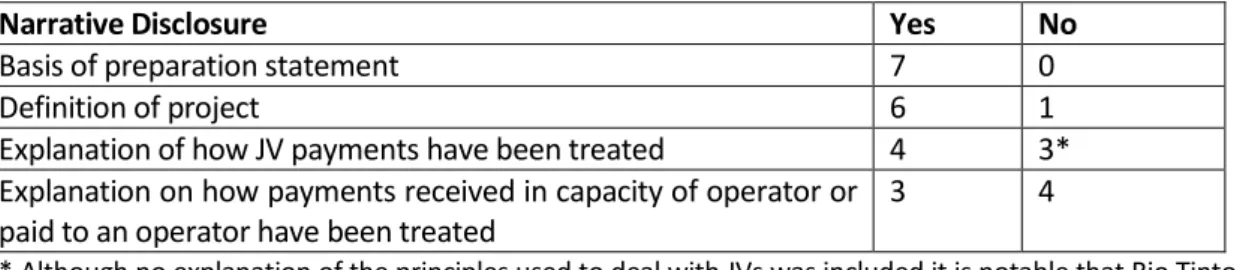
Table 5 outlines the additional disclosures made in key areas of interest. It is interesting to note that Rio Tinto prepared its RPGs based on principles it regarded as compliant with EITI, and so its basis of preparation presents a different proposition to others in the sample, this company did also make mandatory disclosure under the Directives in the UK in the form of a spreadsheet submitted to Companies House.
Table 5
Narrative Disclosure Yes No
Basis of preparation statement 7 0 Definition of project 6 1 Explanation of how JV payments have been treated 4 3* Explanation on how payments received in capacity of operator or
paid to an operator have been treated 3 4
* Although no explanation of the principles used to deal with JVs was included it is notable that Rio Tinto, included in the No column here, disclosed a separate table of JV taxes paid.
Project definition
It is notable that six of the seven companies provided an explanation as to how they have defined projects for the purpose of the report. This additional disclosure is more helpful in some cases than others. Bare minimum disclosure by one company re-stated the definition included in the standard however others clarified that projects were arranged on a commodity basis and one company chose to disclose company-by-company as this was felt to be the most representative form of project reporting given their operational arrangement. These additional details help users to contextualise the information and give better direction for finding related information in the consolidated AR&A or in individual level company financial statements.