palaeo-electronica.org
PE Article Number: 18.1.17A
Copyright: Paleontological Society April 2015
Submission: 26 September 2014. Acceptance: 25 February 2015
Camacho, Sarita Graça, Maria de Jesus Moura, Delminda, Connor, Simon, Scott, David B., and Boski, Tomasz. 2015. Taxonomy, ecology and biogeographical trends of dominant benthic foraminifera species from an Atlantic-Mediterranean estuary (the Guadiana, southeast Portugal). Palaeontologia Electronica 18.1.17A: 1-27.
Taxonomy, ecology and biogeographical trends of
dominant benthic foraminifera species from
an Atlantic-Mediterranean estuary
(the Guadiana, southeast Portugal)
Sarita Graça Camacho, Delminda Maria de Jesus Moura,
Simon Connor, David B Scott, and Tomasz Boski
ABSTRACT
This study analyses the taxonomy, ecology and biogeography of the species of benthic foraminifera living on the intertidal margins of the Guadiana Estuary (SE Portu-gal, SW Spain). Of the 54 taxa identified during sampling campaigns in winter and summer, 49 are systematically listed and illustrated by scanning electron microscope (SEM) photographs. Ammonia spp. were the most ubiquitous calcareous taxa in both seasons. Morphological analysis and SEM images suggested three distinct morpho-types of the genus Ammonia, two of which proved to be Ammonia aberdoveyensis on the basis of partial rRNA analyses. Jadammina macrescens and Miliammina fusca were the most ubiquitous agglutinated taxa in the estuary. Jadammina macrescens dominates the upper-marsh zones almost exclusively, occurring at very high densities.
Ammonia spp. are the most abundant in the low-marsh and tidal-flats of the lower
reaches of the Guadiana Estuary, but are widespread throughout the estuary, espe-cially during summer when environmental conditions favor their proliferation.
Miliam-mina fusca doMiliam-minates the sparsely vegetated low-marsh and tidal-flat zones of the
upper reaches, where it is associated with calcareous species. Due to its geographical position, the Guadiana system shares characteristics of both Atlantic and Mediterra-nean estuaries. This is reflected in the foraminiferal assemblages, with a dominance of thermophilous species and an ecological zonation typical of the Mediterranean climatic zone.
Sarita Graça Camacho. Center of Environmental and Marine Research (CIMA), Faculdade de Ciências e Tecnologia, Universidade do Algarve, Campus de Gambelas, 8005-139 Faro, Portugal [email protected] Delminda Maria de Jesus Moura. CIMA, Faculdade de Ciências e Tecnologia, Universidade do Algarve, Campus de Gambelas, 8005-139 Faro, Portugal. [email protected]
Simon Connor. School of Earth, Atmosphere and Environment, Faculty of Science, Monash University, Clayton 3800, Australia. [email protected]
David B Scott. Centre for Environmental and Marine Geology, Department of Earth Sciences, Dalhousie University, Halifax, Nova Scotia, Canada B3H 4J1. [email protected]
Tomasz Boski. CIMA, Faculdade de Ciências e Tecnologia, Universidade do Algarve, Campus de Gambelas, 8005-139 Faro, Portugal. [email protected];
Keywords: benthic foraminifera; taxonomy; biogeography; ecological zonation; genetic analysis; Guadiana Estuary
INTRODUCTION
Foraminifera are single-celled organisms that possess a hard test, which often remains in the sediment where it may fossilize. Foraminifera were first described and illustrated in the sixteenth cen-tury but only studied systematically in the nine-teenth century following the remarkable voyage of HMS Challenger (Lowe and Walker, 1997). Their usefulness in stratigraphy was gradually realized, and they attained a fundamental role in applied sci-ence as stratigraphical index fossils (Albani et al., 2001). Widely used in petroleum assessment, fora-minifera are also important in paleoclimatic, paleo-sea-level, paleo-depth and paleoceanographic studies and in age determinations using oxygen isotopes (Albani et al., 2001). Stratigraphically, for-aminifera appear in the Early Cambrian at about the same time as the metazoans with skeletons (Pawlowski et al., 2003), diversifying into thou-sands of species adapted to all marine and coastal environments, from the most superficial to the greatest oceanic depths (Scott et al., 2001). Cur-rently, around 6800 species of foraminifera are estimated to exist (Hayward et al., 2014).
Accurate taxonomy is essential for classifying the fossil species and to create reliable environ-mental analogies. The test is the most commonly studied element of foraminifera, as classification relies essentially on morphological characteristics (Debenay et al., 1996). However, the taxonomic value of those characteristics is questionable due to the influence of environmental factors on the morphology of foraminiferal tests, which makes the distinction between ecophenotypes and species difficult (Holzmann and Pawlowski, 1997). These difficulties are particularly problematic in the case of species of cosmopolitan distribution and with high morphological variability, such as the genera
Ammonia (Hayward et al., 2004) and Elphidium
(Feyling-Hanssen, 1972; Miller et al., 1982). The high morphological variability of Ammonia, for instance, rendered its status uncertain and contro-versial (Pawlowski et al., 1995; Holzmann and Pawlowski, 1997; Debenay et al., 1998a; Holzmann et al., 1998; Langer and Leppig, 2000) until molecular studies were used to better
under-stand its taxonomy (Hayward et al., 2004). More than 40 species and subspecies (or varieties) of
Ammonia have been described worldwide, and at
least 30 species were expected to be recognizable by molecular techniques (Hayward et al., 2004). The application of molecular techniques has brought new insights into foraminiferal taxonomy. Pawlowski et al. (1994) demonstrated that the analysis of RNA ribosomal sequences can be applied in the identification of foraminiferal species, providing a new taxonomic criterion, independent of the morphological characteristics of the test. Molecular analysis also enables an evaluation of the ecological significance of various morphologi-cal characteristics and the determination of intra-specific morphological variability (Pawlowski et al., 1994). Since 1994, molecular techniques improved and became more accessible. Thus, is expected that taxonomic descriptions of new and/or modern species of foraminifera with controversial classifi-cations include genetic data in addition to morpho-logic information.
Along with taxonomy, it is essential to study the living assemblages, their main features, life cycles and ecological tolerances in order to per-form consistent and reliable paleo-interpretations (Calonge et al., 2001). In Portugal, most ecological studies based on estuarine foraminifera have been performed in order to establish modern databases through which fossil foraminiferal assemblages can be compared and interpreted (e.g., Fatela and Silva, 1990; Cearreta et al., 2002, 2007; Andrade et al., 2004; Moreno et al., 2005; Fatela et al., 2009; Leorri et al., 2010). Nevertheless, the result-ing taxonomic data are very limited, with little sys-tematic study and no molecular analysis. Recently, the seasonal and spatial patterns of live benthic foraminifera in intertidal margins of the Guadiana Estuary were studied (Camacho et al., 2015). That analysis lacked detailed taxonomical information and genetic data. In order to address these knowl-edge gaps, this study presents a photographic and systematic compendium of almost all species found in the estuary and provides preliminary genetic information on two of the most important taxa. These data, along with the ecology and
bio-geography of the main species, are expected to complement the previous study by Camacho et al. (2015) and contribute to a more robust taxonomic basis for foraminiferal identification.
Study area
From its headwaters located in Lagoas de Ruidera (1700 m altitude) in Spain, the Guadiana River runs 810 km until it reaches the Atlantic Ocean between the Portuguese town of Vila Real de Santo António and Spanish town of Ayamonte (Figure 1). The terminal 200-km stretch of the river follows a north-south course and sets the national border between the two countries (M.A., 1999). The estuarine system is characterized by semi-diurnal mesotidal regime (Morales et al., 2006), with tidal influence, in a physical sense, extending 44 km upstream to Pomarão (Barros and Cande-ias, 1998). The mean tidal range at the river mouth is approximately 2 m, reaching 3.4 m during spring tides (I.H., 2011). Its basin has Mediterranean cli-matic characteristics, with hot, dry summers, strong insolation and high evapotranspiration. The winters are relatively cold and continental in the upper reaches of the river and become milder downstream (M.A., 1999).
The Estuary includes a series of habitats of high ecological value, such as a rich wetland zone (saltmarshes, salt pans, tidal creeks and ponds), intertidal flats, barrier islands and sandy spits. The wetland is noteworthy for its halophytic saltmarsh communities (Ramsar, 2013), which carry out an essential role in the functioning and maintenance of a healthy ecosystem (Simonson, 2007) and have earned the estuary its status as a Natural Reserve in the Portuguese conservation network (ICNB, 2007).
METHODOLOGY Sampling and Processing
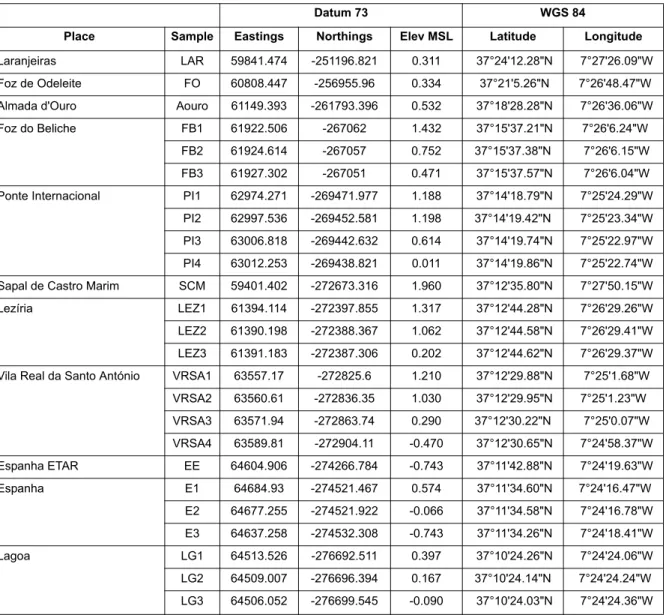
During the two most contrasting seasons, i.e., winter (February and March) and summer (August), of the year 2010, 49 samples of the top 1 cm of surface sediment of the river’s intertidal mar-gins were collected in order to cover the environ-mental range of living benthic foraminiferal assemblages in the Guadiana Estuary. The sam-pling extended over 27 km, from the most upstream site located at Laranjeiras (LAR site) to the mouth of the river at Lagoa (LG site), covering the entire salinity gradient of the estuary (see Table 1, Appendix). In total, 11 sites were sampled, with the majority located on the right bank of the river
(Figure 1). In the middle and upper estuary, only one sample was collected per site due to the absence of saltmarsh zonation. In the lower estu-ary, where the environmental zonation is well-marked due to a more pronounced tidal range, three to four samples were collected along topo-graphic profiles at each site, usually running per-pendicular to the river course. These transects were placed according to the vertical zonation of halophytic vegetation, with the aim of sampling the distinct pedomorphic units, from unvegetated mud-flats (permanently wet) to the higher levels of the marsh. Topographic profiles were surveyed in detail using a differential Global Positioning Sys-tem (d-GPS) and a Trimble 5800 mobile unit (a Nikon DTM 310 Total Station was employed in places without a radio signal). Elevation was mea-sured in relation to mean sea level (MSL) (datum 73). Samples were divided into upper marsh (col-lected at 1–2 meters above MSL), lower marsh (0– 1 meters above MSL) and mud zone (-1–0 meters in relation to MSL). The salinity gradient was divided in three sectors: lower, middle and upper estuary (Figure 1) according to Boski et al. (2006).
At each sampling point, two pseudoreplicates were collected (replicates of the same sample) (Hurlbert, 1984) with the aim of avoiding the effect of patchiness (Debenay et al., 2006), which is the non-uniform distribution trend of benthic foramin-iferal assemblages in shallow, marginal environ-ments usually caused by asynchronous reproduction pulses (Buzas et al., 2002). Each pseudoreplicate was collected using small PVC cores of 15-cm length and 5-cm diameter, keeping the first cm of sediment (19.6 cc) for foraminiferal analysis. Samples for foraminifera, sediment tex-ture and elemental composition analysis were col-lected during ebb time. Physico-chemical parameters of river water (salinity, temperature and dissolved oxygen) and the sediment (pH) were also measured (Camacho et al., 2014).
In the laboratory, 20 cc aliquots of the sam-ples were separated and kept in a mixture of Rose Bengal and ethanol (2 g/l) for two days. After this period, samples were wet-sieved in a column of two sieves: 63 µm to retain the fraction for analysis and 500 µm to remove large organic debris. Sam-ples with high organic content and with high num-ber of foraminifera, both calcareous and agglutinated, were split into smaller aliquots using a wet splitter (Scott and Hermelin, 1993). Samples with few individuals, or with calcareous tests only, were dried and sprinkled into carbon tetrachloride to float off the tests. Whenever possible, 100 to 300
living individuals were counted. Due to low num-bers of stained individuals in some samples, an exceptional threshold of 48 living individuals was adopted for the purpose of statistical significance (see details in Camacho et al., 2015). Samples with fewer than 48 living individuals were not ana-lyzed statistically (in grey in Tables 2 and 3, Appen-dix).
Identification and Classification
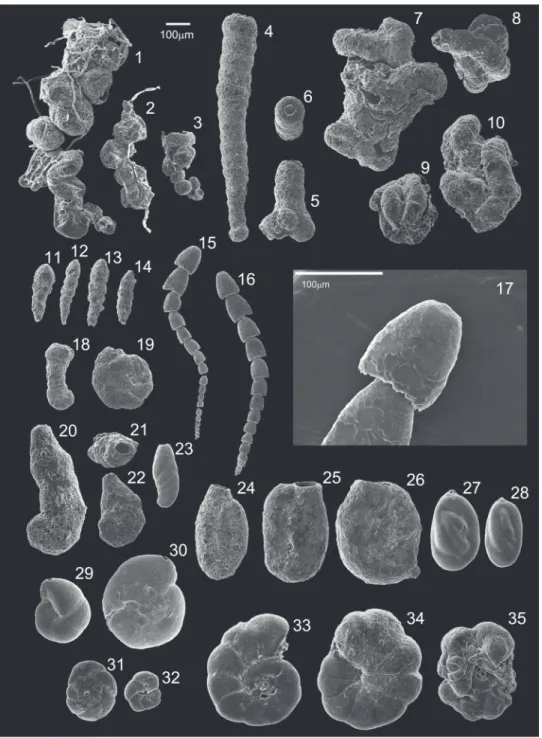
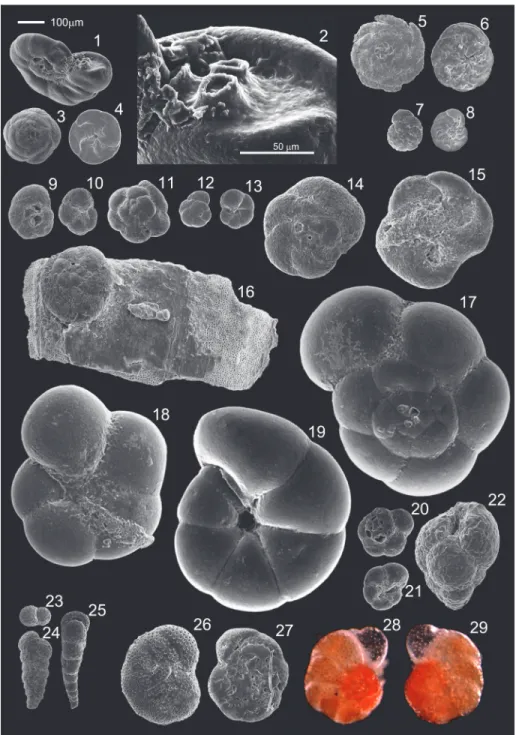
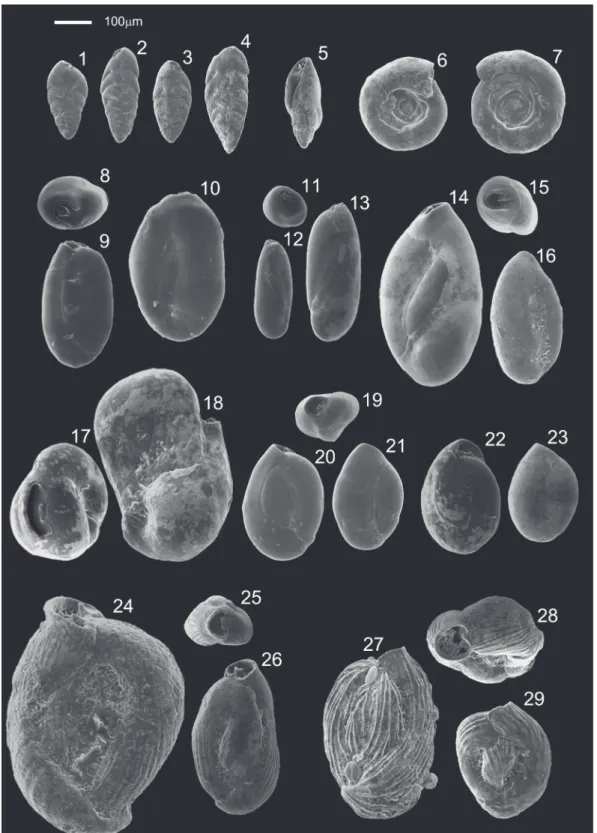
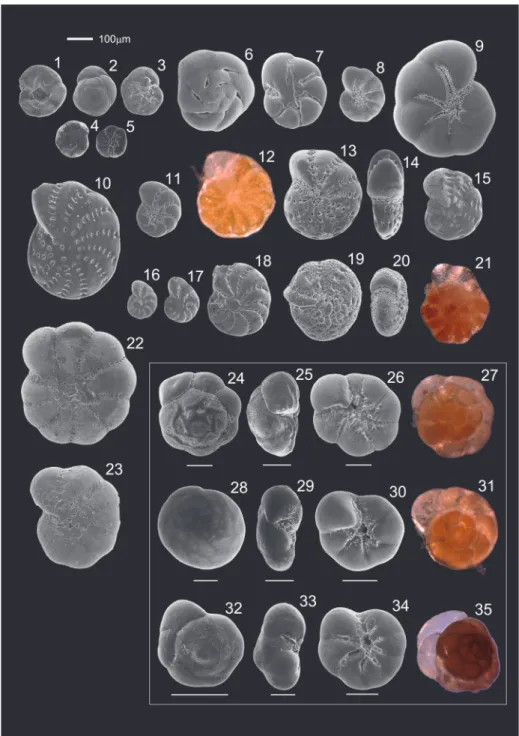
Forty-nine species were photographed using a scanning electron microscope (SEM), model JEOL JSM–5410, based at Huelva University and are presented in plates (Figures 2, 3, 4, 5).
Several guides were used for identification, especially Colom (1974), Loeblich and Tappan FIGURE 1. Location of the study area; 1) Geographical context of the Guadiana River basin in the Iberian Peninsula (Europe). Adapted from chguadiana.es (2012). Coordinate system: Datum ETRS89 UTM Zone 30N; 2) Study area: Map of the Guadiana Estuary with site locations.
FIGURE 2. Scanning electron micrographs of the foraminifera specimens. Scale bar equals 100 µm. 1-3- Three dif-ferent specimens of Polysaccammina ipohalina Scott, 1976b, illustrating the differences in size and form. In all spec-imens it is possible to see attached organic matter; 4-5- Polysaccammina hyperhalina Medioli, Scott, and Petrucci, 1983. 4- complete specimen of P. hyperhalina; 5- aperture view; 6- specimen with several side branches; 7-10- differ-ent sized specimens of Ammovertellina sp.; 11-14- various specimens of Reophax nana Rhumbler, 1913;
15-17-Leptohalysis scottii (Chaster, 1892); 15 and 16- side view of two complete specimens; 17- detail on the agglutination
of the last chamber; 18- complete specimen of Ammobaculites exiguus Cushman and Brönnimann, 1948b;
19-Ammobaculites sp. with the uncoiled portion broken; 20-22- Ammotium salsum (Cushman and Brönnimann, 1948a);
20- best specimen; 21- smaller specimen; 22- aperture detail; 23- Ammotium sp.; 24-26- different specimens of
Mil-iammina fusca (Brady, 1870); 27-28- MilMil-iammina obliqua Heron-Allen and Earland, 1930; 27- view of the
interio-mar-ginal arch of the aperture; 29-30- Arenoparrella mexicana (Kornfeld, 1931); 29- ventral side with view to main aperture and supplementary apertures; 30- dorsal side with view to supplementary apertures; 31-32- Deuterammina
eddystonensis Brönnimann and Whittaker, 1990; 31- dorsal view; 32- ventral view; 33-35- Jadammina macrescens
FIGURE 3. Scanning electron and light microscope micrographs of the foraminifera specimens. Scale bar equals 100 µm except where noted otherwhise; 1-2- Jadammina macrescens (Brady, 1870); 1- supplementary apertures view; 2- detail of supplementary apertures (scale bar = 50 µm); 3-4- Lepidodeuterammina plymouthensis Brönni-mann and Whittaker, 1990; 3- dorsal view; 4- ventral view; 5-8- Lepidodeuterammina ochracea (Williamson, 1858); 5- dorsal view; 6- ventral view; 7- dorsal view of a smaller specimen; 8- ventral view of a smaller specimen;
9-10-Portatrochammina sp.; 9- dorsal view; 10- ventral view; 11-13- Siphotrochammina sp.; 11- dorsal side with
inter-cam-eral foramen view; 12- dorsal view of a smaller specimen, also with inter-caminter-cam-eral foramen; 13- ventral view of a smaller specimen; 14-16- Tiphotrocha comprimata Saunders, 1957; 14- dorsal view; 15- ventral view; 16- individual strongly attached to a sea-grass leaf; detail of a Pinus pollen grain at the center of the leaf; 17-21- Trochammina
inflata (Montagu, 1808); 17- dorsal view; 18- ventral view; 19- ventral view with umbilical tube detail; 20-
micro-spheric form dorsal view; 21- micromicro-spheric form ventral view; 22- Eggerelloides scaber (Williamson, 1858);
23-25-Textularia earlandi Parker, 1952; 23- apertural view; 24- lateral view; 25- profile view with aperture in detail; 26-29-Discorinopsis aguayoi (Bermúdez, 1935); 26- scanning electron dorsal view; 27- scanning electron ventral view;
FIGURE 4. Scanning electron micrographs of the foraminifera specimens. Scale bar equals 100 µm. 1-4- different sized specimens of Bolivina ordinaria Phleger and Parker, 1952, new name; 5- Buliminella elegantissima (d’Orbigny, 1839b); 6-7- Cornuspira involvens (Reuss 1850); 8-10- Miliolid sp1; 8- apertural view; 9- front view; 10- back view; 11-13- Miliolid sp2; 11- apertural view; 12- front view; 11-13- back view; 14-16- Miliolid sp3; 14- front view; 15- apertural view; 16- back view; 17-18- Miliolid sp4; 17- apertural view; 18- front view; 19-21- Miliolid sp5; 19- apertural view; 20-front view; 21- back view; 22-23- Miliolid sp6; 22- 20-front and apertural view; 23- back view; 24-26- Miliolid sp7; 24- 20-front view; 25- apertural view; 26- front and apertural view; 27-29- Miliolid sp8; 27- front view; 28- apertural view; 29- front view of a smaller specimen.
FIGURE 5. Scanning electron and light microscope micrographs of the foraminifera specimens. Scale bar equals 100 µm. 1- Lamarckina haliotidea (Heron-Allen and Earland, 1911) ventral view; 2-3- Asterigerinata mamilla (Williamson, 1858); 2- dorsal view; 3- ventral view; 4-5- Discorbis sp.; 4- dorsal view; 5- ventral view; 6-7- Helenina anderseni (Warren, 1957); 6- dorsal view; 7- ventral view; 8- Haynesina depressula (Walker and Jacob, 1798) side view; 9-
Hay-nesina germanica (Ehrenberg, 1840) side view; 10- Elphidium advenum (Cushman, 1922) side view; 11- Elphidium excavatum (Terquem, 1875) side view; 12-15- Elphidium wiliamsoni Haynes, 1973; 12- side view in light microscope
image; 13- side view in scanning electron image; 14- profile view in scanning electron image; 15- side view of a smaller specimen in scanning electron image; 16-18- side view of different size Elphidium gerthi Van Voorthuysen, 1957; 19-21- Elphidium oceanensis (d’Orbigny, 1826); 19- side view in scanning electron image; 20- profile view in scanning electron image; 21- side view in light microscope image; 22- Elphidium poeyanum (d’Orbigny, 1826) side view; 24-27- Ammonia sp1; 24- dorsal view; 25- profile view; 26- ventral view; 27- dorsal view in light microscope image; 28-31- Ammonia sp2 (Ammonia aberdoveyensis Haynes, 1973); 28- dorsal view; 29- profile view; 30- ventral view; 31- dorsal view in light microscope image; 35- Ammonia sp3 (Ammonia aberdoveyensis Haynes, 1973); 32-dorsal view; 33- profile view; 34- ventral view; 35- 32-dorsal view in light microscope image.
(1987), Jones (1994) and the Ellis and Messina (1942-2012) online catalogue. The foraminiferal collection gathered during the study of Guadiana River paleoenvironments (Boski et al., 2002, 2008) was the main reference for taxonomic identifica-tion.
Most of the foraminifera were classified according to the generic classification proposed by Loeblich and Tappan (1987). For the higher levels of taxonomy, other than genus and species, the WoRMS classification was followed (Hayward et al., 2014
)
, including the recent modifications pro-posed by Cavalier-Smith (2010).In collaboration with the project foram BAR-CODING, a molecular database of foraminifera based at Geneva University and coordinated by Pawlowski and Holzmann (2014), several species were analysed at genetic level. To accomplish this, two extra field campaigns were made with the aim of collecting live specimens, the first in November 2010 and the second in March 2011. During both campaigns, the most fruitful sites identified during the previous sampling campaigns in terms of fora-miniferal densities were revisited and resampled. Samples of the top centimeter of sediment were collected by hand with a scraper. In the laboratory, two subsamples were taken and washed. One was stained with Rose Bengal to evaluate the quantity and quality of live specimens; the other was left to settle for 2 hours in sea water. Living foraminifera (indicated by bright, colorful protoplasms, move-ment and sedimove-ment aggregation) were isolated using a stereomicroscope, and selected speci-mens were put into tubes, each containing 50 µl guanidine extraction buffer. Up to 10 live speci-mens of each species were separated and sent to the Geneva laboratory for genetic analysis and ste-reomicroscope photography.
The DNA extraction methodology was adapted from the general procedure in Pawlowski and Holzmann (2014), detailed in Pawlowski (2000). The analyzed barcoding region is situated at the 3’ end of the SSU rRNA gene and is ampli-fied using the primer pairs s14F3 (acgcamgtgt-gaaacttg)-sB (tgatccttctgcaggttcacctac). It is usually necessary to perform a nested PCR, replacing primer 14F3 with primer 14F1 (aaggg-caccacaagaacgc). The barcoding region spans six foraminifera-specific hypervariable expansion seg-ments, 37f, 41f, 43f, 45e, 47f and 49e, which were shown to be sufficiently variable to differentiate between closely related species. The length of the barcoding region varies between 1000-1200 nucle-otides depending on the species. Most
amplifica-tions are done on single-cell DNA extracamplifica-tions. Because of intra-individual polymorphism, the amplification products are cloned and two to three clones are sequenced. After sequencing the results were aligned to confirm the presence of the species.
Data Analysis
Statistical analyses were performed based on the relative abundance of the living foraminiferal species with representations higher than 10% (Boltovskoy and Totah, 1985) in at least one sam-ple.
Redundancy Analysis (RDA) (a constrained form of the linear ordination method of PCA) was chosen to analyse the relationships between the dominant species and elevation and distance-to-sea, which were the two most important environ-mental variables in living foraminiferal distribution in Guadiana River Estuary (Camacho et al., 2015). In the present work, RDA was performed with a focus on inter-species correlations, where abun-dances of individual dominant species are trans-formed to a comparable scale. The relationship between species and environmental variables is represented by an attribute plot, where arrows rep-resent the environmental variables, and species are represented by symbols of variable size according to its abundance in the sample scores fitted by the model (Leps and Smilauer, 2003).
RESULTS AND DISCUSSION Classification and Genetic Analysis
There is a tendency among foraminiferal tax-onomists to raise varieties and subspecies to spe-cies rank and to distinguish new spespe-cies on the basis of subtle morphologic differences. Likewise, differences between genera are becoming smaller. Collectively these trends reduce the chances of consistent identification because the system depends on the judgment of each observer, rather than on unambiguously defined criteria (Murray, 2007). In order to avoid contributing to this general trend towards taxonomic entropy, several taxa were left in open nomenclature or in incertae sedis. This was the case of the miliolids, which, in the absence of type material and similarities with other miliolids in the same geographical area (e.g., Colom, 1974; Villanueva et al., 1999), were assigned code names.
Analysis of partial rRNA genes only yielded results for a limited number of species, among which only two were sucessfuly identified and
reg-istered in the European Nucleotide Archive (http://
www.ebi.ac.uk/ena/data/view/LN551930-LN551935): Ammonia aberdoveyensis Haynes (1973) (accession numbers: LN551930-LN551933) and Elphidium williamsoni Haynes (1973) (accession numbers: LN551934-LN551935).
The Ammonia genus includes species that are among the most common benthic foraminifera in the shallow waters of marginal marine environ-ments globally (Langer and Leppig, 2000). With 35 taxa so far described, the genus Ammonia exhibits a significant range of morphological variants, mak-ing species-level identification particularly difficult morphologically (Holzmann et al., 1998; Langer and Leppig, 2000; Hayward et al., 2004). A variety of specific epithets for Ammonia morphotypes are in current use along the Guadiana Estuary and adjacent shelf (see Ruiz et al., 1996, 2005; Boski et al., 2002, 2008; Mendes et al., 2004, 2012; Del-gado et al., 2012). Aiming to better understand
Ammonia genetic affinities and clarify some of
these taxonomic problems, we subjected three morphological variants to genetic analysis. Of these, only two produced successful results (Ammonia sp2 and sp3), being both aligned with
Ammonia T2 (Hayward et al., 2004), thus
corre-sponding to the species Ammonia aberdoveyensis Haynes (1973). Further field collections were per-formed, but genetic analysis of Ammonia sp1 proved fruitless. While some morphological dissim-ilarity was observed between the three variants (Figure 5.24-35), these characteristics were not significantly correlated with specific environmental conditions. Thus, further analysis is required to determine whether Ammonia sp1 is a different taxon or belongs to the species A. aberdoveyensis, with morphological differences resulting only from intergradational morphology.
Seasonal Species Distribution
Seasonal species distribution within the estu-ary was studied in detail in Camacho et al. (2015). Here we synthesize the main findings in that work with new observations on species distribution pat-terns and major environmental forcing parameters. Of the 54 living foraminifera taxa identified in the Guadiana Estuary, only 15 presented abundances ≥ 10%. Jadammina macrescens (Brady, 1870),
Trochammina inflata (Montagu, 1808), Miliammina fusca (Brady, 1870), Ammonia spp. and Haynesina germanica (Ehrenberg, 1840) were dominant in
both seasons. Bolivina ordinaria Phleger and Parker (1952), Miliolid sp3 and the miliolids group
(dominant) and Asterigerinata mamilla (Williamson, 1858), Discorinopsis aguayoi (Bermúdez, 1935) and Miliammina obliqua Heron-Allen and Earland (1930) (common) were only found in winter.
Poly-saccammina hyperhalina, PolyPoly-saccammina ipoha-lina and Elphidium oceanensis (dominant) and Siphotrochammina sp. were only found in summer.
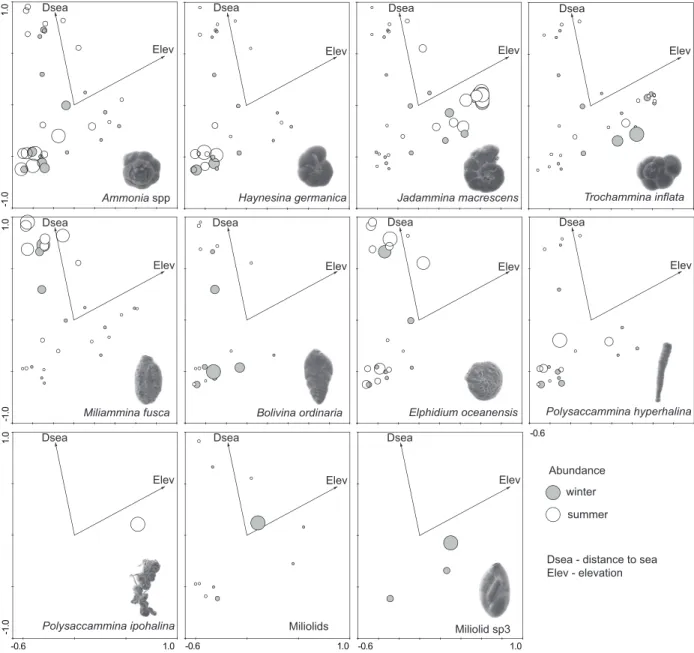
Seasonal distribution profiles for each dominant species, according to the environmental variables of elevation and distance-to-sea, are shown in Fig-ure 6.
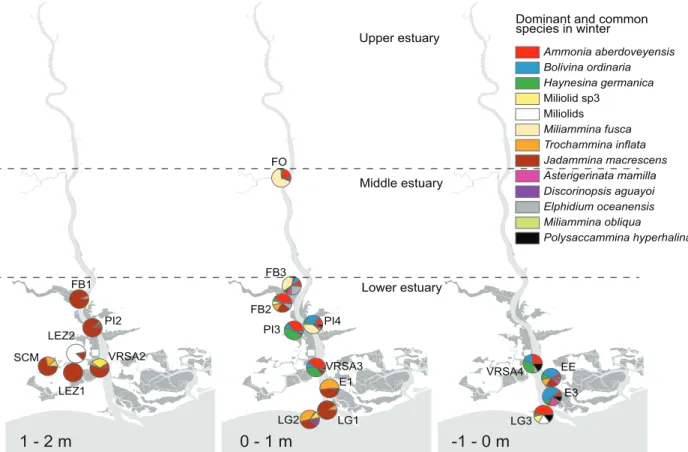
Winter distribution of the main species. The dis-tribution of common and dominant species during winter is represented in Figure 7. According to the division of the marsh into different elevation zones, it is clear that the upper marsh was almost exclu-sively colonized by the agglutinated species J.
macrescens. In two of these samples, LEZ2 and
VRSA2, there was a marked abundance of porcel-aneous species, especially in LEZ2, where this group represents 82.3% of the total individuals (Appendix, Tables 2 and 3).
The lower marsh zone had more diverse fora-miniferal composition than in the upper marsh. At the most confined sites (E1, located in the margin of a small tidal pond, and LG2 and LG3, located at the margin of a shallow, small lagoon), J.
mac-rescens was dominant alongside T. inflata. Ammo-nia spp. and H. germanica had their highest
representation in the samples collected in the lower marsh and mud zones of the lower estuary (Figure 7). Ammonia spp. exhibited a more euryha-line behavior than H. germanica, being abundant in the upper reach sample (FO), as well as in the lagoonal environment (LG3), which occupies the most downstream position. The agglutinated spe-cies M. fusca had its optimum spanning from the upper reaches of the lower estuary to the middle estuary, in samples from lower marsh-mud zone.
Bolivina ordinaria is common in the lower marsh
but had its optimum in mud zone areas, occurring together with Ammonia spp. and H. germanica.
Polysaccammina hyperhalina Medioli et al. (1983)
(Petrucci et al., 1983) occurred mainly in the mud zone.
It is worth pointing out that the porcelaneous forms, represented here by the miliolids group and Miliolid sp3, only occurred in environments subject to some degree of confinement, such as the sam-ples located in the upper marsh and the small lagoon site (LG).
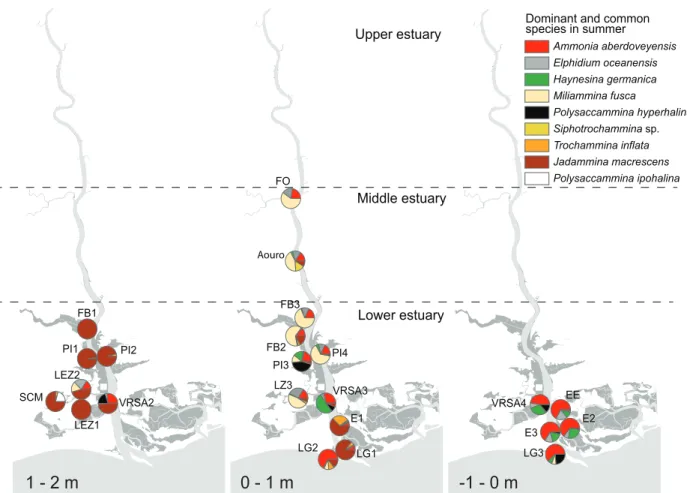
Summer distribution of the main species. The distribution of the common and dominant taxa during summer is represented in Figure 8. It is
pos-sible to see that the upper marsh was almost exclusively colonized by the agglutinated species
J. macrescens, similarly to the situation during
win-ter. The exceptions were samples SCM, LEZ2 and VRSA2, where other species had significant abun-dances. At SCM, the site farthest inland from the estuary channel, J. macrescens shares dominance with P. ipohalina Scott (1976b), the latter repre-senting more than 20% of the individuals and exclusive to that sample, suggesting specific envi-ronmental conditions. At LEZ2 and VRSA2, both samples located in the lowermost position within the upper marsh (1.06 and 1.03 meters above MSL), J. macrescens lost prominence to other
spe-cies, such as P. hyperhalina, M. fusca, Ammonia spp. and E. oceanensis, suggesting that the eleva-tion thresholds for the latter species were above the 1 m level.
In the lower marsh the assemblages are more diversified, especially in samples located on the channel margin, where J. macrescens loses domi-nance. At more confined locations (FB2, E1, LG2 and LG3) J. macrescens is still prominent but shares dominance with T. inflata, Ammonia spp. and M. fusca. When considering foraminifera distri-bution in the lower marsh, the dominance of M.
fusca stands out. This species had its optimum in
the middle elevations (0 – 1 m) of the upper
Dsea - distance to sea Elev - elevation Dsea
Dsea Dsea
Dsea Dsea Dsea
Dsea Dsea -1 .0 1. 0
Ammonia spp Haynesina germanica
Miliammina fusca
-1
.0
1.
0
Jadammina macrescens Trochammina inflata
Bolivina ordinaria
-1
.0
1.
0
Elphidium oceanensis Polysaccammina hyperhalina
Polysaccammina ipohalina -0.6 1.0 Miliolids -0.6 1.0 Miliolid sp3 -0.6 Abundance winter summer -0.6 1.0 Dsea Dsea Dsea Elev Elev Elev
Elev Elev Elev Elev
Elev Elev
Elev Elev
FIGURE 6. RDA attribute plot representing the distribution and abundance of the dominant species in Guadiana Estu-ary according to elevation and distance-to-sea variables.
reaches of the lower estuary to middle estuary and is associated with Ammonia spp. and E.
oceanen-sis. In the lower marsh, it is important to point out
that the species Siphotrochammina sp. was only found alive at the Aouro site, located approximately 16 km upstream from the inlet, showing significant abundance. Ammonia spp. had its optimum in the samples collected in the mud zone, where it was dominant. Of all studied species, it was the most euryhaline, being recorded at considerable per-centages along the distance-to-sea gradient and in the most confined environments of the lower marsh, as well as in some samples of the upper marsh. It was closely associated with H.
german-ica, especially in the mud zone, and with E. ocean-ensis in both lower marsh and mud zone. Polysaccammina hyperhalina, which was restricted
to the mud zone in winter, had a patchy distribution in summer, more dependent on site location than on the elevation of the sample.
Species Ecology and Biogeography
Almost all the common and dominant species described in the present work are cosmopolitan,
occurring in other estuaries all over the world (Sen Gupta, 1999) and several of them were previously recorded by Ruiz et al. (1996, 2005) and González et al. (2000) in Guadiana Estuary. A new finding is that both M. fusca and P. hyperhalina, which are presently very abundant and constant along the estuary, were not reported by previous authors who studied the same area. Moreover, P.
hyperha-lina, P. ipohahyperha-lina, M. obliqua and D. aguayoi are
reported for the first time in the Guadiana Estuary, and, to our knowledge, in Portugal.
Jadammina macrescens is one of the species
with the greatest scientific consensus in terms of life position and ecological indicator value. The first applications of marsh foraminifera in reconstruction of episodes of mean sea-level change were based in monospecific assemblages of J. macrescens (syn. Trochammina macrescens) collected near the continental limit (high marsh) in Nova Scotia marshes (Scott and Medioli, 1978, 1980). Being the most tolerant species to subaerial exposure, its relative abundance is very useful in sea-level change studies because it reflects the elevation of the depositional environment in relation to the
high-Ammonia aberdoveyensis Bolivina ordinaria Haynesina germanica Miliolid sp3 Miliolids Miliammina fusca Trochammina inflata Jadammina macrescens Asterigerinata mamilla Discorinopsis aguayoi Elphidium oceanensis Miliammina obliqua Polysaccammina hyperhalina
Dominant and common species in winter SCM LEZ1 LEZ2 VRSA2 PI2 FB1 LG2 LG1 E1 VRSA3 PI4 PI3 FB2 FB3 FO LG3 E3 VRSA4 EE
1 - 2 m
0 - 1 m
-1 - 0 m
Lower estuary Middle estuary Upper estuaryFIGURE 7. Distribution patterns of the common to dominant species in the samples collected in winter along a dis-tance-to-sea and elevation gradients (in relation to MSL).
est high-water level, where it may represent 100% of foraminiferal assemblages, decreasing towards the low marsh, where it is almost absent (Scott and Medioli, 1978, 1980). Therefore, its relative abun-dance is inversely related to tide-flood frequency and other species’ relative abundance (diversity) and has thus been used as an indicator of flood frequency (Thomas and Varekamp, 1991; Varekamp et al., 1992). In the present work, J.
macrescens is the most widespread species,
occurring in almost all samples from winter (94.7%) and summer (82.6%) (Figure 6). In the most ele-vated positions, the assemblages are almost exclu-sively (and in some cases, excluexclu-sively) composed of J. macrescens, exhibiting uncommonly high densities in some places (e.g., 68266 individuals/ 20 cc, in sample LG1 during winter) (Figures 7, 8). In a time-series study performed in the Tees Estu-ary, UK, Horton and Murray (2007) monitored J.
macrescens standing crops fortnightly over 12
months and recorded peaks in abundance during the year. The maximum standing crop was 864/10 cc in October, being far less than the 34133
individ-uals/10 cc in Guadiana sample LG1. Furthermore, Horton and Murray (2007) observed a progressive decline of this species from May/June, where it represents more than 80%, to March (5th day), when it temporarily disappeared. Our winter sam-pling, with high densities of J. macrescens, coin-cided exactly with the absence period verified by Horton and Murray (2007). These samples have a strong component of juveniles (generally more than 50% of the total, pers. obs.), extremely small and fully stained, which were ‘hidden’ in small mucous sediment aggregates, and were only visi-ble when these were disaggregated with a probe. The counting of these hidden specimens may explain the large differences between the densities found in this work and others in which J.
mac-rescens was also dominant. In summer, the
juve-nile component is always present and, although generally less than 50%, there are some samples in which it is higher. These observations lead us to conclude that, in the Guadiana, this species has the capacity of reproducing in both seasons, although winter seems more favorable. While
juve-SCM LEZ1 LEZ2 VRSA2 PI2 FB1 PI1 LG2 LG1 E1 VRSA3 PI4 PI3 FB2 FB3 LZ3 LG3 E3 VRSA4 EE E2 FO Aouro
Dominant and common species in summer Ammonia aberdoveyensis Elphidium oceanensis Haynesina germanica Miliammina fusca Polysaccammina hyperhalina Trochammina inflata Jadammina macrescens Polysaccammina ipohalina Siphotrochammina sp. Lower estuary Upper estuary Middle estuary
1 - 2 m
0 - 1 m
-1 - 0 m
FIGURE 8. Distribution patterns of the common to dominant species in the samples collected in summer along a dis-tance-to-sea and elevation gradients (in relation to MSL).
niles are always present in samples containing adult J. macrescens, there are considerable differ-ences between the adult/juvenile proportions from sample to sample, especially in summer. This seems to suggest that, within the same geographi-cal area, the species does not reproduce at the same time, or at least at the same scale, which points to the influence of other abiotic and/or biotic factors acting locally and in parallel with seasonal-ity in triggering reproduction.
Trochammina inflata is closely related to J. macrescens, occurring together in almost all the
samples and being more abundant during winter, although it has higher abundances in the lower marsh (0.2 to 0.8 m above MSL at samples E1, LG2 and FB2) where J. macrescens abundance starts to decrease and species diversity starts to increase (Figures 7, 8). This relationship was reported previously for the Guadiana (González et al., 2000; Ruiz et al., 2005), and in other areas (some of the Nova Scotia marshes–Scott and Med-ioli, 1980; Fraser River Delta–Patterson, 1990). In other estuarine systems all over the Iberian Penin-sula (Morbihan, Basque, Minho-Lima and Sado– Leorri et al., 2010), both J. macrescens and T.
inflata are dominant components at the most
ele-vated zones, but species association/succession is not exactly the same as that found in the Guadi-ana, probably due to local environmental differ-ences. No other species is intrinsically related to J.
macrescens and T. inflata, but several species with
ephemeral occurrences seem to share similar hab-itat preferences. In the lower estuary in winter, the Miliolids group and Miliolid sp3 have peaky occur-rences, each in a distinct sample of the upper marsh: LEZ2 (82.3%) and VRSA2 (28.8%), respec-tively (Figure 7). In summer it is worth noting the ephemeral occurrence of P. ipohalina at SCM, where it is subdominant to J. macrescens (20.8 and 75%, respectively). Polysaccammina ipohalina is a high marsh species (or upper mangrove, Bar-bosa et al., 2005), usually representing a minor component in estuarine systems (Scott, 1976b; Scott and Medioli, 1980; Scott et al., 1990). It was firstly described by Scott (1976b) in San Dieguito Marsh, California, associated with a few other spe-cies, especially J. macrescens polystoma and T.
inflata. Although the latter species are common to
almost every marsh, from brackish to hypersaline, when the association includes P. ipohalina it indi-cates a brackish marsh environment (Scott, 1976b). In the present study, salinity was mea-sured in both seasons at site SCM, a sample located at the margin of a salt-works pond
(Cama-cho et al., 2014). Here, salinity is relatively high in both seasons (winter – 14.3 and summer – 26.1) when compared with those measured by Scott (1976b) (2–10‰). A common characteristic of SCM and San Dieguito marsh is the lack of tidal activity, which raises the possibility that this spe-cies is conditioned primarily by confinement and temperature.
In winter, at the SCM site, P. ipohalina is replaced by T. inflata and M. obliqua. Hayward et al. (1999b) have characterized M. obliqua as largely restricted to Southern Hemisphere shores (New Zealand marsh environments) where it occurs with J. macrescens and T. inflata. Based on the present experience, we believe that the strong morphological similarities between M. obliqua and
M. fusca may be a hindrance to accurate
identifica-tion, not only in Portuguese estuarine systems, but also worldwide, since the former taxon is rarely mentioned in the literature. In the Guadiana, M.
obliqua exhibits higher incidence in winter in the
lower marsh of the upper estuary and in two sam-ples of the upper marsh with a more confined posi-tion.
Discorinopsis aguayoi, like M. obliqua, is a
species of narrow distribution, occurring with J.
macrescens and T. inflata in significant
abun-dances (11.9%) during winter. In the living assem-blage, its occurrence seems limited to the lower marsh zone, at the sheltered marine lagoon in the inlet (LG). Discorinopsis aguayoi is regarded as an indicator of landlocked marine/brackish ponds, mangrove marshes (Javaux and Scott, 2003) and high marsh in warm temperate environments (Scott, 1976a; Scott et al., 1990). Despite being very well documented by the latter authors, D.
aguayoi was never mentioned as an epiphytic
spe-cies. In the Guadiana it is found strongly attached to vegetal structures, each specimen having to be carefully detached using a needle probe.
The Ammonia genus includes species that are among the most common benthic foraminifera in shallow waters of marginal marine environments (Langer and Leppig, 2000; Debenay and Guilou, 2002). In the Guadiana Estuary, Ammonia spp. (A.
aberdoveyensis and Ammonia sp1) is the most
ubiquitous calcareous taxon, being absent only from the most elevated samples (> 1.3 m in relation to MSL - PI1, FB1, SCM, LEZ1). Its optimum occurrence is in the mud zone to lower marsh (-1 – 1 m) of the lower and middle estuary (Figures 7, 8). Its peak of occurrence is observed in summer, especially in the mud zone where it is always the dominant taxon (Figure 8). It is noteworthy that, in
summer, Ammonia spp. are able to migrate farther up the marsh, occupying higher elevation stands, probably due to decreased inter-species competi-tion. Ammonia spp. are dominant in two of the main assemblages found for Guadiana: the lower marsh (0 – 1 m) upper reaches assemblage, where they are subdominant to M. fusca, and the mud zone (-1 – 0 m) of the lower estuary, where they are co-dominant with B. ordinaria in winter.
Haynesina germanica is closely associated
with Ammonia spp., occurring as subsidiary spe-cies in almost all samples where Ammonia spp. are present (Figures 7, 8). The dominance of these two hyaline forms (Ammonia tepida (Cushman, 1926) or Ammoni beccarii (Linné, 1758) instead of our
Ammonia spp.) has been documented for the
estu-arine systems of the whole of Europe (see Redois and Debenay, 1996). Both species are resistant to strong physico-chemical changes such as anoxia crises (common in the Mediterranean Sea and stratified lagoons), which require rapid recoloniza-tion (Debenay et al., 1998c; Frontalini and Coc-cioni, 2011). In the temperate paralic environments of the Atlantic coast of France, H. germanica is the most euryhaline and opportunistic hyaline species, marking the transition between agglutinated forms from upper paralic environments (where it is domi-nant) to calcareous forms from environments of higher marine influence, being progressively replaced by A. tepida (Redois and Debenay, 1996; Debenay et al., 2000; Debenay and Guilou, 2002). Horton and Murray (2007) found H. germanica among the dominant calcareous species from the tidal flats to middle marsh environments, and
Ammonia spp. as sub-dominant,
ephemeral-occur-rence taxa. Martins et al. (2010, 2013) found H.
germanica to be the most abundant species,
fol-lowed by A. tepida, in the Ria de Aveiro, NW Portu-gal. In the Guadiana Estuary, H. germanica is not as prominent as Ammonia spp. but is very constant and is even dominant in a few samples of the lower marsh-mud zone. However, our data do not reveal the zonation pattern observed by Redois and Debenay (1996), Debenay et al. (2000) and Debenay and Guilou (2002). Instead, it seems that
Ammonia spp. is the best-established calcareous
taxon in the estuary, and, together with E.
ocean-ensis, the most able to migrate farther up the
marsh and upstream. A similar distribution was found in Venice Lagoon (Serandrei-Barbero et al., 1999) and at Acheloos and Evinos Estuaries (Greece) (Scott et al., 1979), where in both areas the lower stands are dominated by Ammonia with significant components of Elphidium and
Hayne-sina. These and the Guadiana Estuary distributions
seem to indicate that Ammonia is the dominant component in the low stands of the estuarine wet-lands in southern Europe’s warmer Mediterranean environments; whilst in north Europe’s colder oce-anic environments, H. germoce-anica has higher prom-inence as a lower stands species.
According to Hayward et al. (1997), E. gunteri (here E. oceanensis) has a middle to low latitude distribution, with preference for warmer waters. It is also associated with brackish waters (Fatela and Silva, 1990; Debenay et al., 2003). In the Guadi-ana, E. oceanensis has its optimum during sum-mer, being a dominant species in the lower marsh-mud zones (-0.7 to 1.1 m in relation to MSL) (Fig-ure 6). In terms of distribution range, it is almost as eurytopic as Ammonia spp., occupying the entire study range of elevation and latitude.
Bolivina ordinaria has a controversial
taxo-nomic history in the literature, as various names have been used by different authors to describe similar specimens worldwide (see Mendes, 2010, for review). The direct comparison of our speci-mens with the specispeci-mens of Mendes (2010) led us to conclude that both belong to the same species and thus Mendes’ (2010) identification criteria were adopted. Bolivina ordinaria distribution within the Guadiana Estuary was surprising, as it is primarily described as an abundant species at great depths on the Portuguese continental shelf (Mendes et al., 2004; Martins et al., 2006, 2007; Mendes, 2010). Mendes (2010) considered B. ordinaria as a ubiq-uitous, very abundant species, highly adaptable and tolerant to a wide range of different factors or combination of factors, living at two different conti-nental-shelf depth ranges (25-100 m in the south-east and 20-60 m in the northwest Gulf of Cadiz), and strongly associated with the direct influence of river discharges. She also found a peak abun-dance of B. ordinaria at 50 m depth and related it to a high rate of productivity at that depth. Mendes et al. (2004) previously described B. ordinaria as an important component of the shelf deep-water assemblage, relating it to low hydrodynamic levels, low-oxygen fine-grained sediments and to cold-water incursion derived from upwelling events. This species was also found in significant numbers in benthic foraminiferal assemblages from areas of greater marine influence offshore from the Ria de Aveiro, associated with fine-grained sediments enriched in TOC (Martins et al., 2014). Debenay and Redois (1997a,1997b), in a survey regarding foraminiferal distribution on the continental shelf in North Senegal, related the presence of Bolivina
spp. to the fertility of upwelling waters and Senegal River discharges. Likewise, Lévy et al. (1993) related two species of Bolivina with upwelling events along the southern coast of Portugal. In the Guadiana Estuary, B. ordinaria occurs as a domi-nant species in winter. In summer it is less frequent and less abundant (Figure 7). Depth and low hydrodynamics are not regarded as conditioning factors, as the species occurs in environments above MSL (< 0.61 m) and during winter, when the estuary experiences higher hydrodynamics. Pas-sive upriver transportation by tides could explain its distribution, but then it would be expected to occur mainly in summer when the residence times are higher due to low river flows (Oliveira et al., 2006). From the overall environmental drivers discussed here, productivity and low temperatures seem to be the common factors in controlling the occur-rence of B. ordinaria in both the estuary and deep shelf environments. In the Guadiana Estuary, during the rainy seasons (winter and spring), river inputs of freshwater are higher, enhancing the bio-availability of nutrients, especially Si, promoting the bloom of diatoms, which are the preferred food source for healthy foodwebs (Dias et al., 2001; Rocha et al., 2002). The low temperatures (indi-rectly) and productivity (di(indi-rectly) could be triggering
B. ordinaria reproduction and proliferation inside
the estuary.
Miliammina fusca is a very common species
in worldwide paralic environments, dominating the continental end-member, and associated with direct freshwater influence (see Debenay and Guilou, 2002 for review). It is considered as an indicator species of the low-mid marsh zone (Varekamp et al., 1992) and the most ubiquitous agglutinated shallow-water species (Murray and Alve, 1999). In the Guadiana estuary, M. fusca is the most ubiquitous agglutinated shallow-water species, dominating assemblages either in the upper reaches of the lower estuary and upstream, at middle elevation zones (0 – 1 m) (Figure 6). Along with the indigenous calcareous species (Ammonia spp. and Elphium oceanensis), M. fusca is most abundant during summer, when it often represents more than 50% of the total assemblage (Figure 8). The species also seems able to migrate farther up the marsh in summer (e.g., LEZ and FB transects), reaching 16.3% at 1.06 m above MSL (LEZ2 sample).
Polysaccammina hyperhalina is a common
and nearly constant agglutinated species in the Guadiana Estuary. In winter, its distribution seems
to be restricted to the mud zones, whilst in summer it reaches higher abundances in the lower marsh as well (Figure 6). Polysaccammina hyperhalina is a species of hypersaline environments and was first reported and described from Venice Lagoon (Petrucci et al., 1983). In the Guadiana Estuary, the species has its optimum at the lower elevations of the lower estuary (Figures 7, 8), where marine pro-cesses are more pronounced. In northwest Portu-gal’s paralic systems, P. hyperhalina was not recorded as a prominent species by Martins et al. (2010) in the Canals of Ria de Aveiro, nor found by Moreno et al. (2005) and Fatela et al. (2009) in the Minho and Coura estuaries. The presence/ absence of this species may be related not only to salinity but also to temperature, as P. hyperhalina seems to prefer warmer climates, as noted by Petrucci et al. (1983) when they compared faunas from Venice Lagoon, Greece and Southern Califor-nia.
Debenay et al. (2000) and Debenay and Guilou (2002) reviewed ca. 1500 samples collected worldwide by several authors in various types of transitional environments and synthesized the main foraminiferal distribution trends for each geo-graphical and climatic zone. Despite several simi-larities between the general distribution model they proposed for temperate North Atlantic transitional environments and those studied by Horton and Murray (2007) (UK), Moreno et al. (2005), Fatela et al. (2009) and Martins et al. (2010) (north of Portu-gal), the benthic foraminifera distribution trends found in Guadiana Estuary present greater similari-ties with the distribution trends observed in Medi-terranean transitional environments (Scott et al., 1979; Petrucci et al., 1983; Serandrei-Barbero et al., 1999; Debenay et al., 2000). In Mediterranean transitional environments, J. macrescens and T.
inflata are prominent species in the upper marsh
zone, occasionally associated with D. aguayoi. The middle marsh is characterized by the presence of
M. fusca, occasionally associated with Ammonia, P. hyperhalina, T. inflata and Quinqueloculina seminula. Mudflats and low marshes are
character-ized by the presence of Ammonia, sometimes alongside Haynesina germanica.
The high diversities observed in Guadiana (Camacho et al., 2015) and the dominance of ther-mophilous taxa (Ammonia spp., D. aguayoi, E.
oceanensis and P. hyperhalina) reflect the
estu-ary’s geographical position, which is subject to both Mediterranean and Atlantic influences.
SYSTEMATIC PALAEONTOLOGY Order ASTRORHIZIDA Lankester, 1885 Family POLYSACCAMMINIDAE Loeblich and
Tappan, 1984
Genus POLYSACCAMMINA Scott, 1976b
Polysaccammina ipohalina Scott, 1976b
Figure 2.1-3
1976b Polysaccammina ipohalina Scott: p. 316, pl. 2, figs. 1-4, text fig. 4a-c.
1980 Polysaccammina ipohalina Scott; Scott
and Medioli, p. 43, pl. 2, figs. 8-11.
1991 Polysaccammina ipohalina Scott; Scott,
Suter and Kosters, p. 386, pl. 2, fig. 3. 2005 Polysaccammina ipohalina Scott; Barbosa,
Scott, Seoane, and Turcq, p. 40, pl. 1, fig. 12.
Morphological description. Test free, finely aren-aceous with pseudochitinous base; globular cham-bers, irregularly shaped, in uniserial arrangement but sometimes irregularly developed; with terminal aperture; test is flexible at sutures; earlier cham-bers appear to collapse; sutures distinct and depressed; arenaceous outer layer is not continu-ous between chambers.
Occurrence. Dominant species along with
Jadam-mina macrescens and TrochamJadam-mina inflata.
Nar-row occurrence, recorded only in one site in the Guadiana, in the vegetated margin of a saltworks pond which feeds salt-pans reservoirs, during sum-mer, at 1.96 m above MSL.
Remarks. Its amorphous aspect and similarities with organic matter debris could hinder identifica-tion of this taxon as it is rarely menidentifica-tioned in other works concerning marsh and estuarine foramin-iferal analysis. The species was originally described as non-attached; however, many of the species observed in Nova Scotia (Scott and Medi-oli, 1980) and in the present work were attached to organic debris (Figure 2.1-3).
Polysaccammina hyperhalina (Medioli, Scott and
Petrucci, 1983 in Petrucci et al., 1983) Figure 2.4-2.6
1870 Lituola findens Parker, 1870; Dawson, p. 8,
fig. 1.
1913 Reophax findens (Parker, 1870);
Rhum-bler, p. 466, fig. CLXXV.
1983 Polysaccammina hyperhalina Medioli,
Scott and Petrucci; Petrucci, Medioli, Scott, Pianetti and Cavazzini, p. 73, 74, pl. 1, 2.
1996 Reophax moniliformis Siddall, 1886;
Redois and Debenay, p. 258, pl. 1, fig. 3. 2005 Polysaccammina hyperhalina Medioli,
Scott and Petrucci; Barbosa, Scott, Seo-ane and Turcq, p. 40, pl. 1, figs. 10, 11. Morphological description. Test coarsely to fine agglutinated, usually uniserial but often irregular and sometimes branching (Figure 2.5); chambers of irregular shape, either regularly increasing in size or remaining of the same size throughout; test flexible due to an inner pseudochitinous lining which can be observed at broken chamber connec-tions; aperture terminal, round and ivaginated to form a inner, backward pointing funnel (Figure 2.6). Occurrence. Common and nearly constant agglu-tinated species; more common at the lower reaches of the estuary; in winter, its distribution seems restricted to the lower elevation zones, whilst in summer it reaches higher abundances at both the middle and lower elevations of the marshes.
Remarks. This species has a fragile test, easily broken during washing.
Order LITUOLIDA Lankester, 1885 Family AMMODISCIDAE Reuss, 1862 Genus AMMOVERTELLINA Suleymanov, 1959
Ammovertellina sp.
Figure 2.7-2.10
Morphological description. Proloculus followed by streptospirally wound tubular second chamber, later becoming planispiral; final stage uncoiling and with zig-zag or irregular growth; wall agglutinated, of angular quartz grains in insoluble cement; aper-ture at the open end of the tube.
Occurrence. Occurred only in the lower estuary, as a rare species.
Family REOPHACIDAE Cushman, 1927 Genus REOPHAX de Montfort, 1808
Reophax nana Rhumbler, 1913
Figure 2.11-2.14
1913 Reophax nana Rhumbler: p. 471, pl. 8,
figs. 6-12.
1957 Reophax nana Rhumbler; Todd and
Brön-nimann, p. 22, pl. 1, fig. 17.
1980 Reophax nana Rhumbler; Scott and
Medi-oli, p. 43, pl. 2, fig. 6.
2005 Reophax nana Rhumbler; Barbosa, Scott,
Seoane and Turcq, p. 40, pl. 1, figs. 15-17. Morphological description. Test agglutinated, uniserial, elongated; aperture simple on the top of the last chamber.
Occurrence. Accessory species, occurring mainly at the lower stands of the marsh.
Genus LEPTOHALYSIS Loeblich and Tappan, 1984
Leptohalysis scottii (Chaster, 1892)
Figure 2.15-2.17
1892 Reophax scottii Chaster: p. 27, pl. 1, fig. 1.
1971 Reophax scottii Chaster; Murray, p. 17, pl.
1, figs. 6-9.
1995 Reophax scottii Chaster; Lévy, Mathieu,
Poignant, Rosset-Moulinier, Ubaldo and Lebreiro, p. 18, pl. 1, fig. 15.
2011 Leptohalysis scottii (Chaster); Murray and
Alve, p. 30, fig. 18.5.
Morphological description. Test agglutinated uniserial and elongated; usually very thin and with somewhat angular chambers; an inner organic lin-ing makes the test particularly flexible.
Occurrence. Species with rare occurrence along the estuary, at middle to low elevations of the marsh, revealing an exotic behavior.
Family LITUOLIDAE de Blainville, 1827 Genus AMMOBACULITES Cushman, 1910
Ammobaculites exiguus Cushman and
Brönnimann, 1948b Figure 2.18
1948b Ammobaculites exiguus Cushman and Brönnimann: p. 38, pl. 7, figs. 7, 8.
1953 Ammobaculites exiguus Cushman and
Brönnimann; Parker, Phleger and Pierson, p. 5, pl. 1, fig. 16.
1986 Ammobaculites exiguus Cushman and
Brönnimann; Brönnimann and Keij, pl. 3, fig. 7.
1995 Ammobaculites exiguus Cushman and
Brönnimann; Scott, Hasegawa, Saito, Ito and Collins, p. 292, fig. 6.1.
2005 Ammobaculites exiguus Cushman and
Brönnimann; Barbosa, Scott, Seoane and Turcq, p. 39, pl. 1, fig. 9.
Morphological description. Test agglutinated, elongate, initially planispirally coiled and latter with several uniserial chambers; aperture terminal and rounded.
Occurrence. Very rare, occurring only in one sam-ple, near the Ayamonte Sewage Treatment Plant.
Ammobaculites sp.
Figure 2.19
Morphological description. Similar to A. exiguus although larger and usually with the uncoiled
por-tion broken; chambers better differentiated than A.
exiguus.
Occurrence. Occurred only at the lower estuary, as a rare species, between the middle and low marsh stands.
Genus AMMOTIUM Loeblich and Tappan, 1953
Ammotium salsum (Cushman and Brönnimann,
1948a) Figure 2.20-2.22
1948a Ammobaculites salsus Cushman and Brönnimann: p. 16, pl. 3, figs. 7-9 (holo-type figs. 7a, 7b).
1962 Ammotium salsum (Cushman and
Brönni-mann); Closs and Madeira, p. 15, Est. 3, fig. 8; p. 43, Est. 7, fig. 2.
1980 Ammotium salsum (Cushman and
Brönni-mann); Scott and Medioli, p. 35, pl. 1, figs. 11-13.
1991 Ammotium salsum (Cushman and
Brönni-mann); Scott, Suter and Kosters, p. 384, pl. 1, figs. 11-13.
1993 Ammotium morenoi (Acosta, 1940);
Brön-nimann and Whittaker, p. 121, fig. 54. 2003 Ammotium salsum (Cushman and
Brönni-mann); Duleba and Debenay, p. 77, pl. 1, fig. 10.
2011 Ammoscalaria pseudospiralis (Williamson,
1858); Murray and Alve, p. 28, fig. 16.12. Morphological description. Test agglutinated, ini-tially planispirally coiled and latter chambers tend to uncoil, forming a wide uniserial pattern with poorly defined, slightly slanting suture lines; aper-ture is terminal and oval (Figure 2.21).
Occurrence. Accessory species (<10%) along the estuary, preferring the middle-low stands of the marsh; higher proliferation and densities during summer.
Ammotium sp.
Figure 2.23
Morphological description. Test finely aggluti-nated, initially planispirally coiled and latter cham-bers tend to uncoil, forming a wide uniserial pattern with slanting, well defined suture lines; much smaller than A. salsum.
Occurrence. Very rare species.
Family RZEHAKINIDAE Cushman, 1933 Genus MILIAMMINA Heron-Allen and Earland,
Miliammina fusca (Brady, 1870)
Figure 2.24-2.26
1870 Quinqueloculina fusca Brady: p. 286, pl.
11, figs. 2, 3.
1953 Miliammina fusca (Brady, 1870); Parker,
Phleger and Pierson, p. 10, pl. 1, figs. 40, 41.
1980 Miliammina fusca (Brady, 1870); Scott and
Medioli, p. 40, pl. 2, figs. 1-3.
1990 Miliammina fusca (Brady, 1870); Scott,
Schnack, Ferrero, Espinosa and Barbosa, p. 731, pl. 1, fig. 4.
2003 Miliammina fusca (Brady, 1870); Javaux
and Scott, p. 16, fig. 6.7.
2013 Miliammina fusca (Brady, 1870); GenBank,
ID: 302103,
www.ncbi.nlm.nih.gov/Taxonomy/Browser/ wwwtax.cgi?id=302103&lvl=0
Morphological description. Test agglutinated, elongated, ovate, of half coil in a quinqueloculine pattern; wall relatively thick, medium to coarse agglutinated; aperture at the end of the chamber, rounded to semilunate, depending on the degree of compression against the previous whorl and may be produced on a short neck.
Occurrence. One of the most ubiquitous aggluti-nated species in the Guadiana Estuary, dominating mid-low environments in the upper reaches of the estuary.
Miliammina obliqua Heron-Allen and Earland, 1930
Figure 2.27-2.28
1930 Miliammina obliqua Heron-Allen and
Ear-land: p. 42, pl. 1, figs. 7, 12.
1999a Miliammina obliqua Heron-Allen and Ear-land; Hayward, Grenfell, Reid and Hay-ward, p. 82, pl. 1, figs. 7, 8.
2005 Miliammina obliqua Heron-Allen and
Ear-land; Horton, Whittaker, Thomson, Hard-battle, Kemp, Woodroffe and Wright, p. 3, pl. 1, fig. 2.
2006 Glomospira sp. Debenay and Luan: pl. 1,
fig. 9.
Morphological description. Broadly ovate, quin-queloculine test with early chambers oblique to main axis; thin wall composed of well-cemented fine silt grains, with a smoothly finished, light brown shinning surface; aperture is an interio-marginal arch (Figure 2.27); smaller than M. fusca.
Occurrence. Reported for the first time in Guadi-ana, where it is common, with higher incidence in winter, at middle elevations of the northernmost
positions and at upper elevations with a more con-fined position.
Remarks. Strong morphological similarities with M.
fusca may prevent accurate identification, not only
in Portuguese estuarine systems, but also world-wide; rarely mentioned in the literature.
Family TROCHAMMINIDAE Schwager, 1877 Genus ARENOPARRELLA Andersen, 1951
Arenoparrella mexicana (Kornfeld, 1931)
Figure 2.29-2.30
1931 Trochammina inflata (Montagu) var. mexi-cana Kornfeld: p. 86, pl. 13, fig. 5.
1957 Arenoparrella mexicana (Kornfeld); Todd
and Bronnimann, p. 30, pl. 4, figs. 23, 24. 1981 Arenoparrella mexicana (Kornfeld);
Haynes, p. 104, pl. 6.10, fig. 12.
1991 Arenoparrella mexicana (Kornfeld); Scott,
Suter and Kosters, p. 384, pl. 1, figs. 16, 17.
2003 Arenoparrella mexicana (Kornfeld); Duleba
and Debenay, p. 77, pl. 1, figs. 11, 12. 2013 Arenoparrella mexicana (Kornfeld);
Gen-Bank ID: 164132,
www.ncbi.nlm.nih.gov/Taxonomy/Browser/ wwwtax.cgi?id=164132andlvl=0
Morphological description.Test agglutinated, tro-chospiral, with supplementary apertures in the apertural face which differentiate the genus from other trochospiral forms.
Occurrence. Rare species in the live fraction, appearing mainly in the low stands of the mid-upper estuary.
Genus DEUTERAMMINA Brönnimann, 1976
Deuterammina eddystonensis Brönnimann and
Whittaker, 1990 Figure 2.31-2.32
1990 Deuterammina eddystonensis Brönnimann and Whittaker: pl. 4, figs. 1-8; pl. 8, fig. 2. 2001 Deuterammina eddystonensis Brönnimann
and Whittaker; Debenay, Tsakiridis, Sou-lard and Grossel, p. 86, pl. 1, figs. 17, 18. 2004 Deuterammina eddystonensis Brönnimann
and Whittaker; Diz, Francés, Costas, Souto and Alejo, p. 270, pl. 1, fig. 7. Morphological description. Wall is thin and agglutinated; the test is low trochospirally enrolled and slightly concavo-convex; chambers increasing in size as added; sutures are radial and the periph-ery is rounded.
Occurrence. Very rare species in the live fraction (common in dead fraction).
Genus JADAMMINA Bartenstein and Brand, 1938
Jadammina macrescens (Brady, 1870)
Figures 2.33-2.35 and 3.1-3.2
1870 Trochammina inflata (Montagu) var.
mac-rescens Brady: p. 290, pl. 11, fig. 5.
1938 Jadammina polystoma Bartenstein and Brand: p. 381, fig. 1, 2.
1953 Jadammina polystoma (Brady); Parker, Phleger and Pierson, p. 9, pl. 2, figs. 35-37.
1976b Trochammina inflata (Montagu) var.
mac-rescens Brady; Scott, p. 320, pl. 1, figs.
4-7.
1980 Trochammina macrescens (Brady); Scott and Medioli, p. 44, pl. 3, figs. 1-11.
1990 Trochammina macrescens (Brady); Scott,
Schnack, Ferrero, Espinosa and Barbosa, p. 733, pl. 1, figs. 1, 2.
2003 Trochammina macrescens (Brady); Javaux and Scott, p. 23, figs. 6.14-6.19.
2014 Jadammina macrescens (Brady); Gen-Bank ID: 164128,
www.ncbi.nlm.nih.gov/Taxonomy/Browser/ wwwtax.cgi?id=164128andlvl=0
Morphological description. Test a flattened tro-chospiral, that tends to be nearly planispiral in the adult; chambers increasing gradually in size as they are added, sutures radial to slightly curved, periphery rounded; wall finely and sparsely aggluti-nated on a proteinaceous base; imperforate; the primary aperture is a low interiomarginal equatorial slit, with one or more supplementary areal open-ings in the lower portion of the apertural face, each bordered by a projecting lip (Figure 3.1-2).
Occurrence. Indigenous species in the modern estuary; the most ubiquitous agglutinated species, occurring along the entire estuary, but with an opti-mum of occurrence at the marine estuary, in the most elevated positions of the marsh, where the assemblages are almost exclusively (and in some cases, exclusively) composed of J. macrescens. This species exhibits uncommonly high densities in some places, surpassing 65,000 individuals/20 cc in sample LG1 (confined environment) in winter; dominant in both winter and summer, seems to be better adapted to winter conditions.
Genus LEPIDODEUTERAMMINA Brönnimann and Whittaker, 1983
Lepidodeuterammina plymouthensis Brönnimann
and Whittaker, 1990 Figure 3.3-3.4
1974 Trochammina rotaliformis (Wright); Lévy, Mathieu, Poignant, Rosset-Molinier and Rouvillois, p. 128, pl. 1, figs. 4, 5.
1981 Trochammina rotaliformis (Wright); Todd and Low, p. 18.
1990 Lepidodeuterammina plymouthensis Brön-nimann and Whittaker: p. 117-118, pl. 3, figs. 1-14.
2004 Lepidodeuterammina plymouthensis Brön-nimann and Whittaker; Martins and Gomes, p. 31, fig. 2.13.
Morphological description. The wall is thin and agglutinated; test is low trochospirally enrolled and concavo-convex; sutures are radial and the periph-ery is rounded.
Occurrence. Very rare in the living assemblages.
Lepidodeuterammina ochracea (Williamson, 1858)
Figure 3.5-3.8
1858 Rotalina ochracea Williamson: p. 55, pl. 4, fig. 112; pl. 5, fig. 113.
1865 Trochammina squamata Parker and Jones: p. 407, pl. 15, figs. 30, 31.
1920 Trochammina ochracea (Williamson); Cushman, p. 75, pl. 15, fig. 3.
1952 Trochammina squamata Parker and Jones; Parker, p. 460, pl. 3, fig. 4.
1954 Trochammina ochracea (Williamson); Boltovskoy, p. 265, pl. 22, fig. 5.
1962 Trochammina ochracea (Williamson); Closs and Madeira, pl. 2B, fig. 8.
1971 Trochammina ochracea (Williamson); Mur-ray, p. 37, pl. 11, figs. 1-5.
1980 Trochammina ochracea (Williamson); Scott and Medioli, p. 45, pl. 4, figs. 4, 5. 1987 Lepidodeuterammina ochracea
(William-son); Loeblich and Tappan, p. 127, pl. 135, figs. 10-14.
2004 Lepidodeuterammina ochracea
(William-son); Martins and Gomes, p. 29, fig. 2.12. 2005 Trochammina ochracea (Williamson);
Bar-bosa, Scott, Seoane and Turcq, p. 40, pl. 2, figs. 16-20.
Morphological description. The wall is thin, agglutinated and single layered; trochospirally enrolled, very flat and concave ventrally; sutures are radial and the periphery is rounded.