UNIVERSIDADE DA BEIRA INTERIOR
Engenharia
Traffic Classification Based on Statistical Tests for
Matching Empirical Distributions
of Lengths of IP packets
Miguel Ângelo Silva Neto
Dissertação para obtenção do Grau de Mestre em
Engenharia Informática
(2
ociclo de estudos)
Orientador: Prof. Doutor Pedro Ricardo Morais Inácio
Dedicatory
"... to my parents and my brothers, for the tenderness and strength that they gave me during the elaboration of this document. Specially dedicated to you, Anita, for the love, patience and tolerance."
Acknowledgements
First of all, I would like to thank my supervisor, Professor Doutor Pedro Inácio, for the opportunity to integrate his dynamic investigation team and for guiding me during my academic path, while sharing his knowledge and sapience with me.
My second thought goes to João Gomes, for all the great discussions, for the shared knowledge and all the patience to deal with several research problems along the master's degree programme. No less important, I would like to mention my colleagues on the lab, specially Rui Brás, Pedro Correia, and Fábio Teixeira, for their support and friendship.
A no less important but different acknowledge goes to my parents and my brothers, mostly for having faith in me through all these years, and not only regarding my academic or professional course, but also in every single personal project in which I was involved in.
Last, but not least, I would like to thank my girlfriend for her motivation, support and understanding during this last year in which, unfortunately, I could not be as present as I would like to. For many months, most of my free time was dedicated to this work, abdicating on some opportunities of spending time with her. For her, my true gratitude and love.
Thank you all.
Resumo
Hoje em dia, a classificação de tráfego de rede assume um papel importante na gestão de redes de computadores. As ferramentas e técnicas que permitem a segregação do tráfego em classes são cruciais para que os administradores de redes possam assegurar a qualidade de serviço, o normal funcionamento e ainda a segurança das redes que administram. No entanto, a constante evolução da infrastrutura e principalmente dos nós terminais, bem como o consequente aumento da complexidade das redes tem dificultado esta tarefa, quer em termos de eficácia como de recursos computacionais. Entre os fatores que mais prejudicam a classificação de tráfego estão a adopção de técnicas de cifragem e de evasão, aplicadas por aplicações de rede. Por estes motivos, muitos investigadores têm concentrado esforços na descoberta de novos meios para classificar tráfego de rede ou na melhoria dos existentes.
Nesta dissertação é relatado um trabalho de investigação no tema da classificação de tráfego de rede, focado na segregação dos fluxos de acordo com a aplicação que os gera, independente-mente do facto dessas aplicações usarem diferentes paradigmas de comunicação. Para isso, foi montado um cenário de rede semelhante a um cenário real, onde foi capturado tráfego gerado por várias aplicações. Este tráfego foi objeto de uma análise inicial que permitiu identificar padrões no seu comportamento sem recorrer á informação do conteúdo dos pacotes, usando apenas a distribuição empírica dos tamanhos dos pacotes. Realizada a análise, foram ideal-izadas e guardadas assinaturas compostas pela distribuição empírica do tamanho dos pacotes e pelo nome da aplicação que lhes deu origem, para todas as aplicações e tipos de tráfego analisado. Estudou-se, de seguida, a melhor forma de obter correspondência entre as assinat-uras e o tráfego em análise em tempo-real e pacote-a-pacote, tendo sido adaptados dois testes estatísticos conhecidos por Chi-Squared e Kolmogorov-Smirnov, posteriormente implementados em protótipos de classificadores de tráfego. Para permitir a análise pacote-a-pacote, as duas estatísticas dos testes mencionados antes são calculadas para uma janela de valores deslizante, que itera sempre que chega um novo pacote do fluxo. O número de operações envolvidas na atualização das estatísticas é constante e baixo, permitindo obter uma classificação a qualquer altura de um fluxo.
Cada um dos métodos de classifcação foi implementado num protótipo diferente, tendo ainda sido desenvolvido um classificador que combina as estatísticas de ambos, através de uma heurística. Os classificadores foram testados e avaliados separadamente recorrendo a novos registos de tráfego, gerados pelas diferentes aplicações consideradas, capturados num ponto de agregação. Embora os resultados obtidos para cada um dos classificadores sejam bastante bons, apresentando uma eficácia de classificação acima dos 70%, a combinação dos dois produz uma melhoria significativa dos resultados, classificando corretamente mais de 90% dos fluxos analisados. Os protótipos desenvolvidos foram ainda comparados com outras ferramentas
descritas na literatura da especialidade e disponíveis online, tendo-se verificado que, em muitos casos, os classificadores propostos produzem melhores resultados para o tráfego analisado.
Palavras-chave
Análise Estatística, Classificação de Tráfego de Rede Baseado no seu Comportamento, Classi-ficação de Tráfego no Escuro, Monitorização de Tráfego de Rede, Teste Chi-Quadrado, Teste Kolmogorov-Smirnov.
Resumo alargado
Introdução
Este capítulo sintetiza, mas de forma alargada e em língua portuguesa, o trabalho descrito nesta dissertação. Este capítulo começa pela descrição do problema abordado e quais os objetivos a alcançar. De seguida, são apresentados alguns tópicos ligados às técnicas existentes para classificação de tráfego. A penúltima secção é dedicada à descrição dos métodos usados para a resolução do problema identificado. O capítulo termina com a breve discussão das principais conclusões obtidas e com a apresentação de algumas direções para trabalho futuro.
Enquadramento, Descrição do Problema e Objetivos
As redes de computadores compreendem, nos dias de hoje, uma tecnologia sem a qual o Mundo já não sabe viver. À medida que a sua importância foi aumentando, também os requisitos de qualidade de serviço e segurança se tornaram indispensáveis. O preenchimento destes requisitos está, contudo, dependente da capacidade de segregar, classificar e controlar o tráfego que flui na infrastrutura que lhes dá suporte. A classificação de fluxos de rede é, por isso, um recurso crítico para administradores de redes, organizações e provedores de Internet. Tradicionalmente, a classificação do tráfego era feita recorrendo aos números das portas do protocolo Transmission Control Protocol (TCP) e User Datagram Protocol (UDP). Contudo, assim que várias aplicações começaram a usar números aleatórios para as portas ou números associados a outros protocolos (por exemplo, a porta 80), este método tornou-se obsoleto. Como alternativa, desenvolveram-se métodos de inspeção profunda de pacotes, que usam o conteúdo dos pacotes Internet Protocol (IP) para classificar o tráfego. Estes mecanismos são normalmente os mais precisos e detalhados no que diz respeito à identificação da aplicação que gerou determinado pacote IP ou fluxo. Ainda assim, apresentam duas grandes desvantagens: (i) não podem ser aplicados quando é aplicada cifragem dos conteúdos e (ii), são normalmente mais pesados em termos computacionais, por serem baseados na correspondência de cadeias de caracteres com o conteúdo dos pacotes. As limitações apontadas antes têm vindo a motivar a investigação de técnicas para classificação que não use o conteúdo dos pacotes IP, por vezes designadas por técnicas no escuro. Os classificadores resultantes não costumam ser tão precisos como os anteriores, mas têm normalmente uma complexidade computacional menor e podem ser aplicados a tráfego cifrado. Estas técnicas são normalmente baseadas na descrição e captura do comportamento esperado para várias classes em análise usando, por exemplo, estatísticas para várias características do tráfego. O trabalho descrito nesta dissertação focou-se no estudo das propriedades do tráfego de rede e no defocou-senvolvimento de um classificador de tráfego no escuro. O seu tema enquadra-se na área de investigação de monitorização e
análise de tráfego. O problema abordado nesta dissertação é o de construir um classificador
agnóstico aos conteúdos dos pacotes IP e simultaneamente preciso e computacionalmente
eficiente. Como objetivos secundários incluem-se o estudo e geração de conhecimento acerca do comportamento do tráfego de rede e o teste exaustivo do classificador proposto. De forma a atingir os objetivos apresentados, o trabalho de investigação baseou-se na seguinte abordagem:
1. Contextualização com o problema e revisão da literatura da especialidade;
2. Delineação das experiências e configuração do laboratório para obter registos de tráfego e ainda realizar uma análise preliminar a esse tráfego de modo a obter um conjunto de assinaturas que representem as várias classes de tráfego.
3. Estudar e propor formas de fazer a correspondência entre as assinaturas definidas e tráfego capturado da placa de rede.
4. Desenvolvimento de uma arquitetura para o classificador e implementação de protótipos para provar o conceito aqui descrito.
5. Testar os protótipos desenvolvidos e comparar os resultados com outras aplicações existentes na literatura.
Principais Contribuições
A principal contribuição desta dissertação consiste na proposta de um novo método para clas-sificar tráfego de rede baseado no comportamento das diferentes aplicações consideradas, usando apenas o tamanho dos pacotes IP e informações relativas ao fluxo. Outras contribuições importantes incluem: (i) o classificador proposto recorre a estatísticas dos testes estatísticos de Kolmogorov-Smirnov e Chi-Quadrado para fazer a correspondência entre distribuições em-píricas, que representam classes e o tráfego em análise; (ii) os protótipos desenvolvidos que implementam as estatísticas em cima mencionadas são capazes de produzir resultados pacote-a-pacote com recurso a uma janela deslizante com tamanho fixo; (iii) os testes ao classificador recorrem a um conjunto de tráfego gerado e capturado em ambiente de laboratório, e os resultados obtidos foram comparados com outras ferramentas existentes na literatura.
Parte deste trabalho de investigação é matéria do artigo científico intitulado Real-Time
Traffic Classification Based on Statistical Tests for Matching Signatures with Packet Length Distributions, publicado nas atas da 19th IEEE International Workshop on Local and Metropolitan Area Networks (LANMAN), que decorreu em Bruxelas, Bélgica, entre 10 e 12 de Abril de
2013 [NGFI13].
Estado da Arte
O trabalho descrito nesta dissertação pressupôs um estudo prévio de abordagens para classi-ficação tráfego já existentes e ainda uma avaliação das suas limitações e vantagens, tendo
em conta o seu contexto de utilização. Esse estudo é descrito no capítulo 2. De uma forma resumida, é dito que os métodos baseados apenas nas portas TCP ou UDP são considerados obsoletos e que os métodos baseados na inspeção profunda de pacotes são dos que têm mais desenvolvimento na indústria. A discussão evolui para os métodos baseados em comportamento e que não recorrem ao conteúdo dos pacotes IP, dado serem os que mais se relacionam com este trabalho.
Alguns trabalhos que também usaram a distribuição empírica do tamanho dos pacotes para classificação de tráfego estão discutidos em [JXXLH10, LLL+09, BMM+07, PBL+03, LLHL12,
WP10], mas nenhum deles usou as mesmas estatísticas usadas neste trabalho para fazerem a correspondência das assinaturas, nem implementaram o mecanismo da janela deslizante para permitir a classificação pacote-a-pacote. Por exemplo, em [PBL+03], a distância euclidiana é
usada para fazer a correspondência, enquanto que em [WP10], as distribuições são calculadas apenas para os primeiros pacotes de cada fluxo.
Análise do Tamanho dos Pacotes do Tráfego de Rede
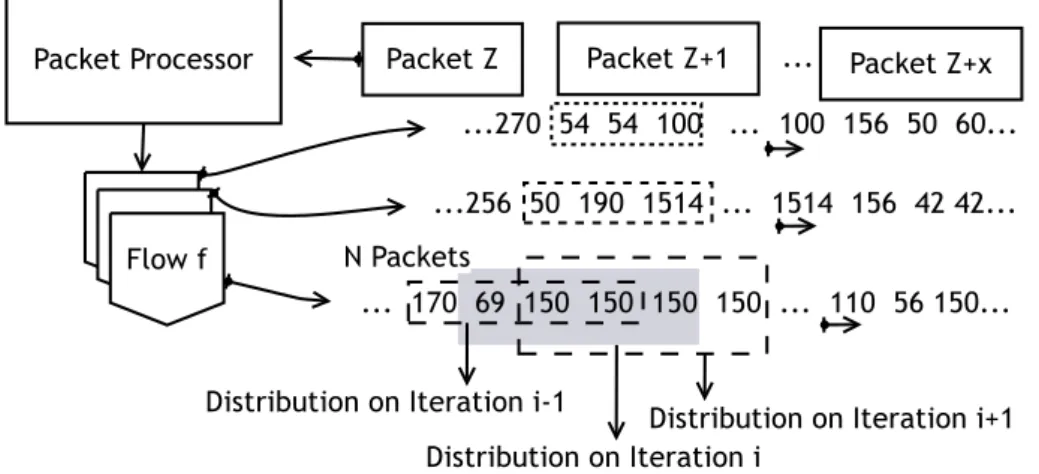
Um dos passos iniciais do trabalho de investigação descrito nesta dissertação consistiu na análise do comportamento do tráfego gerado por várias aplicações de software, recorrendo para isso à construção da distribuição empírica do tamanho dos pacotes IP. As conclusões deste estudo inicial, descritas no capítulo 3, mostram que existem variações no comportamento passíveis de serem capturadas pela abordagem tomada, e que serão depois utilizadas na construção de um classificador de tráfego de rede. O tráfego de rede usado nesta análise foi capturado junto à fonte onde foi gerado e ainda num ponto de agregação de um laboratório de redes. Desta forma, foi possível observar as propriedades nos dois cenários e estabelecer a verdade dos registos de tráfego. De modo a proceder-se à análise da distribuição empírica do tamanho dos pacotes do tráfego, foi construída uma pequena aplicação que, ao receber o tráfego recolhido, cria a sua distribuição. Tendo em conta os resultados obtidos, esta aplicação foi modificada de forma a poderem ser criadas assinaturas para cada classe de tráfego considerada neste estudo. Estas assinaturas, que contêm apenas a distribuição empírica e o respetivo nome da aplicação que a gerou, foram usadas pelo classificador descrito no capítulo 4. Exemplos de duas destas assinaturas podem também ser consultadas no anexo A.1. Visto que a complexidade computacional destes mecanismos é de extrema importância, foi adotado um mecanismo, denominado de janela deslizante, que permite a criação da distribuição empírica, e a sua alteração, usando um conjunto fixo e relativamente pequeno de operações. O mesmo mecanismo permite obter uma classificação por cada pacote IP capturado e, portanto, durante todo o tempo de vida de um fluxo. Para cada fluxo é criada uma janela com um tamanho de 500 pacotes, cujo funcionamento é descrito na figura 3.2. Os pacotes que pertençam a um dado fluxo são adicionados na janela até que esta atinja o número máximo de pacotes. Depois disto, à chegada de um novo pacote, este é adicionado à janela e o valor inserido há mais tempo é
removido, mantendo sempre o tamanho da janela. Em concordância com o trabalho discutido em [PBL+03], os resultados deste estudo permitem afirmar que a distribuição empírica dos
pacotes pode ser uma característica a ter conta no área da classificação do tráfego de rede.
Classificação de Tráfego de Rede Baseada em Testes Estatísticos
O desafio que se colocava na etapa a que esta secção diz respeito era o de conseguir fazer a correspondência entre o tráfego de rede capturado da placa de rede e as assinaturas antes desenvolvidas de uma forma eficiente. Dado que os objetos matemáticos envolvidos nesta correspondência eram distribuições empíricas, procurou-se uma resposta na teoria das probabilidades e, mais concretamente, na área dos testes estatísticos. Depois de estudar o funcionamento deste tipo de testes, chegou-se à conclusão de que o artefacto mais interessante para este trabalho seriam as estatísticas usadas nos referidos testes. As estatísticas usadas no âmbito desta dissertação foram a estatística D do teste de Kolmogorov-Smirnov e a sobejamente conhecida χ2, definidas no capítulo 4. Dado que estas estatísticas são normalmente calculadas
durante análises indeferidas, foram descritos nesta dissertação os algoritmos que permitem a sua estimação para uma janela deslizante de valores. A discussão inclui referência ao facto dos procedimentos acarretarem apenas um conjunto fixo de operações matemáticas simples e de manipulação de memória, de maneira a argumentar que os classificadores construídos com base nestes procedimentos têm requisitos computacionais baixos. As duas estatísticas foram depois usadas para construir os classificadores, cuja arquitetura se ilustra na figura 4.3. Para efeitos de estudo, cada uma das estatísticas foi primeiro usada para implementar protótipos de classificadores diferentes e só depois combinadas num terceiro. Cada protótipo é capaz de capturar e segregar os pacotes em fluxos através dos campos endereço fonte e destino do cabeçalho IP e dos campos porta fonte e destino do cabeçalho TCP ou UDP. De seguida, o tamanho do pacote é inserido na janela deslizante, correspondente ao seu fluxo, e a respetiva distribuição empírica é atualizada de forma eficiente. Por último, a distribuição empírica é comparada com todas as assinaturas de tráfego, sendo devolvida a classe daquela que apresenta o menor valor da estatística D ou χ2 (dependendo do classificador). O protótipo que combina
as duas estatísticas funciona de forma semelhante, exceto no instante de estabelecer a classe: caso as duas estatísticas favoreçam a mesma assinatura, a classe respetiva é devolvida; caso contrário, a classe da assinatura com menor valor em qualquer das estatísticas é devolvida. Todos os protótipos são capazes de produzir classificações por cada pacote analisado.
Testes e Discussão dos Resultados
Tendo em conta o último ponto dos objetivos desta dissertação na secção que inicia este capítulo, os classificadores propostos no âmbito deste trabalho foram sujeitos a conjunto de testes para avaliar a sua precisão e requisitos computacionais. Os testes efetuados recorreram a registos de tráfego capturados em ambiente laboratorial, para efeitos de reprodutibilidade, embora tentando simular o mais possível cenários de utilização reais. Foi tido o cuidado de
construir um conjunto de registos representativos da utilização das redes de computadores de hoje em dia, com as aplicações consideradas no âmbito deste trabalho e para as quais já haviam sido construídas assinaturas. Após terem sido capturados os registos de tráfego, estes foram processados por cada classificador proposto e os respetivos resultados foram usados para avaliar o número de falsos positivos, falsos negativos, verdadeiros positivos e verdadeiros negativos. Para a respetiva avaliação dos métodos foram as métricas precisão e sensibilidade, ambas descritas na secção 5.2. Os resultados obtidos mostram que os classificadores são precisos e capazes de classificar corretamente a maioria do tráfego analisado. Na tabela 5.1 é possível verificar que, em alguns casos, os classificadores chegam a apesentar uma precisão de 100%. Também é possível ver que o pior caso diz respeito a tráfego Voice over Internet Protocol (VoIP). Na parte final deste estudo, o classificador que apresentou melhores resultados na avaliação anterior foi comparado com um conjunto de classificadores do estado da arte e que são parte integrante da ferramenta NeTraMark. Os resultados obtidos nesta comparação são bastante satisfatórios, uma vez que classificador proposto demonstrou ser tão bom como os restantes na maioria dos casos e até melhor para algumas classes de tráfego. Por fim, e de modo a obter uma evidência empírica dos baixos requisitos computacionais do classificador proposto, foram ainda feitos alguns testes de stress. Nestes testes, o classificador foi executado para vários registos de tráfego e os tempos de processamento foram medidos, bem como a quantidade máxima de memória utilizada na análise. Os resultados desta experiência demonstram claramente que carga de processamento depende linearmente do número de pacotes analisado e que a quantidade de memória depende linearmente do número de fluxos simultaneamente em análise.
Conclusões e Trabalho Futuro
Este trabalho partiu do pressuposto de que seria possível classificar tráfego de rede, de uma forma eficiente, usando distribuições empíricas dos tamanhos dos pacotes. O classificador proposto, que combina as duas estatísticas selecionadas no âmbito do trabalho, comprova esse pressuposto. Alguns dos resultados obtidos com este classificador revelaram-se surpreendentes, já que estavam ao nível de outros classificadores do estado da arte, e até um pouco melhor nalguns casos. Uma razão apontada para este sucesso foi que o uso de distribuições empíricas, apesar de parecer simples, explora uma grande quantidade de informação da característica analisada (neste caso, o tamanho dos pacotes). Depois de colocar em perspetiva os modestos requisitos de memória do classificador proposto, este é apresentado como uma solução atrativa para o problema proposto, embora tenha ainda arestas a limar, nomeadamente no que diz respeito a alguns dos seus parâmetros. As direções de trabalho futuro, descritas na secção 6.2, apontam no sentido de melhorar os próprios classificadores propostos, nomeadamente através do estudo do melhor tamanho para a janela deslizante, que neste trabalho foi ajustado para 500 com base nalgumas experiências e no discernimento humano. Outras direções de trabalho futuro compreendem a tentativa de implementar uma interface gráfica que permita uma melhor
interação com a aplicação, o estudo de métodos para derivação automática ou semi-automática de novas assinaturas para tráfego desconhecido, e o aumento do número assinaturas para novas classes de trafego, nomeadamente jogos online.
Abstract
Nowadays, traffic classification constitutes one of the most important resources in the task of managing computer networks. The tools and techniques that enable network traffic to be segregated into classes are critical for administrators to maintain their networks operating at the required Quality of Service (QoS) and security levels. Nonetheless, the steady evolution of the infrastructure and mainly of the terminal devices, as well as the consequent increase of the complexity of the networks, make this task a lot harder to achieve, both in terms of accuracy and computational requirements. Some of the factors that most prejudice traffic classification are the adoption of encryption and evasive techniques, employed by network applications. Several researchers have thus been focusing efforts in finding new means to classify traffic or improve the existing ones.
This dissertation discusses a research work on the network traffic classification subject, focused on the segregation of network flows according to the application that generated them, independently of the fact that such applications use different communication paradigms. For achieving that purpose, a network scenario similar to a real one was setup on a lab environment, and several traffic traces generated using different contemporary applications were collected. This traces were initially subject to human analysis, which enabled the identification of behavior patterns without resorting to information inside the contents of the packets, using only the empirical distribution of the size of the packets. After the initial analysis, a set of signatures composed by the aforementioned empirical distributions and the name of respective applications was build, for each one of the applications and type of traffic under analysis. Subsequently, the best means to obtain the correspondence between the signatures and the network traffic in real-time and in a packet-by-packet manner was investigated, from which resulted the modification of two statistical tests known as Chi-Squared and Kolmogorov-Smirnov, later implemented in prototypes for traffic classification. To enable the packet-by-packet analysis, the two statistics of the aforementioned tests are calculated for a sliding window of values, which iterates each time a new packet of the flow arrives. The number of operations involved in the actualization of the statistics is constant and low, which enables obtaining a classification at any given moment of the duration of a flow.
Each one of the two classification methods was implemented in a different prototype and then combined, using an heuristic, to obtain a third classifier. The classifiers were tested and evaluated separately resorting to new traffic traces, generated by the different applications considered in the study, captured in a network aggregation point. Even though the results obtained for each one of the two classifiers were good, presenting an accuracy above 70%, the combination of the two methods improves those results, correctly classifying more than 90% of the analysed flows. Additionally, the developed prototypes were compared with other similar
tools discussed on the related literature and available online, and it was verified that, in many cases, the proposed classifiers produce better results for the analysed traces.
Keywords
Chi-Squared Test, Kolmogorov-Smirnov Test, Traffic Classification in the Dark, Traffic Monitoring, Real-Time, Statistical Analysis.Contents
1 Introduction 1
1.1 Motivation and Scope . . . 1
1.2 Problem Statement and Objectives . . . 2
1.3 Adopted Approach for Solving the Problem . . . 3
1.4 Main Contributions . . . 4
1.5 Dissertation Overview . . . 5
2 State-of-the-Art in Traffic Classification 7 2.1 Introduction . . . 7
2.2 Traffic Classification Based on Port Numbers . . . 7
2.3 Traffic Classification Based on Deep Packet Inspection (DPI) . . . 8
2.4 Traffic Classification in the Dark . . . 11
2.5 Conclusion . . . 14
3 Traffic Capturing and Preliminary Analysis 15 3.1 Introduction . . . 15
3.2 Experimental Data . . . 16
3.3 Experimental Test-bed . . . 17
3.4 Real-Time Calculation of the Empirical Distributions of the Packet Lengths . . . . 18
3.5 Packet Length Empirical Distributions . . . 20
3.6 Conclusion . . . 23
4 Matching Based on Statistical Tests and Architecture of the Classifiers 25 4.1 Introduction . . . 25
4.2 Matching Based on the Kolmogorov-Smirnov Test . . . 25
4.3 Matching Based on the Chi-Squared Test . . . 27
4.4 Classifiers Architecture and Implementation . . . 30
4.5 Conclusion . . . 31
5 Tests and Discussion of Results 33 5.1 Introduction . . . 33
5.2 Performance Evaluation and Comparison of the Three Prototypes . . . 33
5.3 Comparison with Other Classifiers . . . 35
5.4 Computational Resources Analysis . . . 37
5.5 Conclusion . . . 38
6 Conclusions and Future Work 41 6.1 Main Conclusions . . . 41 xvii
6.2 Future Work . . . 42
A Signatures 53
A.1 Example of Signatures . . . 53
List of Figures
2.1 Rule for detection of traffic generated through BitTorrent, as presented in [Dav]. 8 2.2 Example of a signature used by Wireshark to identify an HTTP packet. . . . 9
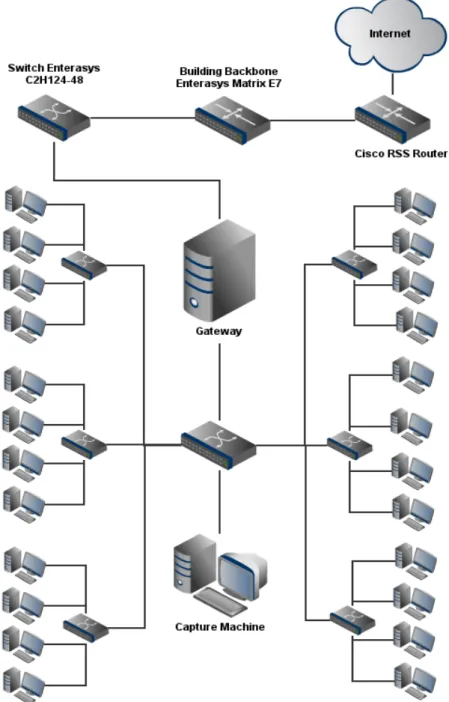
3.1 Schematics of the network lab of the Department of Computer Science of the University of Beira Interior. . . 17 3.2 Sliding window with size of N packets that contain packet lengths for each flow,
and the distribution is calculate in each iteration. . . 19 3.3 Empirical cumulative distributions for traffic of different applications: (a) HTTP
download; (b) instance of live streaming; (c) instance #1 of file-sharing using a P2P protocol; (d) P2P Video; (e) instance #1 of streaming on-demand; (f) Skype VoIP; (g) instance #2 of streaming on-demand; and (h) instance #2 of file-sharing using a P2P protocol. . . 21 3.4 Empirical cumulative distributions for three classes of traffic created using bucket
with size of 16 bytes. . . 22
4.1 Representation of the Kolmogorov-Smirnov statistic for the comparison between the Video On-demand empirical distribution and several signatures: 4.1a maxi-mum distance to the Skype G.729 signature; 4.1b maximaxi-mum distance to the P2P
file-sharing signature; 4.1c maximum distance to the Video On-demand signature. 27
4.2 Empirical distribution for 4 traffic sample: 4.2a both samples are from video streaming demand traffic; 4.2b the top sample is from video streaming on-demand and the bottom sample is from VoIP traffic. . . 28 4.3 Architecture of the proposed classifier. . . 30
5.1 Graphical representation of the results concerning the precision and recall of the three matching approaches for each one of the traffic classes considered in the scope of this work. . . 36 5.2 Representation of the CPU time and memory consumption as functions of the
number of packets and flows, respectively. . . 37
List of Tables
2.1 Comparison of the approaches for traffic classification (based on [GIF+10]). . . . 8
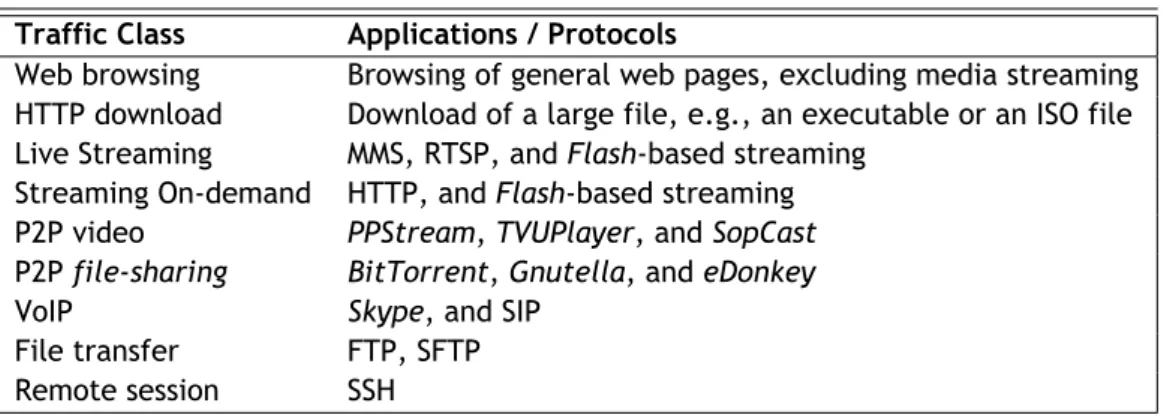
3.1 Classes of traffic analyzed within the scope of this work. . . 16 3.2 Hardware and software characteristics of the equipment used in the research lab
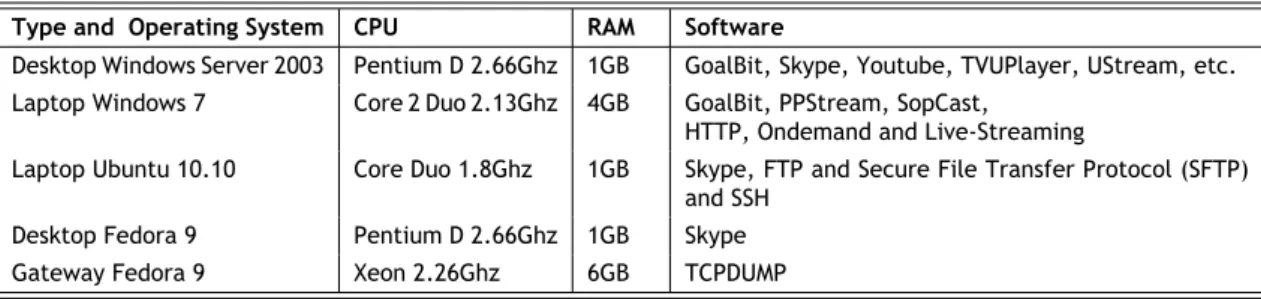
test-bed. . . 18
5.1 Results of the performance evaluation in terms of precision and recall for the three matching approaches. . . 35 5.2 CPU time and maximum memory usage of the classifier for different amounts of
data (seven distinct trace files) and for each one of the three matching techniques. 38 5.3 Results of the performance evaluation, in terms of precision (P) and recall (R),
for the eleven classification approaches considered within the scope of this work. 40
List of Listings
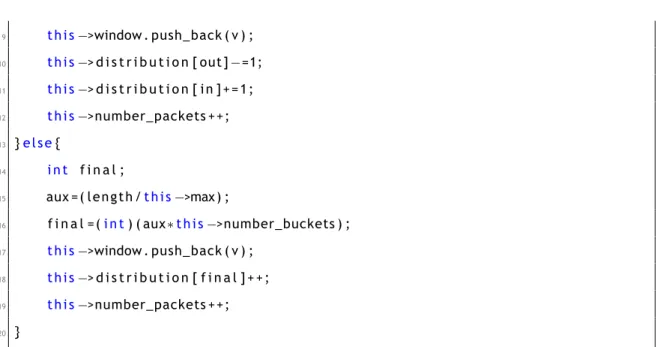
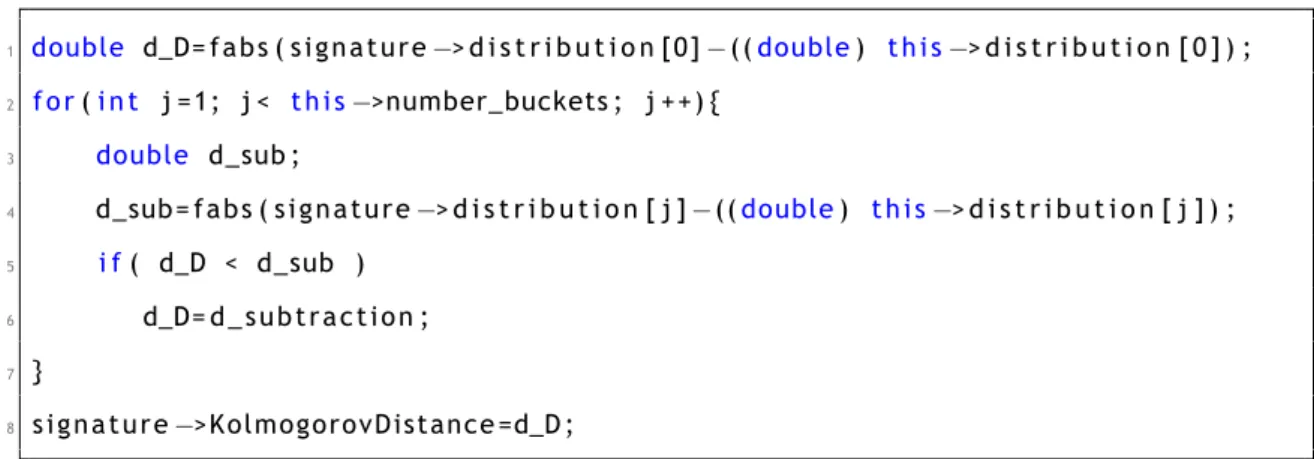
3.1 Packet-by-packet calculation of the empirical distributions of the packet lengths. 19 4.1 Procedure for calculating the Kolmogorov-Smirnov statistic in the prototype when
the sliding window fills up. . . 26 4.2 Procedure for calculating the χ2 statistic in the prototype when the sliding
window fills up. . . 28
4.3 Procedure for calculating the χ2 statistic in the prototype when the sliding
window is full and a new packet arrives. . . 29
A.1 Example of signature defined to VoIP traffic. . . 53 A.2 Example of signature defined for peer-to-peer (P2P) file-sharing traffic. . . 54
Acronyms
CPU Central Processing Unit DPI Deep Packet Inspection
TCD Traffic Classification in the dark FN false negative
SMTP Simple Mail Transfer Protocol FP false positive
FTP File Transfer Protocol
HTTP Hypertext Transfer Protocol IP Internet Protocol
MMS Microsoft Media Server RAM Random Access Memory MTU Maximum Transmission Unit OS Operating System
P2P peer-to-peer QoS Quality of Service
RTSP Real Time Streaming Protocol SFTP Secure File Transfer Protocol SIP Session Initiation Protocol SSH Secure Shell
RTP Real Time Protocol SVM Support Vector Machine TCP Transmission Control Protocol TN true negative
TP true positive TV Television
UDP User Datagram Protocol
UTP Unshielded Twisted Pair VoIP Voice over Internet Protocol ISP Internet Service Provider IDS Intrusion Detection System VPN Virtual Private Network DFA Deterministic Finite Automata BN Bayesian Network
NN Neural Networks NB Naive Bayes
NBKE Naive Bayes Kernel Estimation DT Decision Tree
KNN k-Nearest Neighbor ML Machine Learning
XML Extensible Markup Language
ISO International Organization for Standardization VBR Variable Bit Rate
GNU GNU's Not Unix
ACM Association for Computing Machinery CCS Computing Classification System NAT Network Address Translation
Chapter 1
Introduction
This chapter defines the focus and the problem addressed by the research work described in this dissertation, as well as the steps taken to solve that problem. The next-to-last section presents the main contributions for the advance of scientific knowledge and the last section describes the contents of each chapter of the dissertation.
1.1 Motivation and Scope
Computing devices and the networks interconnecting them have been simultaneously the recepient of technological advances and driving innovation for almost half a century. Computer networks connect billions of users everyday both at a local and at a global scale. They are critical for businesses and for the world economy, and support a wide panoply of services through an equally impressive number of protocols and software applications. Even though these networks are hierarchically structured and can be divided into logically smaller networks, knowing or dealing with such heterogeneous and dynamic environments comprises a difficult task. As computer networks became more important, Quality of Service (QoS) and security requirements became mandatory. On the other hand, assuring QoS and security on a computer network is often dependent on the segregation, classification and control of the traffic flowing through the underlying infrastructure.
Network traffic classification refers typically to the capability to identify the service or application that generated a traffic flow. While basic forwarding and blocking policies can be applied using simple flow segregation techniques, enforcing more elaborated QoS or security policies in modern networks requires more granular classification mechanisms. This is specially true if the network is connected to the Internet or if the users of terminal devices have permissions to install software. The problem is that the amount and diversity of traffic may drastically increase in such cases and, more importantly, several applications implementing evasive techniques may be downloaded and installed by the users, potentially affecting the availability and security of the overall network. This area has also been partially dominated by a cat-and-mouse game in the last few years, since developers have been trying to create resilient applications that run behind firewalls and Network Address Translation (NAT) systems, while preventing eavesdropping of the contents of the data units by monitoring systems.
In the Transmission Control Protocol (TCP)/Internet Protocol (IP) protocol suite, evasion is
often achieved resorting to two basic techniques: (i) usage of a transport layer port number that is normally assigned to other well-known protocol, preferably a protocol accepted by the policies implemented in the network; and (ii), encryption of the network or transport layer payload. The success of these techniques is mostly due to the two following reasons: (i) simple segregation mechanisms decide the class of an IP packet or flow using the numbers of the source and destination transport layer ports, which can be changed programatically; (ii) some classification mechanisms decide the class based on the contents of the payload, which is not available if encryption is applied. Actually, while the former segregation technique is now considered obsolete for accurate traffic classification, the latter refers to Deep Packet Inspection (DPI) techniques that were more recently developed. Both approaches are discussed with more detail in chapter 2. The association of the HTTP to traffic flowing through port 80 is an example of the traditional use of port numbers to identify the application protocols.
The advent of DPI techniques is a clear sign that network administrators and ISPs needed a more granular and accurate classification. Nonetheless, a DPI classifier elaborates on computationally expensive bit pattern matching procedures, which do not scale well and cannot handle encrypted traffic. The effectiveness of these techniques depends also of the signatures database, which has to be updated regularly. Additionally, DPI monitoring systems raise privacy concerns [SOG07]. These limitations have been motivating the research and development of techniques that do not rely on the IP packets contents, which are sometimes referred to as Traffic Classification in the dark (TCD) techniques [KPF05]. In most cases, in
the dark mechanisms are based on statistical measures or heuristics applied to different traffic
features. Their objective is to capture the behavior that applications or protocols imprint on the network traffic and, even though they are typically not as accurate as DPI techniques, they can be applied when the packets payload is encrypted.
The work described herein is focused on the study of the statistical properties of network traffic and on the research and development of an in the dark classifier. Its scope falls within the specific research area of network monitoring and analysis of the computer science discipline. In the Association for Computing Machinery (ACM) Computing Classification System (CCS), this work would fall in the C.2.3 [COMPUTER-COMMUNICATION NETWORKS]: Network
Operations--Network monitoring category and descriptor.
1.2 Problem Statement and Objectives
The problem addressed in this master's degree programme is the one of correctly and efficiently classify network traffic. As hinted in the previous section and further discussed in chapter 2, this problem is dominated by several challenges. First of all, there is typically a trade-off between the accuracy and the efficiency of the classifier, since the accuracy may depend on the amount of available data and the ability to process it. The idea is that the classification is
more granular if more data is available, possibly requiring more processing. Secondly, aiming for the construction of a general solution to the aforementioned problem requires assuming that the traffic may either be encrypted or not, since that fact changes the amount of available data. Additionally, evasive techniques to avoid classification (and blocking) are constantly being developed. Thirdly, these kind of procedures have to deal with the fast evolution of the networks and with the increasing number of network protocols, services and applications. In other words, a classifier that behaves efficiently today may not perform as good in the future. Due to their nature, addressing all these challenges simultaneously is difficult.
Constructing a general classification means that handles both encrypted and non encrypted payloads is only possible if its operation does not depend on the payload at all, or if different procedures are applied depending on the case. The initial assumption behind this research work is that it is possible to classify traffic based only on the lengths of the IP packets, which is one of the most general features of network traffic. It is thus assumed that different classes of traffic impact those lengths differently -- an assumption that some authors did in the past too. A classifier using this approach (based on behaviour) is also agnostic to changes in the payload of non encrypted traffic, though the categorization may not be as granular as if a DPI technique was used. The problem is also to perform the classification with a minimum amount of computational resources, so as to keep the method compliant with real-time operation.
Given the above definition of the problem under analysis, the objectives of this research work can be further detailed as follows:
1. Study and gather additional knowledge about the statistical behaviour of the network traffic and about the impact that contemporary applications or protocols have on that behaviour.
2. Devise a classifier based on the IP packet lengths, namely on the empirical distribution of such feature, modest in terms of computational resources and capable of producing results in a packet-by-packet manner. The motivation behind the requirement of producing values on a per packet basis is that such mode of operation favours real-time compliance, since the resulting procedure is able to produce results at any given instance of a network flow.
3. Evaluate the performance of the proposed classifier using a concise and contemporaneous dataset of traffic and compare it with similar tools of the state-of-the-art.
1.3 Adopted Approach for Solving the Problem
The achieve the objectives described in the previous section, the research work was divided into the following phases:
1. Contextualization with the problem addressed in this dissertation and with related re-search work on this area of knowledge. This part included surveying the state-of-the-art on traffic classification, the study of the functioning of modern networks with detail, namely the TCP/IP protocol stack and structure of IP packets, and getting acquainted with the technologies required to solve the problem.
2. Delineation of the experiments and laboratory setup to obtain traffic traces, and conduct-ing a preliminary analysis to those traces. The three main objectives of this preliminary analysis are to (i) assess if the main assumption, on which the solution relies on, still applies, (ii) get familiar with the task of capturing and processing network traffic and (iii), construct a dataset of signatures representing traffic classes.
3. Study of the best means to match the aforementioned signatures with live traffic.
4. Development of an architecture for the classifier and implementation of prototypes for proof-of-concept.
5. Testing the developed prototypes and comparing them with other state-of-the-art classi-fiers.
The overall organization of the dissertation (refer to section 1.5) reflects the way this research work was divided.
1.4 Main Contributions
The main contribution of this dissertation is the proposal of a new means to classify network traffic based on the behaviour of different applications, using only the IP packet lengths and flow-level information. Other important contributions can be summarized as follows:
1. The proposed classifier uses a combination of statistics based on the well-known Chi-Squared and Kolmogorov-Smirnov tests to perform the matching between empirical distri-butions, representing classes, with the traffic under analysis;
2. The algorithms to estimate the aforementioned statistics and to construct the empirical distributions were adapted so as to produce results in a packet-by-packet manner for an iterative sliding window with a fixed size. The modifications are described in this dissertation. The usage of the sliding window makes the classifier capable of producing classifications during the entire duration of a network traffic flow, and not only during its initial part or for some instants of time. This mode of operation also increases the overall accuracy, since some flows are easier to classify after an initial, and potentially unstable, connection establishment phase.
3. The classifier was extensively tested using traffic captured in a laboratory setup and its performance was compared with other state-of-the-art classifiers. The signatures and the testing datasets were constructed using traffic from a large number of applications, so as to provide evidence that the proposed classifier is accurate and suitable for scenarios where real-time operation is required.
Part of the research work described in this dissertation is the main matter of a scientific paper entitled Real-Time Traffic Classification Based on Statistical Tests for Matching Signatures
with Packet Length Distributions, published in the proceedings of the 19th IEEE International
Workshop on Local and Metropolitan Area Networks (LANMAN), held in Brussels, Belgium, between the 10th and the 12th of April, 2013 [NGFI13].
1.5 Dissertation Overview
The body of the dissertation is composed by six chapters. The contents of each one of the chapters can be summarized as follows:
• Chapter 1 - Introduction - presents the scope and the motivation behind the work described in this dissertation, as well as the addressed problem and objectives. It includes a subsection describing its main contribution for the advance of knowledge and the approach taken to fulfil the objectives. The dissertation structure is also briefly discussed at the end of this chapter.
• Chapter 2 - State-of-the-Art in Traffic Classification - contains a discussion on the techniques used for traffic classification along the years, along with their advantages and disadvantages. It also contains a revision of the literature on this area of knowledge, with focus on some related works.
• Chapter 3 - Traffic Capturing and Preliminary Analysis - describes the laboratory setup used to capture the set of traces analysed during the initial part of the research. The method to construct the empirical distributions in a packet-by-packet manner, as well as the experimental data, are also detailed in this chapter. Additionally, the most interesting findings of this initial phase are discussed, along with the means used to construct the traffic signatures.
• Chapter 4 Matching Based on Statistical Tests and Architecture of the Classifiers -describes the two statistical tests that were on the basis of the methods used for matching the signatures with traffic under analysis. It elaborates on the modifications required for calculating the two statistics in an efficient manner and for a sliding window of values. It also presents the architecture of the implemented prototypes for classification, as well as the heuristic used to combine the results of the two matching procedures into a single
one.
• Chapter 5 - Testing and Discussion of Results - starts by presenting the means used to test the developed prototypes and evolves to the discussion of the results of the evaluation. The chapter includes the comparison of the accuracy of the prototypes with other classifiers described in the literature, as well as some comments on their computational requirements.
• Chapter 6 - Conclusions and Future Work - is devoted to presenting the main conclusions of this research work, with focus on the results, and pointing out future research directions.
Appendix A.1 - Signatures - contains two examples of signatures devised along this research work.
Chapter 2
State-of-the-Art in Traffic Classification
2.1 Introduction
The field of traffic classification has been the recepient of several contributions since the beginning of the Internet. The approaches for solving the problem of segregating the flows according to a given criteria have been changing, sometimes motivated by the specific purpose or granularity of the classification, other times as a reaction to tentatives to evade such classification techniques. Nowadays, the literature on this field isolates three main types of approaches: port-based, DPI and TCD techniques. Table 2.1 provides a simple comparison between the three types of approaches discussed below, placing some emphasis on their main advantages and disadvantages. This chapter is divided into three sections, each of them dedicated to the discussion of one of the aforementioned techniques. The subjects are chronologically organized, discussing the oldest approach first.
2.2 Traffic Classification Based on Port Numbers
Traffic classification based on User Datagram Protocol (UDP) or TCP port numbers is a straight-forward method that assumes that each application protocol uses always the same specific transport layer port. Traditionally, this method is mostly useful in the identification of well-known protocols like, for example, Telnet or File Transfer Protocol (FTP), which use port numbers 23 and 21, respectively. However, it is rather easy for applications to deceive this type of classification. Many applications began using random port numbers or ports normally assigned to well-known application protocols like e.g., Hypertext Transfer Protocol (HTTP), that normally use port 80. Due to these reasons, this type of traffic classification is considered obsolete nowadays [KFc04, MP05, KBB+04].
Regardless of all of its drawbacks, a few studies have used this kind of approach, or at least the port numbers, to identify applications and protocols in network traffic in the past. In [KW02], the authors analyzed traffic from different peer-to-peer (P2P) applications as
Gnutella, and FastTrack collected in an aggregation point. For distinguish the flows from
different applications, they used the TCP port numbers. Gerber et al. [GHN+03] use port
numbers to identify traffic from several P2P applications.They used traffic collected from an Internet Service Provider (ISP) and an university campus network, having analysed the properties of the traffic. The authors of [LBBSS02] analyzed traffic from several P2P systems and use port
Table 2.1: Comparison of the approaches for traffic classification (based on [GIF+10]).
Type of Approach Features Used Advantages Drawbacks
Port Number matching
- Associate Port Numbers to Specific Applications. - Low Computational Requirements; - Easy to implement.
- Less Precision due to random port numbers.
Deep Packet Inspect - Use the content of
payload
- Hight level of accu-racy classification.
- may not work for en-crypted traffic; - Requires high compu-tational resources; - Can only be used for known applications;
Classification in the
dark
- Use only packet
header and flow level information;
- Can be used in Encrypted Traffic; - Usually have better performance than DPI; Can identify unknown applications from target classes.
Usually has lower clas-sification performance when compared with DPI.
numbers to identify the different applications under analysis. Several tools use also this kind of approach to provide information about the application protocol, like Wireshark [wir13] and
Corel Reef presented by Moore et al. [MKK+01].
2.3 Traffic Classification Based on DPI
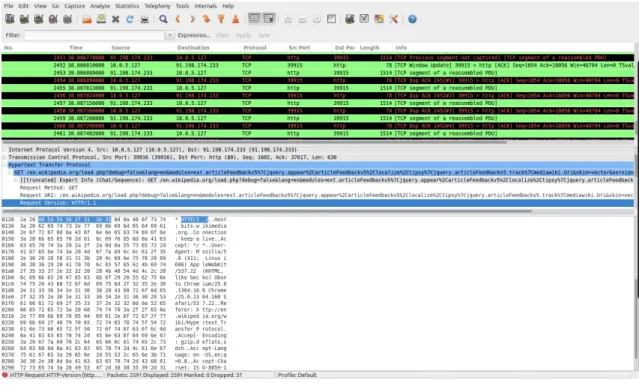
DPI methods are the most obvious alternative to the port based mechanisms. The system using this kind of mechanisms is capable of inspecting the payload of the IP packets, normally up to the application layer, where it searches for bit patterns of a set of signatures stored in a database. Each signature is associated with a given application protocol, virus or, more generally, a given class. This approach can thus be also applied to the identification of threats, malicious data and other anomalies. Because of their accuracy, classification based on DPI is especially useful for accounting solutions, or for situations or systems in which accuracy is crucial as, for example, Intrusion Detection System (IDS). Figure 2.1 presents a rule specification for the Snort IDS to detect BitTorrent traffic, derived by Carvalho et al. [Dav]. Wireshark also uses this kind of approach to identify several network protocols. For example, figure 2.2 shows the signature used by wireshark to identify HTTP traffic.
alert tcp $HOME_NET any -> $EXTERNAL_NET any (msg:"P2P BitTorrent Outgoing announce request"; flow:to_server,established; content:"GET"; offset:0; depth:4;
content:"/announce"; distance:1; content:"info_hash="; offset:4;
content:"event=started"; offset:4; classtype:policy-violation; sid:1000301; rev:1;)$
Figure 2.1: Rule for detection of traffic generated through BitTorrent, as presented in [Dav].
DPI approaches are typically the most accurate ones, but they present some drawbacks. Inspecting each packet is a demanding task, in terms of computational resources, which can 8
Figure 2.2: Example of a signature used by Wireshark to identify an HTTP packet.
lead to the malfunctioning of these techniques in high-speed networks since, in such situations, the system may not be able to handle all traffic, become slow or stop responding. To avoid or, at least, minimize this specific problem, some authors or manufacturers of DPI systems make them search only in some parts of the packets or in some subset of the packets constituting a flow, effectively establishing a compromise between efficiency and accuracy. In such case, some flows may remain unclassified because the packets enabling the classification are never processed by the DPI engine. On the other hand, DPI mechanisms can also raise legal issues related with user privacy protection, since the user data travelling in the application payload may be inspected, even if automatically, by a DPI engine.
One of the major drawbacks of DPI techniques concerns their inability to be used when traffic is encrypted. If the packet payload is mostly inaccessible due to encryption, DPI methods are restricted to a few unencrypted packets of a flow or to the headers of the IP packets, often to the transport layer header. Some protocols use encryption for data exchange, but they leave parts of the session unencrypted, namely the parts for establishing such session, which may leave some space for DPI techniques to correctly classify that traffic. Moreover, some applications use both UDP and TCP connections concurrently, but only the TCP sessions is encrypted, again enabling their classification. This approach is also particularly sensitive to modifications in the protocol or to the evolution of the respective application, since alterations in the protocol or in the application may imply modifications in the signature in the DPI database. Additionally, these mechanisms can only identify protocols or applications for which signatures have been devised and installed in the DPI systems.
Several studies focused their classification procedure on the contents of the packet payload by resorting to byte-level signatures associated with specific types of traffic. Dewes et al. [DWF03] used DPI to identify the traffic from different chat protocols. Karagiannis et al. [KBB+04]
made an analysis of data from several P2P systems using DPI to identify the traffic. Moore and Papagiannaki [MP05] described a mechanism which aggregates a set of DPI classifiers and searches for signatures within the entire packet. Sen et al. [SSW04] proposed payload signatures for several P2P applications, as for example, Gnutella, eDonkey and BitTorrent. They tested the solution using traffic collected on an access network to a major backbone and on link with 45 Mbps connecting a Virtual Private Network (VPN) to the Internet. BitTorrent was the worst case of their experiment, for which they obtained approximately 9.90% of false negatives. For the remaining protocols, the number of false negatives variates between 0% and 4.97%. Nonetheless, they considered that the flows that use well known port numbers of P2P applications are, in fact, P2P traffic. Based on that assumption, each flow that used one of those ports, and was not classified as P2P traffic, was identified as a false negative case. In [BZTH07] the authors used the payload signatures to identify flows generated by some P2P applications. In this solution, when the packet is identified successfully, several information concerning the flow is combined and added to an hash table. This way, the proposed procedure only inspect the packets that belong the flows that were not yet classified. Traffic generated by chat applications is analyzed in [DWF03]. Through this analysis, the authors of this study identified some signatures contained in the payload of the packets. The precision and the recall obtained in subsequent tests were of 93.13% and 91.7% respectively.
Particularly preoccupied with the computational complexity associated with deeply inspecting every IP packet, a few authors have proposed methods based on DPI that can perform more efficiently [GQ08, SEJK08, CCR10]. In [CRE+10], the authors presented two optimizations
of a DPI classifier that reduces the data that needs to be checked by the pattern matching engine. Cascarano et al. [CEG+09] evaluated the computational cost of a DPI mechanism by
comparing it with a statistical one. This comparison show that depending on the composition of the traces, the DPI mechanism can be as much computationally heavy as the statistical classifier, which is an interesting fact to keep in mind. Smith et al. [SEJK08] used auxiliary variables and optimizations to implement a mechanism for deflating explosive Deterministic Finite Automata (DFA). Using their solution, the authors were able to optimize the process of signature matching, achieving promising results for FTP, Simple Mail Transfer Protocol (SMTP) and HTTP traffic.
Even though payload encryption usually invalidates the usage of DPI methods, some authors have focused their efforts in finding if it was possible to classify encrypted traffic using DPI methods. The authors of [CPF09b], for example, manually devised several payload signatures for BitTorrent encrypted traffic. They explored the fact that some fields of the data units were
fixed, regardless of being encrypted. In their papers, the authors provide a set of rules for
Snort. The same authors present a similar approach to identify encrypted P2P Television (TV)
traffic in [CPF09a, EIPF11], this time resorting to the fact that part of the packets follow in plaintext, namely the ones belonging to the session establishment phase or to a secondary control channel. More recently, some authors combined the inspection of the packet payload with statistical analyses or heuristics [SHR+09, LLM10, ZZZY10] to try to improve the accuracy
and reduce the computational requirements. A few authors [BMM+07, DPTP10] have also
explored the fact that the bytes in packet payloads are more random in encrypted traffic than in non-encrypted traffic. Based on that, they used statistical measures, like entropy or the chi-squared test, to create methods that segregate encrypted from non-encrypted traffic.
Due to their attractive characteristics, namely their classification accuracy and granu-larity, several DPI applications and systems have been developed or constructed. l7-netpdlclassifier [net13], L7-filter [l7f09] and nDPI [ope13] are good examples of such
ap-plications.
2.4 Traffic Classification in the Dark
As discussed in previous section, the deep inspection of the payload of each IP packet is not always a valid option for the identification of applications and traffic in the networks. Therefore, several methods that do not used information contained in the packet payload have been developed along the years. The main strategy of this kind of methods, usually known by in the dark methods, is to classify traffic using heuristics or statistical patterns of generic properties of the traffic (e.g., number of connections, flow-level information like packet length, ports and IPs).
Using this type of approach, classification in the dark methods are able to identify a protocol or application without needing to examine the payloads. The drawback is that, as they do not use the payload information, this kind of approach cannot aspire to the same accuracy level of DPI methods. Their results should be understood as a strong suspicion about the traffic protocol. Nevertheless, many recent studies have achieved high success rates in the classification of traffic generated by Internet applications. In addiction, this kind of approach can more easily be applied to unknown applications, since many TCD techniques segregate the traffic flows into classes of applications (e.g., web traffic, Voice over Internet Protocol (VoIP), Streaming, P2P, etc) instead of identifying specific protocols. Additionally, classification in the
dark mechanisms require, normally, less computational resources than DPI mechanisms.
Recently, many authors proposed methods based on heuristics, using several flow-level or packet-level features [SFKT06, JT08, MP11]. In other studies, the behavior of the traffic is modelled using statistical measures. Some of the methods defined statistical fingerprints for
different classes of Internet traffic and used them to classify network data [CDGS07, DCGS09]. Bartlett et al. [BHP07] identified behavioural signatures for P2P file-sharing, like the number of failed connections, the ratio of incoming and outgoing connections, and the use of unprivileged ports. They evaluated the mechanism by classifying BitTorrent and Gnutella traffic, captured from a commercial ISP and from academic institutions. Freire et al. [FZS08] analyzed several properties of traffic and used the Kolmogorov-Smirnov and the Chi-squared tests to implement a mechanism to distinguish VoIP and legitimate Web traffic. They analyzed sevral proprieties of the network traffic to distinguish VoIP and normal Web Traffic and selected some parameters like Web response size, inter-arrival time between requests, number of requests per page and page retrieval time, etc. The evaluation was made using Skype and Google Talk VoIP data, previously collected in both ISP and university links on a controlled manner.
The authors of [GIF+08] analyzed the heterogeneity of the lengths of the packets to distinguish
different types of traffic. They analyzed several traces from P2P and non-P2P applications and tried to identify a behavioral pattern of the P2P traffic. Their conclusions show that the P2P applications generate packet lengths with an high degree of heterogeneity when compared to the packets lengths of non-P2P applications. They used entropy as a measure for heterogeneity and calculated its value for a sliding window containing a fixed number of packets to enable the segregation of traffic into traffic classes. Lin et al. [LLL+09] resorted to the distributions
of the lengths of the packets and to port association to identify the application protocol. The authors used traffic collected in a real environment to evaluate the method. In [BMM+09]
the authors present a method to identify user-sessions using the so-called cluster algorithm. However, the mechanism proposed by them is limited to offline usage, as they need to process the entire flows before producing any classification. Palmieri and Fiore [PF09] proposed a mechanism to classify Internet traffic that is based on recurrence quantification analysis. The authors studied non-linear properties of specific IP flows in which they could determine the recurrence phenomena and hidden non-stationary transition patterns related to each type of traffic. To test the method, the authors used three distinct traces, captured in a university network, and compared their approach with a DPI mechanism. Karagiannis et al. presented
BLINC in [KPF05], a mechanism for flow classification that does not use information contained
in the packets payloads or transport port numbers to identify the application protocol. BLINC analyzes properties of each node, like the relation with the remaining hosts, the role in the connection (server or client), the transport layer information, or the average packet size. The authors used traffic captured in different sites of their university to evaluate the mechanism and compare it with the DPI mechanism. Iliofotou et al. [IcKF+11] explored the interactions
between the hosts and used such iterations to classify the traffic. The mechanism was tested using two traces from different ISPs and a DPI-based method as baseline. The results showed that the solution was suitable for traffic classification.
More recently, many authors have focused their efforts on the application of machine learning algorithms to the development of mechanisms for traffic classification. In [BMM+07], the
authors implemented a Naïve Bayes classification mechanism that uses the payload length and the inter-arrival times. They also implemented a classifier based on the packet payload that uses Chi-Square test to identify Skype traffic exploring the randomness due to the encryption of the payload. The authors tested their approach using traffic from an ISP and from a campus and compared its accuracy against a signatures based method. Sun et al. [SYP+10] used
a distributed application to traffic samples collected in host users and used a probabilistic neural network to classify Web and P2P traffic. In [GCRHMA+06], the authors resorted to
Support Vector Machines (SVMs) to identify P2P traffic, while Jiang et al. [JG10] proposed a method based in the K − NN algorithm to classify Internet traffic. In [EMA06], the authors proposed using an unsupervised machine learning solution for traffic classification. They analyzed the performance of the solution using traces of traffic captured in the university campus and compared the results obtained with a supervised machine learning algorithm. Auld et al. [AMG07] presented a classifier based on a Bayesian trained neural network. This neural network was trained with data derivated the inspection of the packets contents. A set of traffic properties and statistics was used as input for the classification process. The authors test the performance of the mechanism with traffic collected eight months after the data used to train the classification mechanism. The results of the accuracy of their classifier are between 95% and 99%. Alshammari et al. [AZH09] used several machine learning algorithms (AdaBoost, SVM, Naïve Bayesian, RIPPER and C4.5) to identify encrypted traffic, using Secure Shell (SSH) and Skype as case studies, and compared the results obtained with all of them. Finamore et al. [FMMR10] calculated the probability distribution of the first bytes of the payload of UDP packets and used a test similar to the Pearson's Chi-Squared test to match the patterns.
A few previous articles have also used the empirical distributions of the lengths of the packets to classify traffic. In [JXXLH10], the authors calculated the distributions for P2P TV traffic and resorted to a SVM to match the data with the known patterns. Bonfiglio et al. [BMM+07] used
the distributions of the lengths of the packets and of the inter-arrival times in cooperation to classify Internet traffic. Lin et al. [LLL+09] use the distributions of the lengths of the packets
to classify traffic and used the Euclidean distance to match the patterns.
The most similar works to the classifiers described herein were proposed in [PBL+03] and
[WP10]. Parish et al. [PBL+03] used the distributions to classify the traffic and resorted to the
correlation coefficient and to the Euclidean distance to match the distributions. Moreover, they calculated the whole distributions for each flow at every 30 seconds, so as to make the method applicable to real-time operation. In [WP10], the authors followed a similar approach but used the Kolmogorov-Smirnov test to measure the distances between the distributions. They calculated the distributions only for the first packets of each flow. Lu et al. [LLHL12], present
a method to match the distribution based in the Euclidean distance and port association to identify traffic.
2.5 Conclusion
Classification of network traffic constitutes one of the most defying research topics nowadays. As can be concluded from the small survey on this chapter, many researchers have contributed to this area of knowledge using very different approaches along the years, corroborating the idea that this is a very dynamic area. Along the years, the solutions for classifying traffic have become more complex, as a proportional reaction to the evolution of the networks and terminal devices. The techniques evolved from simple TCP or UDP port based classifiers to the computationally demanding DPI engines.
For some years, it was believed that DPI would solve the traffic classification problem, since it is a more accurate and granular approach. Using DPI, a system could identify the type of traffic, the application producing the packets and other specific information that other methods could not. The major drawback of DPI is that its accuracy depends on the packets payload and as soon as encryption at the session or higher layers started to be applied, new approaches were needed. More recently, there is an evident effort to devise means for traffic classification that may not depend on the payloads of the packets, sometimes referred to as traffic classification
in the dark methods, many of them elaborating on machine learning techniques.
This chapter presents not only the most important works on the area, as identifies the features used by each means to classify network traffic, along with some of their advantages and disadvantages. It is possible to deduce from the discussion in this chapter that many of the related works are limited to a given number of traffic classes (e.g., Skype vs. Web traffic) and are may be susceptible to small variations in the protocols of the applications. The four characteristics that define a classifier are its computational requirements, accuracy, ability to deal with encrypted traffic and ability to handle modifications to protocols or applications. There is often a trade-off between the computational requirements and accuracy. While DPI techniques are the most accurate ones, TCD techniques can often handle encrypted data and small modifications to the protocols or applications.
The following chapters describe a TCD method based on the lengths of the IP packets. Because of that, it can handle encrypted traffic and it is highly agnostic to the protocol or application level details. It is mostly dependent on the overall behaviour of the applications and protocols that is printed in the packet length distributions. It is shown that the method is accurate and computationally modest.
Chapter 3
Traffic Capturing and Preliminary Analysis
3.1 Introduction
This chapter describes with detail the phase that succeeded the revision of the state-of-the-art. As discussed in chapter 1, the work plan for tackling the problem at hands includes a preliminary analysis of network traffic, whose objectives were to gain proficiency in capturing and handling traces, study the behavior of different classes of traffic and, later on, to devise behavioral signatures. Most of the effort was placed on the analysis of the packet lengths, and on understanding the relation of their probability distribution with the different applications or protocols. The choice to focus on this particular feature of the traffic is justified by the two following reasons:
1. the packet lengths are always available to traffic collectors, independently of the traffic being encrypted or not;
2. for a given host and excluding the IP packet payload, this traffic feature is the one that potentially reflects better the functioning of an application.
Focusing on this feature of the traffic aids in building agnostic classifiers, since they are based on a very general property of the packets, thought they may be susceptible to intentional modification of the packets lengths to avoid correct classification. Nonetheless, such modi-fication may impact the performance of the respective network applications and protocols, which should discourage such actions. It should be noted that other particular values of the IP packets are also indirectly used by the proposed classifiers. For example, IP addresses, port numbers and the protocol field of the IP headers are used to separate traffic into flows prior to further processing. Last, but not least, it should be also mentioned that the behavior of other features of the traffic was not excluded from the preliminary analysis a priori, though the work converged to the usage of that feature only.
The following two sections describe the data sets used in the preliminary analysis and the experimental test-bed in which they were obtained. An explanation on how the empirical distributions of the traffic are calculated and updated in a packet-by-packet manner is included afterwards, before discussing some findings resulting from this part of the work and concluding the chapter.
![Figure 2.1: Rule for detection of traffic generated through BitTorrent, as presented in [Dav].](https://thumb-eu.123doks.com/thumbv2/123dok_br/19174959.942768/32.892.110.741.132.476/figure-rule-detection-traffic-generated-bittorrent-presented-dav.webp)