UNIVERSIDADE DA BEIRA INTERIOR
Ciências
Understanding Ion Exchange adsorption
mechanisms under overloaded conditions
Patrícia da Silva Pousada
Dissertação para obtenção do Grau de Mestre em
Biotecnologia
(2º ciclo de estudos)
Orientador: Prof. Doutora Ana Cristina Mendes Dias Cabral
ii Aos meus pais, aos meus irmãos
iii
Agradecimentos
Gostaria de agradecer à Professora Cristina Dias-Cabral, por toda a sua disponibilidade, apoio, e por todo o conhecimento e orientação transmitidos ao longo desta dissertação e do meu percurso académico.
Um especial agradecimento ao Francisco Marques, pela sua total disponibilidade que sempre teve para comigo, amizade e acima de tudo, pela sua paciência. O seu apoio foi determinante para a elaboração desta dissertação.
Gostaria também de agradecer à FCT (Fundação para a Ciência e a Tecnologia), projeto número FCOMP-01-0124-FEDER-014750 (Ref. FCT PTDC/EBB-BIO/113576/2009) por apoiar este trabalho.
À Ana, que sempre me acompanhou e ajudou durante esta etapa, agradeço a amizade e a partilha de todos os momentos.
A todos os meus colegas de laboratório que sempre me ajudaram, apoiaram e proporcionaram um óptimo ambiente de trabalho no laboratório.
À Lúcia Queirós, minha colega de casa e amiga, que foi como uma irmã, obrigado pelas inúmeras horas de companhia, de conversas, partilhas, refeições e horas de chá.
À minha família, em especial à minha mãe e ao meu pai, apesar de muitas vezes não compreenderem, sempre me encorajaram e me deram forças para continuar.
Por último, ao meu grande pilar, Filipe, agradeço pelo seu amor, carinho e encorajamento, tolerância e compreensão, em todos os momentos.
v
Resumo
A Cromatografia de Troca Iónica (IEC) é uma técnica de separação e purificação de biomoléculas bastante popular e muito usada na indústria biotecnológica. Contudo, a previsão do comportamento de adsorção de biomoléculas em resinas de cromatografia ainda não está totalmente compreendido. Além disso, torna-se interessante executar os processos cromatográficos sob condições de sobrecarga; no entanto, trabalhar sob esta condição é consideravelmente mais complexo do que trabalhar em cromatografia linear. A falta de modelos adequados para descrever adequadamente a cromatografia em modo linear e não-linear é um obstáculo importante na conceção e implementação de unidades de separação e purificação a larga escala. Portanto, é essencial uma melhor compreensão dos mecanismos subjacentes à cromatografia linear e não linear de biomoléculas. Os estudos termodinâmicos têm contribuído para a melhor compreensão dos processos de adsorção e do papel dos efeitos não específicos no estabelecimento dos processos que levam à de adsorção de biomoléculas. Assim, estes estudos serão aplicados no presente trabalho.
Os ensaios de Microcalorimetria de fluxo (FMC) e isotérmicas de adsorção permitiram ilustrar os mecanismos de adsorção de Albumina de Soro Bovino (BSA) na resina de troca aniónica, Toyopearl® DEAE-650M, tanto na ausência como na presença de sal (50mM e 100mM NaCl) a pH 9. Os estudos de isotérmicas de adsorção também foram realizados para Toyopearl® GigaCap Q-650M (pH9 na ausência e presença de 50mM e 100mM NaCl). Os resultados obtidos através das isotérmicas mostraram que o processo de adsorção da BSA a Toyopearl® DEAE-650M e Toyopearl® GigaCap Q-DEAE-650M, segue um perfil compatível com a isotérmica de Lagmuir para concentrações de equilíbrio baixas. Os resultados de FMC para Toyopearl® DEAE-650M, obtidos em condições lineares mostram picos sobrepostos, um primeiro pico endotérmico seguido por um exotérmico. Para o calor endotérmico a libertação de moléculas de água foi sugerido como sendo o principal contribuinte, enquanto que o calor exotérmico foi relaciona-se com a interação atrativa entre a BSA e o suporte. Verificou-relaciona-se ainda que o processo global de adsorção é endotérmico, como é esperado para a interação de troca aniónica, ou seja, trata-se de um processo conduzido entropicamente.
Palavras-chave
Cromatografia de troca iónica; Troca aniónica; Microcalorimetria de fluxo; Isotérmicas; Adsorção; Toyopearl® DEAE-650M; Toyopearl® GigaCap Q-650M;Albumina de Soro Bovino.
vi
Resumo alargado
A Cromatografia de Troca Iónica (IEC) é uma técnica de separação e purificação de biomoléculas bastante popular e muito usada na indústria biotecnológica. A vantagem desta técnica deve-se às suaves condições de trabalho utilizadas, permitindo deste modo a manutenção da estabilidade e atividade biológica das biomoléculas durante o processo. Esta técnica cromatográfica baseia-se em interacções eletrostáticas entre a biomolécula carregada e o suporte cromatográfico de carga oposta. Contudo, a previsão do comportamento de adsorção de biomoléculas em resinas de cromatografia ainda não está totalmente compreendido. Além disso, torna-se interessante executar os processos cromatográficos em modo de sobrecarga, ou seja, através da sobrecarga da coluna de cromatografia. No entanto, trabalhar sob esta condição é consideravelmente mais complexo do que trabalhar em cromatografia linear. A falta de modelos adequados para descrever adequadamente a cromatografia em modo linear e não-linear é um obstáculo importante na conceção e implementação de unidades de separação e purificação a larga escala. Portanto, é essencial uma melhor compreensão dos mecanismos subjacentes à cromatografia linear e não linear de biomoléculas. Os estudos termodinâmicos têm contribuído para a melhor compreensão dos processos de adsorção e do papel dos efeitos não específicos no estabelecimento dos processos que levam à de adsorção de biomoléculas.
Um factor também importante associado à eficiência do processo de purificação é a escolha do suporte a ser utilizado. Atualmente existe uma grande variedade de resinas disponíveis no mercado.
Esta dissertação tem como objetivo o estudo dos mecanismos de adsorção de uma proteína modelo, Albumina de Soro Bovino (BSA) em suportes de troca aniónica comerciais, em condições de linearidade e de sobrecarga.
A análise termodinâmica dos mecanismos de adsorção foi realizada através da técnica de Microcalorimetria de Fluxo (FMC). Esta técnica permite a deteção de pequenas variações de calor associado à interação de biomoleculas com a superfície do adsorvente, sob condições de fluxo. Esta abordagem permite obter uma melhor compreensão das forças motrizes, dos mecanismos e das cinéticas envolvidas no processo de adsorção em diferentes sistemas cromatográficos, mesmo em condições experimentais complexas, tais como em condições de sobrecarga ou até mesmo na presença de fases móveis não ideais.
Para além da microcalorimetria de fluxo, e de modo a obter uma melhor compreensão dos mecanismos de adsorção da proteína de BSA, também foram realizados estudos de isotérmicas de adsorção, sob as mesmas condições, ou seja, na ausência e presença de sal (50mM e 100mM de NaCl) a pH9.
vii Os resultados obtidos através das isotérmicas de adsorção da BSA para Toyopearl® DEAE-650M e Toyopearl® GigaCap Q-650M mostram que o processo de adsorção segue uma isotérmica de Langmuir para concentrações de equilíbrio baixas. Nos ensaios realizados de FMC para Toyopearl® DEAE-650M, não foram atingidas as condições de sobrecarga, os resultados obtidos apenas se verificam em condições lineares de concentração de equilíbrio de proteína. Todos os termogramas obtidos são compostos por um primeiro pico endotérmico seguido de um pico exotérmico. No entanto, nos ensaios realizados na presença de sal, para concentrações mais baixas apenas se verifica a presença de um primeiro pico endotérmico. Para os picos endotérmicos o processo de libertação de moléculas de água foi sugerido como sendo o principal contribuinte, enquanto que para o caso dos picos exotérmicos a interação atrativa entre a proteína e o adsorvente e a adsorção secundária foram apontados como os principais contribuintes. Para além disso, como era esperado para a interação de troca aniónica, a microcalorimetria de fluxo sugere que o processo global de adsorção é endotérmico, ou seja, o processo é conduzido entropicamente.
Todos os resultados obtidos confirmam que, para uma visão mais consistente do mecanismo de interação de troca iónica, a utilização da microcalorimetria de fluxo mostra-se de grande interesse no estudo sistemático dos diferentes suportes comerciais disponíveis.
viii
Abstract
Ion-exchange chromatography (IEC) is a powerful technique and the most widely used for separation and purification of biomolecules in the biotechnological industries. However, the prediction of biomolecules adsorptive behavior onto chromatographic resins is still not completely understood. Also, it may be interesting to run the chromatographic processes in the overloaded mode; however operation under this condition is considerably more complex than linear chromatography. The lack of appropriate models to adequately describe linear and non-linear mode of chromatography is a major impediment in the design and implementation of scaled-up units. Therefore, is essential a better understanding of the mechanisms underlying linear and non-linear chromatography of biomolecules. Thermal events accompanying biomolecules adsorption have been proved to shed some light into the adsorption process and on the role of non-specific effects in the establishment of the adsorptive process.
Flow microcalorimetry (FMC) and adsorption isotherms measurements were used to illustrate Bovine Serum Albumin (BSA) adsorption mechanism onto an anion-exchanger, Toyopearl® DEAE-650M, at both absence and presence of salt (50mM and 100mM of NaCl) at pH 9. Adsorption isotherms studies were also run for Toyopearl® GigaCap Q-650M (pH9 in absence and presence of 50mM and 100mM NaCl). Isotherms showed that the mechanism of BSA adsorption onto Toyopearl® DEAE-650M and Toyopearl® GigaCap Q-650M follows a Lagmuir-type profile at the lower equilibrium concentrations. FMC results for Toyopearl® DEAE-650M obtained under linear conditions, showed overlapped peaks, a first endothermic peak followed by an exothermic one. Endothermic heat major contributor was suggested to be water molecules release, and the exothermic heats were related to the attractive interactions between BSA and supports. In addition, the FMC revealed that overall adsorption process is endothermic, as expected for an anion-exchanger, which means that the process was entropically driven.
Keywords
Ion-exchange chromatography; Anion-exchange; Flow microcalorimetry; Isotherms; Adsorption; Toyopearl® DEAE-650M; Toyopearl® GigaCap Q-650M; Bovine Serum Albumin.
ix
Index
Chapter 1 - Liquid Chromatography ... 1
1.1 Introduction ... 1
1.2 Basic Principles ... 1
1.3 Ion Exchange Chromatography ... 5
1.4 Properties of the ion exchange resins ... 6
Chapter 2 – Adsorption process ... 9
Chapter 3 - Calorimetry ... 12
Chapter 4 - Goal of study ... 17
Chapter 5 – Experimental ... 18
5.1 Adsorption Isotherms ... 18
5.2 Flow microcalorimetry ... 18
Chapter 6 – Discussion ... 20
6.1 Adsorption isotherms onto anion exchange resins at selected pH and different salt conditions ... 20
6.2 Microcalorimetry ... 24
Chapter 7 – Conclusions and future work ... 34
x
Lista de Acrónimos
IEC Ion Exchange Chromatography pI Isoelectric point
NaCl Sodium chloride ΔG Gibbs free energy
ITC Isothermal Titration Calorimetry FMC Flow Microcalorimetry
DBC Dynamic Binding Capacity BSA Bovine Serum Albumin
Mw Molecular weight
SDM Stoichiometric Displacement Model SMA Steric Mass Action Model
1
Chapter 1 - Liquid Chromatography
1.1 Introduction
Chromatography is an important and a powerful tool for protein separation and purification. The protein separation process occurs between two phases, the stationary and the mobile phase and it is defined by the separation of a mixture of proteins into each individual component (Carta & Jungbauer 2010). Protein adsorption from mixtures is determined by several types of interactions, including electrostatic, van der Waals, hydration and steric interactions (Bowen & Pan, 1997). Experimental studies have examined how protein adsorption can be affected by different factors as protein type (Hunter & Carta, 2002), adsorbent surface chemistry (Müller, 2005) and structural properties (Katiyar et al., 2005), pH (Katiyar et al., 2005; Chen et al., 2007) , salt type and concentration (Chen et al., 2007) and temperature (Chen et al., 2007). Thus, the main challenge is to evaluate how these interactions will affect the protein adsorption and try to understand and even predict the possible adsorption mechanism.
1.2 Basic Principles
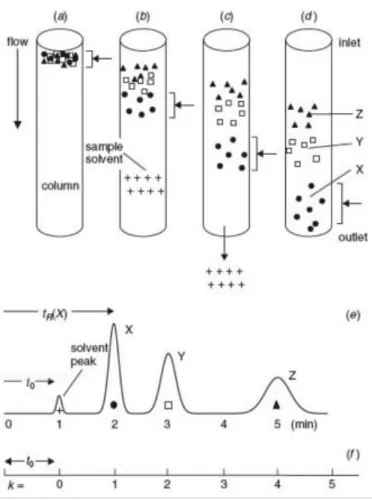
The principle of chromatography is based in a differential migration process, where each mixture component travels through the chromatographic column (Carta, G., & Jungbauer, 2010). The chromatographic system is consisted by the stationary phase material, an absorbent, which is packed into a tube and by the mobile phase. The adsorbent and mobile phase properties depend on the chromatographic technique used by the operator (Hedhammar et al., 2006). The separation occurs due to the different degree of in interaction between the substances to be separate and the stationary phase. The components that interact more strongly with the stationary phase are retarded and are eluted later, while those that interact more weakly travel more quickly and are eluted sooner, (Carta, & Jungbauer 2010).Therefore, the speed of a migrating sample component depends on whether the component has an affinity for the stationary or for the mobile phase (Figure 1.2.1).
2
Figure 1.2.1 – Representation of component separation and its residence time.
Biomolecules are purified and separated according to their specifics proprieties, such as, charge, hydrophobicity, size or biospecific interaction (Table 1.2.1) (GE Healthcare, 2004). These properties imply different types of stationary phases and chromatographic mechanisms (Figure 1.2.2); for example, Ion Exchange Chromatography (IEC) separates biomolecules according to surface charge differences (GE Healthcare, 2004).
Table 1.2.1 – Chromatography techniques and their specifics proprieties (GE Healthcare, 2004)
Technique Proprieties
Ion Exchange Chromatography (IEC) Charge
Hydrophobic Interaction Chromatography (HIC)
Reversed Phase Chromatography (RPC) Hydrophobicity Gel Filtration (GF) (or Size Exclusion) Size
3 Ion exchange Hydrophobic
interaction Reversed phase Gel filtration Affinity
Figure 1.2.2 - Separation principles in chromatographic purification, adapted from (GE Healthcare, 2004).
Hydrophobic interaction chromatography (HIC) is based on the interaction between the protein hydrophobic residues and the hydrophobic groups on the support. The proteins are retained differently depending on the exposed hydrophobic amino acids (Nfor et al., 2011). The conditions of HIC separations are usually the opposite conditions of those used in IEC. The protein mixture is loaded on the column in a buffer with high salt concentration (Queiroz et
al., 2001), and the molecules are eluted by decreasing the ionic strengh. The most commonly
used matrices in HIC are agarose, silica and organic polymer resin (Hedhammar et al., 2006). Ammonium sulphate ((Na2)SO4) and sodium sulphate (Na2SO4) are often used in HIC
(Hedhammar et al.,2006).
Reversed phase chromatography (RPC) and HIC are very similar, since are both based on the hydrophobic interaction between the adsorbent ligands and the protein residues, however the ligands in RPC promote stronger hydrophobic interactions than the ligands in HIC (Hedhammar
et al., 2006). For this reason the buffer used in both separation techniques is different. On
one hand, HIC uses the decrease in ionic strength to promote the elution and RPC requires the use of organic solvents and other additives to desorb the protein (Hedhammar et al., 2006). However the use of organic solvents can lead to protein denaturation. The most popular base matrix used in RPC is porous silica beads with modified Si-OH groups. This stationary phase is mechanically strong and also chemically stable. When, the RPC mobile phase is polar (aqueous), the protein is strongly bound to the stationary phase. Molecules are eluted by employing organic solvents to the mobile phase, which decreases its polarity. The most used
4 organic solvent are acetonitrile and methanol. Ethanol and isopropanol may also be used. (Hedhammar et al., 2006).
Another technique required for biomolecule purification is affinity chromatography (AC). In this case the biomolecules binding may involve a combination of electrostatic and hydrophobic interactions, as well as molecular forces such as van der Waals and hydrogen bonds. In this method a specific ligand is covalently attached to an inert matrix (Hedhammar
et al., 2006). The sample is applied under conditions that favors specific and reversible
binding of the target biomolecule to the ligand. The stationary phase is typically a gel matrix, often agarose, and should have suitable chemical groups on which the ligand can be covalently coupled. Also must present a relatively large surface area available for attachment and must be inert to the solvents and buffers employed in the process, especially during biomolecule elution. In AC, the binding buffer should interact efficiently with the target molecule and the ligand so non-specific interactions are minimized. In most cases the binding buffer is also used to wash unbound substances from the column without eluting the target molecules. This requires careful variation of the flow rate since if the sample is pumped too quickly, proper binding may not take place. The elution is promoted by breaking the interaction between the target molecules and the ligand. This may be done in different ways one ligand-biomolecule interaction is often based on a combination of electrostatic and hydrophobic interactions, van der Waals forces and hydrogen bonds. Among the different elution possibilities, is the pH change that affects the ionization state of groups in the ligand and in the target molecule; also, a buffer ionic strength increment promotes the elution of biomolecule bounded predominantly by electrostatic interactions. AC is commonly used in the purification of recombinant proteins(Hedhammar et al., 2006).
Unlike other techniques mentioned above, gel filtration or size exclusion chromatography (SEC) does not separates the biomolecules according to a propriety that lead to interaction with matrices. In SEC the separation occurs according to molecular weight, in other words, occurs by the differential exclusion or inclusion within the porous particles (Hedhammar et
al., 2006). In SEC, the matrix consist in porous particles and separation is achieved according
to the size and the shape of the molecules, as shown in Figure 1.2.2. The SEC matrices, are often composed of natural polymers such as agarose or dextran, but may also be made of synthetic polymers such as polyacrylamide or silica (Li et al., 2010). The biomolecule separation made using a SEC column, where the small molecules are retained more easily because they have more channels they can access. On the other hand, larger molecules are, for steric reasons, excluded from the channels, and pass quickly through the beads. This leads to retardation of smaller molecules in comparison to the larger ones. The different pore sizes are obtained by cross-linking (Fekete et al., 2014; Hedhammar et al., 2006). In SEC, is not necessary the change in composition of the mobile phase, but the strategy used, in order to reduce electrostatic interactions, is to increase the ionic strength with a well-defined pH and
5 ionic composition that permits substances of interest preservation conformational structure and biological activity (Fekete et al., 2014). The elution in SEC is isocratic and biomolecules are eluted with the decreasing of its size. SEC can be used for different purposes, matrices with smaller pores are generally used for rapid desalting procedures or for peptide purification, and the larger pores are used for small proteins, while very large ones are used for biological complexes (Hedhammar et al., 2006).
1.3 Ion Exchange Chromatography
The interest in large-scale isolation of proteins with commercial value is increasing which demands of more effective and reliable purification methods. Ion exchange chromatography (IEC) is widely employed in pharmaceutical industries on peptide and protein purification (Bowen & Pan, 1997). The proteins can preserved their native structure and biological activity during these processes, since the IEC separations usually occur in the presence of aqueous buffers and hydrophilic surfaces (Korfhagen et al., 2010; Staby et al., 2007).
IEC is based on ionic interactions of proteins and on molecule separation through the competition between proteins with different surface charges for oppositely charged groups on an ion exchanger adsorbent (Korfhagen et al., 2010; Hedhammar et al., 2006; Harinarayan et
al., 2006). Each protein has both positive and negative charges that will contribute to the net
surface charge of proteins. This varies according to their structure and chemical microenvironment, such as the surrounding pH. As previously referred, the IEC separates proteins according to the reversible interaction between a charged protein and an oppositely charged adsorbent. Therefore, a protein will bind to a positively charged stationary phase, an anion exchanger, when the pH is above its isoelectric point (pI). On the other hand, when the surrounding pH is below to the protein pI, it will bind to a negatively charged surface, in other words, a cation exchanger (Hedhammar et al., 2006; GE Healthcare, 2004).
The buffer pH and ionic strength are selected according to the characteristics of the target protein. The protein-adsorbent interaction can be reduced by changing the mobile phase pH or the salt concentration. The required change in the salt concentration depends on the molecule charge and on its binding strength to the stationary phase. Usually the samples are eluted with NaCl, but also both potassium chloride (KCl) and lithium chloride (LiCl) can be used (Thrash Jr & Pinto, 2002). These ions compete with the protein for the binding sites on the resin. The weakly charged proteins will be the first to elute, while the stronger ones will require higher salt concentrations in order to elute. The column is then re-equilibrated with
6 the equilibration buffer before applying more samples in the next run. IEC is a very powerful separation tool, because it is highly selective and specific.
The wide use of IEC has been providing countless works. The anion-exchange chromatography is the most common chromatography technique in plasmid DNA purification. Eon-Duval and Burke (2004), used anion-exchange chromatography to remove RNA in a RNase-free plasmid purification process as a polishing step. This was possible through careful selection of adsorbent and operating conditions as well as RNA reduction steps before chromatography. This is an example of one of many works made by IEC technique. Recombinant monoclonal antibody purification is another example for the employ of anion-exchange chromatography. The anion-exchange chromatography is used to bind trace levels of impurities and potential contaminants such as DNA, host cell protein, and virus, while allowing the antibody to flow through (Knudsen et al., 2001; Liu et al., 2011).
1.4 Properties of the ion exchange resins
A wide variety of adsorption resins are currently in use in industry for the purification of proteins. Thus, the selection of resins is based on previously acquired knowledge and on specific application. Consequently, it is essential to understand the specific features of each resin (Dismer & Hubbuch, 2007) and the differences between them (Muller, 2003).
The resins differ with respect to the base resin as well as to the surface chemistry (Muller, 2003), which carries the chromatographic functions. The base resins can be divided into synthetic polymers (such as polystyrene-divinylbenzene, methacrylates, acrylamides) and natural polymers (among them dextran and cellulose). The synthetic polymers are rigid with strong resistance to hydrolysis, have a high density of hydroxyl and diol groups and exhibit a low degree of swelling both in water and in organic solvents. On the other hand, the natural polymers are very hydrophilic and can be easily derivatized, however they have poor mechanical strength. The surface chemistry, which provides resins functionality, could be ionic, hydrophobic or with affinity ligands. In addition, the resin performance is influenced by the ligand density and its the spatial accessibility (Müller, 2005).
The ligand immobilization can be classified in three different methods, namely derivatization with low-molecular-mass ligands, derivatization with high-molecular-mass ligands (polymers) and graft and block polymerizations (Müller, 2005). All of these methods are in use.
The resin performance is usually determined by two parameters: static binding capacity (SBC) or equilibrium binding capacity and dynamic binding capacity (DBC) (Carta, 2012). Both methods are usually measured using standard proteins, such as Bovine Serum Albumin (BSA)
7 (Staby et al., 2007). The SBC is determined by batch adsorption tests. The loading protein value is calculated according to the amount of bounded protein by mass balance, which is used for isotherms determination and for characterization of batch processes (Müller, 2005; Carta, 2012). The DBC is usually measured in a packed column and is defined as the amount of protein bound in a column when the effluent concentration reaches a certain percentage of the feed concentration (Carta, 2012). The DBC can be 5 to 10 less than the equilibrium or maximum binding capacity (Müller, 2005).
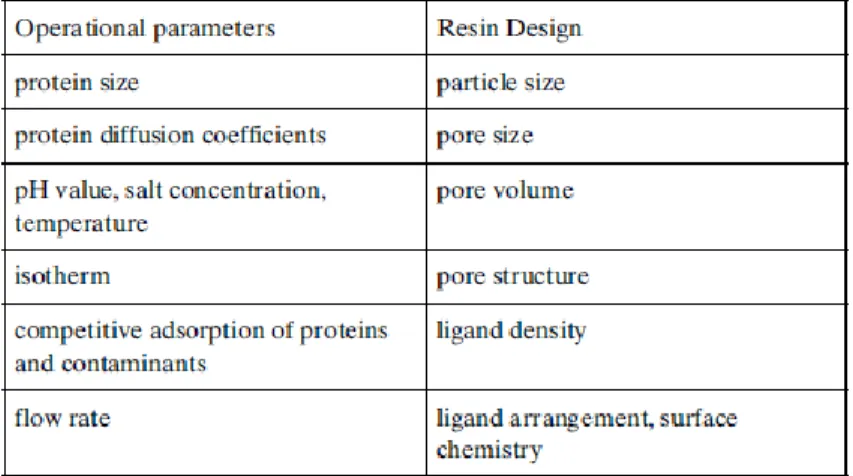
DBC is influenced by different parameters, operational ones (for example mobile phase conditions) and the ones related with the resin characteristics (Table 1.4.1).
Table 1.4.1- Operational parameters and resin design, which influence the DBC, taken from (Müller, 2005)
In terms of mobile phase conditions, the buffer conductivity and pH are important parameters that may affect the DBC results. Generally, the resin capacity for a given protein decreases as the buffer conductivity increases and also when the protein net charge decreases (Hardin et
al., 2009).
In addition to the features already mentioned, the DBC is also influenced by the surface modification procedure (Müller, 2005). The surface modification affects the mass transfer properties, the magnitude of the binding capacities and sometimes may induce non-specific interactions, which is capable to affect both positively and negatively the adsorption properties for specific protein.
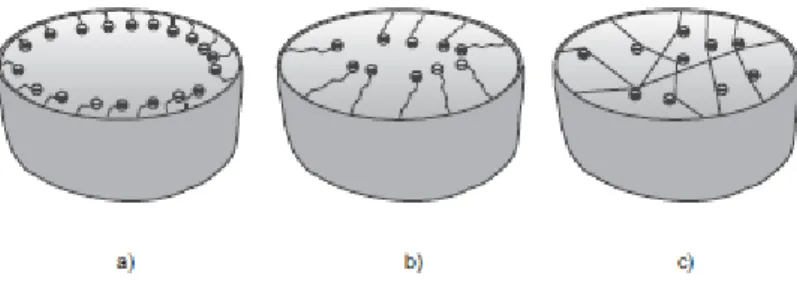
Three different approaches can be used to connect the ligands to the matrix. The ligands can be linked by classical chemistry reactions with spacers or by using polymers grafted into the pores of a resin, as can be seen in Figure 1.4.1:
8
Figure 1.4.1– Ligand architecture in the resin pore: a) without spacer, b) with spacer and c) polymeric modification (Müller, 2005).
According to Müller (Müller, 2005), the optimization of the structure and pore volume can improve the resin and may also enhance mass transfer, increasing the DBC.
9
Chapter 2 – Adsorption process
Ion exchange chromatography is commonly used in the pharmaceutical industry, mainly for the separation and purification of proteins since it has several advantages as highlighted in Chapter 1. However, it is not easy to understand the mechanism of protein adsorption, since it may involve several types of additional interactions, such as van der Waals, hydration or steric. It is of interest to understand the fundamental factors that control adsorption to provide the optimization of chromatographic processes (Thrash Jr & Pinto, 2001; Thrash Jr & Pinto, 2002; Roth et al., 1996). Thus, in the scale-up and optimization of chromatographic systems for protein purification, empirical and semi-empirical isotherm models have to be applied (Thrash Jr & Pinto, 2001; Thrash & Pinto, 2006; Xu & Lenhoff, 2009). In the last years a number of models have been proposed to describe protein retention.
The Langmuir isotherm is the most sample model used to describe one component protein adsorption. Langmuir model is based on basic considerations molecules are adsorbed on fixed number, with each site only accepting one molecule and adsorbed molecules are organized as a monolayer. In addition, all sites are considered energetically equivalent and there is no interaction between adsorbed molecules. This model does not taken into account the solute-solute interactions. At low solute-solute concentration, the isotherm shows a linear relation between the absorbed amount and the equilibrium solute concentration on the mobile phase. At higher concentration, all adsorption sites become saturated, inducing a curvature of the isotherms to an asymptotic (Bellot & Condoret, 1993). However, some complex systems cannot be correctly described by the Langmuir isotherm.
In ion exchange adsorbents protein isotherms are also often estimate by the stoichiometric displacement model (SDM) and the steric mass action model (SMA).
The SDM, Rounds and Regnier (Rounds & Regnier, 1984), describes protein retention in linear IEC and assumes that the adsorption only occurs by an ion-exchange mechanism. This model considers that the entire ion-exchange capacity is available for protein adsorption and both surface and mobile phases are thermodynamically ideal. The SDM is currently used at low protein loading, but some works have already applied at higher solute concentrations (P Raje & Pinto, 1998). However, SDM do not present satisfactory results under overloaded conditions, since does not take into account other effects besides the primary adsorption mechanism (Raje & Pinto, 1997; Raje & Pinto, 1998; Bellot & Condoret, 1993).
The SMA model, proposed by Brooks and Cramer in 1992, is based on the SDM and uses a correction factor which takes into account some non-ideal interactions (Gallant et al., 1995; Korfhagen et al., 2010). This model considers the effects of biomolecule steric hindrance
10 (Raje & Pinto, 1997) and is widely employed for multi-components equilibria (Gallant et al., 1995). In IEC, Cramer and co-workers (1995) have focused on the salt dependence of protein adsorption. According to these investigators, SMA model could be applied under overloaded conditions, since this model offers the ability to predict elution at various salt concentration and also non-linear adsorption and displacement effects (Gallant et al., 1995).
The non-ideal surface solution (NISS) model is also based in SDM. Was originally proposed by Li and Pinto in 1994 and describes the non-ideal surface effects in a thermodynamically manner. The adsorbent phase is considered as a non-ideal surface solution and the major source of non-ideal behavior is assumed to be dominated by nearest neighbor interactions between adsorbed proteins (Raje & Pinto, 1997).
Raje and Pinto (Raje & Pinto, 1997) combined SMA and NISS model in order to know which effects actually limit protein adsorption (Raje & Pinto, 1998). It was concluded that for the adsorption under overload conditions, adsorption isotherms data are unable to reveal which of the two effects, steric interactions or non-ideal surface, is dominant (Raje & Pinto, 1998). They concluded that in order to correctly characterize steric hindrance and surface interactions between adsorbed molecules with the SMA-NISS model, it is necessary to have an adsorption isotherm as well as the adsorption heat data. Raje and Pinto also demonstrated that salt-salt interactions on the surface cannot be neglected, since the protein surface activity is strongly affected by the salt (Raje & Pinto, 1997).
Other protein isotherm model described in the literature is the colloidal model proposed by Oberholzer and Lenhoff (Oberholzer & Lenhoff, 1999). The protein is treated as a sphere which possesses a fixed surface potential (Thrash & Pinto, 2006). Oberholzer and Lenhoff mentioned that in a solution of a single protein or in a monodisperse suspension, adsorption usually does not exceed a monolayer. Thus, the fractional surface coverage is the quantity of interest (Oberholzer & Lenhoff, 1999). This model takes into account the particle-surface interactions that depend on the extent of lateral interactions between the adsorbed molecules. When the surface coverage is low, the influence of lateral interactions is minimal, which leads to a linear isotherm. With the increasing of the covered area, surface exclusion effects appear due to the electrostatic interactions. The linear behavior is then corrected taken into account the repulsion among adsorbed particles (Oberholzer & Lenhoff, 1999). Nevertheless, the colloid method is limited since the protein is assumed to be a sphere and the determination of the surface potentials is difficult at high salt concentrations (Thrash & Pinto, 2006).
In addition to the models already mentioned and described, other models tried to capture more detailed contributions, such as protein structural properties, protein conformational change and aggregation (Xu & Lenhoff, 2009). However, some factors are treated as independent parameters since the difficulty of experimental verification. Computationally
11 approaches have also been used to model isotherms from protein molecular interaction potentials. Molecular dynamics (MD), Monte Carlo (MC) and Brownian dynamics (BD) have been used to model adsorption proteins onto different surfaces.
In industries, the separation and purification processes made under linear conditions have high costs. A way to reduce the costs is to increase the throughput, increasing the product per time unit (Müller, 2005), however, operate in the overloaded mode is considerably more complex than in the linear mode, since suitable models, able to predict the behavior of separation, do not exist. This is the main impediment in the design and implementation of scaled-units (Korfhagen et al., 2010).
12
Chapter 3 - Calorimetry
Due to regulatory concerns, separation and purification industry needs to understand the adsorption process.
The fundamental understanding of proteins IE separation could be significantly improved if it was possible to develop a rigorous knowledge of the process energetic. Thermodynamics quantities, as enthalpy (ΔH), entropy (ΔS) and free energy (ΔG) can be estimated using the van’t Hoff equation or using calorimetric methods combined with a measured adsorption isotherms (Draczkowski et al., 2014; Kim et al., 2013). Therefore, calorimetry can be seen as a thermodynamic tool to explore the underlying mechanisms involved in protein adsorption (Katiyar et al., 2010; Stademan & Wadso, 1995). This thermodynamic analyses helps to elucidate some questions about how the proteins interact with the absorbent, particularly at high solute concentrations.
The Gibbs free energy (ΔG) determines the equilibrium capacity of a protein on a adsorbent surface, which, in turn, depends on the enthalpy and entropy (Katiyar et al., 2010). Since the interaction between the protein and the adsorbent creates heat during the adsorption process, this heat can be measure with calorimetric methods such as isothermal titration calorimetry (ITC) and flow microcalorimetry (FMC) (Kim et al., 2013).
The ITC and FMC are both calorimetric methods used to measure the energy involved on a specific adsorption process. In ITC, the heat signal can be measured in solution or in suspension in a fed-batch cell. This technique characterizes the heat of adsorption generated between the protein and the adsorbent, including the heat of protein dilution, the heat of gel dilution, recognition interaction, ligand binding and others (Bouchemal, 2008; Huang et al., 2000).
ITC experiment is carried out in the addition of biomolecule solution to a buffer solution with suspended adsorbent particles in a fed-batch cell (Draczkowski et al., 2014). In this experiment after each injection, solution adsorbs or generates a certain amount of heat which is proportional to the amount of ligand binding to the protein and enthalpy characteristic of the interaction. The value of the heat released or adsorbed is determined by integrating the peak signal (Draczkowski et al., 2014).
Several studies have been done by applying the ITC technique (Bowen, & Hughes, 1993; Bowen & Pan 1997; Huang et al., 2000). One, reported by Bowen and Hughs in 1993 (Bowen & Hughes, 1993), studied the adsorption of bovine serum of albumin (BSA) onto two anion exchangers at different conditions (0.01 M Tris without and with 0.06M or 0.11M NaCl). They have observed that in the absence of NaCl the adsorption was high, but the increasing of NaCl
13 concentration decreases the interaction. Furthermore, through the analysis of ITC, adsorption in the NaCl absence was an exothermic process. In Tris/0.06M NaCl, the initial adsorption was exothermic but the overall process became endothermic. On the other hand, in Tris/0.11M NaCl solution the adsorption was entirely endothermic. They concluded that the overall energetic change involved on the adsorption of a protein molecule onto an ion exchanger surface is the sum of a number of different events. They also stated that the rearrangement of solvents molecules leading to an increase in entropy in the system might be the driving force for spontaneous adsorption under conditions where the overall process is endothermically driven. In addition, the rearrangement of protein structure and the intramolecular hydrophobic interaction of protein molecules may affect the ion-exchange process due to its hydrophobicity and low structural stability, the BSA molecule is sensitive to the solution conditions and consequently the adsorption enthalpy change will vary depending on the applied conditions.
Yamamoto and co-workers (Chen et al., 2007) have also used the ITC technique to investigate possible hydrophobic interactions of ion-exchanges during protein adsorption from mild to high ionic strengths. They studied the interaction between two proteins (lysozyme and myoglobin) and cation exchanger resin at various pH (4 and 6) values and salt concentrations. In this work, the hydrophobic interactions between ligands and proteins were evalueted at different ionic strengths. They reported that the hydrophobic interaction is crucial to this ion-exchange binding system. The thermodynamic data demonstrated that the adsorption is mainly entropy-driven and that the enthalpy is more prominent at pH 4, where electrostatic interactions dominates the adsorption phenomenon. The increasing of the salt concentration induces an enthalpy increment and, consequently, entropy also increases, since more system chaos results from free water molecules. It was also demonstrated that the hydrophobic interaction at pH 6 drives the lysozyme binding interaction and that more hydrophobic interactions are created at higher salt concentration. These investigations showed a binding mechanism controlled by electrostatic to one controlled by hydrophobic interactions.
To conclude, ITC can be also considered a powerful technique for the determination of affinity, stoichiometry, and absolute thermodynamic parameters in receptor–ligand interactions. These parameters reveal the nature of physical processes involved in the binding reaction and leads to a better understanding of the investigated interaction.
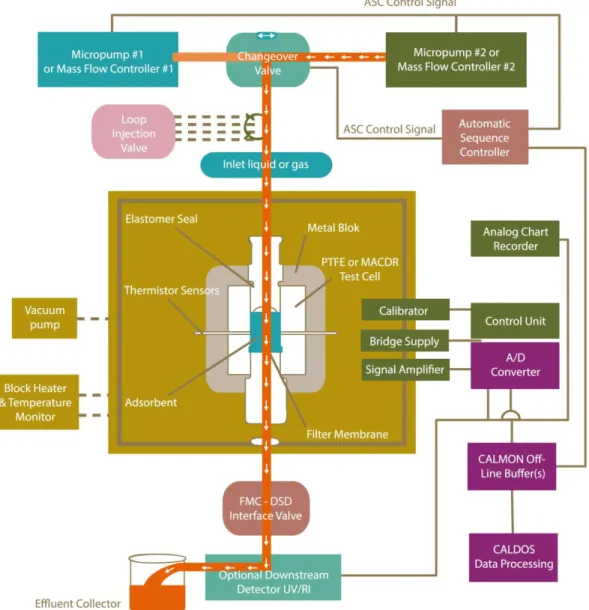
FMC is a more dynamic means of measuring corresponding once its done the enthalpy changes to protein adsorption and desorption on a small column, under flow conditions. This approach allows a better understanding of the driving forces and mechanisms involved on the protein adsorption process, even in complex experimental situations such at overloaded conditions, in presence of non-ideal mobile phases and when strong interactions between proteins adsorbed on the surface are present (Diaz et al., 2005; Kim et al., 2013). The FMC simulates
14 a liquid chromatography process and is capable to detect small variations of heat, associated with the interaction of proteins with the surface adsorbent. A schematic representation of the flow microcalorimeter is shown in Figure 3.1. The temperature changes caused by the protein adsorption is converted to a heat signal using an experimentally determined calibration factor, which was obtained via electrical energy dissipation in the cell under flowing conditions (Raje & Pinto, 1998).
Figure 3.1 - Microscal Flow Microcalometrer schematic representation.
The FMC provides the enthalpy change of adsorption, Δ , which can be exothermic and/or endothermic. Exothermic peaks result in temperature increases, whereas endothermic peaks are caused by a temperature decrease (Katiyar et al., 2010).
15 Previous studies suggested that in IEC, the exothermic adsorption is associated with the attractive forces between the adsorbed protein and surface. The presence of endothermic heat is associated with several factors such as repulsive interaction between the adsorbed protein molecules, repulsive interaction between hydrophobic groups on the protein surface and hydrophilic regions on the adsorbent surface, and repulsive interaction between charged groups on the protein surface and charged surface sites on the adsorbent which have the same charge. Also, endothermic adsorption is often associated to changes of protein conformation, protein reorientation or water release from the surface (Katiyar et al., 2010; Korfhagen et al., 2010; Thrash & Pinto, 2006).
Pinto and co-workers (Thrash et al., 2004) made some studies of BSA adsorption on an anion-exchange adsorbent in order to understand the mechanism of protein-adsorbent interaction in IEC. For this, they applied the FMC and isotherm measurements in the linear and overloaded conditions. It was observed under all the condition (effects of salt type, salt and protein concentration and temperature) the adsorption process was entropically driven. The calorimetric data showed that the BSA adsorption onto the anion exchanger causes water release, which was previously described to only happen in the adsorption onto hydrophobic surfaces (Thrash et al., 2004). It was showed that the release of water is large enough to overcome the unfavorable enthalpic energy change at 25ºC. However, at 37◦C the free energy reduction from water release was not always sufficient to overcome unfavorable enthalpic effects. At the higher temperature it was suggested that the entropy increase associated with structural rearrangement was also contributing to the entropic driving force responsible for BSA adsorption.
In other study (Esquibel-King et al., 1999) FMC was used to determine the adsorption heat of BSA onto a HIC surface under linear and overloaded chromatographic conditions. The heat of adsorption data also confirmed that the BSA adsorption under linear isotherm conditions was driven by entropy changes resulting from the release of water molecules. However, it was shown that conclusions reached under linear conditions cannot, in general, be extrapolated to the non-linear region. Furthermore, they have reported that enthalpy of adsorption obtained with a van’t Hoff analysis do not satisfactorily corresponds to the enthalpy of adsorption under overloaded conditions.
Another similar study (Silva et al., 2014), investigated the adsorption mechanism of lysozyme onto a cation exchanger (carboxymethyl cellulose (CMC)). The experiments were conducted both in the absence and presence of salt (NaCl 50mM) at pH 5, using FMC and adsorption isotherm measurements. This study proved that traditional approaches such isotherm measurements or van’t Hoff analysis can’t always provide all the information about the protein adsorption process, particularly when it occurs under overloaded conditions. The FMC data produced both endothermic and exothermic heats of adsorption, and have showed that, on this particular system, lysozyme moves from a side-on orientation, at lower surface
16 concentrations, to an end-on orientation at higher protein surface concentration, in order to accommodate more molecules. Also, Cabral and co-workers (2014) determined, through separate experiments, that in the contact zone between the protein and the adsorbent were present a high number of water molecules, which, when released, had a significant contribution to the entropic behavior (Silva et al., 2014).
All these studies, have confirmed that FMC is a useful technique, to understand the underlying adsorption mechanism associated with protein adsorption in the linear and in the overloaded isotherm zones.
17
Chapter 4 - Goal of study
As previously mentioned, it is well recognized that chromatography is the most effective tool used for downstream separation and purification of biomolecules (Korfhagen et al., 2010; Bellot & Condoret, 1993), and IEC is one of the most widely used techniques in industrial recovery of biomolecules (Chen et al., 2007).
The prediction of biomolecules adsorptive behavior onto chromatographic resins is still not completely understood. Also, it may be interesting to run the chromatographic processes in the overloaded mode. However operation under this condition is considerably more complex than linear chromatography, and suitable models do not exist (Korfhagen et al., 2010). The lack of appropriate models to adequately describe linear and non-linear mode of chromatography is a major impediment in the design and implementation of scaled-up units. Therefore,is essential a better understanding of the mechanisms underlying linear and non-linear chromatography of biomolecules.
Thus, the aim of this study is to understand the non-ideal interactions of BSA adsorption onto anion-exchangers under linear and overloaded conditions, through the study of protein adsorption isotherms and calorimetry, as a means to explore the underlying adsorption mechanism.
18
Chapter 5 – Experimental
5.1 Adsorption Isotherms
Adsorption isotherms were used as an experimental procedure to investigate mobile phase effect in the protein adsorption behavior.
Bovine Serum Albumin (Sigma-Aldrich) solution was prepared in a 20mM of Tris-HCl (Mw = 121.14g/mol) buffer solution at pH 9, using different concentrations of sodium chloride, 0, 50mM and 100mM, (NaCl, Mw = 58.44 g/mol). A protein solution volume of 1mL was transferred to a multi-well plate and then 10µL of commercial resins, kindly offered by TOSOH Bioscience, Toyopearl® DEAE 650M and Toyopearl® GigaCap Q-650M, were transferred into the protein solution. The plates were sealed with parafilm and placed in a shaker for 16h at 230rpm and 21.5ºC. After reaching equilibrium, the slurry solution was allowed to settle for a 30 minutes in Eppendorfs tubes. The supernatant was removed with a filter (0.22µm) syringe and the absorbance of all the filtrated solutions were measured at 280nm, with a UV spectrophotometer (Amersham Biosciences, Uppsala, Sweden) to obtain the equilibrium solution concentration. A mass balance was applied in order to know the amount of protein bound to the adsorbent. The isotherm plot was obtained by representing BSA surface concentration against protein equilibrium liquid concentration.
5.2 Flow microcalorimetry
The Flow Microcalorimetry system (Microscal Ltd, London, UK) is operated similar to a liquid chromatographic system and can work under flow (FMC) or in static condition (ITC). In this study flow conditions were used.
19
Figure 5.2.1 – Microcalorimeter (Microscal Ltd, London, UK) in a CICS-UBI laboratory.
The system has a column of 171 µL and was packed with the chromatographic adsorbent to be studied (Toyopearl® DEAE 650M). After packing, the system was left to equilibrate for 24h with a constant flow rate of 1.5mL/h (controlled by precision syringe micropumps) with Tris-HCl 20mM at pH 9 in absence or in presence of 50mM and 100 mM NaCl. The BSA solutions were prepared in the respective buffers and injected through a sample loop (230 μL) at a constant flow rate of 1.5 mL. The effluent was collected and analysed with a UV spectrophotometer (Amersham Biosciences, Uppsala, Sweden) at a wavelength 280 nm. From a mass balance, the amount of protein adsorbed was calculated. CALDOS 4, was used to acquire store, calibrate and processes enthalpy data interactions. The enthalpy is then divided by the amount of protein adsorbed and plotted against the protein surface concentration.
20
Chapter 6 – Discussion
6.1 Adsorption isotherms onto anion exchange resins at
selected pH and different salt conditions
In order to understand the ion exchange adsorption mechanisms, the study of adsorption isotherms is essential to evaluate the adsorption. So, isotherms measurements for bovine serum albumin (BSA) onto a weak and strong anion exchanger were performed, in order to evaluate the salt effect. For both resins three different salt conditions were tested.
Bovine serum albumin (BSA) adsorption onto a Toyoperal® DEAE-650mM resin, a weak anion exchanger and Toyopearl® GigaCap Q-650M resin, a strong anion exchanger, were performed both in Tris-HCl buffer carried at pH 9 in absence of salt and in presence of NaCl 50mM and 100mM. The adsorption isotherms of Toyoperal DEAE-650mM resin are represented in Figure 6.1.1 and 6.1.2. Figure 6.1.2 represents a “zoom in” of low protein equilibrium concentration zone. Results for Toyopearl® GigaCap Q-650M resin are represented in Figure 6.1.3 and the “zoom in” of low protein equilibrium concentration zone in Figure 6.1.4.
Figure 6.1.1 – Adsorption isotherms for BSA on Toyoperal® DEAE-650mM resin at pH 9 in Tris-HCl buffer in absence of salt and in presence of NaCl 50mM and 100mM. Red circles: Absence of salt; Green triangles: NaCl 50mM; Blue diamonds: NaCl 100mM.
21
Figure 6.1.2– “Zoom in” of low protein equilibrium concentration zone of the isotherm for BSA on Toyoperal DEAE-650mM resin at pH 9 in Tris-HCl buffer in absence of salt and in presence of NaCl 50mM and 100mM. Red circles: Absence of salt; Green triangles: NaCl 50mM; Blue diamonds: NaCl 100mM.
By analyzing the isotherm profile for BSA on Toyoperal® DEAE-650mM resin, at the lower protein equilibrium concentrations, at both conditions (in absence and presence of salt), it can be seen that the curve is similar to a Langmuir isotherm profile (Bellot & Condoret, 1993). In the isotherm linear region (Figure 6.1.2), where equilibrium solution concentration of the protein is low, BSA loading is greater in the absence of salt when compared to the presence of salt (50mM and 100mM NaCl). Also, BSA distribution coefficient in the isotherm linear region, is higher when compared to the presence of salt (Figure 6.1.2). This is expected due to the screening effect of NaCl (Chen et al., 2007), as the overall charge of the biomolecule and support is reduced due to the presence of salt ions.
At each salt concentration (0, 50mM and 100mM NaCl), with increasing protein solution equilibrium concentration an increase from zero capacity to a plateau region is observed. Figure 6.1.1 shows clearly the presence of the plateaus. In absence of salt, this plateau is reached at about 200 mg BSA/ml DEAE-650M, whereas in presence of salt, this is achieved approximately at 20-30 mg BSA/ml DEAE-650M. The plateau is compatible with the establishment of a mono-layer, the lower values obtained in presence of salt can be explained, as previously discussed, by the screening effect of NaCl. After the plateau, around 30 mg/mL of protein solution equilibrium concentration, it is observed an increase in capacity. This behavior may suggest the formation of BSA multi-layers on the surface or the reorientation/alteration of conformation of adsorbed proteins to accommodate more molecules (Jachimska & Pajor, 2012).
22 As mention, the adsorption isotherms of Toyoperal® GigaCap Q-650M resin were also obtained (Figure 6.1.3 and 6.1.4. Figure 6.1.4 represents a “zoom in” of low protein equilibrium concentration zone). As expected, for lower protein solution equilibrium concentrations GigaCap Q-650M resin shows higher loading surface concentrations than DEAE-650M, once it is a stronger anion exchanger. The DEAE-650M is considered a weak anion-exchanger (it as a ternary amine group as ligand), on the other hand GigaCap Q-650M is considered a stronger anion-exchanger (it as a quaternary amine as ligand). Furthermore, Toyopearl® GigaCap Q-650M is produced using a third generation ligand attachment chemistry which allows a better access from biomolecules to the ligand binding site (Müller, 2005).
Figure 6.1.3 – Adsorption isotherms for BSA on Toyopearl® GigaCap Q-650M resin at pH 9 in Tris-HCl buffer in
absence of salt and in presence of NaCl 50mM and 100mM. Red circles: Absence of salt; Green triangles: NaCl 50mM;
Blue diamonds: NaCl 100mM.
The GigaCap Q-650M resin showed a more rectangular Langmuir isotherm shape than DEAE- 650M resin, which is not strange as the later support is considered, as mention, a weak anion-exchanger. The loading capacities observed in the first plateau region follow the same sequence observed with DEAE-650M (higher capacities in absence of salt followed by a decreasing in capacity as salt concentration increases).
23
Figure 6.1.4 – “Zoom in” of low protein equilibrium concentration zone of the isotherm for BSA on Toyopearl®
GigaCap Q-650M resin at pH 9 in Tris-HCl buffer in absence of salt and in presence of NaCl 50mM and 100mM. Red circles: Absence of salt; Green triangles: NaCl 50mM; Blue diamonds: NaCl 100mM.
Another interest feature of the GigaCap adsorption isotherms is observed for higher loading concentrations (Figure 6.1.3). In this region BSA surface concentration seems to be greater in the presence of 50mM of NaCl when compared to absence of salt. This behavior may also be explained by salt screening effect under overloaded conditions. Here, three mechanisms might promoted BSA adsorption: multilayer formation and/or protein reorientation and/or structural rearrangements. All this mechanism are favored when repulsion between the charge is reduced, which is achieved in the presence of low salt concentration.
By analyses of these data along with enthalpic data, an explanation for this behavior may be advanced.
24
6.2 Microcalorimetry
As previously mentioned in Chapter 2, the FMC allows to measure the enthalpy heat changes related to the biomolecule-adsorbent interactions under flow conditions. Therefore, the FMC studies permit a better understanding of the driving forces and the mechanisms implicated on the protein adsorption process, even in complex experimental condition (Diaz et al., 2005; Kim et al., 2013).
In IEC, It is well established that the electrostatic attractions between a protein and an adsorbent surface are usually associated with exothermic peaks (Kim et al, 2011). On the other hand, endothermic adsorption is often attributed to the electrostatic repulsion between adsorbed proteins, surface dehydration or changes of protein conformation or orientation upon adsorption (Katiyar et al., 2010). Also, some calorimetric studies on IEC adsorbents have shown that protein adsorption could be endothermic (Thrash & Pinto, 2006) and associated with other processes in addition to ionic interaction. Endothermic heats of adsorption imply that the overall adsorption process is entropically driven, since the Gibbs free energy has to be negative for a favourable interaction (Thrash Jr & Pinto, 2002; Silva et al., 2014).
In this work, BSA adsorption onto a weak anion exchanger, Toyoperal DEAE-650M resin, was performed and the effects of salt at a specific pH were checked for a wide range of protein concentrations.
As already described in the Experimental section, the experiments were performed at pH 9 in Tris-HCl buffer 20mM in the absence and in the presence of 50 mM and 100 mM NaCl. The 230 μL loop was used with a constant flow rate of 1.5 mL/h. The BSA initial concentration varied in the range of 20 to 100 mg/mL in both buffers conditions. Figures 6.2.1, 6.2.2 and 6.2.3 represent the heat signal profile of the injections at the mentioned conditions. The protein loading varied from 6 to 42 mg BSA/mL DEAE-650M in the absence of salt, from 7 to 20 mg BSA/mL DEAE-650M at 50mM NaCl, and finally, from 4 to 14 mg BSA/mL DEAE-650M in the presence of 100 mM NaCl.
From Figures 6.2.1, 6.2.2 and 6.2.3, it can be observed distinct events for both conditions. Generally, it is shown an endothermic signal followed by an exothermic peak. However, in the salt presence (50mM and 100mM) at lower protein concentrations it is only observed the endothermic peak. In order to accomplish a better understanding of the processes that may be occurring simultaneously or sequentially, a peak de-convolution was performed using the PeakFit software package. Asymmetric Gaussian peaks were used. The integral heat of adsorption recorded by CALDOS was calculated from the area of the de-convoluted peaks. Figures 6.2.4, 6.2.5 and 6.2.6 show the PeakFit de-convolution of thermograms in the salt absence and in the presence of 50mM and 100mM of NaCl, respectively.
25
Figure 6.2.1 – Thermograms of BSA adsorption onto Toyopearl® DEAE-650M at pH 9 in Tris-HCl buffer 20mM in
absence of salt. Black line (− −): 6.1 mg BSA/mL DEAE-650M; Red line (− ∙ −): 11.9 mg BSA/mL DEAE-650M; Yellow line (−): 27.7 mg BSA/mL DEAE-650M. Vertical dashed line: time where the protein-containing plug of solution is replaced with protein-free mobile phase.
Figure 6.2.2 – Thermograms of BSA adsorption onto Toyopearl® DEAE-650M at pH 9 in Tris-HCl buffer 20mM in
presence of 50 mM NaCl. Black line (− −): 7.1 mg BSA/mL DEAE-650M; Green line (−): 14.1 mg BSA/mL DEAE-650M;
Orange line (−): 20.2 mg BSA/mL DEAE-650M. Vertical dashed line: time where the protein-containing plug of solution is replaced with protein-free mobile phase.
26
Figure 6.2.3 – Thermograms of BSA adsorption onto Toyopearl® DEAE-650M at pH 9 in Tris-HCl buffer 20mM in
presence of 100 mM NaCl. Purple (−): 4.3 mg BSA/mL DEAE-650M; Pink line (−): 8.1 mg BSA/mL DEAE-650M; Green line (−): 13.7 mg BSA/mL DEAE-650M. Vertical dashed line: time where the protein-containing plug of solution is replaced with protein-free mobile phase.
Figure 6.2.4 - PeakFit de-convolution of thermograms for BSA adsorption onto Toyopearl® DEAE-650M at pH 9 in
Tris-HCl buffer 20mM in absence of salt for loading concentration of (a) 6.1 mg BSA/mL DEAE-650M. Black line: experimental peak; Red line: generated peak; Blue line: de-convolutions peaks; Vertical line: time where the protein-containing plug of solution is replaced with protein-free mobile phase.
27
Figure 6.2.4 - PeakFit de-convolution of thermograms for BSA adsorption onto Toyopearl® DEAE-650M at pH 9 in
Tris-HCl buffer 20mM in absence of salt for loading concentration of (b) 11.9 mg BSA/mL DEAE-650M; (c) 27.7 mg BSA/mL DEAE-650M. Black line: experimental peak; Red line: generated peak; Blue line: de-convolutions peaks; Vertical line: time where the protein-containing plug of solution is replaced with protein-free mobile phase.
In the salt absence (Figures 6.2.4), it can be seen the endothermic and exothermic peaks began around 600 s after the beginning of the experiment and endothermic peak maximum is reached before the 1430 s. The vertical line (at 1430 s) represents the time when mobile phase plug containing the protein solution was replaced with protein-free mobile phase. Only after the 1430 s the exothermic peak reaches it maximum and returns to baseline. It can be also seen that the endothermic peak is still present after the protein plug comes out of the cell (1430 s).
(c) (b)
28
Figure 6.2.5 - PeakFit de-convolution of thermograms for BSA adsorption onto Toyopearl® DEAE-650M at pH 9 in
Tris-HCl buffer 20mM in presence of 50 mM NaCl for loading concentration of (a) 7.1 mg BSA/mL DEAE-650M; (b) 14.1 mg BSA/mL DEAE-650M; (c) 20.2 mg BSA/mL DEAE-650M. Black line: experimental peak; Red line: generated peak; Blue line: de-convolutions peaks; Vertical line: time where the protein-containing plug of solution is replaced with protein-free mobile phase.
(a)
(b)
29 In the presence of 50mM NaCl it is possible to observe two distinctive FMC profiles. On one hand, at lower protein loadings, it is only present an endothermic peak. On the other hand, at higher protein loadings the graphic shows the same profile as seen in salt absence (an endothermic peak followed by an exothermic peak). As already stated in the absence of salt, the endothermic peak began around 600 s after the beginning of the experiment and its maximum is reached before the 1430 s and the exothermic peak (when present) reaches it maximum after this time. In addition the endothermic heat is also present after the protein plug comes out of the column.
Figure 6.2.6 - PeakFit de-convolution of thermograms for BSA adsorption onto Toyopearl® DEAE-650M at pH 9 in
Tris-HCl buffer 20mM in presence of 100 mM NaCl for loading concentration of (a) 4.3 mg BSA/mL DEAE-650M; (b) 8.1 mg BSA/mL DEAE-650M. Black line: experimental peak; Red line: generated peak; Blue line: de-convolutions peaks; Vertical line: time where the protein-containing plug of solution is replaced with protein-free mobile phase.
(a)
30
Figure 6.2.6 - PeakFit de-convolution of thermograms for BSA adsorption onto Toyopearl® DEAE-650M at pH 9 in
Tris-HCl buffer 20mM in presence of 100 mM NaCl for loading concentration of (c) 13.7 mg BSA/mL DEAE-650M. Black
line: experimental peak; Red line: generated peak; Blue line: de-convolutions peaks; Vertical line: time where the protein-containing plug of solution is replaced with protein-free mobile phase.
Finally, in the presence of 100mM NaCl, it is shown a similar behavior as previously described in presence of 50mM NaCl, however, compared with the others conditions (absence of salt and presence of 50mM NaCl) were obtained lower values of protein loading (a maximum of 14 mg BSA/mL DEAE-650M).
In order to analyze the thermograms it is useful to considered the mechanism proposed by Yamamoto and co-workers (Lin et al,, 2001), who suggested that the ion exchanger adsorption can be divided into five sequential sub-processes: (i) water molecules and ions release from the protein surface; (ii) water molecules and ions release from the adsorbent surface; (iii) electrostatic and/or hydrophobic interactions between the protein and the ion exchanger; (iv) structural conformation rearrangement and reorientation of the adsorbed protein; (v) rearrangement of the excluded water molecules and ions in the solution. In this way, the source of endothermic heat signal could be related with sub-process (i), (ii), (iv) and (v) (Lin et al., 2001; Silva et al., 2014) and the exothermic heat signal could be due to sub-process (iii).
At all conditions of this study, when the exothermic peak is present it overlaps the endothermic peak, however, before the end of protein plug, the endothermic peaks area is greater than the exothermic peak area in the same interval. This indicates that the adsorption of BSA is entropically driven for the process to be energetically favorable, since the Gibbs free energy must be negative (Bowen & Hughes, 1993; Gill et al., 1994; Raje & Pinto, 1998; Thrash Jr & Pinto, 2002; Thrash et al., 2004; Silva et al., 2014). Bowen and Hughes (1993) suggested that when the enthalpy change is unfavorable towards the negativity of the ΔG value, there is a necessary increment of the entropic forces. In this process, water