NUEVA ´EPOCA REMEF
(THE MEXICAN JOURNAL OF ECONOMICS AND FINANCE)
VOLUMEN 7
N ´
UMERO 2
JULIO 2012
CONTENIDO
EDITORIAL IMEF
C.P.C. Jos´e A. Quesada Palacios (Presidente Nacional del IMEF)
REACCI ´ON DEL MERCADO DE VALORES MEXICANO ANTE LOS
ESC ´ANDALOS FINANCIEROS: EVIDENCIA EMP´IRICA.
Marcela Jaramillo Jaramillo (Universidad Aut´onoma del Estado de M´exico), Mar´ıa Antonia Garc´ıa Benau (Universidad de Valencia)(Ganador del 2do Lugar, Premio de Investigaci´on Financiera IMEF-2010). . . .129
SINCRONIZACI ´ON DE FASE EN LOS MERCADOS INTERNACIONALES
DE CAPITALES, EVIDENCIA DE INTEGRACI ´ON.
Salvador Cruz Ak´e (Instituto Polit´ecnico Nacional), Reyna Susana Garc´ıa Ruiz (Universidad Nacional Aut´onoma de la Ciudad de M´exico), Fernando Ram´ırez Alatriste (Universidad Nacional Aut´onoma de la Ciudad de M´exico)...155
AN EMPIRICAL ANALYSIS OF THE DIMENSIONS OF CORPORATE SOCIAL RESPONSIBILITY IN PORTUGAL
Sandra Afonso (Instituto Polit´ecnico de Bragan¸ca), Paula Odete Fernandes (Instituto Polit´ecnico de Bragan¸ca), Ana Paula Monte (Instituto Polit´ecnico de Bragan¸ca)...175
EL MODELO SABR Y SU RELACI ´ON CON LA GEOMETR´IA
DIFERENCIAL: VALUACI ´ON DE OPCIONES DE COMPRA DE D ´OLARES DEL BANCO DE M´EXICO
Guillermo Sierra Ju´arez (Universidad de Guadalajara)...185
EDITORIAL IMEF
Dentro de todo gran proyecto, el reto siguiente a la inauguraci´on o estreno p´ublico es continuar. La nueva ´epoca de la Revista Mexicana de Econom´ıa y Finanzas fortalece su con-solidaci´on en este segundo n´umero, cuya difusi´on busca posicionar el alto nivel del contenido como una referencia, entre investigadores y profesionales, en el ´ambito financiero, econ´omico y empresarial.
La informaci´on, conforme se comparte, genera conocimiento y riqueza intelectual en diversos niveles de la sociedad. M´exico, en v´ıas de desarrollo e incremento de su compe-titividad, busca potencializar las variables cuyo impacto generen soluciones a las diversas problem´aticas de ´ındole nacional. Es por ello que La Fundaci´on de Investigaci´on del Instituto Mexicano de Ejecutivos de Finanzas, A.C. (IMEF), en alianza con PwC, aportan, en excelente medida, valor al pa´ıs a trav´es del impulso y conexi´on a los principales actores, mismos que nos encaminan hacia una sociedad del conocimiento.
Asimismo, la aportaci´on de capital intelectual representa la continua evoluci´on del acervo, dado que las publicaciones son art´ıculos in´editos que buscan innovar, tanto teor´ıa como pr´actica, a trav´es del gran talento de sus editores e investigadores. Adem´as, debido al bajo n´umero de publicaciones mexicanas que se presentan en comparaci´on con los pa´ıses desarrollados, la Fundaci´on de Investigaci´on se suma a la intenci´on de mejorar el nivel y transmitir la riqueza de la informaci´on generada hacia los mexicanos.
Por otro lado, en atenci´on a las nuevas tendencias tecnol´ogicas, la REMEF ahora podr´a estar disponible a trav´es de una plataforma digital, misma que nos acercar´a a´un m´as al objetivo de posicionar el contenido con mejor direcci´on, es decir, extender la divulgaci´on de publicaciones mexicanas hacia contextos globales al romper las barreras de libro impreso.
Progresar es posible gracias a todos aquellos que creen en el proyecto y contin´uan aportando elementos clave y de calidad; sin duda el talento es y seguir´a siendo la fuente esencial de esta Revista Especializada.
AN EMPIRICAL ANALYSIS OF THE
DIMENSIONS OF CORPORATE
SOCIAL RESPONSIBILITY
IN PORTUGAL
Sandra Afonso
∗Instituto Polit´ecnico de Bragan¸ca
Paula Odete Fernandes
Instituto Polit´ecnico de Bragan¸ca; NECE (UBI)
Ana Paula Monte
Instituto Polit´ecnico de Bragan¸ca; NECE (UBI).
(Received 6 june 2012, accepted 16 july 2012)
Abstract
This paper investigates factors that can explain the motivations of Portuguese companies to a social performance. The study was based on a sample of nineteen large Portuguese companies, listed on the PSI 20 index, for a period of five year, since 2005 to 2009. A Factorial Analysis was applied to identify the dimensions of Portuguese Corporate Social Responsibility using variables reference on the Green Book of European Community Commission (ECC, 2001). The results produced two dimensions that may explain Portuguese corporate motivation social performance: (1) Standards and Legal Requirements and (2) Ethic and social conduct. Further research may be done to find correlations with these dimensions and financial and economic corporate performance.
Resumen
En este trabajo se investigan los factores que pueden inventivar a las empresas portuguesas a un desempe˜no social. El estudio se bas´o en una muestra de diecinueve grandes empresas portuguesas, que figuran en el ´ındice PSI 20, por un per´ıodo de cinco a˜nos, desde 2005 a 2009. Se realiza un an´alisis factorial que se aplic´o para identificar las dimensiones de la Responsabilidad Social Corporativa portuguesa utilizando variables de referencia en el Libro Verde de la Comisi´on de la Comunidad Europea (CEC, 2001). Los resultados obtenidos pueden en dos dimensiones que explique la motivaci´on del rendimiento social de la empresa portuguesa: (1)Normas y requisitos legales y (2) la conducta ´etica y social. Futuras l´ıneas de investigaci´on se puede hacer para encontrar la coorrelaci´on con estas dimensiones y el rendimiento empresarial financiero y econ´omico.
.
JEL Classification:M14, J24, H70.
Keywords: Corporate Social Responsibility, Multivariate Analysis, Portugal.
176 Nueva ´Epoca REMEF (The Mexican Journal of Economics and Finance)
1. Introduction
Globalization has increased the economic and financial interdependence of markets and countries, raising awareness about the consequences of a less responsible conduct undertaken by organizations. Society has increased its awareness about the impact of organizations activities, and hopes that they respond to their social demands, if they want to maintain long-term profits. Organizations will be better equipped to develop their business in community, if they contribute positively to that community (Davis, 1973). In this context, Corporate Social Responsibility (CSR) emerge as a way to organizations assume their responsibilities, and is assuming an increasingly importance globally. In the European context, the European Commission has developed several initiatives to promote CSR, but more than that, to put Europe on the path of excellence on CSR.
There are several reasons for this change, for example, corruption cases involving fraudulent accounting, the growing gap between the salaries of top managers and their employees, abusive practices, marketing of products harmful to public health, violation of human rights and environmental standards (Lama & Muyzenberg, 2008).
Other reasons cited are the shift of organizations towards social responsibility relates to the organizational changes and market driven by globalization and technological development (Zadek, 1999), namely “the transparency of business activities brought by the media and by modern information and communication” (ECC, 2001, p.4). Joining this with social responsibility it can become increasingly important, and “the business which vacillates or choose not to enter the arena of social responsibility, may find that it gradually sink into customer and public disfavor” (Davis, 1973, p. 321).
Heal (2004) argues that CSR has a role to play when the market fails through private-social cost differentials, particularly in two situations: (1) when the private economic costs are not aligned with social costs, for example, what is more profitable for the companies is not the best for the welfare of society; (2) when there are strong disagreements to what is perceived as fair by the companies and society. In both situations, the CSR can be used to produce the social welfare. Otherwise, if economic private costs and social cost are in line, CSR has, according to the author, little to add.
In the current context, characterized by social asymmetries, CSR has an important role in bringing the balance that should support a sustainable development. In this research we try to identify the dimensions that may influence the social performance of Portuguese companies, finding what moves companies into CSR.
2. Theoretical Framework
to make decisions, or to follow lines of action which are desirable in terms of the objectives and values of our society” (p. 270). According to the author businessmen were responsible for their actions not only with regard to economic performance, but in a broader context as well (Bowen, 1953, cited by Carroll, 1999).
Many definitions and conceptualizations have followed, suggested by an extensive literature, outlining a confusing framework, without unanimity on a universally accepted definition. The World Business Council for Sustainable Development (WBCSD), an organization that combines several international companies, that share commitment to a sustainable development, published in their Social Responsibility Report on 2000, the following definition: “Corporate social responsibility is the commitment of business to contribute to sustainable economic development, working with employees, their families, the local community and society at large to improve their quality of life” (WBCSD, 2000, p.10).
In the European context the first great impetus to the promotion of social responsibility, arise in 1993, through the “call made by President Jacques Delors to these companies to participate in the fight against social exclusion” (ECC, 2001, p.3), which resulted in a large membership. Later, in March 2000, on the Lisbon European Council, the European Union called again to the sense of corporate social responsibility as “regarding best practices on lifelong learning, work organization, equal opportunities, inclusion social and sustainable development” (ECC, 2001, p.3).
In the Green Paper, named “Promoting a European framework for corporate social responsibility”, ECC has defined CSR as “a concept whereby companies decide voluntarily to contribute to a fair society and a cleaner environment (...). This responsibility is expressed towards employees and more generally in relation to all stakeholders affected by business and which in turn can influence their results” (ECC, 2001, p.4). ECC (2001), considered the corporate social responsibility in two dimensions, the internal and external dimension, which include several aspects: (1) The internal dimension includes the “Human Resources Management”, “Health and Safety at Work” “Adapting to change,” and “Management of environmental impacts and natural resources”; (2) The external dimension of CSR includes “local communities”, “Business partners, suppliers and consumers,” and “Human rights and global environmental concerns” (pp.8-16).
178 Nueva ´Epoca REMEF (The Mexican Journal of Economics and Finance)
that examined the relationship between social performance and economic and financial performance.
Different authors (e.g.,Griffin & Mahon, 1997; McWilliams & Siegel, 2000; Waddock & Graves, 1997), used indexes for the measurement of social performance, namely the index developed by the rating agency Kinder, Lyden-derg, Domini (KLD). Other indexes often used are those based on reputation developed by Fortune and Moskowitz (e.g., Griffin & Mahon, 1997; Orlitzky, Schmidt & Rynes, 2003, Stanwick and Stanwick, 1998; Wood & Jones, 1997).
In Europe, and for German companies, Szekeley and Knirsch (2005) reported that different methods were used by companies to evaluate performance, and that many have adopted the guidelines of the Global Reporting Initiative (GRI), differing, however, on aspects who chose to measure and report. In Portugal, where the practice of CSR in a systematic way is relatively recent, with some lag to most of the other European countries (CECOA, 2004). A recent study refers the difficulties in quantifying and measuring socially responsible practices and advised the need of building measurement models that serve, not only for Portuguese companies to quantify their projects, but also to be able to select the best practices in accordance with sustainability and stakeholder expectations (Leite & Rebelo, 2010).
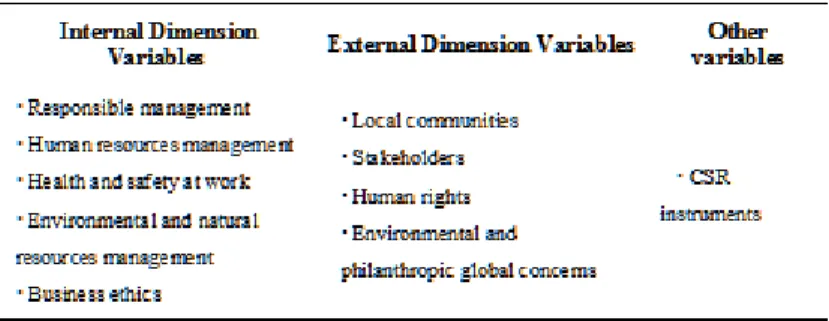
In this study we defined several variables to assess the social performance, taking into account the multiplicity of aspects that are covered by CSP, and based on the variables defined in the Green Book by ECC (2001), considering as well literature on the theme and the guidelines of the GRI, used by several Portuguese companies that report their social performance. Also we consider the fact that most of the Portuguese companies set their CSR goals according to the three dimensions of the sustainable development (usually call by “Triple bottom line”): Economic, Environmental and Social.
3. Data Analysis
3.1 Variables to Measure the Corporate Social Performance
The variables chosen to measure the multiple dimensions of CSP were based on the aspects mention by ECC (2001) in the Green Book and considering several literatures on the issues, and the GRI guidelines (Table 1).
Table 1. Variables to Measure the Corporate Social Performance.
The analysis and measure of social performance, was done through information’s gathered from sustainability and financial reports, available on companies’ official websites.
A factor analysis was applied in order to find the dimensions, not directly observable, that may explain what motivates Portuguese companies to a social performance. In this sense the factor analysis aims to analyze the possible correlations between items that constitute the index study of social responsibility in order to determine the factors that explain these correlations,
i.e. the factors not directly observable and that will influence the performance socially responsible organizations. In first step it was need to produce the Bartlett’s Test of Sphericity in order to verify the hypothesis that the variables are uncorrelated in the population. To measure the appropriateness of factor analysis, measure of sampling adequacy (MSA), an index is used the Kaiser-Meyer-Olkin Measure (KMO), as a rule of thumb, KMO should be 0.60 or higher in order to proceed with a factor analysis, Kaiser suggests 0.50 as a cut-off value, and a desirable value of 0.8 or higher (Kaiser, 1970). In this index compares the simple correlation with the observed partial correlations between variables and is given by eq. 1.
KM O=
Pp−1
i=1 Pp
j=i+1r 2
xixj
Pp−1
i=1 Pp
j=i+1r 2
xixj +
Pp−1
i=1 Pp
j=i+1r 2
xixj\xk
(1)
Where r2
xixj represents the square of the Pearson correlation between the
variables xi and xj e represents the square of the partial correlation between the variablesxi andxj discounting the effect of the variablesXk (k6=i6=j = 1· · ·, p).
180 Nueva ´Epoca REMEF (The Mexican Journal of Economics and Finance)
To identify the contribution of variable to each dimension it was used the Varimax rotation method with Kaiser Normalization, to find an orthogonal matrix (T) and is given by the follows equations:
L∗= LT (2)
and
V =1 p
m
X
j=1
p
p
X
i=1
l∗4
ij h∗4
i −
p
X
i=1
l∗2
ij h∗2
i
!2
(3)
(i.e. the variance of squared weights for each factorial variable) are maximum under the constraint that the commonalities remain unchanged.
4. Empirical Results
Appling the factor analysis it was verified the performance of the sampling adequacy using KMO obtained a 0,852 value, which according the parameterization it can be considered a Good Factor Analysis and these data can be applied to factor analysis effectively; and also show that variables under analysis are statistic and significantly correlated according to the values obtained by the Bartlett’s Test of Sphericity (χ2 = 929,486; p-value ¡ 0,001).
Table 2. KMO Value and Bartlett Test of Sphericity.
According with the results produced by Factor Analysis, reported in Table 3, it was possible to extract two dimensions that can explain the Portuguese corporate motivation for a social performance. The factor structure after Varimax rotation is constituted by two factors contributing with 75,953% to the observed total variance.
Table 3. Total Variance Explained.
According to the values presented in the tables 3 and 4, the Dimension 1, which explains 64.116% of the variance, is defined by the variables Environmental and natural resources management, Health and Safety at Work, CSR instruments and Human Resources Management, which seem to have in common standards and compliance with legal requirements, in particular in which refers to the environment, health and safety, and human resources, and we named
Standards and Legal Requirements. The variables, Environmental and natural resources management, health and safety at work, present the greatest contributions. This dimension seems to be more relevant to internal policies of organization in order to comply with regulations and in particular to obtain certifications.
The second dimension (Tables 3 and 4), which explains 11.838% of the variance, is defined by the variables Business Ethics, Stakeholders, Local Communities, Responsible Management, Human Rights, and Environmental and Philanthropic Global Concerns (see Table 4). The variables appear to have in common ethical concerns, good conduct and action in the social sphere, so we namedEthic and social conduct. This factor seems to be more relevant in terms of communication with the outside, disclosing an image of ethic and social responsibility. The variable business ethics has the higher weight, which may indicate the importance of transparent and ethical image.
182 Nueva ´Epoca REMEF (The Mexican Journal of Economics and Finance)
5. Conclusions and Further Research
It seems that social performance by Portuguese companies under analysis are mostly motivated by complying with the regulations and attainment of certifications, perhaps motivated by the interest of avoiding restrictive regulations and pressures by external organizations, especially with environment, health and safety at work, and to obtain certifications. Their Corporate Social Responsibility behaviour it also seems to be slitting encourage, by the opportunity to improve their reputation and especially through an ethic and social responsible image. Findings suggest that social performance is not having the same relevance in its multiple dimensions, but it maybe being used as a strategy to comply with regulations and certifications and to improve their reputation.
This study provides a new framework to measure social performance, based on ten variables providing an extended view of the multiple dimensions of Corporate Social Responsibility. These ten variables contributed to construct two new dimensions to explain the Portuguese Corporate Social Responsibility Practice, since 2005; namely Standards and Legal Requirements and Ethic and Social Conduct. Though the policies and corporate responsible practices of biggest Portuguese companies seems to be driven by legal and standard concerns as well as ethic and social issues.
This findings rise questions like the motivations for adoption of corporate social responsibility practices is related to financial and economic performance. The level of implementation the policies of corporate social responsibility is driven by financial and economic performance concerns. Related to this we suggest that further research can follow a different path, by studying different strategies that organizations are using to achieve a social performance. And if that strategies are influencing economic and financial performance, not only in a direct way (e.g., influencing results) but in an indirect way (e.g., avoiding restrictive regulations and cost with environmental and social demands, or increasing employees motivation and work efficiency). As some previews research found positive relation between financial and economic measures and Corporate Social Performance measures we also suggest applying the same methodology to Portuguese Public Companies.
References
Carroll, A. (1999). Corporate Social Responsibility: Evolution of a Definitional Construct.
Business Horizons, 38(3), pp. 268-295. Accessed July 17, 2011, http://bas.sagepub. com/content/38/3/268.full.pdf+html.
Centro de Forma¸c˜ao Profissional para o Com´ercio e Afins, [CECOA], (2004). Responsa-bilidade social das empresas - Estado de arte em Portugal. Accessed November, 2011, http://www.sairdacasca.com/recursos/docs/CECOA.pdf.
Comiss˜ao das Comunidades Europeias, [CCE], (2001). Livro Verde - Promover um quadro europeu para a responsabilidade social das empresas. COM 366. Bruxelas. Accessed October 15, 2010, http://eur-lex.europa.eu/LexUriServ/site/pt/com/2001/com2001 03-66pt01.pdf.
Griffin, J. J. & J. F. Mahon (1997). The corporate Social Performance and Corporate Financial Performance Debate.Business and Society, 36(1), pp.5-31. Accessed October 8, 2011, http://business.gwu.edu/smpp/articles/griffin mahon 1997 b and s.pdf. Heal, G. (2004). Corporate Social Responsibility - An Economic and Financial Framework.
Columbia Business School. Accessed October 8, 2011, http://www.genevaassociation.-org/PDF/Geneva papers on Risk and Insurance/GA2005 GP30(3) Heal.pdf.
Kaiser, H. (1970). A Second Generation little Jiffy.Psychometrika, 35(4), pp. 401-415. Lama, D., & L. Muyzenberg 2008). O Caminho para a Lideran¸ca (Trad. S. Oliveira).
Alfragide: Publica¸c˜oes Dom Quixote. (Original work published in 2008).
Leite, C. & T. Rebelo (2010). Explorando, caracterizando e promovendo a responsabilidade social das empresas em Portugal. Proceedings of the Eighth National Symposium on Research in Psychology, Universidade do Minho, Portugal. Accessed October 8, 2011, http://actassnip2010.com/conteudos/actas/PsiTrab 15.pdf.
Orlitzky, M., F. L. Schmidt, and S. L. Rynes (2003). Corporate Social and Financial perfor-mance: A Meta-analysis. Organization Studies, 24(3), pp. 403-441. Accessed October 8, 2011, http://www.finanzasostenibile.it/finanza/moskowitz2004.pdf.
Stanwick, P. A. & S. D. Stanwick (1998). The Relationship between Corporate Social Per-formance, and Organizational Size, Financial Performance and Environmental Perfor-mance: An Empirical Examination.Journal of Business Ethics, 17, pp. 195-204. Ac-cessed October 8, 2011, http://www.springerlink.com/content/l6366530525221v0/full-text.pdf.
United Nations Human Development Report (2010). The Real Wealth of Nations: Pathways to Human Development. Accessed July 15, 2011, http://hdr.undp.org/en/media/HDR-10%20EN%20summary without%20table.pdf.
Waddock, S. A. & S. B. Graves (1997). The Corporate Social Performance - Financial Performance link. Strategic Management Journal, 18(4), pp. 303-319. Accessed Octo-ber 8, 2011, http://onlinelibrary.wiley.com/doi/10.1002/(SICI)1097-0266(199704)18:4-%3C303::AID-SMJ869%3E3.0.CO;2-G/pd.
Wartick, S. & P. Cochran (1985). The Evolution of the Corporate Social Performance Model.
Academy of Management Review, 10(4), pp. 758-769.
Wood, D. & R. Jones (1995). Stakeholders Mismatching: A Theoretical Problem in Empirical research on Corporate Social Performance. International Journal of Organizational Analysis, 3(3), pp. 229-267. Accessed July 17, 2011, http://www.kantakji.com/fiqh/-Files/Companies/l148.pdf.
Wood, D. (1991). Toward Improving Corporate Social Performance. Business Horizons. Accessed July 17, 2011, http://www.kantakji.com/fiqh/Files/Companies/l150.pdf. World Business Council for Sustainable Development, [WBCSD], (2000). Corporate Social
Responsibility: making good business sense. Accessed July 31, 2011, http://www.-wbcsd.org/DocRoot/IunSPdIKvmYH5HjbN4XC/csr2000.pdf.
Zadek, S. (1999). Stalking Sustainability. Accessed July 31, 2011, http://www.zadek.net/-wp-content/uploads/2011/04/Zadek Stalking-Sustainability 1999.pdf.