éOUA ZOOLOG ICA - 45( 1), 65-7ú 11 99ú)
FEEDING BEHAVIOUR OF BARBUS BOCAGEI ASSESSED
UNDER A SPATIO-TEMPORAL APPROACH
Maria J. COLLARES- PEREm A, Mari:l J. M ARTINS A na M. PIRGS. Ana M . GERALDES 3ml Maria M. COELHO
Rcccivc d May 19. 1995 Acccplcd Decc lllocr 15. 1995 Dcpan meIH Df Zoology and Ant hropology, Faculty Df Scienccs, Un iversily 01' Lisbon, Lisboa A b s t racI
The feeding bchaviour of Barbus bocagei was asscssed in a low l:md syslcm by a 1 wo ye:lrs su rvcy Df 1wo contrasting sites. al so tald ng inlo aCCou llt, for lhe firsl time . d iurnal chan!!cs 0 1' fi sh diel and bcnthos ava ilabillly. This barbeI recds more Dr Icss co nlinuollsly during lhe 24 flOurs upon lhe do· minilnt and lhe most availablc bcnlhic itCI1lS, such as Diplera larvac (C hironom iLlae), Ep hcmcroptern nymphs (Cac nidac). mail uses and plant m:ncrial. switchi ng 10 one or Fcw itcms whcn Ihey beco me common. Such a gencral isl anel op pOrlUni Slic bchaviour was also dcm onsLralccI over lime by scoring lhe benlhos availnbility during lhe seconel year ofthis projccl. ln facl, a hi ~h spatio-lcmporaJ homogc neiLy 01' prey was gcncrally rounel, whercas significant elifTcrences in LIlI.! gut conlents occurred by sampJi ng period and sitc. This Jack 01' correlation ma)' he expJ<lincd by lhe existence 01' itH raspecific vari;:tlion in lhe Fccding pallern. cou pled \V ith lhe existence 01' rccdi ng: mi-grmions lcading 10 ex ploilalion 01' dislincl zonC$ fro m those pros pected.
Kcy words: Jbcria n barbei , dicl, intraspedri c rclíl ti ons, dicl cycles I ntroeluclion
ln the Centra l anel Southe rn paris of Ibe lün Pc ninsula, the lotic systems are highly variable, constraining benthos a vailability to seasona I, local and dil1rn ~ 1 changes. Therefore , !'ishes shoulel be able to adapt the ir feeding behaviour to suc h variable cond ition and sw itch from one item to another in orde r to inc rease the ir specific forag ing success (P y k c 1984).
This is appare ntly the case of the lberian barbeI
8 orb"s bocagei
S teinelachner. 1865, which inhabits septe ntrional and central lberian drainages. lt has been stud ied both in le ntic but al so in lotic habitars (see M a g a I h ã e s 1992). Conside ring the latest systems, L O b ó n - C e r v i á & D e D i e g o (19 88) corre lateel it s feedin g strategy with benth os composit ion in a northern river (Douro dra inage) . and M a g a I h ã e s ( 1992) first and G e r a I d e s e t aI. ( 1993) aft er, re ferred to the ex iste nce of ontogene tic variations in the diet composition 01' a populati on living in a central syste m, the Rive r SOlnia.ln fact, the ve ry pre liminary elata obta ined by our {cam (G e r a I d e s et aI. 1993) in !'ive distinct sites 01' that Tagus tri butary, suggested lhe ex istencc Df spa-ti al and te mporal differe nces in die t composispa-tion , and the necessity 01' reassess ing s uch variati ons by e nlarging the temporal scale fo r fi s h and be nthos availability analyses.
So, we selected the two most contrasting sites and we processed the m season-ally during two years fo r fi sh di et, and during the last year al so fo r benth os availability. Finall y, to check the validity of the adopted sampling hours, in o rde r to avoid possible mi sinterpretations due to diurna l c hanges, the da il y feed ing
rhythm was for the first time analysed in the periods where abiotie fae tors sueh as water quality and flow may be more limiting in Iberian streams (s ummer and autumn). It is expeeted that these data wiJl inerease our understanding about the feedi ng behaviour of this eommon and widely distributed speeies.
Material and Mcthods
The stuely was eondueted in the Son'aia syste m, whieh is described in C O II a r e s - P e r e i r a et aI. (1995) and G e r a I de s & C o II a r e s -P e r e i r a (1995). The seleeted zones were the sites B and E here nameel as sites A and B respeetively. Sampling was earried out in sile B from Oetober 199 I la Oetober 1993 (Oel. 199 I, Feb. 1992, May 1992, July 1992, Jan. 1993,
Mar. 1993, June 1993, July 1993 and Oel. 1993), and in the same momhs wilh the exeeplion of Jan. 1993, Mar. 1993 and June 1993 in site A. ln these three 1110mhs in Ihi s laller site, the number of individuais eaplured was nol sulTieienl for analysis.
The fi sh were colIeeted by eleetrie fishing (350 V, 3-4 A, d.e) in a 50 111 seeti-on at the same day period (10.00 h - solar hour) plaeed in ice immediately anel fro-zen (- 18°C) afler. At Jeast ten fi sh represenlalive of lhe size range (40 to 273 111111 of lotai le ngth) o f the speeies were examined in eaeh period and at eaeh site. For the die l feeding analysis fi sh frol11 ditfe rent sizes were eoJleeled in July 1993 a nd Oel. 1993 IVith two hours imervals during a 24 h period in the two siles.
To assess benthos availability, three la five samples of bottom fauna were eol-leeted in eaeh site/pe riod from Jan . 1993 to Oe!. 1993 usi ng a draIV-nel (mouth: 30 cm x 20 em/mesh size 0.25 mm) by holding the net again st lhe ri ver bed and disturbing the area upstream during one minute, in several zones of the fish eoJleeli ng sites. Sediment samples were also plaeed in ice and frozcn.
Diet and Benthos Availability Analyses
The lotai gut eontems of 535 fish was weighted (to nearest 0.00 I g) anel exam-ineel. A visual evaluation of the volume of plant malerial was maele and eategori-sed for absenee (0%), presenee( <50%) and elominanee (>50%), and the presenee 01' sanei and mud were also reeorded. Animal prey were identified by family and eounted by referenee to pieees thal mosl often survive digestion . Relative impor-lance of food eategories ineluding plant material and gravei was evaluated by ea
l-culaling lhe percentage occurrence of ali categories and the numerical
percenta-ge of eaeh animal prey in the sample (H y s I o P 1980). Variation in lhe mean total we ight of gut eonlenls relati ve lO fish size (fullness index), and the total numbe r aI' e mpty guts relative lO total gulS (vacuity index) were lIsed to delermine lhe seasonal aetivity pattern and lhe diel rhyl hm of feed ing (H y s I o P 1980).
Maeroinvertebrates from benthie samples were identified to the family and eounled. Benthos availability was evaluated by eaJculating lhe numerieal per-cem age of eaeh prey eategory per sampling periodlsile. The barbeis were grouped into five length-elasses aeeoreling la Ma g a I h ã e s ( 1992) and G e r a I d e s et aI. ( 1993) to study the ontogenetie variation in diel composition. ln relalion lO the spal io/lemporal variation in the feed ing aeti vity and because our samples spanned in general the total size range in the eolleelion, lhe dai a were gathered for analysis.
rhe data was done (S o k a I & R o h I I' 198 1) to obrain unil'orm variance. When signi l'icanr differences in rhe mean fulln ess index were detecred. a multiple co m-pari son test "Turkey b" (Z a r 1984) was perl'ormecl to c1isringu ish d il'ferences
between means I'rom more than two groups. A G test for inclependence with William's correction (S O k a I & R O h I f 198 1) was used to compare the
abso-lute frequencies 01' e mpty gurs across month s. The same tesr was carried out to compare the frequencies of occurrence of plant material and the numerical frequencies
01'
prey caregories across seasons and across fish lenglh-c1asses. When independence between vari ables was rejected, log ical tesrs of subsets 01' rows and columns in lhe contingency table were carried out by a Simultaneous Tesl Procedure (STP). T he Spearman rank con elalion coefficienl (Z a r 1984)was used 10 assess lhe relationship between the numerical percentage or prey in the gut conlents and rhe numerical percentage 01' prey in benthos across months. lt was al so used to cOITelale rhe numerical percentage
01'
prey in lhe benlhos in ali months and between bOI h siles. T he Slrauss index (S I r a u S S 1979) was usecl to compare rhe diet wirh lhe availabilily 01' rhe pOlential food resou rces along month s, and was calculaled using numerical frequencies. The non-para-meth ric Kru skall-Wall is test was used to tesl for signi ficant d ifferences in lhe mean fu llness index along the diel cyc les. Ow ing to the irregular captures du ring the 24 h period we gat hered rhe cyc le into three periods (morni ng 8- 12 h; after-noon 14-20 h; and night 22-6 11). Significanl differences between mean s wereanalysed tl1rough a "Turkey b" les!.
8
~
V IV III
'"
~ ~ t: ::;'"
'"
'" "
~ t:"
~r-'"'
õlii ~ o r- r- r- c
"
Q.
""
"
g ~ '3 Q. C '3"
"
.~ u ~ .~~ E r- Õ. 'O ~ 'O Õ. Õ. ~ r- ~
"
§ 2 o E ~ c. E r- o o u
"
~ .
"
'O
,.,
'O:;: c
"
O" "
"
;5, ~ c«
2 EE õ. u u u
E
"
"
" "
o o ~ Ec
"
:I: Q. Õ. Õ. u"
,.,
-'r-u
~ ~ i5 iS i5 'O 'O :!: 11:
Q. Q. U Z
UJ UJ U
Fig. I. Pcrcentage occu rrcncc of eac h item in lhe fivc length-c1 asscs of Ibcrian barbei B. bocagó
at bOI h silCS co mbined. I (40-79 mm); II (80- 11 9 mm ); III ( 120,1 59 mm) ; IV (160-1 99 mm); V (>200 mm).
Rcsults
NOlable intraspecific variali ons in the dier composition
01'
the five size-c1asses o r barbei were found (Fig. I, Table I). The percenlage OCCll rrence 01' plant material, mollllscs, and Diptera pupae increased wirh fi sl1 size (Fig. I). Dipteran larvaere the dominant prey items for every length-e1ass, but were consu med in larger amounts by small fish. The ephemeropteran nymphs and dipteran adlllts occurred most freqllently in the guts of medillm-sized fish. Heleroplera occllrred in higher freqllencies in the smallesl fis h (e1ass I), whereas Trichoptera and Coleopte ra larvae occurred in lhe biggest (c lass V). Larger fish consumed predo-minantly molluscs, Trichoptera larvae and plant material, and lhe smaller fish took more dipteran larvae (Table I ). Some items li ke acarin s, hymenopterans.
coleopterans adu lts and larvae seem 10 be consumed in similar proponions by ali size-e1asses c1l1e lO the low nllmerical percentage found in gut contems.
Tab le 1. Intraspecific diet composition 01' Ibcrinn barbcl B. bocagei. Summary results 01' G-test of
indcpcndcnce ln bOI h sitcs. Plnnt material (pcrccnl<lgc occurrencc); animal itcms (numerical pcrccllIagc). The Simultaneolls TcsI Procedurc (ST?) results are undcrlined. *P<O.05.
I II III I V V GW STP
(40-79) (80- 119) (120-159) (160-199)(>200)
PIam material
Mollll sca (Sphacriidae)
Ephemcroptera nymphs
(Clcnidne, EphcmerellidJc,
l3aelidae)
Eph ctll. imagos
Odonata I-Iclcroptcra
(Corixidac, Hebridac)
mm 4.8 0.29 3.5 lU [) 6.0
D iplel':I larvae 87.2
(Chironomidae, Simuliidnc,
Ceratopogonidac, Dixidae)
Oipl. pupac
DipL adulLs
Co!eoplcra !arva e
Colcoplcra adults
0.3 2.1 0. 14 O
Trichoptera 0.14
(Hydrops)'chidac.
Hydroptilidac, Ecnomidae) Hymcnoptera
(Formicidae) Acarina
Crustacea (A tyidae, Astacidae)
N.1. (TerresL)
o
0.29o
o
mm 38.5 0.78 4.4 0.46 O 0.89 85.9 0.3 2.4 0.07 0.039 0.54 0.15 0.16 0. 12 0. 16 mm 51.1 1.4 3.7 1.2 O 6.48 1. 2
0.26 4.6 0. 14 0.073 0.47 mm 63.2 0.47 2.0 1.2 0.036 O R2.0 0.12 2.9
o
O O mm90.0 185.01 * 1 11111 V 3.64 0.26 0.26 O O 87.5
- - I V 32.65 * IV
- !J.!ll!
41.92* V IV
- I
----'L
..l!..lll 15.81 * VtV l1I
III 0.92 I II IITIVV 314.72* IVV l.l!l
-1l 36.19* J.!.!JY
V - -.lll
1.0 65.92* II I IV V III 1.0 33.05* V IIII VIII 0.52 7.29 111111 IV V O 2.0 1 I III III VV 4.7 71.78* IV
- J.lll1.l Y
0.14 0.043 O 3.56 III IJlIV V
0.073 O O
0.1 1 0.043 O
0.036 O 0.26
6.46 I ti JII IV V 2.38 I 11111 IV V
Spatio-Temporal Variation in rhe Diet Compos iri on a nd Benrhos Availability
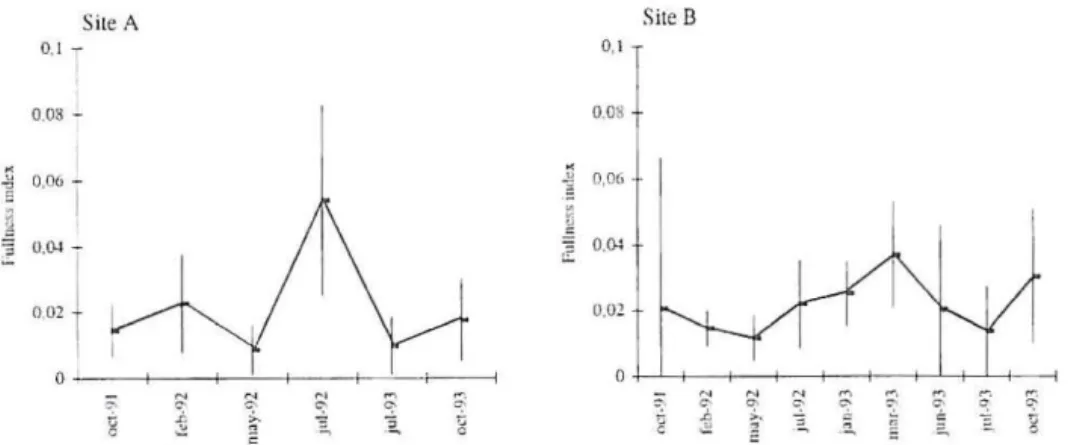
The varialion in lhe fullness index refleets some seasonal di seontinuity in lhe barbei feeding aeliviry (Fig. 2). Al sile A, rhe mean fullness index was significantly higher in Ju ly 1992 (F = 10. 1109, P<O.O I). At site B, we eoulel nor delect a marked
eliscontinuilY, however some differenees were found belween lhe mean fullness index in Oel. 199 1 and Mar. 1993 (F = 2.476 1, P<O.OS ). T he high slanelard devi-al ions observed suggesled lhe ex islence of gredevi-al indi vidudevi-al diffe rences in feedin g intensiry aI ali momhs bUl particularly in July 1992 ar sile A and in Oel. 1991 and June 1993 aI sile B. T he vacuiry index re mained slable lhrou ghoUl the monrhs (si le A Gw = 7.9020 n. s. and sire B Gw = 13.0906 n. s.).
Sile A Sile B
0,1 - 0 . 1
0 .08 - 0.01!
~
0.06!
0 ,0.;~
~
,
0.06j
"4
U,Q.I-0,01
o ---<
"
"
!
N-.
~
,
, ,
eg
i
~-
-
,,
-N
,
, ,
€
-
'-
,
Fig. 2. S c a son~ 1 v:lrimion in lhe mcall fullllcss index and rcspect ive standard dt::vi:l lio lls in Ibc ri ,:m barbei B. bOCClget at sitcs A and B.
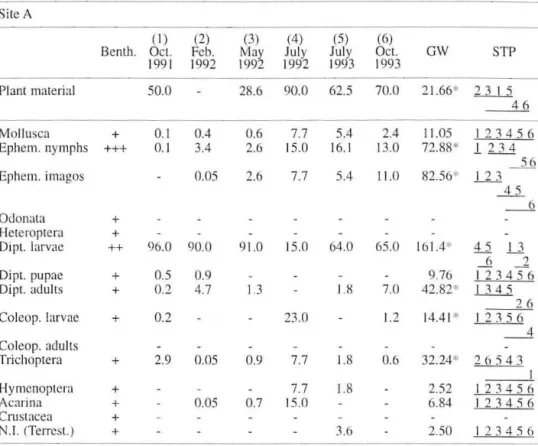
Plant material occurred more frequently in lhe diel during su mme r and au-lumn (Table 2) when il was more abundant . The major prey in barbei diel in every season \Vere dipreran larvae. T hese larvae were eonsumed in higher propor-rions in wi nrer monlhs (Feb. 1992 al sire A; Feb. 1992 anel Jan. 1993 ar sire B). July 1992 anel 1993 were lhe periods wilh lowesl frequencies of diplernn larvae. corresponding ex actly lO an increase in the consumplion of ephe meropteran nymph s. An inerease in lhe eonsumplion of lhese lWO lasl ilem s lVas observed also in Oel. 1993 in sile B. Dipleran adullS were more common in rhe gut contems in Ju ly 1993 at site B, and in Feb. 1992 and Oel. 1993 at sire A. Mo lluscs ap-pear to have some importance in the feeding of the barbei, being eonsumed essentiall y in summer and autumn at site B, but in equa l proportions in ali momh s al site A. Co leoptera la rvae were nor very abu ndant, but lVere mostly eonsumed in July 1992 and Ocl. 1993 at site A, and in lowe r proportions uniformly in ali months ar sile B. Triehoptera larvae showed low frequeneies il1 fi shes eaptured il1 the \Vi nter (Feb. 1992) al both sites. Odonata, Hele roptera, Coleoplera adults anel C ru staeea \Vere only present in lhe gur eontel1 ts at site B. Heteroptera were COI1-sumed onl y in Ju ly 1992, a nd lhe re mainder items were more rare and ide ntieal-Iy ealen duril1g ali months. The Hymenoplera al1d Aca rina were also eOl1 siderecl
minor items, but consumed in similar quamities al both sites.
Table 2. Bcnlhos ava ilability (+ rare, ++ abllndalll, +++ vc
ú
abundam) and seasonal diet COInJ)O-sition or Ibcrian barbei 11, bocagei. SlI111m:lry resu llS ar lhe -Iest 01' indcpendence in SilC A an in
sitc 13. PI.ml mat erial (percentage occurrence); animal itcms (Ilumerical pcrcentnge). The Si mulatncous Test Procedurc (STP) rcsulls are underlincd. *P<O,05.
Si leA
(I) (2) (3) (4) (5) (6)
Bcnth. DeI. Fcb. May Ju1y Ju1 y DeI.
GW
STP 1991 1992 1992 1992 1993 1993Plant material 50.0 28.6 90.0 62.5 70.0 21.66* 2315
---1Ji
Mollusca + 0.1 0.4 0.6 7.7 5.4 2.4 11.05 123456 Ephem. nymphs +++ 0.1 3.4 2.6 15.0 16. 1 13.0 72.88' 1 2] 4
5fi Ephem. imagos 0.05 2.6 7.7 5.4 11.0 82.56* U2
~
~
Odonata +
Heteroptera +
Dipl. larvac ++ 96.0 90.0 91.0 15 .0 64.0 65.0 161.4' 45 Ll
....li 2
Dipl. purae + 0.5 0.9 9.76 1 234 H
Dipl. ad ult s + 0.2 4.7 1.3 LX 7.0 42 .82* 1345
---1...6
Caleap. larvae + 0.2 23.0 1.2 14.41 ' 12 156
__ 4
Calcap. adu lts
Trichoptera + 2.9 0.05 0.9 7.7 1. 8 0.6 32.24* 'J (, 543
I
I-IY111cnoptcra + 7.7 1.8 2.52 123456
Acari na + 0.05 0.7 15.0 6.84 1 23456 Cruslacea +
N. l. (Terresl. ) + 3.6 2.50 1 2 3456
The re was no significant difference belween lhe benrhic assemblages ar lhe IWO sites (Speannan condition), and the only signiticant difference wirh in a site was I'ound between Ocl. 1992 and lune 1993 at sire A (rs = 0.446 1). Significant di fferences
\Vere found between gut conlents and benthos availability in eaeh month/site. T he Iberian barbei showed positi ve selectivity (Table 3) for dipteran larvae ill all mon1hs with the exeeption of lu ly 1993 at site B (si = -0.260). The low
availa-bi lity of these larvae in lul y 1993 was eorrelated with all high positi ve selectivit)' for ephemeropteran larvae (si
=
0.211 ) and dipteran aduli s (si=
0. 188). 111 faer , barbei usually showed a negative prefere nee for ephe me ropteran larvae, but in summer (luly 1993) this ile m seemed to have replaeed the very rare dipteran larvae. Diple ran adulis were usually eonsumed in the same proportion as the)' ex-isted ill the ellvironment, but in su mmer (l uly 1993) they were positively selee-ted. Converse ly the dipteran larvae were posit ively seleeted in lu1 y 1993 at site A, and the e phe meropteran nymphs were not preferred in thi s month. Aearin a was one o f the most abundant ite m at site B, and was always negati vely seleeted. Ali the other ite ms were eonsumed nearly in the sam e proportion as they ex isted in the syste m, with the exeeption of moll uses which were negatively se leeted in Oe!. 1993 (si = -0.200) aI site B.Tnble 2. (eontinucd )
Sile B
(I) (2) (3) (4) (5) (6) (7) (8) (9)
Bcnth. Oe!. Feb. May l ll ly Jan. M<Jr. Junc l uly Dei. GW STP
199 1 1992 1992 1992 1993 1993 1993 1993 1993
Plant material 7 1.4 50.0 42.8 88.8 85.7 100.0 77.8 34.95' 212765 41
8
Moll usca + 2.2 0. 1 0.7 0.5 0.9 1.0 7.0 3.5 3.0 66.86* 234S6 1 79 _ _ 8
Ephcrn. nymphs + 0.5 0.3 0.06 2 1.0 0.7 0.5 1.4 23.0 520.33' 1165279
--"-8
Ephcm. imagos 0.5 0.1 1.8 28.5 1* 215 1 6789
4
Odonala + 0. 1 3.98 1 214 5~7R9
Helero plcra + 32.9 992.25 * 1215678 94
Dipt. larvac ++ 94.0 97.0 89.0 4 1.0 96.0 92.0 83.0 35.0 79.0 1070.6'
1.B.
76 16225Dipt. pu pac + 0.4 6.9 0. 1 0.5 216.80' 1' 45 6789 ----l
Dipt. adults + 2.2 2.6 3.4 2.5 2.3 3.8 3.9 19.0 9.0 20.79' 49S 1 2367 8
CoI cor. larvac + 0.3 0.3 12.85 1 2145 6 789
Colcop. adu lt s 0.1 3.2 10.93 121456789
Triehoptcra + 0.06 0.2 1.8 3.4 46.97' 214518 9 67
1-IYl1lcnoptcra 0.5 0.1 0.3 9.7 8.21 1214S6789
Aearina +++ 0.06 0.1 3.2 9.62 1 2345 6 789
Crustacea + 0.8 0.3 10.62 1 23456789
N.!. (Te rrcsl.) + 0.3 3.2 6.0 8.92 1 23456789
Tablc 3. Yalues Df electivi ty Df Strauss index (Significant valLles are givcn in bold) fo r Iberia n bar-beI B. bocagei.
Sire A Site I3
JuJy Oel. Jan. Mar. JLlnc July Oel.
1993 1993 1993 1993 1993 [993 1993
Mollu sca -0.004 -0.061 -0.082 -0.077 -0.001 -0.1 22 -0.200
Ephem. nymphs -0.379 -0.434 -1l.313 -0.275 0.006 0.211 -0. 105 Ephcl1I. imagos 0.054 0.110
Odonata -0.0 12 -0.003 -0.003 -0.002 -0.057
Heteroptcra 0.054 -0.003 -0.0 15 -0.007
Di pl. larvac 0.280 O.4Z1 0.647 0.670 0.538 -0.260 0.550
Dipl. pupae -0.009 -0.0 17 -0.0 16 -0.004 -0.Q20 -0.066
Dipt. ndults 0.0 18 0.070 0.023 0.038 0.039 0.188 0.09
Coleop. larvíle 0.007 -0.003 -0.002 0.003 0.023
Coleop. aU Ll[t s 0.032
Trichoptcra 0.014 -0.067 -0.024 0.005 0.032 -0.009 -0.019
Hymcnoplcra 0.014 -0.005 0.003 0.097
At:arina 0.025 -0.009 -0.198 -0.330 -0.610 -0.156 -O.2GO
CrLlstacea -0.004 -0.002 -0.007 -0.002 -0.0 11
N. 1. (TerresL ) 0.036 -0.001 0.0111 -0.002 0.032 0.056
O i e I Cyeles
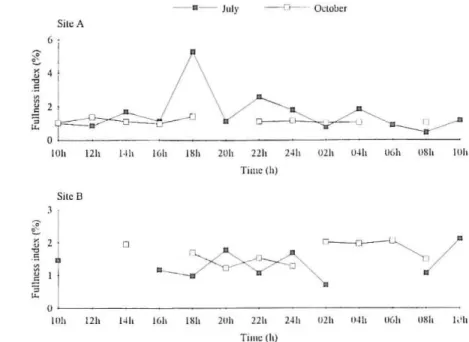
No significant differences were found in the feeding periodicity during thc eycles IVith the exception for site A in July 1993 (Kruskall-Wallis
x'
= 34.56,d.r. = 12, P<O.OI ) (Fig. 3). ln this cyele, a sign ificant differenee was found
betIVeen the fullness index at 18.00 h and the rest of the period (Turkey b test). This peak seems to be related with an occasional higher consumption of sand and graveI by ali the individuaIs captured, leading lo an important increase in the full -ness index at that hom (Table 4).
The inexistenee of significant diffe rences among the three periods (morning, afternoon, night) in eaeh eycle with the exception of site N July 1993 as ameri-orly refened to
(X'
= 6.6953 , d.f. = 2, P<O.OS ) IVere confirmed. ln spite ofth e lack of a specific period of feeding aetivity, some differences in the consumption of distinet items through the three periods of the nycte meral cyc le were fo und. However, the slight diffe rences in the consumption of some ite ms throllgh the three periods were not due to differences in the total length of the individuaIscaptured in each period ( GW S' IC M uly
! ~'I .1
= 6.9034 I1.S ; GV.,I Silc BiJUly IW .l = 11.291 8 I1. S;GW
S il" AJ( ~ l l ~~ .1
= 15.290 1 I1. S; GW SiICU/(k l l'i'),l = 9.4733 n.S). It see ms tllat the dom inantprey item or lhe barbe!'s diet (dipteran larvae) was consumed essentially dllring the aftemoon, with the exception of si te B/Oel. 1993, and that the ephemeropteran nymphs were consumed in higher propOJ1ions in July 1993 as referred to and essentially during the moming and night periods. Other important items, Iike molluscs and triehopterans showed no consistent patterns as regards die l consumption.
Discussion
- a- JuJ)' ---{l- Ül.:lolJcr
Sih:A G •
l
I
\
-
,)j 4 I
i
' i.-_G ...--o-""-,,_
o L-__________________________~
.~0
~~
~~ __IUh 1211 J.lh JGII I lSh 2Uh 22 h 2.jh 02h O-l l! (}G il USh ]UI!
Time" (h)
Sitc B
.1
I
~~
j' ~
D .~r
~
~
, /
~
: LI _ ____
~
___
u _ " _ _ - _~
_ _ _ _ _ _~
_ _IfIh 12 h I-I I! I(, h IlSh l Uh 2211 Hh ul h IJ.l h U(, h URh I ,~ h
Ti me (h)
Fig. 3. Diel v<lriation Df fu ll ncss index in Ibcrian ba rhcl B. bocagei <H sitcs A aml B.
T,lhle 4. Menn p erce n m~e
Dr
occurrence 01' s:tnd :lnd grave i in lhe gut cOlllents Df Ibcrian barbeiB. hocagei m eJch sampling baur along lhe dicl cycles.
July 1993
solnr Sitc A
hours
10.00 11 14.3
12.00 11 36.3
14.0011 33.3
16.0011 50.0
18.00 11 100.0
20.00 11 44.4
22.00 h II.I
24.0011 55.5
02.0011 50.0
04.00 11 14.3
06.0011 37.5
08.00 h 60.0
10.0011 30.0
Silc B
O
63.6
9.0
II.I 20.0 O
O O
SiteA
O
22.2
33.3 55.5 57.7 10.0 10.0 30.0
12.5
33.3
Oet. 1993
Sile B
55.5
44.4 44.4 22.2 16.6
55.5
12.5
12.5
2S.6
1986), L O b ó n - C e r v i á & De D i e g o ( 1988), M a g a I il ã e s ( 1992, 1993), and G e r a I d e s et aI. ( 1993) for lhe sarne speeies. S imil ar resu lrs were a lso oblained for arher Bm'bus speeies by A d á m e k & O b r d I í k ( 1977), K r a i e m ( 1980), B a r a k & M O h
a
m e d (J 982) and K li m a r e r a I. (1986).Tile onrogenetie differe nees in feecli ng aCl ivil y seems, in fact , to be an e fTec live mean to avo id intraspee ific compelirion, as suggesled by M a g a I h ã e s ( 1992) for the same speeies, and fo r olher Barblls speeies (B a r a k & M o h a 111 e d
1982; K li m a r et a I. 1986).
73
Although large barbei did not avoid small prey (dipteran larvae), they feed on grealer amounts
01'
large prey (molluscs, dipteran pupae) and on plant material. ln fact, as reporled by M a g a I h ã e s (1992), we also observed lhat the per-centage of occurrence of planl material, molluscs and diplera pupae increased wilh fish size. Plant material was an abundant resource thal allows a considera-ble drop in lhe cosI of food searching, and may increase lhe growlh rale and lhe densities of some species (L e s sem a r k 1983 ; P e r s s o n 1983). The assimi lalion efficiency of plants by fish is low when compared wilh animal ilems, but lhis fact may contribute to reduce the intraspecific competition. According to P i n d e r (1986) and M a g a I h ã e s (1992), the abundance of dipteran larvae in guts could be relaled to this later situation. Effeclively, ali size-classes exploi! this most abundant item, but it was observed thal these larvae were eaten in larger amounls by small fish, perhaps due lo moulh morphology which can limit the ingestion of larger prey. The ephemeropteran nymphs and dipteran adults occurred most frequently in lhe guls of medium-sizeel fish (classes TI to IV). These classes, especia ll y elass II (120-159 mm), showed a great variety of indi-viduai food preferences and a large diet spectrum, whereas smaller and larger oncs showed a greater uniformity in prey utilization.ln the present study, some differences in spalio/temporal consumption of some items were found to occur independently of fish size. ln relalion to the prin-cipal items of barbe!'s diet, Ihey were consumed in high quantities in both sites, allhough in a different way throughout lhe seasons. Dipteran larvae were con-sumed in higher proportion during winter months and with lower proportions during the summer. Conversely, plant material occurred more frequently in the guts during lhe summer and autumn, and less frequenlly in lhe winter. This temporal variation seems to be essentially related to changes of prey and plant availability in lhe system. The periods of low availability of aquatic invel1ebrates in lemperate streams are summer anel autumn (H y n e s 1970), during summer is observed the emergence of the dipteran larvae (O I i ver 1971 ).
On the other hand, plant material during lhese seasons is found in grear den-sities in temperate streams, due to algae and macrophytic blooms in summer and to the inputs of leal'es and other planl material from the tree canopies in autumn. Other items like ephemeropteran nymphs and imagos clearly replace lhe con-sumption of dipteran larvae in summer. Jt seems thar the increased consumption of Ephemeroptera during summer and autumn was directly relaled to the low availability of dipteran larvae in these seasons. Conlrarily to what was elescribed by other authors (M o n t a jj e s & L o b ó n - C e r v i á 1986; L o b ó n
-C e r v i á & De D i e g o 1988; M a g a I h ã e s 1992), trichopteran larvae showed low freq uencies during the winter (Feb. 1992). This fact can be explained because Feb. 1992 was an exceptionally dry month, possibly inducing an early emergence of lhe larvae.
conlent s and benthic availabilil y in each monlh at each sile, \Vhat may be explained by lhe ex islence oF inlraspec ific variation in lhe feeding pallern and/or by lhe exiSlence of feeding migralion s coupled wilh a particular foraging behaviour in some monlhs. Regarding lhe firsl aspect, in facl onlogenelic varialions in the feeding partern were found to occur, and for lhe second one according lo K r a i e m ( 1980), barbeis can undertake short feeding migralions, allo\V ing lhe exploilati on of diversified food niehes. Also a pos itive seleelivily for dipteran larvae was seen in ali monlhs, IVilh the exceplion of sile BlJuly 1993, w here a "non prefe re nce" for Ihese larvae, associaled to a posit ive seleclivity for ephe meropteran nymph s and dipleran adults, \Vere delected. These t wo last ilems IVere usually not selecled by lhe barbei in lhe OlheI' periods . The dipleran adults were in general consumed in the same proportion as they exist in the environmenl, but in July 1993 they \Vere posilively se lecled probably due to their hi gh abundance resulting from th e e mergenee of lhe dipleran larvae (M a s o n & M a c D o n a I d 1982). As described by several authors [berian barbei does not show very selecti ve food requiremenls but le nds lO eat lhe dominant available groups. This was suggesled by L o b ó n -C e r v i á & De D i e g o ( 1988), Ma g a I h ã e s ( 1992, 1993), G e r a I d e s el aI. ( 1993), and is supponed by lhe present results.
ln the IIVO nyclemeral eycles studied lhe barbei fed throughoul lhe 24 hours. The peak aI 18.00 h in sile
NJuly
1993 can be explained by an occasional eonsumplion01'
sand and gravei by ali the individuai s captured aI Ihal lime . These indigeslible elemenls inereased lhe gastroinleslinal conlents weighl of these fi shes increasing lhe mean rullness index. HOlVever in a similar study, also in a lotic syste m, E n c i n a & G r a n a d o - L o r e n e i o ( 1991) round thalB. sclaferi was a daylighl reeder. The temporal COSI of feeding is related to the
type of food ingested, and the amount wilh lhe energy conlenl oft he di e!. For fish eonsuming low energy diels, like lhe barbei, brge amou nt s a r rood mu st be proces-sed per e ne rgy gain unit. So Ihese fish feed conlinuously or, ar leas!. ove r lon g time pe riods re lalive 10 diges lion lime (D i a n a 1979; E n e i na &
G
r a n ad
o -L
o r e n c i o 199 1).The le mporal ditlere nces in lhe mean fulln ess index observed between summer a nd aulu mn in sile A cou ld be due lO higher food consumpti on in thi s sile (site IVith lower deplh), especiall y during summer o\V ing to lhe increase or \Valer temperature, as demonslraled by L é o n a r d & P o n c i n (1993) for olher barbeis. ln conclusion, we have confirmed Ihal this lberian barbei feeds mo-re or less conlinuou sly during the 24 hours pe ri od upon benthi e mo-resources. However, iI has, in fac!. an high ab ilily lo react to seasonal , loca l and diurnal changes of food availability and lO switeh 10 one or few items when Ihey beco me common, even being of low energy supply. Such a generalisl and opportunistic foragin g beha viour may poss ibl y ex plain lhe appa renl sueeess of Ihis species in colon izing unslable habitaI s.
Acknowlcdgcmenls
Wc wi sh to Ihank M.J . A I v c S, R.M. I3 r i lo . M.M . G o n ç a 1 v e s , R.C. P i r e s ,
E. R o d r i g u c s , J. A. R o d r i g LI C S , E.C. S o LI s a . for Iheir collaboration in lhe ficlel wo rk.
This \Vork was funded by lhe JNICT projcct (PEAMIl 15/9 1).
LITERATURE
ADÁMEK, Z. & OBRDLfK, p, 1977: Food 01' important cyprinid spccics in the warmcd barb-zonc 01' Lhe Oslava river. Folia Zool., 26(2): 171-182.
BARAK, N.A.A. & MOHAMED, A.R.M., 1982: Food habits 01' cyprinid fish Barbus Ju-teus (Hcckcl). lraqi.l. Mm: Sei .. 34: 59 __ 66. COLLARES-PEREIRA, M,J., MAGALHAES,
M.F., GERALDES, A.M. & COELHO, M.M., 1995: Riparian ecnlones and spaliaJ va-riaLion 01' fish assembla~cs in POrlU~U CSC low-land streams. Hydrobiolo~i(J, 303: Y3-JOI.
DIANA, JS, 1979: The fecdlng paHcm and daily rntion of a Lap carnivore, lhe nanhem pike (Esox lucius). Cal/. 1. 201/1, 57: 2121-2127. ENCINA, L. & GRANADO-LORENCIO, C,
! 991: Diet and Dicl Fccding Chrono logy of Three Ibenan Fish Species. Eco/. bl/C/:
ii/til., 19: 43-64.
GERALDES, A.M., COELHO, M.M. & COLLARES-PEREIRA, M,J., 1993: Régime alimemaire el croissance du barbc-au Ibérique, Bnrbus bocagci (Steind 1865) dans la ri vicrc Somlia (Portugal). eaft. Erlwl., 13(2): 179-180.
GERALDES, A.M. & COLLARES-PEREIRA, M.J., 1995: Preliminary insight iOlo age and growth 01' lhe iherian chub (Leuciscus pyre-naicus) in the Sorraia system. Folia Zoo/., 44(2): 159-165.
GRANADO-LORENCIO, C. & GARCIA-NOVO, F., 1981: Cambios icliologicos du-mnte las primeras elapas de la sucession en el embalse de Arrocampo (Cuenca dei Tajo, Caceres). /J o/. deI In 5t. Esp. Oecanog/:, 6: 224-243.
GRANADO-LORENCIO, C. & GARCIA-NOVO, F, 1986: Feeding habits of the fish community in a eutrophi c reservo ir in Spain. Ekol. Pol., 34: 95-110.
HYNES, H.BN, 1970: Thc ccology of stream insects. Ali/III. ReI'. EIl/oIl/Ol. . IJ: 25-43.
HYSLOP, E.J., 1980: Stomach contenls analy-sis - A review of methods and Iheir applica-lion.1. Fish /Jio/., 17: 4JJ-429.
KRAIEM, M.tv1., 1980: Contribuition a l'étudc du régirnc alimenlaire de Barbus barbus (L. 1758) (Poissons, Cyprinidae). Bill!. F,; Pêche Piscic .. 278: I-l().
KUMAR, K.P., VIJAYAKUMAR, B., PADMA-NABHAN, K.B. & KORTMULDER, K., 1986: Food and fecding habits of two cypri-nid foragc lishes, PuOlius (=Barbus)
til(lmen-10SUS (Y:11) and P. amphibius (Vai) from south A lI/lIors , oddre.\'S:
Prol'. Maria JO"O COLLARES-PEREIRA, Dr. Maria Jofío MARTINS,
Dr. Ana Maria PIRES, Dr. Ana Maria GERALDES, Prof. Maria Manuela COELHO,
Keral, Indi<l. Nea/'" J. Zoo/. , 36: 449-461. LÉONARD, L. & PONCIN, P , 1993: Inlluence
de la température el de la durée J'éclairc-ment sur les rythmes nycthéméraux d'act i-vilé chez Barbus barbus el Barbus meridio-nalis. Cah. Elflol., /3: /81-182.
LESSMARK, O., 1983: The utilization 01' plant m<lleria! for metabolislll and growth by ro-ach (Rutilus rU lllu s). Insti//Ile oJ Lil/lI1ofog)',
Ullil'ersitv of L/IIuf. Swcdcll: 9 I -lOS.
LOBO N-CERV1A, 1. & DE DIEGO, A., 1988 : Fecding stralegy 01' the barbei (Ba rbus bo-cagei Steind.) with rel ation lo benthos com-posilion-, AnA H)'dmbiol., 114: 83 -95. MAGALHAES, M.F, 1992: Fceding ccology
af the Iberian cyprinid Barbus bacagei Sleindachncr, 1865 in a lowland ri ver . .J. Fish /JiQI., 40: 123-133.
MAGALHAES, M.F., 1993: Feeding 01' an Iberian stream cyprinid assemblage: seaso-nality 01' resou rse use in a highly variablc environment. Oecologia, 96: 253-260. MASON , CP. & MACDONALD, S.M., 1982:
The input of tcrrest ri al invertebrates from tree canories to a stream. Frcshll'a/C/' Hio/ ..
12: 305-0/1.
MONTANES, C & LOBON-CERVIA, J., 1986: Fceding ccology af a population 01' browll trouI (Salmo trulla L.) ln <ln
aquifer-red slrc(lm 01' old Castile, Spain. Eko/. Pol., 34: 203-213.
OLIVER, D.R., 1971: Life history 01' the Chironomidae. AI/IIlI. ReI'. Emolllof., 16:
2/1-229.
PERSSON, L. , 1983: Food consumption and significance 01' dctritus and (llgae (Q intras-pecitlc compelition in roach Rutilus rutilus !l1 a shallow cUlrophic lakc. Oecologia. 41: /18-125.
PI NDER, L.c., 1986: Biolony 01' freshwatcr Chironomidac. AII1!11. ReI'. Emoll/ul., 3/: 1-23.
PYKE, E.M., 1984: Optimal foraging theory : a criticai review. Ann. Rcv. Ecol. Syst., 15: 523-575.
SOKAL, R.R. & ROHLF, FL 1981: Biornetry.
WH. Freeman & COII/llml)' 2/1d edilioll. Ncll' YtJrk, 858 pp.
STRAUSS, R.E., 1979: Reability eSlimates fo r Ivelcv's electivity index, the foraoe mtio, and a proposcd linear index 01' food sclccti-on. Trtm5. Am. Fisl!. Soe.. 108: 344-352. ZAR, J.H., 1984: Biostatistical Analysis.
Prenlice-Hal! /n/. iI/ C 2nd ediliol! . NCI\!
Jersey, 7181'11.