i MESTRADO
PSICOLOGIA
Apple ID: Building a model of Consumer Brand
Identification.
ANA CAROLINA FERNANDES DEMAR PEREIRA
M
i Apple ID: Building a model of Consumer Brand Identification.
Ana Carolina Fernandes Demar Pereira
outubro, 2019
Dissertação apresentada no Mestrado Integrado em Psicologia, área de Psicologia das Organizações, Social e do Trabalho, Faculdade de Psicologia e de Ciências da Educação da Universidade do Porto, orientado pelo Professor Doutor Samuel Lins (FPCEUP).
ii Avisos Legais
O conteúdo desta dissertação reflete as perspetivas, o trabalho e as interpretações da autora no momento da sua entrega. Esta dissertação pode conter incorreções, tanto concetuais como metodológicas, que podem ter sido identificadas em momento posterior ao da sua entrega. Por
conseguinte, qualquer utilização dos seus conteúdos deve ser exercida com cautela.
Ao entregar esta dissertação, a autora declara que a mesma é resultante do seu próprio trabalho, contém contributos originais e são reconhecidas todas as fontes utilizadas, encontrando-se tais fontes devidamente citadas no corpo do texto e identificadas na secção de
referências. A autora declara, ainda, que não divulga na presente dissertação quaisquer conteúdos cuja reprodução esteja vedada por direitos de autor ou de propriedade industrial.
iii Agradecimentos
A presente dissertação simboliza o culminar e fecho de um dos capítulos mais importantes do meu percurso académico. Todo o trabalho aqui demonstrado foi realizado com a maior dedicação e motivação, e tal só foi possível porque tive sempre as pessoas certas do meu lado. A todas elas o meu mais profundo e sincero obrigada.
Aos meus pais e irmã por sempre acreditarem em mim e me terem dado as condições necessárias para poder perseguir os meus sonhos. Foram vocês que me ensinaram que o conhecimento é das coisas mais valiosas que existe, pela liberdade que proporciona ao homem que o busca toda a sua vida. Espero que se orgulhem de mim.
Ao Tiago que esteve sempre do meu lado durante a elaboração deste trabalho, por sempre me apoiar e acreditar no meu potencial incondicionalmente. E, por sempre cuidar do meu bem-estar de forma a conseguir terminar este capítulo.
À AIESEC, por todas as pessoas maravilhosas que conheci, por me ter transformado num ser humano melhor e mais responsável e por me fazer perceber que não existem limites quando a vontade humana assim o deseja. Mandala e Lumos obrigada por terem feito parte dos melhores anos da minha vida.
A todos os meus amigos que me acompanharam no percurso académico e que guardarei sempre no meu coração, Inês, Gil, Flá e Daniela um enorme obrigada.
Ao Professor Doutor Samuel Lins por ter acreditado na minha ideia e depositado toda a confiança que precisava para a execução desta dissertação. A sua constante disponibilidade e profissionalismo foram fundamentais, um enorme obrigada pela sua orientação.
A todos/as os/as participantes que dedicaram o seu tempo a preencher o questionário para o estudo desenvolvido, bem como a todos/as aqueles/as que me ajudaram a divulgar os mesmos. Muito obrigada, sem vocês, não teria sido possível.
iv Resumo
As estratégias de marketing baseadas na identificação estão a aumentar e a desafiar as marcas a criar altos níveis de identificação entre os consumidores. Neste sentido, o presente estudo tem como objetivo compreender quais são os significados que os consumidores da Apple atribuem à marca, assim como também testar um modelo de Identificação com a Marca. O modelo proposto neste artigo explica os potenciais antecedentes e consequentes da identificação do consumidor com a marca Apple. O modelo propõe que os Benefícios Sociais da Marca e a Satisfação do Cliente antecedem a Identificação com a Marca, tendo como consequentes a Advocacia da Marca, Lealdade à Marca e a Compra por Impulso. Participaram no estudo 776 consumidores portugueses da Apple que responderam a um questionário online divulgado no
Facebook. O questionário era dividido em duas partes. Primeiramente, através da técnica de
associação livre de palavras foi solicitado aos participantes que indicassem as palavras e expressões que lhes surgiam quando pensavam na marca Apple. A seguir, eram apresentadas as escalas das variáveis do estudo. A análise qualitativa foi realizada através de um programa de análise textual, o Iramuteq, e, na análise quantitativa foi utilizada a Modelagem de Equações Estruturais. Os resultados demonstram que os consumidores da Apple quando pensam na marca, pensam na qualidade, nas propriedades distintivas e nas diferentes partes que compõem o produto. Além disso, os resultados também apontam que a Satisfação do Cliente e os Benefícios Socias são antecedentes da Identificação com a marca, que consequentemente levam a uma maior advocacia, lealdade e maior tendência a comprar os produtos da marca por impulso. Estes resultados fornecem informações úteis sobre as relações entre a Identificação do Consumidor com a marca sob a perspetiva da Teoria da Identidade Social e, com implicações importantes para a gestão estratégica de uma marca.
Palavras-Chave: Identificação do Consumidor, Benefícios Sociais, Satisfação do Cliente, Advocacia da Marca, Lealdade à marca, Compra por Impulso, Apple.
v Abstract
Identity-based marketing strategies are increasing and challenging brands to build high levels of brand identification among consumers. In this sense, this study aims to understand the meanings that Apple consumers attribute to the brand, as well as to test a Brand Identification model. The proposed model in this paper, explains the potential antecedents and consequences of Consumer-Brand Identification with Apple brand. The model hypothesizes that Brand Social Benefits and Customer Satisfaction precede the Brand Identification, which leads to Brand Advocacy, Brand Loyalty, and Impulse Buying as consequents. 776 Portuguese Apple consumers took part in the study and answered an online questionnaire through Facebook. The questionnaire was divided into two parts. First, through the Free Word Association Technique, where participants were asked to indicate the words and expressions that came to mind when thinking about the Apple brand. Next, the scales of the study variables were presented. The qualitative analysis was performed using a textual analysis software called Iramuteq, and in the quantitative analysis the Structural Equation Modelling was used. The results show that when Apple consumers think about the brand, they think about the quality, the distinctive properties and the different parts that make up the product. In addition, the results also indicate that Customer Satisfaction and Social Benefits precede Brand Identification, which consequently leads to greater advocacy, loyalty and a greater tendency to buy Apple products by impulse. These results provide useful insights into Consumer-Brand relationships from a Social Identity Theory perspective with important implications for strategic brand management.
Keywords: Consumer-Brand Identification, Brand Social Benefits, Customer Satisfaction, Brand Advocacy, Brand Loyalty, Impulsive Buying, Apple brand.
vi Index
Introduction – Consumer Brand Identification ... 1
Apple ... 1
Consumer Brand Identification (CBI) ... 2
Brand Social Benefits ... 4
Customer Satisfaction ... 5 Brand Advocacy ... 6 Brand Loyalty ... 7 Impulsive Buying ... 8 Method ... 10 Participants ... 10 Questionnaire ... 10 Procedures ... 12 Results ... 13
Structural Equation Model ... 15
Reliability, discriminant validity and convergent validity testing ... 15
Findings and testing of the structural model ... 17
Discussion ... 19
Managerial Implications ... 20
Limitations and further research ... 21
vii Figure Index
Figure 1. Apple Brand Meanings Word Cloud...14 Figure 2. Downward Hierarchical Classification...15 Figure 3. Consumer-Brand-Identification of Apple´s Brand Structural Model……...19
Table Index
Table 1. Construct Measures...12 Table 2. Correlation Matrix, Means, Standard Deviations, Reliability and Validity Measures………...17 Table 3. Structural Model (SEM) Results………..18
1 Introduction – Consumer Brand Identification
Marketers are becoming more aware of the importance of consumer´s identification with a brand or company, seeking to build committed and meaningful relationships with their customers. Brands give, to the consumers, the possibility of enhancing their social identity by wearing branded clothes or discussing the brand and its products online (McGowan, Shiu, & Hassan, 2017). Therefore, brands have been crucial for building relationships with consumers guaranteeing long-term business success.
In the last years, we could experience great consumer skepticism toward brands and a global economic crisis. This scenario led to questions concerning consumer-brand identification that become even more important for brand management (Tuškej, Golob, & Podnar, 2013). Moreover, the identity of a brand has proven to have profound impacts on an industry and its consumers, a clear example is the Google Droid and Apple iPhone in the cell phone market (Lam, Ahearne, Mullins, Hayati, & Schillewaert, 2013).
This article begins with the presentation of the conceptual framework, following by the relevant literature and developing the hypothesis that it's presented in a structural model that characterizes the relationships among brand identification, brand social benefits, customer satisfaction, brand advocacy, brand loyalty and impulse buying which results in the proposed Consumer-Brand Apple Identification model. Then it is described the research design and the results of the study, discussing the findings and the consequent implications. To conclude, some limitations of this research were discussed as suggest directions for further investigation.
Apple
It is important to explain why the Apple brand was chosen to conduct this study. The main reason behind these is the fact that Apple has been considered, in the past years, a cult-like following of highly identified consumers. Over the years Apple grew through the manufacture and distribution of its line of personal computers and went on to become the world leader in the design, distribution, and manufacturing of high-tech personal computing devices (Myers, 2014). Indeed, Apple´s brand continues to be on the list of the 100 most powerful global brands (Badenhausen, 2019).
This distinction of being a “cult brand” emerged by the fact that some brand claims a particularly highly identified consumer base (Muñiz Jr. & Schau, 2005). Contributing to the
2 fact that Apple has a strong brand personality based on the ideas of nonconformity, innovation, and creativity. Advertising and marketing strategies like “Think Different” enlighten these characteristics with an expressive symbol of individuality and empowerment (Fitzsimons, Chartrand, & Fitzsimons, 2008). In this way, it is easy to understand why Apple consumers are deeply loyal integrating the brand into their self and creating “brand communities” with like-minded passionate consumers (Phillips-Melancon & Dalakas, 2014).
The prior research on Apple established several factors that contributed to identification with the company, including the story of Apple´s beginnings in Steve Jobs´ garage and the great performance of Mac computers (Phillips-Melancon & Dalakas, 2014). These and other factors contribute to Apple being recognized and referenced in the academic and business world as a love brand (Coelho, 2011). Research has been shown that a product´s design can promote brand identification, for example, the Apple product line utilizes a minimalist design that produces perceptions of high quality. This identification by product design is becoming more important in the context of fast market consumer goods (Herm & Moller, 2014).
Moreover, customers are extremely involved with the Apple brand, giving them a means of expressing individual and social status (Forsido, 2012). Lusensky (2014) states that usually companies have consumers, but Apple has fans and strong brand mythology. This idea comes from findings in neuroscience using MRI scans that were showing that Apple´s brand stimulates the same part of the brain in its followers as religious images do in people of faith (Lusensky, 2014).
In conclusion, the power of the Apple brand on the consumers is undeniable, the associations “prestigious, high quality, fashionable, elegant, trustworthy and number-one among brands” that the users made reinforce a positive self-image, status, loyalty and a positive word of mouth (Forsido, 2012, p. 34).
Consumer Brand Identification (CBI)
Social Identity Theory (SIT) (Tajfel & Turner, 1985) has emerged as an important theoretical perspective in marketing research by explaining group processes and inter-group relations. SIT suggests that individuals tend to simplify the social world by classifying themselves and others into various social groups, which is called social categorization. This classification, helps to cognitively segment and order the social environment but also provides
3 means to define themselves and others. Recently, this idea has been extended to the field of consumer relationships (Elbedweihy, Jayawardhena, Elsharnouby, & Elsharnouby, 2016).
Social identity refers to the “interaction between two or more individuals (or groups of individuals) that are fully determined by their memberships in various social groups…” (Tajfel, 1985, p. 277). Once social identification affects social behavior, SIT has been widely used to understand the consumer's psychological linkage to brands and to building and lasting relationships with consumers (Elbedweihy & Jayawardhena, 2014). This theory is important because it was the foundation of the concept of brand identification, and most of the definitions about CBI were drawn on the social identity theory.
The term consumer brand identification (CBI) is known as “the primary psychological substrate for that kind of deep, committed, and meaningful relationships that marketers are increasingly seeking to build with their customers” (Bhattacharya & Sen, 2003, p. 77). CBI can be also defined as “a consumer´s psychological state of perceiving, feeling and valuing his or her belongingness with a brand” (Lam et al., 2013, p. 235).
Since the sense of oneness with a brand is usually a shared symbol of groups (Edson Escalas & Bettman, 2005; Tuškej & Podnar, 2018), the researchers have been emphasizing the value of identity-motivated marketing strategies (Lam, 2012). Consumer identification has multidisciplinary foundations and scholars recognize that the process of identification has a significant impact on consumer behavior (Tuškej, Golob, & Podnar, 2013). In fact, the researchers have applied the concepts of identity and identification to study a wide variety of situations in the marketing field (Lam, 2012).
According to Bhattacharya and Sen (2003), CBI depends on the extent to which a company´s perceived identity is seen as an attractive means of satisfying one or more individual´s self-definitional needs. The powerful brands embody positive, attractive and meaningful social identities that fulfill the consumer's self-definitional needs (Bhattacharya & Sen, 2003).
Moreover, consumers are likely to find brands identity more attractive when the brand matches their sense of who they are because such identities enable them to maintain and express their sense of self authentically (Bhattacharya & Sen, 2003). Consumers tend to create powerful relations with brands because they express and enhance the self-identity, which plays an important role in consumers life (Tuškej et al., 2013). The identification towards a brand has various positive outcomes, thus understanding how identification occurs over time has
4 important managerial implications on the customer`s loyalty, satisfaction and the predisposition to pay for a specific product (Popp & Woratschek, 2017c).
Previous research suggests that brand identification may act as an important tool for identifying and developing a long-term brand relationship (Kumar & Kaushik, 2018). Additionally, people who identify with a brand are more likely to perform activities that benefit the brand (Homburg, Wieseke, & Hoyer, 2009). Therefore, identification is considered to have positive effects on a diversity brand goals, including customer satisfaction, brand loyalty, feedback and product innovation (Popp & Woratschek, 2017c).
The prior research has studied brand identification leading to various behavioral outcomes, however, it is not clear why and how identification occurs (He, Chen, Lee, Wang, & Pohlmann, 2017). There is also a lack of understanding about the dynamics of the antecedents and the nature of the CBI itself (Elbedweihy & Jayawardhena, 2014).
Considering the prior research, we still know little about how identification takes place. It is essential to know how the consumers incorporate attributes from a brand and identification evolves, oscillates and changes over time (Lam et al., 2013). Several authors address an urge to operationalize consumer-brand identification (CBI) and highpoint the importance to further investigate its antecedents and consequences (Tuškej & Podnar, 2018). Besides that, it remains unclear what factors CBI comprehends, and it is vital to both marketing academics and practitioners to know what lead to a CBI (Lam et al., 2013).
The conceptual framework in this paper, explains potential antecedents and consequences of CBI. The model postulates that brand social benefits and customer satisfaction antecedes the identification and that brand identification leads to brand advocacy, brand loyalty, and impulse buying. This study aims to gain insights into the scope of research on consumer-brand identification with the Apple consumer-brand and integrate different lines of marketing research.
Brand Social Benefits
Brand social benefits (BSB) is defined as “social interaction opportunities that are provided by a brand”, (Torres, Augusto, & Godinho, 2017, p. 54). suggesting that if the consumers perceive that a brand provides social benefits then will likely lead to identification with that brand (Torres, Augusto, & Godinho, 2017). This concept is important when we are studying CBI because brands are involved with social and cultural meaning.
5 Research on social groups suggests that people often consume brands by their groups to gain social status and strengthen their membership in that group (Stokburger-Sauer et al., 2012). In the Apple context, the existence of brand communities is an essential way for connecting people, since these users have something in common that is the admiration towards a brand and a company. Apple´s brand carries social and cultural meaning, and sometimes consumers form groups based on a shared commitment to a brand and with a set of shared beliefs and values (Torres et al., 2017).
For example, Zhang and Luo (2016) reveals that BSB show the strongest impact on satisfaction in the online smartphone brand community. Additionally, Kleine et al.´s (1993) study tried to answer the question “How do products make the person?” and the results showed that products stimulate reflexive self-evaluations that leads to self-definitions (Laverie, Kleine III, & Kleine, 2002). Despite the fact brands and products have been perceived as creating and enhance social identity, little research on consumption´s benefits and social interactions has been produced (Lee, Ko, & Megehee, 2015).In that way, the research has been showing that consumers are more likely to identify with brands that help them to connect with important groups, communities or subcultures (Stokburger-Sauer et al., 2012). Hence, the following hypothesis is postulated:
H1: Brand Social Benefits is positively related to Consumer-Brand Identification;
Customer Satisfaction
Customer satisfaction (CS) occurs when the performance of a product or service meets or exceeds the customer´s expectations (Oliver, 1980; Popp & Woratschek, 2017c). So, satisfaction is the result of purchase expectation and the experience after obtaining the product or service. The customer expectations influence the satisfaction with the brand or product and it is influenced by the importance of brand and its cost (Forsido, 2012).
Consequently, we understand satisfaction as a subjective evaluation of the consumption experience concerning consumer expectation. This expectation is an indicator of consumers anticipated performance which depends on what they are receiving in the present. Although that evaluation is based on the characteristics they value from that brand, it is increasingly difficult to meet or exceed the customer expectations (Forsido, 2012; Homburg, Wieseke, & Hoyer, 2009).
6 Accordingly to Homburg et al (2009), the effects between customer satisfaction, loyalty and willingness to pay are stronger for the customer who has a long relationship with the firm (Homburg et al., 2009). On the other hand, history proves that companies lose customers despite high satisfaction (Sondoh, Omar, & Wahid, 2007). So, in order to maintain and build loyalty customers, marketers must focus on efforts to improve satisfaction among its customers while at the same time strengthen their brand functional appeal strategy (Sondoh et al., 2007).
Scholars argue that identification is related with the levels of CS because satisfied customers have fulfilled their self-definitional needs and thus are more likely to identify to a certain product, brand or company (Popp & Woratschek, 2017a). Furthermore, research shows that customer identification and satisfaction influence a customer´s loyalty and willingness to pay. If loyal to a brand, the customer will keep using that product/brand in the future and not search for alternatives (Forsido, 2012). Therefore, we propose the hypothesis that:
H2: Customer Satisfaction is positively related to Consumer-Brand Identification;
Brand Advocacy
People are social animals and share information and opinions about all kinds of things, such as, what we buy, eat, drive, visit, wear and which brands are the best (Thomson, 2015). In the current global market where information and competition are massive and easily accessible, companies struggle to differentiate themselves from competitors (Wilder, 2015). What people say about a product or brand is one of the most important sources of information for the consumer. For marketers it is imperative to understand the dynamics of how their brands are being discussed and use those insights to find new ways of engagement (Keller, 2007).
Brand advocacy (BA) occurs when the consumer proactively recommends a brand and defend the same against detractors (Wilder, 2015). This advocate behavior is difficult to measure because “nobody knows how to do it on purpose” since is out of our control (Thomson, 2015), but with the rise of digitalization and social media the focus on the social influence around a brand or product has increased. Nevertheless, the online media does not replace peer to peer influence and conversation. The studies have been shown that even if the consumers embrace digital tools to discuss brand experiences they still need to engage through conversations that take place offline (Thomson, 2015).
The research reveals that consumers across many countries consistently report that the recommendations of their friends, family and work colleagues have a big impact on their brand
7 choices (Thomson, 2015). However, little consensus has been achieved regarding what specific actions and behaviors the term brand advocacy comprehends (Wilder, 2015).
Simon Sinek in his famous TED talk, says that Apple´s success is a result of the company´s ability to gain and maintain loyal customers. Sinek (2010) argues that due to Apple founded all the marketing messages on a core set of beliefs, consumers who share that belief system will not only be loyal to the brand but will also engage in an effort to seek validation for those beliefs (Wilder, 2015). In sum, when a customer perceive value in the relationship they feel a sense of responsibility to return the favor by investing in products or by talking about the brand to other consumers (Wilder, 2015).
Research has been shown that people that love tech products advocates more the brand than the usual consumer as they engage in online or offline reviews and recommendations. Additionally, this tech savvy consumers have a high functional and emotional expectations about the products (Gupta, Laddha, & Singh, 2017).
This customer´s willingness to promote the brand allows to identify customers that are willing to try and buy new products, spreading favorable word-of-mouth and being resilient to negative information (Stokburger-Sauer, Ratneshwar, & Sen, 2012). This phenomenon of advocacy tries to communicate to others their consumer experience and lifestyle (Gupta et al., 2017). Hence, the following hypothesis is formulated:
H3: Consumer-Brand Identification is positively related to Brand Advocacy;
Brand Loyalty
As the business environment grows more complex and globalized, market disruptions become widespread and threaten customer-brand relationships. Events like sales promotion, industry crises, negative publicity and innovations by competitors are examples that can put brands in risk (Lam, Ahearne, Hu, & Schillewaert, 2010).
Marketers are devoting a lot of effort investigating consumers loyalty, (Yeh, Wang, & Yieh, 2016), since they realized that loyalty is a crucial driver to the growth of the market share, to creating resistance to competitors’ brands and originate positive word-of-mouth (Forsido 2012). Additionally, loyalty is positively related to the acceptance of the premium price and resistance to negative information (Yeh et al., 2016).
Accordingly, with Lam et al. (2010) brand loyalty (BL) is “a deeply held commitment to re-buy or re-patronize a preferred product consistently in the future”, despite marketing
8 efforts to make the consumer switching brands (Forsido 2012, p.9). Brand loyalty occurs when the customer perceived the brand has high quality, because maintains the intentions of repurchase and willingness to recommend (Forsido 2012). Regarding recommendation, consumers tend to consider peer opinions more reliable than the produced information by the brand. This social interaction based on consumer experience, comparing product experiences and seeking advice is a way of strong trust and loyalty towards the brand (Coelho, Rita, & Santos, 2018).
The more the brand is integrated into the self and the more benefits the consumer perceived from that brand, the more likely the consumer is willing to invest their social, financial and time resources to maintains and value the brand-relationship, where simultaneously become resilient to negative information (Elbedweihy, Jayawardhena, Elsharnouby, & Elsharnouby, 2016).
The Social Identity Theory (SIT) suggests that people that have high levels of identification exhibit supportive behaviors to increase their status. This explains that when a consumer says positive things about a brand helps them to express their self-identity and strengthen the consumer´s feeling of fulfillment and self-enhancement (Popp & Woratschek, 2017a). Although brand loyalty is related to CBI, there is a difference between both constructs. While brand loyalty represents an attitude or action to the brand, the identity remains separate from the brand. Despite that, both constructs have been widely studied and received great attention among marketers (Popp & Woratschek, 2017a).
But the question remains, what makes Apple consumers loyal to Apple products when there are similar products on the market? Is that loyalty generated by Apple users because of a high admiration to the company or just loyal to one or more Apple products? Possibly this kind of loyalty is created by the own consumer social identity that sees the Apple product as an extension of who they are. Discover and understanding these questions is important for companies to reproduce this kind of loyalty to their brands (Pinson, 2010). Thus, we posit the following hypothesis that:
H4: Consumer-Brand Identification is positively related to Brand Loyalty;
Impulsive Buying
Impulse buying (IB) has been defined “as a sudden hedonically complex purchase behavior in which the impulse purchase precludes any thoughtful, deliberate consideration of
9 alternative or future implications” (Amos, Holmes, & Keneson, 2014). On the other hand, Rook (1987) defined impulse buying as a powerful urge to buy something immediately. This concept creates effective marketing tactics that can be used to increase a company´s market share and revenue (Xiao & Nicholson, 2013).
Impulsive buying includes three facets: the purchasing is unplanned, difficult to control and accompanied by an emotional response (Xiao & Nicholson, 2013). These kinds of purchase are driven by strong desires of immediate satisfaction and are difficult to resist or control. The consumers that have this experience describe it has a strong temptation for a product and have a little control in their behavior for resisting to this impulse (Amos et al., 2014).
Many researchers have been investigated the antecedents of IB behavior, Amos et al. (2014), design a framework that tries to classify IB into three categories: dispositional, situational and sociodemographic. Regarding dispositional factors, spontaneity, susceptibility to influence, purchase enjoyment, low self-esteem and ability to regulate emotions are the factors that influence IB behavior. In contrast, the situational antecedents are external like stimulus in where the impulsive urges, for example, marketing stimuli, current mood, the store or product layout, or the presence of others during a shopping situation. Lastly, the sociodemographic aspects that influences IB are age, gender, income and ethnicity (Amos et al., 2014).
Prior research categorizes that in IB behavior, the purchase decision making is associated more with feelings rather than cognitive processing (Sharma, Sivakumaran, & Marshall, 2010). Due to this fact, identification has a central role in the process of impulsive buying. Lins, Poeschl, and Eberhardt (2016) state that impulse buying in teenagers is related with the importance attached to the brand which is linked to the consumer feelings. Additionally, the results suggest that having a positive attitude toward a brand may lead to the desire to acquire the product which makes the consumer more likely to be impulsive in the purchase. In sum, since brands give the possibility to the consumer to express and enhance their self-identity, and simultaneously the consumer identifies with a specific brand the willing to try and buy new products will increase.
Apple understands the power of constant innovation and the outcomes of having the best product layout in a higher probability of a purchase. By integrating the brand into consumer self, the company is creating the urge to acquire the Apple product for immediate satisfaction and gratification of the consumer which leads to an impulsive buying.
10 Marketers and retailers constantly try to increase the possibility of impulsive buying through product design, promotion, or marketing channel innovation (Lam, 2010). What is important to understand is that impulse buying is typically categorized by three criteria. Firstly, the act is spontaneous and incites a positive emotion. Secondly, the consumer when is making the purchase doesn´t think about the consequences or tries to reduce them. Thirdly, the act generally involves a temptation for self-fulfillment through the purchase (Amos et al., 2014). Therefore, we posit the hypothesis that:
H5: Consumer-Brand Identification is positively related to Impulsive Buying;
Method
Participants
In this research the participants were 776 Portuguese Apple users, 48.3% (375) were male and 51.5% (400) were female and 0.1% (1) other gender. The mean age of participants was 28.29 years (SD=9.56), respondents were aged between 18 and 76 years. In terms of professional background, 46.9% are currently working and 33.8% were college students. Questionnaire
The study was conducted through a questionnaire, divided into two parts. The first part used a qualitative approach, the Free Word Association Technique, where were asked to the participants which 5 words come to their mind when they are thinking about Apple brand and to rate those words to 1 = very negative to 5= very positive. The aim of the question at the top of the survey was to induce the priming effect in people´s mind about the Apple brand. The second part used a quantitative approach by the scales of the variables under study: consumer-brand identification, consumer-brand social benefits, customer satisfaction, consumer-brand advocacy, consumer-brand loyalty and impulse buying as can be seen in Table 1.
The questionnaire included multiple-item scales for each construct that have already been validated in previous studies (see Table 1). The items were adapted to Apple brand context, in such a way that the respondents had the Apple brand in mind when they filled the survey. A preliminary data analysis was conducted to detect items poorly correlated with the remaining items in each scale, consequently, some items were deleted, and each scale was left with 4 items (see Table 1). Thus, was selected the items that were more closely oriented toward
11 the model in the study. All the items were measured on a five-point Likert scale ranging from 1- completely disagree to 5- completely agree.
Table 1. Construct measures
Item Adapted S ource Consumer Brand Identification (CBI)
I feel proud of Apple´s brand. Rubio, Villaseñor and Oubiña (2015).
I identify strongly with brand Apple. Stokburger-Sauer, Ratneshwar and Sen (2012). I have a lot in common with other people who Tuškej, Golob and Podnar (2013).
use the Apple brand.
Apple is like a part of me. Stokburger-Sauer, Ratneshwar and Sen (2012).
Brand Social Benefits (BSB)
Being a customer of Apple brand makes me feel like. Stokburger-Sauer, Ratneshwar and Sen (2012). I belong to a special group.
Apple offers me the opportunity to socialize. Stokburger-Sauer, Ratneshwar and Sen (2012). Apple brand allows me to achieve a certain social status. Carroll and Ahuvia (2006).
Having Apple products has a positive impact. Carroll and Ahuvia (2006). on what others think of me.
Customer Satisfaction (CS)
All in all, I am very satisfied with Apple. Homburg, Wieseke and Hoyer (2009). My experience with Apple meets my expectations Homburg, Wieseke and Hoyer (2009). of an ideal brand.
Apple products have a good performance. Sondoh et al(2007). This brand does not disappoint me ever. Kang (2015).
Brand Advocacy (BA)
I give advice about this Apple brand to people I know. Tuškej, Golob and Podnar (2013).
I´ve already recommended the Apple brand Stokburger-Sauer, Ratneshwar and Sen (2012). to other consumers.
I have managed to convince other people to buy Apple brand. Stokburger-Sauer, Ratneshwar and Sen (2012). I talk about Apple brand because it is offers Tuškej, Golob and Podnar (2013).
really good products.
Brand Loyalty (BL)
It makes sense to buy Apple products instead Yoo and Donthu (2001). of any other brand, even if they are the same.
I intend to buy Apple products in the near future. Algesheimer, Dholakia and Herrmann (2005). I would be willing to pay a higher price for Elbedweihy et al (2016).
Apple over other brands.
If I buy technology products I will continue to choose Apple. Netemeyer et al (2004).
Impulse Buying (IB)
"Just do it" describes the way I buy Apple products. Rook and Fisher (1995). "I see it, I buy it" describes the way I buy Apple products. Rook and Fisher (1995). "Buy now, think about it later" describes the way Rook and Fisher (1995). I buy Apple products.
12 Procedures
The data was collected using social media Facebook through brand communities of Apple´s users. The sampling procedure used was non-probabilistic convenience sampling. Convenience sampling via Facebook is no substitute for probability-based techniques, however, the fact that Facebook is the most popular social network in Portugal – 95% of the internet users accessed Facebook at least once a month in 2018, supports the decision to use Facebook as a main sampling tool (Grupo Marktest, 2018).
Survey data were gathered in March 2019 and 1628 answers were collected using the
SurveyMonkey platform. In all, 776 completed surveys were used after a few cases with
incomplete responses were removed via listwise deletion (Byrne, 1998). The questionnaire was pre-tested on a sample of 10 respondents and based on the feedback provided, modifications were made to ensure that the wording and meaning of the items are comprehensible.
The textual analysis, regarding the qualitative data, was made using the Iramuteq
software (Ratinaud, 2009. A word cloud was created which indicates the frequency of
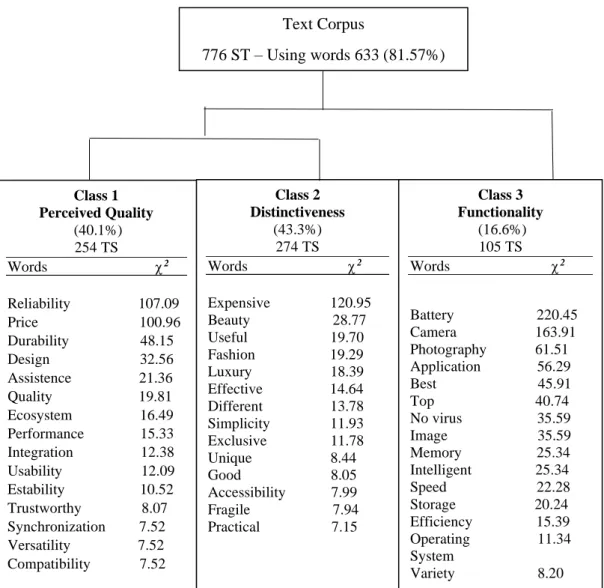
occurrence (see Figure 1), and a Downward Hierarchical Classification (DHC) were performed, that organize similar and different textual segments into classes (see Figure 2). From this analysis results a dendrogram which organizes the words, indicating the quantity and lexical composition of each class. Each word has a Chi-square value (χ2), the larger χ2 the more significant is the association with the class.
The quantitative data were analyzed using structural equation modeling (SEM). SEM analysis allows to build, test and confirm models of complex relationships considering various types of variables (Marôco, 2014). As a result, SEM test hypothesized relationships among concepts, with basic principles that are easy to comprehend with a framework not different from other statistical techniques, such as ANOVA or multiple regressions (Gallagher, Ting, and Palmer, 2008). This research followed the suggest two-steps approach by Gallagher, Ting and Palmer (2008), that separate the measurement and relationship estimations. So the analysis began with the first step of examining the measurement model by a confirmatory factor analysis of all the variables, then once a satisfactory measurement model is obtained, the theoretical relationship structure is then tested (Gallagher, Ting & Palmer, 2008). By applying this two-stage method is ensured that the measures of the constructs are reliable and valid before trying to conclude relations between constructs (Jensen & Hansen, 2006). The SPSS 25.0 and AMOS 25.0 were used in performing confirmatory, causal, and structural equation analysis (SEM).
13 Results
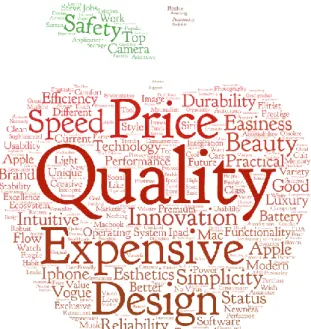
The ten most frequent words were: expensive (n = 165), quality (n = 133), design (n= 127), price (n = 106), reliability (n = 77), durability (n = 66), beauty (n = 65), simplicity (n = 56), innovation (n = 53) and safety (n = 49) (see Figure 2). Moreover, the words evoked were very positive (M=4.10, DP= 0.68). In this way it is possible to observed that the most cited words are related with the monetary value of the brand product as well as its qualities.
Figure 1. Apple brand meanings word cloud.
Analyzing the general corpus consisted of 776 text segments (TS), with use of 633 (81.57%). 3885 occurrences have emerged (words or forms), with 3918 distinct words and 1853 with a single occurrence. The content analyzed was categorized into three classes:
Class 1 – Perceived Quality
Firstly, the second-biggest class, was composed of 254 TS, (40.1%) of the text segments included words like “reliability” (χ2 = 107.09), “price” (χ2 = 100.96), “durability” (χ2 = 48.15), “design” (χ2 = 32.56) and “quality” (χ2 = 19.81). These evoked words are related to the good quality and characteristics perceived by the users of Apple´s brand.
Class 2 – Distinctiveness
Secondly, the biggest class, was composed of 274 TS, (43.3%) of the text segments included words like “expensive” (χ2 = 120.95), “beauty” (χ2 = 28.77), “useful” (χ2 = 19.70),
14 “fashion” (χ2 = 19.29) and “luxury” (χ2 = 18.39). These evoked words are related to the distinctive features perceived by the users of Apple´s brand.
Class 3 – Functionality
Lastly, the smallest class, was composed of 105 TS, (16.6%) of the text segments included words like “battery” (χ2 = 220.45), “camera” (χ2 = 163.91), “photography” (χ2 = 61.51), “application” (χ2 = 56.29) and “no virus” (χ2 = 35.59). These evoked words are related to the functionality proprieties and parts that make up the Apple product.
In this way, we understand that people think of the Apple brand in different ways. They think about the quality of the brand (Class 1), what distinguishes it and makes it unique (Class 2), and the functionality of the devices (Class 3).
Figure 2. Downward hierarchical classification about the meanings of the Apple brand.
Class 1 Perceived Quality (40.1%) 254 TS Words χ 2 Reliability 107.09 Price 100.96 Durability 48.15 Design 32.56 Assistence 21.36 Quality 19.81 Ecosystem 16.49 Performance 15.33 Integration 12.38 Usability 12.09 Estability 10.52 Trustworthy 8.07 Synchronization 7.52 Versatility 7.52 Compatibility 7.52 Class 2 Distinctiveness (43.3%) 274 TS Words χ 2 Expensive 120.95 Beauty 28.77 Useful 19.70 Fashion 19.29 Luxury 18.39 Effective 14.64 Different 13.78 Simplicity 11.93 Exclusive 11.78 Unique 8.44 Good 8.05 Accessibility 7.99 Fragile 7.94 Practical 7.15 Class 3 Functionality (16.6%) 105 TS Words χ 2 Battery 220.45 Camera 163.91 Photography 61.51 Application 56.29 Best 45.91 Top 40.74 No virus 35.59 Image 35.59 Memory 25.34 Intelligent 25.34 Speed 22.28 Storage 20.24 Efficiency 15.39 Operating 11.34 System Variety 8.20 Text Corpus 776 ST – Using words 633 (81.57%)
15 Structural Equation Model
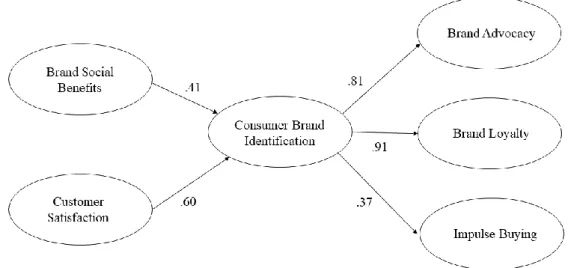
The model in Figure 3 theorizes that brand social benefits and customer satisfaction are the antecedents of brand identification, which means that if a customer is satisfied and if the brand gives to the consumer social benefits or status the consumer will be more predisposed to identify with that specific brand. Consequently, that identification with a brand results in be an advocator, loyal and to have an impulse to buy products from that brand. Preceding the main analysis, assumptions for structural equation modeling (SEM) were checked and verified. Those SEM assumptions we checked were an adequate variable-to-sample ratio, normality, linearity, no extreme multicollinearity, and sampling adequacy (Hair et al. 1998).
Reliability, discriminant validity and convergent validity testing
Table 2 shows the correlation coefficients r of Pearson, Cronbach’s alphas coefficients, composite reliabilities (CR), and average variances extracted (AVE). Cronbach’s α coefficients ranged from .74 for brand identification to .90 for social benefits which is acceptable (Kim, Morris, & Swait, 2008) and the CR of each scale exceeded the .70 standard that suggests adequate construct reliability (Bagozzi & Yi, 2012). The results indicate that the scales are internally consistent (Fornell & Larcker, 1981). AVE for each construct presented in the proposed model exceeded the .50 level in all the constructs except in Brand Identification (Fornell & Larcker, 1981).
16 Table 2. Correlation Matrix, Means, Standard Deviations, Reliability and Validity Measures
Despite that, as shown in Table 1 the variables dash back to different theoretical foundations and they ate conceptually distinct. Observing the Figure 3, each of the scale items has relatively high standardized estimates on each of the factors, demonstrating high convergent validity which means that the chosen items for each factor reflect the examination construct (see Table 3). In addition, correlations between each of the constructs are not excessively high, indicating high discriminant validity (see Table 2). In summary, the constructs are unidimensional and show acceptable levels of reliability, convergent validity, and discriminant validity to proceed with the structural measurements.
CBI SB CS BA BL IB CBrand Identification 1.00 Social Benefits .44** 1.00 Customer Satisfaction .42** .09* 1.00 Brand Advocacy .62** .26** .51** 1.00 Brand Loyalty .64** .34** .53** .65** 1.00 Impulsive Buying .34** .37** .10** .30** .21** 1.00 Cronbach´s α .74 .90 .83 .86 .77 .88 CR .71 .90 .88 .87 .78 .89 AVE .38 .69 .66 .69 .98 .66 Mean 3.45 1.94 4.44 4.03 3.56 1.45 SD 0.90 1.10 0.72 0.99 1.01 0.85
Note: BI = Brand Identification, SB = Social Benefits, CS = Customer Satisfaction, BA = Brand Advocacy,
BL = Brand Loyalty IB = Impulse Buying, CR = Composite Reliability, AVE = Average Variance Extracted, SD = Standard Deviation. * p < .05; ** p ≤ .01
17 Table 3.
Structural Model (SEM) Results
Findings and testing of the structural model
The measurement model was assessed by covarying all the latent constructs contained in the model and examining the model fit. Regarding to the sample size (n=776), multiple fit indices were used to assess the overall fit of the model. The measurement model, as implemented in AMOS yields adequate fit properties suggested by Hair et al. (1998) – CFI .94, GFI =.90, TLI =.93, χ2/df =3.57, RMSEA=.06. However, the χ2/df test shows minor adjustment, there isn’t a universal agreed-upon standard as to what is a good and a bad fitting model. As a result, alternative measures of fit have been developed and analyzed in this study (Marôco, 2014). Overall, these results show that the fit indices rates are acceptable which indicate that the hypothesized model is a good fit to the observed data and the proposed hypotheses in this report are confirmed at the p<0.001 level.
Standardized Z- Statistic*** Estimates BI SB .41 11.17 BI CS .60 12.67 BI → IB .37 8.46 BI → BL .91 15.18 BI → BA .81 15.66
Note: BI = Brand Identification, SB = Social Benefits, CS = Customer
Satisfaction, BA = Brand Advocacy, BL = Brand Loyalty IB = Impulse Buying, Notes: *** p < 0.001
18
Figure 3. Consumer-Brand-Identification of Apple´s brand Structural Model
CFI [Comparative Fit Index] =.94, GFI [Goodness of Fit Index] =.90, TLI [Tucker-Lewis Index] =.93, χ2/df [Degrees of Freedom] =3.57, RMSEA [Root Mean Square Error of Approximation] =.06.
Brand social benefits and customer satisfaction are antecedents and measure consumer brand identification, on the other hand identification has a significant influence on the two consequent variables of consumers brand advocacy and loyalty, and smaller influence in impulse buying. As Figure 3 shows we found support for the proposed hypotheses. This is not surprising given the fact that many of our hypotheses have been established in previous research (Table 1). In sum, our structural model substantially contributes to existing knowledge by providing a detailed picture of the underlying relationships and their strengthen.
Table 4. Results of hypothesis testing
Research Hypotheses Construct Decision Relationships
H1: Brand Social Benefits is positively related to BI SB Supported Consumer-Brand Identification.
H2: Customer Satisfaction is positively related to BI CS Supported Consumer-Brand Identification.
H3: Consumer-Brand Identification is positively related BI → BA Supported to Brand Advocacy.
H4: Consumer-Brand Identification is positively related BI → BL Supported to Brand Loyalty.
H5: Consumer-Brand Identification is positively related BI → IB Supported to Impulsive Buying.
19 Discussion
Belk´s (1988) states “we are what we have”, and so what we buy, own, and consume define us to others. It is commonly recognized that brands can embody, inform, and communicate desirable consumer identities (Bhattacharya & Sen, 2003). In this way, new marketing research tools are developed, so the marketers can get information about who consumers are and gain insights on various aspects of their lives including lifestyles, needs, desires and consumption expectations (Coelho, Rita, & Santos, 2018). This is extremely important since the customer´s expectations continue to rise, challenging companies to fulfill these expectations in order to succeed (Popp & Woratschek, 2017b).
The conceptualization between brand identity-based constructs and existing marketing constructs remains unclear. Scholars seem concerned about the discriminant validity between the constructs, the validity of structural model estimation and the interpretation of models that involves identity constructs (Lam, 2012). Moreover, the idea that brands have a crucial role in the construction and maintenance of consumers identities is old and is related to the consumer culture theory. This theory says that “consumers actively rework and transform symbolic meanings encoded in advertisements, brands, retail settings, or material goods to manifest their particular personal and social circumstances and further their identity and lifestyle goals” (Lam et al., 2013, p.871).
The main purpose of this research was to create and test a model that integrates antecedents and consequences of Consumer-Brand Identification. This research demonstrates the role and impact of identification in long-term brand relationships and brand-related behaviors applied to Apple brand. In line with the previous research about the emergence of customer extra-role behavior from identification (Stokburger-Sauer et al., 2012), this study extends these findings due to the strong effects observed of identification on brand advocacy and brand loyalty. However smaller effects but significant were observed in trait constructs like impulsive buying behavior.
Regarding the sample used in this paper, only consumers of Apple products are represented which provides reliability to the results presented. Therefore, the results indicate that brand managers have to invest on consumer satisfaction and social experiences to increase the consumer identification towards a brand, since this is will lead to a customer that is loyal, that recommends the brand to others and that has more impulsiveness in the buying process. In addition, choosing a brand that is an expression of individuality and empowerment like Apple contributes to enlighten the significant interrelationships. In this way, brands should strive to
20 increase CBI by drawing on social influence and symbolic antecedents of identification. Social interactions increase involvement with the brand which has effects on the success of a brand profitability. Although all the hypothesis was supported in this research, researchers should not be misread the study as a call for only aiming high levels of identification, instead, complementary, mixed-use of the different areas of marketing seems appropriate.
In conclusion, these findings provide useful insights into consumer-brand relationships from a social identity theory perspective with important implications for strategic brand management. This research contributes with an examination on consumer-brand identification by qualitative and quantitative methods. Including brand social benefits and customer satisfaction as the antecedents of brand identification and to investigate the interrelationships among these constructs on brand loyalty, brand advocacy and impulse buying as the consequences of brand identification. Moreover, this paper not only confirms previous studies about the importance of CBI but also leads to several new insights for researchers and important managerial implications due to the integrative perspective on drivers of marketing success.
Managerial Implications
This paper aimed a more inclusive perspective on marketing activities by integrating customer satisfaction into the areas of identification and impulsive buying, which are broadly examined in brand management and relationship marketing. The results show a clear direction, to managers take an accurate view of relationships and identify all targets of identification which are relevant from a consumer´s point of view. Brands must strengthen their identity throw investing in marketing strategies and communicating the brand´s values that seem to be consistent with consumers values. Also, initiatives to make the brand more attractive to satisfy the consumer self-verification needs should be taken in order to increase identification towards the brand (Elbedweihy et al., 2016).
This study offers some important insights into high involvement consumer behavior processes and has important implications in building strong and lasting relationships with consumers. The findings indicate that brands have an important role in the everyday lives and can influence the construction of individuals identity. In that way, managers have to ensure that their brands have high social value and serve consumer interpersonal goals since the results indicate that will lead to brand advocacy and loyalty (Stokburger-Sauer et al., 2012).
21 Successful marketing strategies differentiate between individual and social dimension of the consumers. If the goal is to increased brand loyalty, the strategy should be to build consumer-brand relationships based on individuality. On the other hand, if consumers see brands as social currency, then the brand strategy should focus on generating brand advocacy. That is why social media is a great facilitator because it offers platforms to interact, collaborate and inform other consumers in a congruent way with their values, attitudes, and lifestyles (Tuškej, Golob, & Podnar, 2013).
In sum, this paper advances our understanding of the relationship between brands and consumer identity across technologic products. Moreover, by providing an integrative understanding of antecedents of CBI, were brought simultaneously consequences that have been examined only in isolation (e.g., brand social benefits and impulsive buying). The proposed model provides insights into the relationships among key constructs from different research streams and should encourage future studies with similar goals. The relevance of multiple targets of identification highlighted in this research may lead to new perspectives to increase brand loyalty and advocacy, the key relationship outcomes.
Limitations and further research
The present study contributes to understanding the role of identification for brand relationships and brand-related behaviors, though the results should be interpreted with some caution and limitations in mind.
Firstly, this study only focusses on a single brand that holds high levels of symbolic meaning and has a strong commitment and emotional involvement which can be a shortcoming to measure the conceptualization of identification in marketing. In the future should be included multiples brands (Popp & Woratschek, 2017b). Secondly, the study analyzes consumers behavior processes only with a brand the participants possess, which can origin higher means of the items and correlation between them. In this way, it is necessary carefulness when generalizing the results of this study to situations in which consumers are not previously involved with the brand. Thirdly regarding the participants, another limitation could be the use of online surveys distributed through Facebook using non-probabilistic convenience sampling. Future research on CBI may also explore the role of CEOs, for example, consumers’ identification with Steve Jobs can induce them to identify with any new brands that Apple has. On the other hand, it will be interesting to analyze if the consumers maintain their strong CBI towards Apple and new product with the loss of Steve Jobs (Lam et al., 2013). Additionally,
22 future research can be made to measure differences between Apple and Samsung using the same framework presented in this study. Lastly, replicating the model in the context of different types of brands, such as product, service and retail brands could serve to further generalize the results. Future studies could also apply this framework to other cultural contexts and consumer characteristics.
23 References
Arnould, E. J., & Thompson, C. J. (2005). Reflections twenty years of research. Journal of Consumer Research, 31(4), 868-882. DOI: 10.1086/426626
Algesheimer, R., Dholakia, U. M., & Herrmann, A. (2005). The social influence of brand community: Evidence from European car clubs. Journal of Marketing, 69(3), 19-34. DOI: 10.1509/jmkg.69.3.19.66363
Amos, C., Holmes, G. R., & Keneson, W. C. (2014). A meta-analysis of consumer impulse buying. Journal of Retailing and Consumer Services, 21 (2), 86–97. DOI: https://doi.org/10.1016/j.jretconser.2013.11.004
Augusto, M., & Torres, P. (2018). Effects of brand attitude and eWOM on consumers’ willingness to pay in the banking industry: Mediating role of consumer-brand identification and brand equity. Journal of Retailing and Consumer Services, 42 (February), 1–10. DOI: https://doi.org/10.1016/j.jretconser.2018.01.005
Badenhausen, Kurt. (2019). The world´s most valuable brands 2019: Apple on top at 206
billion. Forbes. Available in:
https://www.forbes.com/sites/kurtbadenhausen/2019/05/22/the-worlds-most-valuable-brands-2019-apple-on-top-at-206-billion/#7c9c7e8337c2
Bagozzi, R. P., & Yi, Y. (2012). Specification , evaluation , and interpretation of structural equation models. Journal of the Academy of Marketing Science, 40 (1), 8–34. DOI: https://doi.org/10.1007/s11747-011-0278-x
Belk, R. W. (1988). Possessions and the extended self. Journal of consumer research, 15(2), 139-168. DOI: 10.1086/209154
Bhattacharya, C. B., & Sen, S. (2003). Consumer–company identification: A framework for understanding consumers’ relationships with companies. Journal of Marketing, 67(2), 76-88. DOI: 10.1509/jmkg.67.2.76.18609
Byrne, B. M. (2001). Structural equation modeling with AMOS, EQS, and LISREL: Comparative approaches to testing for the factorial validity of a measuring instrument.
International Journal of Testing, 1(1), 55-86, DOI: 10.1207/S15327574IJT0101_4
24
Marketing letters, 17(2), 79-89. DOI: 10.1007/s11002-006-4219-2
Coelho, P. S., Rita, P., & Santos, Z. R. (2018). On the relationship between consumer-brand identification, brand community, and brand loyalty. Journal of Retailing and Consumer
Services, 43 (February), 101–110. DOI: https://doi.org/10.1016/j.jretconser.2018.03.011
Elbedweihy, A. M., Jayawardhena, C., Elsharnouby, M. H., & Elsharnouby, T. H. (2016). Customer relationship building: The role of brand attractiveness and consumer-brand identification. Journal of Business Research, 69 (8), 2901–2910. DOI: https://doi.org/10.1016/j.jbusres.2015.12.059
Escalas, J. E., & Bettman, J. R. (2003). You are what they eat: The influence of reference groups on consumers’ connections to brands. Journal of Consumer Psychology, 13(3), 339-348. DOI: 10.2139/ssrn.412081
Fitzsimons, G. M., Chartrand, T. L., & Fitzsimons, G. J. (2008). Automatic effects of brand exposure on motivated behavior: how apple makes you “think different”. Journal of
Consumer Research, 35(1), 21-35. DOI: 10.1086/527269
Forsido, Z. M. (2012). Brand Loyalty in Smartphone. (Master Thesis, Uppsala Universitet).
Available in:
http://uu.diva-portal.org/smash/record.jsf?pid=diva2%3A545415&dswid=8589
Fornell, C., & Larcker, D. F. (1981). Evaluating structural equation models with unobserv- able variables and measurement error. Journal of Marketing Research, 18(1), 39–50.
Gallagher, D., Ting, L., & Palmer, A. (2008). A journey into the unknown: Taking the fear out of structural equation modeling with AMOS for the first-time user. The Marketing
Review, 8 (3), 255–275. DOI: https://doi.org/10.1362/146934708x337672
Grupo Marktest. (2018). Os Portugueses e as redes sociais 2018. Available in: https://www.marktest.com/wap/private/images/Logos/Folheto_Portugueses_Redes_So ciais_2018.pdf
Gupta, P., Laddha, S., & Singh, S. (2017). Brand advocacy and brand bonding: New parameters in consumer purchase decision journey in the digital world. SIES Journal of
25 Hair, J. F., Black, W. C., Babin, B. J., & Anderson, R. E. (2010). Structural equations modeling
overview. In Multivariate data analysis (pp. 541-597). Prentice Hall.
He, Y., Chen, Q., Lee, R. P., Wang, Y., & Pohlmann, A. (2017). Consumers' Role Performance and Brand Identification: Evidence from a Survey and a Longitudinal Field Experiment.
Journal of Interactive Marketing, 38, 1-11. DOI: 10.1016/j.intmar.2016.11.001
Herm, S., & Möller, J. (2014). Brand identification by product design: The impact of evaluation mode and familiarity. Psychology & Marketing, 31(12), 1084-1095. DOI: 10.1002/mar.20755
Homburg, C., Wieseke, J., & Hoyer, W. D. (2009). Social Identity and the Service-Profit Chain.
Journal of Marketing, 73 (2), 38–54. DOI: https://doi.org/10.1509/jmkg.73.2.38
Jensen, J. M., & Hansen, T. (2006). An empirical examination of brand loyalty. Journal of
Product and Brand Management, 15 (7), 442–449. DOI: https://doi.org/10.1108/10610420610712829
Kang, A. (2015). Brand love–moving beyond loyalty an empirical investigation of perceived brand love of Indian consumer. Arab Economic and Business Journal, 10(2), 90-101. 10.1016/j.aebj.2015.04.001
Keller, E. (2007). Unleashing the power of word of mouth: Creating brand advocacy to drive growth. Journal of Advertising Research, 47 (4), 448–452. DOI: https://doi.org/10.2501/S0021849907070468
Kim, J., Morris, J. D., & Swait, J. (2008). Antecedents of true brand loyalty. Journal of
Advertising, 37 (2), 99–117. DOI: https://doi.org/10.2753/joa0091-3367370208
Laverie, D. A., Kleine III, R. E., & Kleine, S. S. (2002). Reexamination and extension of Kleine, Kleine, and Kernan's social identity model of mundane consumption: The mediating role of the appraisal process. Journal of Consumer Research, 28(4), 659-669. DOI: 10.1086/338208
Lai, C. W. (2010). How financial attitudes and practices influence the impulsive buying behavior of college and university students. Social Behavior and Personality, 38 (3), 373–380. DOI: https://doi.org/10.2224/sbp.2010.38.3.373
26 Lam, S. K. (2012). Identity-motivated marketing relationships: Research synthesis, controversies, and research agenda. AMS Review, 2 (2), 72–87. DOI: https://doi.org/10.1007/s13162-012-0028-3
Lam, S. K., Ahearne, M., Hu, Y., & Schillewaert, N. (2010). Resistance to brand switching when a radically new brand is introduced: A social identity theory perspective. Journal
of Marketing, 74 (6), 128–146. DOI: https://doi.org/10.1509/jmkg.74.6.128
Lam, S. K., Ahearne, M., Mullins, R., Hayati, B., & Schillewaert, N. (2013). Exploring the dynamics of antecedents to consumer-brand identification with a new brand. Journal of
the Academy of Marketing Science, 41 (2), 234–252. DOI: https://doi.org/10.1007/s11747-012-0301-x
Lee, J., Ko, E., & Megehee, C. M. (2015). Social benefits of brand logos in presentation of self in cross and same gender influence contexts. Journal of Business Research, 68(6), 1341-1349. DOI: 10.1016/j.jbusres.2014.12.004
Lins, S., Poeschl, G., & Eberhardt, A. (2016). Identificando os factores de influência da compra por impulso em adolescentes Portugueses. Análise Psicológica, 34 (2), 147–163. DOI: https://doi.org/10.14417/ap.920
Luo, X. (2005). How does shopping with others influence impulsive purchasing? Journal of
Consumer Psychology, 15 (4), 288–294. DOI: https://doi.org/10.1207/s15327663jcp1504_3
Luo, X. M. (2004). Group dynamics of impulse buying: An extended social facilitation perspective. Advances in Consumer Research, 31, 431
Lusensky, M. J. (2014). Did You Bite the Magic Apple? Exploring the Symbolic Meaning of Apple, Inc. Jung Journal, 8(1), 57-70. DOI: 10.1080/19342039.2014.841445
Marôco, J. (2014). Análise de equações estruturais: Fundamentos teóricos, Software & Aplicações. Perô Pinheiro, Lisboa. ReportNumber, Lda.
McGowan, M., Shiu, E., & Hassan, L. M. (2017). The influence of social identity on value perceptions and intention. Journal of Consumer Behaviour, 16(3), 242-253. DOI: 10.1002/cb.1627
Muniz Jr, A. M., & Schau, H. J. (2005). Religiosity in the abandoned Apple Newton brand community. Journal of consumer research, 31(4), 737-747. DOI: 10.1086/426607
27 Netemeyer, R. G., Krishnan, B., Pullig, C., Wang, G., Yagci, M., Dean, D., ... & Wirth, F. (2004). Developing and validating measures of facets of customer-based brand equity.
Journal of business research, 57(2), 209-224. DOI: 10.1016/S0148-2963(01)00303-4
Oliver, R. L. (1980). A cognitive model of the antecedents and consequences of satisfaction decisions. Journal of marketing research, 17(4), 460-469. DOI: 10.2307/3150499
Phillips-Melancon, J., & Dalakas, V. (2014). Brand rivalry and consumers’ Schadenfreude: The case of Apple. Services Marketing Quarterly, 35(2), 173-186. DOI: 10.1080/15332969.2014.885370
Pinson, C. (2010). The church of Mac: Exploratory examination on the loyalty of Apple customers. Journal of Marketing and Management Research, 14 (1), 1–15
Popp, B., & Woratschek, H. (2017a). Consumer-brand identification revisited: An integrative framework of brand identification, customer satisfaction, and price image and their role for brand loyalty and word of mouth. Journal of Brand Management, 24 (3), 250–270. DOI: https://doi.org/10.1057/s41262-017-0033-9
Popp, B., & Woratschek, H. (2017c). Consumers’ relationships with brands and brand communities: The multifaceted roles of identification and satisfaction. Journal of
Retailing and Consumer Services, 35 (May), 46–56. DOI: https://doi.org/10.1016/j.jretconser.2016.11.006
Sinek, S. (2010). How great leaders inspire action. Retrived from: https://www.youtube.com/watch?v=qp0HIF3SfI4
Ratinaud, P. (2009). IRAMUTEQ: Interface de R pour les Analyses Multidimensionnelles de Textes et de Questionnaires [Computer software]. Available in: http://www.iramuteq.org
Rubio, N., Villaseñor, N., & Oubiña, J. (2015). Consumer identification with store brands: Differences between consumers according to their brand loyalty. BRQ Business
Research Quarterly, 18(2), 111-126. DOI: 10.1016/j.brq.2014.03.004
Rook, D. W., & Fisher, R. J. (1995). Normative influences on impulsive buying behavior.
Journal of consumer research, 22(3), 305-313. DOI: 0093-5301/96/2203
Sharma, P., Sivakumaran, B., & Marshall, R. (2010). Impulse buying and variety seeking: A trait-correlates perspective. Journal of Business Research, 63 (3), 276–283. DOI: https://doi.org/10.1016/j.jbusres.2009.03.013