“NOTICE: this is the author’s version of a work that was accepted for publication in Health Education Research. Changes resulting from the publishing process, such as peer review, editing, corrections, structural formatting, and other quality control mechanisms may not be reflected in this document. Changes may have been made to this work since it was submitted for publication. A definitive version was subsequently published as:
Fernandes, S., Arriaga, P., & Esteves, F. (2014). Providing preoperative information for children undergoing surgery: a randomized study testing different types of educational material to reduce children’s preoperative worries. Health Education Research, 29 (6), 1058-1076. doi: 10.1093/her/cyu066.
Running head: PROVIDING PREOPERATIVE INFORMATION
Providing preoperative information for children undergoing surgery: a randomized study testing different types of educational material to reduce children’s preoperative worries
Fernandes*, C. S. University Institute of Lisbon (ISCTE-IUL), CIS-IUL, Lisbon, Portugal Arriaga, P. University Institute of Lisbon (ISCTE-IUL), CIS-IUL, Lisbon, Portugal Esteves, F. Mid Sweden University, Sweden; CIS-IUL, Lisbon, Portugal
Key words: Preoperative preparation; children; surgery; preoperative worries.
* This research was supported by the first author’s Ph.D. grant (SFRH/BD/61041/2009), sponsored by the FCT (Portuguese Foundation for Science and Technology).
Correspondence should be addressed to: Sara Costa Fernandes, Centre for Research and Social Intervention (CIS/ISCTE) – Lisbon University Institute, Av. das Forças Armadas, 1649–026 Lisboa, Portugal. [Email: [email protected]].
Abstract:
The present study developed three types of educational preoperative materials and examined their efficacy in preparing children for surgery by analyzing children’s preoperative worries and parental anxiety. The sample was recruited from three hospitals in Lisbon and consisted of 125 children, aged 8 to 12 years, scheduled to undergo outpatient surgery. The participants were randomly assigned to one of the seven independent conditions that were combined into the following three main groups: an experimental group, which received
educational materials with information about surgery and hospitalization (a board-game, a video, or a booklet); a comparison group, which received entertaining material with the same format type; and a control group, which did not receive any material. Children’s preoperative worries and parental anxiety were evaluated after the experimental manipulation. Children who received the educational materials were significantly less worried about surgery and hospital procedures than children in the comparison and the control groups, although no statistically differences were found between the type of materials within the experimental group, and no significant effect occurred on parental state anxiety. These results do however support the hypothesis that providing preoperative materials with educational information reduce children’s preoperative worries.
Preoperative interventions have been increasingly used in the hospital settings for the last few decades [1, 2]. The negative impact of surgery on children and their families has been largely recognized in the literature [3-5]. Surgery tends to evoke negative behaviors and feelings in children, such as avoidance, guilt, sadness, and distrust, which have been related to preoperative fears and anxiety [6, 7]. The period that precedes surgery involves an emotional and stress overload [8], with potential negative consequences during and after surgery [9], including phases such as the induction of anesthesia, the recovery period, and the postoperative period [5, 10]. Several preoperative types of interventions (i.e. pharmacological, behavioral/psychological) have been used to reduce the negative responses of children and their family, to increase the
cooperation and compliance during the medical process, to promote self-efficacy and sense of control, and to improve the postoperative recovery and the emotional adjustment after medical discharge [11-13].
Research has shown that interventional preparation programs which provide educational information positively tend to affect children, parents, and healthcare professionals [14, 15]. The expected positive health outcomes may include a reduction in the children’s stress levels, an improvement of the child’s cooperation with the healthcare professionals, and a stronger adhesion to medical procedures [11, 12]. These outcomes may be related to an increase in the child’s sense of self-control, decrease of unrealistic expectations and of inappropriate concerns with
hospitalization and surgery [14], and greater trust and confidence on the healthcare professionals [11, 12]. These benefits may also reduce postoperative maladaptive emotional and behavioral responses, decrease pain perception and foster a faster recovery [14]. Research has also shown that providing educational information using books, medical play, and peer modeling videos (i.e., observation of appropriate behaviors executed by a similar model) are the most appropriate and effective methods for children to learn effective strategies for coping with surgery, in particular
during the concrete operational stage of development (children aged approximately between 7-12 years old), according to Piaget’s theory (1963) [12, 16, 17]. Taking this into account, we
developed three types of educational preoperative materials (i.e. a booklet, a board game, and a video) to prepare children for outpatient surgeries, also designated as same-day surgeries.
Worry and anxiety are related constructs, although independent and therefore they should be conceptually distinguished [18]. Anxiety is a global construct that includes somatic, cognitive and behavioral components, while worry is conceptualized as a cognitive construct, and a major component of generalized anxiety disorder [18; 19]. Previous studies have focused on distracting the children from anxiety without addressing children’s specific worries to preoperative scenarios and medical procedures (e.g. hospital rules about food and clothing, administration of
premedication and anesthetic procedures). Moreover, to our knowledge, no study has compared the effects of both educational and entertainment preoperative materials on children responses, with the exception of two studies: one conducted about the effects of hospital clowns [20] and the other on the efficacy of an educational multimedia application [21]. These studies are relevant because they showed that when children interact with professional hospital clowns [20] or receive information using an interactive multimedia program that combine several techniques (e.g.
videos, mini-games) [21] they tend to report less preoperative worries about surgery.
The present study aimed to provide clearer information about the impact and efficacy of educational preoperative materials, by using a randomized controlled trial to examine their effects on children’s preoperative worries and also on parental state anxiety before surgery. Children were randomly assigned to one of seven independent conditions, that were combined into the following three main groups, based on the content of the materials they received: 1) children in the experimental group received educational materials about surgery and hospitalization in the format of a board-game, a video, or a booklet; 2) children in the comparison group received
material in the same three format as the experimental group but the materials contained no information about surgery or hospitalization; and 3) the control group did not receive any
material. The use of three types of materials (board-game, video, or booklet) in the experimental group was important to analyze whether the format of the information might have different impacts on children’s responses. In addition, the use of a comparison group in which children received the same-type of material was relevant to differentiate the content of the material and to ascertain whether the effects can be due to specific educational information about surgery or more related to the a mere entertainment activity which may distract children from their
preoperative worries. A control condition was necessary to compare both previous groups with the standard hospital procedures.
Based on previous research that have shown the important effects of preoperative programs on the decrease of anxiety [14, 22] and preoperative worries [21], and especially those in which information about surgery was provided to children, we hypothesized that children in the experimental group would report less preoperative worries about surgery when compared to children in both the comparison and the control groups. Due to the potential of distraction achieved by the entertainment materials, we also examined the differences between the
comparison and the control groups, and expected that children in the comparison group would report less preoperative worries [1, 12]. Although the educational information provided was the same in all of the three materials (board game, video, or booklet) within the experimental group, we expected the booklet to be the least effective in reducing preoperative worries because the board-game is interactive and the video illustrates a behavioral model using real children. Several other important factors may also affect children’s worries, therefore additional variables were collected, such as demographic, clinical information, temperamental dispositions, coping strategies, and parental anxiety [15, 23, 24] to examine the degree of their relationship with the
child’s preoperative worries and to analyze whether these variables predict a significant amount of the variance in preoperative worries beyond what might be accounted by the intervention.
Previous research suggested that negative behaviors and preoperative anxiety are more common in older children [20, 25], females [25-27], and children with previous surgery experience [13, 28, 29]. We expected that these factors could predict children’s preoperative worries, since they are vulnerability factors for the clinical symptoms of anxiety [19]. The evaluation of the children’s temperamental disposition, defined as the way children typically respond emotionally and behaviorally to the environmental events [30, 31], is also important because some temperamental dimensions, such as shyness, emotionality, sociability, and activity, tend to be associated with worries and distress [20, 21, 32-34]. In addition, the type of strategies that children use to cope with disease, hospitalization, and surgery might be relevant to predict children’s worries about surgery. Coping is defined as the set of strategies people use to adapt to stressful situations [35, 36] and adverse events [12, 37]. The efficacy of preoperative preparation programs could be affected by the individual coping strategies [38]. According to the literature [38, 39] preoperative materials could be more effective for children who have a tendency to seek information, in contrast with children who have a tendency to avoid receiving specific
information about their problems [40-42].
It is also very common for parents to experience anxiety during the preoperative period, which might be transmitted to the child and negatively affect them [43]. Previous studies suggested that children whose parents are more anxious also have higher levels of anxiety and distress [5]. Therefore, the inclusion of this variable in our study is important to understand the effects of our intervention on children’s worries. In addition, we analyzed the effects of our intervention on parental state anxiety. Previous studies have shown a decrease on anxiety levels during preoperative preparation programs [21, 29], or while they watch their child being
entertained during the preoperative period [21]. Thus, we expected that parents in the
experimental and comparison groups would report less state anxiety compared with those in the control group. We also examined for potential differences between the experimental and
comparison groups.
Finally, the preoperative period may have a negative impact on children’s emotional states, resulting in feelings of fear, anger, and sadness [12]. Due to the fact that the materials provided to the experimental and comparison groups were written in a playful and pleasant style, we asked children from these two groups to report the emotions they felt (i.e., happiness, fear, anger, and sadness) to examine the potential emotional impact of the materials. We expected that children would report more positive emotions at the end of the materials’ application.
Method
Participants.
The project was conducted at three different hospitals located in the Lisbon metropolitan area from November 2010 to May 2012. The committees of the hospitals which oversee research approved the project.
Sample Size Estimation. The sample size originally estimated for each one of the seven
conditions was 30 participants, which would yield a total of 210 participants. However, according to the suggestions provided by the healthcare professionals during our meetings at the hospitals, this sample size was unrealistic to be collect in a period of one year. Therefore, we took into account minimum sample size recommendations for conducting our main analyses [44]: at least 30 participants in each of the three main group conditions (i.e. experimental, comparison, and control) and 15 participants within each subgroup (i.e., type of material: booklet, video and board game), yielding 45 participants for each of the interventional groups (experimental and
size discrepancies between the three main groups. Thus, a minimum of 125 participants should be recruited. G*Power 3.2.3 software analysis [45] was also used to estimate the sample size. Based on conventional recommendations for social and medical sciences [46, 48-49] we set the
statistical power at .80 (for Type II error), the alpha level at .05 (for Type I error) and have considered the type of statistical analyses we would be conducting to test our main
hypotheses. Power analysis estimates for analyses of variance (ANOVAs) with three main groups indicated that for detecting a medium effect size (f = .25, using Cohen´s standard effect sizes) the total size required would be 159 and 66 for a large effect size (f = .40) [47]. To maximize
statistical power, we chose to conduct planned contrasts to test our main hypotheses. We also conducted Principal Components Analysis (PCA) on the results of both the EAS and SCSI to examine their factor structure, since both instruments were developed to be used for self-report, and in our study we asked parents to evaluate their children. Several authors have proposed different minimum ratios of participants for the number of items. Cattell [50] suggested a minimum sample of 1:3 per item; Gorsuch [51] and Hair [52] suggested a ratio of 1:5. Other researchers suggested a sampling of at least 100 [51, 52, 53] while others recommended being at least 50 participants [54]. Because the recruitment of participants in a clinical setting is very difficult, Bujang, Ghani, Bujang, Soelar, and Zulkifli [55] took into account several statistics (e.g., factor loadings, corrected item-total correlation, communalities, total variance explained, internal consistency) and the type of measurement scales, to estimate a sufficient sample size for a reliable PCA. They found that a sample size ratio of 1:5 would be sufficient to yield an
appropriate and stable factor solution for any type of measurement scales. Thus, with a total of at least 125 participants, all minimum requirements will be ensured to proceed with our analyses. However, the period of collecting data was extended to a period of 18 months to guarantee this sample size.
The sample was initially composed of 127 children; however, two children were not included in the study due to sensory and mental disabilities. Exclusion criteria (i.e. children and parents who did not speak Portuguese; children with sensory or mental disabilities, such as developmental delay or blindness) were used to guarantee that all participants would understand the materials and the scale items to report their responses. The final sample was composed of 125 children of both genders (99 males, 26 females), aged between 8 and 12 years of old (M=10.09;
SD=1.43), who were scheduled for minor and outpatient surgery. The most common surgical
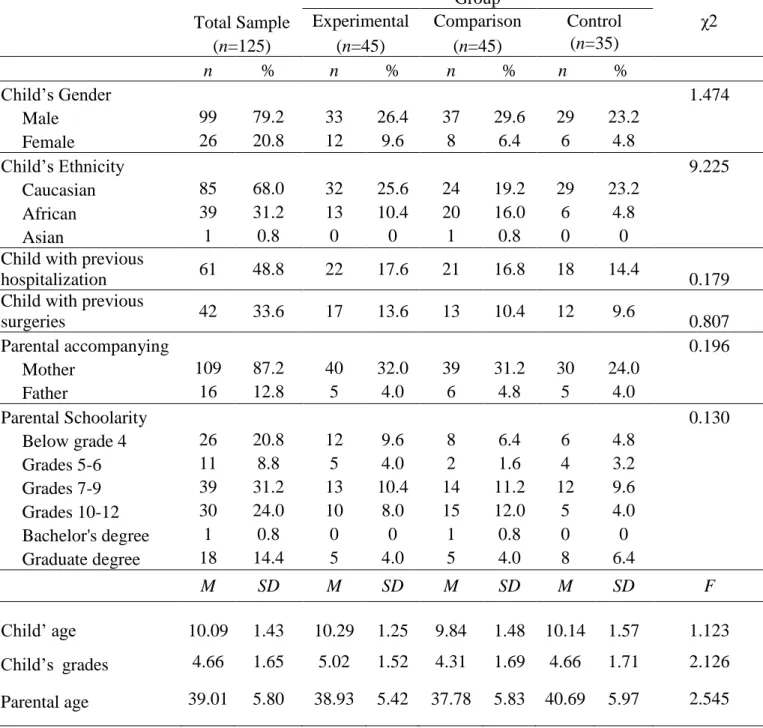
procedures were circumcisions (52.8%), herniorrhaphies (20.0%) and excisions (15.2%). Almost half of children (48.8%) reported previous hospitalization and 33.6% reported previous surgical experiences. The parental sample was composed of 125 parents (109 mothers; 16 fathers), with a mean age of 39.01 years (SD=5.80). The main demographical characteristics of the sample, from both children and parents, were similar for the three main group conditions (all p > .05) (see Table 1). Due to non-significant differences between hospitals on all responses (ps > .10), we did not include this variable in further analyses to safeguard the confidentiality of the hospitals.
Measures and Materials
Demographic and clinic information. Age, gender, nationality, hospitalization history and
type of surgery were obtained from parents or were provided by the hospital nursing services (through admission records).
Preoperative worries. To evaluate children’s preoperative worries about surgery,
hospitalization, and medical procedures we used the Child Surgery Worries Questionnaire (CSWQ) [25], which is composed of 23 items. Children were asked to indicate the degree of worry regarding each statement using a five-point Likert scale response with a thermometer scale format (ranging from 0 = not at all worried to 4 = extremely worried). Higher scores correspond to higher worries about the surgery. The original version showed good reliability (Cronbach’s
alpha = .88) and construct validity [25]. In the present study, we decided to evaluate only the global preoperative worries, since all the three factors were moderately correlated with each other (rs > .60), as well as highly correlated with the global score (rs > .83). The average score was calculated by summing all responses and dividing by the total number of items to facilitate the interpretation of results. Although the original CSWQ was administered to a sample of Spanish children, aged between 11 and 14 years old, other studies using Portuguese samples of children from 5-12 [20] and 8-12 years [21] also yielded high reliability scores. According to Chambers and Johnston [56], children over 6 years are able to understand the five-point response scale that is used in this study.
Parental Anxiety. The State-Trait Anxiety Inventory–Form Y (STAI-Y) [57-58] was used
to evaluate parental preoperative anxiety state. STAI-Y is composed of two subscales (anxiety trait and state anxiety), each containing 20 items. In the present study, only state anxiety was measured. Parents were asked to indicate, in a four-point scale (from 1 = not at all to 4 = very
much), the way they were feeling at that moment (i.e., before surgery). The responses to all items
were summed into a single state anxiety score for each individual. Total scores could range from 20 to 80, with higher scores indicating greater state anxiety. Previous studies in Portugal have demonstrated the reliability and validity of the STAI-Y [20, 21, 58].
Child’s Temperament. The Emotionality, Activity, and Sociability Temperament Survey
for Children: Parental Ratings (EAS-P) [59] was used to assess children’s temperament through parental-report. The EAS-P is composed of 20 items that measure four temperamental
dimensions: emotionality, activity, sociability and shyness. Responses can be expressed using a five-point Likert scale response format (from 1 = not characteristic or typical of your child to 5 =
very characteristic or typical of your child). The reliability and validity of the EAS-P
Child’s Coping Strategies. The Schoolagers’ Coping Strategies Inventory: Parental
Version (SCSI-P) [61, 62] was used to analyze child’s coping strategies. We decided to adapt the original SCSI-P instrument into a hetero-report version for parents to avoid overloading the children with the completion of another questionnaire. SCSI-P is composed of two subscales, each containing 21 items: frequencies of certain actions that children engage when they are worried or anxious; and parental beliefs about the efficacy of these behaviors. Parents were asked to indicate, on a 4-point scale, each statement applicability (from 0 = never to 3 = most of the
time). The Portuguese adaptation, based on a sample of 291 Portuguese children, also suggest
three dimensions in the frequency subscale. The final scores of both subscales can be obtained by the sum of each item (range between 0 and 63 points). In both original and Portuguese versions, the results showed good reliability [61, 62].
Educational materials. The educational materials were designed in three different formats
– a booklet, a board-game and a video (saved in a Windows Media format and run in a laptop), and they were all developed to provide the same information. These materials are composed of seven parts, illustrating the hospital stages: 1) Hospital admission; 2) Healthcare professionals and hospital rules; 3) Medical instruments; 4) Medical procedures; 5) Anesthesia and Surgery room; 6) Recovery room; and 7) Aftercare and Going home. Each part is composed of clear explanations about specific topics and intervention stages (e.g. information about healthcare professionals, medical instruments, clinical procedures, and induction of anesthesia), as well as explanations of specific hospital and medical rules (e.g. reasons why they should not eat or drink before surgery, the changing of clothes and parental separation during surgery). Exactly the same educational information was provided through text and pictures, some of them to be color
(booklet); game cards (board-game); or scripts of the scenes filmed in one hospital with children actors (video). All the materials were designed to last 15-20 minutes. A previous pilot study (n =
490) was conducted to select the content of the materials. This study, conducted in different schools in the Lisbon metropolitan area, with children aged between 7 to 12 years (M = 9.22; SD = 1.52), also contributed to gather information about the child’s beliefs and fears about surgery. In addition, several meetings with healthcare professionals were also conducted to determine and improve the content of the educational materials [21].
Entertainment materials. We used entertainment materials in the same three formats (i.e.
a booklet, a video and a board-game) in the comparison group (i.e. Entertainment Material Group). A Calvin and Hobbes comic strips, a Tom and Jerry cartoon movie and a classic
Snakes and Ladders board-game were the entertainment materials chosen. They also lasted about 15 minutes.
Emotions. Whilst the children were engaging with the different educational/entertainment
material they were asked to report how they were feeling by choosing a drawing depicting emotional facial expressions of sadness, happiness, anger, and fear. This evaluation occurred at the end of each section of the educational materials, and at the beginning and end of exposure to the entertainment materials. The drawings of the facial expressions were also previously tested in the previous pilot study mentioned above [21].
Procedure.
The healthcare professionals working in the pediatric surgery unit of the hospitals were briefed beforehand about all the details. On the day of surgery and immediately after the hospital admission, informed consents for parents were requested. Parents were initially informed that the present study aimed to evaluate children’s cognitive and affective responses regarding surgery. Children also provided assent and all agreed to participate. All participants were guaranteed anonymity. The study was conducted only after the hospital admission to ensure that all participants would undergo surgery on that day. Before any intervention, demographic and
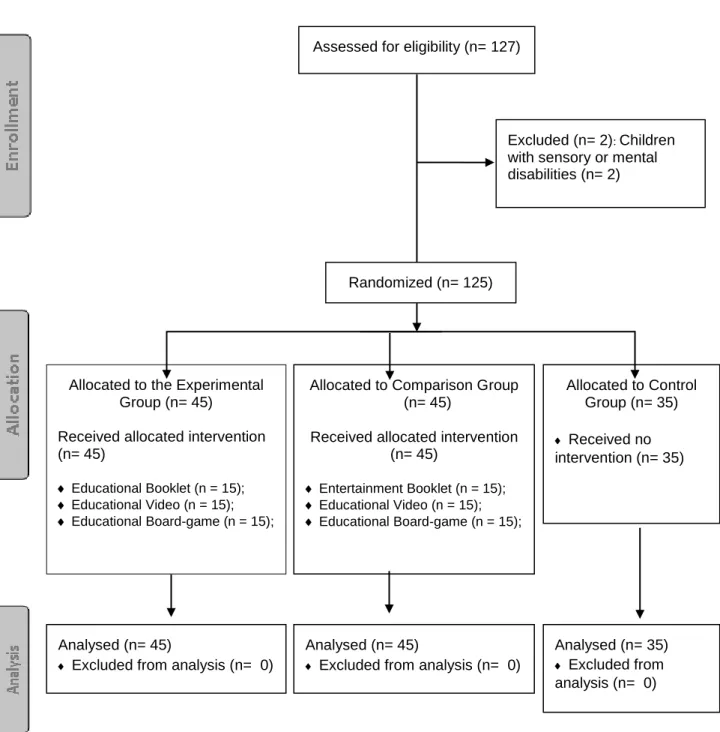
clinical information about the participants were obtained1. Participants (children and parents) were randomly assigned to seven independent conditions, that were combined into the following three main groups the Experimental Group (n=45), the Comparison Group (n=45) and the Control Group (n=35) (Figure 1). The random assignment of participants was accomplished a priori by using the Research Randomizer online tool at http://www.randomizer.org/form.htm. Note that children were randomly assigned to one of the seven conditions, and therefore those in the experimental or in the comparison groups received only one of the three types of materials (i.e. a booklet, a board-game, or a video). It was also previously established that children scheduled for surgery on the same day, in the same hospital, and in the same preoperative ward room, would share the same group condition despite the results of the random assignment tool. This decision was made before any contact between the researcher and the participants because of ethical concerns, i.e., children (or parents) might feel devalued if they would have notice that another child received a different treatment. This procedure only occurred in 9.6% of the sample and affected all groups, reducing a potential selection threat.
1 Additional measures of affective (arousal, valence, pain) and physiological responses (blood pressure, heart rate)
were collected in this project, which will not be reviewed in this article because it was not clear whether providing information on surgery and hospitalization should influence them. Thus, we included these variables for exploratory analysis. Nonetheless, we summarize here information on these measures and their main findings. Blood pressure and heart rate frequency were obtained using a pulse monitor device (Omron’s brand) that was placed on the wrist before collecting any other measure (baseline). Children were also asked to indicate how aroused versus calm (arousal dimension), and how happy versus sad (valence dimension) they were feeling using the Self-Assessment Maniquin scales [63]. The Wong-Baker Faces Scale [64] was used to assess the amount of pain they were experiencing. All these additional measures were collected during the pre- and post-operative period (three phases: baseline, after the experimental intervention, and after the surgery). Each measure was scored twice (post-intervention & post-surgery) as the mean values collected after the experimental (post-intervention and after the surgery subtracted by the mean values at baseline. Using a 3 (group condition) X 2 (operative period: intervention, post-surgery) factorial design, five independent analyses of variance (ANOVAs) were conducted. No main effects of group condition and no significant interactions involving group X operative period were found for any of these responses. Regarding group condition, F (2, 109) test values ranged from 0.52 (p = .595, = .01, for blood pressure) to 1.88 (p = .158, = .03, for arousal); F (2, 109) test values for group X operative period ranged from 0.13 (p = .880, = .002, for arousal) to 3.06 (p = .052, = .05, for heart rate frequency). Thus, for the sake of simplicity these variables were not addressed in the literature review and they will not be discussed further.
Immediately after the experimental intervention, children’s preoperative worries were evaluated using the CSWQ. At the same time, parents were asked to report their own state anxiety using the STAI-Y and to evaluate the temperament and coping strategies of their child, using the EAS-P and SCSI-P (see Figure 1). The decision to ask parents to assess their children's temperament and coping strategies was made to avoid overloading the child with more
instruments and questionnaires.
All participants underwent the same procedures. Both educational and entertainment materials were administered by a psychologist, after the hospital admission and when children were already in their own bed in the preoperative ward room, waiting for surgery. Parents
remained with the child during the preoperative and postoperative periods, and they were present throughout the process in all conditions. The entire questionnaires took around 10 minutes for children and 15 minutes for parents.
In the postoperative period, children received a certificate of bravery and parents were debriefed regarding the specific aims of the study (i.e. to test the efficacy of preoperative materials, by examining their effects on the children and parental responses). Parents were also informed that they could request to exclude their data from the analyses, but no parent requested it.
Results
Data were analyzed by using IBM SPSS Statistics 20 for Windows.The data set used in this study had only two missing value due to non-responses in one item of the STAY-Y, which were replaced by the participant’s average.
Descriptive data and reliability of the measurements.
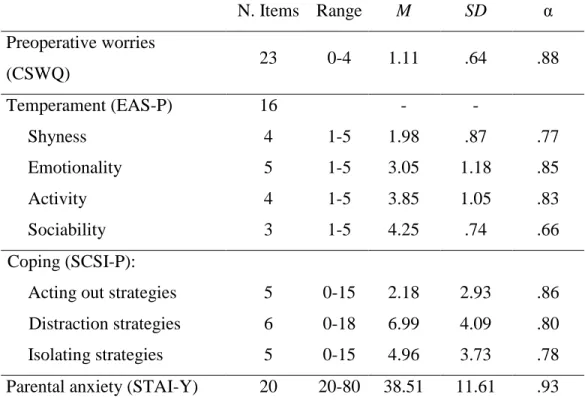
Descriptive statistics and alpha coefficients of the measuring instruments are presented on Table 2. Internal consistencies of each scale were examined as indexes of reliability. Cronbach’s
coefficient alpha was .88 for the 23 items of CWQS and .93 for the 20 item of the STAI-Y, suggesting a high reliability for the both measures.
Because the child’s temperament and coping strategies were measured by parent reports, a Principal component analysis (PCA) with varimax rotation on the results of the EAS-P and SCSI-P questionnaires were conducted to examine their factor structure. For the EAS-P, the sampling adequacy was guaranteed, as indicated by the Kaiser Meyer Olkin (KMO) = .80 and the Bartlett's test of sphericity, χ2 (120) = 922.690, p ˂ .001. Four rotated factors were extracted with eigenvalues above 1 (Kaiser’s criteria), and meaningful factor loadings (i.e., > |.30|), that
accounted for 65.45% of the total variance. Similarly to the original instrument, the following factors were extracted: Emotionality (5 items: 2, 6, 11, 15 and 19; α = .85); Activity (4 items: 7, 9, 13 and 17; α = .83); Shyness (4 items: 8, 12, 14 and 20; α = .77); and Sociability (3 items: 3, 5 and 10; α = .66). However, five of the original items (1, 4, 16 and 18) were eliminated because of lower factor loadings or cross-loading on different factors. The sampling adequacy of the SCSI-P was also guaranteed (KMO = .75; Bartlett's test = χ2 (120) = 822.889, p ˂ .001). The following three factors were extracted with eigenvalues > 1 and factor loadings > |.30|, that accounted for 59.37% of the total variance: Acting out strategies (5 items: 9, 10, 11, 12 and 21; α = .86);
Distraction strategies (6 items: 4, 6, 7, 13, 19 and 20; α = .80); and Isolating strategies (5 items:
1, 2, 3, 17 and 18; α = .78). Five items of the original SCSI-P (5, 8, 14, 15 and 16) were eliminated because of low factor loadings and cross loadings.
Children’s preoperative worries about surgery as a function of group condition
To determine the effects of the experimental interventions on children’s preoperative worries, the following six planned contrasts were conducted: three contrasts between the three main group conditions (experimental vs. comparison vs. control); and another three comparisons within the experimental group to test whether there were differences between the three types of
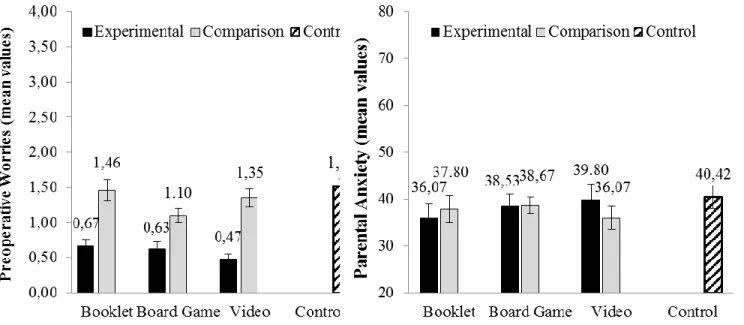
material (board game vs. video vs. booklet). The means for each condition can be seen in Figure 2 and the results of the planned contrasts are reported in Table 3. Planned contrasts showed, as expected, that children in the experimental group reported statistically significant lower
preoperative worries than children in both the comparison, t (118) = -6.79, p < .001, Cohen's d = 1.43; and the control group, t (118) = -8.26, p < .001, Cohen's d = 1.86; both hypotheses also demonstrated large effect sizes [46]. However, no statistical difference was found between the comparison and the control group (p =.059). Planned comparisons between the type of materials (board game, video, booklet) within the experimental group also revealed no statistical
differences (all p > .05), indicating that all educational material seemed to display a similar important effect on children’ worries.
Predictors of children preoperative worries
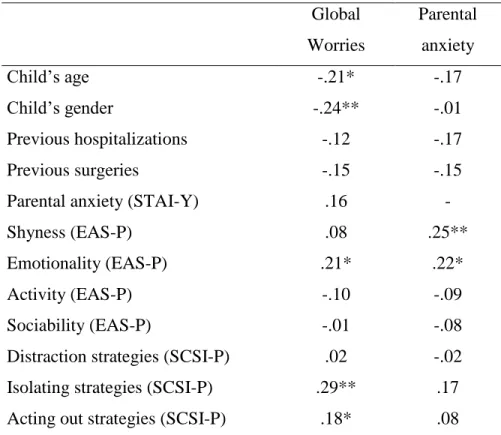
Bivariate correlational analyses were performed between the children preoperative worries and demographic (gender and age), clinical previous history, individual characteristics
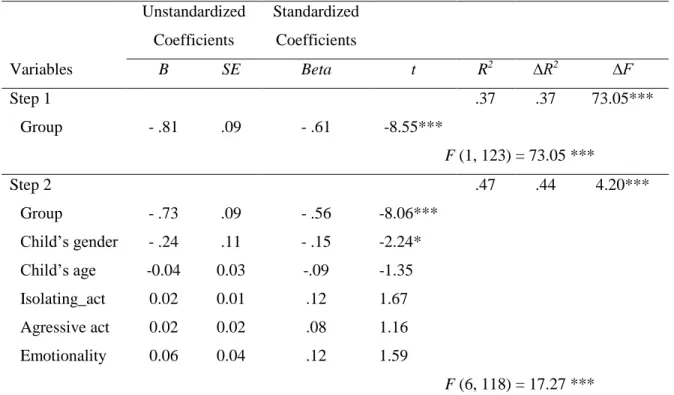
(temperament and coping strategies), and parental state anxiety, to examine for potential factors that might also predict preoperative child worries, in addition to the experimental intervention (see Table 4). A subsequent Hierarchical Multiple Regression (HMR) analysis was carried out to assess whether the set of variables that were found to be statistically correlated with the outcome (i.e., age, gender, emotionality, isolating coping, and acting out coping strategies, all p < .05) would be still able to explain some variance in the child’s preoperative worries, over and above the effect of the educational material intervention. Because no differences were found between the comparison and the control groups on children’s worries, the group condition was
dichotomized to examine the specific effects of providing information about surgery and
hospitalization (Experimental group = 1) versus no information provided (Comparison & Control groups = 0). Again, to estimate if we would have the required sample size for running a HMR
analysis, we used G*Power 3.2.3 [45] and a recent web-based calculator developed by Soper [65]. Both programs estimated a minimum of 92 participants when we used the following criteria: the inclusion of five additional set of independent predictor variables to the model, over and above the educational material intervention initial predictor, the Cohen’s f2 size of .15, probability level of .05, and .08 of power level. Thus, the minimum sample size requirement was ensured, and the HMR was performed. Multicollinearity was also not considered a problem for this analysis (tolerance values > .80; variance inflation factor (VIF) < 1.3). The predictor variables were entered into the analysis in a two stage step: the recoded group condition was entered at the first step, while age, gender, emotionality (temperament), isolating and acting out coping strategies were entered at step two. As can be seen in Table 5, the HMR showed that the educational material intervention contributed significantly to the regression model, F (1, 123) = 73.053, p < .001, accounting for 37% of the variance in children’s worries. The inclusion of the other set of five individual variables to the model in the second step increased the explanation significantly, with an additional 7% of the variance in preoperative worries, after statistically controlling for the educational interventions effect, F change (5, 118) = 4.20, p = .001. However, when analyzing the unique contribution of each variable, we found that only gender had a
statistically significant contribution (β = .15, t = 2.492, p= .014), besides the educational material intervention (β = .56, t = 8.577, p< .001). Although the bivariate linear correlations between preoperative worries and age, emotionality, isolating, and acting out strategies were statistically different from zero, these variables did not contribute significantly to the regression. Overall, the results have shown that providing educational information accounted for more than a third of the variability in reducing children’s worries, but being male (β = .15, t = 2.49, p= .014) seems to also be a significant contributor to these reduced levels of the child’s preoperative worries.
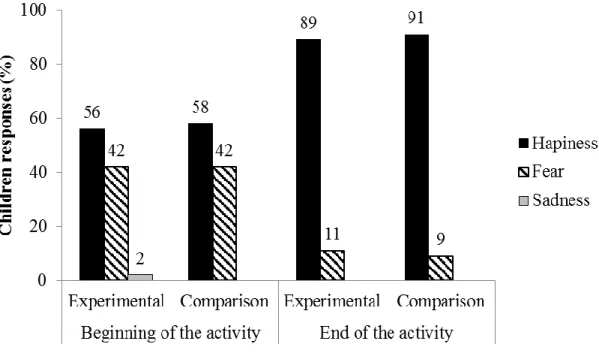
In addition to the above main analyses, we also collected information on children’s emotions throughout the different sections of the educational materials. The emotion most reported by children throughout the different parts of the educational materials was happiness. Initially, 55.6% of children choose happiness and at the end of the activities this percentage increased to 88.9%. Children in the comparison group also evaluated their emotions at the beginning and the end of the entertainment activities. Similarly, in this group, there was a statistically significant increase of happiness from the beginning (57.8%) to the end (91.1%) of the activities. In contrast, there was a decrease in fear reported by children in both groups (see Figure 3).
Parental state anxiety as a function of group condition
The effects of group intervention on parental state anxiety were also analyzed using planned contrasts, in which comparisons were made between the experimental and the comparison groups versus the control group; and also between the experimental and the
comparison group (see Table 3 and Figure 2). Contrary to expectations, there were no statistically significant differences for parental anxiety on the two planned comparisons.
Discussion
Preparing children for hospitalization and medical procedures is recognized to be an important way to minimize the negative impact of medical treatments since the mid-twentieth century [1]. This need is particularly relevant in cases of surgery [66], especially for outpatient surgeries, because the time spent at the hospital is reduced and the opportunities of the healthcare professionals to provide accurate information to patients are restricted [67-69]. Several factors may contribute to children’s negative responses to the hospitalization experience: such as the anticipation of pain; the perception of danger; fear related to hospital procedures and surgical instruments; loss of control; unfamiliar routines and people; separation from parents; and parental
anxiety [7, 11, 24]. A previous study demonstrates that a preoperative informational book
educated the children and provided the benefit of reducing anxiety in the children [70]. Similarly, studies conducted with preoperative educational modeling videos also reveal a positive effect on children’s anxiety relief and a reduction on postoperative maladaptive behaviors [66]. A
preoperative educational video can also provide educational and anxiolytic benefits for parents, increasing their knowledge and reducing the parental state of anxiety [71]. Despite the fact that games are increasingly being used by health care providers to facilitate patient care, to our knowledge no research has been conducted using a preoperative educational board-game to prepare children about forthcoming surgery.
Because the access to information about heath, illness, body and medical procedures is largely recognized as one of the fundamental rights of every child in a clinical context [72], we developed educational preoperative materials in three different formats to be used by children in hospital settings. Although educational materials are considered the most effective preoperative preparation for children in the concrete operational stage of development [12], the present study is the first experimental research that was conducted to analyze and compare the effects of preoperative interventions using different type of formats.
Research also suggests that many other factors may influence children’s preoperative responses besides preoperative preparation, such as the child’s age, cognitive development, previous surgical experiences, family support, pathology/illness, and type of surgical intervention [1, 68, 73]. Taking these factors into account, we decided to collect a restricted sample,
composed of children from 8 to 12 years, undergoing a pediatric outpatient surgery. In an attempt to address the lack of research on testing different preoperative materials, the present study aimed to develop different educational materials and analyze their efficacy on children’s preoperative responses.
According to the Information Provision Model [14], that combines both the
self-regulation and the schema-script theories, providing information about surgical procedures allows children to identify the most relevant and appropriate schemata to cope with events. In our study we focused on children’s worries, and our main results indicated that educational information materials contributed to minimize children’s preoperative worries, thus confirming our initial hypothesis: children who received preoperative educational information reported less worries, compared to those that were only entertained and to those who did not received any material. These results are in line with other studies suggesting that providing children with preoperative information may decrease child’s unrealistic expectations, inappropriate beliefs and concerns related to hospitalization and surgery [14, 74]. Thus, it is possible that this type of intervention worked because the materials have taught children what to expect in each phase, which in turn may have contributed to increase their confidence [1, 12, 74] and to use appropriate coping skills [11, 40]. Nevertheless, additional studies should test the processes that may contribute to explain the positive effects of educational material on preoperative worries. For the present study, we decided to introduce a contextualized outcome measure by examining the effects of preoperative interventions on children’s specific worries about surgery and hospitalization. However, many previous studies have analyzed preoperative program effects using more global outcomes, such as the children’s anxiety levels. Thus, in our view, our findings ought to be replicated and
complemented with traditional measures of anxiety and of behavioral responses.
Children in the present study also reported a relatively low level of preoperative worries, regardless of group condition, which indicates that outpatient surgeries does not produce strong concerns on children. However, the large effect size obtained in our study when comparing group conditions is particular important because this statistical measure is less sensitive to changes in
sample size than the p-value, i.e., the estimated probability of rejecting the null hypothesis [46, 75], which suggest that the effect might be large enough to be clinically relevant.
The results of the regression model also suggest that providing educative information, regardless the format of the information, predicts less preoperative worries about surgery, even when controlling for the child’s age, temperament and coping strategies. These results replicate the findings from another study [21], demonstrating that educational preoperative materials can be an important predictor to minimize children’s preoperative worries. In addition, the results showed that gender was also an important predictor, contributing beyond what was accounted for by the educative materials. These findings are in line with the literature, which suggests that males’ patients tend to report lower levels of worry compared to females [25, 27, 76]. Regarding the other potential predictors, statistically significant bivariate correlations were found between preoperative worries and age, emotional temperament, and coping strategies. However, these variables had no effects over and above the impact of the educational materials on preoperative worries. A possible explanation for these non-significant results may be related to the age range of the sample which was small and covered children with the same concrete operational stage of cognitive development. Another possible explanation could be related to the way the coping strategies and the temperament were measured (i.e., by hetero-evaluation). Parents could have assumed, for example, that children use certain coping strategies when feeling stressed that might be different from those that children actually use. However, the decision to ask parents about their children's temperament and coping strategies was previously taken to not overload the child with more instruments. Temperament and coping may also function as moderators on the
relationship between participating in preoperative preparation programs and preoperative worries [12, 38, 39, 74]. Analyses of moderation could be addressed in future studies using
self-evaluation measures administered in separated phases, and using a larger sample to allow this type of analysis.
Another interesting finding in our study was that in both experimental and comparison groups most children reported feeling happy. Although the anticipation of surgery can bring stress, outpatient surgeries tend to be a less distressing experience than surgeries with unplanned admissions [77]. Confirming our initial hypothesis, after the application of both educational and entertainment materials, there was an increase in the percentage of children that reported feeling happy.
Preoperative anxiety in parents is a common phenomenon that has been associated with a higher incidence of a child’s negative behaviors [5, 24]. It is possible that parents may feel guilty or responsible for putting their child through the stress of the surgical procedure [12]. Several authors emphasize the inclusion of parents during preoperative preparation, which may be extremely important for both children and parents [15, 78]. Contrary to our expectations, the effects of preoperative materials on parental state anxiety were statistically non-significant. In general, parents reported low state anxiety, maybe because they perceived the risk of outpatient surgery as being low. The results of a previous study [21] also suggested that parents tend to feel less anxious when watching their child engaged in an activity, regardless of whether if it was educational or entertainment. It would be also interesting in future studies to examine the potential effects of different levels and methods of parental involvement in the child’s
preoperative program. Another suggestion is to evaluate the effects of the preoperative materials specifically designed for parents [29].
A wide variety of approaches have been proposed to minimize the potential negative effects of surgery and hospitalization, in particular the use of toys and other entertainment
guided visits to the hospital and operating room [87] and educational preoperative programs [11, 66, 73, 88]. The literature also recommends that preoperative instruments should be brief, portable, inexpensive, and easy to administer [89]. In this line, we developed preoperative educational materials in three different formats, using either photographs or drawings as explanatory figures, which symbolized patients, families and healthcare professionals, to allow their identification with the models [14, 17, 90]. Future research using larger samples may be useful to examine the effect of materials’ format in more detail.
Ideally, the preparation for surgery should be administered about 2 to 4 weeks before the surgical intervention [12]. However, due to the internal organization of hospitals, the preoperative preparation was only possible to perform at the same day of surgery. Nevertheless, in future studies, it would be relevant to assess the child’s preoperative worries several days before the surgery and compare their responses to their thoughts at the day of surgery. Furthermore, it would important to evaluate the effects of preoperative programs on children undergoing other type of surgery and other invasive or painful medical procedures.
In general, Portuguese hospitals lack preoperative preparation materials properly developed and tested to provide educational information to minimize the potential anxiety and worry of children and their caregivers. Moreover, the three formats will be available in
Portuguese hospitals and children may choose the format they prefer to use to obtain preoperative information. It is also important to highlight that the materials’ developed, also because of their short application time, proved to be recommended in cases of outpatient surgery, where the time is strait.
To sum up, the present study reinforced the importance of providing preoperative information to minimize children’s preoperative worries, regardless their gender, age, previous surgical experiences, temperament and coping dispositions. A significant body of literature
supports the need for every pediatric hospital to implement preoperative programs for patients. In fact, preoperative programs, when used appropriately, have several benefits for children and potential positive effects for the parents and healthcare professionals involved in the surgical experience [14, 15].
ACKNOWLEDGEMENTS.
The authors would like to thank the Portuguese Foundation for Science and Technology for providing the financial support for these studies through PhD Scholarship grant for the first author (SFRH/BD/61041/2009).
We sincerely acknowledge the availability of children and parents for their participation in the study. The authors are also especially grateful to health professionals from the Pediatric Surgery Units at Cuf Descobertas Hospital, Fernando Fonseca Hospital and Garcia de Orta Hospital. Finally, a special thanks to the actors Cristina Ribeiro, Francisco Martins, Fernanda Nunes, Gonçalo Mendes, Joana Sepúlveda, Nuno Barbosa, Rodrigo Barbosa, Sara Ribeiro and Susana Nunes Barbosa who participated on the educational video “An Adventure at the Hospital”.
References
1. Broering C, Crepaldi M. Preparação Psicológica Para a Cirurgia em Pediatria: Importância, Técnicas e Limitações. Paidéia 2008; 18: 61-72.
2. McCann M, Kain Z. The management of preoperative anxiety in children: An update.
Anesth Analg 2001; 93: 98–105.
3. Frisch A, Johnson A, Timmons S, Weatherford C. Nurse practitioner role in preparing families for pediatric outpatient surgery. Pediatr Nurs 2010; 36: 41-47.
4. Moro E, Módolo N. Ansiedade, a criança e os pais. Rev Bras Anestesiol 2004; 54: 728-738.
5. Wright K, Stewart S, Finley G, Buffett-Jerrott S. Prevention and intervention strategies to alleviate preoperative anxiety in children – a critical review. Behav Modif 2007; 31: 52-79.
6. Caumo W, Broenstrub J, Fialho L, Petry S, Brathwait O, Bandeira D, Loguercio A, Ferreira M. Risck factors for postoperative anxiety in children. Acta Anaesthesiol Scand, 2000; 44: 782-789.
7. Crepaldi M, Hackbarth I. Aspectos psicológicos de crianças hospitalizadas em situação pré-cirúrgica. Temas Psicol Soc Bras Psicol 2002; 10: 99-112.
8. Burstein S, Meichenbaum D. The work of worrying in children undergoing surgery. J
Abnorm Child Psychol 1979; 7: 121-132.
9. Aouad M. The psychological disturbances of the child undergoing surgery – From admission till beyond discharge. Middle East J. Anesth 2011; 21: 145-147.
10. Karanci A, Dirik G. Predictors of pre- and postoperative anxiety in emergency surgery patients. J Psychosom Res 2003; 55: 363-369.
11. Brewer S, Gleditsch S, Syblik D, Tietjens M, Vacik H. Pediatric anxiety: Child life intervention in day surgery. J Pediatr Nurs 2006; 21: 13-22.
12. LeRoy S, Elixson E, O'Brien P, Tong E, Turpin S, Uzark K. Recommendations for preparing children and adolescents for invasive cardiac procedures: A statement from the American Heart Association Pediatric Nursing Subcommittee of the Council on
Cardiovascular Nursing in collaboration with the Council on Cardiovascular Diseases of the Young. Circulation 2003; 108: 2550-2564.
13. Wollin S, Plummer J, Owen H, Hawkins R, Materazzo F. Predictors of preoperative anxiety in children. Anaesth Int Care 2003; 31: 69-74.
14. Jaaniste T, Hayes B, von Baeyer C. Providing children with information about
forthcoming medical procedures: A review and synthesis. Clin Psychol-Sci Pr 2007; 14: 124-143.
15. Moix J. Preparación psicológica para la cirugía en pediatría. Arch pediatr 1996; 47: 211-217.
16. Pinto R, Hollandsworth J. Using videotape modeling to prepare children psychologically for surgery: Influence of parent and costs versus benefits of providing preparation service.
Health Psychol 1989; 8: 79-95.
17. Bandura A. Health promotion from the perspective of social cognitive theory. Psychol
Health 1989; 13: 623-649.
18. Zebb B, Beck J. Worry versus anxiety: is there really a difference? Behav Modif 1998; 22: 45-61.
19. Judah M, Grant D, Mills A, Lechner W, Slish M, Davidson C, Wingate L. The
prospective role of depression, anxiety, and worry in stress generation. J Soc Clin Psychol 2013; 32: 381-399.
20. Fernandes S, Arriaga P. The effects of clown intervention on worries and emotional responses in children undergoing surgery. J Health Psychol 2010; 15: 405-415. 21. Fernandes S, Arriaga P, Esteves F. Using an educational multimedia application to
prepare children for outpatient surgeries. Health Commun, in press.
22. Blount R, Zempsky W, Jaaniste T, Evans S, Cohen L, Devine K, Zeltzer L. Management of pain and distress due to medical procedures. In M. C. Roberts & R. Steele (Eds.). Handbook of pediatric psychology. New York: Guilford Press, 2009; 171-188. 23. Kain Z, Mayes L, O’Connor T, Cicchetti D. Preoperative anxiety in children: predictors
and outcomes. Arch Pediatr Adolesc Med 1996; 150: 1238-45.
24. Kain Z, Mayes L, Weisman S, Hofstadter M. Social adaptability, cognitive abilities, and other predictors for children´s reactions to surgery. J Clin Anaesth 2000; 12: 549-554. 25. Quiles M, Ortigosa J, Méndez F, Pedroche S. Cuestionario de preocupaciones sobre
cirurgía infantil. Psicothema 1999; 11: 601-609.
26. Méndez F, Inglés C, Hidalgo M, García-Fernández J, Quiles M. Los miedos en la infancia y la adolescencia: un estudio descriptivo. Rev Electrón Motiv Emoc 2003; 6. Available from: http://reme.uji.es/articulos/amxndf4650710102/texto.html. Accessed: 2 January 2014.
27. Sebastián M, Carrillo F, Quiles J. Preocupaciones pre-quirúrgicas: estudio empírico con población infantil y adolescente. An Espan Ped 2001; 55: 129-134.
28. Peterson C, Ross A, Tucker VC. Hospital emergency rooms and children’s health care attitudes. J Pediatr Psychol 2002; 27: 281-291.
29. Watson A, Visram A. Children’s preoperative anxiety and postoperative behaviour.
30. Shaffer D, Kipp K. Developmental Psychology. Childhood and adolescence (8th Edition). Belmont, CA: Wadsworth/Thomson Learning, 2010.
31. Goldstein S, Naglieri J. Encyclopedia of Child Development. New York, NY: Springer, 2010.
32. Gasman I, Purper-Ouakil D, Michel G, Mouren-Siméoni M, Bouvard M, Perez-Diaz F, Jouvent R. Cross-cultural assessment of childhood temperament – A confirmatory factor analysis of the french emotionality activity and sociability (EAS) Questionnaire. Eur
Child Adoles Psy 2002; 11: 101-107.
33. Laredo A, Jané M, Viñas F, Mitjavila M, Pla E, Pi M, Ruiz G, Domènech E.
Temperamental dimension and anxiety problems in clinical sample of three to six-year old children: A study of variables. Span J Psychol 2007; 10: 399-407.
34. Masi G, Mucci M, Favilla L, Brovedani P, Millepiedi S, Perugi G. Temperament in adolescents with anxiety and depressive disorders and their families. Child Psychiat Hum
D 2003; 33: 245-259.
35. Antoniazzi A, Dell’aglio D, Bandeira D. O conceito de coping: uma revisão teórica.
Estudos de Psicologia 1998; 3: 273-294.
36. LaMontagne L, Hepworth J, Salisbury M. Anxiety and postoperative pain in children who undergo major orthopedic surgery. Appl Nurs Res 2001; 14: 119-124.
37. Ryan-Wenger N. Children, coping and the stress of illness: a synthesis of the research. J
Soc Pediatr Nurs 1996; 1: 126-139.
38. Kain Z, Caramico L, Mayes L, Genevro J, Bornstein M, Hofstadter M. Preoperative preparation programs in children: a comparative study. Anesth Analg 1998; 87: 1249-1255.
39. Miller S. Monitoring and blunting: Validation of a questionnaire to assess styles of information seeking under threat. J Pers Soc Psychol 1987; 52: 345-353.
40. LaMontagne L. Children’s preoperative coping: Replication and extension. Nurs Res 1987; 36: 163-167.
41. Peterson L, Toler S. An information seeking disposition in child surgery patients. Health
Psychol 1986; 5: 343-358.
42. Ryan-Wenger N. Coping behavior in children: Methods of measurement for research and clinical practice. J Pediatr Nurs 1994; 9: 183-195.
43. Kain Z, Caldwell-Andrews A, Mayes L, Weinberg M, Wang S, MacLaren J, Blount R. Family-centered Preparation for Surgery Improves Perioperative Outcomes in Children.
Antesthesiology 2007; 106: 65-74.
44. Kraemer H, Thiemann S. How Many Subjects? Statistical Power Analysis in Research, Newbury Park, CA: Sage Publications, 1987.
45. Faul F, Erdfelder E, Lang A, Buchner A. G*Power 3: a flexible statistical power analysis program for the social, behavioral, and biomedical sciences. Behav Res Methods 2007;
39: 175-191.
46. Cohen J. Statistical Power Analysis for the Behavioral Sciences. Hillsdale, NJ: L. Erlbaum Associates, 1988.
47. Cunningham J, Gardner E. Power, effect and sample size using GPower: practical issues for researchers and members of research ethics committees. Evidence Based Midwifery, 2007; 5: 132-136.
48. Ellis P. The essential guide to effect sizes: Statistical power, meta-analysis, and the
interpretation of research results. Cambridge, United Kingdom: Cambridge University
49. Prajapati B, Dunne M, Armstrong R. Sample size estimation and statistical power analyses. Optometry Today 2010; 16. Available from:
http://www.optometry.co.uk/uploads/articles/STATISTICAL%20ARTICLE.pdf. Accessed: 2 January 2014.
50. CattelR. The scientific use of factor analysis in behavioral and life sciences. New York: Plenum, 1978.
51. Gorsuch, R. Factor analysis. Hillsdale, NJ: Erlbaum, 1983.
52. Hair J, Black W, Babin B, Anderson R. Multivariate data analysis. Upper Saddle River, NJ: Pearson Education, 2009.
53. Kline P. An Easy Guide To Factor Analysis. New York: Routledge, 1994.
54. Winter J, Dodou D, Wieringa P. Exploratory Factor Analysis With Small Sample Sizes.
Multivar Behav Res 2009; 44:147-181.
55. Bujang M, Ghani P, Bujang M, Soelar S, Zulkifli N. Sample size guideline for exploratory factor analysis when using small sample: taking into considerations of
different measurement scales. International Conference on Statistics in Science, Business, and Engineering (ICSSBE). September 10-12, 2012: 10.1109/ICSSBE.2012.6396605. 56. Chambers C, Johnston C. Developmental differences in children's use of rating scales. J
Pediatr Psychol 2002; 27: 27-36.
57. Spielberger C. State-Trait Anxiety Inventory: A comprehensive bibliography. Palo Alto, CA: Consulting Psychologists Press, 1983.
58. Santos S, Silva D. Adaptação do State-Trait Anxiety Inventory (STAI) – Form Y para a população portuguesa. Revista Portuguesa de Psicologia 1997; 32: 85-98.
59. Buss A. Plomin R. Temperament: Early developing personality traits. Hillsdale, New Jersey: Erlbaum, 1984.
60. Boer F, Westenberg P. The factor structure of the Buss and Plomin EAS Temperament Survey (Parental Ratings) in a Dutch sample of elementary school children. J Pers Assess 1994; 62: 537-551.
61. Ryan-Wenger N. Development and psychometric properties of the schoolagers' coping strategies inventory. Nurs Res 1990; 39: 344-349.
62. Lima L, Lemos M, Guerra M. Estudo das qualidades psicométricas do SCSI (Schoolagers’ Coping Strategies Inventory) numa população portuguesa. Análise
Psicológica 2003; 4: 555-570.
63. Bradley M, Lang P. Measuring emotion: The Self-Assessment Manikin and The Semantic Differential. J Behav Ther Exp Psy 1994; 25: 49-59.
64. Wong D, Baker C. Pain in children: comparison of assessment scales. Pediatr Nurs 1988;
14: 9-17.
65. Soper D. (2014). F-Value and p-Value Calculator for Multiple Regression [Software]. Available from: http://www.danielsoper.com/statcalc. Accessed: 28 July 2014.
66. Melamed B, Siegel L. Reduction of anxiety in children facing hospitalization and surgery by use of filmed modelling. J Consult Clin Psych 1975; 43: 511-521.
67. Bondy L, Sims N, Schroeder DK, Narr D. The effect of anesthetic patient education on preoperative patient anxiety. Reg Anesth Pain Med 1999; 24: 158-164.
68. Contrada R, Leventhal E, Anderson J. Psychological preparation for surgery: Marshaling individual and social resources to optimize self-regulation. In Maes S, Johnston M, Leventhal H (eds.). International Yearbook of Health Psychology. New York: Wiley, 1994, 219-266.
69. Margolis J, Ginsberg B, Dear G, Ross A, Goral J, Bailey A. Paediatric preoperative teaching: effects at induction and postoperatively. Pediatr Anesth 1998; 8: 17-23.
70. Felder-Puig R, Maksys A, Noestlinger C, Gadner H, Stark H, Pfluegler A, Topf R. Using a children’s book to prepare children and parents for elective ent surgery: Results of a randomized clinical trial. Int J Pediatr Otorhi 2003; 67: 35-41.
71. Cassandy J, Wysocki T, Miller K, Cancel D, Izenberg N. Use of a preanesthetic video for facilitation of parental education and anxiolysis before pediatric ambulatory surgery.
Anesth Analg 1999; 88: 246-250.
72. Seagul E. The child's rights as a medical patient. J Clin Child Psychol 1978; 7: 202-205. 73. Mitchell M, Keppell M, Johnston L. Using educational technology to advance the practice
of preparing children and families for hospitalisation. Proceedings of ASCILITE: Balance,
Fidelity, Mobility: Maintaining the Momentum? Australia: ASCILITE, 2005, 483-492.
74. Block A, Gatchel R, Deardorff W, Guyer R. The psychology of spine surgery. Washington, DC, US: American Psychological Association, 2003.
75. Denis D. Alternatives to Null Hypothesis Significance Testing. Theory & Science 2003;
4: 1-18.
76. Badner N, Nielson W, Munk S, Kwiatkowska C, Gelb A. Preoperative anxiety: detection and contributing factors. Can J Anesth 1990; 37: 444-447.
77. Gordon B, Jaaniste T, Bartlett K, Perrin M, Jackson A, Sandstrom A, Charleston R, Sheehan S. Child and parental surveys about pre-hospitalization information. Child Care
Health Dev 2010; 37: 727-733.
78. Crepaldi M, Hackbarth I. Aspectos psicológicos de crianças hospitalizadas em situação pré-cirúrgica. Temas em Psicologia da Sociedade Brasileira de Psicologia 2002; 10: 99-112.
79. Golden L, Pagala M, Sukhavasi S, Nagpal D, Ahmad A, Mahanta A. Giving toys to children reduces their anxiety about receiving premedication for surgery. Anesth Analg 2006; 102: 1070-1072.
80. Justus R, Wyles D, Wilson J, Rode D, Walther V, Lim-Sulit N. Preparing children and families for surgery: Mount Sinai's multidisciplinary perspective. Pediatr Nurs, 2006; 32: 35-43.
81. Schmitz S, Piccoli M, Viera C. A utilização do brinquedo terapêutico na visita pré-operatória de enfermagem à criança. Rev Electrónica Enferm 2003; 5: 14-23. 82. Kain Z, Caldwell-Andrews A, Krivutza D, Weinberg M, Gaal D, Wang S, Mayes L.
Interactive Music Therapy as a Treatment for Preoperative Anxiety in Children: A Randomized Controlled Trial. Anesth Analg 2004; 98: 1260-1266.
83. Kain Z, Wang S, Mayes L, Krivutza D, Teague B. Sensory stimuli and anxiety in children undergoing surgery: a randomized, controlled trial. Anesth Analg 2001; 92: 897-903. 84. Bennett M, Lengacher C. Humor and laughter may influence health. I. History and
backgrounds. Evid Based Complement Alternat Med 2006; 3: 61-63.
85. Hart R, Walton M. Magic as a therapeutic intervention to promote coping in hospitalized pediatric patients. Contin Nurs Educ 2010; 36: 11-16.
86. Vagnoli L, Caprilli S, Robiglio A, Messeri A. Clown doctors as a treatment for
preoperative anxiety in children: A randomized, prospective study. Pediatrics 2005; 116: 563-567.
87. Peterson L, Ridley-Johnson R, Tracy K, Mullins LL. Developing cost effective presurgical preparation: A comparative analysis. J Pediatr Psychol 1984; 9: 274-296. 88. Rassin M, Gutman Y, Silner D. Developing a computer game to prepare children for
89. Patel A, Schieble T, Davidson M, Tran M, Schoenberg C, Delphin E, Bennett H.
Distraction with a hand-held video game reduces pediatric preoperative anxiety. Pediatr
Anesth 2006; 16: 1019-1027.
90. Bandura A. Social foundations of thought and action: A social cognitive theory. Englewood Cliffs, NJ: Prentice-Hall, 1986.
Figure 1. Flow diagram of the randomized allocation of participants to groups based on the Consort 2010 Group
Assessed for eligibility (n= 127)
Excluded (n= 2): Children
with sensory or mental disabilities (n= 2)
Allocated to the Experimental Group (n= 45)
Received allocated intervention (n= 45) Educational Booklet (n = 15); Educational Video (n = 15); Educational Board-game (n = 15); Allocated to Control Group (n= 35) Received no intervention (n= 35) Randomized (n= 125)
Allocated to Comparison Group (n= 45)
Received allocated intervention (n= 45)
Entertainment Booklet (n = 15); Educational Video (n = 15); Educational Board-game (n = 15);
Analysed (n= 45)
Excluded from analysis (n= 0)
Analysed (n= 45)
Excluded from analysis (n= 0)
Analysed (n= 35)
Excluded from analysis (n= 0)
Figure 2. Children’s preoperative worries (left) and Parental state anxiety (right) as a function of
Figure 3. Emotions reported by children in the Experimental and Comparison Groups at the
Table 1. Demographic and clinical characteristics of participants by group condition
Total Sample
Group
Experimental Comparison Control χ2
(n=125) (n=45) (n=45) (n=35) n % n % n % n % Child’s Gender 1.474 Male 99 79.2 33 26.4 37 29.6 29 23.2 Female 26 20.8 12 9.6 8 6.4 6 4.8 Child’s Ethnicity 9.225 Caucasian 85 68.0 32 25.6 24 19.2 29 23.2 African 39 31.2 13 10.4 20 16.0 6 4.8 Asian 1 0.8 0 0 1 0.8 0 0
Child with previous
hospitalization 61 48.8 22 17.6 21 16.8 18 14.4 0.179
Child with previous
surgeries 42 33.6 17 13.6 13 10.4 12 9.6 0.807 Parental accompanying 0.196 Mother 109 87.2 40 32.0 39 31.2 30 24.0 Father 16 12.8 5 4.0 6 4.8 5 4.0 Parental Schoolarity 0.130 Below grade 4 26 20.8 12 9.6 8 6.4 6 4.8 Grades 5-6 11 8.8 5 4.0 2 1.6 4 3.2 Grades 7-9 39 31.2 13 10.4 14 11.2 12 9.6 Grades 10-12 30 24.0 10 8.0 15 12.0 5 4.0 Bachelor's degree 1 0.8 0 0 1 0.8 0 0 Graduate degree 18 14.4 5 4.0 5 4.0 8 6.4 M SD M SD M SD M SD F Child’ age 10.09 1.43 10.29 1.25 9.84 1.48 10.14 1.57 1.123 Child’s grades 4.66 1.65 5.02 1.52 4.31 1.69 4.66 1.71 2.126 Parental age 39.01 5.80 38.93 5.42 37.78 5.83 40.69 5.97 2.545
Table 2. Descriptive statistics and alpha coefficients of the measuring instruments N. Items Range M SD α Preoperative worries (CSWQ) 23 0-4 1.11 .64 .88 Temperament (EAS-P) 16 - - Shyness 4 1-5 1.98 .87 .77 Emotionality 5 1-5 3.05 1.18 .85 Activity 4 1-5 3.85 1.05 .83 Sociability 3 1-5 4.25 .74 .66 Coping (SCSI-P):
Acting out strategies 5 0-15 2.18 2.93 .86
Distraction strategies 6 0-18 6.99 4.09 .80
Isolating strategies 5 0-15 4.96 3.73 .78
Parental anxiety (STAI-Y) 20 20-80 38.51 11.61 .93
Note. CSWQ: Child Surgery Worries Questionnaire; EAS-P:
Emotionality, Activity, and Sociability Temperament Survey for Children: Parental Ratings; SCSI-P: The Schoolagers’ Coping Strategies Inventory: Parental Version; STAI-T: The State-Trait Anxiety Inventory–Form Y.
Table 3. Planned Contrasts for the Children’s Preoperative Worries and Parental Anxiety as a
function of Group Conditions
Contrasts Preoperative Worries t gl p d Experimental vs. Comparison - 6.79 118 .000 1.43 Experimental vs. Control - 8.26 118 .000 1.86 Comparison vs. Control - 1.91 118 .059 0.43
Experimental: board-game vs. booklet - 0.22 118 .827 0.08 Experimental: board-game vs. video 0.91 118 .364 0.33 Experimental: booklet vs. video 1.13 118 .261 0.41
Contrasts Parental Anxiety*
t gl p d
Experimental + Comparison vs. Control - 0.96 48 .340 0.19 Experimental vs. Comparison 0.28 74 .781 0.06
Note. * For parental anxiety, t-test values for unequal variances were reported because p = .036
Table 4. Zero-order correlations between the predictor variables, the child’s preoperative
worries and parental state anxiety
Global Worries Parental anxiety Child’s age -.21* -.17 Child’s gender -.24** -.01 Previous hospitalizations -.12 -.17 Previous surgeries -.15 -.15
Parental anxiety (STAI-Y) .16 -
Shyness (EAS-P) .08 .25**
Emotionality (EAS-P) .21* .22*
Activity (EAS-P) -.10 -.09
Sociability (EAS-P) -.01 -.08
Distraction strategies (SCSI-P) .02 -.02 Isolating strategies (SCSI-P) .29** .17 Acting out strategies (SCSI-P) .18* .08
Note. *p ˂ .05; **p ˂ .01; ***p ˂ .001; Child’s gender (male = 1, female = 2); CSWQ: Child
Surgery Worries Questionnaire; EAS-P: Emotionality, Activity, and Sociability Temperament Survey for Children: Parental Ratings; SCSI-P: The Schoolagers’ Coping Strategies Inventory: Parental Version; STAI-Y: State-Trait Anxiety Inventory–Form Y; Higher values indicate higher worries about surgery, pain perception, shyness, emotionality, activity, sociability, use of distraction, isolating and acting out coping strategies, parental state anxiety, number of previous hospitalizations and surgeries..