Physical activity buffers the negative relationship between
multimorbidity, self-rated health and life satisfaction
Adilson Marques
1,2,3, Miguel Peralta
1, Élvio Rúbio Gouveia
4,5, Francisco Gómez Chávez
6,
Miguel González Valeiro
31
Centro Interdisciplinar de Estudo da Performance Humana, Faculdade de Motricidade Humana, Universidade de Lisboa, Lisboa, Portugal
2
Centro de Investigação em Saúde Pública, Escola Nacional de Saúde Pública, Universidade Nova de Lisboa, Lisboa, Portugal
3
Facultad de Ciencias del Deporte y la Educación Física, Universidad de A Coruña, A Coruña, España
4
Department of Physical Education and Sport, University of Madeira, Funchal, Portugal
5
Madeira Interactive Technologies Institute, Funchal, Portugal
6
Centro Universitario de la Costa, Universidad de Guadalajara, Puerto Vallarta, México Address correspondence to Adilson Marques, E-mail: [email protected]
A B S T R A C T
Background This study aimed to examine the relationship between multimorbidity, self-rated health and life satisfaction, and to test the moderating effect of physical activity on the relationship between multimorbidity, self-rated health and life satisfaction.
Methods This is a cross-sectional study based on data from the European Social Survey 2014. Participants were 25 713 adults (12 830 men), aged 18–64 years old, from 18 European countries and Israel. Self-reported information regarding chronic diseases, health perception, life satisfaction and physical activity was collected through interview. Multimorbidity was defined as the co-occurrence of ≥ 2 chronic diseases. Linear regression models were used to estimate the effects of multimorbidity, physical activity and the interaction effect of multimorbidity× physical activity on self-rated health and life satisfaction.
Results Multimorbidity was negatively related to self-rated health (d = 0.03) and life satisfaction (d = 0.03). Physical activity was positively related to self-rated health and life satisfaction. There was a significant interaction effect between multimorbidity and physical activity with regard to self-rated health (β = 0.01, P < 0.001) and life satisfaction (β = 0.04, P < 0.001).
Conclusions Physical activity buffered the negative relationship between multimorbidity, self-rated health and life satisfaction; contributing to better self-rated health and life satisfaction.
Keywords chronic diseases, European, exercise
Introduction
Self-rated health reproduces the subjective experience of health, and it has been shown to be a significant predictor of morbid-ity and mortalmorbid-ity,1,2related to several biomarkers such as blood pressure, blood levels of albumin, white blood cell count, haemoglobin, HDL cholesterol, serum creatinine and a barom-eter of physiological states.1,3,4 Life satisfaction can be defined as a general evaluation of an individual’s personal life, and has been related to several mental adverse health outcomes such as depression and psychiatric problems,5along with somatic dis-ability and mortality.6The association between self-rated health and life satisfaction with health outcomes enables a conceptual understanding of the health from people’s perspective.
Multimorbidity, defined as the co-occurrence of two or more chronic diseases7is a consequence of the aging of the population; it results from both an increase in the prevalence of chronic diseases,8and the number of diseases from which a patient suffers.9 Multimorbidity influences health percep-tion and subjective wellbeing perhaps because of its physical and psychological consequences.10 Chronic diseases affect people ability to manage their daily functioning, and those
Adilson Marques,Auxiliary Professor Miguel Peralta,Doctoral Researcher Élvio Rúbio Gouveia,Auxiliary Professor Francisco Gómez Chávez,Assistant Professor Miguel González Valeiro,Associate Professor
© The Author(s) 2018. Published by Oxford University Press on behalf of Faculty of Public Health. All rights reserved. For permissions, please e-mail: [email protected]
e328
people usually experienced a decline on their quality of life.11 Thus, the presence of multimorbidity is negatively associated with both self-rated health2,12,13and life satisfaction.14Most studies relating self-rated health or life satisfaction to chronic diseases focus on specific populations or specific diseases or group of diseases. For example, among middle-aged and older adults, poorer self-rated health is strongly associated with single chronic diseases, particularly cardiovascular dis-eases, multimorbidity and poor psychosocial function,2,13,15 while life satisfaction is inversely associated with multimor-bidity.14,15 Similarly, cardiovascular mortality in the general populations with and without prior cardiovascular disease is associated with poor self-rated health.16Also, increased risk of specific diseases, such as cancer, stroke and type 2 dia-betes mellitus are associated with lower life satisfaction.17
In opposition to multimorbidity, physical activity has been shown to have a significant and positive association with self-rated health and life satisfaction.18,19Furthermore, phys-ical activity can reduce chronic diseases and the risk of dis-ease progression,20–22 and it is inversely associated with multimorbidity.12However, the possibility for physical activ-ity moderating the relationship between multimorbidactiv-ity and self-rated health and life satisfaction has yet to be explored. It is thus expected that, by having a positive effect on self-rated health and life satisfaction, and by having a protective health effect against chronic diseases, physical activity might moderate the relationship between multimorbidity and self-rated health and life satisfaction. Therefore, the purpose of this study was two-pronged: (i) to examine the relationship between multimorbidity, self-rated health and life satisfac-tion; and (ii) to test the moderating effect of physical activity
on the relationship between multimorbidity, self-rated health and life satisfaction.
Methods
Study design and participants
The present study was based on the seventh wave of the European Social Survey, 2014, which included 20 European countries (Austria, Belgium, Switzerland, Czech Republic, Germany, Denmark, Estonia, Spain, Finland, France, Hungary, Ireland, Lithuania, Netherlands, Norway, Poland, Portugal, Sweden, Slovenia, UK) and Israel. The European Social Survey is a survey that has been conducted every two years to measure the attitudes, beliefs, and behaviours of European adults. The survey uses representative samples among countries. Participants were sampled by postal code, addressfiles, social security registry data, population registers and/or telephone books. The information was collected in each country, using a questionnaire filled-in through an hour-long face-to-face interview. The questionnaire was translated, by language experts, into the language spoken in each of the participating countries. Further details about the European Social Survey are available elsewhere.23The study protocol subscribes to the Declaration on Professional Ethics of the International Statistical Institute.
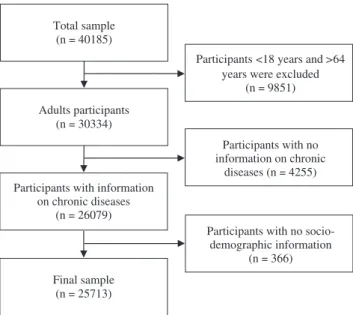
Probability sampling from residents aged 15 years and older was applied (excluding the homeless, and institutiona-lized people), comprising 40 185 participants. For the pre-sent study participants under 18 years and above 64 years of age were excluded (n= 9851), because the focus was on the adult population. Participants from Czech Republic and Estonia, and others that also did not report information on chronic diseases and were therefore excluded (n = 4255). Respondents without information in more than two socio-demographic variables were also excluded (n = 366). These restrictions resulted in a sample of 25 713 participants (12 830 men and 12 883 women) (Fig.1).
Measures Chronic diseases
Most of the chronic diseases (heart or circulation problems, high blood pressure, diabetes, stomach or digestion pro-blems, breathing propro-blems, allergies, headaches and cancer) were assessed by asking participants to indicate whether they currently have, or had, chronic diseases (yes/no) in the last 12 months. For obesity, body mass index (BMI) was calculated from self-reported height and weight (kg/m2). Body mass index categories were calculated in accordance with the WHO guidelines24 and dichotomized into non-obese (<30.0 kg/m2)
Total sample (n = 40185)
Adults participants (n = 30334)
Participants <18 years and >64 years were excluded
(n = 9851)
Participants with information on chronic diseases (n = 26079) Final sample (n = 25713) Participants with no information on chronic diseases (n = 4255)
Participants with no socio-demographic information
(n = 366)
Fig. 1 Flow chart diagram of participants.
and obese (≥30 kg/m2). Multimorbidity was defined as the co-occurrence of two or more of the nine aforementioned diseases.7
Physical activity
Physical activity was assessed with a single item asking,‘On how many of the last 7 days did you walk quickly, do sports or other physical activity for 30 min or longer?’ Although physical activity was assessed with a single item, there is evi-dence in previous studies that a single question is an accept-able alternative;25 this approach was used previously with European Social Survey data.26,27
Self-rated health
Self-rated health was assessed with a single item question. Participants were asked, ‘How is your health in general?’ The response options were very bad, bad, fair, good or very good. This single item question has been widely validated in epidemiological studies.26–28 Previous studies have found a relationship between levels of self-rated health and adverse health outcomes, indicating its validity.1,29
Life satisfaction
Life satisfaction was assessed with the item, ‘How satisfied are you with your life as a whole nowadays?’ Responses were indicated using a scale ranging from 0‘extremely dissatisfied’ to 10‘extremely satisfied’. Studies have shown that life satis-faction is associated to mental health outcomes,5can predict mortality,30and that one single item is a robust measure cap-able of reliably estimating life satisfaction.31
Covariates
Participants reported sex, age and years of full-time educa-tion. Respondents were asked to describe whether they live with or without a husband/wife/partner, and the legal situ-ation. Response options were dichotomized into live with, or without, a partner. Household income was determined based on decile. It is a socioeconomic indicator as important as or more important than education and occupation, because is indicative of a standard of living.32 Household income also shows relationship with health status.33 Using household income decile information, first to third decile, fourth to seventh decile and 8th to 10th were grouped to create three groups. Participants were asked to report their occupation. To determine the living place, those who indicated that they lived in a big city, the suburbs or the outskirts of big city were grouped into a new category named urban areas; those who responded that they lived in the country, a village or a
home in countryside were grouped into rural areas. Participants answered if they lived with or without children at home, along with the number of people living regularly as a member of the household.
Data analysis
Descriptive statistics were calculated for the entire sample (means, standard deviation and percentages). The relation-ship between the presence or absence of chronic diseases and multimorbidity, according self-rated health and life satis-faction, was tested by ANCOVA. Linear regression models were used to estimate the principal effects of multimorbidity, physical activity, and the interaction effect of multimorbidity× physical activity on self-rated health and life satisfaction. Multimorbidity enters the models as a dummy variable, and physical activity as a continuous variable. To calculate the variable that expresses the interaction effect (multimorbidity× physical activity), physical activity was transformed using grand mean centring. The grand mean centring was calculated by taking each value of physical activity (times/week) and sub-tracting from it the mean of the total sample. Physical activity grand mean centring was then multiplied by multimorbidity to have a variable to test the moderation effect (multimorbidity× physical activity). Analyses were not stratified by sex or age because an interaction effect between sex and age on multi-morbidity was not verified. For ANCOVA and linear regres-sion, the analysis were adjusted for sex, age, education, marital status, household income, occupation, living place, having children and household members. Statistical analysis was per-formed using IBM SPSS Statistics v.24.0. The significance level was set at P< 0.05.
Results
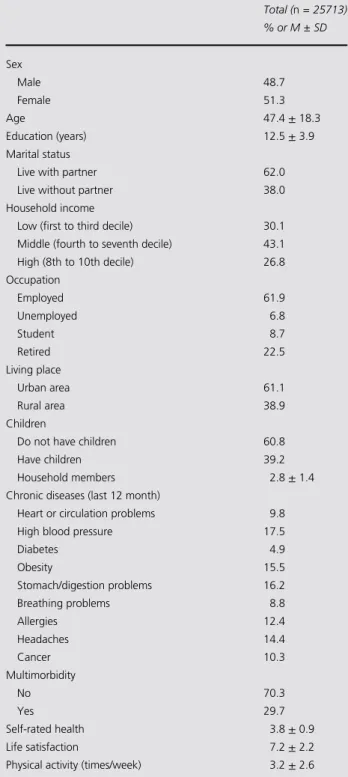
Table1presents the characteristics of the study sample. The most prevalent chronic diseases were: high blood pressure (17.5%), stomach or digestion problems (16.2%) and obesity (15.5%). Almost 30% of the participants had multimorbidity (≥2 chronic diseases). From 1 to 5, the mean value for self-rated health was 3.8 ± 0.9, and from 0 to 10, the mean of life satisfaction was 7.2± 2.2. Physical activity was practiced, on average, 3.2± 2.6 times/week.
Results of the relationship between the presence or absence of chronic diseases and multimorbidity, according to self-rated health and life satisfaction, are presented in Table 2. For each chronic disease, participants who did not report having the disease had significantly better self-rated health than those who reported having the disease. Similar
results were observed for life satisfaction. Those who did not report the presence of the disease had better life satisfac-tion, with the exception of allergies. Although the effect size was small, multimorbidity was also significantly related to self-rated health and life satisfaction. Those without
multimorbidity had better self-rated health (4.08± 0.77 ver-sus 3.40± 0.89, F(1) = 2399.93, P < 0.001) and better life satisfaction (7.37± 20.00 versus 6.86 ± 2.30, F(1) = 243.35, P< 0.001).
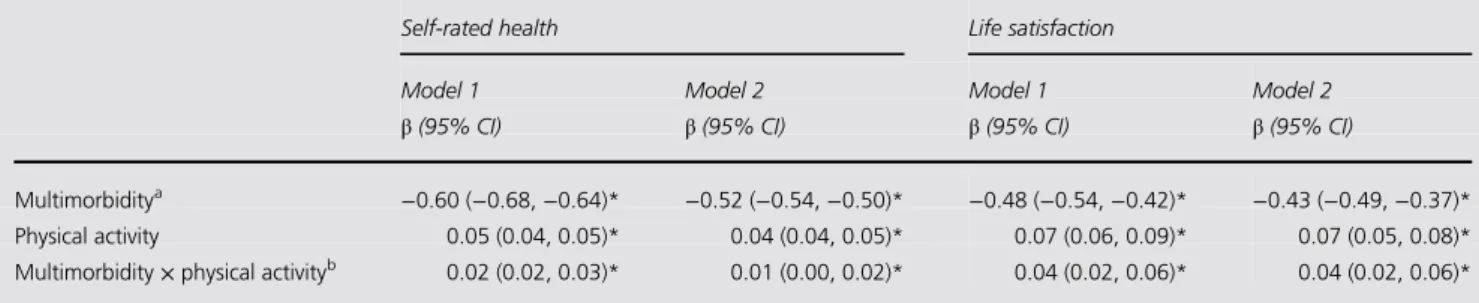
Table 3 depicts the results for linear regression analysis. Unadjusted analysis demonstrated that multimorbidity was negatively related to self-rated health and life satisfaction. When accounting for other social-demographic confounders, multimorbidity remained negatively related with self-rated health (β = −0.52, 95% CI: −0.054 to −0.50, P < 0.001) and life satisfaction (β = −0.43, 95% CI: −0.49 to −0.37, P < 0.001). In turn, in the unadjusted and adjusted model, physical activity was positively related to self-rated health (β = 0.04, 95% CI: 0.04–0.05, P < 0.001) and life satisfac-tion (β = 0.07, 95% CI: 0.05–0.08, P < 0.001). There was a significant interaction effect between multimorbidity and physical activity with regard to self-rated health (β = 0.01, 95% CI: 0.01–0.02, P < 0.001) and life satisfaction (β = 0.04, 95% CI: 0.02–0.06, P < 0.001), portraying physical activity as a moderator of the relationship between multi-morbidity and these variables.
Discussion
Mainfinding of this study
This study investigated the relationship between multimor-bidity, self-rated health and life satisfaction, as well as the moderating effect of physical activity on the relationship between multimorbidity, self-rated health and life satisfac-tion. Multimorbidity was negatively related to self-rated health and life satisfaction. On the other hand, physical activity was positively related to self-rated health and life sat-isfaction, thereby buffering the effect of multimorbidity on self-rated health and life satisfaction. In sum, physical activ-ity moderates the effect of multimorbidactiv-ity on self-rated health and life satisfaction.
What is already known on this topic
Subjective health expressed, as self-rated health, is associated with single chronic diseases and with multimorbidity. Those with chronic diseases and multimorbidity had lower self-rated health. Results from this study are in line with previous findings in literature.2,12,13
These results corroborate that self-rated health is a proxy of health biomarkers,1and a bar-ometer of physiologic states,3 because it is sensitive to the presence of chronic diseases or multimorbidity. Self-rated health is correlated with socio-demographic factors.2,13 However, adjusting the analysis of the relationship between multimorbidity and self-rated health, for socio-demographic Table 1 Participants’ characteristics for total sample and stratified by sex
in 2014 Total (n = 25713) % or M ± SD Sex Male 48.7 Female 51.3 Age 47.4± 18.3 Education (years) 12.5± 3.9 Marital status
Live with partner 62.0
Live without partner 38.0
Household income
Low (first to third decile) 30.1
Middle (fourth to seventh decile) 43.1
High (8th to 10th decile) 26.8 Occupation Employed 61.9 Unemployed 6.8 Student 8.7 Retired 22.5 Living place Urban area 61.1 Rural area 38.9 Children
Do not have children 60.8
Have children 39.2
Household members 2.8± 1.4
Chronic diseases (last 12 month)
Heart or circulation problems 9.8
High blood pressure 17.5
Diabetes 4.9 Obesity 15.5 Stomach/digestion problems 16.2 Breathing problems 8.8 Allergies 12.4 Headaches 14.4 Cancer 10.3 Multimorbidity No 70.3 Yes 29.7 Self-rated health 3.8± 0.9 Life satisfaction 7.2± 2.2
Physical activity (times/week) 3.2± 2.6
factors, did not significantly modify the association. This reinforces the strong relationship between the two variables, independently of socio-demographic factors.
Literature shows that chronic diseases and multimorbidity are associated with lower life satisfaction.14,34 This was observed, in the present study, for all particular chronic dis-eases (except for allergies) and for multimorbidity, confirm-ing that the presence of these diseases, or a cluster of these diseases, has a negative effect on subjective wellbeing. The observed negative relationship supports the fact that life satis-faction depends on the individual’s health status.35
Thisfinding
depicts life satisfaction as an important health outcome used to characterize the population’s health and wellbeing.5,36
Regarding the relationship between physical activity, self-rated health and life satisfaction, this study’s results provide evidence that regular physical activity is associated with bet-ter self-rated health and life satisfaction among adults. Previous studies have also demonstrated the positive rela-tionship between these variables.18,19The impact of physical activity on self-rated health and life satisfaction is observed even among people with chronic diseases,37,38and exists across the spectra of both age and socioeconomic status.19,39
Tables 2 Relationship between, chronic diseases and the presence of multimorbidity and self-rated health of European adults in 2014
Chronic diseases and multimorbidity Self-rated health Life satisfaction
Mean ± SD P Mean ± SD P
Heart or circulation problems <0.001 <0.001
No 3.96± 0.81 7.28± 2.07
Yes 3.08± 0.90 6.62± 2.39
High blood pressure <0.001 <0.001
No 3.99± 0.82 7.29± 2.05 Yes 3.35± 0.87 6.89± 2.33 Diabetes <0.001 <0.001 No 3.92± 0.84 7.24± 2.09 Yes 3.09± 0.89 6.82± 2.38 Obesity <0.001 <0.001 No 3.95± 0.84 7.28± 2.07 Yes 3.49± 0.87 6.90± 2.29 Stomach/digestion problems <0.001 <0.001 No 3.94± 0.84 7.27± 2.08 Yes 3.59± 0.91 6.97± 2.21 Breathing problems <0.001 <0.001 No 3.93± 0.84 7.25± 2.08 Yes 3.34± 0.96 6.88± 2.33 Allergies <0.001 0.964 No 3.89± 0.86 7.21± 2.11 Yes 3.81± 0.87 7.27± 2.09 Headaches <0.001 <0.001 No 3.92± 0.84 7.30± 2.05 Yes 3.64± 0.93 6.77± 2.37 Cancer <0.001 <0.001 No 3.93± 0.84 7.25± 2.08 Yes 3.43± 0.95 6.93± 2.33 Multimorbidity <0.001 <0.001 No 4.08± 0.77 7.37± 2.00 Yes 3.40± 0.89 6.86± 2.30 Tested by ANCOVA. SD, standard deviation.
Analysis were adjusted for sex, age, education, marital status, household income, occupation, living place, having children and household members.
What this study adds
The identification of physical activity as a mediator between multimorbidity, self-rated health and life satisfaction is of importance because this moderation effect changes the slope of the negative relationship (i.e. physically active people with multimorbidity can have better self-rated health and life satis-faction than their non-active peers). Considering that self-rated health and life satisfaction are directly linked to mortality, health biomarkers and mental health outcomes,1,2,5improving self-rated health and life satisfaction can result in improving general health status. This study’s results offer potential targets for future public health interventions. In order to enhance overall physical and mental health status, both of which are strongly linked to self-rated health and life satisfaction, physical activity should be promoted. For those who are not physically active, even a minimum amount of physical activity has a pro-tective health effect against chronic diseases and mortality.20–22
Limitations of this study
A number of strengths and limitations should be kept in mind. The main strength of this study was the European Social Survey database, which includes a large and represen-tative sample of adults from several European countries, as well as socio-demographic characteristics and numerous chronic diseases of the study sample. In view of the large sample and the heterogeneity of the participants, the general-ity of these results should be considered strengths of the study. The use of multimorbidity as a predictor variable is of importance, because multimorbidity is becoming progres-sively common,40 and is an increasing burden for public health.41On the other hand, there are some limitations that
should be acknowledged. The cross-sectional design implies that no causal inferences can be made. The current study cannot answer the question whether multimorbidity changes self-rated health and life satisfaction, or vice versa. Although the large and representative sample of adults contributes to the generalization of the results, when doing so and when designing public health interventions the cultural and socio-demographic differences across European countries should be taken into account. Notwithstanding, all the analyses were adjusted to socio-demographic characteristics. Multimorbidity was based on self-reports, and only nine chronic diseases were considered, albeit the major ones.42 However, studies have suggested that self-reported chronic disease is fairly to largely accurate for most diseases.43Physical activity was self-reported which could be subject to bias in terms of over- and under-estimation.44 Nonetheless, self-reported physical activity is a reliable method for epidemiologic studies, and is still the main-stay of surveillance studies.45 Considering that only nine chronic diseases were used to calculate multimorbidity, perhaps some participants classified as not suffering from multimor-bidity could be included in this group if more diseases had been asked for. Nevertheless, the chronic diseases included in the study were the most prevalent ones. Finally, the European Social Survey had no data on whether individuals had mobility limitations or not. Therefore the analyses were not adjusted for mobility limitations.
Conclusion
Multimorbidity was negatively related to self-rated health and life satisfaction. Physical activity buffered these relationships, contributing to better self-rated health and life satisfaction, Table 3 Main and interaction effect of multimorbidity and physical activity on self-rated health and life satisfaction of European adults in 2014
Self-rated health Life satisfaction
Model 1 Model 2 Model 1 Model 2
β (95% CI) β (95% CI) β (95% CI) β (95% CI)
Multimorbiditya −0.60 (−0.68, −0.64)* −0.52 (−0.54, −0.50)* −0.48 (−0.54, −0.42)* −0.43 (−0.49, −0.37)*
Physical activity 0.05 (0.04, 0.05)* 0.04 (0.04, 0.05)* 0.07 (0.06, 0.09)* 0.07 (0.05, 0.08)*
Multimorbidity× physical activityb 0.02 (0.02, 0.03)* 0.01 (0.00, 0.02)* 0.04 (0.02, 0.06)* 0.04 (0.02, 0.06)*
CI, confidence interval. Model 1: Unadjusted analyses.
Model 2: Analyses were adjusted for sex, age, education, marital status, household income, occupation, living place, having children and household members. *P < 0.001.
aMultimorbidity enter into the model as a dummy variable.
bPhysical activity was transformed using grand mean centring. The grand mean centring was achieved by taking each value of physical activity (times/
week) and subtracting from it the mean of the total sample.
even among European adults with multimorbidity. These find-ings offer potential targets for future public health interven-tions. Promoting physical activity, and thus improving self-rated health and life satisfaction in order to enhance overall physical and mental health status, is suggested to be an important inter-vention strategy.
Funding
There is no funding to declare.
Conflicts of interest
The authors declare none conflict of interests.
References
1 DeSalvo KB, Bloser N, Reynolds K et al. Mortality prediction with a single general self-rated health question. A meta-analysis. J Gen Intern Med2006;21(3):267–75.
2 Mavaddat N, Valderas JM, van der Linde R et al. Association of self-rated health with multimorbidity, chronic disease and psycho-social factors in a large middle-aged and older cohort from general practice: a cross-sectional study. BMC Fam Pract 2014;15:185. 3 Jylha M, Volpato S, Guralnik JA. Self-rated health showed a graded
association with frequently used biomarkers in a large population sample. J Clin Epidemiol 2006;59(5):465–71.
4 Jarczok MN, Kleber ME, Koenig J et al. Investigating the associa-tions of self-rated health: heart rate variability is more strongly asso-ciated than inflammatory and other frequently used biomarkers in a cross sectional occupational sample. PLoS One 2015;10(2):e0117196. 5 Nes RB, Czajkowski NO, Roysamb E et al. Major depression and life satisfaction: a population-based twin study. J Affect Disord 2013; 144(1–2):51–8.
6 Koivumaa-Honkanen H, Koskenvuo M, Honkanen RJ et al. Life dissatisfaction and subsequent work disability in an 11-year follow-up. Psychol Med 2004;34(2):221–8.
7 Valderas JM, Starfield B, Sibbald B et al. Defining comorbidity: implications for understanding health and health services. Ann Fam Med2009;7(4):357–63.
8 Global Burden of Disease Study C. Global, regional, and national incidence, prevalence, and years lived with disability for 301 acute and chronic diseases and injuries in 188 countries, 1990-2013: a sys-tematic analysis for the Global Burden of Disease Study 2013. Lancet2015;386(9995):743–800.
9 Marques A, Peralta M, Martins J et al. Cross-sectional and prospect-ive relationship between physical activity and chronic diseases in European older adults. Int J Public Health 2017;62(4):495–502. 10 WHO. Multimorbidity: Technical Series on Safer Primary Care. Geneva:
World Health Organization, 2016.
11 Mukherjee B, Ou HT, Wang F et al. A new comorbidity index: the health-related quality of life comorbidity index. J Clin Epidemiol 2011;64(3):309–19.
12 Cimarras-Otal C, Calderon-Larranaga A, Poblador-Plou B et al. Association between physical activity, multimorbidity, self-rated health and functional limitation in the Spanish population. BMC Public Health2014;14:1170.
13 Perruccio AV, Katz JN, Losina E. Health burden in chronic disease: multimorbidity is associated with self-rated health more than med-ical comorbidity alone. J Clin Epidemiol 2012;65(1):100–6.
14 Lukkala PS, Honkanen RJ, Rauma PH et al. Life satisfaction and mor-bidity among postmenopausal women. PLoS One 2016;11(1):e0147521. 15 Wister A, Kendig H, Mitchell B et al. Multimorbidity, health and aging in Canada and Australia: a tale of two countries. BMC Geriatr 2016;16(1):163.
16 Mavaddat N, Parker RA, Sanderson S et al. Relationship of self-rated health with fatal and non-fatal outcomes in cardiovascular disease: a systematic review and meta-analysis. PLoS One 2014;9(7):e103509. 17 Feller S, Teucher B, Kaaks R et al. Life satisfaction and risk of chronic
diseases in the European prospective investigation into cancer and nutrition (EPIC)-Germany study. PLoS One 2013;8(8):e73462. 18 Sodergren M, Sundquist J, Johansson SE et al. Physical activity,
exer-cise and self-rated health: a population-based study from Sweden. BMC Public Health2008;8:352.
19 Maher JP, Pincus AL, Ram N et al. Daily physical activity and life satisfaction across adulthood. Dev Psychol 2015;51(10):1407–19. 20 Ekelund U, Ward HA, Norat T et al. Physical activity and all-cause
mortality across levels of overall and abdominal adiposity in European men and women: the European Prospective Investigation into Cancer and Nutrition Study (EPIC). Am J Clin Nutr 2015;101(3):613–21. 21 Wen CP, Wai JP, Tsai MK et al. Minimum amount of physical
activ-ity for reduced mortalactiv-ity and extended life expectancy: a prospective cohort study. Lancet 2011;378(9798):1244–53.
22 O’Donovan G, Lee IM, Hamer M et al. Association of ‘weekend warrior’ and other leisure time physical activity patterns with risks for all-cause, cardiovascular disease, and cancer mortality. JAMA Intern Med2017;177(3):335–42.
23 Schnaudt C, Weinhardt M, Fitzgerald R et al. The European Social Survey: contents, design, and research potential. Schmollers Jahrbuch 2014;134(4):487–506.
24 WHO. Obesity: Preventing and Managing the Global Epidemic. Report of a WHO Consultation. Geneva: World Health Organization, 2000. 25 Wanner M, Probst-Hensch N, Kriemler S et al. What physical
activ-ity surveillance needs: validactiv-ity of a single-item questionnaire. Br J Sports Med2014;48(21):1570–6.
26 Marques A, Peralta M, Martins J et al. Associations between physical activity and self-rated wellbeing in European adults: a population-based, cross-sectional study. Prev Med 2016;91:18–23.
27 Marques A, Sarmento H, Martins J et al. Prevalence of physical activity in European adults—compliance with the World Health Organization’s physical activity guidelines. Prev Med 2015;81:333–8. 28 Chandola T, Jenkinson C. Validating self-rated health in different
ethnic groups. Ethn Health 2000;5(2):151–9.
29 Bopp M, Braun J, Gutzwiller F et al. Swiss National Cohort Study G. Health risk or resource? Gradual and independent association between self-rated health and mortality persists over 30 years. PLoS One2012;7(2):e30795.
30 St John PD, Mackenzie C, Menec V. Does life satisfaction predict five-year mortality in community-living older adults? Aging Ment Health2015;19(4):363–70.
31 Cheung F, Lucas RE. Assessing the validity of single-item life satis-faction measures: results from three large samples. Qual Life Res 2014;23(10):2809–18.
32 Daly MC, Duncan GJ, McDonough P et al. Optimal indicators of socioeconomic status for health research. Am J Public Health 2002; 92(7):1151–7.
33 Bird Y, Lemstra M, Rogers M et al. The relationship between socio-economic status/income and prevalence of diabetes and associated conditions: a cross-sectional population-based study in Saskatchewan, Canada. Int J Equity Health 2015;14:93.
34 Hu SX, Lei WI, Chao KK et al. Common chronic health problems and life satisfaction among Macau elderly people. Int J Nurs Sci 2016;3(4):367–70.
35 Schuz B, Wurm S, Warner LM et al. Health and subjective well-being in later adulthood: different health states-different needs? Appl Psychol Health Well Being2009;1(1):23–45.
36 Diener E. Assessing subjective well-being—progress and opportun-ities. Soc Indic Res 1994;31(2):103–57.
37 Lee HY, Kim J, Merighi JR. Physical activity and self-rated health status among older adult cancer survivors: does intensity of activity play a role? Oncol Nurs Forum 2015;42(6):614–24.
38 Mulroy SJ, Hatchett PE, Eberly VJ et al. Objective and self-reported physical activity measures and their association with depression and satisfaction with life in persons with spinal cord injury. Arch Phys Med Rehabil2016;97(10):1714–20.
39 Trachte F, Geyer S, Sperlich S. Impact of physical activity on self-rated health in older people: do the effects vary by socioeconomic status? J Public Health (Bangkok) 2016;38(4):754–9.
40 Barnett K, Mercer SW, Norbury M et al. Epidemiology of multi-morbidity and implications for health care, research, and medical education: a cross-sectional study. Lancet 2012;380(9836):37–43. 41 Pefoyo AJ, Bronskill SE, Gruneir A et al. The increasing burden
and complexity of multimorbidity. BMC Public Health 2015;15:415. 42 WHO. Global Status Report on Noncommunicable Diseases 2014.
Geneva: World Health Organization, 2014.
43 Hansen H, Schafer I, Schon G et al. Agreement between self-reported and general practitioner-self-reported chronic conditions among multimorbid patients in primary care—results of the MultiCare Cohort Study. BMC Fam Pract 2014;15:39.
44 Marques A, Martins J, Ramos M et al. Perception and reality— Portuguese adults’ awareness of active lifestyle. Eur J Sports Sci 2014; 14(5):468–74.
45 Pedisic Z, Bauman A. Accelerometer-based measures in physical activ-ity surveillance: current practices and issues. Br J Sports Med 2015;49 (4):219–23.