Original Article
High intensity interval training improves health-related quality of life in adults
and older adults with diagnosed cardiovascular risk
MARCO ANTÔNIO RABELO DA SILVA1, LILIANA CARINA BAPTISTA2, RAFAEL SANTOS NEVES3,
ELIAS DE FRANÇA4, HELENA LOUREIRO5, MONICA DOS ANJOS COSTA REZENDE6, VANDESON
DA SILVA FERREIRA7, MANUEL TEIXEIRA VERÍSSIMO8, RAUL AGOSTINHO MARTINS9
1,3,6,7,8,9
Faculty of Sport Sciences and Physical Education, University of Coimbra, PORTUGAL
2
Department of Medicine, University of Alabama at Birmingham, UNITED STATES OF AMERICA
4
Metabolism of exercise Research and Study group, São Judas Tadeu University, BRAZIL
5
Escola Superior de Tecnologias da Saúde de Coimbra, PORTUGAL
1
Universidade da Amazônia, BRAZIL
Published online:March 31, 2019
(Accepted for publication February 24, 2019)
DOI:10.7752/jpes.2019.01089 Abstract:
Background – The purpose of this study is to analyze the effects of high intensity exercise on health-related quality of life in middle-aged and elderly people with diagnosed cardiovascular risk. Methods – 39 men and women (67.0 ± 6.7 years-old) were randomly assigned to 3 groups: a) Group 1 (CT) included strength training and continuous aerobic training; b) Group 2 (HIT) included strength training and high intensity interval aerobic training; c) Control Group (CON) included participants without formal physical exercise. Intervention lasted for 12 weeks (3 sessions/week, and 50 minutes/session). CT group used 60-70% of maximal heart rate (HRmax), while HIT group alternated between 55-65% and 80-90% HRmax. The health-related quality of life (HRQoL) was assessed using the questionnaire Medical Outcomes Short Form Health Survey 36 (SF-36). Results – CT group improved general health (P = 0.031), while HIT group improved social functioning (P = 0.022), Physical Component Score (P = 0.042) and SF-36 Total (P = 0.032). CON group did not change HRQoL (P > 0.05). Conclusion – The high intensity interval training was the most effective to improve HRQoL, although some positive changes observed also after the continuous training, in middle-aged and elderly adults with diagnosed cardiovascular risk.
Key words: health-related quality of life, concurrent training, high intensity interval training, elderly. Introduction
Quality of life (QoL) has been defined as “an individual's perception of their position in life in the context of the culture and values system in which they live and in relation to their goals, expectations, standards and concerns” (Power & Kuyken, 1998), being also positively associated with physical activity (Rejeski et al., 1996). Additionally, health-related quality of life (HRQoL) has been conceptualized based in individual's perception on impact of diseases on the different "spheres of life" (physical, mental, social, and functional health), being treated as a multidimensional construct and global health indicator (Balboa-Castillo et al., 2011).
The aging process is associated with a decline in physical structures and capacities such as muscle mass and strength that limit and reduce physical function, which contributes to increase health costs with physical and mental illnesses, and also decreases well-being and HRQoL (Sillanpää et al., 2012).
Among the several strategies available to mitigate this deleterious process, a more active lifestyle, including regular physical exercise, contributes significantly to the improvement of the physical component, reduction of cardiovascular risk (CVR), prevention of diseases and premature death, but also for the perception of a better QoL (Gary et al., 2012; Heyward & Gibson, 2014; Jewiss et al., 2016; Sillanpää et al., 2012).
However, the improvement of the adherence rate is one of the first challenges for practicing physical exercise, with the American College of Sports Medicine (ACSM) suggesting to practice in group, which seems to be associated with better adherence, higher physiological efficacy, social interaction and HRQoL, comparing to more individualized exercise programs (ACSM, 2018).
Concurrent training (CTR) protocols, performing aerobic and strength training in the same session, have been used to increase HRQoL and prevalence of practice in general populations (ACSM, 2018; Gary et al., 2012; Myers et al., 2013; Sillanpää et al., 2012;). Unfourtunately, evidence has been inconsistent about the effects of
--- 612
while some studies have observed positive associations between CTR and HRQoL in patients with type 2 diabetes mellitus (DM2) (Myers et al., 2013) and in heart failure (Gary et al., 2012; Jewiss et al., 2016), others did not found any gains in individuals with metabolic syndrome (Agner et al., 2018).
The inconsistency of the results could be related with the specific treatments used in each pathology, with the severity of the diseases, but also with the type and intensity of the training protocols (Wilhelm & Pinto, 2019). In fact, some authors (Weston et al., 2014) have suggested CTR as the most appropriate training to improve HRQoL in participants with moderate to higher CVR and / or chronic non-communicable diseases, particularly using the high intensity interval aerobic training (HIIT); while others have also associated HIIT with greater adaptations in VO2peak, and systolic volume, compared to continuous aerobic training with lower
intensities, in subjects with cardiovascular disease (CVD), and DM2 ( Aamot et al., 2016; Butcher e Jones, 2006; Cheema et al., 2015; Currie et al., 2015; Helgerud et al., 2010; Helgerud et al., 2011; Smart et al., 2012; Stavrinou et al., 2018). Therefore, the aim of the present study is to analyze the effects of CTR with continuous aerobic, and CTR with HIIT, in HRQoL of middle-aged and elderly participants with diagnosed CVR.
Materials and methods
Overall design
This randomized controlled trial is part of a larger intervention aiming to study the effects of CTR with continuous aerobic and CTR with HIIT in several health indicators in individuals with diagnosed CVR (67.0 ± 6.7 years-old). Participants were part of the project “O Coração é a Razão – Unidade de Risco Cardiovascular”, developed with the support of the following institutions: Câmara Municipal da Mealhada; Santa Casa da Misericórdia da Mealhada; Hospital da Misericórdia da Mealhada; Fundação Portuguesa de Cardiologia; Administração Regional de Saúde do Centro; Centro de Saúde da Mealhada.
Participants were recruited from the cardiology consultations at the Hospital da Misericórdia da Mealhada and the inclusion criteria for the clinical characterization of CVR and to the definition of metabolic syndrome were based on the guidelines of ACSM (2014), and on the criteria of the International Diabetes Federation (2005). The exclusion criteria included decompensated heart failure, angina pectoris, history of myocardial infarction or stroke less than one year of evolution, uncontrolled hypertension and self-reported renal failure. In addition, if participants did not attended at least 2/3 of the training sessions they were excluded from the analysis.
Participants were randomly assigned to 3 groups: a) Continuous concurrent exercise group (CT), included strength training and continuous cardiovascular training (n = 13; 15% men); b) High intensity interval concurrent exercise group (HIT), included strength training and HIIT (n = 13; 31% men); c) Control group (CON), included participants without formal physical exercise (n = 13; 31% men). The physical exercise intervention lasted for 12 weeks (3 sessions/week; 50 minutes/session). The training intensity was set between 60-70% of the maximum heart rate (HRmax) in CT group, while in the HIT group the values ranged from 55-65%
to 80-90% HRmax as measured by cardiac-telemetry devices. All the participants were instructed to maintain the
same nutritional pattern during the period of the investigation. All participants signed freely an informed consent form, in accordance with the Declaration of Helsinki. The study design, methods and procedures were previously approved (Reference: CE/FCDEF-UC/00202016) by the Ethic Committee of the Faculty of Sport Sciences and Physical Education of the University of Coimbra (FCDEF).
Sample characteristics
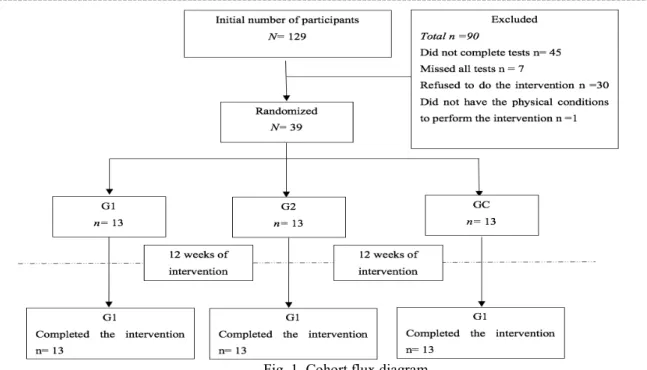
A group of 129 people was initially selected to participate in the research. After applying inclusion and exclusion criteria, 39 participants remain. All these participants completed at least the 2/3 of the sessions in the 12 weeks of intervention. As described by the Figure 1, participants were divided into three groups: the CT group (71.1 ±4.8 years old), HIT group (63.3±7.2 years old), and CON group (67.8 ±3.8 years old).
Interventions and procedures
The specific objective of this study is to understand the effects of CTR with continuous aerobic and CTR with HIIT on the perception of HRQoL in participants with moderate to high CVR. The HRQoL was evaluated using the Medical Outcomes Short Form Health Survey 36 (SF-36). At the FCDEF, and at the School of Health Technologies of Coimbra, after the recruitment period, participants completed the SF-36 questionnaire, collected anthropometric measurements and evaluated cardiorespiratory fitness (VO2peak).
All procedures were performed by a specialized technical team, composed by Nurses, Physicians, Health Technicians and Physical Education Teachers, in laboratory following the guidelines of the ACSM (2014). All the evaluations occurred between May 2016 and September 2016. The same sequence was followed for the tests, both in the initial and final evaluations, after 12 weeks, with the same team of investigation, to minimize the errors inherent to the evaluator.
---Fig. 1. Cohort flux diagram
Exercise Programs
Two CTR protocols (including strength, aerobic and flexibility exercises) were developed for the intervention groups (CT and HIT groups). The difference between protocols was based on the mode and on the intensity of the aerobic training. The sessions consisted of warm-up, strength training, aerobic training (continuous or HIIT) and flexibility, 3 times per week for 12 weeks, in a closed gymnastic pavilion.
Strength training consisted of 2 sets of 8-15 repetitions, with a recovery interval of 1 to 2 minutes (ACSM, 2014; Heyward & Gibson, 2014), totaling approximately 20 minutes per session. The strength exercises were: deadlift, barbell bent-over row, stiff-leg deadlift, bench press and crunches. The intensity was assessed through the subjective perceived exertion scale of Borg CR-10 (1982), with intensity between 2 and 5 (increased over the weeks). Also for the strength training, steel bars with 1.20 meters were used and plates were gradually increased according to the capacity to overcome the load. The periodization occurred as described in the Table 1.
Table 1. Strength training periodization.
Weeks Intensity (Borg CR-10) Repetitions 1 and 2 2 15 3 to 5 3 12-15 6 to 10 4 10-12 11 to 12 5 8-10
Continuous aerobic training was carried out by the participants of the CT group, having completed 25 minutes of walking respecting a moderate to vigorous intensity (60-70% HRmax), controlled by cardiac-telemetry
devices model ONRHYTHM 110 KALENJI® (Villeneuve, France). It was also used the scale of Borg CR-10 (Borg, 1982) to control the subjective intensity (3-5 points). The HIIT was performed by HIT group. Participants ran for 3 minutes, with the intensity of 80-90% HRmax, 3 times/session and walking for 3 minutes with an
intensity of 55-65% HRmax, 2 times/session, controlled by cardiac-telemetry devices model ONRHYTHM 110
KALENJI® (Villeneuve, France). It was also used the scale of Borg CR-10 (Borg, 1982) (5-7 points for high intensity, and 2-3 for low intensity).
The flexibility was trained at last 5 minutes in each session, at the final moment. The stretches were static, during 10 to 15 seconds for each movement, with 1 to 2 repetitions for the large muscle groups.
Anthropometry
The determination of the body mass was obtained through the portable digital scale SECA® model 770 (Hamburg, Germany), with a precision of 100 grams. The stature was determined by means of the portable stadiometer Harpenden, model 98.603 (Crosswell, United Kindon), with a precision of 0.1 centimeters. Waist circumference (WC) was measured using a plastic tape measure HOLTAIN® (Crosswell, United Kindon), with 2 meters and a precision of 0.1 centimeters (measurements were made at the midpoint between the lower rib and the top of the iliac crest with the relaxed abdomen). The fat mass was evaluated by dual energy radiological densitometry (DEXA), assessed by Lunar iDXA GE® (Diegem, Belgium). Body mass index (BMI) was
--- 614
Cardiorespiratory Fitness
The modified Bruce protocol (Lerman et al., 1976) was performed to evaluate VO2peak on an
ergometric treadmill HP Cosmos®, model Pulsar® (Nussdorf, Germany). The protocol is composed of stages lasting 3 minutes; HR was evaluated continuously; gas exchanges (O2 and CO2) were determined continuously
by ergospirometry (Quark CPET COSMED®) (Roma, Italy), calibrated at each test and programmed to provide the average breath by breath value; the subjective perception of effort (CR-10) was determined at the end of each stage and at the end of the protocol (Borg, 1982). The first three stages have an energy expenditure between 0,5 - 1 MET, with the speed of 2,74 km/h, and the inclination varying between 0%, 5% and 10%, respectively. The fourth stage has the speed of 4,02 km/h and inclination of 12%, the fifth 5,47 km/h and 14%, the sixth 6,75 km/h and 16%, the seventh 8,04 km/h and 18%, the eighth 8,85 km/h with 20%, and the ninth 9,65 km/h and 22% (Fletcher et al., 2013). A 12-lead electrocardiogram (ECG) was conducted during all the protocols. Interruption criteria were in agreement with ACSM (2014) which were: angina symptoms, nervous system symptoms (ataxia, dizziness or near syncope), signs of poor perfusion (cyanosis or pallor), difficulty in monitoring the electrocardiogram, individual interruption, sustained ventricular tachycardia, and when HR exceeded 85% of HRmax predicted according to the formula HRmax = 208 - 0.7 x age (Tanaka et al., 2001). We considered the test
valid when the individuals reached one of the following criteria: 85% HRmax predicted by Tanaka’s (2001)
formula, respiratory exchange ratio > 1.05, or voluntary exhaustion. The VO2peak was calculated as the average
values registered during the last 30s of the test.
Health-related quality of life
To assess the HRQoL of the participants, the SF-36 was used before and after the 12 weeks of intervention. The SF-36 was developed by Ware e Sherbourne (1992) and was previously validated for the Portuguese population (Ferreira, 2000). The survey is composed of 36 items and the values of the scores vary between 0 and 100, and it is verified that the higher the value, the better the perception of functional health and well-being. In addition to calculating the dimensions separately, Ware et al. (2000) have elaborated calculations and methods that give results in relation to physical and mental components, in addition to the total SF-36, which is a general summation. The items are separated into eight health-related dimensions: Physical Functioning (PF), Role-Physical limitations (RP), Bodily Pain (BP), General Health (GH), Vitality (V), Social Functioning (SF), Role-Emotional limitations (RE) and Mental Health (MH). There are also the Physical Component Score (PCS) and the Mental Component Score (MCS), and the Total SF-36 Score (Ware et al., 2000).
Health history
The demographic and health history of the participants was assessed using a general questionnaire. This instrument includes questions on age, sex, level of schooling, life situation, exercise, smoking and presence of diseases such as heart disease, hypertension, stroke, diabetes, dyslipidemia, pulmonary osteoarthritis diseases, liver diseases, thyroid diseases, visual and hearing problems, cancer, Parkinson's disease, Alzheimer's disease, dementia or other comorbidities. The self-reported questionnaire also included questions on the type and amount of medications individual are taking daily.
Statistical analysis
The baseline characteristics of the participants were described using frequencies, means and standard deviations (SD) for the following variables: age, body weight, WC, BMI, fat mass, VO2peak and domains of
SF-36. The clinical characteristics of the participants were analyzed per group. The normality was tested by the Shapiro-Wilks test, verifying that none of the variables presented values greater than +3 or -3 in asymmetry and kurtosis (Hair et al., 2006; Lomax et al., 2004). The differences between the groups were explored using the multivariate analysis of variance (MANOVA), for a 95% level of significance. To calculate the differences within groups and between the evaluations, it was used an analysis of the variance (ANOVA) for repeated measures. The effect size was calculated using the statistical calculation d Cohen (1988), and the standardized effect sizes were classified as small (<0.20), moderate (0.20 to 0.79) and large (> 0.80). All statistical analyzes used the software Statistical Package for the Social Sciences for Windows (IBM-SPSS, Inc., Chicago, IL, EUA), version 24.0.
Results
Comparisons at baseline
The results are described in the Table 2 and Table 3, being also presented the differences between groups for the variables of interest. At baseline, the three groups (CT, HIT and CON) showed similar values for the variables body mass, BMI, WC, fat mass and VO2peak (P > 0.05). Also at baseline, the CT group was older
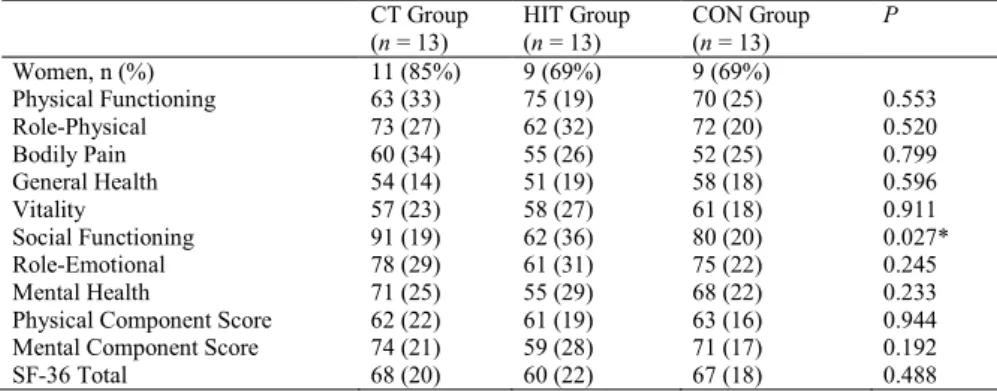
than the HIT group (P = 0.001) as verified after multiple comparison (Bonferroni test). The HRQoL was also similar in the three groups, at baseline, with the exception of the dimension SF that was lower in the HIT group than in the CT group (P = 0.025).
---Comparisons between evaluations in HRQoL
Table 4 describes the values of the dimensions of the HRQoL at the end of the intervention, after 12 weeks, for each one of the three groups. In the CT group, only the dimension GH presented a statistical significant change (P = 0.031) corresponding to an increase of 14%. In the HIT group, the variables SF, PCS, and SF-36 Total also changed (P < 0.05), corresponding to increases of 27%, 7% and 12%, respectively. In the CON group, none of the variables changed during the intervention period (P > 0.05).
The comparisons between groups after the 12-weeks intervention period, from a repeated-measures ANOVA, revealed similar values for the variables PF, RP, V and MH (P > 0.05). Differently, the variables BP, GH, SF, RE, PCS, MCS and SF-36 Total show differences between groups (P < 0.05) translating the gains in HRQoL observed in CT and HIT groups after the exercise intervention. Interaction between groups and variables was found in the dimension SF (P = 0.044), and Bonferroni test shows differences between CT and HIT group (P = 0.039) translating the increase observed in the HIT group after the 12-weeks intervention.
Regarding the effect size, the results were – in CT group, the variables PF and GH show medium effect (d ≥ 0.4); in HIT group the variables SF and RE show medium effect; and in CON group RE show medium effect. All the other variables showed small effect (d < 0.4).
Table 2. Baseline characteristics of the participants, and comparisons between groups calculated from a MANOVA controlling for the effect of sex.
CT Group (n = 13) HIT Group (n = 13) CON Group (n = 13) P Women, n (%) 11 (85%) 9 (69%) 9 (69%) Age, years 71.1 (4.8) 63.3 (7.2) 67.8 (3.8) 0.001** Body mass, kg 70.5 (14.6) 77.9 (17.4) 76.1 (9.3) 0.596 BMI, kg/m2 29.3 (5.5) 31.1 (5.5) 29.5 (3.2) 0.633 Waist circumference, cm 98.2 (11.5) 102.5 (14.7) 100.1 (7.9) 0.788 Fat mass, % 38.6 (4.6) 39.5 (7.3) 38.2 (6.2) 0.554 VO2peak, mL/kg/min 19.7 (3.9) 21.4 (4.0) 20.5 (3.3) 0.577 History of health / Total / per
group Arterial hypertension = 24 8 10 6 Diabetes Melitus T2 = 5 1 2 2 Dyslipidemia = 20 12 6 2 Central obesity = 37 11 13 13 BMI obesity = 18 7 6 5 * P ≤ 0.05; ** P ≤ 0.01.
Table 3. Health-related quality of life at baseline and comparison between groups calculated from a MANOVA controlling for the effect of sex.
CT Group (n = 13) HIT Group (n = 13) CON Group (n = 13) P Women, n (%) 11 (85%) 9 (69%) 9 (69%) Physical Functioning 63 (33) 75 (19) 70 (25) 0.553 Role-Physical 73 (27) 62 (32) 72 (20) 0.520 Bodily Pain 60 (34) 55 (26) 52 (25) 0.799 General Health 54 (14) 51 (19) 58 (18) 0.596 Vitality 57 (23) 58 (27) 61 (18) 0.911 Social Functioning 91 (19) 62 (36) 80 (20) 0.027* Role-Emotional 78 (29) 61 (31) 75 (22) 0.245 Mental Health 71 (25) 55 (29) 68 (22) 0.233 Physical Component Score 62 (22) 61 (19) 63 (16) 0.944 Mental Component Score 74 (21) 59 (28) 71 (17) 0.192 SF-36 Total 68 (20) 60 (22) 67 (18) 0.488 * P ≤ 0.05; ** P ≤ 0.01.
Table 4. Differences between initial (pre) and final (post) evaluations in the HRQoL calculated from ANOVA for repeated measures and effect size.
CT Group (n = 13) HIT Group (n = 13) CON Group (n = 13) B groups P D.M. (D.P.) P ES D.M. (D.P.) P ES D.M. (D.P.) P EF PF 10.7 (8.3) 0.221 0.414 -3 (3.2) 0.367 0.175 2.3 (2.4) 0.363 0.109 0.289 RP 0.4 (5) 0.938 0.000 10.1 (8) 0.069 0.354 0.1 (8.0) 0.996 0.002 0.331 BP 10.6 (6.2) 0.116 0.345 8.9 (4.6) 0.082 0.353 1.3 (6.1) 0.828 0.053 0.042* GH 8.4 (3.4) 0.031* 0.551 1.9 (2) 0.356 0.111 2.6 (4.9) 0.594 0.143 0.047* V 3.8 (4.8) 0.443 0.202 -1.5 (4.9) 0.760 0.042 0.7 (3.3) 0.982 0.038 0.766 SF 0.1 (4.8) 0.994 0.000 17.3 (6.5) 0.022* 0.591 1.9 (3.4) 0.630 0.111 0.042* RE 4.5 (3.6) 0.233 0.201 14.2 (6.8) 0.061 0.529 7.6 (7.1) 0.299 0.411 0.017* MH 8 (6.1) 0.216 0.402 7.6 (5.4) 0.186 0.306 -0.3 (4.4) 0.933 0.018 0.110 PCS 7.5 (3.8) 0.072 0.407 4.4 (1.9) 0.042* 0.222 1.6 (3.7) 0.673 0.094 0.022* MCS 4.0 (3,5) 0.287 0.224 9.6 (4.8) 0.068 0.389 2.3 (2.9) 0.456 0.147 0.023* SF36 5.8 (2.8) 0.065 0.348 7.1 (2.9) 0.032* 0.372 1.9 (3.0) 0.529 0.129 0.006** D.M. = Differences of means; S.D. = Standard deviation; * P ≤ 0.05; ** P ≤ 0.01; B (Between) ES (effect size); PF (Physical Functioning); RP (Role-Physical limitations); BP (Bodily Pain); GH (General Health); V (Vitality); SF (Social Functioning); RE (Role-Emotional
--- 616
Discussion
Through this study it is possible to say that 12-weeks of CTR improve HRQoL in adults and older adults with moderate to high CVR. Specifically, after the intervention, CT group moderately increased GH (8.4 (3.4); p= 0.031). Likewise, HIT group moderately increased SF (17.3 (6.5); P = 0.022), the PCS (4.4 (1.9); P = 0.042) and SF-36 Total (7.1 (2.9); P = 0.032). No statistical changes in HRQoL were found in CON group. Investigations with similar study design are scarce and the conclusions have been inconsistent. Agner et al. (2018) found, after 12-weeks of continuous aerobic CTR intervention, in elderly individuals with metabolic syndrome and high CVD, a trend of improvement in the PF, RP, BP, V and MH, although not statistically significant. Burich, R. et al. (2015), who also submitted elderly participants to a 12-weeks of continuous aerobic CTR, found an improvement of 11% in the GH dimension (P < 0.001), which is close to the significant improvement of 14% observed in our study by the CT group participants. On the other hand, a 12-week study in adult and elderly participants with heart failure (Mandic et al., 2009), did not find significant improvement in the HRQoL, in the participants who performed continuous aerobic CTR, and only those who underwent continuous aerobic training achieved significant gains (P < 0.001). Another study that applied CTR intervention with continuous aerobic during 12-weeks (Gary et al., 2012) in elderly patients with heart failure found improvements in HRQoL, with statistically significant differences (P < 0.001). Although they used another instrument to evaluate the HRQoL, they found a positive and significant response in the total sum, as in our study. Another study tested the effects of 12-weeks of continuous aerobic CTR in aquatic environment (Silva et al., 2018) in healthy elderly ladies, but did not found significant improvement in HRQoL (P > 0.05).
The results obtained in the previous studies are quite diverse. Even though the studies were carried out with participants of a similar age, though with different clinical conditions, it was not possible to obtain gains in the HRQoL as those obtained by our study. Possibly, since much of the clinical factors are chronic and have been established for some time, the period in which the intervention occurred is determinant for the results. Following this rationale, Tibana et al. (2014) performed a CTR intervention with continuous aerobic, during 10-weeks in adult women with metabolic syndrome. In this study they achieved a significant response in the PF dimension (P = 0.011), which lead one to believe that the sooner the intervention starts, the easier it will be to achieve significant improvements. On the other hand, in people with more advanced ages, it may be interesting to provide an intervention with greater intensity, just as our study did, so that the significant improvement of the physical functioning dimension is achieved more quickly .
Longer studies were conducted by other authors, obtaining other types of responses. Sillanpää and colleagues applied for 21-weeks a CTR program with continuous aerobic in healthy middle-aged adults and elderly, having obtained improvements in the V dimension (P = 0.038). Similarly, Myers et al. (2013), in a 9-months investigation in adults and elderly participants with DM2, who performed CTR with continuous aerobic, found significant improvements in the V dimension comparing with control group (P = 0.021) and with those who performed only continuous aerobic training (P = 0.031). Comparing with those who performed only continuous aerobic training, found also differences in the MH dimension (P = 0.008) and MCS (P = 0.004).
Another longitudinal investigation (24-months) was carried out by Baptista et al. (2017) who submitted elderly patients with DM2 to an intervention with CTR with continuous aerobic. Significant improvements were found in PF (P < 0.001), RP (P < 0.015), BP (P < 0.001), GH (P < 0.006), SF (P < 0.001), RE (P < 0.008), PCS (P < 0.001), MCS (P ≤ 0.014), SF-36 Total (P < 0.001). Our randomized controlled study found significant improvements in line of the work of Baptista and colleagues (2017). However, the period of intervention and also the intensity of the training protocols were different, suggesting that it may be necessary to practice at higher intensities if the goal is to achieve significant improvements in a short period of time, since 12-weeks with lower intensities have not been able to show similar consistency in the HRQoL gains.
Conclusion
In conclusion, this study shows that the two types of training improved HRQoL. However, CTR with HIIT proved to be more effective than continuous aerobic CTR in improving HRQoL perception in middle-aged and elderly adults with moderate and high CVR. Research with a larger sample and a longer intervention period would be useful to better understand the effectiveness of this type of approach.
Acknowledgements
The authors would like to thank the Faculty of Sport Sciences and Physical Education of the University of Coimbra (by technical support), Câmara Municipal da Mealhada Santa Casa da Misericórdia da Mealhada, Hospital da Misericórdia da Mealhada, Fundação Portuguesa de Cardiologia, Administração Regional de Saúde do Centro; Centro de Saúde da Mealhada and Associação para o Estudo e Investigação em Geriatria e Nutrição clínica (by the project “O coração é a razão”)
Conflict of interest.
---References
Aamot, I. L., Karlsen, T., Dalen, H., & Støylen, A. (2016). Long-term Exercise Adherence After High-intensity Interval Training in Cardiac Rehabilitation: A Randomized Study. Physiotherapy Research International, 21(1), 54–64. https://doi.org/10.1002/pri.1619.
ACSM (2014). American College of Sports Medicine guidelines for exercise testing and prescription. Lippincott Williams & Wilkins.
Agner, V. F. C., Garcia, M. C., Taffarel, A. A., Mourão, C. B., da Silva, I. P., da Silva, S. P., … Lombardi, I. (2018). Effects of concurrent training on muscle strength in older adults with metabolic syndrome: A randomized controlled clinical trial. Archives of Gerontology and Geriatrics, 75(March 2016), 158–164. https://doi.org/10.1016/j.archger.2017.12.011.
Balboa-Castillo, T., León-Muñoz, L. M., Graciani, A., Rodríguez-Artalejo, F., & Guallar-Castillón, P. (2011). Longitudinal association of physical activity and sedentary behavior during leisure time with health-related quality of life in community-dwelling older adults. Health and Quality of Life Outcomes, 9(1), 47. https://doi.org/10.1186/1477-7525-9-47.
Baptista, L. C., Machado-Rodrigues, A. M., & Martins, R. A. (2017). Exercise but not metformin improves health-related quality of life and mood states in older adults with type 2 diabetes. European Journal of Sport Science, 17(6), 794–804. https://doi.org/10.1080/17461391.2017.1310933.
Borg, G. A. (1982). Psychophysical bases of perceived exertion. Med sci sports exerc, 14(5), 377-381.
Burich, R., Teljigović, S., Boyle, E., & Sjøgaard, G. (2015). Aerobic training alone or combined with strength training affects fitness in elderly: Randomized trial. European Journal of Sport Science. https://doi.org/10.1080/17461391.2015.1060262.
Butcher, S. J., & Jones, R. L. (2006). The impact of exercise training intensity on change in physiological function in patients with chronic obstructive pulmonary disease. Sports Medicine, 36(4), 307–325. https://doi.org/10.2165/00007256-200636040-00003.
Cheema, B. S., Davies, T. B., Stewart, M., Papalia, S., & Atlantis, E. (2015). The feasibility and effectiveness of high-intenSearch by author, title or year in My Libraryg in adults with abdominal obesity: a pilot study. BMC Sports Science, Medicine & Rehabilitation, 7(1), 27–44.
Cohen, J. (1988). Statistical power analysis for the behavioral sciences (2. Auflage). Hillsdale, NJ: Erlbaum. Currie, K. D., Bailey, K. J., Jung, M. E., McKelvie, R. S., & MacDonald, M. J. (2015). Effects of resistance
training combined with moderate-intensity endurance or low-volume high-intensity interval exercise on cardiovascular risk factors in patients with coronary artery disease. Journal of Science and Medicine in Sport, 18(6), 637–642. https://doi.org/10.1016/j.jsams.2014.09.013.
Ferreira, P. L. (2000). Criação da versão portuguesa do MOS SF-36. Parte I–Adaptação cultural e linguística. Acta Med Port, 13(1-2), 55-66.
Fletcher, G. F., Ades, P. A., Kligfield, P., Arena, R., Balady, G. J., Bittner, V. A., … Williams, M. A. (2013). Exercise standards for testing and training: A scientific statement from the American heart association. Circulation, 128(8), 873–934. https://doi.org/10.1161/CIR.0b013e31829b5b44.
Gary, Rebecca A, Cress, M Elaine, Higgins, M. K., & Smith, Andrew L, Dunbar, S. B. (2012). NIH Public
Access. Journal of Cardiovascular Nursing, 27(5), 418–430.
https://doi.org/10.1097/JCN.0b013e31822ad3c3.A.
Hair, Joseph F., Bill Black, Barry Babin, Rolph E. Anderson, and Ronald L. Tatham (2006), Multivariate Data Analysis, 6th ed., Upper Saddle River, NJ: Prentice Hall.
Helgerud, J., Bjørgen, S., Karlsen, T., Husby, V. S., Steinshamn, S., Richardson, R. S., & Hoff, J. (2010). Hyperoxic interval training in chronic obstructive pulmonary disease patients with oxygen desaturation at peak exercise. Scandinavian Journal of Medicine and Science in Sports, 20(1), 1–8. https://doi.org/10.1111/j.1600-0838.2009.00937.x.
Helgerud, J., Karlsen, T., Kim, W. Y., Høydal, K. L., Støylen, A., Pedersen, H., … Hoff, J. (2011). Interval and strength training in CAD Patients. International Journal of Sports Medicine, 32(1), 54–59. https://doi.org/10.1055/s-0030-1267180.
Heyward, V. H., & Gibson, A. (2014). Advanced fitness assessment and exercise prescription 7th edition. Human kinetics.
Idf, T. (2005). New consensus definition of the metabolic syndrome. British Journal of Cardiology, 12(3), 180. https://doi.org/10.14341/2071-8713-4854
Jewiss, D., Ostman, C., & NA, S. (2016). The effect of resistance training on clinical outcomes in heart failure: A systematic review and meta-analysis. International Journal of Cardiology, 221, 674–681. https://doi.org/10.1016/j.ijcard.2016.07.046 .
Lerman, J., Bruce, R. A., Sivarajan, E., Pettet, G. E., & Trimble, S. (1976). Low-level dynamic exercises for earlier cardiac rehabilitation: aerobic and hemodynamic responses. Archives of physical medicine and rehabilitation, 57(8), 355-360.
--- 618
Lomax, R. G., & Schumacker, R. E. (2004). A beginner's guide to structural equation modeling. psychology press.
Mandic, S., Tymchak, W., Kim, D., Daub, B., Quinney, H. A., Taylor, D., … Haykowsky, M. J. (2009). Effects of aerobic or aerobic and resistance training on cardiorespiratory and skeletal muscle function in heart failure: A randomized controlled pilot trial. Clinical Rehabilitation, 23(3), 207–216. https://doi.org/10.1177/0269215508095362.
Myers, V. H., McVay, M. A., Brashear, M. M., Johannsen, N. M., Swift, D. L., Kramer, K., … Church, T. S. (2013). Exercise Training and Quality of Life in Individuals With Type 2 Diabetes. Diabetes Care. Retrieved from http://care.diabetesjournals.org/content/early/2013/02/14/dc12-1153.abstract.
Power, M., & Kuyken, W. (1998). World Health Organization Quality of Life Assessment (WHOQOL): Development and general psychometric properties. Social Science and Medicine, 46(12), 1569–1585. https://doi.org/10.1016/S0277-9536(98)00009-4.
Rejeski, W. J., Brawley, L. R., & Shumaker, S. A. (1996). Physical Activity and Health-related Quality of Life. Exercise and Sport Sciences Reviews, 24(1). Retrieved from https://journals.lww.com/acsm-essr/Fulltext/1996/00240/Physical_Activity_and_Health_related_Quality_of.5.aspx.
Riebe, D. et al., (2018). Diretrizes do ACSM para os Testes de Esforço e sua Prescrição, 10ª edição [VitalSource Bookshelf version]. Retrieved from vbk://9788527733519 .
Sardinha, L., & Baptista, F. (1999). Programas de actividade física no concelho de Oeiras. Actas do seminário qualidade de vida no idoso: o papel da actividade física, 54-64.
Sillanpää, E., Häkkinen, K., Holviala, J., & Häkkinen, A. (2012). Combined strength and endurance training improves health-related quality of life in healthy middle-aged and older adults. International Journal of Sports Medicine. https://doi.org/10.1055/s-0032-1311589.
Silva, M. R., Alberton, C. L., Portella, E. G., Nunes, G. N., Martin, D. G., & Pinto, S. S. (2018). Water-based aerobic and combined training in elderly women: Effects on functional capacity and quality of life. Experimental Gerontology, 106(2017), 54–60. https://doi.org/10.1016/j.exger.2018.02.018.
Smart, N. A., & Steele, M. (2012). A Comparison of 16Weeks of Continuous vs Intermittent Exercise Training in Chronic Heart Failure Patients. Congestive Heart Failure, 18(4), 205–211. https://doi.org/10.1111/j.1751-7133.2011.00274.x.
Stavrinou, P. S., Bogdanis, G. C., Giannaki, C. D., Terzis, G., & Hadjicharalambous, M. (2018). High-intensity Interval Training Frequency: Cardiometabolic Effects and Quality of Life. International Journal of Sports Medicine, 39(3), 210–217. https://doi.org/10.1055/s-0043-125074.
Tanaka, H., Monahan, K. D., & Seals, D. R. (2001). Age-predicted maximal heart rate revisited. Journal of the American College of Cardiology, 37(1), 153-156.
Tibana, R. A., Da Cunha Nascimento, D., De Sousa, N. M. F., De Souza, V. C., Durigan, J., Vieira, A., … Prestes, J. (2014). Enhancing of women functional status with metabolic syndrome by cardioprotective and anti-inflammatory effects of combined aerobic and resistance training. PLoS ONE, 9(11), 1–8. https://doi.org/10.1371/journal.pone.0110160.
Ware Jr, J. E. (2000). SF-36 health survey update. Spine, 25(24), 3130-3139.
Ware, J., & Sherbourne, C. (1992). The MOS 36-Item Short-Form Health Survey (SF-36): I. Conceptual Framework and Item Selection. Medical Care, 30(6), 473-483. Retrieved from http://www.jstor.org/stable/3765916.
Weston, K. S., Wisløff, U., & Coombes, J. S. (2014). High-intensity interval training in patients with lifestyle-induced cardiometabolic disease: A systematic review and meta-analysis. British Journal of Sports Medicine, 48(16), 1227–1234. https://doi.org/10.1136/bjsports-2013-092576.
Wilhelm, E. N., & Pinto, R. S. (2019). Concurrent Aerobic and Strength Training for Body Composition and Health. In M. Schumann & B. R. Rønnestad (Eds.), Concurrent Aerobic and Strength Training: Scientific Basics and Practical Applications (pp. 293–307). Cham: Springer International Publishing. https://doi.org/10.1007/978-3-319-75547-2_19