CERN-PH-EP/2015-295 2016/06/17
CMS-SMP-14-004
Forward-backward asymmetry of Drell–Yan lepton pairs in
pp collisions at
√
s
=
8 TeV
The CMS Collaboration
∗Abstract
A measurement of the forward-backward asymmetry AFB of oppositely charged
lepton pairs (µµ and ee) produced via Z/γ∗ boson exchange in pp collisions at
√
s = 8 TeV is presented. The data sample corresponds to an integrated
luminos-ity of 19.7 fb−1collected with the CMS detector at the LHC. The measurement of AFB
is performed for dilepton masses between 40 GeV and 2 TeV and for dilepton
rapid-ity up to 5. The AFB measurements as a function of dilepton mass and rapidity are
compared with the standard model predictions.
Published in the European Physical Journal C as doi:10.1140/epjc/s10052-016-4156-z.
c
2016 CERN for the benefit of the CMS Collaboration. CC-BY-3.0 license
∗See Appendix A for the list of collaboration members
1
Introduction
A forward-backward asymmetry AFBin the production of Drell–Yan lepton pairs arises from
the presence of both vector and axial-vector couplings of electroweak bosons to fermions. For a given dilepton invariant mass M the differential cross section at the parton level at leading order (LO) can be expressed as
dσ
d(cos θ∗) = A(1+cos
2
θ∗) +B cos θ∗, (1)
where θ∗ represents the emission angle of the negatively charged lepton relative to the quark
momentum in the rest frame of the dilepton system, and A and B are parameters that depend
on M, the electroweak mixing angle θW, and the weak isospin and charge of the incoming and
outgoing fermions. The AFBquantity is
AFB=
σF−σB
σF+σB
, (2)
where σF(σB) is the total cross section for the forward (backward) events, defined by cos θ∗ >
0 (cos θ∗ <0). AFBdepends on M, quark flavor, and the electroweak mixing angle θW. Near the
Z boson mass peak AFBis close to zero because of the small value of the lepton vector coupling
to Z bosons. Due to weak-electromagnetic interference, AFBis large and negative for M below
the Z peak (M <80 GeV) and large and positive above the Z peak (M > 110 GeV). Deviations
from the SM predictions could result from the presence of additional neutral gauge bosons [1– 5], quark-lepton compositeness [6], supersymmetric particles, or extra dimensions [7]. Around
the Z peak, measurements of AFB can also be used to extract the effective weak mixing angle
sin2θlepteff (mZ)[8, 9] as well as the u and d quark weak coupling [9–12].
To reduce the uncertainties due to the transverse momentum (pT) of the incoming quarks, this
measurement uses the Collins–Soper (CS) frame [13]. In this frame, θCS∗ is defined as the angle
between the negatively charged lepton momentum and the axis that bisects the angle between the quark momentum direction and the opposite direction to the antiquark momentum. In the laboratory frame, θ∗CSis calculated as
cos θCS∗ = 2(P + 1 P − 2 −P − 1 P + 2 ) q Q2(Q2+Q2 T) , (3)
where Q and QTrepresent the four-momentum and the pTof the dilepton system, respectively,
while P1 (P2) represents the four-momentum of `− (`+) with Pi± = (Ei± Pz,i)/ √
2, and Ei
represents the energy of the lepton.
The production of lepton pairs arises mainly from the annihilation of valence quarks with sea antiquarks. At the LHC, the quark and antiquark directions are not known for each collision because both beams consist of protons. In general, however, the quark carries more momentum than the antiquark as the antiquark must originate from the parton sea. Therefore, on average, the dilepton system is boosted in the direction of the valence quark [2, 14, 15]. In this paper, the positive axis is defined to be along the boost direction using the following transformation on an event-by-event basis:
cos θ∗CS→ |Qz|
Qz
cos θCS∗ , (4)
where Qz is the longitudinal momentum of the dilepton system. The fraction of events for
which the quark direction is the same as the direction of the boost depends on M and increases with the absolute value of the dilepton rapidity y= 12ln[(E+Qz)/(E−Qz)].
2 3 Data and Monte Carlo samples
AFBwas previously measured by the CMS [16] and ATLAS [8] experiments using data samples
collected at √s = 7 TeV. The techniques used in this analysis are similar to those used in the
previous CMS measurement at 7 TeV, and the rapidity range of this measurement is extended
to|y| =5 by including electrons in the forward calorimeter. Since large Z boson rapidities are
better correlated with the direction of the valence quark, AFBis measured as a function of the
invariant mass and the rapidity of Z boson. The number of selected events at 8 TeV is about a factor of 5 larger than the number of events at 7 TeV. The larger data sample collected at 8 TeV
extends the measurement of AFB in the high-mass region where the number of events in the
7 TeV samples was limited.
2
The CMS detector
The central feature of the CMS detector is a superconducting solenoid with a 6 m internal di-ameter that provides a magnetic field of 3.8 T. Inside the solenoid are a silicon pixel and strip tracker, a lead tungstate crystal electromagnetic calorimeter (ECAL), and a brass and scintilla-tor hadron calorimeter, each composed of a barrel and two endcap sections. Extensive forward calorimetry complements the coverage provided by the barrel and endcap calorimeters. Out-side the solenoid, gas-ionization detectors embedded in the steel flux-return yoke are used to measure muons.
Muons are measured in the pseudorapidity [17] range|η| < 2.4 using the silicon tracker and
muon systems. The muon detectors are constructed using three different technologies: drift tubes for|η| < 1.2, cathode strip chambers for 0.9 < |η| < 2.4, and resistive plate chambers
for |η| < 1.6. Matching muons to tracks measured in the silicon tracker results in a relative
pT resolution of 1.3–2.0% in the barrel, and better than 6% in the endcaps for muons with
20< pT<100 GeV [18].
Electrons are measured in the range|η| < 2.5 using both the tracking system and the ECAL.
The energy resolution for electrons produced in Z boson decays varies from 1.7% in the barrel (|η| <1.48) to 4.5% in the endcap region (|η| >1.48) [19].
The η coverage of the CMS detector is extended up to |η| = 5 by the hadron forward (HF)
calorimeters [20]. The HF is constructed from steel absorbers as shower initiators and quartz fibers as active material. Half of the fibers extend over the full depth of the detector (long fibers) while the other half does not cover the first 22 cm measured from the front face (short fibers). As the two sets of fibers are read out separately, electromagnetic showers can be distinguished from hadronic showers. Electrons in the HF are measured in the range 3< |η| <5. The energy
resolution for HF electrons is∼32% at 50 GeV and the angular resolution is up to 0.05 in η and
φ.
The CMS experiment uses a two-level trigger system. The level-1 trigger, composed of custom-designed processing hardware, selects events of interest based on information from the muon detectors and calorimeters [21]. The high-level trigger is software based, running a faster ver-sion of the offline reconstruction code on the full detector information, including the tracker [22]. A more detailed description of the CMS detector, together with a definition of the coordinate system used and the relevant kinematic variables, can be found in Ref. [17].
3
Data and Monte Carlo samples
The analysis is performed using the pp collision data collected with the CMS detector in 2012 at a center-of-mass energy of 8 TeV. The total integrated luminosity for the entire data set amounts
to 19.7 fb−1.
The simulated Z/γ∗ → µµ and Z/γ∗ → ee signal samples are generated at next-to-leading
order (NLO) based in perturbative QCD using POWHEG [23–26] with the NLO CT10 parton
distribution functions (PDFs) [27]. The parton showering and hadronization are simulated
using thePYTHIAv6.426 [28] generator with the Z2* tune [29].
The background processes, Z/γ∗ →ττ, tt, tW−and tW+, are generated withPOWHEG, and the
inclusive W production with MADGRAPH[30]. The backgrounds from WW, WZ, and ZZ
pro-duction are generated usingPYTHIA v6.426. The τ lepton decays in the background processes
are simulated usingTAUOLA[31]. For all processes, the detector response is simulated using a
detailed description of the CMS detector based on the GEANT4 package [32, 33]. GFLASH[34]
is used for the HF [35], and the event reconstruction is performed with the same algorithms used for the data. The data contain multiple proton-proton interactions per bunch crossing (pileup) with an average value of 21. A pileup reweighting procedure is applied to the Monte Carlo (MC) simulation so the pileup distribution matches the data.
4
Event selection
The inclusive dimuon events are selected by a trigger that requires two muons, the leading
one with pT > 17 GeV and the second one with pT > 8 GeV. Muons are selected offline by
the standard CMS muon identification [18], which requires at least one muon chamber hit in the global muon track fit, muon segments in at least two muon stations, at least one hit in
the pixel detector, more than five inner tracker layers with hits, and a χ2/dof less than 10 for
the global muon fit. The vertex with the highest pT sum for associated tracks is defined as
the primary vertex. The distance between the muon candidate trajectories and the primary vertex is required to be smaller than 2 mm in the transverse plane and smaller than 5 mm in the longitudinal direction. This requirement significantly reduces the background from cosmic ray muons. To remove muons produced during jet fragmentation, the fractional track isolation, ∑ ptrk
T /p µ
T, is required to be smaller than 0.1, where the sum runs over all tracks originating from
the primary vertex within a cone of∆R= √(∆η)2+ (∆φ)2 <0.3 around each of the identified
muons. Furthermore, each selected muon is required to have pT >20 GeV and|η| <2.4.
The inclusive dielectron events include electrons that are produced in an extended lepton pseu-dorapidity range,|η| <5. The events with dilepton rapidity|y| < 2.4 are selected by triggers
requiring either two central electrons, |η| < 2.4, with pT > 17 and > 8 GeV. In the
analy-sis, the central electron candidates are required to have pT > 20 GeV, have opposite charges,
and to pass tight electron identification and isolation requirements [19]. The particle-flow (PF) event reconstruction [36, 37] consists of reconstructing and identifying each single particle with an optimized combination of all subdetector information. In this process, the identification of the particle type (photon, electron, muon, charged hadron, or neutral hadron) plays an impor-tant role in the determination of the particle direction and energy. The fractional PF isolation, ∑ pPF
T /peT, is required to be smaller than 0.1. The isolation variable is calculated from the energy
sum over all PF candidates within a cone of size 0.3 around each of the identified electrons. This sample is used to perform the analysis for the dilepton rapidity,|y| <2.4.
For the events with dilepton rapidity 2.4 < |y| < 5, one central (|η| < 2.4) and one forward
electron (3< |η| <5) are used requiring one isolated central electron trigger with pT >27 GeV.
In this case, the central (forward) electron candidate is required to have pT > 30(20)GeV, as
well as to pass stringent electron identification and isolation requirements (forward electron identification criteria). Since the 2.4 < |η| < 3 region is outside the tracker acceptance, the
4 5 Simulation corrections
particle flow variables cannot be defined in this region, and are therefore not considered in the analysis.
Forward electron identification requires an isolated energy deposition in the core of the elec-tron cluster [35]. To reduce the contribution from jet background in the forward region, both
electrons are required to be on the same side of the detector (ηe1ηe2 > 0) and almost
back-to-back in azimuth (|∆φ(e1, e2)| > 2π/3). Because the forward electrons do not have charge
information, no oppositely-charged requirement is applied.
After the event selection, about 8 million µµ and 4.3 million ee events remain with|y| < 2.4,
and 0.5 million ee events with 2.4< |y| <5.
5
Simulation corrections
Scale factors are derived and applied to the simulated MC events to account for differences of detector performance between data and the MC simulation. The efficiencies for the trigger, lepton identification, and lepton isolation are measured using a “tag-and-probe” method [18, 38] for both data and simulation. For the muon channel, the trigger efficiency is measured as a function of η only because the pT dependence is small for pT >20 GeV, while in the electron
channel the efficiency is measured as a function of ET and η. Similarly, the identification and
isolation efficiencies for the muons and central electrons are measured in data and simulation
as a function of pT and η. The difference in trigger efficiency between data and simulation is
1 to 4% for the muon channel, depending on the η region, and less than 1% for the electron channel. The differences in the muon identification and isolation efficiencies are less than 1%. For central electrons the absolute difference is at the 5% level in the barrel and increases to 12% in the endcaps.
For forward electrons, the identification efficiency is measured as a function of ET and η. We
observe a 9 to 18% difference in the identification efficiency between data and MC simula-tion. The simulation is scaled using these factors to reproduce the data. Forward electrons
require additional corrections in GFLASH simulation in order to match the η distribution of
the data. Furthermore, a global normalization factor of 0.6±0.3 is applied to account for the
data/simulation difference in the event yields in HF. Its effect is negligible in the AFB(M)
mea-surement.
The muon momentum and electron energy scales are affected by detector misalignment and imperfect calibration, which cause a degradation in the energy measurements and the
measure-ment of AFB. Such effects are accounted for by additional momentum and energy corrections,
which are applied to muons and electrons in both data and simulation. It has been shown [18] that the primary cause of the bias in the reconstructed muon momentum is the misalignment of the tracking system. To remove this bias, a muon momentum correction extracted as a function of the muon charge, θ, and φ [39] is applied for both data and MC events. The overall muon
momentum corrections for muons with pT > 20 GeV are measured with a precision of better
than 0.04%.
For central electrons, an ECAL energy scale correction is applied. The overall energy scale
for electrons with 7 < pT < 70 GeV is measured with a precision better than 0.3% [19]. To
match the electron energy resolutions in data, additional smearing is applied to the energy of central electrons in the MC simulation. For forward electrons, the predicted energy of the forward electron is calculated using Z boson mass, the energy of the central electron, and the angular positions (η and φ) of central and forward electrons. The residual energy correction for
forward electrons as a function of ETis determined from the average of the difference between
the reconstructed energy and the predicted energy. The corrections are applied in data and
simulation as a function of the electron ET and range between −18% and+12%. The energy
resolution of the forward electron in the MC simulation is also tuned to match the data.
6
Backgrounds
The main sources of background at low dilepton mass are Z/γ∗ → ττevents and QCD dijet
events. At high mass, the main background comes from t¯t events. The diboson (WW, WZ, ZZ) and inclusive W background contributions are small. The background contributions are
estimated versus M and|y|for forward and backward events separately. Different techniques
are used for estimating background contributions in the muon and electron channels.
The dijet background for both muon and electron channels is estimated with data using control samples. The muon channel uses same-sign dimuon events, which mostly originate from dijets. The number of same-sign events after the final event selection is used to estimate the number of opposite-sign dimuons that originate from dijets. The contribution from the diboson process is subtracted in the same-sign events using MC simulation.
For the electron channel, a fitting method is used to estimate the dijet background. The
kine-matic distributions of the ee events in M and|y|are fitted with a sum of signal and background
templates to determine the dijet component. A signal template is extracted from the Z/γ∗ →ee
MC sample. A background template is obtained by applying a reverse isolation requirement on the central electron in data. The signal and non-QCD background contributions, which are small, are subtracted from this nonisolated electron sample using simulation.
In the muon channel, events selected with an eµ lepton pair are used to determine the
back-grounds from Z/γ∗ → ττ, tt, W+jets, tW, and tW processes. The overall rate for µµ
back-ground events from these sources is proportional to the number of observed eµ events. Here the MC simulation is used only to calculate the ratio of µµ events to eµ events. The background rate extracted with this method is in agreement with MC simulations. Therefore, in the electron analysis these backgrounds are modelled using MC simulations. The cross sections are
normal-ized to next-to-next-to-leading-orderFEWZpredictions [40]. Also, the diboson backgrounds are
estimated using MC simulation for both the muon and electron channels.
The invariant mass distributions for µµ and ee events in two|y|ranges are shown in Fig. 1,
which also includes the MC predictions for both the signal and estimated background contri-butions. The MC predictions are normalized using the cross section for each process and the integrated luminosity.
7
Measurement of
A
FBThe events are assigned to “forward” or “backward” regions as described in Section 1. AFB is
measured using the selected dilepton events as a function of dilepton mass in five regions of absolute rapidity: 0–1, 1–1.25, 1.25–1.5, 1.5–2.4, and 2.4–5. The most forward region has 7 mass bins, from 40 to 320 GeV, while the others have 14 mass bins, which extend up to 2 TeV. The
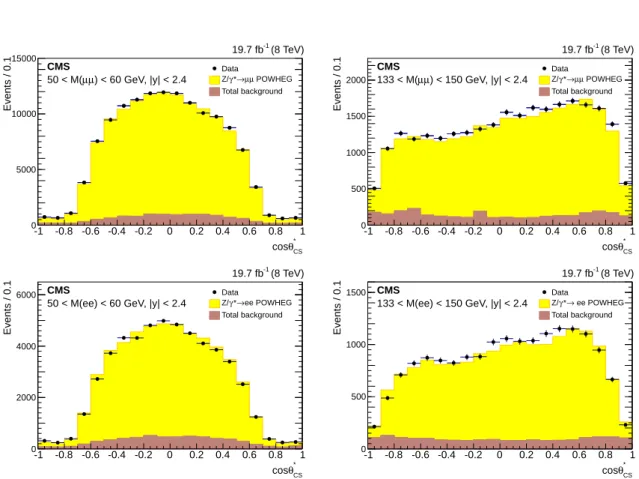
shape of the cos θ∗CSdistribution changes with the dilepton mass. The top panels of Fig. 2 show
the reconstructed cos θCS∗ distributions for µµ events, with |y| < 2.4. The bottom panels show the reconstructed cos θCS∗ for ee events, with |y| < 2.4. The distributions are shown for two representative mass bins. The distributions for dilepton events at low mass (50<M <60 GeV)
6 8 Systematic uncertainties ) [GeV] µ µ M( 50 100 200 300 1000 2000 Events / GeV 1 10 2 10 3 10 4 10 5 10 6 10 |y| < 2.4 Data µ µ → * γ Z/ WW, WZ, ZZ W t , tW, t t τ τ → * γ Z/ Dijets Inclusive W CMS (8 TeV) -1 19.7 fb M(ee) [GeV] 50 100 200 300 1000 2000 Events / GeV -1 10 1 10 2 10 3 10 4 10 5 10 6 10 CMS (8 TeV) -1 19.7 fb |y| < 2.4 Data ee → * γ Z/ WW, WZ, ZZ W t , tW, t t τ τ → * γ Z/ Dijets Inclusive W M(ee) [GeV] 50 100 200 300 1000 2000 Events / GeV -3 10 -2 10 -1 10 1 10 2 10 3 10 4 10 CMS (8 TeV) -1 19.7 fb 2.4 < |y| < 5 Data ee → * γ Z/ Dijets Inclusive W WW, WZ, ZZ W t , tW, t t τ τ → * γ Z/
Figure 1: The invariant mass distributions for µµ (upper left), ee (upper right) events with
|y| <2.4, and ee (bottom) events with 2.4 < |y| < 5. Only statistical uncertainties are shown. The stacked histograms represent the sum of the background contributions and the signal.
are shown in the left panels, and at high mass (133 < M < 150 GeV) in the right panels. The
MC predictions are normalized to the integrated luminosity of the data.
The measured AFB value is corrected for detector resolution, acceptance, efficiency, and the
effect of final-state QED radiation (FSR) using a two-dimensional iterative unfolding method
based on Bayes’ theorem [41, 42]. The AFBquantity is unfolded to account for event migration
between mass bins and between positive and negative cos θCS∗ region. Since the ambiguity of
the quark direction is more significant at low |y|, the dilution of AFB is larger in the low |y|
region.
8
Systematic uncertainties
The largest experimental uncertainties originate from the background estimation, the electron energy correction, the muon momentum correction, and the unfolding procedure. The domi-nant contribution to the background uncertainty is the statistical uncertainty in the background data control sample. The theoretical uncertainty of the cross section in the MC background samples also contributes to the systematic uncertainty in the estimation of the background. After energy corrections to central electrons are applied, we find that there is a 0.4% offset in the position of the Z peak between data and simulation in the barrel and a 0.5% offset in the endcaps. This difference is assigned as the systematic uncertainty in the central electron energy
CS * θ cos -1 -0.8 -0.6 -0.4 -0.2 0 0.2 0.4 0.6 0.8 1 Events / 0.1 0 5000 10000 15000 CMS (8 TeV) -1 19.7 fb ) < 60 GeV, |y| < 2.4 µ µ 50 < M( Data POWHEG µ µ → * γ Z/ Total background CS * θ cos -1 -0.8 -0.6 -0.4 -0.2 0 0.2 0.4 0.6 0.8 1 Events / 0.1 0 500 1000 1500 2000 CMS (8 TeV) -1 19.7 fb ) < 150 GeV, |y| < 2.4 µ µ 133 < M( Data POWHEG µ µ → * γ Z/ Total background CS * θ cos -1 -0.8 -0.6 -0.4 -0.2 0 0.2 0.4 0.6 0.8 1 Events / 0.1 0 2000 4000 6000 CMS (8 TeV) -1 19.7 fb 50 < M(ee) < 60 GeV, |y| < 2.4
Data ee POWHEG → * γ Z/ Total background CS * θ cos -1 -0.8 -0.6 -0.4 -0.2 0 0.2 0.4 0.6 0.8 1 Events / 0.1 0 500 1000 1500 CMS (8 TeV) -1 19.7 fb 133 < M(ee) < 150 GeV, |y| < 2.4
Data ee POWHEG → * γ Z/ Total background
Figure 2: The cos θCS∗ distributions for µµ (ee) events are presented in the top (bottom) panels. Only statistical uncertainties are shown. The stacked histograms represent the sum of the back-ground contribution and the signal. The plots on the left (right) panels correspond to events with dilepton invariant mass 50< M <60 GeV (133< M <150 GeV).
8 9 Results
calibration.
In order to estimate the uncertainty in the energy calibration of forward electrons, the parametrized function of the correction factor is scaled up and down by its statistical uncertainty. The
differ-ence in AFB before and after changing the correction factor is assigned as a systematic
uncer-tainty.
The systematic uncertainty in the muon momentum correction is estimated with a similar ap-proach. The muon momentum correction is scaled up and down by its statistical uncertainty
and the difference in AFB resulting from the change of the muon momentum correction is
as-signed as systematic uncertainty. We find that the contributions of the uncertainties in the effi-ciency scale factors (trigger, identification, and isolation) and in the pileup reweighting factors to the uncertainty in AFBare small.
For forward HF electrons, the uncertainties in the electron η correction and in the global
nor-malization factor contribute to the systematic uncertainty in AFB. In addition, the energy
cali-bration varies approximately 5% between+ηand−η. To account for this asymmetric effect in
the energy calibration, the AFB distribution is measured using one forward electron in+ηor
−η, separately, along with one central electron and half of the difference in AFBis assigned as
a systematic uncertainty. The systematic uncertainty varies from 0.005 to 0.03 as a function of dielectron invariant mass.
The systematic uncertainty in the unfolding procedure is estimated using a closure test in sim-ulation. Any residual shown in the closure test of the unfolding procedure is assigned as the systematic uncertainty.
The theoretical uncertainties which affect the detector acceptance originate from the uncertain-ties in PDFs (CT10 [27, 43] and NNPDF 2.0 [44]) and from uncertainuncertain-ties in the FSR model-ing [45].
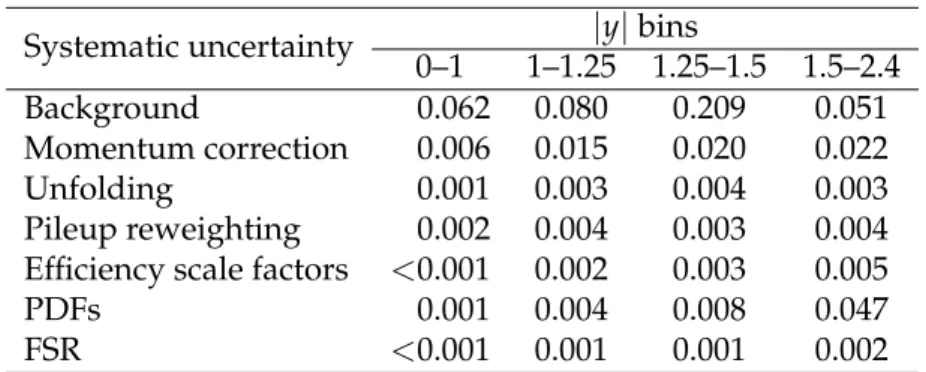
The systematic uncertainty in AFBdepends on the mass of the dilepton pair. Table 1 gives the
maximum value of this uncertainty from each source, for different regions of|y|.
9
Results
A comparison of the unfolded, background-subtracted AFB(M) distributions for µµ and ee
events in the four central rapidity regions is shown in Fig. 3. The statistical and systematic
uncertainties are added in quadrature. The measured AFB(M)distributions agree for µµ and
ee events in all rapidity regions.
The unfolded AFB(M)measurements for µµ and ee events, within|y| <2.4, are combined
un-der the assumption that the uncertainties in the muon and electron channels are uncorrelated. Any effect of the correlation between the µµ and ee systematic uncertainties in the pileup cor-rection, FSR modeling, and the normalization of MC simulations in the background estimation is found to have a negligible effect on the combination.
Figure 4 shows the combined results for the four central rapidity regions up to 2.4. The
com-bined result is compared with thePOWHEG (NLO) prediction with CT10 PDFs. The effective
weak mixing angle, sin2θlepteff = 0.2312, is used for the POWHEGprediction. For all rapidity
re-gions, the combined AFB(M)values are in a good agreement with thePOWHEGprediction. The
uncertainty in the theoretical prediction (POWHEG) originates from the statistical uncertainty in
the MC sample, the uncertainties in the PDFs, and the variations of factorization and renormal-ization scales (simultaneous variation between values 2M, M, and M/2, with M corresponding
Table 1: The maximum value of the systematic uncertainty in AFBas a function of M from each
source for different regions of|y|.
Muon channel
Systematic uncertainty |y|bins
0–1 1–1.25 1.25–1.5 1.5–2.4
Background 0.062 0.080 0.209 0.051
Momentum correction 0.006 0.015 0.020 0.022
Unfolding 0.001 0.003 0.004 0.003
Pileup reweighting 0.002 0.004 0.003 0.004
Efficiency scale factors <0.001 0.002 0.003 0.005
PDFs 0.001 0.004 0.008 0.047
FSR <0.001 0.001 0.001 0.002
Electron channel
Systematic uncertainty |y|bins
0–1 1–1.25 1.25–1.5 1.5–2.4 2.4–5
Background 0.064 0.015 0.008 0.004 0.033
Energy correction 0.011 0.015 0.012 0.012 0.123
Unfolding 0.005 0.007 0.006 0.004 0.001
Pileup reweighting 0.003 0.002 0.002 0.001 0.007
Efficiency scale factors <0.001 <0.001 <0.001 <0.001 0.008
Forward η scale factor — — — — 0.002
Forward η asymmetry — — — — 0.029
Global normalization factor — — — — 0.060
PDFs 0.002 0.004 0.005 0.008 0.014
FSR <0.001 0.001 0.001 0.001 0.002
to the middle of the invariant mass bin). Table 2 summarizes the combined AFB quantity for
each rapidity region.
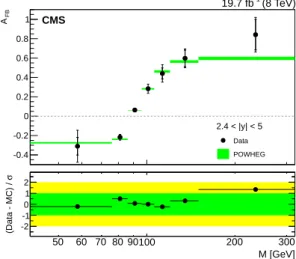
The unfolded AFB distribution for the forward rapidity region (2.4 < |y| < 5) is shown in
Fig. 5. The forward rapidity region extends the scope of the measurement beyond that of the
previous CMS result at√s =7 TeV. Because AFBin the forward rapidity region is diluted less,
the measured AFBquantity is closer to the parton-level asymmetry after the unfolding process,
than it is in the central rapidity bins. The unfolded AFB(Me+e−) for 2.4 < |y| <5 agrees with
thePOWHEGpredictions.
10
Summary
We report a measurement of the forward-backward asymmetry of oppositely charged µµ and
ee pairs produced via a Z/γ∗boson exchange at√s=8 TeV with a data sample corresponding
to an integrated luminosity of 19.7 fb−1. The AFBmeasurement is performed as a function of the
dilepton invariant mass between 40 GeV and 2 TeV for µµ and ee events in 4 dilepton rapidity bins up to|y| = 2.4. For ee events with 2.4< |y| < 5, the AFBmeasurement is performed for
dielectron masses between 40 and 320 GeV. The large data sample collected at 8 TeV extends
the measurement of AFBin the high mass region compared to previous results. The final AFB
10 10 Summary FB A -0.4 -0.2 0 0.2 0.4 0.6 0.8 1 CMS (8 TeV) -1 19.7 fb |y| < 1 ) µ µ → * γ Data (Z/ ee) → * γ Data (Z/ M [GeV] 50 100 200 300 1000 2000 σ - ee) / µµ ( -2 -1 0 1 2 FB A -0.4 -0.2 0 0.2 0.4 0.6 0.8 1 CMS (8 TeV) -1 19.7 fb 1 < |y| < 1.25 ) µ µ → * γ Data (Z/ ee) → * γ Data (Z/ M [GeV] 50 100 200 300 1000 2000 σ - ee) / µµ ( -2 -1 0 1 2 FB A -0.4 -0.2 0 0.2 0.4 0.6 0.8 1 CMS (8 TeV) -1 19.7 fb 1.25 < |y| < 1.5 ) µ µ → * γ Data (Z/ ee) → * γ Data (Z/ M [GeV] 50 100 200 300 1000 2000 σ - ee) / µµ ( -2 -1 0 1 2 FB A -0.4 -0.2 0 0.2 0.4 0.6 0.8 1 CMS (8 TeV) -1 19.7 fb 1.5 < |y| < 2.4 ) µ µ → * γ Data (Z/ ee) → * γ Data (Z/ M [GeV] 50 100 200 300 1000 2000 σ - ee) / µµ ( -2 -1 0 1 2
Figure 3: The unfolded AFBdistributions for muons (open squares) and electrons (solid circles)
for the four central rapidity regions. The statistical (thick vertical bar) and statistical plus sys-tematics (thin vertical bar) uncertainties are presented. The solid circles are shifted slightly to compare the result better. The lower panel in each plot shows the difference of the unfolded
FB A -0.4 -0.2 0 0.2 0.4 0.6 0.8 1 CMS (8 TeV) -1 19.7 fb |y| < 1 Data POWHEG M [GeV] 50 100 200 300 1000 2000 σ (Data - MC) / -2 -1 0 1 2 FB A -0.4 -0.2 0 0.2 0.4 0.6 0.8 1 CMS (8 TeV) -1 19.7 fb 1 < |y| < 1.25 Data POWHEG M [GeV] 50 100 200 300 1000 2000 σ (Data - MC) / -2 -1 0 1 2 FB A -0.4 -0.2 0 0.2 0.4 0.6 0.8 1 CMS (8 TeV) -1 19.7 fb 1.25 < |y| < 1.5 Data POWHEG M [GeV] 50 100 200 300 1000 2000 σ (Data - MC) / -2 -1 0 1 2 FB A -0.4 -0.2 0 0.2 0.4 0.6 0.8 1 CMS (8 TeV) -1 19.7 fb 1.5 < |y| < 2.4 Data POWHEG M [GeV] 50 100 200 300 1000 2000 σ (Data - MC) / -2 -1 0 1 2
Figure 4: The combined (µ+µ−and e+e−) unfolded AFBdistributions in the four central
rapid-ity regions. The statistical (thick vertical bar) and statistical plus systematics (thin vertical bar)
uncertainties are presented. The measurements are compared with the prediction ofPOWHEG.
The total uncertainties (considering the statistical, PDF, and scale uncertainties) in thePOWHEG
prediction are shown as shaded bands. The lower panel in each plot shows the difference of
12 10 Summary FB A -0.4 -0.2 0 0.2 0.4 0.6 0.8 1 CMS (8 TeV) -1 19.7 fb 2.4 < |y| < 5 Data POWHEG M [GeV] 50 60 70 80 90100 200 300 σ (Data - MC) / -2 -1 0 1 2
Figure 5: The unfolded AFB distribution for the forward rapidity region (2.4 < |y| < 5) using
one central electron (|η| <2.4) and one HF electron (3< |η| <5). The inner thick vertical bars
correspond to the statistical uncertainty and the outer thin vertical bars to the total
uncertain-ties. The measurements are compared with the prediction ofPOWHEG. The total uncertainties
(considering the statistical, PDF, and scale uncertainties) in thePOWHEGprediction are shown
as shaded bands. The lower panel shows the difference of AFBin data and prediction divided
by the total uncertainty of data and prediction.
measurements of AFB(M)are consistent with standard model predictions.
Acknowledgments
We congratulate our colleagues in the CERN accelerator departments for the excellent perfor-mance of the LHC and thank the technical and administrative staffs at CERN and at other CMS institutes for their contributions to the success of the CMS effort. In addition, we gratefully acknowledge the computing centers and personnel of the Worldwide LHC Computing Grid for delivering so effectively the computing infrastructure essential to our analyses. Finally, we acknowledge the enduring support for the construction and operation of the LHC and the CMS detector provided by the following funding agencies: BMWFW and FWF (Austria); FNRS and FWO (Belgium); CNPq, CAPES, FAPERJ, and FAPESP (Brazil); MES (Bulgaria); CERN; CAS, MoST, and NSFC (China); COLCIENCIAS (Colombia); MSES and CSF (Croatia); RPF (Cyprus); MoER, ERC IUT and ERDF (Estonia); Academy of Finland, MEC, and HIP (Finland); CEA and CNRS/IN2P3 (France); BMBF, DFG, and HGF (Germany); GSRT (Greece); OTKA and NIH (Hungary); DAE and DST (India); IPM (Iran); SFI (Ireland); INFN (Italy); MSIP and NRF (Re-public of Korea); LAS (Lithuania); MOE and UM (Malaysia); CINVESTAV, CONACYT, SEP, and UASLP-FAI (Mexico); MBIE (New Zealand); PAEC (Pakistan); MSHE and NSC (Poland); FCT (Portugal); JINR (Dubna); MON, RosAtom, RAS and RFBR (Russia); MESTD (Serbia); SEIDI and CPAN (Spain); Swiss Funding Agencies (Switzerland); MST (Taipei); ThEPCenter, IPST, STAR and NSTDA (Thailand); TUBITAK and TAEK (Turkey); NASU and SFFR (Ukraine); STFC (United Kingdom); DOE and NSF (USA).
Individuals have received support from the Marie-Curie program and the European Research Council and EPLANET (European Union); the Leventis Foundation; the A. P. Sloan Foun-dation; the Alexander von Humboldt FounFoun-dation; the Belgian Federal Science Policy Office; the Fonds pour la Formation `a la Recherche dans l’Industrie et dans l’Agriculture (FRIA-Belgium); the Agentschap voor Innovatie door Wetenschap en Technologie (IWT-(FRIA-Belgium);
Table 2: The combined (ee and µµ) AFB measurements, with statistical and systematic
uncer-tainties for the four rapidity regions with |y| < 2.4. The AFB quantity for ee events is also
shown for 2.4< |y| <5.
M (GeV) AFB(data) Stat. err Syst. err Tot. err M (GeV) AFB(data) Stat. err Syst. err Tot. err
|y| <1 1< |y| <1.25 40–50 −0.0167 0.0049 0.0045 0.0067 40–50 −0.0225 0.0108 0.0092 0.0142 50–60 −0.0355 0.0042 0.0031 0.0052 50–60 −0.0825 0.0092 0.0060 0.0110 60–76 −0.0415 0.0033 0.0031 0.0045 60–76 −0.0999 0.0071 0.0044 0.0084 76–86 −0.0221 0.0022 0.0019 0.0029 76–86 −0.0468 0.0048 0.0042 0.0064 86–96 0.0065 0.0004 0.0003 0.0005 86–96 0.0157 0.0009 0.0005 0.0011 96–106 0.0320 0.0020 0.0016 0.0025 96–106 0.0747 0.0046 0.0042 0.0063 106–120 0.0524 0.0037 0.0024 0.0045 106–120 0.1448 0.0085 0.0029 0.0089 120–133 0.0652 0.0065 0.0035 0.0074 120–133 0.1663 0.0152 0.0083 0.0174 133–150 0.0905 0.0081 0.0070 0.0108 133–150 0.2191 0.0185 0.0064 0.0195 150–171 0.1020 0.0104 0.0075 0.0128 150–171 0.2469 0.0243 0.0123 0.0272 171–200 0.1251 0.0129 0.0145 0.0194 171–200 0.2401 0.0272 0.0143 0.0308 200–320 0.1423 0.0112 0.0099 0.0149 200–320 0.3245 0.0257 0.0115 0.0282 320–500 0.1541 0.0268 0.0195 0.0331 320–500 0.4697 0.0609 0.0302 0.0680 500–2000 0.3437 0.0554 0.0514 0.0756 500–2000 0.4954 0.1145 0.0400 0.1213 1.25< |y| <1.5 1.5< |y| <2.4 40–50 −0.0261 0.0114 0.0087 0.0144 40–50 −0.0747 0.0073 0.0049 0.0088 50–60 −0.1122 0.0098 0.0078 0.0125 50–60 −0.1645 0.0070 0.0053 0.0088 60–76 −0.1293 0.0077 0.0039 0.0086 60–76 −0.2365 0.0059 0.0052 0.0079 76–86 −0.0700 0.0052 0.0040 0.0065 76–86 −0.1071 0.0041 0.0057 0.0070 86–96 0.0249 0.0010 0.0007 0.0013 86–96 0.0379 0.0008 0.0009 0.0013 96–106 0.1012 0.0051 0.0044 0.0067 96–106 0.1546 0.0041 0.0057 0.0070 106–120 0.1655 0.0095 0.0045 0.0105 106–120 0.2647 0.0078 0.0047 0.0091 120–133 0.2485 0.0169 0.0080 0.0187 120–133 0.3630 0.0141 0.0068 0.0156 133–150 0.2576 0.0210 0.0197 0.0287 133–150 0.4334 0.0179 0.0129 0.0221 150–171 0.2903 0.0259 0.0103 0.0279 150–171 0.4713 0.0230 0.0083 0.0245 171–200 0.3209 0.0315 0.0112 0.0335 171–200 0.4906 0.0276 0.0095 0.0292 200–320 0.3752 0.0286 0.0114 0.0308 200–320 0.5042 0.0244 0.0092 0.0261 320–500 0.4372 0.0655 0.0287 0.0715 320–500 0.5248 0.0610 0.0131 0.0624 500–2000 0.4071 0.1556 0.0824 0.1761 500–2000 0.6878 0.1862 0.0413 0.1907 2.4< |y| <5 (ee only) 40–76 −0.3104 0.0912 0.1378 0.1652 76–86 −0.2174 0.0214 0.0210 0.0300 86–96 0.0635 0.0060 0.0146 0.0158 96–106 0.2834 0.0183 0.0439 0.0475 106–120 0.4412 0.0567 0.0696 0.0898 120–150 0.5972 0.0851 0.0476 0.0975 150–320 0.8412 0.1567 0.0851 0.1783
the Ministry of Education, Youth and Sports (MEYS) of the Czech Republic; the Council of Science and Industrial Research, India; the HOMING PLUS program of the Foundation for Polish Science, cofinanced from European Union, Regional Development Fund; the OPUS pro-gram of the National Science Center (Poland); the Compagnia di San Paolo (Torino); MIUR project 20108T4XTM (Italy); the Thalis and Aristeia programs cofinanced by EU-ESF and the Greek NSRF; the National Priorities Research Program by Qatar National Research Fund; the Rachadapisek Sompot Fund for Postdoctoral Fellowship, Chulalongkorn University (Thailand); the Chulalongkorn Academic into Its 2nd Century Project Advancement Project (Thailand); and the Welch Foundation, contract C-1845.
14 References
References
[1] D. London and J. L. Rosner, “Extra Gauge Bosons in E6”, Phys. Rev. D 34 (1986) 1530,
doi:10.1103/PhysRevD.34.1530.
[2] J. L. Rosner, “Off-Peak Lepton Asymmetries from New Z’s”, Phys. Rev. D 35 (1987) 2244, doi:10.1103/PhysRevD.35.2244.
[3] M. Cvetiˇc and S. Godfrey, “Discovery and identification of extra gauge bosons”, in Electroweak Symmetry Breaking and New Physics at the TeV Scale, T. Barklow, S. Dawson, H. Haber, and J. Siegrist, eds., p. 383. World Scientific, Singapore, 1995.
arXiv:hep-ph/9504216. Advanced Series on Directions in High Energy Physics, Vol. 16. doi:10.1142/9789812830265_0007.
[4] J. L. Rosner, “Forward-backward asymmetries in hadronically produced lepton pairs”, Phys. Rev. D 54 (1996) 1078, doi:10.1103/PhysRevD.54.1078,
arXiv:hep-ph/9512299.
[5] A. Bodek and U. Baur, “Implications of a 300-500 GeV/c√ 2Z0 boson on p ¯p collider data at
s =1.8 TeV”, Eur. Phys. J. C 21 (2001) 607, doi:10.1007/s100520100778,
arXiv:hep-ph/0102160.
[6] CDF Collaboration, “Limits on Quark-Lepton Compositeness Scales from Dileptons Produced in 1.8 TeV p ¯p Collisions”, Phys. Rev. Lett. 79 (1997) 2198,
doi:10.1103/PhysRevLett.79.2198.
[7] H. Davoudiasl, J. L. Hewett, and T. G. Rizzo, “Phenomenology of the Randall-Sundrum Gauge Hierarchy Model”, Phys. Rev. Lett. 84 (2000) 2080,
doi:10.1103/PhysRevLett.84.2080, arXiv:hep-ph/9909255.
[8] ATLAS Collaboration, “Measurement of the forward-backward asymmetry of electron
and muon pair-production in pp collisions at√s = 7 TeV with the ATLAS detector”,
JHEP 09 (2015) 049, doi:10.1007/JHEP09(2015)049,
arXiv:hep-ex/1503.03709.
[9] CMS Collaboration, “Measurement of the weak mixing angle with the Drell-Yan process in proton-proton collisions at the LHC”, Phys. Rev. D 84 (2011) 112002,
doi:10.1103/PhysRevD.84.112002, arXiv:hep-ex/1110.2682.
[10] D0 Collaboration, “Measurement of the Forward-Backward Charge Asymmetry and Extraction of sin2θeffW in p ¯p→Z/γ∗+X→e+e−+X Events Produced at
√
s=1.96
TeV”, Phys. Rev. Lett. 101 (2008) 191801, doi:10.1103/PhysRevLett.101.191801, arXiv:hep-ex/0804.3220.
[11] CDF Collaboration, “Indirect measurement of sin2θW (or MW) using e+e−pairs in the
Z-boson region with p ¯p collisions at a center-of-momentum energy of 1.96 TeV”, Phys. Rev. D 88 (2013) 072002, doi:10.1103/PhysRevD.88.072002,
arXiv:hep-ex/1307.0770.
[12] CDF Collaboration, “Indirect measurement of sin2θW (or MW) using µ+µ−pairs from
γ∗/Z bosons produced in p ¯p collisions at a center-of-momentum energy of 1.96 TeV”,
Phys. Rev. D 89 (2014) 072005, doi:10.1103/PhysRevD.89.072005, arXiv:hep-ex/1402.2239.
[13] J. C. Collins and D. E. Soper, “Angular Distribution of Dileptons in High-Energy Hadron Collisions”, Phys. Rev. D 16 (1977) 2219, doi:10.1103/PhysRevD.16.2219.
[14] P. Fisher, U. Becker, and J. Kirkby, “Very high precision tests of the electroweak theory”, Phys. Lett. B 356 (1995) 404, doi:10.1016/0370-2693(95)00714-V.
[15] M. Dittmar, “Neutral current interference in the TeV region: The experimental sensitivity at the CERN LHC”, Phys. Rev. D 55 (1997) 161, doi:10.1103/PhysRevD.55.161,
arXiv:hep-ex/9606002.
[16] CMS Collaboration, “Forward-backward asymmetry of Drell–Yan lepton pairs in pp collisions at√s=7 TeV”, Phys. Lett. B 718 (2013) 752,
doi:10.1016/j.physletb.2012.10.082.
[17] CMS Collaboration, “The CMS experiment at the CERN LHC”, JINST 3 (2008) S08004, doi:10.1088/1748-0221/3/08/S08004, arXiv:physics.ins-det/1206.4071.
[18] CMS Collaboration, “Performance of CMS muon reconstruction in pp collision events at√
s =7 TeV”, JINST 7 (2012) P10002, doi:10.1088/1748-0221/7/10/P10002,
arXiv:physics.ins-det/1206.4071.
[19] CMS Collaboration, “Performance of electron reconstruction and selection with the CMS
detector in proton-proton collisions at√s=8 TeV”, JINST 10 (2015) P06005,
doi:10.1088/1748-0221/10/06/P06005,
arXiv:physics.ins-det/1502.02701.
[20] CMS HCAL Collaboration, “Design, performance, and calibration of CMS forward calorimeter wedges”, Eur. Phys. J. C 53 (2008) 139,
doi:10.1140/epjc/s10052-007-0459-4.
[21] CMS Collaboration, “The TriDAS Project: Technical Design Report, Volume 1: The Trigger System”, CMS TDR CERN-LHCC-2000-038, 2000.
[22] CMS Collaboration, “The TriDAS Project: Technical Design Report, Volume 2: Data Acquisition and High-level Trigger”, CMS TDR CERN-LHCC-2000-026, 2002. [23] P. Nason, “A New Method for Combining NLO QCD with Shower Monte Carlo
Algorithms”, JHEP 11 (2004) 040, doi:10.1088/1126-6708/2004/11/040,
arXiv:hep-ph/0409146.
[24] S. Frixione, P. Nason, and C. Oleari, “Matching NLO QCD computations with Parton Shower simulations: the POWHEG method”, JHEP 11 (2007) 070,
doi:10.1088/1126-6708/2007/11/070, arXiv:hep-ph/0709.2092.
[25] S. Alioli, P. Nason, C. Oleari, and E. Re, “NLO vector-boson production matched with shower in POWHEG”, JHEP 07 (2008) 060,
doi:10.1088/1126-6708/2008/07/060, arXiv:hep-ph/0805.4802.
[26] S. Alioli, P. Nason, C. Oleari, and E. Re, “A general framework for implementing NLO calculations in shower Monte Carlo programs: the POWHEG BOX”, JHEP 06 (2010) 043, doi:10.1007/JHEP06(2010)043, arXiv:hep-ph/1002.2581.
[27] H.-L. Lai et al., “New parton distributions for collider physics”, Phys. Rev. D 82 (2010) 074024, doi:10.1103/PhysRevD.82.074024, arXiv:hep-ph/1007.2241.
16 References
[28] T. Sj ¨ostrand, S. Mrenna, and P. Skands, “PYTHIA 6.4 Physics and Manual”, JHEP 05 (2006) 026, doi:10.1088/1126-6708/2006/05/026, arXiv:hep-ph/0603175. [29] CMS Collaboration, “Study of the underlying event at forward rapidity in pp collisions
at√s=0.9, 2.76, and 7 TeV”, JHEP 04 (2013) 072, doi:10.1007/JHEP04(2013)072,
arXiv:hep-ph/1302.2394.
[30] J. Alwall et al., “MadGraph 5: going beyond”, JHEP 06 (2011) 128,
doi:10.1007/JHEP06(2011)128, arXiv:1106.0522.
[31] N. Davidson et al., “Universal interface of TAUOLA technical and physics documentation”, Comput. Phys. Commun. 183 (2012) 821,
doi:10.1016/j.cpc.2011.12.009, arXiv:hep-ph/1002.0543.
[32] GEANT4 Collaboration, “GEANT4—a simulation toolkit”, Nucl. Instrum. Meth. A 506 (2003) 250, doi:10.1016/S0168-9002(03)01368-8.
[33] J. Allison et al., “GEANT4 developments and applications”, IEEE Trans. Nucl. Sci. 53 (2006) 270, doi:10.1109/TNS.2006.869826.
[34] CMS Collaboration, “Parameterized Simulation of the CMS Calorimeter using GFlash”, in Nuclear Science Symposium Conference record (NSS/MIC), 2009 IEEE, p. 2074. Orlando, FL, 2009. doi:10.1109/NSSMIC.2009.5402114.
[35] CMS Collaboration, “Measurement of the rapidity and transverse momentum
distributions of Z bosons in pp collisions at√s = 7 TeV”, Phys. Rev. D 85 (2013) 032002,
doi:10.1103/PhysRevD.85.032002, arXiv:hep-ex/1110.4973.
[36] CMS Collaboration, “Particle-Flow Event Reconstruction in CMS and Performance for
Jets, Taus, and EmissT ”, CMS Physics Analysis Summary CMS-PAS-PFT-09-001, 2009.
[37] CMS Collaboration, “Commissioning of the Particle-flow Event Reconstruction with the first LHC collisions recorded in the CMS detector”, CMS Physics Analysis Summary CMS-PAS-PFT-10-001, 2010.
[38] CMS Collaboration, “Measurement of the Inclusive W and Z Production Cross Sections
in pp Collisions at√s=7 TeV”, JHEP 10 (2011) 132,
doi:10.1007/JHEP10(2011)132, arXiv:hep-ex/1107.4789.
[39] A. Bodek et al., “Extracting muon momentum scale corrections for hadron collider experiments”, Eur. Phys. J. C 72 (2012) 10,
doi:10.1140/epjc/s10052-012-2194-8, arXiv:hep-ex/1208.3710.
[40] Y. Li and F. Petriello, “Combining QCD and electroweak corrections to dilepton production in the framework of the FEWZ simulation code”, Phys. Rev. D 86 (2012) 094034, doi:10.1103/PhysRevD.86.094034, arXiv:hep-ph/1208.5967.
[41] G. D’Agostini, “A Multidimensional unfolding method based on Bayes’ theorem”, Nucl. Instrum. Meth. A 362 (1995) 487, doi:10.1016/0168-9002(95)00274-X.
[42] T. Adye, “Unfolding algorithms and tests using RooUnfold”, Proceedings of the PHYSTAT 2011 Workshop on Statistical Issues Related to Discovery Claims in Search Experiments and Unfolding (Jan., 2011) 313, doi:10.5170/CERN-2011-006,
[43] P. M. Nadolsky et al., “Implications of CTEQ global analysis for collider observables”, Phys. Rev. D 78 (2008) 013004, doi:10.1103/PhysRevD.78.013004,
arXiv:0802.0007.
[44] NNPDF Collaboration, “A first unbiased global NLO determination of parton distributions and their uncertainties”, Nucl. Phys. B 838 (2010) 136,
doi:10.1016/j.nuclphysb.2010.05.008, arXiv:1002.4407.
[45] CMS Collaboration, “Measurements of Inclusive W and Z Cross Sections in pp Collisions
at√s=7 TeV”, JHEP 01 (2011) 080, doi:10.1007/JHEP01(2011)080,
A
The CMS Collaboration
Yerevan Physics Institute, Yerevan, Armenia V. Khachatryan, A.M. Sirunyan, A. Tumasyan
Institut f ¨ur Hochenergiephysik der OeAW, Wien, Austria
W. Adam, E. Asilar, T. Bergauer, J. Brandstetter, E. Brondolin, M. Dragicevic, J. Er ¨o, M. Flechl, M. Friedl, R. Fr ¨uhwirth1, V.M. Ghete, C. Hartl, N. H ¨ormann, J. Hrubec, M. Jeitler1, V. Kn ¨unz,
A. K ¨onig, M. Krammer1, I. Kr¨atschmer, D. Liko, T. Matsushita, I. Mikulec, D. Rabady2,
B. Rahbaran, H. Rohringer, J. Schieck1, R. Sch ¨ofbeck, J. Strauss, W. Treberer-Treberspurg,
W. Waltenberger, C.-E. Wulz1
National Centre for Particle and High Energy Physics, Minsk, Belarus V. Mossolov, N. Shumeiko, J. Suarez Gonzalez
Universiteit Antwerpen, Antwerpen, Belgium
S. Alderweireldt, T. Cornelis, E.A. De Wolf, X. Janssen, A. Knutsson, J. Lauwers, S. Luyckx, M. Van De Klundert, H. Van Haevermaet, P. Van Mechelen, N. Van Remortel, A. Van Spilbeeck Vrije Universiteit Brussel, Brussel, Belgium
S. Abu Zeid, F. Blekman, J. D’Hondt, N. Daci, I. De Bruyn, K. Deroover, N. Heracleous, J. Keaveney, S. Lowette, L. Moreels, A. Olbrechts, Q. Python, D. Strom, S. Tavernier, W. Van Doninck, P. Van Mulders, G.P. Van Onsem, I. Van Parijs
Universit´e Libre de Bruxelles, Bruxelles, Belgium
P. Barria, H. Brun, C. Caillol, B. Clerbaux, G. De Lentdecker, G. Fasanella, L. Favart, A. Grebenyuk, G. Karapostoli, T. Lenzi, A. L´eonard, T. Maerschalk, A. Marinov, L. Perni`e,
A. Randle-conde, T. Reis, T. Seva, C. Vander Velde, P. Vanlaer, R. Yonamine, F. Zenoni, F. Zhang3
Ghent University, Ghent, Belgium
K. Beernaert, L. Benucci, A. Cimmino, S. Crucy, D. Dobur, A. Fagot, G. Garcia, M. Gul, J. Mccartin, A.A. Ocampo Rios, D. Poyraz, D. Ryckbosch, S. Salva, M. Sigamani, N. Strobbe, M. Tytgat, W. Van Driessche, E. Yazgan, N. Zaganidis
Universit´e Catholique de Louvain, Louvain-la-Neuve, Belgium
S. Basegmez, C. Beluffi4, O. Bondu, S. Brochet, G. Bruno, A. Caudron, L. Ceard, G.G. Da
Silveira, C. Delaere, D. Favart, L. Forthomme, A. Giammanco5, J. Hollar, A. Jafari, P. Jez,
M. Komm, V. Lemaitre, A. Mertens, M. Musich, C. Nuttens, L. Perrini, A. Pin, K. Piotrzkowski,
A. Popov6, L. Quertenmont, M. Selvaggi, M. Vidal Marono
Universit´e de Mons, Mons, Belgium N. Beliy, G.H. Hammad
Centro Brasileiro de Pesquisas Fisicas, Rio de Janeiro, Brazil
W.L. Ald´a J ´unior, F.L. Alves, G.A. Alves, L. Brito, M. Correa Martins Junior, M. Hamer, C. Hensel, C. Mora Herrera, A. Moraes, M.E. Pol, P. Rebello Teles
Universidade do Estado do Rio de Janeiro, Rio de Janeiro, Brazil
E. Belchior Batista Das Chagas, W. Carvalho, J. Chinellato7, A. Cust ´odio, E.M. Da Costa,
D. De Jesus Damiao, C. De Oliveira Martins, S. Fonseca De Souza, L.M. Huertas Guativa, H. Malbouisson, D. Matos Figueiredo, L. Mundim, H. Nogima, W.L. Prado Da Silva, A. Santoro, A. Sznajder, E.J. Tonelli Manganote7, A. Vilela Pereira
Universidade Estadual Paulistaa, Universidade Federal do ABCb, S˜ao Paulo, Brazil
20 A The CMS Collaboration
E.M. Gregoresb, P.G. Mercadanteb, C.S. Moona,8, S.F. Novaesa, Sandra S. Padulaa, D. Romero Abad, J.C. Ruiz Vargas
Institute for Nuclear Research and Nuclear Energy, Sofia, Bulgaria
A. Aleksandrov, R. Hadjiiska, P. Iaydjiev, M. Rodozov, S. Stoykova, G. Sultanov, M. Vutova University of Sofia, Sofia, Bulgaria
A. Dimitrov, I. Glushkov, L. Litov, B. Pavlov, P. Petkov Institute of High Energy Physics, Beijing, China
M. Ahmad, J.G. Bian, G.M. Chen, H.S. Chen, M. Chen, T. Cheng, R. Du, C.H. Jiang, R. Plestina9,
F. Romeo, S.M. Shaheen, A. Spiezia, J. Tao, C. Wang, Z. Wang, H. Zhang
State Key Laboratory of Nuclear Physics and Technology, Peking University, Beijing, China C. Asawatangtrakuldee, Y. Ban, Q. Li, S. Liu, Y. Mao, S.J. Qian, D. Wang, Z. Xu
Universidad de Los Andes, Bogota, Colombia
C. Avila, A. Cabrera, L.F. Chaparro Sierra, C. Florez, J.P. Gomez, B. Gomez Moreno, J.C. Sanabria
University of Split, Faculty of Electrical Engineering, Mechanical Engineering and Naval Architecture, Split, Croatia
N. Godinovic, D. Lelas, I. Puljak, P.M. Ribeiro Cipriano University of Split, Faculty of Science, Split, Croatia Z. Antunovic, M. Kovac
Institute Rudjer Boskovic, Zagreb, Croatia
V. Brigljevic, K. Kadija, J. Luetic, S. Micanovic, L. Sudic University of Cyprus, Nicosia, Cyprus
A. Attikis, G. Mavromanolakis, J. Mousa, C. Nicolaou, F. Ptochos, P.A. Razis, H. Rykaczewski Charles University, Prague, Czech Republic
M. Bodlak, M. Finger10, M. Finger Jr.10
Academy of Scientific Research and Technology of the Arab Republic of Egypt, Egyptian Network of High Energy Physics, Cairo, Egypt
Y. Assran11, S. Elgammal12, A. Ellithi Kamel13,13, M.A. Mahmoud14,14, Y. Mohammed14 National Institute of Chemical Physics and Biophysics, Tallinn, Estonia
B. Calpas, M. Kadastik, M. Murumaa, M. Raidal, A. Tiko, C. Veelken Department of Physics, University of Helsinki, Helsinki, Finland P. Eerola, J. Pekkanen, M. Voutilainen
Helsinki Institute of Physics, Helsinki, Finland
J. H¨ark ¨onen, V. Karim¨aki, R. Kinnunen, T. Lamp´en, K. Lassila-Perini, S. Lehti, T. Lind´en, P. Luukka, T. M¨aenp¨a¨a, T. Peltola, E. Tuominen, J. Tuominiemi, E. Tuovinen, L. Wendland Lappeenranta University of Technology, Lappeenranta, Finland
J. Talvitie, T. Tuuva
DSM/IRFU, CEA/Saclay, Gif-sur-Yvette, France
M. Besancon, F. Couderc, M. Dejardin, D. Denegri, B. Fabbro, J.L. Faure, C. Favaro, F. Ferri, S. Ganjour, A. Givernaud, P. Gras, G. Hamel de Monchenault, P. Jarry, E. Locci, M. Machet, J. Malcles, J. Rander, A. Rosowsky, M. Titov, A. Zghiche
Laboratoire Leprince-Ringuet, Ecole Polytechnique, IN2P3-CNRS, Palaiseau, France
I. Antropov, S. Baffioni, F. Beaudette, P. Busson, L. Cadamuro, E. Chapon, C. Charlot, T. Dahms, O. Davignon, N. Filipovic, A. Florent, R. Granier de Cassagnac, S. Lisniak, L. Mastrolorenzo, P. Min´e, I.N. Naranjo, M. Nguyen, C. Ochando, G. Ortona, P. Paganini, P. Pigard, S. Regnard, R. Salerno, J.B. Sauvan, Y. Sirois, T. Strebler, Y. Yilmaz, A. Zabi
Institut Pluridisciplinaire Hubert Curien, Universit´e de Strasbourg, Universit´e de Haute Alsace Mulhouse, CNRS/IN2P3, Strasbourg, France
J.-L. Agram15, J. Andrea, A. Aubin, D. Bloch, J.-M. Brom, M. Buttignol, E.C. Chabert,
N. Chanon, C. Collard, E. Conte15, X. Coubez, J.-C. Fontaine15, D. Gel´e, U. Goerlach,
C. Goetzmann, A.-C. Le Bihan, J.A. Merlin2, K. Skovpen, P. Van Hove
Centre de Calcul de l’Institut National de Physique Nucleaire et de Physique des Particules, CNRS/IN2P3, Villeurbanne, France
S. Gadrat
Universit´e de Lyon, Universit´e Claude Bernard Lyon 1, CNRS-IN2P3, Institut de Physique Nucl´eaire de Lyon, Villeurbanne, France
S. Beauceron, C. Bernet, G. Boudoul, E. Bouvier, C.A. Carrillo Montoya, R. Chierici, D. Contardo, B. Courbon, P. Depasse, H. El Mamouni, J. Fan, J. Fay, S. Gascon, M. Gouzevitch, B. Ille, F. Lagarde, I.B. Laktineh, M. Lethuillier, L. Mirabito, A.L. Pequegnot, S. Perries, J.D. Ruiz Alvarez, D. Sabes, L. Sgandurra, V. Sordini, M. Vander Donckt, P. Verdier, S. Viret
Georgian Technical University, Tbilisi, Georgia T. Toriashvili16
Tbilisi State University, Tbilisi, Georgia I. Bagaturia17
RWTH Aachen University, I. Physikalisches Institut, Aachen, Germany
C. Autermann, S. Beranek, M. Edelhoff, L. Feld, A. Heister, M.K. Kiesel, K. Klein, M. Lipinski, A. Ostapchuk, M. Preuten, F. Raupach, S. Schael, J.F. Schulte, T. Verlage, H. Weber, B. Wittmer,
V. Zhukov6
RWTH Aachen University, III. Physikalisches Institut A, Aachen, Germany
M. Ata, M. Brodski, E. Dietz-Laursonn, D. Duchardt, M. Endres, M. Erdmann, S. Erdweg, T. Esch, R. Fischer, A. G ¨uth, T. Hebbeker, C. Heidemann, K. Hoepfner, D. Klingebiel, S. Knutzen, P. Kreuzer, M. Merschmeyer, A. Meyer, P. Millet, M. Olschewski, K. Padeken, P. Papacz, T. Pook, M. Radziej, H. Reithler, M. Rieger, F. Scheuch, L. Sonnenschein, D. Teyssier, S. Th ¨uer
RWTH Aachen University, III. Physikalisches Institut B, Aachen, Germany
V. Cherepanov, Y. Erdogan, G. Fl ¨ugge, H. Geenen, M. Geisler, F. Hoehle, B. Kargoll, T. Kress,
Y. Kuessel, A. K ¨unsken, J. Lingemann2, A. Nehrkorn, A. Nowack, I.M. Nugent, C. Pistone,
O. Pooth, A. Stahl
Deutsches Elektronen-Synchrotron, Hamburg, Germany
M. Aldaya Martin, I. Asin, N. Bartosik, O. Behnke, U. Behrens, A.J. Bell, K. Borras18,
A. Burgmeier, A. Cakir, A. Campbell, S. Choudhury19, F. Costanza, C. Diez Pardos, G. Dolinska,
S. Dooling, T. Dorland, G. Eckerlin, D. Eckstein, T. Eichhorn, G. Flucke, E. Gallo20, J. Garay
Garcia, A. Geiser, A. Gizhko, P. Gunnellini, J. Hauk, M. Hempel21, H. Jung, A. Kalogeropoulos,
O. Karacheban21, M. Kasemann, P. Katsas, J. Kieseler, C. Kleinwort, I. Korol, W. Lange,
J. Leonard, K. Lipka, A. Lobanov, W. Lohmann21, R. Mankel, I. Marfin21, I.-A. Melzer-Pellmann,
22 A The CMS Collaboration
H. Perrey, D. Pitzl, R. Placakyte, A. Raspereza, B. Roland, M. ¨O. Sahin, P. Saxena, T. Schoerner-Sadenius, M. Schr ¨oder, C. Seitz, S. Spannagel, K.D. Trippkewitz, R. Walsh, C. Wissing
University of Hamburg, Hamburg, Germany
V. Blobel, M. Centis Vignali, A.R. Draeger, J. Erfle, E. Garutti, K. Goebel, D. Gonzalez, M. G ¨orner, J. Haller, M. Hoffmann, R.S. H ¨oing, A. Junkes, R. Klanner, R. Kogler, T. Lapsien,
T. Lenz, I. Marchesini, D. Marconi, M. Meyer, D. Nowatschin, J. Ott, F. Pantaleo2, T. Peiffer,
A. Perieanu, N. Pietsch, J. Poehlsen, D. Rathjens, C. Sander, H. Schettler, P. Schleper, E. Schlieckau, A. Schmidt, J. Schwandt, V. Sola, H. Stadie, G. Steinbr ¨uck, H. Tholen, D. Troendle, E. Usai, L. Vanelderen, A. Vanhoefer, B. Vormwald
Institut f ¨ur Experimentelle Kernphysik, Karlsruhe, Germany
M. Akbiyik, C. Barth, C. Baus, J. Berger, C. B ¨oser, E. Butz, T. Chwalek, F. Colombo, W. De Boer, A. Descroix, A. Dierlamm, S. Fink, F. Frensch, R. Friese, M. Giffels, A. Gilbert, D. Haitz,
F. Hartmann2, S.M. Heindl, U. Husemann, I. Katkov6, A. Kornmayer2, P. Lobelle Pardo,
B. Maier, H. Mildner, M.U. Mozer, T. M ¨uller, Th. M ¨uller, M. Plagge, G. Quast, K. Rabbertz, S. R ¨ocker, F. Roscher, G. Sieber, H.J. Simonis, F.M. Stober, R. Ulrich, J. Wagner-Kuhr, S. Wayand, M. Weber, T. Weiler, C. W ¨ohrmann, R. Wolf
Institute of Nuclear and Particle Physics (INPP), NCSR Demokritos, Aghia Paraskevi, Greece
G. Anagnostou, G. Daskalakis, T. Geralis, V.A. Giakoumopoulou, A. Kyriakis, D. Loukas, A. Psallidas, I. Topsis-Giotis
National and Kapodistrian University of Athens, Athens, Greece A. Agapitos, S. Kesisoglou, A. Panagiotou, N. Saoulidou, E. Tziaferi University of Io´annina, Io´annina, Greece
I. Evangelou, G. Flouris, C. Foudas, P. Kokkas, N. Loukas, N. Manthos, I. Papadopoulos, E. Paradas, J. Strologas
Wigner Research Centre for Physics, Budapest, Hungary
G. Bencze, C. Hajdu, A. Hazi, P. Hidas, D. Horvath22, F. Sikler, V. Veszpremi, G. Vesztergombi23, A.J. Zsigmond
Institute of Nuclear Research ATOMKI, Debrecen, Hungary N. Beni, S. Czellar, J. Karancsi24, J. Molnar, Z. Szillasi
University of Debrecen, Debrecen, Hungary
M. Bart ´ok25, A. Makovec, P. Raics, Z.L. Trocsanyi, B. Ujvari
National Institute of Science Education and Research, Bhubaneswar, India P. Mal, K. Mandal, D.K. Sahoo, N. Sahoo, S.K. Swain
Panjab University, Chandigarh, India
S. Bansal, S.B. Beri, V. Bhatnagar, R. Chawla, R. Gupta, U.Bhawandeep, A.K. Kalsi, A. Kaur, M. Kaur, R. Kumar, A. Mehta, M. Mittal, J.B. Singh, G. Walia
University of Delhi, Delhi, India
Ashok Kumar, A. Bhardwaj, B.C. Choudhary, R.B. Garg, A. Kumar, S. Malhotra, M. Naimuddin, N. Nishu, K. Ranjan, R. Sharma, V. Sharma
Saha Institute of Nuclear Physics, Kolkata, India
S. Bhattacharya, K. Chatterjee, S. Dey, S. Dutta, Sa. Jain, N. Majumdar, A. Modak, K. Mondal, S. Mukherjee, S. Mukhopadhyay, A. Roy, D. Roy, S. Roy Chowdhury, S. Sarkar, M. Sharan
Bhabha Atomic Research Centre, Mumbai, India
A. Abdulsalam, R. Chudasama, D. Dutta, V. Jha, V. Kumar, A.K. Mohanty2, L.M. Pant,
P. Shukla, A. Topkar
Tata Institute of Fundamental Research, Mumbai, India
T. Aziz, S. Banerjee, S. Bhowmik26, R.M. Chatterjee, R.K. Dewanjee, S. Dugad, S. Ganguly,
S. Ghosh, M. Guchait, A. Gurtu27, G. Kole, S. Kumar, B. Mahakud, M. Maity26, G. Majumder,
K. Mazumdar, S. Mitra, G.B. Mohanty, B. Parida, T. Sarkar26, N. Sur, B. Sutar, N. Wickramage28
Indian Institute of Science Education and Research (IISER), Pune, India S. Chauhan, S. Dube, S. Sharma
Institute for Research in Fundamental Sciences (IPM), Tehran, Iran
H. Bakhshiansohi, H. Behnamian, S.M. Etesami29, A. Fahim30, R. Goldouzian, M. Khakzad,
M. Mohammadi Najafabadi, M. Naseri, S. Paktinat Mehdiabadi, F. Rezaei Hosseinabadi, B. Safarzadeh31, M. Zeinali
University College Dublin, Dublin, Ireland M. Felcini, M. Grunewald
INFN Sezione di Baria, Universit`a di Barib, Politecnico di Baric, Bari, Italy
M. Abbresciaa,b, C. Calabriaa,b, C. Caputoa,b, A. Colaleoa, D. Creanzaa,c, L. Cristellaa,b, N. De Filippisa,c, M. De Palmaa,b, L. Fiorea, G. Iasellia,c, G. Maggia,c, M. Maggia, G. Minielloa,b, S. Mya,c, S. Nuzzoa,b, A. Pompilia,b, G. Pugliesea,c, R. Radognaa,b, A. Ranieria, G. Selvaggia,b, L. Silvestrisa,2, R. Vendittia,b, P. Verwilligena
INFN Sezione di Bolognaa, Universit`a di Bolognab, Bologna, Italy
G. Abbiendia, C. Battilana2, A.C. Benvenutia, D. Bonacorsia,b, S. Braibant-Giacomellia,b, L. Brigliadoria,b, R. Campaninia,b, P. Capiluppia,b, A. Castroa,b, F.R. Cavalloa, S.S. Chhibraa,b, G. Codispotia,b, M. Cuffiania,b, G.M. Dallavallea, F. Fabbria, A. Fanfania,b, D. Fasanellaa,b, P. Giacomellia, C. Grandia, L. Guiduccia,b, S. Marcellinia, G. Masettia, A. Montanaria, F.L. Navarriaa,b, A. Perrottaa, A.M. Rossia,b, T. Rovellia,b, G.P. Sirolia,b, N. Tosia,b, R. Travaglinia,b
INFN Sezione di Cataniaa, Universit`a di Cataniab, Catania, Italy
G. Cappelloa, M. Chiorbolia,b, S. Costaa,b, F. Giordanoa,b, R. Potenzaa,b, A. Tricomia,b, C. Tuvea,b INFN Sezione di Firenzea, Universit`a di Firenzeb, Firenze, Italy
G. Barbaglia, V. Ciullia,b, C. Civininia, R. D’Alessandroa,b, E. Focardia,b, S. Gonzia,b, V. Goria,b, P. Lenzia,b, M. Meschinia, S. Paolettia, G. Sguazzonia, A. Tropianoa,b, L. Viliania,b,2
INFN Laboratori Nazionali di Frascati, Frascati, Italy L. Benussi, S. Bianco, F. Fabbri, D. Piccolo, F. Primavera
INFN Sezione di Genovaa, Universit`a di Genovab, Genova, Italy
V. Calvellia,b, F. Ferroa, M. Lo Veterea,b, M.R. Mongea,b, E. Robuttia, S. Tosia,b
INFN Sezione di Milano-Bicoccaa, Universit`a di Milano-Bicoccab, Milano, Italy
L. Brianza, M.E. Dinardoa,b, S. Fiorendia,b, S. Gennaia, R. Gerosaa,b, A. Ghezzia,b, P. Govonia,b, S. Malvezzia, R.A. Manzonia,b, B. Marzocchia,b,2, D. Menascea, L. Moronia, M. Paganonia,b,
D. Pedrinia, S. Ragazzia,b, N. Redaellia, T. Tabarelli de Fatisa,b
24 A The CMS Collaboration
Basilicatac, Potenza, Italy, Universit`a G. Marconid, Roma, Italy
S. Buontempoa, N. Cavalloa,c, S. Di Guidaa,d,2, M. Espositoa,b, F. Fabozzia,c, A.O.M. Iorioa,b, G. Lanzaa, L. Listaa, S. Meolaa,d,2, M. Merolaa, P. Paoluccia,2, C. Sciaccaa,b, F. Thyssen
INFN Sezione di Padova a, Universit`a di Padova b, Padova, Italy, Universit`a di Trento c, Trento, Italy
P. Azzia,2, N. Bacchettaa, L. Benatoa,b, D. Biselloa,b, A. Bolettia,b, R. Carlina,b, P. Checchiaa, M. Dall’Ossoa,b,2, T. Dorigoa, S. Fantinela, F. Fanzagoa, F. Gasparinia,b, U. Gasparinia,b, F. Gonellaa, A. Gozzelinoa, S. Lacapraraa, M. Margonia,b, A.T. Meneguzzoa,b, F. Montecassianoa, J. Pazzinia,b, N. Pozzobona,b, P. Ronchesea,b, F. Simonettoa,b, E. Torassaa, M. Tosia,b, M. Zanetti, P. Zottoa,b, A. Zucchettaa,b,2, G. Zumerlea,b
INFN Sezione di Paviaa, Universit`a di Paviab, Pavia, Italy
A. Braghieria, A. Magnania, P. Montagnaa,b, S.P. Rattia,b, V. Rea, C. Riccardia,b, P. Salvinia, I. Vaia, P. Vituloa,b
INFN Sezione di Perugiaa, Universit`a di Perugiab, Perugia, Italy
L. Alunni Solestizia,b, M. Biasinia,b, G.M. Bileia, D. Ciangottinia,b,2, L. Fan `oa,b, P. Laricciaa,b, G. Mantovania,b, M. Menichellia, A. Sahaa, A. Santocchiaa,b
INFN Sezione di Pisaa, Universit`a di Pisab, Scuola Normale Superiore di Pisac, Pisa, Italy
K. Androsova,32, P. Azzurria, G. Bagliesia, J. Bernardinia, T. Boccalia, R. Castaldia,
M.A. Cioccia,32, R. Dell’Orsoa, S. Donatoa,c,2, G. Fedi, L. Fo`aa,c†, A. Giassia, M.T. Grippoa,32, F. Ligabuea,c, T. Lomtadzea, L. Martinia,b, A. Messineoa,b, F. Pallaa, A. Rizzia,b, A. Savoy-Navarroa,33, A.T. Serbana, P. Spagnoloa, R. Tenchinia, G. Tonellia,b, A. Venturia, P.G. Verdinia INFN Sezione di Romaa, Universit`a di Romab, Roma, Italy
L. Baronea,b, F. Cavallaria, G. D’imperioa,b,2, D. Del Rea,b, M. Diemoza, S. Gellia,b, C. Jordaa,
E. Longoa,b, F. Margarolia,b, P. Meridiania, G. Organtinia,b, R. Paramattia, F. Preiatoa,b, S. Rahatloua,b, C. Rovellia, F. Santanastasioa,b, P. Traczyka,b,2
INFN Sezione di Torino a, Universit`a di Torino b, Torino, Italy, Universit`a del Piemonte Orientalec, Novara, Italy
N. Amapanea,b, R. Arcidiaconoa,c,2, S. Argiroa,b, M. Arneodoa,c, R. Bellana,b, C. Biinoa, N. Cartigliaa, M. Costaa,b, R. Covarellia,b, A. Deganoa,b, N. Demariaa, L. Fincoa,b,2, B. Kiania,b,
C. Mariottia, S. Masellia, E. Migliorea,b, V. Monacoa,b, E. Monteila,b, M.M. Obertinoa,b, L. Pachera,b, N. Pastronea, M. Pelliccionia, G.L. Pinna Angionia,b, F. Raveraa,b, A. Romeroa,b, M. Ruspaa,c, R. Sacchia,b, A. Solanoa,b, A. Staianoa, U. Tamponia
INFN Sezione di Triestea, Universit`a di Triesteb, Trieste, Italy
S. Belfortea, V. Candelisea,b,2, M. Casarsaa, F. Cossuttia, G. Della Riccaa,b, B. Gobboa, C. La Licataa,b, M. Maronea,b, A. Schizzia,b, A. Zanettia
Kangwon National University, Chunchon, Korea A. Kropivnitskaya, S.K. Nam
Kyungpook National University, Daegu, Korea
D.H. Kim, G.N. Kim, M.S. Kim, D.J. Kong, S. Lee, Y.D. Oh, A. Sakharov, D.C. Son Chonbuk National University, Jeonju, Korea
J.A. Brochero Cifuentes, H. Kim, T.J. Kim
Chonnam National University, Institute for Universe and Elementary Particles, Kwangju, Korea
Korea University, Seoul, Korea
S. Choi, Y. Go, D. Gyun, B. Hong, M. Jo, H. Kim, Y. Kim, B. Lee, K. Lee, K.S. Lee, S. Lee, S.K. Park, Y. Roh
Seoul National University, Seoul, Korea H.D. Yoo
University of Seoul, Seoul, Korea
M. Choi, H. Kim, J.H. Kim, J.S.H. Lee, I.C. Park, G. Ryu, M.S. Ryu Sungkyunkwan University, Suwon, Korea
Y. Choi, J. Goh, D. Kim, E. Kwon, J. Lee, I. Yu Vilnius University, Vilnius, Lithuania A. Juodagalvis, J. Vaitkus
National Centre for Particle Physics, Universiti Malaya, Kuala Lumpur, Malaysia
I. Ahmed, Z.A. Ibrahim, J.R. Komaragiri, M.A.B. Md Ali34, F. Mohamad Idris35, W.A.T. Wan
Abdullah, M.N. Yusli
Centro de Investigacion y de Estudios Avanzados del IPN, Mexico City, Mexico
E. Casimiro Linares, H. Castilla-Valdez, E. De La Cruz-Burelo, I. Heredia-De La Cruz36,
A. Hernandez-Almada, R. Lopez-Fernandez, A. Sanchez-Hernandez Universidad Iberoamericana, Mexico City, Mexico
S. Carrillo Moreno, F. Vazquez Valencia
Benemerita Universidad Autonoma de Puebla, Puebla, Mexico I. Pedraza, H.A. Salazar Ibarguen
Universidad Aut ´onoma de San Luis Potos´ı, San Luis Potos´ı, Mexico A. Morelos Pineda
University of Auckland, Auckland, New Zealand D. Krofcheck
University of Canterbury, Christchurch, New Zealand P.H. Butler
National Centre for Physics, Quaid-I-Azam University, Islamabad, Pakistan A. Ahmad, M. Ahmad, Q. Hassan, H.R. Hoorani, W.A. Khan, T. Khurshid, M. Shoaib National Centre for Nuclear Research, Swierk, Poland
H. Bialkowska, M. Bluj, B. Boimska, T. Frueboes, M. G ´orski, M. Kazana, K. Nawrocki, K. Romanowska-Rybinska, M. Szleper, P. Zalewski
Institute of Experimental Physics, Faculty of Physics, University of Warsaw, Warsaw, Poland
G. Brona, K. Bunkowski, A. Byszuk37, K. Doroba, A. Kalinowski, M. Konecki, J. Krolikowski,
M. Misiura, M. Olszewski, M. Walczak
Laborat ´orio de Instrumenta¸c˜ao e F´ısica Experimental de Part´ıculas, Lisboa, Portugal
P. Bargassa, C. Beir˜ao Da Cruz E Silva, A. Di Francesco, P. Faccioli, P.G. Ferreira Parracho, M. Gallinaro, N. Leonardo, L. Lloret Iglesias, F. Nguyen, J. Rodrigues Antunes, J. Seixas, O. Toldaiev, D. Vadruccio, J. Varela, P. Vischia
Joint Institute for Nuclear Research, Dubna, Russia
26 A The CMS Collaboration
V. Konoplyanikov, A. Lanev, A. Malakhov, V. Matveev38, P. Moisenz, V. Palichik, V. Perelygin,
S. Shmatov, S. Shulha, N. Skatchkov, V. Smirnov, A. Zarubin
Petersburg Nuclear Physics Institute, Gatchina (St. Petersburg), Russia
V. Golovtsov, Y. Ivanov, V. Kim39, E. Kuznetsova, P. Levchenko, V. Murzin, V. Oreshkin,
I. Smirnov, V. Sulimov, L. Uvarov, S. Vavilov, A. Vorobyev Institute for Nuclear Research, Moscow, Russia
Yu. Andreev, A. Dermenev, S. Gninenko, N. Golubev, A. Karneyeu, M. Kirsanov, N. Krasnikov, A. Pashenkov, D. Tlisov, A. Toropin
Institute for Theoretical and Experimental Physics, Moscow, Russia
V. Epshteyn, V. Gavrilov, N. Lychkovskaya, V. Popov, I. Pozdnyakov, G. Safronov, A. Spiridonov, E. Vlasov, A. Zhokin
National Research Nuclear University ’Moscow Engineering Physics Institute’ (MEPhI), Moscow, Russia
A. Bylinkin
P.N. Lebedev Physical Institute, Moscow, Russia
V. Andreev, M. Azarkin40, I. Dremin40, M. Kirakosyan, A. Leonidov40, G. Mesyats, S.V. Rusakov Skobeltsyn Institute of Nuclear Physics, Lomonosov Moscow State University, Moscow, Russia
A. Baskakov, A. Belyaev, E. Boos, M. Dubinin41, L. Dudko, A. Ershov, A. Gribushin,
V. Klyukhin, O. Kodolova, I. Lokhtin, I. Myagkov, S. Obraztsov, S. Petrushanko, V. Savrin, A. Snigirev
State Research Center of Russian Federation, Institute for High Energy Physics, Protvino, Russia
I. Azhgirey, I. Bayshev, S. Bitioukov, V. Kachanov, A. Kalinin, D. Konstantinov, V. Krychkine, V. Petrov, R. Ryutin, A. Sobol, L. Tourtchanovitch, S. Troshin, N. Tyurin, A. Uzunian, A. Volkov University of Belgrade, Faculty of Physics and Vinca Institute of Nuclear Sciences, Belgrade, Serbia
P. Adzic42, J. Milosevic, V. Rekovic
Centro de Investigaciones Energ´eticas Medioambientales y Tecnol ´ogicas (CIEMAT), Madrid, Spain
J. Alcaraz Maestre, E. Calvo, M. Cerrada, M. Chamizo Llatas, N. Colino, B. De La Cruz, A. Delgado Peris, D. Dom´ınguez V´azquez, A. Escalante Del Valle, C. Fernandez Bedoya, J.P. Fern´andez Ramos, J. Flix, M.C. Fouz, P. Garcia-Abia, O. Gonzalez Lopez, S. Goy Lopez, J.M. Hernandez, M.I. Josa, E. Navarro De Martino, A. P´erez-Calero Yzquierdo, J. Puerta Pelayo, A. Quintario Olmeda, I. Redondo, L. Romero, J. Santaolalla, M.S. Soares
Universidad Aut ´onoma de Madrid, Madrid, Spain C. Albajar, J.F. de Troc ´oniz, M. Missiroli, D. Moran Universidad de Oviedo, Oviedo, Spain
J. Cuevas, J. Fernandez Menendez, S. Folgueras, I. Gonzalez Caballero, E. Palencia Cortezon, J.M. Vizan Garcia
Instituto de F´ısica de Cantabria (IFCA), CSIC-Universidad de Cantabria, Santander, Spain I.J. Cabrillo, A. Calderon, J.R. Casti ˜neiras De Saa, P. De Castro Manzano, J. Duarte Campderros, M. Fernandez, J. Garcia-Ferrero, G. Gomez, A. Lopez Virto, J. Marco, R. Marco, C. Martinez