Universidade de Lisboa
Faculdade de Ciências
Departamento de Biologia Animal
T
OWARDS A CONSERVATION STRATEGY FOR AN ENDANGERED
RODENT
,
THE
C
ABRERA VOLE
(M
ICROTUS CABRERAE
T
HOMAS
).
I
NSIGHTS FROM ECOLOGICAL DATA
INÊS TEIXEIRA DO ROSÁRIO
Doutoramento em Biologia
(Ecologia)
Universidade de Lisboa
Faculdade de Ciências
Departamento de Biologia Animal
T
OWARDS A CONSERVATION STRATEGY FOR AN ENDANGERED
RODENT
,
THE
C
ABRERA VOLE
(M
ICROTUS CABRERAE
T
HOMAS
).
I
NSIGHTS FROM ECOLOGICAL DATA
INÊS TEIXEIRA DO ROSÁRIO
Tese orientada por:
Professora Doutora Maria da Luz Mathias
Doutoramento em Biologia
(Ecologia)
v | P a g e
N
OTAP
RÉVIANa elaboração desta tese, foi feito o aproveitamento de trabalhos já publicados ou submetidos para publicação, que integram os seus diferentes capítulos. Considerando que os referidos trabalhos foram realizados em colaboração com outros autores, e de acordo com o disposto no nº 1. do artigo 41º do Regulamento de Estudos Pós-Graduados da Universidade de Lisboa, publicado no Diário da República II série nº 209 de 30 de Outubro de 2006, o candidato esclarece que, em todos eles, liderou e participou activamente na sua elaboração, incluindo recolha de dados, análise e discussão dos resultados, bem como na redacção dos manuscritos.
Como esta tese integra manuscritos apresentados em diferentes revistas científicas alguns aspectos da sua formatação podem diferir de acordo com as normas de cada revista.
Lisboa, 30 de Novembro de 2012 Inês Teixeira do Rosário
vii | P a g e
Fundacão para a Ciência e Tecnologia supported this thesis with a PhD grant (SFRH/BD/6841/2001).
This Thesis should be cited as:
Rosário, I.T. 2012. Towards a conservation strategy for an endangered rodent, the Cabrera vole (Microtus cabrerae Thomas). Insights from ecological data. PhD Thesis, University of Lisbon, Lisbon, Portugal.
ix | P a g e
Para os meus avós
Jorge e Olivete João e Olinda
xi | P a g e
A
GRADECIMENTOSA elaboração desta tese foi um longo percurso que eu não teria conseguido percorrer sem a ajuda de tantos. Como foi tão longo é provável que alguém fique esquecido nesta lista de agradecimentos, pelo que peço desde já desculpa aos eventuais esquecidos.
Em primeiro lugar gostaria de agradecer à Professora Catedrática Maria da Luz Mathias, por me ter proposto um tema tão interessante como tese de doutoramento. Pelo apoio que sempre me deu, pelas críticas construtivas e pela confiança que sempre demonstrou no meu trabalho.
À Fundação para a Ciência e a Tecnologia por ter financiado a bolsa que permitiu realizar esta tese.
Ao Centro de Biologia Ambiental (CBA) pelo acolhimento e apoio logístico.
Durante o trabalho de campo tive a ajuda de várias pessoas que tornaram tudo mais fácil e mais divertido. Gostaria de agradecer ao Sr. António “das Barras” por me ter deixado armadilhar durante um ano no pasto por ele alugado, mesmo achando que era uma coisa muito estranha. Em especial gostaria de agradecer ao Paulo Cardoso (sei o quanto foi duro para ti andar com os pés molhados tantas vezes) e à Sara Santos, por serem excelentes companheiros de trabalho (em estilos muito diferentes) e os que me ajudaram durante mais tempo. A todos os outros que por lá passaram fica aqui o meu agradecimento e os nomes que não esqueci: Maria Peixe Dias, Pedro Lourenço, Dulce Ferreira, Joana Bernardino, Sandra Pascoal e Susana Reis.
Para além do trabalho de campo havia o descanso e diversão na casa da Herdade da Ribeira Abaixo. Devo confessar que passei lá dos melhores momentos da minha vida. A todos os que por lá se divertiram comigo agradeço: Sara Santos, Paulo Cardoso, Maria João Cruz, Rui Braz (nunca esquecerei a nossa curtíssima metragem), Rui Rebelo, Filipa Loureiro, Dulce Ferreira, Filipa loureiro, Raquel, Ana Quaresma, Pedro Segurado, Susana Rosa, Tátá, Gonçalo, Ana Luísa, Pedro, Sandra Pascoal e Sandra Amaral, Guida.
Ao Prof. Doutor Francisco Petrucci Fonseca por me facilitar o trabalho no laboratório da Ecoteca na Herdade da Ribeira Abaixo.
Tenho igualmente que agradecer aos colegas do grupo da “salinha de metabolismo” pelas discussões mais ou menos produtivas que tivemos, partilha de preocupações e solidariedade: Sara Santos, Cláudia Nunes, Carla Marques, Sofia Gabriel, Rita Monarca, Inês
xii | P a g e
Sousa, Joaquim Tapisso, Paulo Cardoso, Paula Lopes, Patricia Napoleão, Ana Veríssimo e D. Irene.
Ao Prof. Doutor Pedro Rodrigues pela ajuda que me deu com a estatística, por ter sido tão prestável e sempre disponível.
Ao meu primo Toninho agradeço ter traduzido o abstract de um dos artigos para alemão, jamais teria conseguido sozinha!
Ao Paulo Marques, Rui rebelo todas as revisões que fizeram aos artigos desta tese e às críticas realmente construtivas. Ao Rui Rebelo tenho ainda que agradecer pela bela ideia de fazer um artigo sobre o impacto do fogo nas colónias, pelas discussões mais ou menos científicas que tivemos, por ouvir os meus lamentos de doutoranda, por ser já um velho amigo.
A outro velho amigo, Pedro Segurado, também pelas revisões. De certeza que me ajudaste em mais alguma coisa, mas passado tanto tempo já nem sei o que foi. De qualquer forma, agradeço-te a tua presença constante, sei que pelo menos às vezes deves estar a ouvir-me.
À Maria Peixe-Dias por ter sido uma grande impulsionadora para o finalizar desta tese, por todas as revisões e comentários, por ser uma inspiração para quem trabalha em ciência.
À Susana Rosa, por também ter sido uma grande inspiração para mim enquanto mãe, trabalhadora e doutoranda.
À Sara Santos...grande miúda! Não cabe nesta folha todas as coisas que partilhámos juntas e tudo o que eu tenho a agradecer. Desde o início, quando ambas mal sabíamos o que era um rato de Cabrera (mais eu), passando pelo trabalho de campo, animado por grandes conversas, pelas maravilhosas idas ao Lidl em busca das novidades da semana, até às conversas mais científicas e partilha de preocupações típicas de um bolseiro. E tanto mais.
Aos meus amigos que não me lembro de terem ajudado nada para a conclusão desta tese, mas que são uma grande ajuda a manter a alegria de viver para além de uma tese: Ana Maria, Isabel Pinto, Ricardo Mendes Sofia Palma e Rivaes. Aos “amigos do ano do Paulo” e afins: Susana Reis, Joana, Teresa, Ricardo Tomé, Ana Leal e Ricardo Martins, Maria João, Nuno, Miguel Lecoq. Finalmente, à criançada desta gente toda.
À minha família, que também não ajudou nada, mas que está sempre lá para o que é preciso: Mãe (sem qualquer subtileza), David, Fery, Ana, Pai, Dione, Avós, tios e tias. O
xiii | P a g e
David sempre ajudou qualquer coisa, embora um pouco forçado, fez os separadores de capítulos que muito contribuiram para alegrar a tese.
Finalmente, ao Paulo, que me ajudou muito no início da tese, sempre com críticas construtivas (?), na estatística e no trabalho de campo. Mas, principalmente, por tudo o que já partilhámos, pelo que conseguimos ultrapassar e pelo que ainda sonhamos para nós.
À Sofi Donobofi, que atrapalhou bastante este trabalho, mas que é a minha mais que tudo e, por último, ao novo rebento Zibofi, que veio contribuir, mesmo sem saber nada de ratos, para que eu terminasse esta tese um pouco mais depressa.
xv | P a g e
A
BSTRACTThe Cabrera vole Microtus cabrerae is a Vulnerable species in Portugal and Spain. The lack on the general ecology and the importance of the conservation of this species lead to this thesis, which also has as a goal to contribute to a future conservation plan.
It was identified an enlargement of the previously known distribution at a national scale, particularly over the most central region of Portugal, extending its range to the north-eastern side and to the southwest. This vole is not as specialized at a regional scale as it was detected for the national model. The importance of the montado, which was not detected at a national scale, was also highlighted. Contrarily, at the colony scale, open areas with high herbaceous cover determined the occurrence of voles. However, distribution and spacing greatly varied throughout the year.
Several demographic and spatial parameters were determined. Although most of them are consistent with previous studies, differences between wet and dry seasons for these parameters had never been reported.
The palatability experience revealed a preference of voles for monocotyledons and annual plants, but no relationship with grassland plant communities. The hypothesis that the establishment of a colony is mainly determined by abundance and persistence of plants, rather than by their palatability, was suggested.
Post-wildfire recolonisation was studied for the first time. Vegetation structure and composition were closely related to reoccupation. Fire intensity did not influence recolonisation, contrary to distance from unburned areas and the presence of the
montado.
In this thesis the importance of the montado was reinforced (chapters III and VI) as well as differences detected between seasons (chapters III and IV). Several aspects, such as main distribution areas, habitat characteristics and dietary preferences (chapters II, III and V), are of major importance in the definition of a future national conservation plan for the species.
Key-words: Microtus cabrerae, conservation, distribution, palatability, plants
phenology, grassland communities, home range, montado, seasonality, habitat selection, wildfire.
xvii | P a g e
R
ESUMOA bacia do Mediterrâneo, considerada como um dos maiores “hotspot” de biodiversidade da Europa, é tida hoje em dia como uma das regiões mais transformadas da Terra. Foi estimado que apenas 5% da vegetação original se manteve inalterada em pequenos fragmentos dispersos na paisagem, sendo a fragmentação dos habitats um grave problema, particularmente no que se refere a espécies endémicas.
Das cerca de 220 espécies de mamíferos terrestres que habitam a região do Mediterrâneo apenas 25 são endémicas. Para além disso, espécies do hemisfério norte que têm populações isoladas no limite sul da sua distribuição merecem uma atenção especial, pois estão mais expostos a riscos de extinção. Idealmente estas espécies deveriam ser o principal alvo dos projectos de conservação e gestão da vida selvagem.
A presente tese foca uma dessas espécies-alvo, o rato de Cabrera (Microtus cabrerae), um roedor endémico e ameaçado que possui uma distribuição fragmentada na Península Ibérica e que provavelmente enfrenta um declínio populacional, tanto em Portugal como em Espanha.
Embora durante a idade do Bronze (2200 AC) a área de distribuição desta espécie incluísse a maior parte da Península Ibérica e a costa mediterrânica francesa, nos três milénios seguintes o rato de Cabrera desapareceu de França, da costa mediterrânica espanhola e da costa atlântica portuguesa. Actualmente, também devido a esta redução da sua área de distribuição, é considerada uma espécie Vulnerável, tanto em Portugal como em Espanha, estando também citada no Anexo II da Convenção de Berna (82/72/CEE) e na Directiva Habitats (92/43/EEC).
À data de início desta tese o rato de Cabrera era dado para o sudoeste de Portugal, centro e nordeste. No entanto, os limites da sua distribuição não se encontravam claramente definidos, sendo esta informação bastante desactualizada e frequentemente resultante de registos ocasionais. Dentro da sua área de distribuição foi encontrado em áreas de montado, junto de pequenos cursos de água, juncais e zonas de gramíneas altas, sendo esta informação recolhida em trabalhos muito descritivos e pouco direccionados a perguntas concretas sobre as preferências da espécie.
Do mesmo modo, os dados existentes relativos às preferências alimentares do rato de Cabrera eram bastante reduzidos, indicando, ainda assim, preferências deste roedor por monocotiledóneas.
xviii | P a g e
De entre os aspectos menos estudados até então encontravam-se a organização social e o uso do espaço, assim como vários parâmetros demográficos. Os poucos estudos disponíveis sobre estas matérias foram realizados em Espanha, sendo as informações sobre as colónias portuguesas muito escassas.
A falta de conhecimento sobre a ecologia desta espécie, aliada ao seu interesse conservacionista, levou à elaboração do plano desta tese, tendo como principal objectivo aumentar o conhecimento de base de modo a contribuir para um futuro plano de conservação do rato de Cabrera. Para atingir este objectivo outros objectivos específicos foram delineados, de acordo com os tópicos que se seguem.
Capítulo II - Distribuição Nacional
O principal objectivo deste capítulo foi actualizar os dados de distribuição do rato de Cabrera em Portugal, recorrendo à análise de regurgitações de coruja-das-torres (Tyto
alba), um predador nocturno deste roedor. Através de regressões logísticas e utilizando
diversas variáveis ambientais modelou-se a distribuição e determinou-se quais as variáveis determinantes para a actual distribuição do rato de Cabrera em Portugal.
O esforço realizado na recolha de novos dados resultou num claro aumento da área de distribuição conhecida até ao momento. Dos dois modelos de regressão logística desenvolvidos (um apenas com as variáveis ambientais e outro integrando também a variação devido à autocorrelação espacial) foi evidente a maior probabilidade de ocorrência da espécie na região central do país, estendendo os seus limites para nordeste e para sudoeste. A área de distribuição caracterizou-se por possuir valores de precipitação média entre 600 e 1200 mm, humidade baixa (menos de 85%) e solos ácidos a neutros (pH entre 3 e 7). Os mapas de distribuição potencial sugerem que existe uma fragmentação da população nacional de rato de Cabrera, identificando-se três núcleos principais de maior probabilidade de ocorrência: nordeste, centro e sudoeste. Sendo a maior parte destas áreas fora de áreas classificadas, deve-se olhar para estes dados como ferramentas valiosas para o planeamento de estratégias de conservação do rato de Cabrera
xix | P a g e Capítulo III – Caracterização de habitats
Para além da avaliação das macrovariáveis, também foi feita uma avaliação das preferências do rato de Cabrera a outras escalas: escala regional e local (colónia).
Na região considerada para este estudo (Sudoeste de Portugal) foram detectadas várias colónias, não só em prados de gramíneas altas, mas também em habitats mais ruderais, como bermas de estradas. Recorrendo à Análise Factorial de Nicho Ecológico (Ecological Niche Factor Analysis – ENFA) calculou-se um modelo global de qualidade de habitat, com os respectivos valores de marginalidade e especialização. O modelo obtido revelou um bom ajustamento aos dados e os valores de especialização e marginalidade revelaram que o rato de Cabrera não é uma espécie tão especializada como se supunha, pelo menos à escala considerada. O modelo obtido realçou a importância que o montado tem para este roedor na região. A manutenção deste habitat, com as suas práticas de gestão tradicionais, é essencial para a preservação do rato de Cabrera no Sul de Portugal.
Para avaliar as preferências da espécie a nível local seleccionou-se uma área mais pequena dentro da região já referida, onde se monitorizaram mais de 30 colónias. Usando diversas variáveis que caracterizam a estrutura e composição do habitat e recorrendo à análise de regressão logística foi possível identificar as que mais contribuem para a presença de uma colónia, durante as épocas seca e húmida. Os modelos obtidos revelaram que áreas abertas com grande cobertura de herbáceas foram as variáveis mais importantes nas duas épocas do ano. Os resultados demonstraram igualmente que a distribuição das colónias variou bastante nas duas épocas consideradas, o que poderá ser relevante na elaboração de futuros planos de conservação para o rato de Cabrera.
Capítulo IV – Estrutura demográfica e comportamento espacial
Até à data de início desta tese muito poucos trabalhos tinham sido feitos recorrendo à captura do rato de Cabrera. Estes estudos permitem obter dados dificilmente obtidos recorrendo a outras metodologias, nomeadamente dados biométricos, demográficos, de organização social e de utilização do espaço.
Para a realização do estudo do presente capítulo utilizou-se a armadilhagem para capturar animais mensalmente, durante um ano, em quatro colónias adjacentes. Os resultados obtidos com esta metodologia permitiram estimar densidades, sex-ratio, recrutamento, bem como outros dados demográficos, muitos estimados pela primeira vez para colónias portuguesas. As densidades obtidas foram bastante baixas, quando
xx | P a g e
comparadas com as de outros estudos, embora a variação anual seja semelhante. Durante a época mais seca do ano verificou-se uma redução na actividade reprodutora e a consequente diminuição do recrutamento interno e densidade. Para além destes resultados, obtiveram-se ainda resultados relativos à utilização do espaço e organização social, tais como: distâncias entre localizações sucessivas, áreas vitais e percentagens de sobreposição de áreas vitais. Também para estes parâmetros foram registadas diferenças relativamente a outros estudos. Com efeito, identificaram-se áreas vitais maiores no presente estudo. Apesar destas diferenças, o padrão geral de semelhanças entre os sexos para todos estes parâmetros é consistente com outros estudos, ao contrário do que sucede com as diferenças detectadas entre as diferentes épocas do ano para muitos dos parâmetros anteriormente referidos. As diferenças significativas entre áreas vitais, distâncias entre localizações sucessivas e a sobreposição entre áreas vitais para as duas épocas do ano consideradas (seca e húmida) nunca tinham sido detectadas e constituem dados ecológicos de base essenciais na elaboração de uma estratégia de base para a conservação da espécie.
Capítulo V – Ecologia Trófica
À data de início desta tese existia apenas um artigo científico abordando a dieta do rato de Cabrera, que revelava a predominância de monocotiledóneas, sobretudo gramíneas perenes e juncáceas, nos conteúdos estomacais deste roedor. Com o presente trabalho pretendeu-se testar, pela primeira vez, a palatabilidade de 21 espécies de plantas, para o rato de Cabrera, que ocorrem dentro e fora das típicas comunidades de gramíneas perenes, mais comuns nas colónias. Para além disso, pretendeu-se também determinar a possível existência de uma relação entre as preferências alimentares e a selecção do local da colónia. Os resultados demonstraram um grande consumo de monocotiledóneas e plantas anuais como: Festuca ampla, Agrostis castellana, Brachypodium distachyon, B.
phoenicoides and Vulpia geniculata, mas não se verificou qualquer relação entre as plantas
mais seleccionadas como items alimentares e as típicas comunidades de gramíneas perenes. A preferência por plantas anuais, em detrimento das perenes, que ocorrem mais abundantemente fora das colónias, levam à hipótese que o estabelecimento de uma colónia é determinado mais pela abundância e persistência das plantas ao longo do ano do que pela sua palatabilidade.
xxi | P a g e Capítulo VI – Vulnerabilidade da espécie a eventos estocásticos
Embora as queimadas e os incêndios sejam frequentes em muitas das áreas habitadas pelo rato de Cabrera, o efeito do fogo sobre esta espécie nunca foi estudado. Com este trabalho monitorizaram-se várias colónias durante um ano, após um incêndio e, pela primeira vez, avaliou-se o efeito do fogo na recolonização das colónias desta espécie.
Durante os primeiros oito meses nenhuma das colónias foi reocupada, no entanto, após um ano, 11 das 18 colónias tinham sido recolonizadas. A estrutura e composição da vegetação (altura da vegetação, diversidade, percentagem de solo nú e cobertura de arbustos antes do incêndio) nas colónias, parâmetros importantes no fornecimento de protecção e nutrição, estavam claramente relacionadas com a recolonização. Surpreendemente, a intensidade do fogo não teve qualquer influência no processo de recolonização. Por outro lado, verificou-se que uma maior distância das colónias à área não ardida atrasou o processo de recolonização. A importância do montado para o rato de Cabrera foi reforçada pela evidência de que a recolonização ocorreu preferencialmente em colónias localizadas neste habitat.
Considerações finais
As lacunas no conhecimento ecológico de base para o rato de Cabrera foram o principal motor para o início desta tese. Sem o conhecimento de base agora aumentado, não seria possível elaborar um plano de conservação bem fundamentado no conhecimento científico. Assim, no final desta tese foi possível enunciar alguns aspectos que deverão ser incluídos num futuro plano de conservação. Os aspectos salientados nos primeiros capítulos, nomeadamente a distribuição da espécie e preferências de habitat, são essenciais na definição das áreas e habitats a proteger. As áreas de maior probabilidade de ocorrência não se encontram em Zonas Especiais de Conservação (ZEC), o que poderia ser rectificado de acordo com os dados aqui apresentados. Nos capítulos III e IV verificou-se que existem diferenças na ocupação do espaço quer dos indivíduos nas colónias, quer das próprias colónias, entre a época mais seca e a época mais húmida do ano. Esta sazonalidade é especialmente importante quando se pretende proteger uma determinada colónia, pois a sua localização pode variar ao longo do ano. Tanto no capítulo III como no capítulo VI é salientada a importância do montado para o rato de Cabrera, sendo este habitat especialmente importante na região Sul. Características mais específicas de habitat avaliadas em vários capítulos (capítulo III, capítulo V, capítulo VI) permitiram definir
xxii | P a g e
acções muito concretas a adoptar em caso de se verificar que são necessárias medidas minimizadoras.
Palavras-chave: rato de Cabrera, conservação, distribuição, área vital, sazonalidade,
xxiii | P a g e
NOTA PRÉVIA ... V AGRADECIMENTOS...XI ABSTRACT ... XV RESUMO ... XVII CHAPTER I - GENERAL INTRODUCTION ... 1
1 INTRODUCTION ... 3
2 BACKGROUND INFORMATION ON THE CABRERA VOLE ... 4
2.1 Evolutionary history and occurrence in Portugal ... 4
2.2 Morphology ... 5
2.3 Habitat ... 6
2.4 Reproduction and social organization ... 7
2.5 Trophic ecology ... 8
2.6 Conservation status ... 8
3 STUDY AREA SELECTION AND LOCATION ... 9 4 GENERAL GOALS AND STRUCTURE OF THE THESIS ... 11 5 REFERENCES ... 14
CHAPTER II - NATIONAL DISTRIBUTION ... 21
PAPER I-ENVIRONMENTAL DETERMINANTS OF THE DISTRIBUTION OF THE CABRERA VOLE (MICROTUS CABRERAE) IN
PORTUGAL: IMPLICATIONS FOR CONSERVATION ... 23
CHAPTER III - HABITAT CHARACTERIZATION ... 43
PAPER II-SEARCHING FOR HIGH QUALITY HABITATS FOR CABRERA VOLE AT A REGIONAL SCALE: THE IMPORTANCE OF THE MONTADO ... 45
PAPER III-MICROHABITAT PREFERENCE OF THE CABRERA VOLE IN A MEDITERRANEAN CORK OAK WOODLAND OF SOUTHERN PORTUGAL ... 63
CHAPTER IV – DEMOGRAPHY AND SPACING BEHAVIOUR ... 83
PAPER IV-DEMOGRAPHY AND SPACE USE DYNAMICS OF A SOUTH-WESTERN PORTUGUESE POPULATION OF THE
CABRERA VOLE (MICROTUS CABRERAE) THROUGHOUT AN ANNUAL CYCLE ... 85
CHAPTER V – TROPHIC ECOLOGY ... 101
PAPER V-IS HABITAT SELECTION BY THE CABRERA VOLE (MICROTUS CABRERAE) RELATED TO FOOD PREFERENCES?
xxiv | P a g e
CHAPTER VI –VULNERABILITY TO STOCHASTIC EVENTS ... 119
PAPER VI-POST-FIRE RECOLONISATION OF A MONTADO AREA BY THE ENDANGERED CABRERA VOLE (MICROTUS CABRERAE) ... 121
CHAPTER VII – GENERAL DISCUSSION ... 145
1. NATIONAL DISTRIBUTION ... 147 2. HABITAT CHARACTERIZATION –CHAPTER III ... 148
3. DEMOGRAPHY AND SPACE USE DYNAMICS –CHAPTER IV ... 150 4. TROPHIC ECOLOGY –CHAPTER V ... 151 5. RESPONSES TO HABITAT DISTURBANCE–CHAPTER VI ... 152
5.1 Wildfire ... 152
5.2 Shrub clearing ... 154
6 CONSERVATION STRATEGY ... 155
6.1 Conservation measures to preserve essential areas and habitats of the Cabrera vole in
Portugal 155
6.2 Habitat management actions to promote the conservation of the Cabrera vole ... 157
6.3 Information and environmental education campaigns ... 159
7 REFERENCES ... 159
ANNEX ... 165
I. CONFIRMATION OF THE OCCURRENCE OF THE CABRERA VOLE ... 165 II. MITIGATION MEASURES ... 165
General Introduction – Chapter I
3 | P a g e
1 Introduction
The main aim of conservation biology is to protect biological diversity and the processes that sustain it in the face of perturbations caused by human activity.
Recent estimates suggest that up to 50% of all species on the planet will disappear within the next 50 years, which will contribute not only to increase poverty and starvation but also to reset the course of evolution on this planet (Millenium Ecosystem Assessment, 2005).
The Mediterranean Basin, the main biodiversity hotspot in Europe, stretching west to east from Portugal to Jordan and north to south from northern Italy to Morocco, is considered nowadays one of the most significantly altered regions on Earth. It was estimated that only about five percent of the original vegetation (e.g. evergreen oak forests and conifers) remains in small scattered patches. Thus, habitat fragmentation is a serious problem, in particular regarding endemic species. Out of the 220 terrestrial mammal species inhabiting the Mediterranean Basin, a mere 11 percent (25 species) are endemic. In addition, following Soulé & Kohm (1989), species in the northern hemisphere that have isolated populations in the southern part of their distribution range are worth special attention because they are more exposed to extinction risks than others. Ideally these populations should represent the target for practical conservation and wildlife management.
The present thesis focus one of these target species, the Cabrera vole (Microtus
cabrerae), an endemic and threatened rodent, showing a discontinuous distribution across
the southern part of Iberia, and probably facing population declining both in Portugal and Spain (Blanco and González 1992, Cabral et al. 2005).
The Cabrera vole is one of the poorest known rodent species in Europe. The reduction in numbers and the fragmentation of its distribution area have been mainly imputed to changes in its natural habitat, frequently associated with oak woods (e.g. Landete-Castillejos et al. 2000), in combination with a very slow renewal rate of populations (Fernández-Salvador 1998, Landete-Castillejos et al. 2000, Fernández-Salvador 2001, Pita
et al. 2006a).
The results achieved with this study may provide an ecological baseline to develop a realistic conservation strategy for the species, since most of the information on the species is relatively old (Ayarzaguena et al. 1976, Ayarzaguena and lopez-Martinez 1976, Soriguer
4 | P a g e
and Amat 1988, Ventura et al. 1998), largely descriptive (Fernández-Salvador 1998) or it only refers to scattered colony data (Ayarzaguena et al. 1976, Garrido-García 1999). Providing data on habitat and resources requirements, by selecting which habitat components correlate most with the presence or absence of the species and by analysing diet preferences, determine demographic and social parameters or analyse responses to stochastic events, are within the detailed baseline information needed to prepare any conservation plan (Pimm et al. 1988, Caughley and Sinclair 1994, McKinney 1997, Simberloff 1998, Purvis et al. 2000, Simcharoen et al. 2008, Hillen et al. 2009). In fact, most of the conservation plans done all over the world have been based upon anecdote and myth rather than upon the systematic appraisal of the evidence, which constitutes a major problem for the conservation of species (Sutherland et al. 2004).
Our main motivation is to be able to effectively contribute to a conservation action plan for the Cabrera vole.
2 Background information on the Cabrera vole
2.1 Evolutionary history and occurrence in Portugal
The Cabrera vole - Microtus cabrerae - was firstly described by Thomas in 1906 from the Sierra de Guadarrama (Spain). The most direct ancestor of M. cabrerae is M.
brecciensis, a fossil species that occupied the southwestern Europe until the Pleistocene,
being both species considered into de subgenus Iberomys (Cabrera-Millet et al. 1983). Until the Bronze Age (2200 BC) the distribution area of the Cabrera vole included most of the Iberian Peninsula and the Mediterranean France (Figure 1). However, throughout this period, the area occupied decreased and during the next three millennia, not only due to the aridification phases that occurred during the Bronze Age, but as well due to increased habitat changes induced by man, namely agriculture (Cabrera-Millet et al. 1983), the species disappeared from the Mediterranean coast of Spain (Ayarzaguena and Lopez-Martinez 1976), France (Balsac 1939) and the Atlantic coast of Portugal (Storch and Uerpmann 1969, Niethammer 1970).
The present patchy distribution of the Cabrera vole includes diverse areas from central and southern Portugal to the Iberian Prepyrenees through central and southeastern Spain (Madureira 1979, Madureira and Ramalhinho 1982, Niethammer 1982, Ventura et al. 1998). In Portugal, the species is known from the southwest through
General Introduction – Chapter I
5 | P a g e
the centre and northeast part of the country (Madureira and Ramalhinho 1982). However, not a single study has been carried out to clarify the geographical limits of the species distribution in Portugal. The few known studies referring to the occurrence of the species are mainly based in the analysis of owl pellets in order to characterize rodent communities or owls’ diets (Madureira 1979, Madureira and Magalhães 1980).
Figure 1 – Distribution of Microtus cabrerae and of Iberomys; following Ayarzaguena and Lopez-Martinez (1976) and Cabrera Millet et al. (1983) for Pleistocene and sub-fossil data and following Palomo and Gisbert
(2002) for Spanish data and Madureira and Ramalhinho (1982) for portuguese data.
2.2 Morphology
The Cabrera vole is a robust vole being one of the heaviest voles of the genus Microtus (Fernández-Salvador 1998). Its dense fur is brown or brownish-grey above with long guard hairs protrude far on rump while the underside is paler (Cabrera 1914, Fernández-Salvador 1998). The feet are also paler with white toes, having 6 plantar tubercles (Fernández-Salvador 2007). The tail is slightly bi-colored grayish above and yellowish underside (Figure 2). As in other microtines, juveniles are darker and have more short and dense fur.
6 | P a g e
Body mass in adults ranges from 30 to 76 g and body measurements are as follows: body length 93 to 141 mm , tail length 30 to 46 mm, ear length 9.8 to 16.6 mm and hind foot length 18.2 to 22 mm (Fernández-Salvador 1998, Ventura et al. 1998). A skull almost convex in profile is also characteristic of this species. Dental formula is 1/1, 0/0, 0/0, 3/3=16. Molar teeth are hipsodont and without roots. Males and females do not show significant differences in body or cranial measurements and shape (Fernández-Salvador 1998). However, sexual dimorphism is found in pelvis dimensions (Ayarzaguena and Cabrera 1976). The Cabrera vole has four pectoral and four inguinal nipples (Niethammer
et al. 1964).
Figure 2 – The Cabrerae vole (Microtus cabrerae).
2.3 Habitat
Within its range, M. cabrerae occurs mainly at medium altitudes, in brushwood near small streams, in riverside sedge/rush areas or in tall-grass fields, frequently associated with Oakwood (Niethammer et al. 1964, Ayarzaguena et al. 1976, Madureira and Ramalhinho 1982, Ayanz 1994, Ventura et al. 1998, Landete-Castillejos et al. 2000). Niethammer (1982) also referred the presence of the species in sunflower fields. Although most studies on the ecology of this species have been, so far, largely descriptive (Ayanz 1992, Ayanz 1994, Fernández-Salvador 1998), recent studies considered this vole as a
General Introduction – Chapter I
7 | P a g e
habitat specialist, strictly related to moistly tall perennial grassland communities with sedges and rushes (Pita et al. 2006a). However, a recent study by Santos et al. (2006) describing the composition of plant communities in colonies of this species in south Portugal, revealed that the Cabrera vole exploits a wide variety of grasslands, including ecologically disturbed ruderal and annual communities where perennial grasses are uncommon.
2.4 Reproduction and social organization
Few studies have considered the social organization of M. cabrerae (Fernández-Salvador 2007) or its reproduction (Ventura et al. 1998, Fernández-(Fernández-Salvador et al. 2005). Voles live aggregated in discrete habitat patches, defined as colonies, where tunnels and droppings are easily found (Pita et al. 2006a). This colonial social behavior is characteristic of the species, and has been recorded from several different populations (Ayarzaguena et al. 1976, Fernández-Salvador 2007, Santos et al. 2007).
Ventura et al. (1998) when studying a colony in Madrid (Spain) found out that approximately 40% of captured females in February, May and October were pregnant while the size of the testis revealed a decrease in sexual activity during the summer period. Fernández-Salvador et al. (2005) found out a very similar pattern suggesting that the reduction of the sexual activity is probably related with the high temperatures and extreme dryness typical of the summer months in Mediterranean climate areas.
Usually litter sizes in the Cabrera vole range from 3 to 5 (mean=4.0) per female in experimental conditions (Fernández-Salvador et al. 2001), and from 3 to 7 (mean=4.9) in the wild (Ventura et al. 1998). Neonates are heavier (3.5 g on average) than in most
Microtus species (Fernández-Salvador et al. 2001). Furthermore, when compared to other
species, M. cabrerae has a long gestation period and the descendants remain in close contact with their parents (Fernández-Salvador et al. 2001). All of these reproductive characteristics suggest that Cabrera vole should be included among the K-strategist species (Nadeau 1985, Guédon et al. 1991, Fernández-Salvador et al. 2001).
Some behavioral characteristics also suggest a monogamous mating system which is not very common among voles (Ostfeld 1990). Couples build a nest with grasses, usually placed close to shrubs or in a burrow (Fernández-Salvador 1998). Both parents seem to participate in the rearing of the pups, since males do not show aggressive behavior to
8 | P a g e
them and share the nest with the female and descendents all the time (Fernández-Salvador et al. 2001). However, as far as we know, only two studies on the social behavior of the Cabrera vole have been published. The first one, by Fernández-Salvador (2007), states that adults occupy exclusive territories only overlapped by individuals of the opposite sex. Adult females associate with adult males in pairs, whose territories do not overlap with those from other pairs. Juveniles remain in their parents territories until dispersal to another colony. This author did not observe differences in the sizes of home ranges of females versus males. Another more recent study (Pita et al. 2010) reported similar findings: reduced variation in range size across sexes and seasons.
In addition, the similar body size of both sexes (Ventura et al. 1998) and the equal sex-ratio (Fernández-Salvador et al. 2005) are also in accordance with a monogamous behaviour.
2.5 Trophic ecology
So far, the single study on the diet of the Cabrera vole, based on the analysis of faecal pellets, revealed a predominance of monocotyledons, mainly perennial grasses, sedges and rushes (Soriguer and Amat 1988). Grasses were the most consumed plants, especially those of the genus Bromus, Poa, Vulpia, Briza and Avena. The second most important component of the Cabrera vole’s diet was sedges and rushes. Some insect fragments were also found, although in a very low percentage. Although these authors did not measure the specific plant availability within the patches inhabited by voles, they hypothesised that voles spent most of their time in these patches consuming the dominant plants. However, this study only reflected the diet of the Cabrera vole within a restricted area, raising the question if in other locations, or habitats, other plants could be more relevant as food items. Further, the analysis of faecal pellets tends to underestimate the dicotyledon species (Batzli and Pitelka 1983) and thus, these taxa can be more relevant food items than revealed by the existing results.
2.6 Conservation status
The Cabrera vole is an Iberian endemism considered Vulnerable both in Portugal and Spain (Blanco and Gonzalez 1992, Cabral et al. 2005); it is also listed in the European
General Introduction – Chapter I
9 | P a g e
Community Habitats Directive (92/43/EEC) and in the Annexe II of the Bern Convention (82/72/CEE). When a species is classified as Vulnerable it means that it is facing a high risk of extinction in the wild in the medium-term future, as defined by several criteria. In the case of the Cabrera vole, in Portugal, these criteria are: a continuous decline in numbers of mature individuals and sub-population; a severely fragmented distribution within the area of occurrence, estimated to be less than 2000 km2 (Cabral et al. 2005). In
Spain, the same reasons lead to the same conservation status, namely a patchy distribution and population decline (Ventura et al. 1998, Landette-Castillejos et al. 2000, Fernández-Salvador et al. 2005).
The reduction and fragmentation of the distribution area of this species is mainly due to the changes in its natural habitat. Colonies are frequently associated with agricultural areas under intense human pressure (Fernández-Salvador 1998, Landete-Castillejos et al. 2000, Pita et al. 2006a). Effectively, colonies of this species are, in most of its distribution range, confined to small patches inserted in a matrix of inhospitable habitat, making these populations in a metapopulation structure, more vulnerable to extinction (Pita et al. 2006a, Pita et al. 2006b).
In addition to the main threats faced by this species, there are some particular biological characteristics of the Cabrera vole that additionally may contribute to an increased vulnerability to extinction such as a very slow renewal rate of populations (typical of its life-history K-strategy; Fernández-Salvador et al. 2001), reducing the species ability to recover from stochastic events or even from natural fluctuations derived from climate shifts (Fernández-Salvador 2007). This can be enhanced by the presumably low dispersal capacity of this species. Although there are no studies focusing this particular issue in Cabrera voles, Microtus species are known for their reduced dispersion capacity, commonly less than 600m (Cranford et al. 1981, Boonstra et al. 1987, McGuire et al. 1993, Sutherland et al. 2000).
3 Study area selection and location
Most of the field work carried out under the scope of the present thesis was conducted in South Portugal (the exception is the study presented in Chapter II, which respects to all the country). The capture probability was one of the major criterions taken into account to choose this area – that it is known to have relatively high capture rates (Mathias et al.
10 | P a g e
2003, Santos et al. 2004) - once some of the main aims of the thesis required capturing animals. Another relevant criterion was the lack of sympatry with other voles in South Portugal, hence reducing the probability of confusing Cabrera vole signs with those of other voles such as the Field vole Microtus agrestis.
Southern Portugal harbours one of the most important montado formations in Portugal (Natividade 1950, Correia and Nisa 1999, Santos-Reis and Correia 1999), characterised by the presence of a savannah-like open tree layer (Quercus rotundifolia and
Q. suber), a shrub layer (Cistus ladanifer, C. salvifolius, C. populifolius, Lavandula luisieri and Erica arborea) periodically controlled by farmers, and a herbaceous layer comprised of
either cultivated cereals or, more commonly, native vegetation dominated by annual species, which are used for cattle grazing (Pinto-Correia 1993, Díaz et al. 1997, Joffre et al. 1999). Within this habitat, small moistly patches characteristic of the classes
Molinio-Arrhenateretea, Isoeto-Littorelletea and Isoeto-Nanojuncetea, dominated by perennial
grasses (e.g. Agrostis castellana, Festuca ampla, Brachypodium phoenicoides and Phalaris
caerulescens), rushes (Juncus spp.) and sedges (e.g. Carex flacca, Scirpus holoscoenus and Eleocharis palustris) are found (Rivas-Martínez et al. 2002). These patches correspond to
the typical perennial grassland communities frequently occupied by colonies of the Cabrera vole (Figure 3) (Santos et al. 2006).
General Introduction – Chapter I
11 | P a g e
Although this habitat is used for cattle grazing or cereal crops, it is managed in a traditional way, more compatible with natural ecosystems, when compared to other agricultural land uses. This habitat has unique characteristics which make it one of the most biodiverse habitats of Europe (Maranon et al. 1999, Quezel et al. 1999, Myers et al. 2000). This highly diverse and well preserved habitat seems to be one of the communities more frequently occupied by the Cabrera vole (Madureira and Ramalhinho 1982, Ayanz 1994, Ventura et al. 1998, Santos et al. 2006
)
.4 General goals and structure of the thesis
The main goal of this thesis was to increase the knowledge about the ecology and biology of the Cabrera vole, one of the less known rodents of Europe. It was also intended to evaluate the vulnerability of the species to some stochastic events as a way to contribute to a future conservation strategy for M. cabrerae in Portugal. Thus, the following objectives by chapter were defined:
Chapter II - To update the distribution range of the species in Portugal and to identify the variables related to this distribution;
Chapter III – To characterize the habitats in which colonies occur;
Chapter IV – To determine the demographic structure and spacing behavior in colonies;
Chapter V – To characterize some aspects of the species trophic ecology;
Chapter VI – To determine the vulnerability of the species to stochastic events;
Chapter VII – To discusse and integrate all the results obtained.
Chapter II – National Distribution
At the beginning of this thesis, only few locations of the Cabrera vole where known. Thus, a major effort was made to update the information on the species distribution, collecting owl pellets (Tyto alba). Although it was not possible to cover the entire country, these data allowed the modeling of the species distribution in places where it was not prospected. The logistic regression models computed made it possible to identify the
12 | P a g e
environmental macro-variables (e.g. climatic variables, altitude, type of soil) that regulate the species occurrence. This chapter has originated one paper:
1. Environmental determinants of the distribution of the Cabrera vole (Microtus
cabrerae) in Portugal: implications for conservation
António Mira, Carla Marques, Sara M. Santos, Inês T. do Rosário & Maria da Luz Mathias.
in Mammalian Biology
Chapter III – Habitat Characterization
Besides the macro-variables evaluated in the previous chapter, we also intended to assess which habitat variables were most relevant to the species occurrence both at a regional scale and at a micro-scale (colony level). At the regional scale a considerable effort was made to identify a high number of colonies in the southwest of Portugal. Several variables characterizing both habitat composition and structure were registered at each of these locations. This approach allowed assessing the most important areas for the species presence which is essential towards its conservation.
As stated before, we also evaluated the main variables influencing the species occurrence at a colony level. Data on microhabitat preference was obtained in a sub-area of the region above referred. Several colonies were surveyed in the dry and wet seasons, and several variables defining microhabitat structure and composition were measured in each colony. By computing logistic regression models it was possible to identify the most relevant variables influencing the presence of voles in the colonies for each season. This chapter has originated two papers:
2. Searching for high quality habitats for Cabrera vole at a regional scale: the importance of the montado
Inês T. do Rosário, Paulo Cardoso & Maria da Luz Mathias.
Submitted to Mammalia
3. Microhabitat preference of the Cabrera vole in a Mediterranean cork oak woodland of southern Portugal
Sara M. Santos, Inês T. do Rosário & Maria da Luz Mathias.
General Introduction – Chapter I
13 | P a g e Chapter IV – Demography and spacing behavior
Very few studies have been made based on live captures of the Cabrera vole. These studies allow to access data that cannot be easily obtained from other methods, namely biometric data, demographic data or social and spacing parameters. In the present study trapping sampling was done on a monthly basis for one year, in four neighbouring colonies. We registered individual biometric data of voles, their location in the colonies and other relevant variables. Results allowed the estimation of the density, sex-ratio, recruitment, and as well as other demographic data, which had never been estimated for Portuguese colonies.
It was also possible to determine distance between successive locations of voles, home ranges, core areas and overlap between them. Some of the results were consistent with other studies. However differences between seasons were found for these parameters, which has never been detected before. This chapter has originated one paper:
4. Demography and space use dynamics of a southwestern Portuguese population of the Cabrera vole (Microtus cabrerae)
Manuscript
Chapter V - Trophic ecology
At the beginning of this thesis, there was only a single published study on the diet of the Cabrera vole, which revealed dominance by monocotyledons, mainly perennial grasses, sedges and rushes. Our major aim during the present study was to test the palatability of 21 plant species occurring within or outside typical perennial grassland colonies in order to assess vole’s food preferences, but also to determine if there is a relationship between diet selection and the typical grassland plant communities. The preference of voles for annual species, occurring more abundantly outside the colonies, was also tested. This allowed the discussion about the choice of the colonies location in the view of the plants palatability for this vole. This chapter has originated one paper:
5. Is habitat selection by the Cabrera vole (Microtus cabrerae) related to food preferences?
Inês T. do Rosário, Paulo Cardoso & Maria da Luz Mathias.
14 | P a g e
Chapter VI -Vulnerability to stochastic events
Although, the regular burning is very frequent in areas inhabited by the Cabrera vole, the impact of fire on this species was unknown. Post-wildfire re-colonisation by the Cabrera vole was analysed for the first time in this study. Colonies were monitored over one year after a wildfire and the most relevant ecological features in their reestablishment were identified. Variables related to the vegetation structure and composition in the colonies, but also other related to fire intensity or distance to unburned areas, were monitored. Recolonised places were identified as well as the time for recolonisation. The analyses performed allowed to identify the characteristics that mostly contributed for this process. Given the rising number of fires in the last years in Portugal, the capacity of M.
cabrerae to re-establish after these events is discussed. This chapter has originated one
paper:
6. Post-fire recolonisation of a montado area by the endangered Cabrera vole (Microtus cabrerae)
Inês T. do Rosário & Maria da Luz Mathias.
In International Journal of Wildland Fire
Chapter VII - Discussion
The main findings of the present study are here analysed. Except for the Introduction and the Discussion chapters, the results presented in the remaining chapters have been accepted (four papers), or submitted for publication (one paper) in international peer-reviewed journals, or are in preparation (one paper) . Thus formatting of these papers may show slightly differences from the originals in order to obtain a more uniform format for the thesis.
5 References
Ayanz, A. S. M. (1992) Inventario De La Población Española De Topillo De Cabrera (Microtus Cabrerae Thomas, 1906). Madrid: Project 200/G91072010, Ministerio de Agricultura , Pescas y Alimentación.
Ayanz, A. S. M. (1994) El topillo de Cabrera, una reliquia faunística de la península Ibérica. Quercus 14-18.
General Introduction – Chapter I
15 | P a g e
Ayarzaguena, J. and Cabrera, M. (1976) Dimorfismo sexual en Microtus cabrerae en base a los caracteres de su pelvis. (*). Donana, Acta vertebrata 3 (1): 105-108.
Ayarzaguena, J. and Lopez-Martinez, N. (1976) Estudio Filogenético y comparativo de
Microtus cabrerae y Microtus brecciencis (*). Donana, Acta vertebrata 3 (2): 181-204.
Ayarzaguena, J., Ibáñez, J. I. and San Miguel, A. (1976): Notas sobre la distribución y ecologia de Microtus cabrerae, Thomas, 1906. Donana, Acta vertebrata 3: 109-112. Balsac, H. (1939) Le Campagnol denté, rarissime relicte d’un phylum ibérique se retrouve
{ l’état subfossile en Languedoc. C.R. Séances Acad. Sci. 209:123-125.
Batzli, G. O. and Pitelka, F. A. (1983) Nutritional ecology of Microtine rodenst: food habits of lemmings near Barrow, Alaska. Journal of Mammalogy 64: 648-655.
Blanco, J. C. and González, J. L. (1992) Reed Book of Spanish Vertebrates. Madrid: Instituto para la Conservación de la Naturaleza.
Boonstra, R., Krebs, C.J., Gaines, M.S., Johnson, M.L. and Craine, I.T.M. (1987) Natal philopatry and breedings systems in voles (Microtus Spp.). Journal of Animal Ecology 56 (2): 655-673.
Cabral, M., Almeida, J., Almeida, P., Delinger, T., Ferrand Almeida, N., Oliveira, M., Palmeirim, J., Queiroz, A., Rogado, L. and Santos-Reis, M. (2005) Portuguese Red Data Book. Lisboa: Instituto da Conservação da Natureza.
Cabrera, A. (1914) Fauna Ibérica. Mamiferos. Junta para ampliación de Estudios e Investigaciones Cientificas. Madrid.
Cabrera-Millet, M., López-Matinez, N. and Michaux, J. (1983) Un example de lignée endemique iberoccitane, les campagnols Microtus brecciensis et Microtus cabrerae (Mammalia, Rodentia): étude phylogenétique et contexte ecologique d'un phenomene evolutif recent. In: Actes Du Symposium Paléontologique George Cuvier Ed. by E. Buffetaut, J. M. Mazin , E. Salmon. Montbéliard Pp 69-83.
Caughley, G. and Sinclair, A.R.E. (1994) Wildlife ecology and management. Blackwell Science, Cambridge
Correia, A. I. and Nisa, S. (1999) Flora Vascular In: Caracterização Da Flora e Da Fauna Do Montado Da Herdade Da Ribeira Abaixo (Grândola-Baixo Alentejo) Ed. by M. Santos-Reis , A. I. Correia. Lisboa: CBA. Pp 47-60.
16 | P a g e
Cranford, J. A., Harrison, J. and Derting, T.L. (1981). Colonization of an abandoned orchard by pine voles (Microtus pinetorum). In Proceedings of the Eastern Pine and Meadow Vole Conference (R.E. Byers, ed.), 5: 60-63.
Díaz, M., Campos, P. and Pulido, F.J. (1997) The Spanish dehesas: a diversity of land use and wildlife. In "Farming and Birds in Europe: The Common Agricultural Policy and its implications for bird conservation.". (Eds Pain D and Pienkowski M) pp. 178-209. Academic Press: London.
Fernández-Salvador, R. (1998) Topillo de Cabrera, Microtus cabrerae Thomas, 1906. Galemys 10: 5-18.
Fernández-Salvador, R. (2007) Biologia y Ecologia de Microtus cabrerae Thomas, 1906 (Rodentia: Cricetidae). Tesis Doctoral. Facultat de Biociènces. Department de Biologia Animal, de Biologia Vegetal i d’Ecologia.
Fernández-Salvador, R., García-Perea, R. and Ventura, J. (2001) Reproduction and postnatal growth of the Cabrera vole, Microtus cabrerae, in captivity. Canadian Journal of Zoology 79: 2080-2085.
Fernández-Salvador, R., Garcia-Perea, R. and Ventura, J. (2005) Effect of climatic fluctuations on body mass of a Mediterranean vole, Microtus cabrerae. 70(2): 73-83. Fernández-Salvador, R.; Ventura, J.; García-Perea, R. (2005) Breeding patterns and
demography of a population of the Cabrera vole, Microtus cabrerae. Animal Biology 55: 147–161.
Garrido-García, J. A. (1999) Nuevas localidades para Microtus cabrerae Thomas, 1906 (Mammalia, Arvicolidae) en Andalucía Oriental (España). Zool. Baetica, 10: 219-221. Getz, L. L. (1985). Habitats In: Biology of New World Microtus Ed. by R. H. Tamarin.
Boston: The American Society of Mammalogists. Pp 286-309.
Guédon, G., Pascal, M. and Mazouin, F. (1991) Le campgnol provençal en captivité (Pitymys
duodecimcostatus de SélysLongchamps, 1893) (Rongeurs, Microtidés) II. La
croissance.Mammalia. 55: 397-406.
Hillen, J., Kiefer, A. and Veith, M. (2009) Foraging site fidelity shapes the spatial organisation of a population of female western barbastelle bats. Biol Conserv 142:817–823.
Joffre, R., Rambal, S. and Ratte, J.P. (1999) The dehesa system of southern Spain and Portugal as a natural ecosystem mimic. Agroforestry Systems 45: 57–79. doi:10.1023/A:1006259402496
General Introduction – Chapter I
17 | P a g e
Landete-Castillejos, T., Andrés-Abellán, M., Argandoña, J. J. and Garde, J. (2000) Distribution of the Cabrera vole (Microtus cabrerae) in its first reported areas reassessed by live trapping. Biol Conserv 94: 127-130.
Madureira, M. L. (1979) Contribuição para o conhecimento da alimentação de Tyto alba Scop. no centro de Portugal. Arq. Mus. Bocage 6: 343-360.
Madureira, M. L. and Magalhães, C.M.P. (1980) - Small Mammals of Portugal. Arq, Mus. Bocage (2ª Série), 7 (13): 179-214.
Madureira, M. L. and Ramalhinho, M. G. (1982) Notas sobre a distribuição, diagnose e ecologia dos Insectivora e Rodentia portugueses. Arq. Mus. Bocage 1: 165-263.
Maranon, T., Ajbilou, R., Ojeda, F. and Arroyo, J. (1999) Biodiversity of woody species in oak woodlands of southern Spain and Northen Morocco. Forest Ecology and Management 115: 147-156
Mathias, M.L., Klunder, M. and Santos, S.M. (2003) Metabolism and thermoregulation in the Cabrera vole (Rodentia: Microtus cabrerae). Comparative Biochemistry and Physiology (A) 136: 441-446.
McGuire, B., Getz, L.L., Hofmann, J.E., Pizzuto, T. and Frase, B. (1993) Natal dispersal and philopatry in prairie voles (Microtus ochrogaster) in relation to population density, season, and natal social environment. Behav. Ecol. Sociobiol. 32:293-302.
McKinney, M. L. (1997) Extinction vulnerability and selectivity: combining ecological and paleontological views. A. Rev. Ecol. System. 28: 495-516.
Millennium Ecosystem Assessment (2005) Ecosystems and Human Well-being: Biodiversity
Synthesis. World Resources Institute, Washington, DC.
Myers, N., Mittlemeier, R.A., Mittlemeier, C.G., Da Fonseca, G.A.B. and Kent, J. (2000). Biodiversity hotspots for conservation priorities. Nature 403: 853-858
Nadeau, J.H. (1985) Ontogeny In: Tamarin, R.H. (ed.) Biology of the New World Microtus. Spec. Publ. Am. Soc. Mammal. 8.Pp 245-285.
Natividade, J.V. (1950) Subericultura. Ministério da Agricultura, Pescas e Alimentação, Direcção-Geral das Florestas, Lisboa.
Niethammer, J. (1970) Über Kleinsäger aus Portugal. Bonn. Zool. Beitr. 21: 89-118.
Niethammer, J. (1982) Microtus cabrerae Thomas, 1906 - Cabreramaus. In: Handbuch Der Säugetiere Europas Ed. by J. Niethammer , F. Krapp. Pp 340-348.
18 | P a g e
Niethammer, J., Niethammer, G. and Abs, M. (1964) Ein Beitrag zur Kenntnis der Cabreramaus (Microtus cabrerae Thomas, 1906). Bonn. Zool. Beitr. 15: 127-148. Ostfeld, R. S. (1990). The Ecology of Territoriality in Small Mammals. TREE. 5 (12): 411 –
415.
Palomo, L. J. and Gisbert, J. (2002) Atlas De Los Mamíferos Terrestres De España. Madrid: Dirección General de Conservación de la Naturaleza-SECEM-SECEMU.
Pimm, S. T., Jones, H. L and Diamond, J. (1988) On the risk of extinction. Am. Nat. 132 (6):757-785.
Pinto-Correia, T. (1993) Threatened landscape in Alentejo, Portugal: the montado and other agro-sylvo-pastoral systems. Landscape and Urban Planning 24:43–48.
Pita, R., Beja, P. And Mira, A. (2006b). Spatial population structure of the Cabrera vole in Mediterranean farmland: The relative role of patch and matrix effects. Biological Conservation. 134: 383-392.
Pita, R., Mira, A. and Beja, P. (2006a). Conserving the Cabrera vole, Microtus cabrerae, in intensively used Mediterranean landscapes. Agriculture, Ecosystems and Environment. 115:1-5.
Pita, R., Mira, A. and Beja, P. (2010). Spatial segregation of two vole species (Arvicola sapidus and Microtus cabrerae) within habitat patches in a highly fragmented farmland landscape. European Journal of Wildlife Research Online publication date: 19-Jan-2010.
Purvis, A., Gittleman, J.L., Cowlishaw, G. and Mace, G. M. (2000) Predicting extinction risk in declining species Proc. R. Soc. Lond. B 267: 1947-1952.
Quezel, P., Medail, F., Loisel, R. and Baarbero, M. (1999) Biodiversity and conservation of forest species in the Mediterranean basin. Unasylva 50: 21-28.
Rivas-Martínez, S., Díaz, T. E., Fernández-González, F., Izco, J., Loidi, J., Lousã, M. and Penas, Á. (2002) Vascular plant communities of Spain and Portugal (addenda to the syntaxonomical checklist of 2001, part II. Itenera Geobotanica 15: 433-922.
Santos, S., Klunder, M. and Mathias, M.L. (2004) Food consumption and energy assimilation in the Cabrera vole Microtus cabrerae (Rodentia). Vie Milieu 54(1): 27-30.
Santos, S. M., Mathias, M.L., Mira, A. and Simões, M.P. (2007) Vegetation structure and composition of road verge and meadow sites colonized by Cabrera vole (Microtus
General Introduction – Chapter I
19 | P a g e
Santos, S. M., Simões, M. P., Mathias, M. L. and Mira, A. (2006) Vegetation analysis in colonies of an endangered rodent, the Cabrera vole (Microtus cabrerae), in southern Portugal. Ecol. Res. 21: 197-207.
Santos-Reis, M and Correia, A.I. (1999) Caracterização da Fauna e Flora do Montado da Herdade da Ribeira-Abaixo. Centro de Biologia Ambiental, Lisboa.
Simberloff, D. 1998 Small and declining populations. In Conservation science and action (ed. W. J. Sutherland), pp. 116-134. Oxford, UK: Blackwell Science.
Simcharoen S., Barlow A.C., Simcharoen A. and Smith J.L. (2008) Home range size and daytime habitat selection of leopards in Huai Kha Khaeng Wildlife Sanctuary, Thailand. Biol Conserv 141:2242–2250
Soriguer, R. and Amat, J.A. (1988) Feeding of Cabrera vole in west-central Spain. Acta Theriologica 33: 589 - 593.
Soulé, M.E. & K. Kohm (1989) Research priorities for conservation biology. Island Press, Washington.
Storch, G. and Uerpmann, H. P. (1969) Kleinsäugerfunde aus dem bronze zeitlichen Siedlungshügel "Cabezo Redondo" bei Villena in SO-Spanien. Senckenbergiana Biol. 50: 15-22.
Sutherland, G. D., Harestad, A.S., Price, K. and Lertzman, K.P. (2000) Scaling of natal dispersal distances in terrestrial birds and mammals. Conservation Ecology 4(1): 16. [online] URL: http://www.consecol.org/vol4/iss1/art16/
Sutherland, G. D., Pullin, A. S., Dolman, P. M. and Knight, T. M. (2004) The need for evidence-based conservation. TRENDS in Ecology and Evolution. 19 (6): 305-308. Thomas, O. (1906) A new vole from Spain. Ann. Mag. Nat. Hist., Series 7 (17):576-577. Ventura J., M'Closkey, R.T. and Cabrera-Millet, M. (1998) The Cabrera vole, Microtus
cabrerae, in Spain: a biological and a morphometric approach. Netherlands Journal of
Chapt
er
II
Nat
i
onal
National Distribution – Chapter II
23 | P a g e
Paper I - Environmental determinants of the distribution of the Cabrera vole
(Microtus cabrerae) in Portugal: implications for conservation
António Mira, Carla Marques, Sara M. Santos, Inês T. do Rosário & Maria da Luz Mathias.
National Distribution – Chapter II
25 | P a g e
Abstract
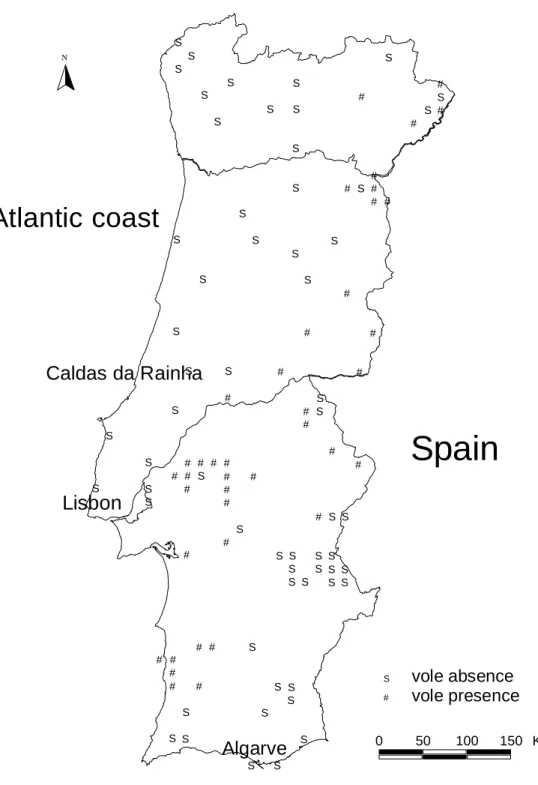
The main aim of this study was to update the distribution of the Cabrera vole (Microtus cabrerae) in Portugal in order to determine regions of suitable environmental conditions and to assess potential occurrence areas, as a first step towards a conservation strategy for the species. Data on the distribution of the species was derived from Barn owl pellet samples. Climatic, topographic and soil descriptors were selected and logistic regression was used to model the species distribution. The effort in data collection resulted in the enlargement of the previously known distribution of Microtus cabrerae. Two logistic models were developed, one environmental and one autologistic, integrating variation due spatial autocorrelation. Results showed that the species is more likely to occur over the most central region of Portugal, extending its range to the north-eastern side and to the southwest. The preferred areas of occurrence are characterized by medium rainfall values (between 600 and 1200 mm), low to medium humidity values (lower than 85 %) and acid to neutral soils (pH between 3 and 7). Species probability of occurrence is discussed in terms of paleontological data and geographical barriers. Potential distribution maps suggest a fragmentation of the overall national population and allowed the identification of three major areas of high probability of occurrence: northeast, centre and southwest. As most of these areas are outside Classified Areas Network, models obtained may be regarded as valuable tools in conservation planning.
Key-words: Microtus cabrerae, conservation, distribution, logistic regression models,
26 | P a g e
Zusammenfassung
Determinierende Umweltparameter für die Ausbreitung der Cabreramaus (Microtus
Cabrerae): Implikationen für seine Erhaltung.
Hauptziel dieser Studie war es, die Ausbreitung der Cabreramaus (Microtus cabrerae) in Portugal zu aktualisieren, um Gebiete mit fördernden Umweltbedingungen und Flächen mit Vorkommenspotential zu bestimmen, als einen ersten Schritt in einer Strategie zur Erhaltung der Spezies. Die Daten über die Ausbreitung der Spezies erhielten wir über Gewölleproben von Turmeulen. Es wurden Merkmale ausgewählt, bezogen auf Klima, Topografie und Boden und eine logistische Regression angewandt, um die Ausbreitung der Spezies zu modellieren. Die Anstrengung bei der Datensammlung ergab sich aus der Erweiterung des ehemals angenommenen Ausbreitungsgebietes. Man entwickelte zwei logistische Modelle, das eine autologistisch, das andere ohne räumliche Autokorrelation. Die Ergebnisse zeigen, die Spezies kommt bevorzugt im mehr zentralen Gebiet Portugals vor, sich nach Nordosten und Südwesten ausbreitend. Die bevorzugten Vorkommensgebiete zeigen niedrige Niederschlagswerte (zwischen 600 und 1200mm), mittlere bis niedrige relative Feuchtigkeit übers Jahr (unter 85%) und saurer bis neutraler Boden (pH zwischen 3 und 7). Die ermittelten Wahrscheinlichkeitswerte für das Vorkommen der Spezies werden in ihrem Bezug zu paläontologischen Daten und geographischen Barrieren diskutiert. Die Karten über die potenzielle Verbreitung legen eine Fragmentierung der globalen nationalen Population nahe und erlauben die Kennzeichnung von drei Hauptgebieten mit einer Wahrscheinlichkeit von hohem Vorkommen: Nordosten, Zentrum und Südwesten. Da die Mehrheit dieser Flächen sich außerhalb der Grenzen des Klassifizierten Flächennetzes befindet, können die erhaltenen Modelle als wertvolles Werkzeug bei der Entwicklung von Erhaltungsplänen angesehen werden.