F
ACULDADE DEE
NGENHARIA DAU
NIVERSIDADE DOP
ORTOData Modeling with NoSQL:
How, When and Why
Carlos André Reis Fernandes Oliveira da Silva
Master in Informatics and Computing Engineering Supervisor: João Correia Lopes (Ph.D.)
Data Modeling with NoSQL:
How, When and Why
Carlos André Reis Fernandes Oliveira da Silva
Master in Informatics and Computing Engineering
Approved in oral examination by the committee:
Chair: Maria Eduarda Silva Mendes Rodrigues (Ph.D.) External Examiner: Rui Carlos Mendes Oliveira (Ph.D.) Supervisor: João António Correia Lopes (Ph.D.)
Abstract
As the Web continues to grow in size, more and more services are being created that require data persistence. The amount of data that these services need to archive is growing at an exponential rate and so is the amount of accesses that these services have to serve. Additionally, the relation-ships between data are also increasing. In the past, problems involving data persistence have been consistently solved by relying on relational databases. Still, the requirements of these new services and the needs for scalability have led to a depletion of relational database technologies.
New approaches to deal with these problems have been developed and the NoSQL movement was formed. This movement fosters the creation of new non-relational databases, specialized for different problem domains, with the intent of using the “right tool for the job”. Besides being non-relational, these databases also have other characteristics in common such as: being distributed, trading consistency for availability, providing easy ways to scale horizontally, etc.
As new technologies flourish, there is a perceived knowledge impedance that stems from the paradigm shift introduced by these technologies, which doesn’t allow developers to leverage the existing mass of knowledge associated with the traditional relational approach.
This work aims to fill this knowledge gap by studying the available non-relational databases in order to develop a systematic approach for solving problems of data persistence using these technologies.
The state of the art of non-relational databases was researched and several NoSQL databases were categorized regarding their: consistency, data model, replication and querying capabilities.
A benchmarking framework was introduced in order to address the performance of NoSQL databases as well as their scalability and elasticity properties. A core set of benchmarks was defined and results are reported for three widely used systems: Cassandra, Riak and a simple sharded MySQL implementation which serves as a baseline.
Data modeling with NoSQL was further researched and this study provides a simple method-ology for modeling data in a non-relational database, as well as a set of common design patterns. This study was mainly focused on both Cassandra and Riak.
Additionally, two prototypes using both Riak and Cassandra were implemented, which model a small chunk of a telecommunications operator’s business. These prototypes relied on the method-ology and design patterns described earlier and were used as a proof of concept. Their performance was put to test by benchmarking a set of common (and usually expensive) operations against a tra-ditional relational implementation.
Both Cassandra and Riak were able to yield good results when compared to the relational implementation used as a baseline. They also proved to be easily scalable and elastic. Cassandra, specifically, achieved significantly better results for write operations than the other systems. The developed design patterns proved themselves useful when implementing the prototypes and it is expected that given this work it will be easier to adopt a NoSQL database.
Acknowledgements
I would like to thank everyone who somehow contributed for the success of this work.
I would like to thank my supervisor, Prof. João Correia Lopes, for the constant help and support.
To everyone at PT Inovação for giving me the opportunity to tackle this challenge. Especially José Bonnet and Miguel Coutinho who supervised my work and guided me in the right direction. To my friends from FEUP, for their companionship, support and all the great moments over the past five years. Particularly, I’d like to thank Nuno Cardoso for going out of his way, providing me with the necessary resources to successfully reach all the goals of this thesis.
To my family, for their constant support, understanding and inspiration.
Last but not least to Sofia for always being by my side, supporting me every step of the way.
“Against boredom even gods struggle in vain.”
Contents
1 Introduction 1
1.1 Context and Motivation . . . 1
1.2 Objectives . . . 2 1.3 Expected Results . . . 2 1.4 Report Overview . . . 3 2 Background Concepts 5 2.1 CAP Theorem . . . 5 2.1.1 Consistency . . . 5 2.1.2 Availability . . . 6 2.1.3 Partition Tolerance . . . 6 2.2 ACID vs. BASE . . . 6 2.2.1 ACID . . . 6 2.2.2 BASE . . . 8 2.2.3 Eventual Consistency . . . 8
2.3 Multiversion Concurrency Control . . . 9
2.4 MapReduce . . . 10 2.4.1 Example . . . 11 2.4.2 Relationship to NoSQL . . . 11 2.5 Hinted Handoff . . . 12 3 Technologies 13 3.1 CouchDB . . . 13 3.1.1 Data Model . . . 13 3.1.2 Query Model . . . 15 3.1.3 Replication Model . . . 15 3.1.4 Consistency Model . . . 15 3.1.5 Usage at CERN . . . 15 3.2 MongoDB . . . 16 3.2.1 Data Model . . . 16 3.2.2 Query Model . . . 17 3.2.3 Replication Model . . . 17 3.2.4 Consistency Model . . . 18 3.3 Cassandra . . . 18 3.3.1 Data Model . . . 18 3.3.2 Query Model . . . 20 3.3.3 Replication Model . . . 21 3.3.4 Consistency Model . . . 21
CONTENTS 3.3.5 Usage at Facebook . . . 22 3.4 Riak . . . 23 3.4.1 Data Model . . . 23 3.4.2 Query Model . . . 24 3.4.3 Replication Model . . . 24 3.4.4 Consistency Model . . . 24 3.5 HBase . . . 25 3.5.1 Data Model . . . 25 3.5.2 Query Model . . . 26 3.5.3 Replication Model . . . 26 3.5.4 Consistency Model . . . 27 3.5.5 Usage at Google . . . 27 3.6 CAP Properties . . . 27 3.7 Conclusions . . . 28 4 Benchmarking 31 4.1 Methodology . . . 31 4.1.1 Tiers . . . 31 4.2 Scenarios . . . 32 4.3 Quantum Bench . . . 33 4.3.1 Architecture . . . 34 4.4 Results . . . 35 4.4.1 Setup . . . 35 4.4.2 Raw Performance . . . 36 4.4.3 Scalability . . . 38 4.4.4 Elasticity . . . 40 4.5 Conclusions . . . 41 5 Data Modeling 43 5.1 Methodology . . . 43 5.2 Design Patterns . . . 44 5.2.1 Generic . . . 44 5.2.2 Riak . . . 48 5.2.3 Cassandra . . . 49
5.3 Dealing with Inconsistency . . . 51
6 Case Study 53 6.1 Problem Description . . . 53 6.2 Implementation . . . 55 6.2.1 Riak . . . 55 6.2.2 Cassandra . . . 57 6.3 Analysis . . . 59 6.3.1 Benchmarking . . . 59 6.4 Conclusions . . . 67
7 Conclusions and Future Work 69 7.1 Conclusions . . . 69
CONTENTS
List of Figures
2.1 MapReduce job representation . . . 10
3.1 Illustration of master-slave replication and replica sets . . . 18
3.2 Cassandra column . . . 19
3.3 Cassandra super column . . . 19
3.4 Cassandra column family . . . 19
3.5 Cassandra super column family . . . 20
3.6 Cassandra’s replication example between different datacenters . . . 21
3.7 Example of data replication with a replication factor of 3 . . . 25
3.8 Representation of HBase’s data model . . . 26
3.9 Classification of databases according to CAP theorem . . . 28
4.1 Quantum bench architecture . . . 34
4.2 Update heavy workload results . . . 37
4.3 Read heavy workload results . . . 38
4.4 Scalability benchmark results . . . 39
4.5 Elasticity benchmark results . . . 40
6.1 Simplified telecommunications operator data model . . . 54
6.2 Riak’s data model . . . 55
6.3 Cassandra’s data model . . . 58
6.4 Customer benchmarking results . . . 61
6.5 Child accounts benchmarking results . . . 62
6.6 "Grandchild" accounts benchmarking results . . . 63
6.7 "Grand-grandchild" accounts benchmarking results . . . 64
6.8 Direct buckets benchmarking results . . . 65
List of Tables
Abbreviations
ACID Atomicity, Consistency, Isolation, Durability
API Application Programming Interface
BASE Basically Available, Soft-state, Eventual consistency
BSON Binary JSON
CRUD Create, Read, Update and Delete
DBMS Database Management System
HTTP Hypertext Transfer Protocol
JSON JavaScript Object Notation
JVM Java Virtual Machine
MVCC Multiversion Concurrency Control
ORM Object-Relational Mapping
RAID Redundant Array of Independent Disks
RDBMS Relational Database Management System
REST Representational State Transfer
SMS Short Message Service
SQL Structured Query Language
URL Uniform Resource Locator
UUID Universally unique identifier
Chapter 1
Introduction
This chapter briefly presents the work’s context, purpose and scope. It covers the motivation behind it and its objectives.
1.1
Context and Motivation
With the continuous growth of the Web and an increasing reliance on the services it provides, the amount of data to archive and preserve is growing at an exponential rate. Along with the increas-ing size of the datasets, as the adoption of these services increases so does the number of accesses and operations performed. This growth, enhanced by the proliferation of social networks, led to a depletion of traditional relational databases that were commonly used to solve a wide range
of problems [Lea10]. We have been witnessing a sharp growth of a set of solutions that despite
differing from traditional techniques of data persistence, allow systems to cooperate with the ex-panded volume and flow of data efficiently. These solutions are based mainly in the expansion of the existing infrastructures with non-relational database systems, with the main motto being scalability.
The NoSQL movement began in early 2009 and has been growing rapidly [Edl11]. This
movement represents a new generation of non-relational databases that share some characteristics such as: focus on the distribution of the system, scalability (mainly horizontal), non-relational schema-free representation of data, etc. Most of these new databases offer a more limited range of properties than the current RDBMS systems, relaxing consistency constraints and often not supporting full ACID properties. This relative reduction of capabilities gives the system a boost in performance, while at the same time facilitating its distribution. Still, it should be interpreted as a trade-off, which is often justified.
The name NoSQL suggests that these databases do not support the SQL query language. How-ever, it does not address their main characteristic which is the fact that they are non-relational [Edl11].
Introduction
The name should be interpreted as “not only sql”, which suggests a change in mentality of the cur-rently employed strategies that one type of database is useful to solve all sorts of problems.
“The last 25 years of commercial DBMS development can be summed up in a single phrase: “One size fits all”.” [SC05]
Thus, this movement fosters the creation of different types of databases, each with a specific set of characteristics and applicable to different problem domains.
The potential and utility of these new technologies that are under constant development and growth is unquestionable. However, after so many years modeling data using a relational approach, implementing business rules around these concepts and optimizing the outcome, a radical change of paradigm doesn’t allow us to leverage the existing mass of knowledge. The potential adoption of a non-relational system is severely hampered by a lack of knowledge and expertise.
The lack of knowledge and potential benefits acquired by using a NoSQL database are there-fore the main motivation for this work.
1.2
Objectives
The main objective of this work is to study the available systems of non-relational databases in order to obtain a more specific knowledge about the broad range of existing technologies.
During the first phase of this project various non-relational databases will be analyzed such as: key-value stores, document-oriented databases and column-oriented databases. Several capabili-ties will be discussed including consistency, data model, replication and querying.
A few selected databases will be further analyzed and put to test by benchmarking and cat-egorizing their performance for both read and write operations, as well as their scalability and elasticity capabilities. To that extent, a framework will be developed in order to assist the creation and execution of these benchmarks.
Additionally, some prototypes will be developed making use of NoSQL technologies, to be used as a proof of concept. These prototypes will be created in the context of “PT Inovação”’s business and they will be applied to the telecommunications domain, where currently relational databases are used.
Furthermore, using these prototypes it will be possible to draw comparisons with the tradi-tional solutions of relatradi-tional databases, thus providing the possibility of a quantitative analysis of the system’s performance (benchmarking) as well as a qualitative analysis (e.g. system distribution capabilities).
1.3
Expected Results
With this project it is expected that the knowledge acquired and developed can contribute to the development of a systematic approach for solving problems of data persistence with an alternative non-relational database.
Introduction
After an overview of the current state of non-relational databases, it is expected that the factors that may lead to choosing one or another type of database become clear, thus facilitating the adoption of these new technologies.
The careful examination of NoSQL databases and their application is expected to create a common set of design patterns that may be reused when modeling data and designing a database. It is also expected that the adoption of these technologies on “PT Inovação”’s use cases leads to an improved system, paving the way to solve existing performance problems.
1.4
Report Overview
The rest of this report is structured as follows.
Chapters2and3describe the state of the art regarding, respectively, the theoretical background and technologies in the field of non-relational databases.
Chapter4presents the performed benchmark measurements, providing a clear interpretation of
the results obtained as well as the methodology used. It also details the developed benchmarking framework.
Chapter5describes the acquired knowledge regarding data modeling with NoSQL databases,
by exposing a simple methodology to tackle problems as well as common design patterns.
Chapter6introduces the domain problem that the developed prototypes will try to address in
the context of the company “PT Inovação”. Furthermore, it explores the two developed prototypes as well as presenting a detailed performance analysis.
Chapter 7finishes this document by providing some conclusions about the research carried
Chapter 2
Background Concepts
This chapter describes the state of the art regarding the field of non-relational databases. It re-views the theoretical background and recent breakthroughs, detailing background knowledge that is integrated into the technologies, which is required in order to fully understand the domain of non-relation databases.
2.1
CAP Theorem
The CAP theorem (also known as Brewer’s theorem), is a theorem on distributed systems which states that of the following desired properties in a distributed system: Consistency, Availability and Partition-tolerance; it is impossible to achieve all of the three properties at the same time. Therefore, at most only two of these properties can be satisfied [Bre00].
The theorem was introduced in 2000 at the Symposium on Principles of Distributed
Comput-ing by computer scientist Eric Brewer as a conjecture [Bre00] and was formally proved in 2002
by Seth Gilbert and Nancy Lynch, therefore establishing it as a theorem [GL02].
The CAP theorem has implications on the design of distributed systems and must be taken into account. Since most NoSQL databases are distributed systems it plays an important role on this field. In the context of NoSQL, it is important to understand the different properties of the CAP theorem, as different databases seem to satisfy different properties.
2.1.1 Consistency
In the context of distributed systems, consistency means that all the nodes of the system see the
same data at the same time [GL02]. Therefore, the system guarantees that once you store a given
state, the system will report that same state in every subsequent operation (on every node of the system), until it is explicitly changed. Full consistency is easier to achieve in a non-distributed environment and it is usually supported by most of the RDBMS that comply with ACID (discussed later). On the other hand, it is a lot harder to achieve in a distributed environment, and sometimes
Background Concepts
it may not even be desirable, since the overall performance of the system may drop as the number of nodes increases. It is necessary to resort to network communication between nodes to make sure they all share the same data. Most often, distributed systems may provide a form of weak consistency which will be discussed later on this chapter.
2.1.2 Availability
Availability means that the system is ensured to remain operational over a period of time (it is therefore a probabilistic metric). In this context, it represents a system on which node failures do
not prevent survivors from continuing to operate [GL02]. One of the main reasons to distribute a
system is to provide high availability, as more nodes are part of the system and share some data, the system becomes more tolerant to particular node failures. A centralized system cannot provide high availability given that if the only node of the system fails, the system is no longer able to operate.
2.1.3 Partition Tolerance
Partition Tolerance implies that a system must continue to operate despite arbitrary message loss
between the different nodes of the distributed system [GL02].
The constituent nodes of a distributed system are required to communicate with each other, sharing data and state to ensure the system is operational and provides some form of consistency. In the presence of a network failure, some of the nodes of the system may no longer be able to communicate and the system becomes partitioned. If the system is partition tolerant then it must be able to perform as usual, despite the temporary partition.
In the case of a distributed database if it is partition tolerant then it will still be able to perform read/write operations while partitioned. If it is not partition tolerant, when partitioned, the database may become completely unusable or only available for read operations.
2.2
ACID vs. BASE
Distributed systems, and databases in particular, usually offer a defined consistency model. These models guarantee that if certain conditions are met we can expect different properties to be assured (i.e. consistency, availability, partition tolerance).
In this section, the popular ACID set of properties that guarantee database transactions are processed reliably, is compared to the opposing BASE model, which is derived directly from the CAP theorem, but aims to provide a different set of properties than ACID does.
2.2.1 ACID
Traditionally, relational databases are able to provide and comply with the ACID properties, which is a set of properties that guarantee database transactions are processed reliably and that the
Background Concepts
database is consistent in the face of concurrent accesses and system failure. ACID is an acronym
which means the following: Atomicity, Consistency, Isolation and Durability [HR83].
Atomicity Atomicity means that database transactions must follow an “all or nothing” rule.
Given that a transaction is a series of instructions to be executed (as one), for the transaction to be “atomic”, all the instructions must be executed, or if one (or more) fail, the entire transaction should fail, and the database should remain unchanged.
Consistency Consistency ensures only valid data is written to the database, guaranteeing that
if a transaction is executed successfully the database is taken from a consistent state to a new consistent state. If for any reason, an error occurs during the transaction, then any changes already made will be automatically rolled back, therefore ensuring that the database remains in a consistent state.
Isolation Isolation requires that a transaction in process and not yet committed must remain
isolated from any other transaction, therefore the execution of a transaction must not impact the execution of other concurrent transactions. Isolation is important because, as transactions are being executed, the state of the system may not be consistent, since transactions only ensure that the system remains consistent after the transaction ends. If a transaction was not running in isolation, it would be able to access data from the system that may not be consistent.
Durability Durability ensures that any transaction committed to the database is permanent and
will not be lost. The database system must be able to recover the committed transaction updates against any kind of system failure (hardware or software). Many databases implement durability by writing transactions into a transaction log that can be reprocessed to recreate the system state right before any later failure. A transaction is deemed committed only after it is entered in the log.
The ACID model provides the consistency choice for partitioned databases, it is pessimistic and forces consistency at the end of every operation. This strong consistency may not always be necessary, depending on the requirements of the problem domain. It is also very difficult to im-plement in a distributed system without creating bottlenecks. For example, the two-phase commit protocol is able to provide atomicity for distributed transactions [ML85], still it is a blocking pro-tocol, a node will block while it is waiting for a message. It also creates overhead as it involves a great deal of communication.
Also, if we take into account the CAP theorem, if we are getting strict consistency we may be jeopardizing either availability or partition tolerance. If we use a two-phase commit protocol we are able to provide consistency across partitions, therefore losing availability [Pri08]. As different applications may have different consistency (and availability) needs, NoSQL databases tend to provide alternative consistency models.
Background Concepts
2.2.2 BASE
BASE, as its name suggests, is the logical opposite of ACID [Bro09]. While ACID focuses more
on strong consistency by being pessimistic, BASE takes availability as it’s primary objective, it is optimistic and provides eventual consistency. BASE is an acronym standing for Basically
Available, Soft-state, Eventual consistency [Bre00]. It is intrinsically connected with the CAP
theorem and it was also proposed by Eric Brewer in 2000 at the Symposium on Principles of
Distributed Computing [Bre00].
2.2.3 Eventual Consistency
Eventual Consistency is a specific form of weak consistency [Vog09]. A distributed system that
provides eventual consistency guarantees that given that no new updates are made to a record, eventually the system will be consistent (i.e. all the nodes of the system will “eventually” hold the same values, although that may not be necessary for example when using quorums), and all read accesses will return the latest updated value. The period between the update and the moment that it is guaranteed that the system is consistent is called the inconsistency window. The maximum size of this inconsistency window can be determined based on a number of factors such as, system load and number of replicas. There are different variations on the eventual consistency model that
we might consider [Vog09].
Causal consistency If a certain process communicates to another process that it has updated a
value, a subsequent access by that process will return the updated value, and a write is guaranteed to supersede the earlier write. Access by another distinct process that has no causal relationship to the originator process is subject to the normal eventual consistency rules.
Read Your Writes consistency The effect of a write operation by a process on a variable is
always seen in a subsequent read operation of the same variable by the same process.
Session consistency A variation of read your writes, which assures that a process is able to read
it’s own writes during a specific session. Out of the context of that session the same process might see older values.
Monotonic reads If a process reads the value of a variable, any subsequent reading of that
variable by the same process should return the same value or a more up-to-date value.
Monotonic writes A write operation of a variable by a process completes before the following
write operation of the same variable by the same process. The system guarantees to serialize writes performed by the same process.
Background Concepts
Taking into account the CAP theorem, eventual consistency plays an important role on NoSQL databases because it gives the database the ability to relax consistency, effectively trading it for availability (or partition tolerance) [Vog09].
2.3
Multiversion Concurrency Control
Multi-version concurrency control (MVCC) is a concurrency control mechanism that enables con-current access to a certain resource (e.g. a database). It was first described in a 1978 dissertation
by David Reed [Ree78] and since then it has been implemented widely on relational databases,
such as, PostgreSQL [Pos11], MySQL [Ora11] and also on some NoSQL databases, such as,
CouchDB [ALS10].
Multi-version concurrency control is an alternative to locking and it is able to provide efficient parallel access to data avoiding the possibility of data corruption and deadlocks. Locking works by giving exclusive access to a certain record to a requesting process. Until that process releases the lock, any other processes trying to access that record (even for reading) have to wait. This model effectively serializes the requests and grants exclusive access to requesting parties. It can be seen as a pessimistic stance on concurrency.
In MVCC instead of granting exclusive access to a resource, the resources are versioned, and whenever processes request access they are given a copy of the latest version available. This way, processes are able to read data in parallel, even if another process is writing to this resource. Therefore, MVCC takes a more optimistic stance on concurrency.
To achieve consistency, each data item has attached to it a timestamp (or a revision number). Whenever a process reads a resource, it retrieves its value as well as this timestamp. If that same process wants to update this record, whenever it tries to write to the database the new value is sent as well as the original timestamp. If the latest revision’s timestamp is the same, then this new value is written and the timestamp is updated, effectively creating a modified copy of the original data. If the timestamp is not the same, then it means that another process already updated the record in the meantime, which means that our changes were not made on the latest version, generating a conflict.
The database may deal with this conflict by requesting the conflicting client to re-read the record (with the new value) and redo the update operation. Some databases might instead store all the conflicting revisions of a certain record and let the client solve the conflict by himself [ALS10]. The client might then chose one version, or merge both.
On some database systems (e.g. CouchDB) MVCC also allows to perform disk access opti-mizations. Since updates mean that a new copy of the data item is completely recreated it allows to
write entire data items onto contiguous sections of a disk [ALS10]. Although this technique offers
some advantages over locking, it comes with the drawback of having to store multiple versions of data items, therefore increasing the database’s size.
Background Concepts
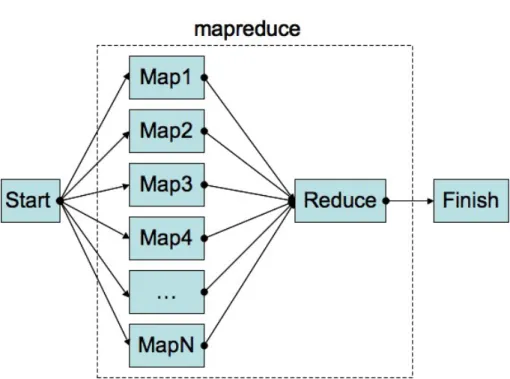
Figure 2.1: MapReduce job representation
2.4
MapReduce
MapReduce is a programming model and an associated implementation for processing and
gener-ating large data sets. It was developed by Google to support their indexing system [DG08].
Given a big data set, it may be necessary to process it and perform certain operations on it. The data set may be big enough that computing power of a single machine may not suffice and it may be necessary to distribute the task across several machines. By using the MapReduce frame-work a developer is able to write applications that are automatically distributed across multiple computers without him having to deal with issues such as parallelization, synchronization and
distribution [DG08]. As the name implies, MapReduce is a two-step process: map and reduce.
“Map” step The master node takes the input, chops it up into smaller sub-problems, and
dis-tributes those to worker nodes. A worker node may do this again in turn, leading to a multi-level tree structure. The worker node processes that smaller problem, and passes the answer back to its master node.
“Reduce” step The master node then takes the answers to all the sub-problems and combines
them in some way to get the output – the answer to the problem it was originally trying to solve.
In Figure2.1[Cle07] a representation of the MapReduce phases and work distribution is
pre-sented. To be able to use the MapReduce framework, a user must simply provide the appropriate map and reduce functions that are to be used in each of these steps. The map function takes an input
Background Concepts
1 map(String key, String value):
2 // key: document name
3 // value: document contents
4 for each word w in value:
5 EmitIntermediate(w, "1");
6
7 reduce(String key, Iterator values):
8 // key: a word
9 // values: a list of counts
10 int result = 0;
11 for each v in values:
12 result += ParseInt(v);
13
14 Emit(AsString(result))
Listing 2.1: Example map and reduce functions for word counting
pair and produces a set of intermediate key/value pairs. The reduce function accepts an intermedi-ate key and a set of values for that key. It merges together these values to form a possibly smaller
set of values, typically just zero or one output value is produced per reduce invocation [DG08].
2.4.1 Example
The MapReduce paper published by Google presents a simple example on the usage of the
MapRe-duce framework that helps understanding the key concepts [DG08].
Considering we want to count the number of occurrences of each word in a very large set of documents, it may be useful to rely on the MapReduce technique to distribute the task. To do so, we must specify map and reduce functions.
The map function emits a key/value pair for each word found in a certain document. The key represents the word and the value represents the number of occurrences (1 in this case).
The reduce function sums together all counts (value) emitted for a particular word (key) and emits the final result.
Pseudo-code for this example is presented in Listing2.1.
2.4.2 Relationship to NoSQL
Although MapReduce was first implemented, as proprietary software, by Google, there are now
free implementations like Apache Hadoop [Bor07]. It is also widely available and used in many
NoSQL databases.
As NoSQL databases tend to be distributed and usually deal with very large data sets, batch processing of data and aggregation operations (SQL’s COUNT, SUM, etc.) are usually imple-mented as MapReduce operations, so as to be able to evenly distribute the work across the system, while providing an easy framework for the developer to deal with.
Background Concepts
2.5
Hinted Handoff
Hinted handoff is a mechanism developed by Amazon to use on Dynamo, their highly-available
key-value store [DHJ+07]. This mechanism attempts to increase system availability in the case of
node failures. Let us consider the following scenario: a write request is sent to the database, but the node responsible to perform the write operation (i.e. the owner of that record) is not available, either due to a network partition or system failure. In order to allow the write operation to be successful, it is redirected to another node where a hint is attached, i.e. this node records the operation but notes (hints) that it is not the owner of that record and therefore should replay the operation on the node that owns that record when it comes back online.
By using hinted handoff, the database ensures that the read and write operations are not failed due to temporary node or network failures.
Chapter 3
Technologies
The number of available non-relational databases is relatively large and is constantly increasing. In this chapter some of the available NoSQL technologies are presented. These databases were chosen based on their maturity, relevance and applicability to the case study that will be developed as part of this project.
For each database their data model, query model, replication model and consistency model is analyzed.
Additionally, for some of the databases a case study is presented detailing the related worked performed with such databases. The presented case studies are fairly brief and do not go into much detail mainly because there is a lack of information to support them.
3.1
CouchDB
Apache CouchDB is a free and open-source document-oriented database [Fou11d]. It is a top-level
project of the Apache Foundation and it is written in Erlang, a programming language aimed at concurrent and distributed applications. It complies with the ACID properties, providing serialized
updates and with the use of MVCC reads are never locked [Fou11c].
It is distributed in nature and supports various types of replication schemes and conflict reso-lution.
3.1.1 Data Model
CouchDB stores data in semi-structured documents. A document is a JSON file which is a collec-tion of named key-value pairs. Values can either be numbers, string, booleans, lists or diccollec-tionaries. The documents are completely schema-free and do not have to follow any structure (except for JSON’s inherent structure).
An example document is shown in Listing3.1, this document models the information
Technologies 1 { 2 "_id":"282e1890a8095bcc0cb1318bed85bcb377e2700f", 3 "_rev":"946B7D1C", 4 "Type":"Book" 5 "Title":"Flatland", 6 "Author":"Edwin A. Abbot", 7 "Date":"2009-10-09", 8 "Language":"English", 9 "ISBN":"1449548660",
10 "Tags":["flatland", "mathematics", "geometry"],
11 }
Listing 3.1: Example of a CouchDB document
“_id” field). CouchDB is a simple container of a collection of documents and it does not establish
any mandatory relationship between them [ALS10].
Views Although CouchDB does not enforce any kind of relationship between documents it is
usually desirable to have some kind of structure on how the documents are organized. To do so, CouchDB provides a view model.
Views are methods to aggregate and report existing documents on the database. They do not affect the underlying existing data on the base, they simply change the way data is represented, and define the application’s design.
To define a view the user must provide a JavaScript function that acts as the “map” function of a MapReduce operation. This function takes a document as argument and it is able to manipulate the document’s data in any way desired. The resulting view is a document that might have multiple rows. Let’s imagine the case were we have a document collection of books (similar in structure
to the one presented in Listing3.1). We might be interested in getting the title of all the books
currently stored in the database, to do so we create the corresponding “map” function to be used in a view, as seen in Listing3.2.
Views can also have a “reduce” function, which is used to produce aggregate results for a given view [Fou11g].
As views can be computationally complex to generate, CouchDB provides the facility to index views. Instead of constantly recreating views from scratch, CouchDB indexes views and updates
1 function(doc) {
2 if (doc.Type == "Book") {
3 emit(null, {Title: doc.Title};
4 }
5 }
Technologies
them incrementally as the databases’ data changes.
3.1.2 Query Model
CouchDB exposes a RESTful HTTP API to perform basic CRUD operations on all stored items and it uses the HTTP methods POST, GET, PUT and DELETE to do so. More complex queries can be implemented in the form of views (as was seen before) and the result of these views can
also be read using the REST API [ALS10].
3.1.3 Replication Model
CouchDB is a peer-based distributed database system [Fou11b], it allows peers to update and
change data and then bi-directionally synchronize the changes. Therefore, we can model ei-ther master-slave setups (were synchronizations are unidirectional) or master-master setups were changes can happen in either of the nodes and they must be synchronized in a bidirectional way. In order to do so, CouchDB employs optimistic replication, and it has the ability to handle conflicts, that might happen when replicating changes.
For conflict handling, CouchDB relies on the MVCC model. Each document is assigned a revision id and every time a document is updated, the old version is kept and the updated version is given a different revision id. Whenever a conflict is detected, the winning version is saved as the most recent version and the losing version is also saved in the document’s history. This is done consistently throughout all the nodes so that the exact same choices are made. The application can
then chose to handle the conflict by itself (ignoring one version or merging the changes) [ALS10].
3.1.4 Consistency Model
CouchDB provides eventual consistency. As multiple masters are allowed, changes need to be propagated to the remaining nodes, and the database does not lock on writes. Therefore, until the changes are propagated from node to node the database remains in a inconsistent state. Still, single master setups (with multiple slaves) are also supported, and in this case strong consistency can be
achieved [ALS10].
3.1.5 Usage at CERN
The European Organization for Nuclear Research (CERN), makes use of CouchDB in order to collect the data captured by the Compact Muon Solenoid (CMS), a general purpose detector that
is part of the Large Hadron Collider (LHC) [Cou11].
The data generated must be collected for offline processing and that involves cataloguing data and transferring it across different computing centers for distributed computing. When the LHC is running at it’s full power, the CMS alone will collect roughly 10PB of data per year.
Technologies
Being able to easily access and consolidate data from distributed locations with minimal la-tency is required routinely, and was one of the main reasons CouchDB was chosen, for it’s ability to perform on a distributed environment with a multi-master setup.
Another reason for its use was the ability to quickly prototype and adapt the system. The team often doesn’t have clearly defined requirements and needs to quickly create a new part of the system and deploy it right away. With CouchDB being schema-free and not enforcing any kind of relationship between data, it is a perfect fit to achieve a higher speed of development.
3.2
MongoDB
MongoDB (from “humongous”) is a free and open-source document-oriented database written in
C++ [10g11d]. Aside from the open-source community, the development is also supported by the
company 10gen.
It is completely schema-free and manages JSON-style documents, as in CouchDB. It focuses on high-performance and agile development, providing the developer with a set of features to easily model and query data, as well as to scale the system.
3.2.1 Data Model
MongoDB stores data as BSON objects, which is a binary-encoded serialization of JSON-like documents. It supports all the data types that are part of JSON but also defines new data types, i.e.
the Date data type and the BinData type [BSO11]. The key advantage of using BSON is efficiency
(both in space and compute time), as it is a binary format [10g09].
Documents are contained in “collections”, they can be seen as an equivalent to relational
database tables [10g11b]. Collections can contain any kind of document, no relationship is
en-forced, still documents within a collection usually have the same structure as it provides a logical way to organize data.
As data within a collections is usually contiguous on disk, if collections are smaller better
performance is achieved [10g11h].
Each document is identified by a unique ID (“_id” field), which can be given by the user upon
document creating or automatically generated by the database [10g11e]. An index is
automati-cally created on the ID field although other indexes can be manually created in order to speed up common queries.
Relationships can be modeled in two different ways embedding documents or referencing documents. Embedding documents means that a document might contain other data fields related to the document, i.e. a document modeling a blog post would also contain the post’s comments. This option might lead to denormalization of the database, as the same data might be embedded in different documents. Referencing documents can be seen as the relational database equivalent of using a foreign-key. Instead of embedding the whole data, the document might instead store the ID of the foreign document so that it can fetched. It is important to note that MongoDB does not
Technologies
1 db.books.find({’title’: ’Flatland’})
Listing 3.3: Example query for finding all books titled "Flatland"
provide the ability to join documents, therefore when referencing documents, any necessary join has to be done on the client-side [10g11h].
3.2.2 Query Model
MongoDB supports dynamic (ad hoc) queries over all documents inside a collection (including embedded documents). Many traditional SQL queries have a similar counterpart on Mongo’s Query Language. Queries are expressed as JSON objects and are sent to MongoDB by the database driver (typically using the “find” method) [10g11i].
In Listing3.3, we see a simple example were we query the database for all the books with the
title ‘Flatland’. In addition to exact matching fields, MongoDB also supports regular expressions,
comparators, conditional operators and logical operators [10g11a].
Sorting and counting features are also provided as can be seen in Listing3.4, the first query
retrieves all the books that are written in English sorting them by their title. The second query retrieves the number of books written in English.
More complex queries can be expressed using a MapReduce operation, and it may be useful for batch processing of data and aggregation operations. The user specifies the map and reduce
functions in JavaScript and they are executed on the server side [10g11c]. The results of the
operation are stored in a temporary collection which is automatically removed after the client gets the results. It is also possible for the results to be stored in a permanent collection, so that they are always available.
3.2.3 Replication Model
MongoDB provides Master-Slave replication and Replica sets, where data is asynchronously repli-cated between servers. In either case only one server is used for write operations at a given time,
while read operations can be redirected to slave servers [10g11g].
Replica sets are an extension of the popular Master-Slave replication scheme in order to
pro-vide automatic failover and automatic recovery of member nodes [10g11f]. A replicate set is a
group of servers where at any point in time there is only one master server, but the set is able to
1 db.books.find({’language’: ’English’}).sort({’title’:1})
2 db.books.find({’language’: ’English’}).count()
Technologies
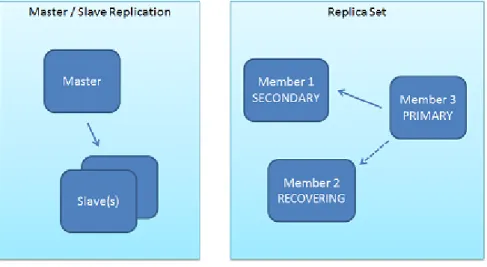
Figure 3.1: Illustration of master-slave replication and replica sets
elect a new master if the current one goes down. Data is replicated among all the servers from the set. Figure3.1[10g11g] illustrates the two different replication models.
3.2.4 Consistency Model
Since MongoDB has only one single active master at any point in time, strong consistency can be
achieved if all the read operations are done on the master [10g11g].
Since replication to the slave servers is done asynchronously and MongoDB does not provide version concurrency control, reads from the slave servers employ eventual consistency semantics. The ability to read from slave servers is usually desired to achieve load balance, therefore the client is also able to enforce that a certain write has replicated to a certain number of slave servers. This feature helps dealing with important writes, where eventual consistency semantics might not be suitable, while at the same time providing the flexibility to read from slave servers.
3.3
Cassandra
Apache Cassandra is a free and open-source distributed, structured key-value store with eventual consistency. It is a top-level project of the Apache Foundation and it was initially developed by
Facebook [Fou11h]. It is designed to handle very large amounts of data, while providing high
availability and scalability.
3.3.1 Data Model
Cassandra follows a key-value model, although the value is an object that is highly structured [LM10]
and that contains multiple dimensions. The various dimensions that form Cassandra’s data model are presented below.
Technologies
Figure 3.2: Cassandra column
Column The column (Figure3.2) is the smallest entity of data, and it is a tuple that contains a
name and a value. A timestamp is also present, that is used for conflict resolution. A column can be interpreted as a record in a relational database.
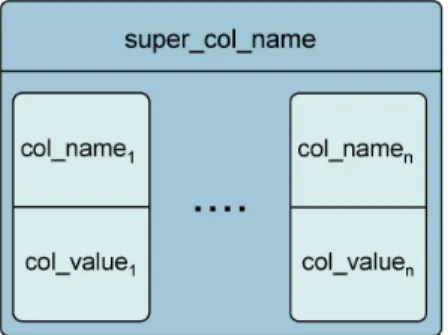
Figure 3.3: Cassandra super column
Super Column A supercolumn (Figure3.3) can be seen as a column that itself has subcolumns.
Similarly to a column, it is a tuple that contains a name and a value, although the value in this case
is a map1containing columns.
Figure 3.4: Cassandra column family
Column Family A column family (Figure3.4) contains an infinite number of rows. Each row
has a key and a map of columns, sorted by their names. It can be interpreted has a table in 1Referring to the data structure. Not to be confused with the map phase from MapReduce.
Technologies
1 insert(table, key, rowMutation)
2 get(table, key, columnName)
3 delete(table, key, columnName)
Listing 3.5: Data access methods of Cassandra
a relational database, although no schema is enforced, a row does not have a predefined list of columns that it contains.
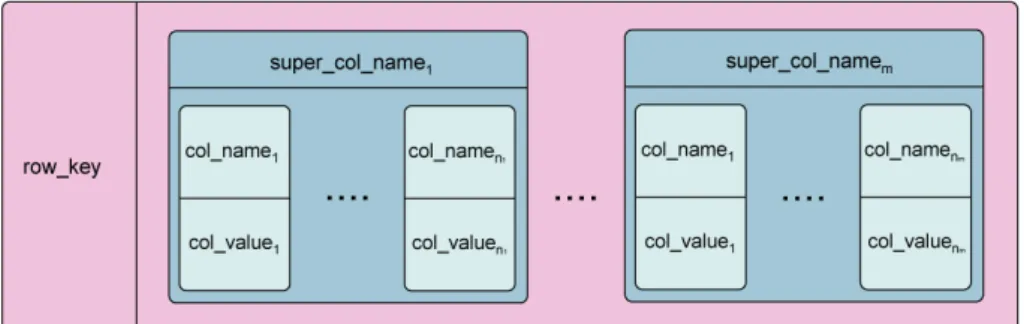
Figure 3.5: Cassandra super column family
Super Column Family Similarly to Column Families, a Super Column Family (Figure3.5) is a
container for Super Columns.
Keyspace A keyspace is a collection of Column Families. It usually groups all the data related
to an application. They can be interpreted as a schema or database in a relational database.
3.3.2 Query Model
Since Cassandra is in essence a key-value store, the querying model provides only three simple operations [LM10], as seen in Listing3.5.
All the accesses are done by key and return the column value associated with that key. Addi-tional methods for getting multiple values or getting multiple columns are also available, but they all rely on the key as input.
Additionally it is also possible to run MapReduce jobs on the database, in order to process
complex queries. This can be done by using Apache Hadoop [Dat11b] which is a framework for
distributed data processing. In order to simplify this task, Cassandra also provides Pig [Fou11i]
support, which enables the user to write complex MapReduce jobs in a high-level language similar to SQL.
It’s important to note that these queries aren’t usually supposed to be answered in real-time, they are mainly used as an off-line method of data analysis.
Technologies
Figure 3.6: Cassandra’s replication example between different datacenters
3.3.3 Replication Model
As Cassandra is distributed in nature, data is partitioned over a set of nodes and each data item is assigned to a specific node.
Data items are assigned a position by hashing the data item’s key, using consistent
hash-ing [KLL+97]. Nodes are also assigned a random value within the hashing’s space, which
rep-resents it’s position on the ring. To find which node is the coordinator for a given data item, it is necessary to go through the ring in a clockwise manner, and find the first node with a position larger than the data item’s position [LM10].
The client is able to specify the number of replicas that each data item should have. The data item’s coordinator node is then responsible for the replication. Several replication policies are available, were the system might be aware of a node’s geographic position (i.e. replicate to other datacenters or to other racks).
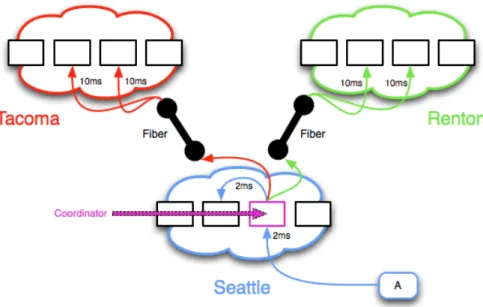
In Figure 3.6 [Ste09], we can see a simple replication example. The value A was written
to the coordinator node, which then replicated the changes to two additional nodes. One of the replication nodes was in the same datacenter, and the other two were on another datacenter. Using this replication model, Cassandra provides durability guarantees in the presence of node failures or network partitions.
3.3.4 Consistency Model
Cassandra uses a configurable quorum-based approach [Gif79]. The client is able to specify
consistency levels per query, which enables it to manage the trade-off of availability vs. con-sistency [Dat11a].
Technologies
The consistency levels for write operations are as follow: • Any – Ensure that the write is done on at least one node;
• One – Ensure that the write has been replicated to at least one node;
• Quorum – Ensure that the write has been replicated to a quorum of replicas;
• Local Quorum – Ensure that the write has been replicated to a quorum of replicas in the same datacenter of the coordinator node;
• Each Quorum – Ensure that the write has been replicated to a quorum of replicas in each datacenter of the cluster;
• All – Ensure that the write has been replicated to all replicas.
The consistency levels for read operations have similar meanings and are as follow: • One – Reads from the closest replica;
• Quorum – Reads the record once a quorum of replicas has reported;
• Local Quorum – Reads the record once a quorum of replicas, in the datacenter of the coordinator node has reported;
• Each Quorum – Reads the record once a quorum of replicas, in each datacenter of the cluster has reported;
• All – Reads the record once all replicas have replied.
Although Cassandra is usually seen as an eventually consistent system, since consistency is highly tunable, the client can opt for strong consistency or eventual consistency.
3.3.5 Usage at Facebook
Facebook2is a social network service and website that allows users to create a personal profile,
add other users as friends and exchange messages. Facebook uses Cassandra to power it’s inbox search feature, providing users with the ability to search through their Facebook inbox. This means that the system is required to handle a very high write throughput, billions of writes per day, and also scale with the number of users. As data is distributed geographically across different data centers it is also necessary to be able to replicate between data centers [LM10].
Cassandra was developed by Facebook to address this problem. To do so, a per user index of all messages that have been exchanged between the sender and the recipients of the message is
Technologies
maintained, where the different terms used in the message are stored to easily and efficiently be able to answer a search query.
This feature was deployed initially to around 100 million users which accounted to roughly 7TB of inbox data. The system is now being used widely, storing about 50TB of data on a 150 node cluster, providing high performance and scalability.
3.4
Riak
Riak is a free and open-source distributed key-value store inspired by Amazon’s Dynamo,
imple-menting the principles detailed in Dynamos’s paper [DHJ+07]. Besides the open-source
commu-nity its development is also overseen by the company Basho [BT11a].
It is primarily written in Erlang and C. It is a fault-tolerant with no single point of failure, sup-porting high availability and providing tunable levels of guarantees for durability and consistency.
An enterprise version [BT11b] with added features is also available although it will not be
discussed in this document.
3.4.1 Data Model
In Riak data is organized in a simple manner consisting of Buckets, Keys and Values (also referred to as Objects) [BT11c].
Values hold the data to be stored and they can store any kind of data as required by the user wether it be binary data, simple textual data, or a structured document like a JSON object. Values are identified and accessed by a unique key and each key-value pair is stored in a bucket.
It is important to take into account that Riak is content-agnostic, therefore it does not differ-entiate if the value is either a JSON document or a simple string. Therefore, if we, for example, model an object using a JSON document it is impossible to only fetch one of the attributes (sim-ilarly to fetching a column value on a relational database) as Riak doesn’t know how to interpret JSON documents.
A bucket is a namespace and provides only a logical separation of data. Although there is no requirement on data structure stored within a bucket, it is usually desirable to store similar data within the same bucket. A bucket can be interpreted as an analogous to a table in a relational database, where similar data is contained.
To complement this fairly simple key-value data model, the concept of links is introduced. Links define one-way relationships between different objects, providing the user with a simple
way to create relationships between data [BT11e]. A single object may hold several links pointing
Technologies
3.4.2 Query Model
Riak provides the usual simple methods to access data existing in a key-value store, that is, all the accesses are done by key, providing the ability to add new objects, get existing objects, update objects and delete objects.
These methods can be accessed by using a RESTful HTPP API, where the HTTP methods POST, GET, PUT and DELETE are used respectively to create, read, update and delete objects.
Additionally, a native Erlang interface [BT11d] and a Protocol Buffers interface [BT11g]
pro-vide the same utilities.
MapReduce More powerful and complex queries can be issued using MapReduce. The map
and reduce functions can be written in either Erlang or JavaScript and they can be executed using
the Erlang API or the REST API, respectively [BT11f].
Link Walking A powerful feature of Riak is the ability to add links between different objects.
Given the existing links, it is possible to follow links from one object to another, effectively
travers-ing the chain of connected objects. To do so we can use the existtravers-ing methods in the API [BT11e].
Riak Search is a platform built by Basho that runs on top of the Riak key-value store and
provides a full-text search engine. The user is then able to retrieve an object given it’s value. It may be useful when using Riak as it provides additional access methods. Still, this technology is not discussed in-depth as it is still in an early stage of development.
3.4.3 Replication Model
Since both Riak and Cassandra are based on Amazon’s Dynamo they share some characteristics regarding the replications model.
Riak data is also partitioned over a ring of nodes, in the same way Cassandra does [BT11c].
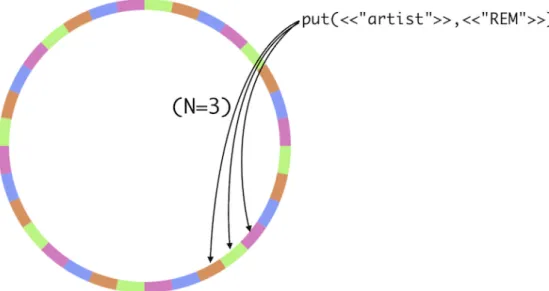
In Figure3.7[BT11c] it is possible to see the data distribution and replication across the ring of nodes. Every color represents a physical node responsible for a given range of the keyspace.
Replication properties are configured on a per-bucket basis. The client is able to specify how many replicas of data should be kept, and the system automatically replicates the data within a bucket across the cluster, to match the specified replication factor.
As nodes join or leave the cluster, Riak automatically re-balances the data [BT11c].
3.4.4 Consistency Model
Similarly to Cassandra, Riak also provides tunable consistency controls, allowing the user to easily
adapt the system to different CAP properties [BT11h].
Riak uses a quorum-based approach that allows the user to specify the number of replicas that must report for a given operation (e.g. write operation) to be considered complete and successful.
Technologies
Figure 3.7: Example of data replication with a replication factor of 3
The API allows the user to manually set the number of replicas that must report to an operation, by simply providing the desired value. The user may also use one of the existing symbolic options which are:
• All – Requires that all replicas reply; • One – Requires that only one replicas reply;
• Quorum – Requires that a majority of the replicas (i.e. quorum) reply.
With this capability the user is able to efficiently control consistency constraints, moving the system from eventually consistent to strongly consistent as needed.
3.5
HBase
HBase is a free and open-source distributed, column-oriented database, which is modeled after
Google’s BigTable [CDG+06] and is written in Java.
It is developed as part of Apache Software Foundation’s Hadoop project and runs on top of
HDFS (Hadoop Distributed Filesystem), providing BigTable-like capabilities for Hadoop [Bor07],
ensuring a fault-tolerant way of storing large quantities of sparse data.
3.5.1 Data Model
HBase’s data model is very similar to that of Cassandra, since they are both based on Google’s BigTable. It also follows a key-value model where the value is a tuple consisting of a row key, a
Technologies
Figure 3.8: Representation of HBase’s data model
column key and a timestamp (i.e. a cell) [Fou11a]. Data is stored into tables, which are made of
rows and columns, as seen in Figure3.8[BK10].
A row consists of a row key and a variable number of columns. Rows are lexicographically sorted with the lowest order appearing first in a table.
Columns contain a version history of their contents, ordered by a timestamp. Columns are grouped into Column Families and they all have a common prefix in the form of family:qualifier. Since tunings and storage specifications are done at the column family level, it is desirable that all column family members have the same general access pattern and size characteristics.
3.5.2 Query Model
HBase provides a Java API that can be used to make queries. The obvious map operations: put,
delete and update are provided by this API [Fou11a].
An abstraction layer Filter, gives applications the ability to define several filters for a row key, column families, column key and timestamps and the results can be iterated using the Scanner abstraction.
For more complex queries it is possible to write MapReduce jobs that run on the underlying
Hadoop infrastructure. Using Pig [Fou11i] it is possible to query data using an high-level,
SQL-like, language. It is also possible to use Cascading [Con11] to simplify the process of writing
MapReduce jobs.
In addition to the Java API, it is also possible to access HBase through REST, Avro or Thrift gateway APIs. A shell for direct user interaction with HBase also exists.
3.5.3 Replication Model
HBase uses a simple master-slave replication model [Fou11a]. The replication is done
Technologies
can be offline for some time, and rows inserted on the master server may not be available at the same time on the slave servers, therefore providing only eventual consistency.
Replication is performed by replicating whole WALEdits in order to maintain atomicity.
WALEd-itsare used in HBase’s transaction log (WAL) to represent the collection of edits corresponding to
a single transaction.
3.5.4 Consistency Model
HBase is strictly consistent, every value appears in one region only, within the appropriate bound-ary for its row key, and each region is assigned to only one region server at a time.
If replication is enabled and one reads from the slave servers, only eventual consistency can be guaranteed, since the replication is done asynchronously.
Row operations are atomic and it is possible to make transactions inside a row. Transactions
over multiple rows are not supported at the moment of this writing [Fou11f].
3.5.5 Usage at Google
Google Analytics3is a free service offered by Google that generates detailed statistics about the
visitors to a website, such as the number of unique visitors per day and the number of page views per URL per day.
Webmasters are required to embed a small JavaScript program in their web pages that is re-sponsible for recording various information about the request in Google Analytics (e.g. user iden-tifier and information about the page being fetched). This raw information is then processed, summarized and presented to the webmaster by Google Analytics.
In order to power the storage and processing of this data, Google relies on BigTable (which
is analogous to HBase) and the MapReduce framework [CDG+06]. A table that stores raw clicks
(which is around 200TB) maintains a row for each end-user session. This row is identified by the website’s name and the time at which the session was created, making sure that sessions for the same website are stored contiguously and sorted chronologically. An additional summary table contains the various predefined summaries for each website, which were generated by running a MapReduce job over the raw click table.
3.6
CAP Properties
This section attempts to compare the CAP properties: consistency, availability and partition
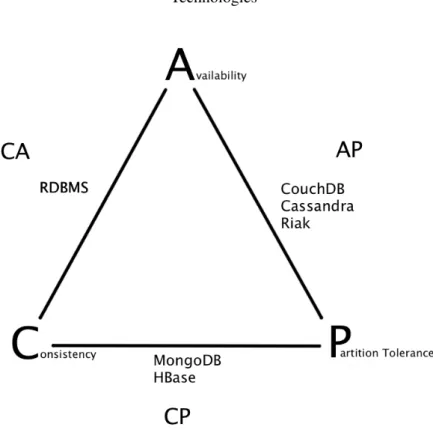
toler-ance of each of the described databases with each other. Figure3.9shows the relative distribution
of the databases according to these three properties.
Traditional Relational Database Management System (RDBMS) are known for their ability to provide strong consistency. At a transaction-level this consistency is usually supported by the ACID set of properties. Taking into consideration a distributed RDBMS (with a master-slave
Technologies
Figure 3.9: Classification of databases according to CAP theorem
configuration) it is also able to provide availability, still, it is only able to deliver it when there is connectivity between the different RDBMS nodes; if there is a partition between these entities (i.e. the master and slaves) the system is not able to properly function. Therefore, it can be said that the RDBMS does not provide partition tolerance.
Available and partition tolerant databases, such as CouchDB, Cassandra and Riak, usually relax consistency restraints by providing “eventual consistency”. All of these databases support asynchronous replication yielding high degrees of availability. Mechanisms such as hinted handoff also allow the system to achieve partition tolerance. It’s important to keep in mind that both Riak and Cassandra allow the user to vary the desired consistency level at a query-level, therefore being able to trade-off some availability for consistency.
Finally, both MongoDB and HBase provide consistency and partition tolerance. Both HBase and MongoDB provide a strict consistency model across partitioned nodes, which sacrifices avail-ability.
3.7
Conclusions
Although this technology review only addressed five NoSQL databases, it is possible to notice that there are a lot of differences among them. Different databases rely on different design principles in an effort to provide certain properties.
Throughout the rest of this work, the study will be focused on Riak and Cassandra. This two databases were chosen because they provide distinct data models which will allow for a wider
Technologies
research on data modeling techniques. They also both provide easy and flexible scalability (i.e. horizontal scalability) as well as high availability. Another important aspect is that both these databases allow for the definition of consistency constraints on an operation level which gives immense flexibility when design a database. Effectively, we are able to provide the whole spectrum of CAP properties, focusing on those which are necessary for a given case.
Chapter 4
Benchmarking
In order to assess the performance of non-relational databases, a set of benchmarks was developed targeting both Riak and Cassandra. A sharded MySQL setup was also benchmarked in order to provide a baseline.
A benchmarking framework was developed to fulfill this purpose. In this section the bench-marking methodology and results are presented. The developed benchbench-marking framework is also detailed.
4.1
Methodology
The methodology presented was based on the work performed by Yahoo! on benchmarking cloud
serving systems [CST+10]. The systems were benchmarked according to three different tiers, in
order to gain more knowledge on some characteristics relevant to a distributed system.
4.1.1 Tiers
In this section the three benchmark tiers for evaluating the performance, scalability and elasticity of database systems are presented.
4.1.1.1 Raw Performance
This tier allows us to evaluate the raw performance of read and write operations. The systems were setup in a distributed environment with a randomly generated dataset. On this benchmark the systems were stressed with a progressively increasing load of both read and write operations, i.e. the throughput (operations/second) was increased and the average latency of the requests was monitored. This benchmark was performed under different workload scenarios with different percentages of both read and write operations. These scenarios will be described later.
Benchmarking
With these benchmarks it will be possible to see how the database scales under increasing load and also under different workload conditions.
4.1.1.2 Scalability
An important characteristic of a distributed systems is their ability to scale horizontally, i.e. by adding more nodes to the system. Ideally, as we add more nodes to the system it should scale linearly, for example if we double the number of nodes ideally the system should then be able to handle twice the maximum throughput that it was able to handle before. Unfortunately, we know
from Amdahl’s Law [Amd67] that that is not the case. Distributed systems are limited by the
amount of parallel computation that is possible and the mechanisms involved in distributing the system introduce some overhead that degrades performance.
On this benchmark we progressively increase the load on the system and the size of the dataset as the number of nodes is also increased. Allowing us to ascertain how well the system scales as it grows. It’s important to note that after adding each node the system was given enough time to stabilize before restarting the benchmark. Therefore, the performance degradation associated with transferring data between nodes in order for it to rebalance is not taken into account.
4.1.1.3 Elasticity
As stated before, as nodes are added to the system, the system has to rebalance, effectively re-distributing data across the new nodes until it stabilizes. The ability for a distributed system to do so is known as Elasticity, since it is able to seamlessly grow (or shrink) while online, and it is expected to improve performance after the system stabilizes. This process is expected to cause some load on the system and therefore, as the system is rebalancing it’s ability to support a certain throughput should decrease, yielding higher latencies to the requests.
On this benchmark, a slightly overloaded and stabilized system is given a constant throughput of requests. After ten minutes a new node is added to the system while the requests are still being made (with the same throughput). A spike in latencies is expected while the system readjusts itself.
This benchmark attempts to mimic the real-world scenario were an overloaded system needs to grow in order to accommodate the increased performance needs. The measures taken will allow us to determine how long the system takes to stabilize after a new node is added and if afterwards it yields better performance.
4.2
Scenarios
In order to test the system under different scenarios two different workloads were used. They vary
on the percentage of read and write operations. On Table4.1it’s possible to see the different read
and write probabilities for the two scenarios. Also given on the table is the distribution used to select which objects were to be read or written.