International Journal of Marketing, Communication and New Media. ISSN: 2182-9306. Vol 4, Nº 7, July/December 2016
106
Research Paper
Understanding Portuguese Young Consumers’ Intention to use Mobile Commerce Compreender a Intenção de uso do Mobile Commerce pelos Jovens Consumidores Portugueses
Susana Costa e Silva* Carla Carvalho Martins **
ABSTRACT
In the last decade, e-commerce became popular all over the world. The recent widespread of smartphones transformed a significant part of e-commerce in mobile commerce. Therefore, the aim of this paper is to find out which factors affect consumers intention of using m-commerce through the exploration of a conceptual model to analyze customers’ perceptions of using mobile commerce services for online shopping. This paper aims at anticipating consumer behavior, and providing implications for designers, managers, marketers, and operators related to mobile commerce (m-commerce).
In order to test a conceptual model, an empirical investigation with a sample of 183 young Portuguese participants was carried out. It was used a structural equation model (SEM) in order to test the relationships of the model. The results reveal that anxiety, which is an affective obstacle against using new technology, is a key negative predictor of a customer’s intentions to use mobile devices for e-commerce. Additionally, enjoyment, usefulness, and compatibility have an impact on a customer’s behavioral intentions. Also, the consumer’s self-awareness of his/her mobile skillfulness affects anxiety, enjoyment, and usefulness and compatibility.
The outcomes of this study help to understand what prevents or encourages the use intention of m-commerce. The results not only help develop a better understanding of mobile commerce theories for researchers, but they also offer viable knowledge to those involved in promoting m-commerce to potential purchasers.
Keywords: Mobile Commerce; Online Shopping; Purchase Behavior; Consumer Behavior, Portugal.
* Universidade Católica Portuguesa. Portugal. E-Mail: [email protected] ** Universidade Católica Portuguesa. Portugal. E-Mail: [email protected]
International Journal of Marketing, Communication and New Media. ISSN: 2182-9306. Vol 4, Nº 7, July/December 2016
107
RESUMO
Na última década, o e-commerce tornou-se popular em todo o mundo. Paralelamente, o uso de smartphones transformou uma parte significativa do e-commerce em m-commerce. O objectivo deste paper é descobrir os fatores que afetam a intenção de uso de m-commerce através da exploração de um modelo conceptual para analisar as percepções dos consumidores na utilização de smartphone para comprar online. Pretende-se ainda com este trabalho antecipar o comportamento de compra através do telefone e derivar implicações para gestores, designers e operadores de telefone móvel (m-commerce).
De forma a testar o modelo conceptual, foi levada a cabo uma investigação empírica com uma amostra de 183 jovens portugueses. Foi usado um modelo de equações estruturais (SEM) para testar as relações propostas no modelo. Os resultados revelaram que a ansiedade, sendo um efectivo obstáculo à adoção de novas tecnologias, é um determinante negativo chave das intenções de uso dos consumidores em relação ao e-commerce. Adicionalmente, o prazer do uso, a utilidade e a compatibilidade revelaram ter ainda um impacto nas intenções comportamentais do consumidor. De referir ainda que a percepção de auto-capacidade no uso de smartphones revelou afetar a ansiedade, o prazer na utilização, a utilidade e a compatibilidade.
Os resultados deste estudo ajudam a entender o que limita ou encoraja a intenção de uso do m-commerce, contribuindo assim não apenas para um melhor entendimento das teorias subjacentes, mas também - em termos práticos - para compreender como promover o m-commerce junto dos potenciais utilizadores desta forma de comércio. Palavras-chave: Mobile Commerce; Online Shopping; Comportamento de Compra; Comportamento de Consumidor, Portugal.
Received on: 2016.10.27 Approved on: 2016.12.29
Evaluated by a double blind review system
1. INTRODUCTION
According to a Juniper Research Group study (2015), more than 1.2 billion smartphones were sold worldwide during 2014, representing year-over-year growth of 29%. This was the first time that smartphone sales had exceeded 1 billion in a single year. In November 2014, the Ericsson Mobility Report revealed that there were over 7.1 billion mobile subscriptions worldwide, resulting in 5.6% year-over-year growth. Most of these subscriptions still involve regular phones. However, Ericsson’s report (2014) indicates that this is rapidly changing, and by 2016 the number of smartphone subscriptions will exceed those for basic phones as they become increasingly affordable
International Journal of Marketing, Communication and New Media. ISSN: 2182-9306. Vol 4, Nº 7, July/December 2016
108
in developing markets. It is expected that by 2020 there will be approximately 9.5 billion mobile subscriptions, of which 6.1 billion will be smartphones and 650 million may be mobile PCs, tablets, and routers.
These impressive numbers, along with the systematic upgrading of the mobile devices’ performance as well as internet access/bandwidth improvements, provides the perfect conditions for mobile commerce (m-commerce) emergence (Lu & Su, 2009). According to another Juniper Research report (December, 2014), mobile phone and tablet users made 72 billion mobile commerce transactions in 2014 alone. The same report anticipated that by the end of 2019, the number of transactions will reach 195 billion. On March 5, 2014, Goldman Sachs released a report estimating that global m-commerce sales reached US$133 billion in 2013, and anticipating that this number will reach US$626 billion in 2018. The 2013 m-commerce sales represent more than 9% of the global e-commerce sales (US$1.233 trillion in 2013 according to eMarketer, 2014), while the 2018 m-commerce sales will represent about 3.7% of the anticipated global e-commerce sales for that year (US$2.356 trillion in 2018 according to eMarketer, 2014). The m-commerce percentage seems to diminish over the next few years, although this has to do with the rapid growth of e-commerce in developing markets, such as the Asia-Pacific countries (eMarketer, 2014). It is expected that in the short-term mobile devices will exceed PCs as the most common way to access the internet worldwide. Gartner Inc. (2012) predicted that by the end of 2015 more than 80% of device sales in mature markets will be smartphones.
The situation in Portugal is not that different. According to a Marktest report (2012), there were about 8.54 million cell phone users on Portuguese soil by the end of 2011, representing 92.0% penetration. An IDC report (2013) revealed that there were 4,155 million mobile phones sold in 2013, and for the first time smartphone sales exceeded basic cell phone sales. According to the same report, during Q2 Portuguese users bought 473,742 basic call phones and 549,286 smartphones, and this trend remains constant until the present day. As for internet access through mobile devices, an OberCom study (2014) concluded that 38.5% of the Portuguese population used a cell phone, smartphone or tablet to navigate online during 2013. However, despite the evident progress in Portuguese telecommunications, it is obvious that m-commerce technology is still in its infancy compared to other mature markets. It is already possible to identify several mobile applications that allow users to buy through their mobile devices.
International Journal of Marketing, Communication and New Media. ISSN: 2182-9306. Vol 4, Nº 7, July/December 2016
109
However, these applications are just the tip of the iceberg compared to the anticipated full potential of m-commerce and what it could mean for Portuguese businesses.
Considering m-commerce’s growing influence on the 21st century economy, it is crucial that businesses take this new distribution channel into account, since otherwise they might lose their competitiveness (Siwici, 2012). Meanwhile, it is also important to follow a clear train of thought with regard to comprehending the factors that affect mobile commerce adoption. Portuguese companies that are interested in applying these strategies need to understand consumers’ behavior with respect to this new mode of commerce. Perceptions of these behavioral aspects can help companies to predict consumers’ reactions. Yet, there is currently very little knowledge concerning how individual’s intrinsic motivations influence the use intention of m-commerce. Therefore, this research relies mainly on the technology acceptance model (TAM) (Davis, 1989), which we consider to be an appropriate theory for measuring the use intention of a new technology, such as m-commerce. Furthermore, the TAM (Davis, 1989) has already been used in the mobile communications and wireless technologies context (Amberg et al., 2004; Fang et al., 2005-6; Han et al., 2006; Lu et al., 2003) and therefore we assume it to be appropriate for evaluating the consumer usage intention of m-commerce.
Given the above reasoning, this research study’s purpose is to understand and deepen the discussion concerning the use intention of m-commerce by Portuguese consumers. To achieve such a goal, it is proposed to evaluate the use intention of mobile devices, as a shopping alternative, on the part of young consumers. In order to do so, it is important to identify the factors that can be used to measure their behavior when faced with this new technology.
The consumer group selection is supported by the arguments of de Kulviwat et al. (2007) and Curry (2001). They identify young consumers as the early adopters of this kind of technology, based on the fact that such young consumers are the main users of mobile communication services, including m-commerce. This research considers young consumers to be individuals aged 18 to 29 (OCDE, 2001). The importance of studying them lies in the fact that they are early adopters (Rogers, 1995) and so they represent the future generation that will probably use these technologies. With this target in mind, we would like to understand the factors that influence young Portuguese consumer’s intention to use m-commerce.
International Journal of Marketing, Communication and New Media. ISSN: 2182-9306. Vol 4, Nº 7, July/December 2016
110
motivation, as well as the objectives and the research questions. In Section two, the authors review the relevant existing literature concerning mobile devices, the concept of m-commerce, the technology acceptance model (TAM), and m-commerce acceptance based on the TAM. Furthermore, it also presents the model and defines the hypotheses. Section three details the methodology for the study, while section four presents the empirical study. Finally, section five discusses the findings of the study, offers the main conclusions, and makes some suggestions for future research.
2. LITERATURE REVIEW 2.1 Mobile Devices
Besides its personal aspect, a device must present three main characteristics in order to be considered a mobile device: portability, location specificity, and the absence of wires (Shankar & Balasubramanian, 2009). An ultra-small size and the relative ease of carrying such devices everywhere represent key qualities of portability as well as important benefits of mobile devices for consumers (Balasubramanian et al., 2002). These characteristics imply the continuous usage of the device, giving it a systematic presence in the user’s daily life and allowing businesses to contact the consumer anywhere and at any time. The location specificity allows marketing professionals to target their offers according to the user’s location. The wireless aspect represents a promotion and an increase of mobile device use and also creates opportunities for contextual marketing actions. Those actions can be harmonized with the consumer’s profile and with his/her current location, thereby increasing the chances of a purchase decision by an individual (Shankar & Balasubramanian, 2009).
A mobile device is not just another technological gadget and it can be seen as a cultural object, that is, part of a person’s everyday life. Mobile devices are in constant use in activities such as communicating, listening to music, searching for information, performing transactions, managing agendas, and facilitating the personal and social experiences of an individual; therefore, such devices have become agents of social change (Nurullah, 2009). Meanwhile, businesses’ main challenges are to identify how to transform this cultural object, understand the mobile lifestyle, and adapt the small display (i.e. the mobile device’s screen) into a commercial environment in order to explore the efficiency of this new channel of distribution.
International Journal of Marketing, Communication and New Media. ISSN: 2182-9306. Vol 4, Nº 7, July/December 2016
111
2.2 M-Commerce
Before discussing and conceptualizing m-commerce, it is crucial to formerly identify the differences between e-commerce and m-commerce. Pay (2012) identifies two distinguished eras of m-commerce. At first, m-commerce is classified simply as an extension of e-commerce. In the second era, m-commerce develops as an independent business area and, consequently, as an alternative mechanism for e-commerce itself. According to Xu an Yang (2012), e-commerce is an alternative way of buying and selling goods and services using computer networks. Users can order the same products simultaneously in different places, while m-commerce brings the concept of mobility into the buying process, allowing the user to make a business transaction regardless of his geographic location (Zhang et al., 2002). So, the main difference between m-commerce and e-m-commerce resides in the transaction context and access method, in which it is possible to use cell phones or mobile devices to communicate anytime and anywhere. Therefore, the mobility concept, as used in the specific m-commerce contexts, represents the possibility of conducting transactions or business processes anytime and anywhere. The access occurs through wireless mobile communications networks, so that these services are viable regardless of the user’s geographical location. Once a comparison and distinction have been made between the two concepts, it is possible to proceed to the conceptualization of m-commerce. Being a relatively new phenomenon, m-commerce is still susceptible to various definitions. Kauffman and Angsana (2005) describe m-commerce as being like any other electronic transaction (e.g. the communication interaction, purchase, and payments) in that it uses a wireless connection to access the Internet or a supplier’s private network. On the other hand, Hanebeck and Raisinghani (2002) describe m-commerce as the delivery capability of electronic commerce being directly available to consumers through wireless technology. According to them, the selling point of m-commerce is that it is basically in the consumer’s hand.
This method of commerce allows businesses to reach consumers at anytime and anywhere. It is understood that m-commerce can operate through any wireless mobile device connected to the Internet, and so it can be perceived as a technological solution that uses wireless devices to conduct business or transactions via a network system. This way, geographically independent consumers can buy, carry out banking services, transfer money, book a flight ticket or perform any other commercial transaction
International Journal of Marketing, Communication and New Media. ISSN: 2182-9306. Vol 4, Nº 7, July/December 2016
112
(Hanebeck & Raisinghani, 2002). However, m-commerce should not be seen as simply a new distribution channel or a replacement for the computer. On the contrary, m-commerce should be seen as a new aspect of consumerism and a much more powerful way to reach the consumer (Nohria & Leestma, 2001; Zhang et al., 2002). It should not be regarded as a limited extension of e-commerce, but rather as an original model with its own unique benefits. Obviously, people will not go shopping with their mobile phones in the same way they shop with their computers. Exploring the true value of m-commerce requires an understanding of the role that mobility plays in contemporary lives; therefore, it is important to identify factors that can stimulate internal motivations towards buying processes involving this technology.
2.2.1 M-Commerce Acceptance
Several theories have been used to understand the factors that determine the acceptance and use of technology. Among them, the technology acceptance model (TAM) proposed by Davis (1989) and Davis et al. (1989), which was adapted from the theory of rationalized action (TRA) (Ajzen & Fishbein, 1980), suggests that the belief of an individual determines his/her attitude towards the presented technology. This action, in turn, directly affects the use intention. The TAM was designed as a parsimonious model to explain the adoption and use of a given technology by exploring only two cognitive constructs: the perceived usefulness and the perceived ease of use (Morris & Dillon, 1997). This model was specifically built to explain the use of computers and other related technologies (Davis et al., 1989).
In the original TAM model, the acceptance of a technology by an individual is determined by his voluntary intention to use it. This intention is characterized by perception and by the individual’s attitude towards the technology, its usefulness, and its ease of use. Perceived usefulness refers to the extent to which an individual believes an item of technology will improve his performance when using a particular system. As for the perceived ease of use, this construct is defined by the extent to which an individual believes that using a given system will be effort free (Davis, 1989; Davis et al., 1989). The TAM has been one of the most discussed and influential models intended to explain the final user’s behavior while facing the use of computer technologies and information systems (King & He, 2006; Yousafzai et al., 2007). In this way, researchers have investigated and replicated the perceived usefulness and
International Journal of Marketing, Communication and New Media. ISSN: 2182-9306. Vol 4, Nº 7, July/December 2016
113
perceived ease of use constructs, associated with other external variables (Davis et al., 1989). There is also a general agreement that the constructs (ease of use and usefulness), in addition to several others introduced in the model, are valid for predicting the acceptance of a number of technologies by an individual.
Several studies have investigated m-commerce in different contexts, such as mobile banking (Luarn & Lin, 2005), ticket sales (Mallat et al., 2006), and auctions (Wang & Barnes, 2007). However, despite the fact that the literature evaluating the use intention and the effective use of mobile devices for commerce points to a number of factors that affect consumer behavior in the adoption of m-commerce, the results are not yet conclusive. In an exploratory study, Mahatanankoon and Vila-Ruiz (2007) showed that (1) consumers’ unfamiliarity with m-commerce, (2) the perception of a cell phone being an inefficient device on which to conduct transactions, (3) the lack of face-to-face communication in conventional transactions, (4) the interoperability limitation between different mobile technologies, and (5) the important need for customization in m-commerce activities, are the main barriers to consumers adopting it.
Islam et al. (2011) extended the TAM model and found that prices and usage costs (i.e. Internet access fees), rich and fast information, and security and privacy are significant indicators of m-commerce adoption. Their findings match the findings of previous studies, such as Haque (2004), which identified prices and costs as the most significant factors influencing the adoption of m-commerce. Regarding security and privacy, the results of Islam et al. (2011) were similar to those found in studies by Haque (2004), Huei (2004), and Mariga (2003). However, Islam et al. (2011) found a contradictory result concerning the perception of usefulness. Despite being previously identified as an important construct for predicting the use intention of both information systems and related technologies (King & He, 2006; Yousafzai et al., 2007), as well as m-commerce (Mariga, 2003; Huei, 2004), in Islam et al (2011), studies found that the perception of usefulness was not significant in explaining the use intention.
Other studies, including Amberg et al. (2004), identified the perception of usefulness, the perceived ease of use, the perception of mobility, and the perceived costs involved as key factors in the adoption of m-commerce. Finally, Wu and Wang (2005) reviewed the TAM and added the perceived risk, cost, and compatibility constructs.
International Journal of Marketing, Communication and New Media. ISSN: 2182-9306. Vol 4, Nº 7, July/December 2016
114
3. HYPOTHESES AND MODEL DEVELOPMENT
Song et al. (2008) argue that any company considering implementing m-commerce strategies must first consider the behavioral aspects of consumers. Indeed, understanding these behavioral aspects can help them to predict consumer reactions. However, Song et al. (2008) argue that there is currently little knowledge concerning how the use of m-commerce is determined by the intrinsic motivations of users. In this sense, the TAM has been a useful model for assessing the intention and use of technologies by taking these factors into account.
Therefore, through an adaptation of Su and Lu’s (2009) model, this study aims to evaluate the acceptance of m-commerce as a purchasing or shopping alternative on the part of Portuguese consumers. Following Davis et al.’s (1989) guidance, which suggests the introduction of external variables to the TAM in addition to the utility variable, some constructs that are considered to be important during the purchase process via m-commerce were added: skill with mobile, anxiety, enjoyment, and compatibility. The relationships between each of them along with the appropriate justifications are described below.
3.1 Perceived Usefulness
The perceived usefulness portrays how an individual believes that a given technology can improve his productivity or performance in any work task (Davis, 1989). With regard to consumer matters, the perceived usefulness is linked to the functional outcome of using technology, and it can be translated as the probability perceived by the consumer that the technology in question will benefit him in some way when accomplishing a task. Regarding mobile commerce services, the utility associated with immediate access to information about products or services anywhere and anytime, plus the ability to transact at any time, can be attractive to customers (Lu & Su, 2009). Thus, based on previous research (Davis et al., 1989; Venkatesh & Davis, 1996; Amoroso & Magnier-Watanabe, 2012), we propose the following hypothesis:
H1: Perceived usefulness will have a direct and positive effect on the consumer’s
International Journal of Marketing, Communication and New Media. ISSN: 2182-9306. Vol 4, Nº 7, July/December 2016
115
3.2 Compatibility
The compatibility construct refers to the degree to which an innovation is perceived as consistent with the values, prior experiences, and needs of potential adopters (Rogers, 1995). Mobile technology is already deeply integrated into people’s lives. Communication via mobile devices has become universal and involves almost all activities of modern society, including work, education, social relations, and even entertainment (Nurullah, 2009). Some mobile device users feel severely isolated or even panic in cases of losing or forgetting their mobile phone. The existence of a high degree of consistency between the values and the individual’s experience with using mobile technology may facilitate the adoption of other mobile services that are hardly used or less known, as in the m-commerce case. Chen et al. (2002) suggest that greater compatibility positively affects the decision to use a virtual store. Similarly, Lin (2007) points out that compatibility has a positive effect on the spread of online games. Based on this, the following hypotheses are proposed:
H2: Compatibility will have a direct and positive effect on the consumer’s perceived
usefulness of mobile commerce services.
H3: Compatibility will have a direct and positive effect on the consumer’s intention to
use a mobile commerce services.
3.3 Anxiety
Anxiety reveals apprehensive feelings and even fear about experienced or imagined situations. Such emotions can be evoked in real or imaginary interactions with new technologies such as mobile commerce systems. As Igbaria and Iivari (1995, p. 593) noted, “Individuals who experience high levels of anxiety are more likely to behave more rigidly than individuals whose level of anxiety is relatively low.” Normally, it is expected that people avoid behaviors that evoke feeling of anxiety (Compeau & Higgins, 1995). Mistrust on the part of an individual can reduce the probability of him using a mobile commerce service regardless of whether or not the individual is effectively using the service or just imagining that he is. For example, when the consumer is in the payment process, he fears pressing the wrong button, which leads to the possibility of financial loss, thus increasing his anxiety. In this context, previous studies have shown anxiety to be a factor with a significant negative influence on the adoption of
International Journal of Marketing, Communication and New Media. ISSN: 2182-9306. Vol 4, Nº 7, July/December 2016
116
information systems (Compeau et al., 1999; McFarland & Hamilton, 2006). Based on this, the following hypothesis is proposed:
H4: Anxiety will have a direct and negative effect on a consumer’s intention to use a
mobile commerce services.
3.4 Enjoyment
Advanced mobile devices provide a wide range of online media, such as product descriptions, photos, music, videos, commercials, and games. Customers can have fun looking for products and services while interacting with the media. Davis et al. (1992) showed that both extrinsic and intrinsic factors affect consumer motivations for using information technology systems. Intrinsic motivations may be connected to the fun and the reward of action. Venkatesh (1999), for example, in a study about training based on games found that high intrinsic motivation indices lead to a sustained behavioral intention of using the software information. Chu and Lu (2007) suggest that perceived enjoyment serves as a motivation for music purchase intention in the online world. Finally, Hsu and Lu (2007) suggest that fun positively affects the loyalty of online games customers.
In our study, enjoyment refers to the consumer’s immediate experience of pleasure and joy (Lu & Su, 2009) when using a mobile commerce service, and we understand it to be considered to be an important dimension in the online shopping process. However, relatively few studies relate perceived fun with online purchasing behavior when using a mobile device. Therefore, we propose that:
H5: Enjoyment will have a direct and positive effect on the consumer’s intention to use
a mobile commerce services.
3.5 Mobile Skillfulness
Skillfulness or ability to use a given technology is defined as a combination of experience, training, and knowledge that an individual has with that technology. A greater confidence in the ability to use a technology will lead to a greater intrinsic motivation to try it and embrace it (Compeau & Higgins, 1995). Igbaria et al. (1996)
International Journal of Marketing, Communication and New Media. ISSN: 2182-9306. Vol 4, Nº 7, July/December 2016
117
found that users with computer skills are more likely to have a favorable perception and confidence about the performance of several tasks using computers. The higher the usage skills, the bigger the probability of performing more complicated functions with greater dexterity, feeling less anxiety or frustration, and possibly having more fun (Lu & Su, 2009). Compeau et al. (1999) concluded that individuals feel more anxiety when performing particular behaviors if they do not believe they have the ability to execute them. Thus, some consumers may avoid using m-commerce services due to a lack of skill in using mobile devices. Even if they understand the results, they may doubt their ability to successfully complete the transaction and therefore not believe in the system’s usefulness (Lu & Su, 2009). Although the relationship between the self-efficacy of an individual and the use of a system has been studied previously (Huang & Liaw, 2005; Pajares, 1997; Schunk & Gunn, 1986; Staples et al., 1999) there is a need for further investigation of perceived skillfulness as a key factor in reducing barriers to the adoption of m-commerce.
H6: Mobile skillfulness will have a direct and positive effect on the usefulness of
mobile commerce services.
H7: Mobile skillfulness will have a direct and positive effect on the compatibility of
mobile commerce services.
H8: Mobile skillfulness will have a direct and negative effect on anxiety when using a
mobile commerce services.
H9: Mobile skillfulness will positively affect the enjoyment when using a mobile
commerce services.
International Journal of Marketing, Communication and New Media. ISSN: 2182-9306. Vol 4, Nº 7, July/December 2016
118
Figure 1 - Conceptual Model
Adapted from: (Su & Lu, 2009)
4. METHODOLOGY
In order to analyze the relationships, an online survey was designed that encompassed several constructs. The survey was written in Portuguese to enhance the response rate and facilitate the correct understanding of the questions. Writing the survey in Portuguese also helped to avoid misunderstandings that could occur when responding to a survey written in a foreign language. Participants were asked to indicate their degree of agreement/disagreement with statements regarding the “Mobile Skillfulness”, “Anxiety”, and “Use Intention” variables. The statements were based on Liaw and Huang’s (2005) item “Mobile Skillfulness” scale; Thatcher and Perrewe’s (2002) 4-items “Anxiety” scale; and Mao, Srite, Thatcher, and Yaprak’s (2005) 3-item “Use Intention” scale. To measure these three constructs, a 7-point Likert scale ranging from 1 “Strongly Disagree” to 7 “Strongly Agree” was used. Then, participants were asked to indicate their degree of agreement/disagreement with statements regarding the “Enjoyment” and “Perceived Usefulness” variables, based on Davis, Bagozzi, and Warshaw’s (1992) 2-item “Enjoyment” scale; and Davis, Bagozzi, and Warshaw’s (1989) 4-item “Perceived Usefulness” scale. The fifth section concerned the “Compatibility” variable and it asked participants to indicate their degree of agreement/disagreement with statements from Karahanna, Straub, and Chervany’s
International Journal of Marketing, Communication and New Media. ISSN: 2182-9306. Vol 4, Nº 7, July/December 2016
119
(1999) 3-item “Compatibility” scale. Items (table 1) were adapted from the original scales. The survey was translated from English to Portuguese and reverse translation was used to ensure the consistency of the questions.
The survey was pre-tested in order to identify possible errors and problems, to analyze if the scales’ items were well understood by the respondents and to guarantee the quality of the translation. The pre-test didn’t reveal any major concern. After pre-testing, the research took place in Portugal and it was based on an online survey that was distributed with the help of selected universities, companies, and individuals that shared the survey with their contacts, in a snowball approach. All the questions were marked as mandatory, meaning that the respondents could not move on to the next question without answering the previous one. The initial questions allowed guaranteeing the eligibility of the respondents. A sample of 200 potential respondents took part in the study, although only 183 questionnaires were considered valid since only those participants replied affirmatively to the first three demographic questions. The sample was composed by 183 respondents with ages between 18- and 29-years-old. They all had Portuguese nationality and lived in Portugal. More than 90% of participants either completed or were attending higher education.
Data was analyzed through Structural Equation Modeling (SEM), using maximum likelihood estimation method (MLE). In the first stage, an Exploratory Factor Analysis (EFA) was conducted in order to ensure the validity and reliability of the scales used to measure the constructs comprised in model. In the second stage, the whole model was tested through path analysis. These analyses were supported by both SPSS 23 (general statistics software) and AMOS 22 (SEM software). The sample obtained was considered acceptable according to extant guidelines from the literature. It is generally accepted that the minimum sample size to ensure the use of SEM with MLE (the most commonly used and the one that used in this study) is 100 to 150 (Hair et al., 2006).
International Journal of Marketing, Communication and New Media. ISSN: 2182-9306. Vol 4, Nº 7, July/December 2016
120
Table 1 - Online survey items to measure the constructs of the model
Reference Items (original study) Cronbach α
Mobile Skillfulness
Liaw & Huang (2005)
For the following statements, please indicate your degree of
agreement/disagreement with each one. We propose a 7-point scale ranging from “strongly disagree” (1) to “strongly agree” (7).
I feel confident using a mobile device.
I feel confident using a mobile device in order to purchase via m-commerce. I feel confident using a mobile device correctly.
I feel confident using a mobile device easily.
0.92
Anxiety
Thatcher & Perrewe (2002)
For the following statements, please indicate your degree of
agreement/disagreement with each one. We propose a 7-point scale ranging from “strongly disagree” (1) to “strongly agree” (7).
I feel apprehensive about using mobile devices to make transactions. It scares me to think that I could cause damage by hitting the wrong key. I hesitate to use a mobile device to buy products for fear of making mistakes that I cannot correct.
M-commerce is somewhat intimidating to me.
0.94
Enjoyment
Davis, Bagozzi & Warshaw (1992)
For the following statements, please indicate your degree of
agreement/disagreement with each one. We propose a 7-point scale ranging from “Unlikely” (1) to “Likely” (7).
I find using m-commerce enjoyable. I have fun using m-commerce.
For the following statement, please indicate your degree of agreement/disagreement with each one. We propose a 7-point scale ranging from “Unpleasant” (1) to “Pleasant” (7)
The actual process of using m-commerce is unpleasant/pleasant.
0.94
Perceived Usefulness
Davis, Bagozzi & Warshaw (1989)
For the following statements, please indicate your degree of
agreement/disagreement with each one. We propose a 7-point scale ranging from “Unlikely” (1) to “Likely” (7).
Using m-commerce would help me to do my shopping.
Using m-commerce would increase my probability of purchasing online. Using m-commerce would enhance my shopping effectiveness. I would find m-commerce useful for the shopping process.
0.97
Compatibility
Karahanna, Straub & Chervany (1999)
For the following statements, please indicate your degree of
agreement/disagreement with each one. We propose a 7-point scale ranging from “Low Value” (1) to “High Value” (7).
If I were to adopt m-commerce, it would be compatible with most aspects of my shopping needs.
If I were to adopt m-commerce, it would fit well the way I like to do my shopping.
If I were to adopt m-commerce, it would fit well my purchase process.
0.93
Use Intention
Mao, Srite, Thatcher & Yaprak (2005)
For the following statements, please indicate your degree of
agreement/disagreement with each one. We propose a 7-point scale ranging from “strongly disagree” (1) to “strongly agree” (7).
I intend to use m-commerce to purchase online. I intend to use m-commerce to make online payments. I intend to use m-commerce to make reservations.
International Journal of Marketing, Communication and New Media. ISSN: 2182-9306. Vol 4, Nº 7, July/December 2016
121
5. RESULTS
In this section, the computation model’s main results are presented. The psychometric properties of the used measures are first assessed through confirmatory factor analysis. To test the model hypotheses path analysis was employed.
5.1 Confirmatory factor analysis results
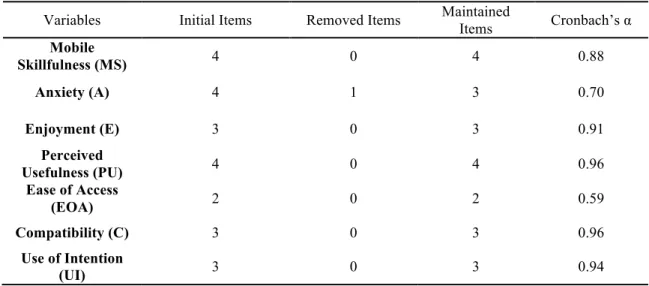
The measurement model was specified and subject to a confirmatory factor analysis (CFA), conducted with the support of AMOS 22.0, using a maximum likelihood estimation method. In the current analysis, the specified relationships between the indicators and the seven respective constructs were tested. Some of the scale items were then removed due to low standardized factor loadings, following Comrey (1973) guidelines, which establish 0.63 as the minimum threshold to retain an indicator. However, not all indicators with loadings below that level were eliminated. Indeed, literature states the need for theoretical justification in model respecification, appealing for caution in the process of eliminating items (Hair et al., 2006). Thus, after analyzing all the indicators with low loadings, the authors considered that some were theoretically important and so, should be retained. The scale purification changed the number of items in the scales used in the current model, as presented in Table 2.
Table 2 - Items removed and maintained after scale purification.
Variables Initial Items Removed Items Maintained Items Cronbach’s α Mobile Skillfulness (MS) 4 0 4 0.88 Anxiety (A) 4 1 3 0.70 Enjoyment (E) 3 0 3 0.91 Perceived Usefulness (PU) 4 0 4 0.96 Ease of Access (EOA) 2 0 2 0.59 Compatibility (C) 3 0 3 0.96 Use of Intention (UI) 3 0 3 0.94
International Journal of Marketing, Communication and New Media. ISSN: 2182-9306. Vol 4, Nº 7, July/December 2016
122
After the scale purification process, several fit indices were used to assess the measurement model. As shown in Table 3, all the model-fit indices are within the recommended values (Brown, 2015), thereby revealing a satisfactory fit to the collected data.
Table 3 - Fit indices for measurement model
Fit Indices Measurement Model Recommended Values
χ2 (155 df) (407.22; p=.00) ---
CMIN / DF 2.63 < 3.00
Root mean square error of approximation
(RMSEA) 0.06 < 0.10
Standardized Root Mean Square Residual
(SRMSR) 0,07 < 0.08
Non-normed fit index (NNFI) or (TLI) 0.91 > 0.90
Comparative fit index (CFI) 0.93 > 0.90
Source: research data
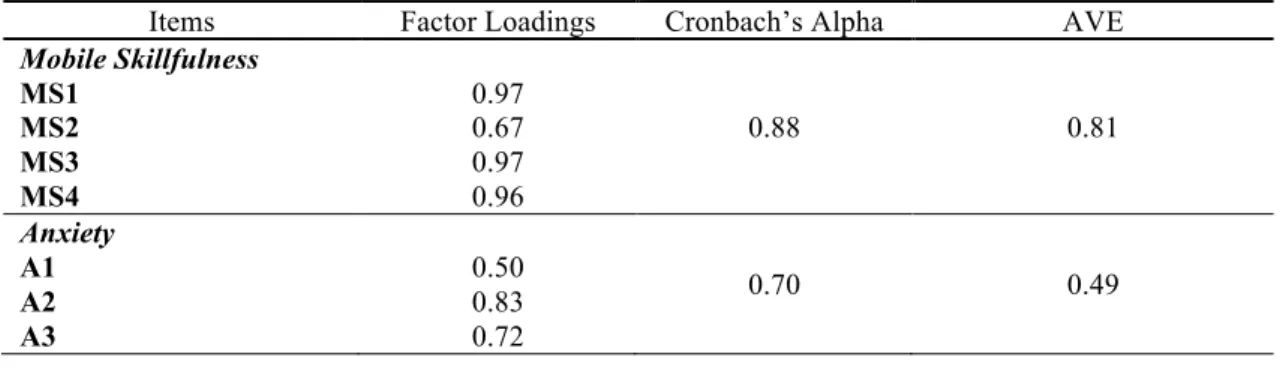
The scales’ internal consistency (or reliability) - the extent to which all of the items of a test measure the same latent variable - was measured using the Cronbach’s α value. According to Hair et al. (2006), the generally agreed upon lower limit for Cronbach’s α is 0.7, although it may decrease to 0.60 in exploratory research. Also, if a construct has a limited number of items, researchers may be less strict with the Cronbach’s α value. As can be observed in Table 2, all of the values obtained are higher than 0.7. Convergent validity of the factors was assessed through average variance extracted (AVE), depicted in Table 4.
Table 4 - Reliability, average variance extracted, and factor loading of items.
Items Factor Loadings Cronbach’s Alpha AVE
Mobile Skillfulness MS1 MS2 MS3 MS4 0.97 0.67 0.97 0.96 0.88 0.81 Anxiety A1 A2 A3 0.50 0.83 0.72 0.70 0.49
International Journal of Marketing, Communication and New Media. ISSN: 2182-9306. Vol 4, Nº 7, July/December 2016 123 Enjoyment E1 E2 E3 0.93 0.91 0.81 0.91 0.78 Perceived Usefulness PU1 PU2 PU3 PU4 0.95 0.91 0.92 0.93 0.96 0.86 Compatibility C1 C2 C3 0.92 0.96 0.95 0.96 0.89 Use Intention UI1 UI2 UI3 0.90 0.93 0.92 0.94 0.84
Source: research data
According to Hair et al. (2006), the AVE should exceed 0.50 for a construct. As can be seen in Table 4, all values of the AVE exceeded the minimum required, thus revealing convergent validity. Furthermore, as shown in Table 3, convergent validity was also demonstrated through the factor loadings of the measurement items. According to Hair et al. (2006), the indicator reliabilities should exceed 0.50 which roughly corresponds to a standardized loading of 0.70.
According to Bagozzi and Phillips (1991, p.425), discriminant validity refers to “the degree to which measures of different concepts are distinct.” Consequently, in order to be unique and capture some phenomena that other constructs did not, there should be high values for the discriminant validity (Hair et al., 2006). In fact, a high value guarantees that the construct is significantly distinct from related concepts. According to Fornell and Larcker (1981), discriminant validity is ensured if “the construct inter-correlations are significantly different from one another, and the shared variance between any two constructs is less than the average variance explained in the items by the construct.” The discriminant validity is visible in the current model, as shown in the squared correlations matrix (Table 5), wherein the main matrix diagonal values are calculated based on the average variance extracted (Fornell & Larcker, 1981) obtained from Table 3.
International Journal of Marketing, Communication and New Media. ISSN: 2182-9306. Vol 4, Nº 7, July/December 2016
124
Table 5 - Squared correlations and average variance extracted (within parenthesis)
Variables MS A E PU C UI MS (0.81) A 0.12 (0.49) E 0.38 0.18 (0.78) PU 0.38 0.16 0.88 (0.86) C 0.46 0.34 0.46 0.49 (0.89) UI 0.38 0.25 0.81 0.76 0.53 (0.84)
Source: research data
5.2 Structural equation model
The conceptual model proposed in this paper (Figure 1) involves various relationships between constructs, which should be tested simultaneously. Consequently, structural equations modelling (SEM) was used in order to validate the model by measuring all the suggested construct relationships simultaneously. As previously stated, the model was computed with AMOS v22.0, with a maximum likelihood discrepancy estimation method. In terms of fit, the model has a χ2 = 650.19, with 161 degrees of freedom, and a statistical significance level of 0.000. The normed chi-square (χ2/df) equals 4.038; TLI=0.87, CFI=0.89, SRMR=0.15 and RMSEA=0.13
The path coefficients from the SEM analysis are shown in Figure 2, showing that all the hypotheses of the conceptual model were confirmed. If an individual deem m-commerce useful (H2) and compatible with its lifestyle (H3), there’s a better chance of using it. Moreover, the more compatible m-commerce is with the consumer way of living, more useful s/he will consider it (H2). Although the relationship is not very strong (β=0.100; p>0.05), anxiety tends to have a negative effect on use intention (4). The more anxious or insecure an individual feels when using a mobile device, the lower the chance of using commerce. Enjoyment is, in fact, the best predictor of m-commerce use intention (H5) in the model (β=0.548; p>0.001).
Mobile skillfulness significantly affects all the use intention predictors of the model. It has a negative influence over anxiety (H8), i.e. if an individual has more ability to use a mobile device, he will feel less anxious using it for e-commerce purposes. At the same
International Journal of Marketing, Communication and New Media. ISSN: 2182-9306. Vol 4, Nº 7, July/December 2016
125
time, it exerts a positive influence over perceived usefulness (H6), compatibility (H7) and enjoyment (H9).
6. DISCUSSION
Previous studies that used the technology acceptance model (TAM) have somehow ignored emotions, beliefs in level of capability, and intrinsic motivations. However, our study has successfully included factors such as mobile skillfulness, anxiety about mobile devices, enjoyment in using and purchasing through mobile commerce and applied them in the context of m-commerce.
The results obtained allow us to better understand the role of psychological and functional beliefs in human behavior. The results also provide insights into the opportunities and risks that are part of the rapidly changing environment of mobile services. Overall, this study provides six important insights into consumers’ behavior, and the outputs represent important information for all m-commerce providers.
The study indicates that enjoyment has an evident impact on the intention to use m-commerce. It is interesting to see, through the study’s results, that a customer’s interaction with m-commerce occurs because the individual gets involved in an activity due to intrinsic motivation (i.e. enjoyment) rather than extrinsic motivation (e.g. perceived usefulness). Ryan and Edward (2000) claimed that if individuals are in a playful state, they will find the interaction intrinsically interesting and, therefore, they are involved in the activity for pleasure and enjoyment rather than for extrinsic rewards. The results of this study support this view. Mobile devices play a systematic role in their owner’s life, since they are more at hand and ready for use than traditional personal computers. Also, users normally enjoy a deep connection with their mobile phones. M-commerce applications or systems can be seen as interactive intermediates that may become one of the customer’s favorite pastimes/hobbies. Thus, operators should pay more attention to not only the useful outcomes of using m-commerce services, but also to the fact that there is an evident fun factor involved in the whole shopping process. Transforming the experience of buying into a more amusing event can increase the use of m-commerce.
Secondly, as previous studies had already stated, anxiety was proven to be a negative predecessor of behavioral intention to the purchase act. Individuals who are less anxious when interacting with a system also feel more comfortable using it, so they are more
International Journal of Marketing, Communication and New Media. ISSN: 2182-9306. Vol 4, Nº 7, July/December 2016
126
likely to accept the system. Operators should seek to control the complexity of m-commerce systems in order to reduce the negative effect barrier created by customers’ worries about operation errors. Also, design departments should pay attention to any system features that may cause anxiety and work to minimize them, as for instance allowing the possibility to revert some actions and thus diminishing regret, for instance. Regarding mobile skillfulness, this factor plays an important role. Mobile skillfulness indirectly encourages m-commerce purchases, by increasing individuals’ perceptions of compatibility, enjoyment and usefulness. Additionally, mobile skillfulness plays a vital role in reducing anxiety about mobile technology and enhancing the motivation to use mobile commerce systems. One suggestion regarding this finding is that retailers should offer potential users training or tutorial programs in using mobile devices. Such an initiative would also improve users’ performance skills by demonstrating how to purchase products or services. These educational and training programs, designed as they are to help individuals perform advanced mobile phone skills effectively, will both enhance their ability to handle a mobile device, and reduce affective barriers to using m-commerce.
This investigation successfully expands the capacity to generalize all of its constructs to the mobile commerce context. This area of research is different from that of prior studies focused on analyzing traditional information systems. Overall, the predictive power of this revised TAM seems to be rigorous. Furthermore, similar to previous investigations, this study confirmed that usefulness exerted a tendentially positive influence on behavioral intention to use m-commerce. The study’s outcome is also consistent with the results of recent studies on internet technology-related systems. It is possible to observe that ease of access was an important and direct determinant of an individual’s perception of enjoyment and utility. This discovery suggests that operators should pay attention to reducing the user’s constraints in connecting with the mobile internet. Operators should not only develop large network systems, since they should also eliminate the inherent effort involved in switching between networks and the struggle with variations in communication quality while in subways, suburbs or remote areas. Despite the non-significant direct effect of ease of access on the intention to use m-commerce, the new construct of ease of access may be valuable in future studies into the adoption of wireless services. In agreement with previous investigations, usefulness tends to exert a positive influence on the use intention of m-commerce.
International Journal of Marketing, Communication and New Media. ISSN: 2182-9306. Vol 4, Nº 7, July/December 2016
127
Finally, the compatibility factor applied a significant effect on the use intention of m-commerce. This result indicates that a customer’s engagement can be achieved by developing compatibility with the customer’s values, lifestyle, and needs. A lifestyle that embraces the use of mobile devices, receiving or processing information anytime and anywhere, will influence a person’s intention to engage in m-commerce. Operators can capture the attention of potential customers who may have previous experience with e-commerce services. It is not surprising that the early adopters of advanced mobile devices are likely to be well educated and to have a higher socioeconomic status. It is also evident that these individuals are attracted by innovative commercial media and applications. Operators should hence introduce m-commerce in the context of e-commerce services that customers already have experience of.
7. CONCLUSION AND FUTURE RESEARCH
Our main goal was to investigate the factors that influence young Portuguese consumers’ intention to use m-commerce services. Overall, results suggest that the intention to use mobile devices for commerce is dependent on perceptions about e-commerce such as perceived compatibility and perceived usefulness, but also on internal factors such as anxiety and especially enjoyment. At the same time, in the case of m-commerce, mobile skillfulness influence all the mentioned predictors Therefore, if operators try to eradicate the difficulty associated with accessing the mobile internet and make it as easy as accessing the computer internet, it could improve customers’ perceptions of the helpfulness of accomplishing a transaction through an m-commerce connection. Operators should also pay more attention not only to the functional outcomes but also to fun factors that are involved in the whole shopping process.
The current study presents some limitations, namely regarding its scope. It only includes young people with high education levels. Results obtained in the general Portuguese population of smartphone users might lead to different results. Future studies must address a wider demographic range, especially because smartphones are now being used by consumers of all ages and socio-economic backgrounds. Moreover, we suggest three possible directions for further research. First, additional social factors can be added to this model in order to explain the adoption of human communication tools. Second, these results were obtained in only one time period, so longitudinal research would help to develop a better sample of the interrelationships among the
International Journal of Marketing, Communication and New Media. ISSN: 2182-9306. Vol 4, Nº 7, July/December 2016
128
variables over time. Finally, taking into account the payment system over a mobile connection would be interesting. It is obvious that a great deal of mobile phone subscribers may become mobile commerce customers who should feel safe in the mobile transaction environment. Therefore, the payment security issue needs further investigation in order to enhance customers’ engagement and satisfaction with mobile commerce. Future work in these three areas would not only help to develop a better understanding of m-commerce concepts for researchers, but would also provide valuable data for those involved in endorsing online purchasing to potential mobile customers.
REFERENCES
Ajzen, I., & Fishbein, M. (1980). Understanding attitudes and predicting social behavior. Englewood Cliffs, NJ: Prentice-Hall.
Amberg, M., Hirschmeier, M. & Wehrmann, J. (2004). The Compass Acceptance Model for the analysis and evaluation of mobile services. International Journal of Mobile Communications (IJMC), vol. 2(3), pp. 248-259.
Amoroso, D.L., & Magnier-Watanabe R. (2012). Building a Research Model for Mobile Wallet Consumer Adoption: The Case of Mobile Suica in Japan. Journal of Theoretical and Applied
Electronic Commerce Research, vol. 7(1), pp. 94-110.
Balasubramanian, S.,Peterson, R. A. & Jarvenpaa, S. L. (2002), Exploring the Implications of m-Commerce for Markets and Marketing. Journal of the Academy of Marketing Science, vol. 30(4), pp. 348-361.
Byrne, B. M. (2001). Structural Equation Modeling with AMOS: basic concepts, applications, and
programming. Mahwah, New Jersey: Lawrence Erlbaum Associates.
Browne, M. & Cudeck, R. (1992). Alternative ways of assessing model fit. Sociological Methods and
Research, vol. 21(2), pp. 230-258
Chu, C. M. & Lu, H. P. (2007). Factors influencing online music purchase intention in Taiwan,
Internet Research, vol. 17(2), pp. 139-155.
Compeau, D. R., & Higgins, C. A. (1995). Computer self-efficacy: development of a measure and initial test. MIS Quarterly, vol. 19, pp. 189–211
Compeau, D. R., Higgins, C. A., & Huff, S. (1999). Social Cognitive Theory and Individual Reactions to Computing Technology: A Longitudinal Study. MIS Quarterly vol. 23(2), pp. 145-158. Curry, S. R. (2001). Wireless trend taking hold. Advertising Age, vol. 72(26).
Davis, F. D. (1989). Perceived Usefulness, Perceived Ease of Use, and User Acceptance of Informat ion Technology," MIS Quarterly, vol. 13, pp. 319-340.
Davis, F. D., Bagozzi, R. P., & Warshaw, P. R. (1992). Extrinsic and intrinsic motivation to use computers in the workplace1. Journal of applied social psychology, vol. 22(14), pp. 1111-1132. Davis, F. D., Bagozzi, R. P., & Warshaw, P. R. (1989). User acceptance of computer technology: a comparison of two theoretical models. Management science, vol. 35(8), pp. 982-1003.
EMARKETER. "Worldwide Ecommerce Sales to Increase Nearly 20% in 2014". July, 2014. Available in: http://www.emarketer.com/Article/Worldwide-Ecommerce-Sales-Increase-Nearly-20-2014/1011039
ERICSSON MOBILITY REPORT. "On The Pulse Of The Networked Society". November 2014 Available in: http://www.ericsson.com/res/docs/2014/ericsson-mobility-report-november-2014.pdf Fang, X., Chan, S., Brzezinski, J., & Xu, S. (2005). Moderating effects of task type on wireless technology acceptance. Journal of Management Information Systems, vol. 22(3), pp. 123-157. Fornell, C., & Larcker, D. F. (1981). Evaluating structural equation models with unobservable
International Journal of Marketing, Communication and New Media. ISSN: 2182-9306. Vol 4, Nº 7, July/December 2016
129
variables and measurement error. Journal of marketing research, vol. 18(1), pp. 39-50.
GARTNER INC. "Gartner Says Worldwide Mobile Payment Transaction Value to Surpass $171.5 Billion". May, 2012. Available in: http://www.gartner.com/newsroom/id/2028315
GOLDMAN SACHS. "eCommerce expected to accelerate globaly in 2014". March, 2014. Available in: http://boletines.prisadigital.com/Global_ecommerce.pdf
GRUPO MARKTEST. Barómetro Telecomunicações: "Posse do telemóvel nos 92%". January, 2012. Available in: http://www.marktest.com/wap/a/n/id~18f8.aspx
Hair, J. F., Black, W. C., Babin, B. J., Anderson, R. E. & Tatham, R. L. 2006. Multivariate Data
Analysis (6th ed.). Upper Saddle River, NJ: Prentice Hall International.
Han, S., Mustonen, P., Seppanen, M., & Kallio, M. (2006). Physicians' acceptance of mobile
communication technology: an exploratory study.International Journal of Mobile
Communications, vol. 4(2), pp. 210-230.
Hanebeck, H. C. L., & Raisinghani, M. S. (2002). Mobile Commerce: Transforming Vision into Reality. Journal of Internet Commerce, vol. 1(3), pp. 49-63.
Haque, A., (2004). Mobile commerce: Customer perception and its prospect on business operation in Malaysia, The Journal of American Academy of Business, vol. 4 (1/2), pp. 257-262.
Harzing, A. W., & Maznevski, M. (2002). The interaction between language and culture: A test of the cultural accommodation hypothesis in seven countries. Language and Intercultural
Communication, vol. 2(2), pp. 120-139.
Hsu, C. L., & Lu, H. P. (2007). Consumer behavior in online game communities: A motivational factor perspective. Computers in Human Behavior, vol. 23(3), pp.1642-1659.
Huang, H. M., & Liaw, S. S. (2005). Exploring users' attitudes and intentions toward the web as a survey tool. Computers in human behavior, vol. 21(5), pp. 729-743.
Huei, P.V. (2004). The study on the acceptance of wireless computing devices among consumers in Penang, Unpublished MBA thesis, Nottingham Trent University. Olympia College, Penang, Malaysia.
IDC Portugal (2014). Predictions 2014: "IDC apresenta previsões para a evolução do setor das TIC em Portugal". Available in: http://www.idc.pt/press/pr_2014-02-10.jsp
Igbaria, M., & Iivari, J. (1995). The effects of self-efficacy on computer usage. Omega, vol. 23(6), pp. 587-605.
Igbaria, M., Parasuraman, S., & Baroudi, J. J. (1996). A motivational model of microcomputer usage. Journal of management information systems, vol. 13(1), pp. 127-143.
Islam, M. A., Khan, M. A., Ramayah, T., & Hossain, M. M. (2011). The adoption of mobile commerce service among employed mobile phone users in Bangladesh: self-efficacy as a moderator. International Business Research, vol. 4(2), pp. 80-89.
JUNIPER RESEARCH. "Global Smartphone Shipments Exceeded 1.2 Billion in 2014; Apple Closes in on Samsung in Q4 2014". January, 2015. Available in: http://www.juniperresearch.com/press/press-releases/global-smartphone-shipments-exceeded-1-2-billion-i
JUNIPER RESEARCH. "Mobile Commerce Transactions to Approach 200bn By 2019, Juniper Report Finds". December, 2014. Available in: http://www.juniperresearch.com/press/press-releases/mobile-commerce-transactions-to-approach-200bn-by
Kauffman, R. J., & Techatassanasoontorn, A. A. (2005). International diffusion of digital mobile technology: A coupled-hazard state-based approach. Information Technology and Management, vol. 6(2-3), pp. 253-292.
King, W. R., & He, J. (2006). A meta-analysis of the technology acceptance model. Information &
management, vol. 43(6), pp. 740-755.
Kulviwat, S., Bruner, I. I., Gordon, C., Kumar, A., Nasco, S. A., & Clark, T. (2007). Toward a unified theory of consumer acceptance technology. Psychology & Marketing, vol. 24(12), pp. 1059-1084.
Li, S., Glass, R., & Records, H. (2008). The influence of gender on new technology adoption and use–mobile commerce. Journal of Internet Commerce, vol. 7(2), pp. 270-289.
Liao, C. H. (2015). The Roles of Perceived Enjoyment and Price Perception in Determining Acceptance of Multimedia-on-Demand. International Journal of Business and Information, vol. 3(1), pp. 27-52.
Lin, J. C. C. (2007). Online stickiness: its antecedents and effect on purchasing intention. Behaviour
& information technology, vol. 26(6), pp. 507-516.
Lu, H. P., & Yu-Jen Su, P. (2009). Factors affecting purchase intention on mobile shopping web sites. Internet Research, vol. 19(4), pp. 442-458.
International Journal of Marketing, Communication and New Media. ISSN: 2182-9306. Vol 4, Nº 7, July/December 2016
130
Internet. Internet Research, vol. 13(3), pp. 206-222.
Luarn, P., & Lin, H. H. (2005). Toward an understanding of the behavioral intention to use mobile banking. Computers in human behavior, vol. 21(6), pp. 873-891.
Mahatanankoon, P., & Vila-Ruiz, J. (2007). Why won't consumers adopt m-commerce? An exploratory study. Journal of Internet Commerce, vol. 6(4), pp. 113-128
Mallat, N., Rossi, M., Tuunainen, V. K., & Öörni, A. (2006). The impact of use situation and mobility on the acceptance of mobile ticketing services. Proceedings of the 39th Annual Hawaii
International Conference on System Sciences, vol. 2.
Mariga, Julie R. 2003. Managing E-Commerce and Mobile Computing Technologies. Hershey, PA: IRM Press.
McFarland, D. J., & Hamilton, D. (2006). Adding contextual specificity to the technology acceptance model. Computers in human behavior, 22(3), 427-447.
Moon, J. W., & Kim, Y. G. (2001). Extending the TAM for a World-Wide-Web context. Information
& management, vol. 38(4), pp. 217-230
Morris, M. G., & Dillon, A. (1997). How user perceptions influence software use. IEEE software, vol. 14(4), pp. 58.
Nurullah, A. S. (2009). The cell phone as an agent of social change. Rocky mountain communication
review, vol. 6(1), pp. 19-25.
OBERCOM (2004). A Internet em Portugal: Sociedade em Rede 2014. Available in:http://www.worldinternetproject.net/_files/_Published/_oldis/338_internet_portugal_2014.pdf Pajares, F. (1997). Current directions in self-efficacy research. Advances in motivation and
achievement, vol. 10(149), pp. 1-49.
Pay, E. F. (2012). From electronic commerce to ubiquitous commerce. Interdisciplinary Journal of
Contemporary Research in Business, vol. 3(12), pp. 330.
Ryan, R. M., & Deci, E. L. (2000). Intrinsic and extrinsic motivations: Classic definitions and new directions. Contemporary educational psychology, vol. 25(1), pp. 54-67.
Rogers, E. M. (1995). Diffusion of Innovations (4th ed). New York: Free Press.
Schunk, D. H., & Gunn, T. P. (1986). Self-efficacy and skill development: Influence of task strategies and attributions. The Journal of Educational Research, vol. 79(4), pp. 238-244.
Shankar, V., & Balasubramanian, S. (2009). Mobile marketing: a synthesis and prognosis. Journal of Interactive Marketing, vol. 23(2), pp. 118-129.
Silva, S. C., Bradley, F. and Sousa, C. M. 2012. Empirical test of the trust performance link in international alliances context. International Business Review, vol. 21(2), pp. 293-306.
Sivunen, A., & Valo, M. (2006). Team leaders’ technology choice in virtual teams. IEEE
Transactions on Professional Communication, vol. 49(1), pp. 57–68
Siwicki, B. (2012) Four of every five smartphone users accessed retail sites or apps in July. Available in: http://www.internetretailer.com/2012/09/19/four-every-five-smartphone-users-accessed-retail-sites-apps.
Song, J., Koo, C., & Kim, Y. (2008). Investigating antecedents of behavioral intentions in mobile commerce. Journal of Internet Commerce, vol. 6(1), pp. 13-34.
Staples, D. S., Hulland, J. S., & Higgins, C.A. (1999). A self-efficacy theory explanation for the management of remote workers in virtual organizations. Organization Science, vol. 10(6), pp. 758-776.
Venkatesh, V. (1999). Creation of favorable user perceptions: Exploring the role of intrinsic motivation. MIS quarterly, vol. 23 (2), pp. 239–260.
Venkatesh, V., & Davis, F. D. (1996). A model of the antecedents of perceived ease of use: Development and test. Decision sciences, vol. 27(3), pp. 451-481.
Venkatesh, V., Morris, M. G., Davis, G. B., & Davis, F. D. (2003). User acceptance of information technology: Toward a unified view. MIS quarterly, vol. 27(3), pp. 425-478.
Wang, S. & Barnes, S. (2007). Exploring the acceptance of mobile auctions in China. Proceedings of
the Sixth International Conference on the Management of Mobile Business, Toronto, Canada.
Wu, J. H., & Wang, S. C. (2005). What drives mobile commerce. An empirical evaluation of the revised technology acceptance model. Information and Management, vol. 42(5), pp. 719–729. Xu, H., & Yang, J. (2012). Do M-Commerce User's Expectations Reflect Reality?. International
Journal of Electronic Business Management, vol. 10(4), pp. 322-331.
Yousafzai, S. Y., Foxall, G. R., & Pallister, J. G. (2007). Technology acceptance: a meta-analysis of the TAM: Part 1. Journal of Modelling in Management, vol. 2(3), pp. 251-280.
Zhang, J. J., Yuan, Y., & Archer, N. (2002). Driving forces for m-commerce success. Journal of
International Journal of Marketing, Communication and New Media. ISSN: 2182-9306. Vol 4, Nº 7, July/December 2016
131
How to cite this article:
Silva, S. C. & Martins, C. C. (2016) Understanding Portuguese Young Consumers’ Intention to use Mobile Commerce. International Journal of Marketing, Communication and New Media. 7 (4), 106-131. Available at http://u3isjournal.isvouga.pt/index.php/ijmcnm