Research article
Restricting the scope of justice to justify discrimination: The role played by justice
perceptions in discrimination against immigrants
ALINE LIMA-NUNES1*, CICERO ROBERTO PEREIRA2AND ISABEL CORREIA1
1Instituto Universitário de Lisboa (ISCTE-IUL), Cis-IUL, Lisboa, Portugal;2Institute of Social Sciences,
University of Lisbon, Portugal Abstract
In this research, we have analysed the role played by the scope of justice and belief in a just world (BJW) in discrimination against immigrants. In Study 1 (n = 185), we found that the relationship between prejudice and discrimination is mediated by a restricted view of the scope of justice. In addition, the results also showed that this mediation is moderated by BJW insofar as the mediation occurred in participants with a high level of BJW but not in participants with a low level of BJW. Studies 2 and 3 experimentally tested our prediction that the legitimising role played by the scope of justice is guided by a justice motive such as BJW. In both studies, the results showed a greater degree of discrimination against immigrants when a restricted scope of justice was considered but only when the BJW was made salient. In sum, these results introduced an innovation into the literature on the legitimation of social inequalities by demonstrating the relevant role played by the justice perceptions in discrimination against immigrants. Copyright © 2013 John Wiley & Sons, Ltd.
According to contemporary theories and research into prejudice and discrimination, during the last 50 years, individuals have been living in a social and cultural environment that both pro-motes egalitarian justice principles and still harbours a negative system of beliefs about minority and historically disadvantaged groups. This body of research implies that individuals are exposed to a socialisation process through which they internalise both prejudiced attitudes (e.g., racist beliefs and negative stereotypes) and unprejudiced beliefs. Consequently, although individuals genuinely have self-concepts through which they see themselves as egalitarian individuals who always ought to behave in a just and non-discriminatory way (e.g., Gaertner & Dovidio, 2005), psychological conflict arises when they are faced with situations in which they have to express attitudes towards members of minority groups against whom they are prejudiced (see Crandall & Eshleman, 2003; Katz & Hass, 1988). Do individuals exhibit behaviours motivated by their prejudiced beliefs, thus discriminating against these minorities? Or are they motivated by a view of themselves as egalitarian and fair people, thus avoiding the expression of discriminatory attitudes?
Recent research into the relationship between prejudice and discrimination has suggested that individuals can simultaneously discriminate against minority groups on the basis of their prejudiced attitudes and still maintain the feeling that they have acted in a fair and unprejudiced way (e.g., Pereira, Vala, & Costa-Lopes, 2010; Pereira, Vala, & Leyens, 2009). This line of research suggests that the normative pressure to suppress
any biased behaviour leads individuals to search for justifica-tions in order to discriminate against outgroups. That is, norma-tive constraints can drive both prejudiced and non-prejudiced individuals to legitimise their discriminatory behaviour, and they do so by using a seemingly unprejudiced justification (e.g., Costa-Lopes, Dovidio, Pereira, & Jost, 2013; Gaertner & Dovidio, 2005; Jost & Banaji, 2001). Assuming that the anti-prejudice norm constantly impels individuals not to act in a discriminatory way, the legitimation of discrimination helps prejudiced individuals to resolve the tension between two contrasting motives: one that promotes behaviours guided by prejudiced attitudes and another that promotes behaviours guided by a justice motive (being egalitarian and fair). This possibility highlights the specific role played by different aspects of justice perception in discrimination against minority groups that is an under-explored avenue of research.
In this paper, we intend to expand upon previous research by proposing that individuals’ perception of the scope of justice (e.g., Opotow, 1990) can be a legitimising factor in discrim-ination against immigrants. Our rationale is that by restricting their scope of justice (i.e., the individuals’ perception that justice principles are only applied to ingroup members), individuals can discriminate against immigrants without threatening their belief that they are acting in a just way. Additionally, we extend this rationale by proposing that this process is especially marked in individuals who are more concerned with justice principles, such as people who feel motivated to believe that the world is just (e.g., Lerner, 1980).
*Correspondence to: Aline Lima-Nunes, Instituto Universitário de Lisboa (ISCTE-IUL), Cis-IUL, Av. Forças Armadas, 1649-026 Lisboa, Portugal. E-mail: [email protected]
In a Just World Unequal Treatment Needs to Be Legitimised
According to justice-motive theory (Lerner, 1977; Lerner, Miller, & Holmes, 1976), individuals are motivated to perceive the world as a place where people get what they deserve and deserve what they get. Evidence that injustice exists (e.g., that there are innocent victims) threatens this “fundamental delusion” (Lerner, 1980). In such situations, individuals are motivated to reduce this threat by reframing their perceptions so that they are able to maintain the appear-ance that the world is just. This may paradoxically lead indi-viduals to legitimise injustices so that they can preserve the perception of the world as just. Derogating an innocent victim (Correia & Vala, 2003) is an example of such a process. Another source of threat to the belief in a just world (BJW) is being themselves unjust (Dalbert, 2001) because this represents a break to the “personal contract” that assures fair outcomes to those that commit fair deeds. Therefore, BJW leads individuals to act in a fair way (Otto & Dalbert, 2005).
The issue that we are raising here is to determine whether this motivation to be fair can also be found when individuals are faced with situations involving the unequal treatment of minority groups even though their prejudiced attitudes motivate them to discriminate against these groups. We propose that for high believers in a just world, even if they are prejudiced, acting in a discriminatory way without a “good” reason for doing so can threaten their BJW. Because individuals are motivated to maintain their BJW, they need to reframe the situation by searching for a justification that allows them to discriminate. Furthermore, the need for legitimation should be stronger in individuals who believe that the world is a fair place, presumably reflecting differences in their need to believe in a just world (see Hafer & Bègue, 2005). Restricting their scope of justice in order to legitimise their behaviour may be one such reframing mechanism.
The Scope of Justice as a Legitimising Mechanism of Discrimination
The concept of the “scope of justice” emerged in social psychology in the past 30 years and refers to the psychological boundary of one’s moral community (e.g., Deutsch, 1985). The scope of justice might consist of a specific categorisation process through which an individual decides whether to include a target in his or her moral community by extending his or her concerns for justice to others. This approach is consistent with a social-categorisation analysis of justice according to which a specific target does or does not deserve fair treatment depending on the social category to which the target is perceived to belong (see Wenzel, 2000). It involves a perception of boundaries within which fairness is made relevant or is applied to individuals who are considered to belong to their moral community (Hafer & Olson, 2003; Opotow, 1994). Specifically, the scope of justice involves judging of whether the principles and rules of justice that orga-nise intragroup relations could also be used as principles for guiding broader social relations, including events involving outgroup members (e.g., Coryn & Borshuk, 2006; Olson, Cheung, Conway, Hutchison, & Hafer, 2011).
Importantly, the scope of justice can be used as a legitimising mechanism that justifies intergroup behaviours (Opotow, 1995; Staub, 1989). For instance, a central justice principle that organises social relations in several western societies is the idea that all individuals are equal before the law and thus should be treated with justice; an example of the scope-of-justice problem occurs when individuals have to judge whether this principle holds true when immi-grants ask for the same political rights as nationals, such as the right to vote in elections or to stand for senior politi-cal positions. Individuals may either restrict their perception of the scope of justice by saying that the principle of equal justice does not apply to immigrants in the same way that it applies to nationals (e.g., “immigrants are only allowed to stay in the country and nothing else”), and so, it is legit-imate to deny them political rights, or they can broaden their scope of justice and consider that immigrants should be granted a greater number of political rights. Accordingly, individuals may be more motivated to support a discrimina-tory policy against immigrants depending on the extent to which they restrict their perception of the scope of justice. In this sense, the restriction of the scope of justice would be an active way to dissemble (to the self, but especially to others) any prejudiced basis for discrimination in more prejudiced individuals because their discriminating behav-iour would supposedly be based only on justice judgements. Accordingly, legitimation by restricting the scope of justice would function as a mechanism by which prejudice leads to discrimination.
Indeed, research into the scope-of-justice construct has shown that when individuals perceive that some rules of justice are not applied to a target, they may consider the mistreatment of this target to be legitimate (Opotow, 1995). That is, individ-uals may perceive harmful treatment against the target to be mor-ally justified (e.g., Deutsch, 1985). For example, members of a majority group may use their perception of the scope of justice to justify their lack of support for inclusive actions regarding outgroup members, as when affirmative action favouring minor-ity groups is perceived to be unfair and thus illegitimate (Opotow, 1997). Thus, by indicating individuals’ perceptions about the applicability of fairness, the scope of justice allows us to understand how people rationalise unjust outcomes for target groups.
Therefore, we aim to clarify the role played by justice concerns in the psychological process underlying the legitimisation of social inequalities. We argue that the scope of justice can influence discrimination in the sense that the more individuals restrict their perception of the scope of justice, the greater their motivation to engage in discriminatory treatment against outgroup members. Importantly, if the need to restrict the scope of justice in order to make discrimination acceptable is guided by a justice motive, then the influence of the restriction (vs amplification) of the scope of justice on discriminating behaviour should depend on the extent to which individuals are concerned with justice. If we are correct in this assumption, then the influence that restricting the scope of justice has on discrimination should be greater when the BJW is higher. Our rationale implies that the BJW should function as a moderator of the influence of the scope of justice on the intention to discriminate.
OVERVIEW OF STUDIES
In three studies, we examined how the scope of justice and the BJW play a legitimating role in discriminatory attitudes against immigrants in Portugal. We measured discrimination against Brazilian immigrants by examining participants’ support for discriminatory policies. The support for discrim-inatory policies can be defined as individuals’ support for a set of restrictions, indirectly addressed by the host commu-nity, which directly affects the immigrant population in a negative way (e.g., immigrants should have restricted access to health care and social services). We chose Brazilian immigrants as our target group for two reasons. First, it is the largest immigrant community legally resident in Portugal (where this research was conducted; e.g., Lages, Policarpo, Marques, Matos, & António, 2006). Second, these immi-grants are the victims that most report discrimination by the host community (e.g., European Union Agency for Funda-mental Rights – FRA, 2009).
In Study 1, we followed the example set by literature on the legitimation of social inequalities by operationalising the legitimising role played by the scope of justice as the mecha-nism through which prejudice relates to discrimination (e.g., Pereira et al., 2009). Specifically, we explored whether the relationship between prejudice and support for discriminatory policies is mediated by the scope of justice and whether this mediation is moderated by individuals’ BJW. Studies 2 and 3 were designed to test experimentally whether the influence of the scope of justice on discrimination is only needed when the BJW is present.
STUDY 1
In this study, we adopted a correlational design in order to explore whether the scope of justice plays a role in dis-crimination against immigrants and whether it is related to individuals’ BJW. Based on evidence that the expression of prejudice in discrimination occurs in an indirect way (Gaertner & Dovidio, 1986; Pettigrew & Meertens, 1995; Pereira et al., 2010), we reasoned that if the scope of jus-tice plays a legitimising role in the derogation of outgroups (e.g., Opotow, 1995; Staub, 1989), a restricted perception of this scope should mediate the relationship between prejudice and discrimination so that the greater the preju-dice, the more the participants’ perceptions of the scope of justice should be restricted to the ingroup and the greater this restriction, the greater their support for discrim-inatory policies will be.
Importantly, if the need to restrict the scope for discrimi-nation involves a justice motive, then mediation should occur for those with high rather than low levels of BJW. That is, mediation by the scope of justice should be moderated by the BJW. This should occur because, in a situation where the outgroup is derogated, people with higher levels of BJW need to protect their belief that they are living in a fair world (e.g., Correia, Vala, & Aguiar, 2007) and that they need to behave in a fair way.
Method Participants
One hundred and eighty-five Portuguese university students (Mage= 23.2, SD = 7.36; 120 female, 63 male and 2
unre-ported) voluntarily participated in this study. Prejudice Measure
We measured prejudice using the Portuguese version of the blatant-prejudice scale (Pettigrew & Meertens, 1995; Vala, Lopes, & Lima, 2008). This scale has 10 items (e.g., “Brazilian immigrants have jobs that Portuguese people should have”; “Portuguese people and Brazilian immigrants can never really be comfortable with each other, even if they are close friends”; “Brazilian immigrants come from less able races and this explains why they are not as well off as most Portuguese people”). Participants indicated their agreement with each item using a 7-point scale (1 = strong disagreement to 7 = strong agreement; α = .84).
Scope-of-Justice Measure
We developed a 5-item scope-of-justice scale to measure a restricted (as opposed to amplified) perception of the boundaries of applicability of justice principles to the relationship between Portuguese people and Brazilian immigrants (“In what concerns justice, Portuguese people and Brazilian immigrants belong to different worlds”; “When we talk about justice, Brazilian immi-grants and the Portuguese do not share the same principles”; “Portuguese people and Brazilian immigrants share the same moral community,” reversed; “Brazilian immigrants share Portuguese social-justice,” reversed; “The principles of justice of Portuguese people are applicable to Brazilian immigrants,” reversed). Participants indicated their agreement with the sentences using a 7-point scale (1 = strong disagreement to 7 = strong agreement). The scores were submitted to an explor-atory factor analysis (using the principal axis factoring method of extraction) that revealed only one factor that explained 50.33% of the variance (eigenvalue = 2.52; factor loadings from 0.46 to 0.69). Moreover, reliability analysis indicated that this scale has good internal consistency (α = .75).
The Belief-in-a-Just-World Measure
We used the general BJW scale (Dalbert, Montada, & Schmitt, 1987) translated into Portuguese (Alves & Correia, 2008). This scale has six items (e.g., “Generally, the world is just”; “I am confident that justice will always win in the world no matter what”) in which participants indicated their agreement (α = .66) using a 7-point scale varying from 1 (“totally disagree”) to 7 (“totally agree”).
Discrimination Measure
We operationalised discrimination by means of the participants’ support for discriminatory policies (SDP) against immigrants. We developed a 5-item scale to measure SDP using these items: “The national health service should charge Brazilian immigrants
more than what Portuguese nationals are charged”; “Brazilian immigrants should pay more for social security than Portuguese nationals”; “The Portuguese courts should give more severe sentences to Brazilian immigrants than those given to Portuguese nationals”; “Portugal should prohibit Brazilian immigrants from running for political office”; “Portugal should give permission to all Brazilian immigrants to vote in Portuguese elections” (reverse). Participants indicated their agreement using a 7-point scale (1 = strong disagreement to 7 = strong agree-ment). The scores were submitted to an exploratory factor analysis (using the principal axis factoring method of extraction) that revealed only one factor that explained 51.10% of the vari-ance (eigenvalue = 2.56; factor loadings from 0.35 to 0.94). Moreover, reliability analysis indicated that this scale has good internal consistency (α = .72).
Distinguishing Measures
We analysed whether there is some overlap between three measures involving the participants’ evaluation of the target group (i.e., prejudice, scope of justice and support for discrim-inatory policies) because these measures contain items that seem to express a negative view of the Brazilian immigrant outgroup. We therefore performed an exploratory factorial anal-ysis (using the principal axis factoring method of extraction with oblimin rotation) that included all the items concerning preju-dice, scope of justice and SDP. The results demonstrated that the items loaded on three conceptually distinguishable factors, which explained 42.10% of the shared variance: Factor 1 loaded
the items of prejudice (eigenvalue = 1.06; factor loadings from 0.30 to 0.84); Factor 2 loaded the items of the discrimination measure (eigenvalue = 6.41; factor loadings from 0.33 to 0.99); and Factor 3 loaded the items of the scope of justice scale (eigenvalue = 0.95; factor loadings from 0.43 to 0.73). These results are important because they show that there is no overlap between the measures that we used to operationalise the concepts.
Results
Table 1 presents the descriptive statistics and the zero-order correlation matrix of the measures used in this study. We used a multiple-regression approach (Muller, Judd, & Yzerbyt, 2005) to test whether the relationship between prejudice and the SDP is mediated by the scope of justice and moderated by the BJW. For this purpose, we estimated three regression models after centring all predictors. The parameters estimated for the three steps are shown in Table 2.
In the first model, we regressed the SDP on prejudice, BJW and the interaction term (prejudice × BJW). As predicted, the results showed that prejudice predicted SDP so that the higher the level of prejudice, the more the participants supported discriminatory policies against immigrants. There was no reli-able effect of the BJW or of the interaction term. In the second model, we regressed the scope of justice on prejudice, BJW and the interaction term. The results indicated that prejudice has a reliable effect on the restricted view of the scope of justice, demonstrating that the greater their prejudice, the more participants restricted their scope of justice.
In the third model, we added the scope of justice and its interaction with BJW to the estimated model for the first step towards discrimination. The results indicated that the effect of the scope of justice on the SDP was significant. The direct effect of prejudice decreased substantially but remained signif-icant. This result indicated that the relationship between preju-dice and discrimination was partially mediated by the scope of justice (Sobel = 3.20; p < .01). Importantly, we found that a reliable interaction effect exists between the scope of justice and BJW in relation to the SDP. This interaction means that
Table 1. Descriptive statistics and correlation matrix of the measures used in Study 1 (Cronbach’s alpha in brackets)
Mean SD SDP of justice Prejudice BJWScope
SDP 3.32 1.01 (.72)
Scope justice 3.61 1.01 .49** (.75)
Prejudice 2.99 0.92 .62** .58** (.91)
BJW 3.33 0.74 .10 !.03 .12 (.66)
Note: SDP= support for discriminatory policies; BJW= belief in a just world.
Table 2. Parameters estimated according to regression models used in the analysis of the role of scope of justice and BJW in the relationship between prejudice and support for discriminatory policies
Predictors
Criterion variables
Step 1: SDP Step 2: SJ Step 3: SDP
b β b β b β Intercept 3.32 4.44 3.33 Prejudice (P) 0.67 0.61** 0.65 0.61** 0.50 0.46** BJW 0.06 0.04 0.12 0.09 0.09 0.07 P × BJW 0.07 0.05 0.03 0.02 !0.06 !0.04 Scope of justice (SJ) 0.26 0.25** BJW × SJ 0.18 0.18* Model information R = .62 R = .61 R = .65 R2
Adjusted= .37 R2Adjusted= .36 R2Adjusted= .41
F(3, 180) = 37.27 F(3, 181) = 35.82 F(5, 178) = 26.78
p < .001 p < .001 p < .001
Note: b = unstandardised coefficients; β = standardised coefficients; SDP= support for discriminatory policies; BJW= belief in a just world. *p < .05. **p < .01.
the scope of justice predicts the SDP for participants with high BJW scores (b = 0.39; SE = 0.101; β = 0.38, p < .001) but not for participants with low BJW scores (b = 0.12; SE = 0.085; β = 0.12, ns), indicating that the mediation obtained earlier could be moderated by the BJW (see again Table 2).
In order to interpret this moderated mediation, we analysed the effect of prejudice on discrimination against immigrants by taking into account different levels of BJW. Specifically, we estimated the mediating effect of the scope of justice in partic-ipants with a low BJW (i.e., those with !1.0 SD below the BJW mean) and with a high BJW (i.e., those with +1.0 SD above the BJW mean). As Figure 1 shows, for participants with higher levels of BJW, the effect of prejudice on SDP was mediated by the restricted perception of the scope of justice. In other words, being highly prejudiced significantly predicted a more restricted view of the scope of justice, which, in turn, predicted higher SDP (Sobel = 3.41, p < .001). For participants with lower levels of BJW, prejudice predicts both the scope of justice and SDP, but the scope of justice did not mediate the effect of prejudice on SDP (Sobel Test = 1.48, ns). Given the correlational nature of the study, we analysed the possibility of an alternative mediational model in which discrimination is the mediating variable in the relationship between prejudice and the scope of justice. In fact, this analy-sis indicated that there is an effect of the SDP on the restriction of the scope of justice and that discrimination can mediate the relationship between prejudice and the scope of justice (Sobel = 2.71, p < .01). That is, these results suggest that not only the scope of justice predicts discrimination, but it also can be predicted by discrimination. However, this alternative model explains a little less variance (R2
Adjusted= .36) than the
previous one and also has a slightly lower effect (β = 0.21, p < .01) of the SDP on the restriction of the scope of justice than the effect of the restriction of the scope of justice on discrimination (see again Table 2). This pattern of results suggests (although not strongly) that it is more likely that the direction of the psychological process runs from the scope of justice to discrimination rather than in the opposite direction. Discussion
This study provides the first evidence that justice concerns can play an important role in the legitimising process underlying prejudice and discrimination. In fact, the results showed that
for those participants who were most concerned with justice (i.e., those with higher levels of BJW), restricting the scope of justice can be the psychological mechanism that underlies the relationship between prejudice and discrimination. This means that restricting the scope of justice involves prejudice, which is useful in understanding the strong role played by the scope of justice in the derogation of outgroup members, as previous studies have shown (e.g., Coryn & Borshuk, 2006).
Importantly, mediation by the scope of justice occurred only for participants with higher levels of BJW, which supports the hypothesis, reached through correlational evidence, that legitimation is necessary when the motivation to believe that the world is just is present. This is the core of our argument and the most innovative aspect of our hypothesis.
In addition, we showed that the legitimation process is more dynamic than we originally hypothesised. Indeed, we found that the reversed mediation (i.e., discrimination as an antecedent of the restriction of the scope of justice) can also occur. However, results suggested that the justice motivation predicting discrimination can be a stronger legitimising mech-anism than the alternative model. The next series of studies sought to provide experimental evidence of the causal relation-ship identified in this study.
STUDY 2
This study aims to test experimentally the hypothesis that a restricted view of the scope of justice influences support for discriminatory policies and that this influence is moderated by the BJW. Participants were invited to engage in a study of justice perceptions that involved three phases. In the first, we manipulated the scope of justice by asking participants to consider a questionnaire allegedly answered by another partic-ipant that contained the items of the scope-of-justice scale. In phase two, we manipulated the BJW by asking participants to read a small text about the importance of living in a just world and to rank the items of the BJW scale (vs reading and ranking a neutral text and items). In the last phase, participants were tested in accordance with the support-for-discriminatory-policies scale. We predicted that if the influ-ence of the scope of justice on support for discriminatory policies is guided by the need to believe in a just world, then participants with a restricted view of the scope of justice should support more discriminatory policies against immigrants after engaging in a task concerning the impor-tance of living in a just world but not after taking part in a neutral task.
Method
Participants and Design
Eighty-nine Portuguese university students participated in this experiment (Mage= 20.7, SD = 2.4; 71 female and 18 male).
The participants were randomly allocated to one cell of a 2 (BJW salient vs BJW not salient) × 2 (restricted scope of justice vs control) between-subjects factorial design.
Figure 1. Relationship between prejudice and support for discrimina-tory policies (SDP), mediated by the scope of justice and moderated by belief in a just world (coefficients in bold refer to participants with higher levels of BJW)
Belief in a Just World Manipulation
All participants were instructed to read a small text describing a fictitious participant’s response to a previous study and to think for 2 minutes about the content of the text. In the BJW-salient condition, participants read the following text:
Currently, the world has undergone many changes: from the weather to the economy, from wars to family conflicts. However, justice is the same for all, which makes it possi-ble to live in a healthy society. For those who break the rules, there are penalties and social shame, and for those who obey the laws, there is serenity and peace. Employ-ment opportunities, education and home ownership are possible for those who seek these things through their effort and dedication. Fortunately, the world is just to those who deserve justice in the world.
After the reading task, and in order to make the justice concern more salient to participants, we asked them to rank the items on the general BJW scale (Dalbert et al., 1987) according to their importance for them (1 = the most important item; 6 = the least important item).
In the non-salient BJW condition, participants read a text that was unrelated to justice in the world. They read a text about the Portugal’s relationship with the United Nations (UN). After reading, participants ranked six sentences that were unrelated to justice (e.g., “The UN recognizes Portugal’s good work in promoting active citizenship”; “The UN has always had a good relationship with Portugal”), considering the link between each sentence and the content of the text presented for reading.
Restricted Scope-of-Justice Manipulation
In the condition of a restricted view of the scope of justice, participants read the answers of an alleged participant in the five-item scope-of-justice scale (see Study 1). They were told that these were the answers given by a university student in a previous study and that we were asking them to consider the answers presented (see Alves & Correia, 2008, for a similar procedure). These bogus answers were items on the scale that conveyed support for a restricted view of the scope of justice, that is, the participants’ perception that the justice rules applied to nationals are not applied in order to regulate their relationships with immigrants. Participants were asked to carefully read the answers of the alleged participant. They were then introduced to a task designed to manipulate their BJW. In the control condition, participants did not read anything about the scope of justice. Instead, they were directly introduced to the BJW manipulation.
Dependent Measure
Participants answered the SDP scale as did the participants in Study 1 (α = .76).
Results
A 2 (BJW: salient vs not salient) × 2 (restricted scope of justice vs control) between-subjects factorial ANOVA on the SDP
indicated a main effect of BJW, which shows that participants in the BJW-salient condition supported discriminatory policies to a greater extent (M = 3.65, SD = 0.93) than participants in the non-salient condition (M = 3.02, SD = 1.21), F(1, 85) = 5.88, p = .017, η2
p= .06. For our prediction, the
critical effect was a reliable interaction between the BJW and a restricted view of the scope of justice, F(1, 85) = 5.57, p = .021, η2
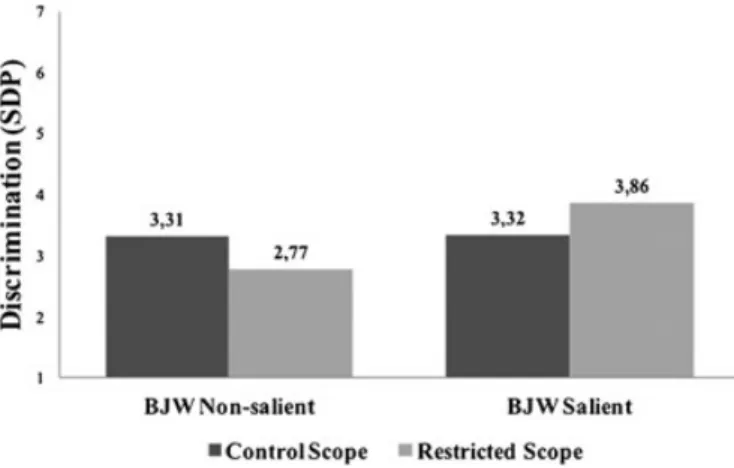
p= .06. As can be seen in Figure 2, when BJW was salient,
participants supported discriminatory policies against immi-grants to a greater extent in the restricted-scope-of-justice condi-tion (M = 3.86, SD = 0.75) than in the control condicondi-tion (M = 3.32, SD = 1.09), F(1, 85) = 4.06, p < .05, η2
p= .05. When
BJW was non-salient, there was no difference in the SDP between the condition in which the scope of justice was restricted (M = 2.77, SD = 0.99) and the control condition (M = 3.31, SD = 1.41), F(1, 85) = 2.11, ns, η2
p= .02. Analysing
the interaction from another perspective, we found that BJW influenced support for discriminatory policies against immi-grants in the condition where the scope of justice was restricted so that the SDP was higher when the BJW was salient than when it was not salient, F(1, 85) = 13.01, p = .001, η2
p= .13. In the
control condition of the scope of justice, the salience of the BJW did not influence SDP, F(1, 85) < 1, ns.
Discussion
This study replicates and extends the previous study by showing the first experimental evidence for the influence of the scope of justice on support for discriminatory policies. Importantly, this influence occurred only when the BJW was salient. These results are in accordance with our prediction that in a situation in which people are genuinely concerned with justice, a restricted scope of justice facilitates discrimination against a minority outgroup.
Although the effects are clearly in accordance with our hypotheses, there were some limitations on this study that could weaken our inference concerning the influence of the scope of justice on support for discriminatory policies and could open a window to alternative explanations. For instance, an alternative hypothesis might suggest that greater support for discriminatory policies was due not to the restricted scope of justice but to the fact that participants had engaged in a bogus
Figure 2. Support for discriminatory policies as a function of scope of justice and belief in a just world (BJW) (Study 2)
questionnaire task. In fact, participants in the control condition did not read an already completed scale equivalent to that read by participants in the restricted scope condition, varying only in the content of the manipulated construct. Another alter-native explanation could suggest that manipulating the scope of justice activated a perception of a “tighter superordinate category” rather than a concern for the applicability of justice. In this case, the obtained effect would not have been guided by a justice motive but by a mere superordinate-category effect. In order to overcome these shortcomings, we conducted another experimental study using a new manipulation for the restricted scope of justice.
STUDY 3
This study intended to replicate the previous one by showing that the influence of a restricted view of the scope of justice on support for discriminatory policies is guided by a justice motive. Moreover, we used a new manipulation strategy for the scope of justice and introduced a set of manipulation checks intended to address the alternative hypotheses that support for discriminatory policies is more influenced by the task and a superordinate-category effect than by concern for the applicability of justice.
As in the previous study, participants were invited to take part in a study concerning justice perceptions. In phase one, we manipulated the scope of justice by asking participants to organise a set of scrambled phrases that actually were the items on the scope-of-justice scale used in Study 1 (vs neutral phrases). In phase two, we manipulated the BJW by using a procedure similar to that used in Study 2. In the last phase, participants indicated their support for discriminatory policies against immigrants and answered manipulation-check measures for scope of justice, BJW and the perception of a superordinate category. We hypothesised that the influ-ence of the scope of justice on support for discriminatory policies is driven by a justice motivation so that participants will show greater support for discriminatory policies when engaged in a restricted scope-of-justice situation but only in the condition in which BJW is salient. We also reasoned that if this effect is guided by a justice motivation, then manipu-lating the scope of justice should affect the perception of applicability of justice but not a perception of superordinate category.
Method
Participants and Design
Eighty-eight Portuguese university students participated in this study (Mage= 25.6, SD = 8.06; 54 female, 33 male and 1
unreported). As in Study 2, the participants were randomly allocated to one condition of a 2 (BJW salient vs BJW non-salient) × 2 (restricted scope of justice vs control) between-subjects factorial design. Therefore, the control conditions for both manipulations had neutral backgrounds without any justice references.
Belief in a Just World Manipulation
The BJW-salient condition was the same as that used in Study 2. Participants in the non-salient BJW condition read a neutral text about reading habits.
Restricted Scope-of-Justice Manipulation
Participants in the restricted view condition were asked to write a paragraph using five scrambled sentences (actually the items on the restricted scope-of-justice scale). Participants were told that they could use the given sentences in any order they liked and that they could use connectors so that the paragraph made sense. In addition, they could not introduce any changes to the content of the sentences. In the control condition, participants carried out the same process using five neutral sentences involving phrases unrelated to the scope of justice (e.g., “In society, it is important to organise several events”; “It is preferable to arrange the events in such a way that they do not coincide in time and space”). The partic-ipants were then introduced to a task in which we manipu-lated the BJW.
Dependent Measure
The measure was the SDP scale such as that used in previous studies (α = .65).
Manipulation Checks
After answering the support-for-discriminatory-policies scale, participants were asked to state the words that spontaneously came to their mind when thinking about the tasks performed in the previous phases of the study. We used the number of words related to justice as a means of measuring the manipula-tion check in relamanipula-tion to BJW. The average number of words evoked that related to justice (e.g., “justice,” “merit” and “deserve”) was higher in the BJW-salient condition (M = 1.86, SD = 1.3) than in the non-salient condition (M = 1.38, SD = 1.3), t(1, 86) = 1.75, p = .04 (one tailed).
As a means of checking for the restricted scope-of-justice manipulation, participants were presented with a list of 10 sentences (the five items from the scale and the five neutral sentences from the control condition) and were asked to choose those that they thought were related to their concern in the tasks performed in the previous phases of the study. We counted the number of sentences that they chose that were related to the scope of justice. The participants chose more sentences from the scope-of-justice scale in the restricted-scope condition (M = 3.55, SD = .97) than in the control condition (M = 0.16, SD = .74), t(1, 84) = 18.24, p < .001. Thus, both procedures successfully activated the BJW and the scope of justice.
Finally, we asked participants to indicate where they placed themselves on a continuum ranging from Portuguese to Portuguese speakers or “Lusophone” (a superordinate category that includes both Portuguese nationals and Brazilian immi-grants) by using a 7-point scale (1 = “Portuguese” to 7 = “Lusophone”). The scope-of-justice manipulation did not influence the participants’ self-categorisation in that there was
no difference between the control (M = 2.25, SD = 1.57) and the restricted condition (M = 2.70, SD = 2.11), t(1, 85) = !1,12; ns. These results indicate that this manipulation did not activate a perception of a superordinate category.
Results
A 2 (BJW salient vs BJW non-salient) × 2 (restricted scope of justice vs control) between-subjects factorial ANOVA on the SDP revealed a main effect of the scope of justice. Participants in the restricted-scope condition supported discriminatory policies more (M = 3.58, SD = 1.07) than participants in the control condition (M = 3.13, SD = 0.97), F(1, 84) = 4.61, p = .035,η2
p= .05.
As predicted, this main effect was qualified by an interac-tion between the restricted view of the scope of justice and the BJW, F(1,84) = 3.92, p = .05, η2
p= .04 (Figure 3). In the
BJW-salient condition, participants expressed greater support for discriminatory policies in the condition of a restricted scope of justice (M = 3.73, SD = 1.02) than in the control condition (M = 2.84, SD = .97), F(1, 84) = 8.33, p < .01, η2
p= .09. In the BJW non-salient condition, the scope of justice
exerted no influence on the support for discriminatory policies (M = 3.39, SD = 0.91 vs M = 3.43, SD = 1.12), F(1, 84) < 1, ns. As in Study 2, we also analysed the interaction effect from another perspective, and we verified that the salience of BJW did not influence support for discriminatory policies in the condition where the scope of justice was restricted, F(1, 84) < 1, ns. However, in the control condition of the scope of justice, we found that the BJW has a marginal effect on SDP, F(1, 84) = 3.29, p = .07, so that participants’ SDP was lower in the BJW-salient condition than in the BJW non-salient condition. Finally, we conducted supplementary analysis in which we added the measure of superordinate category as a covariate in the analysis. The results indicated a reliable effect of the superordinate category on discrimination so that the greater the participants’ perception that nationals and immigrants share a common identity (i.e., the superordinate category of Lusophone), the lower the SDP (β = !0.23, p < .05), F(1, 82) = 4.70, p < .04, η2
p= .05. It is significant that the
pattern of results that we obtained does not change in accor-dance with whether the superordinate category is included in
the analysis. That is, the influence of the scope of justice and the moderating role played by the BJW occur independently of the effect of the superordinate category. In fact, when the BJW is salient, the restriction of the scope of justice influenced support for discriminatory policies against immigrants, F(1, 83) = 8.99, p < .01, η2
p= .10. When BJW was not salient,
the restricted scope of justice did not influence SDP, F(1, 83) < 1, ns.
Discussion
The results replicated the previous results using a new manip-ulation of the restricted scope of justice. According to our predictions, the restricted scope of justice influenced support for discriminatory policies only in the BJW-salient condition. This result allows us to reject the alternative hypothesis that participants showed greater support for discriminatory policies because they had engaged in a task of some kind because participants in the current study carried out the same task across the conditions of the scope of justice, which varied only in the concern for the relevance and applicability of fairness (vs non-justice related task). In addition, the analysis from the BJW perspective showed that this belief reduced discrimi-nation in the control condition of the scope of justice. This effect is complementary to our hypothesis because it suggests that individuals that are highly motivated to believe that the world is just tend to avoid supporting discrimination when it is not justified, that is, when they do not have a restricted view of the scope of justice.
Importantly, the results involving the manipulation checks and supplementary analysis demonstrated that participants in both scope-of-justice conditions did not group together national citizens and immigrants into a broader category, which allows us to reject the alternative hypothesis based on the superordinate-category effect. Moreover, despite the role played by this categorisation in reducing discrimination, it did not affect the influence of the scope of justice and the BJW on the SDP. Thus, this set of results is a strong test for our prediction that the influence of the scope of justice on dis-crimination is guided by a justice motive.
GENERAL DISCUSSION
In the present research, we analysed the role played by the scope of justice and belief in a just world in discrimination against immigrants. Study 1 explored this role in the relation-ship between prejudice and discrimination, revealing a media-tion effect in that more prejudiced individuals tended to restrict their perception of the scope of justice by saying that the justice principles that regulate national citizenship do not apply to their relations with immigrants. Furthermore, the more restricted the scope of justice was perceived to be, the more support individuals showed for discriminatory policies against immigrants. The results also indicated that the media-tion is needed only for participants with higher levels of BJW. The moderated mediation obtained suggests that restricting the scope of justice could represent a mechanism by which prejudice relates to discrimination for participants
Figure 3. Support for discriminatory policies as a function of scope of justice and support for discriminatory policies (BJW) (Study 3)
who are highly concerned with justice. This possibility suggests that prejudiced individuals could restrict their percep-tion of the scope of justice by holding the idea that the princi-ples of justice that guide national citizens do not apply to their relationship with immigrants, and so, it may be legitimate to deny them full political and civil rights.
The mediation role of the scope of justice can be interpreted within the framework of research and theory in social psyc-hology according to which prejudice and discrimination tend to persist because individuals have developed indirect ways and legitimated forms of discrimination (e.g., Crandall & Eshleman, 2003; Dovidio & Gaertner, 2004; Sidanius & Pratto, 1999). This interpretation also follows recent theorising and research on the legitimation of social inequalities, which pre-dicts that the relationship between prejudice and discrimination needs to be legitimised because individuals’ self-concepts hold internalised egalitarian justice principles that require them to have good reasons to discriminate (e.g., Pereira et al., 2009). Study 1 represents a unique contribution to this literature by demonstrating that restricting the scope of justice may function as an example of such a good reason. Importantly, it also represents a contribution to the existing literature on the scope of justice by investigating the mediating role that it plays in discrimination, besides using a measure that directly addresses individuals’ perceptions of relevance and applicability of fairness, which had not yet been demonstrated in this research field (see Hafer & Olson, 2003).
Studies 2 and 3 went further by testing experimentally whether the scope of justice influences discrimination and whether it is driven by the justice motivation as opera-tionalised by BJW. In accordance with our predictions, the results showed that individuals supported discriminatory policies against immigrants depending on whether they were submitted to a condition in which the scope of justice was restricted. Moreover, the results demonstrated that the BJW moderated this effect. In other words, participants in the condi-tion involving a restricted view of the scope of justice showed more support for discriminatory policies against immigrants after they had read a text about the importance of living in a just world than they did when they read a text that did not refer to justice.
In many ways, the most novel finding in this research is that the influence of the scope of justice on discrimination is, paradoxically, guided by a justice motive, which helps to illuminate some of the processes underlying the effects of justice motivation on intergroup attitudes. In this sense, we interpreted the results as one indication that justice motives play a central role in legitimating social inequalities (e.g., Dovidio & Gaertner, 2004; Jost, Pelham, Sheldon, & Sullivan, 2003; Pereira et al., 2010). In fact, BJW seems to make it necessary for individuals to pursue some legitimating justifica-tion for discriminajustifica-tion, for instance, by restricting their scope of justice.
Perhaps this situation has arisen because, in contemporary western societies, individuals genuinely have internalised egalitarian values and are encouraged to act in a fair way, which may generate psychological conflict when they need to behave towards members of socially disadvantaged minor-ity groups (see Crandall & Eshleman, 2003). This conflict might be stronger when individuals are concerned with justice
principles, such as when they need to maintain their belief that the world is a fair place. This is especially true in conditions when the scope of justice can play a legitimising role because it can be used as a good reason to derogate a target to which the ingroup’s justice principles are not applied (e.g., Deutsch, 1985; Opotow, 1995; Staub, 1989). This legitimation may have the psychological function of reducing the tension caused by the conflict between people being egalitarian and fair while acting in a discriminating way. Moreover, we also consider the possibility that another process for legitimising discrimination might exist. Rather than being motivated by prejudice to restrict the scope of justice and then justifying discrimination, individuals might first discriminate and then rationalise their behaviour by restricting their perception of the scope of justice. Although it is plausible that the process operates in this way, previous research has shown that the prejudice– justification discrimination hypothesis seems more likely because prejudiced individuals have the need to express discrimination (e.g., Pereira et al., 2009); however, because the anti-prejudice norm and anti-discrimination laws make the expression of discrimination undesirable, prejudiced individuals actively seek out justification for discriminatory behaviour (e.g., Pereira et al., 2010).
Limitations and further directions
There are more justice perceptions besides the scope of justice or the salience of BJW that probably influence intergroup conflicts and were not addressed in this investigation. Further research is needed to analyse the role played by other justice perceptions as legitimising factors in discrimination (e.g., descriptive and prescriptive meritocracy; see Son Hing et al., 2011). Also, we suggest that the same analysis should be carried out with different target groups (e.g., the homeless and the gypsy community). In addition, on the basis of Wenzel (2001) suggestion that social identity can also influence justice perceptions in intergroup attitudes, further research should consider the role played by the superordinate category as a potential moderator of the legitimising effect of the restricted scope of justice in discrimination. For instance, the manipula-tion of both variables (the restricmanipula-tion of the scope of justice and the superordinate category) could help to provide a better understanding of the complexity underlying the effect of the restricted scope of justice beyond the moderation role played by justice motivation.
Perhaps the main limitation of this research concerns the assumption that individuals feel a psychological tension that is brought about by the internalisation of both egalitarian justice principles and prejudiced attitudes, and beliefs towards historically disadvantaged minority groups. Although this assumption has been considered to be strongly plausible by all contemporary theories about prejudice and discrimination (e.g., Crandall & Eshleman, 2003; Dovidio & Gaertner, 2004; Pereira et al., 2009), it has not yet been directly tested in further experimental research. Another limitation is the non-differentiation between the motivations of low-prejudice and high-prejudice individuals to legitimise discrimination. We speculate that the need to legitimise discrimination may be different in individuals with low-prejudice and high-prejudice attitudes against minorities. There is a possibility
that in less prejudiced individuals, the need to justify discriminatory behaviour could be specifically related to the internalisation of egalitarian norms, and in more prejudiced individuals, the need to justify discrimination could derive from normative pressures in a society that prohibits and punishes discrimination against minorities.
Despite these limitations, this series of studies makes at least three contributions to the literature on the legitimation of social inequalities. First, it shows a way of articulating the idea of BJW in intergroup relations processes (see also Correia et al., 2007) in which the salience of BJW can have negative conse-quences on the integration of immigrants in Europe. Second, the operationalisation of the scope of justice is important in extending its use in intergroup-relation research in social psychology. Third, it represents a step forward in the process of acquiring knowledge of the relationship between justice perceptions and intergroup conflicts because it takes into account justice perceptions in considering the more general problem of the relationship between prejudice and discrimination.
ACKNOWLEDGEMENTS
This work was supported by a grant of the Fundação para Ciência e Tecnologia, Portugal, awarded to Aline Lima-Nunes (SFRH/BD/62066/2009) and to Cicero Roberto Pereira (PTDC/PSI-PSO/114159/2009). We thank Jorge Vala, Sven Waldzus, Hélder Alves and the Lisbon PSART group of the Institute of Social Sciences of the University of Lisbon for their helpful comments on previous versions of these studies. We would also like to thank Radmila Prislin and two reviewers for their insightful comments that greatly contrib-uted to improving this paper.
REFERENCES
Alves, H., & Correia, I. (2008). On the normative of expressing the belief in a just world: Empirical evidence. Social Justice Research, 21, 106–121. DOI: 10.1007/s11211-007-0060-x
Correia, I, & Vala, J. (2003). When will a victim be secondarily victimized? The effect of observer’s belief in a just world, victim’s innocence and persistence of suffering. Social Justice Research, 16, 379–400.
Correia, I., Vala, J., & Aguiar, P. (2007). Victim’s innocence, social categori-zation, and the threat to the belief in a just world. Journal of Experimental Social Psychology, 43, 31–38. DOI: 10.1016/j.jesp.2005.12.010
Coryn, C. L. S., & Borshuk, C. (2006). The scope of justice for muslim Americans: Moral exclusion in the aftermath of 9/11. The Qualitative Report, 11, 568–604.
Costa-Lopes, R., Dovidio, J. F., Pereira, C. R., & Jost, J. T. (2013). Social psychological perspectives on the legitimation of social inequality: Past, present and future. European Journal of Social Psychology, 43(4), 229–237. Crandall, C. S., & Eshleman, A. (2003). A justification–suppression model of the expression and experience of prejudice. Psychological Bulletin, 129, 414–446. DOI: 10.1037/0033-2909.129.3.414
Dalbert, C. (2001). The justice motive as a personal resource: Dealing with challenges and critical life events. New York: Kluwer Academic/Plenum Publishers.
Dalbert, C., Montada, L., & Schmitt, M. (1987). Glaube an die gerechte welt als motiv: Validierung zweier skalen [The belief in a just world as a motive: Validation of two scales]. Psychologische Beitrage, 29, 596–615. Deutsch, M. (1985). Distributive justice. New Haven, CT: Yale University
Press.
Dovidio, J. F., & Gaertner, S. L. (2004). Aversive racism. In M. P. Zanna (Ed.), Advances in experimental social psychology (Vol. 36, pp. 1–52). Thousand Oaks, CA: Sage.
European Union Agency for Fundamental Rights – FRA. (2009). EU-MIDIS European union minorities and discrimination survey.
Gaertner, S. L., & Dovidio, J. F. (1986). The aversive form of racism. In J. F. Dovidio, & S. L. Gaertner (Eds.), Prejudice, discrimination, and racism (pp. 61–89). San Diego: Academic Press.
Gaertner, S. L., & Dovidio, J. F. (2005). Understanding and addressing contemporary racism: From aversive racism to the common ingroup identity model. Journal of Social Issues, 61, 615–239.
Hafer, C. L., & Bègue, L. (2005). Experimental research on just-world theory: Problems, developments, and future challenges. Psychological Bulletin, 131, 128–167. DOI: 10.1037/0033-2909.131.1.128
Hafer, C. L., & Olson, J. M. (2003). An analysis of empirical research on the scope of justice. Personality and Social Psychology Review, 7, 311–323. Jost, J. T., & Banaji, M. R. (Eds.) (2001). The psychology of legitimacy:
Emerging perspectives on ideology, justice, and intergroup relations. Cambridge: Cambridge University Press.
Jost, J. T., Pelham, B. W., Sheldon, O., & Sullivan, B. N. (2003). Social inequality and the reduction of ideological dissonance on behalf of the sys-tem: Evidence of enhanced system justification among the disadvantaged. European Journal of Social Psychology, 33, 13–36. DOI: 10.1002/ejsp.127 Katz, I., & Hass, R. G. (1988). Racial ambivalence and American value conflict: Correlational and priming studies of dual cognitive structures. Journal of Personality and Social Psychology, 55, 893–905.
Lages, M. F., Policarpo, V. M., Marques, J. C. L., Matos, P. L., & António, J. H. C. (2006). Os imigrantes e a população portuguesa: Imagens recíprocas [Immigrants and the Portuguese population: Reciprocal images]. Observatório da Imigração 21, 237–259.
Lerner, M. J. (1977). The justice motive: Some hypotheses as to its origins and forms. Journal of Personality, 45, 1–52. DOI: 10.1111/j.1467-6494.1977. tb00591.x
Lerner, M. J. (1980). The belief in a just world: A fundamental delusion. New York: Plenum Press.
Lerner, M. J., Miller, D. T., & Holmes, J. G. (1976). Deserving and the emergence of forms of justice. In L. Berkowitz, & E. Walster (Eds.), Advances in experi-mental social psychology (Vol. 9, pp. 133–162). New York: Academic Press. Muller, D., Judd, C. M., & Yzerbyt, V. (2005). When moderation is mediated
and mediation is moderated. Journal of Personality and Social Psychology, 89, 852–863.
Olson, J., Cheung, I., Conway, P., Hutchison, J., & Hafer, C. (2011). Distinguishing two meanings of moral exclusion: Exclusion from moral principles or principled harm-doing? Social Justice Research, 24, 365–390. DOI: 10.1007/s11211-011-0141-8
Opotow, S. (1990). Deterring moral exclusion. Journal of Social Issues, 46, 173–182.
Opotow, S. (1994). Predicting protection: Scope of justice and the natural world. Journal of Social Issues, 50, 49–63.
Opotow, S. (1995). Drawing the line: Social categorization, moral exclusion, and the scope of justice. In B. B. Bunker, & J. Z. Rubin (Eds.), Conflict, cooperation, and justice (pp. 347–369). San Francisco: Jossey-Bass. Opotow, S. (1997). What’s fair? Justice issues in the affirmative action
debate. American Behavioral Scientist, 41, 232–245. DOI: 10.1177/ 0002764297041002006.
Otto, K., & Dalbert, C. (2005). Belief in a just world and its functions for young prisoners. Journal of Research in Personality, 39, 559–573. Pereira, C., Vala, J., & Costa-Lopes, R. (2010). From prejudice to
discrimina-tion: The legitimizing role of perceived threat in discrimination against immigrants. European Journal of Social Psychology, 40, 1231–1250. DOI: 10.1002/ejsp
Pereira, C., Vala, J., & Leyens, J.-P. (2009). From infra-humanization to discrimination: The mediation of symbolic threat needs egalitarian norms. Journal of Experimental Social Psychology, 45, 336–344. DOI: 10.1016/ j.jesp.2008.10.010
Pettigrew, T. F., & Meertens, R. W. (1995). Subtle and blatant prejudice in western Europe. European Journal of Social Psychology, 25, 203–226. Sidanius, J., & Pratto, F. (1999). Social dominance. New York: Cambridge
University Press.
Son Hing, L. S., Bobocel, D. R., Zanna, M. P., Garcia, D. M., Gee, S. S., & Orazietti, K. (2011). The merit of meritocracy. Journal of Personality and Social Psychology, 101, 433–450. DOI: 10.1037/a0024618.
Staub, E. (1989). The roots of evil: Origins of genocide and other group violence. New York: Cambridge University Press.
Vala, J., Lopes, D., & Lima, M. (2008). Black immigrants in Portugal: Luso-tropicalism and prejudice. Journal of Social Issues, 64, 287–302. Wenzel, M. (2000). Justice and identity: The significance of inclusion for
perceptions of entitlement and the justice motive. Personality and Social Psychology Bulletin, 26, 157–176.
Wenzel, M. (2001). A social categorization approach to distributive justice: Social identity as the link between relevance of inputs and need for justice. British Journal of Social Psychology, 40, 315–335.