Virtual Palaces, Part II
Lost Palaces and their Afterlife
Virtual Reconstruction between Science and Media
Edited by
Virtual Palaces, Part II
Lost Palaces and their Afterlife
PALATIUM e-Publication 3
Virtual Palaces, Part II
Lost Palaces and their Afterlife
Virtual Reconstruction between
Science and Media
Edited by
Stephan Hoppe & Stefan Breitling
With the assistance of
Heike Messemer
PALATIUM
München 2016
PALATIUM e-Publications
Volume 3
Series Editors: Krista De Jonge and Pieter Martens
Published in the same series:
Vol. 1 The Habsburgs and their Courts in Europe, 1400–1700
Edited by Herbert Karner, Ingrid Ciulisová and Bernardo J. García García (2014) Vol. 2 Virtual Palaces, Part I. Digitizing and Modelling Palaces
Edited by Pieter Martens, with the assistance of Heike Messemer (2016)
The work reported on in this publication has been financially supported by the European Science Foundation (ESF) in the framework of the Research Networking Programme PALATIUM. Court
Residences as Places of Exchange in Late Medieval and Early Modern Europe (1400-1700),
2010-2015.
The European Science Foundation was established in 1974 to pro-vide a common platform for its Member Organisations to advance European research collaboration and explore new directions for research. It is an independent organisation, owned by 67 Member Organisations, which are research funding organisations, research performing organisations and academies from 29 countries. ESF promotes collaboration in research itself, in funding of research and in science policy activities at the European level. Currently ESF is re-ducing its research programmes while developing new activities to serve the science community, including peer review and evaluation services.
PALATIUM is supported by 14 organisations from 11 countries: Austrian
Science Fund (FWF) • Austrian Academy of Sciences (ÖAW) • Research
Foundation Flanders, Belgium (FWO) • Czech Science Foundation
(GACR) • Academy of Sciences of the Czech Republic (ASCR) • Danish
Agency for Science, Technology and Innovation (FI) | The Danish Council for Independent Research | Humanities (FKK) • National Centre for
Sci-entific Research, France (CNRS) • German Research Foundation (DFG) • Netherlands Organisation for Scientific Research (NWO) • Foundation
for Science and Technology, Portugal (FCT) • Slovak Academy of
Scienc-es (SAV) • Slovak Research and Development Agency (APVV) • Carlos de
Amberes Foundation, Spain (FCA) • Swedish Research Council (VR). http://www.courtresidences.eu/
The PALATIUM workshop Virtual Palaces, Part II. Lost Palaces and their Afterlife. Virtual
Recon-struction between Science and Media, held in Munich on 13-14 April 2012, received additional
support from the Ludwig-Maximilians-Universität München and the Otto-Friedrich-Universität Bamberg.
© Ludwig-Maximilians-Universität München, Otto-Friedrich-Universität Bamberg, KU Leuven and authors, 2016 ISBN 978-94-6018-538-0 open access digital version
Copyright: This is an open access work distributed under the terms of the Creative Commons Attribution-ShareAlike
4.0 International License (CC BY-SA 4.0), which permits unrestricted use, distribution and reproduction in any medium, provided that the original author and source are properly credited and that any adaptations or derivative works are distributed under the same license. Copyright is retained by the authors.
Cover image: Bamberg, Alte Hofhaltung at around 1300. Overlay of the medieval palace with the photorealistic model
of the surrounding area, as it is today. Breitling/Buba/Fuhrmann/Uni Bamberg 2012, building research by Burandt 1998, nowadays city model by Carlo Schramm, Stadtplanungsamt Bamberg 2012.
Contents
AcknowledgementsStephan Hoppe, Stefan Breitling 7
Preface
Krista De Jonge 9
Virtual Palaces, Digital Images – an Introduction
Stephan Hoppe, Stefan Breitling 11
The Beginnings of Digital Visualization of Historical Architecture in the Academic Field
Heike Messemer 21
Virtual Reconstructions and Building Archaeology in Bohemia. A Digital Model of the 14th-Century House U zvonu (‘Zur Glocke’ / ‘At the Sign of the Bell’) in Prague
Michael Rykl 55
3D Reconstruction of Cultural Heritage Artifacts. A Literature Based Survey of Recent Projects and Workflows
Sander Münster, Thomas Köhler 87
Visualisation of Uncertainty in Archaeological Reconstructions
Dominik Lengyel, Catherine Toulouse 103
Sharpness Versus Uncertainty in ‘Complete Models’. Virtual Reconstructions of the Dresden Castle in 1678
Marc Grellert, Franziska Haas 119
A Review of Sources for Visualising the Royal Palace of Angkor, Cambodia, in the 13th Century
Tom Chandler, Martin Polkinghorne 149
Medieval Castles and their Landscape. A Case Study towards Historic Reconstruction
Building Knowledge Spaces. Scientific Reconstruction and Modeling of the Medieval City of Bamberg
Stefan Breitling, Martin Buba, Jan Fuhrmann 201
Virtually Rebuilding the Palace of Vila Viçosa in Portugal. From the Present to the Time of D. Teodósio I (16th Century)
Ana Catarina G. Lopes 209
Visualizations of Rubens’s Palazzos of the 17th Century in the Antwerp ‘Nieuwstadt’
Piet Lombaerde, Marc Muylle 221
City & Spectacle: A Vision of Lisbon Before the 1755 Great Earthquake
Alexandra Gago da Câmara, Helena Murteira, Paulo Rodrigues 245
Back to the Future. Visualizing the Planning and Building of the Dresden Zwinger from the 18th until the 19th Century
Peter Heinrich Jahn, Markus Wacker, Dirk Welich 267
Hoppe & Breitling (eds.): Virtual Palaces, Part II. Lost Palaces and their Afterlife, München 2016 209
-Virtually Rebuilding the Palace of Vila Viçosa
in Portugal
From the Present to the Time of D. Teodósio I (16th Century)
Ana Catarina G. Lopes (EAUM – Escola de Arquitectura da Universidade do
Minho / CHAM – Centro de História de Além-Mar, Portugal)
Studying the Palace of Vila Viçosa (fig.1) as an element of Portuguese architectural history became essential to the FCT research project De Todas as Partes do Mundo. O Património do 5.º Duque
de Bragança, D. Teodósio I / All his Wordly Possessions. The Inventory of the 5th Duque of Bra-gança, D. Teodósio I.1 Since the beginning of the project, the research team has been working on
an inventory of extraordinary value, revealing the goods, the cultural and intellectual interests of an important aristocrat of the 16th century, D. Teodósio, describing in detail and giving us a rare and amazing view of the material world of a prince of the Portuguese Renaissance. The Duque was from one of the most powerful families of his time. His father, D. Jaime (who was nephew of the king D. Manuel), ordered the construction of a palace in 1501 in southern Portugal to mark the land that the king had offered him. I began collaborating with the research team in order to virtually reconstruct the Palace of Vila Viçosa and its surroundings, in the time of D. Teodósio I (the first half of the 16th century).
Hoppe & Breitling (eds.): Virtual Palaces, Part II. Lost Palaces and their Afterlife, München 2016 210
-Lopes: ‘Virtually Rebuilding the Palace of Vila Viçosa’
The Major Aims of the Ongoing Work Framed in the Workshop Virtual Palaces II
As an architect and a teacher in the field of the history of Portuguese architecture, the interest for the study of architectural heritage has aroused in me a special interest in virtually design-ing and reconstructdesign-ing architectural structures as material to be deeply analysed, thus producdesign-ing know-ledge, especially in its interaction with the territory and the cultural contexts that produced historical monuments. The idea of participating in an interdisciplinary forum to discuss the con-tribution of virtual reconstructions and its various methods was something I found of extreme interest. It allowed for obtaining a greater insight into architectonic structures and their physical space, rhetoric representations and how to better inform the scientific community on the inves-tigations’ results.
D. Teodósio was responsible for the renewal and extension of his family’s residence, turning it into a palace that followed the most erudite Italian models – a clear demonstration of his adherence to what was most advanced in European architecture of that time. Several changes have been made to the palatial spaces until the present day, but with the documentation under study and through an interpretation of the existing building, we believe one can virtually rebuild its architecture in a unique approach to the history of this ducal house.
The short communication I was able to do2 wished to report on how we were developing
this work, sharing the possible methods I have been using and comparing them with some case studies that I have been analysing, framing the study of the Palace of Vila Viçosa (from the present to the first half of 16th century). The work aimed to include the registration of all the metric and geometric information – architectural and topographical surveys, counting with photogrammetry. We have always considered the architectural survey a fundamental tool to proceed with rigorous studies of the historical structure. It is fundamental to acquire it, as it allows to test, clarify the types, forms, functions and geometries of this complex, allowing to launch interpretations related to the artistic domain and functional programme, as well as the evaluation of the possible impact of different construction phases.
At the time of the meeting in Munich, the research project was already underway for some time, but the architectural work of virtual reconstitution was really just starting and already had several process changes. The short presentation became an opportunity to report how we intended to develop the work. And for that it was important to reflect briefly about one or two examples of other case studies we have carried out. Its results have been quite satisfying and, therefore, we wanted to apply the same methodology to study the Palace of Vila Viçosa.
Hoppe & Breitling (eds.): Virtual Palaces, Part II. Lost Palaces and their Aft erlife, München 2016 211
-L����: ‘V�������� R��������� ��� P����� �� V��� V�����’
Other Case Studies
Working as a researchassistant at the Centro de História de Além-Mar (CHAM) has allowed me to be part of some research projects about castles and military sett lements built in the fi rst half of the 16th century by the Portuguese overseas, parti cularly in Morocco (fi gs. 2-4). The drawings and three-dimensional representati ons reproduced results of architectural and topographical surveys, including photogrammetry. The works always begin with the registrati on of all the metric and geometric informati on of the architectural remains. Someti mes we resort to the use of technology, on other occasions we work with the support of more traditi onal methods, usually adapti ng the best tool to each situati on. At each ti me of the fi eldwork it is necessary to decide what informa-ti on is esseninforma-ti al and what is detrimental to capture the formal features of the architectonic object we wish to comprehend. The architectural survey is fundamental to proceed with rigorous studies of the historical structure, but someti mes it is hard to decide where to exactly point out the laser to accurately locate and measure damaged structures. At other ti mes, it is impossible to reach the enti re spaces with the topography equipment or it simply becomes easier to do some manual measurements, using a triangulati on method overlapping some points topographically calculated as a common axis vector. AutoCAD is the soft ware I use to work out the metric and rigorous data as vector informati on of the current state of the building, with all its formal characteristi cs. The collected material is then processed and produced in 2D and 3D reconstructi ons in terms of seek-ing interpretati ons and studies produced on the architectural work. It is always possible to go back and remake these drawings and handle their representati veness. Aft er this, I export the data to another program – SkechUP, that greatly simplifi es choosing views, imposing shadows caused by simulated sunlight and deciding the graphical representati on. As a fi nal treatment of the images produced, we use Photoshop and Illustrator. We never seek realisti c representati ons, but we pre-fer to create virtual models that can be updated at any moment.
Fig. 2 Three-dimensional reconstructi on of the Portuguese military sett lement and urban occupati on in Azemmour, Morocco, 2009.
Hoppe & Breitling (eds.): Virtual Palaces, Part II. Lost Palaces and their Aft erlife, München 2016 212
-L����: ‘V�������� R��������� ��� P����� �� V��� V�����’
Fig. 3 Three-dimensional reconstructi on of the Portuguese military sett lement in Safi , Morocco, 2010.
Fig. 4 Plan of the Portuguese military sett lement in Ksar – Seghir, Morocco (survey of the remaining ruins) and close up of the citadel’s plan, 2011.
These are the fundamental tools that permit us to test and clarify the geometries of the ele-ments under study, allowing launching interpretati ons related to the arti sti c domain and functi onal programme, as well as the evaluati on of the possible impact of diff erent constructi on phases.
Hoppe & Breitling (eds.): Virtual Palaces, Part II. Lost Palaces and their Afterlife, München 2016 213
-Lopes: ‘Virtually Rebuilding the Palace of Vila Viçosa’
Some of this work is also important as testimony of built heritage, which sometimes is on the brink of disappearing. This is the case of the Château de Mer in Safi, which is about to be destroyed by the sea. In Azemmour, the urban and architectonic studies have defined the best sites for archaeologists to carry out their excavations. With their findings, we made some virtual reconstructions of structures that disappeared with time (fig. 5). As an architect, my vision will always be more focused on issues like metrics, ratios, geometry, materials and construction sys-tems. Collaborating with other professionals, particularly with surveyors, archaeologists and art historians has shown me that the crossing of several disciplines can produce the real (re)creation of knowledge for the reconstruction of architectural spaces and life styles of the cultural heritage.
Fig. 5 Reconstitution of the bulwark excavated by the archaeologists recovering the moat section, Azemmour, Morocco, 2009.
I studied proportions, ways of building, tested the knowledge of the Portuguese build-ers concerning the treatises of their time and verified if the workmen complied with the ordbuild-ers of the King that have been interpreted by historians. The analysis of the data obtained allowed us to identify some interesting mathematic rules and geometries used by the constructors, understanding their architectural solutions to the challenges they had. It was also possible to overlay the three-dimensional reconstructions with coeval iconography to check the accuracy be-tween representation and reality. This joint work enabled an improved understanding of its con-tinuous overlaps and multiplied conceptual elements that were introduced over time, so we could better read its architecture and virtually rebuild it in its original form.
Hoppe & Breitling (eds.): Virtual Palaces, Part II. Lost Palaces and their Afterlife, München 2016 214
-Lopes: ‘Virtually Rebuilding the Palace of Vila Viçosa’
Studying the Palace of Vila Viçosa
We planned to do the same kind of work and subsequent research on the Palace in question. Today, the palace serves as a museum and belongs to a foundation established in the early 20th century: the Fundação Casa de Bragança, with which we had to establish some protocols. Our study focuses on the structures that constitute the ground floor and the noble floor, as it is known that the third level is the result of a more recent construction campaign. But these are the main floors of the museum, which is open almost every day of the week and weekend and receives a huge number of visitors. This could hinder the progress of measurement, drawing and observa-tion fieldworks, and all this made it necessary to coordinate things between us and the staff and officials of the palace.
We started studying the palace as it is nowadays, starting from a few architectural drawings that report its physical status over time, going back to 1845. Together with the meager historical information, we were just learning a little more about the building history, crossing information with the rest of the research team, recognizing the physical changes that its architecture suffered with the continuous periods of construction.
We already had a strategy and a timetable for the survey work, when we were informed that there was no authorization to develop this kind of effort, because it could jeopardize the safety of the museum and its exhibits. Thus, we decided to develop an alternative approach – we would have to use the existing drawings to compare different stages of the building’s existence. But we soon realized that those plans were not truly realistic and perhaps, we could be compro-mised to achieve accurate results of architectural historiography. We wanted to recognize and draw the functional distribution of the Palace and for that it will be very important to cross the possible analysis of those drawings with the documents that the inventory of D. Teodósio in-cludes (such as letters, account books, descriptions of preparations for family weddings and their festivities taking place in the residence and even records of building work and its payments, in-cluding measurements of what was executed).
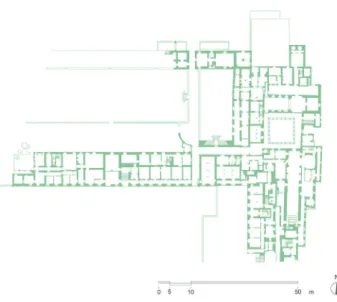
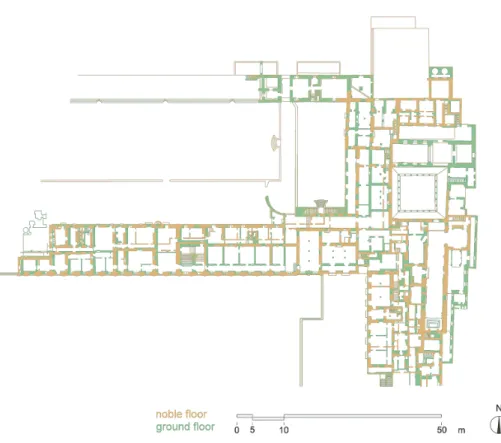
Moreover, there was still no graphical database for us for working on the virtual models. We decided to draw over the most recent plans, line by line, to have a basis to work on (figs. 6-7). Having done this, we asked for permission to walk through the Palace, only to make notes on our drawings about some of the interior walls and even some ceilings and doors that have been changing until the last few years. We also requested to register only a few measurements just to serve as a comparison with our projections. This appeal was accepted, and we visited Vila Viçosa for this fieldwork. At that time we already had the plans that resulted from combining informa-tion from the different existing drawings. The outcome of the overlapping between floors had an evident failure, once almost neither of the main walls had a structural overlay (fig. 8). We were dealing with a large degree of uncertainty and definitely would have different results than we ex-pected to obtain with our usual process doing archaeology of the architecture. The ancient plans
Hoppe & Breitling (eds.): Virtual Palaces, Part II. Lost Palaces and their Afterlife, München 2016 215
-Lopes: ‘Virtually Rebuilding the Palace of Vila Viçosa’
we had access to are ideal representations of the Palace, with too many orthogonal angles – a constructive stiffness that we know is not usual in these buildings. And drawing over some scans brings several irregularities of perception. One can read the spatial relationships, but not the built reality. With this outcome, and because it was really a waste of opportunity to develop such a study without being able to make a proper architectural survey in a building that still exists, we got back to having the authorization to carry out the work as we had envisioned originally.
Fig. 6 Drawing of the ground floor of the Palace of Vila Viçosa, obtained by vectorization of overlapped scans of the existing plans (2012).
Fig. 7 Drawing of the noble floor of the Palace of Vila Viçosa, obtained by vectorization of overlapped scans of the existing plans (2012).
Hoppe & Breitling (eds.): Virtual Palaces, Part II. Lost Palaces and their Afterlife, München 2016 216
-Lopes: ‘Virtually Rebuilding the Palace of Vila Viçosa’
Fig. 8 Superimposition of the two plans under study (2012).
Observing some of the areas of that courtly architecture gave several hints that required us to update our information. We had already detected some clues that we wanted to confirm and it is surely more appropriate to obtain a deeper knowledge of the Palace prior to the survey. We are used to detecting different wall thicknesses or to look at the different types of cutouts of doors and windows with its construction details and thus realize the architectonic fractures and continuities, so it is very important to deeply know every detail of the building. Another way to search for the original Palace structure is by looking at some of the ceilings that are now inter-rupted and reconstituting those spaces, or trying to fit the tile panels from the time of D. Teodósio that are now being recovered – in its overall composition they should fit up with some of the main rooms.
With this kind of analysis of empirical surveillance, at the time of this communication it was already possible to propose a possible development of the palace over time. It was a primary projection, only reporting a possible volumetric evolution. We still have so much to learn, mainly concerning what D. Teodósio had to deal withwhen he decided to increase his family’s residence and how he imposed an advanced form of architecture in a preexisting structure.
Hoppe & Breitling (eds.): Virtual Palaces, Part II. Lost Palaces and their Afterlife, München 2016 217
-Lopes: ‘Virtually Rebuilding the Palace of Vila Viçosa’
The Continuous Research
At this time, we have concluded the survey work but the investigation is ongoing. We continue to discuss the issues regarding the communication of the architectural research so that the Palace can be perceived not only by specialists in this fieldwork. It is important that this knowledge can be shared with the whole public.
We are looking for a virtual model that fits specifically in giving a physical and architectural context to the existence of the 6303 objects surveyed over 637 folios. The 3D models and plans that reconstruct the architectural spaces change our view about the past, both as researchers and as citizens. They also make it possible to be continuously questioning interpretative options, and redefining architectural hypothesis. There is an awareness of the fact that these virtual re-constructions change the standard tools used in teaching and learning about art and architectural history. They allow people to earn a visual consciousness that becomes more attractive and coher-ent than the interpretative variations that literature allows. It is clear for the researchers of the D.
Teodósio research project that the purpose of these models should be to recover the measures,
spaces, and architectural language of buildings (palaces, in this case), helping to reflect on the construction processes and materials that were applied, and clarifying their different stages of existence. Digital reconstructions are increasingly becoming one of the key resources of the re-search teams in the field of art and architectural history. One can say that, despite the advanced technology that already exists, in this kind of researches this is something that is still maturing. Renderings and movies demonstrate certain capabilities that are now being adopted and that make it inevitable to take up these tools as a part of its growing development.
Hoppe & Breitling (eds.): Virtual Palaces, Part II. Lost Palaces and their Afterlife, München 2016 218
-Lopes: ‘Virtually Rebuilding the Palace of Vila Viçosa’
Bibliography
Almeida, Rodrigo Vicente de, A cruz de Vila Viçosa – monografia histórica redigida à vista de
docu-mentos inéditos existentes na Biblioteca Real da Ajuda, 2nd edn (Lisbon, 1957).
Bello, António Burnay and Lucena, Armando de, Os Jardins do Paço Ducal de Vila Viçosa (Lisbon, 1955). Correia, Jorge and Lopes, Ana, ‘L’espace urbain d’Azemmour pendant la domination portugaise: bilan de la première mission’, in Portugal e o Mabrebe. Actas do Congresso Internacional de
História, (Lisbon, 2011), pp. 199-212.
Correia, Jorge, Implantação da cidade portuguesa no Norte de África: da tomada de Ceuta a
mea-dos do século XVI (Porto, 2008).
Cunha, M. S. da, ‘Nobreza, Rivalidade e Clientelismo na Primeira Metade do Século XVI’, Penélope:
Revista de História e Ciências Sociais, 29 (2003), pp. 33-48.
Cunha, Rui Maneira, As medidas na arquitectura, séculos XIII-XVII. O estudo de Monsaraz (Casal de Cambra, 2003).
Fundação da Casa de Bragança, Paço Ducal de Vila Viçosa (Vila Viçosa, 2000). Gil, Júlio, Os mais belos castelos de Portugal (Lisbon, 1992).
González García, Juan Luis (ed.), Los inventarios de Carlos V y la familia imperial (Madrid, 2010). Matos, Luís de, A corte literária dos Duques de Bragança no Renascimento (Lisbon, 1956). Moreira, Rafael (ed.), História das Fortificações Portuguesas no Mundo (Lisbon,1989).
Ricard, Robert, ‘Sur la chronologie des fortifications portugaise d’Azemmour, Mazagan et Safi’, in proceedings of Congresso do Mundo Português, (Lisbon, 1940) vol. III, pp. 107-117.
Serrão, Vítor, O fresco maneirista do Paço de Vila Viçosa: Parnaso dos Duques de Bragança,
1540-1640 (Caxias, 2008).
Sousa, A. C. de, Provas da História Genealógica da Casa Real Portuguesa (Lisbon, 1739). Teixeira, J., O Paço Ducal de Vila Viçosa, (Caxias, 1983).
Hoppe & Breitling (eds.): Virtual Palaces, Part II. Lost Palaces and their Afterlife, München 2016 219
-Lopes: ‘Virtually Rebuilding the Palace of Vila Viçosa’
Sources (unpublished)
Viana, Abel, Notas de Arqueologia Alto-Alentejanas, Materiais do Museu Arqueológico do Paço Ducal de Vila Viçosa (1955).
Sites (web)
http://cham.fcsh.unl.pt/teodosio.html
Illustrations
Fig. 1 Ana Lopes (author’s photo), Palace of Vila Viçosa, Vila Viçosa, Portugal.
Fig. 2 Ana Lopes, Three-dimensional reconstruction of the Portuguese military settlement in Safi, done under the research project ‘Portugal and southern Morocco: Contacts and Clashes between the XV and XVIII’ [FCT PTDC/HAH/71027/2006], Morocco, 2010.
Fig. 3 Ana Lopes, Three-dimensional reconstruction of the Portuguese military settlement and ur-ban occupation in Azemmour, done under the research project ‘Portugal and southern Morocco: Contacts and Clashes between the XV and XVIII’ [FCT PTDC/HAH/71027/2006], Morocco, 2009. Fig. 4 Ana Lopes, Plan of the Portuguese military settlement in Ksar—Seghir (remaining ruins’ survey) and zoom of the citadel’s plan, done under the research project ‘Cities and architectures of Portuguese origin in northern Morocco: Asilah and Alcacer Ceguer’ [FCT / CNRST], Morocco, 2011.
Fig. 5 Ana Lopes, Drawing reconstitution of the bulwark excavated by the archaeologists recov-ering the moat section of the Portuguese castle in Azemmour, done under the research project ‘Portugal and southern Morocco: Contacts and Clashes between the XV and XVIII’ [FCT PTDC/ HAH/71027/2006], Morocco, 2009.
Fig. 6 Ana Lopes and Nuno Senos, Drawing of the ground floor of the Palace of Vila Viçosa, ob-tained by vectorization of overlapped scans of the existing plans, done under the project ‘All His Worldly Possessions. The patrimony of the 5th Duke of Bragança, D. Teodósio I’, [PTDC/EAT-HAT/098461/2008], Portugal, 2012.
Fig. 7 Ana Lopes and Nuno Senos, Drawing of the noble floor of the Palace of Vila Viçosa, ob-tained by vectorization of overlapped scans of the existing plans, done under the project ‘All
Hoppe & Breitling (eds.): Virtual Palaces, Part II. Lost Palaces and their Afterlife, München 2016 220
-Lopes: ‘Virtually Rebuilding the Palace of Vila Viçosa’
His Worldly Possessions. The patrimony of the 5th Duke of Bragança, D. Teodósio I’, [PTDC/EAT-HAT/098461/2008], Vila Viçosa, Portugal, 2012.
Fig. 8 Ana Lopes and Nuno Senos, Drawing superimposing the two plans of the Palace under study, done under the project ‘All His Worldly Possessions. The patrimony of the 5th Duke of Bra-gança, D. Teodósio I’, [PTDC/EAT-HAT/098461/2008], Vila Viçosa, Portugal, 2012.
1 The paper here presented concerns the first phase of works that I have been developing as a member of the research team of the project ‘All His Worldly Possessions. The patrimony of the 5th Duke of Bragança,
D. Teodósio I’, Centre of Overseas History (CHAM), Faculdade das Ciências Sociais e Humanas, Universidade Nova de Lisboa and the Universidade dos Açores, in collaboration with the Foundation of the House of
Bra-ganza (FCB), and financed by the Fundação para a Ciência e Tecnologia [PTDC/EAT-HAT/098461/2008]. The project is directed by Jessica Hallett (coord.), Nuno Senos (CHAM) and Maria de Jesus Monge (FCB). 2 The accepted submission I made to the European Scientific Foundation, for a short visit grant, made it possible for me to attend the workshop Virtual Palaces, Part II.