New developments on fibre optic colorimetric
sensors for dissolved CO
2
in aquatic environments
L. Coelho
CAP / INESC TEC - Technology and Science, Faculty of Sciences, University of Porto, Rua do Campo Alegre,
Porto, Portugal [email protected]
João Mendes
CIIMAR, University of Porto, Porto, Portugal [email protected]
J. M. M. M. de Almeida
CAP / INESC TEC - Technology and Science, Faculty of Sciences, University of Porto, Rua do Campo Alegre,
Porto, Portugal
Department of Physics, School of Sciences and Technology, Universidade de Trás-os-Montes e Alto Douro
Vila Real, Portugal [email protected] B. Kovacs and K. Balogh
University of Pécs, Department of General and Physical Chemistry, Pécs, Hungary
[email protected] and [email protected]
Carlos Pereira
Centro de Investigação em Química Linha 4, Faculdade de Ciências da Univ. do Porto, Dep. de Química e Bioquímica,
Porto, Portugal [email protected]
Teresa Borges
Biology Department, Science Faculty, Faculty of Sciences, University of Porto, Porto, Portugal
CIIMAR, University of Porto, Porto, Portugal [email protected]
P.A.S. Jorge
CAP / INESC TEC - Technology and Science, Faculty of Sciences, University of Porto, Rua do Campo Alegre,
Porto, Portugal
Department of Physics and Astronomy of Faculty of Sciences, University of Porto
Porto, Portugal [email protected]
Abstract—The detection of dissolved carbon dioxide (dCO2)
is made possible through a colorimetric effect that occurs in a sensitive membrane. The reaction with dCO2 changes the pH of
the membrane causing a small difference in its colour which results in a characteristic absorbance spectrum band near 435 nm. A sensing platform based on this effect was developed and tested in gaseous and in aqueous environments. It is a combination of a bundle of large core fibre optics (with diameters above 200 µm) with light emission diodes (LEDs) in the visible range of the spectrum, a silicon photodetector and a polymer membrane sensitive to CO2. A variation in the absorption of
3 / %VV was obtained in the range from 0 to 1.6 % of gaseous CO2 with an estimated response time below 60 seconds.
Keywords—Colorimetric sensor, Fibre optic sensor; Sensitive membrane, Dissolved carbon dioxide.
I. INTRODUCTION
The life in Earth is very water-dependent. According to the National Oceanic and Atmospheric Administration of the U.S. Department of Commerce [1] the oceans cover 71% of the Earth’s surface containing 97% of Earth’s water and less than 1% is fresh water. Reading these data it is easy to conclude that aquatic organisms exert tremendous influence over the planet’s life and small changes in the local environment are
capable to modify completely the entire ecosystem due to a boomerang effect. The consequences can be felt through changes in the primary productivity of the oceans, changes in fishery catch potential, patterns of harmful algal bloom occurrences, dispersal of invasive species, and many other shifts in aquatic habitats around the world.
The dissolved carbon dioxide (dCO2) level in water based environments is one of the most important water quality parameters to monitor in the ocean and, particularly, in aquaculture applications, either offshore or onshore, being applied in open facilities or in closed systems using recirculating aquaculture systems (RAS) [2]. Elevated
dCO2concentration in the water will induce stress responses in fish causing significant physiological disturbances that can result in reduced growth and poor feed conversion. In spite of its critical nature in fish farming, presently existing systems for dCO2 determination still do no satisfy the industry needs. The existing dCO2 sensors are usually very expensive and do not allow multipoint measurements in real time which is a crucial feature [3]. An alternative to these sensing equipment has been studied and developed [4] to be low-cost, with reliable response allowing multipoint measurements in real-time and connected to a database. This work addresses a sensing platform based on the combination of a bundle of large core fibre optics (with diameters above 200 µm) with
light emission diodes (LEDs) in the visible range of the spectrum, a silicon photodetector and a polymer membrane sensitive to CO2.
The detection of CO2 is possible through a colorimetric effect where the sensitive membrane is capable to change its own colour in the presence of CO2, causing variations in the absorbance spectrum at a specific wavelength region. This paper shows the latest results obtained with this sensing platform.
II. MATERIALANDMETHODS
The sensor is based on a simple RBG (red-blue-green) LED where two distinct wavelengths are used, one at 435 nm, to monitor the absorbance changes in the presence of CO2, while the second, at 630 nm, is used as a self-reference in order to avoid optical power fluctuations. The detection is accomplished with a single silicon photodetector through a modulation in the emission setup, which allows distinguishing and processing both detected signals. A simple scheme of the sensing setup is presented in Fig. 1 showing the light emission and detection modules, the membrane positioned close to a mirror, operating in reflection mode, increasing the detection sensitivity with a dual pass through the membrane, and enabling a probe like design.
Fig. 1. Scheme of the sensing setup.
A. Sensing membrane
The sensing chemistry of CO2 is based on the measurement of the internal pH change of the sensing membrane. The acid-basic equilibrium of 4-nitrophenol (NP), a well-known colorimetric indicator, for titrations with a pKa of around 7.2,
is converted into the anionic form by addition of a large alkyl chain quaternary ammonium hydroxide (QA-OH). Because of the proton uptake or release during operation, the indicator molecules become charged, making them more soluble; therefore their immobilization is a crucial problem of the sensor development. 4-nitrophenol derivatives were synthesized as a pH and CO2 sensitive materials. This mixture was deposited homogeneously on top of a Mylar substrate through the spinning technique at 3500 rpm during 1 minute. The sensing membrane is suitable to measure the CO2 in gaseous environment for long periods without any specific treatment.
When working in water the membrane is encapsulated in a thin specific elastomer membrane (Elastosil N199 from Wacker, Germany), which acts as a hydrophobic layer protecting against degradation, while it allows the diffusion of CO2. This membrane was produced through the knife technique and a thickness around 50 µm was achieved.
B. Optical configuration
The optical configurations uses a single RBG LED (from Kingbright Electronic Europe GmbH, Germany) to illuminate the sensing membrane. From this optical source only two distinct wavelengths are used, one at 435 nm, to monitor the absorbance changes in the presence of CO2, while the second, at 630 nm, is used as a self-reference in order to avoid random information to be introduced by any optical power or electrical fluctuations. The detection is accomplished with a spectrometer (ScanSpec UV-VIS, ScanSci, Portugal)
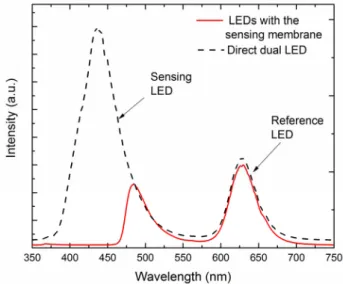
The spectral response of both light sources is presented in Fig. 2 before and after the sensitive membrane is placed. It is observed a strong absorption around 435 nm when the membrane is aligned with the optical path. The positioned sensing membrane has a deep yellow colour acting as a filter to the blue LED. The red LED works as a reference and should not change in time due to the CO2 measurements.
Fig. 2. Wavelength spectra of the LEDs before and after the sensing membrane.
The integration of the signals with a fixed wavelength range combined with mathematical processing returns a signal sensitive to the CO2 concentration, independent of any other optical power changes.
C. Dissolved CO2 generation
The response of the sensing membrane to the CO2 was validated in a first stage by measuring the absorbance in gas phase of the entire bandwidth of the visible spectrum at different CO2 concentrations using the previous light/detection setup. The sensitive membrane was protected with a silicone layer and the same procedure was applied in water containing different levels of dCO2. Two different approaches were studied. One using a mixture of gaseous CO2 with nitrogen (N2). By adjusting the gaseous mixture, it is possible to change the concentration of the dCO2 in the water. Gaseous mixtures were injected in the water, using a CO2 diffuser, in a different container. The combination of two small pumps allows the water to be pumped into the measurement vessel creating a closed recirculating system. The purpose of this configuration was to avoid gas bubbles attaching to the sensing membrane, causing interference in the measurements. This approach requires long time to stabilize with low accuracy. The other approach involves the chemical formation of dCO2 in water. Solutions with very precise concentrations of dissolved CO2 can be produced by adding specific quantities of citric acid into carbonate. In the carbonate solution, the pH of the water raises by converting any existent CO2 into carbonates while adding citric acid the pH is reduced to below 3.5, liberating any inorganic carbon in the water into free CO2 [5]. While there is carbonate in the solution, the addition of citric acid will generate exact amounts of CO2.
The latest keeps the environment extremely acid, which in time can modify the structure of the sensing layer. The different concentrations of dCO2 obtained were confirmed with a commercial sensor from Oxyguard (model Oxyguard CO2, Denmark) with a range between 0 and 50 ppm and a resolution of 1 ppm.
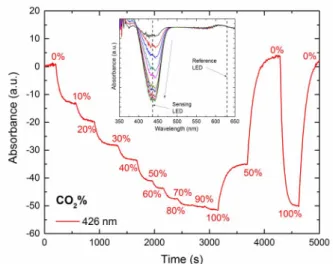
III. EXPERIMENTALRESULTSANDDISCUSSION In a first stage, the setup was validated in gaseous environment using mixtures from 0 to 100% of CO2 in N2 inside of a sealed chamber. From Fig. 3 it is seen that the sensitive membrane responds as expected while is absorbing or releasing CO2.
Fig. 3. Timeline of the CO2 sensor response considering
mathematical processing between 426 nm and 630 nm for different mixtures of CO2 and N2 in gas phase from 0% to
100%. Inset is the absorbance spectra for each mixture.
After the full characterization of the sensing membrane in gaseous atmosphere, it was placed in aqueous environments with the protective silicone layer. This silicone is highly hydrophobic, being capable of keeping the water away from the sensing layer but allowing the dissolved CO2 passage despite the 50 µm of thickness. Because of the highly acidic solutions obtained when the CO2 is formed chemically, it was decided to perform these preliminary tests by injecting the previous gaseous mixtures in the water samples considering the high solubility of CO2 in water.
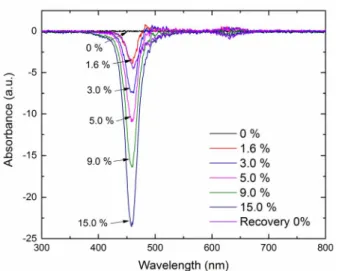
The variations in the absorbance spectra are shown in Fig. 4 in terms of the CO2 concentration in the gas mixture from 0 to 15% of CO2. The same narrow absorption band was observed and its intensity depends of the dCO2 concentration, which is related to the concentration of the injected gas sample. It is important to note that the commercial OxyGuard CO2 meter needs a magnetic stirrer close to the sensing region and it takes a long time to perform the measuring. A set of measurements using these conditions allows to estimate that 1.5 % of gaseous CO2 corresponds to 12-14 ppm of dissolved CO2.
Fig. 4. Spectral absorbance of the sensing device using mixtures of CO2 and N2 in water from 0 to 15%.
The processed timeline for these measurements is traced in Fig. 5, confirming the behaviour of the different kind of gas mixtures that are injected in the water. It takes several minutes to stabilize at each mixture, which is mostly due to the time CO2 takes to fully dissolve in the water. A very stable signal at different quantities of CO2 was observed and the response was still reasonable considering the thick protective membrane.
Fig. 5. Time response of the spectral absorbance considering the differential processing between the wavelengths 460 nm and 630 nm. Data corresponds to the sensing device using different mixtures of CO2 and N2 in water from 0% to 15%. Figure 6 shows the evolution of the absorbance, in the range 430 – 460 nm, of the sensing membrane in water when submitted to specific changes in CO2 concentration chemically prepared. The response to the CO2 is extremely fast, when compared to the OxyGuard sensor, and when compared to the previous gaseous injection. First, the measured absorbance is constant at zero level but with the production of only 10 ppm the absorbance changes with a very fast response. The same
happens when more quantities of acid is added generating extra 15, 20 and 40 ppm of CO2.
After this fast response to the generated dCO2 the absorbance increases because an open system was used, with an uncovered glass beaker and magnetic stirring, which allows the release of the dCO2 to the atmosphere, decreasing the dCO2 near the membrane, which causes the increase of the absorbance.
Fig. 6. Time response of the new sensor to a dCO2 concentration
from 0 to 40 ppm in aqueous environment.
It is known that the dissolution of the CO2 in the water causes changes in the water pH [5]. That effect can be observed in Fig. 7 where small quantities from 1 to 4 % of gaseous CO2 is added to the water. The water pH measured with a pH meter (datalogger PCE-PHD 1 pH Meter from www.pce-instruments.com) changes from 5.25 to 4.95. At the same time, the measuring absorbance through the sensitive membrane follows the same behaviour. The same is not true when different pH levels without CO2 are used, i.e. the optical sensor responds to dCO2 and not to pH.
Fig. 7. Time response of sensing membrane to different concentrations of dCO2 (in %) in aqueous environment
IV. CONCLUSIONS
The detection of dissolved CO2 was demonstrated using a colorimetric platform with a thin layer as sensing element. The dual wavelength LED allows this optical configuration to be used even when external signals affect de detection medium, either optic or electric.
The latest results have shown high sensitivities to the detection of dissolved CO2 in water in the concentration range from 0 to 15 %. The concentration variations were simulated by injecting in pure water a previously obtained mixture of pure gaseous CO2 and N2.
ACKNOWLEDGMENT
This work has received funding from the European Union's Horizon 2020 research and innovation programme under the project STRONGMAR: STRengthening MARitime technology Research Center (H202-TWINN-2015 (CSA)-692427). It was also financed by the “North Portugal Regional Operational Programme (NORTE 2020), under the PORTUGAL 2020 Partnership Agreement”, and through the “European Regional Development Fund (ERDF)” within the project Coral - Sustainable Ocean Exploitation: Tools and Sensors/NORTE-01-0145-FEDER-000036. The authors acknowledge the financial support from Iceland, Liechtenstein and Norway through the EEA Grants (PT02_Aviso4_0017 – MarinEye Project)
REFERENCES
[1] National Oceans Service – National Oceanic and Atmosferic Administration U.S. Department of Commerce. Retrieved January 10, from
http://oceanservice.noaa.gov/about/
[2] C. Martins et al., "New developments in recirculating aquaculture systems in Europe: A perspective on environmental sustainability," Aquacultural
Engineering, vol. 43, no. 3, pp. 83-93, 2010.
[3] M.-T. Borges, J. O. Domingues, J. M. Jesus, and C. M. Pereira, "Direct and continuous dissolved CO 2 monitoring in shallow raceway systems: from laboratory to commercial-scale applications,"
Aquacultural Engineering, vol. 49, pp. 10-17, 2012.
[4] K. Balogh et al., "Characterization of a novel dissolved CO2 sensor for utilization in environmental monitoring and aquaculture industry," in 8th Ibero
American Optics Meeting/11th Latin American Meeting on Optics, Lasers, and Applications, 2013,
pp. 8785FC-8785FC-7: International Society for Optics and Photonics.
[5] W. N. R. W. Isahak, Z. A. C. Ramli, M. W. M. Hisham, and M. A. Yarmo, "The formation of a series of carbonates from carbon dioxide: Capturing and utilisation," Renewable and Sustainable Energy