Cat
ó
lica Lisbon School
of Business and EconomicsMaster thesis
Master of Science in Finance
Case Study
The Metro Transportes do Sul Concession
&
Risk Sharing and Public Financial Compensations
Bruno Reais Ferreira 01-09-2014
3
Abstract
Title:
Case Study: The Metro Transportes do Sul Concession & Risk Sharing and Public Financial Compensations
Author:
Bruno de Araujo Reais Ferreira
Objective:
The goal of this study is to provide a case-study on the Metro Transportes do Sul (MTS) Concession trough an analysis of the risk sharing and financial compensations. Over the last 20 years, Portugal has been experiencing a large wave of PPP contracts. Concessions experiencing unbalance risk allocation is a constant problem in important projects and the MTS concession has been the most recent example of it. Renegotiation Agreement, calculation of compensations, traffic forecasts, no connection among bodies and unbalanced risk allocation are some of the reasons for a detailed analysis of this concession project
Methodology:
This paper is divided in two categories: First, a description of the concession contract, the delays in the MTS concession and the renegotiation process; Secondly, an analysis of the financial compensation from the Government and the Risk Allocation situation.
Findings:
This paper concludes that due to the inaccurate traffic forecast and the lack of coordination among the different bodies in the concession project there is a strong imbalance in the current risk allocation the Government was bound to be the largest contributor of the MTS concession trough financial compensations to the concessionaire
Recommendation:
The recommendations to this concession project are ground on the idea of a better management of the concession in general, avoiding Demand risk ex-ante, providing better technical condition for monitoring and controlling and more important, analyses traffic forecast on more solid indicators
4
Contents
1. Introduction ... 7 2. Literature Review ... 9 3. Case study ... 12 3.1 Concession agreement ... 12 3.1.1 Concession Overview ... 12 3.1.2 Concession Contract ... 13 3.1.3 Protocols (1999 & 2002) ... 15 3.1.4 Concession Financing ... 18 3.1.5 Concession Diagram ... 183.1.6 Responsibilities of the Government ... 19
3.2 Background on the renegotiation ... 20
3.2.1 Municipality Deliberation ... 20
3.2.3 GMST Briefing Note ... 21
3.2.4 Causes for the delay... 22
3.2.4.1 Political Changes ... 22
3.2.4.2 Commissions ... 22
3.2.4.3 Municipality of Almada ... 22
3.2.5 Synthesis of the Concession Delay ... 24
3.3 Contract Renegotiation ... 25
3.3.1 Financial rebalancing agreement ... 26
4. Risk sharing ... 27
4.2 Risk of Fraud ... 29
4.1.2 Demand Risk ... 30
4.1.2 Summary on Risk Allocation ... 30
5. Additional public costs ... 33
6. Conclusions ... 35
6.1 Recommendations and Further Research ... 36
7. Bibliography ... 37
5
Table of Abbreviations
CMA Municipality of Almada
DIA Declaration of Environmental Impact
FRA Financial Rebalance Agreement
GMST Metro Sul do Tejo office
ILD Infrastructure of Long Duration
MTS Metro Transportes do Sul (Concession)
PPP Public and Private Partnership
SIGAQS
Integrated System for Environmental, Quality
and Security Management
VfM Value for Money
DGTF Finance and Treasury Department
6 Preface
The following paper was written under the Public and Private Partnerships Seminar of Católica Lisbon School of Business and Economics. The paper with dissertation purposes was submitted as a fulfillment of requirements for the MSc in Finance at the CLSBE.
I would like to thank my counselors, Prof. Ricardo Reis and Prof. Joaquim Miranda Sarmento, for the support given in this work. Last but not the least I would like to thank my family José R. Ferreira, Cristina Araujo, Vanessa Ferreira, Catia Araujo and others, as to my girlfriend Ludivine Dumont for the support given throughout this journey.
I share my gratitude to the Portuguese Court of Audits and the Finance and Treasury Department for the necessary and valuable data to conduct my case study and financial implication analysis. After having experienced controversial and successful PPPs such as the Lusoponte and Fertagus Concession, the Portuguese Government is once again confronted with a complex and controversial significant project. The MTS is the main ongoing concession in Portugal with regard to financial implication to the Portuguese State. Therefore, I have chosen to explain the main issues and events behind this contract management in my dissertation. Hopefully, this will bring valuable insights for the remaining of the concession period.
7
1. Introduction
The Public and Private Partnerships idea is not new one. We would have to come back to the seventeenth century to experience the beginning of this famous arrangement, when France launched their first concession models. Yet, this private financing through PPPs, with the goal of procuring and maintaining public-sector infrastructures saw its popularity increased over the last decade. Structuring Public and Private Partnerships is not an easy task and most of the times rather complex. There is the need to bring together and reconcile the objectives of a large stake of participants such as investors, companies providing the service and lenders in the private sector to public authorities and the public in general on the public side (Yescombe, 2007).
Presenting it as a definition, PPPs concept can be defined as different ways of co-operation between authorities in the public sphere and the business world to provide the financing, management, construction and others, of some infrastructure as a provision of a service (European Commission 2004). Nevertheless, what makes it interesting for the Government or any other public authority to engage in such a time-consuming and complex arrangement is not the partnership by itself but the opportunity to achieve Value for money. VfM refers to providing an infrastructure asset and any other related service in the process at a lower cost than the conventional public procurement, yet, taking into consideration that quality standards are being met in accordance with the contract specifications (Nick Sciulli, 2007)
When considering Public and Private Partnerships, the concessionaire will normally take as responsibilities the building and maintenance as well as the managing of the infrastructure. A contract with a single firm that brings together both the building and operation may take the form of a DBFO (Design, Build, Finance and Operate), BOT (Build, Operate and Transfer) or a BOO (Build, Own and Operate). PPPs are used across Europe, US and a several other developing countries for the arrangement of infrastructures and services of public domain in sector such as energy, transports, waste management, prisons, IT, hospitals, schools and others. Typically, in rail, port and road projects the private party recovers its initial investment through charges to the customers whereas in Hospital and Schools, where the customer does not pay, it is the public sector that compensates the private firm for the service provided to the citizens (Iossa and Martimort, 2011).
8 The first large PPP project in Portugal was the bridge over Tagus River. PPP concessions were also used in health, railway, water distribution to mention just few, over the last 25 years. With the entrance in the European Union, Portugal experienced a large wave of PPP concessions with the launch of 11 road projects in the transportation sector. The Portuguese Government ended up going too far in launching these concessions, in such a short amount of years (Cruz and Marques, 2010). After the financial crisis, a new fiscal reform was agreed between the Portuguese State and the European Bodies where new PPP projects were suspended, awaiting a review of the existing PPPs and the implementation of several legal and institutional reforms. This processes had the aim of improving the management and assessment of PPPs fiscal risk lacking in Portugal concessions, (European PPP Expertise Centre, 2014).
The MTS concession signed in 2002 is part of a great number of onerous deals made by the Portuguese Government. The problems related with demand risk makes it interesting since one can extend the conclusions already achieved for Fertagus concession which presented similar issues. The fact that the concession takes place between not only the Portuguese Government and MTS concessionaire but also between the municipalities of Almada, Seixal and Moita, gives further insight on the ability of the Government to coordinate multiple contract relations, particularly during the Financial Rebalancing Agreement of 2008.
The present paper is a case-study on the evolution and delays of the MTS construction and subsequent operation, with special focus on the 2008 FRA. A breakdown on the several financial compensations and additional costs due to these same delays will be presented, in order to better understand the magnitude of this project failure and the impact it had on the initial investment by the Portuguese Government.
This study starts by giving a general picture with regard to PPP renegotiations and risk allocation, with special focus on the MTS concession. The Case study on the concession is presented in a detailed way in Section 3. This chapter starts with a description of the initial concession agreement, focusing on the contract itself, the bodies celebrating it and responsibilities taken by them (section 3.1). Special attention will also be given to the causes contributing for the concession delay (section 3.2) as for the renegotiation process and its implications (section 3.3). In Section 4, a general description on the risk accompanying this concession, with special attention to the demand risk and risk of fraud will be presented. An analysis on the financial compensations by the State and its impact on the initial investment is provided in section 5. Finally, in section 6, conclusions on the
9 overall concession period, further research and recommendation to the future of this concession will be also presented.
2. Literature Review
Nowadays economic growth heavily lies on the development of infrastructures. The volume of infrastructures in a country has both direct and indirect effects, at least, on the long term economic growth, (Calderon and Serven, 2003). One way to achieve the optimal infrastructure stock is by public and private partnership concessions.
The advantages of this well-established form of project execution are somehow considered in the present days. From many benefits it may bring, PPPs can reduce development risk, contributes to a more cost and time effectiveness in project delivery, provides a better ongoing maintenance and requires a small amount of public resources. Unlike in a private project, a high level of ownership is maintained by the public sector throughout the project and any outcome after conclusion, (NCPPP, 2012).
However, what makes a PPPs project valuable are the ways in which this process can improve VfM. There are eight different value drivers that increase value for money: Risk transfer, whole of life costing, innovation, asset utilization, focus on service delivery, predictability and transparency of costs and funding, Mobilization of additional funding and accountability, (World Bank, 2012) In spite of its benefits, there is still no consensus on whether these benefits are enough to outweigh the issues brought about by PPPs projects. Several are the cases when few risks taken by the private side gives them no incentives for improved management and efficiency. Additionally, models used by the public entity to value risk are rather incomplete, being mostly simple and qualitative, (Sarmento and Renneboog, 2014).
Opportunistic behaviors taken by parties in the concession may also harm the project, ultimately bringing it to a renegotiation stage. In many cases, government cut tariffs or holds back on agreed tariff increases to maintain the voters support before elections. Also the new elected government may not agree with the tariff increase on the concession contract, honored by the previous board. The enterprises will, in many cases, behave opportunistically trying to renegotiate the contract in an early stage of the concession in order to improve the conditions on the first bid, (Guasch, Laffont, Straub, 2003). As a result of that and many other issues, countless contracts around the
10 world have been renegotiated, impacting the creditability of the respective sectors and countries as will be seen further in a Portuguese concession.
Regardless of the efforts consumed on it, incomplete contract will always persist. Tirole (1999) puts in a nutshell the main reasons originating incomplete contracts. First, eventualities that may emerge over the running of the concession cannot be anticipated when signing the contract. Second, even if capable of anticipating it, the time to review all the possible and infinite contingencies would be excessive. Third and last, the contract would be only credible based on eventualities that could be verified by a third party, generally a commission with expertise on privatization contracts. In the MTS concession, it became evident that this commission was not present or in some cases did not perform an acceptable surveillance.
There is clearly an incomplete contract in the MTS concession. The allocation of risk made in anticipation of the contract was not solid and did not identify the potential risks of demand, fraud and others, which not only harmed the Portuguese Government but also the concessionaire MTS. Nevertheless, the problem is not the PPPs per si but the way the Portuguese Government negotiated MTS and other concessions. A great number of Portuguese concession have seen additional costs over the agreed budget mostly due to environmental problems, project changes demanded by the Government or delayed urban permits, (Monteiro, 2007). A better balancing of risk ex-ante, as their management, will decrease the unilateral modification of the contract by the State in most of the Portuguese concessions. The risk of demand shall be allocated to the private party or the demand forecast conducted beforehand, must be credible and calculated by unbiased entities and not by the concessionaires, as in the case of the MTS concession.
A balanced risk-sharing is the main goal to strive when negotiating and running a PPP. However this fundamental factor on a concession efficiency is infrequently realized even though most of the times the ex-ante analysis of risk-sharing concludes the contrary. On one hand, too little risk on the private side will inhibit VfM achievement, on the other hand too much risk will eventually drag high risk premiums, pushing VfM down and increasing project costs. Monteiro (2007) claims that contracts should be arranged in a way that encourages cooperation between the public and private parties, yet preventing strategic behaviors by the private side that may hurt the public sphere. Additionally, the author argues that a solid risk analysis will consider the fact that accepting too much risk is almost equivalent as accepting no risk at all. When a partner is not able to manage the
11 risk, its consequents may be transferred to the other party. In some way, MTS concession suffered from this issue, when the Government indirectly accepted too much risk demand.
The most efficient way to better transfer risk is through risk allocation. Risk allocation is the primary process of assignment between the public and private sector. A risk allocation mechanism is shared when both sides bear a specific risk outcome, (Bing, Akintoye, Edwards, Hardcastle, 2005). Karim claims that risk management is the key factor to a credible risk allocation. The author also mentions four logical processes of risk allocation which are the identification of risk, subsequent analysis of its consequences, solutions to minimize the risk and contingencies allocation.
The main objective of transferring risk to the private sector is to create an incentive to effectively manage and efficiently run the project keeping customers satisfied. Nevertheless, on a value-for-money basis, the optimal risk distribution will be achieved only if the Government takes back some risks, which should be better managed by it, (Loosemore, 2007). Additionally, the author argues that this optimal distribution is only achieved if the risk is given to someone who has been made aware of the risk, has the greatest capacity to manage it efficiently, has the resources to cope with the risk, has the right appetite to want to take the risk and finally, has been given the opportunity to charge a proper premium for taking the risk. Once these rules are not met, problem such as confused responsibility for monitoring and responding to risk will arise. Also, conflict and disputes to drop the risk responsibility when they arise may eventually happen. In summary, the public sector is just accepting the illusion of risk transfer since it will be given back in the form of higher premiums or project problems.
Many were the authors who analyzed the optimal risk allocation in concession projects. Grimsey and Lewis introduced a model starting by sketching the key risks inherent in a project, followed by the analysis of the nature and quantum of each risk from each party’s perspective. For the three big players (Procurer, Sponsor, Lender), the authors define their risk perspective, risk variable, risk face by them and finishes by identifying the appropriate risk analysis to be used. Quiggin (2006) goes more in deep, in analytical terms, and proposes the inclusion of put and call option. Making use of these options, in intervals of 5 years, both parties would be able to finish the partnership at a specific day with the private entity being given a lump sum of payments based on the valuation of the flow of payments and services left under contract.
12 Medda (2006) presents a final offer arbitration game as a popular increasing model in risk allocation. The model based on game theory has the potential to reduce the consequences of moral hazard problems in agents’ bids offers. Studies from Li at al (2005) and Jin and Doloi (2008) use the frequently adopted survey questionnaires as a risk sharing scheme.
In summary, managing risk is a crucial concern in contractual agreements. Risk shall be managed both by allocating predictable risk to the party better prepared to take it and through the creation of solid and long-term relationship to the joint resolution of uncertain risks. However, reality often fails to match the theory. Reforms are the core point to improve risk management and make sure PPPs are used only if they bring together VfM and not used as a political convenient way of bundling together infrastructure deals.
The rest of the paper presents a case study on the Metro Sul do Tejo concession, containing a full description on the development of this project over its conception until the present days. The case study will give special attention to events that in one way or another contributed for the increase of government unexpected expenditures in the concession. It will also provide an elucidated and transparent description on the concession’s risk sharing and additional compensations paid by the Portuguese, in quantitative terms.
3. Case study
3.1 Concession agreement
3.1.1 Concession Overview
The project for a southern Tagus surface metro started being considered 20 years before its implementation, when the study about the technical and economic viability of a surface metro as supplement to the southern Tagus railway network was initiated. The initial proposal was given to the central authorities and a contract was signed by the Portuguese Government and the municipalities where the works would take place. The proposal predicted an eighty percent of capital cost for the Government with the remaining twenty percent as responsibility of the municipalities.
Yet, the project came to vanish as the Government tried to cut it down. In 1999, a new proposal was on the table but this time in a smaller scale. In the same year an international public tender
13 was launched. Through this concessionaire contract, the private unit would be responsible for the construction, equipment supply, financing as for the operation and maintenance (DBOT) of the Southern Tagus surface metro. Finally, in July 2002 the concession project was given to MTS – Metro Transportes do Sul for the period of 30 years until 2032.
At the same time, a new agreement was signed between the Government and the municipalities of Seixal and Almada. This agreement replaced the 1995 contract, exempting the municipalities from any cost contribution, with the Government assuming the public costs in the concession,. The MTS project aims to provide not only an interconnection with transports’ network connected to Lisbon but also to allow a more efficient mobility within the covered municipalities. Additionally it would help to achieve a modal split favorable to public transport in detriment of individual transports, particularly in the cross between the northern and the southern side. In general terms, the project was signed with the view of improving the quality of life of the population resident in the south bank of Tagus River.
3.1.2 Concession Contract
The contract was celebrating between the grantor Portuguese Government and a concessionaire MTS, in July 2002. The initial contract follows a DBOFT model covering the project, construction, equipment and rolling stock supply, financing, operation and maintenance of the whole light rail network of the southern bank of the river. The contract predicted a DBOFT for the development of the 1st stage of the surface metro network, in the areas of Almada and Seixal, to be started immediately after the contract signing. Nonetheless, the contract also predicted the development of a 2nd and 3rd stages of the MTS, to be built in the areas of Seixal and Barreiro in case the following requirements were met:
• Traffic volume in two consecutive years maintained above the minimum level given by the reference traffic band1.
1 Reference Traffic band refers to the traffic model used in the concession contract to calculate real traffic level against estimated one, in order to arrive at potential financial compensations. Detailed description in section 4
14 • Verification, through and economic and financial studying, that determined traffic volumes makes it viable to continue with the 2nd and 3rd stage and consequently testify the reliability
of such forecasts
The 1st stage has a network of 13.5 km comprised by three lines between Corroios and Cacillhas, Corroios and Pragal, and Cacilhas and the Univeristy. The potential extension for the 2nd stage would be set between Corroios and Fogueteiro and for the 3rdstage an extension to Barreiro.
Source: http://www.mts.pt
In the contract were also highlighted the construction of the infrastructures of long duration and requalification of the surrounding urban areas to be the responsibility of the respective municipalities. The works with the infrastructures should be finished until 34 months after the signing of the contract, with the services from MTS starting before the end of the 36th month. As it will be mentioned in the following sections, this deadline was not met and delays in the concession were constant.
The concession includes as a secondary element, the use of publicity, commercial areas and car parks in the facilities of MTS. 5 sub-contracts and 2 protocols which made part of 27 annexes were joined to this initial contract. As containing valuable information in terms of risk sharing and responsibilities of the participants in this concession, some will be briefly described
15
3.1.3 Protocols (1999 & 2002)
On the first of July 1999, an initial protocol was celebrated between the representatives of the Government and the Almada, Barreiro, Moita and Seixal Municipalities. The protocol for technical and financial cooperation.
This protocol set the model for the public tender realization, as well as the supervision and management of the concession in the future, clarifying the distribution of responsibilities between the Government and the respective municipalities where the metro would be set. Integrated in the annex 23 of the concession contract, the protocol enumerated the following points as each party’s responsibility:
Municipalities
• Maintain and preserve the area reserved for MTS by not taking or accepting any intervention that would aggravate its availability afterwards.
• Implement the planning and management of traffic and car parking which may be necessary to ensure the quality of the MTS.
• Make available the parcels of land of public domain necessary for the concretization of MTS network.
• Prioritize and accept projects that might optimize the concession project viability and provide before the start of the metro construction the projects for squares and exterior spaces to be crossed by the metro
Government & Concessionaire
• In case of public lands but not municipal, the responsibilities lies with the Government • In case of private lands, the responsibility may lie with the Government or the concessionaire
16 The cost of the above projects prioritized and accepted by the municipalities, which were not considered as part of proposal of the concessionaire, would be supported by the State through community funds in a maximum amount of 7.5% of the investment value in the concession infrastructures. A maximum amount of:
• 1st Stage ( 9.4 million euros )
• 2nd Stage ( 2.97 million euros )
• 3rd Stage ( 4.45 million euros )
On the 30 of July 2002, a second protocol was signed in conjunction with the concession contract. This second protocol between the Government and the municipalities had the goal of conforming the project to the works done in exterior spaces, the supervision of these works, building of the infra-structures of long duration, make available the lands of public domain and the financial contribution incurred by the Government with the works in exterior spaces. This second contract was elaborated to reinforce the first protocol in order to accurately identify the rights and duties of the Government and MTS concessionaire, in the concession contract.
While the initial contract required a contribution by the Government of 9.4 million euros (1st stage), in the second one this amount increase to 26 million euros. An increase of almost 300% separates these two numbers.2
Likewise in the first protocol, a set of points were presented as responsibilities of the Government and municipalities:
Municipalities
• The municipality must to provide a judgment about the conformity of the ILD project in relation to the exterior reparations.
• The municipality must back the works in the exterior reparations.
• The municipal lands must be provided to the concessionaire for the construction of platforms, metro stops and the reparation of exterior works.
Under this protocol the Government had the sole responsibility of negotiating with the concessionaire the way and conditions for lands acquisition, construction and exploitation of
17 parking lots, which were not already being considered by the later. In the following years after the protocol’s signing, one can conclude that the focal clause of this second protocol was the one where the municipalities make themselves totally responsible for any violation of the clauses stated above, in case this violation leads the Government to financially compensate the concessionaire. As it will be seen later in the case-study this did not happen in reality.
3.1.4 Concession Financing
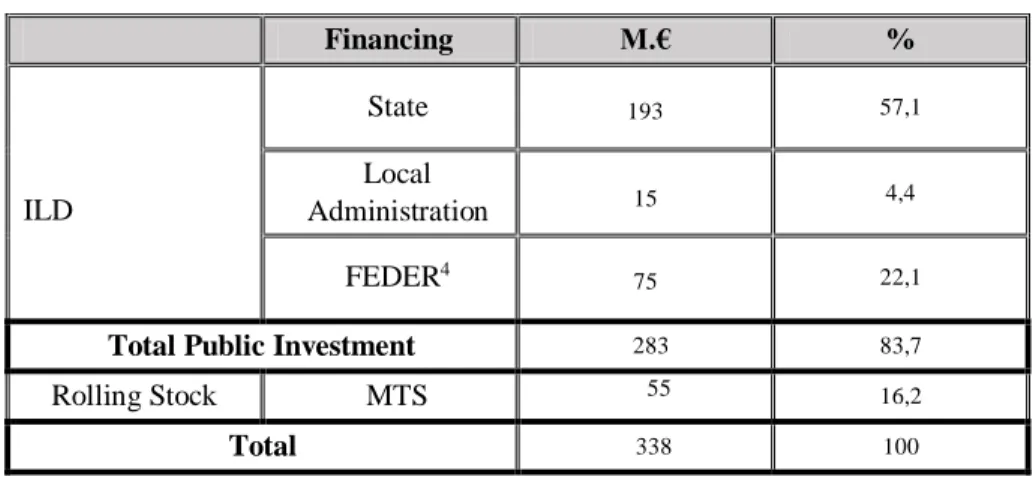
Table 1 - Financing of Metro Sul do Tejo3
Financing M.€ % ILD State 193 57,1 Local Administration 15 4,4 FEDER4 75 22,1
Total Public Investment 283 83,7
Rolling Stock MTS 55 16,2
Total 338 100
Source: Tribunal de Contas Report and Author
From the table, we conclude that more than 80 % of the funds were borne by public investments. All the public funding was allocated to infrastructures of long duration, with the Portuguese state contributing with roughly 68% of the total public investment. The concessionaire contributed with slightly more than 15% of the total funds, being allocated to rolling stock and ticketing equipment.
Next section presents a diagram of the different bodies involved in the Initial Contract and the subsequent years for better understanding the concession´s course of events that came to be seen later. Additionally, information about the bodies that were created for this project and the agreements between them are briefly described.
3 Taken from the Tribunal de Contas Report 46/2006
18
3.1.5 Concession Diagram
Apart from the grantor, the Portuguese Government and the concessionaire, this project has been marked by a great involvement of different bodies that with their different objectives influenced the course of events in the concession.
Exhibit 1 - MTS concession structure
The below figure shows the structure of the MTS Concession. Presenting the agreements that created the construction of Metro Sul do Tejo and the bodies that celebrated them.
Source 2 : made by the author
The above diagram presents the different bodies involved in the concession at the time of the initial contract or later in the construction stage. GMST was the representative of the Portuguese Government, which had as main goals the coordination and supervision of the principal objectives in the concession contract. This body would cease its activities in the end of the construction phase
19 in the 1st stage of the MTS network. Moura Consultores, Siemens and ACE were outsourcing firms used by MTS for consulting, supplying and construction services respectively.
The next sub-chapter presents the main responsibilities of the Portuguese Government in the concession contract
3.1.6 Responsibilities of the Government
Although the present concession lies on a public and private partnership model, many are the responsibilities on the side of the grantor, Portuguese Government. Two different financial responsibilities can be found:
• Costs incurred with the infra-structures of long duration as any activity necessary for the beginning of the operating phase with exception of the ticketing equipment and rolling stock.
• Implicit costs incurred with the assumed risks matrix , in particularly with the demand risk, through two different channels:
1. The Government must financially compensate the concessionaire when the traffic goes below the lower limit of the reference traffic band5, based on the formula presented on
the concession contract.
2. The concessionaire is allowed to ask for the redemption of the concession if during the first three years after the begging of MTS service, the traffic stays below the minimum of the inferior traffic band
5 Detailed explanation in Section 4
20
3.2 Background on the Renegotiation
As stated in the concession contract, the MTS service should begin no later than the 36 month after the signing day of the contract. However, roughly 2 years after the signing day, the concession was already close to renegotiated. A situation partly caused by the Municipality of Almada, as this party refused to provide the municipal lands that ultimately prevented the MTS to start operation on the agreed dates.
As stated by the Portuguese court of audits in its 2006 audit report, the arguments presented by the municipality of Almada for the supposed delay of the works are mere factual description of the events. The CMA added as one of the causes, the inappropriate manner of organization from the concessionaire, which run the concession anarchically contradicting the concession contract and the impositions stated in the DIA6
3.2.1 Municipality Deliberation
The municipality presented several conditions to be met, which were not stipulated in the contract, in order to provide the necessary lands for the continuation of the works. These conditions were:
• The Municipality demanded that the construction process followed an evolutionary system, called “Trem Construtivo”7, as agreed on the concession contract.
• The concessionaire and its related parties should strictly comply with the safety requirements stated in the SIGAQS of the concessionaire and in the DIA.
• Technical and logistic conditions should be provided to the GMST so that it can supervise and conduct the project on behalf of the State.
• A decision should be taken on where to locate the terminal of Cacilhas. It is important to highlight that this subject was not mentioned in the concession contract.
• A new route for the “triangulo da ramalha”8 cross and Street Conceição Sameiro Antunes
should be set.
6 Declaration of environmental impact
7 This model was based on the scheduling of the work by MTS, where the works are conducted lot by lot and section by section in order to minimize
the impact of the works on the urban environment.
21 • The municipality demanded the construction of car parks.
• Compensation ought to be given to merchants due to damages caused by the works. • The project should adopt the measures exiting in the mobility plan ”Acessibilidades 21”9
The fact that the Municipality of Almada demanded several conditions, which were not mentioned in any of the two protocols celebrated between the Government and the municipalities ended up being one of main causes for the delay of the works for more than 2 years.
As stated in the protocol of technical and financial cooperation between the Government and the municipalities, the later ought to provide the lands necessary to the works with the condition that the concessionaire had given the partial plans for the works at least 30 days in advance. This condition was, in fact, met by the concessionaire.
3.2.3 GMST Briefing Note
As a representative of the Portuguese Government, GMST sent on the 18th of March 2004, an information note to the secretary of state for transports with its own analysis on the above conditions. The note presented the following conclusions:
• In contrast with what was presented by the municipality of Almada, the works which would follow a “Trem construtivo” model only started during the month of March. Until the present time, only related works were conducted, which were not supposed to follow the mentioned model, as stated in the concession contract.
• All the standard and rules are being followed regarding the safety requirements, the SIGAQS and the DIA. Monthly reports are sent to the municipality in what concerns the compliance of the works with the safety requirement and the activities in the SIGAQS.
Nevertheless, the GMST assumed its lack of resources for monitoring and controlling these systems. GMST presented the impossibility of contracting an outsourcing team of auditors as an additional issue for the defective monitoring. As already stated, this situation cause by the Municipality ceased the conclusion of MTS’s infra-structures. However, although this deliberation
22 ceased the works, the long renegotiation process which would be finalized in 2008 was directly or indirectly caused by several different factors. A brief description of each of them will be given in the next subsection
3.2.4 Causes for the Concession Delay
3.2.4.1 Political Changes
The first years of the concession coincided with three different Portuguese Governments. On the 22 of July 2002, the contract was signed by the current representative of the State at the time. On the 17 of July 2004 the XVI Government was elected and secretaries of state were assigned to existing portfolios. On the 12 of March 2005 the third and the XVII Government was elected. Overall, 8 ministers and 3 secretaries of state were in charge of a project with less than 4 years of life. In a nutshell, the successive alterations of government and its representatives brought a lack of central decision at a time where negotiations were on the spotlight.
3.2.4.2 Commissions
With the cessation of the works, the concessionaire asked for the renegotiation of the contract. To this end, in 2004 a monitoring commission was created in order to help on alterations of the contract conditions. On the 8 of March 2006, a new and second commission was nominated with the goal of expediting the work attributed to its former. This shows the inertia presented by the first commission, since over its 15 months of life it was not able to find any solution to the pending issues. On the 22nd of March, commission and concessionaire agreed on a deadline of 90 days for
the termination of the renegotiation process. This deadline was, by far, not met.
3.2.4.3 Municipality of Almada
As mentioned in the previous section, the Municipality of Almada decided to make the lands available for the continuation of the works if several conditions were met. Some of these conditions deserve further analysis.
23
A. Terminal of Cacilhas
There was a deadlock on where to locate the Terminal of Cacilhas. The terminal, being part of lot 1, was not included in the section 1 of MTS in the concession contract. However, as stated by the court of auditors in its 2006 report, it is not understandable how the municipality can jeopardize all the work on the section 1 due to a decision on a subject that interferes only the lot
1.10
B. Triangle of Ramalha
According to the draft project, the MTS route would cross the street “Rua do Clube Recreativo”. Later, at the time of the initial contract this same route was transferred to the street “Rua Cidade de Ostrava”. This new route would form a triangle around a block of buildings by three different lines of the metro. However, in the summer of 2003 residents showed their discontent with this situation. A new study by the concessionaire brought the idea of the draft project into the table again but with improvements. The municipality finally agreed with this solution despite the continuing public discontent.
C. Acessibilidade 21
The Municipality of Almada asked for the adaptation of the concession project to the plan of Mobility and Accessibility. An agreement was reach between the concessionaire MTS, the Municipality and GMST. After a study, by the concessionaire, on the costs and modifications this adaptation would bring, it was agreed that the GMST would act as an intermediary and would technically support the Municipality.
D. Route “Conceição Sameiro Antunes”
Following the presentation by the concessionaire of a project for the street “Rua Conceição Sameiro Antunes and after the technical evaluation with the Municipality, it was concluded that this route would bring a large architectural barrier. Subsequently, a new plan was found by the
10The Metro Sul do Tejo network is divided into sections with which one having several lots. Terminal of Cacilhas in lot 1was p hysically present
24 GMST which eliminated the previous drawback. However, it brought about several modifications to initial area under work, increasing costs and work time.
E. Merchants Compensations
The municipality demanded compensations to the local merchants due to trouble brought by the works of the project. However, there was a daily supervision by GMST on this subject and all the accesses to the commercial shops were granted. Additionally, the concession contract does not mentioned any compensation measure for losses caused by the project’s works
3.2.5 Synthesis of the Concession Delay
Exhibit 2 – Synthesis on all the important events caused by work delays from 2002 to 2008
Source: made by the author
Figure 2 chronologically summarizes the events already described in the previous sections. Starting with the municipalities decision of not giving the public lands for the continuation of the works to the two commissions created for renegotiation purposes, finishing with the MTS cessation of the works and subsequent demand for the financial rebalance and renegotiation.
March 2004
•Municipality deliberation
• Public land availability dependent on conditions to be met by the parties in the concession.
March 2004 •
GMST briefing note
• A briefing note sent to the secretary of transports with its own analysis on the CMA deliberation. December 2004 •1 nd Commission
•A commission elected to help on the potential contract negotiations. December 2005 ••ConcessionaireCessation of the work by MTS due to land unavailability
February 2006
•Concessionaire
•MTS ask for the financial rebalance of the concession due to delay of the MST operation start
March 2006 •
2. Commission
•The inertia presented by the first commission force the authority to create a second monitoring commission November
2008
•FRA
25 In the next section, the relevant modifications on the renegotiation contract as their financial implications for the Portuguese Government will be presented
3.3 Contract Renegotiation
In February 2006 the concessionaire officially asked for a renegotiation contract after having ceased the works with ILD and others. The contract alteration started in December 2004 with the participation of the first monitoring commission, GMST and the concessionaire. This contract was completely closed only in 2008 with the change of the dates for the beginning of the MTS services and the end of the infrastructures construction. It was set that the 1st stage of MTS would be concluded in the following way:
• The line between Corroios and Cova da Piedade to be ready for operation until the 30 of Abril 2007
• The line between Corroios and Monte da Caparica University to be ready for operation until the 15 of December 2007
• The other sections to be ready for operation until the 27 of November 2008
Picture 2- The image illustrates the entire 1º stage network of MTS
26 It is important to highlight that the beginning of MTS service operation was late by three years, but the parties did not mention the extension of the concession life in the renegotiation contract. This concession would still last for 30 years, as agreed in the initial contract.
3.3.1 Financial Rebalancing Agreement
A financial rebalance agreement was also celebrated between the Portuguese Government and the concessionaire on the 21 of November 2008. This financial rebalancing was a result of the delay of the beginning of the MTS operation and the deadline modifications to the ILD conclusion. Contribution, mostly, to this delay were the unavailability of public lands necessary for the ILD construction and the alteration to the route lines demanded by the CMA, as stressed in previous chapters.
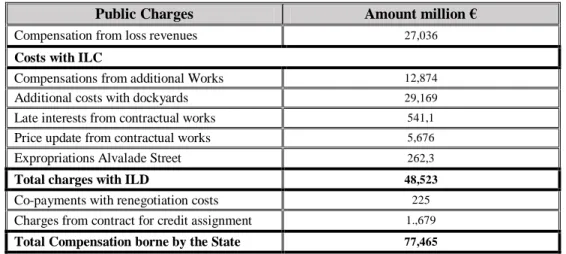
From this rebalance agreement, the Government directly compensated the concessionaire with an amount of 77,5 million euros11. In the following table this compensation amount is break down
accordingly to what was meant to cover:
Table 2 – Financial compensation due to delay on the beginning of MTS service
Public Charges Amount million €
Compensation from loss revenues 27,036
Costs with ILC
Compensations from additional Works 12,874
Additional costs with dockyards 29,169
Late interests from contractual works 541,1
Price update from contractual works 5,676
Expropriations Alvalade Street 262,3
Total charges with ILD 48,523
Co-payments with renegotiation costs 225
Charges from contract for credit assignment 1.,679
Total Compensation borne by the State 77,465
Source: Tribunal de Contas Report 22/2011 and author
Table 2 sub-divides compensations into 3 large categories: compensations from loss revenues, costs with ILD and cost with the financing and renegotiation processes. A great part from these compensations came from cost with ILD, totalizing an amount of 48,523 million. Compensations with loss revenues amounted to 27,036 million euros.
11 Taken from the Tribunal de Contas Report 22/2011
27 Exhibit 3 - Detailed distribution of Financial Compensations
Source: Tribunal de Contas Report 22/2011 and author
Exhibit 3 shows which financial implications tipped the scale. Clearly the item Loss revenues
and expenses and the item Yards had a larger weight on the total amount. These items represented
34 and 37 percent, respectively. Additional works and price updating represent roughly 16 and 7 percent, respectively, with the rest of the rubrics being of insignificant amount in comparison with the total compensation.
4. Risk sharing
The main risk inherent in this concession is the demand risk. This risk is borne by the Government since it would have to compensate the concessionaire in case the number of passengers per km (Pkt) stays below the lower limit of the traffic reference band. The concession contract establishes that the concessionaire bears all the risks accruing from the operation of the MTS service. This includes the operational costs associated with the operation of the railway network, maintenance of the equipment, rolling stock and installations.
The risk of fraud is both shared by the Government and the MTS concessionaire. This risk includes the lack of ability by the concessionaire to force every passenger to pay for the service. In other words, customers who illegally use the service without paying for it and other situations that shall be explained, in more detail, in the next sub-chapter.
28 The concessionaire also bears the risk incurring from the advertisement low revenue levels. Due to the current financial crisis, the revenue coming from advertisement dropped, making it an uncontrollable risk for the concessionaire.
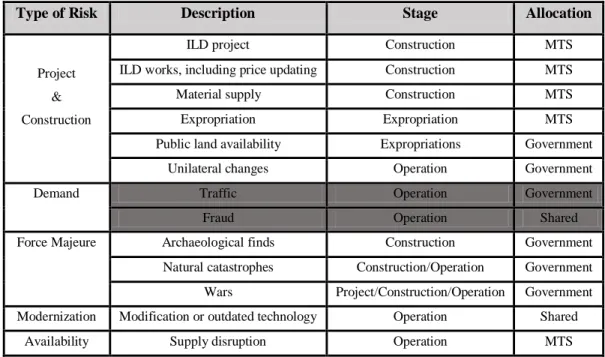
Table 3 – Risk Allocation in the MTS Concession
Type of Risk Description Stage Allocation
Project & Construction
ILD project Construction MTS
ILD works, including price updating Construction MTS
Material supply Construction MTS
Expropriation Expropriation MTS
Public land availability Expropriations Government Unilateral changes Operation Government
Demand Traffic Operation Government
Fraud Operation Shared
Force Majeure Archaeological finds Construction Government Natural catastrophes Construction/Operation Government Wars Project/Construction/Operation Government Modernization Modification or outdated technology Operation Shared
Availability Supply disruption Operation MTS
Source: made by the author
Table 3 shows the allocation of risk between the Portuguese Government and the concessionaire MTS over the life of the project. The risks of traffic and fraud highlighted in the table are the most relevant over the concession period, and will deserve further attention later in this study. The main risks present in MTS concession and which deserve further explanation are:
Project & Construction
The realization and execution of the project is from the MTS responsibility. Exception may result, in case of unilateral modification by the Portuguese Government. Although not mentioned, the operating and maintenance risks were also allocated to the concessionaire.
Demand Risk
The risk Demand is ultimately allocated to the Portuguese Government since demand values are lower than the one predicted in the base case.
29
Availability risk
Concerning the availability risk, the concessionaire is the complete responsible for any unavailability of MTS service. In case the unavailability threshold is not met, the concessionaire is bond to specific penalties.
Force majeure risk
The force majeure risk, of the Government’s responsibility, represents any unpredictable event, which, directly or indirectly, has a negative impact in the concessionaire’s contractual obligations or in the concession project.
Modernization Risk
Although officially allocated to the concessionaire, any time a technological modification largely affecting the financial equilibrium of the concession, will the Portuguese Government equally contribute for such expenses.
4.2 Risk of Fraud
The risk of fraud came to be of great importance after the beginning of the metro service. This risk results from the fact that passengers who own a monthly card but do not validate them; passengers who bought a ticket but do not validate it or passengers who do not buy a ticket at all. Therefore one would conclude that the concession has borne this risk, as it directly gives a loss in revenues. However, as mentioned by the IMTT12, over the years it has been the Portuguese state
that has actually borne the risk of fraud.
The risk of fraud was set 8%13 in the concession contract. Yet, the formula for financial
compensations, in case of traffic deficit, did not take into account this number. This discrepancy between the clause in the contract and the financial model means that a fraud increase indirectly harms the Portuguese Government. The concessionaire is compensated taking into account the difference between the estimated traffic in the base case and real traffic determined by the control
12 Mobility and Transports Institute, I.P
30 mechanisms. Recently, the Concessionaire arrived a rate of 25% for passengers travelling in a fraudulent way which is much higher than the 8 % estimated in the contract.
4.1.2 Demand Risk
The Portuguese Government bears the majority of the risk in the concession, that is, the demand risk. The years, in which the numbers of passengers stay below the lower limit of the reference traffic band, the Government has to financially compensate the concessionaire.
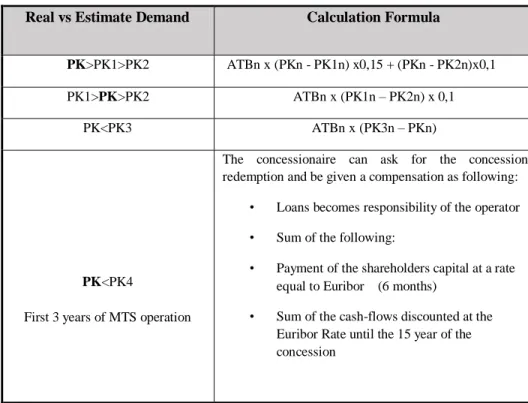
Table 4 – Calculation method for Financial Compensations
Real vs Estimate Demand Calculation Formula
PK>PK1>PK2 ATBn x (PKn - PK1n) x0,15 + (PKn - PK2n)x0,1
PK1>PK>PK2 ATBn x (PK1n – PK2n) x 0,1
PK<PK3 ATBn x (PK3n – PKn)
PK<PK4
First 3 years of MTS operation
The concessionaire can ask for the concession redemption and be given a compensation as following:
• Loans becomes responsibility of the operator • Sum of the following:
• Payment of the shareholders capital at a rate equal to Euribor (6 months)
• Sum of the cash-flows discounted at the Euribor Rate until the 15 year of the concession
Source: made by the author
ATBn – Average tariff band in year n PK- Real traffic (passengers/Km) in year n PK1n-Upper limit of the upper band PK2n-Lower limit of the upper band PK3n-Lower Limit of the reference band PK4n-Lower Limit of the lower band
On the other hand, if the traffic of passengers stays in or above the upper traffic band, the concessionaire must give to the grantor a financial contribution in accordance to the formula presented in the table 4. The project was considered to be self-sustainable according to the
31 estimated demand values and the limits of the reference band. However, it is important to highlight that it was the responsibility of the concessionaire to arrive at these calculations, putting into question their reliability.
This traffic study was too optimistic ultimately making the compensation from traffic deficit the third largest one in the concession. After two years of MTS operation, traffic demand never achieved the lower limit of the reference band. The following table presents the traffic as in the base case until 2015 and the real or estimated traffic conducted by the concessionaire.
Years 2008 2009 2010 2011 2012 2013 2014 2015
LLRTB 14 16,139.445 88,064.228 88,228.363 89,681.649 89,138.089 89,597.709 90,060.537 90,526.60
Real/Estimated traffic
1,889.278 24,725.862 29,329.763 32,261.410 _ _ _ _ Source: Courts of audits (2011) and Concession Contract (Annex 4)
The real traffic in 2009 and 2010 and the estimated one in 2011 are 28.1%, 33.2% and 36, 4%, respectively, of the traffic in the lower limit of the reference band. By the year of 2011 the State had already paid 23.14 million euros to the concessionaire as financial compensations due to traffic deficit, making it an average of 7 million euros per year since the beginning of the metro operation in 2008
The data available help us to conclude that in the near future this trend will continue and the grantor will keep on paying financial compensations to the concessionaire (Tribunal de Contas, 2011). Most of the financial flows coming from the rail sector concerns compensations with the MTS concession, (Quarterly bulletin UTAP15, 2013). The first quarter of 2004 saw an increase of
17%, compared to the previous year, to 2.3 million euros from the financial compensations for reduced traffic.
4.1.3 Summary on Risk Allocation
Initially, forecasted demand was presented in the original contract. However, several events that may emerge over the course of the concession cannot be anticipated when signing the contract. Second, even if capable of anticipating it, the time to review all the possible and infinite
14 Lower limit of reference traffic band 15 Technical unit of Project Monitoring
32 contingencies would be excessive. Additionally, the contract would be only credible based on events that could be verified by a third party, generally a body with expertise on privatization contracts, (Tirole, 1999). In the MTS concession this body was not present to analyze and provide insights, particularly, on these forecasts. We should also highlight that a commission was later created to follow up on the changes to the initial contract but was not always efficient in its task, section (3.2.4.2).
Demand risk can be allocated to each party or shared by both (OECD, 2008). Additionally, allocating risk to the party best able to manage it is one of the key factors to an optimal risk sharing, (Nur Alkaf, 2008). In MTS concession, the demand risk was allocated to one party but not to the one best able to manage it.
In urban road projects, the Government is able to manage demand risk, (Quiggin, 2006). Demand is conditioned by provision of public transport and urban development policies. In case of public services such as schools and health care facilities, the government again, can have a great influence on its demand as it can increase, for example, the years of schooling, (Quiggin, 2006). Nevertheless, the MTS concession does not fall in any of these situations, and then we would conclude that demand risk borne by the Government is not as acceptable as in the rest of the literature.
On the other hand, totally transferring it to the MTS concessionaire would eventually push the company into bankruptcy since it has been under financial trouble over the last years. Also, too much risk on one side would lead to higher risk premiums.
This concession project should have taken into consideration the experience with the Fertagus concession, particularly in what concerns the Demand risk. This concession suffered from wrong demand forecasts from 1990 through 2005.Renegotiation brought new forecasts much lower than the previous ones, taking into consideration assumptions directly related to the reality exiting at the time and in the near future, (Sarmento, 2012).16
16 Assumptions such as the extension of the service to Setubal, a new public transport (MTS), reformulation of Transtejo offer with return to the terminal in Terreiro do Paco and connection the Lisbon Metro.
33 Had the parties in the MTS concession used this earlier experience and adopted a shared allocation of risk, not based on the actual reference traffic band, then the Portuguese Government could be free of any financial compensation to the concessionaire. Giving support to this ending is the deliberation of the Portuguese Government of any financial compensation from traffic deficit after 2010 in the Fertagus concession.
5. Additional public costs
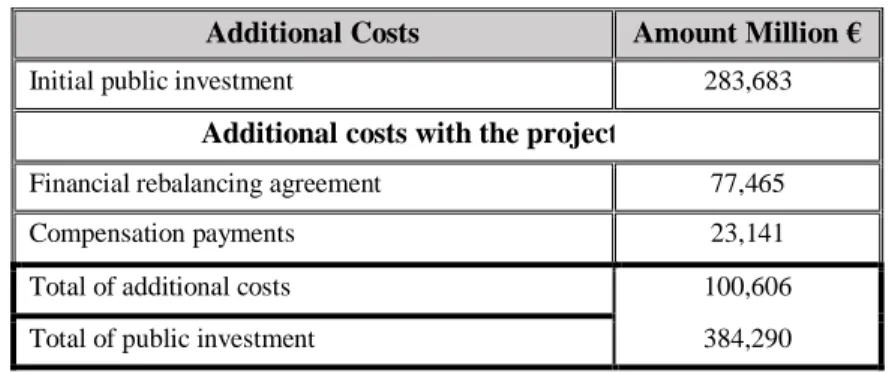
The concession MTS had an initial cost of 284 million for the Portuguese state. Nevertheless, in 2011 this amount had gone up by 101 million euros, representing an increase of approximately 35%.
Table 5 – Additional cost for the Government with MTS
Additional Costs Amount Million €
Initial public investment 283,683
Additional costs with the project
Financial rebalancing agreement 77,465
Compensation payments 23,141
Total of additional costs 100,606
Total of public investment 384,290
As mentioned in the last section (3.3.1) and in table 5, the Portuguese Government paid an amount of 77 million euros within the financial rebalancing agreement. The State additionally paid compensations of 23 million euros for insufficient demand until 2011. These two costs represented 20.3% and 6 % of the total public investment.
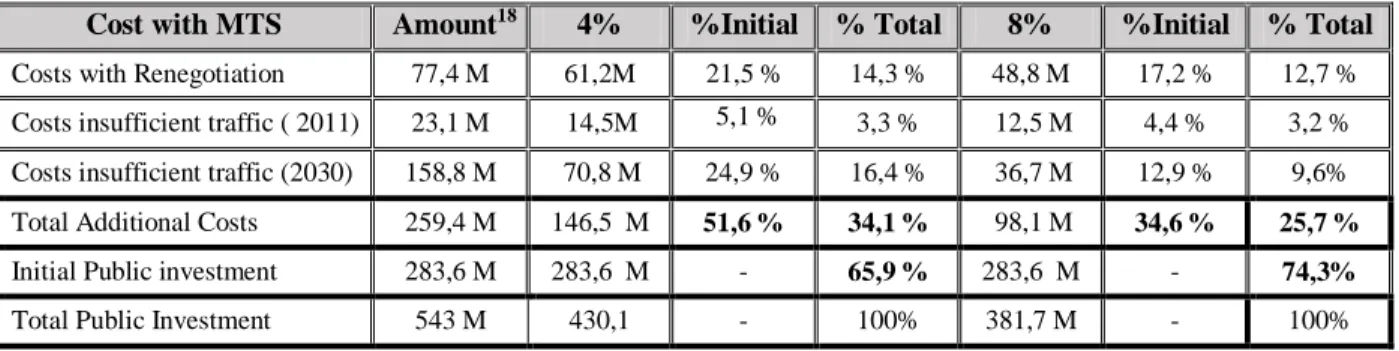
In its annual report on PPPs in Portugal, DGTF forecasted potential compensations for the years from 2011 through 2030, coming to an estimation of 12,2 million for 2012 and 7,4 million for the subsequent years. Table 6 makes use of the values in table 5 and the values estimated by the DGTF17, discounted using a 4% and 8% annual interest rate so that it can be compared to the initial
public investment in 2002.
17Finance and Treasure Department
34 Table 6 – Total additional costs & Initial Public investment with MTS
This table breaks downs the different investment made by the Government in the MTS Concession, differentiating the initial investment from subsequent additional costs with its respective percentages on the final investment amount. The Net Present Values in 2002 of the additional costs to the Government in the MTS Concession based on 2 distinct discount rates. The different investments made by the Government in the MTS Concession, differentiating the initial investment from subsequent additional costs with its respective percentages on the final investment amount.
Cost with MTS Amount18 4% %Initial % Total 8% %Initial % Total
Costs with Renegotiation 77,4 M 61,2M 21,5 % 14,3 % 48,8 M 17,2 % 12,7 % Costs insufficient traffic ( 2011) 23,1 M 14,5M 5,1 % 3,3 % 12,5 M 4,4 % 3,2 % Costs insufficient traffic (2030) 158,8 M 70,8 M 24,9 % 16,4 % 36,7 M 12,9 % 9,6% Total Additional Costs 259,4 M 146,5 M 51,6 % 34,1 % 98,1 M 34,6 % 25,7 %
Initial Public investment 283,6 M 283,6 M - 65,9 % 283,6 M - 74,3%
Total Public Investment 543 M 430,1 - 100% 381,7 M - 100%
Source: made by the author and Court of Audits
When discounting the additional costs with the MTS project at a 4% interest rate, the Government spent 51.6 % of the initial investment in compensations to the MTS. Considering higher rates in the market and hence using an 8 % discount rate, the Government would be still asked to pay 25.7 % of the initial investment in compensations.
It is important to highlight that forecasted compensations were conducted in 2011 by the DGTF for traffic deficit until 2030. Nevertheless, other studies have been done with higher results for these compensations. Therefore, if the later were used, the percentage values for additional compensations mentioned above would have been even higher.
Going back to 2002 and analyzing the protocol agreement between the Portuguese Government and the municipalities, one could verify the increase of 300 % in the Government contribution for the works with MTS compared to the previous protocol. This example shows us how strategically wrong was the Government positioning itself, even before the official start of the concession.
18 Values in Million Euros
35
6. Conclusions
Portugal experienced a large wave of Public and Private Partnerships over the last two decades. The low growth presented in most of this period was mostly originated by a low level in education, productivity and a lack of needed infrastructures. The acceptance of the European common currency urged the country to rapidly work on these problems. As mention in the first chapter of this study, one of the justifications for the use of PPP Concessions is the fiscal or debit constraints faced by a national government. As Portugal integrated the European Union over the last 20 years, several limits on major economic indicators were imposed on the Euro members. Therefore, the perfect tailpipe for the Portuguese Government was to follow the public and private partnership trend in order to modernize itself.
Nevertheless, the successive Portuguese Governments overused this Concession process, using it in sectors which did not need it at the time or using it in a precarious way in terms of efficiency. The highways built across the country with, the goal of connecting the several districts, is a good example of a project which its relevance was not entirely certain. This project was accomplished through a public and private partnership and as we see today, the traffic in them has not been enough to justify their construction.
The risk shared by the Portuguese Government and MTS is present on section 4. When looking at current risk framework of railway concessions in Portugal (DGTF, 2011), we see three of them being the most problematic ones in the MTS concession. Project/Construction risk and force
majeure risk were predominant in this concession, since events such as the unavailability of public
lands, alterations of the metro’s routes and related works caused the concessionaire not to fulfill its contractual obligation and the Government to financially compensate the company.
The demand risk is the third and the most crucial risk in this concession and has been under the Government responsibility since the first day of the MTS service. Although the supposed revenue accruing to the Concessionaire should come from traffic flows, until the present day, most of it has been dependent on direct financial compensation from traffic deficit. Taking as true the forecasted financial compensations (section 5), this dependency will persist and the risk allocation in the concession will continue unbalanced.
One could exert that it was concessionaire that conducted the traffic forecasts in which the base case model in the concession contract was built. This raises questions of creditability in these same
36 forecasts. However, as stated by public authorities, these forecasts are based on assumptions that may not be realized in the future, and then possible mistakes should be devalued.
Therefore, the fault would be attributed to the Portuguese Government (section 2), as mentioned by S. Monteiro. Late 2010, the MTS was close to stop operation due to concessionaires’ lack of financial capacity. This cessation of the service was dependent on compensations by government from traffic deficits. This ultimately helps us to understand and agree with the idea of government’s fault on this concession failure, as the concessionaires came out hurt as well.
Table 6 (Section 5) presents the impact of additional compensations due to delays in the concession and traffic deficits. Using a 4% interest rate yields discounted compensations of more than 50% of the total initial investment. Total compensations represent 34 % when looking at the total investment until the present day. These numbers are still significant when using an 8% interest rate. In fact, when separating the compensations both due to renegotiations and traffic deficits, the later represents more than 50% of them.
This tells us that great part of the costs with the concession come from the bad allocation of risk, especially demand risk, and not from concession delays and subsequent renegotiation.
6.1 Recommendations and Further Research
Taking into account the several conclusions and ideas taken from the case study, several recommendation can be made for the parties involved. Firstly, a more rigorous way of analysis of demand forecast studies and the economic viability of the current concession. The State should introduce better mechanism of traffic control to lower the impact of fraud. It is vital for the State to fully provide the technical and human resources to the public authorities and commissions which monitored and controlled this concession. Finally, the Portuguese state should avoid project which effectively transfer Demand risk to the public side.
This case study presents the Government’s bad preparation in the concession contract as its lack of decision power during the construction process. All of this leading to a wrong allocation and management of risk and renegotiation. Further studies can be built on the reason for the lack of action by the several public authorities and commissions during the construction stage and possible solutions and buffers for wrong traffic forecast that most impact this project. A study on the private partner, understanding the development of results for the concessionaire throughout the concession
37 period or ways to deal with the risk of fraud could be of immense value and a great extension to the work already done. These, together, would not only help to better understand what went wrong with the MTS concession but would give lessons for future or past related concessions.
7. Bibliography
Bing Li, Akintola Akintoye and Cliff Hardcastle, “Risk Analysis and Allocation in public private partnership project”, Department of Building and Surveying, Glasgow Caledonian University, Glasgow G4 0BA, UK
Calderón Cesar, Serven Luis, “The effects of infrastructure development on growth and Income Distribution”, Central Bank of Chile, Working Papers N° 270, Septiembre 2004
Cruz C., Marques R., “Revisiting the Portuguese experience with Public-Private Partnerships”, African Journal of Business Management Vol.5 (11), pp. 4023-4032, (2011).
Darrin Grimsey, Mervyn K. Lewis,”Evaluating the risk of public private partnerships for infrastructure projects”, International Journal of Project Management 20 (2002) 107-118
DGTF, “Parcerias Público-Privadas e Concessões – Relatório de 2011”, Direcção-Geral do Tesouro e Finanças, 2011
E. R. Yescombe,”Public-Private Partnerships: Principles of Policy and Finance” Yescombe Consulting Ltd London, UK, (2007)
European Commission, “Green Paper on Public-Private Partnerships and Community Law on public Contracts and Concessions”, Brussels, 30.4.2004 Com (2004) 327 final
European PPP Expertise Centre, “Establishing and Reforming PPP Units: Analysis of EPEC Member PPP Units and lessons learnt”, August (2014)
Francesca Medda, “A game theory approach for the allocation of risks in transport public private partnerships”, International Journal of Project Management 25 (2007) 213–218