“CTT in the digitalization
era”
Sofia Cabanas
Dissertation written under the supervision of Patrícia Machado
Dissertation submitted in partial fulfilment of requirements for the MSc in
International Management with specialization in Strategy and Consulting, at the
Abstract
Dissertation Title: “CTT in the digitalization era” Author: Sofia Cabanas
Keywords: Digitalization, Exogenous Shocks, Strategic Change, Organizational Change,
Diversification, Dynamic Capabilities
The world is in constant change and the rapid evolution of technology, among other factors, plays an important role. Thus, it is crucial for organizations to adapt and to implement organizational changes and strategic decisions in order to survive in highly dynamic environments. To better illustrate the theoretical views with a real-life example, I selected the centenary Portuguese postal operator named CTT and how it has responded to the heavy decline of the Mail business. The case study intends to demonstrate the importance of identifying exogenous shocks in the operating market and the associated challenges that can arise to companies. Furthermore, it enhances how poor organizational performance can be a main driver for change.
As a response to the shifts in the industry, CTT had a late implementation of a diversification strategy, mainly focused on two growth levers – Banking and Parcels sectors. Nonetheless, the case study shows how CTT’s diversification attempts have affected its core business and its competitive advantage. Moreover, it illustrates the importance of accessing Dynamic Capabilities in order to respond to dynamic environments.
Resumo
Título da dissertação: “CTT in the digitalization era” Autor: Sofia Cabanas
Palavras-chave: Digitalização, Choque Exogéneo, Mudança Estratégica, Mudança
Organizacional, diversificação, Dynamic Capabilities
O mundo está em constante mudança e para tal contribui, além de outros fatores, a rápida evolução da tecnologia. Por isso, é crucial que as organizações se adaptem e implementem mudanças organizacionais e decisões estratégicas para sobreviver em ambientes altamente dinâmicos. Para melhor ilustrar as visões teóricas com um exemplo da vida real, decidi selecionar o centenário operador postal português CTT e analisar a sua resposta ao forte declínio do sector postal. O caso de estudo pretende demonstrar a importância de identificar choques exógenos no mercado operacional e os desafios associados que podem surgir para as empresas. O caso identifica, ainda, o fraco desempenho organizacional como um possível fator que desencadeia a mudança.
Em resposta às mudanças na indústria, os CTT adotaram tardiamente uma estratégia de diversificação, focada principalmente em duas alavancas de crescimento – o setor bancário e de encomendas. No entanto, o caso dos CTT realça como as tentativas de diversificação da empresa acabaram por afetar o seu negócio principal e a sua vantagem competitiva. Além disso, o caso ilustra perfeitamente a importância da utilização das Dynamic Capabilities para responder a estes ambientes dinâmicos.
Acknowledgments
Firstly, I would like to express my deepest gratitude to my dissertation advisor, Patrícia Machado not only for her constant understanding and support throughout the entire writing process, but also for her outstanding capability to always motivate and inspire me. Her great knowledge of the theoretical views has provided me with crucial feedback and has enabled me to think deeper.
Moreover, I would like to thank the Católica Lisbon School of Business and Economics, all of my Professors and the entire staff who helped me outgrow myself both during my bachelor and Master program.
Lastly, I would like to thank my family and friends for their love, inspiration and support on an academic and personal level. Thank you for encouraging and enabling me to pursue this master’s degree and extent my academic knowledge in such a great manner.
Table of Content
1. INTRODUCTION ... 1 1. LITERATURE REVIEW ... 3 1.1. STRATEGIC CHANGE ... 3 1.2. DYNAMIC CAPABILITIES ... 4 1.3. DIVERSIFICATION ... 6 2. TEACHING CASE: ... 9 2.1. THE POSTAL INDUSTRY ...112.1.1. The global Postal Industry ...11
2.1.2. The Portuguese postal industry ...13
2.2. CTT–CORREIOS DE PORTUGAL,S.A. ...16
2.2.1. CTT’s history...16
2.2.2. Decline and refocusing ...17
2.3. THE TRANSFORMATION JOURNEY ...20
2.4. LOOKING INTO THE FUTURE...23
3. EXHIBITS ... 25 5. TEACHING NOTES ... 28 5.1. OVERVIEW ...28 5.2.TEACHING OBJECTIVES: ...28 5.3.INTENDED CONTRIBUTION ...29 5.4.PEDAGOGICAL OVERVIEW ...30
5.5.ASSIGNMENT QUESTIONS AND ANALYSIS ...30
5.6.BOARD PLAN ...35
4. DISCUSSION ... 36
5. CONCLUSION ... 40
6. REFERENCES ... 41
1.
Introduction
We live in a globalized world, where people are better informed and are technologically connected with everyone, new opportunities keep arising every day and competition among organizations is running high. In this highly dynamic world, the only thing that remains constant for businesses is change (Alvesson & Sveningsson, 2008). Therefore, organizations need to rapidly find the “strategic fit” in order to survive (Teece, 2007).
According to Audia, Locke and Smith (2000), significant shifts in the environment may occur thus, firms need to align with the new conditions. Empirical research over the years has shown the importance of strategic change. In fact, it has turned to be one of the most broadly shared theories within the strategic management literature. However, setting a strategic decision is difficult and risky, considering that organizations have to face uncertainty and other factors that inhibit strategic change (Quigley & Hambrick, 2012). Hence, higher consideration has been on strategic change topic, but less attention has been given into the question: “What can firms do to sustain superior performance in changing environments?”. The Dynamic Capabilities view was proposed by Teece et al. (1997) in order to answer this question, while addressing the limitations of previous theoretical perspectives. After Teece, many were the scholars who have aimed to expand the concept of Dynamic Capabilities. However, the necessary consolidation of the concept was introduced by Barreto (2010)’s work, perceiving Dynamic Capabilities as a multidimensional concept.
This dissertation focusses on illustrating how CTT, the leader in the Portuguese postal industry, has reacted when facing major exogenous shocks. CTT has been operating in the postal industry for over 500 years however, in recent years, digitalization turned into a major challenge for this industry. The company was passing through darkest times as change was happening fast, competition increased, and competitors started to get ahead.
Overall, I intend to contribute to a better understanding of the need for strategic change, to analyze the challenges of implementing a diversification strategy and to apply the DCs framework to a recent real-life example of a company in a dynamic environment. In the format of a teaching case, this thesis will provide insights into a firm’s ability to successfully adapt to shifts in the environment.
This thesis will be divided into five chapters. The Literature Review will consist of a critical analysis of the main theoretical findings about Strategic Change, Dynamic Capabilities and
Diversification Strategy. The next chapter presents a Teaching Case about CTT, followed by the Teaching Notes. The final sections will consist of a Discussion and a Conclusion.
1. Literature Review
1.1. Strategic Change
Within the strategic management literature, one of the most broadly shared theory is that strategy defines the fit, or match, between an organization and its environment (Zajac, Kraatz, & Bresser, 2000). Meanwhile, change is related to differences in form, quality, or state in an organization in time (Van de Ven & Poole, 1995). Therefore, Strategic Change can be defined as a significant modification in the fundamental nature of the organization. Over the years, many were the researches who argued that strategies are in constant change. Although, some believed that this change happened “gradually and incrementally” (Quinn, 1978), whereas others described it as being rapid and sudden (Mintzberg, 1978).
Firms should maintain its alignment with the environment (Zajac, Kraatz & Bresser, 2000) however, significant shifts in the competitive, social, and legal environment may occur (Audia, Locke & Smith, 2000). These shifts can be defined as exogenous shocks, which cause huge transformations and changes in the environment. Therefore, organizations must predict and identify such environmental changes and introduce either a redefinition of their organizational mission and purpose or a substantial shift in overall priorities and goals, in order to be aligned with the new environment (Gioia, Thomas, Clark, and Chittipeddi, 1994).
The correlation between strategic change and organizational performance has been very controversial over the years - some researches support that Strategic Change results in higher performance levels and in increases in the likelihood of firm’s survival (Hambrick & Schecter, 1983; Haveman, 1992; Zajac & Kraatz, 1993); while others in lower performance by decreasing financial performance (Graham & Richard, 1979) and by reducing the likelihood of firm’s survival (Singh et. al., 1986); others have found no relationship between the two (Zajac & Shortell, 1989); while others have found unstable and mixed relations (smith & Grimm, 1987). Moreover, Haveman (1992), argued that Strategic Change leads to increased firm performances in certain contexts; whereas Singh, House and Tucker (1986) claimed that similar Strategic Change in distinct context results in failure for the organization. In more recent papers, Zhang and Rajagoplan (2010) observed that Strategic Change may have two distinct effects on an organization’s performance – adaptive if it increases the change of aligning the organization with its environment; or disruptive if it increases inappropriate and/or poor implementation of changes.
Setting a strategic decision is difficult and risky, considering that organizations have to face uncertainty for either possible outcomes or profitability (Alvarez, Afuah & Gilbson, 2018). Also, managers tend to resist realigning their strategy to the new environment because they are too attached to the status quo or they cannot see the need for change (Quigley & Hambrick, 2012). This is one of the factors that inhibits Strategic Change titled Cognitive Inertia, which can be identified as a resistance to change rooted on managers’ inability to review their mental models (Hodgkinson, 1997). The other factor is named structured inertia, regarding the resistance to change due to the size, complexity, and inter-dependence in the organization’s structures, systems, procedures, and processes (Tushman & O’Reilly, 1996). Often organizations tend to realign their strategic decisions upon poor performance levels or declines (Boeker, 1997).
Although Strategic Change is a very popular concept for scholars worldwide, there is still a long path forward for research aimed at developing our understandings of Strategic Change (Kunisch, Bartunek, Mueller & Huy, 2017). Researchers can validate better strategic measures if they rely on multiple sources of information (Snow & Hambrick, 1980), therefore further research on the topic is needed. For instance, past researches on the topic have remained static by not taking the time variable into consideration for their studies. As Staudenmayer et al. (2002) stated, the alleged “temporal shifts” (i.e. actions that influence actors’ perceptions of time) can lead to Strategic Change. Therefore, exploring the relationship of time and Strategic Change could be considered for further research. By trusting the valuable role of time for discovering new insights of Strategic Change, Kunisch, Bartunek, Mueller and Huy (2017) concluded that future studies on this concept should focus on temporary, change agents and recipients, emotionality tools and practices, complexity, and tensions.
1.2. Dynamic Capabilities
For several years, scholars worldwide have tried to find theories and key concepts that would explain the different strategy outcomes across firms. The bottom-line was to understand why some firms succeed, while others fail. Some address the industry’s influence on the profitability of firms; Porter (1980) argued that the main driver of performance was found in the firm’s position within the industry. However, this IO theory does not consider changes in industries’ structures, as it is based on a static and determinist perspective (Porter, 1981). Others argued
core competencies of each firm (Barney, 1991). “The Resource-Based View of the firm” (RBV) was first introduced by Wernerfelt (1984) and then became popular due to Barney’s (1991) paper. Yet, many criticized this theory for insufficiently capturing and explaining firms’ competitive advantage, neither statically nor dynamically (Kraaijenbrink et. al, 2010). Also, the highly dynamic environments in the 1990s challenged the basics of RBV as being too static (Eisenhardt and Martin, 2000; Priem and Butler, 2001).
Hence, there was a missing gap on the competitive advantage literature that needed to be filled in order to enable enterprises to identify, achieve and maintain competitive advantage. Teece proposed the Dynamic Capabilities (DC) framework in its article in 1997 to solve some of the fragilities of the RBV theory, after attempting to introduce the topic earlier in 1994. This framework emerged to define how firms can establish valuable, rare, inimitable and nonsubstitutable resources on dynamic environments (Teece, Pisano, & Shuen, 1997). For this reason, Teece’s work is considered to be a substantial evolution of the RBV theory since it addresses the limitations of previous theoretical perspectives (Amit and Schoemaker, 1993). According to Teece, Dynamic Capabilities are “the firm’s ability to integrate, build, and reconfigure internal and external competences”, in order to engage with fast changing environments (Teece, 1997).
This concept is still widely used, although for several years many are the scholars who have aimed to expand the concept of Dynamic Capabilities, while giving emphasis on a particular aspect of the concept. In the line of Teece, Eisenhardt and Martin’s (2000) also addressed the crucial role of the environment on organizational performance and how Dynamic Capabilities are related to unstable environments; Whereas other authors, namely Ambrosini and Bowman (2009), argued that Dynamic Capabilities are about organizations’ capacity to adapt to environmental changes and therefore, can be established in stable environments. In addition, some authors, in accordance with Teece, describe DC as a capacity of each firm (Winter, 2003; Zahra, Sapienza, & Davidsson, 2006) whereas others have described it as either a routine (Zollo & Winter, 2002) or a specific process (Eisenhardt & Martin, 2000).
Given the mixed use and interpretation by several authors over the years, a consolidation was needed in order to clarify the concept of Dynamic Capabilities. Barreto’s (2010) work tries to elucidate and refine it as “the firm’s potential to systematically solve problems, formed by its propensity to sense opportunities and threats, to make timely and market-oriented decisions, and to change its resource base” (Barreto, 2010). According to Barreto’s definition, Dynamic
Capabilities is perceived as a multidimensional concept (Edwards, 2001), as it notes four dimensions. Moreover, all four dimensions have to be considered since alone they cannot represent the concept. Also, there is “no requirement about the level of correlation among different dimension, and some dimensions might even be poorly correlated” (Barreto, 2010). The Dynamic Capabilities research has progressed considerably since its introduction on the Teece and colleagues’ paper in 1997 (Barreto, 2010). However, this concept is still recent and therefore, there is a lot of research that needs to be conducted. For future studies on this area, it is required to determine the types of environments and firms for which the Dynamic Capabilities construct is more and less relevant. Furthermore, now that there is a consolidation of the concept, it is essential to draw research attention to what can prevent an organization with high levels of Dynamic Capabilities from achieving high performance levels since there is still no assurance that such results are actually produced (Barreto, 2010).
1.3. Diversification
Beforehand, it is crucial to define diversification. However, the concept of diversification is yet to be clearly defined as researchers have not been able to achieve a common agreement on how to define it. One of the earliest definitions of “diversify” was introduced in the 1950s by Ansoff (1957). He assumed diversification as a business strategy to develop new markets with new products. For the first time, Ansoff explicitly explained the meaning of the diversification strategy from the perspective of corporate growth strategy (Le & Han, 2019). Lending support to all the various definitions, for this thesis’s purpose, diversification is defined in a broader sense as an expansion of the organizations’ businesses either to new markets, new products or both.
Kotler (2006) establishes three types of diversification, namely: concentric, when organizations seek new products or services closely related to its core business; horizontal, when organizations explore new products that could be attractive to present customers even if these new products are technological unrelated; and conglomerate, when organizations pursue new businesses that are unrelated with its current business or market operations. Whereas, Collins and Montgomery (2005) identify two types of diversification – related and unrelated. Related diversification occurs when organizations have a product portfolio containing different products or businesses within the same industry. While, unrelated diversification happens when
Corporate diversification is very risky and often quite disappointing (Grant, 2015), however it is still considered to be the fastest route for organizations that wish to grow and be profitable (Al-Bayati, 2013). Therefore, one of the main topic discussions is based on what motivates organizations to carry out this strategy. Most organizations pursuing diversification strategies start with poor performance and with a tighter corporate scope (Zheng-Feng, 2012). Akewushola (2015) pointed that organizations diversify to allocate its surplus cash. However, most researches defend that organizations seek to diversify as a way to achieve value creation through economies of scope, financial economies, or market power (Barney, 1991; Bettis, 1981; Montgomery, 1985; Prahalad & Hamel, 1990). Based upon Montgomey’s (1994) and Amit & Livnat (1988), one can categorize diversification under five main motives – the market power view, the resource view, the agency view, the financial view and the synergetic view. These last two views from Amit & Livnat (1988) work were included in order to complement Montgomery’s views, as they were lacking these perspectives. The market power view and the resource view both support profit maximization, but only the last takes emphasis on the use of resources. These views suggest that diversified companies have greater market power and thereby earn higher profits. However, this is only true to a certain point since transaction costs will raise corporate governance costs, which results in reduction of profits (Jones & Hill, 1988). The agency view enhances the managerial nature of diversification, predicting a negative relationship between diversification and firm value based on the difference between the owner and the managers who do not hold any firms’ equity. These managers tend to pursue activities that reduce organizations’ value to reinforce their own interests (Mueller, 1969). The financial view focuses on the pure financial motives driven from diversification such as financial risk reduction, whereas the synergetic view targets the created synergies that may explain the decision to diversify. Amit & Livnat (1988) defend that related diversification may increase the market power of the organization which would result in enhancing its long-term strategic position.
Literature on corporate diversification has not yet reached a consensus about the relationship between diversification and performance (Goold & Luchs, 1993). On one hand, many researchers argued that the diversification strategy is very profitable for organizations because it allows them to gain market power (Markham, 1973; Palepu, 1985); deploy assets more efficiently (Teece, 1982; Williamson, 1975); create synergies from combining complementary skills (Clarke, 1985); and increase debt capacity by reducing bankruptcy probabilities (Higgins and Schall, 1975; Lewellen, 1971). One the other hand, there are also some studies showing
that almost 90 percent of organizations that attempt to diversify outside their core business have failed over the past decade (Zook, 2001). A similar view suggests that organizations destroy their competitive advantage due to weak diversification strategies (Porter, 1996). According to Montgomery (1994), diversification results may differ within organizations, across organizations and across time. Therefore, it is crucial to carefully analyzes diversification attempts in order to understand whether organizations are better off diversified or not (Miller, 2004). As Gary (2005) defends, diversification and performance have a nonlinear relationship and thus, diversification can start off as having positive outcomes and after that, negative impacts may occur. It is becoming more evident that for companies to survive in the long run, they must change and adopt a new strategy such as diversification. However, when moving into unfamiliar territories with unfamiliar products, organizations are exposed to all kinds of uncertainty (Ajay & Madhumathi, 2012; Nyaigiri & Ogollah, 2015). Hence, Diversification requires careful investigation and evaluation (Goold & Luchs, 1993).
2. Teaching Case:
As João Bento was preparing for a short notice meeting with the board of directors of CTT – Correios de Portugal S.A., his eyes wide in shock as he saw on the tv screen the latest news
“On this Friday, the 10th of May of 2019, Francisco de Lacerda resigned his position as CTT’s
CEO”. Now, more than ever, he was nervous and suspicious about this urgent meeting, scheduled at the last minute by the members of the company he has known for several years. However, he was not the only one, as he enters the meeting room of the company, the first thing he notices is the tension and the concern in everyone’s eyes.
The meeting started with a presentation of the company’s results during the first trimester of 2019. Net results had fallen 37.7% in the first quarter of 2019, accounting for 3.7 million euros. This was a shock for many as it was predicted by the company that in 2019 the results were going to be positively affected by the performance of the Operational Transformational Plan. The results of this plan seemed to still not be able to offset the decline in the Mail business. In fact, this decrease of net results had become a tendency for the company in its recent reports. Along with the results for the first quarter of 2019, the company's profits had already fallen about 28% in 2018, compared to the previous year. Nonetheless, the bad news did not seem to have stopped here as he could still see the scariness across the board members.
The “final straw” that made the situation at the meeting overflow was the Anacom’s update. According to an official report conducted by Anacom, the National Communications Authority, in 2018 there were two million Correio Azul letters delivered after the deadline established by the regulator – i.e., it took more than one business day to be delivered. “Only 92,3% of Correio Azul letters were delivered on time” was written in big words on the white board. Since he has been working for this sector for a long time, João Bento knew that this would translate into severe consequences for the company. This meant that the quality of service indicators of CTT have dropped. Thus, this non-compliance would determinate the impossibility of updating the prices charged, as the company was expecting to do for the following year.
Poor financial results, political and social pressure, share price devaluation and Anacom’s incident made it impossible for Francisco de Lacerda to survive his tenure as CEO. In his resignation statement he said he had taken that decision “because I understand that it is in the interest of the society to carry out a leadership transition of the CTT executive team at this stage”.
Minutes of silence followed the farewell speech of Francisco de Lacerda. The logical sequential topic on everyone’s mind was who would be succeeding as a CEO. At a certain point, all eyes turned to João Bento and this was the moment he knew everyone was expecting him to be the next in line for the Chief Executive position in the company.
Along with the offer, the board handled him three thick reports. “Here lie the three most important reports of the company with extreme useful information about the company itself, the Postal industry and past strategies that have been implemented”, said one of the members of the board of directors: “Read and analyze it carefully as it will grant you with enough information in order to help you make the decision”.
2.1. The Postal Industry
2.1.1. The global Postal Industry
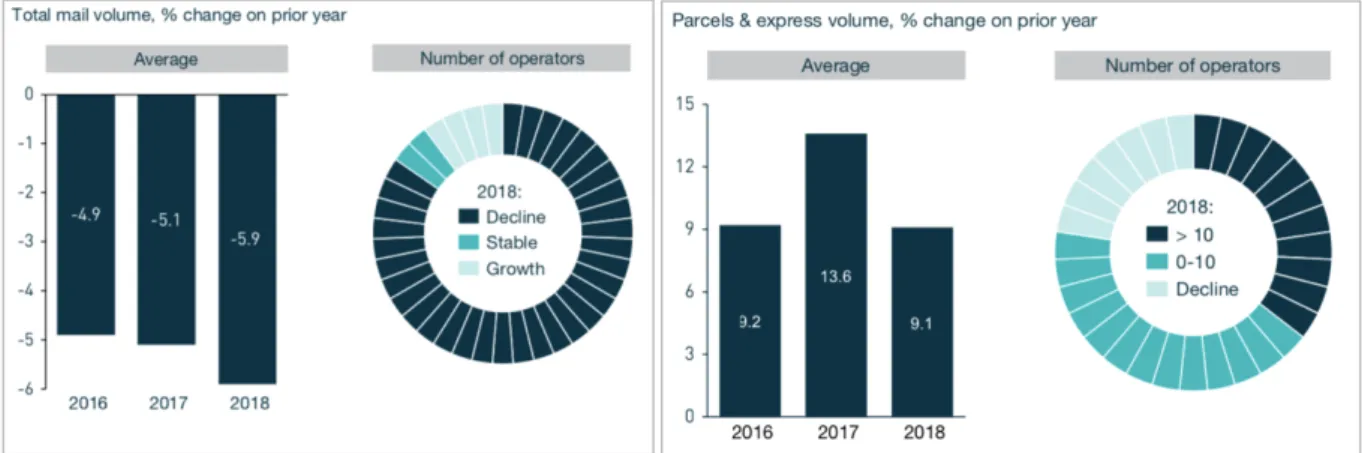
The postal industry had been suffering massive changes over the years. Around the world, digitalization had helped connecting people, businesses and governments. However, for the postal industry digital disruption had turned into a great challenge. This had translated into two major opposing pressures: mail volume decline and e-commerce parcels’ volume increase (Figure 1). On one hand, the traditional core business of postal operators was decreasing, as communications moved online, ever since the introduction of electronic mail at the end of the 20th century. On the other hand, the industry faced fierce competition as new players entered the rapid-growing e-commerce parcels market. These opposing pressures had led postal operators to shift from state-owned monopolies to commercial companies; from being only dependent on mail to having diversified portfolios; and from historical and traditional companies into a dynamic and uncertain prospect.
Figure 1- Mail and Parcels & Express volume variation (Source: IPC Global Postal Industry
Report 2019)i
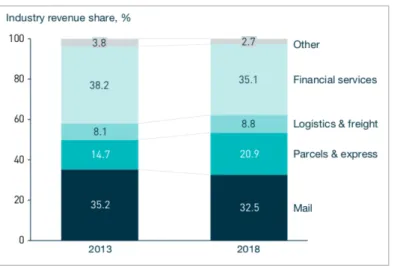
Postal operators around the world had followed a trend towards business diversification. While mail still remained the industry’s biggest segment, several postal operators had tried to pursue growth outside its core business (Figure 2). According to a study on the postal industry, conducted by Accenture, revenues from non-mail activities exceeded the revenues of the mail
segment for the first time in 2014, and this was only the beginningii. This brought attention to
strengthening their position in growth markets, namely by empowering e-commerce logistics, by investing on financial services and by repairing retain networks.
Figure 2 – Postal industry diversification (Source: IPC Global Postal Industry Report 2019)iii
Another factor, that had led to drastic consequences in this sector, was the liberalization of the postal market. In contrast to what EU Commission had promised, the report of “The Liberalization of European Postal Markets and the Impact on Employment and Working
Conditions” showed that postal liberalization had overall negative resultsiv. The report claimed
that it resulted in higher job losses and worsening working conditions for postal workers, contrarily to the improved services and reduced prices promised by the EU.
Despite constant changes and diversification attempts, the postal industry achieved revenues of
409.8 billion euros in 2018v, representing an increase of 14 Billion Euros from 2017 (exhibit
1). The e-commerce parcels segment remained the key growth lever as its development contributed for essentially half of the aggregate increase in revenue. However, mail services still had a large impact on the industry, contributing to more than half of revenues in about 40% of the world's postal operators.
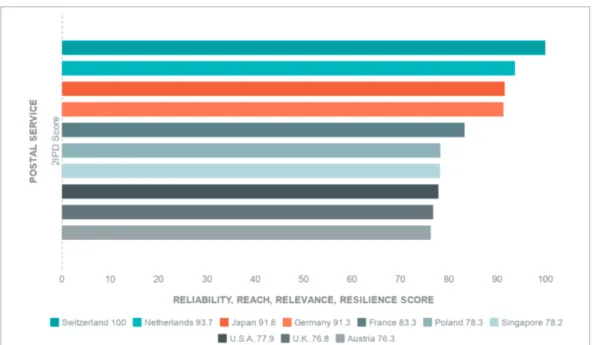
Regarding the main postal players, a report conducted by the Universal Postal Union (UPU) in 2018, evaluated 173 postal operators worldwide and the results showed that Switzerland was topping the list, followed by the Netherlands and Japan. These results were based on the ability of these three top players to focus on reliability, reach, relevance and resilience in their postal services. The following graph shows the top 10 international players in the postal industry,
Figure 3 – Top 10 postal services in the world (Source: Dropshipping Business Management)vi
2.1.2. The Portuguese postal industry
Aligned with what had been happening across the world, Portugal was facing the same challenges. As a result of the digitalization era, the postal liberalization and the privatization of CTT, new players had entered the market and there had been a decline in mail volume. In 2018, total traffic for postal services decreased 5.9%, which corresponded to a decrease of 4.9% in revenues. This decline was mainly due to the decrease in correspondence, editorial mail and addressed advertisement, which was partly balanced by the increase of 10.2% beheld in parcel trafficvii.
Regarding the mail segment, the replacement by digital solutions continued to pressure mail traffic - in 2018 at an international level, the mail volume had a decrease of 5,9%, when compared to the previous year. Similarly, the Portuguese market witnessed the same tendency of an accelerating decline in mail volumes, with greater expression in the transactional and advertising mail addressed. In an attempt to ease the impact of the mail downfall, several international postal operators continued to invest in strategies for the increase of mail prices –
the price broadened 6,5% each year between 2012 and 2019viii. In Portugal, even though an
increase in prices had occurred, the country still continued to charge one of the lowest prices in Europe. In addition, many postal operators had sought to adopt several other strategies to reduce costs and to increase efficiency. The main drivers to boosting efficiency were the decrease in
delivery days, the integration of mail and parcel networks and the flexibility of human resources structures.
Regarding the Parcels and Express segment in Portugal, the volume of orders grew by around 10% in 2018 and this growth trend was maintained in the first half of 2019ix.This segment
evolution was mainly boosted by the rapid growth of e-commerce in the Iberian Peninsula, with a growth of around 17% in Portugal, and leveraged by the progressive increase in internet penetration, which in Portugal was standing at 75% in 2019. It was estimated that in 2025 the
majority of the Portuguese population also would have access to the Internet (91%)x.
Consumers are changing their purchasing habits, relying more on online shopping. In 2018, 5
out of 10 Portuguese made online purchases (about 46%, 10 p.p. more than in 2017)xi. However,
the degree of penetration of e-commerce in the Iberian Peninsula was lower than that seen in other European countries. Therefore, it was believed that there was a high growth potential in the Iberian Peninsula, given that it was at a lower maturity stage compared to other more mature markets.
The industry of postal services was only totally liberalized in 2012xii, which historically was
limited to a single operator – CTT. In 2018, CTT was still the major detaining a share of 91% of total postal traffic, less 1.3 percentage points than the previous year (Figure 4). However, many companies keep emerging in this sector. For instance, Premium Green Mail (PGM) was a young player, whose operations only started in October of 2017, that had already been showing surprising results. By heavily relying on price as its competitive advantage, PGM turnover exceeded four million euros during its first year of operations. "Compared to 2018, the first quarter of 2019 registered an increase of 32%, a trend that we expect to continue to register over the next few months.", said the general director of PGM, in an interview with a Portuguese business newspaper xiii.
Postal operators 2014 2015 2016 2017 2018
Group CTT 94,5% 94,5% 93% 92,3% 91,0%
Premium Green Mail - - - - 3,0%
Group Adicional 0,2% 0,3% 0,9% 2,1% - Geopost /DPD Group 1,1% 1,3% 1,5% 1,7% 1,9% Vasp Premium 0,7% 0,7% 0,8% 0,9% 1,0% Notícias Direct 0,8% 0,6% 0,6% 0,7% 0,7% Group Nacex 0,2% 0,2% 0,2% 0,3% 0,4% Urbanos 0,3% 0,3% 0,4% 0,4% 0,3% Iberomail 0,3% 0,3% 0,3% 0,3% 0,3% TNT Express 0,2% 0,2% 0,2% 0,2% 0,3% Servinasa 0,0% 0,0% 0,0% 0,0% 0,2% SDIM 0,2% 0,2% 0,2% 0,2% 0,2% Best Direct 0,2% 0,2% 0,2% 0,2% 0,2% Group MRW 0,1% 0,1% 0,1% 0,1% 0,1% UPS 0,1% 0,1% 0,1% 0,1% 0,1% Other operators 1,2% 0,9% 1,4% 0,4% 0,2%
Figure 4 - Total shares of postal traffic in Portugal (Source: own composition, based on
2.2.CTT – Correios de Portugal, S. A. 2.2.1. CTT’s history
CTT – Correios de Portugal, S.A. was the universal postal operator in Portugal, also with activities in Spain and Mozambique. The origins of this centenary company date back to 1520, with the creation of the first public mail service in the country by king D. Manuel I. Then, in 1970, it was transformed into a public company named CTT – Correios e Telecomunicações de Portugal. Later, in 1992, postal services were separated from telecommunications and the company CTT – Correios de Portugal S.A. was created. More recently, in 2013, the Portuguese government decided to privatize CTT, thus becoming the first publicly traded company in Portugal, with 100% free-float. The following timeline highlights the company’s major events (Figure 5).
Figure 5 – Timeline of CTT’s key historical events (Source: own composition, based on information found on multiple web sources)
In 2016, the Company decided to invest in the banking sector by introduction Banco CTT. Banco CTT was born from the company’s ability to notice the diversification tendency already happening all around the world and brought with it the history and the experience of a company with more than 500 years. It aimed to provide appealing services for a broader profile: with no maintenance fee, zero annual fee on the debit card and zero fee on national transfers on digital channels. Leveraging on the centenary mark of CTT and on promoting the proximity to its clients, the bank started with 52 branches integrated in the structures of CTT’s postal offices and with a strong presence on digital channels by using the latest tools and applications that
D.Manuel I creates public
1952
1970
Foundation of the pubic company: Correios e Teleomunicações de Portugal Creation of CTT -Correios de Portugal S.A. 1992 2013 Privatization of CTT Creation of Banco CTT 2016
Banco CTT stood out positively in commissions charged for the most basic services, in the ease of the service and in the lack of extra costs, when compared to its competitors.
Regarding CTT’s organizational structure, Francisco de Lacerda had remained the executive chairman of the Company and vice chairman of the company's board of directors since 2012, when the company was still public and thus, he had been responsible for managing the privatization process. This was already his third term at this position. According to him, throughout the years the company had been facing numerous challenges aligned with the trends of the postal sector. These were specially the digitalization, the business diversification and the regulatory framework in Portugal. His term of office was characterized by the consolidation of the three critical pillars of the strategy approved for 2017-2019, namely, the transformation and modernization plans (which included cutting costs and reducing jobs), the growth of the Parcel segment and the creation and consolidation of Banco CTT.
CTT's competitive advantages arose from its history and unique position in the postal services market. According to Francisco de Lacerda, one of the company’s main competitive advantage was the proximity to the Portuguese population, especially for the Express & Parcels segment. As providers of the Universal Postal Service, CTT had always been concerned with maintaining a capillary network of access points and convenience to its services. Adding to this advantage was the trust the Portuguese had on the excellence of the CTT Brand and also the innovation component that the company had always invested in. The company had worked with several national start-ups, thus contributing for the development of the entrepreneurship in Portugal. Being internationally recognized for the service’s quality and its innovations, CTT had been distinguished with several awards, such as the Superbrands - Brand of Excellence 2018 and the
Trusted Brand 2019xv. Thus, CTT was widely known for being one of the most trusted brands
in Portugal. Leveraging on this advantage, in 2019 CTT held a diversified portfolio mainly in Mail, Express & Parcels, Financial Services and the Banking Sector (Banco CTT).
2.2.2. Decline and refocusing
According to its financial reports, CTT's profit fell 37.7% in the first quarter of 2019, compared to the same period in 2018, to 3.7 million euros. Despite its diversified portfolio, the mail segment still remained the fundamental business of the group, accounting for 70% of total revenue (Figure 6).
Figure 6 – CTT revenues on the first quarter of 2019 (source: CTT website)xvi
Thus, here lied CTT’s largest concern, as the mail segment continued in a decline trend (exhibit 2). In a statement sent to the Securities Market Commission (CMVM), CTT advanced that the mail business fell 3.2%, to 123.3 million euros, "due to the decrease in addressed mail traffic of -11.3%, strongly impacted by the postponement of Government shipments to the second quarter of 2019 and due to the loss of the share of customer traffic in banking and insurance to competition at the end of March 2018". This decline was offset by the growth in registered mail and international mail revenues and by the 4.7% increase in universal service prices compared to the first quarter of 2018 (Figure 7).
Figure 7 – Mail volume by type in million items (source: CTT’s website)xvii
The express and parcel business increased 2% to 36.7 million euros: + 3.5% in Portugal, -0.4% in Spain and -1.1% in Mozambique (exhibit 3).
Regarding CTT’s banking sector, Banco CTT revenues increased 1.4 million euros during the first three months of 2019 (exhibit 4). Such improvement was mainly driven by the growth in net interest income (+1.0 M€) and commissions received (+0.7 M€), and negatively impacted by payments and transfers (-0.3 M€).
Lastly, the continued recovery in public debt placements, with high incremental margin coupled with robust cost control, provided a strong boost to Financial Services profitability.
2.3. The transformation journey
Digitalization, e-commerce and e-substitution were global phenomena that expanded across all sectors of activities, with the postal sector being one of the most exposed sectors to these enormous changes. CTT, aware that the world was changing, and that digital was the new normal, started in 2016, with the implementation of a business diversification strategy, relying on two major growth levers – Express & Parcels and Banking Services, with Banco CTT. The company’s results had been under pressure since mid-2016, hence a strategic change was needed. But it only became to be implemented at the end of 2017, when the company announced the Operational Transformation Plan, mainly focused on improving the profitability of the postal business, optimizing its store network and reducing costs in order to support all the company’s transformations. This was the change that costumers and the sector were demanding for. At the time this plan was announced, CTT admitted that it had been lagging behind when compared to other international postal players, mainly due to the slow penetration of e-commerce parcels in Portugal and to its late bet on the banking sector, as Banco CTT only started its operations in 2016. Although late, the initial results of this plan were surprisingly good. In a statement sent to the Securities Market Commission (CMVM), CTT announced that the transformation plan, which initiated in the first quarter of 2018, exceeded initial projections, having raised 11.7 million euros in savings from recurring expenses.
Regarding the Express & Parcels segment, where the company was the market leader, several innovative services and disruptive products had been launched, with the new consumption habits and requirements of the digital customer in mind. In 2017, the company acquired the total share capital of Transporta – Transportes Porta a Porta, S.A., a company that offered integrated logistics solutions and that operated in the distribution and transport of goods in Portugal. "This acquisition is part of CTT's strategy of expansion and diversification, either through a new offer for the distribution of objects over 30 kg, or through the creation of a new expansion platform for the Company in the logistics and cargo value chain.” – Francisco de Lacerdaxviii.
Banco CTT was still in its third year of operations, having competitive offers in home and car loans and digital tools created for the benefit of customers, about 40% of whom were millennials. In 2019, the company announced the acquisition of 321 Crédito, a used car
strengthened by introducing a new business line, generating funding synergies and optimizing Banco CTT’s balance sheet, through a significant increase in the credit portfolio and the
transformation ratio from about 30% to more than 70%”xix. This acquisition was the completing
of another step towards achieving the Banco CTT’s targets (Figure 7).
Figure 7 – Banco CTT’s financial targets (source: CTT website)xx
These initiatives on the two growth levers were made without forgetting the base network, where CTT's traditional business was based and where it would invest 40 million euros over the next two years, in the modernization of mail and logistics operations. This was an investment in the core business, where CTT provided the Universal Postal Service in a context of strong and continuous drop in mail volumes. It was an investment in a new wave of mechanization and reorganization of the network, relying on advanced tools and new technologies and which would prepare CTT for the new reality of mail traffic, with the heavy weight of orders, but without forgetting CTT’s role of proximity to citizens and the importance of the capillarity of its network. In 2018, the company concluded the reorganization of its retail network, with some replacements of CTT Stores by Post Points and without putting at risk the proximity to its clients and the services provided. This restructuring plan intended to reduce around 800 people in the area of operations over the three following years, in order to stem the drop-in mail traffic. In 2019, CTT had a network with more CTT Points than in 2017 and in 2014, the year after its privatization. Additionally, the year of 2019 was perceived by the company as a year of investment and innovation, by providing CTT with the tools that would allow them to strengthen the activity and to grow. At the South Logistics and Production Center of the company, in Cabo Ruivo, there was a robotic arm to feed an automatic sorting machine for small orders, with a capacity to process 140,000 objects per day. This robotic arm was the
commerce, which was growing double digits yearly and which required profound changes to infrastructure and processes.
In addition to the innovations already implemented, CTT had been actively looking for new solutions outside its two growth levers, such as CTTads.pt, Express2Me, CTT 24H Lockers, the development of VEDUR, a 100% electric motorized tricycle, and the launch of a national marketplace, Dott. This marketplace resulted from a partnership with Sonae and from an investment in sustainability, with one of the largest electric fleets in the country in the logistics sector. During its first month, Dott had gathered 17 categories, more than 1.500 subcategories, more than 500 thousand references and more than 400 partners. The site had already received one million visits, during the month of May of 2019. In an interview to Distribuição Hoje, the CEO of Dott, Gaspar D’Orey stated that “Dott’s biggest goal is to be the top of mind of the Portuguese in terms of online shopping”xxi.
Besides the identification of a set of trends and the investment in CTT's innovation, the company was also aware of the development of the Portuguese entrepreneurial ecosystem, which was increasingly relevant. For this reason, CTT launched in 2018 the CTT 1520 StartupProgram, a program that aimed to interact with startups, by looking for projects that would fit into the business of the postal sector. The main aim was to enhance areas of joint collaboration and to provide possible benefits for startups. “We were a startup in 1520 and we are going to celebrate 500 years in 2 years”, this was how Francisco Simão, executive director of CTT, justified the name used to designate the company's program for interacting with
startupsxxii. In its first year of operations, this program had already mapped more than 1000
startups, with around 100 companies identified as having the potential to work with the company. Twenty of these companies were under detailed evaluation, five in technical pilot and one in commercial pilot. In addition, some of these companies were in commercial partnership with CTT, such as Pudo.pt for Automatic Lockers, Shopkit for integration with the 'e-commerce' offer, Robosavvy for Autonomous Vehicles to support operations and UOU Mobility for VEDUR (a 100% electric motorized tricycle).
With the investment in the basic infrastructure, the bet on cutting-edge technology and the improvement of the working conditions of the postmen, the constant spirit of innovation and a strong concern with sustainability, CTT continued to ensure their stakeholders that the company was increasingly prepared to succeed in all opportunities that the digital future would bring.
2.4.Looking into the future
After reading carefully the three reports on the company, João Bento was still uncertain about many things but one thing he was sure – it was imperative for CTT to follow a turnaround Strategy. However, he knew that this was not going to be an easy task, as several attempts had been made by the past CEO but results still did not seem to show signs of improvement (exhibit 5).
Francisco de Lacerda’s leadership was mainly characterized by the management of the company’s privatization process and by the implementation of a diversification strategy, as an attempt to broaden CTT’s portfolio to respond to the sector’s trends. However, the last months of its terms were also marked by a strong devaluation on the stock exchange (Figure 8) and by a consistent drop in profits, which in the first quarter of 2019 had already totaled 3.7 million euros, about 38% less than the same period last year. In 2018, net results accounted for 19.6 million, a value that corresponded to a 28% fall when compared to the previous year.
Figure 8 – CTT stock price evolution (Source: Deco Proteste)xxiii
These negative results had shown that diversification alone was not able to offset the decline of the Mail business. It was expected that the two growth levers would be able to compensate for the weak performance of the traditional segment of CTT, but neither Banco CTT nor Express & Parcels had grown sufficiently to compensate for the loss. They also had shown that one of the main advantages of its core business was damaged – the quality of its service.
Another difficult task, that the upcoming CEO knew he had to face, was to convince investors that the Postal Industry could return to the right destination. In consequence of the CTT’ results,
in 2018 and in the first semester of 2019, and the Anacom red card on the service’s quality, tensions between the administration of Francisco de Lacerda and CTT’s shareholders were running high. In fact, during a general company meeting, which took place on the 23rd of May 2019, a group of shareholders refused to approve the vote of confidence to CTT’s management. One of the most important aspects of the company was the trust Portuguese put in it, so this confidence had to be rebuilt.
After days of self-debating, he picked up his phone confidently and dialed the number. As soon as the other person picks up, the first thing he says is “I accept your offer to be the new executive president of CTT”.
3. Exhibits
Exhibit 1: Key figures of the Global Postal Industry in 2018
Exhibit 2: Revenues of CTT’s Mail segment in the first quarter of 2019
Source: CTT websitexxv
Exhibit 3: Revenues of CTT’s Express & Parcels segment in the first quarter of 2019
Exhibit 4: Revenues of CTT’s Banco CTT segment in the first quarter of 2019
Source: CTT website xxvii
Exhibit 5: Evolution of CTT’s net profits, in million euros
5.
Teaching Notes
5.1. Overview
This case illustrates how CTT, the biggest postal operator in Portugal has reacted when faced with a technological, legal and social exogenous shock and how it managed to implement a diversification strategy in a very traditional company. The case describes how the transformation process was coordinated and how it impacted the company’s results.
The first part focuses on introducing the case by providing an overview of the company’s context on the first trimester of 2019. It intends to illustrate the difficult time that CTT was going through and the necessity for a new CEO to take over the company.
Afterwards, the three following parts describe the three main aspects of CTT – the industry, the company itself and its strategy. Firstly, “The Global Postal Industry” chapter analyses both the international and the national context of the postal industry in order to allow the students to better understand the major trends that the industry has been facing. Secondly, the chapter of “CTT History” highlights CTT’s major milestones and accomplishments, as well as its main competitive advantages. Additionally, it covers the financial situation of the company at the date of the case, by evaluating all its business segments. Thirdly, the “The transformation journey” section focuses on enumerating all the organizational changes and strategic decisions made by CTT in order to respond to all the exogenous shocks. Through this section students can better understand CTT’s commitment to develop a diversify portfolio.
To conclude, the final part of the case aims to inform the students that the new CEO had accepted the offer and to highlight all difficult talks that wait for him. At the end, it was intended not to mention which were its first commands as the new CEO in order to allow students to wonder and to predict on their own.
5.2. Teaching objectives:
This case was designed to be presented to both undergraduate and graduate students in the fields of strategic management and dynamic capabilities. This case illustrates how a historical
legal and social exogeneous shocks. Furthermore, the case emphasizes the dynamic capabilities view applied to a real-life example of a company.
Overall, the case was intended to focus on the following teaching objectives:
- Highlight the importance of identifying exogenous shocks and the impact they can have on an industry and the associated challenges that can arise to companies;
- Introduce students to the challenges of implementing a diversification strategy; - Analyze a firm’s ability to successfully adapt to overcome the shifts in the market; - Highlight the need to constantly adapt and be aware of competitors’ responses;
- Understand how Strategic Change and Dynamic Capabilities are critical for the analysis of a firm’s ability to adapt to changing environments.
5.3. Intended contribution
Firstly, the case demonstrates the importance of Strategic Change and how a company with many years of experience in the industry has struggled to adapt to changes in the market. The company was evidently late in implementing a strategy as a reaction towards the exogenous shift. Around the world, several postal operators were already implementing diversification strategies beforehand, while CTT took more time to sense the threats and the opportunities. Secondly, it illustrates perfectly the importance of accessing the Dynamic Capabilities view in order to respond to the highly dynamic environment.
Lastly, the case demonstrates how CTT’s diversification attempts have affected its core business and how they have contributed to the performance of the firm. While investing on the banking sector and on the parcels segment, the traditional mail business of CTT was under the attack of Anacom, the National Communications Authority, for its downgrade on service’s quality.
5.4. Pedagogical overview
In order to assure an outstanding analysis and discussion of the case, it is crucial that both the instructor and students are familiarized with the concept of Dynamic Capabilities. Thus, it is recommended to read the paper by Ilídio Barreto, 2010: “Dynamic Capabilities: A Review of Past Research and an Agenda for the Future”, which covers the relevant theory illustrated in the case. Additionally, students must also know the basics of Strategic Change in order to be able to perform an analysis of the external environment, and the basics of Corporate Strategies, namely of a Diversification Strategy in order to correctly identify it.
For a better understanding and overview of the company’s strategy and mission, it should be beneficial, for both students and the instructor, to visit CTT’s website. Also, if students seem to not know enough about the company, the disclosure of the following video before the case discussion is recommended:
https://www.youtube.com/watch?v=tVGzUYFTXOg
5.5. Assignment questions and analysis
Legal - Liberalization of the postal market in Europe, resulting in higher jobs losses and worsening working conditions for postal workers, which turned out to have an overall negative impact on the industry; - Liberalization of the Portuguese postal market, which resulted in a shift from having only one stated-owned company to the entrance of more competitors in the market.
Social - “Communications moved online, ever since the introduction of electronic mail” (e-substitution);
- “Consumers are changing their purchasing habits, relying more on online shopping. In 2018, 5 out of 10 Portuguese made online purchases (about 46%, 10 p.p. more than in 2017)”. (e-commerce).
Technological - The unstoppable digitalization trend which continued to pressure
mail traffic.
1.Taking CTT’s external environment into consideration, identify what were the major exogenous shocks that the company faced?
• Operational transformation plan at the end of 2017, “mainly focused on improving the profitability of the postal business, optimizing its store network and reducing costs in order to support all the company’s transformations”.
• Implementation of a business diversification strategy, relying on two major growth levers – Express & Parcels and Banking sector (Banco CTT).
o Investment in the banking sector: Introduction of Banco CTT in 2016, with competitive offers in home and car loans and with digital tools for the benefit of customers. In 2019, acquired 321 Crédito in order to “introduce a new business line, generate funding synergies and optimize Banco CTT’s balance sheet”. o Investments in Express and Parcel business: Acquisition of Transporta, a
company that offered integrated logistics solutions and that operated in the distribution and transport of goods in Portugal, in order to offer greater distribution capacity and increase service efficiency.
• Investments in CTT’s traditional business:
o Investment in a new wave of mechanization (for instance, robotic arm to feed an automatic sorting machine for small orders, with a capacity to process 140,000 objects per day);
o Reorganization of its retail network (for instance, replacement of CTT stores by Post Points).
• Investment in innovation: CTT found new solutions outside its two growth levers (For instance, CTTads.pt, Express2Me, CTT 24H Lockers, the development of VEDUR, a 100% electric motorized tricycle, and the launch of a national marketplace, Dott)
2. What were the main organizational changes and strategic decisions implemented by the company in order to react to the exogeneous shocks?
• Investment in the Portuguese entrepreneurial ecosystem: Launching in 2018, the CTT 1520 StartupProgram in order to interact with Portuguese startups, by looking for projects that would fit into the business of the postal sector, by enhancing areas of joint
collaboration and by providing possible benefits for startups (for
instance, Puto.pt helped CTT with the creation of Automatic lockers, Shopkit for integration with the 'e-commerce' offer, Robosavvy for Autonomous Vehicles to support operations or UOU Mobility for VEDUR.)
Dimension Degree Case evidences
Propensity to sense opportunities and threats
High: CTT knew that the world was changing and that the company needed to adapt. The Company saw the opportunity of entering other businesses and saw the threat of the digitalization and of the entrance of new players in the industry
Opportunities:
- “Banco CTT was born from the company’s ability to notice the diversification tendency already happening all around the world”. - “The company was also aware of the
development of the Portuguese entrepreneurial ecosystem”.
- “CTT continued to ensure their stakeholders that the company was increasingly prepared to succeed in all opportunities that the digital future would bring.”
Threats:
- “CTT, aware that the world was changing, and that digital was the new normal, started in 2016, with the implementation of a business diversification strategy”.
- “Relying on advanced tools and new technologies and which would prepare CTT for the new reality of mail traffic”.
Propensity to make timely decisions
Low: CTT was not able to make changes ahead of its competitors
- “The company’s results had been under pressure since mid-2016… But it (Operational Transformational
3. Analyze CTT’s case using Barreto’s four dimensions of dynamic capabilities. Justify your answer with examples from the case study.
- “CTT admitted that it had been lagging behind when compared to other international postal players”. - “Although late, the initial results of
this plan were surprisingly good”. Propensity to make
market-oriented decisions
Medium-low: The company paid attention to find ways to provide superior value to its customers. However, some strategic decisions affected the evolution of CTT’s stock price and affected one of the most valuable assets for clients – the quality of the postal service.
- “This was the change that costumers and the sector were demanding for”. - “Being internationally recognized for
the service’s quality and its
innovations, CTT had been
distinguished with several awards”. - “Banco CTT … digital tools created
for the benefit of customers”
- “Dott’s biggest goal is to be the top of mind of the Portuguese in terms of online shopping”.
- “CTT was widely known for being one of the most trusted brands in Portugal”
- “This meant that the quality of service indicators of CTT have dropped”.
- “The last months of its terms were also marked by a strong devaluation on the stock exchange” (figure 8) Propensity to change
the resource base
High: CTT acquired many companies and reconfigured its resources in order to reinforce its diversification strategy.
Through gaining resources:
- “In 2017, the company acquired the total share capital of Transporta.”- to develop its Express & Parcels segment.
- “In 2019, the company announced the acquisition of 321 Crédito.” - to strengthened Banco CTT.
Through reconfiguring resources:
- “In 2018, the company concluded the reorganization of its retail network” - “It was an investment in a new wave
of mechanization and reorganization of the network to reinforce its traditional business”.
The instructor should separate the students into groups in order to form consulting teams. Each team will have time to think of a strategic solution to propose to the new CEO and then present it to the rest of the class. After all teams present their solutions, students and the instructor will vote on the best solution.
Assessing the different options requires consideration of the company’s overall identity and mission. There are no right answers to this open discussion, so the following topics might be considered for the purpose of the class discussion:
- Create synergies amongst all its business segments. According to Clarke (1985), Diversification strategies increase organizations’ profitability because it allows the creation of synergies from combining complementary skills. Therefore, the new CEO could focus on creating synergies between Banco CTT and the rest of its business segments.
- Focus more on the e-commerce segment. Since E-commerce evolution is still lagging behind in Portugal, CTT could heavily invest in this segment by concentrating all of its activities and forces in the development of its Express & parcels business. Perhaps instead of diversifying in all segments, the company could focus on the one CTT believes will be more profitable for the company.
- Target the older generation for Banco CTT. According to the company, Banco CTT success was leveraged on how the brand name has a strong impact on the Portuguese population due to its history and symbology. Therefore, it would be expected that the bank’s main customer segment would be the elder. Surprisingly, Banco CTT’s clients are mainly millennials, who are the generation less emotionally attached with the history of CTT and with what it represents. So, here lies an opportunity – to focus on retaining the older generation in order to broader Banco CTT’s customers.
4. Imagine that you are an external consultant hired by CTT, what would be the strategic solutions that you would advise the new CEO to follow?
- Reinforce the relationship with Anacom. CTT and Anacom, Portugal's communications authority, have constantly been battling during Francisco de Lacerda’s term because of the quality of service indicators and the way they are measured. However, the new CEO has the opportunity to change this scenario in order to combined forces to improve the postal industry.
- Exploit the company’s archives and its history: CTT is a centenary company, meaning it has 500 years of history. Thus, its long archive must contain a great amount of interesting historical files. Leveraging on this, the company could use all of these historical files as advertisement materials or to present them in a museum.
5.6. Board plan
This case is designed for a 90-minute lecture. The table below aims at proposing a potential schedule for all activities related with the case:
Activities Duration (min.)
Case Review and Assigned Question 20
Question 1 10
Question 2 15
Question 3 15
Question 4: Brainstorm in teams 15
4. Discussion
In our global world, environments in which organizations operate are becoming more and more vulnerable to radical changes, namely because of the heavy impact of technology. My dissertation focusses on illustrating, with the real-life setting of CTT, the importance of implementing organizational changes and strategic decisions in order to adapt to new environmental conditions. The case study also illustrates a recent implementation of a diversification strategy in the company. Furthermore, one of the main objectives of this case is to highlight the relevance and applicability of the Dynamic Capabilities view.
First of all, the CTT case supports the findings of Zajac, Kraatz and Bresser (2000) that organizations should adapt in order to maintain its alignment with the environment because significant shifts may occur. These shifts were witnessed in the postal industry, especially in its legal, social and technological environment. The digitalization era has been changing the world and for the postal industry has brought major challenges, that is, communications and purchases are now online. Also, another great shift for this industry was its liberalization, contributing for the entrance of new players and consequentially to the increase in competition. Aligned with what Gioia, Thomas, Clark and Chittipeddi (1994) stated, the organization identified these exogenous shocks and proposed organizational changes in order to realign with the new environment. CTT proposed its Operational Transformation Plan back in 2017, as a response to the shifts in the operating environment, along with the commitment of expanding its business portfolio. Furthermore, this case confirms the findings of Boeker’s (1997) that poor performance is the main driver for change. Indeed, when CTT decided to initiate its strategic changes, the company’s results were already under pressure. Also, in coherence with Quinn 1978, CTT’s implementation of strategic change has been happening “gradually and incrementally” and not rapidly and suddenly as Mintzberg (1978) described it.
CTT adapted by diversifying its portfolio and by leveraging on two major growth levers – Banco CTT (banking sector) and Parcels. In order to respond to all the shifts that the industry was facing, CTT adopted a diversification strategy, following what other international postal operators were already developing. Regarding the two types of diversification defined by Collins and Montgomery (2005), the company adopted an unrelated diversification when it invested in a different industry (banking sector) and a related diversification strategy when it