Joana Correia Brandão
Chronic Postoperative Pain: Impact
on the Quality of Life and Recovery
Mestrado Integrado em Medicina
Área: Anestesiologia
Trabalho efetuado sob a Orientação de:
Doutor Fernando José Pereira Alves Abelha
Trabalho organizado de acordo com as normas da revista:
European Journal of Anaesthesiology
on the Quality of Life and Recovery
Chronic Postoperative Pain: Impact on the Quality
of Life and Recovery
Joana Brandão1, GabrielaSousa2, DalilaVeiga2, Fernando Abelha2,3§
1 Faculty of Medicine, University of Porto, Porto, Portugal
2Department of Anaesthesia, Hospital de São João, Porto, Portugal
3Anaesthesiology and Perioperative Care Unit-Department of Surgery of Faculty of
Medicine, University of Porto, Alameda Professor Hernani Monteiro, 4200-319, Porto, Portugal
§Corresponding author: [email protected] or Faculty of Medicine,
Abstract and Keywords
Context: Chronic postoperative pain (CPOP) is defined as pain persisting 2 months after surgery that cannot be explained by other causes. Quality of recovery (QoR) after anaesthesia is a measure of the early postoperative health status of patients, and together with health-related quality of life (QoL) is considered a valid indicator of outcomes.
Objectives: Assess the incidence and risk factors of developing CPOP after high risk surgeries, and evaluate its impact on the quality of life and recovery.
Design: Observational, prospective study.
Setting: Post-Anaesthesia Care Unit of a tertiary hospital: Centro Hospitalar São João, Porto, Portugal.
Patients: 175 patients scheduled for elective surgery. Exclusion criteria: unable to give informed consent, cognitive impairment and urgent surgery.
Main outcome measures: The primary end point was CPOP. CPOP was assessed with the Brief Pain Inventory (BPI), QoL was evaluated with the EQ-5D EuroQol five-dimension questionnaire (EQ-5D) and QoR with the 15-item Quality of Recovery score (QoR-15). Evaluations were performed preoperatively (T0), 24 hours after surgery (T24) and 3 months after surgery (T3).
Results: 49 (28%) patients had CPOP 3 months after surgery. At T3, the problems reported by patients with CPOP were significantly larger in all EQ-5D dimensions: “mobility” (p=0.001), “self-care” (p=0.001), “usual activities” (p<0.001), “pain/discomfort” (p<0.001), and “anxiety/depression” (p=0.002). Patients with CPOP had lower median EuroQol Visual analogue scale (EQ VAS) (60 vs. 87, p<0,001). Concerning QoR-15 scores at T24, CPOP patients had lower median scores for “been able to enjoy food” (p=0.022), “feeling rested” (p=0.001), “moderate pain” (p=0.004), “severe pain” (p=0.009), “nausea or vomiting” (p=0.049), “feeling sad or depressed” (p=0.013), and for global score (p<0.001).
Conclusions: CPOP incidence was relevant (28%) and patients with CPOP reported worse QoR at T24 and worse QoL at T3 than those without CPOP.
Introduction
Chronic postoperative pain (CPOP) is an undervalued yet prevalent healthcare problem associated with significant morbidity and impact on physical, psycho-social, cognitive, and working domains. (1) It is defined as pain persisting 2 months after surgery that cannot be explained by other causes. (2) A neuropathic pain is often present and described as ‘burning’, ‘shooting’, or ‘electric-like’, and together with the presence of clinical signs of hyperalgesia or allodynia. An acute injury or surgery leads to neuroplastic changes in the peripheral and central nervous system in response to the nociceptive input. These changes cause nervous system hypersensitivity, and, if persistent, often can lead to debilitating chronic pain.
Three linked processes are implicated in the transition from acute to chronic pain and may serve as targets for prevention: i) peripheral sensitization, ii) central sensitization, and iii) descending modulation. (3) CPOP can occur with any type of surgery, but is more common following procedures with significant nerve or tissue damage. Prevalence varies greatly; the estimated prevalence for surgeries with higher risk of developing CPOP is: mastectomy 20–50%, amputation 50–85%, hysterectomy 5–30%, hernia repair 5–35%, and thoracotomy 5–65% (2). Risk factors include the type of surgery, preoperative pain, moderate-to-severe acute post-operative pain, neurotoxic radio or chemotherapy and psycho-social factors, among others (Fig. 1). (1)
Health-related Quality of Life (QoL) questions about function and perceived physical and mental health are generally considered valid indicators of service needs and intervention outcomes. (4) Recovery after surgery and anaesthesia is a complex process dependent on patient, surgical, and anaesthetic characteristics, as well as the presence of any of numerous adverse sequelae. However, it has been considered a relevant measure of the early postoperative health status of patients. Evaluating QoL and QoR may be essential for better outcomes studies in both surgery and anaesthesia. (5)
The aim of our study was to assess the incidence and risk factors of developing CPOP after high risk surgeries (mastectomy, amputation, hysterectomy, cholecystectomy, hernia repair, thoracotomy, thyroidectomy, and knee/hip arthroplasty), and to evaluate its impact on quality of life and recovery.
Methods
The Institutional Review Board of the Centro Hospitalar São João approved the study protocol (Centro Hospitalar São João Ethics Committee, Alameda Hernâni Monteiro, 4200-310 Porto, Portugal - Chairperson Prof Filipe Nuno Alves Santos Almeida, Ethical approval number 198-13), and written informed consent was obtained from all patients. This prospective cohort study was carried out in the multidisciplinary Post-Anaesthesia Care Unit (PACU) at the 1124-bed Centro Hospitalar São João, a community teaching hospital in Porto, Portugal. It was conducted in patients scheduled for elective surgery admitted in the PACU from June to August 2013.
Inclusion criteria were all consecutive adult patients undergoing orthopedic (limb amputation, total knee and hip arthroplasty), thoracic (thoracotomy), gynecologic (hysterectomy), and general surgery (mastectomy, thyroidectomy, inguinal hernia repair and cholecystectomy). Patients unable to give informed consent, patients with cognitive impairment (Mini-mental State Examination < 24) and patients submitted to emergent or urgent surgery were excluded.
The following clinical variables were recorded preoperatively (T0): age, sex, body weight, height, body mass index (BMI) and the American Society of Anaesthesiologists physical status (ASA-PS). Additionally, pre-admission comorbidities and history of hypertension, diabetes, hyperlipidaemia, chronic obstructive pulmonary disease (COPD), cerebrovascular disease, psychiatric disease, smoking and benzodiazepines therapy were recorded. Preoperative cognitive function was evaluated with the Mini Mental State Examination.
Intra-operatively, we recorded duration and type of anaesthesia. Analgesic or anxiolytic drugs administered in the 24-hour period after surgery were registered.
Brief Pain Inventory (Appendix 1) was used to assess CPOP. BPI is a widely used questionnaire designed to assess the patient-reported outcome of pain making it a suitable method for detecting chronic pain in those adults who are able to provide information about them. (6, 7)
QoL was evaluated with the EQ-5D EuroQol five-dimension questionnaire (Appendix 2) and QoR after anaesthesia with the 15-item Quality of Recovery score (Appendix file 3). EQ-5D is a generic questionnaire that measures health outcome and was developed at the European level. The Portuguese version of EQ-5D was designed in 1998. (8) The EQ-5D comprises two parts: the EQ-5D self-classifier, a self-reported description of health problems according to a five dimensional classification i.e., mobility, self-care, usual activities, pain/discomfort
and anxiety/depression; the EQ VAS, a self-rated health status using a visual analogue scale (VAS), similar to a thermometer, to record perceptions of participants own current overall health; the scale is graduated from 0 (the worst imaginable health state) to 100 (the best imaginable state). An index (EQ Index), based on the five dimensions and the EQ VAS and ranging from 0 to 100, was also calculated and used to describe the overall QoL of the patients. (9, 10) We categorized patients into two groups considering their answers to EQ-5D: those with no referred problems and those with problems, regardless of their severity. QoR-15 is a short-form version of the 40-question original questionnaire and provides a valid, reliable, responsive, easy-to-use, extensive, and efficient method of evaluating the quality of postoperative recovery. It may be used to assess the impact of changes in health care delivery for quality assurance purposes. (5) We performed QoR-15 before surgery (T0) and 24 hours after surgery (T24).
Quality of life and BPI evaluations were performed preoperatively (T0) and 3 months after surgery (T3) in 175 patients. The primary endpoint was CPOP. Each patient admitted was evaluated prospectively for the diagnosis of CPOP using BPI conducted by research staff physicians. All patients yielding a positive BPI at 3 months post-operatively were considered to have CPOP.
Results
Admission and pre-admission patient characteristics (T0)
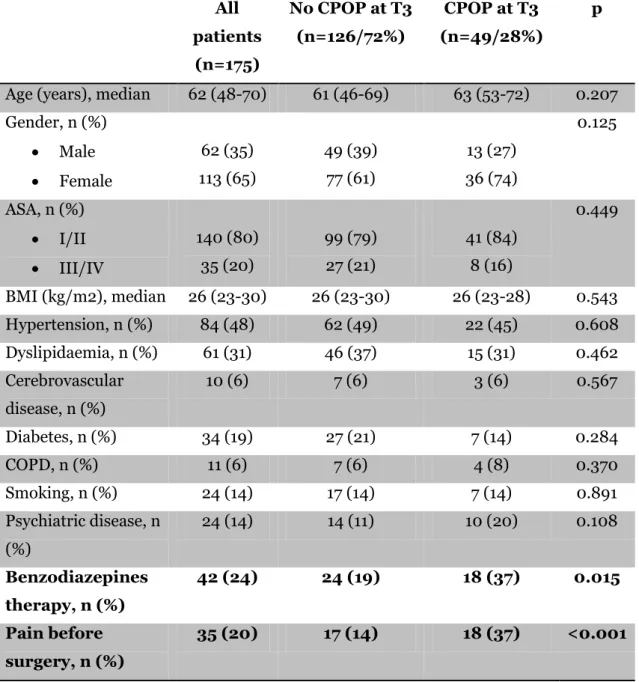
175 patients were enrolled in this study (Table 2), 62 (35%) were male and 113 (65%) were female. The median age was 62 years old and 140 (80%) patients were considered ASA-PS I/II and 35 (20%) ASA-PS III/IV. The median BMI was 26 kg/m2.
84 (48%) patients had history of hypertension, 61 (31%) of dyslipidaemia, 11 (6%) of COPD, 34 (19%) of diabetes, 10 (6%) of cerebrovascular disease, and 24 (14%) of psychiatric disease. 24 (14%) patients were smokers. 42 (24%) patients confirmed taking benzodiazepines daily as usual medication.
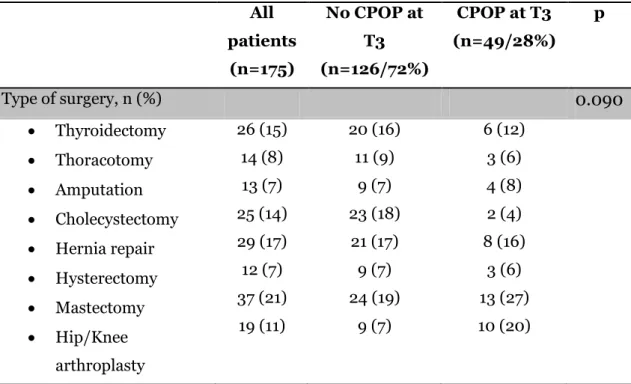
Concerning type of surgery, 26 (15%) patients underwent thyroidectomy, 14 (8%) thoracotomy, 13 (7%) amputation, 25 (15%) cholecystectomy, 29 (17%) inguinal hernia repair, 12 (7%) hysterectomy, 37 (21%) mastectomy, and 19 (11%) orthopaedic surgery. Type of surgery was not associated with CPOP at 3 months (p=0.090) (Table 3).
35 (20%) patients reported pain before surgery. Patients with CPOP at T3, had more frequently “pain before surgery” (p<0.001) and were less frequently on “benzodiazepines therapy” (p=0.015).
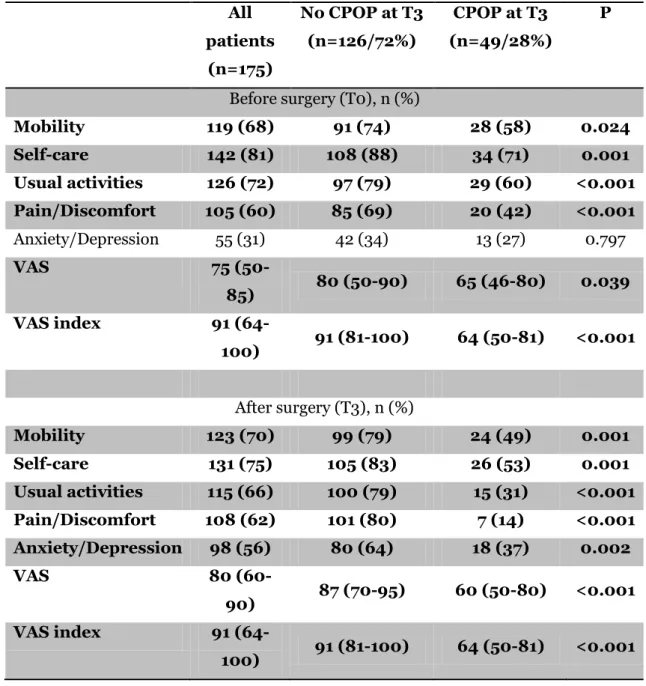
At T0, the problems reported by patients with CPOP were significantly larger in all EQ-5D dimensions: “mobility” (p=0.024), “self-care” (p=0.001), “usual activities” (p<0.001), and “pain/discomfort” (p<0.001), but “anxiety/depression” (p=0.797). Patients with CPOP reported lower median EuroQol Visual analogue scale (EQ VAS) (65 vs. 80, p<0,001), and lower VAS index (64 vs. 91, p<0,001) (Table 4).
Concerning QoR-15 scores, CPOP patients presented with lower total median scores at T0 in the following domains: “getting support from hospital doctors and nurses” (10 vs. 10, p=0.016), “able to return to work or usual home activities” (10 vs. 10, p=0.026), “moderate pain” (9 vs. 10, p<0.001), “severe pain” (10 vs. 10, p<0.001) and for a “global score” (125 vs. 132, p=0.021) (Table 5).
During surgery and PACU stay results
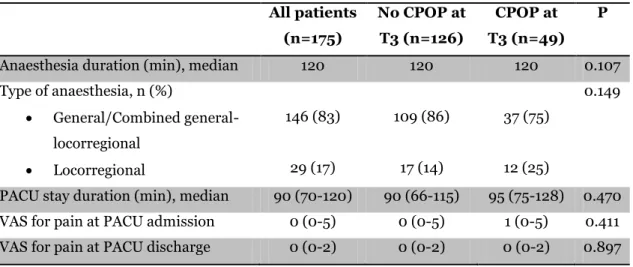
Regarding anaesthesia, 146 (83%) patients received general or combined general-locorregional anaesthesia while 29 (17%) received locorregional anaesthesia. The median duration of the anaesthesia was 120 minutes and median PACU stay was 90 minutes. The median value for pain at PACU admission and discharge using VAS was 0 (Table 6).
24h post-operatively (T24) results
At T24, 81 (46%) patients reported pain. Pain 24 hours after surgery was associated with more CPOP at 3 months follow-up (p=0.021). QoR-15 mean global score was lower for CPOP patients (103 vs. 121, p<0.001). At T24, when evaluating each domain of QoR-15, CPOP patients have lower scores at “been able to enjoy food” (5 vs. 9, p=0.022), “feeling rested” (7 vs. 9, p=0.001), “moderate pain” (5 vs. 7, p=0.004), “severe pain” (10 vs. 10, p=0.009), “nausea or vomiting” (10 vs. 10, p=0.049), and “feeling sad or depressed”(8 vs. 10, p=0.013) (Table 5).
3 months post-operatively (T3) results
49 (28%) patients had CPOP 3 months after surgery. Patients with CPOP at 3 months follow-up had more frequently pain 24 hours after surgery (p=0.021). Moreover, half of our patients with positive BPI before surgery still had pain at T3.
At this time, the problems reported by patients with CPOP were significantly larger in all EQ-5D dimensions: “mobility” (p=0.001), “self-care” (p=0.001), “usual activities” (p<0.001), “pain/discomfort” (p<0.001), and “anxiety/depression” (p=0.002). Patients with CPOP reported lower median EuroQol Visual analogue scale (EQ VAS) (60 vs. 87, p<0,001) as well as lower VAS index (64 vs. 91, p<0,001) (Table 4).
Discussion
Our study reports that 3 months after surgery 28% of patients had CPOP. This incidence, similar to those of the previous studies, may be viewed as an important indicator regarding the economic burden and the significant impact on quality of life.
In our study, a considerable number of patients, all well characterized according to their medical history, were submitted to various types of surgeries, different kinds of anaesthetic management and diverse times of recovery. The population was extensively evaluated by several parameters that are known to influence the quality of recovery and it was possible to determine its impact on quality of life. According to our knowledge, this is also the first study recording the incidence of chronic postoperative pain after thyroidectomy.
Regarding risk factors and predictors of CPOP, previous studies reported that age (11) and gender (12, 13) are non-modifiable patient-related risk factors: younger patients and female patients tend to have a higher risk of developing CPOP than older patients and male patients. However, in our study we did not find any difference according to age or gender. Regarding modifiable risk factors, previous studies found that high body mass index (≥25) (11), severe preoperative pain (13-15), higher incidence of postoperative complications (16), and the presence of chronic pain in other areas of the body (17) were also considered to be risk factors. Although in the present study, we could not find that a higher BMI and the presence of chronic pain in other areas of the body were associated with an increase in CPOP incidence, we could find that CPOP was related with severe postoperative pain as reported in many previous studies (2, 3), which corroborates the thesis that CPOP may be associated with severe and/or poorly controlled acute pain after surgery. Thus, we may theorize that aggressive acute pain management may diminish the development of CPOP. (2, 3) Moreover, certain psychological factors including anxiety, depression, posttraumatic stress disorder, past life traumas (18), catastrophizing (19), and stress and duration of disability (time to return from work) (20) were associated with CPOP in various studies. We did not perform a psychological evaluation of our patients by a specialized therapist; nonetheless we enquired patients about the presence of any psychiatric disorder and psychiatric medication use. We observed that those taking benzodiazepines daily had less frequently CPOP at 3 months after surgery, which is in accordance to previous studies (21) regarding psychological status of patients. In a particularly anxious patient, pre-existing pain may be intensified by fear and anxiety, and benzodiazepines may reduce the amount of intraoperative anaesthetic and postoperative analgesic needs. (21) During the intraoperative and postoperative
periods, important surgical factors include: the type of surgery (22), anatomical location of surgery, surgical technique (23), and the extent of nerve injury and tissue ischemia (23). (3) Some surgeries are associated with higher incidence of CPOP, such as mastectomy, thoracotomy and inguinal hernia repair.
In addition, we did not find differences in CPOP incidence between the different types of surgeries, but we must recognise that the limited number of patients and the relatively high number of surgeries’ groups may have limited any conclusion.
Type of anaesthesia has been implicated on the development of CPOP but in the present study we did not find any difference according to this variable, which is consistent with previous results. (24)
Although several risk factors have been implicated in the development of this pain condition, no single factor appears to dominate. It is believed that less than 20% of the overall risk can be predicted by the severity of postoperative pain. (25) Yet, it might be possible that the cumulative risk is crucial in patients with multiple risk factors. Whenever possible, identifying and aggressively treating the underlying cause of nervous tissue injury is essential. This may explain why half of our patients with positive BPI before surgery still had pain at T3. Surgery on a painful body area did not treat the pain, which should point us towards an alternate cause.
Patients who presented CPOP after surgery included those with pre-existing pain (positive BPI before surgery) and those with newly developed pain. Before surgery, patients who later reported CPOP presented significantly more problems in all EQ-5D dimensions except “anxiety/depression”. At T3, patients with CPOP reported significantly more problems in all EQ-5D dimensions. Before and after surgery, these patients also reported lower mean EQ VAS. All mentioned results show a clear relationship between CPOP and poor own perception of health related-QoL.
When evaluating each domain of QoR-15 at T24, CPOP patients had lower scores at “been able to enjoy food”, “feeling rested”, “moderate pain”, “severe pain”, “nausea or vomiting”, and “feeling sad or depressed”.
We propose that some of the baseline values obtained preoperatively may be underestimated providing many patients were possibly anxious, medically unstable or in pain before surgery. However, we should not ignore that CPOP patients already felt more pain, moderate and severe, before surgery when compared with those without CPOP at T3. This may also explain why some patients develop pain and others do not, leading us to believe certain patients have a higher risk for developing CPOP. It is essential to have means to discriminate between these two groups in
order to find strategies to prevent CPOP. Although we believe prevention is the key, its effect is often small and the evidence is not consistent. Currently, there is almost nothing suggesting a reliable and effective method for prevention is possible. Nonetheless, as previous mentioned, the severity of postoperative pain has been recognized as a predicting factor for chronic pain in many studies. We have excellent techniques aimed at this and it may be that focusing more attention on patients in severe pain after surgery will be of benefit. (2) Future studies concentrating on the effect of aggressive management of acute postoperative pain on long-term CPOP are crucial.
Additionally, previous studies reported that QoR-15 was able to discriminate between men and women (26, 27) and it has already been found a negative association between QoR-15 and duration of surgery and duration of time spent in PACU. However, in our study, no relation has been found between QoR-15 score and patient age (28, 29), possibly explained by the fact that older people tend to report less pain, nausea and vomiting and scoring their recovery more positively. (5) Despite this, our study shows a clear relation between a worse recovery and the development of CPOP. Not only did CPOP patients felt more pain, moderate or severe, before and after surgery compared to those who were CPOP-negative at T3, but they also experienced incapacity to appreciate food and to feel rested, nausea and vomiting, and felt sad or depressed, immediately after surgery. All these in addition to an overall worse QoR-rate both at T0 and T24 suggest these patients have poorer quality of recovery and consequently lower quality of life.
This study has several limitations that must be addressed. We did not exclude patients with pain before surgery and that may be a confounding factor. The sample was not homogenous since we included adult patients with a variety of surgeries. In this study the anaesthetic management was not standardized: there was no anaesthetic protocol to follow and the postoperative management was not guided by any protocol. We also had a small patient population and we studied patients submitted to wide variety of surgeries and this may have increased statistical type II error. Even so, the sample may have been very small to detect other statistically significant factors. Moreover, we did not study some variables known to be associated with CPOP like the nature, intensity, and duration of pre-surgical pain.
In conclusion, CPOP is an increasingly prevalent healthcare problem associated with significant morbidity and it represents an important outcome measure after surgery. In our study its incidence was relevant (28%) and patients
with CPOP reported worse QoR at T24 using QoR-15, and worse QoL 3 months after surgery with EQ-5D than those without CPOP.
Acknowledgements
No financial support or sponsorship is declared. The authors declare no conflicts of interest.
Presentation: Preliminary data for this study will be presented as a poster presentation at the European Society of Anaesthesiology (ESA) Euroanaesthesia, 31 May–2 June 2014, Stockholm.
References
1. Visser EJ. Chronic post-surgical pain: Epidemiology and clinical implications for acute pain management. Acute Pain 2006; 8(2): 73-81.
2. Niraj G, Rowbotham DJ. Persistent postoperative pain: where are we now? British journal of anaesthesia 2011; 107(1): 25-9.
3. McGreevy K, Bottros MM, Raja SN. Preventing Chronic Pain following Acute Pain: Risk Factors, Preventive Strategies, and their Efficacy. European journal of pain supplements 2011; 5(2): 365-72.
4. Dominick KL, Ahern FM, Gold CH et al. Relationship of health-related quality of life to health care utilization and mortality among older adults. Aging clinical and experimental research 2002; 14(6): 499-508.
5. Stark PA, Myles PS, Burke JA. Development and Psychometric Evaluation of a postoperative quality of recovery score: the QoR-15. Anesthesiology 2013; 118(6): 1332-40.
6. Atkinson TM, Rosenfeld BD, Sit L et al. Using confirmatory factor analysis to evaluate construct validity of the Brief Pain Inventory (BPI). Journal of pain and symptom management 2011; 41(3): 558-65.
7. Furler L. Validity and reliability of the pain questionnaire "Brief Pain Inventory". A literature research. Pflege Zeitschrift 2013; 66(9): 546-50.
8. Granja C, Lopes A, Moreira S et al. Patients' recollections of experiences in the intensive care unit may affect their quality of life. Critical care 2005; 9(2): R96-109. 9. Brooks R. EuroQol: the current state of play. Health policy 1996; 37(1): 53-72.
10. EuroQol G. EuroQol--a new facility for the measurement of health-related quality of life. Health policy 1990; 16(3): 199-208.
11. Massaron S, Bona S, Fumagalli U et al. Analysis of post-surgical pain after inguinal hernia repair: a prospective study of 1,440 operations. Hernia: the journal of hernias and abdominal wall surgery 2007; 11(6): 517-25.
12. Caumo W, Schmidt AP, Schneider CN et al. Preoperative predictors of moderate to intense acute postoperative pain in patients undergoing abdominal surgery. Acta anaesthesiologica Scandinavica 2002; 46(10): 1265-71.
13. Gerbershagen HJ, Pogatzki-Zahn E, Aduckathil S et al. Procedure-specific Risk Factor Analysis for the Development of Severe Postoperative Pain. Anesthesiology 2013. [Epub ahead of print]
14. Hanley MA, Jensen MP, Smith DG et al. Preamputation pain and acute pain predict chronic pain after lower extremity amputation. The journal of pain: official journal of the American Pain Society 2007; 8(2): 102-9.
15. Tsirline VB, Colavita PD, Belyansky I et al. Preoperative pain is the strongest predictor of postoperative pain and diminished quality of life after ventral hernia repair. The American Surgeon 2013;79(8): 829-36.
16. Franneby U, Sandblom G, Nordin P et al. Risk factors for long-term pain after hernia surgery. Annals of surgery 2006; 244(2): 212-9.
17. Lavand'homme P. Chronic pain after vaginal and cesarean delivery: a reality questioning our daily practice of obstetric anesthesia. International journal of obstetric anesthesia 2010; 19(1): 1-2.
18. Young Casey C, Greenberg MA, Nicassio PM et al. Transition from acute to chronic pain and disability: a model including cognitive, affective, and trauma factors. Pain 2008; 134(1-2): 69-79.
19. Peters Peters ML, Sommer M, de Rijke JM et al. Somatic and psychologic predictors of long-term unfavorable outcome after surgical intervention. Annals of surgery 2007; 245(3): 487-94.
20. Hinrichs-Rocker A, Schulz K, Jarvinen I, Lefering R et al. Psychosocial predictors and correlates for chronic post-surgical pain (CPSP) - a systematic review. European Journal of Pain 2009; 13(7): 719-30.
21. Bottiger BA, Esper SA, Stafford-Smith M. Pain Management Strategies for Thoracotomy and Thoracic Pain Syndromes. Seminars in Cardiothoracic and Vascular Anesthesia 2014; 18(1): 45-56.
22. Macrae WA. Chronic pain after surgery. British journal of anaesthesia 2001; 87(1): 88-98.
23. Reddi D, Curran N. Chronic pain after surgery: pathophysiology, risk factors and prevention. Postgraduate medical journal 2014. [Epub ahead of print]
24. Duale C, Ouchchane L, Schoeffler P et al. Neuropathic aspects of persistent postsurgical pain: a French multicenter survey with a 6-month prospective follow-up. The journal of pain: official journal of the American Pain Society 2014; 15(1):24 e1- e0.
25. Eisenach JC. Treating and preventing chronic pain: a view from the spinal cord. Regional anesthesia and pain medicine 2006; 31(2): 146-51.
26. Myles PS, Hunt JO, Nightingale CE et al. Development and psychometric testing of a quality of recovery score after general anesthesia and surgery in adults. Anesthesia and analgesia 1999; 88(1): 83-90.
27. Buchanan FF, Myles PS, Cicuttini F. Effect of patient sex on general anaesthesia and recovery. British Journal of Anaesthesia 2011; 106(6): 832-9. 28. Hall JA, Dornan MC. Patient sociodemographic characteristics as predictors of satisfaction with medical care: a meta-analysis. Social science & medicine 1990; 30(7): 811-8.
29. Blanchard CG, Labrecque MS, Ruckdeschel JC et al. Physician behaviors, patient perceptions, and patient characteristics as predictors of satisfaction of hospitalized adult cancer patients. Cancer 1990; 65(1): 186-92.
30. Akkaya T, Ozkan D. Chronic post-surgical pain. Agri 2009; 21(1): 1-9.
31. Brogly N, Wattier JM, Andrieu G et al. Gabapentin attenuates late but not early postoperative pain after thyroidectomy with superficial cervical plexus block. Anesthesia and analgesia 2008; 107(5): 1720-5.
Tables and Figures
Figure 1 - Risk factors for the development of CPOP.
Table 1 – Prevalence of CPOP according to type of surgery (2, 3, 30, 31).
Prevalence of CPOP
Mastectomy
20–50%
Amputation
30–85%
Hysterectomy
5–32%
Hernia repair
5–35%
Thoracotomy
5–65%
Thyroidectomy
unknown
Total knee arthroplasty
19-30%
Total hip arthroplasty
28-41%
Table 2 – Pre-admission patient characteristics. All patients (n=175) No CPOP at T3 (n=126/72%) CPOP at T3 (n=49/28%) p
Age (years), median 62 (48-70) 61 (46-69) 63 (53-72) 0.207 Gender, n (%) Male Female 62 (35) 113 (65) 49 (39) 77 (61) 13 (27) 36 (74) 0.125 ASA, n (%) I/II III/IV 140 (80) 35 (20) 99 (79) 27 (21) 41 (84) 8 (16) 0.449 BMI (kg/m2), median 26 (23-30) 26 (23-30) 26 (23-28) 0.543 Hypertension, n (%) 84 (48) 62 (49) 22 (45) 0.608 Dyslipidaemia, n (%) 61 (31) 46 (37) 15 (31) 0.462 Cerebrovascular disease, n (%) 10 (6) 7 (6) 3 (6) 0.567 Diabetes, n (%) 34 (19) 27 (21) 7 (14) 0.284 COPD, n (%) 11 (6) 7 (6) 4 (8) 0.370 Smoking, n (%) 24 (14) 17 (14) 7 (14) 0.891 Psychiatric disease, n (%) 24 (14) 14 (11) 10 (20) 0.108 Benzodiazepines therapy, n (%) 42 (24) 24 (19) 18 (37) 0.015 Pain before surgery, n (%) 35 (20) 17 (14) 18 (37) <0.001
Table 3 – CPOP incidence according to the type of surgery. All patients (n=175) No CPOP at T3 (n=126/72%) CPOP at T3 (n=49/28%) p Type of surgery, n (%)
0.090
Thyroidectomy Thoracotomy Amputation Cholecystectomy Hernia repair Hysterectomy Mastectomy Hip/Knee arthroplasty 26 (15) 14 (8) 13 (7) 25 (14) 29 (17) 12 (7) 37 (21) 19 (11) 20 (16) 11 (9) 9 (7) 23 (18) 21 (17) 9 (7) 24 (19) 9 (7) 6 (12) 3 (6) 4 (8) 2 (4) 8 (16) 3 (6) 13 (27) 10 (20)Table 4 – EQ-5D results. All patients (n=175) No CPOP at T3 (n=126/72%) CPOP at T3 (n=49/28%) P Before surgery (T0), n (%) Mobility 119 (68) 91 (74) 28 (58) 0.024 Self-care 142 (81) 108 (88) 34 (71) 0.001 Usual activities 126 (72) 97 (79) 29 (60) <0.001 Pain/Discomfort 105 (60) 85 (69) 20 (42) <0.001 Anxiety/Depression 55 (31) 42 (34) 13 (27) 0.797 VAS 75 (50-85) 80 (50-90) 65 (46-80) 0.039 VAS index 91 (64-100) 91 (81-100) 64 (50-81) <0.001 After surgery (T3), n (%) Mobility 123 (70) 99 (79) 24 (49) 0.001 Self-care 131 (75) 105 (83) 26 (53) 0.001 Usual activities 115 (66) 100 (79) 15 (31) <0.001 Pain/Discomfort 108 (62) 101 (80) 7 (14) <0.001 Anxiety/Depression 98 (56) 80 (64) 18 (37) 0.002 VAS 80 (60-90) 87 (70-95) 60 (50-80) <0.001 VAS index 91 (64-100) 91 (81-100) 64 (50-81) <0.001
Table 5 – QoR-15 results All patients (n=175) No CPOP at T3 (n=126) CPOP at T3 (n=49) P Before surgery (T0)
1. Able to breathe easy 10 (10-10) 10 (10-10) 10 (10-10) 0.876 2. Been able to enjoy food 10 (10-10) 10 (10-10) 10 (8-10) 0.072 3. Feeling rested 9 (5-10) 8 (5-10) 9 (5-10) 0.684 4. Have had a good sleep 9 (5-10) 9 (5-10) 7 (4-10) 0.401 5. Able to look after personal toilet and
hygiene unaided
10 (10-10) 10 (10-10) 10 (10-10) 0.239 6. Able to communicate with family or
friends
10 (10-10) 10 (10-10) 10 (10-10) 0.687 7. Getting support from hospital
doctors and nurses
10 (10-10) 10 (10-10) 10 (10-10) 0.016
8. Able to return to work or usual home activities
10 (8-10) 10 (9-10) 10 (6-10) 0.026
9. Feeling comfortable and in control 10 (7-10) 10 (8-10) 10 (5-10) 0.097 10. Having a feeling of general
well-being
9 (6-10) 9 (7-10) 8 (5-10) 0.105
11. Moderate pain 10 (8-10) 10 (10-10) 9 (4-10) <0.001
12. Severe pain 10 (10-10) 10 (10-10) 10 (8-10) <0.001
13. Nausea or vomiting 10 (10-10) 10 (10-10) 10 (10-10) 0.177 14. Feeling worried or anxious 5 (3-9) 5 (2-9) 5 (3-9) 0.997 15. Feeling sad or depressed 8 (5-10) 9 (5-10) 7 (4-10) 0.107
Total 131 (114-140) 132 (119-142) 125 (99-138) 0.021
24h after surgery (T24)
1. Able to breathe easy 10 (8-10) 10 (9-10) 10 (7-10) 0.094
2. Been able to enjoy food 8 (4-10) 9 (5-10) 5 (1-10) 0.022
3. Feeling rested 8 (6-10) 9 (7-10) 7 (5-8) 0.001
4. Have had a good sleep 7 (4-9) 8 (5-10) 7 (2-9) 0.366 5. Able to look after personal toilet and
hygiene unaided
8 (2-10) 9 (2-10) 7 (2-10) 0.265 6. Able to communicate with family or
friends
10 (9-10) 10 (9-10) 10 (7-10) 0.144 7. Getting support from hospital
doctors and nurses
10 (9-10) 10 (9-10) 10 (9-10) 0.973 8. Able to return to work or usual
home activities
6 (2-9) 7 (3-9) 5 (1-9) 0.246 9. Feeling comfortable and in control 9 (6-10) 9 (7-10) 8 (5-10) 0.165 10. Having a feeling of general
well-being
8 (5-10) 8 (6-10) 7 (5-9) 0.096
11. Moderate pain 5 (3-10) 7 (4-10) 5 (3-6) 0.004
12. Severe pain 10 (9-10) 10 (10-10) 10 (7-10) 0.009
13. Nausea or vomiting 10 (8-10) 10 (10-10) 10 (6-10) 0.049
14. Feeling worried or anxious 8 (5-10) 8 (5-10) 8 (3-10) 0.506
15. Feeling sad or depressed 10 (6-10) 10 (8-10) 8 (5-10) 0.013
Table 6 – During surgery and at PACU stay results. All patients (n=175) No CPOP at T3 (n=126) CPOP at T3 (n=49) P
Anaesthesia duration (min), median 120 120 120 0.107
Type of anaesthesia, n (%) General/Combined general-locorregional Locorregional 146 (83) 29 (17) 109 (86) 17 (14) 37 (75) 12 (25) 0.149
PACU stay duration (min), median 90 (70-120) 90 (66-115) 95 (75-128) 0.470
VAS for pain at PACU admission 0 (0-5) 0 (0-5) 1 (0-5) 0.411
Gostaria de agradecer ao Prof. Dr. Fernando Abelha pelos inestimáveis apoio e disponibilidade, que permitiram o desenvolvimento deste projecto; e por me ter dado a oportunidade de integrar um grupo de investigação tão motivador e dedicado.
Agradecer também à Dra. Dalila Veiga e à Dra. Gabriela Sousa pela incansável e imprescindível colaboração.
Por fim, gostaria de agradecer aos meus pais, meus eternos companheiros de luta e de vida (académica e não só!).
Guidance for Authors on the Preparation and Submission of Manuscripts to the European Journal of Anaesthesiology
Note: These instructions comply with those formulated by the International Committee of Medical Journal Editors (ICMJE). For further details, authors should consult the following article: International Committee of Medical Journal Editors. “Uniform Requirements for Manuscripts Submitted to Biomedical Journals” New Engl J Med1997, 336:309–315. The complete document appears at http://www.icmje.org. Scope
The European Journal of Anaesthesiology (EJA) publishes original work of high scientific quality in the field of anaesthesiology, pain, emergency medicine and intensive care. Preference is given to experimental work or clinical observation in man, and to laboratory work of clinical relevance. The journal also publishes commissioned reviews by an authority, abstracts of scientific meetings, editorials, commentaries, special articles and correspondence are also included.
Redundant or duplicate publication
We ask you to confirm that your paper has not been published in its current form or a substantially similar form (in print or electronically, including on a web site), that it has not been accepted for publication elsewhere, and that it is not under consideration by another publication. The ICMJE has provided details of what is and what is not duplicate or redundant publication. If you are in doubt (particularly in the case of material that you have posted on a web site), we ask you to proceed with your submission but to include a copy of the relevant previously published work or work under consideration by other journals. Authors must draw attention to any published work that concerns the same patients or subjects as the present paper in a covering letter with their article.
Conflicts of interest
Authors must state all possible conflicts of interest in the manuscript, including financial, consultant, institutional and other relationships that might lead to bias or a conflict of interest. If there is no conflict of interest, this should also be explicitly stated
Permissions to reproduce previously published material
The EJA requires you to send us copies of permission to reproduce material (such as illustrations) from the copyright holder. Articles cannot be published without these permissions.
Patient consent forms
The protection of a patient's right to privacy is essential. Please collect and keep copies of patients’ consent forms on which patients or other subjects of your experiments clearly grant permission for the publication of photographs or other material that might identify them. If the consent form for your research did not specifically include this, please obtain it or remove the identifying material.
A statement to the effect that such consent had been obtained must be included in the ‘Methods’ section of your paper. If necessary the Editors may request a copy of any consent forms.
Ethics committee approval
All articles dealing with original human or animal data must include a statement on ethics approval at the beginning of the Methods section. This paragraph must contain the following information: the name and address of the ethics committee responsible; the protocol number that was attributed by this ethics committee; the name of the Chairperson of the ethics committee (or the person who approved the protocol) and the date of approval by the ethics committee.
The paragraph could read, for example:
Ethics: Ethical approval for this study (Ethical Committee N° NAC 207) was provided by the Ethical Committee NAC of Geneva University Hospitals, Geneva, Switzerland (Chairperson Prof N. Dupont) on 12 February 2007.
In addition and as stated above, for studies conducted on human participants you must state clearly that you obtained written informed consent from the study participants; please also look at the latest version of the Declaration of Helsinki. Similarly, for
clearance was not necessary, or if there was any deviation from these standard ethical requests, please state why it was not required. Please note that the editors may ask you to provide evidence of ethical approval. If you have approval from a National Drug Agency (or similar) please state this and provide details, this can be particularly useful when discussing the use of unlicensed drugs.
Adherence to international guidelines on adequate data reporting The European Journal of Anaesthesiology adheres to the guidelines on adequate data reporting that were established by The Enhancing the QUAlity and Transparency Of health Research (EQUATOR) network (http://www.equator-network.org/home/). For more information, see the EJA Editorial: Guidelines on adequate data reporting: use them!
Authorship
We ask all authors to confirm that they have read and approved the paper. Second, we ask all authors to confirm that they have met the criteria for authorship as established by the ICMJE, believe that the paper represents honest work, and are able to verify the validity of the results reported.
All persons designated as authors should qualify for authorship and all those who qualify should be listed. Each author should have participated sufficiently in the work to take public responsibility for appropriate portions of the content. One or more authors should take responsibility for the integrity of the work as a whole, from inception to published article. Authorship credit should be based only on 1) substantial contributions to conception and design, or acquisition of data, or analysis and interpretation of data; 2) drafting the article or revising it critically for important intellectual content; 3) final approval of the version to be published. Conditions 1, 2 and 3 must all be met. Acquisition of funding, the collection of data or general supervision of the research group, by themselves, do not justify authorship. All others who contributed to the work who are not authors should be named in the Acknowledgements section.
Retractions
Compliance with Research Funding Agency Accessibility Requirements A number of research funding agencies now require or request authors to submit the “post-print” (the final manuscript, in Word format, after peer-review and acceptance for publication but prior to the publisher’s copyediting, design, formatting, and other services) to a repository that is accessible online by all without charge. As a service to our authors, LWW will identify to the National Library of Medicine (NLM) articles that require deposit and will transmit the post-print of an article based on research funded in whole or in part by the National Institutes of Health, Wellcome Trust, or the Howard Hughes Medical Institute to PubMed Central. Authors of research funded by other funding agencies may submit the post-print 12 months after publication of the final article, or 6 months after publication if the funding agency mandates a shorter time-frame.
Open access
LWW’s hybrid open access option is offered to authors whose articles have been accepted for publication. With this choice, articles are made freely available online immediately upon publication. Authors may take advantage of the open access option at the point of acceptance to ensure that this choice has no influence on the peer review and acceptance process. These articles are subject to the journal’s standard peer-review process and will be accepted or rejected based on their own merit.
Authors of accepted peer-reviewed articles have the choice to pay a fee to allow perpetual unrestricted online access to their published article to readers globally, immediately upon publication. The article processing charge for European Journal of Anaesthesiology is $2,500. The article processing charge for authors funded by the Research Councils UK (RCUK) is $3,175. The publication fee is charged on acceptance of the article and should be paid within 30 days by credit card by the author, funding agency or institution. Payment must be received in full for the article to be published open access.
Authors grant LWW a license to publish the article and identify itself as the original publisher.
Creative Commons license
Articles opting for open access will be freely available to read, download and share from the time of publication. Articles are published under the terms of the Creative Commons License Attribution-NonCommerical No Derivative 3.0 which allows readers to disseminate and reuse the article, as well as share and reuse of the scientific material. It does not permit commercial exploitation or the creation of derivative works without specific permission. To view a copy of this license visit: http://creativecommons.org/licenses/by-nc-nd/3.0.
Compliance with NIH, RCUK, Wellcome Trust and other research funding agency accessibility requirements
A number of research funding agencies now require or request authors to submit the post-print (the article after peer review and acceptance but not the final published article) to a repository that is accessible online by all without charge. As a service to our authors, LWW identifies to the National Library of Medicine (NLM) articles that require deposit and transmits the post-print of an article based on research funded in whole or in part by the National Institutes of Health, Howard Hughes Medical Institute, or other funding agencies to PubMed Central. The revised Copyright Transfer Agreement provides the mechanism. LWW ensures that authors can fully comply with the public access requirements of major funding bodies worldwide. Additionally, all authors who choose the open access option will have their final published article deposited into PubMed Central.
RCUK and Wellcome funded authors can choose to publish their paper as open access with the payment of an article process charge (gold route), or opt for their accepted manuscript to be deposited (green route) into PMC with an embargo.
With both the gold and green open access options, the author will continue to sign the Copyright Transfer Agreement (CTA) as it provides the mechanism for
the gold route will be able to publish under the terms of the Attribution 3.0 (CCBY) License. To view of a copy of this license visit: http://creativecommons.org/licenses/by/2.0/. Those authors who wish to publish their article via the green route will be able to publish under the rights of the Attribution Non-commercial 3.0 (CCBY NC) license (http://creativecommons.org/licenses/by-nc/2.0/).
It is the responsibility of the author to inform the Editorial Office and/or LWW that they have RCUK funding. LWW will not be held responsible for retroactive deposits to PMC if the author has not completed the proper forms.
FAQ for open access
http://links.lww.com/LWW-ES/A48 Copyright assignment
Papers are accepted for publication on the understanding that exclusive copyright in the paper is assigned to the Publisher. Each author must complete and submit the journal’s copyright transfer agreement, which includes a section on the disclosure of potential conflicts of interest based on the recommendations of the ICMJE. The form is readily available on the manuscript submission page and can be completed and submitted electronically. Please note that authors may sign the copyright transfer agreement form electronically. For additional information about electronically signing this form, go to http://links.lww.com/ZUAT/A106. Without the signed copyright form, the manuscript cannot be published.
Submissions
All manuscripts and materials must be submitted through the web-based tracking system at https://www.editorialmanager.com/eja/. Submissions should be in English, UK spelling is preferred. The site contains instructions and advice on how to use the system. Authors should NOT in addition then post a hard copy submission to the editorial office, unless you are supplying artwork, letters or files that cannot be submitted electronically, or have been instructed to do so by the editorial office. For those authors who have no option but to submit by mail please send one copy of the
1.5 spacing should be used throughout the manuscript, which should include the following sections, each starting on a separate page: Title Page, Abstract, Text, Acknowledgements, References, Tables and Figures, and captions. Margins should be not less than 3 cm. Pages should be numbered consecutively, beginning with the Title Page, and the page number should be placed in the top right hand corner of each page. Two letter abbreviations should be avoided. Longer abbreviations should be defined on their first appearance in the text; those not accepted by international bodies should be avoided.
Article Types
Randomised Controlled Trials
Authors are requested to report these in accordance with the CONSORT (Consolidated Standards of Reporting Trials) statement [www.consort-statement.org]. This ensures that enough information is provided for editors, peer reviewers, and readers to see how the study was performed and to judge whether the findings are likely to be reliable (see EJA Editorial: Adherence to guidelines for improved quality of data reporting: where are we today?). Please provide the following:
A flow chart showing the progress of participants through the study. The example flowchart may be adapted as required.
A checklist for editors and reviewers (not for publication) showing that you have described the recommended respective key points in your report.
The trial registration number and name of the registry. This must be stated at the end of the abstract (see the relevant example in the section 'Structured
Abstract'). Acceptable registries are:
www.anzctr.org.au www.clinicaltrials.gov www.ISRCTN.org www.umin.ac.jp/ctr/index/htm www.trialregister.nl https://eudract.ema.europa.eu/
Maximum length of reports of randomised controlled trials is 3500 words. Please provide a structured abstract (300 words, see subheading Structured Abstract).
Observational Study (Cohort, Case-control, Cross-sectional, Case Series) Authors are requested to report these in accordance with the STROBE (STrengthening the Reporting of OBservational studies in Epidemiology) statement [www.strobe-statement.org].
Maximum length of reports of observational studies is 3500 words. Please provide a structured abstract (300 words, see subheading Structured Abstract).
Studies of Diagnostic Accuracy
Authors are requested to report these in accordance with STARD (STandard for the Reporting of Diagnostic accuracy) statement [www.stard-statement.org].
Maximum length of reports of Diagnostic studies is 3500 words. Please provide a structured abstract (300 words, see subheading Structured Abstract).
Systematic Reviews (with or without meta-analysis)
Authors are requested to submit these as ‘Original articles’ (not ‘Reviews’) and report them in accordance with the PRISMA (Transparent Reporting of Systematic Reviews and Meta-Analyses) Statement [www.prisma-statement.org]. This ensures that enough information is provided for editors, peer reviewers, and readers to see how the study was performed and to judge whether the findings are likely to be reliable (see EJA Editorial: Adherence to guidelines for improved quality of data reporting: where are we today?). Please provide the following:
• A flow chart showing the progress of retrieved reports through the review • A checklist for editors and reviewers (not for publication) showing that you have described the recommended respective key points in your report.
Maximum length of reports of systematic reviews is 3500 words. Please provide a structured abstract (300 Words, see subheading Structured Abstract). Authors are encouraged to publish additional material (for instance, large tables, figures with forest
Conventional, Non-systematic Reviews
These are usually commissioned. Maximum length of reviews is 3500 words. Please provide an unstructured abstract (max. 250 words). Please include a title page giving the author's name, address, email address, phone and fax numbers, as well as an Acknowledgement statement (see paragraph: Acknowledgements) and signed copyright forms.
Practice Guidelines
In general, published statements intended to guide clinical care (e.g., Guidelines, Practice Parameters, Recommendations, Consensus Statements, Position Papers) should describe:
1. The clinical problem to be addressed;
2. The mechanism by which the statement was generated; 3. A review of the evidence for the statement (if available), and; 4. The statement on practice itself.
As more than one group or society may issue statements on the same topic, this often results in confusion amongst clinicians. To minimize confusion and to enhance transparency, such statements should begin with the following bulleted phrases, followed by brief comments addressing each phrase:
What other guideline statements are available on this topic? Why was this guideline developed?
How does this statement differ from existing guidelines? Why does this statement differ from existing guidelines? Editorials
Editorials discuss issues that are not directly related to published material. Editorials are usually commissioned. Editorials should be up to 1500 words long with no more than 15 references. Please include a title page giving all authors' names, addresses, email addresses, phone and fax numbers, as well as an Acknowledgement statement
Commentaries
Commentaries discuss issues that are directly related to published material. Commentaries accompany original articles, critically appraise their results and put their conclusions into a wider context. Commentaries are always commissioned and should be up to 1000 words long with no more than 10 references. Commentaries do not have an abstract. Please include a title page giving the author's name, address, email address, phone and fax numbers, as well as an Acknowledgement statement (see paragraph: Acknowledgements) and signed copyright forms.
Correspondence
In this section, we publish case reports, letters and replies. Items in the Correspondence section are peer reviewed. Please look at a very recent copy of the European Journal of Anaesthesiology to see how the material should be presented. The format (layout) for the Correspondence section is quite different from our other articles. The absolute maximum is 1000 words, which must include the space for any tables and illustrations (this is approximately two sides of printed matter in the Journal). There should be no more than 4 authors, if more than 4 are stated then a letter justifying the number of authors and listing what each contributed should be submitted with the article. References are limited to seven.
Correspondence articles do not have an abstract. Please include a title page giving the author's name, address, email address, phone and fax numbers, as well as an Acknowledgement statement (see paragraph: Acknowledgements) and signed copyright forms.
Case Reports
Case reports should follow the guidance for correspondence (see above). In addition case reports dealing with patients must state that informed consent to publication was obtained from the patient or guardian (or was granted by a competent ethics committee).
The Title Page should carry the full title of the paper and a short title to be used as a ‘running head’ (and which should be so identified). Please, include the study design in the title; for instance, “randomised controlled trial”, or “systematic review”. Titles should be as informative and complete as possible. The EJA Editorial:How to write a good title provides some help. The first name, middle initial and last name of each author and their affiliations should appear. Academic degrees should not be stated. If the work is to be attributed to a department or institution, its full name should be included. The name and address of the corresponding author and the name and address of the author to whom requests for reprints should be made should also appear on the Title Page.
Structured Abstract
For original articles, the second page should carry an abstract, which will be printed at the beginning of the paper and should not be more than 300 words. Use the following headings and information as appropriate (which are adapted from the BMJ and JAMA websites). The abstract should be usable as it stands by abstracting journals. Because of this it should contain some numerical data (if appropriate), not just statistical statements, and it should not contain abbreviations or references (see EJA Editorial: Writing the abstract: completeness and accuracy matter).
Example: Randomised controlled trial, observational study, diagnostic study, animal study
Background: Explaining the clinical (or other) importance of the study question. Objective(s): Including a clear statement of the main aim(s) of the study and the major hypothesis tested or research question posed. Avoid statements such as “We aimed to evaluate the effectiveness of X”.
Design: For example, randomised controlled study, case control study, crossover study, observational study, survey, diagnostic test etc.
Patients, other participants (delete what does not apply): Numbers entering and completing the study, sex, and ethnic group if appropriate. Give clear definitions of how selected, entry and exclusion criteria. For animal studies, this information should be included in the Design or Setting section.
Intervention(s): What, how, when and for how long. This heading can be deleted if there were no interventions but should normally be included for randomised controlled trials, cross over trials, and before and after studies.
Main outcome measures: What was the primary endpoint? What outcome measures were planned in protocol, which were finally measured (if different, explain why)? Results: Main results with (for quantitative studies) 95% confidence intervals and, where appropriate, the exact level of statistical significance.
Conclusions: Primary conclusions and their implications, suggest areas for further research if appropriate.
Trial registration: The trial registration number and the name of the registry must
be stated at the end of the abstract, for example: “Trial registration:Clinicaltrials.gov identifier: NCT00405977.”
Example: Systematic reviews with or without meta-analyses Background:
Objective(s):
Design: For example: Systematic review of randomised controlled trials with meta-analyses.
Data sources: Where included studies were retrieved from? Include years searched. Eligibility criteria: Describe inclusion and non-inclusion criteria of selected studies. Results:
The remainder of the text should be divided into sections headed Introduction, Methods (including ethical and statistical information), Results, and Discussion (including a conclusion).
Acknowledgements
The acknowledgements section should be headed 'Acknowledgements relating to this article' and contain four distinct statements in three separate paragraphs:
1. Assistance with the article. Acknowledgements should be made only to those who have made a substantial contribution to the study. Authors are responsible for obtaining written permission from people acknowledged by name in case readers infer their endorsement of data and conclusions. If there was no assistance state: none declared.
2. Financial support and sponsorship. You must make reference to all relevant sources of funding concerning this article. If there were no sources of funding please state: none declared.
3. Conflicts of interest. You must make reference to all relevant conflicts of interest concerning this article. If there are no conflicts of interest please state: none declared. 4. Presentation. Presentations of preliminary data at, for example, international meetings should be acknowledged separately. If preliminary data was not previously presented please state: none declared.
For example:
Acknowledgements relating to this article
Assistance with the study: We would like to thank Dr John A. Smith for his assistance with the study.
Financial support and sponsorship: This work was supported by the Department of Anaesthesiology, London Hospital, London, UK.
Presentation: Preliminary data for this study were presented as a poster presentation at the European Society of Anaesthesiology (ESA) Euroanaesthesia, 9–12 June 2012, Paris.
References
Number references consecutively in the order in which they are first mentioned in the text. Identify references in the text, tables and legends using superscripted Arabic numerals that are placed after the punctuation. References cited only in tables or in legends to figures should be numbered in accordance with the sequence established by the first identification in the text of the particular table or illustration.
Use the Vancouver reference system as adopted by the U.S. National Library of Medicine ensuring that all journal titles conform to Index Medicus approved abbreviations. If in doubt, look up the reference list of a recent paper published in the European Journal of Anaesthesiology.
Avoid citing abstracts unless from a MEDLINE or EMBASE indexed journal. Unpublished observations and personal communications should not be used as references, although references to written (not verbal) communications may be inserted (in parentheses) in the text. Manuscripts that have been accepted but not yet published (e.g. Epub ahead of print) should be included in the list, followed by (in press). Information from manuscripts not yet accepted may be cited only in the text as (unpublished observations). Authors should verify references against the original documents before submitting the article.
Electronic or online references should be cited in the reference list only if the material referenced is a specific article (e.g. a paper published in a web-based journal); see below for correct style. Less specific references (e.g. the web pages of societies, organisations and university departments) should not appear in the references; instead the URL should be cited in full in the text.
Authors must confirm that the details of these references are accurate and complete. In the full list of references give the names and initials of all authors. If there are more than six, cite only the first three names followed by et al. The authors' names are followed by the title of the article: the title of the journal (italics) abbreviated according
page numbers. See the following examples: Journal articles
Pollard BJ, Bryan A, Bennett D et al. Recovery after oral surgery with halothane, enflurane, isoflurane or propofol anaesthesia. Br J Anaesth 1994; 72: 559–566.
Books
Korttila K. Recovery period and discharge. In: White P, ed. Outpatient Anaesthesia. New York, USA: Churchill Livingstone Inc, 1990: 369–395.
Chapter in a book:
Pessayre D, Feldmann G, Haouzi D, Fau D, Moreau A, Neumann M. Hepatocyte apoptosis triggered by natural substances (cytokines, other endogenous molecules and foreign toxins). In Cameron RG, Feuer G (editors): Apoptosis and its Modulation by Drugs. Handbook of Experimental Pharmacology. Berlin: Springer-Verlag; 2000, pp. 59-108.
Electronic articles:
Margolis PA, Stevens R, Bordley WC, Stuart J. From concept to application: the impact of a community-wide intervention to improve the delivery of preventive services to children. Pediatrics [online serial] 2001; 108:e42. http://www.pediatrics.org/cgi/content/full/108/3/e42. [Accessed 20 September 2001].
Tables
References to tables should be made in order of appearance in the text and should be in Arabic numerals in parentheses, e.g. (Table 1). Each table should be typed on a separate sheet in 1.5 spacing. Tables should not be submitted as photographs. Each table should have a brief title as a heading. Vertical rules should not be used. Place explanatory matter in footnotes, not in the heading. Authors are discouraged from using abbreviations in tables. If abbreviations are necessary then please explain them in the
Be sure that each table is cited in the text. If you use data from another published or unpublished source, obtain permission and acknowledge the source fully.
Authors are encouraged to submit non-essential tables as supplemental digital content for publication online only. See Supplemental Digital Content section for more details. Figures
A) Creating Digital Artwork
1. Learn about the publication requirements for Digital Artwork: http://links.lww.com/ES/A42
2. Create, Scan and Save your artwork and compare your final figure to the Digital Artwork Guideline Checklist (below).
3. Upload each figure to Editorial Manager in conjunction with your manuscript text and tables.
B) Digital Artwork Guideline Checklist
Here are the basics to have in place before submitting your digital artwork:
Artwork should be saved as TIFF, EPS, or MS Office (DOC, PPT, XLS) files. High resolution PDF files are also acceptable.
Crop out any white or black space surrounding the image.
Diagrams, drawings, graphs, and other line art must be vector or saved at a resolution of at least 1200 dpi. If created in an MS Office program, send the native (DOC, PPT, XLS) file.
Photographs, radiographs and other halftone images must be saved at a resolution of at least 300 dpi.
Photographs and radiographs with text must be saved as postscript or at a resolution of at least 600 dpi.
Each figure must be saved and submitted as a separate file. Figures should not be embedded in the manuscript text file.
should be in Arabic numerals in parentheses, e.g. (Fig. 2).
Number figures in the figure legend in the order in which they are discussed. Upload figures consecutively to the Editorial Manager web site and enter figure
numbers consecutively in the Description field when uploading the files.
If hard copies are submitted they should have a label pasted to the back bearing the figure number, the title of the paper, the author’s name and a mark indicating the top of the figure. Figures should be presented to a width of 82 mm or, when the illustration demands it, to a width of 166 mm.
Photomicrographs must have internal scale markers. If photographs of people are used, their identities must be obscured or their written consent to use the photograph must have been obtained. If necessary the Editors may request copies of any consent forms.
If a figure has been published before, the original source must be acknowledged and written permission from the copyright holder for both print and electronic formats should be submitted with the material. Permission is required regardless of authorship or publisher, except for documents in the public domain.
Figures may be reduced, cropped or deleted at the discretion of the editor. Figure legends
Captions should be typed in 1.5 spacing, beginning on a separate page. Each figure should be assigned an Arabic numeral, e.g. (Figure 3) and a brief title as a heading. Internal scales should be explained and staining methods for photomicrographs should be identified.
Units of measurement
Scientific measurements should be given in SI units. Blood pressure, however, may be expressed in mmHg and haemoglobin as g dL-1.
Abbreviations and symbols
Authors are discouraged from using abbreviations. If an abbreviation is necessary please use only standard abbreviations. Avoid abbreviations in the title and abstract.