ETHYLENE OXIDE STERILISATION OF MEDICAL DEVICES:
DEVELOPMENT OF MATHEMATICAL MODELS FOR PREDICTION OF ETHYLENE
OXIDE DIFFUSION AND MICROBIAL LETHALITY
Thesis submitted to Universidade Católica Portuguesa to attain the degree of PhD in Biotechnology, with specialisation in Microbiology
Gisela Cristina da Cunha Mendes
E
THYLENEO
XIDES
TERILISATION OFM
EDICALD
EVICES:
D
EVELOPMENT OFM
ATHEMATICALM
ODELS FORP
REDICTION OFE
THYLENEO
XIDED
IFFUSION ANDM
ICROBIALL
ETHALITYThesis submitted to Universidade Católica Portuguesa to attain the degree of PhD in Biotechnology, with specialisation in Microbiology
by
Gisela Cristina da Cunha Mendes
under the supervision of
Cristina Luísa Miranda Silva, Associate Professor
and co-supervision of
Teresa Maria Ribeiro da Silva Brandão, Ph.D.
“Imagination is more important than knowledge. For knowledge is limited to all we now know and understand, while imagination embraces the entire world, and all there ever will be to know and understand.”
Abstract
v Resumo
O óxido de etileno (EO) é um agente de esterilização dominante na indústria dos dispositivos médicos, devido à sua efectividade e compatibilidade com a maioria dos materiais. Considerando o crescimento exponencial do mercado de dispositivos médicos sensíveis, complexos e sofisticados, assim como de conjuntos de procedimento customizados (que combinam uma grande diversidade de produtos e gama de polímeros) utilizados em actos médicos e cirúrgicos específicos, o EO emerge como o método de esterilização de eleição. A optimização deste processo constitui um desafio devido ao facto da competitividade do mercado global exigir custo-efectividade, flexibilidade e redução do tempo de ciclo necessário à colocação dos produtos no mercado, sem prejuízo da segurança e assegurando o cumprimento dos requisitos reguladores.
A esterilização por EO é um processo multi-paramétrico complexo, que exige uma fase final de arejamento dos materiais. A eficácia destes processos é influenciada por diversas variáveis (e.g. temperatura, humidade, concentração do agente, material alvo), pelo que a sua optimização exige o conhecimento da influência das condições impostas e das suas relações com os produtos.
A modelização matemática do processo de esterilização e arejamento permite a definição das condições óptimas para morte microbiana e desgaseificação, respectivamente. Tal permite a redução dos tempos de ciclo e/ou concentração de EO, assim como a comparação de diferentes processos de esterilização. Deste modo é possível contribuir para o desenvolvimento de processos com eficiência e flexibilidade acrescidas e a libertação paramétrica da esterilização surge assim cientificamente apoiada.
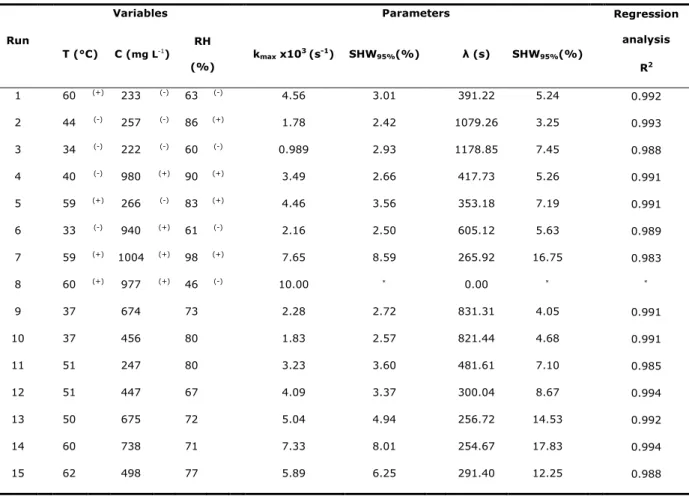
Nesta dissertação foi estudada a influência das condições de processo na esterilização de dispositivos médicos por EO. Este é um processo implementado na empresa Bastos Viegas, S.A., desde 2005. Foram estudados os efeitos e interacções da temperatura, concentração de óxido de etileno e humidade relativa na inactivação do Bacillus subtilis, var. niger (ATCC 9372), o microrganismo de referência usado no controlo do processo. As experiências foram realizadas em câmaras de esterilização, com uma carga de campos cirúrgicos. Aplicou-se um planeamento experimental factorial 23 para avaliação dos efeitos das três variáveis (de acordo com limites comuns de condições operacionais) na letalidade da esterilização por EO.
A inactivação do B. subtilis apresentou um comportamento sigmoidal e um modelo baseado em Gompertz foi ajustado com sucesso aos dados experimentais. Características importantes das curvas, tais como atraso inicial e taxa de inactivação foram considerados parâmetros do modelo. A
Abstract
vi temperatura e a concentração de óxido de etileno foram as variáveis que afectaram significativamente esses parâmetros, pelo que experiências adicionais foram realizadas de forma a incluir o efeito dessas variáveis do processo. Foi desenvolvido um modelo matemático para previsão da morte de B. subtilis expresso em função da temperatura e concentração de EO.
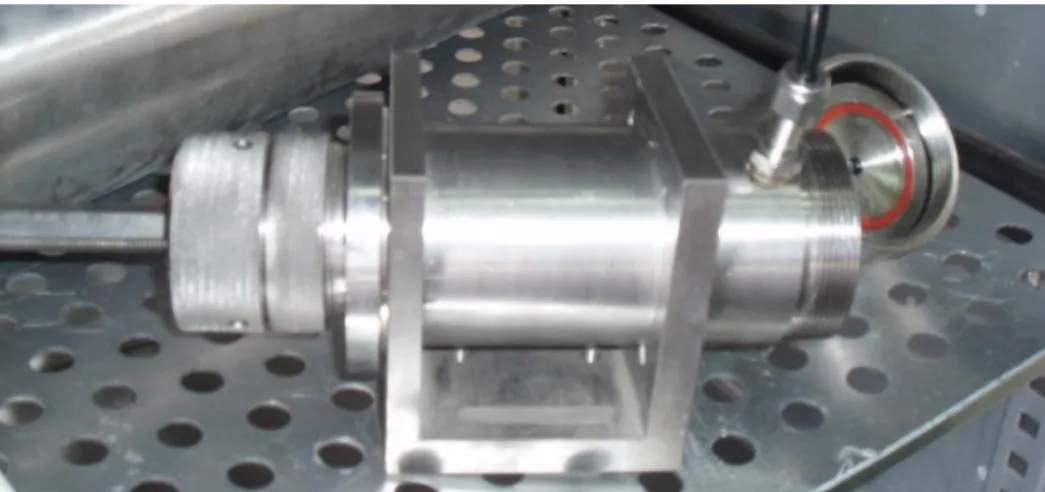
Uma vez que a letalidade demonstrou estar directamente relacionada com a concentração de agente esterilizante, compreender a efectividade da esterilização por EO suscita obter a permeabilidade dos materiais ao gás, assim como o conhecimento sobre a dinâmica deste processo. A análise em tempo real da concentração de EO no espaço-livre do esterilizador tem-se tornado prática comum e o desafio neste momento é prever o seu valor no interior da carga. Foi desenhado, concebido e desenvolvido um equipamento para determinar a difusividade e a solubilidade de EO, e a permeabilidade de diversos materiais ao gás, pela metodologia de tempo de atraso. A operação deste equipamento é baseada no princípio de medição de uma mudança transiente de pressão em condições de volume e temperatura constantes (abordagem pressão-variável) e permite a determinação do tempo de atraso e do fluxo de EO em estado estacionário através de diversos materiais. As experiências foram executadas com um material de campo cirúrgico, a uma temperatura típica de esterilização, i.e. 48 ˚C, e a uma pressão de 3,2x10⁵ Pa. As propriedades de transferência do EO no campo cirúrgico foram usadas para modelizar a sua cinética numa carga industrial do mesmo material. A segunda lei de Fick demonstrou ser adequada na descrição do processo de transferência, o que foi validado pela utilização de dosímetros que integraram a concentração de EO durante o tempo de exposição.
A etapa de arejamento é importante para reduzir os resíduos de EO a um nível seguro e neste contexto, prever a desorção do EO é uma importante ferramenta para a optimização global da esterilização por EO. A cinética de desorção de EO de diferentes materiais esterilizados foi avaliada numa gama de temperaturas de arejamento entre 1,5 e 59,0 °C. Os dados experimentais seguiram um processo de difusão Fickiano e as difusividades foram estimadas para dois materiais médicos têxteis e dois poliméricos.
Os resultados apresentados nesta dissertação contribuem para uma melhor compreensão da dinâmica do processo de esterilização por EO e por conseguinte, para uma optimização e controlo eficiente deste processo.
Palavras-chave: Dispositivos médicos, esterilização, óxido de etileno, esporos de Bacillus subtilis, microbiologia
Abstract
vii Abstract
Ethylene oxide (EO) is a dominant sterilisation agent in medical device industry, due to its effectiveness and compatibility with most materials. Considering the exponential market growth of sensitive, complex and sophisticated medical devices, as well as custom procedure packs (that combine a large diversity of products and range of polymers) for use in specific medical and surgical procedures, EO emerges as the sterilisation method of choice. The process optimisation is a challenge, due to the fact that the global competition market requires cost effectiveness, flexibility and inherent reduction of turnaround time required to get the products to market, without compromising safety and compliance with regulatory requirements.
Ethylene oxide sterilisation is a complex multi-parameter process that requires an aeration final step of the materials. The effectiveness of these processes is influenced by several variables (e.g. temperature, humidity, concentration of the agent, target material), so their optimisation requires knowledge of the influence of the conditions imposed and of their relations with the products. Mathematical modelling of the sterilisation and aeration processes allows the definition of optimal microbial inactivation and outgassing conditions, respectively. This allows cycle times and/or EO concentration reduction, as well as the comparison of different sterilisation processes. In this way it is possible to contribute to the development of processes with added efficiency and flexibility and, therefore, the parametric release of the sterilization arises scientifically supported.
In this dissertation the influence of process conditions on EO sterilization of medical devices was studied. This is an implemented process in Bastos Viegas, S.A. company, since 2005. The main effects and interactions of temperature, ethylene oxide concentration and relative humidity on the inactivation of the Bacillus subtilis, var. niger (ATCC 9372), the reference microorganism used in the control of the process, were assessed. The experiments were carried out in sterilisation chambers, with a load of surgical drapes. A 23 full factorial experimental design was applied for evaluation of the effects of the three variables (under the common limits of operational conditions) on microbial lethality by EO sterilisation.
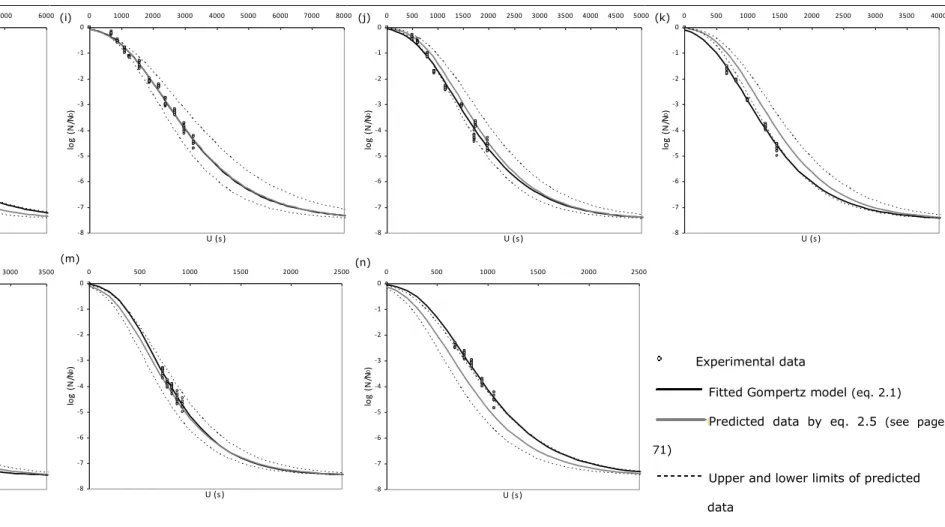
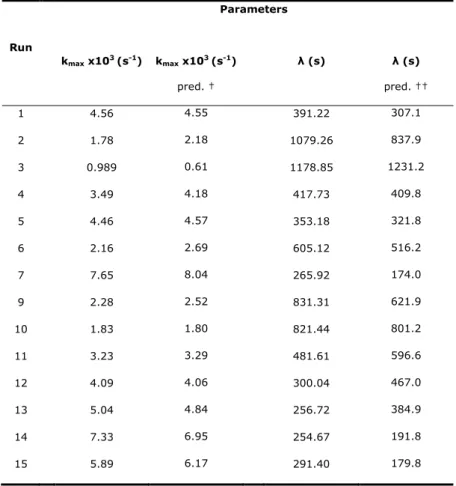
The B. subtilis inactivation presented a sigmoidal behaviour and a Gompertz based model was successfully applied in experimental data fitting. Important characteristics of the curves, as initial shoulder and inactivation rate were considered model parameters. Temperature and ethylene oxide concentration were the variables that significantly affected those parameters, so additional
Abstract
viii experiments were carried out to include the effects of those process variables. A mathematical model for B. subtilis death prediction was developed, expressed in terms of temperature and EO concentration.
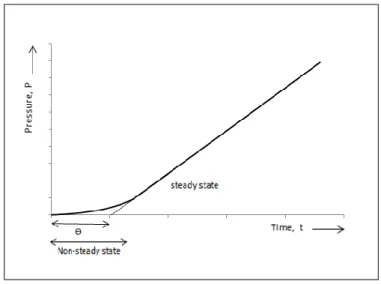
Since the lethality was found to be directly related with the sterilant agent concentration, understanding EO sterilisation effectiveness requires attaining gas permeability of materials, as well as the knowledge of the process dynamics. The on-line analysis of EO concentration in the steriliser head-space is becoming common practice and the challenge now is to predict its value within the load. An apparatus was designed, conceived and developed for determination of EO diffusivity and solubility, and gas permeability of sheet materials, by lag time methodology. The operation of this apparatus is based upon the principle of measuring a transient change in pressure at conditions of constant volume and temperature (variable-pressure approach) and allows determination of lag time and steady state flow of EO through different materials. Experiments were carried out with a surgical drape material at a standard sterilisation temperature, i.e. 48 ˚C, and at a pressure of 3.22x10⁵ Pa. The transport properties of EO through surgical drape were used for modelling its kinetics through an industrial load of the same material. The Fick‟s second law was adequate for describing the transport process, which was validated by the use of dosimeters that integrated EO concentration through exposure time.
The aeration step is important for reducing EO residues to a safe level and in this context, prediction of EO desorption is a valuable tool for the overall optimisation of EO sterilisation. The kinetics of EO desorption, from different sterilised materials, was assessed within the range of aeration temperatures from 1.5 to 59.0 °C. The experimental data followed a Fickian diffusion process and diffusivities were estimated for two textile and two polymeric medical materials.
The results presented in this dissertation contributes to a better understanding of the full dynamics of EO sterilisation and consequently, for an optimisation and efficient control of this process.
Keywords: Medical devices, sterilisation, ethylene oxide, Bacillus subtilis spores, predictive microbiology,
Acknowledgments
ix Acknowledgments
The preparation of the thesis would not be possible without the support of several persons and Institutions, to whom I am very grateful. Herein I express my acknowledgment to all the ones that supported me in achieving this important goal.
I start by expressing my warmest gratitude and thanks to my supervisors, Professor Cristina L. M. Silva and Doctor Teresa Brandão, without whom I would never have been able to get so much. They gave me the inspiration and the freedom I needed to follow my ideas and in the more difficult moments they have trusted and encouraged me in my work. I must also thank for continuously challenging me, and for their commitment to provide the resources needed throughout my graduation. Besides all the scientific achievements, I always admired their sensibility and understanding, their sense of joy and their strength. My most sincere appreciation to both of you and thank you both for the friendship.
I am very grateful to my colleagues and friends of Bastos Viegas and University, who in one way or another contributed to the development of my work, and with whom I shared a pleasant working place. I would like to thank Paulo Mendes, Joana Pereira, Raquel Ribeiro, Fátima Castanheira, Fátima Miller and Serpa Rosa. My special “Thanks!” to Mr. Serpa for all the support in developing the skills that allowed my progress on experiments described in section II, chapter 3.
To Dr. Clark Houghtling and Dr. Gregg Mosley to whom I thank for the opportunity to exchange information and share experiences in this field, and in particular Clark, for the moments we shared. I truly admire their commitment to science.
Acknowledgments
x I hereby acknowledge Bastos Viegas for financial support through a PhD grant and for giving me the opportunity to develop my work in a very promising area.
The support and cheering of my very best and closest friends was essential to keep me in the right mood during these last working years. I feel really lucky for that. I want to address them a special “Thanks!”
I want to express my deepest gratitude to Mr. Luís Guimarães. He has always demonstrated care for my work and always been there for whatever needed. He has been both an excellent leader at work and a friend during these years. Thank you for always being around!
I would like to thank my family for respecting my options and for supporting me in the moments I most needed. I have to specially thank to the two most important women in my life, my mother and grandmother. Their love, sensibility, generosity, strength and amazing ability to go through the difficulties in life deserves my deepest appreciation and are true life lessons to me. I will always keep in mind the enthusiasm they share with me on my best moments of success and happiness.
I also wish to thank my brother for always bringing happiness and extra positivity to my life. My very special thanks for being such a good friend.
Finally, it is difficult to express gratefulness to someone so special to me. His love and care were essential for giving me the strength to face this challenge. Thank you for being by my side in all moments. Thank you Pedro!
Table of Contents xi Table of Contents
Resumo __________________________________________________________________ v
Abstract _________________________________________________________________ vii
Acknowledgments _________________________________________________________ ix
Table of Contents _________________________________________________________ xi
List of Symbols ____________________________________________________________ 1
General Introduction _______________________________________________________ 7
Project rationale and objectives __________________________________________ 8
Outline of dissertation structure ________________________________________ 10
Scientific outputs of dissertation ________________________________________ 12
Chapter 1 _________________________________________________________ 15
Ethylene oxide as sterilising agent of medical devices
1. Preamble _____________________________________________________________ 17
1.1. Introduction ______________________________________________________ 18
1.2. Ethylene oxide properties, sterilisation mechanism and toxicity __________ 23
1.2.1. Ethylene oxide properties ________________________________________ 23
1.2.2. Ethylene oxide sterilisation mechanism ____________________________ 25
1.2.3. Ethylene oxide toxicity __________________________________________ 25
Ethylene oxide toxicity in workplace _______________________________ 26
Ethylene oxide toxicity in sterilised MDs – control of residues _________ 28
1.3. Ethylene oxide sterilisation and its specific advantages _________________ 31
Table of Contents
xii
1.4. From process design to market release of ethylene oxide sterilised medical
devices ______________________________________________________________ 32
1.4.1. Process design _________________________________________________ 33
1.4.2. Description of a typical process ___________________________________ 36
1.4.3. Process validation ______________________________________________ 39
Microbiological validation ________________________________________ 41
1.5. Ethylene oxide sterilisation process optimisation _______________________ 44
1.5.1. Parametric release ______________________________________________ 45
1.5.2. Lethality modelling _____________________________________________ 46
1.5.3. Ethylene oxide diffusion modelling _______________________________ 48
1.6. Final remarks _____________________________________________________ 51
- PART I -
Microbial lethality by ethylene oxide
Chapter 2 _________________________________________________________ 55
Modelling the inactivation of Bacillus subtilis spores by ethylene oxide processing
2.1. Introduction ______________________________________________________ 57
2.2. Materials and methods _____________________________________________ 59
2.2.1. Experimental procedures ________________________________________ 59
Experimental design _____________________________________________ 59
Bacterial strain __________________________________________________ 60
Table of Contents
xiii
Sterilisation process _____________________________________________ 61
Enumeration of viable spores _____________________________________ 62
2.2.2. Modelling procedures ___________________________________________ 62
Equivalent time _________________________________________________ 62
Regression analysis and statistical assessment _______________________ 63
2.3. Results and discussion _____________________________________________ 64
2.3.1. Influence
of
environmental
conditions
on
microbial
inactivation
kinetics 64
2.3.2. Assessment of model prediction __________________________________ 70
2.4. Conclusions _______________________________________________________ 78
- PART II -
Ethylene oxide transport phenomena
Chapter 3 _________________________________________________________ 81
Design and development of an apparatus for measuring ethylene oxide permeability
of sheet materials – a case study
3.1. Introduction ______________________________________________________ 83
3.1.1. Gas permeation theory __________________________________________ 84
3.1.2. Lag time method _______________________________________________ 86
3.2. Materials and methods _____________________________________________ 89
3.2.1. Materials ______________________________________________________ 89
3.2.2. General method ________________________________________________ 90
Table of Contents
xiv
Permeation cell _________________________________________________ 90
General apparatus ______________________________________________ 91
Operation of permeation apparatus ________________________________ 92
Mathematical approach __________________________________________ 93
3.3. Results and discussion _____________________________________________ 94
3.4. Conclusions _______________________________________________________ 96
Chapter 4 _________________________________________________________ 97
Understanding the dynamics of ethylene oxide permeation
4.1. Introduction ______________________________________________________ 98
4.1.1. Mathematical considerations _____________________________________ 99
4.2. Materials and methods ____________________________________________ 101
4.2.1. Samples and ethylene oxide dosimeters __________________________ 101
4.2.2. Sterilisation process ____________________________________________ 103
4.3. Results and discussion ____________________________________________ 103
4.4. Conclusion ______________________________________________________ 107
Chapter 5 ________________________________________________________ 109
Kinetics of ethylene oxide desorption from sterilised materials
5.1. Introduction _____________________________________________________ 111
5.1.1. Mathematical considerations ____________________________________ 112
5.2. Materials and methods ____________________________________________ 114
Table of Contents
xv
5.2.1. Experimental procedures _______________________________________ 114
Materials ______________________________________________________ 114
Sterilisation and aeration processes _______________________________ 114
Ethylene oxide determination ____________________________________ 115
5.2.2. Modelling procedures __________________________________________ 116
5.3. Results __________________________________________________________ 117
5.4. Discussion _______________________________________________________ 121
5.5. Conclusions ______________________________________________________ 123
Chapter 6 ________________________________________________________ 125
General Conclusions and Suggestions for Further Work
6.1. General conclusions _______________________________________________ 127
6.2. Suggestions for further work _______________________________________ 130
Table of Contents
xvi
Appendixes
Appendix A, Ethylene oxide potential toxicity
157
Appendix B, Appendixes to Chapter 2
165
B.1 Running cycles conditions
B.2 Enumeration of viable spores of B. subtilis
B.3 Results of B. subtilis inactivation, as predicted by the Gompertz model and by
the model expressed only in terms o the relevant process variables
B.4 Analysis of variance from 2
3factorial design
B.5 Studies on the sensitivity of the predicted microbial response in relation to
processing conditions
B.6 Predicted bands of B. subtilis inactivation by the model that integrates relevant
process conditions
Appendix C, Appendix to Chapter 3
343
C.1 Ethylene oxide permeability through surgical drape material
Appendix D, Appendixes to Chapter 4
347
D.1 Cycle parameters and dosimeter results
D.2 Ethylene oxide concentration predicted by colour progression in EO dosimeters
D.3 Ethylene oxide concentration as predicted by Fick’s second law of diffusion
Appendix E, Appendix to Chapter 5
355
E.1 Experimental data points of ethylene oxide desorption throughout aeration
processes
List of Symbols
2 Symbols
A Tail (chapter 2); Area (chapter 3)
a and b Model parameters that relate shoulder and maximum inactivation rate with temperature and ethylene oxide concentration (chapter 2)
C Ethylene oxide concentration (mg L-1 or mol m-3)
C
Average ethylene oxide concentration (mg L-1) C* Ethylene oxide concentration per hour (mg L-1 h-1) CI Confident intervalCO2 Carbon dioxide 60Co Cobalt-60
D Diffusion coefficient (m2 s-1) D-value Decimal reduction time (min)
d rise
Ea Activation energy (J mol-1) F Equivalent process time (min)
J Flow, rate of diffusion (m2 min-1) k Inactivation rate constant (min-1) θ Lag time (s or min)
l Thickness of the material (cm)
Shoulder (s or min)
MM Molecular mass N Microbial load
n Total number of process steps
P Permeability coefficient (mol s-1 m-1 Pa-1) P Pressure (Pa or Bar)
p Partial pressure (Pa or Bar)
Q Amount of gas
Q10 Temperature coefficient (measure of the rate of inactivation as a consequence of increasing the temperature by 10 °C).
List of Symbols
3 Symbols (continued)
R Gas constant (8.314472 m3 Pa K-1 mol-1) R2 Coefficient of determination
S Solubility coefficient (mol m-3 Pa-1)
t Time (s or min)
T Temperature (˚C or K)
U Equivalent (exposure) time (s or min) V Volume (m3)
x Position / Distance (cm)
z Temperature increase required for a ten-fold reduction of D-value
Subscripts and Superscripts
0 Initial value
b Interface
d Downstream
i Process step / layer
int Interior
max Maximum value
m Total number of process steps
n Model parameter
R Reference value
ss Steady state
List of Symbols
4 Abbreviations
AAMI Association for the Advancement of Medical Instrumentation ABS Poly(acrylonitrile-butadiene-styrene)
ANOVA Analysis of variance
ANSI American National Standards Institute, Inc.
ANSI/AAMI ST Standard developed by AAMI and approved by ANSI ATCC American type culture collection
B. Bacillus
BI Biological indicator
BIER Biological indicator evaluator resistometer
CDL Cell-derived leukaemia
CFC-12 Chlorofluorocarbon-12 CFR Code of Federal Regulations
CFU Colony forming unit
CI Confidence interval
CSI Continuous steam injection
DEC Dynamic environmental conditioning
DNA Deoxyribonucleic acid
Dos Colour progression in dosimeter (cm)
EBZ Employee breathing zone
ECH Ethylene chlorohydrin
EG Ethylene glycol
EN European norm
EO Ethylene oxide
EPA Environmental protection agency EPCD External process challenge device ERPG Emergency response planning guideline
EUCOMED European Association of Medical Device Manufacturers FID Flame-ionization detector
GC Gas chromatography
List of Symbols
5 Abbreviations (continued)
HIMA Health Industry Manufacturers Association
HS Head-space
HSKP Holcomb-Spearman-Karber procedure IDLH Immediately dangerous to life or health IPCD Internal process challenge device
IR Infrared
ISO International Organization for Standardisation ISO/DIS Draft International Standard of ISO
LSKP Limited Spearman-Karber procedure LSMCP Limited Stumbo-Murphy-Cochran procedure
MD Medical device
MDA 4,4'-Methylenedianiline
NFPA National Fire Protection Association
NIOSH National Institute for Occupational Safety and Health NOHSC National Occupational Health & Safety Commission OSHA Occupational and Safety Health Administration PCD Process challenge device
PE Polyethylene
PEL Permissible exposure limit PPE Personal protective equipment PPQ Physical performance qualification PSI Pulsed steam injection
PU Polyurethane
RH Relative humidity
RNA Ribonucleic acid
rpm Rotations per minute
SAL Sterility assurance level SHW Standardised half width
SLR Spore log reduction
List of Symbols
6 Abbreviations (continued)
SPME Solid phase micro-extraction STEL Short term exposure limit TIR Technical information report
TWA Time weighted average
UHMWPE Ultra-high-molecular-weight-polyethylene
UK United Kingdom
USA United States of America USP United States Pharmacopeia
General Introduction
8
Project rationale and objectives
Ethylene oxide (EO) is the leading technology in sterilisation of medical devices (MDs) and consequently, studies in the field of process optimisation are of main importance. As a response to market demand to optimise process conditions, while simultaneously reducing the overall sterilisation process time and cost and bringing flexibility to the process, without compromising the delivery of sterile and safe products to the market, a research effort was given to this topic.
There is a considerable number of works exploiting relevant influencing factors (such as temperature, ethylene oxide concentration and humidity) on EO sterilisation. However, the mathematical modelling of the microbial lethality related to EO sterilisation, aiming at a complete description of the inactivation pattern, is scarce. Moreover, the assessment of influencing variables on microbial inactivation kinetics is undoubtedly lacking.
Studies providing an overview of EO transport properties are also limited. As EO concentration is one of the requisite process parameters for estimating the lethality of the cycle, and due the complexity of controlling EO concentration within the load, modelling of EO permeation is a key issue. The prediction of the dynamic distribution of EO concentration within the load being sterilised, would allow the estimation of theoretical sterilising EO concentrations and this is useful for understanding both sterilisation and aeration processes.
In addition, and considering the overall optimisation of EO sterilisation, the prediction of ethylene oxide desorption is important for assuring a proper aeration, contributing to an efficient removal of residual ethylene oxide content.
General Introduction
9 This works intends to contribute for attaining a better understanding of the process, by progress in the field of mathematical models to integrate lethality and EO diffusion. The parametric release procedure will certainly also be much more scientifically supported.
The main objective of this dissertation is the optimisation of process variables involved in EO sterilisation of medical devices, by mathematical modelling of Bacillus subtilis inactivation, allowing a characterization of microbial kinetics. This will contribute to a complete assessment of influencing factors (e.g. temperature, ethylene oxide concentration and humidity) with the potential of designing more efficient and controlled processes. In addition, understanding EO diffusivities through different medical devices for future development of mathematical models to integrate EO diffusion, is also an objective.
More specific objectives of this dissertation include:
(i) Generation of experimental data of microbial kinetic behaviour throughout the ethylene oxide sterilisation process;
(ii) Quantification of microbial inactivation kinetics by applying predictive microbiology models;
(iii) Influence of the process variables and combined effects in kinetics parameters and lethality modelling;
(iv) Design and conception of an apparatus for measuring ethylene oxide transport properties through different materials of the medical devices;
(v) Modelling of EO gas diffusion/permeation through the load;
(vi) Estimation of EO diffusivities/desorptions through different materials in a range of aeration temperatures.
General Introduction
10
Outline of dissertation structure
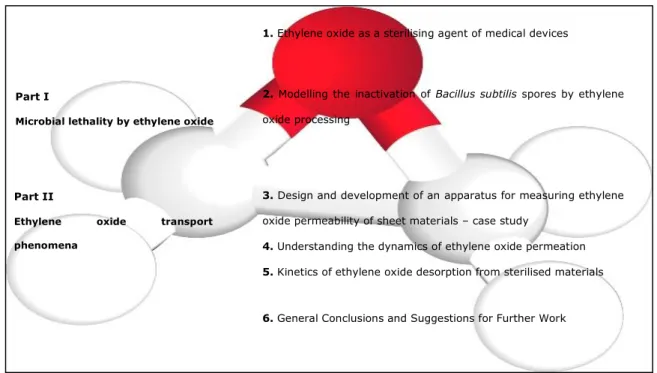
This dissertation is divided into six chapters, including an introduction (that intends to be a review of ethylene oxide as sterilising agent of medical devices), conclusions and suggestions for further work. The remaining chapters are organised into two major parts, schematically presented in Figure I.
Figure I. Schematic structure of the dissertation
Part I, chapter 2, addresses a predictive microbiology work on ethylene oxide sterilisation. The experimental conditions for the assessment of the kinetics of B. subtilis inactivation are detailed and the process variables effects in kinetic parameters were achieved.
Part II deals with modelling of EO permeation behaviour. In chapter 3, a description of a conceived apparatus for experimental determination of ethylene oxide diffusivity through
Part I
Microbial lethality by ethylene oxide
Part II
Ethylene oxide transport
phenomena
3. Design and development of an apparatus for measuring ethylene
oxide permeability of sheet materials – case study
4. Understanding the dynamics of ethylene oxide permeation 5. Kinetics of ethylene oxide desorption from sterilised materials 2. Modelling the inactivation of Bacillus subtilis spores by ethylene
oxide processing
netics of ethylene oxide desorption from sterilized materials
6. General Conclusions and Suggestions for Further Work 1. Ethylene oxide as a sterilising agent of medical devices
General Introduction
11 different materials of the medical devices is described. This data will be important for attaining a global kinetic approach of gas permeation through EO sterilisation, described in chapter 4. The case study elected for validation of the model is a surgical drape load. In chapter 5, kinetics of EO desorption from different materials in a range of aeration temperatures were evaluated.
General Introduction
12
Scientific outputs of dissertation
Part of the work reported in this dissertation has already been subjected to international peer reviewing via publication in international journals, as indicated in the list below. Furthermore, the research work has been presented to the scientific community in international conferences.
LIST OF PUBLICATIONS
Book chapters
1. Mendes, G.C., Brandão, T.R.S. and Silva, C.L.M. (2011)“Ethylene Oxide Sterilization”. In. Sterilization of biomaterials and medical devices, S. Lerouge and A. Simmons (Ed.), Woodhead Publishing Limited, Abington Hall, Abington, Cambridge, UK, Invited publication.
Peer-reviewed articles
1. Mendes, G.C., Brandão, T.R.S. and Silva, C.L.M. (2011) “Modelling the inactivation of Bacillus subtilis spores by ethylene oxide processing”, Journal of Industrial Microbiology and Biotechnology, 38(9): 1535-1543.
2. Mendes, G.C., Brandão, T.R.S. and Silva, C.L.M. (2008) “Ethylene oxide potential toxicity”, Expert Review of Medical Devices, 5(3): 323-328, Invited paper.
3. Mendes, G.C., Brandão, T.R.S. and Silva, C.L.M. (2007) “Ethylene oxide sterilization of medical devices: a review”, American Journal of Infection Control, 35(9): 574-581.
General Introduction
13 Non-reviewed articles
4. Mendes, G.C., Brandão, T.R.S. and Silva, C.L.M. (2009) “Modelling the inactivation of Bacillus subtilis by ethylene oxide processing”. Proceedings of the symposium: “10th World Congress of Sterilization”, Crete, Greece, 7 to 10
October.
Submitted articles
5. Mendes, G.C., Brandão, T.R.S. and Silva, C.L.M. (2011) “Kinetics of ethylene oxide desorption from sterilized materials”, Journal of Pharmaceutical Sciences, Submitted.
6. Mendes, G.C., Brandão, T.R.S. and Silva, C.L.M. (2011) “Design and development of an apparatus for measuring ethylene oxide permeability of sheet materials”, Journal of Membrane Science, Submitted.
Communications
Oral communications
1. Mendes, G.C., Brandão, T.R.S. and Silva, C.L.M. (2009) “Modelling the inactivation of Bacillus subtilis spores by ethylene oxide processing”, 10th World
Congress of Sterilization, Crete, Greece, 7 to 10 October.
Posters communications
1. Mendes, G.C., Brandão, T.R.S. and Silva, C.L.M. (2009) “Study of the influence of ethylene oxide sterilization variables on Bacillus subtilis inactivation”, III International Conference on Environmental, Industrial and Applied Microbiology, BioMicroWorld2009, Lisbon, Portugal, 2 to 4 December.
General Introduction
14 2. Mendes, G.C., Brandão, T.R.S. and Silva, C.L.M. (2006) “Ethylene oxide sterilization of medical devices”, 20th European Conference on Biomaterials,
Chapter 1
Ethylene oxide as sterilising agent
of medical devices
This chapter provides a basis for contextualizing the ethylene oxide as a dominant agent in medical devices sterilisation. The advantages and disadvantages as well as its recommended uses are explored. The variables involved and their relevance to process optimisation are described, the types of processing cycles are detailed and emphasis is given to the design and validation of the sterilisation process.
Chapter 1 Introduction
17
1. PREAMBLE
This chapter provides a comprehensive review, divided in four parts, of the sterilisation process of medical devices by ethylene oxide.
The first part presents an overview of the mechanism of the EO activity and inherent toxicity of the sterilising agent. Regulated limits for occupational exposure, as well as for patients using EO sterilised MDs are also discussed.
The second part summarizes the advantages of this sterilisation technology over the other two industrial sterilisation technologies most widely used (irradiation and moist heat). The objective is to explain why EO, despite many predictions about its demise as a sterilisation alternative, is still a dominant mode of sterilisation and continues to be used for high volumes of MDs.
The third part outlines the process design and process validation procedures, including the microbiological validation, which is the most challenging one.
Finally, the last part addresses the state-of-the-art on optimisation of EO sterilisation conditions. Topics, such as parametric release, lethality and modelling of EO diffusion, are discussed.
Chapter 1 Introduction
18
1.1.INTRODUCTION
Sterilisation processes in medical field have become increasingly complex due to the need to prevent patient exposure to infections caused by contaminated instruments and/or devices. Failures in adequate sterilisation of medical devices result in significant institutional costs related to patient nosocomial infections and mortality versus mortality concerns (Anonymous, 1996; Rutala et al., 1999).
The appropriate sterility assurance level (SAL), which is the probability of viable microorganisms presence on a sterilised medical device, is regulated by national authorities and may vary from country to country. According to EN 556-1:2001, a SAL of 10-6 is a requirement for terminal sterilisation of MDs (EN 556-1, 2001; ANSI/AAMI/
ST67, 2003). However, ANSI/AAMI ST 67: 2003 refers that a SAL of 10-3 can be used for
certain MDs, depending on their intended use or on their inability to withstand a terminal sterilisation process that provides a SAL of 10-6.
The more widely used industrial MDs sterilisation technologies are moist heat, ethylene oxide, gamma and electron beam irradiation. Until the introduction of EO sterilisation in the latest 1950s, dry heat and moist heat sterilisation were the only methods available to routinely sterilise medical devices. Gamma and electron beam irradiation are much more recent technologies. Other methods, such as low-temperature hydrogen peroxide gas plasma, low-temperature peracetic acid gas plasma, vapour-phase hydrogen peroxide, ozone, chlorine dioxide, and high-intensity visible light are not entirely assessed (Anonymous, 1996; Feldman and Hui, 1997; Rutala et al., 1998; Fairand et al., 2003).
Ethylene oxide has emerged as the sterilisation method of choice for MDs, due to its undeniable advantages when compared with other technologies. Ethylene oxide is an exceptional sterilising agent, due to its effective bactericidal, sporicidal and virucidal
Chapter 1 Introduction
19 activity. However, difficulties had to be overcome, mostly related with potential hazards of EO to patients, staff and environmental, as well as risks associated with handling a flammable gas (Barker, 1995; Anonymous, 1996; Rutala and Weber, 1999; Hucker and Axel, 2001; Strain and Young, 2004). In fact, during the latter half of the 1980s and the early 1990s, the future of EO sterilisation used in the health care industry was strongly questioned, basically due to the disadvantages above referred. In 1989, the Eucomed EO sterilisation conference was organized to demonstrate that EO sterilisation remained a safe and effective technology. Ethylene oxide has allowed and contributed significantly to the advancement and evolution of delicate, complex and sophisticated MDs, that otherwise would not be available. For sensitive materials, EO is the only acceptable sterilisation method (Barker, 1995; Anonymous, 1996). Ethylene oxide sterilisation became even more important since the single-use MD market has grown. With the purpose of cost-saving in health management, there has been a transition to develop MDs in customized packs, for use in specific medical and surgical procedures. According to Barker (1995) and Strain and Young (2004), the diversity of developed products, designs, types of materials and packaging configurations, resulted in an exponential growth of EO sterilisation. This made EO the agent most widely used in MDs sterilisation processes, with a continuous growth tendency.
Nowadays, EO sterilisation is described as the most cost-effective low temperature sterilisation process available, with a recognized history of reliability (Barker, 1995; Hucker and Axel, 2001; Sordellini et al., 2001; Mosley et al., 2002; Strain and Young, 2004).
The aim of this chapter is to gather information on EO sterilisation, and to present critical points of view about what has been done and what is required, in order to provide the tools for advancement and optimisation of EO sterilisation of MDs.
Chapter 1 Introduction
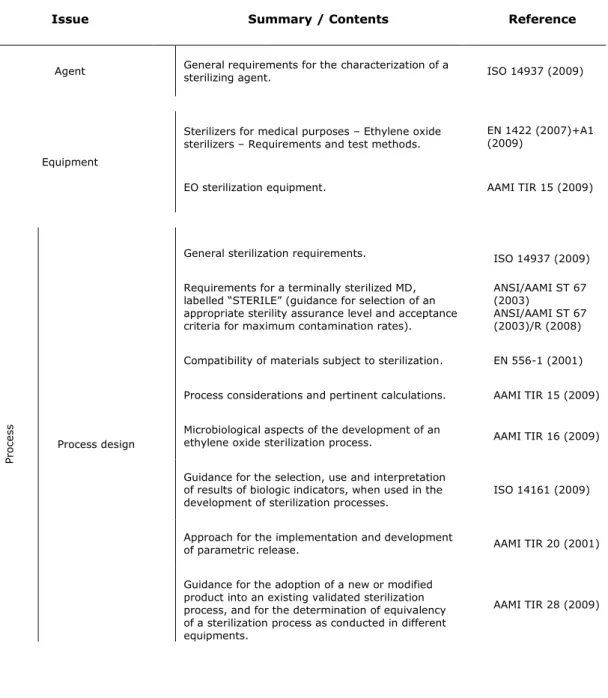
20 There are several guidelines, standards and other documents, which provide a consensual understanding on implementation of harmonized methods related to EO sterilisation. These guideline documents have been classified into three main issues (see Table 1.1) that are related with the sterilising agent, equipment considerations and the process itself. It should also be mentioned that some of these documents are not specific, and include guidelines for all the referred issues.
Table 1.1 Ethylene oxide sterilisation guideline standards and related documents
Pr
oc
es
s
Process design
General sterilization requirements. ISO 14937 (2009) Requirements for a terminally sterilized MD,
labelled “STERILE” (guidance for selection of an appropriate sterility assurance level and acceptance criteria for maximum contamination rates).
ANSI/AAMI ST 67 (2003)
ANSI/AAMI ST 67 (2003)/R (2008) Compatibility of materials subject to sterilization. EN 556-1 (2001) Process considerations and pertinent calculations. AAMI TIR 15 (2009) Microbiological aspects of the development of an
ethylene oxide sterilization process. AAMI TIR 16 (2009) Guidance for the selection, use and interpretation
of results of biologic indicators, when used in the
development of sterilization processes. ISO 14161 (2009) Approach for the implementation and development
of parametric release. AAMI TIR 20 (2001) Guidance for the adoption of a new or modified
product into an existing validated sterilization process, and for the determination of equivalency of a sterilization process as conducted in different equipments.
AAMI TIR 28 (2009)
Issue Summary / Contents Reference
Agent General requirements for the characterization of a sterilizing agent. ISO 14937 (2009)
Equipment
Sterilizers for medical purposes – Ethylene oxide
sterilizers – Requirements and test methods. EN 1422 (2007)+A1 (2009)
Chapter 1 Introduction
21
Table 1.1 (continued) Ethylene oxide sterilisation guideline standards and related documents
General
requirements General process requirements and guidance.
ISO 14937 (2009) ISO 11135-1 (2007) ISO /TS 11135-2 (2008) ISO/TS 11135-2/Cor 1 (2009) EN 550 (1994) Chemical indicators
General performance requirements and acceptance criteria for chemical indicators.
ISO 11140-1 (2005) ANSI/AAMI/ISO 11140-1 (2005)/R (2010)
Guidance for the selection, use and interpretation of chemical indicators that are intended to monitor sterilization processes. ANSI/AAMI/ISO 15882 (2008) ANSI/AAMI ST 60 (1996) Microbiological aspects
Microbiological aspects of the validation of an
ethylene oxide sterilization process. AAMI TIR 16 (2009) Guidance on selecting a microbial challenge and
inoculation sites for sterilization validation of
medical devices. AAMI TIR 39 (2009)
Biological indicators
Guidance for the selection, use and interpretation
of results from BIs. ISO 14161 (2009) General requirements of BI systems to be used in
the validation and routine monitoring of
sterilization processes. ISO 11138-1 (2006) Specific requirements for test organisms, BI
systems and test methods intended for use in assessing the performance of sterilizers and sterilization processes employing EO gas as the sterilizing agent. ISO 11138-2 (2006) ANSI/AAMI/ISO 11138-2 (2006)/R (2010) ANSI/AAMI ST 21 (1994)
Guidance for the selection, use and interpretation of results of biologic indicators when used to validate and monitor sterilization process.
ISO 14161 (2009) ANSI/AAMI ST 59 (1999)
Bioburden
Requirements and guidance for the enumeration and characterization of the population of viable microorganisms on or in medical device, component, raw material or package.
ISO 11737-1 (2006) ISO 11737-1/Cor 1 (2007)
Sterility tests
General criteria for tests of sterility on medical devices that have been exposed to a treatment with the sterilizing agent that is a fraction of the specified sterilization process. These tests are intended to be performed when validating sterilization process.
ISO 11737-2 (2009)
Parametric
release Approach for the validation of parametric release. AAMI TIR 20 (2001)
Pr
oc
es
Chapter 1 Introduction
22
Table 1.1 (continued) Ethylene oxide sterilisation guideline standards and related documents
Residues
Allowable limits for residual EO and ECH in individual EO-sterilized medical devices, procedures for the measurement of EO and ECH, and methods for determining compliance so that devices may be released.
ISO 10993-7 (2008)
Guidance to augment ANSI/AAMI/ISO 10993-7. Assists in understanding the steps necessary to evaluate an ethylene oxide-sterilized device according to the ANSI/AAMI/ISO 10993-7. Also provides limited guidance for the application of other parts of the ANSI/AAMI/ISO 10993 series of standards to the biologic evaluation of ethylene oxide-sterilized MDs.
AAMI TIR 19 (1998) AAMI TIR 19/A1 (1999)
Contract sterilisation
Guidance for both medical device manufacturers that use contract sterilization facilities and contract
sterilization operations. AAMI TIR 14 (2009) Safety
Requirements for work place safety. 29 CFR, part 1910.1047 (1997) NOHSC 3016 (1992) Requirements for personal protective equipment.
29 CFR Part 1910.132 29 CFR Part 1910.133 Ethylene oxide sterilization safety in the health
care facilities. AAMI ST 41 (2008)
Operator safety.
EN 61010-1/A2 (1995) IEC 1010-2-042 (1997) Prevention of worker injuries and deaths from
explosions in industrial ethylene oxide sterilization facilities.
NIOSH Safety Alert (2000)
Pr
oc
es
Chapter 1 Introduction
23
1.2.ETHYLENE OXIDE PROPERTIES, STERILISATION MECHANISM AND TOXICITY
1.2.1. Ethylene oxide properties
As reported by the French Academy of Sciences, ethylene oxide, 1,2-epoxy-ethane, was firstly synthesized in 1859 by Wurtz (Bommer and Ritz, 1987). However, it was only developed as sterilant in the 40‟s by the military and in the 50‟s the McDonald process was patented for use in MDs sterilisation (Fairand et al., 2003).
Table 1.2 included some of the EO most important properties, which will help further understanding of the contents of this dissertation.
Chapter 1 Introduction
24
Table 1.2 Ethylene oxide properties
Property Behaviour Reference
Physicochemical
Boiling point 10.7 °C
Gas at room temperature and atmospheric pressure Highly volatile and reactive, flammable and potentially explosive gas at ordinary room temperature and pressure
Bommer and Ritz (1987) Rutala and Weber (1999) Tsai et al. (2004) 29 CFR Part 1910.1047 (1997)
The Merck Index (1983) Explosive limits 3-100 %
Flash point -55 °C Auto ignition
temperature 429 °C Exergonic
combustion reaction 313 kcal mol-1
Solubility Miscible with water and
organic solvents Allows aqueous extraction of residues The Merck Index (1983)
Sensorial
Colour Colourless gas Despite the ether-like odour, it is not a reliable sensorial warning of EO‟s hazardous due to its high odour threshold
Rutala and Weber (1999)
Odour Ether-like
Microbiological activity
Range of activity Bactericidal, sporicidal
and virucidal Exceptional sterilizing agent Rutala and Weber (1999)
Health effects
Acute effects Respiratory and eye irritation, headache, nausea, vomiting, and diarrhoea
Requires highly trained operations, efficient management and good plant infrastructures in order to follow safe work practices
Yahata et al. (2001) Tsai and Wu (2003) Tsai et al. (2004)
NIOSH Current Intelligence Bulletin 35 (1981) Chronic effects Altered behaviour, anaemia, secondary respiratory infections, skin sensitisation, miscarriages, and reproductive problems Carcinogen
Chapter 1 Introduction
25 1.2.2. Ethylene oxide sterilisation mechanism
The EO high reactivity, as expressed by the high energy of its exergonic combustion reaction (see Table 1.2), in combination with its high diffusivity, is of major importance for the inactivation of microorganisms (Phillips and Miller, 1973; Bommer and Ritz, 1987). Ethylene oxide is a direct alkylating agent that does not require metabolic activation. Its microbiological inactivation properties are considered to be the result of its powerful alkylation reaction with cellular constituents of organisms, such as nucleic acid and functional proteins, including enzymes, which leads to consequent denaturation.
The addition of alkyl groups to proteins, DNA and RNA in microorganisms by binding to the sulfhydryl and hydroxyl, amino and carboxyl groups, prevents normal cellular metabolism and ability to reproduce. This affects microbes viability (Poothulil et al., 1975; Grammer et al., 1985; Bommer and Ritz, 1987; D‟Ambrosio et al., 1997; Rutala and Weber, 1999; Swenberg et al., 2000). These chemical moieties are not present in most of the MDs composition; therefore, exposure to EO does not cause them similar structural changes (Fairand et al., 2003).
1.2.3. Ethylene oxide toxicity
Taking into account the previously described EO sterilisation mechanism, it is easy to understand EO toxicity as a chemical agent, and potential related problems with employee, patient, and environmental safety.
Chapter 1 Introduction
26
Ethylene oxide toxicity in workplace
The ability of a chemical to serve as an alkylating agent, and to cause mutations in a variety of biological test systems, is widely accepted as an indicator of the carcinogenic potential of the chemical. Both alkylation and mutagenicity potential have been demonstrated for EO. The National Institute for Occupational Safety and Health (NIOSH) recommends EO to be regarded in the workplace as a potential occupational carcinogen (NIOSH Current Intelligence Bulletin 35, 1981; Angerer et al., 1998).
However, in nowadays, EO can be used safely with minimal personal risk of chemical hazardous exposure, by following recommended practices and meeting current Occupational Safety and Health Administration (OSHA) EO regulations (see Table 1.1; Strain and Young, 2004). The 29 CFR Part 1910.1047 (1997), besides establishing the permissible occupational exposure limits, also gives orientations for compliance with the established limits and how to monitor exposure, classify and manage regulated areas, specifying the personal protective equipment, including respiratory protection that must be used. Furthermore, NIOSH established EO concentrations dangerous to life or health (see Table 1.3).
Chapter 1 Introduction
27
Table 1.3 Exposure limits and EO concentration dangerous to life (or health), according to OSHA's
and NIOSH‟s guidelines, respectively
Definition Exposure limit Reference Concentration of airborne EO calculated as an eight-hour time-weighted average
PEL (permissible exposure
limit) 1 ppm 29 CFR Part 1910.1047 (1997) Action level 0.5 ppm Concentration of airborne EO calculated as 15 minutes time weighted average
STEL (short-term exposure
limit) 5 ppm 29 CFR Part 1910.1047 (1997)
Concentration of EO immediately dangerous to life or health
IDLH (immediately
dangerous to life or health) 800 ppm NOHSC 3016 (1992) Maximum airborne
concentration below which it is believed that nearly all individuals could be exposed for up to 1 hour without experiencing or developing irreversible or other serious health effects, or symptoms which could impair an individual‟s ability to take protective action
ERPG-2 (Emergency response planning
guideline) 50 ppm
NIOSH Current Intelligence Bulletin 35 (1981)
Despite the discussions about EO potential risk, this sterilant is being used with greater frequency. This is due to investments on equipment that have dramatically improved the efficiency of the process and worker exposure. The process equipment of modern plants generally consists on tightly closed, highly automated and controlled systems (NOHSC 3016, 1992; Anonymous, 1996; Rutala and Weber, 1999; Hucker and Axel, 2001).
Chapter 1 Introduction
28
Ethylene oxide toxicity in sterilised MDs – control of residues
In addition to the problems associated with EO toxicity in workplace, it is also important to take into consideration the EO and its secondary product residuals and toxicity on sterilised MDs. Ethylene oxide and some of its derivates, such as ethylene chlorohydrin (ECH), which appears when chloride ions are present, and ethylene glycol (EG), formed by EO reaction with water, are toxic residues. Ethylene oxide itself can also be polymerised to form polyethylene glycol or polyethylene oxide and epichlorohydrin, but at least the first two secondary products are non-toxic polymers (Poothulil et al., 1975; Furuhashi and Miyamae, 1982; Buben et al., 1999).
The trace amounts of EO and its secondary products remaining on MDs depend on the type of material sterilised, including shape, thickness, density and manufacture of the basic raw material, as well as sterilisation process and aeration method used. On the one hand, thicker materials hold more EO and take longer to aerate, because the diffusivity path is longer; but on the other hand, harder materials retain lower EO concentrations, but also take longer time to aerate. Furthermore, it is known, for example, that polyvinyl chloride, polystyrene and rubber retain more ethylene oxide products than polyethylene, polyurethane, silicone, ABS (Acrylic Butyl Styrene) and polycarbonate. These last materials retain more EO than nylon, paper or cotton. Metal and glass are two materials that retain very low quantities of EO products (Poothulil et al., 1975; Aeschlimann, 1986; Buben et al., 1999; Lucaset al., 2003).
Taking into consideration the diversity of MDs sterilised with EO, and the potential undesirable effect on patient health, residue control is required. The accurate determination of residues is also critical for the development of reliable risk assessment data used by toxicologists, epidemiologists, MD manufacturers, and regulatory bodies (Centola et al., 2001).
Chapter 1 Introduction
29 The series of standards governing the biological testing of MDs include the ISO 10993-7 (Biological Evaluation of MDs - Ethylene Oxide Sterilisation Residuals). It specifies the allowable limits of EO and ECH by categorization of products based on examination of toxicological risk of the residue to patient, according to the length of the time the patient is likely to be exposed to the device (limited exposure - daily, prolonged exposure - monthly, permanent exposure and special situations). The standard also outlines suitable methods for the extraction of residues from products, using exhaustive extraction and simulated use procedures, details the subsequent analysis via gas liquid chromatography, and provides the procedures for determining compliance and subsequent release to the market. The objective of simulated use procedure is to quantify the “bioavailable” EO residues, which is the amount of EO that may be assimilated by the body, and the extraction is carried under conditions that represent the intended use of MD (ISO 10993-7, 2008). With exhaustive extraction (thermal extraction followed by head-space analysis and solvent extraction procedures with either head-space gas analyser or chromatography of the solvent extract) the intention is to recover the entire residual content of a device.
The Standard Working Group 63, Sterilisation residuals working group, from the Association for the Advancement of Medical Instrumentation, undertook the task of studying variables that influence the test results for the amount of residual EO and ECH in MDs, and developed a protocol for controlling the relevant factors. The data from the study suggest that small and random variations in the technique during short sample extraction times can lead to great variability in the results. Variables such as initial water temperature, oven temperature, weighting of sample, and length of extraction should be carefully controlled. Inherent variations in the material composition of similar devices are also a possible contributing factor for the variability of test results regarding the amount of residual EO and ECH in MDs (AAMI TIR No. 19, 1998; AAMI TIR 19/A1, 1999; Centola et al., 2001).
Chapter 1 Introduction
30 Lucas et al. (2003) evaluated the effects of various extraction conditions and the number of re-sterilisation cycles on the amount of EO residues. In addition, the total amount of EO using exhaustive extraction was compared to the amount of EO using simulated extraction. For some polymers there was no difference between total EO residues to EO bioavailable, while others had almost eight times of difference.
All these conclusions alert for the need to carefully study the residuals determination technique. There are no general rules and each specific material has its own characteristics.
Recently, contrasting with the head-space (HS) analysis of EO residues described on ISO 10993-7, a new extraction technique called solid-phase micro-extraction (SPME) was referred by Pawliszyn. SPME presents many advantages over conventional analytical methods by combining sampling, pre-concentration and direct transfer of the analyte into a standard gas chromatograph. Determination of EO, ECH and EG in the HS gas phase, as well as in the aqueous solution, by SPME device have been referred in works of Grushka and Bar-Ilan (2001), Tsai and Wu (2003) and Tsai et al. (2004).
Just as EO diffusivity has been a well studied field, so then MD design, including the selection of materials that will follow EO sterilisation, can be done in a similar logical way. Moreover, investigations about the efficacy of different aeration methods are required.
Different aeration technologies have been reported, such as pulsed vacuums post process and heat addition, steam addition and removal, as well as combinations of different gases and pressure set points and newer developments, such as microwave desorption. Despite the major interest on this issue, there are no recent published studies about efficiency comparisons for the different aeration technologies, and current studies only show that a mechanical aeration at higher temperatures allows easier desorption of the EO residues (Peacock, 1999).
Chapter 1 Introduction
31 A specific study about the potential toxicity of ethylene oxide is presented in Appendix A.
1.3. ETHYLENE OXIDE STERILISATION AND ITS SPECIFIC ADVANTAGES
The compatibility of EO with a wide range of materials and its chemical molecule penetration properties in not so aggressive environments, compared with dry heat or moist heat, made EO sterilisation the most suitable process for the majority of heat- and/or moisture sensitive medical products (Baier et al., 1982; Angerer et al., 1998).
The effectiveness of EO sterilisation, coupled with the flexibility of the process allowed by the large number of possible control variables, represent some of the advantages of this method (Bommer and Ritz, 1987; Rutala and Weber, 1999; Hucker and Axel, 2001; Mosley et al., 2002; Strain and Young, 2004). Taking into consideration the thermal or moisture sensitivity of the specific material, the parameters of the EO cycle can be adjusted in order to preserve the integrity of the device. For many medical devices (MDs), and in particular, thermolabile plastic and elastomer polymeric materials, as well as most electronic devices and biomaterials, EO is the method of choice and sometimes the only acceptable sterilisation method (Ernest, 1973; Handlos, 1980; Rogers, 2005). Considering the exponential market growth of custom procedure packs for use in specific medical and surgical procedures that combine a diversity of products and range of polymers, the probability of encountering a material that is incompatible with a specific process increases, resulting in a exponential growth of EO applications.
Moist heat and irradiation sterilisation frequently cause polymers degradation and changes in physical or mechanical properties, which can be detrimental for intended performance (Fray et al., 2000; Gorna and Gogolewski, 2003; Anonymous, 2006a). Many MDs are composed of heat-sensitive materials. Regarding irradiation, generation of free
Chapter 1 Introduction
32 radicals through haemolytic bond cleavage occurs because 60Co sources supply 1.17 and
1.33 MeV photon energies, which correspond to 5 orders of magnitude larger than the average energy of a chemical bond (Baier et al., 1982; Goldman and Gronsky, 1996; Ries et al., 1996; Kurtz et al., 1999; Affatato et al., 2002; Costa et al., 2002).
The opinion of some sterilisation specialists on new developments in the MDs sterilisation techniques that use oxidizing agents such as hydrogen peroxide, ozone, peracetic acid, and chlorine dioxide is that limited development will occur because of inherent adverse effects on material properties (Feldman and Hui, 1997).
1.4. FROM PROCESS DESIGN TO MARKET RELEASE OF ETHYLENE OXIDE STERILISED
MEDICAL DEVICES
Process design includes the planning of the physical parameter conditions (such as temperature, humidity and EO concentration) of a sterilisation process, taking into consideration the limitations imposed by the product, the sterile barrier packaging and the equipment (Sordellini et al., 1998).
The efficiency and profitability of the process, the personnel safety and equipment integrity, as well as the well-being of the end-user of EO- sterilised MDs are all directly related to the cycle design. Regarding efficiency, the influence of each of the EO sterilisation process parameters on reaction kinetics should be considered when a cycle design is being conducted. Modelling of accumulated lethality and EO diffusion kinetics are two important issues that will be further discussed in more detail.
The sterilisation process must consistently assure that all critical process parameters are delivered within the load, to a degree that assures the required sterility assurance level
Chapter 1 Introduction
33 (SAL), without causing any deleterious effect on product and its sterile barrier package functionality and safety (Sordellini et al., 1998; AAMI TIR 20, 2001; ISO 14161, 2009). These activities are part of the process validation, which includes physical and microbiological performance qualifications.
The release of the MDs to the market is done according to the process specifications defined during validation. There are two methodologies for market release of MDs: conventional and parametric. The conventional traditional method of release requires that the process parameters are within the validated tolerance and the biological indicators (BIs) exposed to the sterilisation process are inactivated. On the other hand, parametric release relies solely on the recording and evaluation of the process parameters, since the equipment potentialities are enough to evaluate the impact of process parameters on microbiological inactivation (AAMI TIR 20, 2001). Parametric release is still a very challenging topic and will be further discussed in more detail.
A well structured process design, its rigorous validation, and a strictly and efficient control of the sterilisation cycle parameters are the key principles for the safe and efficacious release of the MDs to the market.
1.4.1. Process design
Investigation of all process variables impact is mandatory for reaching a well structured EO sterilisation process. Furthermore, considerations about product compatibility together with optimisation of the sterilisation process should be undertaken.