Digital Transformation in
Hospitality –
A guidance on how to implement and
operate a hotel app to generate
incremental revenue and to maximize
customer value
Pia Mairinger
Dissertation written under the supervision of
André Pinho
Dissertation submitted in partial fulfilment of requirements for the MSc in
International Management, at the Universidade Católica Portuguesa, 20.12.2018.
ABSTRACT
Title: Digital transformation in Hospitality – A guidance on how to implement and operate a hotel app to generate incremental revenue and to maximize customer value
Author: Pia Mairinger
The way luxury hospitality services are consumed has changed immensely over the last years due to evolving customer expectations, innovative technology and high competition in the market. Therefore, luxury hoteliers are forced to provide a completely seamless and personalized experience to serve the mobile-driven guests. With a personalized hotel-app a hotel can interact with the guest on a variety of different touchpoints during the customer journey to provide an extraordinary experience at all time.
The thesis focuses on different hotel-apps and features and analyses which of them can generate incremental revenues. With expert interviews and a conducted online survey, a model on how to implement and operate a hotel-app successfully to maximize customer value and to generate additional revenue was created. The results reveal, that various features can lead to incremental revenue and added customer value, especially the option to order room-service via the app. With the usage of push-notifications an additional revenue increase can be generated among certain customers and discounts should be considered according to the hotels’ strategy. Finally, the study helps as a guidance for hoteliers to know which features should be implemented and prioritized, how these features should be operated in the app and provides key figures on additional generated revenue.
Keywords: digital transformation, technology in hospitality, hotel-app features, mobile
SUMÁRIO
Título: Transformação digital em Hospitalidade - Uma orientação sobre como implementar e operar uma aplicação hoteleira para gerar receita incremental e maximizar o valor do cliente Autor: Pia Mairinger
A forma como os serviços de hospitalidade de luxo são consumidos mudou imensamente nos últimos anos, devido à evolução das expectativas dos clientes, tecnologia inovadora e alta concorrência no mercado. Portanto, hoteleiros de luxo são forçados a fornecer uma experiência completamente perfeita e personalizada para servir os hóspedes mais tecnológicos. Com uma hotel-app personalizada um hotel pode interagir com o hóspede numa variedade de diferentes pontos de contato durante a viagem do cliente para proporcionar uma experiência extraordinária em todos os momentos.
A presente tese tem como foco diferentes aplicações de hotéis e características, e analisa quais delas podem gerar receitas incrementais. Com base em entrevistas com especialistas e um questionário on-line, foi criado um modelo sobre como implementar e gerir uma aplicação hoteleira com sucesso para maximizar o valor do cliente e gerar receita adicional. Os resultados revelam que várias funcionalidades podem conduzir a receitas incrementais e valor acrescentado para o cliente, especialmente a opção de encomendar room-service através da aplicação. Com o uso de notificações, um aumento adicional de receita pode ser gerado entre certos clientes e os descontos devem ser considerados de acordo com a estratégia dos hotéis. Finalmente, o estudo ajuda como orientação para que os hoteleiros saibam quais recursos devem ser implementados e priorizados, como esses recursos devem ser operados na aplicação e fornece números-chave sobre a receita adicional gerada.
Palavras-chave: transformação digital, tecnologia em hotelaria, recursos hoteleiros,
ACKNOWLEDGEMENTS
First, I would like to thank my thesis supervisor André Pinho for his constant support, the valuable suggestions and patience throughout the entire process. His challenging questions enabled me to think further, to foster good ideas and to develop my dissertation.
Moreover, I would like to thank my boyfriend Alexander, who supported and motivated me during the past months and who took the time to spend evenings with me discussing structures and procedures.
Further, I am very grateful for my parents, for their never-ending support not only during my master thesis and my studies, but in my everyday life. Without their guidance, advices and help in any matter, I would not be where I am today. Thank you for making this journey possible! Another special thanks is given to my brother-in-law Rob, who has supported me in my topic finding and who used his valuable time to proof-read my dissertation.
TABLE OF CONTENTS
ABSTRACT ... ii
SUMÁRIO ... iii
ACKNOWLEDGEMENTS ... iv
TABLE OF CONTENTS ... v
TABLE OF TABLES ... vii
TABLE OF APPENDICES ... viii
CHAPTER 1: INTRODUCTION ... 1
CHAPTER 2: LITERATURE REVIEW ... 4
2.1 Experience as a new form of luxury ... 4
2.2 Luxury hotels and their rising demand ... 4
2.3 Current trends and challenges in luxury hospitality ... 5
2.3.1 The personalized experience ... 6
2.3.2 Evolving customer expectations within the hospitality sector ... 6
2.3.3 Increasing Competition – the battle for the customer ... 7
2.3.4 New technologies in hospitality ... 8
2.4 A personalized hotel app ... 9
2.4.1 Benefits for the hotelier ... 10
CHAPTER 3: METHODOLOGY ... 12
3.1 Research Design ... 12
3.2 In-depth interviews ... 12
3.3 Online survey ... 13
CHAPTER 4: ANALYSIS AND FINDINGS ... 14
4.1 Analysis of expert interviews ... 14
4.1.2 Hotel’s branded apps ... 14
4.1.2.1 Marriott Rewards App ... 14
4.1.2.2 Hilton Honors App ... 15
4.1.3 Third-party Apps ... 15 4.1.3.1 Conichi ... 15 4.1.3.2 SuitePad ... 16 4.1.3.3 Intelity ... 16 4.1.4 Main features ... 17 4.1.5 Special features... 18
4.1.6 Features increasing non-room revenue ... 22
4.2 Survey analysis ... 24
4.2.1 Sample description ... 24
4.2.2 Findings ... 25
4.2.2.1 Most used features in the app ... 26
4.2.2.3 Assessing the amount of discount for each feature ... 27
4.2.2.4 Usage of app versus traditional approach ... 28
4.2.2.5 Usage of push-notification ... 29
4.2.2.6 The impact of a mobile app on selected revenue-generating services ... 30
CHAPTER 5: DISCUSSION ... 33
CHAPTER 6: CONCLUSION ... 35
6.1 Main Findings and Conclusion ... 35
6.2 Managerial Implications ... 37
6.3 Limitations and Future Research ... 37 REFERENCE LIST ... I APPENDICES ... VI
TABLE OF TABLES
TABLE 1 – OVERVIEW OF THE DIFFERENT APPS AND THEIR FEATURES ... 21
TABLE 2 – DESCRIPTIVE STATISTICS OF THE SAMPLE (N=120). ... 25
TABLE 3 – LIKELIHOOD RATING FOR USAGE OF HOTEL APP FEATURES IN DETAIL ... 26
TABLE 4 – DISCOUNT AMOUNTS TO USE THE APP... 27
TABLE 5 – PREFERRED WAY OF BOOKING VS. DISCOUNT AMOUNTS ... 28
TABLE 6 – FREQUENCIES: PREFERRED WAY OF BOOKING VS. AGE-GROUP ... 29
TABLE 7 – RATING FOR ALLOWANCE OF PUSH-NOTIFICATIONS ... 30
TABLE 8 – RATING FOR LIKELIHOOD USAGE NO APP VS. WITH APP ... 31 TABLE 9 – RATING FOR LIKELIHOOD USAGE WITH APP VS. WITH APP + PUSH-NOTIFICATIONS 32
TABLE OF APPENDICES
APPENDIX 1 – GROWTH IN SPENDING ON ENRICHMENT ... VI APPENDIX 2 – MOST USED FEATURES IN THE APP ... VI APPENDIX 3 – LIKELIHOOD RATINGS FOR USAGE OF HOTEL APP FEATURES ... VII APPENDIX 4 – AREAS OF INTEREST TO RECEIVE PUSH-NOTIFICATIONS ... VII APPENDIX 5 – BASES MODEL ... VIII APPENDIX 6 – QUESTIONNAIRE ... IX APPENDIX 7 – EXPERT INTERVIEW MARRIOTT ... XVIII APPENDIX 8 – EXPERT INTERVIEW HILTON I ... XIX APPENDIX 9 – EXPERT INTERVIEW HILTON II... XX APPENDIX 10 – EXPERT INTERVIEW SUITEPAD ... XXI APPENDIX 11 – EXPERT INTERVIEW INTELITY ... XXII APPENDIX 12 – EXPERT INTERVIEW CONICHI ... XXIII
CHAPTER 1: INTRODUCTION
The way hospitality services are purchased and consumed has changed extremely over the last years. Especially technological innovations have an important impact on the traditional hotel service process for both, customers as well as hotel managers and staff. Technology is now determining the way service is delivered, in every type of operation (Oracle Hospitality, 2016b). In particular mobile devices play an important role, as they have become indispensable in our daily lives.
Nevertheless, the hospitality industry is lagging behind other industries in terms of digitalization, hence an acute need for advancement is evident. As digital transformation is not only about installing technology, it must drive real value for the customer and improve outcomes for the business. These transformations typically lead to changes in the customer experience, the digitalization of products and services, the creation of new economic models, and advances in operations (Bain & Company, 2018).
Moreover, guests are not only becoming more diverse demographically, but also in their expectations, therefore, the one-size-fits all approach needs to be replaced by a more unique personalized experience. Consumers have changed in their behaviour, they have new requirements and expect innovative technology before, during and after the hotel stay. To meet the guests’ needs of the digital age and to survive in an increasingly competitive market, it is crucial for hotels to provide a unique, personalized and high-quality guest experience leading to total guest satisfaction, added value and increased guest loyalty.
To solve the named problems, the deployment of a hotel-app, also known as digital concierge app can help. It enables hotels to deliver a unique experience through seamless and easy interactions between the guest and the hotel and can help at the most important points of the customer journey. With this technology, the guests are able to complete all transactions through their own mobile device. It is a conversational, informational and digitally-powered tool that ensures constant service to provide higher value to the guests as well as to the hoteliers. This technology can increase the guest’s satisfaction by delivering a faster, more personalized and immediate service while it also provides customer data to the hotel manager which is fundamentally needed to create such experiences according to the guests wishes (Richard, 2017). Besides more efficient operations and a competitive position, hotels can increase revenues by implementing a hotel app. As the installation of such a technology is combined with high costs, complexities and technical skills and is only effective when utilised properly, an optimal model of operation is highly important. Therefore, the aim of this study is to give
hotel managers a guidance on how to implement and operate a hotel app successfully. In order to come to this result and to create an appropriate model, the following research questions will be answered within the scope of the study:
RQ1: What are the features available on hotel apps for luxury hotels? RQ2: Which of those features can generate additional non-room revenue?
RQ3: How should an optimal model of a hotel app be implemented and operated to generate additional non-room revenue and to maximize customer value?
Non-room revenues relate to all ancillary services and activities that generate an additional profit beyond room-rate prices. These additional revenue streams are becoming more important, as the traditional revenue management is moving away from a straight focus on top-line rooms revenue towards a bottom-line orientation focused on the customer leading to an expansion to multiple revenue sources including food and beverage, spas, leisure activities, upgrades, etc. (Noone, Enz, & Glassmire, 2017).
Currently, there are different hotels offering a hotel app either from third-party providers or developed by the hotel itself. Each app varies in its features and functionalities, depending on the technological innovation and development. Thus, there is no prototype for all hotels. As research on hotel app features generating incremental revenue is not well explored yet and plays an important role on the scalability of digital transformation and the return on investment especially in terms of such high investments, it is critical to investigate a proper way on how to operate and implement a hotel app to create additional revenue streams. By examining the different hotel app features and the appropriate way of managing them to increase revenues, from a customer and from a hotel managers perspective, this study will contribute not only to the literature but also to practice. The main contribution to the literature will be in assessing the apps market in the context of hotels. Despite the increasing importance of being mobile, there has been limited research on features that lead to additional revenue. While other studies examined the technology progress and the technology acceptance in the hospitality, they fail to investigate the customers’ viewpoint on operations of such hotel apps. It contributes to get an understanding of the app usage likelihood for guests and demonstrates increases of certain service bookings made through the app. Mainly the study contributes to managerial practice: it presents and analyses the main hotel apps covering the hospitality industry and their different features; it identifies the value-added features and the benefits of each app. The customers perspectives assist managers to develop and operate the app according to their needs and
expectations to ensure a high usage rate in the end. Finally, as the market for mobile applications is very competitive and adoption is very low and short term for travel apps (Nielson, 2015) it is essential to offer a costumer oriented-app with a successful implementation and operating strategy.
This study is structured in the following order: after the introduction, the relevant literature and research on luxury hospitality and its current trends and challenges, new technologies in the hotel market and on personalized hotel apps is presented to give the theoretical foundation of this research. The methodology section shows the research design and the data collection and data analysis process. Key findings from both research approaches are presented in the analysis and findings part and are followed by the discussion section. Finally, the conclusion, managerial implications and limitations and future research are elaborated.
As luxury hotels offer a wider range of amenities and services to differentiate themselves and to generate additional revenue, the study has focused only luxury hospitality. Besides that, the luxury sector has the necessary resources for technology investments and accommodates the most demanding customers. The anticipation of the needs and preferences of the guest is especially in luxury travel of highest importance. Instead of bothering the guest repeatedly with the same questions, hotels can guide the guest inconspicuously and outline all options of the hotel in the app.
What is more, the investigated apps belong to hotel chains or third-party providers covering multiple properties, since those may be perceived as more useful than apps only limited to one hotel and are therefore likely to be downloaded and preferred by a larger number of hotel guests.
CHAPTER 2: LITERATURE REVIEW 2.1 Experience as a new form of luxury
Since defining a luxury hotel is challenging and ambiguous, one should first explain what is meant by the word luxury. The word “luxury” derives from luxus which means sensuality, splendour and pomp (Yeoman & McMahon-Beattie, 2011). More generally the meaning is highly subjective, perceived different from person to person (Brun & Castelli, 2013) and depends on the context (Vigneron & Johnson, 2004). Where ordinary ends and luxury begins is judged individually by consumers (Miller & Mills, 2012; Tynan, McKechnie, & Chhuon, 2010), thus luxury means different things to different people.
The concept of luxury has changed extremely over the past years. It has shifted from material values to a blurred genre where people seek for personal fulfilment, individualism and authenticity through experience improving their quality of life (Yeoman & McMahon-Beattie, 2011). With predictive technology and the emergence of an on-demand economy, the consumers today expect more than material luxury goods. This results in a growth of the experience economy and a focus on expenditure on travel and tourism products (Yeoman, Brass, & McMahon-Beattie, 2007). Moreover, the luxury spending portfolios of the consumer have moved since the 1990s to a significant increase of spending on leisure activities, eating out, hotels etc. classified as ‘enrichment’ in Appendix 1. It is forecasted to continue to grow immensely, hence enrichment and experience will be determining factors of our future luxury consumption (Yeoman & McMahon-Beattie, 2011). Particularly the leisure industry and out of home expenditure can benefit from this experience economy. (Yeoman, 2010). This means that delivering a flawless experience, expanding innovation and improving quality are key to compete in the growing luxury market. Customization in value chains is important to provide benefits, and being authentic should be valued high to protect the exclusivity (Yeoman & McMahon-Beattie, 2011).
2.2 Luxury hotels and their rising demand
In regard to the hospitality industry, the definition of the concept of luxury is as well relative, based on different physical factors and on the perceptions and personal evaluation that people assign to them (Fedeli, 2010). Generally, luxury hotels account for the top 15% average daily room rate (STR Global, 2015) and offer their guests superior physical environments and qualified service to support their high-price strategies. Next to functional benefits, guests of luxury hotels seek for experiential service attributes that are memorable (Cetin & Walls, 2016). Luxury hotel guests typically travel frequently with high expectations and are well experienced
in hospitality services (Presbury, Fitzgerald, & Chapman, 2005). Besides that, consumers have more and more demanded greater value for money, followed by requests for higher levels of service and facilities (Presbury et al., 2005). These luxury travel accommodations need to create an experience rather than just a product (Chu, 2014). This is why the concept of luxury in hospitality has also seen a shift from traditional luxury products, like five star resorts, to a large variety of unique and exclusive experiences (Bakker, 2005). Nevertheless, Barbara Talbot, former Chief Marketing Officer of the Four Seasons Hotels, proposed that key factors: style, comfort, service and pampering complement a luxury hotel experience. To be considered as a luxury hotel, the four requirements should be met, regardless whether the hotel belongs to a chain or is independently-owned (Becker, 2009).
In terms of demand, the luxury hotel segment has experienced an immense growth in the past decade and has become a major role in the hospitality industry (Tran, 2015). The global luxury hotel market size was valued USD 83.10 billion in 2017 and is expected to reach a valuation of around USD 115.80 billion by 2025 (Grand View Research, 2018). The key drivers for the luxury hotels’ strong performance are growing tourism across various regions, rising disposable income, increasing standard of living of people and the rise in preference for leisure travel. The increasing number of distribution channels and the availability of easy hotel booking processes contribute as well to the rising demand of luxury hotels (Grand View Research, 2018). The number of luxury hotels is increasing worldwide, most dominant is North America with a revenue share over 35% in 2017. The top global players in the luxury hotel market are Marriott International, Inc.; Shangri-La International Hotel Management Ltd.; InterContinental Hotels Group; AccorHotels; Taj Hotels Palaces Resorts Safari; and Four Seasons Hotels Limited (Grand View Research, 2018).
2.3 Current trends and challenges in luxury hospitality
With the entry in a new era of luxury hospitality, it is getting more challenging to serve each luxury customer whilst remaining exclusive and relevant. The competition is intensified with increasing numbers of luxury hotel rooms in the global infrastructure, higher mobility of guests and a variety of high-quality online marketing. The luxury hotel industry today is under the impact of an evolutionary change. Rapid technological progress is driving society forward at an incomparable pace and affects the human life as never before. Hoteliers are faced with a critical challenge on how to continuously meet the expectations of a constantly evolving customer (Tutek, Roth, & Simatic, 2018).
2.3.1 The personalized experience
In order to provide a more personalized experience, it is fundamental to better understand the customers and their needs. It is inevitable to collect and analyze customer data to identify the customers beyond basic segmentation, measuring and monitoring their changing expectations, and generating authentic experiences. Therefore, it is crucial to determine the customers as unique individuals rather than statistical groups. With the constant present of the internet and the related transparency of information, the ‘knowing your customer’ has become even more important (Yeoman, 2011). For a market segmentation in greater detail, it is necessary to rely more on the capability to collect, access, and analyze larger data sets and pass traditional segmentation methods (Richard, 2017). In the age of ‘big data’, segmentation means to include activity-based data (e.g. website, mobile, purchase history), social network profiles and social influence plus sentiment data into the analyses. This shift from market segmentation to individual’s expectations and preferences will affect the process of customer acquisition and the serving of existing guests. Besides this, the data generated during the customers’ stay should not be disregarded. Meaning remembering the customers’ choices, analyzing the details of the activities they were involved with, what facilities they used and what they consumed during their stay. Using this data, the next visit can be even more customized and refine to the customers’ wishes (Talwar, 2011), including marketing and issue tailored offerings (Oracle Hospitality, 2016).
Additionally, a ‘total service model’ can be used to deliver a personalized experience. The model offers choices for almost every aspect of what the guest sees, experiences and uses during the stay. Thus, the customers have the ability to select their exact requirements from a set of choices to personalize their stay starting from the booking process, type of bed to the payment method, etc. (Talwar, 2011). Eventually, luxury hotels can either reach a potential customer at the best time through the best fitting channel or encourage loyalty for existing customers (Richard, 2017).
2.3.2 Evolving customer expectations within the hospitality sector
Due to the rise of ubiquitous computing and content sharing on various social media channels the customer is more informed than ever, what leads to a higher level of expectations of service and product offerings (Richard, 2017). According to Chris Elam (Hyatt Hotels, Vice President central reservations) until today the customer is forced to interact with the hotel employees on regular points like check-in/-out, room service, wake-up calls, etc. The trend is developing to a scenario where hoteliers have to deal with the customer at several touch points based on the
customer desire (Amadeus, 2016). This assumption can be confirmed by the behavior of millennials, since they seek immediate satisfaction and prefer fast service over friendly service and personal contact. Millennials are social beings who actively engage in social media, share their experiences online, and research and contribute to crowdsourced review sites like TripAdvisor. This forces hoteliers to provide a completely seamless integrated experience, in which every aspect of the hotel stay can be customized and reserved online (Richard, 2017).
2.3.3 Increasing Competition – the battle for the customer
The landscape of luxury hotels is highly competitive and likely to be intensifying, due to both an increasing number of luxury properties as well as improvements in delivering customized service to luxury guests in existing operations (Tutek et al., 2018). The phenomena of Airbnb, shared accommodation and other similar forms play also a strong role in the market. According to a study for every 10% increase in Airbnb listings in one market, hotel revenue decreased by 0.37%. This fact challenges hotels on how to innovate and adapt to bypass such a collaborative technology (Richard, 2017).
In terms of distribution the relationship between hotels and online travel agencies (OTAs) is an ongoing contest, as OTAs continue to prove their strength and evoke an important inflection point in the hotel industry. For the first time, OTA hotel bookings exceed now the total number of hotel bookings on the hotel’s website with no sign for a slowdown (Langford & Weissenberg, 2017). With their strategy of continuously investing in technology, OTAs are able to provide digital trip-planning experiences that are difficult to outperform (Dongre, 2017). Apart from that, OTAs enlarge their business with additional services like private accommodation, tours and activities, restaurant reservations and others. Together with extensive investments in new technologies, this range of different purchasing and booking data can provide OTAs with new opportunities to a fully personalized customer experience (Langford & Weissenberg, 2017). To compete against the power of OTAs, hotels have to develop their own applications to provide better on-property and off-property services to guests. With special incentives such as loyalty points, hotels can encourage their guests to use the internal application over OTAs applications and enhance customers for direct bookings. These services require a developed technological infrastructure with specialized analytics and communications capabilities (Kansakar, Munir, & Shabani, 2018). On the other hand, OTAs offer value-added marketing and deliver thereby new customers to hotels. Since OTAs focus normally on price-sensitive travels and bargain hunters, hotels can concentrate on generating more loyalty and higher-spending of their guests through digital and experiential improvements. Thus, OTAs are not only a threat, the relationship
between OTAs and hotels can be also seen from a perspective of collaboration (Langford & Weissenberg, 2017).
2.3.4 New technologies in hospitality
In order to meet these challenging trends, to stay competitive and to satisfy the modern customer in the digital world, the hospitality industry needs to make appropriate investments in technology and understand how to exploit technology in the right way (Momongan & Papandreou, 2018). The challenge here is to determine which type and level of technology to integrate based on specific objectives and the different customers (Tutek et al., 2018).The following paragraph gives an overview of emerging technologies in the hotel industry.
Self-service technology makes it possible to serve customers without direct contact to employees, what is favored especially by business people, since it is a faster, more productive approach. A typical self-service technology are kiosks systems in hotels allowing guests to check-in and check-out on their own. Commonly they are situated close to the front desk, and the customers only need to put in their data, a keycard comes out and they can go straight to the room (Wei, Torres, & Hua, 2017). Although self-service technology does not align with the values of luxury hotels, its implementation is inevitable, as technology development cannot be stopped (Tomašević, 2018).
In addition, mobile devices can be used as credit cards and room-keys while cameras can report who is coming and going with the aid of a face recording software (Tomašević, 2018). Primarily, the software is to increase security, but it also memorizes and stores all kinds of personal information of the customer what can contribute to deliver a personalized service (Tomašević, 2018). Other new services emerged from information technology are databases for example of previous pillow requests, since special pillow menus are widely used in luxury hotels. The data can be collected with personalized hotel-apps, which are discussed in more detail in the next point.
Besides that, Artificial Intelligence will be used to mine data from guests from external sources and internal collected data, to create an even more advanced customer profile. Next to personalized experience at scale, it also offers an anticipation of needs that is remarkable aligned with the customers’ own to predict what they want in a fast way (Hospitality Technology, 2018).
Moreover, smart mirrors in hotel rooms can provide the guest information about the weather, the stock market, the guest’s emails and it can even be configured to interact with the guests’ smartphones (Tomašević, 2018). Also, connected smart-home assistants such as Amazon Alexa and Google Home provide real-time convenience and connectivity to customers. Thereby customers can request concierge assistance and utilize their voices to access services via new touchpoints in a more seamless way (Hospitality Technology, 2018).
Another upcoming technology are robots. They are being introduced in major hotel chains in different roles: bartenders, receptionists, room service delivery, housekeeping and also as concierge. The robots have the ability to move at the same speed as humans and can rode the elevators by itself with Wi-Fi sensors (Seitzman, Bhattacharjee, & Seeley, 2017). They are based on a technology platform for cognitive computers, a combination of different application programming interfaces (Dialog, Speech to Text, Text to Speech and Natural Language Classifier) and a cognitive travel recommendation engine. Furthermore, they are able to welcome guests upon arrival and answer questions about hotel facilities, services and opening hours (Bellini & Convert, 2016). However, the degree of use should be carefully considered, as human interaction plays an extremely important role in the luxury experience and is in certain areas highly appreciated.
The challenge for the hoteliers is to find the right balance between the use of technology and dedicated human interaction (Amadeus, 2016). All these technologies have the aim to provide newer generations of customers with additional elements of experience, that are characterized by a gaming approach as well as by the variety and timeliness of the information provided (Bellini & Convert, 2016).
2.4 A personalized hotel app
Since the customers basically thrive for personalized engagement on the appropriate device, with the right message at the time they need it, luxury hotels need to engage in platforms that enable them to deliver such an integrated, seamless and personalized experience across different channels, devices and various customers (Solis, 2018). Regarding mobile-device-related behavior and preferences among travelers, they consider the smartphone as the single most indispensable item to carry with them when travelling, more important than taking a toothbrush (Egencia, 2016). Leading to the fact, that mobile is becoming one of the most important elements for consumers’ interaction with the hotel and an indispensable tool for the modern traveler. It is used for pre-trip research and booking, in-destination engagement, and post-trip
interaction (Skift, 2018). To deliver such a seamless mobile experience to the customers, hotels need to engage in mobile apps, either with a hotel’s proprietary app or a third-party app. With such an app, also known as the ‘digital concierge’, hotels are able to communicate with the guests, provide services on demand and collect data at real time, no matter where the guest is located. The data and analytics processed by the app are powerful tools to personalize the customer experience and meet the most important touchpoints of the journey (Skift, 2018). Despite the fact that the role of a traditional concierge in a luxury hotels being highly important, especially in a time of emerging experiential luxury, a ‘digital concierge’ approach indeed allow for a much wider scope of interaction with guests (Bellini & Convert, 2016). It guarantees that every guest is connected to virtual assistance 24/7 for all requests by the app, meaning that many traditional and manual services can be available at the touch of a screen (Friberg, 2018). Only more complex problems that need human assistance and are unable to be answered by the app are redirected to the on-site concierge. In this way, the concierge can invest his time in more personalized, genuine interactions with each guest, what is of incredible value as personalization of the guest experience being a driving hospitality trend (Schyma, 2017). The personalized hotel app allocates many features that drive engagement and build loyalty. Regardless at which stage of the journey the users of the app are – be it researching and planning the trip, currently staying at the hotel or already writing their review online – the app provides personalized features and content depending on which services users are most likely to need in that particular moment (Wolf, 2017). Features such as mobile check-in and check-out, mobile key, ordering room-service, loyalty programs and more can be integrated in the app and vary among the different providers.
2.4.1 Benefits for the hotelier
Since the investments of developing and implementing a hotel app are huge, it is of high interest and importance which benefits it offers for the hotel itself.
With the digital app, hotels can collect data more efficiently and store them in one place. Hence, services and a more personalized experience can be executed according to the needs of the guest. Furthermore, it can increase operating efficiency and drives up quality and consistency. Since data of every guest is recorded, the hotel employees can foresee requests, generate a considerable share of repetitive visits and increase recommendations from former guests. In addition, the processes are faster and human errors can be eliminated (Kazandzhieva & Ilieva, 2018). What is more, a successful implementation of the app leads to improving guest
communication, higher customer satisfaction at all and enhances customer loyalty (Oracle Hospitality, 2016).
Another major part of justifying the investment are increasing revenue streams. Through transparency of the offers and having them available in one tool at hand additional revenue can be generated. Reducing costs is as well a benefit of the app, because paper and printing costs can be minimized through digitalization of the documents and all guest information can be updated easily whenever necessary (Oracle Hospitality, 2016).
The usage of this technology further increases competitiveness within the industry, and hotels seeking to differentiate themselves among their guests as leaders in comfort and convenience should be concerned about the interests of modern guests (Intelity, 2016b).
Finally, a hotel app is the ideal platform to create relevant, timely and personalized experiences – ranging from offering customized benefits to guests to providing valuable information to employees when they need it. Delivering such experiences consistently and at scale is increasingly becoming a key to success (Oracle Hospitality, 2017).
CHAPTER 3: METHODOLOGY 3.1 Research Design
For the purpose of the study, primary and secondary data were used.
First, secondary data was collected to develop the theoretical foundation of the study based on information found in existing literature, such as academic articles, journals and specialist books. These secondary data were primarily used to get an overview of the industry and to validate them with primary data subsequently. Furthermore, a content analysis of hotel apps’ features and functions was conducted after they were identified and downloaded. The hotel apps had to meet the criteria of serving several luxury hotels from different locations, thus hotel apps focusing on one property only were excluded. The identified features and functions from the content analysis were then used for the primary data collection.
For the primary data collection, two independent methods were conducted. First, in-depth interviews were executed with experts from the industry. These insights, combined with those of the content analysis, helped to develop an online customer survey. Both methods were generated to collect primary data to answer the research questions mentioned in the problem statement.
3.2 In-depth interviews
A total of six expert interviews were conducted on the basis of a pre-defined interview guideline. Three of the interviews were conducted with experts from the hotel chains Marriott and Hilton, the others were taken with employees from the third-party apps Conichi, SuitePad and Intelity. All experts have positions either in the department of marketing, sales or guest experience and mobile operations.
For the interview guideline (Gläser & Laudel, 2010), a questionnaire was formulated with regard to predefined topics, but neither the wording nor the sequence was subject to a rigid and binding sequence, and the possible answers were widely open. The interviewees could answer the questions openly, report freely, comment, explain and thus direct the conversation to aspects that are important to them.
Next to deeper insights regarding the specific features of each app and future app-developments, the experts provided some key figures relating to additional revenue sources generated by the app, which could later be used as indication for the development of the model.
3.3 Online survey
To gather insights on the consumer-side an online survey was generated. Thereby, the customers’ attitude towards hotel apps at luxury hotels was assessed and it was tested how likely customers would use such an app in particular for revenue-generating activities.
Starting with an introduction to the survey, the first blog assessed the type and purpose of luxury hotel stays of the participants and if they had ever used a hotel app before and for which services. Further, a five-point Likert scale was used for rating the level of likelihood to use a hotel app for 14 identified services. In addition, their motivation to use the app with a discount was identified, followed by their attitude towards push-notifications. Also, they were asked to specify their preferred way of booking services to find out if human-interaction is valued among the participants. The next blog investigated the likelihood of using the app to book revenue-generating activities. Thereby, different scenarios were presented to the participants: without app, with app and with app and push-notifications. The likelihood rating was again assessed with a five-point Likert scale. The survey concluded with a section on respondent demographics.
The survey was generated through the online platform ‘Qualtrics’ and distributed among the authors’ social circle (friends, family and social media), luxurious travel groups on social media and among guests of a luxury hotel. The survey was pre-tested by five individuals to ensure all questions were clear and easy to answer and to make sure no further adjustments were needed. Through this easy to track procedure, responses from a large number of individuals could be obtained at short time. All answers were collected anonymously since the personal identity of the individuals was not crucial for the analysis. In the next step, the data reports were imported into SPSS to perform a statistical analysis by using descriptive statistics, means, standard deviation and correlation.
CHAPTER 4: ANALYSIS AND FINDINGS
The first part of the analysis concentrates on the various features implemented in digital hotel-apps. Using information from primary and secondary research, different apps from hotels and third-party providers are analysed, by the most common features and special features. In addition, it shows which of these features can generate additional revenue and highlights the benefits of each app. The second part of the analysis is customer-oriented based on insights of a conducted online survey.
4.1 Analysis of expert interviews
In the following analysis five different mobile apps are examined: two of them are apps of international hotel chains, the other three are developed by third-party providers to be used at different hotels. All apps are free of charge and can be downloaded by everyone. Further, the features increasing non-room revenue are explained.
4.1.2 Hotel’s branded apps
4.1.2.1 Marriott Rewards App
The Marriott Rewards App, also named as ‘The Perfect Travel Companion’ encompasses 6,700 hotels and 29 brands across different categories. Since it merged with Starwood Preferred Guest and Ritz-Carlton Rewards in August 2018, it is one of the largest hotel rewards programs in the world (Marriott, Interview). Marriott’s mobile app is a dynamic and personalized tool designed to meet the needs of the guests before, during and after their stay. Within the loyalty program the guests can reach five elite levels and the earned points can be redeemed for different services. Regarding the target group, the app should be appealing for business guests as well as for leisure guests. Special about the app is the huge portfolio of hotels where the app can be used, and the loyalty program including different kind of rewards. On top of that Marriott focuses currently on the deployment of mobile key, which will be standard from January 2021 in all 6,500 hotels. The feature ‘mobile places’ is another differentiating feature that sends push-notifications to the guests according to their location and is currently only available in the U.S. and in Canada (Marriott, Interview).
4.1.2.2 Hilton Honors App
The Hilton Honors App is the award-winning guest loyalty program with almost 80 million members. The app has functionality for almost 5,500 hotels of Hilton’s 14 brands all around the world (Hilton, 2018). First, every brand had their own app, only during the last years all apps were consolidated to one app. It is with a rating of 4.8 the highest-rated hospitality app in the Apple App Store (Hilton, Interview). Hilton Honors members can book directly via the app and have access to instant benefits like an exclusive member discount that is not available anywhere else. By collecting points, each member can achieve different loyalty levels and redeem the points afterwards. The aim of Hilton is to get 100% of the guest to use the app (right now 20-30% are interested in using the app). The app is also a tool to attract younger people and to build a lifetime relationship with them. Another new feature of the app is ‘Explore’, a local travel feature giving the guest the opportunity to explore the neighbourhood surroundings of their hotel with location-based suggestions for dining, entertainment and more from locals (Hilton, Interview). Besides that, the Hilton Honors app is currently the only app offering the ability to select the room on a digital floor plan. In this way, the guests can choose their preferred floor and location of the room upon availability. What is more, a new coming feature ‘Connected-Room’ is tested at the moment in four hotels in the U.S. (Hilton, Interview).
4.1.3 Third-party Apps
4.1.3.1 Conichi
The Berlin-based start-up Conichi is an app to connect guests and hotels during their stay to offer a personalized and efficient guest experience. By setting up Conichi's software, the hotel becomes a so-called ‘smarthotel’, which offers an innovative hotel experience to its guests, focused on a fully digital arrival and departure profess and guarantees a secure handling of personal and sensible payment data. Conichi can be seen as the bridge between hotels and corporates. The start-up collaborates with more than 500 hotels and over 20 leading corporates, resulting in a total of 25 million travellers who use Conichi. It is mostly represented in the DACH (Germany, Austria, Switzerland) region, but also in Italy, Ireland and the U.S.
Due to high competition of travel apps the company has shifted from the leisure market to focus on business travels. Since Conichi experienced that the adoption of mobile apps among business travellers is low, the company is now expanding its web service and sends emails with booking information, the ability to check-in and to share payment information in advance, to the traveller. This allows the traveller to use the service as well without downloading the app. The
start-up also got support from investor HRS1, which integrated the Conichi functionality into
the HRS app for its ‘smarthotels’ (Conichi, Interview). Conichi has cooperation with companies like Volkswagen and Daimler, and in terms of luxury hotels, its client base consists of hotels such as ‘Roomers’, ‘Regent Hotels & Resorts’ and ‘Radisson Blu’.
4.1.3.2 SuitePad
SuitePad is a digital guest directory and serves as a communication and sales channel for hotel rooms. It combines the classic guest registry, travel guide, in-room entertainment, room service menu and hotel shop in one tablet, placed in the guest room. SuitePad is currently used by more than 500 hotels in 25 different countries and every month more than 400.000 guests are reached (SuitePad, 2018).
The company concentrated on the tablet-solution, since it generates a positive surprise-effect to the guests and meets the DEHOGA (German hotel and restaurant association) criteria of having a certain number of physical items in the hotel room. Getting the customer to download a mobile app can be challenging and shows low engagement rates compared to the tablet solution. Therefore, SuitePad offers now as well SuitePad BYOD to follow the mobile trend. Via a personalised link the guests have access to all the functions of a hotel app, without any downloads or registration. As such, the guests have all the amenities of a hotel app and the hotel does not have to invest lots of money in the development and design of an app (SuitePad, 2018). Moreover, with SuitePad, push-notifications can be sent to the in-room tablets of the guests for marketing purposes, resulting in additional revenue streams depending on the amount of notifications sent per day and guest. Among the clients of the company are ‘Ruby Hotels & Resorts’, ‘The Four Seasons Limassol’ in Cyprus and ‘Jumeirah Port Soller Hotel & Spa’ (SuitePad, 2018).
4.1.3.3 Intelity
Intelity, headquartered in Orlando, Florida, was the first hospitality company introducing a guest-service mobile app (ICEapp). Next to a conventional information tool, it serves as a complete interactive device including all important operating areas on and off the property. Each hotel can fully customize the mobile app and can pull all of the existing hotel systems
1The HRS Group is a global eCommerce company and one of the market leaders in the global business travel
market. In Europe, HRS is one of the top three hotel portals. As an outsourcing provider for corporate groups, it simplifies processes relating to hotel stays and offers forward-looking solutions for travel managers and travellers themselves.
together. Compared to the other analysed apps, the Intelity app includes the biggest number of features, particularly noteworthy are the option to order food and beverages to the room or anywhere else on property (e.g. poolside), and the booking of activities on property like spa-appointments or any sport activities, which have proven to be profitable. In addition, it is possible to integrate third-party services into the app and likewise, the Intelity service offerings can be integrated into existing apps.
The Intelity platform has deployment across six continents at hundreds of hotels worldwide, including major brands like ‘The Peninsula Hotels’, ‘Park Hyatt’ and the ‘Waldorf Astoria Hotels & Resorts’ as well as many independent hotels. Furthermore, Intelity was recently named for several awards as the ‘World’s Leading Hotel App’ (Intelity App).
4.1.4 Main features
Marriott and Hilton are among the largest hotel chains in the world and cover a large proportion of the luxury hotel industry, whilst the client base of the presented third-party-apps also includes luxury hotels such as ‘The Peninsula’, ‘Waldorf Astoria’, ‘Shangri-La’, ‘The Grand Westin’, ‘FourSeasons’, ‘Jumeirah’ and many more. Consequently, the above presented hotel-apps are a representative sample for the whole market. The following functions can be found in the most analysed apps and are therefore called main features:
Mobile-Check-in/Checkout
Next to the ability of booking your journey via the app, in a next step it can be used for mobile check-in and check-out at the hotel. Once the room is ready, the customer gets a notification. This option offers added value to the customer, since it increases the customers’ control and allows access to information of the reservation from the smartphone, resulting in transparency, confidence and immediateness. Also, requests for late check-out can be done with the app rather than at front desk and customers can receive the invoice digitally on their phone (Wolf, 2017).
Mobile Key
Users of the app can use their smartphones to open the door to their room after completed the mobile check-in. This allows the guest to skip the queue at the front desk and head directly to the room to ensure a seamless journey (Talwar, 2011).
In-app chat
With automation, hotels can use in-app messaging to get in touch with their guests before, during and after their stay and allow an easy and immediate response for frequently-asked questions. Thereby staff can be relieved from answering the same questions repeatedly and valuable time can be saved for more meaningful tasks. For special requests that demand personal assistance, the guests get directed to chat directly with hotel staff (Alice Hotel Technology, 2018). The upcoming ‘chatbot’ technology (AI) will automate this furthermore and reduce human intervention (Hotel Technology).
Special requests
Most frequently requested services or amenities like extra pillows, new towels or another shampoo can be selected via the app before or during the stay.
Loyalty Program with a personal account
To drive loyalty and generate traffic in the app, a personal account is crucial. With the earning of loyalty points, special rewards and discounts, guests are eager to book another stay (Tecsynt Solutions, 2018).
4.1.5 Special features
Some of the analysed apps have special features that differentiate them from the others. Depending on their strategy, their focus and their state of development, the following functions can be found:
Research and book
To facilitate the planning process, users can accurately narrow the search for destinations by address or by point of interest to find the nearest and most convenient hotel and save their favourite hotels for faster future booking.
Room upgrade
Upon arrival or the day before arrival, the guest gets offered (or can request) an upgraded room for a nominal fee via the app. This function is an easy to use upselling tool and improves the customer experience.
Room selection process
The day before arrival, the guest can choose the preferred room via digital floor plan maps adapted the property similar to selecting the seat on a flight (Hilton, 2018).
In-room dining/room-service
On top of that, guests can order food from the restaurant or the room-service to be delivered wherever they are in the hotel, be it by the pool or in the room (Wolf, 2017).
Booking activities on property
It is also possible to schedule spa-appointments, reservations at a restaurant or other additional services the hotel is offering (Intelity, Interview).
Real-time messaging
This feature allows for recognition and personalized offers at the right time and place throughout the customer stays. Based on customer data and installed beacons at hotels, personalized and informative content can be added to the feature. Examples are greeting guests with a personal welcome by the time they arrive at the hotel or sending guests who normally workout during their stay information about the location, hours and services of the hotel gym (Wolf, 2017). This feature can also be utilized for real-time alerts, such as guest notifications of spa and restaurant availability and last-minute rates (Friedman & Sen, 2017).
Connected-Room
Implementing room-automation enables the guests for full control over activities like turn off and on the lights, regulate the temperature and personalize their room entertainment with their mobile device. Specific preferences can be saved in the app for future stays, in order to make sure the room is set according to the guests’ preferences before they arrive the next time (Ting, 2017).
Integration of third-party services
Ordering an Uber driver with the app, getting information about events and special offers nearby or recommendations from locals about hotspots in the city, offer the guests a wider range of services during their stay and thus (Tecsynt Solutions, 2018), satisfy the increasingly desire for more authentic destination information from local experts (Wolf, 2017).
In-app payments
Following the one-size-fits-all approach and having only one instrument to manage all booking details delivers high convenience to the customer and creates loyalty (Tecsynt Solutions, 2018). Integrating mobile payment simplifies user’s activities, but reliable security measures are needed.
Reading/ leaving a review
Sending an in-stay survey to guests via the app before check-out is an optimal way to get easy and direct feedback to identify problems, which can be addressed immediately and hence improve review ratings (SuitePad, 2018).
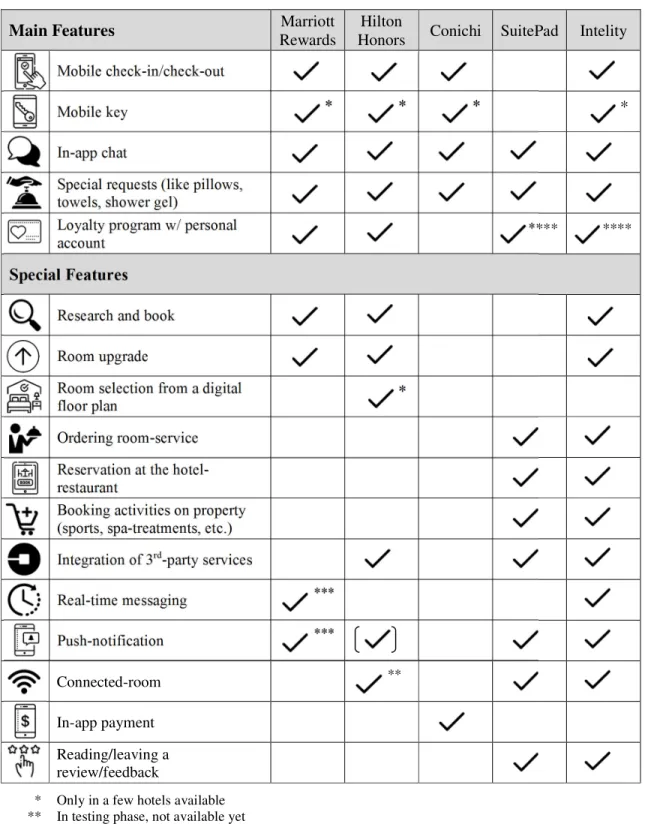
The analysis above of the different features in a hotel app and Table 1 address the first research question, ‘What are the features available on hotel apps for luxury hotels?’ Combining all those features in one app includes important touchpoints of the customer journey to increase efficiency, boost guest satisfaction and to create loyalty through a stronger customer relationship what in the end can lead to higher revenues (Tatar, 2017).
Table 1 – Overview of the different apps and their features
Main Features Marriott
Rewards
Hilton
Honors Conichi SuitePad Intelity
Mobile check-in/check-out
Mobile key * * * * In-app chat
Special requests (like pillows, towels, shower gel)
Loyalty program w/ personal account
**** **** Special Features
Research and book Room upgrade
Room selection from a digital
floor plan *
Ordering room-service Reservation at the hotel-restaurant
Booking activities on property (sports, spa-treatments, etc.) Integration of 3rd-party services
Real-time messaging *** Push-notification *** Connected-room ** In-app payment Reading/leaving a review/feedback * ** *** ****
Only in a few hotels available In testing phase, not available yet
Only available in the US and Canada, in Europe in testing phase (pilot program)
Does not offer a native loyalty program, only existing ones from hotels can be embedded in the app.
The table above represents the analysed apps with their availability of different features. Many features are not available for all hotels of the chains, and others are still in the testing phase to be implemented in the app in the future.
4.1.6 Features increasing non-room revenue
Next to benefits like higher guest satisfaction and optimization of processes, a hotel-app can be used to increase non-room revenue. In particular in the area of food and beverage, but also with additional services like booking of spa-appointments, the ability to request late-check-outs or with the option for room-upgrades, additional revenue be generated. Using push-notifications can even intensify the growth of incremental revenue and can attract the guest with suitable offers at the right time. To answer the second research question, the features mentioned before are examined in more detail:
Ordering room-service
This feature is one of the main additional revenue drivers in the food and beverage area. Intelity reports on average a growth in room-service revenue between 15% and 35% as adoption varies depending on the type of property (Intelity, Interview).
This can be attributed to an increase in the number of orders explained by convenience and capitalizing on guests that would normally not order room-service at all. Also, it leads to increases in check averages due the more appealing menu-presentation, since pictures of food are much more attractive than names of dishes or descriptions (Intelity, Interview). Also, suggesting additional menu items based on the order history of returning customers (e.g. drink the guest had before) can lead to higher revenues. If reviews of previously ordered items are available, those the customer has rated highest can be suggested for reordering.
Besides creating an easier and less stressful process for the guests, it also reduces the risk of human error when taking room-service orders (Intelity, Interview).
Reserving a table at the hotel restaurant
Another feature leading to more revenue in the area of food and beverage is the possibility to view the menu of the hotel restaurant in the app and to make a reservation via the app, due to the fact of convenience and more transparency for the guest. Meaning the guest can check if the restaurant suits his/her food preferences before making the reservation and the risk of waiting for minutes on the telephone line or even reaching no one can be omitted (SuitePad, Interview).
Late-check out and room-upgrades
The option to request late-check-out is an additional revenue source, which can be implemented in form of a tiered-pricing, where the guest gets charged an additional fee according to the hour
of check-out (SuitePad, Interview). Apart from this, room-upgrades can be used as an additional revenue source. For a certain amount of money, the guest gets offered a superior room-category just before the arrival (Hilton, Interview).
Integration of third-party services
By integrating services such as Uber or car rental, food delivery services (Uber Eats), activities in the area or local shopping guides, the guest is offered additional services leading to rising revenues. For a fee discussed individually, these partners can advertise their offering on the hotel-app and give guests information about local services (Hilton, Interview; SuitePad, Interview). It is essential to select partners who fit to the existing brand image or bring relevant benefits to the guests of the hotel (Intelity, 2016a).
Next to the described features above, the effect of push-notifications and discounts can even more increase additional revenue (SuitePad, Interview).
Push-notifications
Push-notifications allow hoteliers a wider reach to market their services to their guests and can be used for a variety of purposes: especially upselling and cross-selling can be very effective and are well accepted by the guest (SuitePad, Interview). Depending on the effort the respective hotel invests in managing the tool, the messages can be either personalized or generic. The messages commonly advertise a special dish of the day, announce the happy hour or contain personalized offerings. It is also a way to promote free capacities for spa-treatments or restaurant-reservations to tempt guests and to make full use of all available facilities. An alternative approach, that has proven to be successful is to promote value added items, such as breakfast offers for those who have not booked it in advance (SuitePad, Interview).
Offering discounts for bookings via the app
Offering discounts on the services when booking via the app create more incentives to buy. Additionally, discounts can also be combined with push-notifications to maximize the effect even more (SuitePad, Interview).
Finally, despite the already mentioned growth in room-service revenue between 15% and 35% (Intelity, Interview), other apps report a total annual in-room dining revenue increase by 16.4% and average restaurant reservations are up 8% (SuitePad, Interview). Regarding spa sales
revenue, a wellness hotel increased revenue up to 50% (SuitePad, Interview) with the implementation in the hotel app and the sending of push-messages. Eventually, a total property revenue increase up to 5% can be seen in hotels deploying the Intelity-App as guests become more aware of all property offerings (Intelity, Interview).
4.2 Survey analysis 4.2.1 Sample description
During the data collection phase, 195 surveys have been accessed. Responses that have been completed only partially were eliminated from the dataset. Furthermore, data obtained from participants indicating not staying sometimes at luxury hotels were also cleared as they are not part of the aimed statistical sample. Leaving a total sample of 120 valid answers for further analysis. Since all questions of the online survey were backed up by a ‘forced response’, there were no missing data.
Table 2 – Descriptive statistics of the sample (N=120). Variable Frequency % Age 18-24 20 16.67% 25-34 66 55% 35-50 22 18.33% >50 12 10% Gender Male 51 42.50% Female 69 57.50% Occupation Student 28 23.33% Employed 87 72.50% Unemployed 0 0% Retired 1 0.83% Other 4 3.33% Nationality Germany 107 89.17% Portugal 3 2.50% U.S. 2 1.67% Bangladesh 1 0.83% Colombia 1 0.83% Croatia 1 0.83% India 1 0.83% Ireland 1 0.83% Switzerland 1 0.83% Turkey 1 0.83% UK 1 0.83%
Main purpose of luxury hotel stays
Leisure 87 72.50%
Business 9 7.50%
Both 24 20%
Luxury hotel characteristics
Chain Hotel 61 49.59%
Independent Hotel 59 47.97%
Other 3 2.44%
Usage of hotel app before
Yes 53 44.17%
No 67 55.83%
4.2.2 Findings
Analyzing the main purpose for most of the luxury hotel stays among the sample, 72,5% indicated leisure, 7,5% stated business and 20% selected both as being their main purpose for luxury hotel stays (table 2).
Regarding the usage of a hotel app, 44% already used a hotel-app on their own mobile device or on the in-room tablet of the hotel during their luxury hotel stay, whereas the majority with 56% has not used it before.
4.2.2.1 Most used features in the app
The people who used a hotel-app before, indicated as the top three most used features within the app the ‘booking of the hotel-stay’ (only those who used the app on their own mobile device) with 83%, followed by the feature to get information about the hotel with 75% and to check-in/check-out with 41% (also only on their own mobile device). All the other features were used less frequent, but at least by 2% (3 people) of the 44% who already used a hotel-app before (Appendix 2).
4.2.2.2 Features most likely to be used by the sample in the future
To measure the services the respondents would most likely use within a hotel-app, a 5-point Likert-scale was used. In order to test the reliability and internal consistency of each factor a reliability analysis (Cronbach’s Alpha) was conducted. Coefficients over 0.7 are considered acceptable, coefficients greater than 0.8 considered as good (Malhotra, Nunan, & Birks, 2017). Thus, with α = 0.884, the overall reliability of the 14 items is good.
Looking at the means of the different features, the ‘check-in/check-out’ feature, ‘reserve a table at the hotel restaurant’ and ‘leave/read reviews about the hotel’ result in the highest means (Appendix 3). Having a closer look at the results of each feature, the following table can be obtained.
Table 3 – Likelihood rating for usage of hotel app features in detail
Scale Extremely
unlikely Somewhat unlikely Neutral Somewhat likely Extremely likely
Feature Frequency (%)
Check-in/Check-out process 10 (8.3) 15 (12.5) 13 (10.8) 33 (27.5) 49 (40.8) Ordering room-service 11 (9.2) 19 (15.8) 20 (16.7) 39 (32.5) 31 (25.8) Schedule spa-appointments 9 (7.5) 12 (10.0) 19 (15.8) 42 (35.0) 38 (31.7) Book other services/ activities on
property
8 (6.7) 14 (11.7) 17 (14.2) 49 (40.8) 32 (26.7) Book external facilities and
activities
16 (13.3) 16 (13.3) 9 (7.5) 47 (39.2) 32 (26.7) Reserve a table at the hotel
restaurant
7 (5.8) 11 (9.2) 9 (7.5) 48 (40.0) 45 (37.5) Mobile-key to access the room 14 (11.7) 13 (10.8) 15 (12.5) 27 (22.5) 51 (42.5) Payment made through the app 9 (7.5) 17 (14.2) 18 (15.0) 29 (24.2) 47 (39.2) Control the room 12 (10.0) 26 (21.7) 21 (17.5) 32 (26.7) 29 (24.2) Access loyalty programs 10 (8.3) 15 (12.5) 28 (23.3) 33 (27.5) 34 (28.3) Connect to in-room entertainment 9 (7.5) 20 (16.7) 17 (14.2) 39 (32.5) 35 (29.2) Communicate with hotel staff 11 (9.2) 21 (17.5) 30 (25.0) 40 (33.3) 18 (15.0) Access social media 16 (13.3) 23 (19.2) 24 (20.0) 33 (27.5) 24 (20.0) Leave/read reviews about the hotel 9 (7.5) 10 (8.3) 19 (15.8) 38 (31.7) 44 (36.7)
The results show, the features extremely likely to be used indicated by the majority of the participants are: ‘Check-in/check-out’, ‘Mobile-key to access the room’, ‘Payment made through the app’, ‘Access loyalty programs’ and ‘Leave/read reviews about the hotel’. The features related to increase additional revenue have highest frequencies only for the scale point ‘somewhat likely’.
4.2.2.3 Assessing the amount of discount for each feature
To motivate guests to use the hotel-app for bookings of services, the hotel could offer a discount on these services (Interview, SuitePad). SuitePad usually recommends its clients to give a discount of 10%. To verify the information and to establish an appropriate discount amount, the following hypothesis was established:
H2: People are more likely to book the service via the app with a discount of at least 10%.
In the following, the discount amounts that would convince the participants to use the app for each specific service are determined. Only the features leading to incremental revenue were listed and each participant could select a percentage between 0 and 100 as the discount amount.
Table 4 – Discount amounts to use the app
Features Discount Amounts
No discount 0% Low 1-10% Medium 11-20% High 21-50% Very High 51-99% For free 100% Mean Ordering-room service 22 37 35 17 7 2 19,2% Schedule spa-appointments 13 29 46 23 7 2 21,1% Book other services/activities on property 25 22 41 23 5 4 21,6% Book external facilities/activities 30 23 37 19 7 4 19,9% Reserve a table at
the hotel restaurant 37 30 29 13 6 5 17,8%
Use the in-room
entertainment 48 19 17 22 6 8 20,5%
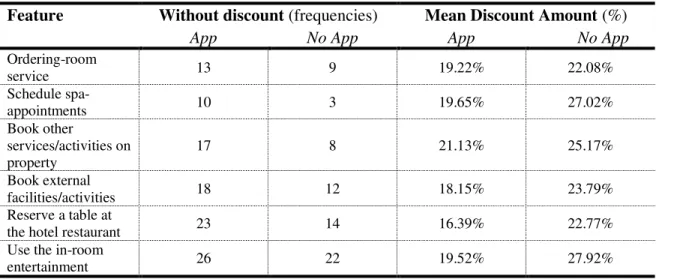
Table 4 shows the indicated discount amounts divided into six different groups for each feature. Leading to the following result, that for spa-appointments a discount would be most appropriate, since the amount to book the service even without discount is the lowest and the