Acta Stomatologica Marisiensis 2018;1(1)48-54 ISSN 2601-6877(print)/ISSN-L 2601-6877(online)
ORIGINAL PAPER
Clinical-statistical analysis of correlations between caries risk
indicators and the prevalence of maxillary dental anomalies in a group
of children from Tirgu Mures
Mariana Păcurar1, Eugen Bud1, Haj Alexandra2, Manuela Chibelean1 , Maria Cristina Figueiredo
Pollmann 3
1 Faculty of Dental Medicine, University of Medicine and Pharmacy of Tirgu Mures, Romania 2 Psihiatric Clinical, Emergency Mures Hospital, Tirgu Mures, Romania
3Faculdade de Medicina Dentária da Universidade do Porto, Portugal
Abstract
Aim: The authors proposed to analyse the pattern of carious lesions in children who underwent orthodontic treatment at the Orthodontic Department of the Faculty of Dental Medicine at the University of Medicine and Pharmacy, Tirgu Mures during 2015-2017 and to determine the correlation between the pathology of carries and the prevalence of maxillary dental anomalies in these children.
Material and method. Study was a retrospective, in a group of 200 patients (91 young female and 109 young male patients), aged 6-9 years old, who underwent special treatment. We performed a caries risk assessment quantified by the DMFT/dmft scores of mixed dentition and determined a predictive factor of the occurrence of maxillary dental anomalies. We diagnosed maxillary anomalies based on study models and calculated the DAI score (Dental Aesthetic Index) characteristic to the degree of malocclusion
Results. We registered the highest percentage of vertical anomalies for deep bite malocclusion, Class II division 2 anomaly (according to Angle’s classification), in a percentage of 54%, found that the DMFT/dmft score was between 0 - 11, the most frequent values being between 0 - 5. The DMFS/dmfs score was between 0 - 34, the most common score being 1, followed by values between 2 -7. A more suggestive characterization of these indices is obtained by addressing them as quantitative variables, by assessing mean and standard deviations. The DMFS/dmfs score was significantly higher in boys (10.86 ± 8.902) than in girls (7.93 ± 7.932), and respectively higher in rural areas (11.04 ± 8.822) than in urban areas (8.02 ± 8.083).
Conclusions. The presence of high DMFT/dmft index scores do not present a potential risk for the development of anomalies in the sagittal and vertical direction.
Disharmony caused by maxillary dental crowding presents direct correlations between the caries index and the severity of the anomaly.
Keywords: caries, anomalies DMFT/dmft, index DAI Introduction
Although oral health has improved worldwide, oral diseases still continue to pose a major public health problem, especially within communities belonging to socially disadvantaged groups who still face increased levels of carious lesions and periodontal diseases. Currently, the distribution and severity of oral diseases vary greatly from one country to another as well as among the different areas of the same country.
There are several studies published that have attempted to establish the correlation between the indicator of dental caries in mixed dentition and the risk of maxillary dental anomalies, as well as the way in which
intra-arch and inter-intra-arch modifications occur. Premature loss of temporary teeth, as a consequence of untreated dental caries, can cause severe three-dimensional disorders of the dental arches and implicitly of dental occlusion, interfering with the harmonious development of the physiological dentition.
Aim of research
The authors proposed to analyse the pattern of carious lesions in children who underwent orthodontic treatment at the Orthodontic Department of the Faculty of Dental Medicine at the University of Medicine and Pharmacy, Tirgu Mures during 2015-2017 and to determine the correlation between the
ISSN 2601-6877(print)/ISSN-L 2601-6877(online) Acta Stomatologica Marisiensis 2018;1(1)48-54
pathology of carries in the mixed dentition stage and the prevalence of maxillary dental anomalies in these children. We compared the DAI (Dental Aesthetic Index) scores, which characterizes the degree of malocclusion, with the DMFT/dmft and DMFS/dmfs
Material and method
We conducted a retrospective study in a group of 200 patients (91 young female and 109 young male patients), aged 6-9 years old, who underwent special treatment. The inclusion criteria were: carious pathology of the temporary and permanent teeth; diagnosed maxillary dental anomalies, compliant patients, whose parents signed the informed consent.
The exclusion criteria were: non-cooperative patients; patients older than nine years of dental age; patients with dental dystrophies; labial, maxillary and palatine clefts or genetic/ endocrine disorders. The processing of the collected data was performed by using SPS 22.0 for Windows, a medical statistical analysis program.
We performed a caries risk assessment quantified by the DMFT/dmft scores of mixed
dentition and determined a possible predictive factor of the occurrence of some maxillary dental anomalies. We diagnosed maxillary dental anomalies based on study models and calculated the DAI score (Dental Aesthetic Index) characteristic to the degree of malocclusion. We also established the correlations between DAI and DMFT/dmft scores respectively DAI and DMFS/dmfs scores. The modified DAI score for mixed dentition was calculated for each patient without taking into account the number of missing teeth: canine, premolars of the maxillary and mandibular arches.
Results
Out of the 200 subjects comprised in the survey 91 (48.5%) were females with a median age of 7.31±0.6 and 109 (51.5%) were males with a median age of 7.45±0.8; 114 (53%) patients came from urban area and 86 (47%) from rural area.
The distribution by gender and background (urban or rural) is shown in figures 1 and 2.
48,5% 51,5% Female Male 47,0% 53,0% Rural Urban
Figure 1. Gender distribution Figure 2. Rural-urban distribution of patients
Analysing the frequency of maxillary dental anomalies we found an uneven distribution among classes of anomalies, gender and background. Thus, the most frequent sagittal anomalies were class II, division1 anomalies (40% of the cases), figure 3, and the most frequent transverse anomalies were dental-maxillary disharmonies with crowding (secondary) (55% of the cases), figure 4.
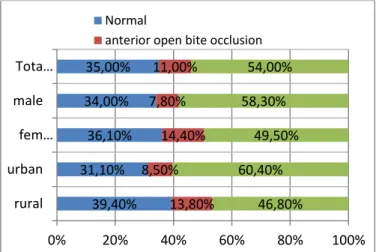
We registered the highest percentage of vertical anomalies for deep bite malocclusion,
Class II division 2 anomaly (according to Angle’s classification), in a percentage of 54% (figure 5). The Chi- square test revealed statistically significant differences in the prevalence of these abnormalities. Thus, the percentage of male patients without sagittal anomalies (24.3%) was significantly higher in comparison to female patients (16.5%), and class II/2 malocclusion was more frequent in young female patients than in young male patients (32.0% versus 23.3%).
Acta Stomatologica Marisiensis 2018;1(1)48-54 ISSN 2601-6877(print)/ISSN-L 2601-6877(online) 22,5% 16% 16,5% 24,3% 20,5% 35,1% 44,3% 40,2% 39,8% 40% 26,6% 28,3% 32% 23,3% 27,5% 12,8% 11,3% 11,3% 12,6% 12% 0% 20% 40% 60% 80% 100% rural urban female male Total group normal overjet d.II/1 d.II/2 d.III
Figure 3. The frequency of sagittal malocclusions
Regarding background, the percentage of patients without anomalies (25.5%) was higher in the rural area than in the urban area (16.0%),
while class II/1 malocclusions were more frequent in patients coming from urban areas (44.3%).
Figure 4. The frequency of vertical malocclusions
Figure 5. The frequency of transverse malocclusions
We found that transverse crowding and
spacing anomalies were more frequent in males than in females (10.7% vs. 6.2%), while in females crowding anomalies were more
39,40% 31,10% 36,10% 34,00% 35,00% 13,80% 8,50% 14,40% 7,80% 11,00% 46,80% 60,40% 49,50% 58,30% 54,00% 0% 20% 40% 60% 80% 100% rural urban fem… male Tota… Normal
anterior open bite occlusion
3,20% 1,00% 1,90% 1,50% 51,10% 58,50% 61,90% 48,50% 55,00% 1,10% 0,90% 6,20% 1,90% 1% 10,60% 8,50% 18,60% 12,60% 9,50% 21,30% 13,20% 6,20% 15,50% 17,00% 6,40% 10,40% 2% 10,70% 8,50% 3,20% 3,80% 3% 3,90% 3,50% 3,20% 4,70% 3,10% 4,90% 4,00% 0% 10% 20% 30% 40% 50% 60% 70% 80% 90% 100% rural urban female male Total group normal crowding
lateral balanced reverse occlusion spacing crowding+ lateral balanced reverse occlusion spacing + spacing
ISSN 2601-6877(print)/ISSN-L 2601-6877(online) Acta Stomatologica Marisiensis 2018;1(1)48-54
frequent (61.9%), and lateral balanced reverse occlusion was completely absent. Crowding anomalies were more common in patients coming from urban areas compared to rural areas (58.5% vs. 51.1%), as well as crowding and spacing (10.4% versus 6.4%), and crowding and lateral balanced reverse occlusion appeared more frequently in rural areas (21.3% vs. 13.2%).
We analyzed the frequency distribution chart of caries risk assessment and found that
the DMFT/dmft score was between 0 - 11, the most frequent values being between 0 - 5. The DMFS/dmfs score was between 0 - 34, the most common score being 1, followed by values between 2 -7. A more suggestive characterization of these indices is obtained by addressing them as quantitative variables, by assessing mean and standard deviations. From this perspective, the global DMFT/dmft score was 3.64 ± 2.686 and the DMFS/dmfs score was 9.44 ± 8.56.
Graph 1. The frequency distribution of DMFT/dmft scores
The comparative study of gender indices showed a significant increase of the DMFT/dmft score in young male patients (3.90 ± 2.679) compared to young female patients (3.36 ± 2.669), as well as in rural areas (4.40 ± 2.865) compared to urban areas (2.96 ± 2.318), graph 1.
Similarly, the DMFS/dmfs score was significantly higher in boys (10.86 ± 8.902) than in girls (7.93 ± 7.932), and respectively higher in rural areas (11.04 ± 8.822) than in urban areas (8.02 ± 8.083), graph 2.
Graph 2. The frequency distribution of DMFS/dmfs scores 93 42 36 18 45 24 12 42 21 1521 21 1812 12 24 9 15 12 24 3 12 12 12 6 3 6 9 6 3 3 6 3 0 10 20 30 40 50 60 70 80 90 100 1 /1 /1 90 0 1 /2 /1 90 0 1 /3 /1 90 0 1 /4 /1 90 0 1 /5 /1 90 0 1 /6 /1 90 0 1 /7 /1 90 0 1 /8 /1 90 0 1 /9 /1 90 0 1 /1 0/ 19 0 0 1 /1 1/ 19 0 0 1 /1 2/ 19 0 0 1 /1 3/ 19 0 0 1 /1 4/ 19 0 0 1 /1 5/ 19 0 0 1 /1 6/ 19 0 0 1 /1 7/ 19 0 0 1 /1 8/ 19 0 0 1 /1 9/ 19 0 0 1 /2 0/ 19 0 0 1 /2 1/ 19 0 0 1 /2 2/ 19 0 0 1 /2 3/ 19 0 0 1 /2 4/ 19 0 0 1 /2 5/ 19 0 0 1 /2 6/ 19 0 0 1 /2 7/ 19 0 0 1 /2 8/ 19 0 0 1 /2 9/ 19 0 0 1 /3 0/ 19 0 0 1 /3 1/ 19 0 0 2 /1 /1 90 0 2 /2 /1 90 0
Acta Stomatologica Marisiensis 2018;1(1)48-54 ISSN 2601-6877(print)/ISSN-L 2601-6877(online)
The presence of class II division 1 anomaly was not influenced by the DMFT/dmft score, on the contrary, in patients with such DMFT/dmft score we observed a lower percentage of class II/1 anomalies (38.3%) compared to other patients of class II/1 anomalies scoring 40.5%. Similarly, neither the
presence of class II division 2 anomaly was influenced by the DMFT/dmft score 5; on the contrary, in patients with this DMFT/dmft score, a lower percentage of Class II/2 anomalies (23.4%) were observed compared to other Class II/2 patients, with a percentage of 28.8% anomalies.
Graph 3. DMFT/dmft: Descriptive statistical parameters of transversal anomalies
No correlation could be established between the caries risk scores and the presence of Angle Class III anomalies. The patients with DMFT/dmft score greater than 5, presented statistically significantly lower percent of class III anomalies (6.4%) compared to other lower score DMFT/dmft class III malocclusion patients (13.7%).
We observed a more complex situation regarding the variation of DMFT/dmft and DMFS/dmfs scores in case of transversal
anomalies. Thus, for the DMFT/dmft indices, we found that in case of crowding of teeth, lateral balanced reverse occlusion and spacing the calculated scores were slightly lower than in patients with normal occlusion. Combined diagnoses of crowding + lateral balanced reverse occlusion showed increased DMFT/dmft score, while crowding + reverse occlusion, demonstrated a slight decrease in the DMFT/dmft score (graphs 3,4).
ISSN 2601-6877(print)/ISSN-L 2601-6877(online) Acta Stomatologica Marisiensis 2018;1(1)48-54
The frequency distribution graph (graph 5) for the study group shows that the DAI index values were between 13-60, the most frequent values being 24, 26 and 32 respectively. 42% of the patients had the DAI index values corresponding to an absent or slight
malocclusion, while 58% of patients had varying degrees of malocclusion: 24.5% presented stable malocclusion (DAI between 26-30), 16.5% sever malocclusion (DAI between 31-35), and 17.0% extremely severe malocclusion (DAI score over 36).
Graph 5. The frequency distribution of the DAI score
Discussions
A situation of the caries risk index on the national level was reported in a study conducted by the representative of WHO (World Health Organization), Prof. Dr. P.E. Petersen in 1992, in the framework of a Tempus project comprising five of our major cities: Bucharest, Iasi, Timisoara, Cluj and Tirgu Mures. Thus, during 1986 - 1992 there was an increase in the DMFT score of 12-year-old patients from 3.1 to 4.1. (6) Subsequently a slight downward trend of the DMFT score (3.4) was recorded in 1995. In 1996, the National Oral Health Pathfinder Survey, conducted in Romania by WHO, showed that the average level of DMFT score in 12-year-old patients was 3.1, much higher than recommended for Europe (2 for children of the same age).
Attempts to demonstrate a direct link between the presence of dental caries and maxillary dental anomalies reported inconclusive results [4, 9]. Parker have found parallelism between tooth decay prevalence and mandibular overjet for mixed dentition,
which proved to be statistically significant after the assessment of the risk of developing a particular malocclusion [10]. The likelihood of developing an open occlusion is twice as high in children with dental caries then in children without caries [6]. Peres reported similar results in children with a DAI index > 35 and a significantly higher caries experience compared to other children. Moreover, DAI scores have shown a significant correlation with the mean scores of the DMFT index (r = 0.368, p <0.05). Another survey conducted in Argentina in 2016 also showed a positive correlation between the severity of malocclusions and dental caries based on the DAI index. But Axelsson [7] concluded that there was no statistically significant correlation between the DAI and DMFT index scores (although the prevalence of malocclusion and dental caries had proven to be high).
Conclusions
1. The presence of high DMFT/dmft index scores do not present a potential risk for the
Acta Stomatologica Marisiensis 2018;1(1)48-54 ISSN 2601-6877(print)/ISSN-L 2601-6877(online)
development of anomalies in the sagittal and vertical direction.
2. Disharmony caused by maxillary dental crowding presents direct correlations between the caries index and the severity of the anomaly, so that the premature loss of temporary teeth associated with untreated dental caries determines the drifting of antagonistic adjacent permanent teeth. 3. The most accurate predictor of caries
activity in mixed dentition, the DMFT/dmft index, showed lower mean values in patients with dental spacing and higher in patients with dental crowding. 4. The combination of anomalies: disharmony
caused by dental crowding and reverse occlusion, respectively by lateral reverse occlusion can be associated with higher values of the DMFT/dmft indices.
5. High DMFT/dmft index values influence DAI index values only in a low percentage, which cannot be considered a positive influence. Low DMFT/dmft index values have greater influence on low DAI index values.
Conflict of interest: None to declare.
References
1. Cushing AM, Sheiham A, Meizels J. Developing socio-dental indicators -the social impact of dental disease. Community Dent Health 1996; 3: 3-17; 2. Gift HG, Atchison KA, Dayton CM. Conceptualizing
oral health and oral health-related quality oflife. Soc Sci Med 1997; 44: 601-609;
3. Marthaller TM. Caries status in Europe and poredictions of future trends , Caries research, 1990, 24(6) , 381-396
4. Broder HL, Slade G, Caine R, et al. Perceived impact of oral health conditions and quality oflife among American adolescents. J Dent Res 207: 26 (8) 201-205;
5. Maxim A, Bălan A, Păsăreanu M. Demographic trends of caries activity in children and teenagers, Medicina Stomatologică, 2004, 8 (1) 80-83 6. Petersen PE, Hoerup N, Poomviset N, Prommajan
J, Watanapa A. Oral health status and oral health behaviour of urban and rural schoolchildren in Europe . Int Dent J 2001, 51:95-102.
7. Axelsson S, Soder B, Nordenram G et al. Effect of
combined caries-preventive methods: a
systematic review of controlled clinical trials. Acta Odontol Scand 2004; 62: 163-9.
8. Dănilă I, Hanganu C, Timis T. Trends in oral health status in schoolchildren from Iasi, Romania. Oral Health and Preventive Dentistry' 2004: 2 (1): 71 9. Widstrom E, Eaton KA, Borutta A. Oral health care
in transition in Eastern Europe. British. Dental Journal 2009; 190: 580-4
10. Parker MW. The significance of occlusion in restorative dentistry. Dental Clinic North. American Journal, 2013, 37 (3), 341-347
Corresponding author: Manuela Chibelean
University of Medicine and Pharmacy of Tirgu Mures, 38 Gheorghe Marinescu street, Tirgu Mures, 540139, Romania Email: [email protected]