The impact of loyalty program type, personality and
brand familiarity on loyalty programs’ valuation
João Figueiredo
152117112
Dissertation written under the supervision of Vera Herédia Colaço
Dissertation submitted in partial fulfilment of requirements for the MSc in
Management with Specialization in Strategic Marketing, at the Universidade
II Title: The impact of loyalty program type, personality and brand familiarity on
loyalty programs’ valuation.
Author: João Figueiredo
Abstract
Loyalty programs are one of the main strategies companies implement to incentivize customers to continuously shopping from their brands. These programs have existed for a long time and have not changed a lot in the recent decades. Most of these programs don’t consider in which markets the brands are competing, focusing most of their offers on discounts, leaving a lot of other options unexplored. Based on the literature review about loyalty programs, marketing and personality traits, specifically on maximizers and satisficers, an experimental study was designed to test the moderating effects of brand familiarity and personality on loyalty programs’ valuation. Results suggest that maximizers predominantly impact loyalty program valuations, as they are more engaged and satisfied with this type of marketing strategy, showing higher satisfaction levels, as well. Furthermore, it was found that brand familiarity is an important aspect to take into account, especially for maximizers who value choosing high familiar brands over non-familiar, while satisficers showed no difference in their preferences.
Resumo
Os programas de fidelização são uma das principais estratégias de marketing que as empresas implementam para incentivar os clientes a comprar nas suas marcas de forma continuada. Estes programas já existem há muito tempo e não sofreram grandes alterações nas últimas décadas. A maioria destes programas não se foca no mercado em que a marca está a competir mas sim na oferta de descontos, deixando muitas outras oportunidades por explorar. Baseado na revisão da literatura existente sobre programas de fidelização, marketing e traços de personalidade, especificamente os maximizers e os satisficers, foi criado um estudo experimental para testar os efeitos da moderação da familiaridade com as marcas e da personalidade na avaliação que os clientes fazem de cada programa. Os resultados mostram
III
que os maximizers têm um interesse maior por estes programas, bem como um nível de satisfação mais elevado. Também se conclui que a familiaridade com a marca é um atributo importante, especialmente para os maximizers, que preferem escolher marcas com as quais estão mais familiarizados em vez de marcas com as quais têm um nível de familiaridade mais reduzido, enquanto que os satisficers se mostraram indiferentes nas suas preferências.
IV
Acknowledgements
Writing this dissertation was one of the most rewarding projects I have ever embraced. I had the same energy and motivation in the day I wrote the last word as I had in the day I figured out what I wanted to study in my dissertation.
During these three months I had a lot of challenges to overcome and a lot of decisions to make regarding the path I wanted this project to follow. To help me figure out that path and guide me through some of the decisions I had the pleasure to work with Vera Herédia Colaço, to whom I am truly grateful. Her help and guidance helped me to perform at my best level and, for sure, made this project even better.
I also want to thank to all my friends. I want to thank to the ones that I met in Colégio do Amor de Deus and also to the ones I met in Católica Lisbon School of Business and Economics because you were a crucial part of this process. You saw my growth as a person and saw the progress I have made during these three months. Also, to Aihoor Aleem, Maria Sousa and Marta Sampaio, which were my colleagues during this dissertation seminar. We worked together, sometimes helping each other in figuring out what were the best decisions to be made. To all of you, thank you very much. Thank you to the amazing people I met since I joined Católica Lisbon School of Business and Economics in 2014 because without you I wouldn’t be where I am today.
To my family I have nothing but the most rewarding feeling there is: love. Your support, your words, your kindness and your presence helped me to be the man I am today. My parents that have always been there for me are definitely an inspiration. My sister, who makes me proud every day, is a role model for me and will continue to be for the years to come. My grandparents for being incredible human beings that have also followed my journey in life since day one.
Lastly, I would like to thank to every single person I ever crossed paths with, because you had an impact in my life and you helped me to become a better person.
V
Table of content
Abstract ... II Acknowledgements ... IV Table of content ... V 1. Introduction ... 11.1 Problem definition and relevance ... 1
1.2. Research objective ... 2
1.3. Thesis Structure ... 4
2. Literature Review ... 4
2.1 Loyalty programs ... 4
2.2 Loyalty programs’ formats and incentives ... 7
2.3 Consumer traits: Maximizers vs Satisficers ... 8
2.4 Brand familiarity ... 9
3. Conceptual Framework and Hypothesis... 10
3.1 Conceptual Framework ... 10
3.2 Hypotheses ... 11
4. Methodology and Data Collection ... 13
4.1 Research Method ... 13
4.2 Sampling ... 13
4.3 Research instruments... 13
4.4 Design and Procedure... 14
4.5 Variables Descriptions ... 15
4.5.1 Independent Variable ... 16
4.5.2 Moderators ... 16
4.5.3 Dependent Variables ... 16
5. Analysis and results ... 17
5.1 Sample analysis ... 17
5.2 Outliers analysis ... 18
VI
5.4 Manipulation checks ... 19
5.5 Main results ... 19
5.5.1 Impact of program condition on willingness to use and satisfaction levels ... 20
5.5.2 Impact of personality on loyalty program evaluation ... 21
5.5.3 Impact of personality and familiarity on loyalty program evaluation ... 22
6. Conclusions and Implications ... 25
6.1 Theoretical implications ... 26
6.2 Managerial implications ... 27
7. Limitations and Future Research ... 29
Appendices ... 31
Appendix 1: Survey ... 31
References ... 48
Table of tables
Table 1: Loyalty program scenarios ... 15Table 2: Reliability analysis – Cronbach’s alpha ... 18
Table 3: Reliability analysis - Cronbach’s alpha if item deleted... 19
Table 4: Manipulation check for brand familiarity ... 19
Table 5: Results of the three-way interaction loyalty program format, familiarity and personality . 20 Table 6: Results of the independent samples t-test multi brand vs single brand programs ... 21
Table 7: Results of the independent samples t-test loyalty program interest maximizers vs satisficers ... 22
Table 8: Results of the two-way interaction loyalty program format familiarity (maximizers) ... 22
Table 9: Results of the independent samples t-test for maximizers comparing the effects of having high familiarity brands and low familiarity brands in loyalty programs ... 24
Table 10: Results of the independent samples t-test for satisficers comparing the effects of having high familiarity brands and low familiarity brands in loyalty programs ... 24
Table of figures
Figure 1: Conceptual Framework ... 111
1. Introduction
1.1 Problem definition and relevance
Loyalty programs are receiving increased attention and growing in popularity around the world (Sharp & Sharp, 1997). According to an Emarketer article (Emarketer, 2016), marketeers in the US are continuing to invest in some sort of loyalty program. About 57% of US companies that were surveyed said they would increase their spending in loyalty programs in 2017, with only 4% saying they would decrease the investment. That investment is expected to grow from 2.1 Billion USD in 2017 to 6.8 Billion USD by 2023 (PRNewswire, 2018). However, prior literature on this topic has found that loyalty programs may not be as effective as companies believe they are. According to Bruneau, Virginie, Swaen, Valerie and Zidda, Pietro (Bruneau, Swaen, & Zidda, 2018), companies have been able to acquire customers through loyalty programs but have failed to retain them in the long run suggesting that these programs don’t fully fulfil their ultimate purpose, which is creating a sense of commitment towards the companies that implement them. This is a sign of consumers’ low levels of loyalty towards companies that are offering this kind of programs and thus, more research is needed to understand the underlying drives that engage consumers with corporate loyalty programs that are intended to retain consumers based on provided benefits.
In Portugal, for instance, loyalty programs have been present for a long time. However, most of these programs are single brand loyalty programs. In this dissertation, multi-brand loyalty programs will also be considered, to provide further knowledge about the importance and utility of this type of marketing strategy. The multi-brand loyalty program strategy has been adopted by major retail chains. Both SONAE and Jerónimo Martins have partnered with gas companies (Galp and BP respectively) in order to give their customers, the possibility to refuel their vehicles for a lower price. SONAE, for instance, launched the Universo Card in 2015, which can be used to pay at Continente and Galp, as well as other stores. In the United States, Amazon bought Whole Foods and, is now offering its Amazon Prime subscribers the chance to buy some items in Whole Foods with an extra 10% discount (Amazon, 2018).
2
However, most brands offer one loyalty program that can only be used to buy from that brand. More often than expected, companies use these programs to acquire customers instead of reinforcing the loyalty aspect and sense of belongingness among consumers towards the company. This reality is of particular concern if we consider that acquiring a new customer is between 5 to 25 times more expensive than retaining existing ones (Gallo, 2014). With such an increase in costs, companies should use these programs not only to acquire customers but also as a way to retain them, since long-term relationships have proven to be very profitable. According to the advisory firm Bain & Company, a 5% increase in the retention rate can lead to an increase of 25% to 95% in companies’ profits, which can be a decisive factor in the success or failure of a company (Schefter & Reichheld, 2000).
The focus of the present research is to analyze how these programs can be improved so that customers use them more frequently within the context of the food retail industry since it is a market that presents a fair level of complexity when it comes to retaining customers over time.
Also, the food retail industry is a segment that has been growing in the recent years at a compound average annual growth rate of 5.5% between 2010 and 2014, reaching a market size of 5,848.6 Billion $ in 2014 (Marketline, 2015). Although supermarkets account for over 50% of this added-value, the remaining is composed by other retailers such as the brands present in the food courts of shopping malls.
1.2. Research objective
In this dissertation I will assess the possibility of implementing a less common type of loyalty program format in the food retail market, which is the multi-brand loyalty program. My study will also include research on what incentives people value the most in these programs so that more appealing and innovative concepts can be developed in the future, so to increase customer loyalty (Conner, 2013). This is an interesting path to explore since the multi-brand partnership strategy is not common in the food retail industry, being more frequent in other types of retail, where it has been shown to be successful.
3
RQ1: Can multi-brand loyalty programs in the food retail industry be effective in increasing
consumers’ willingness to use and their satisfaction levels with these programs?
These multi-brand partnerships should not be done by companies that are competing directly with one another. They should, instead, include brands whose offer adds value to the program, meaning that their entry in the program allows customers to have access to a product range that is not yet being offered by another company. This means that companies that complement one another by selling food suitable for different parts of a meal may partner and offer the same loyalty program allowing customers to shop from different stores while
receiving benefits for the same program.
This leads to a second relevant issue which is understanding what incentives customers value in these programs so that newer and improved versions can be developed, with the purpose of delivering a program that is appealing enough for users to be actively engaged with the program.
Thus, the second research question is:
RQ2: Which incentives should loyalty programs in the food retail industry include in order
to be more appealing for its users?
According to the author’s knowledge, there is still limited research about loyalty programs in the food retail industry. Moreover, the studies about loyalty programs that were found are not specific for the food retail industry, being so for other industries. However, some research has assessed the effectiveness of such models that offer the 11th consecutive purchase for free
(Bazargan, Karray, & Zolfaghari, 2017), a program typology that has been adopted by some companies in this industry. The fact that this topic of research has not yet seen a lot of studies allows the author to explore this field of research further.
One of the purposes of creating a new concept of loyalty program, with new features and incentives is to increase the satisfaction levels customers have about the programs as well as their willingness to use them, meaning that these programs should become more appealing to them. That satisfaction and willingness to use may also be related with the familiarity level of the brands that develop loyalty programs. Therefore, this dissertation will also assess the
4
importance of having familiar brands in the program, which leads to the last research question:
RQ3: Is brand familiarity an important aspect of loyalty programs?
To provide an answer to this question, an experimental research study will be performed, which will address the impact of loyalty programs on the consumer decision-making process taking into consideration the moderating role of personality traits and brand familiarity in this relationship.
1.3. Thesis Structure
This thesis was written using the following structure: The first chapter includes the problem definition and relevance as well as the research objective with the questions that will be answered as the thesis is developed. The second chapter includes the literature review about loyalty programs and loyalty programs in the food retail industry, the incentives that are considered relevant and also literature about two personality types, which are the maximizers and the satisficers. This chapter ends with a review of the literature about brand familiarity. The third chapter presents the conceptual framework as well as the hypotheses that were created for this study. The methodology and the data collection process are detailed in chapter four. Chapter five presents the data analysis as well as the main findings that the data provided. Finally, chapter six includes the conclusion and also the limitations that this study has, finishing with suggestions for further research.
2. Literature Review
“You don’t earn loyalty in a day. You earn loyalty day-by-day.” – Jeffrey Gitomer
2.1 Loyalty programs
According to Sharp, Byron and Sharp, Anne, (Sharp & Sharp, 1997) loyalty programs are structured marketing strategies that companies design for customers to continue to shop at their stores and use the services available. Loyalty programs cover various types of commerce such as e-commerce, retail stores and they are present in several industries, such as food retail, fashion and electronics. They are usually presented as cards or apps to which
5
consumers must sign up and provide some information about themselves, such as name, address, phone number, email, among others. They have been, traditionally, implemented as a single-brand tool, which means that each program could only be used in one brand. However, in the recent years a new trend has been gaining relevance: multi-brand loyalty programs. These programs work in the same way as traditional single-brand programs but can be used in multiple brands, which allows consumers to receive benefits for the same program while shopping in different brands.
These programs aim to create incentives for people to shop from the same stores several times, leading to an increase in the retention rate of companies’ customers, as well as an increase in repeated purchases (Jawwad, 2017). What distinguishes them is the format in which they are offered and the associated reward schemes, meaning that companies use different methods to reach the same end. These include, usually, one of two formats, which are cards or apps and comprise a variety of incentives, although they are mostly focused on discounts.
However, researchers have found that the loyalty programs often fail to create incentives for people to shop continuously from the same shop (Lewis, 2004). Moreover, it was found that a great deal of these programs seem to be ineffective in achieving the goal they were created for, which is to acquire and retain customers in the long run, (Bruneau et al., 2018). With that in mind, it is crucial to understand why these programs fail so often.
One aspect that has been studied in the past to justify the failure of such programs is the lack of satisfaction with the loyalty scheme offered. According to Demoulin, Nathalie and Zidda, Pietro (Demoulin & Zidda, 2008), the level of satisfaction with the loyalty scheme offered is highly related with the price customers are willing to pay, as well as with the repeated purchases that are made over time. Therefore, one possible justification concerning the lack of commitment and willingness to engage in corporate loyalty programs by the customers is their dissatisfaction with what is being offered. This means that customers may sign up for these loyalty programs, but they end up not being active users of those programs, which leads to an unchanged behavior in the shopping habits.
Another aspect that may contribute to the failure of such programs is over choice, a term related with a cognitive process in which people have a hard time making decisions because
6
they are faced with too many options (Toffler, 1970). Research shows that people usually react better and are more willing to purchase from a particular store or website if the product assortment is not very large. Usually stores have a lot of stock keeping units, or SKU’s, which leads to a harder comparison between products, since the attributes one has will most definitely match the ones of another product (Boatwright & Nunes, 2001). A low number of SKU’s has been linked to increasing sales, whereas a large assortment can even prejudice the store.
It has also been found that CSR, or Corporate Social Responsibility, influences the consumer behavior, because in the recent years people have been adopting a more responsible approach in their consumption habits. According to an industry report (Nielsen, 2015), 66% of the surveyed consumers state they are willing to pay more for a product that comes from a sustainable brand (Landrum, 2017). Patagonia, for instance, a clothing brand that has ethicality as its driving force is keen on promoting its Corporate Social Responsibility plan making sure that its goods are Fair Trade certified, being known worldwide for the values it stands for (Gardner, 2017).
These strategies seem to be working well for companies, which are also known worldwide for their success in implementing them, so why are companies not extending their message to loyalty programs? Can this aspect be a positive incentive for people to use a loyalty program?
Nowadays, people are starting to engage in loyalty programs more often, especially in the food retail industry. This scenario encourages customers to sign up for several programs in order to have access to special deals. For instance, in the United States, it is estimated that the average consumer is currently signed to more than 14 loyalty programs (Bond, 2017). Researchers in the consumer psychology domain have been trying to find ways to improve these programs by studying the underlying reasons why people use them and what creates more value for customers.
Although most loyalty programs are designed for a single brand use, some companies have developed multi-brand loyalty programs, in which brands from different sectors create coalitions to provide their customers with a competitive offer, like Sonae/Galp and Jerónimo Martins/BP. In the food retail, however, this is less common, although there are a few brands
7
that have implemented this strategy. In Portugal, the brands Vitaminas, Wok to Walk and Capri, which belong to the same company, are all part of the same loyalty program. According to Gretchen Moore and Harjit Sekhon (Moore & Sekhon, 2005), when few companies join together under the same loyalty program, client commitment is still low and people usually use the scheme as a single brand program. This reality has to do with a low level of awareness about who are the partners and sponsors of the programs. However, people perceived them as having a better utility since they could be used in different brands, which gives the customers more alternatives regarding where to shop. This opens an avenue of research to test the underlying motivations and perceptions consumers have about multi-brand loyalty program usage. It is interesting to examine whether the partnerships included in the programs are matching consumers’ perceptions and interests.
2.2 Loyalty programs’ formats and incentives
As of today, most food chains offer loyalty programs to their customers. Although the purpose of all the different programs available is the same, which is to strengthen the relationship between companies and customers and increase its usage rate, they can be designed and implemented using different formats. For instance, some companies offer a points system, in which customers can exchange their points for meals after they reach a certain amount of points. Other companies have exclusive discounts for their app users, which means that some customers will have access to discounts that other customers don’t have access to. Another strategy used by companies are coupons that customers receive in a purchase and can be exchanged by discounts in the next purchase. All of these formats are focused mostly on the discounts provided, which is a minimalistic approach to a very powerful tool available for marketeers to explore (Moore & Sekhon, 2005).
Having loyalty programs in apps instead of physical cards is also something people consider to be very appealing, since we live in a digital era in which smartphones are a constant presence. Apps are more versatile in terms of the content they can include, which allows companies to match customers’ needs in a more efficient way. For instance, consumers can make online payments with loyalty programs downloaded on their smartphones, increasing the interaction with the loyalty program (Ilidio, Correia, Rizzi, Senna, & Florencio, 2018). Apps also allow for a new trend to be implemented in loyalty programs, which is
8
gamification. This concept refers to “the usage of video games elements in a non-gaming environment”. Recent studies have shown that gamification is linked with a higher intrinsic motivation to use loyalty programs (Kim, Joo, & Ahn, 2017). This new marketing tool provides a new way for companies to increase the customer engagement since it allows for customers to receive incentives such as points, badges, compete for scoreboard leadership, among others. The goal of using this method is to improve the overall experience customers have with the brand. Furthermore, research has shown that this tool is able to assess the “motivational power of goals” on the user, making customers much more willing to use gamification (Blohm & Leimeister, 2013). Despite the fact that it has been shown that this new tool works in creating a better engagement between companies and consumers, it may not be as effective for everyone. Thus, it is important to study whether all consumers appreciate this tool the same way. Since consumers have different traits, some may be more interested in using this tool whereas others may not value it as much.
2.3 Consumer traits: Maximizers vs Satisficers
It is known that consumers are all different from each other, so the way they make decisions is affected by their personality traits. Mittal (Mittal, 2016) defined two consumer types: the
goal maximizing consumers, hereby called maximizers, which are the consumers that always
look for the best value possible, in every choice they have to make, and the exploring
satisfiers, hereby called satisficers, that prefer to use shortcuts such as brand awareness and
friends’ advices to help them in their decisions. On one hand, satisficers tend to be quicker when taking their decisions and focus more on fulfilling a specific need, since they will not be worried about choosing the best alternative among the ones available. On the other hand, maximizers prefer to extract all the utility available from every choice they make, meaning they won’t be happy just by fulfilling a need. Instead, they will try to make sure that their decision is what gives them the most pleasant experience at any given moment. Therefore, they are more likely to select from a consideration set that is more complex, like choosing multi-brand programs instead of single-brand loyalty programs or familiar brands over non-familiar brands. Yet, satisficers prefer fewer alternatives and it is not unusual for them to feel overwhelmed when there are many options available, which then, are more likely to prefer single-brand loyalty programs, since it simplifies their choice (Schwartz, 2002). Accordingly,
9
the number of alternatives that are considered amongst both types of consumers – maximizers versus satisficers, is likely to differ. Maximizers are likely to consider a wider assortment, since they like to carefully choose the best product in the market, whereas satisficers are likely to be pleased with a more reduced assortment of alternatives.
Assessing the way maximizers and satisficers evaluate and consider loyalty programs is crucial for companies. A trending strategy is usually to increase the product range expecting the market share to grow as a result of that wider assortment. This leads to an increase in the amount of options that may, ultimately, cause a sense of over choice in consumers’ minds. This reality raises another problem, especially for maximizers, which is the realization that there is an opportunity cost in every choice that is made. By choosing a product, consumers become more aware of every other product they will not be able to choose, which leads to lower satisfaction levels (Schwartz, 2002). Though the underlying cannibalization effect is not considered in this analysis, an increase in the number of products from the same company in the market place can destroy value. Nevertheless, a positive aspect to be considered is the fact that consumers use shortcuts to process and analyze the information. For instance, people tend to look into more familiar attributes such as a well-known brand name, in order to expedite search and make more informed decisions (Macdonald & Sharp, 2000).
2.4 Brand familiarity
Brand familiarity is a concept that has been vastly studied in the past. In this dissertation I will focus the analysis on the effectiveness of brand familiarity in the loyalty program market. Specifically, it will be studied on two different levels: a high familiarity level and a low familiarity level.
Having a strong brand has been linked with higher market shares as well as higher profits (Roustasekehravani, Bakar, & Hamid, 2014), which is usually the result of higher loyalty levels among consumers. This provides companies with a competitive advantage to face their competitors in the market (Keller, 2013).
Furthermore, and since loyalty programs are one of the most common marketing strategies companies implement, a brand with a high level of familiarity may be able to capitalize on
10
this important tool and retain more customers on the long run, which is very relevant in the loyalty management market.
On the other hand, a brand with a low familiarity level may struggle to present similar results. For maximizers, for instance, brand familiarity may be a way to extract more utility out of the choices they have to make, whereas for satisficers it may not be as important to choose a familiar brand.
Another advantage that high familiar brands have over low familiar brands is the protection against negative word of mouth. It has been shown that brands that present a high level of familiarity are better protected against negative reviews, while low familiarity brands are more affected by negative reviews (Sundaram, 1999). The fact that consumers usually rely on word of mouth to help them take decisions favors brands with whom they are more familiar, since previous awareness about the brand helps them to contextualize the information they receive from their peers.
Furthermore, consumers tend to follow a pattern of “trial and error”, meaning that they are usually willing to try several brands but end up returning to the more familiar brands, which supports the theory that brand familiarity plays an important role in the decision-making process (Macdonald & Sharp, 2000).
Based on the past literature, this dissertation expects to provide a better understanding of the loyalty management market, improving upon the existing bases regarding the programs’ formats, the incentives the programs include, the most relevant personality traits and also the influence of the brands’ familiarity level in the decision-making process.
3. Conceptual Framework and Hypothesis
3.1 Conceptual Framework
Based on the review of the literature about loyalty programs, the formats in which they are presented, brand familiarity, consumer traits, gamification, CSR and the reward schemes, the following conceptual framework was developed:
11
Figure 1: Conceptual Framework
Source: own contribution
3.2 Hypotheses
According to the aforementioned literature, it is likely that people perceive multi-brand loyalty programs as being better alternatives to the single-brand model that is often implemented. Moreover, maximizers may be more willing to engage with these programs since they always look for utility maximization.
However, in food courts, it is very rare to witness two or more brands developing a joint loyalty program for their customers, meaning that customers must be part of a series of single-branded programs to enjoy all the benefits companies have to offer, which can be a burden. In order to address that problem, the first hypothesis suggests that, instead, a multi-brand loyalty program may be effective in increasing the willingness to use a program as well as the satisfaction levels with those programs:
H1: Customers prefer multi-brand loyalty programs instead of single-brand loyalty programs in the food retail industry:
H1a: A multi-brand loyalty program is more effective than a single-brand loyalty program in increasing the willingness to use the program.
H1b: A multi-brand loyalty program is more effective than a single-brand loyalty program in increasing the satisfaction levels with the program.
12
However, it is also expected that other factors contribute to a more positive perception of the loyalty programs. The predominant personality trait one has, meaning being a maximizer or a satisficer may be one of them. As previously stated, maximizers tend to maximize the utility of their choices, which means that they will always look for the best alternative available for them at any given time, whereas satisficers consider less options and adopt a simpler decision-making process. Thus, the second set of hypotheses to be tested is:
H2: Consumers’ personality traits will show a differential impact on loyalty program evaluations, so that:
H2a: Maximizers will show a higher interest in loyalty programs than satisficers.
Furthermore, amongst the ways maximizers found to make better decisions is choosing familiar brands over non-familiar brands, since it is likely that these brands will expedite search and confirm previously stored information about the quality of the brand and thus, are likely to deliver them a higher utility. For this segment in particular, it is expected that a high level of familiarity with brands included in the programs will have a positive impact. Satisficers, on the other hand, care about satisfying a need without engaging in all the means at their disposal to make the best decision available. Thus, a third hypothesis is suggested as follows:
H3: Maximizers will react more positively to programs that include high familiar brands than satisficers, so that:
H3a: Maximizers are more willing to use loyalty programs that include high familiar brands. H3b: Maximizers show higher satisfaction levels towards loyalty programs that include high familiar brands.
H3c: Maximizers are more satisfied with discounts when loyalty programs include high familiar brands.
H3d: Maximizers are more satisfied with gamification when loyalty programs include high familiar brands.
H3e: Maximizers are more satisfied with CSR incentives when loyalty programs include high familiar brands.
13
H3f: Satisficers will not show a preferential effect towards loyalty programs with high familiar brands.
4. Methodology and Data Collection
In this chapter a description of the research method will be presented as well as the variables used to answer the research questions presented before.
4.1 Research Method
A pilot and a main study were performed to test the research questions and hypotheses. Both studies were created using the Qualtrics web-based platform and were shared using social media (Facebook, Instagram, WhatsApp and LinkedIn). Qualtrics is a website that allows its users to develop surveys and conduct studies. It has other advantages, such as being free with no response limit. This platform also allows the creators of the studies to manage the survey flow, which was crucial to compare different loyalty program formats.
4.2 Sampling
In this study the sampling technique chosen was the non-probabilistic sampling technique, meaning that the participants were volunteers and didn’t have any concrete probability to be included in the sample. Most of the respondents were people that, by reading the author’s posts asking for responses, decided to take five minutes of their time to help the author to conduct the study.
4.3 Research instruments
Two studies were conducted over the period of two and a half weeks: a pilot study and the main study.
Pilot study
The pilot study was sent to a small convenience sample which resulted in a total of 17 answers. The purpose of this study was to understand if all the questions were clear and to understand how long, on average, a person would take to complete the survey. After gathering the 17 answers and receiving individual feedback from each respondent the
14
author concluded the survey had to be shortened, since the average response time was over 10 minutes. The questions, however, were considered “very clear and direct” by most of the people that saw this version of the study. After cleaning the survey and removing unnecessary questions, the survey was shared with the same people that had previously answered, which resulted in a very positive feedback by the majority of the respondents. This last version was then used in the main study, with confidence.
Main study
The main study was launched on October 29th and was live until the 9th of November. During this period, the author was able to collect 353 valid responses. Due to the nature of the study, the number of answers required for the results to be valid should be higher than 120, since four scenarios were tested and the minimum number of responses for the results to be valid should be 30. That condition was highly surpassed.
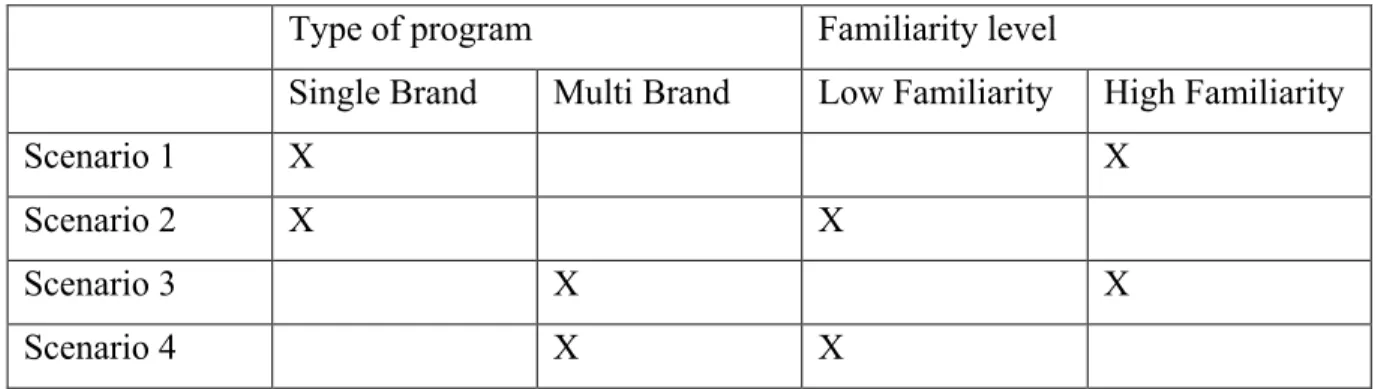
The study was divided in five blocks and was available in two languages, Portuguese and English. The second block of the study included 4 different manipulation scenarios, which differed from each other only in the loyalty program that was presented to each respondent. The purpose of the scenarios was to compare how people would react and evaluate the loyalty program that was being presented to them. Each respondent was exposed to one program only. The first scenario (Single-Brand and High Familiarity) was presented to 79 respondents, the second scenario (Single-Brand and Low Familiarity) was presented to 90 respondents, the third scenario (Multi-Brand and High Familiarity) was presented to 93 respondents and the forth scenario (Multi-Brand and Low Familiarity) was presented to 91 respondents.
4.4 Design and Procedure
This study intended to understand how each loyalty program format is evaluated, specifically the single-brand and multi-brand models as well as brands’ familiarity levels, by studying the impact of those models in the willingness to use the program as well as the satisfaction levels towards these programs.
15
The study design followed a 2 (single brand vs multi brand) x 2 (personality: maximizers vs satisficers) x 2 (high familiarity vs low familiarity) between-within subjects-design (Table 1).
The survey was divided in five blocks. The first block was a brief introduction and included a question regarding the familiarity level with loyalty programs. The second block included four loyalty programs, from which only one would be presented to each respondent. This was possible due Qualtrics’ features, which allows the users to present only one scenario to each respondent. After being introduced to the programs, the respondents were asked a few questions about that program, specifically their satisfaction level and willingness to use as well as the valuation they attributed to each incentive present in the program, meaning the Discounts, CSR and Gamification. The last question of this block was the familiarity level with the companies presented in program they were shown. The third block included questions about loyalty programs in a broader way. These questions included incentives valuation, meaning what drives people to use the programs and also the format in which people prefer the programs to be implemented, meaning a physical card, an account created and used in a website or an app for the smartphone. The forth block was developed to understand if consumers are maximizers or satisficers and it included questions about the way people make choices. The last block of the survey included demographic questions.
Table 1: Loyalty program scenarios
Type of program Familiarity level
Single Brand Multi Brand Low Familiarity High Familiarity
Scenario 1 X X
Scenario 2 X X
Scenario 3 X X
Scenario 4 X X
4.5 Variables Descriptions
16 4.5.1 Independent Variable
The independent variable in this study is the type of loyalty program, meaning single-brand vs multi-brand.
4.5.2 Moderators
This study included two different moderators: brand familiarity (high familiarity vs low familiarity) and personality (maximizers vs satisficers).
Brand familiarity was analyzed by asking participants their level of familiarity with the brand(s) stated in the scenario presented, on 7-points Likert scale (1 = very unfamiliar; 7 = very familiar). In order to compare the high familiarity and the low familiarity brands, a condition which separated the brands according to their, a priori, familiarity level was created, which was later used in the manipulation check.
The personality traits were measured using a scale that consists of 13 questions, adapted from an article from Schwartz, Barry (Schwartz, 2002). The mean of each respondent’s answers was computed and those with a mean above 4.0 were classified as maximizers while means below 4.0 were classified as Satisficers. In order to compare the differences between maximizers and satisficers, a median split was conducted.
4.5.3 Dependent Variables
The dependent variables in this study are the “Satisfaction level with the program” and the “Willingness to use the program” as well as the satisfaction with discounts, gamification and CSR.
Satisfaction level with the program was assessed by asking participants how satisfied they were with the loyalty program that was presented, using a 7-point Likert scale (1 = Totally disagree; 7 = Totally agree).
Willingness to use the program was measured by asking the respondents how willing they were to use the program that was presented, using a 7-point Likert scale (1 = Totally disagree; 7 = Totally agree).
17
Satisfaction with discounts was measured by asking the respondents how satisfied they were with having access to discounts in the loyalty program using a 7-point Likert scale (1 = Totally disagree; 7 = Totally agree).
Satisfaction with gamification was measured by asking the respondents how satisfied they were with having access to gamification in the loyalty program using a 7-point Likert scale (1 = Totally disagree; 7 = Totally agree).
Satisfaction with CSR was measured by asking the respondents how satisfied they were with having access to CSR in the loyalty program using a 7-point Likert scale (1 = Totally disagree; 7 = Totally agree).
5. Analysis and results
This chapter includes the data analysis and reporting. It will be divided in sub-chapters, starting with a description of the sample and finishing with the analysis of the hypotheses.
5.1 Sample analysis
The sample used in this dissertation consists of 353 valid responses, after removing incomplete responses. 61.5% of the respondents that answered to the survey were females while 38.5% were males. 31.4% reported being aged between 18 and 25 years old, 9.6% of the respondents said they were between 26 and 35 years old, 17.4% were between 36 and 45 years old, 26.9% were between 46 and 55 years old, 12.7% reported being aged between 56 and 65 years old and 2.0% of the respondents were older than 65 years old. Regarding the nationalities, 91.8% of the respondents were Portuguese. The author specifically targeted Portuguese citizens since the brands included as familiar brands in the manipulation are Portuguese, so it made sense to test these loyalty programs with the Portuguese population. Regarding the occupation, 67.7% of the respondents were workers and 27.8% were students. There were also 11 respondents that stated they were retired, accounting for 3.1% of the sample.
The annual household income of the respondents varied a lot, from less than 10,000€ a year to over 150,000€ a year. 15.6% of the respondents stated they receive between 10,000€ and
18
19,999€ euros per year, 13.6% receive between 20,000€ and 29,999€ and 16,4% of the respondents preferred not to say how much they earn per year. Although more than half of the respondents receive less than 50,000€ per year, there is a peak above this value of 15 respondents (4.5%) that receive between 100,000€ and 150,000€ per year.
5.2 Outliers analysis
Before analyzing the results, a study regarding the univariate and multivariate outliers was conducted, in order for the data to be as accurate as possible. For this study to be possible, the responses to each variable were converted in z-scores and a Mahalanobis distance was computed for each participant. When this distance has a p-value below 0,001, the participant should be considered an outlier. Since no particular outliers seem to bias the data, all the answers were kept as valid responses.
5.3 Scales Reliability
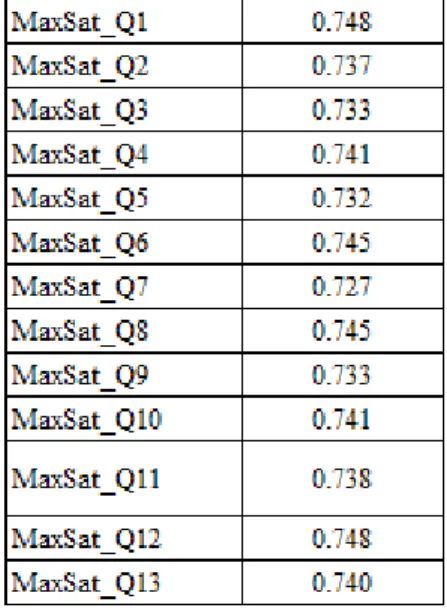
During the process of writing the survey for this project, a scale to measure the personality traits was necessary so that the participants could be classified as maximizers or as satisficers. Although this scale was previously tested, the Cronbach’s alpha of each question was studied and all the values were above 0,72, which is a fairly good value as the scientific community states that values above 0,70 can be considered consistent, meaning that these questions work very well together (Table 2 and Table 3).
19
Table 3: Reliability analysis - Cronbach’s alpha if item deleted
5.4 Manipulation checks
The manipulations present in this survey aimed at understanding how people would rate the different loyalty programs. The goal was also to study the familiarity levels with the brands included in these programs and, therefore, it was important to understand if the respondents could understand the difference between familiar and non-familiar brands.
An independent samples t-test was performed. The results suggest that people understood the differences between the brands, (M Familiar = 3.50 vs M Non-familiar = 1.31 ; t(256)=12.187 ;
p<.001) (Table 4).
Table 4: Manipulation check for brand familiarity
5.5 Main results
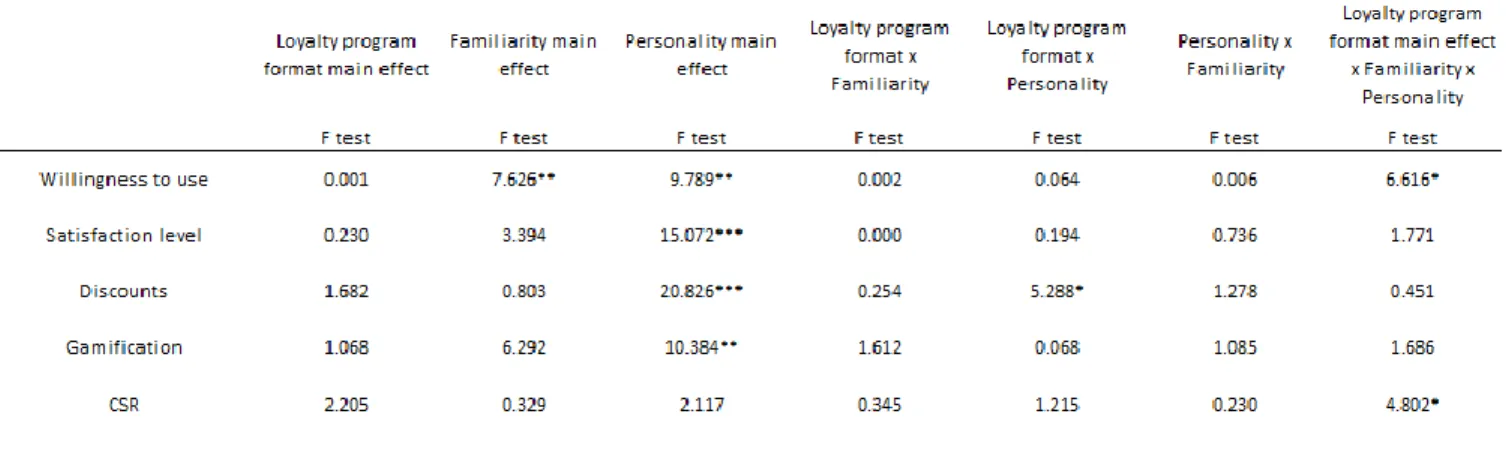
In order to test our hypotheses, a 2 (program type: single brand vs. multi brand) x 2 (brand familiarity: low familiarity vs. high familiarity) x 2 (personality: maximizers vs. satisficers) multivariate analysis (MANOVA) was conducted on the dependent variables (willingness to
20
use, satisfaction level with the program and satisfaction with discounts, gamification and CSR) (see Table 5).
Table 5: Results of the three-way interaction loyalty program format, familiarity and personality
5.5.1 Impact of program condition on willingness to use and satisfaction levels
H1: Customers prefer multi-brand loyalty programs instead of single-brand loyalty programs in the food retail industry:
Contrary to our expectations, Manova results suggest that no loyalty program main effect was found on our dependent variables, namely satisfaction with the program, willingness to use and satisfaction with the incentives (F’s < 2.205 , p’s > .14 ), rejecting H1.
These results indicate that the multi-brand loyalty program, by itself, is not a better alternative to the single-brand model (Table 6). Further analysis was conducted to study how other effects may influence the usage of loyalty programs as well as the satisfaction levels regarding them.
21
Table 6: Results of the independent samples t-test multi brand vs single brand programs
5.5.2 Impact of personality on loyalty program evaluation
The second hypothesis proposes that the different personalities will have a differential impact on the dependent variables. The MANOVA results indicate a significant personality main effect on willingness to use (F (1, 352) = 9.599, p < 0.01) and on satisfaction levels with the program (F (1,352) = 14.668, p < 0.001). Further analysis was conducted in order to test H2a.
H2: Consumers’ personality traits will show a differential impact on loyalty program evaluations, so that:
H2a: Maximizers will show a higher interest in loyalty programs than satisficers
An independent samples t-test was conducted, indicating a significant difference in both the willingness to use and the satisfaction levels with the program between maximizers and satisficers. That is, maximizers are more willing to use (willingness to use: M WTU Maximizers=
5.08 vs M WTU Satisficers= 4.52 ; t(351)=0.002 ; p < 0.05) and show higher satisfaction levels
with loyalty programs than satisficers (satisfaction levels: M Satisfaction Maximizers= 4.92 vs M Satisfaction Satisficers = 4.28 ; t(351)=0.000 ; p < 0.05). These results suggest that personality traits
play a role in the evaluation consumers make of the different loyalty programs and that maximizers show a higher interest in loyalty programs than satisficers, fully supporting H2a (Table 7).
22
Table 7: Results of the independent samples t-test loyalty program interest maximizers vs satisficers
5.5.3 Impact of personality and familiarity on loyalty program evaluation
The third hypothesis proposes that both personality traits and brand familiarity (low vs. high) moderate the loyalty program valuation. Further analysis was conducted considering both the maximizers and the satisficers separately. The personality was assessed across all participants using the median split variable that was computed to divide the sample in maximizers and satisficers (see Table 8). For satisficers, no significant results are observed for this sample (All F’s < 3.508, p’s > .063). However, when considering the maximizers sample separately, results from the 2 (personality) x 2 (brand familiarity) Manova indicate a significant 2-way interaction on willingness to use (F (1, 179) = 4.154, p < 0.05), on the satisfaction level with the program (F (1, 179) = 4.141, p < 0.05), and, on satisfaction with gamification (F (1, 179) = 6.494, p < 0.05) suggesting the moderating effect of brand familiarity and personality (Table 9 and Table 10). Further analyses were conducted.
Table 8: Results of the two-way interaction loyalty program format familiarity (maximizers)
H3: Maximizers will react more positively to programs that include high familiar brands than Satisficers, so that:
23
H3a: Maximizers are more willing to use loyalty programs that include high familiar brands
The results obtained fully support hypothesis H3a (M WTU Maximizers High-Familiarity= 5.35 vs M WTU Maximizers Low-Familiarity = 4.85 ; t(181)=0.036 ; p < 0.05), suggesting that the willingness to
use loyalty programs by maximizers is influenced by the familiarity level of the brands included in the program (Table 9).
H3b: Maximizers show higher satisfaction levels towards loyalty programs that include high familiar brands.
The results obtained also fully support hypothesis H3b (M Satisfaction Maximizers High-Familiarity =
5.16 vs M Satisfaction Maximizers Low-Familiarity = 4.70 ; t(181)=0.038 ; p < 0.05), suggesting that
the satisfaction levels towards a program are influenced by the level of familiarity with the brands for a maximizer (Table 9).
H3c: Maximizers are more satisfied with discounts when loyalty programs include high familiar brands.
The results obtained don’t support hypothesis H3c which leads to its rejection (F’s = 3.026,
p’s > 0.05). Rejecting this hypothesis means that maximizers are equally happy with the
discounts independently of the brands’ familiarity level (Table 9).
H3d: Maximizers are more satisfied with gamification when loyalty programs include high familiar brands.
The results obtained again fully support H3d (M Gamification Maximizers High-Familiarity = 4.32 vs M Gamification Maximizers Low-Familiarity = 3.58 ; t(181)=0.010 ; p < 0.05), showing that satisfaction
levels with gamification are influenced by the level of familiarity with the brands when one is a maximizer (Table 9).
H3e: Maximizers are more satisfied with CSR incentives when loyalty programs include high familiar brands.
The results obtained don’t support the hypothesis H3e, which leads to its rejection (F’s = 1.730, p’s > 0.05). Rejecting this hypothesis means that maximizers are equally happy with CSR independently of the brands’ familiarity level (Table 9).
24
H3f: Satisficers don’t show a preferential effect towards loyalty programs with high familiar brands.
The results obtained fully support the hypothesis since they were all non-significant, meaning that this group is indifferent to the level of familiarity of the brands in loyalty programs (M
WTU Satisficers High-Familiarity = 4.76 vs M WTU Satisficers Low-Familiarity = 4.27 ; t(168)=0.072 ; p > 0.05) ; (M Satisfaction Satisficers High-Familiarity = 4.37 vs M Satisfaction Satisficers Low-Familiarity = 4.19 ; t(168)=0.482 ; p > 0.05)
; (M Discounts Satisficers High-Familiarity = 4.99 vs M Discounts Satisficers Low-Familiarity = 4.96 ; t(168)=0.928 ; p >
0.05) ; (M Gamification Satisficers High-Familiarity = 3.47 vs M Gamification Satisficers Low-Familiarity = 3.14 ;
t(168)=0.256 ; p > 0.05) ; (M CSR Satisficers High-Familiarity = 5.31 vs M CSR Satisficers Low-Familiarity = 5.25 ;
t(168)=0.817 ; p > 0.05) (Table 10).
Table 9: Results of the independent samples t-test for maximizers comparing the effects of having high familiarity brands and low familiarity brands in loyalty programs
Table 10: Results of the independent samples t-test for satisficers comparing the effects of having high familiarity brands and low familiarity brands in loyalty programs
25
6. Conclusions and Implications
The purpose of this study was to assess if the multi-brand loyalty program model would be a better solution for the loyalty management market in the food retail industry (RQ1) and also to study how these new programs should be designed. The author decided to focus the analysis on three main topics. These topics were the incentives loyalty programs should include (RQ2), the familiarity level of the brands that adopt them (RQ3), and the impact that two distinctive personalities, which are the maximizers and the satisficers, may have in the usage of these programs.
There are some relevant findings that can be extracted from this dissertation. To start, it was found that the multi-brand model is, by itself, not a solution to improve loyalty programs. Although the means observed in the answers were higher in the multi-brand format, the differences were not significant. Thus, the answer to RQ1 is that multi-brand loyalty programs are definitely an interesting solution but the model is, by itself, not a way to fix some of the issues this marketing strategy has. The rejection of H1a) and H1b) contributed to this conclusion since it was hypothesized that the willingness to use and the satisfaction levels would increase if the respondents were exposed to a multi-brand program, which didn’t happen.
Regarding RQ2, the results demonstrated that all 3 incentives (Discounts, Gamification and CSR) were appreciated by the respondents. The average means of the satisfaction with Discounts and CSR presented fairly high values (M discounts = 5.36 and M CSR = 5.41
respectively). Gamification average rating (M gamification = 3.63), was slightly lower when
compared with the first two incentives but still it was considered to be high. Thus, all the three incentives can and should be included in loyalty programs since customers feel they are important and should be available.
The familiarity level (RQ3) is another attribute that was measured through the manipulation and it drew an important conclusion. When comparing the single brand programs (high familiarity vs low familiarity) and multi brand programs (high familiarity vs low familiarity) it was observed that high familiarity brands show higher sample means though differences were not significant, except for gamification in the multi brand format. This result was curious since, prior to this study, the information available pointed to significant differences
26
between familiar and non-familiar brands, which was not observed in this study. It is possible that, in fact, when one is using a loyalty program, the level of familiarity it has with the brand does not play a role in the decision-making process because joining a loyalty program may be related with brand familiarity, since one joins a loyalty program in order to benefit from what the brand has to offer, so it makes sense to be aware of the brand prior to joining a program.
Regarding the personality traits, it was observed that maximizers are much more interested in loyalty programs than satisficers. This is one of the main findings of the study and it is related with both H2 and H3. Maximizers present higher means than satisficers in the willingness to use, the satisfaction level and also on the satisfaction with discounts and gamification. Only the CSR attribute presented a non-significant mean difference between the two groups. Furthermore, the file was split in high and low familiarity to measure the mean differences between maximizers and satisficers on the two familiarity levels. It was observed that the familiarity level also influences the rating the programs receive. When analyzing the low familiarity level, it was observed that there are significant mean differences in the willingness to use, in the satisfaction level and in the satisfaction with discounts, with maximizers presenting higher mean values than satisficers. On the high familiarity level, it was observed that maximizers have a higher willingness to use the programs, are more satisfied with them and value discounts and gamification more than satisficers. CSR presented no significant differences between the two personalities, which leads to the conclusion that this attribute is always valued, due to its high mean, regardless of the predominant trait one has.
6.1 Theoretical implications
The findings presented in this dissertation contribute to a better understanding of the role personality plays in our lives and, specifically, on the decisions we take as humans. The knowledge provided by the study helps to increase the information regarding maximizers and satisficers (Schwartz, 2002) by demonstrating that their behavior also differs when it comes using loyalty programs and choosing brands.
27
It was found that a maximizer is usually more engaged with this type of marketing strategy since it’s goal is to maximize every choice’s utility. Satisficers, on the other hand, showed lower levels of engagement with loyalty programs. For them, it is more important to satisfice the need than to search for the option that delivers more utility.
Findings also contribute to the brand familiarity by suggesting that this attribute is relevant when one is choosing whether to join a loyalty program. It was shown that, for maximizers, it is of particular importance because their willingness to use and the satisfaction level with the program, as well as the satisfaction with gamification was influenced by the level of familiarity with the brands. These results show that familiar brands have an advantage over non-familiar brands since customers will be more interested in joining loyalty programs that are created by familiar brands. Thus, this dissertation contributes by extending the knowledge about brand familiarity and the loyalty management market.
Corporate Social Responsibility was found to be a relevant incentive for loyalty programs’ users since it averaged high satisfaction values. Although existing literature suggested the high importance that consumers give to Corporate Social Responsibility, the author didn’t find any studies that analyzed the impact of having a CSR campaign in a loyalty program. Thus, this dissertation shows that consumers truly value this incentive and that including it in a loyalty program may lead to high usage rates.
Gamification, as literature has shown, leads to higher satisfaction levels with loyalty programs while promoting more frequent interactions between people and the brands (Kim et al., 2017). Although interactions can’t be measured with this experimental design, the satisfaction levels were, in fact, demonstrated with the responses collected in this study.
6.2 Managerial implications
The findings that were presented in this study are relevant for marketeers when designing loyalty programs in the future, since they will allow to create better solutions for the loyalty management market and to better address each consumer type.
Firstly, it was found that all the incentives that were selected are relevant and people value having access to them in loyalty programs. The satisfaction with discounts, which are the core of this marketing strategy, presented a high mean, which was expected since most people
28
join these programs to have access to special deals to which they wouldn’t have access otherwise. The Corporate Social Responsibility incentive also presented a high mean. This finding is very important because it presents another reason for companies to truly invest in the society through activities that can help changing people’s lives. The loyalty programs are a very versatile tool, especially if implemented through mobile apps, which leaves room for companies to be creative and innovative. Connecting that with a social mission may deliver better results since people are looking for meaningful purchases. Furthermore, the Social Responsibility is something that customers truly value due to the awareness they have about the problems that we, as a society, face every day. Therefore, they want to feel that their money is well spent and are valuing more the possibility to be part of the change they want to see in the world. Thus, aligning businesses with social responsibility actions may be a good strategy for companies to adopt.
The last incentive, which is Gamification, presented a slightly lower mean. However, having this incentive in loyalty programs may be a very relevant way to interact with the consumers and also to keep them in contact with the brands. It was interesting to see that, while this dissertation was being written, Ibersol launched four games as part of their loyalty program. This corporation, that manages brands such as Burger King, PizzaHut and Telepizza in Portugal, has been a pioneer in the implementation of this strategy in the mainstream food retail. In a society in which smartphones are becoming more important and the room for technological improvements is so vast it may make sense to adopt this strategy if it proves to be relevant for the business and aligned with companies’ values.
Another aspect that should be taken into account is the over choice. In the food retail industry people usually have a high number of brands to shop from and, within each brand, very complete menus with a high number of meals. Over choice has been linked to harder decision making processes and it may even make customers change to a competitor if they feel the choice is not easy (Gourville & Soman, 2005). This decision-making process should be facilitated by helping the consumers to take their decision. For instance, a brand could adopt a strategy of offering only some items of the menu at a lower price, which would increase the likelihood of a customer choosing one of those items, allowing the brands to save in food
29
waste as well. Furthermore, discounts usually attract people, so it could be interesting to offer exclusive discounts for loyalty program users in specific items.
Managers may also want to address the personality type of each consumer in a different way since they, in fact, react differently when they have a choice to make. Maximizers are usually more engaged with loyalty programs, as the results have shown. However, satisficers may need an extra incentive to use these programs. That means that push notifications, special deals or even direct monetary discounts, meaning for instance a discount of 5€ in their next purchase may be a way to engage with them. It may hurt profits in the short-term but it may help corporations to retain customers in the long-term. Another way would be to emphasize the impact of their purchase in a social responsibility mission, for instance.
The last aspect worth mentioning is the importance of the brand familiarity level. Although it is an end and not a mean to attract customers, this study shows that brand familiarity plays an important role in the choices we, as consumers, take, being particularly important for maximizers. One of the most common shortcuts people use to make a purchase is brand awareness, since people rely more often in what they know and trust. Being able to capitalize on that may be the difference between retaining a customer and losing it to one of the competitors.
7. Limitations and Future Research
This study presents a few limitations, mainly regarding the brands that were chosen and the concept of loyalty program itself.
Firstly, when designing the loyalty programs, it had to be decided which type of brands should be included. In the study a total of six brands were presented, from which three were considered to be familiar and the other three were non-familiar brands. However, when respondents were answering to questions such as the willingness to use they were also considering past experiences with the brand, if they had them, of future expectations, for instance by looking at the logos. This means that respondents may be aware of the brands but, for some reason, don’t like them. It may also happen, in case one doesn’t know the brand, that the logo is not appealing enough for them. In this survey it is a possibility that respondents who are not concerned with taking care of their eating habits would rate the
30
programs lower than others who care more about their diets, since the brands that were included are considered healthier than most in the food retail industry, which could bias the results.
Secondly, the concept of loyalty program differs from one person to the other. While the survey was answered by participants from several different age groups (from 18-25 years old to more than 65 years old), the conception one has about loyalty programs is likely to be different. Older generations that didn’t grow with as much technology as younger generations may think about loyalty programs as a card that can be used in the stores, while younger generations may feel that mobile apps are the only way for loyalty programs to exist. Since this study presented just one brand for each part of the meal, future research could offer more possibilities, so that the difference between high familiarity and low familiarity could further investigated.
The personality traits presented in this dissertation are a topic that has not been deeply explored and it was shown that it strongly influences one’s decision. It may be important to further explore these traits in the context of the loyalty management market, since a better understanding of how the personality influences people’s decisions can provide valuable insights for marketeers.
31
Appendices
Appendix 1: Survey
Introduction to the survey
Loyalty programs
Welcome to my Master Thesis survey!
Thank you for taking some time to answer my survey. Your responses are of the utmost importance and they will help me to provide answers in my field of research. This survey should take no longer than 5 minutes and there are no right or wrong answers. Please make sure you answer truthfully to all the questions and if you want to add any comments there will be a section designed for that purpose.
All the data will be treated anonymously and it will be used for my analysis only. If you have any further questions or suggestions feel free to contact me via email:
Hope you enjoy this survey and, once again, thank you! Best regards,
João Figueiredo
Q1: Loyalty programs
Loyalty programs are marketing strategies that companies design for customers to continue shopping in their stores. These programs are usually presented in one of three forms: an app, a store card or even a website account. They allow the users to receive exclusive discounts and special deals.
On a scale from 1 (not familiar) to 7 (very familiar), please rate your level of familiarity with this type of program?
1 = Not
familiar (1) 2 (2) 3 (3) 4 (4) 5 (5) 6 (6) 7 = Very familiar (7) Loyalty
program
32 Q2a: In this block you will be presented to a loyalty program format: The Single-brand
loyalty program!
Most companies develop their own loyalty program, which is usually called the "Single-brand loyalty program". A single "Single-brand loyalty program is a program developed by a "Single-brand that can only be used in their stores to have access to discounts, rewards and everything else the brand decides to provide its customers.
Please consider the following scenario:
You are in a shopping mall deciding where to have lunch when you realize you have the following loyalty program in your smartphone:
Single-Brand loyalty program from Vitaminas, that sells healthy meals.
By using this program you have access to:
Exclusive discounts -> Receive discounts to use in the store just for being part of this program Gamification -> Play games on your smartphone and receive rewards to use in the stores
A Corporate Social Responsibility plan -> For every purchase you make, 10% of the value will be donated to charity