A Work Project, presented as part of the requirements for the Award of a Masters Degree in Management from the NOVA School of Business and Economics.
IFL – SME COMPETITIVENESS
Selection of a co-operation agreement between EMOVE – Innovative Technologies and WavEC – Wave Energy Center
Sofia Ventura Soares, #992
A Project carried out on the Management course, with the supervision of: Professor Sonia Dahab
Professor Filipe Castro Soeiro
2
Abstract
The purpose of this study is to find the best technological co-operative arrangement for two partners – EMOVE and WavEC – concerning the development of the BluSphere technology. EMOVE provided most of the information needed for the empirical study and I based my research on academic papers. From the four options of co-operation on technological development: technology license, R&D joint arrangement, sourcing agreement and joint venture, the latter seems the best option for EMOVE in the short run. In the long run, the joint venture must be dissolute, and the co-operation agreement must change to a sourcing agreement.
3
Index
ABSTRACT ... 2
METHODOLOGY ... 4
THEORETICAL FRAMEWORK OF TECHNOLOGICAL CO-OPERATION ... 4
REASONS FOR CO-OPERATION ... 4
Resource-Based View... 5
Transaction Costs ... 6
FORMS OF CO-OPERATION ... 6
Technology License ... 7
R&D joint arrangement ... 7
Sourcing Agreement ... 8
Joint Venture ... 8
POTENTIAL RISKS ... 9
SUCCESS FACTORS ... 9
BEST FIT OF TECHNOLOGY ACQUISITION ... 9
Organizational Factors ... 10
Characteristics of the technology ... 11
DESCRIPTION OF EMOVE ... 12
BUSINESS MISSION, VISION AND STRATEGIC OBJECTIVES ... 14
THE TECHNOLOGY – ESG ... 16
COMPETITIVE POTENTIAL – VRIO ... 17
MCG – PREVIOUS CO-OPERATION EXPERIENCE ... 18
WAVEC – FUTURE CO-OPERATION EXPERIENCE ... 21
FUTURE DESIGN ... 22
REFERENCES ... 25
APPENDICES ... 28
APPENDIX 1 - BLUSPHERE ... 28
APPENDIX 2 - POWER GENERATOR (ESG) ... 28
APPENDIX 3 - TOP 10 DIRECT COMPETITION (WAVES) ... 28
APPENDIX 4 - TIMELINE EMOVE WAVES ... 29
APPENDIX 5 - FINANCING PHASES EMOVE WAVES ... 30
APPENDIX 6 - MECHANICAL POWER, EMOVE’S APPROACH ... 30
4
Methodology
This work project is an interdisciplinary study focused on the technological co-operation and innovation management areas applied to a Maritime Business case. It aims to study the future co-operative project between EMOVE and WavEC. These two companies are facing doubts about the best way to engage in co-operation, specifically how to create a strategic alliance on the BluSphere development (Appendix 1).
The decision on the co-operative arrangement that best fit EMOVE’s case will be supported on academic papers about co-operation and innovation management as well as empirical information. First I will research the reasons for co-operation, then the different modes of technological co-operation, the potential risks associated, success factors and finally the best fit of technological acquisition considering both the organizational factors and the technological factors. Complementary, based on empirical information of EMOVE previous experience on technological co-operation with other entities and its current relationship with WavEC, a model will be elected as the most suitable one to a win-win situation.
Theoretical Framework of Technological Co-operation
Reasons for Co-operation
High-technology industries are subject to extreme high prices and product feature competition. For them, it is key to have the ability to develop new technologies. As a result, all firms engage in high R&D efforts with the hope to remain competitive (West and Iansiti, 2002).
Hereupon, co-operation presents itself as a way to decrease costs of technological development; to reduce risks of development; to achieve economies of scale on production; and to decrease time on development and commercialization of new
5 products. The above reasons can be grouped according to its co-operation rationale: technological, market and organization.
Specifically regarding technology, there is a growing acknowledgment that peripheral technology of one company may be the key activity of another. So, in many cases, it makes more sense to search for an external source of technology instead of internal development, which demands more risks and is costly both financially and in development time (Tidd et al., 2001). In other cases, co-operation for core competence development seems the best solution when it is the case of a new technology, complex and rare, not only to be effective on the development of the product, but also as a way to incorporate core knowledge for both entities (Granstrand et al., 1992).
The study taken by Yasuda (2005) about the highly technological semiconductor industry, showed that the primary motivation to form strategic alliances is the access to resources owned by the partners, followed by the time reduction required to develop and market a product.
Hoffman and Schlosser (2001) stated that there are two main explanations to engage on strategic alliances: the resource-based theory and the transaction-cost theory.
Resource-Based View
The resource-based theory views the firm as a set of resources and capabilities (Wernerfelt, 1984), and explains the formation of strategic alliances as a way of incorporating additional resources that cannot be purchased via market transactions but are available from partners (Das and Teng, 1998). Many resources are specific from one company, and are not perfectly mobile or imitable (Das and Teng, 2000), therefore firms form alliances to create value by exchanging or combining technological, financial, manufacturing and distribution resources. The resources exchanged depend
6 upon the form chosen to co-operate (Yasuda, 2005). The ultimate goal of the evolved companies is to use pooled resources as sources of competitive advantage. Barney (1991) created an assessment tool of competitive advantage driven by resources and capabilities: the VRIO framework. This framework evaluates if the resources are valuable, rare and costly to imitate and if the firm is organized to exploit them.
Transaction Costs
The transaction-cost theory is focused on the minimization of fixed and continual costs (Yasuda, 2005). These costs vary according to the maturity stage of the technology, the degree of technological knowledge of the buyer, the type of co-operation chosen and the partners’ profile (Tidd et al., 2001).
When the acquired technology is in a mature stage, its cost will be much lower than the same technology in the development stage. Transaction costs tend to increase whenever the potential buyer has few knowledge of the technology and when the technological know-how is key to the buyer (Hauschildt, 1992). Also, these costs tend to decrease when both companies share mutual trust, technical and business data and have strong social connections between each other employees (Tidd et al., 2001).
The resource-based and transaction-costs theories are complementary in high-technology industries, mostly because companies need additional resources that cannot be purchased via market transactions, which make them internalize R&D joint efforts (Yasuda, 2005).
Forms of Co-operation
After knowing that co-operation is the best way to acquire technology, companies should choose the type of co-operation that best fit their needs. The type of co-operation
7 chosen depends on the strategic relevance of the technology to the core competence of the buyer firm as well as on its added value to the firm in relation to its positioning compared to competitors (Tidd et al., 2001).
In the specific case of strategic alliances, there are four common forms in technology-driven companies: technology license, R&D joint arrangement, sourcing agreement and joint venture (Yoshino and Rangan, 1995).
Technology License
Technology license is a formal arrangement that gives a company the right to explore intellectual property of another, when paid a mutually agreed fee and/or a royalty based on sales volume. Manufacturing, development, and sales among other activities are different forms of property technologies (Yasuda, 2005). This arrangement enables the usage of technology inaccessible in other form. The downside is the high price asked most of the times and the limitations imposed by the seller (Tidd et al., 2001). In the last years, technology license has been increasingly used in order to achieve monetary and non-monetary benefits (Lichtenthaler, 2011).
R&D joint arrangement
A joint R&D is a formal arrangement between two or more companies where they agree to combine efforts to develop certain technologies or products. It determines specific goals and a schedule for the project (Yasuda, 2005). According to Hagedoorn (1993), joint R&D agreements are over 85 percent motivated to improve the long-term technological prospects of the product or market achieved by the joint companies. Despite of the slow down on the number of joint R&D noticed on the end of 1980s (de Man and Duysters, 2005), it is now increasing as a way to cope the increased costs associated with R&D (Andersson et al., 2012).
8 Sourcing Agreement
In this form of technologic alliance, firms consign manufacturing services to their partners, and in return, partners provide back to the firms finished (or semi-finished) products. These products are subject to the specification demanded by the firms (Yasuda, 2005). The main advantages are the cost and risk reduction associated with in-house development, as well as a reduction in the leadership time demanded compared to joint R&D. On the other hand, the investment can be very high and the quality control very low which ultimately can severely affect the product quality (Tidd et al., 2001). Nevertheless, more co-operation among sourcing partners in the early stages of R&D development tends to decrease quality problems. Additionally, the increasing cost of internal R&D efforts have lead to outsourcing being used half of the time, in small and medium enterprises, as opposed to other forms of technology acquisition (Vrande et al., 2009).
Joint Venture
In joint ventures, partners create a formal legally independent company to share complementary resources and capabilities as a means of developing a competitive advantage (Yasuda, 2005). These resources are, most of the times, non-transferable and located in specific spots, which motivates the joining of efforts (Chen et al., 2011) and the exploration of new ideas (Santamaria and Surroca, 2011).
Technology oriented joint ventures normally practice high levels of R&D. This form of co-operation is seen as a viable option to overcome entry barriers, to address fast growth markets, to spread big expenses, to share risks and research efforts, to capture economies of scale and to gain access to new markets (Hagedoorn, 2000). In general
9 terms, large enterprises engage in joint ventures to access technology, while small companies aim to acquire knowledge and get financial support (Tidd et al., 2001).
Potential Risks
Despite of the benefits stated above on the different forms of co-operation, there are general risks associated. According to a study made by UMIST (1993) co-operation can potentiate leaks, loss of control or ownership and conflicts.
There is a greater change of leaks when the co-operation is among competitors, due to the access of additional knowledge and skill out of the agreement. Sometimes, collaboration can be a form of tacit knowledge espionage. Another risk is the loss of control or ownership, that can occurs when a firm absorbs knowledge from another and incorporates it on its activities. Finally, divergent aims and objectives can result in conflict (Littler, 1993).
Success Factors
In general terms for a co-operative project to be successful both companies have to agree on each other real intentions and expected outcomes from the co-operation and the motivation of each partner has to be more complementary than competitive (Tidd et al., 2001). A study undertaken by Whipple and Frankel (2000) shows that both suppliers and sellers agree with respect to the top five success factors, although they appear in a slight different form. The responses were: trust, senior management support, ability to meet performance expectations, clear goals and finally partner compatibility.
Best fit of technology acquisition
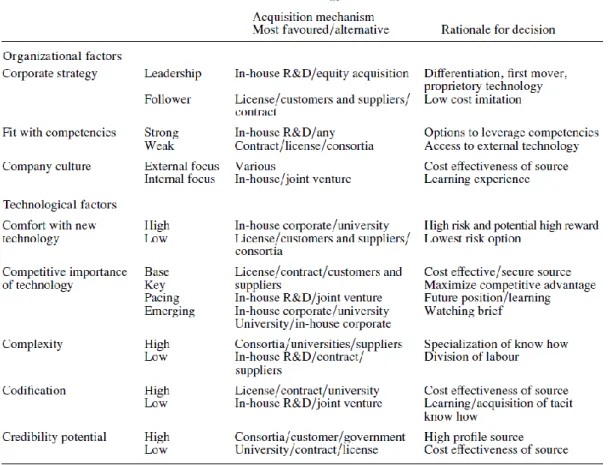
Tidd et al. (2001) suggest a methodology to choose the best form of acquiring technology according to each company organization factors and the characteristics of the technology. Their method is presented below in Table 1.
10 Organizational Factors
The organizational factors cover the company’s strategy; the know-how and capabilities; the culture and the management “comfort” with the technical area.
In terms of strategy, a company can choose to have a leadership or a follower position regarding the technology. There are two types of technical key competences: the strategic and the facilitators. In the first case, the company bets on its competences, because they are an important source of competitive advantage. The facilitators competences do not need to be controlled internally, but they are also sources of success. In the case of having weak internal key competences, there is no alternative to outside acquisition, at least in the short-run. On the other hand, when a company has strong internal key competences, it tends to develop other associated technologies, improving the degree of control over the process.
Source: Tidd, J. and Trewhella, M. 1997. “Organizational and technological antecedents for knowledge acquisition and learning”. R&D Management. 27 (4): 359-375.
Table 1 - Link between technology acquisition strategy, organizational factors and the characteristics of the technology
11 The culture of the company also affects the technology acquisition. An “eyes wide open” culture can benefit the company, as it allows the incorporation of technologies developed outside, as opposed to weaker technologies created in-house.
Finally, the management team is comfortable with new technology when it is familiarized with it and trusts on the development team to deliver a successful product. Characteristics of the technology
The characteristics of the technology are comprised by its competitive relevance, its complexity, the degree of codification and the credibility potential.
Firstly, the competitive relevance is the factor that has the biggest weight in the decision of acquiring technology. As stated before, companies realize that its basic technologies are others’ key competences. Therefore it makes sense to acquire externally for better performance and lower costs.
Secondly, the degree of technological codification measures the degree of which the technology can be expressed using formulas, diagrams and procedures. The higher the codification degree, the easier the knowledge transfer process is. This kind of knowledge is described as explicit. The tacit knowledge, acquired through experience and personal interaction, cannot be codified; hence its transfer is much harder (Nonaka, 2000). In the absence of intellectual property rights or patent protection, tacit technologies are longer sources of competitive advantage, compared with easily codified technologies.
The degree of complexity changes according to the amount of resources needed to develop the new technology. It comprises intellectual resources, amount of time and money needed, physical resources, among others.
12 In terms of credibility, acquiring or developing a new technology can be a way to improve market image about the company.
There are other methods to select the best technological acquisition mode. Lee et al. (2009) suggest an analytic network model that uses a set of 21 influential factors grouped by capability, strategy, technology, market, and environment, to make a strategic decision of technology acquisition that can be the in-house development, cooperation or buying outside.
In the section Future Design, I will use the Tidd et at. (2001) framework to support my choice of EMOVE’s best way to acquire the BluSphere. This is the most suitable model for my research because it uses the elements that I studied – organizational factors and technological factors – to take a final decision concerning technology acquisition.
Description of EMOVE
EMOVE is a Portuguese start-up venture, created in 2009, with the aim of operating in the alternative energy sector as a source of energy generation and distribution. It is composed by five professionals. One has Management background; one is Electric Engineer; and the remaining three are Mechanical Engineers. From this group, three are founders.
EMOVE’s core business is the design and commercialization of green power generators that can be applied in different businesses (Appendix 2). Since the beginning, the main goal of EMOVE is to launch a commercial device for the wave energy sector; nevertheless, this company has recently realized the potential of its technology in the wind sector. So, it has started R&D in this field in order to deliver a generator that will fit in a wind turbine. In the future, the mobile application of their generator technology will be studied, as well as its application in navigation buoys and the aviation sector.
13 In this study I will focus only on the wave business. This is the sector that EMOVE believes has the most potential in terms of generator performance, when compared with other players already operating in the market. In fact, nowadays these players have very low efficient technologies. This fact leads to a very low usage of wave energy when compared with other sources of alternative energy, as they are much less efficient, therefore, profitable. That is why EMOVE considers as its direct competitors other companies that are in the prototype stage, developing more efficient technologies and as its indirect competitors other renewable energy sources. Please check Appendix 3 for detail information.
The goal of EMOVE is to provide the most efficient solution in the usage of waves to generate electric energy in order to sell/rent their generators, always providing their maintenance. Also, EMOVE wants to target electric utilities to sell energy and ultimately to sell carbon credits, since it is a clean source of power.
EMOVE’s path started in March 2009 when the ESG – Electric Spherical Generator – was internationally patented. R&D started in June 2011 in Silicon Valley, California. After that, EMOVE presented a 1:10 scale prototype of its generator. It has predicted the market launch of ESG for the waves market in November 2015. Until then, the goal is to invest in R&D in order to improve the efficiency of the prototype. Appendix 4
details the history of EMOVE since its creation until the ultimate phase of the ESG market launch. Note that “Internationalization” is the next goal right after market launch. EMOVE believes that in 2015 the technology will be much better known worldwide, and the majority of its clients will be foreign. This company entitles itself as “born global”.
14
Business Mission, Vision and Strategic Objectives
EMOVE’s mission is “to build and deliver products that contribute to self-sustainability, sharing the vision of a better world”1By following its mission, EMOVE will be able to achieve its vision of “becoming the leading company worldwide in terms of reliable technological solutions for the wave energy market.”2
EMOVES’ values are supported on Quality, Innovation, Economic Results, Orientation to Customer, Ethics and Social Responsibility and at last Fun and Competitive Spirit. In fact, these values are very coherent with the story of the company and the market which it operates: the Quality operates as a self-regulatory over the product’s reliability. This company guarantees high levels of quality in all its solutions, developed through internal and external audits and according to the highest international standards. Innovation is also a key point in EMOVE and the very reasoning for its existence. As a consequence, it is present in all departments and is presented in every project undertaken by the team. Moreover, the ultimate reason for the existence of every company is the value offered to the shareholder. EMOVE is no exception expressing its value in the form of Economic Results. As such, EMOVE is committed to its objectives of growth and profitability set forth in the company’s strategic plan. The team believes that the success of this company directly depends upon its customers. With them, EMOVE expect to develop its products so that they may always be in compliance with each other requirements, anytime in the process. Ethics and Social Responsibility are also pillars. EMOVE is committed to the best practices with the principles of business ethics and transparency in all spheres of activity of the company.
1 EMOVE website
15 Since this company currently does not have a final product to sale and wants to become the most efficient solution in the market, its strategic objectives are related with R&D, financing, market visibility and learning.
In order to have an excellent product, the company has already invested a lot of man hours and money to develop the prototypes. EMOVE aims to continue doing R&D to reach the optimal product to launch in the market. The problem is that EMOVE does not have clients, so, it has to get financing to support R&D activities.
The financing of the project will have three stages. EMOVE’s financing projection is expressed in Appendix 5. In the first phase, EMOVE is willing to sell 5% to 10% of its equity to obtain 0.883 million Euros. This is the value needed to pursue with the theoretical development of the generator and the testing. Having this first part concluded, EMOVE will have in hand facts that prove the efficiency and the potential of its technology. Also, EMOVE will have the optimal design of the prototype, which will be sent to production, which will need a second phase of financing. The production will require 4.5 million Euros, which will be acquired selling 2% to 5% of EMOVE’s equity. EMOVE expects that both in the first and the second financing phases the equity buyer will be a private investor. Having the real prototype will allow EMOVE to continue with the testing and to compare the outcome with the values obtained by the theoretical testing. The goal here is to prove that the theoretical and real prototypes behave the same, and the performance projections made by the theoretical design are, in fact, achieved in a real device. As a consequence, when a client asks for a generator with a specific power, to deliver a specific amount of energy, EMOVE can be sure that the generator sold will have the performance expected.
16 After having technical proof that the device works as expected, EMOVE will begin the serialization process, which will demand a third phase of financing. Here the goal is to obtain between 190 and 200 million euros to produce and install the devices. EMOVE expected that its major source of revenue will be selling energy to electric utilities. Therefore, this company aims to obtain permits that will allow the implementation of a network of devices, almost like a power plant at sea. Getting the permits is definitely a milestone for EMOVE. So, at this stage, EMOVE predicts that it will have to engage in a joint venture with a company that will facilitate the access to this resource. As of now, EMOVE expects that it will be an oil company, due to its current usage of permits. Besides getting financing, the next major concern of the team is to create market visibility. To do so, this company was able to set an agreement with world surfing champion Kelly Slater and Richard Branson to be their ambassadors. This means that, whenever possible, they will promote EMOVE in events with entities that might be interested on its technology. Also, they will try to help EMOVE to attract investment.3
The Technology – ESG
The basis for the creation of the company is the innovative device designed by EMOVE’s team – ESG – Electric Spherical Generator (Internationally Patented PCT104442). It is an electric generator that absorbs all movements and oscillations and converts them into power (Appendix 2). This technological system can be made in any size, which means that it can deliver the exact amount of power required by the customers.
As stated before, the best application found so far for this generator is the wave energy sector, especially for electric utilities. EMOVE wants the ESG to be combined with
17 other sources of energy, both renewable and non renewable. The reasoning is quite intuitive: this technology uses movement to generate electric energy. Regarding the waves application, the water movement is not constant, which can compromise the flow of electric energy. The best way to address flow constraints of all alternative energies is to combine them with other sources, in order to ensure the constant flow of power. Despite of its limitations in terms of power flow, EMOVE discovered a way to project a generator smaller than the ones on at the market today, but with the same mechanical power. They designed a generator that uses a 3D rotational design, which allows the use of more rotation axis than the 2D generators. In fact, in rotational systems, power is the product of torque τ and angular velocity ω. Instead of creating a big generator, to increase the angular velocity, which is currently being done today, EMOVE discovered a way to increase the torque, projecting a smaller generator that produces the same power. Appendix 6 clarifies the tradeoff of angular velocity and torque.
This reduced size has direct consequences. Being 5 times smaller than the devices existent in the market, the costs of materials, transportation, maintenance and installation are lower. Having lower costs, EMOVE can practices lower prices and lower maintenance costs which make their product more competitive than others on the market today.
Competitive Potential – VRIO
To assess the competitiveness of the ESG, I used the VRIO framework. This framework, created by Barney (1991) is a tool used to examine the internal environment of the firm. Answering the four questions that compose it, one will determine the competitive potential of a resource or capability. In the case of EMOVE, a capability
18 will be studied, since the technology behind the generator is an intellectual property of EMOVE.
Beginning with the question of value, this capability enables the firm to exploit an environmental opportunity. Clients are seeking for lower prices on green energy. With the generator in the market, EMOVE will be able to do so.
In terms of rarity, EMOVE faces competitors with considerable larger and more expensive equipment. So far, in terms of wave energy source, there is no other company with such innovative technology. Also, it is difficult to imitate, since the ESG is internationally patented and no other company can copy it, as long as the patent is valid. Finally, the organization as a whole is betting every resource on its R&D and all the activities that support it, namely the financing. Pedro Balas is currently putting every effort on finding the financing needed. He is pitching over many entrepreneurship events around the world. And besides the financing, EMOVE works very close with MCG, the company that produced the first 1:10 prototype for testing, to make sure that the ESG for waves can be produced the most efficient way possible. Furthermore, EMOVE is committed to find the best form of develop the BluSphere, the shell that will integrate the generator, and that will allow the best exploitation of the sea conditions. So far, EMOVE is only sure that the company that best fit its quality and knowledge requirement is WavEC.
This analysis leads to the conclusion that the capability of creating the ESG has a “Competitive Sustained Advantage”, as summarized in Appendix 7.
MCG – Previous Co-operation Experience
MCG is the first company that co-operated with EMOVE. The co-operation was made in a form of a sourcing agreement.
19 MCG was founded in 1979. It is a Portuguese company with over 60 years of experience working with metal-metallic components. Most of its story is based on the automotive industry, but since 2010 it has diversified its business areas to the solar, laser and tooling industries and created the slogan “Mind For Metal”, which praises the new strategy. 4
MCG is considered by many as one of the best companies in the world in terms of metal engineering, specifically, in prototyping, precision engineering and molds. MCG was contracted by EMOVE to supply the industrial production of the ESG. In fact, MCG built the first 1:10 scale prototype of EMOVE’s electric generator. Due to the fact that this generator has such revolutionary design, MCG was deemed by EMOVE the optimal choice to supply the production. This company has the ability to innovate in the techniques needed to construct the generator, as well as advising EMOVE on the design of several parts. One example was the original design that was impossible to build. To overcome this constraint, these two companies worked together to find the best solution for the construction that would not compromise the final outcome required by EMOVE in terms of design and functionality. The co-operation on the development of the construction was made in a very informal way. To address the modifications needed, both companies agreed to meet in person, but also to communicate by email and cell phone. The reason for the choice of informal communication instead of formal was the resource consumption that the last would require, namely, time and money.
When asked about the relationship between the two companies, after engaging in such a challenging project, EMOVE’s CEO, Pedro Balas, says it is very good. Of course, along the way some issues raised. But EMOVE believes they were solved properly, driven by
4 MCG website
20 the goodwill of both companies. Between April and August of 2012, MCG manufactured the generator. It took longer than EMOVE was expecting, but the CEO of EMOVE does not blame MCG. He is aware that the construction of the generator was not on MCG plans of operations, so this company had to “fit” this construction between the other projects it was already doing. Also, Pedro Balas knows that MCG lost money with the construction of the first prototype, but it was an investment made to promote a long lasting future relationship between both firms. As a matter of fact, MCG’s strategy paid off and EMOVE will be requesting three more generators. One equal to the first one, and two full scale, almost 2.5 meters of height.
Since MCG already built an entire generator for EMOVE, the question of trust and knowledge protection arises. Pedro Balas believes that EMOVE’s trade secret is well kept with MCG and it will continue to be. In terms of legal protection, and to enhance the trust and knowledge transfer between both parties to promote agility and effectiveness, EMOVE and MCG signed several Non-Disclosure Agreements.
Also known as Confidentiality Agreement, this legal contract between the two parties outlines confidential material, knowledge and information that EMOVE wish to share with MCG but wants to restrict access to or by third parties. So this contract is a security for EMOVE that MCG will not disclose information covered by the agreement. Using this legal tool, EMOVE protected any type of confidential and proprietary information as its trade secrets.
As consequence of their past experience, EMOVE want to continue to be a business partner of MCG. When the time for the production of the commercial generator comes, EMOVE expects to have MCG as supplier of some of its parts. The others will have to be built elsewhere and EMOVE will assemble the generator themselves.
21
WavEC – Future Co-operation Experience
To build the BluSphere, EMOVE believes that WavEC is the best choice.
The Wave Energy Center (WavEC) is a non for profit organization. Founded in 2003, this Portuguese organization is dedicated to the development and promotion of ocean wave energy, offshore wind and other renewable energies. It provides technical and strategic support to companies, R&D institutions and public entities inside and outside Portugal. Additionally, it co-ordinates/participates in R&D projects to support the development of wave energy on national and international level. 5
WavEC does not have any financial support from the Portuguese Government. 60% of its revenues come from European Union R&D projects, and the remaining 40% are distributed by Portuguese R&D projects (10%), business services (25%) and the 5% from membership fees.
WavEC’s main areas of activity are Monitoring, Technology, Numerical Modeling, Politics & Economics, Environmental Impacts and lastly Dissemination.
Due to its field experience, and reputation on co-operation, it was EMOVE’s choice to develop the shell called BluSphere. EMOVE expertise is on electric generators. But, to put the generator out to sea, in a way it absorbs the movement of the waves, a shell is needed in order to protect it. EMOVE does not have the knowledge needed to develop such shell but WavEC does. Pedro Balas believes that WavEC is very knowledgeable about fluids mechanics, which is the core knowledge required to develop the shell. The construction of the shell is crucial to EMOVE. Most competitors fail at this stage, because the device that protects the generator (the shell) is not robust enough to sustain the very harsh ocean conditions. Also, the aerodynamics must be perfect, in order to
22 absorb as much movement as possible. So, EMOVE will bet heavily on the development of the most solid shell ever made.
According to EMOVE, WavEC is the best option because it aligns the expertise and trust needed to develop the project together. Despite of never work together in the past, EMOVE trusts on WavEC mostly due to its team composition and the previous projects developed by them. The President of Board of Directors, António Sarmento, is an associate professor at the Department of Mechanical Engineering of the Instituto Superior Técnico (Technical University of Lisbon)6, precisely where EMOVE’s CEO took the Undergraduate studies on Mechanical Engineering. Further, WavEC’s team is formed by 19 specialists with strong backgrounds and experience on different wave fields. Big corporations like EDP, Galp Energia, Martifer, and Efacec among others have already developed projects in co-operation with WavEC, which is another sign for EMOVE that this company is reliable.
EMOVE is not concern about the disclosure of any trade secret because WavEC will not need information about the ESG core specifications in order to project the shell. Because of this, knowledge management of the ESG is not an issue for EMOVE, but the BluSphere is. EMOVE requests WavEC exclusivity on the design on the BluSphere, to avoid its copy by competitors.
Future design
EMOVE needs to acquire the BluSphere and my goal is to find the best way to do it. Until now, the only requirement of EMOVE is to be WavEC’s partner. The reasoning is expressed above. After studying both companies, the co-operation form that I propose is
6 WavEC website
23 a temporary joint venture. There are several reasons why a joint venture is the most appropriate form and other reasons why it should be temporary.
Using Table 1 to address the best acquisition fit, it is clear that the joint venture will turn into a sourcing contract, due to the organizational factors of EMOVE and the technological factors of BluSphere.
In terms of corporate strategy, EMOVE wants to have a “leadership” position by having the most resistant shell in the market. Tidd and Trewhella (1997) suggest as most favored acquisition mechanism in-house R&D. EMOVE does not have the knowledge to do so, as such it has to acquire it externally. The same applies to the competencies fitness, which are “weak”, therefore demand an external acquisition. The authors suggest sourcing contract as the best option. The last point of the organization factors is the company culture. In this case, EMOVE has external and internal focus. It looks externally for key competences that are facilitators, as the BluSphere, but regarding the strategic competences – the ESG – EMOVE believes that it has the best electric generator applied to waves ever made. Therefore, the analysis of the culture does not have any influence on the choice of the form of technological acquisition, but has influenced a lot the choice of partner. In fact, the option for WavEc was greatly influenced by the fact that the member of both companies share similar scholar paths and as such they share a common work methodology.
Analyzing the competitive importance of the technology, the BluSphere is a basic, facilitator technology to EMOVE. It is not the main source of competitive advantage as the ESG, but supports its functionality. As stated before, because base competences of a firm can be the key competences of other, the authors suggest acquiring the technology preferable through a sourcing contract. The complexity of the technology is very high,
24 because it will demand a lot of intellectual resources in the fluid mechanics subject, which again lead to an external acquisition of technology.
Finally, the codification is as high as any mechanical project – very well described into drawings and diagrams – which again points to an external acquisition of the technology.
After weighing the most relevant factors, sourcing agreement seems the best form of co-operation to develop the BluSphere, but there are other factors that must be taken into account, mainly the cash flow.
The research project is expensive because of its complexity and EMOVE only expects to have revenues from the wave sector by 2016. Until then, all investments are made through financing, which is limited.
WavEC also needs to charge at least 800,000€ per year and publish investigation articles, to continue to have financial support from European Union. EMOVE does not want the BluSphere project public, so they must pay for the project to remain undisclosed.
Joint venture with equity is the best option for now, just because EMOVE does not have full capacity to pay for the innovation development of the BluSphere. Moreover, it will engage WavEC into the process, as this company will directly benefit from the shell performance; and it will allow a higher control over the project. The equity split goes beyond this study, and can be a source of further study.
I recommend EMOVE to dissolute the joint venture when it has the ability to pay for WavEC services and change the joint venture into a sourcing agreement. The main reason is that the main source of profit will be the ESG and not the BluSphere and the transition to a supplier sourcing contract is the best way to prevent EMOVE from losing
25 profits to WavEC. Also, it is not EMOVE’s aim to develop the shell by itself, so it is not its ambition to extract knowledge from the joint venture.
References
Andersson, Martin; Johansson, Borje; Karlsson, Charlie and Loof, Hans. 2012.
Innovation and growth: from R&D strategies of innovation firms to economy-wide technological change. Oxford: Oxford University Press.
Barney, Jay B. 1991. “Firm resources and sustained competitive advantage”, Journal
of Management, 17 (1): 99–120.
Chen, Yi-Yu; Farris, George F. and Chen, Yi-Hua. 2011. “Effects of technology
cycles on strategic alliances”, International Journal of Technology Management, 53 (2): 121–148.
Das, T. K. and Teng, Bing-Sheng. 1998. “Resource and risk management in the
strategic alliance making process”, Journal of Management, 24 (1): 21–42.
Man, Ard-Pieter de and Duysters, Geert. 2005. “Collaboration and innovation: a
review of the effects of mergers, acquisitions and alliances on innovation”, Technovation, 25 (12): 1377–1387.
Eisenhardt, Kathleen M. and Schoonhoven, Claudia B. 1996. “Resource-based view
of strategic alliances formation: Strategic and social effects of entrepreneurial firms”, Organization Science, 7: 136–150.
Emove (2012), Company Overview. Available at: http://emovewaves.com/overview/
(Accessed September 2012).
Granstrand, Ove; Bohlin, Erik; Oskarsson, Chirster and Sjoberg, Niklas. 1992.
“External technology acquisition in large multi-technology corporation”, R&D Management, 22 (2): 111–134.
Hagedoorn, John. 1993. “Understanding the rationale of strategic technology
partnering: interorganizational modes of cooperation and sectorial differences”, Strategic Management Journal, 14: 371–385.
Hagedoorn, John. 1996. “Trends and patterns in strategic technology partnering since
the early seventies”, Review of International Organization, 11: 601–616.
Hagedoorn, John; Link, Albert N. and Vonortas, Nicholas S. 2000. “Research
partnerships”, Research Policy. 29 (4) (5): 567–586.
Hanson, Mark J.; Thompson, Joe R. and Dahlgren, Joel J. 2004. "Overview of
Confidentiality Agreements". Available at: http://www.extension.iastate.edu/ (Accessed November 2012).
Hauschildt, Jurgen. 1992. “External acquisition of knowledge for innovations – A
research agenda”, R&D Management, 22 (2): 105–110.
Hoffman, Werner H. and Schlosser, Roman. 2001. “Success factors of strategic
alliances in small and medium sized enterprises – an empirical study”, Long Range Planning, 34: 357–381.
26
Lee, Hakyeon; Lee, Sora and Park, Yongtae. 2009. “Selection of technology
acquisition mode using analytic network process”, Mathematical and Computer Modeling, 49: 1274–1282.
Lichtenthaler, Ulrich. 2011. “The evolution of technology licensing management:
identifying five strategic approaches”, R&D Management, 41 (2): 173–189.
Littler, Dale and Leverick, Fiona. 1993. “Risks and Rewards of Collaboration: A
Survey of Product Development Collaboration in UK companies”, Manchester School of Management, UMIST.
Martins, Maria. 2012. “Kelly Slater faz parceria com Emove”, Expresso, 27 October.
Available from:
http://www.portugalglobal.pt/PT/PortugalNews/Paginas/NewDetail.aspx?newId=%7b9 C1F8E9F-5E56-4A08-9BE8-E67ED7778773%7d (Accessed November 2012).
MCG. 2011. Estratégia. Available at: http://www.mcg.pt/pt/go/estrategia (Accessed November 2012).
McGee, Jeffrey and Dowling, Michael. 1994. “Using R&D Cooperative
Arrangements to Complement Existing Internal Resources: A Study of Technology Intensive New Ventures,” Journal of Business Venturing, 9 (1): 33–48.
Nonaka, Ikujiro; Krogh, George von and Ichijo, Kazuo. 2000. “Enabling
Knowledge Creation: How to Unlock the Mystery of Tacit Knowledge and Release the Power of Innovation”, Oxford University Press.
Raventos, Alex (2010), “Wave Energy Center (WavEC) – An integral vision on Marine
Renewables”. Oceans 2011 Info Day. Conference Center Albert Borschette, 9
September, Brussels. Available at:
http://ec.europa.eu/research/agriculture/ocean/ocean2010/pdf/ppt_10_raventos_wavec.p df (Accessed November 2012).
Santamaria, Lluís and Surroca, Jordi. 2011. “Matching the goals and impacts of
R&D collaboration”, 8 (2): 95–109.
Tidd, Joe; Bessant, John and Pavitt, Keith. 2001. “Managing Innovation –
Integrating Technological, Market and Organizational Change”, 2nd Ed., John Wiley & Sons.
Tidd, Joe and Trewhella, Martin J. 1997. “Organizational and technological
antecedents for the knowledge acquisition and learning”, R&D Management, 27 (4): 359–375.
Vrande, Vareska von de; Jong, Jeroen P. J. de; Vanhaverbeke, Wim and Rochemont, Maurice de. 2009. “Open innovation in SMEs: trends, motives and
management challenges”, Technovation, 29 (6) (7): 423–437.
Viegas, Gonçalo. 2009. “WavEC’s capacities and vision for potential collaboration”,
Brokerage Session: Oceans of Tomorrow. Charlemagne Conference Center, 16
September, Brussels. Available at:
http://ec.europa.eu/research/agriculture/ocean/presentations_speeches/topic2_viegas_wa ve_energy_centre_capacities_and_vision_for_potential_collaboration.pdf (Accessed November 2012).
27 Wavec. 2012. Homepage. Available at: http://www.wavec.org/ (Accessed October 2012).
Welch, James A. and Nayak, P. Ranganath. 1992. “Strategic sourcing: a progressive
approach to the make or buy decision”, Academy of Management Executive, 6 (1), 23– 31.
Wernerfelt, Birger. 1984. “A resource-based view of the firm”, Strategic Management
Journal, 5 (2): 171-180.
West, Jonathan and Iansiti, Marco. 2002. “Experience, experimentation, and the
accumulation of knowledge: the evolution of R&D in the semiconductor industry”, Research Policy, 32 (5): 809-825.
Whipple, Judith M. and Frankel, Robert. 2000. “Strategic alliance success factors”,
The Journal of Supply Chain Management, 36 (3): 21–28.
Wikiversity. 2012. “Torque and angular acceleration”. Available at:
http://en.wikiversity.org/wiki/Torque_and_angular_acceleration (Accessed October 2012).
Yasuda, Hiroshi. 2005. “Formation of strategic alliances in high-technology industries:
comparative study of the resource-based theory and the transaction-cost theory”, Technovation, 25 (7): 763–770.
Yoshimo, Michael Y. and Rangan, U. Srinivasa. 1995. “Strategic alliances: an
28
Appendices
Appendix 1 - BluSphere
Appendix 2 - Power Generator (ESG)
Appendix 3 - Top 10 Direct Competition (waves)
Source: EMOVE Source: EMOVE Source: EMOVE
29
Appendix 4 - Timeline EMOVE Waves
March 2009 • International Patent ESG November 2009 • Creation EMOVE June 2011 • Beginning R&D California - USA September 2012 • Prototype ESG 1:10 October 2012 • Beginning conversations with WavEC December 2012 • 1st Financing Phase • 5% - 10% EMOVE • Obtain 0.883 M€ • To theoretical development • and testing August 2013
• End of Testing Phase
September 2013
• 2nd Financing Phase • 2% - 5% EMOVE
• Obtain 4.5 M€
• To build and test the device
October 2013 • Beginning Construction Commercial Prototype September 2015 • End Construction Commercial Prototype October 2015 • 3rd Financing Phase • Joint Venture or Bank • Obtain 190 - 200 M€ • Serialization • Obtain Permits November 2015
• Market Lauch
December 2015• Internationalization
30
Appendix 5 - Financing Phases EMOVE Waves
Appendix 6 - Mechanical Power, EMOVE’s Approach
Appendix 7 - VRIO Framework
Valuable? Rare? Costly to
Imitate? Organized Properly? Competitive Implications No No No No Disadvantage Yes No No No Parity
Yes Yes No No Temporary Advantage
Yes Yes Yes Yes Sustainable Advantage
5% - 10% EMOVE Obtain 0.883 M€ To theoretical development and testing 1st Phase December 2012 2% - 5% EMOVE Obtain 4.5 M€ To build and test the device
2nd Phase September 2013 Joint Venture or Bank Obtain 190 - 200 M€ Serialization Obtain Permits 3rd Phase October 2015