Instituto de Telecomunicações de Aveiro
University of Aveiro 2010
Lu´ıs
P´
ovoa
Correla¸
c˜
ao de informa¸
c˜
ao de rede
Correlation of network information
Departamento de
“Security is, I would say, our top priority (...) if we don’t solve these security problems, then people will hold back.”
— Bill Gates University of Aveiro
2010
Lu´ıs
P´
ovoa
Correla¸
c˜
ao de informa¸
c˜
ao de rede
Correlation of network information
Departamento de
Electrónica, Telecomunicações e Informática Instituto de Telecomunicações de Aveiro
University of Aveiro 2010
Lu´ıs
P´
ovoa
Correla¸
c˜
ao de informa¸
c˜
ao de rede
Correlation of network information
Disserta¸c˜ao apresentada `a Universidade de Aveiro para cumprimento dos
requisitos necess´arios `a obten¸c˜ao do grau de Mestre em Engenharia
Com-putadores e Telem´atica, realizada sob a orienta¸c˜ao cient´ıfica de Prof. Dr.
Ant´onio Nogueira, Professor Auxiliar do Departamento de Electr´onica
Tele-comunica¸c˜oes e Inform´atica da Universidade de Aveiro e do Prof. Dr.
Paulo Salvador, Professor Auxiliar do Departamento de Electr´onica
Tele-comunica¸c˜oes e Inform´atica da Universidade de Aveiro
Departamento de
Electrónica, Telecomunicações e Informática Instituto de Telecomunicações de Aveiro
o j´uri / the jury
presidente / president Prof. Dr. At´ılio Gameiro
Professor Associado da Universidade de Aveiro
vogais / examiners committee Prof. Dr. Ant´onio Nogueira
Professor Auxiliar da Universidade de Aveiro (orientador)
Prof. Dr. Paulo Salvador
Professor Auxiliar da Universidade de Aveiro (co-orientador)
Prof. Dr. Joel Rodrigues
agradecimentos / acknowledgements
Agrade¸co `a minha fam´ılia por todo o apoio dado ao longo da minha vida
acad´emica. Tamb´em `a minha namorada, amigos e colegas pela ajuda nos
bons e maus momentos.
Um agradecimento especial ao Daniel Carvalho, por toda a ajuda,
paciˆencia e conhecimento que demonstrou sempre que precisei.
Finalmente n˜ao posso deixar de agradecer aos meus orientadores por
toda a ajuda e constante disponibilidade, Professor Ant´onio Nogueira e
Resumo Nos dias de hoje, ´e imposs´ıvel para empresas ou para um utilizador comum de computador, trabalhar sem internet, pesquisar, comunicar, partilhar
informa¸c˜ao . . .
Todos os dias, novas amea¸cas s˜ao criadas e podem afectar milh˜oes de
computadores e centenas de empresas numa quest˜ao de minutos ou horas.
As solu¸c˜oes existentes ainda dependem da interven¸c˜ao Humana e an´alise
de tr´afego, o que significa que existe sempre mais margem para erro e
falhas.
Tudo muda rapidamente e a informa¸c˜ao tende a aumentar mais e mais,
tanto em redes privadas como na Internet, seja essa informa¸c˜ao sens´ıvel
ou n˜ao. Ent˜ao, toda esta informa¸c˜ao deve ser automaticamente reunida
e processada, deixando o m´ınimo poss´ıvel de responsabilidade para o Administrador de rede.
Esta disserta¸c˜ao pretende lembrar que a seguran¸ca n˜ao deve nunca ser vista
como uma tarefa secund´aria. E com este princ´ıpio em mente, o principal
objectivo ´e criar um sistema, f´acil de usar, instalar e de administrar, para
obter a informa¸c˜ao dispon´ıvel de servidores e equipamentos de toda a rede.
A informa¸c˜ao recolhida pode ser depois utilizada para detectar anomalias
de rede e deve tamb´em ter a capacidade de implementar as contra-medidas
Abstract Nowadays, it is impossible for companies or a common computer user, to work without Internet, searching, communicating, sharing information. . . Every day new threats are created and can affect millions of computers and hundreds of companies in a matter of minutes or hours. Existing solutions still depend on Human intervention and network traffic analysis, which means they are open to breaches.
Everything changes faster, runs faster, and information tends to increase more and more, both in private networks and on the Internet, whether it is sensitive or not. So, all this information should be automatically gathered and processed, letting as less as possible behind the responsibility of the Network Administrator.
This dissertation intends to remember that security should never be seen
as a secondary task. Having this principle in mind, the main purpose
was to create a system, easy to use, install and administrate in order to gather information from the servers and equipments of the entire Network. Collected information can then be used to detect network anomalies and the system should also have the ability to deploy them most appropriate countermeasures.
Contents
Contents i
List of Figures iii
1 Introduction 5
1.1 Why Security is Hard . . . 5
1.1.1 What is a botnet? . . . 8
1.1.2 Why is it a threat? . . . 11
1.1.3 Botnet life cycle . . . 14
1.2 Detection of Botnets . . . 15
1.2.1 Prevent it . . . 15
1.2.2 Detect it . . . 16
1.2.3 Cancel it . . . 16
1.3 Motivation . . . 16
1.4 Objectives and Contributions of this work . . . 19
1.5 Organization of this thesis . . . 19
2 Related Work 21 2.1 Introduction . . . 21
2.2 Organization . . . 24
2.3 GFI Network Monitoring . . . 25
2.4 NESSUS . . . 26 2.5 Honeypot-based Tracking . . . 26 2.5.1 Nephentes . . . 27 2.6 BotHunter . . . 27 2.7 Snort . . . 29 2.7.1 ACID . . . 31 2.7.2 Websense . . . 32
3 Information Gathering and Administration 33
3.1 Architecture . . . 33
3.1.1 Architecture Design . . . 33
3.1.2 Administration . . . 36
3.1.3 Crontab, Fetching and Parsing Scripts . . . 42
3.1.4 Statistics and Chart . . . 46
3.1.5 Snort . . . 48
3.1.6 HoneyPot . . . 49
3.1.7 Installation and Use . . . 49
3.2 Discussion . . . 50
3.2.1 Limitations and Potential Solutions . . . 50
4 Conclusions and Future work 53 4.1 Combining Multiple Techniques towards a future botnet detection system . . 53
4.2 Future work . . . 54
Bibliography 57 Appendices 60 A Appendix A 60 A.1 Database and Architecture Diagrams . . . 60
B Appendix B 64 B.1 Crontab . . . 64
List of Figures
1.1 Classic Botnet Architecture . . . 9
1.2 Storm P2P Architecture . . . 10
1.3 MayDay Architecture . . . 11
2.1 BotHunter Infection Cycle Model . . . 29
3.1 Main System Diagram . . . 34
3.2 Login Window . . . 37
3.3 Main Page - Home . . . 37
3.4 SSH new entry form . . . 38
3.5 Services new entry form . . . 39
3.6 Relation between equipment and service - edit . . . 39
3.7 Script - list . . . 40
3.8 Regular Expression edit form . . . 41
3.9 List order example . . . 42
3.10 Process Script Diagram . . . 43
3.11 Specific Query Interface . . . 46
3.12 FTP chart example . . . 47
A.1 NetAlert Database Physical Diagram . . . 61
A.2 Snort Base Database Physical Diagram . . . 62
Acronym
IDS Intrusion Detection Systems GUI Graphical User Interface IPS Intrusion Prevention Systems MAC Media Access Control IP Internet Protocol
OS Operating System SSH Secure Shell
mIRC Microsoft Internet Relay Chat IRC Internet Relay Chat
ACID Analysis Console for Intrusion Databases BASE Basic Analysis and Security Engine CRONTAB Time-based job schedule table CRONJOB Time-based job schedule job
SNORT SNORT - open source network intrusion prevention system PHP Hypertext Preprocessor
MySQL My Structured Query Language ASP Active Server Pages
Pearl Process and Experiment Automation Realtime Language P2P Peer to Peer
IRCBot Internet Relay Chat Bot AgoBot Axel “Ago” Gembe Bot HTTP HyperText Transfer Protocol TCP Transmission Control Protocol UDP User Datagram Protocol
SMTP Simple Mail Transfer Protocol HTTPS HyperText Transfer Protocol secure ICMP Internet Control Message Protocol WMI Windows Management Instrumentation ADSI Active Directory Service Interfaces MS SQL Microsoft Structured Query Language PC Personal Computer
PCs Personal Computers
ICMP Internet Control Message Protocol SMTP Simple Mail Transfer Protocol NTDS NT Directory Service
POP3 Post Office Protocol
ODBC Open Data Base Connectivity IOS Internetwork Operating System IDSM Intrusion Detection System Module SQL Structured Query Language
ISA Internet Security and Acceleration VBscript Visual Basic Script
DNS Domain Name System
IBM International Business Machines DLP Data Loss Prevention
LTS Long Term Support FTP File Transfer Protocol
SNMP Simple Network Management Protocol SEO Search Engine Optimization
DDoS Distributed Denial-of-Service VOIP Voice Over IP
IEEE Institute of Electrical and Electronics Engineers HW Hardware
IPsec Internet Protocol Security ARP Address Resolution Protocol LAN Local Area Network
CGI Common Gateway Interface PDA Personal Digital Assistant USB Universal Serial BUS
MSN Microsoft Network Messenger NFS Network File System
AV Anti-Virus
NTFS New Technology File System GTbot Global Threat bot
DLLs Dynamic Link Libraries DSNX Data Spy Network X
VLAN Virtual Local Area Network MTU Maximum Transmission Unit
PCRE Pearl Compatible Regular Expressions API Application Programming Interface POSIX Portable Operating System Interface TTL Time to Live
Chapter 1
Introduction
1.1
Why Security is Hard
Traditional antivirus software based on packet filtering, port-based, and signature-based techniques do not effectively mitigate botnets that dynamically and rapidly modify the exploit code and control channel. We should never think that it is possible to prevent everything, so it is a good idea to assume that attacks will happen anyway, and we should be concerned with detecting and solving them.[1]
Most of the affected systems run the Microsoft Windows Operating System (OS), but that is not the main reason for vulnerability. The problem is that systems are not frequently updated, patched or properly secured behind firewalls, being an easier target for worms, Trojan horses or backdoor exploits. Most of the successful bots have relied upon exploiting vulnerabilities that have been already corrected by patched systems. In fact, what happens is that bot-masters find exploits by waiting for the vendors patches for a specific vulnerability and reverse engineering them, in order to find their flaws and take advantage of them.[2] In addition, a typical computer user can not detect the majority of the bot activity. So, unless the user has a network traffic capture tool (packet sniffer), the bot will be invisible to the victim and its threat will obviously be difficult to eliminate.
Botnet creation begins with the download of a software program called a bot (for example, Internet Relay Chat Bot (IRCBot), SGBot, or Axel “Ago” Gembe Bot (AgoBot)), along with an embedded exploit (or payload) by an unsuspect user, who might click on an infected e-mail attachment or download infected files or freeware from peer-to- peer (Peer to Peer (P2P)) networks or malicious Websites.
Once the bot and exploit combination are installed, the infected machine contacts a public server that the botmaster has set up as a control plane to issue commands to the botnet. A
common technique is to use public Internet Relay Chat (IRC) servers, but hijacked servers can also issue instructions using HyperText Transfer Protocol (HTTP), HyperText Trans-fer Protocol secure (HTTPS), Simple Mail TransTrans-fer Protocol (SMTP), Transmission Control Protocol (TCP) and User Datagram Protocol (UDP) strings. Control planes are not static and are frequently moved to evade detection; they run on machines that are never owned by the botmaster.
Using the control plane, the botmaster can periodically push out new exploit code to the bots. It can also be used to modify the bot code itself in order to evade signature-based detection or to accommodate new commands and attack vectors.
Initially, however, the botmasters primary purpose is to recruit additional machines into the botnet. Each zombie machine is instructed to scan for other vulnerable hosts. Each new infected machine joins the botnet and then scans for potential recruits. In some hours, the size of a botnet can grow very large, sometimes comprising millions of Personal Computers (PCs) on diverse networks around the world [3].
One of the main ways to get infected is through web browsers, not only because they have flaws, but also because they have low security features. It is often called a “low cost” way, since it will start being affected only by visiting the site (following a link from an email, or simply a search result on the web). Additionally, there are other infection mechanisms:
• ActiveX: used by Microsoft, it allows applications or parts of applications, to be used by web browsers, giving them a freedom that they definitely shouldn’t have.
• Java: object-oriented programming language, where a Java Virtual Machine is used to execute the code, usually called “sandbox”, and the interaction with the rest of the system is limited. However, various implementations have vulnerabilities.
• Plugins
Add-ons: similar to ActiveX controls but specific to the: Mozilla Firefox and Safari web browsers, they can have design and programming flaws, like buffer overflow, cross-domain violations etc.
• JavaScript: scripting language that makes web sites more interactive but can also reveal security flaws.
• Cookies: contain information that is needed for each website and also contains creden-tials for accessing it; persistent cookies remains on the computer until their expiration date and if some attacker obtains the cookie for authentication, it can gain access to the victim account.
• VBScript: not widely used as JavaScript because of is limited compatibilities with other browsers rather than Microsoft Internet Explorer. [4]
Why do anti-virus fail on securing a system or network? Because botnets are dynamically updated and controlled, the strategies used by most anti-virus companies fail because once they update the signature for a specific bot, which identifies one of its variations, the bot controller updates the bot to change the signature, which would force anti-virus software to have a wide array of botnet class variations. So, it is difficult to develop defenses for each particular case. Thus, it is important to create a flexible and structured architecture that can be updated and has classes of countermeasures for each type of bot, and not only for each particular bot or signature.
Securing a system and protecting a network should not be a unique layer of security, instead the network and system administrators should always get together many levels of security, in many areas: network monitoring, server logs, router and switch information. It’s fundamental to correlate as much information as possible to get the conclusions that are needed to detect and stop malware and botnets.
Some Malware Numbers
Sophos, a security company that provides a full range of endpoint, encryption, email, web and Network Access Control solutions, says that the Linux and Mac markets are growing and there are also some threats targeting Linux (0.1%) and Mac Systems. And the problem is not only to be the victim but also transmitting malware to Windows computers.
Around 60% of the web servers run Linux/Apache and most of the financial, commercial server applications also run on Linux. Although the threat is not so high at the present, the risk is growing and the consequences can be very serious because a high number of Windows Machines are Personal Computers and not Servers, unlike Linux OS’s.
Non-Windows platforms will become more attractive to virus and malware writers that will try to infect more servers and machines with sensitive information. So, the solution re-sides in a “cross-platform” security system.
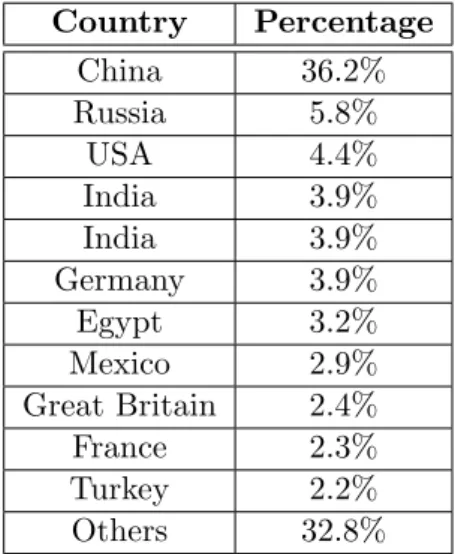
Table 1.1 shows the estimated number of Bots and their corresponding SPAM capacity, while Table 1.2 shows the percentage of infection attempts per country.
Name Estimated no. of Bots Spam capacity Conficker 10.000.000+ 10billion/day Kraken 495.000 9 billion/day Srizbi 450.000 60 billion/day Bobax 185.000 9 billion/day Rustock 150.000 30 billion/day Cutwail 125.000 16 billion/day
Table 1.1: Estimated number of Bots
Table 1.2 shows countries with the higher percentages of infection attempts via web:
Country Percentage China 36.2% Russia 5.8% USA 4.4% India 3.9% India 3.9% Germany 3.9% Egypt 3.2% Mexico 2.9% Great Britain 2.4% France 2.3% Turkey 2.2% Others 32.8%
Table 1.2: Percentage of infection attempts per country
1.1.1 What is a botnet?
Bot is the short term for robot. Normally the term botnet is used to refer to any group of bots; nowadays it is being used mostly to refer to a group of infected machines that are controlled by a bot master. Usually these machines are controlled via IRC or encrypted IRC channels, and they have capabilities to spread and infect their neighbors in the network.
If the BotMaster has programmed his bot clumsily, the victim might sense his computer is slower and the connection to the network or the internet has slowed down, due to scans in the network looking for new victims, spreading malicious code or simply executing some kind of attack. On other cases, the botnet can be more competent and put the machine working only when noticing some idle period on it, so it can stay invisible for a normal user whose computer has been “hijacked”.
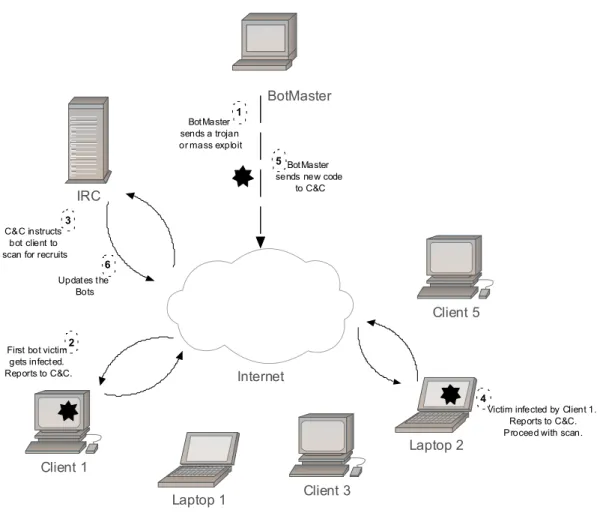
Figure 1.1 illustrates a Classic Botnet Architecture, with Command And Control (C&C) and updates based on Microsoft Internet Relay Chat (mIRC) connections.
Client 1 Internet IRC Client 5 Client 3 Laptop 1 Laptop 2 BotMaster C&C instructs bot client to scan for recruits
1
BotMaster sends a trojan or mass exploit
5 BotMaster
sends new code to C&C 6 Updates the Bots 3 2
First bot victim gets infected. Reports to C&C.
4
Victim infected by Client 1. Reports to C&C. Proceed with scan.
Figure 1.1: Classic Botnet Architecture
There are other similar structures with the only difference of using an HTTP server in-stead of the mIRC server the Botnet functions with a HTTP server. These botnets are harder to detect because HTTP connections are more common in a network; so, it is harder to dis-tinguish botnet communications from regular traffic.
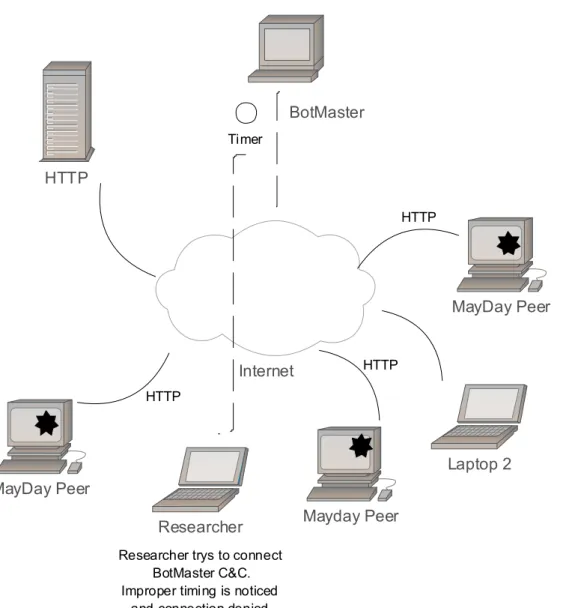
Storm P2P is even harder to detect, due to its complex structure and working operation: non centralized command and control, so any infected Storm machine can act as the C&C at the botmaster’s will, as we can see in Figure 1.2.
MayDay Peer Internet MayDay Peer Mayday Peer Researcher Laptop 2 BotMaster HTTP Timer HTTP HTTP HTTP
Researcher trys to connect BotMaster C&C. Improper timing is noticed
and connection denied.
Figure 1.2: Storm P2P Architecture
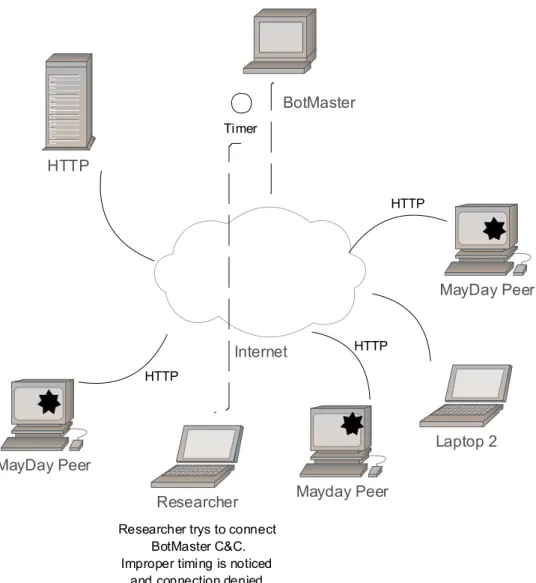
An “evolution” of the above architectures appeared at the beginning of 2008, known as MayDay, having new ways to get rid of researchers and “bot hunters”:
• Communicates between bot clients and the command center using standard HTTP and (even trickier) using proxies.
• Can use P2P communication, if HTTP fails. Can also use Internet Control Message Protocol (ICMP) (encrypted) messages, ports and protocols that administrators dare not to block.
discover and disable bots and botnet: it throttles how much traffic passes between the control center and the clients, enforces short window communications between them, and maintains a small number (compared to mostly known botnets) of bots.
MayDay Peer Internet MayDay Peer Mayday Peer Researcher Laptop 2 BotMaster HTTP Timer HTTP HTTP HTTP
Researcher trys to connect BotMaster C&C. Improper timing is noticed
and connection denied.
Figure 1.3: MayDay Architecture
1.1.2 Why is it a threat?
It is called the ultimate threat. An army of compromised machines, also known as “zom-bies”, that are commanded by a single botmaster.[3]
The bots can be optimized and can change behavior over time, because the botmaster can command the functions of all compromised machines at once or individually, and upload
a new code for spam the network, instructions to steal banking information, record login credentials and always report to some kind of server that is owned by botmaster.
Due to their size and growing speed, botnets pose serious security threats. Even a small botnet. Let’s see, using a simple example, that only 1000 bots can cause a great deal of dam-age. These 1000 bots have (average of 128Kbit/s) a combined bandwidth of 100Mbit/s, which is, nowadays, a usual Company Internet speed connection; in addiction, the Internet Proto-col (IP) distribution is too wide and dificult to filter or control. A botnet could accomplish several threats:
• Distributed Denial-of-Service Attacks: an attack on a computer system or network that causes a loss of service to users, consuming bandwidth or overloading the computational resources of the victim system. It is widely used to take down competitor’s websites, but also other services.
• Spamming: phishing or simple spam, it is usually sent by botnets and can be used for nefarious tasks, such as collect email-addresses.
• SYN Flood: the origin of this attack is difficult to identify and it could be launched to specific hosts or against routers or other network systems that will turn on other TCP services. The attacker could force (servers) to open “half-connections”, because each SYN begins the acknowledgment process to create new connections, and each one is stored on a finite size structure; obviously this structure will overflow by intentionally creating partially-open connections. The “real” client, and also the victim, will never receive the final ACK message.
• Sniffing Traffic: clear-text data passing by a compromised machine, is mostly used to retrieve usernames, passwords, and even more interesting, it is commonly used to steal the key information of other botnets in order to control them.
• Keylogging: keyloggers are the easiest way to get sensitive information, and they can be multiplied by thousands of infected machines.
• Spreading new malware: this integrated feature of most botnets is used to send and spread the infected file or the malicious code to other victims, via email, File Transfer Protocol (FTP), HTTP, Microsoft Network Messenger (MSN)...
• Google AdSense abuse: the attacker has a lot of valid IP addresses and the “company” earns money each time the add is clicked;
• Attacking IRC Chat Networks: the idea of this attack is to flood the IRC network of the victim, triggering a similar Distributed Denial-of-Service (DDoS) attack.
• Manipulating online polls: because the main way to control online polls is based on the IP address, botnets have a particular easy task on manipulating them because all “zombies” have a different IP.
• Mass identity theft: fake websites pretending to be online banking, PayPal, Ebay, etc, ask the vitims to enter their personal and private information just to gather all important and confidential info .
• Sensitive information theft: suppose that a company is developing some new product and does not want anyone to know its projects; a botnet can steal and publish every-thing, or even worst, send the ideas and projects to the wrong hands.
• Change Domain Name System (DNS): this is an easy way to get the victim right were the attacker wants to. Usually few people takes care of the “home” router: proper password, secure connections, etc. The Botnet just has to look for “default” passwords and try to connect to the router, then changes the DNS address to “its” DNS server and just redirect every HTTP request to its fake pages instead of the real ones.
• Certainly an Bot or a Infected Client will spread itself in many forms, depending on the botnet type or technology.
• It will download and execute files, put processes running on the victim’s machine, as well as update and trigger new orders from the C&C.
Worm, Virus, Trojan, Bot: Differences
Botnets blend many malware technologies, describing them can be tricky exercise. Let us take a look at the most important security threats:
• Worm: an executable program that can spread itself. A Worm can spread a payload that constitutes the bot code;
• Trojan: usually a trojan works alone, and just reports to the creator; unlike bots, it cannot respond to the command center and is not flexible;
• Virus: unlike, malware, adware, spyware, etc, a true virus only has the capability of spreading from a computer to another and somehow execute his code, usually via Universal Serial BUS (USB) drive, cd, dvd or network file system;
• Botnet:
– Can run on a victim’s computer
– Can receive and respond to commands from the control center – Is part of a system automated to control many agents simultaneously – Deploys without the victim knowledge or permission [2]
1.1.3 Botnet life cycle
The most important phases of the botnet life cycle are [5]:
• SpreadPhase: In this phase, the bots propagate and infect systems, trough SPAM, e-mails, web worms or malware downloads.
The goal of the spread phase is to infect a system for the first time, bot-heritors attempt to either exploit vulnerabilities on the user system, using applications or browsers, or cheating the user by installing the malware payload.
• Infection Phase: Once in the system, the malware infects and obfuscates its presence (polymorphism), that is, the code changes any time there’s a new infection, making it harder to discover the true nature of the malware and analyzing it using anti-virus. The malicious software (known as rootkit) activates each time the system boots up. It usually uses techniques to actively target anti-virus, services, local firewalls and Intru-sion Prevention Systems (IPS) / IntruIntru-sion Detection Systems (IDS); for instance, the botnet frequently changes local DNS settings to unable anti-virus software reach the update site.
It is also common that advanced botnets present a false image of memory or hard disk to the anti-virus to delude vulnerability scanners.
• Command and Control: IRC, encrypted P2P (eDonkey/Overnet), HTTP, Voice Over IP (VOIP). These are some techniques used by botmasters to control their “zom-bies”. VOIP is still on the horizon but it is being “studied”.
Modern botnets also re-program or update nodes, using these communication channels. HTTP and P2P are particularly difficult to detect because these are very common network protocols:
– HTTP - uses forums and newsgroups where infected computers can anonymously check for messages that will be used as C&C (Command&Control).
– IRC - the most common way to communicate, using messages trough channels, private messages or even the title of the channel. Changing channels is usually used to detect when some node is connected just to study the behavior and gather information, for example a “spy” that wants to disarm the bot.
– P2P - peer-to-peer is commonly encrypted, so it is hard to figure out what is going on under the C&C.
• Attack Phase: perform massive distributed denial-of-service (DoS) attacks to corpo-rate systems, government or other botnets.
1.2
Detection of Botnets
1.2.1 Prevent it
Network-based intrusion prevention systems can’t be the only option to defeat botnets. In order to get a secure network and secured systems, it is mandatory to have a multi layered security system:
• Antivirus, antispyware and host-based firewalls: should be included to avoid getting infected in a first phace.
• Network-Based Intrusion Prevention Systems: usually blocks the most popular bots (blocking the botnet control traffic).
• Host-Based intrusion prevention: important layer, limits the various applications run-ning on the system, but it misses the “trusted ones” and grant them freedom to com-municate with the exterior, so there is still a problem if the botnet code hides on them. • Up-to-date patches: centralized patching techniques are recommended.
• Unable web browsers scripting support: blocking JavaScript, ActiveX and other Add-ons.
• Monitor Ports, like:
– IRC ports: 6667, high-numbered ports (31337 and 54321). In general, all ports above 1024 should be blocked for inbound and outbound traffic, unless special applications need these ports open.
– Ports like 80 or 7 are used for updates and communication: zombies commonly “wait” for 1:00 a.m. until 5:00 a.m for updates, because they suppose there is no one watching, so checking the network logs should be a good principal; if there is no one working in the company during the night, a high traffic in this period should be suspicious. [2]
1.2.2 Detect it
As in Psychology, the first step is to acknowledge that we have or could have a problem. The idea that the prevention makes everything should not be taken as enough and unique. So, in parallel with prevention, it is important to register relevant information: log files, network traffic, statistics...
It is also important to make network testing routines, including: routers, firewalls, web servers, e-mail servers and all other systems that are accessible to the public or simply are critical for the organization. When doing these types of tests, security systems should be aware of it in order to avoid or ignore false positives.
Classic Botnet Architecture have a particular weakness, which makes them the easiest class of botnets to catch and disable, because all bots are susceptible to a single point of failure. They always use IRC ports and then generates a high traffic volume on them.
1.2.3 Cancel it
There are no magical formulas and each case is different from the others, anyway, there are, if they don’t cause troubles for a very specific reason to the company, a couple of measures that can be taken in order to avoid problems:
• Close IRC ports: the majority of current botnets use IRC ports for messaging and commands.
• Close P2P ports: used many times for messaging, updates and share code.
• Prevent users from installing P2P software, such as Kazaa, Grokster, Bear Share, etc, since they have vulnerabilities and downloads can bring virus, worms...
• Search for windows registry entries with botnet names.
• Run cleaning software, searching for worms, virus... Special attention to these applica-tions, many of them are “false” cleaners and will fill the system with even more problems instead of cleaning them.
• Use a good IDS / IPS system (described later on this thesis).
1.3
Motivation
Today, Botnets, are the main threat for organizations, government, banking and common user. So, it is a priority to prevent, detect and cancel these threats. Recently, and ironically,
in a Security Conference sponsored by International Business Machines (IBM), that took place on the Australian Gold Coast between 16 and 21 of May, many companies were selling security products and, unfortunately, one of them offered infected USB drives.
Each day sees the emergence of more and more tools to create and control these nets, so special awareness should exist for these new threats and new technologies, even if there is no sensitive information on the network. Although Linux and Mac OS are also affected, as we can see later on this work, Microsoft Windows are the most affected systems since they are also the most used at home and companies computers.
The high number of possible services, equipments and PCs on a Local Area Network (LAN) or the Internet allows different types of attacks with different characteristics and different con-sequences. So, it is important to gather information from network servers (Apache, FTP, DNS, Post Office Protocol (POP3), SMTP, Network File System (NFS), SAMBA, etc); system logs can also provide important information for analysis (UNIX: syslog; Windows: windows reg-istry).
All services mentioned above, uses a file based method for logging. These files are dis-tributed on each server, and because of that, it is very difficult to analyze and correlate information. So, it is important to gather and centralize the information, having always in mind that these files provides important and sensitive data that should not be accessed by anyone else but network administrators or system administrators.
After gathering all the information, it is necessary to parse and process it. And, finally, store it on a database, the same approach that will be used in this work. The information on the database should be managed through a web interface: this solution was also chosen in this work because it is centralized, fast, provides great integration with already existent technologies and a good possibility to extend its functionalities.
Websense Security Labs Predictions
Websense Security Labs anticipates the emergence and growth of the following trends: • Web 2.0 attacks will increase in sophistication and prevalence
In the coming year, Websense Security Labs predicts a greater volume of spam and attacks on the social Web and real-time search engines such as Topsy.com, Google and Bing.com. In 2009, researchers have seen and increasing malicious use of social networks and collaboration tools, such as Facebook, Twitter, MySpace and Google
Wave to spread attackers’ wares. Spammers and hackers use of Web 2.0 sites have been successful because of the high level of trust users place on these platforms and on other users.
• Botnet gangs will fight turf wars
It is possible to anticipate more aggressive behavior between different botnet groups that will try to deploy bots with the ability to detect and actively uninstall competitor bots.
• Email gains traction again as a top vector for malicious attacks
Email will be used as a vector for spreading malicious attacks and will evolve in sophis-tication and we will see more emails containing malicious data stealing attachments and malicious URLs.
• Targeted attacks on Microsoft properties, including Windows 7 and Internet Explorer 8
With the expected fast adoption of Windows 7, more malicious attacks targeting the new OS will be seen with specific tricks to bypass User Access Control warnings, and greater exploitation of Internet Explorer 8.
• Don’t Trust Your Search Results
A malicious Search Engine Optimization (SEO) poisoning attack, also known as a Black-hat SEO attack, occurs when hackers compromise search engine results to make their links appear higher than legitimate results. As a user searches for related terms, the infected links appear near the top of the search results, generating a greater number of clicks to malicious Web sites.
• Smartphones are the hackers’ next playground
Smartphones such as the iPhone and Android, which are increasingly used for business purposes, are essentially miniature personal computers and in 2010 they will face the same types of attacks that target traditional computing. Additionally, poor security for applications on smartphones can put users and organizations data at risk.
• Why corrupt a banner ad serve, when you can buy malvertising space?
In a high-profile incident in 2009, visitors to the New York Times Web site saw a pop-up box warning them of a virus that directed them to an offer for antivirus software, which was actually rogue Anti-Virus (AV). This attack was served up through an advertisement purchased by someone posing as a national advertiser.
Hackers have noticed Apple’s rapid growth in the market share in both the consumer and corporate segments. There exists additional risk for Mac users because many assume Macs are immune to security threats. There is also the potential for the first drive-by malware created to target Apple’s Safari browser.
The dynamic nature of Web 2.0 attacks, the use of email to drive users to malicious Web sites, and tactics like SEO poisoning and rogue AV, all demonstrate the need for organizations to have a unified content security platform that protects against blended Web, email and data security threats.”[6]
1.4
Objectives and Contributions of this work
The tasks that were carried out in this Dissertation are included in one of the main goals of our research group: to develop a botnet detection system that will be based on gathering network information, correlating it, processing the most important variables and lauching system alerts and counter measures.
Our particular work aims to gather all the available information on the network that can be useful for the identification problem, keeping also track of where the information comes from. A web interface was created to administrate and configure the information gathering process, enabling also to configure equipments, administrators, snort rules, visualize logs files that were acquired from network servers or equipments.
Another important feature is the possibility to create and configure variables that will facilitate classifying information and detecting network anomalies. It will monitor the server logs of e-mail, web, FTP and other servers. The designed system should be flexible enough allow the introduction of new functionalities and the creation (later on the project) of counter measures, system alerts, etc.
One of the objectives of this work is to turn more flexible and adapt the shell scripts that were already created to gather network information [7]. All information is stored in a My Structured Query Language (MySQL) database, as well as the shell script codes, so it is possible to execute and edit them more easily.
1.5
Organization of this thesis
This thesis is devided into four main chapters. Each one briefly describes the work that was done in the different phases of the research, implementation and evaluation of the
archi-tecture.
This chapter contextualizes the thesis objectives, contributions and main purpose. It also briefly explains security aspects and why security at this level is so hard to implement. Finnally, it discusses some of the existing security problems and threats, focusing on Botnets.
The second chapter describes the current state-of-the-art developments in this field. An overview of already developed tools or solutions: freeware, opensource or proprietary soft-ware/hardware.
The third chapter presents the architecture of the proposed system, describing its main features and requirements, as well as a brief “Installation and Use” guide of the implemented system.
The last chapter describes possible work that can be done after this thesis, resulting from an evaluation of the deficiencies and possible improvements that could be made to the imple-mentation, as well as new features that can and should be added.
Chapter 2
Related Work
2.1
Introduction
Gathering information from the network and its equipments became one of the most important procedures for institutions and companies. Some of the most important reasons for that are:
• The size of current company networks and the traffic increase.
• The co-existence of several heterogeneous equipments in the same network and the need for interaction between them.
• Economical concerns, advocating that human intervention should be the last “layer” to solve the problem.
A good monitoring of the network is needed in order to grant security. Sometimes, com-panies thinks they are not big enough to have a network administrator or even a good and well defined security policy. This situation should change, because the attacks are no longer an exclusive of big companies with a high number of enemies or competitors attacks are not even made by a single “hacker” alone in front of a computer - they are usually carried out by an army of already infected computers (called zombies) and the main objective is to gather as much machines as possible so, the hacker, or in some cases organized groups of hackers, can define a single target and the attack objectives.
Security should not be an isolated process, layer or act of goodwill, it is fundamental to think about security as a continuos process, improving existing technologies, upgrading equipments, updating systems, software and implementing or improving policies. This should minimize the risk of attacks, infections, viruses, etc..., which are the main causes security failures.
So, it is crucial to have mechanisms that can monitor and gather information from all the network, then filter and process it in order to show the network administrator what is really relevant.
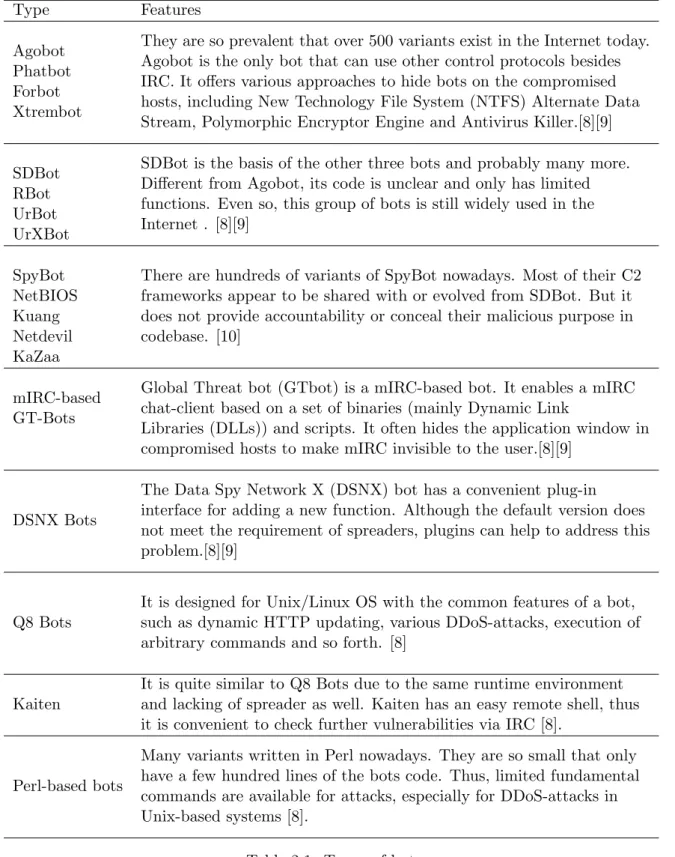
Table 2.1 shows some of the existing botnets and describes some of their features and capabilities .
Type Features
They are so prevalent that over 500 variants exist in the Internet today. Agobot is the only bot that can use other control protocols besides IRC. It offers various approaches to hide bots on the compromised hosts, including New Technology File System (NTFS) Alternate Data Stream, Polymorphic Encryptor Engine and Antivirus Killer.[8][9] Agobot
Phatbot Forbot Xtrembot
SDBot is the basis of the other three bots and probably many more. Different from Agobot, its code is unclear and only has limited functions. Even so, this group of bots is still widely used in the Internet . [8][9]
SDBot RBot UrBot UrXBot
There are hundreds of variants of SpyBot nowadays. Most of their C2 frameworks appear to be shared with or evolved from SDBot. But it does not provide accountability or conceal their malicious purpose in codebase. [10] SpyBot NetBIOS Kuang Netdevil KaZaa
Global Threat bot (GTbot) is a mIRC-based bot. It enables a mIRC chat-client based on a set of binaries (mainly Dynamic Link
Libraries (DLLs)) and scripts. It often hides the application window in compromised hosts to make mIRC invisible to the user.[8][9]
mIRC-based GT-Bots
The Data Spy Network X (DSNX) bot has a convenient plug-in interface for adding a new function. Although the default version does not meet the requirement of spreaders, plugins can help to address this problem.[8][9]
DSNX Bots
It is designed for Unix/Linux OS with the common features of a bot, such as dynamic HTTP updating, various DDoS-attacks, execution of arbitrary commands and so forth. [8]
Q8 Bots
It is quite similar to Q8 Bots due to the same runtime environment and lacking of spreader as well. Kaiten has an easy remote shell, thus it is convenient to check further vulnerabilities via IRC [8].
Kaiten
Many variants written in Perl nowadays. They are so small that only have a few hundred lines of the bots code. Thus, limited fundamental commands are available for attacks, especially for DDoS-attacks in Unix-based systems [8].
Perl-based bots
2.2
Organization
This chapter presents some of the already existing solutions, specially the ones that are more useful for the final solution, that will be proposed in this dissertation. There are many products on the market, some specifically designed to secure only one equipment and others projected for monitoring all the network. Next sections present some of the most important (at the moment) solutions in the market.
Cisco Secure IDS is a network-based intrusion detection system, that uses: • Signature database to trigger intrusion alarms;
• Sensor platform to provide real-time monitoring of network packets;
• Director platform, that allows the management, configuration, log and display of alarms generated by sensors.
As an essential part of the Cisco Secure Borderless Network, Cisco IPS is one of the most widely deployed intrusion prevention systems, providing protection against more than 30,000 known threats: • Directed attacks • Worms • Botnets • Malware • Application abuse
Cisco IPS also helps your organization comply with government regulations and consumer privacy laws. It provides intrusion prevention that:
• Stops outbreaks at the network level, before they reach the desktop; • Prevents losses from disruptions, theft, or defacement;
• Collaborates with other network components, for end-to-end, networkwide intrusion prevention;
• Supports a wide range of deployment options, with near-real-time updates for the most recent threats;
• Decreases legal liability, protects brand reputation, and safeguards intellectual property [11].
There are some products available: the network appliances 4200 Series Sensors, Intrusion Detection System Module (IDSM) for Catalyst 6000 family of switches or the IDS monitoring device - Cisco Internetwork Operating System (IOS) Firewall IDS, which turns the router into an IDS monitoring device.
2.3
GFI Network Monitoring
GFI Network Server MonitorTMis a software solution that scan the network for failures or
irregularities. It automatically scans the network so the network administrator can identify issues and fix unexpected problems before users even know they’ve happened.
GFI Network Server Monitor maximizes network availability by monitoring all aspects of Windows and Linux servers, besided workstations and other devices, such as routers. When a failure is detected, the GFI network monitor will alert by email, pager or SMS, as well as automatically taking the preconfigured corrective action by, for example, rebooting the machine, restarting the service or running a script.
GFI Network Server Monitor actually tests the status of a service, rather than deduc-ing a service status from generated events as other products do. It is the only real way to ensure server uptime. It has built in monitoring rules that include: Exchange Server 2000/2003, Microsoft Structured Query Language (MS SQL), Oracle and Open Data Base Connectivity (ODBC) databases, CPU usage, FTP & HTTP Servers Group Membership, Active Directory & NT Directory Service (NTDS), Disk Drive health, Disk Space, Event Log (with content checking), File Existence (with content checking), TCP, ICMP/Ping, SMTP & POP3 Mail servers, Printers, Processes, Services, UNIX Shell Scripts (RSH), Simple Network Management Protocol (SNMP) & Terminal Server. Custom monitor functions can be created in Visual Basic Script (VBscript), Active Directory Service Interfaces (ADSI) and Windows Management Instrumentation (WMI). GFI Network Server Monitor can virtually monitor almost anything:
• Monitor the network and servers for software and hardware failures;
• Out-of-the-box monitoring of Exchange, Internet Security and Acceleration (ISA), Struc-tured Query Language (SQL), Web servers and more;
• Monitor disk space, services, processes and other parameters on servers and worksta-tions;
• It is an easy to learn, easy to use and easy to deploy solution - no client component or agent.
[12]
2.4
NESSUS
Nessus is a unified security monitoring created by Tenable Network Security, known pri-marily as Nessus vulnerability scanner product; it can be distributed on an entire company, inside one network or across physically separated networks. It provides hardware and virtual-appliances for easier deployment. It is managed through a Security Center that provides continuous monitoring and increases the communication effectiveness between security, audit and management teams.
Alerts can be in the form of syslog messages, notifications, emails or even launching scans. Parameters are set for number of IP addresses, open ports, critical vulnerabilities, missing patches, etc. The system launches alerts any time the parameter value thresholds are reached.
Recently Nessus included the ability to perform security and policy compliance config-uration audits of Cisco IOS routers and switches. This feature provides router and switch administrators the ability to test security and policy compliance settings, requiring encrypted passwords, banning the use of common SNMP community strings, forcing the use of SSH to access the console and avoiding unauthorized users. [13]
2.5
Honeypot-based Tracking
Honeypots are a technique used to discover attacks or flaws in the network. Microsoft Windows 2000 or XP non-patched operating systems are widely used for this purpose because of their well known vulnerabilities, on Internet Explorer for instance. The main principles of a Honeypot are: it should not contain any sensitive information but pretend to have it, in order to attract the attention of attackers and all botnets, so they should first try to com-promise this system. After this step, it is important to monitor these machines, trying to understand what the botnet or the attacker tried to do with them and learn how it behave. This procedure can make it possible to predict a real attack to important machines, servers and other network equipments. Nephentes is an example of a Honeypot platform.
These machines should be mounted in an “unsecured” area of the network, attracting hackers, attackers and bots. They should provide “virtual” servers for almost every service expected on the network, so the attacker doesn’t realize he is going to enter into some kind of trap.
2.5.1 Nephentes
The study described in [14] proposes to apply visualization to better understand network attacks. It doesn’t apply only blacklisting of schemes and specific patterns, that could be easily subverted by more sophisticated approaches, such as P2P communications schemes. It motivates to combine computer technology, automated processes and human intelligence to get a better result, particularly comparing TreeMap and standard graph representations, thus showing the advantages of TreeMap and NFlowVis system.
Nepenthes is a honeypot platform designed for the collection and analysis of malware, such as botnet software. Together with SNORT - open source network intrusion prevention system (SNORT) and combined with NfSen or Stager web interfaces, they have been proposed as an integrated solution.
NetFlows can be also used as a fast database engine in the background, which aggregates tables with appropriate indices for fast data access.
2.6
BotHunter
Unlike Cisco, GFI or other similar systems, BotHunter is not a firewall, spam blocker or antivirus. This is an software based on a algorithm (network dialog correlation) developed under the Cyber-TA research program. It uses a heavily modified Snort version as a dialog event generation engine; when enough evidence is acquired, an infected host is declared. It produces an infection profile to summarize all evidence.
In short, BotHunter helps to rapidly identify infected machines keeping the threads and discovered infections updated in a service where every emerging exploits and malware create new dialog analysis rules. BotHunter is adaptive and share information between every ma-chine that is using the system, keeping the “knowledge base” of BotHunter bigger and better.
BotHunter activity is not a single and simple search for a pattern, because there are many bots and they can change rapidly. So BotHunter searches, not only for incoming outside threats, but also for threats born and emerging inside the network.
False positives can also be identified and avoided: when a machine produces lots of false positives, it is “tagged”, letting the system more aware the next time it has enough informa-tion to generate an alert.
Let’s take a deeper look on the Bot Hunter system and some of its functioning details.
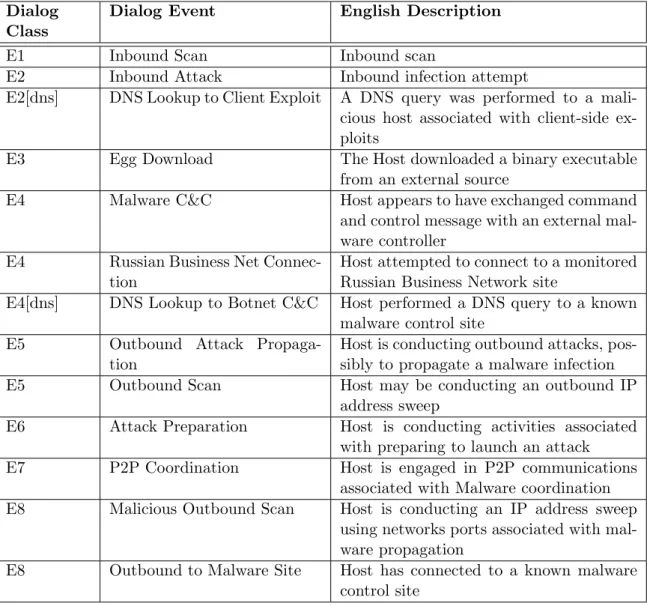
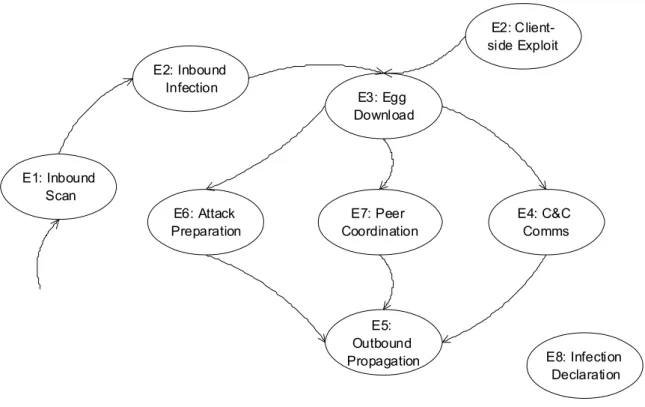
BotHunter current infection dialog set provides the detection coverage, classes and events that are illustrated in Table 2.6 and Figure 2.1
Dialog Class
Dialog Event English Description
E1 Inbound Scan Inbound scan
E2 Inbound Attack Inbound infection attempt
E2[dns] DNS Lookup to Client Exploit A DNS query was performed to a
mali-cious host associated with client-side ex-ploits
E3 Egg Download The Host downloaded a binary executable
from an external source
E4 Malware C&C Host appears to have exchanged command
and control message with an external mal-ware controller
E4 Russian Business Net
Connec-tion
Host attempted to connect to a monitored Russian Business Network site
E4[dns] DNS Lookup to Botnet C&C Host performed a DNS query to a known
malware control site
E5 Outbound Attack
Propaga-tion
Host is conducting outbound attacks, pos-sibly to propagate a malware infection
E5 Outbound Scan Host may be conducting an outbound IP
address sweep
E6 Attack Preparation Host is conducting activities associated
with preparing to launch an attack
E7 P2P Coordination Host is engaged in P2P communications
associated with Malware coordination
E8 Malicious Outbound Scan Host is conducting an IP address sweep
using networks ports associated with mal-ware propagation
E8 Outbound to Malware Site Host has connected to a known malware
control site Table 2.2: BotHunter Class definition
E2: Inbound Infection
E5: Outbound
Propagation E8: Infection
Declaration E4: C&C Comms E2: Client-side Exploit E7: Peer Coordination E6: Attack Preparation E3: Egg Download E1: Inbound Scan
Figure 2.1: BotHunter Infection Cycle Model
The above Figure and Table do not intend to provide a strict order of events or the complete class definition used by BotHunter. This system provides and assumes that bot dialog sequence analysis is robust to the absence of some dialog events. It must comprehend multiple contributing candidates for each of the various dialog phases and could not require strict sequencing in the presented order. BotHunter captures the minimum necessary and sufficient sparse sequences of events under which an infection declaration can be triggered. Each infection declaration is ranked in a range from 0.8 to 3.8, where the greater the dialog evidence trail is, the higher is the score.[15]
BotHunter can be installed in Linux/Unix, Windows or Mac OS .
2.7
Snort
Snort is a network intrusion detection system created by Martin Roesch in 1998, being a free open source detection and prevention system that provides real time monitor to TCP/ IP networks. Snort can detect a wide variety of attacks: buffer overflows, stealth port scans, Common Gateway Interface (CGI) attacks, OS fingerprints attempts, etc. It uses a flexible
rules language to describe traffic that should pass, be blocked or generate an alert. It can be used in three scenarios: packet sniffer like tcpdump or tshark, packet logger or network intrusion prevention system.
The threat prevention components of Snort are [16]:
• Select traffic to be inspected, ensuring that only traffic that could be vulnerable is inspected. By looking only to relevant traffic, Snort performance is improved and the potential for false positives is limited.
• Normalize traffic to ensure that it is in a consistent format and proper order for inspec-tion.
• Match traffic against one of the industry’s largest rulesets using a number of different detection methods. By using multiple detection methods and a large ruleset, Snort ensures that a wide variety of threats is detected and false negatives are avoided. Snort was downloaded 4 million times, being the most widely deployed intrusion preven-tion technology in the world. The fact of being open source contributed to its success because many communities and interested users can add functionalities to the software and this is how it is possible to create better software when compared to traditional proprietary methods.
How Snort works
Packet Classifier: Snort begins by processing the traffic, classifying it at high level. • Token Ring, Ethernet ...
• Virtual Local Area Network (VLAN). • IP.
• TCP, UDP, ICMP.
IP Defragmenter: Snort splits the IP datagrams into two or more smaller IP datagrams. Typically IP datagrams are fragmented when the Maximum Transmission Unit (MTU) is exceeded. In order to detect attacks, Snort reassemble IP datagrams in the same way the destination system of the attack would do. So, it can model the actual targets instead of merely modeling the protocols and looking for attacks within them.
TCP reassembler: because TCP transport layer could face similar issues (TCP segments may arrive out of order or be duplicated), the module stream5 on Snort reassembles TCP
sessions in the same way that the destination operating system would process them.
PortScan Processor: the primary objective in detecting portscans is to detect and track negative response. Snort’s portscan detector must also identify scan attempts that never return a response, because some systems suppress it.
Detection Engine:
• Protocol analyzer ensures that correct areas are selected for inspection and information is presented consistently (Protocol Normalization, Data Normalization, Flow Analysis). • RuleSet Selector and Multi-Rule Search Engine: snort reads and parses all the activated rules (classifying them into rulesets, prior to any packet or stream processing). Each incoming packet is matched to a corresponding ruleset based on the packet’s unique parameters (it searches for protocol field, generic content and packet anomaly).
• Rule Inspector: if a Snort rule is validated, an event is generated and added to the event queue.
• Event Selector: the event queue allows Snort to track every occurrence of every rule match event within a packet. The event selector then prioritizes and selects the event information to send to the Snort output system.
• Ouput System: it process events and check if they match suppression and thresholding rules. The events are logged or passed to other systems for remediation and response purposes.
Snort can be installed in Linux/Unix, Windows(with WinPcap) or Mac OS platforms.
2.7.1 ACID
The: Analysis Console for Intrusion Databases (ACID) web interface, is a Hypertext Pre-processor (PHP) based analysis engine that will also be included in this work to build the final solution for botnet detection.
Bellow some features of ACID are described:
• Query-builder and search interface for finding alerts matching on alert meta informa-tion (e.g. signature, detecinforma-tion time) as well as the underlying network evidence (e.g. source/destination address, ports, payload, or flags).
• Packet viewer (decoder) will graphically display the layer-3 and layer-4 packet informa-tion of logged alerts.
• Alert management by providing constructs that logically group alerts to create incidents (alert groups), deleting the handled alerts or false positives, exporting to email for collaboration or archiving alerts to transfer them between alert databases.
• Chart and statistics generation based on time, sensor, signature, protocol, IP address, TCP/UDP ports, or classification. [17]
ACID can be installed in any system with SNORT, MySQL and PHP.
2.7.2 Websense
Websense created a system called Triton - a unified security architecture - that merges its data-loss prevention and email security products, keeping much of the security-as-a-service approach it already supports, but with a common management and reporting console.
“It’s a unified platform of the systems we have for content security, with a single manage-ment and single policy to open up visibility,” says Dave Meizlik, director of product marketing at Websense. “It will assess risk more clearly.”
As its first product under the Triton umbrella, it is a hardware appliance which makes use of Citrix virtualisation technology to support Data Loss Prevention (DLP) and Web-filtering features. The company will add more email filtering capabilities later this year, under the Websense common management console.
The idea is to roll out content security functions as components for email, Web and DLP under Triton that can be used to centrally administer a common policy.
Websense also expects to continue marketing its stand-alone products, the Websense Web Security Gateway, the Websense Data Security Suite and Websense Email Security. But by opting for the Triton architecture, it will be possible to easily improve security on a shared hardware platform that might include additional software and security-as-a-service functions that are part of it.[18]
Chapter 3
Information Gathering and
Administration
3.1
Architecture
3.1.1 Architecture Design
As already said in this thesis, it is difficult or almost impossible to detect botnets using only a stand alone solution. It is important to “divide to conquer”, gathering all sensitive and important information and correlating it in order to extract the most specific and accurate conclusions that is possible to extract.
The proposed architecture and implementation have implicit software engineering, database modulation and research in order to be able to integrate PHP with shell commands, crontab, charts, Secure Shell (SSH) fetching scripts, regular expressions, statistics and MySQL simple queries. All these features will be described with more detail later in this chapter.
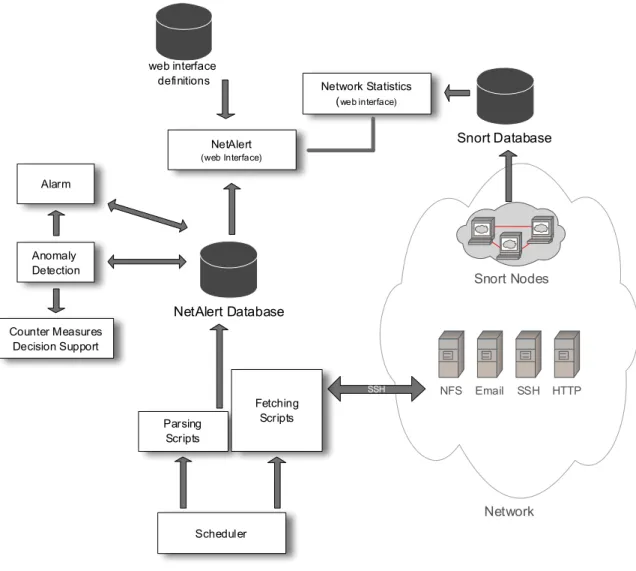
Diagram 3.1 represents the system and all its components: • Fetching and Parsing scripts;
• Servers: Email, SSH, HTTP, etc; • Snort Nodes;
• Databases;
• Anomaly detection and Alarms; • SSH communications.
Alarm Anomaly Detection Counter Measures Decision Support Network NetAlert Database Parsing Scripts HTTP Email SSH NFS Snort Database Snort Nodes Scheduler NetAlert (web Interface) SSH Fetching Scripts Network Statistics (web interface) web interface definitions
Figure 3.1: Main System Diagram
The information system is based on the Physical Diagram A.1, representing the main database, which handles most of the relevant information for this work. There are two more databases: Physical Diagram A.2, with information of Snort sensors, and Physical Diagram A.3 that gives support to the web Administration.
The Databases are separated for security and performance reasons. In the future, Snort sensors A.2 and web Administration database A.3 could need to be placed in different ma-chines, with a dedicated database server for each one, due to the amount of information that can be generated by the processing and parsing log files. Besides, if the system has many Snort sensors, these will generate high levels of traffic and MySQL operations. Although there are many advantages on separating the machines and services needed for the system,
it is important to have in mind that the hardware architecture should be carefully chosen, monitoring a high number of services and equipments, which will generate a lot of traffic on the network. So, the servers should be “near” and should not interfere with the normal functioning of the network itself.
Why PHP?
Hypertext Preprocessor (PHP), initially named Personal Home Page Tools, was not the only possible choice: Active Server Pages (ASP), Cold Fusion, Process and Experiment Au-tomation Realtime Language (Pearl) or even Python can also be a solution. So why PHP?
• Simple: it is a simple language, designed for creating web applications and has many built-in functions to handle common needs or most advanced ones, such as running shell scripts, handle dates, string comparison or replacing, regular expressions, etc. Anyway, programming in PHP could be quite confusing if some cautions are not taken from the beginning, organizing functions and the code itself.
• Easy to install: this is an easy to install package, in most OSs. Available for Ubuntu through “apt-get” repositories.
• Open Source: improvements are constantly made, since this is a widely used language that is tested by hundreds of developers everyday and bugs are corrected quite fast. Between the starting and ending dates of this thesis, at least 3 new versions were released and many bugs were fixed.
• Flexibility and Stability: because it runs on many platforms (AS/400, Mac OS X, Linux, Novell NetWare, RISC OS, Solaris) and exists since 1994 (actually in v5.3.2). PHP also supports many databases, like Oracle, MySQL, MSSQL, Access, Sqlite.
• Documentation: PHP should be the most widely documented web application program-ming language, so there are many articles, forums and code examples on the web. Why MySQL?
MySQL is the world’s most popular open source database, it is fast and consistent, it is used by individual web developers, but also by the world’s largests companies that want to save time and money. Yahoo!, Google, Nokia... are some of the examples that use MySQL in some applications databases. Other important reason is flexibility, since MySQL runs on: Linux, Windows, Mac OS , Solaris, HP-UX and IBM AIX. These advantages are combined with lots of documentation available on the official website and: forums, personal pages, articles, etc. Finally, integration with PHP is very easy, being also available through the “apt-get” repositories of Ubuntu.
Why Linux?
For a project on botnet detection, Linux is obviously the best choice, since it is affected by only a small part of the immense number of threats that typically affect Windows systems.
Linux is an open source OS, very well documentated and it is easy to use, install and get the information or help that is needed for proper configuration. The specific version/distribution of Linux used in this project is Ubuntu 8.04 Long Term Support (LTS). It is free and supports all the necessary technologies: shell script, Apache, PHP, MySQL, CronJob...
Main System
The System is projected in order to be extensible and able to follow the developments that will be implemented in the future, integrating more services, equipments, new types of servers, new types of alerts, etc. The purpose of the current implementation is not to study or incorporate algorithms to detect botnets but to gather all the necessary information and make it available to a much more complex system and group of algorithms that will be developed in the future.
Although one of the objectives of this work was to evolve previous work that was already developed for the same purpose, the existing platform revealed itself very inflexible, complex to use and extense. So, the solution presented here is a complete new approach and intends to be more flexible, secure, easy to use and configure and more effective. Special attention was also given to the documentation of each file and function.
It is assumed that the machine where the System will be installed is secure and well con-figured referring to file permissions, users permissions and groups. So, no special care will be given to make the scheduler and fetching scripts more secure. Although the passwords used for SSH connections had to be saved on the database in cleat text, the passwords for web Administration are encrypted, so it is not possible to reverse and discover them A.1.
3.1.2 Administration
Administration is made through a web interface: the decision to use a web interface instead of a conventional software was taken because a web interface allows several advantages:
• Network administrator can access from any location with a web browser; • Can lock addresses or address classes from accessing the interface;
• It is easy to extend the system capabilities, quality, security, etc, without the need of special configurations, updates or interventions on the client side or even on the monitored servers;
• Network administrator can enclose the server in a secure location and only the sensors will be reporting from other locations on the network.
The first window/page of the system is always the login. The next figure illustrates the login page:
Figure 3.2: Login Window
After the login, the main page of the system will appear, showing the most used options, the update dates, some information about the user and the menu of the whole system.
Figure 3.3: Main Page - Home
A more detailed explanation of the system tables created on the database is presented below, where some of them include images that illustrate the menu or correspondent form:
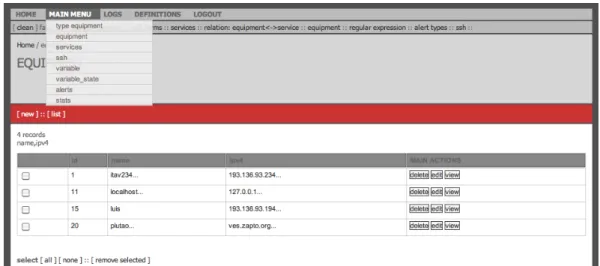
• Equipment: it makes it possible to insert, edit or delete equipments. Each entry on this table holds the IP information, hostname, OS type, Mac Address, the last time the
equipment has been updated, etc. The rel equi service table will relate each equipment to the services it provides.
• Type Equipment: it stores the SNMP version and/or OS general information. So, it can then be associated to the Equipment entries.
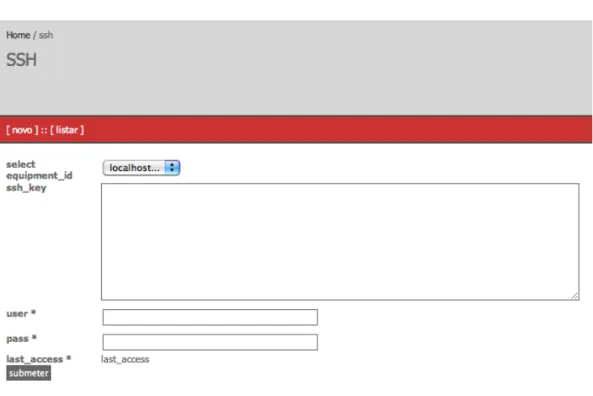
• SSH: in this table it is possible to insert a login (username, password and identity keys), to access equipments via SSH and the date of the last access. An equipment id is associated to each entry, identifying the equipment ssh access (login/password or identity key).
Figure 3.4: SSH new entry form
• Services: this table holds the services available on the system, being possible to add, delete or edit existing services. As referred above in the Equipment case, the rel equi service table will relate the services with the equipments, where they are available.
Figure 3.5: Services new entry form
• Relation Equipment Service: this is a relation table that stores the Services for each equipment, being possible to add, edit and delete entries. It is a very important table, because each entry will have an interval time defined and will be used to create a cronjob. It also holds information about the last updates for the equipment id - service id pair.
Figure 3.6: Relation between equipment and service - edit
• Variables: this is a fundamental table of the system, containing the system variables, that is, the events. On the Web Administration, it is possible to add, edit, or remove entries.
• Variables State: this table is obviously related to the previous ones, storing the state of the variables. When filling this table, it is very important to add as much information as possible, like equipment id or service id, so it will become easier to identify problems and their origin.