EUROPEAN ORGANIZATION FOR NUCLEAR RESEARCH (CERN)
CERN-EP-2017-068 2017/10/16
CMS-HIG-16-027
Search for charged Higgs bosons produced via vector
boson fusion and decaying into a pair of W and Z bosons
using proton-proton collisions at
√
s
=
13 TeV
The CMS Collaboration
∗Abstract
A search for charged Higgs bosons produced via vector boson fusion and decaying into W and Z bosons using proton-proton collisions at√s =13 TeV is presented. The data sample corresponds to an integrated luminosity of 15.2 fb−1 collected with the CMS detector in 2015 and 2016. The event selection requires three leptons (electrons or muons), two jets with large pseudorapidity separation and high dijet mass, and missing transverse momentum. The observation agrees with the standard model pre-diction. Limits on the vector boson fusion production cross section times branching fraction for new charged physical states are reported as a function of mass from 200 to 2000 GeV and interpreted in the context of Higgs triplet models.
Published in Physical Review Letters as doi:10.1103/PhysRevLett.119.141802.
c
2017 CERN for the benefit of the CMS Collaboration. CC-BY-3.0 license ∗See Appendix A for the list of collaboration members
1
The discovery [1, 2] of a Higgs boson [3–8] at the CERN LHC marks an important milestone in the exploration of the electroweak (EW) sector of the standard model (SM) [9–11]. Many aspects of EW interactions at the energy scale of 1 TeV, however, remain to be explored. At the LHC, the study of vector boson scattering (VBS) may reveal hints to extensions of the SM. In particular, extended Higgs sectors with additional SU(2) doublets [12–15] or triplets [16–23] introduce couplings of vector bosons to heavy neutral or charged Higgs bosons.
Searches for charged Higgs bosons (H±) at the LHC currently focus on the production and the decay via couplings to fermions [24–32], well motivated by the minimal supersymmetric standard model [33]. In this model, the H±tb coupling is the dominant one irrespective of the mass of the charged Higgs boson (m(H±)) and tan β, the ratio of the vacuum expectation values of the two Higgs doublets. Couplings to vector bosons are, however, largely suppressed in these models.
Higgs sectors extended by SU(2) triplets, however, give rise to charged Higgs bosons with cou-plings to W and Z bosons at the tree level. Higgs triplets appear in left-right symmetric [34–36], little Higgs [37–39], and supersymmetric models [40, 41] and can generate neutrino masses via the seesaw mechanism [17–19, 42, 43]. A particularly prominent model is the Georgi– Machacek (GM) model [44], where two SU(2) triplets (one real and one complex) are added to the SM Higgs sector and preserve custodial symmetry for large vacuum expectation values of the SU(2) triplets. In such models, the charged Higgs bosons are produced via vector boson fusion (VBF) and the couplings depend on m(H±)and the parameter sin θH, or sH, where s2H
denotes the fraction of the W boson mass squared generated by the vacuum expectation value of the triplets. A representative Feynman diagram for the production by and decay into a W and Z boson pair is shown in Fig. 1.
q q0 W± q q Z H± W± Z
Figure 1: Example of a Feynman diagram showing the production of charged Higgs bosons via VBF.
In this Letter, we discuss the search for charged Higgs bosons that are produced via VBF and decay via couplings to W and Z bosons. The analysis is performed on a sample of proton-proton collisions collected at√s=13 TeV center-of-mass energy by the CMS experiment at the LHC. The data sample corresponds to integrated luminosities of 2.3 and 12.9 fb−1recorded dur-ing the years 2015 and 2016, respectively. The search is performed usdur-ing W and Z bosons decay-ing into electrons and muons. The event selection requires two jets with large pseudorapidity separation and a high dijet mass to select a VBF topology. The data are compared to the pre-dictions of the GM model for a charged Higgs boson mass range of 200< m(H±)<1000 GeV. In addition, an exclusion limit on the VBF production cross section times branching fraction (B) for 200 < m(H±) < 2000 GeV is derived. A similar search was performed by the ATLAS Collaboration in proton-proton collisions at √s = 8 TeV in the semi-leptonic (WZ → qq0``) final state [45]. Other experimental constraints on the GM model can be obtained from studies
of b-meson decays [46] and W±W±VBS processes [47, 48].
The signal samples are produced with MADGRAPH5 [email protected] [49]. WZ production in
association with two jets involving exclusively electroweak interactions at the tree level is gen-erated at leading-order (LO) using MADGRAPH5 aMC@NLOand is referred to as an EW WZ background. Two-jet-associated WZ production with both the strong and electroweak interac-tion vertices at the tree level is simulated at next-to-leading order (NLO) usingPOWHEG2.0 [50– 53] and is denoted as a QCD WZ background. The Z+jets, Zγ, tZq, ttV, and VVV backgrounds, where V refers to a W or Z boson, are produced at NLO using MADGRAPH5 aMC@NLO. Simu-lated tZq and ttV events are included in the background referred to as VVV. The gg→ZZ sam-ple is generated at LO withMCFM[54] and normalized to NLO with a K-factor of 1.7 [55]. The
ZZ production via qq annihilation is simulated at NLO withPOWHEG and normalized to the
next-to-next-to-leading order (NNLO) cross-section prediction with a K-factor of 1.1 [56]. The
PYTHIA8 [57] package is used for parton showering, hadronization, and the underlying event simulation with parameters affecting the underlying event simulation set to the CUETP8M1 tune [58, 59]. The NNPDF 3.0 [60] set is used as the default set of parton distribution functions (PDFs). For all processes, the detector response is simulated using a detailed description of the CMS detector, based on the GEANT4 package [61], and event reconstruction is performed with the same algorithms as used for the data. The simulated samples include additional interac-tions per bunch crossing (pileup) matching the observed multiplicity in the data of about 11 and 20 interactions per bunch crossing in 2015 and 2016, respectively.
Details of the CMS detector, its performance, and the definition of the coordinate system can be found in Ref. [62]. The detector features a superconducting solenoid with a diameter of 6 m, providing a magnetic field of 3.8 T, and surrounding a silicon pixel and strip tracking detector, a lead tungstate electromagnetic calorimeter, and a brass scintillator hadronic calorimeter. Gas ionization detectors embedded into the steel-flux return yokes, the muon system, are installed around the solenoid. The subdetectors are composed into a barrel and two end cap sections. The hadron forward calorimeter provides calorimetry to pseudorapidities from|η| >3 to|η| <
5. A particle-flow technique [63, 64] is employed to identify and reconstruct the individual particles emerging from each collision.
Electrons are reconstructed within |η| < 2.5. The reconstruction combines the information
from clusters of energy deposits in the electromagnetic calorimeter and the trajectory in the tracker [65]. The selection criteria depend on transverse momentum pT and|η|, and on a
cate-gorization based on observables sensitive to the amount of bremsstrahlung emitted. Muons are reconstructed within|η| <2.4 [66]. The reconstruction combines the information from both the
tracker and the muon spectrometer. Leptons are required to be isolated from other charged and neutral particles in the event. The lepton relative isolation is defined as the ratio of the pTsum
of charged hadrons and neutral particles within a cone of radius∆R= √
(∆η)2+ (∆φ)2 < 0.4 (where φ is the azimuthal angle in radians) around the lepton and the lepton pT. The relative
isolation, corrected for pileup contributions, is required to be less than 6.5% (15%) for electrons (muons). Overall efficiencies of the reconstruction, identification, and isolation requirements for the prompt leptons are measured in the data in several bins of pTand|η|using a
“tag-and-probe” technique [67] applied to a sample of leptonically decaying Z boson events.
Jets are reconstructed using the anti-kT clustering algorithm [68] with a distance parameter
R = 0.4, as implemented in the FASTJET package [69, 70], and jet energy corrections are ap-plied [71, 72]. To suppress the top-quark background contribution in its decay to b quarks, the combined secondary vertex b-tagging algorithm [73, 74] requirement is used, corresponding to an efficiency of about 45% with a light flavor quark misidentification probability of 0.1%.
3
The missing transverse momentum vector~pTmissis defined as the negative vectorial sum of the momenta of all reconstructed particles in an event projected onto the plane perpendicular to the beams, corrected for the pileup contribution [75]. Its magnitude is referred to as pmissT . Events are selected by the trigger system requiring the presence of one or two high pTelectrons
or muons. The trigger efficiency is greater than 99% for events that pass all other selection cri-teria explained in the following. The selection of events aims to single out three-lepton events with the VBF topology. The event selection requires three lepton (electron or muon) candi-dates that meet the isolation and identification requirements. Two leptons are required to have pT > 20 GeV and the third lepton is required to have pT > 10 GeV. Events with an additional
fourth lepton with pT > 10 GeV are rejected. Events are required to have at least two jets with
pT > 30 GeV, and |η| < 4.7. The VBF topology is exploited by requiring that the two jets
of highest pT have a large dijet mass, mjj > 500 GeV, and a large pseudorapidity separation,
∆ηjj
> 2.5. To reconstruct a Z boson candidate, a pair of same-flavor and opposite-charge leptons is required to have a dilepton invariant mass within 15 GeV of the nominal Z boson mass [76]. When there are two or more candidate pairs, the one with the mass closest to the nominal Z boson mass is chosen. The remaining lepton is associated with the W boson decay, and it is required to have pT > 20 GeV. The pmissT in the event is required to be larger than
30 GeV to select W boson decays. To reject the top-quark background, the event must not have jets passing the b-tagging selection. After these requirements, the signal efficiency is about 10– 15%, depending on m(H±). For extraction of the signal, the shape of the distribution of the transverse mass variable (mT) obtained from the WZ system is used
mT(WZ) =
q
(ET(W) +ET(Z))2− (~pT(W) +~pT(Z))2,
where~pT(W)is reconstructed from the vectorial sum of~pTmiss and the lepton~pT and ET(W)
is calculated from the scalar sum of the lepton transverse energy and pmissT . Variables such as the invariant mass of the leptonically decaying WZ system using constraints on the neutrino momentum from the W boson mass [77] may be explored in future analyses.
A combination of methods using control samples in the data and detailed simulation studies is used to estimate background contributions. The following background categories are consid-ered: WZ, ZZ→4`, VVV, Zγ, and processes with nonprompt leptons.
The QCD and EW WZ background constitutes about 80% of the total expected SM back-ground yield. The normalization of the QCD WZ backback-ground is obtained from a backback-ground- background-dominated sideband, outside of the search region and defined by the dijet variables, where the expected signal yield is negligible: 100 GeV < mjj < 500 GeV and |∆ηjj| < 2.5. In this
phase-space region, expected background contributions from EW WZ, ZZ→4`, VVV, Zγ pro-duction, and nonprompt leptons are estimated to contribute about 40% to the yield and are subtracted from the overall 266 events observed in data. The simulated sample of QCD WZ processes is then normalized to match the observed number of events in this control region. The estimated normalization of events is consistent with the SM prediction obtained using the
POWHEGNLO cross-section calculation. The EW WZ background contributes about 30% to the
overall WZ background processes in the signal region.
The ZZ→4`, VVV, and Zγ contributions are estimated from simulated samples, with correc-tions to the lepton reconstruction, trigger and selection efficiencies, and momentum scale and resolution, estimated from data control samples. The overall expected contribution from these processes to the total background yield is about 10%, and the uncertainties in the estimates are dominated by the statistical component introduced by the number of simulated events passing the event selection requirements. The ZZ → 4` background is largely reduced by the pmissT
requirement and the veto on events containing an additional lepton.
The main contributions to nonprompt leptons are from Z+jets and top-quark (tt and tW) events, where at least one of the jets or a jet constituent is misidentified as an isolated lepton. The dom-inant background at the final-selection level is Z+jets. According to the simulation, fewer than 10% of the background events with at least one nonprompt lepton come from top-quark pro-cesses. Data control samples are used to estimate this background. Lepton candidates selected with loose identification requirements are defined in a sample of events dominated by dijet production. The efficiency for candidates to pass the full lepton selection criteria is measured and is parametrized as a function of pTand η. The calculated efficiencies are used as weights to
extrapolate the yield of the sample of loose leptons to the sample of fully selected leptons. The background estimation method is validated on a nonprompt lepton W+jets and tt enriched sample, selected by inverting the Z boson mass or b-tagging criteria, where good agreement between the data and prediction is observed.
Uncertainties in the data-to-simulation scale factors applied to leptons in simulated samples result in an overall 4% normalization uncertainty for backgrounds estimated from the sim-ulation. The experimental uncertainties in the lepton momentum scale and resolution, pmissT modeling, and jet energy scale are applied in simulated events by smearing and scaling the rel-evant observables and propagating the effects to the kinematic variables used in the analysis, in particular mT. Uncertainties in the lepton momentum scale and resolution are smaller than 1%
per lepton depending on the pT and η of the lepton, and the effect on the yields at the analysis
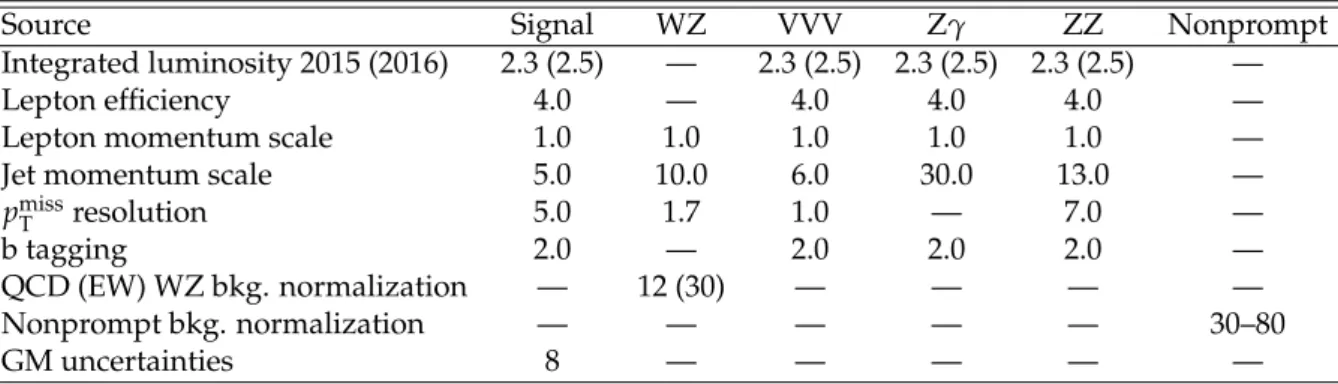
selection level is less than 1%. The uncertainties in the jet energy scale and resolution result in a 5% uncertainty in the signal yields. The uncertainty in the resolution of the pmissT measurement is 10%. Randomly smearing the measured pmissT by one standard deviation of the resolution gives rise to a 5% variation in the estimation of signal yields after the full selection. Uncertain-ties of 2.3% and 2.5% are assigned to the integrated luminosity measurements in the years 2015 and 2016, respectively [78, 79]. The effect of higher-order corrections to the signal cross section in the GM model is taken from Ref. [80]. The theoretical uncertainty is dominated by missing higher-order EW corrections estimated to be 7%. Uncertainties in the signal acceptance due to PDF choice and renormalization and factorization scales are 2–3% and less than 1%, respec-tively, estimated using the LO signal samples. Added in quadrature, the contributions result in an 8% uncertainty in the normalization of the signal samples.
The uncertainty in the estimation of the expected number of QCD WZ events is 12%, which is estimated from the measured yields in the two-jet control region. An uncorrelated uncer-tainty of 30% is assigned on the normalization of WZ events produced via EW processes, esti-mated from the largest bin-by-bin differences after varying the renormalization and factoriza-tion scales. The total uncertainty in the predicfactoriza-tion of the nonprompt background varies bin by bin in the mTdistribution between 30% and 80%, dominated by the low number of nonprompt
leptons passing the sideband selection. A summary of the relative systematic uncertainties in the estimated signal and background yields is shown in Table 1.
After applying the full selection, nine and 62 events are selected in the data collected in 2015 and 2016, respectively. The data yield together with the SM expectation for the different pro-cesses is given in Table 2. The distribution of the mT with bin boundaries given by mT = [0, 100, 200, 400, 600, 800, 1000, 1200, 1500,∞)GeV (the last bin is an overflow bin) is shown in Fig. 2. No event with mT(WZ) > 800 GeV is observed in the data, and overall agreement
be-tween the data and SM background prediction is observed.
A combined fit of the predicted signal and background yields in bins of mTto the data is
5
Table 1: Relative systematic uncertainties in the estimated signal and background yields, in units of percent.
Source Signal WZ VVV Zγ ZZ Nonprompt
Integrated luminosity 2015 (2016) 2.3 (2.5) — 2.3 (2.5) 2.3 (2.5) 2.3 (2.5) —
Lepton efficiency 4.0 — 4.0 4.0 4.0 —
Lepton momentum scale 1.0 1.0 1.0 1.0 1.0 —
Jet momentum scale 5.0 10.0 6.0 30.0 13.0 —
pmissT resolution 5.0 1.7 1.0 — 7.0 —
b tagging 2.0 — 2.0 2.0 2.0 —
QCD (EW) WZ bkg. normalization — 12 (30) — — — —
Nonprompt bkg. normalization — — — — — 30–80
GM uncertainties 8 — — — — —
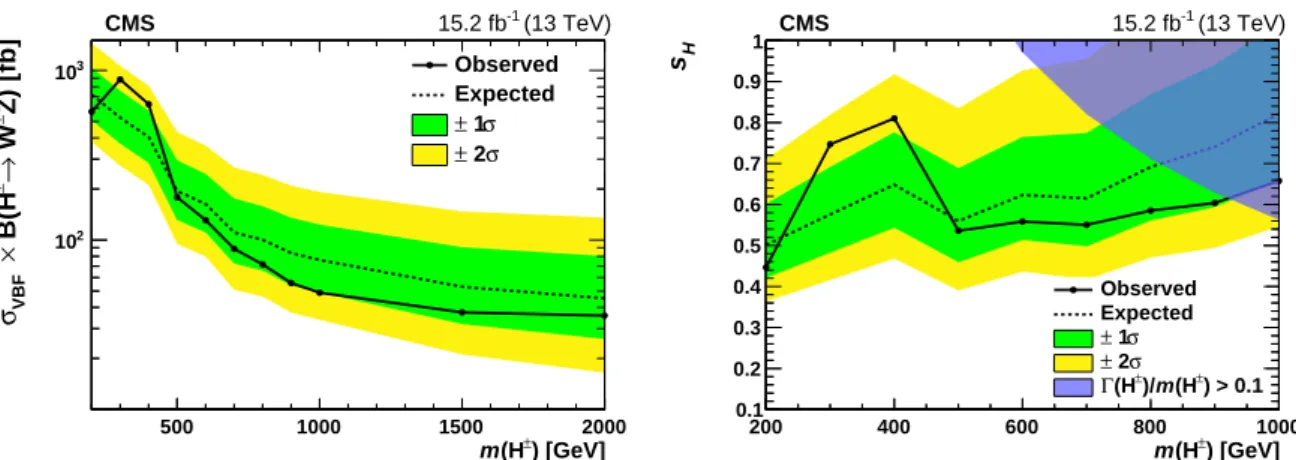
confidence level using the CLsmethod [81–83]. The exclusion limits as a function of m(H±),
as-suming a small intrinsic width for H±, are shown in Fig. 3 (left). Values for σVBF(H±) B(H±→
WZ)ranging from 573 fb at m(H±) =200 GeV to 36 fb at m(H±) =2000 GeV are excluded by the data.
The model-independent exclusion limits are compared to the predicted cross sections at NNLO in the GM model [80] in the sH-m(H±)plane. For the probed parameter space and mT
distri-bution used for signal extraction, the varying width as a function of sH is assumed to have
negligible impact on the result. The value of the branching fractionB(H± →WZ)is assumed to be one. In Fig. 3 (right), the excluded sHvalues as a function of m(H±)are shown. The blue
shaded region shows the parameter space for which the H±total width exceeds 10% of m(H±), where the model is not applicable due to perturbativity and vacuum stability requirements [80]. The observed limit excludes sHvalues greater than 0.45, 0.81, and 0.66 at m(H±) = 200, 400,
and 1000 GeV, respectively.
Table 2: Yields of selected events in 2015 and 2016 data, together with the expected yields from various background processes. The statistical and systematic uncertainties are shown. The signal yields are shown for values of sH=0.7.
Data set 2015 2016 Data 9 62 WZ 7.5±1.2 44.4±5.7 ZZ 0.2±0.1 1.6±0.2 VVV 0.8±0.2 5.5±0.9 Zγ 0.2±0.1 1.0±0.6 Nonprompt 1.3±1.0 7.4±5.4 Total bkg. 10.0±1.6 59.9±8.0 Signal (m(H±) =700 GeV) 0.9±0.1 4.7±0.5
In summary, we present a search for charged Higgs bosons produced via vector boson fusion and decaying into W and Z bosons in proton-proton collisions at √s = 13 TeV based on a sample corresponding to an integrated luminosity of 15.2 fb−1. Events are required to have three leptons (electrons or muons), two jets with large pseudorapidity separation and high dijet mass, and missing transverse momentum. The number of events observed in the signal region agrees with the standard model prediction. The first limits on σVBF(H±) B(H± →WZ)
at√s = 13 TeV are obtained. The results are interpreted in the Georgi–Machacek model for which the most stringent limits to date are derived.
[GeV] T m 0 500 1000 1500 2000 Events 0 5 10 Data WZ ZZ (*) γ Z+ VVV Nonprompt =0.7 H s )=700 GeV, ± (H m sys. uncertainty ⊕ Stat. (13 TeV) -1 2.3 fb CMS [GeV] T m 0 500 1000 1500 2000 Events 0 20 40 60 DataWZ ZZ (*) γ Z+ VVV Nonprompt =0.7 H s )=700 GeV, ± (H m sys. uncertainty ⊕ Stat. (13 TeV) -1 12.9 fb CMS
Figure 2: Transverse mass distributions after full selection, for data collected in 2015 (left) and 2016 (right). The background yield predictions correspond to the background-only hypoth-esis fit result. The signal distribution is shown for m(H±) = 700 GeV and the cross-section prediction in the GM model at sH =0.7.
) [GeV] ± (H m 500 1000 1500 2000 Z) [fb] ± W → ± B(H × VBF σ 2 10 3 10 CMS 15.2 fb-1 (13 TeV) Observed Expected σ 1 ± σ 2 ± ) [GeV] ± (H m 200 400 600 800 1000 H s 0.1 0.2 0.3 0.4 0.5 0.6 0.7 0.8 0.9 1 CMS (13 TeV) -1 15.2 fb Observed Expected σ 1 ± σ 2 ± ) > 0.1 ± (H m )/ ± (H Γ
Figure 3: Expected and observed exclusion limits at 95% confidence level as a function of m(H±)for σVBF(H±) B(H± → WZ)(left) and on the ratio of vacuum expectation values in
the GM model (right) for 15.2 fb−1 of proton-proton collisions at 13 TeV collected in 2015 and 2016. The blue shaded area covers the theoretically not allowed parameter space [80].
References 7
mance of the LHC and thank the technical and administrative staffs at CERN and at other CMS institutes for their contributions to the success of the CMS effort. In addition, we gratefully acknowledge the computing centers and personnel of the Worldwide LHC Computing Grid for delivering so effectively the computing infrastructure essential to our analyses. Finally, we acknowledge the enduring support for the construction and operation of the LHC and the CMS detector provided by the following funding agencies: BMWFW and FWF (Austria); FNRS and FWO (Belgium); CNPq, CAPES, FAPERJ, and FAPESP (Brazil); MES (Bulgaria); CERN; CAS, MoST, and NSFC (China); COLCIENCIAS (Colombia); MSES and CSF (Croatia); RPF (Cyprus); SENESCYT (Ecuador); MoER, ERC IUT and ERDF (Estonia); Academy of Finland, MEC, and HIP (Finland); CEA and CNRS/IN2P3 (France); BMBF, DFG, and HGF (Germany); GSRT (Greece); OTKA and NIH (Hungary); DAE and DST (India); IPM (Iran); SFI (Ireland); INFN (Italy); MSIP and NRF (Republic of Korea); LAS (Lithuania); MOE and UM (Malaysia); BUAP, CINVESTAV, CONACYT, LNS, SEP, and UASLP-FAI (Mexico); MBIE (New Zealand); PAEC (Pakistan); MSHE and NSC (Poland); FCT (Portugal); JINR (Dubna); MON, RosAtom, RAS and RFBR (Russia); MESTD (Serbia); SEIDI and CPAN (Spain); Swiss Funding Agencies (Switzerland); MST (Taipei); ThEPCenter, IPST, STAR and NSTDA (Thailand); TUBITAK and TAEK (Turkey); NASU and SFFR (Ukraine); STFC (United Kingdom); DOE and NSF (USA).
References
[1] ATLAS Collaboration, “Observation of a new particle in the search for the Standard Model Higgs boson with the ATLAS detector at the LHC”, Phys. Lett. B 716 (2012) 1, doi:10.1016/j.physletb.2012.08.020, arXiv:1207.7214.
[2] CMS Collaboration, “Observation of a new boson at a mass of 125 GeV with the CMS experiment at the LHC”, Phys. Lett. B 716 (2012) 30,
doi:10.1016/j.physletb.2012.08.021, arXiv:1207.7235.
[3] F. Englert and R. Brout, “Broken symmetry and the mass of gauge vector mesons”, Phys. Rev. Lett. 13 (1964) 321, doi:10.1103/PhysRevLett.13.321.
[4] P. W. Higgs, “Broken symmetries, massless particles and gauge fields”, Phys. Rev. Lett.
12(1964) 132, doi:10.1016/0031-9163(64)91136-9.
[5] P. W. Higgs, “Broken symmetries and the masses of gauge bosons”, Phys. Rev. Lett. 13 (1964) 508, doi:10.1103/PhysRevLett.13.508.
[6] G. S. Guralnik, C. R. Hagen, and T. W. B. Kibble, “Global conservation laws and massless particles”, Phys. Rev. Lett. 13 (1964) 585, doi:10.1103/PhysRevLett.13.585. [7] P. W. Higgs, “Spontaneous symmetry breakdown without massless bosons”, Phys. Rev.
145(1966) 1156, doi:10.1103/PhysRev.145.1156.
[8] T. W. B. Kibble, “Symmetry breaking in non-Abelian gauge theories”, Phys. Rev. 155 (1967) 1554, doi:10.1103/PhysRev.155.1554.
[9] S. L. Glashow, “Partial-symmetries of weak interactions”, Nucl. Phys. 22 (1961) 579, doi:10.1016/0029-5582(61)90469-2.
[10] S. Weinberg, “A model of leptons”, Phys. Rev. Lett. 19 (1967) 1264, doi:10.1103/PhysRevLett.19.1264.
[11] A. Salam, “Weak and electromagnetic interactions”, in Elementary particle physics: relativistic groups and analyticity, N. Svartholm, ed., p. 367. Almquvist & Wiskell, 1968. Proceedings of the eighth Nobel symposium.
[12] T. D. Lee, “A theory of spontaneous T violation”, Phys. Rev. D 8 (1973) 1226, doi:10.1103/PhysRevD.8.1226.
[13] P. Fayet, “A gauge theory of weak and electromagnetic interactions with spontaneous parity breaking”, Nucl. Phys. B 78 (1974) 14, doi:10.1016/0550-3213(74)90113-8. [14] N. Craig and S. Thomas, “Exclusive signals of an extended Higgs sector”, JHEP 11
(2012) 083, doi:10.1007/JHEP11(2012)083, arXiv:1207.4835.
[15] G. C. Branco et al., “Theory and phenomenology of two-Higgs-doublet models”, Phys. Rep. 516 (2012) 1, doi:10.1016/j.physrep.2012.02.002, arXiv:1106.0034. [16] W. Konetschny and W. Kummer, “Nonconservation of total lepton number with scalar
bosons”, Phys. Lett. B 70 (1977) 433, doi:10.1016/0370-2693(77)90407-5.
[17] M. Magg and C. Wetterich, “Neutrino mass problem and gauge hierarchy”, Phys. Lett. B
94(1980) 61, doi:10.1016/0370-2693(80)90825-4.
[18] T. P. Cheng and L.-F. Li, “Neutrino masses, mixings, and oscillations in SU(2)×U(1) models of electroweak interactions”, Phys. Rev. D 22 (1980) 2860,
doi:10.1103/PhysRevD.22.2860.
[19] J. Schechter and J. W. F. Valle, “Neutrino masses in SU(2)N
U(1) theories”, Phys. Rev. D
22(1980) 2227, doi:10.1103/PhysRevD.22.2227.
[20] C. Englert, E. Re, and M. Spannowsky, “Triplet Higgs boson collider phenomenology after the LHC”, Phys. Rev. D 87 (2013) 095014, doi:10.1103/PhysRevD.87.095014, arXiv:1302.6505.
[21] C. Englert, E. Re, and M. Spannowsky, “Pinning down Higgs triplets at the LHC”, Phys. Rev. D 88 (2013) 035024, doi:10.1103/PhysRevD.88.035024, arXiv:1306.6228. [22] C.-W. Chiang and K. Yagyu, “Testing the custodial symmetry in the Higgs sector of the
Georgi-Machacek model”, JHEP 01 (2013) 026, doi:10.1007/JHEP01(2013)026, arXiv:1211.2658.
[23] C.-W. Chiang, A.-L. Kuo, and K. Yagyu, “Enhancements of weak gauge boson scattering processes at the CERN LHC”, JHEP 10 (2013) 072, doi:10.1007/JHEP10(2013)072, arXiv:1307.7526.
[24] ATLAS Collaboration, “Search for charged Higgs bosons decaying via H+ →τνin top
quark pair events using pp collision data at√s=7 TeV with the ATLAS detector”, JHEP
06(2012) 039, doi:10.1007/JHEP06(2012)039, arXiv:1204.2760.
[25] ATLAS Collaboration, “Search for charged Higgs bosons through the violation of lepton universality in t¯t events using pp collision data at√s=7 TeV with the ATLAS
experiment”, JHEP 03 (2013) 076, doi:10.1007/JHEP03(2013)076, arXiv:1212.3572.
[26] ATLAS Collaboration, “Search for charged Higgs bosons decaying via H± →τ±νin fully
hadronic final states using pp collision data at√s =8 TeV with the ATLAS detector”, JHEP 03 (2015) 088, doi:10.1007/JHEP03(2015)088, arXiv:1412.6663.
References 9
[27] CMS Collaboration, “Search for a light charged Higgs boson in top quark decays in pp collisions at√s=7 TeV”, JHEP 07 (2012) 143, doi:10.1007/JHEP07(2012)143, arXiv:1205.5736.
[28] ATLAS Collaboration, “Search for charged Higgs bosons in the H± →tb decay channel in pp collisions at√s=8 TeV using the ATLAS detector”, JHEP 03 (2016) 127,
doi:10.1007/JHEP03(2016)127, arXiv:1512.03704.
[29] CMS Collaboration, “Search for a charged Higgs boson in pp collisions at√s =8 TeV”, JHEP 11 (2015) 018, doi:10.1007/JHEP11(2015)018, arXiv:1508.07774. [30] ATLAS Collaboration, “Search for a light charged Higgs boson in the decay channel
H+→c¯s in t¯t events using pp collisions at√s = 7 TeV with the ATLAS detector”, Eur. Phys. J. 73 (2013) 2465, doi:10.1140/epjc/s10052-013-2465-z,
arXiv:1302.3694.
[31] CMS Collaboration, “Search for a light charged Higgs boson decaying to cs in pp collisions at√s=8 TeV”, JHEP 12 (2015) 178, doi:10.1007/JHEP12(2015)178, arXiv:1510.04252.
[32] ATLAS Collaboration, “Search for charged Higgs bosons produced in association with a top quark and decaying via H±→τνusing pp collision data recorded at
√
s =13 TeV by the ATLAS detector”, Phys. Lett. B 759 (2016) 555,
doi:10.1016/j.physletb.2016.06.017, arXiv:1603.09203.
[33] S. Dimopoulos and H. Georgi, “Softly broken supersymmetry and SU(5)”, Nucl. Phys. B
193(1981) 150, doi:10.1016/0550-3213(81)90522-8.
[34] J. C. Pati and A. Salam, “Lepton number as the fourth “color”, Phys. Rev. D doi:10.1103/PhysRevD.10.275.
[35] R. N. Mohapatra and J. C. Pati, “A natural left-right symmetry”, Phys. Rev. D 11 (1975) 2558, doi:10.1103/PhysRevD.11.2558.
[36] G. Senjanovic and R. N. Mohapatra, “Exact left-right symmetry and spontaneous violation of parity”, Phys. Rev. D 12 (1975) 1502, doi:10.1103/PhysRevD.12.1502. [37] N. Arkani-Hamed, A. G. Cohen, E. Katz, and A. E. Nelson, “The Littlest Higgs”, JHEP
07(2002) 034, doi:10.1088/1126-6708/2002/07/034, arXiv:hep-ph/0206021. [38] S. Chang, “A ’Littlest Higgs’ model with custodial SU(2) symmetry”, JHEP 12 (2003)
057, doi:10.1088/1126-6708/2003/12/057, arXiv:hep-ph/0306034. [39] S. Chang and J. G. Wacker, “Little Higgs and custodial SU(2)”, Phys. Rev. D 69 (2004)
035002, doi:10.1103/PhysRevD.69.035002, arXiv:hep-ph/0303001. [40] M. Garcia-Pepin et al., “Supersymmetric custodial Higgs triplets and the breaking of
universality”, Phys. Rev.D 91 (2015), no. 1, 015016,
doi:10.1103/PhysRevD.91.015016, arXiv:1409.5737.
[41] L. Cort, M. Garcia, and M. Quiros, “Supersymmetric custodial triplets”, Phys. Rev.D 88 (2013), no. 7, 075010, doi:10.1103/PhysRevD.88.075010, arXiv:1308.4025. [42] G. Lazarides, Q. Shafi, and C. Wetterich, “Proton lifetime and fermion masses in an
SO(10) model”, Nuclear Physics B 181 (1981) 287, doi:10.1016/0550-3213(81)90354-0.
[43] R. N. Mohapatra and G. Senjanovi´c, “Neutrino masses and mixings in gauge models with spontaneous parity violation”, Phys. Rev. D 23 (1981) 165,
doi:10.1103/PhysRevD.23.165.
[44] H. Georgi and M. Machacek, “Doubly charged Higgs bosons”, Nucl. Phys. B 262 (1985) 463, doi:10.1016/0550-3213(85)90325-6.
[45] ATLAS Collaboration, “Search for a charged Higgs boson produced in the vector-boson fusion mode with decay H±→W±z using pp collisions at√s=8 TeV with the ATLAS experiment”, Phys. Rev. Lett. 114 (2015) 231801,
doi:10.1103/PhysRevLett.114.231801, arXiv:1503.04233.
[46] K. Hartling, K. Kumar, and H. E. Logan, “Indirect constraints on the Georgi-Machacek model and implications for Higgs boson couplings”, Phys. Rev. D 91 (2015) 015013, doi:10.1103/PhysRevD.91.015013.
[47] ATLAS Collaboration, “Evidence for electroweak production of W±W±jj in pp collisions at√s=8 TeV with the ATLAS detector”, Phys. Rev. Lett. 113 (2014) 141803,
doi:10.1103/PhysRevLett.113.141803, arXiv:1405.6241.
[48] CMS Collaboration, “Study of vector boson scattering and search for new physics in events with two same-sign leptons and two jets”, Phys. Rev. Lett. 114 (2015) 051801, doi:10.1103/PhysRevLett.114.051801, arXiv:1410.6315.
[49] J. Alwall et al., “The automated computation of tree-level and next-to-leading order differential cross sections, and their matching to parton shower simulations”, JHEP 07 (2014) 079, doi:10.1007/JHEP07(2014)079, arXiv:1405.0301.
[50] S. Alioli, P. Nason, C. Oleari, and E. Re, “NLO vector-boson production matched with shower in POWHEG”, JHEP 07 (2008) 060,
doi:10.1088/1126-6708/2008/07/060, arXiv:0805.4802.
[51] P. Nason, “A new method for combining NLO QCD with shower Monte Carlo algorithms”, JHEP 11 (2004) 040, doi:10.1088/1126-6708/2004/11/040, arXiv:hep-ph/0409146.
[52] S. Frixione, P. Nason, and C. Oleari, “Matching NLO QCD computations with parton shower simulations: the POWHEG method”, JHEP 11 (2007) 070,
doi:10.1088/1126-6708/2007/11/070, arXiv:0709.2092.
[53] S. Alioli, P. Nason, C. Oleari, and E. Re, “A general framework for implementing NLO calculations in shower Monte Carlo programs: the POWHEG BOX”, JHEP 06 (2010) 043, doi:10.1007/JHEP06(2010)043, arXiv:1002.2581.
[54] J. M. Campbell and R. K. Ellis, “MCFM for the Tevatron and the LHC”, Nucl. Phys. Proc. Suppl. 205 (2010) 10, doi:10.1016/j.nuclphysbps.2010.08.011,
arXiv:1007.3492.
[55] F. Caola, K. Melnikov, R. R ¨ontsch, and L. Tancredi, “QCD corrections to ZZ production in gluon fusion at the LHC”, Phys. Rev. D 92 (2015) 094028,
doi:10.1103/PhysRevD.92.094028, arXiv:1509.06734.
[56] F. Cascioli et al., “ZZ production at hadron colliders in NNLO QCD”, Phys. Lett. B 735 (2014) 311, doi:10.1016/j.physletb.2014.06.056, arXiv:1405.2219.
References 11
[57] T. Sj ¨ostrand et al., “An introduction to PYTHIA 8.2”, Comput. Phys. Commun. 191 (2015) 159, doi:10.1016/j.cpc.2015.01.024, arXiv:1410.3012.
[58] P. Skands, S. Carrazza, and J. Rojo, “Tuning PYTHIA 8.1: the Monash 2013 tune”, Eur. Phys. J. C 74 (2014) 3024, doi:10.1140/epjc/s10052-014-3024-y,
arXiv:1404.5630.
[59] CMS Collaboration, “Event generator tunes obtained from underlying event and multiparton scattering measurements”, Eur. Phys. J. C 76 (2016) 155,
doi:10.1140/epjc/s10052-016-3988-x, arXiv:1512.00815.
[60] NNPDF Collaboration, “Parton distributions for the LHC Run II”, JHEP 04 (2015) 040, doi:10.1007/JHEP04(2015)040, arXiv:1410.8849.
[61] GEANT4 Collaboration, “GEANT4—a simulation toolkit”, Nucl. Instrum. Meth. A 506 (2003) 250, doi:10.1016/S0168-9002(03)01368-8.
[62] CMS Collaboration, “The CMS experiment at the CERN LHC”, JINST 3 (2008) S08004, doi:10.1088/1748-0221/3/08/S08004.
[63] CMS Collaboration, “Particle-flow event reconstruction in CMS and performance for jets, taus, and EmissT ”, CMS Physics Analysis Summary CMS-PAS-PFT-09-001, 2009.
[64] CMS Collaboration, “Commissioning of the particle-flow event reconstruction with the first LHC collisions recorded in the CMS detector”, CMS Physics Analysis Summary CMS-PAS-PFT-10-001, 2010.
[65] CMS Collaboration, “Performance of electron reconstruction and selection with the CMS detector in proton-proton collisions at√s=8 TeV”, JINST 10 (2015) P06005,
doi:10.1088/1748-0221/10/06/P06005, arXiv:1502.02701.
[66] CMS Collaboration, “Performance of CMS muon reconstruction in pp collision events at√ s =7 TeV”, JINST 7 (2012) P10002, doi:10.1088/1748-0221/7/10/P10002, arXiv:1206.4071.
[67] CMS Collaboration, “Measurements of inclusive W and Z cross sections in pp collisions at√s=7 TeV”, JHEP 01 (2011) 080, doi:10.1007/JHEP01(2011)080,
arXiv:1012.2466.
[68] M. Cacciari, G. P. Salam, and G. Soyez, “The anti-ktjet clustering algorithm”, JHEP 04
(2008) 063, doi:10.1088/1126-6708/2008/04/063, arXiv:0802.1189.
[69] M. Cacciari, G. P. Salam, and G. Soyez, “FastJet user manual”, Eur. Phys. J. C 72 (2012) 1896, doi:10.1140/epjc/s10052-012-1896-2, arXiv:1111.6097.
[70] M. Cacciari, G. P. Salam, “Dispelling the N3myth for the ktjet-finder”, Phys. Lett. B 641
(2006) 57, doi:10.1016/j.physletb.2006.08.037, arXiv:hep-ph/0512210. [71] CMS Collaboration, “Determination of jet energy calibration and transverse momentum
resolution in CMS”, JINST 6 (2011) P11002,
doi:10.1088/1748-0221/6/11/P11002, arXiv:1107.4277.
[72] CMS Collaboration, “Jet energy scale and resolution in the CMS experiment in pp collisions at 8 TeV”, JINST 12 (2017) 02014,
[73] CMS Collaboration, “Identification of b-quark jets with the CMS experiment”, JINST 8 (2013) P04013, doi:10.1088/1748-0221/8/04/P04013, arXiv:1211.4462. [74] CMS Collaboration, “Identification of b quark jets at the CMS Experiment in the LHC
Run 2”, CMS Physics Analysis Summary CMS-PAS-BTV-15-001, 2016.
[75] M. Cacciari and G. P. Salam, “Pileup subtraction using jet areas”, Phys. Lett. B 659 (2008) 119, doi:10.1016/j.physletb.2007.09.077, arXiv:0707.1378.
[76] Particle Data Group Collaboration, “Review of particle physics”, Chin. Phys. C 40 (2016) 100001, doi:10.1088/1674-1137/40/10/100001.
[77] A. J. Barr et al., “Guide to transverse projections and mass-constraining variables”, Phys. Rev. D 84 (2011) 095031, doi:10.1103/PhysRevD.84.095031, arXiv:1105.2977. [78] CMS Collaboration, “CMS luminosity measurement for the 2015 data-taking period”,
CMS Physics Analysis Summary CMS-PAS-LUM-15-001, 2017.
[79] CMS Collaboration, “CMS luminosity measurement for the 2016 data-taking period”, CMS Physics Analysis Summary CMS-PAS-LUM-17-001, 2017.
[80] M. Zaro and H. Logan, “Recommendations for the interpretation of LHC searches for H05, H5±, and H5±±in vector boson fusion with decays to vector boson pairs”, CERN Report LHCHXSWG-2015-001, 2015.
[81] T. Junk, “Confidence level computation for combining searches with small statistics”, Nucl. Instrum. Meth. A 434 (1999) 435, doi:10.1016/S0168-9002(99)00498-2, arXiv:hep-ex/9902006.
[82] A. L. Read, “Presentation of search results: the CLstechnique”, J. Phys. G 28 (2002) 2693,
doi:10.1088/0954-3899/28/10/313.
[83] G. Cowan, K. Cranmer, E. Gross, and O. Vitells, “Asymptotic formulae for likelihood-based tests of new physics”, Eur. Phys. J. C 71 (2011) 1554,
doi:10.1140/epjc/s10052-011-1554-0, arXiv:1007.1727. [Erratum: doi:10.1140/epjc/s10052-013-2501-z].
13
A
The CMS Collaboration
Yerevan Physics Institute, Yerevan, Armenia
A.M. Sirunyan, A. Tumasyan
Institut f ¨ur Hochenergiephysik, Wien, Austria
W. Adam, E. Asilar, T. Bergauer, J. Brandstetter, E. Brondolin, M. Dragicevic, J. Er ¨o, M. Flechl, M. Friedl, R. Fr ¨uhwirth1, V.M. Ghete, C. Hartl, N. H ¨ormann, J. Hrubec, M. Jeitler1, A. K ¨onig, I. Kr¨atschmer, D. Liko, T. Matsushita, I. Mikulec, D. Rabady, N. Rad, B. Rahbaran, H. Rohringer, J. Schieck1, J. Strauss, W. Waltenberger, C.-E. Wulz1
Institute for Nuclear Problems, Minsk, Belarus
O. Dvornikov, V. Makarenko, V. Mossolov, J. Suarez Gonzalez, V. Zykunov
National Centre for Particle and High Energy Physics, Minsk, Belarus
N. Shumeiko
Universiteit Antwerpen, Antwerpen, Belgium
S. Alderweireldt, E.A. De Wolf, X. Janssen, J. Lauwers, M. Van De Klundert, H. Van Haevermaet, P. Van Mechelen, N. Van Remortel, A. Van Spilbeeck
Vrije Universiteit Brussel, Brussel, Belgium
S. Abu Zeid, F. Blekman, J. D’Hondt, N. Daci, I. De Bruyn, K. Deroover, S. Lowette, S. Moortgat, L. Moreels, A. Olbrechts, Q. Python, K. Skovpen, S. Tavernier, W. Van Doninck, P. Van Mulders, I. Van Parijs
Universit´e Libre de Bruxelles, Bruxelles, Belgium
H. Brun, B. Clerbaux, G. De Lentdecker, H. Delannoy, G. Fasanella, L. Favart, R. Goldouzian, A. Grebenyuk, G. Karapostoli, T. Lenzi, A. L´eonard, J. Luetic, T. Maerschalk, A. Marinov, A. Randle-conde, T. Seva, C. Vander Velde, P. Vanlaer, D. Vannerom, R. Yonamine, F. Zenoni, F. Zhang2
Ghent University, Ghent, Belgium
T. Cornelis, D. Dobur, A. Fagot, M. Gul, I. Khvastunov, D. Poyraz, S. Salva, R. Sch ¨ofbeck, M. Tytgat, W. Van Driessche, W. Verbeke, N. Zaganidis
Universit´e Catholique de Louvain, Louvain-la-Neuve, Belgium
H. Bakhshiansohi, O. Bondu, S. Brochet, G. Bruno, A. Caudron, S. De Visscher, C. Delaere, M. Delcourt, B. Francois, A. Giammanco, A. Jafari, M. Komm, G. Krintiras, V. Lemaitre, A. Magitteri, A. Mertens, M. Musich, K. Piotrzkowski, L. Quertenmont, M. Vidal Marono, S. Wertz
Universit´e de Mons, Mons, Belgium
N. Beliy
Centro Brasileiro de Pesquisas Fisicas, Rio de Janeiro, Brazil
W.L. Ald´a J ´unior, F.L. Alves, G.A. Alves, L. Brito, C. Hensel, A. Moraes, M.E. Pol, P. Rebello Teles
Universidade do Estado do Rio de Janeiro, Rio de Janeiro, Brazil
E. Belchior Batista Das Chagas, W. Carvalho, J. Chinellato3, A. Cust ´odio, E.M. Da Costa, G.G. Da Silveira4, D. De Jesus Damiao, C. De Oliveira Martins, S. Fonseca De Souza, L.M. Huertas Guativa, H. Malbouisson, D. Matos Figueiredo, C. Mora Herrera, L. Mundim, H. Nogima, W.L. Prado Da Silva, A. Santoro, A. Sznajder, E.J. Tonelli Manganote3, F. Torres Da Silva De Araujo, A. Vilela Pereira
Universidade Estadual Paulistaa, Universidade Federal do ABCb, S˜ao Paulo, Brazil
S. Ahujaa, C.A. Bernardesa, S. Dograa, T.R. Fernandez Perez Tomeia, E.M. Gregoresb, P.G. Mercadanteb, C.S. Moona, S.F. Novaesa, Sandra S. Padulaa, D. Romero Abadb, J.C. Ruiz Vargasa
Institute for Nuclear Research and Nuclear Energy, Sofia, Bulgaria
A. Aleksandrov, R. Hadjiiska, P. Iaydjiev, M. Rodozov, S. Stoykova, G. Sultanov, M. Vutova
University of Sofia, Sofia, Bulgaria
A. Dimitrov, I. Glushkov, L. Litov, B. Pavlov, P. Petkov
Beihang University, Beijing, China
W. Fang5, X. Gao5
Institute of High Energy Physics, Beijing, China
M. Ahmad, J.G. Bian, G.M. Chen, H.S. Chen, M. Chen, Y. Chen, T. Cheng, C.H. Jiang, D. Leggat, Z. Liu, F. Romeo, M. Ruan, S.M. Shaheen, A. Spiezia, J. Tao, C. Wang, Z. Wang, E. Yazgan, H. Zhang, J. Zhao
State Key Laboratory of Nuclear Physics and Technology, Peking University, Beijing, China
Y. Ban, G. Chen, Q. Li, S. Liu, Y. Mao, S.J. Qian, D. Wang, Z. Xu
Universidad de Los Andes, Bogota, Colombia
C. Avila, A. Cabrera, L.F. Chaparro Sierra, C. Florez, J.P. Gomez, C.F. Gonz´alez Hern´andez, J.D. Ruiz Alvarez6, J.C. Sanabria
University of Split, Faculty of Electrical Engineering, Mechanical Engineering and Naval Architecture, Split, Croatia
N. Godinovic, D. Lelas, I. Puljak, P.M. Ribeiro Cipriano, T. Sculac
University of Split, Faculty of Science, Split, Croatia
Z. Antunovic, M. Kovac
Institute Rudjer Boskovic, Zagreb, Croatia
V. Brigljevic, D. Ferencek, K. Kadija, B. Mesic, T. Susa
University of Cyprus, Nicosia, Cyprus
M.W. Ather, A. Attikis, G. Mavromanolakis, J. Mousa, C. Nicolaou, F. Ptochos, P.A. Razis, H. Rykaczewski
Charles University, Prague, Czech Republic
M. Finger7, M. Finger Jr.7
Universidad San Francisco de Quito, Quito, Ecuador
E. Carrera Jarrin
Academy of Scientific Research and Technology of the Arab Republic of Egypt, Egyptian Network of High Energy Physics, Cairo, Egypt
A.A. Abdelalim8,9, Y. Mohammed10, E. Salama11,12
National Institute of Chemical Physics and Biophysics, Tallinn, Estonia
M. Kadastik, L. Perrini, M. Raidal, A. Tiko, C. Veelken
Department of Physics, University of Helsinki, Helsinki, Finland
15
Helsinki Institute of Physics, Helsinki, Finland
J. H¨ark ¨onen, T. J¨arvinen, V. Karim¨aki, R. Kinnunen, T. Lamp´en, K. Lassila-Perini, S. Lehti, T. Lind´en, P. Luukka, J. Tuominiemi, E. Tuovinen, L. Wendland
Lappeenranta University of Technology, Lappeenranta, Finland
J. Talvitie, T. Tuuva
IRFU, CEA, Universit´e Paris-Saclay, Gif-sur-Yvette, France
M. Besancon, F. Couderc, M. Dejardin, D. Denegri, B. Fabbro, J.L. Faure, C. Favaro, F. Ferri, S. Ganjour, S. Ghosh, A. Givernaud, P. Gras, G. Hamel de Monchenault, P. Jarry, I. Kucher, E. Locci, M. Machet, J. Malcles, J. Rander, A. Rosowsky, M. Titov
Laboratoire Leprince-Ringuet, Ecole polytechnique, CNRS/IN2P3, Universit´e Paris-Saclay, Palaiseau, France
A. Abdulsalam, I. Antropov, S. Baffioni, F. Beaudette, P. Busson, L. Cadamuro, E. Chapon, C. Charlot, O. Davignon, R. Granier de Cassagnac, M. Jo, S. Lisniak, A. Lobanov, P. Min´e, M. Nguyen, C. Ochando, G. Ortona, P. Paganini, P. Pigard, S. Regnard, R. Salerno, Y. Sirois, A.G. Stahl Leiton, T. Strebler, Y. Yilmaz, A. Zabi, A. Zghiche
Universit´e de Strasbourg, CNRS, IPHC UMR 7178, F-67000 Strasbourg, France
J.-L. Agram13, J. Andrea, D. Bloch, J.-M. Brom, M. Buttignol, E.C. Chabert, N. Chanon, C. Collard, E. Conte13, X. Coubez, J.-C. Fontaine13, D. Gel´e, U. Goerlach, A.-C. Le Bihan, P. Van Hove
Centre de Calcul de l’Institut National de Physique Nucleaire et de Physique des Particules, CNRS/IN2P3, Villeurbanne, France
S. Gadrat
Universit´e de Lyon, Universit´e Claude Bernard Lyon 1, CNRS-IN2P3, Institut de Physique Nucl´eaire de Lyon, Villeurbanne, France
S. Beauceron, C. Bernet, G. Boudoul, C.A. Carrillo Montoya, R. Chierici, D. Contardo, B. Courbon, P. Depasse, H. El Mamouni, J. Fay, L. Finco, S. Gascon, M. Gouzevitch, G. Grenier, B. Ille, F. Lagarde, I.B. Laktineh, M. Lethuillier, L. Mirabito, A.L. Pequegnot, S. Perries, A. Popov14, V. Sordini, M. Vander Donckt, P. Verdier, S. Viret
Georgian Technical University, Tbilisi, Georgia
A. Khvedelidze7
Tbilisi State University, Tbilisi, Georgia
Z. Tsamalaidze7
RWTH Aachen University, I. Physikalisches Institut, Aachen, Germany
C. Autermann, S. Beranek, L. Feld, M.K. Kiesel, K. Klein, M. Lipinski, M. Preuten, C. Schomakers, J. Schulz, T. Verlage
RWTH Aachen University, III. Physikalisches Institut A, Aachen, Germany
A. Albert, M. Brodski, E. Dietz-Laursonn, D. Duchardt, M. Endres, M. Erdmann, S. Erdweg, T. Esch, R. Fischer, A. G ¨uth, M. Hamer, T. Hebbeker, C. Heidemann, K. Hoepfner, S. Knutzen, M. Merschmeyer, A. Meyer, P. Millet, S. Mukherjee, M. Olschewski, K. Padeken, T. Pook, M. Radziej, H. Reithler, M. Rieger, F. Scheuch, L. Sonnenschein, D. Teyssier, S. Th ¨uer
RWTH Aachen University, III. Physikalisches Institut B, Aachen, Germany
V. Cherepanov, G. Fl ¨ugge, B. Kargoll, T. Kress, A. K ¨unsken, J. Lingemann, T. M ¨uller, A. Nehrkorn, A. Nowack, C. Pistone, O. Pooth, A. Stahl15
Deutsches Elektronen-Synchrotron, Hamburg, Germany
M. Aldaya Martin, T. Arndt, C. Asawatangtrakuldee, K. Beernaert, O. Behnke, U. Behrens, A.A. Bin Anuar, K. Borras16, A. Campbell, P. Connor, C. Contreras-Campana, F. Costanza, C. Diez Pardos, G. Dolinska, G. Eckerlin, D. Eckstein, T. Eichhorn, E. Eren, E. Gallo17,
J. Garay Garcia, A. Geiser, A. Gizhko, J.M. Grados Luyando, A. Grohsjean, P. Gunnellini, A. Harb, J. Hauk, M. Hempel18, H. Jung, A. Kalogeropoulos, O. Karacheban18, M. Kasemann, J. Keaveney, C. Kleinwort, I. Korol, D. Kr ¨ucker, W. Lange, A. Lelek, T. Lenz, J. Leonard, K. Lipka, W. Lohmann18, R. Mankel, I.-A. Melzer-Pellmann, A.B. Meyer, G. Mittag, J. Mnich, A. Mussgiller, E. Ntomari, D. Pitzl, R. Placakyte, A. Raspereza, B. Roland, M. ¨O. Sahin, P. Saxena, T. Schoerner-Sadenius, S. Spannagel, N. Stefaniuk, G.P. Van Onsem, R. Walsh, C. Wissing
University of Hamburg, Hamburg, Germany
V. Blobel, M. Centis Vignali, A.R. Draeger, T. Dreyer, E. Garutti, D. Gonzalez, J. Haller, M. Hoffmann, A. Junkes, R. Klanner, R. Kogler, N. Kovalchuk, S. Kurz, T. Lapsien, I. Marchesini, D. Marconi, M. Meyer, M. Niedziela, D. Nowatschin, F. Pantaleo15, T. Peiffer, A. Perieanu, C. Scharf, P. Schleper, A. Schmidt, S. Schumann, J. Schwandt, J. Sonneveld, H. Stadie, G. Steinbr ¨uck, F.M. Stober, M. St ¨over, H. Tholen, D. Troendle, E. Usai, L. Vanelderen, A. Vanhoefer, B. Vormwald
Institut f ¨ur Experimentelle Kernphysik, Karlsruhe, Germany
M. Akbiyik, C. Barth, S. Baur, C. Baus, J. Berger, E. Butz, R. Caspart, T. Chwalek, F. Colombo, W. De Boer, A. Dierlamm, S. Fink, B. Freund, R. Friese, M. Giffels, A. Gilbert, P. Goldenzweig, D. Haitz, F. Hartmann15, S.M. Heindl, U. Husemann, F. Kassel15, I. Katkov14, S. Kudella, H. Mildner, M.U. Mozer, Th. M ¨uller, M. Plagge, G. Quast, K. Rabbertz, S. R ¨ocker, F. Roscher, M. Schr ¨oder, I. Shvetsov, G. Sieber, H.J. Simonis, R. Ulrich, S. Wayand, M. Weber, T. Weiler, S. Williamson, C. W ¨ohrmann, R. Wolf
Institute of Nuclear and Particle Physics (INPP), NCSR Demokritos, Aghia Paraskevi, Greece
G. Anagnostou, G. Daskalakis, T. Geralis, V.A. Giakoumopoulou, A. Kyriakis, D. Loukas, I. Topsis-Giotis
National and Kapodistrian University of Athens, Athens, Greece
S. Kesisoglou, A. Panagiotou, N. Saoulidou, E. Tziaferi
National Technical University of Athens, Athens, Greece
K. Kousouris
University of Io´annina, Io´annina, Greece
I. Evangelou, G. Flouris, C. Foudas, P. Kokkas, N. Loukas, N. Manthos, I. Papadopoulos, E. Paradas, F.A. Triantis
MTA-ELTE Lend ¨ulet CMS Particle and Nuclear Physics Group, E ¨otv ¨os Lor´and University, Budapest, Hungary
N. Filipovic, G. Pasztor
Wigner Research Centre for Physics, Budapest, Hungary
G. Bencze, C. Hajdu, D. Horvath19, F. Sikler, V. Veszpremi, G. Vesztergombi20, A.J. Zsigmond
Institute of Nuclear Research ATOMKI, Debrecen, Hungary
17
Institute of Physics, University of Debrecen, Debrecen, Hungary
M. Bart ´ok20, P. Raics, Z.L. Trocsanyi, B. Ujvari
Indian Institute of Science (IISc), Bangalore, India
S. Choudhury, J.R. Komaragiri
National Institute of Science Education and Research, Bhubaneswar, India
S. Bahinipati22, S. Bhowmik23, P. Mal, K. Mandal, A. Nayak24, D.K. Sahoo22, N. Sahoo, S.K. Swain
Panjab University, Chandigarh, India
S. Bansal, S.B. Beri, V. Bhatnagar, R. Chawla, U.Bhawandeep, A.K. Kalsi, A. Kaur, M. Kaur, R. Kumar, P. Kumari, A. Mehta, M. Mittal, J.B. Singh, G. Walia
University of Delhi, Delhi, India
Ashok Kumar, A. Bhardwaj, B.C. Choudhary, R.B. Garg, S. Keshri, A. Kumar, S. Malhotra, M. Naimuddin, K. Ranjan, R. Sharma, V. Sharma
Saha Institute of Nuclear Physics, Kolkata, India
R. Bhattacharya, S. Bhattacharya, K. Chatterjee, S. Dey, S. Dutt, S. Dutta, S. Ghosh, N. Majumdar, A. Modak, K. Mondal, S. Mukhopadhyay, S. Nandan, A. Purohit, A. Roy, D. Roy, S. Roy Chowdhury, S. Sarkar, M. Sharan, S. Thakur
Indian Institute of Technology Madras, Madras, India
P.K. Behera
Bhabha Atomic Research Centre, Mumbai, India
R. Chudasama, D. Dutta, V. Jha, V. Kumar, A.K. Mohanty15, P.K. Netrakanti, L.M. Pant, P. Shukla, A. Topkar
Tata Institute of Fundamental Research-A, Mumbai, India
T. Aziz, S. Dugad, G. Kole, B. Mahakud, S. Mitra, G.B. Mohanty, B. Parida, N. Sur, B. Sutar
Tata Institute of Fundamental Research-B, Mumbai, India
S. Banerjee, R.K. Dewanjee, S. Ganguly, M. Guchait, Sa. Jain, S. Kumar, M. Maity23, G. Majumder, K. Mazumdar, T. Sarkar23, N. Wickramage25
Indian Institute of Science Education and Research (IISER), Pune, India
S. Chauhan, S. Dube, V. Hegde, A. Kapoor, K. Kothekar, S. Pandey, A. Rane, S. Sharma
Institute for Research in Fundamental Sciences (IPM), Tehran, Iran
S. Chenarani26, E. Eskandari Tadavani, S.M. Etesami26, M. Khakzad, M. Mohammadi
Najafabadi, M. Naseri, S. Paktinat Mehdiabadi27, F. Rezaei Hosseinabadi, B. Safarzadeh28, M. Zeinali
University College Dublin, Dublin, Ireland
M. Felcini, M. Grunewald
INFN Sezione di Baria, Universit`a di Barib, Politecnico di Baric, Bari, Italy
M. Abbresciaa,b, C. Calabriaa,b, C. Caputoa,b, A. Colaleoa, D. Creanzaa,c, L. Cristellaa,b, N. De
Filippisa,c, M. De Palmaa,b, L. Fiorea, G. Iasellia,c, G. Maggia,c, M. Maggia, G. Minielloa,b, S. Mya,b, S. Nuzzoa,b, A. Pompilia,b, G. Pugliesea,c, R. Radognaa,b, A. Ranieria, G. Selvaggia,b, A. Sharmaa, L. Silvestrisa,15, R. Vendittia,b, P. Verwilligena
INFN Sezione di Bolognaa, Universit`a di Bolognab, Bologna, Italy
R. Campaninia,b, P. Capiluppia,b, A. Castroa,b, F.R. Cavalloa, S.S. Chhibraa,b, G. Codispotia,b, M. Cuffiania,b, G.M. Dallavallea, F. Fabbria, A. Fanfania,b, D. Fasanellaa,b, P. Giacomellia, C. Grandia, L. Guiduccia,b, S. Marcellinia, G. Masettia, A. Montanaria, F.L. Navarriaa,b, A. Perrottaa, A.M. Rossia,b, T. Rovellia,b, G.P. Sirolia,b, N. Tosia,b,15
INFN Sezione di Cataniaa, Universit`a di Cataniab, Catania, Italy
S. Albergoa,b, S. Costaa,b, A. Di Mattiaa, F. Giordanoa,b, R. Potenzaa,b, A. Tricomia,b, C. Tuvea,b
INFN Sezione di Firenzea, Universit`a di Firenzeb, Firenze, Italy
G. Barbaglia, V. Ciullia,b, C. Civininia, R. D’Alessandroa,b, E. Focardia,b, P. Lenzia,b, M. Meschinia, S. Paolettia, L. Russoa,29, G. Sguazzonia, D. Stroma, L. Viliania,b,15
INFN Laboratori Nazionali di Frascati, Frascati, Italy
L. Benussi, S. Bianco, F. Fabbri, D. Piccolo, F. Primavera15
INFN Sezione di Genovaa, Universit`a di Genovab, Genova, Italy
V. Calvellia,b, F. Ferroa, M.R. Mongea,b, E. Robuttia, S. Tosia,b
INFN Sezione di Milano-Bicoccaa, Universit`a di Milano-Bicoccab, Milano, Italy
L. Brianzaa,b,15, F. Brivioa,b, V. Ciriolo, M.E. Dinardoa,b, S. Fiorendia,b,15, S. Gennaia, A. Ghezzia,b, P. Govonia,b, M. Malbertia,b, S. Malvezzia, R.A. Manzonia,b, D. Menascea, L. Moronia, M. Paganonia,b, D. Pedrinia, S. Pigazzinia,b, S. Ragazzia,b, T. Tabarelli de Fatisa,b
INFN Sezione di Napolia, Universit`a di Napoli ’Federico II’b, Napoli, Italy, Universit`a della Basilicatac, Potenza, Italy, Universit`a G. Marconid, Roma, Italy
S. Buontempoa, N. Cavalloa,c, G. De Nardoa,b, S. Di Guidaa,d,15, F. Fabozzia,c, F. Fiengaa,b, A.O.M. Iorioa,b, L. Listaa, S. Meolaa,d,15, P. Paoluccia,15, C. Sciaccaa,b, F. Thyssena
INFN Sezione di Padova a, Universit`a di Padova b, Padova, Italy, Universit`a di Trento c, Trento, Italy
P. Azzia,15, N. Bacchettaa, L. Benatoa,b, D. Biselloa,b, A. Bolettia,b, R. Carlina,b, A. Car-valho Antunes De Oliveiraa,b, P. Checchiaa, M. Dall’Ossoa,b, P. De Castro Manzanoa, T. Dorigoa, F. Gasparinia,b, U. Gasparinia,b, A. Gozzelinoa, S. Lacapraraa, M. Margonia,b, A.T. Meneguzzoa,b, J. Pazzinia,b, N. Pozzobona,b, P. Ronchesea,b, R. Rossina,b, F. Simonettoa,b, E. Torassaa, M. Zanettia,b, P. Zottoa,b, G. Zumerlea,b
INFN Sezione di Paviaa, Universit`a di Paviab, Pavia, Italy
A. Braghieria, F. Fallavollitaa,b, A. Magnania,b, P. Montagnaa,b, S.P. Rattia,b, V. Rea, M. Ressegotti, C. Riccardia,b, P. Salvinia, I. Vaia,b, P. Vituloa,b
INFN Sezione di Perugiaa, Universit`a di Perugiab, Perugia, Italy
L. Alunni Solestizia,b, G.M. Bileia, D. Ciangottinia,b, L. Fan `oa,b, P. Laricciaa,b, R. Leonardia,b, G. Mantovania,b, V. Mariania,b, M. Menichellia, A. Sahaa, A. Santocchiaa,b
INFN Sezione di Pisaa, Universit`a di Pisab, Scuola Normale Superiore di Pisac, Pisa, Italy
K. Androsova, P. Azzurria,15, G. Bagliesia, J. Bernardinia, T. Boccalia, R. Castaldia, M.A. Cioccia,b, R. Dell’Orsoa, G. Fedia, A. Giassia, M.T. Grippoa,29, F. Ligabuea,c, T. Lomtadzea, L. Martinia,b, A. Messineoa,b, F. Pallaa, A. Rizzia,b, A. Savoy-Navarroa,30, P. Spagnoloa, R. Tenchinia, G. Tonellia,b, A. Venturia, P.G. Verdinia
INFN Sezione di Romaa, Sapienza Universit`a di Romab, Rome, Italy
L. Baronea,b, F. Cavallaria, M. Cipriania,b, D. Del Rea,b,15, M. Diemoza, S. Gellia,b, E. Longoa,b, F. Margarolia,b, B. Marzocchia,b, P. Meridiania, G. Organtinia,b, R. Paramattia,b, F. Preiatoa,b, S. Rahatloua,b, C. Rovellia, F. Santanastasioa,b
19
INFN Sezione di Torino a, Universit`a di Torino b, Torino, Italy, Universit`a del Piemonte Orientalec, Novara, Italy
N. Amapanea,b, R. Arcidiaconoa,c,15, S. Argiroa,b, M. Arneodoa,c, N. Bartosika, R. Bellana,b, C. Biinoa, N. Cartigliaa, F. Cennaa,b, M. Costaa,b, R. Covarellia,b, A. Deganoa,b, N. Demariaa,
B. Kiania,b, C. Mariottia, S. Masellia, E. Migliorea,b, V. Monacoa,b, E. Monteila,b, M. Montenoa, M.M. Obertinoa,b, L. Pachera,b, N. Pastronea, M. Pelliccionia, G.L. Pinna Angionia,b, F. Raveraa,b, A. Romeroa,b, M. Ruspaa,c, R. Sacchia,b, K. Shchelinaa,b, V. Solaa, A. Solanoa,b, A. Staianoa, P. Traczyka,b
INFN Sezione di Triestea, Universit`a di Triesteb, Trieste, Italy
S. Belfortea, M. Casarsaa, F. Cossuttia, G. Della Riccaa,b, A. Zanettia
Kyungpook National University, Daegu, Korea
D.H. Kim, G.N. Kim, M.S. Kim, J. Lee, S. Lee, S.W. Lee, Y.D. Oh, S. Sekmen, D.C. Son, Y.C. Yang
Chonbuk National University, Jeonju, Korea
A. Lee
Chonnam National University, Institute for Universe and Elementary Particles, Kwangju, Korea
H. Kim
Hanyang University, Seoul, Korea
J.A. Brochero Cifuentes, J. Goh, T.J. Kim
Korea University, Seoul, Korea
S. Cho, S. Choi, Y. Go, D. Gyun, S. Ha, B. Hong, Y. Jo, Y. Kim, K. Lee, K.S. Lee, S. Lee, J. Lim, S.K. Park, Y. Roh
Seoul National University, Seoul, Korea
J. Almond, J. Kim, H. Lee, S.B. Oh, B.C. Radburn-Smith, S.h. Seo, U.K. Yang, H.D. Yoo, G.B. Yu
University of Seoul, Seoul, Korea
M. Choi, H. Kim, J.H. Kim, J.S.H. Lee, I.C. Park, G. Ryu, M.S. Ryu
Sungkyunkwan University, Suwon, Korea
Y. Choi, C. Hwang, J. Lee, I. Yu
Vilnius University, Vilnius, Lithuania
V. Dudenas, A. Juodagalvis, J. Vaitkus
National Centre for Particle Physics, Universiti Malaya, Kuala Lumpur, Malaysia
I. Ahmed, Z.A. Ibrahim, M.A.B. Md Ali31, F. Mohamad Idris32, W.A.T. Wan Abdullah, M.N. Yusli, Z. Zolkapli
Centro de Investigacion y de Estudios Avanzados del IPN, Mexico City, Mexico
H. Castilla-Valdez, E. De La Cruz-Burelo, I. Heredia-De La Cruz33, R. Lopez-Fernandez, R. Maga ˜na Villalba, J. Mejia Guisao, A. Sanchez-Hernandez
Universidad Iberoamericana, Mexico City, Mexico
S. Carrillo Moreno, C. Oropeza Barrera, F. Vazquez Valencia
Benemerita Universidad Autonoma de Puebla, Puebla, Mexico
S. Carpinteyro, I. Pedraza, H.A. Salazar Ibarguen, C. Uribe Estrada
Universidad Aut ´onoma de San Luis Potos´ı, San Luis Potos´ı, Mexico
University of Auckland, Auckland, New Zealand
D. Krofcheck
University of Canterbury, Christchurch, New Zealand
P.H. Butler
National Centre for Physics, Quaid-I-Azam University, Islamabad, Pakistan
A. Ahmad, M. Ahmad, Q. Hassan, H.R. Hoorani, W.A. Khan, A. Saddique, M.A. Shah, M. Shoaib, M. Waqas
National Centre for Nuclear Research, Swierk, Poland
H. Bialkowska, M. Bluj, B. Boimska, T. Frueboes, M. G ´orski, M. Kazana, K. Nawrocki, K. Romanowska-Rybinska, M. Szleper, P. Zalewski
Institute of Experimental Physics, Faculty of Physics, University of Warsaw, Warsaw, Poland
K. Bunkowski, A. Byszuk34, K. Doroba, A. Kalinowski, M. Konecki, J. Krolikowski, M. Misiura, M. Olszewski, A. Pyskir, M. Walczak
Laborat ´orio de Instrumenta¸c˜ao e F´ısica Experimental de Part´ıculas, Lisboa, Portugal
P. Bargassa, C. Beir˜ao Da Cruz E Silva, B. Calpas, A. Di Francesco, P. Faccioli, M. Gallinaro, J. Hollar, N. Leonardo, L. Lloret Iglesias, M.V. Nemallapudi, J. Seixas, O. Toldaiev, D. Vadruccio, J. Varela
Joint Institute for Nuclear Research, Dubna, Russia
S. Afanasiev, P. Bunin, M. Gavrilenko, I. Golutvin, I. Gorbunov, A. Kamenev, V. Karjavin, A. Lanev, A. Malakhov, V. Matveev35,36, V. Palichik, V. Perelygin, S. Shmatov, S. Shulha,
N. Skatchkov, V. Smirnov, N. Voytishin, A. Zarubin
Petersburg Nuclear Physics Institute, Gatchina (St. Petersburg), Russia
L. Chtchipounov, V. Golovtsov, Y. Ivanov, V. Kim37, E. Kuznetsova38, V. Murzin, V. Oreshkin, V. Sulimov, A. Vorobyev
Institute for Nuclear Research, Moscow, Russia
Yu. Andreev, A. Dermenev, S. Gninenko, N. Golubev, A. Karneyeu, M. Kirsanov, N. Krasnikov, A. Pashenkov, D. Tlisov, A. Toropin
Institute for Theoretical and Experimental Physics, Moscow, Russia
V. Epshteyn, V. Gavrilov, N. Lychkovskaya, V. Popov, I. Pozdnyakov, G. Safronov, A. Spiridonov, M. Toms, E. Vlasov, A. Zhokin
Moscow Institute of Physics and Technology, Moscow, Russia
T. Aushev, A. Bylinkin36
National Research Nuclear University ’Moscow Engineering Physics Institute’ (MEPhI), Moscow, Russia
R. Chistov39, M. Danilov39, S. Polikarpov
P.N. Lebedev Physical Institute, Moscow, Russia
V. Andreev, M. Azarkin36, I. Dremin36, M. Kirakosyan, A. Leonidov36, A. Terkulov
Skobeltsyn Institute of Nuclear Physics, Lomonosov Moscow State University, Moscow, Russia
A. Baskakov, A. Belyaev, E. Boos, V. Bunichev, M. Dubinin40, L. Dudko, A. Gribushin, V. Klyukhin, O. Kodolova, I. Lokhtin, I. Miagkov, S. Obraztsov, M. Perfilov, S. Petrushanko, V. Savrin
21
Novosibirsk State University (NSU), Novosibirsk, Russia
V. Blinov41, Y.Skovpen41, D. Shtol41
State Research Center of Russian Federation, Institute for High Energy Physics, Protvino, Russia
I. Azhgirey, I. Bayshev, S. Bitioukov, D. Elumakhov, V. Kachanov, A. Kalinin, D. Konstantinov, V. Krychkine, V. Petrov, R. Ryutin, A. Sobol, S. Troshin, N. Tyurin, A. Uzunian, A. Volkov
University of Belgrade, Faculty of Physics and Vinca Institute of Nuclear Sciences, Belgrade, Serbia
P. Adzic42, P. Cirkovic, D. Devetak, M. Dordevic, J. Milosevic, V. Rekovic
Centro de Investigaciones Energ´eticas Medioambientales y Tecnol ´ogicas (CIEMAT), Madrid, Spain
J. Alcaraz Maestre, M. Barrio Luna, E. Calvo, M. Cerrada, M. Chamizo Llatas, N. Colino, B. De La Cruz, A. Delgado Peris, A. Escalante Del Valle, C. Fernandez Bedoya, J.P. Fern´andez Ramos, J. Flix, M.C. Fouz, P. Garcia-Abia, O. Gonzalez Lopez, S. Goy Lopez, J.M. Hernandez, M.I. Josa, E. Navarro De Martino, A. P´erez-Calero Yzquierdo, J. Puerta Pelayo, A. Quintario Olmeda, I. Redondo, L. Romero, M.S. Soares
Universidad Aut ´onoma de Madrid, Madrid, Spain
J.F. de Troc ´oniz, M. Missiroli, D. Moran
Universidad de Oviedo, Oviedo, Spain
J. Cuevas, C. Erice, J. Fernandez Menendez, I. Gonzalez Caballero, J.R. Gonz´alez Fern´andez, E. Palencia Cortezon, S. Sanchez Cruz, I. Su´arez Andr´es, P. Vischia, J.M. Vizan Garcia
Instituto de F´ısica de Cantabria (IFCA), CSIC-Universidad de Cantabria, Santander, Spain
I.J. Cabrillo, A. Calderon, E. Curras, M. Fernandez, J. Garcia-Ferrero, G. Gomez, A. Lopez Virto, J. Marco, C. Martinez Rivero, F. Matorras, J. Piedra Gomez, T. Rodrigo, A. Ruiz-Jimeno, L. Scodellaro, N. Trevisani, I. Vila, R. Vilar Cortabitarte
CERN, European Organization for Nuclear Research, Geneva, Switzerland
D. Abbaneo, E. Auffray, G. Auzinger, P. Baillon, A.H. Ball, D. Barney, P. Bloch, A. Bocci, C. Botta, T. Camporesi, R. Castello, M. Cepeda, G. Cerminara, Y. Chen, A. Cimmino, D. d’Enterria, A. Dabrowski, V. Daponte, A. David, M. De Gruttola, A. De Roeck, E. Di Marco43, M. Dobson, B. Dorney, T. du Pree, M. D ¨unser, N. Dupont, A. Elliott-Peisert, P. Everaerts, S. Fartoukh, G. Franzoni, J. Fulcher, W. Funk, D. Gigi, K. Gill, M. Girone, F. Glege, D. Gulhan, S. Gundacker, M. Guthoff, P. Harris, J. Hegeman, V. Innocente, P. Janot, J. Kieseler, H. Kirschenmann, V. Kn ¨unz, A. Kornmayer15, M.J. Kortelainen, M. Krammer1, C. Lange, P. Lecoq, C. Lourenc¸o, M.T. Lucchini, L. Malgeri, M. Mannelli, A. Martelli, F. Meijers, J.A. Merlin, S. Mersi, E. Meschi, P. Milenovic44, F. Moortgat, S. Morovic, M. Mulders, H. Neugebauer, S. Orfanelli, L. Orsini, L. Pape, E. Perez, M. Peruzzi, A. Petrilli, G. Petrucciani, A. Pfeiffer, M. Pierini, A. Racz, T. Reis, G. Rolandi45, M. Rovere, H. Sakulin, J.B. Sauvan, C. Sch¨afer, C. Schwick, M. Seidel, M. Selvaggi, A. Sharma, P. Silva, P. Sphicas46, J. Steggemann, M. Stoye, Y. Takahashi, M. Tosi, D. Treille, A. Triossi, A. Tsirou, V. Veckalns47, G.I. Veres20, M. Verweij, N. Wardle, H.K. W ¨ohri, A. Zagozdzinska34, W.D. Zeuner
Paul Scherrer Institut, Villigen, Switzerland
W. Bertl, K. Deiters, W. Erdmann, R. Horisberger, Q. Ingram, H.C. Kaestli, D. Kotlinski, U. Langenegger, T. Rohe, S.A. Wiederkehr
Institute for Particle Physics, ETH Zurich, Zurich, Switzerland
C. Heidegger, D. Hits, J. Hoss, G. Kasieczka, W. Lustermann, B. Mangano, M. Marionneau, P. Martinez Ruiz del Arbol, M. Masciovecchio, M.T. Meinhard, D. Meister, F. Micheli, P. Musella, F. Nessi-Tedaldi, F. Pandolfi, J. Pata, F. Pauss, G. Perrin, L. Perrozzi, M. Quittnat, M. Rossini, M. Sch ¨onenberger, A. Starodumov48, V.R. Tavolaro, K. Theofilatos, R. Wallny
Universit¨at Z ¨urich, Zurich, Switzerland
T.K. Aarrestad, C. Amsler49, L. Caminada, M.F. Canelli, A. De Cosa, S. Donato, C. Galloni, A. Hinzmann, T. Hreus, B. Kilminster, J. Ngadiuba, D. Pinna, G. Rauco, P. Robmann, D. Salerno, C. Seitz, Y. Yang, A. Zucchetta
National Central University, Chung-Li, Taiwan
V. Candelise, T.H. Doan, Sh. Jain, R. Khurana, M. Konyushikhin, C.M. Kuo, W. Lin, A. Pozdnyakov, S.S. Yu
National Taiwan University (NTU), Taipei, Taiwan
Arun Kumar, P. Chang, Y.H. Chang, Y. Chao, K.F. Chen, P.H. Chen, F. Fiori, W.-S. Hou, Y. Hsiung, Y.F. Liu, R.-S. Lu, M. Mi ˜nano Moya, E. Paganis, A. Psallidas, J.f. Tsai
Chulalongkorn University, Faculty of Science, Department of Physics, Bangkok, Thailand
B. Asavapibhop, G. Singh, N. Srimanobhas, N. Suwonjandee
Cukurova University, Physics Department, Science and Art Faculty, Adana, Turkey
A. Adiguzel, F. Boran, S. Cerci50, S. Damarseckin, Z.S. Demiroglu, C. Dozen, I. Dumanoglu, S. Girgis, G. Gokbulut, Y. Guler, I. Hos51, E.E. Kangal52, O. Kara, A. Kayis Topaksu, U. Kiminsu, M. Oglakci, G. Onengut53, K. Ozdemir54, D. Sunar Cerci50, H. Topakli55, S. Turkcapar, I.S. Zorbakir, C. Zorbilmez
Middle East Technical University, Physics Department, Ankara, Turkey
B. Bilin, B. Isildak56, G. Karapinar57, M. Yalvac, M. Zeyrek
Bogazici University, Istanbul, Turkey
E. G ¨ulmez, M. Kaya58, O. Kaya59, E.A. Yetkin60, T. Yetkin61
Istanbul Technical University, Istanbul, Turkey
A. Cakir, K. Cankocak, S. Sen62
Institute for Scintillation Materials of National Academy of Science of Ukraine, Kharkov, Ukraine
B. Grynyov
National Scientific Center, Kharkov Institute of Physics and Technology, Kharkov, Ukraine
L. Levchuk, P. Sorokin
University of Bristol, Bristol, United Kingdom
R. Aggleton, F. Ball, L. Beck, J.J. Brooke, D. Burns, E. Clement, D. Cussans, H. Flacher, J. Goldstein, M. Grimes, G.P. Heath, H.F. Heath, J. Jacob, L. Kreczko, C. Lucas, D.M. Newbold63, S. Paramesvaran, A. Poll, T. Sakuma, S. Seif El Nasr-storey, D. Smith, V.J. Smith
Rutherford Appleton Laboratory, Didcot, United Kingdom
K.W. Bell, A. Belyaev64, C. Brew, R.M. Brown, L. Calligaris, D. Cieri, D.J.A. Cockerill,
J.A. Coughlan, K. Harder, S. Harper, E. Olaiya, D. Petyt, C.H. Shepherd-Themistocleous, A. Thea, I.R. Tomalin, T. Williams
Imperial College, London, United Kingdom
M. Baber, R. Bainbridge, O. Buchmuller, A. Bundock, S. Casasso, M. Citron, D. Colling, L. Corpe, P. Dauncey, G. Davies, A. De Wit, M. Della Negra, R. Di Maria, P. Dunne,
23
A. Elwood, D. Futyan, Y. Haddad, G. Hall, G. Iles, T. James, R. Lane, C. Laner, L. Lyons, A.-M. Magnan, S. Malik, L. Mastrolorenzo, J. Nash, A. Nikitenko48, J. Pela, B. Penning, M. Pesaresi, D.M. Raymond, A. Richards, A. Rose, E. Scott, C. Seez, S. Summers, A. Tapper, K. Uchida, M. Vazquez Acosta65, T. Virdee15, J. Wright, S.C. Zenz
Brunel University, Uxbridge, United Kingdom
J.E. Cole, P.R. Hobson, A. Khan, P. Kyberd, I.D. Reid, P. Symonds, L. Teodorescu, M. Turner
Baylor University, Waco, USA
A. Borzou, K. Call, J. Dittmann, K. Hatakeyama, H. Liu, N. Pastika
Catholic University of America, Washington, USA
R. Bartek, A. Dominguez
The University of Alabama, Tuscaloosa, USA
A. Buccilli, S.I. Cooper, C. Henderson, P. Rumerio, C. West
Boston University, Boston, USA
D. Arcaro, A. Avetisyan, T. Bose, D. Gastler, D. Rankin, C. Richardson, J. Rohlf, L. Sulak, D. Zou
Brown University, Providence, USA
G. Benelli, D. Cutts, A. Garabedian, J. Hakala, U. Heintz, J.M. Hogan, O. Jesus, K.H.M. Kwok, E. Laird, G. Landsberg, Z. Mao, M. Narain, S. Piperov, S. Sagir, E. Spencer, R. Syarif
University of California, Davis, Davis, USA
R. Breedon, D. Burns, M. Calderon De La Barca Sanchez, S. Chauhan, M. Chertok, J. Conway, R. Conway, P.T. Cox, R. Erbacher, C. Flores, G. Funk, M. Gardner, W. Ko, R. Lander, C. Mclean, M. Mulhearn, D. Pellett, J. Pilot, S. Shalhout, M. Shi, J. Smith, M. Squires, D. Stolp, K. Tos, M. Tripathi
University of California, Los Angeles, USA
M. Bachtis, C. Bravo, R. Cousins, A. Dasgupta, A. Florent, J. Hauser, M. Ignatenko, N. Mccoll, D. Saltzberg, C. Schnaible, V. Valuev, M. Weber
University of California, Riverside, Riverside, USA
E. Bouvier, K. Burt, R. Clare, J. Ellison, J.W. Gary, S.M.A. Ghiasi Shirazi, G. Hanson, J. Heilman, P. Jandir, E. Kennedy, F. Lacroix, O.R. Long, M. Olmedo Negrete, M.I. Paneva, A. Shrinivas, W. Si, H. Wei, S. Wimpenny, B. R. Yates
University of California, San Diego, La Jolla, USA
J.G. Branson, G.B. Cerati, S. Cittolin, M. Derdzinski, R. Gerosa, A. Holzner, D. Klein, V. Krutelyov, J. Letts, I. Macneill, D. Olivito, S. Padhi, M. Pieri, M. Sani, V. Sharma, S. Simon, M. Tadel, A. Vartak, S. Wasserbaech66, C. Welke, J. Wood, F. W ¨urthwein, A. Yagil, G. Zevi Della Porta
University of California, Santa Barbara - Department of Physics, Santa Barbara, USA
N. Amin, R. Bhandari, J. Bradmiller-Feld, C. Campagnari, A. Dishaw, V. Dutta, M. Franco Sevilla, C. George, F. Golf, L. Gouskos, J. Gran, R. Heller, J. Incandela, S.D. Mullin, A. Ovcharova, H. Qu, J. Richman, D. Stuart, I. Suarez, J. Yoo
California Institute of Technology, Pasadena, USA
D. Anderson, J. Bendavid, A. Bornheim, J. Bunn, J.M. Lawhorn, A. Mott, H.B. Newman, C. Pena, M. Spiropulu, J.R. Vlimant, S. Xie, R.Y. Zhu
Carnegie Mellon University, Pittsburgh, USA