2015
ESTABLISHMENT AND OPTIMIZATION OF AN
ALGINATE-ANCHORED TRIDIMENSIONAL IN
VITRO INTESTINE MODEL FOR INTESTINAL
ABSORPTION PURPOSES
SARA ISABELA BARBOSA CARNEIRO DISSERTAÇÃO DE MESTRADO APRESENTADA
À FACULDADE DE ENGENHARIA DA UNIVERSIDADE DO PORTO EM ENGENHARIA BIOMÉDICA
Faculdade de Engenharia da Universidade do Porto
Establishment and optimization of an
alginate-anchored tridimensional in vitro intestine model
for intestinal absorption purposes
Sara Isabela Barbosa Carneiro
Dissertação realizada no âmbito do
Mestrado em Engenharia Biomédica
Orientador: Bruno Sarmento, PhD
Co-Orientador: Cristina Barrias, PhD
Abstract
On human body, cellular growth and differentiation occus in the tridimensional environment, requiring an extracellular matrix (ECM) with which the cells interact. During the past decades, artificial 3D matrices, that mimic the natural ECM, have become increasingly relevant to overcome the gap between 2D cell culture and physiological tissue as they efficiently recreates in vivo scenarios and allow for cell–matrix interactions.
The native ECM is a hydrated gel-like substance, therefore various natural and synthetic hydrogels have been used as artificial ECM-like matrices for in vitro cell culture models. The hydrogel-based 3D microenvironments can mimic many functions of the native ECM, provide mechanical integrity to the newly formed cell-derived matrix and a hydrated space for the diffusion of nutrients and metabolites. Moreover, the ECM matrix in cell culture models enhance the natural tissue environment, biologically and physically, through the interactions between different cell types. Because cell-laden hydrogels mimic the natural tissues, they have been developed not only as a strategy for tissue repair and regeneration, but have also been used for in tissue modelling for drug development/screening and also for studying various pathological process.
This dissertation aims to develop an intestinal tissue engineering model based on intestinal fibroblasts and different epithelial cells supported by a natural biomaterial – alginate- resembling the intestinal ECM. The experimental results demonstrate that the variation of different physical and chemical parameters in the formation of alginate hydrogels allow the modulation of the properties to better recreate the mechanical characteristics found on natural intestinal scenario.
In 3D environment, we explored the behaviour of intestinal fibroblast, studying their viability, metabolic activity, morphology and ECM compounds expression, such as fibronectin and collagen. In 3D environment, these cells were characterized by a spherical shape, and the production of ECM, namely of fibronectin and collagen, was essentially restricted to the intracellular and pericellular space. The initial density of 5x10⁶ cells/mL showed to be the most suitable density to be used in the in vitro model.
Further studies consisted in characterizing the epithelium layer of intestinal mucosa through the evaluation of monolayer tightness of epithelial C2BBe1 cells seeded on-top of the hydrogel layer, at different densities. An acceptable integrity and maturity of the monolayer
ii
lower TEER value compared with the respective monolayer of control (C2BBe1 2D model), the results of permeability assays demonstrate an efficient model to predict the permeability.
Ultimately, the three-dimensional C2BBe1 model can be the foundation for in future, development a three-dimensional co-culture model that resembles the intestinal mucosa, representing an effective tool for the early stage of drugs development.
Resumo
No corpo humano, o crescimento e a diferenciação celular ocorrem num ambiente tridimensional (3D), que requer uma matriz extracelular (ECM) com a qual as células interagem. Durante as últimas décadas, as matrizes artificiais tridimensionais, que simulam a ECM natural, tornaram-se cada vez mais relevante para superar a lacuna entre as culturas celulares bidimensionais (2D) e os tecidos fisiológicos, uma vez que as matrizes recriam de uma forma eficaz o ambiente vivo e permitem as interações célula-ECM.
A ECM nativa é uma substância semelhante a um hidrogel, por conseguinte, diferentes hidrogéis sintéticos e naturais têm sido utilizados como matrizes ECM nos modelos celulares in vitro. O microambiente 3D do hidrogel é capaz de imitar muitas funções da ECM nativa, de proporcionar uma integridade mecânica a uma matriz com células e um espaço hidratado para a difusão de nutrientes e metabolitos. Além disso, a matriz ECM nos modelos de culturas celulares melhoram o ambiente do tecido natural, biológico e físico, por meio das interações entre os diferentes tipos de células. Uma vez que os hidrogéis com células na sua matriz imitam os tecidos naturais, estes têm sido desenvolvidos não só como uma estratégia para a reparação e regeneração dos tecidos, mas também para a modelação de tecidos no desenvolvimento de fármacos/rastreio e também para o estudo de várias doenças, tais como cancro metastático.
Esta dissertação tem como objetivo desenvolver um modelo intestinal constituído por fibroblastos e diferentes células epiteliais intestinais suportados por um biomaterial natural – o alginato – que se assemelha com a ECM intestinal. Os resultados experimentais demostram que a variação de vários parâmetros físico-químicos do alginato na formação dos hidrogéis permitem a modulação das propriedades para melhor recriar as características mecânicas encontradas no cenário intestinal natural.
Num ambiente 3D, foi avaliado o comportamento dos fibroblastos intestinais, segundo a sua viabilidade, atividade metabólica, morfologia e expressão de componentes da ECM, tais como a fibronectina e o colagénio. Num ambiente 3D, os fibroblastos demostraram uma forma esférica e uma produção de fibronectina e colagénio essencialmente no espaço intracelular e pericelular. A densidade inicial de 5x10⁶ células/mL mostrou ser a densidade mais adequada para ser usada no modelo intestinal in vitro.
Outros estudos consistiram na caracterização da camada epitelial da mucosa intestinal através da avaliação da coesão da monocamada das células epiteliais C2BBe1 sob a superfície
iv
Uma integridade e maturidade aceitável da monocamada foram observadas somente para a maior densidade de 4x10⁶ células/mL. Embora esta condição apresente um valor de TEER menor comparado com a respetiva monocamada de controlo (modelo C2BBe1 2D), os resultados dos ensaios de permeabilidade demonstram um modelo eficiente na previsão da permeabilidade.
Para finalizar, o modelo tridimensional C2BBe1 pode ser a base para desenvolver futuramente o modelo co-cultura tridimensional que assemelha-se à mucosa intestinal, representando uma ferramenta eficaz para a fase inicial do desenvolvimento de fármacos.
Acknowledgements
This thesis was a deep and long journey in which will surely enriching myself as a person as an engineer and researcher.
I am truly grateful to my supervisor Dr. Bruno Sarmento and my co-supervisor Dra. Cristina Barrias. In all this year of research and writing of this thesis, the continuous support of my supervisors, their patience, motivation, enthusiasm and immense knowledge was extreme important.
Further, I would like to thank all the people of my group who accompanied me, helped whenever necessary and had all the patience with me.
For last, but not least, I would like thank all my friends and family for being support and strength that I needed to reach this far in my life.
“ Lute com determinação, abrace a vida com paixão, perca com classe e vença com ousadia.
Porque o mundo pertence a quem se atreve e a vida é muito para ser insignificante.” (Charles
Contents
List of Figures ... ix
List of Tables ... xi
Acronyms and Symbols ... xiii
Chapter 1 - Introduction ... 1
1.1. Motivation and objectives ... 1
1.2. Dissertation structure ... 2
Chapter 2 - Literature Review ... 3
2.1. Small intestinal ... 3
2.1.2. Intestinal cells ... 4
2.1.3. Intestinal absorption ... 6
2.2. 3D environment ... 8
2.2.1. Native ECM ... 9
2.2.2. Hydrogels in tissue engineering ... 10
2.2.2.1. Alginate hydrogel ... 10
2.2.3. 3D cell-based models ... 13
2.2.3.1. Intestinal epithelium models ... 13
Chapter 3 - Materials and Methods ... 17
3.1. Materials ... 17
3.2. Alginate characterization... 18
3.2.1. Determination of moisture content ... 18
3.2.2. Formation of alginate hydrogel matrix ... 19
3.2.3. Rheometry experimental set ... 20
viii
3.2.6. Quantification of peptide-modified alginate ... 21
3.3. Cell culture studies ... 22
3.3.1. Cell lines and cell culture conditions... 22
3.3.2. 3-D culture of CCD18-Co cell within alginate matrices ... 22
3.3.3. Cell viability, metabolic activity and morphology ... 23
3.3.4. Immunocytochemistry staining ... 24
3.3.5. Histological analysis: Hematoxylin and eosin and Picrosirius red ... 24
3.3.6. Monolayer in vitro cell model ... 25
3.3.7. Tridimensional in vitro model ... 25
3.3.8. Transepithelial electrical resistance (TEER) ... 26
3.3.9. Drug transport assay ... 26
3.4. Statistical analysis ... 27
Chapter 4 - Results and Discussion ... 29
4.1. Alginate characterization ... 29
4.1.1. Moisture Content ... 29
4.1.2. Viscoelastic properties... 30
4.1.3. Swelling ratio ... 35
4.1.4 Characterization of RGD-Alginate ... 36
4.2. Cell culture studies ... 37
4.2.1. Analysis of CCD18-Co cells under 3D behaviour ... 37
4.2.1.1. Effect of cell density on myofibroblast viability and metabolic activity in 3D ... 37
4.2.1.2. Cell morphology ... 39
4.2.1.3. ECM components ... 41
4.2.2. Intestinal models ... 42
4.2.2.1. Evaluating barrier integrity ... 42
4.2.2.2. Insulin permeability ... 45
4.2.2.3.2. FITC-Dextran permeation ... 46
Chapter 5 - Conclusions ... 47
Conclusions e Future Perspectives ... 47
List of Figures
Figure 1 – A| Histology of intestinal epithelium. B| Schematic illustration of the gastrointestinal tissue. ... 4 Figure 2 - Intestinal epithelium. Crypts and finger-like villis of epithelium and the location of the major differentiated cell types. Except for Paneth cells, the other cell types migrate (as clonal lineages) to the tip of the villi. ... 4 Figure 3 – Schematic illustration of intestinal sites of immune response. The lymphoid follicle is situated beneath a subepithelial dome that are below the epithelium and which is covered by the FAE. The M cell present in epithelium possess poorly organized brush border with irregular microvilli on their apical domain and a basolateral cytoplasmic invagination. ... 6 Figure 4 - Representative scheme of the transport mechanisms and pathways of a drug through the intestinal epithelium. ... 6 Figure 5 - Structural characteristics of alginates: A| alginate monomers; B| chain conformation; C| block distribution. ... 11 Figure 6 - The egg-box model for binding of divalent ions to homopolymeric G-blocks. ... 12 Figure 7 - Schematic diagram of external and internal gelation of alginate. ... 12 Figure 8 - - In vitro cell models. A| Examples of organotypic culture: artificial skin and co-culture on Transwell® inserts; B| 3-D cell co-culture in a supporting matrix. ... 13 Figure 9 - Schematic illustration of intestinal epithelial culture system in a collagen membrane. A| 3D system with a collagen membrane and B| Back view of collagen membrane. ... 14 Figure 10 - A| Confocal microscope image of Caco-2 cells on collagen scaffold. B| SEM image of human jejuna villi. ... 14 Figure 11 - Schematic illustration of the insert design... 15 Figure 12 - Schematic illustration of the 3D cell culture system ... 15 Figure 13 - A| Monolayer of Caco-2 cells on top of the collagen layer with the nucleus in blue. Hematoxylin Staining B| The collagen layer contained the immuno cells (macrophages and dendritic cells colored red). Acid phosphatase Staining. C| Confocal laser scanning microscopy image of 3D culture ... 16 Figure 14 - Preparation of PEG hydrogels in a QGel caster. ... 20 Figure 15 - Schematic illustration of monolayer in vitro models ... 26 Figure 17 – Moisture content present in each alginate, by freeze-drying and infrared radiation techniques.. ... 30
x
Figure 18.1 – The effect of different Ca2+/COO- molar ratio on mechanical properties of each alginate, at 1% polymer concentration. ... 32 Figure 19 - Metabolic activity of CCD18-Co cells cultured in 3D along 21 days at different densities ... 38 Figure 20 – Live/Dead viability assay performed in CCD18-Co cells cultured under 3D conditions within alginate hydrogel with or without RGD peptides 21 days after culture at different densities. ... 39 Figure 21 – Intestinal myofibroblast morphology cultured under 3D conditions at 21days ... 40 Figure 22 – ECM components of Intestinal myofibroblast cultured under 3D conditions at 21days ... 41 Figure 23 – TEER cell measurement monitored in function of time during the 21 days of culture comprising CCD18-Co and C2BBe1 cells ... 43 Figure 24 – Microscope loupe images of HMW-M/C2BBe1 model at 21 days of culture with different initial densities. ... 44 Figure 25 - TEER cell measurement monitored in function of time during the 21 days of culture comprising C2BBe1, HT29-MTX and Raji B cells ... 44 Figure 27 – TEER cell monolayer measurements and cumulative insulin transport across monoculture of C2BBe1. ... 45 Figure 28 - Schematic illustration of the tridimensional in vitro model: On CCD18-Co-laden hydrogel in a Transwell system, C2BBe1 and HT29-MTX cells suspension (9:1) were gently. Raji B cells were added on the basolateral chamber of 14-day of culture and further maintained for 4-6days. ... 48
List of Tables
Table 1- Physicochemical properties of each type of alginate ... 18 Table 2 - Physicochemical properties of PRONOVA UPLVM alginate ... 18 Table 3 – Swelling ration of each type of alginate hydrogel. ... 35 Table 4 – Apparent permeability coefficient Paap (×10-6 cm/s) of insulin across the C2BBe1 and hydrogel/C2BBe1 models... 46 Table 5- Apparent permeability coefficient Paap (×10-6 cm/s) of insulin across ex vivo intestinal. ... 46 Table 6 – Permeability of FITC-Dextran across the C2BBe1 and hydrogel/C2BBe1 models after insulin permeability. ... 46
Acronyms and Symbols
ACRONYMS
2D Two-dimensional 3D Tridimensional ALP Alkaline phosphatase BB Brush border
bFGF Basic fibroblast growth factor CA Chitosan-alginate
C-PEG Chitosan-poly (ethylene glycol) DMEM Dulbecco’s Modified Eagle Medium ECM Extracellular matrix
EDC 1-ethyl-(dimethylaminopropyl)-carbodiimide EDTA Ethylenediamine tetraacetic acid
EGF Epidermal growth factor FAE Follicle-associated epithelium FBS Fetal bovine serum
FN Fibronectin G Guluronic acid GDL Glucone-δ-lactone GI Gastrointestinal
GPC Gel permeation chromatography HaCaT Keratinocytes cells
HBSS Hank’s balanced salt solution HepaRG Liver progenitor cell line hFF Fibroblasts cells
HMW-G High molecular weight G-rich HMW-M High molecular weight M-rich HG Hyaluronan-gelatin
H&E Hematoxylin and eosin IMFs Intestinal myofibroblasts ISCs Intestinal stem cells
LMW-G Low molecular weight G-rich LMW-M Low molecular weight M-rich
xiv
M Mannuronic acid
MALT Mucosa-associated epithelium MMW-G Medium molecular weight G-rich MMW-M Medium molecular weight M-rich NEAA Non-essential aminoacids
NFC Nanofibrillar cellulose NPCs Non parenchymal cells PEG Polyethylene glycol PI Propidium iodide
RFU Relative fluorescence units RGD Arginine-glycine-aspartate RT Room temperature
Sulfo-NHS N-Hydroxy-sulfosuccinimide SKPs Skin-derived precursors
TEER Transepithelial electrical resistance TJs Tight junctions
Tris Tris(hydroxymethyl)aminomethane SYMBOLS
ΔQ Amount of compound in basolateral side I Carbon-carbon
Cn Characteristic ratio
Cp Concentration of alginate solution
Ρp Density of alginate
ΡM Density of culture medium
Ceff Effective alginate concentration
R Gas constant
Co Initial concentration
G" Loss (Viscous) modulus ξ Mesh size
Mn Molecular weight
MC Molecular weight of between crosslinks
MR Molecular weight of monomer
MRGD Molecular weight of RGD
Cnom Nominal alginate concentration
δ Phase Angle
G' Storage (Elastic) modulus A Surface area
qF Swelling ratio
T Temperature Δt Time
ν2 Volume fraction
w/v Weight/volume w/w Weight/weight
Chapter 1
-
Introduction
1.1. Motivation and objectives
Many of the intestinal processes are difficult to analyses using only in vivo intestinal models, especially in what concerns the behavior of epithelial cells in response to specific environmental stimulus. Synthetic in vitro intestinal models can allow improved studies of intestinal functions, meeting the requirements of the 3R’s policy, especially for drug absorption studies, since one of the most important factors defining the absorption of oral drug is the drug permeability across the intestinal membrane [1].
Thus, the cell culture models are becoming increasingly routine part of development of the drug pipeline in the pharmaceutical industry. This strategy has proven to be efficient and could be developed and used in the initial stages of research on oral drug delivery, reducing this way the expense and ethical issues raised by using excessive numbers of animals. Hence it is important to invest in improving existing cell models for drug absorption studies [2,3].
The Caco-2 cells has been the most frequently used model to evaluate the intestinal permeability of drugs. However, this model still has limited potentialities, since it does not cover the complexity of interactions between epithelial cells and the underlying lamina propria cells [4]. Therefore, in order to improve the Caco-2 cell-based model, co-culture cell models, which comprises different cell types present in the intestinal epithelium, have been proposed to represent the heterogeneity of the intestinal epithelium at a cellular level [4].
Our group has recently proposed a new in vitro model, based on Caco-2, mucus-producing HT29-MTX and the Raji B cells that protagonize the conversion of Caco-2 in M-like cells through soluble factors. This triple co-culture cell model can be a reliable alternative to existing models, as it provides a more physiological, functional, and reproducible in vitro model of the intestinal barrier and is therefore preferable in permeability studies [4].
Another aspect of existing cell models is the ability to be formed on 2D substrates, including Transwell® inserts. However, it is widely understood that a 3D physical environment plays a critical role in the metabolism, biochemistry and morphology of mammalian cells and thus epithelial cells cultured in 3D environments exhibit different phenotypes that are more reflective of native tissue [1]. Various natural and synthetic biomaterials have been considered as cell supporting matrices to develop 3D structure that can effectively replicate ECM. Polymers
CHAPTER 1
2
of natural origin such alginate are attractive options, mainly due to their similarities with extracellular matrix (ECM) as well as their chemical versatility and biological performance [5]. This work aims to develop an intestinal tissue engineering model based on intestinal fibroblasts and epithelial cells supported by a natural biomaterial – alginate - resembling the intestinal ECM. Such intestinal tissue engineered model, with different degrees of complexity, can be used to mimic the intestinal human tissue and be further explored to correlate the permeability of model drugs with the in vivo situation. The optimized intestinal tissue is expected to be based on fibroblasts embedded in peptide-modified alginate hydrogels, following incubation for ECM production to recreate a more physiological 3D cellular microenvironment and subsequent epithelial cells deposition and differentiation, constructed on immortalized epithelial cells line Caco-2 and HT29-MTX, further differentiated with Raji B cells into M-cell like cells.
The rationale for the overall project concept stems from the idea of developing an economic tissue technology to be useful in absorption’s evaluation on new oral drugs delivery.
1.2. Dissertation structure
This thesis preparation is organized into five chapters, each addressing a relevant stage within the development of the work conducted during the last months. Each chapter is built independently both theoretically and in the logical arguments construction. The remainder of this Section presents the main motivations and objective of the thesis.
Chapter 2 presents a literature review where the available knowledge about small intestinal characteristics, native ECM, hydrogel networks and intestinal 3D models are described. Several works published by different authors in the past are critically analyzed and the background for this study is therefore enriched. Chapter 3 presents the materials and methods used in the work developed. Chapter 4 covers all experimental results obtained and respective discussions.
Finally, the conclusions drawn for the entire study as well as the future improvements and the future work are provided in Chapter 5.
Chapter 2
- Literature Review
2.1. Small intestinal
The human small intestine is divided into three sections – duodenum, jejunum and ileum – and represents approximately 90% of the total absorption in the gastrointestinal tract [6].
Histologically, the gastrointestinal tissue (GI) is composed by four main layers: mucosa, submucosa, muscular and serosa, represented in Figure 1.
The Intestinal mucosa is the most internal layer and is composed of an epithelial layer, the lamina propria and the muscularis mucosae (a thinner layer of smooth muscle) [7]. The lamina propria is composed by connective tissue and provide mechanical support to the epithelium. It contains blood and lymph vessels, fibroblasts and connective tissue extracellular matrix fibers, smooth muscle cells, macrophages, mast cells, eosinophils and unmyelinated nerve fibers [8] .
This intestinal layer is characterized by the presence of villi, vascular projections of the mucosal surface that increase the available area for absorption of nutrients, covered by a single-layered epithelium, lying inside a network of blood and lymphatic capillaries. Most of cells at the surface of villi present cytoplasmic extensions, known as microvillus that increases even more the surface of absorption. Along the entire epithelial surface the microvillus form a brush-border surface [7].
Below the mucosa, a thicker layer of connective tissue constituted by nerves, blood vessels and small glandules formed the submucosa. The nerves present in this layer from a submucosal plexus [7].
The muscular layer is constituted by smooth muscle disposed in two layers, the intern circular and the external longitudinal. Between the two layers of muscle exist a nervous plexus, denoted as myenteric plexus. The submucosal plexus and the myenteric form the enteric plexus that have an important role in the regulation of movement and secretive activity [7].
The serosa, the most external layer of the GI tissue and is constituted for connective tissue that covers the interior of the walls of abdominal cavity and connected with the surrounding connective tissues to cover the major organs that contain the GI [7].
CHAPTER 2
4
Figure 1 – A| Histology of intestinal epithelium. Staining Hematoxylin and eosin. B| Schematic illustration of the gastrointestinal tissue (adapted from[9,7]).
2.1.2. Intestinal cells
The cell-layer epithelium of the gastrointestinal tract represents the largest interface between the internal and external environment. The intestinal epithelium is comprised of five primary cell types, the enterocytes (absorptive cells), the enteroendocrine cells, the goblet cells, the M cells and the Paneth cells [8].
The epithelium of human intestine (see Figure 2) is one of the most quickly renewing tissues. The proliferation is sustained by intestinal stem cells (ISC's) and occurs at the bottom of crypt, with cell maturation occurring as they migrate along the villus axis. The crypt represents the monoclonal proliferative compartment of the intestinal epithelium and the villus the differentiated polyclonal compartment, since its cells derive from several crypts [10,11].
Figure 2 - Intestinal epithelium. Crypts and finger-like villis of epithelium and the location of the major differentiated cell types. Except for Paneth cells, the other cell types migrate (as clonal lineages) to the tip of the villi (adapted from [10]).
LITERATURE REVIEW
The enterocytes are the most common epithelial cell in the small intestinal lining, and are responsible for nutrients and drugs absorption [6]. In fact, the luminal surface is an important barrier to diffusion. Normally, the nutrients have to pass through enterocytes (transcellular pathway) before they reach the underlying lamina propria. The epithelial barrier function is regulated by epithelial junctional complexes, denominated as the tight junction (TJ), that surround the apical membranes of adjacent enterocytes formed an effective barrier to non-selective diffusion between the luminal contents and the underlying tissue compartments [8, 12].
This highly polarized cells derives from the embryonic intestinal endoderm and later in adult phase from intestinal stem cells [11]. Their position on the villus wall reflects their stage in the life cycle: cells on the tips of intestinal villi they undergo programmed, apoptotic, cell death and are shed from the epithelium. They are replaced at the base of the villus by stem cell mitosis [8].
Between the enterocytes, are distributed the goblet cells that represent the second largest population of intestinal epithelial cells. This population is able to secrete mucins and other proteins whose main function is to protect against microorganisms and toxins, and also lubricate the intestinal lining [8].
Driven by the Notch signaling pathway, enteroendocrine cells, having ten different subtypes, represent 1% of total epithelium. This type of cells are responsible for secreting a variety of hormones that participate in glucose homeostasis, satiety, pH balance, gall bladder contraction, gut motility and the regulation of pancreatic and pituitary hormone secretion [13,14].
In the basal portion of the intestine glands we can find the Paneth cells. They are the only differentiated intestinal epithelium cell type that migrates downward to the crypt bottom [11]. These cells play a role in the control of intestinal flora, once they are able to secrete lysozyme, a highly specific antibacterial enzyme, and other defensive proteins, which protect the intestinal luminal surface [8].
Regarding the M cells (microfold), morphologically are distinct from enterocytes, displaying poorly organized brush border with irregular microvilli at the apical domain and a basolateral cytoplasmic invagination which creates a pocket for lymphocytes and macrophages [15] (see
Figure 3).
Microfolds are a specific epithelial cell type specialized that are confined to the epithelial region known as the follicle-associated epithelium (FAE). Overlaid by the FAE, the intestinal tissue contain organized immune inductive tissues, collectively referred to as mucosa-associated lymphoid tissue (MALT). MALT are characterized by the presence of non-encapsulated lymphoid follicles containing lymphocytes (T and B cells) and antigen presenting cells (macrophages). M cells are able to capture macromolecules, particles, and microorganisms by endocytosis and transport them to the underlying immune cells, which migrate to other compartments of the lymphoid system, where it initiates the immune response. Therefore, the M cells represent an important link in the intestinal immune defense, however, the exact role of these cells in the immune response, as well as the mechanisms of absorption and transport of particles remains poorly understood [16,17]. The M cell origin is also an issue that does not
CHAPTER 2
6
stem cells or suffer a phenotypic conversion of enterocytes resultant of lymphoid environment [18].
Figure 3 – Schematic illustration of intestinal sites of immune response. The lymphoid follicle is situated beneath a subepithelial dome that are below the epithelium and which is covered by the FAE. The M cell present in epithelium possess poorly organized brush border with irregular microvilli on their apical domain and a basolateral cytoplasmic invagination. (adapted from [19]).
2.1.3. Intestinal absorption
The oral route remains the most popular and acceptable route of drug administration. Along the process of absorption, the drug need to cross main barriers being the intestinal mucosa the major barrier to drug absorption [20].
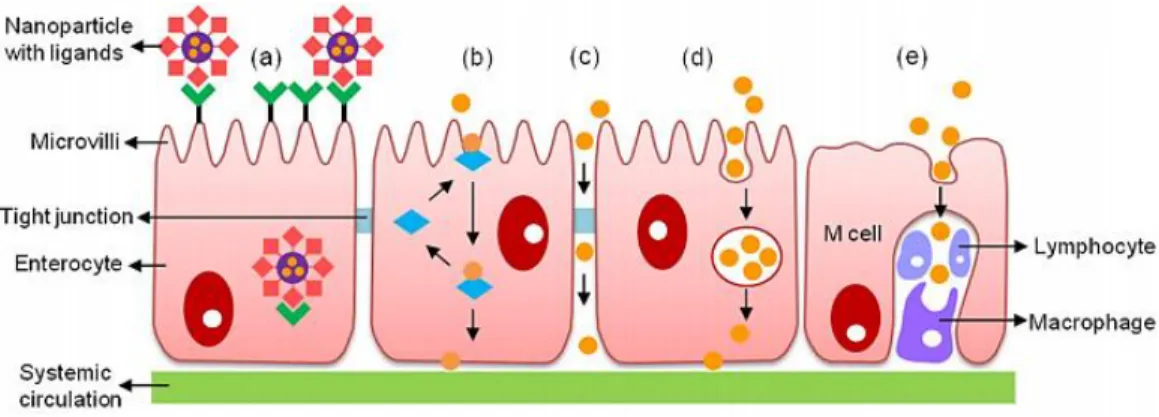
After cross the mucus layer, the molecules may cross the intestinal epithelium through several functional pathways in parallel: transcellular route, paracellular route, receptor-mediated transport, carrier-receptor-mediated transport and vesicular transport [21]. In Figure 4 is illustrated the different transport processes or absorption of a drug into the intestinal epithelium.
Figure 4 - Representative scheme of the transport mechanisms and pathways of a drug through the intestinal epithelium. (a) Receptor-mediated transport, (b) carrier-mediated transport, (c) Paracellular pathway, (d) Transcellular pathway, and (e) Vesicular Transport (uptake into the lymphatic circulation through M-cells Peyer's patches). (adapted from[21] ).
LITERATURE REVIEW
The process of absorption occurs mostly by passive diffusion. The diffusion of molecules can occur through transcellular or paracellular route.
The transcellular route involves the passage of the particles through the cells in a process named endocytosis (uptake in membrane-bound vesicles) at the apical membrane, whereas the paracellular pathway refers to the passage of molecules between adjacent cells, using the intracellular space. Only small hydrophilic molecules (molecular weight <100-200 daltons) are absorbed by paracellular pathway and due the presence of tight junctions between enterocytes this pathway represent about 0.01% of the total intestinal mucosa surface that contribute for transport [20,22] (see Figure 4|c-d).
The choice of the absorption or transport route for particular compound depends on its physicochemical characteristics such as molecular weight, stereochemistry, globular size, solubility and also the characteristics of the biological membrane [20]. Lipophilic and large compounds across the biological membrane mainly by the transcellular route whereas small hydrophilic compounds and peptides tend to cross the membrane by paracellular pathway [22]. Alternatively to passive diffusion, certain proteins and peptides are transported by specific carrier present in the intestinal epithelium (see Figure 4|b). The transport mediated by a carrier is an energy-dependent pathway characterized by the reversible reaction between the substance being transported and the transport protein of the membrane. The molecular cross the apical domain with subsequent passive diffusion into the basolateral space [20,21]. Nevertheless, some macromolecules across the transcellular barrier through receptor-mediated transport (see Figure 4|a). This pathway is characterized by an initial binding the ligand to a specific surface receptor, and a subsequent receptor clustering and internalization through coated vesicles into endosomal acidic compartments. In this transportation the molecular can act either as a receptor specific ligand for surface-attached receptors or as a receptor for surface-attached ligands [21].
Finally, M cells in the FAE have been explored as a route of transport (see Figure 4|e). They deliver proteins and peptides to the underlying lymphoid follicles for the induction of immune response, therefore M cells represent a potential route for proteins and peptides due to their high endocytosis ability [21].
Once absorbed, the drug can be deposited in the lymphatic vessels, moved through or entrapped in the lymph nodes or transferred to the blood [23].
CHAPTER 2
8
2.2. 3D environment
Many of the cell culture systems are performed in 2D conditions, such as tissue culture flasks, Petri dishes and micro-well plates because of the high cell viability, and convenience of use. These culture systems have remarkably improved the understanding of basic cell biology, but the disadvantages reside in the use of a 2D substrate [24]. For example, Kim, K. and collaborators demonstrated that hepatocytes, when isolated and plated onto 2D substrates, usually presents a loss of mature phenotypic character and functionality [25]. Literature has suggested and verified that the cells grown in 3D environment are more representative of what occurs naturally in vivo. In fact, the survival of cells inhabiting a 2D rigid substrate requires a drastic adaptation because of the lack of the unique extracellular matrix environment of each cell type.
In the human body, nearly all tissue inherently present a 3D architecture. The cells through complex physical and biochemical signals interact with the ECM, known as cell-ECM interaction, and with neighbouring cells, known as cell-cell interaction. These interactions provide a three-dimensional communication network that supports the specificity and homeostasis of the tissue, and they are essential to cell differentiation, proliferation and a range of other important cellular functions [4,6].
Two types of supporting structures have been emerged as possible forms for tissue engineering: the “solid” scaffolds, which are usually tridimensional microporous structures; and hydrogel-like matrices, which generally consist on cross-linked polymeric networks with high water contents [27].
During the past decades, artificial 3D matrices, that mimic the natural ECM, have become increasingly evident to overcome the gap between 2D cell culture and physiological tissue as they efficiently mimic in vivo situations and allow for cell–ECM interactions [28].
It is important to note that artificial 3D matrices can be divided into two areas of application: clinical and in vitro 3D modeling approaches. The clinical applications mainly consist of regenerative medicine or tissue engineering, with the objective of creating a functional implant using artificial 3D matrices [24].
The other application makes use of this type of matrices in the development of in vitro 3D model systems. Here, the aim is to perform basic research and drug development/screening, where the 3D environment will significantly improve the understanding of tissue physiology and pathophysiology. In the drug screening field, the use of 3D in vitro systems has been suggested as a potential link to bridge the gap between the monolayer cultures and in vivo animal model systems [4,9].
Although the 2D culture systems are still entrenched in the industry for most kind of cell-based toxicology and efficacy assays, the most recent developments and innovations demonstrate that the change from 2D to 3D cell culture for industrial purposes, as in drug research for example, is simply a question of time and 3D cell culture will surely become more applicable [29].
This review will initially present a brief description of the native extracellular matrix which has been a source of inspiration for the development of artificial matrices. A description of the
LITERATURE REVIEW
properties and characteristics of hydrogels which have been widely used as artificial cell niche to mimic extracellular matrix, is then presented.
Finally a brief report of 3D culture systems with hydrogel-like matrices is provided.
2.2.1. Native ECM
The extracellular matrix (ECM) is a nature’s ideal biologic tissue engineered scaffold or biomaterial for tissue morphogenesis, maintenance and regeneration [10,11]. The complex mixture of structural and functional molecules present in ECM provides a vital 3D structure and mechanical support to the tissues and organs [30].
The ECM also provides a means to the communication between cells and their external environment, and a support or conduit for different tissue and structures, such as nerves, lymphatics, blood vessels; and also control the diffusion of nutrients from the blood to the cells [11,12]. Therefore, the ECM plays an important role in the regulation of cell behavior, like cell migration, proliferation and orientation and it is also a reservoir for signalling biomolecules that modulate processes such as vasculogenesis, angiogenesis, immune responsiveness and inflammation [10,12].
The ECM has a complex and dynamic composition, which is unique for each tissue and organ because it depends on factors like location and the physiological requirements of each physiological structure. For example, organs rich in parenchymal cells, such as the kidney, have little ECM, in contrast with tissues that have primarily structural functions, such as ligaments and tendons. The ECM of the submucosa that resides subjacent to structures rich in epithelial cells, like the mucosa of the small intestine, is disposed to be well vascularized, contain essentially type I collagen and a diversity of growth factors including epidermal growth factor (EGF) and basic fibroblast growth factor (bFGF). Whereas, the ECM of the basement membrane that resides beneath to the hepatocytes of the liver, for example, is composed of different collections of proteins including, collagen type IV and laminin [30]. Nevertheless, all the ECMs share common features [30].
The ECM is a hydrated gel-like substance rich in anionic macromolecules such as polysaccharides in the form of glycosoaminoglycans and proteoglycans [32]. Glycosaminoglycans are important components that play a critical role in binding of growth factors and cytokines and water retention. Although the amounts of cytokines and growth factors present within ECM are small, these molecules act as potent modulators of cell behaviour [33]. Within the ECM there are also present fibrous proteins such as collagen and elastin that due to the architecture and kinematics tensile strength and elasticity, respectively [32]. The collagen is the most abundance fibrous proteins within the mammalian ECM. More than twenty types of collagen have been identified with different biologic function. The different concentrations of these kinds of fibers present in matrix provide distinct mechanical and physical properties to the ECM and an ideal environment for cell growth. [33].
Adhesive proteins are also components embedded in the network, such as laminin, fibronectin or vitronectin, which bind to receptor proteins (integrin, selectins, CD44 and
CHAPTER 2
10
Understanding the structure and general composition of the extracellular matrix is an important step in the development artificial 3D matrices [34].
2.2.2. Hydrogels in tissue engineering
Hydrogels are highly hydrated polymeric materials that possess a 3D structure. They are composed of cross-linked hydrophilic natural or synthetic polymer chains. The synthetic hydrogels include, for example, polylacyides/glycolides, polycaprolactone, polyhydroxyalkanoates, poly(propylene fumarates) and polyurethanes. Natural hydrogels, which are derived from plants, animals and microorganisms, include, collagen, fibrin/fibrinogen, proteins, elastin, alginate, chitosan, polysaccharides and hyaluronate [7,15].
Hydrogels can be formed with essentially any shape, size and form and the crosslinking of the polymer molecules can be achieved chemically or physically. Physically cross-linked hydrogels have H-bonding and hydrophobic forces while the chemical cross-liked are covalently bonded. These crosslinking reaction enables control of the structural integrity of hydrogels [36].
The native ECM is a hydrated gel-like substance, therefore biomaterials with hydrophilic chemistry are better choice to mimic aqueous in vivo environment. For this reason, the hydrogels, compliant and permeable structures, are one of the potential candidates to use as an artificial cell niche which resemble the native ECM [24]. Also the control of the hydrogel structure it is a critical advantage since it can improve the mechanical and biochemical properties of the hydrogels and to better mimic the native ECMs. In addition, several types of hydrogels can be cross-linked in situ under mild conditions and by using a variety of strategies, creating appropriate conditions for cell entrapment [35].
Over the last decade, the properties of hydrogels have made them attractive in different fields, as stem cell engineering, drug delivery, tissue engineering, cellular and molecular therapies, immunomodulation or cancer research. Nevertheless, most of these applications besides the mechanical and chemical properties, also require dynamic interactions between the surrounding matrices and the cells, providing cell compatibility [37]. Furthermore, the cell adhesion is a key factor for survival of most cell types in a tridimensional behavior and the poor cell adhesion due to the hydrophilicity of hydrogels and the lack of cell binding motifs is a drawback. To overcome these limitations some strategies have been set to improve the biological attributes of hydrogels. For example conjugating cell-binding motifs like arginine-glycine-aspartate (hereafter abbreviated as RGD) on polymer chains or coating surfaces with bioactive materials post-fabrication [24]. These techniques can be used to promote cell anchorage and interaction with the hydrogematrix.
2.2.2.1. Alginate hydrogel
Alginates are natural polysaccharides derived primarily from brown seaweed and bacteria, and is of particular interest for a wide range of applications as biomaterials due to their excellent properties in terms of biocompatibility, biodegradability, non-antigenicity, among
LITERATURE REVIEW
others [5]. Alginates have been used in particular as artificial extracellular matrix and/or in controlled delivery system for bioactive molecules and cells for tissue repair and regeneration. Alginates form viscous aqueous solutions with rheological properties that depend on the molecular weight and the concentration of the biopolymer [3,18].
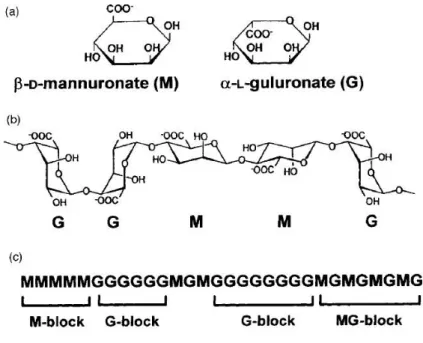
From a molecular perspective, alginate is presented as a copolymer composed by two types of monomers along the polymer backbone: β-D-mannuronic acid (M) and the α-L-guluronic (G) residues, bonded by 1→4 glyosidic linkages. The proposition and sequence of these residues are variable and can be continuously arranged to give homopolymeric blocks (MM or GG), or alternately, yielding heteropolymeric MG blocks as shown in Figure 5Figure 5. The composition, sequence and size of the different blocks, and the molecular weight of the polymer are critical factors that affect the physical properties of alginate and their hydrogels [18,19].
Figure 5 - Structural characteristics of alginates: A| alginate monomers; B| chain conformation; C| block distribution. (adapted from [39]).
In the presence of divalent ions, the alginate solution is ionically cross-linked between chains to form hydrogels. These ionic-crosslinking is the most common method to prepare alginate hydrogels, although others methods are employed including, phase transition (thermal gelation), cell-crosslinking, free radical polymerization and “click” reaction [5].
The process of ionic gelation of alginate solutions is related to their affinity for certain divalent ions, especially calcium ions, and the ability to establish selective links forming thermostable and insoluble gels. The selectivity of these ions is related to the ratio of G consecutive blocks, which contributes to the structural conformation acquired by diaxial link between G residues, as well as the presence of carboxyl groups in the polymer chain of each residue [39].
The alginate hydrogel formation in the presence of calcium ions is conventionally explained by the egg-box model as shown Figure 6, under which the bivalent calcium ions interact with
CHAPTER 2
12
the carboxyl groups of the polymer G residues in adjacent chairs through ionic cross-links, resulting in a three-dimensional polymer network [39].
Figure 6 - The egg-box model for binding of divalent ions to homopolymeric G-blocks. (adapted from [35,39]).
In the literature, essentially two different methods for the preparation of alginate hydrogels by ionic cross-links are described: external gelation or diffusion setting and internal gelation. The external gelation is characterized by a rapid gelation process, in which calcium ions are added to an alginate solution in the form of a soluble salt such as calcium chloride (CaCl2). There is an instantaneous gelation of the polymer at the contact interface with the ionized calcium ions. The gelation process continues with the diffusion of calcium ions through the gelled membrane formed. This method generally yields heterogeneous gels, which haves a higher polymer concentration at surface in relation to the core [19,20].
To achieve a homogeneous distribution of the alginate in the hydrogel, it becomes necessary to control the crosslinking velocity, as slow gelation yields a more uniform structure and a higher mechanical integrity. This can be achieved through an internal gelation method that is based on the use of an inactive source of calcium, for example, calcium carbonate (CaCO3) or calcium sulphate (CaSO4). The release of calcium ions is generally controlled by pH decrease caused by the addition of slow hydrolysis molecules such as glucone-δ-lactone (GDL). Figure 7 presents schematic diagrams of the both gelation process [40].
Figure 7 - Schematic diagram of external and internal gelation of alginate. (adapted from [39]).
LITERATURE REVIEW
2.2.3. 3D cell-based models
The different types of existing in vitro cell models have different degree of complexities at the level of cellular organization and behavior, providing different in vivo relevant information. The cells can be grown from simple models to complex organotypic models that are capable to reproduce the relevant functions of a tissue or organ system. Organotypic cultures are an in vitro model that often involve two or more types of cultured cells to represent in vivo-like cell heterogeneity [21,22].
These models are based on primary, immortalized or stem cell line and can use supporting matrices that allow simulating the composition of native extracellular matrix to mimic tissue or organ cultures (see Figure 8) [41]. In fact, for a long period of time, biomaterial studies have focused on single cells models. However, along the past few years, the use of supporting biomaterial in organotypic models show that systems better model the natural tissues, biologically and physically, through the interactions between different cell types that facilitate viability, differentiation as well as generating proteins and growth factors [26].
In the literature it has been reported different 3D culture models, including specific models for single organs, which have been established to study different systems, such as the nervous system, the skin, the liver, the respiratory system, the intestine and the heart, among others. However, here only intestinal 3D culture models will be described in more detail.
Figure 8 - - In vitro cell models. A| Examples of organotypic culture: artificial skin and co-culture on Transwell® inserts; B| 3-D cell culture in a supporting matrix. Adapted from [41]).
2.2.3.1. Intestinal epithelium models
Currently there is a considerable interest in the pharmaceutical industry in the development of in vitro human small intestinal models in order to evaluate strategies for investigating and/or enhancing the absorption of drugs. Although the conventional 2D cell system present some advantages, a significant progress has been made in the development of new 3D culture models of small intestine epithelium by using microfabrication, biomaterials, microfluidics and tissue engineering principles, in the past five years [43].
With the development of biomaterial fabrication techniques it began to be possible to replace the planar membrane where the cells were traditionally seeded by more advanced
bio-CHAPTER 2
14
intestinal villi. As a result, Wang, Li and collaborators developed a biomimetic intestinal culture system composed by a collagen membrane substrate with a human small intestine crypt-like topography that was coating with ECM proteins (laminin or fibronectin). Enterocyte-like cells were seeded on top of the collagen membrane, and cultures for 21 days (Figure 9). This study showed that the crypt-like topography might affect tight junctions of the Caco-2 monolayer in a short term, and that the effects on phenotype of intestinal epithelial cells are gradually diminished with prolonged time of culture [44].
Figure 9 - Schematic illustration of intestinal epithelial culture system in a collagen membrane. A| 3D system with a collagen membrane and B| Back view of collagen membrane. (Adapted from [44]).
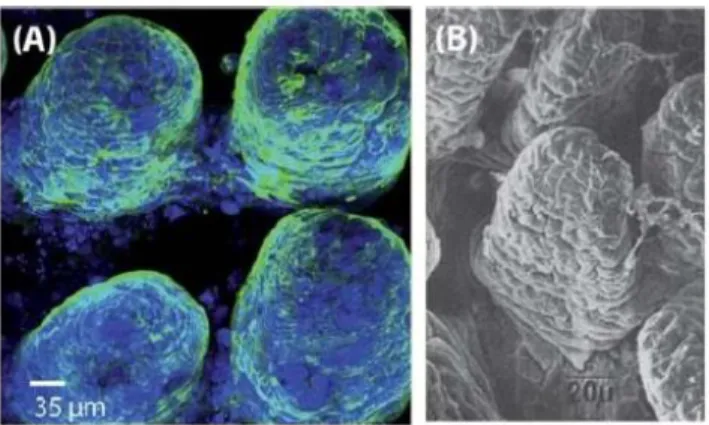
In another study, it was recently demonstrated that combination of laser ablation and sacrificial molding techniques can be used to develop a collagen hydrogel structure mimicking the density and size of the human jejunal villi. Enterocyte-like cells (Caco-2 cells) were seeded onto the structure and cultured for 3 weeks. As shown in Figure 10, remarkable similarities are observed between Caco-2 cells on collagen scaffold and the human jejunal villi. The cells were able to proliferate, invaded and covered the collagen villi. This method of microfabricated hydrogels offers several advantages and is a promising method for the construction of in vitro tissue models [45].
Figure 10 - A| Confocal microscope image of Caco-2 cells on collagen scaffold, after staining for actin (green) and nucleic acid (blue). B| SEM image of human jejuna villi. (Adapted from [45]).
Latter, the same group developed a well-plate insert in order to simulate the villi space at 25 villi/mm2 based on the existing insert and this way facilitate the commercialization (see
Figure 11) [46]. The enterocyte-like cells seeded on top of the collagen villous exhibited
LITERATURE REVIEW
polarized and columnar than cells presents near the bottom of the villus, correlating with the process of differentiation that is observed in vivo in human intestinal epithelium [35,36].
Figure 11 - Schematic illustration of the insert design. (Adapted from [46]).
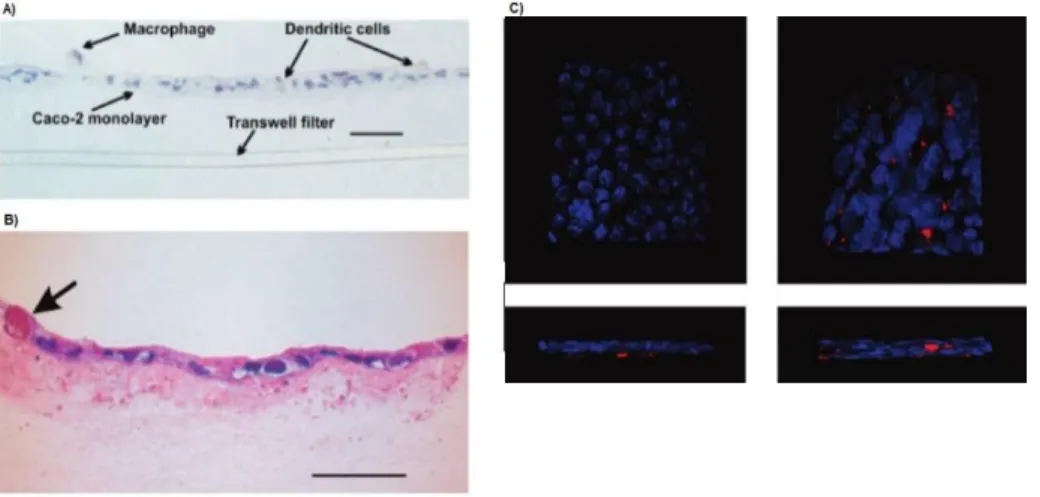
The intestinal epithelium has an important function not only in the absorption process, but also in in inflammatory response. To study intestinal inflammatory process, another type of 3D model was developed by Leonard and collaborators, consisting in a monolayer of enterocyte-like cells (Caco-2) overlying a collagen matrix containing immune components (dendritic cells and macrophages) (see Figure 12) [47].
Figure 12 - Schematic illustration of the 3D cell culture system. (Adapted from [47]).
The results of this study show that cultivation of macrophages and dendritic cells together with the epithelial cells, over 21 days, allows the differentiation of these cells toward the phenotype intestine-like characteristic.
Regarding the epithelial cells, even in the presence of immune cells, 3 weeks of culture is necessary for the monolayer formation and the results show a similar developed of tight junction in compare to the Caco-2 monolayer. When occurs the stimulation with addition cytokine IL-1β, the TEER value decreased, however, after removal stimulation, the TERR value increased gradually and recovered after 7days.
CHAPTER 2
16
monolayer model. This increase of pro-inflammatory activity can reflected the activity of the dendritic cells and macrophages. To support this ideas, was observed by histological cut and by confocal laser scanning microscopy image, an increased invasion of immune cells to the apical side in inflamed model in comparison to healthy model (see Figure 13).
Although the collagen matrix does not present the typical villi-like topography of the small intestine, the incorporation of macrophages and dendritic cells in the collagen matrix makes this 3D cell culture model a power in vitro tool for studying inflammatory bowel disease [47].
Figure 13 - A| Monolayer of Caco-2 cells on top of the collagen layer with the nucleus in blue. Hematoxylin Staining B| The collagen layer contained the immuno cells (macrophages and dendritic cells colored red) and this cells were also found into the cell monolayer or on top of it. Acid phosphatase Staining. C| Confocal laser scanning microscopy image of 3D culture, detected the immuno cells through the intestinal epithelium cells (blue), from their auto fluorescence (red), but can not be distinguished. (Adapted from [47]).
Chapter 3
- Materials and Methods
3.1. Materials
Six grades of sodium alginate from several algal sources were purchased from ISP industries, U.S.A. and Germany; and Sigma-Aldrich, Canada. These can be classified into three main groups according to their molecular weights, and content in acid Mannuronic (M-rich) or acid guluronic (G-rich).
The M-rich alginates used were Manucol LD, Keltone (LV and HV); while the G-rich alginates used were Manugel (LBA and DMB) and Alginic acid sodium. Some physic-chemical properties of the different types of alginate used in this study are described in Table 1.
For the cell culture experiments an ultrapure alginate M-rich (Pronova UPLVM) purchased from NovaMatrix was used. Some of its physic-chemical properties are described in Table 2.
Sodium chloride (NaCl) was purchased from Merck ®, while calcium carbonate (CaCO3) was purchased from Fluka®. Tris(hydroxymethyl)aminomethane (Tris) was purchased from AmResco®.
Calcium chloride (CaCl2), D-glucono-d-lactone (GDL), 1-ethyl-(dimethylaminopropyl)-carbodiimide (EDC), MES and HEPES buffer salt, Hydroxylamine, PolyHEMA were purchased from Sigma. N-Hydroxy-sulfosuccinimide (Sulfo-NHS) was purchased from Thermo Scientific. Peptide (glycine)4–arginine–glycine–aspartic acid–serine–proline (RGD) was purchased from Genscript. Dialysis Tubing (MWCO 3500 membrane) was purchased from Fisher.
Dulbecco’s Modified Eagle’s Medium (DMEM) was purchased from Lonza. Non-essential aminoacids (NEAA) was purchased from Biochrom. Trypan Blue, 0.05% Tripsin/EDTA, Hanks Balanced Salt Solution (HBSS), DMEM without phenol red were purchased from Gibco®, while Fetal Bovine Serum (FBS) and Penicillin/Streptomycin were purchased from BioWest. 24-well Transwell® permeable support (PET membrane and 3μm pore size) were purchased from BD Biosciences. Ethylenediamine tetraacetic acid (EDTA), Resazurin, Bovine Insulin, Triton X-100, DAPI, FluoroshieldTM mounting medium, picrosirius red and Propidium Iodide (PI) were purchased from Sigma.
Calcein-AM was purchased from Invitrogen. Anti-human vimentin antibody was purchased from Santa Cruz Biotecnology. PerCP-CyTM5.5 mouse anti -human Alkaline Phosphatase antibody was purchased from BD Pharmingen. Rabbit anti-fibronectin polyclonal antibody was purchased from Sigma. Donkey mouse AlexaFluor 488, AlexaFluor 594 F(ab’)2 fragment of goat
anti-CHAPTER 2
18
Table 1- Physicochemical properties of each type of alginate, as provided by the manufactures [48]–[52].
Table 2 - Physicochemical properties of PRONOVA UPLVM alginate, as provided by the manufacture [53].
3.2. Alginate characterization
3.2.1. Determination of moisture content
The moisture content of different types of alginate were determined by freeze-drying and infrared radiation.
For the freeze-drying, the different sodium alginate powders were weighed and dissolved in 50 mL of deionized water at room temperature (RT) to form aqueous solutions with a concentration of 1% (w/v). Then, 25 mL of each solution were transferred to previously weighted falcon tubes, which were then frozen at -80 °C for 24 hours in a Forma 900 serie ultrafreezer (Thermo Scientific; U.S.A.). After the freezing process, the samples were lyophilized by using Freezone6 freeze dry system (Labconco, U.S.A.). During freeze-drying, the temperature was kept at -55 °C and the process lasted about 72 hours. After freeze-drying, the falcon tubes were rigorously weighed, and by the difference in weight it was possible to determine the moisture content for each type of alginate.
Regarding infrared radiation technique, 1 gram of each alginate powder were weighed by using AND MX-50 moisture balance (A&D Company, Limited; Japan). This type of balance has
Alginate Type Viscosity 1% (mPa.s) Content (%) M/G Ratio Designation Mannuronic acid) Guluronic acid Low Molecular weight Manugel LBA 3-4 37 63 0,59 LMW-G Manucol LD 10 60 40 1,50 LMW-M Medium Molecular weight Keltone LV 50 60 40 1,50 MMW-M Alginic acid sodium Low (250 a 2%) 39 61 0,64 MMW-G High Molecular weight Manugel DMB 300 37 63 0,59 HMW-G Keltone HV 400 60 40 1,50 HMW-M
Alginate Type Apparent Viscosity
(mPa.s) PH
Content (%)
Designation Mannuronic
acid Dry matter
PRONOVA
MATERIALS AND METHODS
an infrared radiation that penetrates the sample and is converted in heat molecular vibration and the water content in the sample is eliminated by evaporation.
Therefore, the difference in weights, the weight before and after radiation, allows to determine the percentage of humidity present in the alginate samples.
3.2.2. Formation of alginate hydrogel matrix
The alginate hydrogel matrices were prepared by internal gelation as previously described [15,34]. A 1%, 2% and 3% (w/v) alginate final concentration was defined for the rheometry experiments. Sodium alginate powder was weighed and dissolved in 0.9% (w/w) NaCl, at RT, to form aqueous solutions with initial concentration of 2%, 3% and 4% (w/v), respectively. CaCO3 in combination with GDL was used as source of calcium ions to initiate internal gelation.
The quantity of Ca2+, and consequently the CaCO3, required for the alginate solution gelation was determined taking into account the number of carboxyl groups (COO-) present on consecutive G residues. The Ca2+/COO- molar ratios of 0.288; 0.5; 0.65 and 0.75 were tested for all types of alginates and for the three concentrations defined. The molar ratio of CaCO3/GDL was set at 0.125.
Calcium carbonate aqueous suspension (prepared in 0.9% (w/w) NaCl) was added to sodium alginate solutions, mixed and vortexed until homogenization. The gelling process was triggered by adding a fresh aqueous solution GDL, prepared by dissolving in 0.9% (w/w) NaCl. Then, 80μL/disc of the hydrogel precursor solution were transferred to QGel casters to form circular discs. Gel formation continued in incubator at 37 ºC under a 5%CO2 humidified atmosphere for 1h. Thereafter, the hydrogels discs were transferred into a 24-well-plate containing 500μL of pre-warmed culture medium (DMEM with HEPES buffer), for 1h. The medium was subsequently replaced for fresh medium.
For the 3D culture studies, hydrogels loaded with cells were prepared with previously combined the cells with the hydrogel precursor solution before triggering gelation, as described in Section 3.3.2.
In Figure 14, a similar procedure is schematized, used, in this case, to prepare polyethylene glycol (PEG) hydrogels.
CHAPTER 2
20
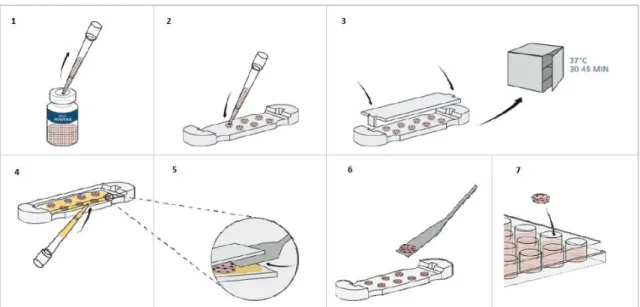
Figure 14 - Preparation of PEG hydrogels in a QGel caster: 1-2| a prefined volume of the hydrogel precursor solution is transferred to the gel caster; 3| the gel caster is carefully closed and placed in an incubator at 37ºC in a humid atmosphere for 1h; 4-5|culture medium is applied around the discs and then the top of the gel caster is slowly withdrawn; 6-7| PEG discs are carefully transferred into a well-plate containing pre-warmed culture medium (adapted from [55]).
3.2.3. Rheometry experimental set
In order to understand the influence of different molecular weights and the ratio of G vs. M groups on the properties of alginate hydrogels, oscillation rheometry experiments were carried out using a Kinexus Pro rheometer (Malvern Instruments, Malven, U.K.).
For the alginate hydrogels assessment, the parallel plates geometry was used, and the alginate samples with a diameter of 4mm were previously punched from the original discs to fit the geometry. The height of the gels was measured with a caliper. This step is necessary to establish the distance of the plates (top and bottom geometry), which is defined according to the height of the disc with a compression of 10% to avoid slippage.
All measurements were performed at 37ºC and in humid environment. Stress sweeps, at a frequency of 0.1Hz were first performed, for all the tested conditions, to determine the linear viscoelastic region (LVR), where the dynamic storage modulus (G') and loss modulus (G") are independent of the strain amplitude. Frequency sweeps, at a frequency of 0.01-10Hz were then performed within the LVR. The values of the storage modulus, G', viscosity modulus, G", and the phase angle, δ, for all the conditions presented in Figure 18 were obtained at frequency at ranging 0.05-0.4Hz. Samples were analyzed in triplicate.
3.2.4. Degree of swelling
The swelling ratio of alginate hydrogels, was calculated as described in [56]. Immediately after crosslinking, the alginate hydrogels, for all concentrations with Ca2+/COO- molar ratios of 0.5, were placed in culture medium (DMEM with HEPES buffer) at 37ºC for 1h, freeze-dried in BenchTop Pro (SP Scientific; U.S.A.) and weight.
MATERIALS AND METHODS
Assuming that the matrices swells uniformly in all directions, the swelling ratio can be defined as a ratio of the weight of swollen hydrogel to the weight of dry hydrogel. Therefore the swelling ratio (qF) was calculated from the following equation:
qF=
mass of gel after 1h incubation
mass of gel after freeze−drying, (1)
3.2.5. Chemical modification of alginate with peptides
HMW-M alginate and Pronova UPLVM sodium alginates were chemical modified with the cell-adhesion peptide RGD, using carbodiimide chemistry as previously described [57],[58].
Sodium alginates solution (1% (w/v)) in MES buffer (0.1M MES, 0.3M NaCl) were prepared and stirred overnight (ON), at 4 ˚C. Thereafter, Sulfo-NHS and EDC were sequentially added to the solution at a molar ratio of 1:2 per gram of alginate, followed by RGD peptide (16.7mg per gram of alginate). Blank solution were prepared without the addition of RGD peptide. After stirring for 20h at RT, the reaction was quenched with hydroxylamine (18mg per gram alginate) and the non-reacted species were separated from the polymer by dialysis (MWCO 3500 membrane) against decreasing salt solution of deionized water and NaCl for 3 days, changing the solution 2-3 times per day.
After dialysis, activated charcoal (0.5g per gram alginate) was added to the modifier alginate solution and stirred for 1h. Then, the solution was centrifuged, for 1h, at 27000 rcf, at 25 ˚C and filtered off using a steriflip. The purified solution was lyophilized and the RGD-alginate was stored at -20 ˚C until used.
3.2.6. Quantification of peptide-modified alginate
The yield of the chemical modification of alginate with RGD peptide was quantified using the BCA Protein Assay, as previously described [59].
A solution (1% (w/v)) of peptide-grafted alginate in deionizer water was prepared. Also, a set of RGD solution at concentration ranging 0 to 1 mg/mL (dissolved in 1% (w/v) blank solution at concentration of 1%) were prepared to use as standards in order to set a calibration curve. Thereafter, the BCA reagent was added to the samples and incubated at 37 ˚C, for 30 minutes in the dark. After incubation, the absorbance was read at 540nm in a microplate reader (Biotek Synergy MX). The efficiency of the reaction and the amount of RGD grafted was calculated by using the standard curve and taking into account the amount of peptide added in the coupling reaction. All measurements were made in triplicate.

![Figure 7 - Schematic diagram of external and internal gelation of alginate. (adapted from [39]).](https://thumb-eu.123doks.com/thumbv2/123dok_br/16119871.1108807/32.893.112.737.775.1010/figure-schematic-diagram-external-internal-gelation-alginate-adapted.webp)
![Figure 11 - Schematic illustration of the insert design. (Adapted from [46]).](https://thumb-eu.123doks.com/thumbv2/123dok_br/16119871.1108807/35.893.308.653.183.438/figure-schematic-illustration-insert-design-adapted.webp)
![Table 1- Physicochemical properties of each type of alginate, as provided by the manufactures [48]–[52]](https://thumb-eu.123doks.com/thumbv2/123dok_br/16119871.1108807/38.893.108.749.139.467/table-physicochemical-properties-type-alginate-provided-manufactures.webp)